




Abstract
The rapid spread of English medium instruction (EMI) across the globe has led to a growing number of non-native lecturers teaching in English to student populations that are increasingly international. The aim of the present study was to investigate to what extent lecturers with slight or moderate Dutch accents or native British English accents are evaluated differently in terms of intelligibility, comprehensibility and attitudinal impressions by non-native and native English-speaking listeners. In an experiment, 189 Dutch listeners, 175 international non-native listeners and 158 native English listeners evaluated fragments recorded by moderately accented Dutch, slightly accented Dutch and native English speakers. Findings showed that the moderately non-native accented lecturers were evaluated more negatively than lecturers with slight or native accents by both Dutch and international non-native listeners, but not by native English listeners. This suggests that non-native listeners evaluate the accents of non-native lecturers according to native speaker pronunciation norms.
I Introduction
The last few decades have seen a rapid increase in English medium instruction (EMI) in countries where English is not the native language in both Asia (Macaro, Curle, Pun, An, & Dearden, 2018) and Europe (Coleman, 2006; Wächter, & Maiworm, 2014). This increase has led to a growing number of non-native lecturers teaching in English to international student populations, many of whom may also be non-native speakers of English.
Survey and interview-based studies in the area of EMI have shown that one of the challenges faced by non-native English lecturers is that they are judged against a native speaker pronunciation norm by both native students (de Figueiredo, 2011) and non-native students (Evans & Morrison, 2011), by administrators, and even by themselves (Zhang & Zhan, 2014). These studies have shown that non-native lecturers are expected to sound like native speakers of English and may be considered less suitable for their job if they do not. At the same time, it has been argued that the native speaker should no longer set the norm in international communication, because other speakers, such as highly proficient second language (L2) speakers, can also function as valid models (Cook, 1999; Davies, 2013). In line with this, it has been reasoned that non-native speakers do not need to aim for full adherence to native speaker pronunciation norms (Jenkins, 1998, 2000). This view is supported by a recent survey in an EMI context, which suggests that students in EMI do not necessarily expect their lecturers to be native speakers as long as they are knowledgeable, proficient and good teachers (Inbar-Lourie & Donitsa-Schmidt, 2020). However, to what extent non-native listeners indeed do or do not judge the English accents of non-native lecturers against native speaker norms has to date received scant research attention.
Accentedness research has shown that non-native speech can be assessed on a number of aspects: the message and the speaker. Earlier studies on non-native accentedness have distinguished two dimensions relating to the content of a message:
times/>intelligibility, which is ‘the extent to which an utterance is actually understood’; and
comprehensibility, which concerns ‘listeners’ perceptions of difficulty in understanding particular utterances’ (Munro & Derwing, 1995, p. 291).
Other studies have also included attitudinal evaluations of the speaker, such as perceived status and likeability (in a commercial context, see, for example, Nejjari, Gerritsen, van der Haagen & Korzilius, 2012). Intelligibility can be measured by asking listeners to (orthographically) transcribe words, phrases, or fragments which are subsequently assessed on accuracy (Munro & Derwing, 1995). Comprehensibility is measured by asking listeners to indicate the difficulty they have in understanding a passage on rating scales. Attitudinal evaluations are measured by asking listeners to indicate their opinions about aspects of the speaker (e.g. status, competence, intelligence), again, on rating scales (Giles & Billings, 2004).
Some experimental studies have shown that non-native lecturers may be evaluated negatively on the basis of their non-native pronunciation, rather than, or in addition to, their academic and didactic abilities. In a number of studies, students who did not have English as their native language have been found to evaluate non-native English lecturers less positively than native English lecturers both in terms of comprehensibility (in an EMI context, see, for example, Hendriks, van Meurs, & Hogervorst, 2016) and attitudinal evaluations, such as attributions of status (in a context of teaching English as a foreign language [EFL], see, for example, Buckingham, 2014; in an EFL teaching context, see, for example, Dalton-Puffer, Kaltenboeck, & Smit, 1997), likeability (Buckingham, 2014; Dalton-Puffer et al., 1997), competence (in an EMI context, see Hendriks, van Meurs, & Reimer, 2018) and, perhaps most importantly, teaching quality (Buckingham, 2014; Hendriks et al., 2018).
Previous research has suggested that in an EMI context, the effects of foreign accentedness may be particularly pertinent. Cargile (1997) found that Chinese-accented speakers were evaluated as less dynamic and having less status in a lecturing context versus a job interview context. In addition, Cargile showed that the Chinese-accented speaker was evaluated as less attractive than the American native speaker in the lecturing context, but as more attractive than the American native speaker in the job interview context. This indicates the importance of investigating the impact of accentedness in an EMI context. At the same time, there are reasons to think that a foreign accent may have less of an impact on students in EMI contexts than in ELF contexts, “where emphasis is on the language as the field of study” (Inbar-Lourie & Donitsa-Schmidt, 2020. p. 301). Students in EMI contexts can be regarded as users of English to a larger extent than EFL students, who are primarily learners of English. Therefore, EFL students may regard their teachers more as models of the English level they aspire to than EMI students, who may regard their teachers more as transmitters of subject knowledge. Consequently, EMI students may be less inclined to expect their teachers to sound like native speakers of English. Given the paucity of research in this area, this study aims to contribute more insights into the evaluation of non-native accentedness in EMI.
To date, some of the studies conducted in an educational context have investigated the effect of non-native accented lecturers on listeners who share their first language (L1) background with the lecturers (e.g. Dalton-Puffer et al., 1997; Hendriks et al., 2016), listeners with different L1 backgrounds (Hendriks et al., 2018), or native listeners (in an EMI context, see Gill, 1994; in an EMI context, see Rubin & Smith, 1990). Increasing mobility among students (OECD, 2016) means that EMI is aimed at all three of these listener groups. While studies in non-educational contexts suggest that these three groups may react differently to non-native accentedness, at least for intelligibility (in isolated non-related sentences, see Bent & Bradlow, 2003; in isolated non-related sentences, see Hayes-Harb, Smith, Bent, & Bradlow, 2008; in retellings of cartoon stories, see Munro, Derwing, & Morton, 2006; in isolated non-related sentences, see Stibbard & Lee, 2006; in isolated non-related sentences, see Wang, 2007), this has not yet been researched for EMI. The aim of the current study is therefore to investigate the effect of non-native English accented lecturers on non-native listeners who share an L1 with the lecturers, non-native listeners who do not share an L1 with the lecturers and native English listeners.
One of the main educational goals of EMI is transfer of knowledge, which makes comprehension of paramount importance. Studies investigating intelligibility of non-native English accented speakers from a variety of L1 backgrounds have demonstrated that non-native English is generally more difficult to understand for both native and non-native listeners (which can be termed the ‘native speech intelligibility benefit’; in an EFL teaching context, see Major, Fitzmaurice, Bunta, & Balasubramanian, 2002, 2005), although other studies did not always find evidence for the native speech intelligibility benefit (in different contexts, including EMI, see Nejjari et al., 2012; Nejjari, Gerritsen, van Hout & Planken, 2020). However, non-native listeners have also been found to assess speakers with the same L1 background as easier to understand than native speakers (matched interlanguage speech intelligibility benefit; see, for example, Stibbard & Lee, 2006). In addition, studies have found that the matched interlanguage speech intelligibility benefit does not always apply (e.g. Hayes-Harb et al., 2008). As findings are conflicting, it is important to investigate these intelligibility effects for different listener groups in EMI.
Studies evaluating the effect of non-native accentedness do not always include different degrees of accentedness, but it has been shown that accent strength is an important factor in determining the comprehensibility of and evaluations of non-native-accented speakers. Generally speaking, the stronger the accent the more negative the evaluation (e.g. Dragojevic, Giles, Beck, & Tatum, 2017). In studies incorporating accent strength as a factor, different degrees of accent strength are commonly determined in pretests with expert judges and consolidated by manipulation checks in the main experiments.
For speakers with slight accents, intelligibility, comprehensibility and attitudinal evaluation tend to be similar to how native speakers are comprehended and evaluated. In an EMI teaching context, for instance, Hendriks et al. (2018) showed that moderately German-accented English speakers were evaluated as being less intelligible, less comprehensible, less competent, less likable and having less status and teaching quality than slightly German-accented speakers, who were evaluated similarly to native speakers. The impact of non-native accent strength has been examined in studies with native listeners (in an EMI context, see, for example, Cargile & Giles, 1998; in a commercial context, see Nejjari et al., 2012), studies with non-native listeners who had the same L1 background as the speaker (in an EMI context, see, for example, Hendriks et al., 2016; in an EMI context, see Roessel, Schoel, Zimmermann, & Stahlberg, 2019), studies with non-native listeners who had a different L1 background than the speaker (in a commercial context, see, for example, Hendriks, van Meurs, & de Groot, 2017; in an EMI context, see Hendriks et al., 2018), but studies including all three listeners groups have only investigated the impact of accent strength for intelligibility (in isolated sentences, see, for example, Stibbard & Lee, 2006) and not for speaker evaluations.
On the basis of the considerations discussed above, the current study aims to answer the following research question:
Research question 1: To what extent does accent strength (moderate Dutch English, slight Dutch English, native English) affect non-native (Dutch and non-Dutch international) listeners’ and native English-speaking listeners’ evaluations of lecturers in terms of intelligibility and attitudes (comprehensibility, perceived likeability, status, competence, and teaching quality)?
Research has shown that comprehensibility can act as a mediator between foreign accent strength and speaker evaluation in influencing speaker evaluations in terms of status attributions (for short stories, Dragojevic et al., 2017) and as a mediator between foreign accent strength and hirability via speaker evaluation (in an EMI context, see Roessel et al., 2019). For an EMI context, this could mean that comprehensibility could act as a mediator between foreign accent strength and teaching quality, which is probably one of the main factors in determining the effectiveness of EMI lecturers. The current study, therefore, aims to answer the following research question:
Research question 2: To what extent does comprehensibility mediate the effect of foreign accent strength on teaching quality for non-native (Dutch and non-Dutch international) listeners and native English-speaking listeners?
In addition to these research questions, there are other issues that bear on the impact of foreign accent strength in EMI. In relation to the impact of accent strength, to date it is unclear to what extent non-native English listeners are able to distinguish different degrees of non-native accentedness. Earlier studies have shown conflicting results in this respect (in a commercial context, see, for example, Hendriks et al., 2017; in an EMI context, see Hendriks et al., 2018). In Hendriks et al. (2017), French, German and Spanish listeners were able to distinguish between a strong Dutch accent and a native English accent, but not between a slight Dutch accent and a strong Dutch accent, nor between a slight Dutch accent and a native English accent in a commercial context. In Hendriks et al. (2018), Dutch and German listeners distinguished between native English accents and moderate non-native, slight non-native accents in both Dutch- and German-accented English in an EMI context. In other words, some non-native listeners were able to differentiate between slight, moderate and native accents, while others were not. In view of these conflicting results, the current study aims to shed more light on non-native listeners’ ability to distinguish different degrees of foreign accentedness by investigating this for non-native listeners who share and do not share an L1 background with the speaker.
Another relevant issue is non-native listeners’ ability to identify the L1 background of non-native speakers based on their accents in English (or other foreign languages). In general, speakers’ accents serve as cues for listeners in identifying the speakers’ origin (Purnell, Idsardi, & Baugh, 1999). On the basis of the identity they ascribe to speakers resulting from the accent cues, listeners may attribute particular traits to these speakers, based on stereotypes they have about the nationality to which they think the speakers belong (DuBois, 2018; Kristiansen, 2001). This may influence the attitudes they have towards the speakers (linguistic stereotyping; see Bradac, Cargile, & Hallett, 2001), and such attitudes may even affect the extent to which they find the speakers comprehensible (Lindemann, 2002).
If listeners identify speakers as having the same linguistic background as themselves, two effects may occur. On the one hand, listeners may evaluate such speakers positively, because they belong to the same in-group (Tajfel, 2010). On the other hand, listeners may judge them negatively because of the vicarious shame they experience upon hearing a clearly noticeable foreign accent in the English of their compatriots (Hendriks et al., 2018; Schmader & Lickel, 2006). In fact, earlier research has found both effects in European non-native listeners’ evaluations of the pronunciation of non-native accented speakers in English. In a survey, Van den Doel and Quené (2013) showed that Greek and Polish listeners did not evaluate the pronunciation of their compatriots negatively, whereas Dutch listeners were quite critical about the pronunciation of Dutch speakers.
In an EMI context, these contradictory theories and findings imply that non-native lecturers may or may not be evaluated relatively more harshly by students with whom they share an L1 background. In the current study, specifically, an effect that may occur is that Dutch students evaluate Dutch lecturers more negatively than do non-native students with different linguistic backgrounds (see Van den Doel & Quené, 2013). However, such effects of shared L1 background depend on listeners recognizing speakers as having a particular linguistic background. Earlier EMI research found that non-native (Dutch and German) students were better, but by no means perfect, at identifying the origin of non-native accented lecturers with whom they shared a first language background than the origin of non-native accented lecturers with a different first language background (Hendriks, et al., 2018). Therefore, this study also measured the extent to which the listeners correctly identified the origin of the lecturers.
II Method
In an experiment, Dutch, international (non-Dutch) and native English listeners evaluated lecture fragments recorded by male speakers with three degrees of accentedness in English (moderate Dutch-accented / slight Dutch-accented / native British English).
1 Materials
The stimulus material of this study consisted of audio fragments of a lecture about a marketing-related topic. The audio fragments had three versions with different degrees of accentedness, i.e. a moderate Dutch accent in English, a slight Dutch accent in English and a native English accent. We chose to use a verbal guise technique (Garrett, 2010), which is a method in which the same text is recorded by different speakers. The advantage of this technique over authentic lecture fragments is that it enables researchers to tightly control factors other than accent strength, such as different content. We opted for a verbal rather than a matched guise technique (Lambert, Hodgson, Gardner & Fillenbaum, 1960), in which one and the same speaker produces all the different accent varieties under investigation, because there are very few speakers who can, convincingly, produce different non-native accent strengths in addition to a native accent (Dalton-Puffer et al., 1997; Garrett, 2010; Nejjari, Gerritsen, van Hout & Planken, 2019).
The fragments that were used for this experiment were materials from a study by Hendriks et al. (2016) that were pretested and evaluated by pronunciation experts. All fragments were evaluated by six expert judges on accent strength (moderate, slight, native), speech rate (slow–fast), voice quality (dynamism, pleasantness, naturalness), and speaker confidence (scales based on Bayard, Weatherall, Gallois, & Pittam, 2001; Jesney, 2004). The items used in the pretest can be found in Appendix 1. Three of the experts were native speakers of English. The other three experts were near-native Dutch lecturers of English. Two of the near-native lecturers had extensive experience in pronunciation training. On the basis of the expert evaluations, the speakers were divided into accent strength categories (moderate, slight, native). Subsequently, two speakers were selected for each of the accent strength categories on the basis of least differences on average scores for speech rate, voice quality, and speaker confidence. The text of the audio sample is presented in Appendix 2.
2 Participants
A total of 522 listeners took part in the study: 189 Dutch listeners (age: M = 24.49, SD = 4.89; range 19-67; 67.2% female; 51.3% BA degree; 48.7% MA degree) and 175 international (non-Dutch & non-native English) listeners (age: M = 25.11, SD = 4.18; range 18-48; 73.7% female; 45.1% BA degree; 54.9% MA degree) and 158 native English listeners (age: M = 27.55, SD = 9.03; range 18-66; 68.4% female; 58.2% BA degree; 41.8% MA degree). The international listeners had 44 different nationalities, the most frequent being German (25.1%), Spanish (10.9%), French (7.4%) and Italian (6.7%). 1 The native English listeners had 19 nationalities, the most frequent being British (47.8%), American (24.2%) and Australian (14.3%). Age (F (2, 518) < 1), gender (χ2(2) = 0.28, p = .869) educational level (χ2(2) = 1.80, p = .406), actual English proficiency (LexTALE) scores (F (2, 518 < 1), and self-assessed English proficiency (F (2, 518) = 1.04, p = .355) were equally distributed over the three conditions of accentedness.
Age was not distributed equally among participant groups (F (2, 518) = 10.83, p < .001 ηp2 = .04) and neither were self-assessed English proficiency (SAP) (F (2, 518) = 32.30, p < .001, ηp2 = .11) or actual proficiency as measured with the LexTALE test (F (2, 518) = 56.55, p < .001 ηp2 = .18; http://www.lextale.com). The Dutch listeners (M = 24.49, SD = 4.89) and the international listeners (M = 25.11, SD = 4.18) were significantly younger than the native English group (M = 27.55, SD = 9.03; Bonferroni corrections, all ps < .002). The Dutch and the international listeners did not differ in age. For both self-assessed proficiency and actual proficiency (LexTALE), the Dutch (SAP: M = 5.54, SD = 0.86, actual proficiency: M = 76.44%, SD = 11.85) and the international listeners (SAP: M = 5.76, SD = 0.95, actual proficiency: M = 76.28%, SD = 13.86) scored significantly lower than the native English listeners (SAP: M = 6.31, SD = 0.96, actual proficiency: M = 88.66%, SD = 11.64, Bonferroni corrections, all ps < .001). The Dutch listeners did not self-assess their proficiency significantly lower than did the international listeners (Bonferroni correction, p = .058), and did not score significantly differently on the actual proficiency (LexTALE) test (Bonferroni correction, p = 1.00). Lemhöfer and Broersma (2012) claim that a percentage between 60 and 80% is roughly equivalent to a B2 CEFR level, which can be characterized as upper intermediate.
There were no differences for the three groups of listeners with regard to distribution of gender (χ2(2) = 1.32, p = .516) or educational level (χ2(2) = 5.93, p = .052). The three groups of listeners differed with regard to how interested they were in the topic of the lecture fragments (F (2, 518) = 15.55, p < .001, ηp2 = .06). Both the Dutch listeners (M = 4.55, SD = 1.61) and the international listeners (M = 4.72, SD = 1.59) were significantly more interested in the topic than the native English listeners (M = 3.74, SD = 1.95; Bonferroni correction, both ps < .001). In addition, the three groups of listeners differed in how familiar they were with Dutch-accented English (F (2, 518) = 105.01, p <.001, ηp2 = .29). The native English listeners (M = 3.25, SD = 2.09) were less familiar with Dutch-accented English than the international listeners (M = 3.91, SD = 2.08), who were in turn less familiar with Dutch-accented English than the Dutch listeners (M = 5.89, SD = 1.09; Bonferroni corrections, all ps < .003).
When asked about their own accent strength, both Dutch listeners (M = 4.02, SD = 1.44) and international listeners (M = 3.81, SD = 1.48) indicated they had stronger foreign accents in their English than did native English listeners (M = 1.17, SD = 1.16; Bonferroni correction, both ps < .001; F (2, 518) = 144.07, p < .001, ηp2 = .36). The Dutch listeners did not differ significantly from the international listeners.
In the questionnaire, listeners were also asked to indicate which proportion of their degree programme was taught in English, i.e. to what extent they had experienced EMI. The native Dutch listeners (M = 56.52%, SD = 37.96) had significantly less experience with EMI than the international listeners (M = 76.19%, SD = 32.25). Not surprisingly, the native English listeners (M = 96.77%, SD = 12.92) indicated that almost their entire degree programme was taught in English (Bonferroni correction, all ps < .001, F (2, 518) = 76.70, p < .001, ηp2 = .23).
3 Design
The study had a 3 (accent: moderate Dutch, slight Dutch, native British) × 3 (listener nationality: Dutch, international, native English) between-participants verbal-guise experimental design.
4 Instruments
Listeners filled in an online questionnaire in which they evaluated one fragment on strength of foreign accent, identification of origin of the speaker, comprehensibility, attitudes towards the lecturer and perceived teaching quality of the lecturer.
Strength of foreign accent was measured with seven-point Likert scales anchored by ‘completely disagree – completely agree’ following the statements ‘This speaker sounds like a native speaker of English’ (reverse coded) and ‘This speaker has a strong foreign accent in English’ (based on Jesney, 2004). The reliability of the two items was good: α = .81.
Identification of origin of speaker was measured with the question ‘Which country do you think this speaker is from?’ followed by a drop-down list of 267 countries, from which listeners were asked to select one.
Comprehensibility was measured with the statements ‘I have to listen very carefully to be able to understand the lecturer’; ‘The lecturer speaks clearly’(reverse coded); ‘The lecturer is barely intelligible’; The lecturer is difficult to comprehend’; ‘I have problems understanding what the lecturer is talking about’ and ‘I do not understand what the lecturer means’, followed by seven-point Likert scales anchored by ‘completely disagree – completely agree’ (based on Hendriks et al., 2016). The reliability of the six items measuring comprehensibility of the speaker was good (α = .84).
Intelligibility of the lecturer was measured by asking respondents to fill in eight words that were gapped in four sentences of the fragment: (1) ‘relationship marketing’, (2) ‘maintaining’, (3) ‘profitable’, (4) ‘overemphasized’, (5) ‘benefits’, (6) ‘forge’, (7) ‘long term’ and (8) ‘existing’ (based on Nejjari et al., 2012). Intelligibility was calculated as the total number of correct words (with a total of eight). Words that were partly misspelled were counted as correct, e.g. ‘long-term’ instead of ‘long term’. Listeners did not receive points for incorrect words or for partly correct words e.g. ‘underestimated’ instead of ‘overemphasized’ or ‘relation management’ instead of ‘relationship marketing’.
Attitudes towards lecturer were measured with 18 seven-point Likert scales following the statement ‘In my opinion, this lecturer sounds’ anchored by ‘completely disagree – completely agree’ (scales based on Bayard et al., 2001; Hendriks et al., 2016; Nejjari et al., 2012; Tsalikis, DeShields, & LaTour, 1991). Status was measured with the items ‘authoritative’, ‘trustworthy’, ‘self-confident’, ‘influential’ and ‘has a powerful voice’ (α = .87). Competence was measured with the items ‘reliable’, ‘intelligent’, ‘competent’, ‘hardworking’ and ‘educated’ (α = .92). Likeability was measured with the items ‘credible’, ‘sympathetic’, ‘warm’, ‘humorous’, ‘tactful’, ‘polite’, ‘irritating’ (reverse coded) and ‘unfriendly’ (reverse coded) (α = .81).
Perceived teaching quality was measured with seven-point Likert scales introduced by the statement ‘In my opinion’ anchored by ‘completely disagree – completely agree’ (based on Hellekjaer, 2010): ‘This lecturer’s subject knowledge is excellent’; ‘The lecturer can clearly communicate the content of the lecture’; ‘This lecturer is a good teacher’; ‘This lecturer contributes positively to the reputation of his college/university’ and ‘This lecturer has excellent didactic abilities’ (α = .92).
Background characteristics
Self-assessed proficiency level of English was measured with four seven-point Likert scales anchored by ‘very bad – very good’ (based on Krishna & Ahluwalia, 2008) following the statement ‘Please indicate how fluent your English is in the following areas: (1) speaking, (2) writing, (3) reading and (4) listening’ (α = .88).
Self-assessed accent strength was measured with two 7-point scales following the statements: ‘I sound like a native speaker of English’ (r), ‘I have a strong foreign accent in my English’, anchored by ‘ completely disagree – completely agree’ (α = .77).
Actual proficiency level of English was measured with the LexTALE proficiency test (http://www.lextale.com, Lemhöfer & Broersma, 2012). In this test, listeners are shown a list of 60 English words (40 existing words and 20 non-existing words) and are asked to indicate for each word whether it is an existing word or not, by clicking yes or no.
Topic interest was measured with one 7-point scale following the statement: ‘Please indicate how interesting the topic of the audio sample is to you’ and anchored by ‘not interesting – very interesting’.
Familiarity with Dutch accented English was measured with three 7-point scales following the statements: ‘I am familiar with Dutch-accented English’, ‘I often meet people who have a Dutch accent in their English’, ‘I regularly talk to people who have a Dutch accent in their English’ anchored by ‘completely disagree – completely agree’ (α = .95).
Language of degree programme was measured with a slider bar on which participants were asked to indicate the percentage of their degree programme that was English-taught (0%–100%).
At the end of the questionnaire, listeners were asked to fill in some personal details, such as age, gender, nationality, mother tongue, educational level and degree programme. In the questionnaire, the variables were presented in the following order: intelligibility, comprehensibility, attitudes, teaching quality, accent strength, origin, topic interest, familiarity with Dutch-accented English, self-assessed accent strength, language of degree programme, self-assessed proficiency in English, actual proficiency, demographic information. For all composite scales, composite means were calculated.
5 Procedure
The questionnaire was administered in English using the online survey tool Qualtrics. Listeners were approached via social media and email starting with the third author’s personal network. Part of the native English and international participants (18.6%) were recruited through a commercial platform (Qualtrics). Listeners were discarded if they were younger than 18, and were not studying for or did not have a university degree. Listeners read an introduction page with a consent form, in which they were asked to give their consent for their data to be used by clicking ‘I Agree’. Listeners were thanked for their participation. They were not informed about the actual purpose of the study. Listeners were randomly assigned to one of the six audio fragments. Completing the questionnaire took about 15 minutes.
III Results
The main purpose of this study was to investigate the effect of lecturers’ accent strength in English on Dutch and international and native English listeners’ perceptions of comprehensibility, actual intelligibility, and students’ attitudinal evaluations of lecturers. As we had selected two male speakers per degree of accentedness condition, we first carried out preliminary analyses to examine if there were significant differences between the two male speakers for each of the accentedness conditions on the measured variables in this study. Independent samples t-tests showed no significant differences between the two male speakers in any of the three accentedness conditions for any of the measured variables (all ps > .363). Subsequently, the two speakers for each degree of accentedness were merged into one accentedness category, i.e. ‘moderately accented’, ‘slightly accented’ or ‘native’.
1 Recognition accent strength: Manipulation check
As our main independent variable, accentedness, had been operationalized as having three conditions, moderately accented, slightly accented and native, the first step in the analysis of the data was to check if these three levels of accentedness in the stimuli were recognized by listeners as we had intended. A two-way ANOVA with accentedness and listener group as factors showed that listeners distinguished three levels of accentedness in the fragments (F(2, 513) = 222.08, p < .001, ηp2 = .46; for means and standard deviations, see Table 1). The moderately accented speakers were evaluated as having a stronger foreign accent (M = 5.00, SD = 1.60) than the slightly accented speakers (M = 2.60, SD = 1.44). The native speakers were evaluated as having the least strong foreign accent of all (M = 1.99, SD = 1.16; Bonferroni corrections, all ps < .001). Regardless of accentedness condition, the international listeners (M = 2.84, SD = 1.81) evaluated the accent strength of all speakers consistently weaker than the Dutch listeners (M = 3.56, SD = 2.01) and the native English listeners (M = 3.25, SD = 1.89; F(1, 513) = 7.71, p = .001, ηp2 = .03; Bonferroni corrections, all ps < .025)). The Dutch listeners did not differ in their evaluations of accent strength of the speakers from the native English listeners. The interaction between accentedness and listener group was not significant (F(2, 513) < 1).
Means, standard deviations and n for perceived accentedness in function of listener group and accent strength (1 = no foreign accent; 7 = strong foreign accent).
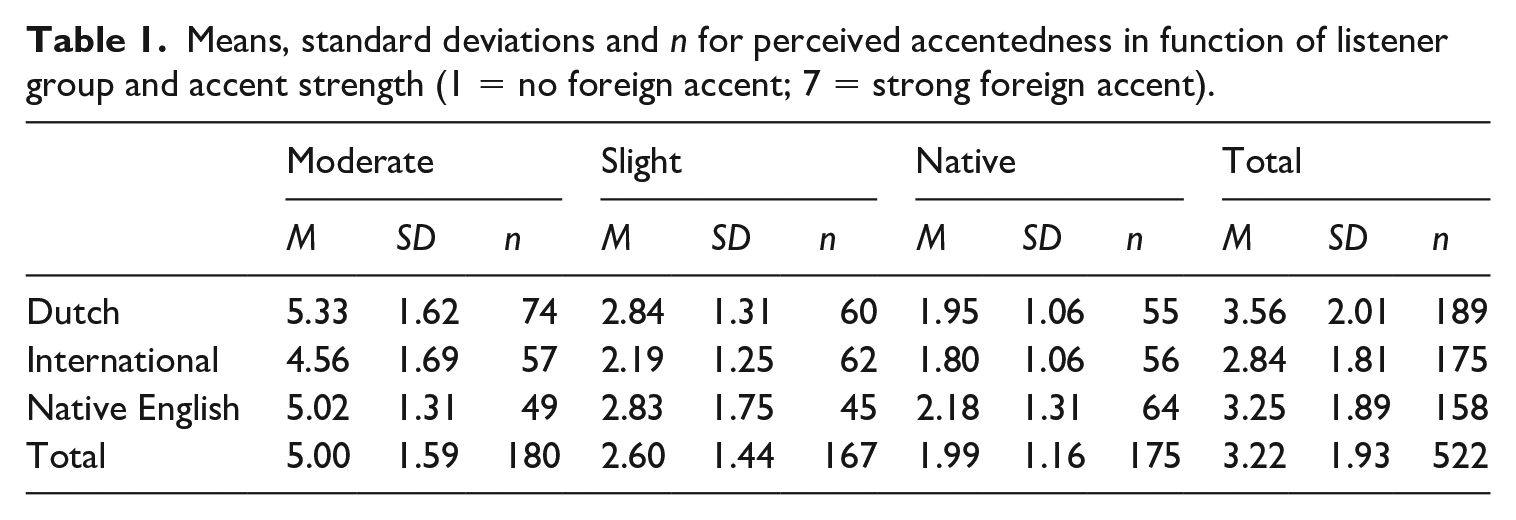
Based on the results of the manipulation check, it can be concluded that listeners differentiated between three accentedness levels (as intended) and that this applied to all three listener groups. Thus, the manipulation of accent strength in the experiment can be deemed successful.
2 Identification of origin of speaker
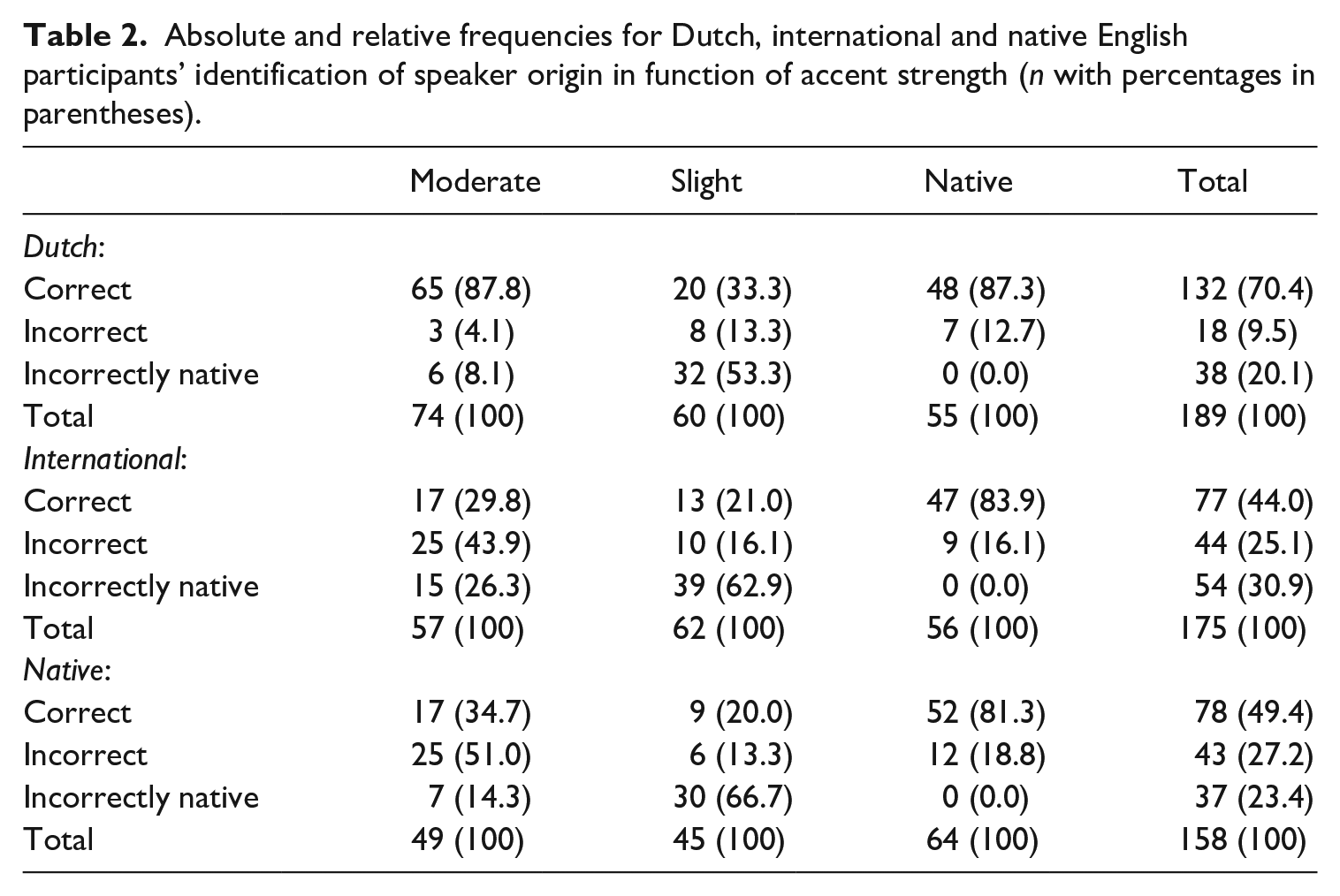
Extant research has shown that familiarity and recognition of a speaker’s country of origin can play a pivotal role in how speakers are evaluated. Therefore, listeners were also asked to identify the origin of the speakers. To examine if speakers in the three accentedness conditions were actually recognized as Dutch (for the moderate and slight conditions) or as native speakers of English (for the native condition), three chi-square analyses were carried out for Dutch, international and native English listeners to establish the relation between accentedness and correct identification of the speakers’ origin (Dutch: χ2 (4) = 69.57, p < .001, Cramer’s V = .43; International: χ2 (4) = 82.10, p < .001, Cramer’s V = .49; native English χ2 (4) = 68.89, p < .001, Cramer’s V = .52; see Table 2). The majority of Dutch listeners correctly identified the nationality of the moderately Dutch-accented speakers (87.8%) and of the native speakers of English (87.3%). However, only a third of the Dutch listeners correctly identified the slightly Dutch-accented speakers as Dutch (33.3%), whereas half incorrectly identified the slightly Dutch-accented speakers as originating from an English-speaking country (53.3%). The international listeners found it more difficult to correctly identify the nationality of the listeners, as only roughly a third correctly identified the moderately Dutch-accented speakers as Dutch (29.8%), and fewer still correctly identified the slightly Dutch-accented speakers as Dutch (21.0%). Slightly under two thirds incorrectly identified the slightly Dutch-accented speakers as being native English (62.9%). For these international listeners, too, the native speakers were relatively easy to identify (93.9%). The native English listeners also found it difficult to correctly identify the nationality of the moderately Dutch-accented speakers (34.7%) and even more difficult to correctly identify the slightly Dutch-accented speakers (20.0%), who were often incorrectly identified as native English (66.7%). The native English listeners had fewer problems recognizing the native speakers (81.3%) as native. To conclude, the native English speakers were identified as native by all listener groups, the moderately accented speakers were more readily identified as Dutch by the Dutch listeners than by the other listener groups, whereas the slightly accented speakers were more difficult to recognize by all listener groups. This means that for the native speakers, their nativeness can be expected to play a role in their evaluation and for the moderately accented Dutch speakers, their Dutchness can be expected to be particularly relevant for the Dutch listeners. For the slightly accented Dutch speakers, their Dutch origin can be expected to have less of an impact on listeners.
Absolute and relative frequencies for Dutch, international and native English participants’ identification of speaker origin in function of accent strength (n with percentages in parentheses).
3 Intelligibility
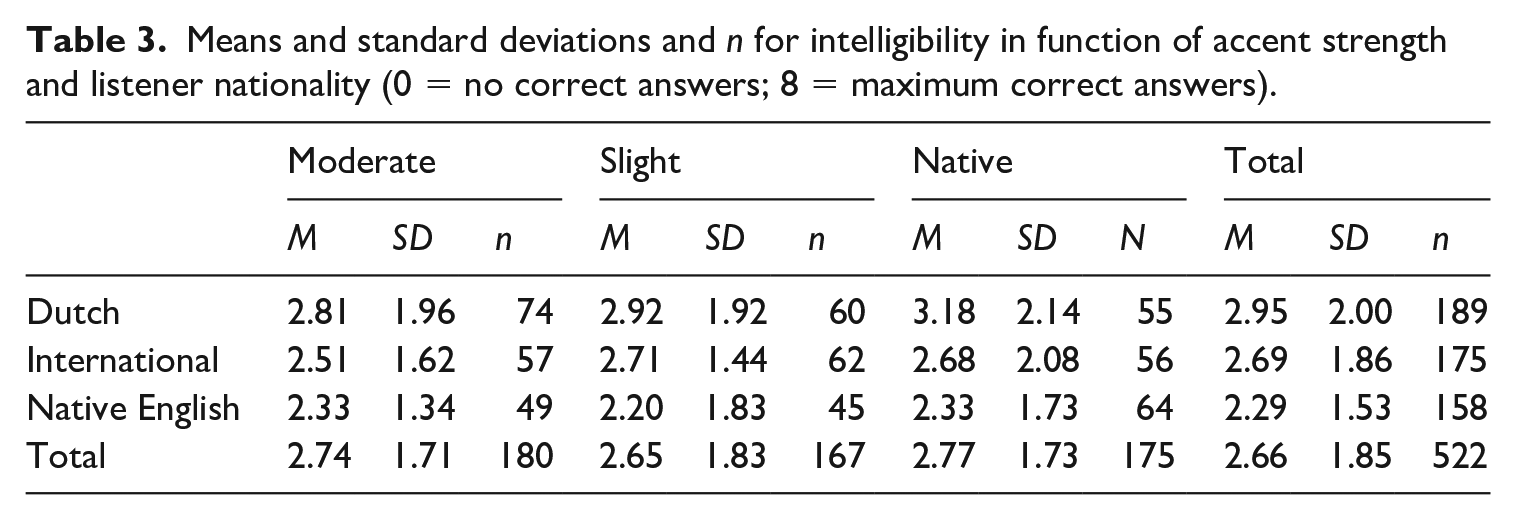
A univariate analysis for intelligibility with accent strength and listener nationality as factors showed no significant main effect for accentedness (F(2, 513) < 1), a significant main effect for listener nationality (F(2, 513) = 5.87, p = .003, ηp2 = . 02) and no significant interaction (F(4, 513) < 1). Regardless of accentedness, the Dutch listeners (M = 2.74, SD = 1.96) had higher scores for intelligibility than the native listeners (M = 2.33, SD = 1.34; Bonferroni correction, p = .003). The difference between the Dutch listeners and the international listeners, or between the international listeners and the native listeners was not significant (both ps > .141). To conclude, there were no differences in intelligibility of accentedness varieties for any of the listener groups, which means that any differences in evaluations of speakers were not caused by differences in comprehension. Means and standard deviations for intelligibility can be found in Table 3.
Means and standard deviations and n for intelligibility in function of accent strength and listener nationality (0 = no correct answers; 8 = maximum correct answers).
4 Attitudes towards lecturers
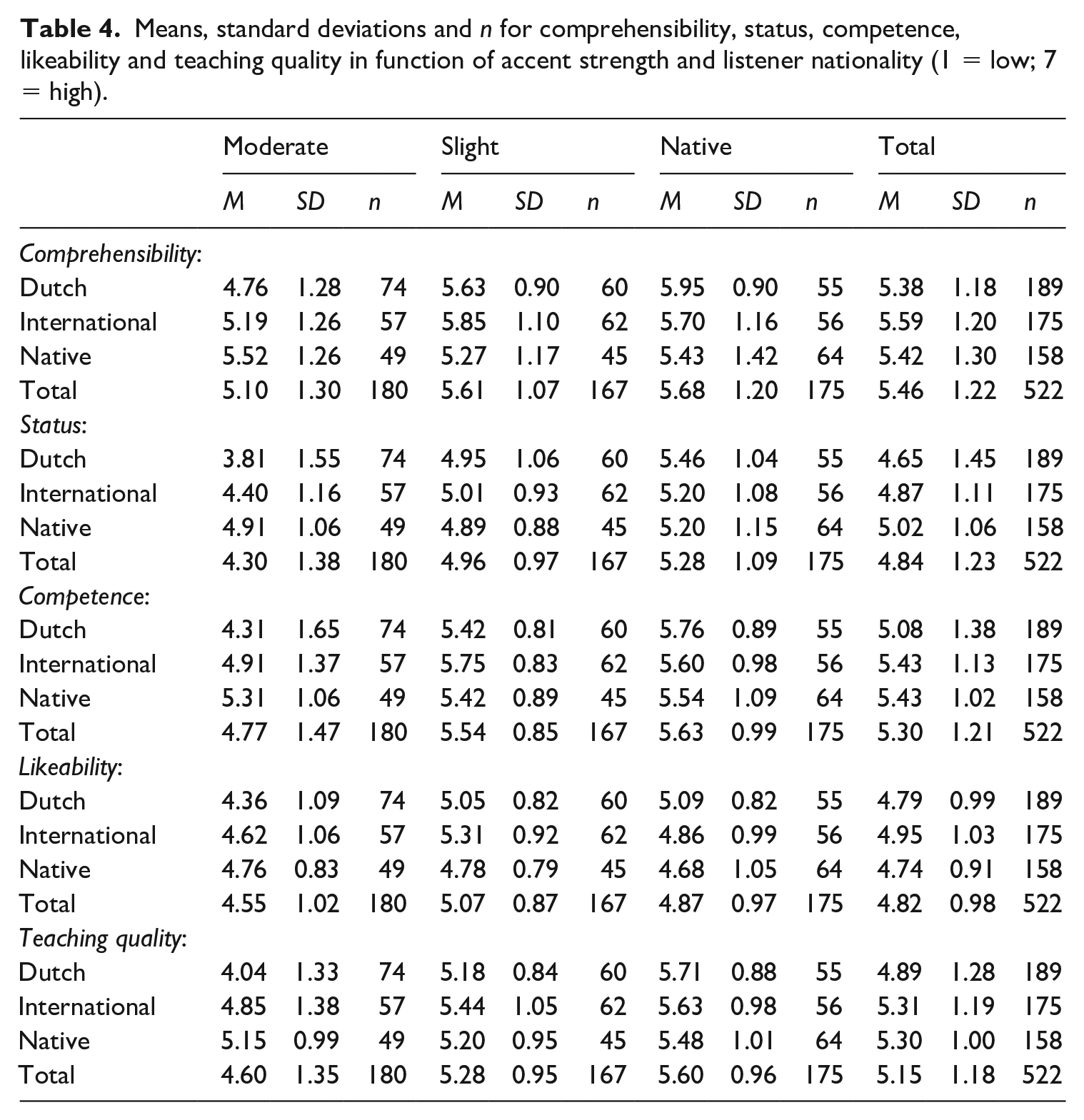
A two-way MANOVA for all measured variables (comprehensibility, status, competence, likeability and teaching quality) with accentedness and listener nationality as factors revealed multivariate main effects for accentedness (F(10, 1018) = 10.43, p < .001, ηp2 = .09) and listener nationality (F(10, 1018) = 3.15, p = .001, ηp2 = .03), and a significant interaction (F(20, 1689) = 2.18, p = .002, ηp2 = .02). Means and standard deviations are shown in Table 4.
Means, standard deviations and n for comprehensibility, status, competence, likeability and teaching quality in function of accent strength and listener nationality (1 = low; 7 = high).
The univariate analyses showed that the interactions were significant for all measured variables (comprehensibility, status, competence, likeability and teaching quality; all ps < .003). To investigate the interaction effect, separate MANOVAs were carried out for the three listener groups. The analyses revealed significant main effects of accentedness for the Dutch listeners (F(10, 364) = 9.29, p < .001, ηp2 = .20) and the international listeners (F(10, 336) = 4.34, p < .001, ηp2 = .11), but not for the native listeners (F(10, 302) = 1.23, p = .270).
The Dutch listeners evaluated the moderately accented speakers as significantly less comprehensible, less competent, less likeable and as having less status than the slightly accented and the native-accented speakers (Bonferroni corrections, all ps < .001), but the slightly accented speakers as similar to the native-accented speakers on comprehensibility, competence, likeability and status (Bonferroni corrections, all ps > .099). The evaluation of teaching quality showed a slightly different pattern. While the moderately accented speakers were again evaluated as having significantly less teaching quality than the slightly accented speakers, the slightly accented speakers were not evaluated as similar to the native-accented speakers, but as having less teaching quality than the native-accented speakers (Bonferroni corrections, all ps < .31).
The pattern for the international listeners was similar. These listeners evaluated the moderately accented speakers also as significantly less competent and as having less status and teaching quality than the slightly accented and native-accented speakers (Bonferroni corrections, all ps < .018), and the slightly accented speakers as similar to the native-accented speakers (Bonferroni corrections, all ps > .999). However, the slightly accented speakers were evaluated as more likeable (Bonferroni corrections, all ps < .044) than both the moderately accented and the native accented speakers, who were evaluated as equally likeable (p = .592). The international listeners evaluated the moderately accented speakers as less comprehensible than the slightly accented speakers (p = .008), but, surprisingly, also as equally comprehensible as the native speakers (p = .066), who were, in turn, evaluated similarly as the slightly accented speakers.
The native listeners differed from the other two groups in that they evaluated the three accent strengths similarly for comprehensibility, status, competence, likeability and teaching quality (all ps > .575). As we were also interested in differences between listener groups in their evaluations of the different accentedness conditions, separate MANOVAs were carried out for the three accentedness conditions. The analyses revealed significant main effects of listener group, mainly for the moderately accented lecturers (F(10, 346) = 3.48, p < .001, ηp2 = .09), less so for the slightly accented lecturers (F(10, 320) = 1.91, p < .043, ηp2 = .06), and not for the native accented lecturers (F(10, 336) = 1.12, p = .346).
For the moderately accented lecturers, there were differences between the listener groups for all measures except likeability. The Dutch listeners thought the moderately accented lecturers were less comprehensible and less competent than the native listeners but not than the international listeners. The Dutch listeners thought the lecturers had less status and less teaching quality than both the international listeners and the native listeners (Bonferroni corrections, all ps < .038). The international listeners did not differ from the native listeners in their evaluations of comprehensibility, competence, status, and teaching quality.
For the slightly accented lecturers, there were differences between listener groups for comprehensibility and likeability. The international listeners thought the speakers were more comprehensible and more likeable than the native listeners (Bonferroni corrections, all ps < .019). The Dutch listeners did not differ from the international listeners or the native listeners.
To conclude, there were clear patterns to the attitudinal evaluations of the three accentedness varieties. The moderately accented lecturers were evaluated less positively than the slightly accented lecturers and the native lecturers by both Dutch and international listeners, while the native listeners did not evaluate the three accentedness varieties any differently. As for differences between listener groups, the main pattern is that the Dutch listeners evaluated the moderately accented lecturers less positively than did the international and native listeners.
5 The mediating role of comprehensibility for teaching quality
Earlier research has shown that comprehensibility (processing fluency) influences attitudinal evaluations of non-native speakers (Dragojevic et al., 2017; Roessel et al., 2019). As the present study is primarily concerned with investigating the effect of accentedness on lecturers’ perceived teaching quality, we were interested in discovering to what extent listeners’ perceptions of lecturers’ teaching quality were influenced by listeners’ perception of the comprehensibility of the lecturers. In other words, we were interested to know whether evaluations of teaching quality were caused by the fact that listeners thought the speakers were difficult to understand. To this end, we carried out a moderated mediation analysis, using a bootstrapping procedure (Preacher & Hayes, 2008) with accentedness as predictor, listener group as moderator, comprehensibility as mediator and teaching quality as outcome variable. As accent strength and listener group were multi-categorical independent variables, we used dummy (‘indicator’) coding (Hayes & Preacher, 2014), with the native accent as a reference group for accentedness and Dutch listeners as reference group for listener group. In Preacher and Hayes’ (2008) bootstrapping procedure (5,000 samples), the indirect effect of a predictor is significant if the 95% confidence interval does not include 0.
The analysis showed that accent strength affected teaching quality and that comprehensibility acted as a mediator. The analysis also showed that the mediating effect of comprehensibility was moderated by listener group. For the native listeners, comprehensibility did not act as a mediator for either the moderate accent (B = .04, SE = .12, 95% CI = [-.19, .26] or the slight accent (B = -.07, SE = .11, 95% CI = [-.30, .15]). For the international listeners, comprehensibility acted as a mediator for the moderate accent (B = -.23, SE = .11, 95% CI = [-.45, -.02] but not for the slight accent (B = .07, SE = .10, 95% CI = [-.12, .25]. For the Dutch listeners, comprehensibility acted as a mediator for the moderate accent (B = -.54, SE = .11, 95% CI = [-.77, -.35] but not for the slight accent (B = -.15, SE = .08, 95% CI = [-.30, -.00]. In other words, for the non-native listeners (both those who shared an L1 with the speakers and those who did not), but not the native listeners, comprehensibility negatively affected listeners’ evaluations of the non-native accented lecturers’ teaching quality for the moderately accented speakers. It can be concluded that Dutch and international listeners evaluated moderately accented speakers negatively with regard to their teaching quality because they thought these moderately accented lecturers were difficult to understand.
6 Summary of findings
All three groups of listeners considered the moderately accented lectures to have stronger non-native accents than the slightly accented lecturers, who in turn were felt to have stronger non-native accents than the native English lecturers. Overall, the origin of the native English lecturers was identified as native by all listener groups, the moderately accented speakers were identified as Dutch by the Dutch listeners more frequently than by the other listener groups, whereas the origin of the slightly accented speakers was more difficult to identify for all listener groups.
Research question 1 addressed the impact of lecturers’ accent strength on how they are evaluated by non-native and native listeners. All lecturers were found to be equally intelligible by all listener groups, irrespective of the lecturers’ accentedness. In terms of attitudinal evaluations, the moderately accented lecturers were evaluated less positively than the slightly accented lecturers and the native English lecturers by both Dutch and international listeners, while the native listeners did not differ in their attitudes to differently accented lecturers. The Dutch listeners were generally less positive about the moderately accented lecturers than the international and native listeners. Figure 1 gives a visual representation of the effects of the three degrees of accentedness on the three listener groups for all variables.
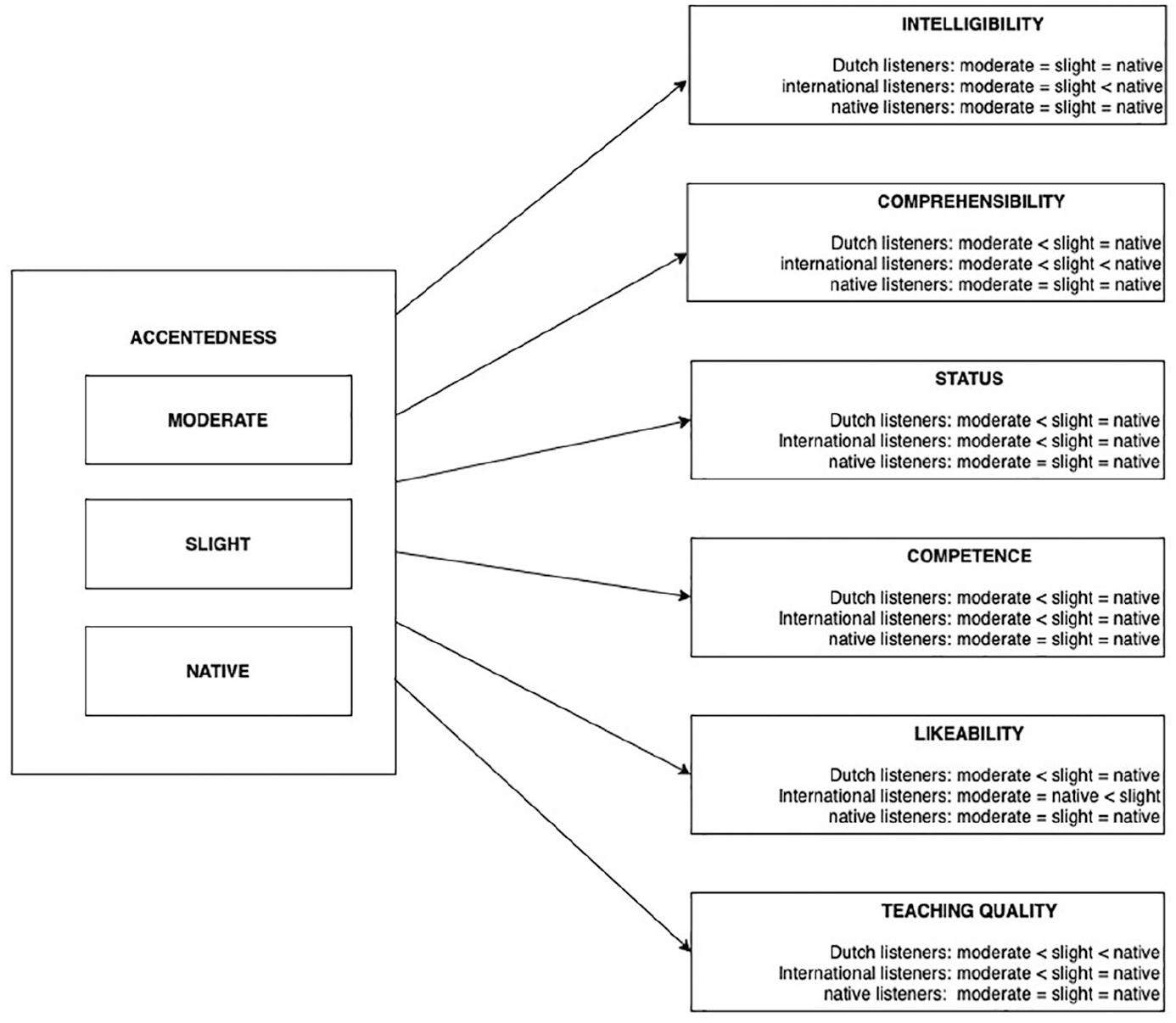
Summary of findings for all measures in function of degrees of accentedness and listener groups (‘=‘: no difference in scores; ‘<‘: lower scores than).
Research question 2 addressed the role of comprehensibility in influencing the effect of accent strength on the evaluation of lecturers’ teaching quality. Poorer comprehensibility was found to have a negative influence on Dutch and international (but not native) listeners’ evaluations of the teaching quality of moderately accented lecturers but not of slightly accented lecturers. Figure 2 displays the mediating role of comprehensibility for accentedness on teaching quality for the three listener groups.
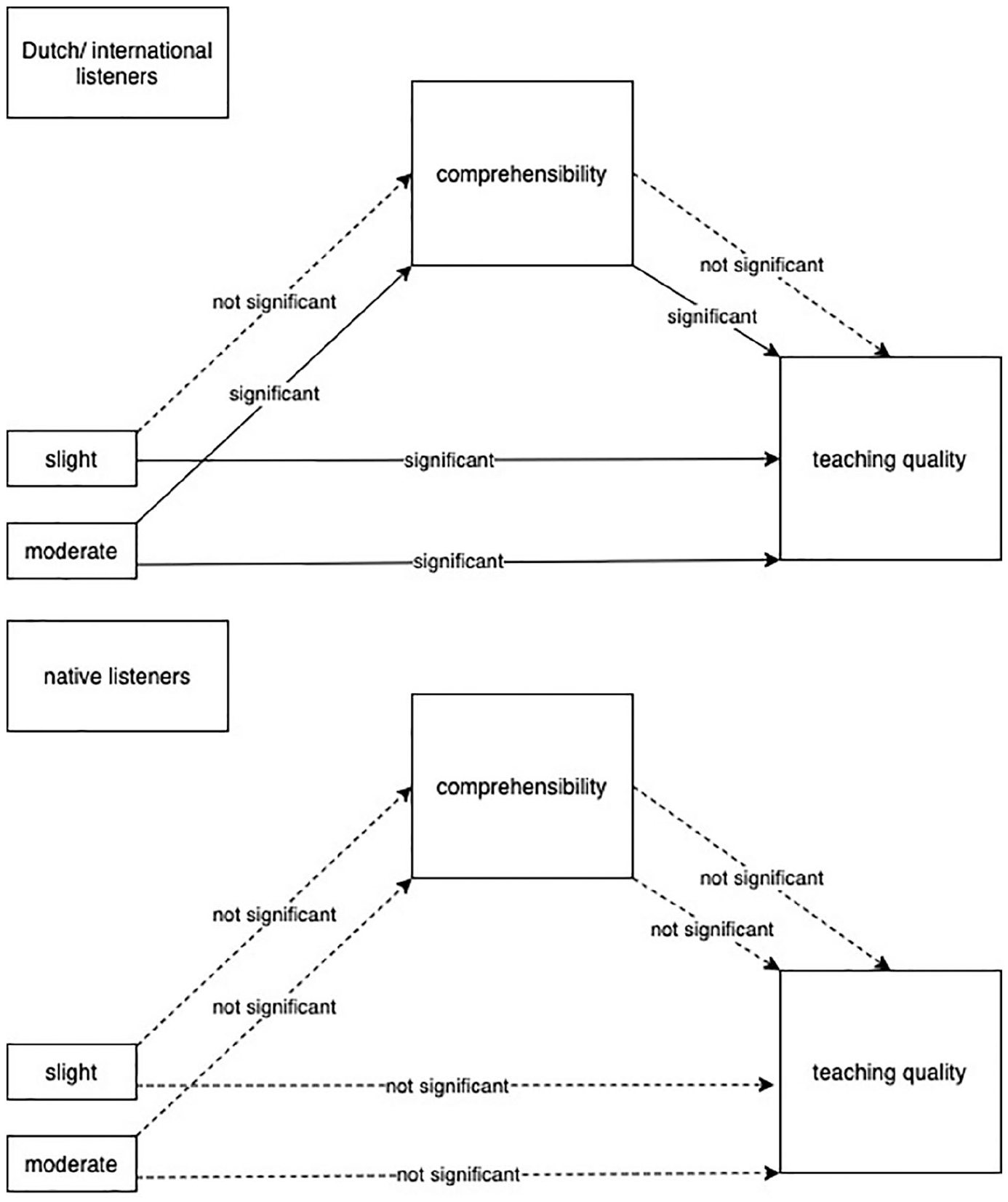
Mediating role of comprehensibility for accentedness on teaching quality for the three listener groups.
IV Conclusions and discussion
The aim of the present study was to determine how non-native English-speaking (Dutch and non-Dutch international) and native English-speaking listeners evaluate the intelligibility, comprehensibility, status, competence, likeability, and teaching quality of non-native lecturers with slight and moderate Dutch accents as compared to lecturers with a native British accent. The general picture that emerged is that lecturers with slight non-native English accents were evaluated similarly to lecturers with native English accents and that lecturers with moderate non-native English accents were evaluated less positively by the Dutch and international listeners, but that the native English listeners evaluated all speakers similarly.
1 Recognition of accent strength
All three groups of listeners distinguished three levels of accentedness in the audio fragments. The moderately accented lecturers were evaluated as having a stronger foreign accent than the slightly accented lecturers, who in turn were evaluated as being more strongly foreign-accented than the native English lecturers. Thus, the current study shows that non-native listeners with a relatively advanced level of proficiency are able to distinguish different levels of accentedness in the English of non-native speakers. Earlier research on EMI has also found that non-native listeners were able to distinguish different degrees of non-native accentedness in English (Hendriks et al., 2016), but this study only included listeners who shared the (Dutch) L1 background with the speakers. Another study with Dutch accented speakers found that non-native listeners who did not share the L1 background with the speakers also distinguished different levels of accentedness (Hendriks et al., 2018). However, the latter study included non-native listeners from a neighbouring country (Germany), with an L1 (German) that is closely related to the L1 of the speakers (Dutch), who have partly similar non-native accent features in English (Swan & Smith, 2001). As a result, the listeners in Hendriks et al. (2018) can be expected to have been familiar with and to have recognized the non-native accent features of the Dutch non-native speakers of English they evaluated, which may have made distinguishing accentedness levels easier. The current study extends these findings by showing that proficient non-native listeners from language backgrounds that are more different from the speaker’s L1 (e.g. Spanish, Italian, French) are also able to distinguish different degrees of accentedness in English. This underlines the salience of levels of non-native accentedness for a wide variety of listeners, making it plausible that differences in evaluations of such accentedness levels can be ascribed to differences in accentedness.
2 Identification of origin of the speaker
With regard to identification of the origin of the speakers, findings show that all three groups of listeners were relatively good at identifying the native speakers as native speakers. The Dutch listeners were also relatively good at identifying speakers with the same linguistic backgrounds as Dutch if these speakers had moderate accents. However, both the international listeners and the native English listeners had problems identifying the origin of these moderately accented speakers. For all groups of listeners, the origin of the slightly accented speakers was difficult to recognize correctly, in that these speakers were often incorrectly identified as native speakers of English. These findings are in line with Hendriks et al. (2016; 2018), who found that Dutch and German listeners were quite good at identifying native speakers of English and moderately Dutch-accented speakers of English, but not slightly Dutch-accented speakers of English. Thus, findings suggest that the origin of speakers with native and moderate non-native accents can be identified successfully by non-native listeners. This successful identification is important because stereotyping speakers rests on recognition of their origin (see Birney, Rabinovich & Morton, 2020; Gluszek & Dovidio, 2010; Lindemann, 2005). In the current study, the importance of recognition of speaker origin is underlined. Dutch listeners were better than international and native listeners at recognizing the moderately accented lecturers as Dutch, and they also evaluated moderately accented Dutch lecturers more negatively than the other two listener groups. This suggests that Dutch listeners’ recognition of the origin of the Dutch lecturers was the basis for their negative evaluations, probably because of ‘vicarious shame’ (Schmader & Lickel, 2006; Hendriks et al., 2018; see Van den Doel & Quené, 2013).
3 Intelligibility
The first part of our main research question concerned the extent to which accent strength affects the intelligibility of non-native speakers. Findings for intelligibility (i.e. the ability to understand individual words) show that all speakers were equally intelligible for all three listener groups. This finding goes against the (matched) interlanguage speech intelligibility benefit and the native speech intelligibility benefit. For the Dutch listeners, our findings provide evidence against the matched interlanguage speech intelligibility benefit, which holds that non-native listeners may find non-native speakers with the same L1 background easier to understand than native speakers (Bent & Bradlow, 2003; Munro et al., 2006; Stibbard & Lee, 2006; Wang, 2007), and as such our findings are in line with other studies showing that the interlanguage speech intelligibility benefit does not always apply (Hayes-Harb et al., 2008; Munro et al., 2006). Our findings do not provide support for the existence of a native speech intelligibility benefit, which entails that native speakers are considered easier to understand than non-native speakers by both native and non-native listeners (see Major et al., 2002, 2005), in line with other studies which also show that a native speech intelligibility benefit does not always occur (Nejjari et al., 2012, 2020). The implication for EMI is that actual understanding of a lecture would not appear to be compromised by non-native accentedness either for non-native listeners (with or without the same L1 background as the lecturer) or for native English listeners, which is important given that the main aim of lectures is the transfer of knowledge.
4 Attitudinal evaluations
The second part of our main research question concerned the extent to which accent strength affects attitudes towards non-native speakers. Our findings indicate that moderately accented lecturers were evaluated more negatively than the slightly accented lecturers and the native lecturers by both Dutch and international listeners, while the three accentedness varieties were not evaluated differently by the native listeners. The Dutch listeners were relatively more negative in their evaluations of the moderately accented lecturers in particular than the international and native listeners. Our findings that, for Dutch and international listeners, a moderate but not a slight accent can lead to negative attitudinal evaluations on a number of measures are in agreement with earlier research findings regarding the effects of different degrees of accentedness by non-native listeners with the same L1 background (Hendriks et al., 2016, 2018; Roessel et al., 2019) and by non-native listeners with a different L1 background (Hendriks et al., 2017, 2018). Thus, more negative evaluations of stronger non-native accents would appear to be consistent for various non-native listener groups.
The finding that Dutch listeners regarded moderately Dutch-accented speakers as having less status and having less teaching quality than did both international and native listeners may suggest that listeners are more critical about speakers they share an L1 with. This critical attitude may be motivated by vicarious shame that listeners may experience when they hear speakers from their in-group (that is, speakers who share their nationality) with a noticeable non-native accent in English (see Schmader & Lickel, 2006). This is in line with Van den Doel and Quené (2013), who showed that Dutch listeners’ evaluations of the pronunciation of Dutch-accented speakers were more negative (in terms of how well these speakers pronounced sentences) than was the case for Greek and Polish listeners’ evaluations of the pronunciation of their compatriots. The vicarious shame explanation is supported by the finding that Dutch listeners were better at identifying moderately-accented Dutch speakers as being Dutch than were native English listeners and international listeners. The Dutch listeners also indicated that, in general, they were more familiar with Dutch-accented English than the other two listener groups, which further supports the common-sense assumption that they would recognize their own accent more readily. As a result, they were able to identify the moderately Dutch-accented speakers as part of their in-group with a less than satisfactory English pronunciation. Another possible explanation for the finding that Dutch listeners were more negative in their evaluations of moderately accented speakers than international listeners is that the Dutch listeners indicated that they had less exposure to EMI than the international listeners, who indicated that a significantly larger part of their programme was English-taught. This may mean that the Dutch listeners were less used to listening to non-native accented lecturers and were, therefore, more negative about them (for studies about the positive effects of exposure to accented speakers, see Subtirelu & Lindemann, 2016).
Lecturers with a slight Dutch accent were evaluated similarly to native English lecturers for the majority of measures by all listeners. These findings concur with earlier studies in which slight-accented Dutch speakers were overall assessed in the same way as speakers with a native English accent by native listeners (Nejjari et al., 2012) and by non-native listeners with the same L1 background (Hendriks et al., 2016). This implies that a slight accent is regarded as similar to a native accent. In the current study, lecturers with a slight accent were evaluated better than native English lecturers in one respect by one group of listeners. International listeners regarded slightly accented Dutch lecturers as more likeable than native English lecturers. This finding is comparable to the finding in Hendriks et al. (2016) that slightly Dutch lecturers were considered more likeable than native English lecturers by Dutch listeners. It is difficult to explain why the slightly-accented lecturers outperformed the native English lecturers on this one dimension, but a possible explanation may relate to the similarity attraction paradigm (Byrne, 1971; see also Deprez-Sims & Morris, 2010), which holds that individuals are attracted to others if these others are felt to be similar to themselves. In the current study, the international listeners indicated that they felt they had a relatively slight accent themselves. As a result, they may have felt attracted to other speakers with a slight accent. In addition, being non-native speakers themselves, they know what acquiring a near-native accent involves, and they may, therefore, admire the achievement of the slightly accented Dutch listeners. In theory, the same explanations also apply to the Dutch listeners, who also felt they had a good English accent, but who did not evaluate the slightly accented Dutch lecturers as more likeable than the native English lecturers. This may be because the Dutch listeners were better than the international listeners at recognizing the slightly accented speakers as being Dutch, which implies that they recognized slight traces of a Dutch accent. This may have triggered some vicarious shame, counteracting the positive effect of the similarity between their own accent and that of the slightly accented Dutch lecturers.
The finding that for the native listener group no differences in attitudinal evaluations were observed does not concur with studies that have found that stronger non-native accented speakers are evaluated less positively than slightly-accented and native accented speakers by native listeners (Brennan & Brennan, 1981; Cargile & Giles, 1998; Carlson & McHenry, 2006; Dragojevic et al., 2017; Nesdale & Rooney, 1996). A possible explanation for the absence of negative evaluations of the non-native accented lecturers is that the native listeners were slightly older than the Dutch and the international listeners. This may have made them less critical as a result of their more extensive life experience. In addition, the native listeners were also less interested in the topic of the lecture fragments than the other listener groups. This may have created a kind of ‘floor effect’ in that their already low interest was not affected by the accentedness of the lecturer.
A third explanation is that the native listeners did not experience any comprehensibility problems due to the non-native accentedness of the moderately and slightly accented lecturers. Several studies have found that comprehensibility of non-native speech influences listeners’ attitudes towards the speaker (Dragojevic et al., 2017; Roessel et al., 2019). The absence of differences in comprehensibility may have led to an absence of differences in attitudes. This explanation is supported by the findings for our second research question, which showed that comprehensibility did not mediate the effect of accent strength on teaching quality for the native listeners, unlike for the other two groups of listeners.
5 The role of comprehensibility
Our second research question concerned the role of comprehensibility in attitudinal evaluations of non-native accented speakers for different groups of listeners. Findings in the current study show that for the Dutch listeners and international listeners, poorer comprehensibility negatively affected the teaching quality of moderately accented lecturers. For the native listeners, comprehensibility did not affect evaluations of teaching quality for any of the accent strengths. The finding that comprehensibility acted as a mediator of the effect of accent strength on ratings for teaching quality, albeit only for the Dutch and the international listeners, is in line with findings in Dragojevic et al. (2017) and Roessel et al. (2019) that comprehensibility was a mediator between accent strength and speaker evaluation.
A possible explanation for the absence of differences in attitudinal evaluations of native and non-native accented speakers for the native listeners in the present study is that for the native listeners, unlike for the other two groups of non-native listeners, no differences were found in comprehensibility for the three accent strengths. For the non-native listeners, the perceptions of reduced comprehensibility experienced when listening to non-native lecturers appear to lead to lower attitudinal evaluations, while for the native listeners, who do not perceive this reduced comprehensibility, no such effect appears to have occurred. This is in line with studies showing that processing fluency is an important factor in determining people’s attitudes (e.g. Reber, Schwarz, & Winkielman, 2004), in the sense that messages that are considered more difficult to process are also evaluated more negatively. For both Dutch and international non-native listeners, the moderately accented Dutch lecturers were considered more difficult to understand than the slightly accented lecturers, in other words, their message was considered more difficult to process, and, as a consequence, evaluated more negatively in terms of teaching quality. In the case of the native listeners in the current study, absence of differences in processing fluency (measured as how difficult to understand they consider the lecturer to be) consequently led to absence of differences in attitudinal evaluations.
The finding that native listeners regarded all speakers as equally easy to understand, in spite of differences in accent, can be explained as resulting from their high English proficiency, as evidenced by their high scores on the LexTALE test, which were better than the scores for the other two listener groups. Their higher proficiency is likely to make it easier for native listeners to understand any spoken English, regardless of accent. Another factor explaining the finding that native speakers found all accents equally comprehensible is that, throughout their lives, native speakers are more likely to have been exposed to different varieties of English (regional and non-native) than non-native speakers, because they communicate in English more frequently, if not exclusively. Research has shown that increased exposure to different accents enhances listeners’ ability to understand accents (for an overview, see Baese-Berk, McLaughlin, & McGowan, 2020, p. 11). The combination of native listeners’ high proficiency in English and their inherent high exposure to different accents may have resulted in their comparable assessments of the comprehensibility of the different accents in the current study.
6 Conclusion: The native speaker pronunciation norm in EMI
Evaluations by the two groups of non-native listeners shed new light on the (non-)desirability of the native speaker pronunciation norm in non-native communication in English. The native English lecturers were never evaluated less positively than the non-native accented lecturers. Non-native lecturers with a moderate accent, in particular, were evaluated more negatively than native speakers. This suggests that users of non-native English still use the native norm to evaluate other non-native speakers, in contrast to the view that native speakers should no longer be the norm in English as a lingua franca communication (Jenkins, 1998; 2000). The experimental findings of the current study are in line with findings from earlier survey and interview studies that showed that non-native lecturers are evaluated according to native speaker pronunciation norms (de Figueiredo, 2011; Evans & Morrison, 2011; Zhang & Zhan, 2014).
Although EMI is primarily concerned with the transfer of knowledge and not with teaching English, the findings of the current study suggest that non-native students may downgrade non-native-accented lecturers when their pronunciation deviates markedly from the native norm. This effect would appear to be particularly strong for non-native students who have the same L1 background as the lecturer. The question is to what extent this downgrading of lecturers with a moderate non-native accent would also occur in EFL teaching, where the focus is on students learning English (see Inbar-Lourie & Donitsa-Schmidt, 2020, p. 301). Since this implies that lecturers in EFL contexts may be seen more as pronunciation models for learners to aspire to than in EMI contexts, it can be expected that EFL students evaluate lecturers with a marked non-native accent even more negatively. Further research should test whether non-native accentedness indeed matters more for students’ evaluations of EFL lecturers than EMI lecturers.
7 Contributions of this study
To the best of our knowledge, our study is the first to have investigated the impact of non-native accent strength of non-native speakers of English on attitudinal evaluations by non-native listeners who share their L1 background with the speakers, non-native listeners who do not share their L1 background with the speakers, and native listeners. Most earlier studies focused on native listener evaluations (e.g. Nejjari et al., 2012) and only few studies would appear to have included a similar range of listeners but only for evaluations of intelligibility (Bent & Bradlow, 2003; Stibbard & Lee, 2006).
Our study has shown that the impact of accent strength is different for different groups of listeners: non-native listeners who have the same L1 background as the speaker, non-native listeners who have different L1 backgrounds than the speaker, and native listeners. Native listeners seem less susceptible to differences in accentedness in (non-)native English than non-native listeners. Although they recognize accentedness, they do not seem to be affected by it.
Our study confirms findings from earlier studies on attitudinal evaluations that more heavily accented speakers are evaluated less positively than native speakers or more weakly accented non-native speakers by both native listeners (Carlson & McHenry, 2006; Dragojevic et al., 2017; Nejjari et al., 2012) and non-native listeners with the same L1 background (Hendriks et al., 2016; Roessel et al., 2019). The current study adds that these negative evaluations also extend to evaluations by non-native listeners from a variety of L1 backgrounds.
8 Limitations and suggestions for further research
One of the limitations of our experimental study is that our non-native stimulus materials were limited to samples from Dutch non-native speakers of English. There are indications that Dutch-accented English may be more comprehensible than other non-native varieties of English. Firstly, Dutch is a Germanic language that is closely related to English (Wang, 2007), which means that the two languages are similar in their sound systems and prosody. Secondly, Dutch people are regularly exposed to English in the media, the Dutch linguistic landscape and education (Edwards, 2016; Gerritsen, van Meurs, Planken, & Korzilius, 2016), which means that they have a great deal of exposure to native pronunciation models they can imitate. Given the importance of comprehensibility for perceived teaching quality as demonstrated by our mediation analysis, this may imply that non-native lecturers with non-Dutch L1 backgrounds may be evaluated less positively than the lecturers in the current study. In addition, previous research has shown that Dutch-accented speakers were evaluated as having relatively high status compared to other (Polish-accented) non-native speakers and that this impacted the evaluations of speakers with strong and weak accents (Birney et al., 2020). This implies that it is important to investigate the effects of non-native accent strength in English in EMI for lecturers from less high-status countries than the Netherlands. Future studies should, therefore, include lecturers with a variety of L1 backgrounds.
Another limitation is that the stimulus materials consisted of relatively short audio fragments of lectures. As real lectures are longer, the negative effects of non-native accents in actual lectures may be even stronger. Earlier research has shown that non-native speakers who were judged equally intelligible as native speakers in short sentences were less easy to understand in longer lecture fragments (Jensen & Thøgersen, 2017). On the other hand, studies have shown that longer exposure may improve understanding of non-native accentedness for L1 listeners (for an overview, see Subtirelu & Lindemann, 2016, p. 733). It is not clear whether the effect that understanding is worse or better for longer fragments would also apply to attitudinal evaluations, which should be examined in future studies.
Another limitation of this study is the use of the verbal guise technique (Garrett, 2010). Although the verbal guise enabled us to keep the content of the fragments identical across speakers, it may lack some ecological validity. In actual teaching practice, different lecturers may not only have different pronunciations but also different ways of delivering lecture content. In future research, the relative importance of accent strength versus, for instance, different lecturing techniques could be investigated by using real lecture fragments.
9 Practical implications
The findings of our study have a number of implications for those involved in English medium education. Overall, evaluations of lecturers with a moderate accent were less positive than of those with a slight accent, except for native listeners, who did not evaluate the non-native speakers differently than the native speakers on any of the measures. For non-native lecturers teaching non-native students, a traditional recommendation would have been to attempt to reduce the strength of their non-native accent (Thomson, 2014), particularly when they teach students from their own country. However, in light of changing views on the undesirability and ineffectiveness of accent reduction (Lindemann, Litzenberg & Subtirelu, 2014), a better approach may be to make pupils and students in EMI contexts more sensitive to and aware of prejudiced reactions to non-native accentedness (see Roessel, Schoel, & Stahlberg, 2020; Rubin, 2012).
Roessel et al. (2019) showed that listeners tend to have more positive attitudes towards non-native accented speakers when they are made aware of the prejudices they have towards such speakers. One way of addressing students’ prejudices would be to expose them to teaching materials showing successful communication involving a variety of non-native speakers with varying degrees of non-native accent strength (Chan, 2016; Cook, 1999; Formanowicz & Suitner, 2020; Sifakis & Sougari, 2003). Another option for non-native lecturers is to reflect on what may be effective lecturing techniques that they can use to compensate for adverse effects of their non-native accent. Such strategies include stimulating students to ask more questions and making use of multimedia techniques to support their lectures (Airey & Linder, 2006).
For administrators at institutions offering EMI, a recommendation would be to refrain from focusing students’ attention on the importance of non-native lecturers’ native-like English proficiency. One way of doing this would be to not include questions about these aspects in questionnaires for student evaluations of lecturers (Lueg, 2015).
