




Abstract
Since the start of the twenty-first century, English has come to be seen by the Chinese government as a linchpin of its continued economic and political influence. Its resultant efforts to promote innovation in English language teaching align with the aspirations of a population, many of whom regard competency in English as a determiner of opportunity and success in their careers, and thus a vehicle through which to provide a good quality of life for themselves and their families. However, despite government-driven initiatives to improve English language education, change has been slow to materialize, especially outside of the main urban areas of Eastern China. Here, we report on a study that sought to explore the constraints governing attempts by teachers of English to innovate in universities located in some of the so-called ‘hinterland’ regions of Southwestern China. Key determinants that emerged, and which we discuss, included time pressure and competing priorities; scepticism towards new ideas; lack of investment in resources; the primacy of the textbook; students’ language proficiency; and opportunities for professional development. Together, these findings indicate the need for a change of culture if innovation is to be welcomed, both in principle and in practice, as a driver of positive change in the teaching of English in these universities. Teachers, their line managers, and university senior managers need to feel willing and able to engage freely in constructive and informed discourse, and in doing so consider recalibrating institutional priorities, thereby helping reconcile the pressures and tensions currently experienced by English language teachers and which impede progress.
Keywords
I Introduction
Since the 1990s, there has been a good deal written on English language teaching and learning in China, much of it in response to the country’s rapid economic, social and cultural transformation, and accompanying changes in English language policies that have sought to reflect a recognition by the Chinese government of the importance of the language to its own influence and fortunes in the context of globalization and the need to improve the quality of teaching (Adamson, 2001; Cortazzi & Jin, 1996; Feng, 2012; Hu, 2002a; Hu & McKay, 2012; Jin & Cortazzi, 2003; Jin & Cortazzi, 2006). English is now seen as indispensable to the fulfilment of China’s political and commercial ambitions, and to the educational and socioeconomic aspirations of its population, with Hu describing it as a subject of ‘paramount importance’ and proficiency in English as ‘a national as well as a personal asset’ (Hu, 2005a, p. 5). This has, perhaps inevitably, raised important questions concerning the type and level of language competence with which Chinese students come equipped once they graduate from the education system and enter the world of work, and by extension, questions about the way in which English is taught in China and its efficacy. Specifically, there have been concerns expressed that while students often graduate with a sound knowledge of the structural properties of English, they often lack the means to translate this into a performative capacity that enables them to function in authentic contexts of use and demonstrate a full communicative competence that goes beyond formal control of the language code and affords them the wherewithal to be fluent and appropriate in communication (Hu, 2002a; Jin & Cortazzi, 2006).
How to develop such competence in the Chinese context requires an understanding of innovation and the local constraints and affordances governing its implementation. These can be national, regional and/or institutional, and the literature is replete with research concerning the nature of innovation and the contextual idiosyncrasies that can impact on both the desire and willingness to innovate as well as the success or otherwise of attempts to implement innovation (see, for example, Darasawang & Reinders, 2015; Markee, 1997; Reinders, Nunan & Zou, 2017; Reinders, Coombe, Littlejohn & Tafazoli, 2019). O’Sullivan and Dooley have defined innovation as ‘the process of making changes to something established by introducing something new’ (2009, p. 3), and by way of clarifying the concept as a preface to their discussion of its relevance to the Middle Eastern context, Reinders et al. (2019, p. 1) cite the Society of Teaching and Learning in Higher Education (STLHE) as follows: The practice of effective and meaningful teaching can benefit immensely when educators thoughtfully experiment and apply new or different pedagogical approaches, technologies, curricular enhancements, course design and organization and assessments.
Since the start of the twenty-first century, in response to its changing place in the world and what Dai described as the ‘time-consuming but low-efficient’ English learning situation in the country (Dai, 2001, p. 1), education in China has undergone a period of major reform focused on innovation and quality and with a reduced preoccupation with the examination-driven curriculum (Li & Edwards, 2013). As Li and Edwards observe, ‘curriculum innovation and change in ELE [English language education] are the defining features of this reform movement’ (2013, p. 391). These have been accompanied by an increased emphasis on the use of information and communications technology (ICT) in an effort to promote learner autonomy and independent learning and reduce teacher contact hours, thereby mitigating the compounding effects of growing student numbers and a shortage of English language teachers (Hu & McGrath, 2011). In these respects, efforts to transform English language teaching have broadly reflected an application of the processes described by the STLHE. Curricular developments have focused primarily on encouraging the adoption of Communicative Language Teaching (CLT) principles in the delivery of English language courses, and applied linguists and practitioners alike have reported on some of the challenges and successes experienced in the process of realizing such policies in the classroom, with many highlighting incongruities between CLT and the traditional Chinese culture of learning (see, for example, Barcelos & Kalaja, 2011; Chen & Wright, 2017; Hu, 2003; Jin & Cortazzi, 2003, 2006; Li & Edwards, 2013; Nunan, 2003). Those incongruities are commonly articulated in terms of the divergence of the Confucian and Socratic traditions, most evident in the contrast between the kind of teacher-centred, highly structured classrooms widely seen as characteristic of Chinese language classrooms and which emphasize subject matter knowledge, discipline and a teacher-centred dynamic, rote learning and memorization; and the more student-centred, interactive, task-based dynamic commonly found in Western language classrooms, in which students take greater responsibility for their own learning and there is a focus on creating an authentic learning environment where the process of language learning reflects that of language use outside the classroom (Butler, 2011; Wang, 2007). In essence, it is a contrast between, on the one hand, so-called traditional classrooms that reflect a structural approach to language learning driven largely by behaviourist principles and following a pedagogical model of knowledge transmission in which teachers follow closely a prescribed textbook, and, on the other, more functionally-oriented classrooms that reflect a communicative approach intent on nurturing in students the ability to use language appropriately and fluently in real-world contexts, and where teachers have greater freedom to realize the syllabus methodologically in whichever way they see fit.
There is evidence that, by the start of the new millennium, efforts at reforming English language teaching were beginning to make inroads into traditional practices, with Hu, for example, reporting that: Impressive progress has also been made in curriculum development, syllabus design, and learning materials production. There is an accelerating shift towards curriculum pluralism to encourage innovation and experimentation in ELT [English language teaching]. Similarly, there exist a variety of syllabuses informed by new developments in language education theory and research. Also available are a range of textbooks produced locally, nationally, and internationally (Jiang, 2003). As a result of these developments, the quality of ELT has improved considerably (Liu & Gong, 2000). (Hu, 2005a, p. 17)
These developments in curriculum, syllabus and materials production were reported by some scholars as being accompanied by a change in English language teachers’ attitudes, with Wang’s 2007 survey indicating that 90% of participating teachers welcomed the change in conception and approach to teaching advocated in The New Curricula, which embed many principles of CLT, and Gu earlier citing Chinese teachers’ ‘openness to CLT methodologies and a willingness to change and improve their teaching practice’ (Gu, 2005, p. 291). Nonetheless, innovation in English language teaching has had to run the gauntlet of tradition, and there is also evidence that practices have proven to be quite impervious to change, even where decreed top-down (Hu, 2002a, 2005b; Liao, 2004). Zhang and Liu, for example, have observed that ‘Although the teachers were willing to apply the new constructivist approach, their efforts to do so were constrained by such factors as shortage of resources, lack of professional training, prevailing cultural norms and some historical-political factors’ (Zhang & Liu, 2014, p. 189; italics added). Factors that appear to have militated against innovation include the embeddedness and resilience of teachers’ beliefs (Tsui, 2003); feelings of anxiety and uncertainty typical of educational change in general (Fullan, 2001); large class sizes (in 2006, Zhang cited the EFL teacher-student ratio as 1:200); poor resources; a shortage of appropriately qualified teachers; insufficient understanding of the change process; lack of necessary competence on the part of those teachers tasked with implementing the innovation; inadequate levels of training and support for teachers’ professional development (Butler, 2011; Wang, 2007); and gatekeeping tests such as the College English Test (CET) which have, until recently, perpetuated the status quo by emphasizing the structural dimension of language as instantiated in a combination of the grammar-translation and audiolingual teaching methods. Furthermore, and specifically in relation to the higher education context, the publish-or-perish culture increasingly prevalent worldwide has served to incline Chinese academics away from a focus on pedagogical developments and other activities, in favour of outputs that many view as a higher priority for the universities that employ them (Qiu, 2010; Tian, Su, & Ru, 2016; Yan & He, 2015), with potential implications for their tenure and promotion, and even their entitlement to cash prizes and housing benefits (Qiu, 2010). As Yan and He note, this culture ‘has caused severe competition among institutions at all levels and of all types (whether comprehensive universities, normal universities, or technical and vocational colleges; whether state-run or private)’ (Yan & He, 2015, p. 527).
The second key pillar of China’s new millennium reform movement is a recognition of the centrality of Information and Communication Technologies (ICT) to educational enterprise in a country increasingly seen as being at the technological cutting edge (Ning, 2009). There is a desire in China to exploit such technologies in an effort to increase pedagogical creativity and thus student engagement, and to introduce efficiencies in the teaching and learning of English in an environment where student numbers are increasing, teachers are at a premium, and where learner independence – a key element of CLT – assumes greater importance as a result. The widespread use of websites, blogs, webinars and social networking applications, in combination with the now ubiquitous use of handheld devices, have rendered IT an essential prerequisite to maximizing learning potential (Dudeney, Hockly & Pegrum, 2013; Gilbert, 2013; Hockly, 2012; Walker & White, 2013). Furthermore, it offers a vehicle for knowledge enhancement and professional exchange and development for English language teachers by helping enable the formation of active networks and vibrant professional communities. These potential benefits and their role as facilitators of innovation are, however, contingent not only upon the availability of suitable hardware and software but also the ICT skills and pedagogical expertise of teachers (Godwin-Jones, 2015; Hockly, 2012; Røkenes & Krumsvik, 2016). Where such skills and expertise are lacking, and support and training is inadequate, the effectiveness with which ICT is utilized is often less than optimal (Hu & McGrath, 2011).
II English language teaching in hinterland regions
There has been some discussion in the literature of the extent to which these constraints on innovation are experienced in what Gao and Xu (2014) refer to as China’s ‘hinterland regions’, that is those regions of Central and Western China located away from the main metropolises (e.g. Hu, 2003; Sargent & Hannum, 2005; Wang & Gao, 2008). Particular attention has been focused on the professional competence and training of teachers working in these regions and the fact that they are disadvantaged due to a disproportionate number of university graduates opting to work in the more developed and prosperous coastal and urban regions the attractions of which also lure qualified teachers from the less developed areas (Hu, 2003). As a result, many secondary school teachers have little or no professional training and their English language skills are often the product solely of their school education. As Hu notes, ‘ambitious and privileged schools’ located in prosperous cities such Beijing and Shanghai often employ overseas teachers who then ‘upgrade the language proficiency and professional skills of their local staff’ (p. 305). These and other urban schools often benefit from connections with prestigious universities that are better informed of developments in theories, methods and approaches to language learning and able to offer in-service teacher training, while the governments of these more prosperous metropolises are able to support mobility programmes that enable teachers to benefit from in-service training at overseas universities and to return home better able to implement more communicative approaches in their teaching.
This situation raises the question of what constitutes key factors – enablers and affordances – that govern the implementation and diffusion of innovation in contexts such as these. Moreover, there has been no shortage of theories that seek to address this question (see, for example, Fullan, 2001; Markee, 1993; Murray, 2016; Rogers, 1995) and which commonly identify a quite diverse set of factors including those personality traits commonly exhibited by change agents, the perceived need for change, the attitudes of the recipients of the innovation and those tasked with implementing it, institutional structures, and external factors such as government policy. However, as Hargreaves and Fullan (1998) have noted in regard to curricular innovation in general, the key determinant of success in any attempt to innovate is teacher quality and teachers’ capacity to understand and implement change. This may involve upskilling via in-service professional development programmes, and the availability of such programmes can therefore become a critical factor in the success or otherwise of attempts to innovate – something we discuss further below. As Gao and Xu (2014) have observed with particular reference to the teaching and learning of English in the hinterland regions of China, the absence of professional networks and sustainable communities of practice through which ideas, practices and experiences can be shared, discussed and supported financially, materially and otherwise by educational authorities, can quickly stunt any initiative to bring about positive change. Such networks and communities provide support mechanisms which can not only alleviate the sense of isolation and vulnerability that teachers working in these areas may feel, but also instil a sense of confidence and legitimacy as they strive to implement change in contexts that may be less conducive – even resistant – to it and where traditional attitudes and values may hold sway.
Building on previous research (e.g. Chen & Wright, 2017; Gao & Xu, 2014; Hu, 2002a; Hu & McGrath, 2011; Jin & Cortazzi, 2006; Li & Edwards, 2013; Li & Walsh, 2010; Zhang & Liu, 2014), it is in relation to this professional context that the study we report on here sought to identify and explore in detail the factors that impact on the ability and willingness of Chinese university English teachers to introduce innovation into their practice. Our study is significant in that much of the literature on English language teaching in hinterland regions of China focuses on the secondary education sector, and there is a notable paucity of scholarly work focused specifically on the tertiary sector. While the extent to which university English teachers choose to innovate may in part depend on what they consider to be the likelihood of any such innovation being implemented in the primary and secondary sectors, we were nonetheless keen to hear from our participants the extent to which this and other factors influenced their pedagogical decisions.
III The study
The study was conducted as part of an ongoing collaboration between the University of Warwick and Shanghai Jiao Tong University (SJTU), with a view to evaluating the impact of a one-month English Language Teacher Professional Development programme (ELTPDP) delivered in Shanghai in summer 2018 for the purpose of equipping university teachers working in under-resourced, hinterland regions with pedagogical knowledge and skills relevant to their educational contexts. Our research was grounded in the belief that if innovative ideas are to translate into teaching practice, then it is essential that teachers’ beliefs and the context that shapes them are clearly understood (Zhang & Liu, 2014, p. 188). As such, its primary goal was to address what has been described by Chen and Wright as ‘the need for rich data on how institutions introduce . . . educational innovation into a new context, and how teachers may have the capacity to contextualize and adapt in EFL settings’ (Chen & Wright, 2017, p. 518). In this article, we look in particular at the constraints governing teachers’ ability to innovate; however, the findings we report emerged from a far larger data set that reflects the broader scope of the research project developed around the ELTPDP and in which we set ourselves a number of key objectives which individually and collectively speak to Chen and Wright’s clarion call. These include the exploration and documentation of local practices in English language teaching and English language teacher education, and the needs of teachers and teacher-trainers working in rural contexts; college English teachers’ perceptions of their own practices and needs, and how those needs can most effectively be met; the constraints and affordances within local institutional culture that govern change and innovation; how professional learning, such as exemplified in the ELTPDP, best works to enhance teachers’ agency and supports the teaching of English in rural areas; and those strategies that can most effectively nurture a professional community of practice (COP) in the Chinese rural ELT context, and what role IT might play in this.
Sixty-eight university English language teachers based in Yunnan and Guizhou Provinces in Southwestern China took part in the ELTPDP, the majority of whom were sourced from normal universities, which have traditionally focused on the training of school teachers, universities that were formally teacher colleges, and education colleges and universities. Teachers were selected for the programme by their institutions based on their perceived level of professional engagement, ambition and potential, and on their English language proficiency. Although there was no language proficiency eligibility requirement stipulated, it was made clear to potential source universities that a good level of proficiency would help ensure that participants would maximally benefit from the programme. While there was, inevitably, some variation in levels, all teachers coped well with the language demands of the programme.
Once participants had been selected, the programme was designed based, in part, on the results of a needs analysis exercise conducted in order understand the teachers’ current practices and to identify areas where training and development would likely be beneficial. Five teacher-trainers delivered the programme, three from the University of Warwick’s Department of Applied Linguistics and two from SJTU’s English Department.
Nine months after the conclusion of the programme – a period judged sufficiently long for the teachers to have reflected on their workshop experience and to have begun incorporating some of their learning into their teaching practice – observations and interviews were conducted at the home institutions of nine teachers from Yunnan Province who had completed the one-month programme and agreed to take part in the research. The researchers involved in the data collection process had no previous relationship with the teacher participants and were not involved in delivery of the ELTPDP. The nine teachers were from ordinary (tier 3) universities and were selected based on their performance on the programme, their exceptional level of professional engagement and enthusiasm throughout, and their fluency in English. It was felt that, for the purposes of the research, a good command of English and the ability to articulate and discuss ideas was essential if we were to answer our research questions in sufficient depth. For their part, the teachers viewed their participation as a way of furthering their own professional development and, eventually, that of colleagues in their own and other universities in the region. This was important as we were keen to explore the extent to which these individuals could, with appropriate training and support, drive innovation – something to which we return later.
The nine participating teachers represented six institutions, with three universities each being represented by two teachers (see Table 1). Of the three researchers directly involved in the data collection, one was Chinese and two were non-Chinese. One had been involved in the development of the ELTPDP, while the other two had not. None of the three researchers had been involved in delivering the programme.
Participating teachers and their institutions.
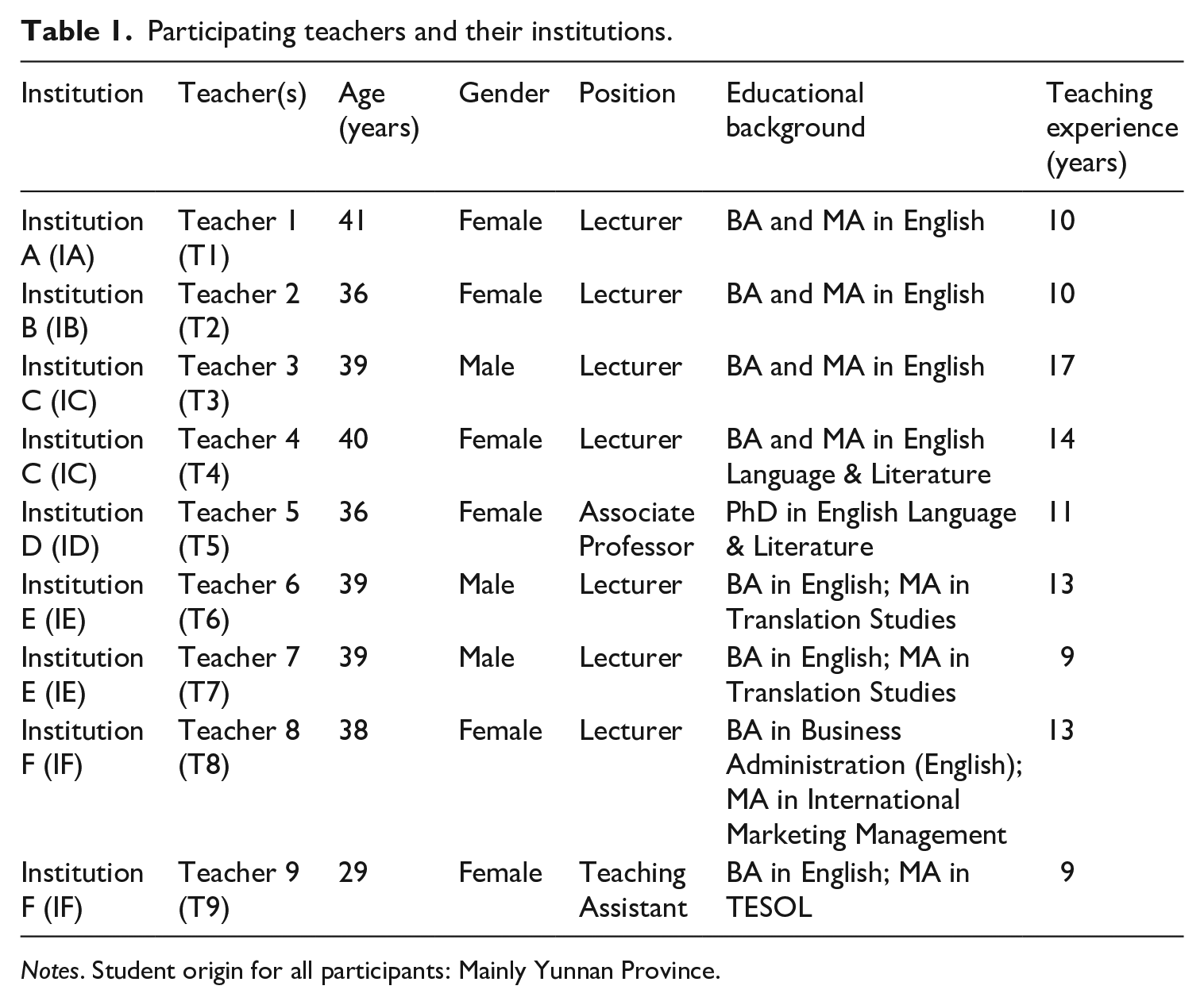
Notes. Student origin for all participants: Mainly Yunnan Province.
The nine observations conducted – one of each teacher participant – were of English language classes delivered to students studying English both as a major and a minor subject, and all the teachers concerned had opted to teach either a listening or a reading class. In every case the lesson content was largely determined by the assigned course textbook. The observations preceded the interviews and were of between 90 and 120 minutes duration. Comprehensive field notes were taken during the observations and recorded various facets of the classroom including the use of Chinese vs. English, the nature, quantity and quality of teacher-student and student-student interactions, the use of IT, whether and to what extent teachers depended on and diverged from the textbook, and types of activity used. Using the interview protocol featured in Appendix 1, all nine teachers were interviewed individually once, immediately following observation of their classes. Interviews lasted approximately one-hour and were transcribed in the weeks that followed. In addition to data from these observations and interviews, what follows also includes some data from two focus groups, each conducted with five trainees sourced from a second ELTPDP cohort who participated in a subsequent iteration of the programme run a year later.
The interviews were analysed using thematic analysis (Braun & Clarke, 2006). The researchers familiarized themselves with the interview data and produced a list of codes. The codes were iteratively examined with the researchers working back and forth between the raw data and the codes to identify patterns between them that could generate broader themes.
IV Findings and discussion
Our findings highlighted a number of key and often interrelated constraints that impacted on the teachers’ ability to innovate.
1 Time pressure and competing priorities
A common issue raised by teachers as a significant limitation on their ability to introduce change into their classroom practices was insufficient time in the face of competing priorities. Pedagogical innovation was frequently cited as vying with institutional pressure to conduct and publish research and enhance their academic qualifications (normally the pursuit of a PhD), expectations in relation to non-classroom related activities such as event organization, and family commitments, especially where children were involved. Particularly salient during the interviews was a sense that teachers often needed to make a choice between introducing innovation into their teaching because they felt it was the right thing to do, and devoting time to research activity in the interests of improving their promotion prospects. Teachers lamented the fact that they often found themselves having to choose between improving their teaching and improving their career opportunities, and there was a sense that they saw this situation as somehow forcing them into making unreasonable compromises that threatened to undermine their sense of professional integrity and create a ‘bottleneck’ for their professional development (Wang & Han, 2011, p. 44).
Extract 1 Researcher: So what you’re saying is most of your time is given over to teaching? IC, T3: Yes. Researcher: The main criterion for promotion is academic papers. . . IC,T3: If you invest uh spend uh much more time on teaching you’ll have less time to do research and to write papers . . . In my department I have to organize uh various kinds of events, competitions, contests. A speaking contest, a writing contest. I have to organize uh training programmes, language training programmes. Uh-uh back home I am also a father, a husband. I have to spend time with my daughter . . . yeah it affects my teaching . . . in a sense they-they take away from me the time I need to prepare my lesson.
In some cases, these tensions result in teachers opting to ignore or put on hold their career development in favour of developing their teaching practice (Extract 2), while others sacrifice their teaching and prioritize their careers (Extract 3).
Extract 2 IF, T8: And . . . and also some of the pressure comes from uh the peers as well . . . Thing is that some of them have started to pursue their Doctor’s degree . . . I think that’s-for me that’s the biggest issue. Researcher: Is it something you would like to do? IF, T8: Umm-yes, actually-actually I’m thinking-umm uh to be honest in this university, I think it’s the same for all the universities, when it comes to the evaluation of the teachers, they always put your ability in the academic research umm higher than their-their ability of teaching in class. And as-personally speaking, I would like to put-put more efforts on my teaching rather than doing some academic research. I would put . . . always put teaching umm as my priority. So probably when I’m-when my child grow up a little bit I will consider to pursue a higher degree. Extract 3 IA, T1: And actually whether I do it good or bad, actually it has very little i influence to my career . . . So (h) so uh in other words I don’t-I think I don’t-I’m not highly motivated to-to-to improve, to develop my-my teaching skills sometimes.
These comments resonate with Tian, Su and Ru’s finding that ‘young scholars faced great pressure to publish papers in internationally indexed journals’ and that their ‘participants were reluctant to spend time on other academic activities, including teaching training.’ They also reported considerable work time devoted to writing, which resulted in fatigue and negatively affected family relations (2016, p. 1).
2 Scepticism of ideas that break with tradition
Teacher T8’s perception that her university gave precedence to academic research over teaching resonated with other participants and may suggest that there exists among university management a belief that, despite the stated goals of educational reform and English language curriculum innovation, current English language pedagogy serves students’ learning sufficiently well given other priorities, such as research, that can be seen as having greater significance both nationally and globally in terms of institutional reputation, inter-institutional collaborations etc. This interpretation would certainly be in keeping with the idea that deeply embedded traditions, belief systems and associated behaviours can be extremely resistant to transformation, particularly where other such priorities make themselves felt (Hu, 2002b, 2005a; Zhang & Lu, 2014). Furthermore, it tallies with Hu’s observation – made quite some time ago – that ‘numerous Chinese teachers and learners of English do not seem to have gone through any fundamental changes in their conception of effective language instruction and in their daily practices’ and that although many teachers claim to be followers of CLT, ‘this is often a matter of paying lip-service. In actuality, there has been resistance deep down to CLT since its very introduction’ (Hu, 2002b, p. 94).
The implications of such resistance can be multifold, extending beyond the time and relative value afforded to teaching and pedagogical innovation. This became evident, for example, when teachers talked about the fact that all classrooms were equipped with cameras via which their classes could be monitored and which the research team themselves observed. In addition, classes contained students tasked with reporting to management any classroom behaviour they considered aberrative or unacceptable. Although the standard against which any such behaviour was measured was not made explicit, there were certainly indications, such as in Teacher T6’s recounting of a visit by the Dean of the School of Foreign Languages: Extract 4 IE, T6: You know when the dean or the deputy dean of the foreign languages school comes to observe my class, and you know he, just two weeks ago he observed one of my classes and he-he you know told me a lot about my teaching, a lot-lot of comments, not good co(h)mm(h)ents . . . You know he asked me so what are your objectives of this class? You know I see that your students have some fun in your class. But what are your objectives? Are those objectives achieved? And how are you going to evaluate your students? Because you are teaching them in this way. And I told-yeah after that I told my students, so whenever uh the school leader comes to observe my class please-I will teach the course book. . . Extract 5 IE, T6: A teacher is supposed to you know stand there lecturing students. You know to give them lots of knowledge. It’s not important whether you divide your students into teams or not. It’s not important to have group discussion. Extract 6 IC, T3: Uh and there is-I don’t know whether uh there is such phenomenon in other university or colleges but it do happen in our universities . . . There is one student, I don’t know who but I know there is one student in every class who reports the teacher’s performance, what the teacher say and the teacher’s performance to the administration department, that’s a secret person.
Teacher T6’s comments instantiate Hu’s observation that Chinese teachers and students regard education as a serious undertaking that is least likely to be associated with light-heartedness but requires deep commitment and painstaking effort. Consequently, ‘the Chinese tend to associate games and communicative activities in class with entertainment exclusively and are sceptical of their use as learning tools’ (Rao, 1996, p. 467, cited in Hu, 2002b, p. 97). This situation, and the fact of their classroom behaviour being subject to scrutiny via classroom monitoring, can serve to stifle teachers’ inclination to be innovative in an environment where not only is innovation often devalued but also differences in practice frowned upon. This is brought into sharp focus when considering T6’s reference to students with responsibility for reporting on teacher performance, and Hu’s description of students’ cool reception of communicative methodology as a result of its failure to promote the accumulation of discrete-point knowledge of grammar rules, structural patterns, metalanguage, vocabulary items, and collocations, and associated learning behaviours such as recording, rehearsing, reviewing and memorizing with a view to accurate reproduction (Hu, 2003, pp. 298–299).
3 The primacy of the textbook
Pressure to complete prescribed textbooks in a given timeframe was particularly salient in the interviews as an inhibitor of innovation, where this is seen in terms of those more student-centred, interactive, task-based activities typically associated with a communicative approach to language teaching. Participants saw these types of activities as more time-consuming than the kinds of more teacher- and textbook-controlled activities that enable textbook material to be covered more quickly: Extract 7 IA, T1: [And uh because we have to finish uh 10 units in each semester, so there would be a lot of students. So uh in order to finish these teaching tasks, I spoke at class most of the time. And most of time the teach . . . the students just listen . . . I told them you need to open your mouth and to practice English. But it is a pity because every week we on . . . we only have two-two-uh four periods . . . =[two times and four periods. And in order to finish the exercise with the long uh text on the textbooks. So most of time I speak.
The time constraints imposed by a requirement to complete the textbook were compounded by large class sizes and reduced contact hours – the latter a particular problem for students studying English as a minor: Extract 8 IC, T3: I mean just too many groups. Uh but I want each group to have the chance or the opportunity to-to speak up to sh-to present their ideas or to-to have the chance to performan-to f-per-perform. Uh but they simply don’t have the enough time Extract 9 FG1, T5: The number of class hours reduced ‘at least every two years’. Foundational English from 48 to 24 hours per semester. Why? Because they want to get more class hours for their majors. Communicative approaches – e.g. TBLL [task-based language learning] – use more time. And have to complete syllabus.
The primacy of place given to the textbook very much reflects the fact that within the Confucian tradition education is seen ‘more as a process of accumulating knowledge than as a practical process of constructing and using knowledge for immediate purposes’ (Yu, 1984, p. 35). That is, the textbook has been regarded as the source of that knowledge, an idea ‘largely incompatible with the tenet of CLT that students are negotiators, discoverers, and contributors of knowledge and information’ (Hu, 2002b, p. 95). The fact that in some cases, in an effort to add creativity and interest to their lessons, teachers are expected to copy – and pay to copy – materials they design and use to supplement the textbook, may also discourage divergence from it. Notable in our classroom observations was that while there was evidence of teachers attempting to be innovative by incorporating activities they had been exposed to in the ELTPDP, these often felt bolted on rather than skilfully integrated. They also presented little opportunity for spontaneous oral interaction, and in the words of Jin and Cortazzi (2006), ‘tended to be framed within dominant use of teacher-centred and book-based interaction which mediates learner activities, so that pair-work is preceded by teacher explanation, demonstration and choral repetition before pair practice of a text dialogue and performance of interaction (often with learned formulae) to the class’ (p. 10).
This focus on completing textbook units as the priority is intriguing in two respects. Firstly, it was striking that despite this emphasis, the content of formal assessment tasks often did not reflect the content of the textbook, although it did tend to be similarly form-focused for the most part. This again suggests a deeply culturally ingrained proclivity to see learning as equated with reading books (Hu, 2002a). Compounding this situation is the fact, reported by the teachers, that ‘students evaluate teacher [sic] at the end of every semester and how they evaluate will likely depend on how well they feel they’ve coped with the writing-based assessment tasks’ – something likely to inhibit any natural desire to innovate. Secondly, the teachers claimed that adhering to traditional teaching methods in order to complete the stipulated number of textbook units in the time allotted was not motivating for students, unlike more communicative methods. Yet, our observations did not indicate particularly that students were not motivated or enjoying their lessons – a disparity that may have arisen as the product of our presence in the classroom. There was certainly a sense, in some cases, that the students had been prepped and that the lessons had been quite carefully choreographed.
4 Lack of investment in resources
Intransigent attitudes on the part of senior managers, along with insufficient consideration by institutional policymakers of the impact of lack of infrastructure and an unwillingness, sometimes, to invest, have the ability to inhibit other types of activity that can be essential if innovation is to flourish (Wedell, 2009). This became evident in our interviews with teachers who felt strongly that their attempts to supplement the textbook and/or introduce ideas and activities not found in the textbook were often thwarted by lack of resources as well as the kind traditional institutional mindset referred to earlier. Most frequently cited by the teachers was a lack of IT infrastructure, something highlighted by Zhang and Liu (2014, p. 196), who observed that teachers in rural schools often have little access to or enthusiasm for using technology.
Extract 10 IC, T3: Umm like sometimes I want to share or say video clip or like audio uh video clip or some learning say reading materials. Uh on kind of say a platform like on the computer, on the-on-on the internet so they can easily read it and I can easily monitor their say monitor their performance, online performance. But I don’t have such a very effective say technological platform.
Inadequate IT facilities were seen by the majority of participants to be a product not of insufficient financial resources and the fact that their universities were located outside of large metropolises and in more rural areas, but rather of a conscious decision by their institutions to give priority to other areas of education, despite evidence in the literature of a positive relationship between college English teaching utilizing computers and a networked environment and the progress of students’ self-directed learning (Li, 2007).
Extract 11 FG2, T4: Video conference mediated co-teaching is very interesting but there’s no equipment and no connection in my classroom. But When I return to my university I will give my feedback and suggestions to my leaders to provide the equipment and to provide the conditions for the teachers to use. Whether institutions have the equipment doesn’t so much depend on degree of remoteness of the area but rather leaders’ decisions; they have money but they don’t want to invest it in this way.
The apparent reluctance by some institutions to invest in resources emerged in other interesting and telling ways. Two teachers, for example, spoke of their having to bear the cost of photocopying materials they developed in order to add creativity to their classes: Extract 12 IA, T1: Umm I think uh for example if w-I want to make my courses more creative, for example I design a game for the student to do. Uh for example I give some-them some sheets, right? Researcher: Umhmm. IA,T1: But it is impossible for me to-to-to copy to-to (h) (dǎyìn) (Hh) to- to c-print . . . to print uh the materials in my school Researcher: Mhmm. IA, T1: So I have to x-I have to pay the money by myself. Researcher: Right. IA, T1: And I h(Hh)ave to devote a lot of time a lot of energy uh to-to do-to do that, Right? So sometimes I feel frustrated.
What is seen as a lack of institutional support here is perhaps indicative of two things. Firstly, as discussed earlier, management sees the textbook as central to learning and anything else as peripheral, obviating the need for teaching materials developed by the teachers themselves and which are seen as a less legitimate – unnecessary, even – use of financial resources. Secondly, it suggests sceptical attitudes to new technologies and pedagogical approaches in the language classroom, despite an ongoing reform movement that appears to acknowledge the shortcomings of traditional English language teaching in China.
5 Students’ language proficiency
Teachers identified students’ language proficiency as a factor affecting their capacity to innovate, and this tended to vary according to the institution and whether students were studying English as a major or minor subject – something which leads to their having different interests and levels of motivation to study English. One of our participants stated: ‘Uh-their English ability-especially oral ability-it’s just beyond my expectation. So it’s hard for me to use English-use uh English to teach them all the time’ (T9). Students’ varied levels of proficiency were observed during classroom observations and the frequency with which students either reverted to Chinese or simply avoided using English. This echoes Hu’s (2003) report, in relation to less developed regions of China, of students compelled to speak in pair/group work often using Chinese ‘partly because of their fear of making mistakes in English and partly because of their lack of oral proficiency’ (Hu, 2003, p. 299).
There was a feeling among some teachers that they had to match the nature of any innovation to what was possible in terms of students’ ability to engage with it according to the linguistic resources they had available to them. Zhang and Liu (2014) speak of teachers from rural schools and ordinary urban schools reporting that although the curriculum requires them to maximize the use of English in class, ‘their actual use of English is limited by their students’ low language proficiency and sometimes by their own inadequate speaking skills’ (p. 196). Once these school students transition into higher education, this lack of proficiency can continue to make itself felt.
Language proficiency is not helped by the fact that in hinterland regions there is a lower proportion of qualified teachers than in urban centres, something which impacts learning, particularly at the secondary and tertiary levels, and which can denude teachers of the confidence needed to implement innovation.
6 Opportunities for professional development
Appropriate levels of training and support for teachers’ professional development, along with a sound understanding of the change process, have been widely cited as key to the successful implementation of innovation (see, for example, Butler, 2011; Li & Edwards, 2013; Wang, 2007), yet our interviews with teachers suggested a situation very much akin to that described by Hu and McGrath as follows: Although a wide range of forms of CPD [continuing professional development] provision were potentially available in the University, such as compulsory induction training courses, seminars, conferences, overseas studies, and degree studies, most interviewees claimed that the ongoing support to follow up the training they received was nearly non-existent. (Hu & McGrath, 2011, p. 49)
Although our participants reported some institutional variation in attitudes towards innovation, they generally felt that there is little value placed on it, and consequently teachers’ in-service professional development is often limited and not treated as a priority: Extract 13 IF, T9: You only will have that . . . the short term uh training programme from some-you know-umm textbook. Uh their organizations to offer . . . they offer us three days maybe some training but just uh short term.
As Gao and Xu report, in rural village contexts it is often also the case that there is no money for the kind of professional development teachers such as teacher T9 desire (Gao & Xu, 2014, p. 163).
The dependency of innovation on teachers’ knowledge of theory and classroom skills emerged in our data in relation to the challenge of teaching large classes and the need to differentiate according to students’ varied levels of proficiency, as well as the need to cope with the physical set-up of the classroom, particularly where desks were permanently fixed in rows not conducive to the interactive dynamics of communicative, task-based learning.
Extract 14 IF, T8: Umm I think the first thing is that, um-large class which me - means that you have to handle the students with different level. And you don’t-sometimes you can’t-it’s a little bit difficult to decide to-to s-to-to determine that whether your teaching content is appropriate for most-for a majority of students or just appropriate for a small amount of students. And uh it’s a little bit difficult for me to-to-to-to handle this issue. And the-the-the uh the content uh and the-the way to deliver it. Whether most of the students can accept it or not.
One other area in which it became evident from classroom observations that professional development was needed was the effective use of technology. While, in most cases, teachers had access to some form of ICT, they tended to use it in the service of traditional teaching methods rather than those associated with more innovative communicative methods, perhaps in part because they were cautious about being perceived of as overly radical. For example, QR codes were quite widely used to assess performance or to access materials – an observation consistent with that of Jin and Cortazzi (2006), who referred to the use of ICT in teaching and learning amounting to little more than the electronic presentation of information, a phenomenon they put down to students lacking experience in using ICT, particularly in more rural areas of China.
As a result of these various determinants of innovation, our observations and follow-up interviews indicated that participants in the ELPDP tended to implement only a limited number of ideas and techniques they had learnt during the programme, including name sticks, poster presentations, jigsaw tasks, ring class, and games. It was significant to us that in every case these were elements that could most easily be incorporated into the traditional Chinese language classroom without fundamentally upsetting the status quo. Furthermore, they tended to be ‘bite-sized’, stand-alone ideas that are easily digested and less cognitively demanding in terms of understanding their theoretical provenance and the broader educational rationale informing how and when they are used. This meant that although ideas from the ELPDP featured in all the classes observed, they were often simply bolted on rather than carefully integrated on a principled basis that allowed for the kind of scaffolding essential for effective learning. For example, we observed the inclusion of group work for its own sake – to have group work – and not in order to support the task at hand, namely to acquire a shared understanding of a listening text. These teacher behaviours appeared to be the product either of their struggling to link theory and practice and/or the fact that they saw the value of the ideas/techniques they were employing as primarily motivational by virtue of being new and more enjoyable for students and lowering their affective filters.
Extract 15 IB, T2: I think activities can bring fun to English classes . . . And in this very relaxing atmosphere the students actually can learn more than the traditional style . . . the teacher centred style. Extract 16 IB, T2: Because from that program uh there are lot of theoretical knowledge . . . Researcher: Umhmm. IB, T2: Umm I don’t have uh so much impression about that. Researcher: Okay. IB, T2: What impressed most are all the activities. Researcher: Okay. IB, T2: (Hhhh). Researcher: Yeah. Why do you think the theoretical things are-are not so attractive? IB, T2: Umm theoretical things? They are a little abstract. If you want to put them into your teaching, there-I think there is still a gap . . . between this theory, the practice. Researcher: Okay. IB, T2: Those activities are something that I can directly use in my own teaching.
So, there was evidence that teachers were not only employing techniques in a theoretically uninformed manner, but that those techniques were also anathema to traditional views held by some institutions and according to which games and student-student interaction and autonomy were seen as not conducive to learning. Nonetheless, it was notable that one of our teacher participants stood out by virtue of the fact that she alone appeared to appreciate the need to understand the theoretical rationale underlying classroom activities: Extract 17 IF, T9: But I-I think I lack that ability of founding the principle or real uh see your idea behind that activities. So why they’re interesting why they can uh train students’ ability. So I want to found the ideas behind-behind the activities. So if I can do this I think I can make that activity more meaningful.
A key factor – perhaps the key factor – frequently cited in the literature as constraining innovation is lack of professional development opportunities for English language teachers. However, our findings suggest that even where such opportunities exist and are made available to staff (as in the ELTPDP), unless there are positive attitudes towards change among institutional policymakers and senior managers, innovation will not take root because without such attitudes the work and time required to implement innovation is often either not made available or not recognized as a particularly legitimate and valued activity, with implications for how innovative, creative teachers are perceived by their institutions, and thus for their promotion and career prospects. Similarly, ambivalent or negative attitudes to change by key stakeholders can thwart teacher creativity by limiting the resources made available to them and which can underpin efforts to innovate both inside and outside of the classroom. Maximizing learning through creativity may warrant the introduction of activities that augment the textbook, yet this too can be problematic as traditional attitudes and approaches mean that teachers are judged in large part according to whether or not they complete the prescribed number of textbook units in a given number of weeks, irrespective of the type and depth of learning that is taking place; that is, whether it is developing a full communicative competence as opposed to a more limited structural competence. Finally, there is perhaps an argument for saying that because these attitudes permeate English language education at primary and secondary levels, this restricts how innovative teachers can be at tertiary level, as students frequently arrive at university lacking sufficient levels of English language proficiency to be able to engage in the kinds of tasks and other activities that innovation is likely to entail – a situation to which our participants certainly attested.
V Conclusions
What our study highlights, then, is the criticality of attitudes to innovation held by key powerbrokers and how they value and reward – or not – efforts by English language teachers to bring about change. While the link between attitudes towards change and the success or otherwise of attempts to innovate is not a particularly surprising finding, we have been struck by its role as common denominator and the interactivity and interdependency of the constraints to innovation to which the teachers in our study gave voice. Those constraints as instantiated in the classrooms we observed and the reflections of our participants, suggest, in line with Hu’s observation in 2002, that despite the effort made in China to change English language teaching practices, teachers and learners of English still do not seem to have gone through any fundamental change in their conception of effective language instruction and in their daily practices. The traditional approach remains dominant, with teachers doing little more than paying lip-service to CLT.
If this is to change, then attitudes need to change at tertiary level, particularly in normal universities, where future English language teachers receive their training. Only then will innovation filter down and impact pedagogy at the primary and secondary levels and thereby help ensure that students arrive at university familiar with communicative methods and with the language skills that enable them to develop a fuller communicative competence and their teachers to innovate, confident that students will be able to engage. Of course, this is something of a Catch-22 situation that requires an intervention point where change can be initiated, and that intervention point must surely be those universities where pre-service training takes place. University management need to sanction and support such change concretely by instilling a change of culture in which innovation and the positive outcomes associated with it are recognized, valued and rewarded and teachers feel at liberty to experiment in their practice and to engage in action research that promises to benefit their students. Given the resistance to change evident to date, it seems unlikely that the kind of rationale we have articulated here will, alone, provide sufficient impetus for universities to adopt such an approach unless and until there is clear evidence of its success in practice. What is perhaps needed is a complementary strategy focused on bringing about local change at universities where innovation is encouraged and supported, and to track over time its graduate teachers and the impact of their practices on English language teaching and learning in the primary and secondary sectors, and ultimately on the proficiency of those students who flow through to the tertiary sector as trainee teachers. This, necessarily, cannot be a swift process, but until there is sufficient tangible evidence of increased communicative competence among students at all educational levels, change is likely to be elusive.
Finally, we would suggest that Chinese university policymakers, managers and English teachers may be more receptive to change that is driven – and seen to be driven – from within China through research conducted and read locally and published in domestic and international journals; research that might also serve to encourage teachers to engage in their own action research.
Our sample of nine teachers was small; however, while there was some degree of institutional variation in certain respects, the teachers we interviewed were of the view that their characterization of the predicament of university English teachers nonetheless reflected the sector more widely in hinterland regions of China. It would be of value to replicate the study with a larger sample set sourced from a significantly larger number of institutions. It would also be interesting to explore whether, how, and to what degree the things we observed are unique to Western China or can be seen in other Chinese contexts. Furthermore, our research was interested specifically in the perceptions of teachers, and it would be informative if future research were to elicit the views of senior university managers to ascertain and understand the nature and degree of alignment and misalignment with the views expressed by our teachers in respect of attitudes to innovation, the tensions teachers reported experiencing, and particularly the relative weighting of research and teaching and how it motivates attitudes, policy and action.
