



Abstract
Peer feedback has been proposed as a way to boost student feedback literacy and learners’ evaluative judgment. However, the notion of peer feedback and its related processes present numerous challenges for teachers and learners. By adopting the principles of Exploratory Practice with my undergraduates studying academic and business English, I explored why my learners did not seem to view peer feedback as worthwhile, unpacking their attitudes and beliefs in this area of practice using both traditional surveys and the idea of classroom meta-dialogues. I attempted to develop evaluative judgment skills and proactive recipience by tailoring peer feedback processes around oral presentations, a central course component and assessment task for both groups of learners. Survey responses, classroom discussion (the meta-dialogues), observation, and reflection revealed that, overall, my learners were positively predisposed to peer feedback whilst, at the same time, only moderately enthusiastic about the usefulness of the actual peer feedback they received. In a minority of cases, learners resisted peer feedback processes strongly, reflecting the complex interplay of linguistic, cultural and affective factors that represent peer feedback in practice. My learners, at first, struggled to be proactively recipient but helped to identify tensions around tailoring peer feedback. I reflect on the learner resistance encountered and the personal implications for my own teaching. I also suggest ways that language teachers can scaffold proactive recipience and enact tailored peer feedback in a way that is inclusive of both composers’ and recipients’ needs. Finally, I provide a practitioner vantage point on peer feedback, contributing to a diversity of research perspectives in this area.
Keywords
I Introduction
As an English for academic purposes (EAP) practitioner teaching in UK higher education, I have always encouraged my learners to engage in peer feedback processes, believing this additional layer of feedback could supplement my teacher feedback and thus help my learners. However, when my learners worked on peer feedback, both giving and receiving it, the engagement I observed could only be described as superficial and my learners’ attitudes towards the process seemed lukewarm at best. I noticed that even usually diligent students composed only brief peer feedback and that students showed only scant interest in peers’ comments. Whether the peer feedback related to language use (pronunciation, vocabulary, grammar) or other aspects (analytical skills, content relevance), learners seemed unenthusiastic. Moreover, I began to suspect that my learners were merely going through the motions, with what motivation there was designed to oblige me, the teacher who had burdened them with the task.
As a language teacher, this lack of enthusiasm troubled me. I want my learners to be on board with my pedagogy. I believe I attune closely with my learners and, as a result, feel dissonances in the language learning experience. A lack of enthusiasm often suggests to me that learners do not see my pedagogical approaches or activities as worthwhile and, unfortunately, ad-hoc conversations with students had only reinforced my impression that peer feedback processes were not highly valued.
At the time of this practitioner research, I had recently completed a teacher development course in which formative peer-to-peer feedback was one of the things we discussed in some depth. This acquainted me for the first time with debates in the literature about the effectiveness, or otherwise, of feedback and especially peer feedback in university settings. This combination of my own classroom and professional development experiences left me curious to better understand why my EAP and Business English (BE) learners might be unenthusiastic and unappreciative of my current peer feedback processes.
II Literature review of peer feedback
Yu and Hu (2017), working in a university context with English language learners, provide a workable and straightforward definition of peer feedback, one which envisages that ‘learners work together and comment on one another’s work or performance and provide feedback on strengths, weaknesses and suggestions for improvement’ (Yu & Hu, 2017, p. 178). In educational research, there have been calls for peer feedback processes to be sustained endeavours rather than sporadic (McConlogue, 2015). Meanwhile, Carless and Boud (2018) have developed the notion of student feedback literacy. They argue that feedback literate students will better comprehend the purpose of their assessments and identify an important enabling role for peer feedback. There are four distinct yet overlapping features which define a feedback literate student: appreciating feedback processes, making judgments, managing affect, and taking action.
First, student feedback literacy considers whether learners appreciate and value feedback, including peer feedback. In one study of EAP learners’ views on peer feedback, peer feedback was increasingly appreciated by international students (Warner & Miller, 2015). This made me wonder why, by contrast, my own learners appeared so lukewarm.
The framework’s second feature is making judgments. Nicol, Thomson and Breslin (2014) claim that composing peer feedback helps learners develop their evaluative judgment, the ability to make judgments, first, about the quality of peers’ work and later their own. Approaches such as this hold a strong, natural appeal for me because they embody efforts to foster learner autonomy and independence which have long been central to my teaching philosophy. However, as a practitioner, I recognize the classroom challenges this presents. For instance, in some cases, learners, especially international students, may struggle with the language demands of enacting this autonomy. The literature mirrored such concerns, with studies noting that learners sometimes lacked the linguistic resources to provide, interpret and enter into peer feedback dialogue (Wärnsby et al., 2018; Winstone & Nash, 2016), in other words, their ability to express their judgments or make sense of peers’ judgments on their work. I was interested to read that difficulties with meta-language, a subset of what EAP often categorizes as general purposes academic vocabulary (Coxhead, 2000; Gardner & Davies, 2014), could hinder peer feedback. Academics use this lexis (‘clarity’, ‘specific’, and ‘range’) because it is embedded in many assessment criteria documents. If peers giving feedback use it too, they may not fully comprehend the terms they are using (Winstone, Nash, Parker & Rowntree, 2017). Meanwhile, discipline specific terminology like Key Performance Indicators’ or ‘Influencers’ in business forms the content of feedback and requires further linguistic knowledge. I reflected that framing language, phrases, for example, to make tentative suggestions (‘Perhaps you could . . .’) or provide balanced judgements (‘You’ve done a good job with the . . . but there’s room to improve the . . .’) was covered briefly in EAP teaching materials (de Chazal, 2012, p. 100), but not prominent in the peer feedback literature. Finally, I reflected that most studies about peer feedback, in both educational research and EAP, focused on written work or written language. Whilst the predominance of written assessment in HE makes this understandable, thinking about my EAP courses, I wondered what role peer feedback could play in relation to oral assessments such as presentations.
The third feature of student feedback literacy, managing affect, attempts to account for socio-emotive aspects. Winstone and Nash agree that ‘the barriers to using feedback are as much emotional as they are practical’ (2016, p. 11). In other words, it may not be the mechanical complexities, but the psychological impact of giving and receiving feedback that acts as a barrier to deeper engagement with peer feedback processes. Also, in my experience, learners may resist and resent the teacher handing over traditional teacher powers to peers. In addition, and, intriguingly for me in my intensely international teaching context, Hu (2019) suggests an additional dimension to peer feedback, reviewing numerous studies which indicate a cultural perspective may be influential in shaping learners’ attitudes towards it. This literature questions whether peer feedback is socio-culturally appropriate, discussing amongst other issues, culturally-bound politeness strategies, notions of interpersonal harmony and norms of educational cultures in which the teacher is positioned not primarily as a facilitator of learning but as a font of all knowledge and expertise.
As a teacher, I agree that unused feedback is not really feedback at all. The final feature of the student feedback literacy framework relates to learners’ ability to use and act on feedback (Carless & Boud, 2018). Winstone et al. claim that fostering the active engagement required for learners to benefit from feedback, can, in part, be prompted by ‘allowing learners to specify which aspects of their work they want to receive feedback on, and then giving feedback tailored specifically to their preferences’ (Winstone et al., 2017, p. 26). As a practitioner, I intuitively agreed with this idea because of the links I could see with autonomous learning. Similarly, I found Bloxham and Campbell’s (2010) findings which indicated that learners are more likely to act on this type of targeted feedback persuasive. Thinking about my own learners and my perceptions of their resistance to peer feedback, I envisaged that presenting peer feedback to them as customized or tailored might be a good way to sell the idea to them. However, research also highlighted potential issues related to taking action on peer feedback. Zhu and Carless (2018) are among those who identify challenges in establishing a course of action from conflicting teacher and peer feedback. Meanwhile, Warner and Miller (2015) see a key role for teachers in elaborating on peer feedback to guide learners towards taking appropriate action.
With the complexities around peer feedback increasingly evident, I wondered how to approach peer feedback with my learners. Due to these complexities, Carless and Boud (2018) recommend unpacking feedback processes, including peer feedback, through what they term meta-dialogues about teaching and learning. They envisage that these inter-practitioner dialogues can not only clarify purposes and approaches but also build empathy in the classroom, reduce distance between teaching and learning practitioners and pre-empt learner critique. Similarly, Winstone and Nash encourage practitioners to ‘actively and critically discuss the concept of feedback in general, and the experience of receiving it’ (2016, p. 11). This chimed with my previous practitioner researcher experiences. Following the example of Rowland (2003), I asked my learners to compare learning experiences with research findings and found that it enhanced my understanding of my practice (Banister, 2018b).
I explored peer feedback using a set of principles known as Exploratory Practice (EP). In the rest of this article, I briefly outline EP, including some tensions I experienced with the process, before laying out my understanding from my practitioner’s vantage point.
III Methods
1 The principles of EP
For this study, I have drawn upon the principles of Exploratory Practice (EP), a form of Practitioner Research based on the notion of classroom practitioners working collaboratively and inclusively for enhanced understanding, for mutual development and, ultimately, improved quality of life (Allwright & Hanks, 2009; Hanks, 2017). EP has proved popular in EAP (Hanks, 2019), where both teachers (e.g. Banister, 2018a, 2018c) and learners (e.g. Banister, 2018b; Chu, 2007; Dawson, 2017) have reported its adoption has improved their understanding of aspects of t teaching and learning.
2 Puzzles and PEPAs
An EP approach involves practitioners choosing a puzzle about their teaching and learning. Often framed as a ‘Why . . .?’ question, puzzles are focal points for practitioner research agendas and act as research questions to facilitate enquiry. For example, I had previously investigated this teaching puzzle: Why do my BE learners select particular vocabulary items and not others to teach their peers? (Banister, 2018a). Once puzzles are formulated, practitioners explore them using reframed pedagogic activities, known as Potentially Exploitable Pedagogic Activities, or PEPAS. Teacher-researchers give PEPAs an additional exploratory dimension which, when integrated into practice, can help shed light on puzzles they set themselves (Hanks, 2017). For instance, with the vocabulary puzzle above, I asked learners to unpack and discuss their rationale (novelty, topic relevance, difficulty) for choosing lexis they taught classmates. This in-class discussion retained its normal EAP pedagogic purpose (a speaking/discussion activity), but, by sharing our perspectives, my learners and I reaped an additional reward: we enhanced our understanding of why vocabulary that was peer-taught had been chosen in the first place and considered other options that might inform future decision-making in this area of language classroom life. In EP, subsequent analysis of classroom artefacts and reflective journal entries can facilitate the dissemination of this locally constructed knowledge, which, whilst emerging from an idiosyncratic context, can resonate within and beyond practitioner communities and contribute a practitioner-researcher vantage point to the literature.
3 Participants and setting
The participants in this research were undergraduates at a UK university on a range of degree programmes, including business, acting, psychology, politics and history. They were studying academic or BE over 2018–19 and I contacted them in my role as module leader. Learners were all in their late teens and early twenties, from Europe, East Asia, Africa, the Middle East and Latin America. All learners were international or exchange students and non-native speakers of English. The participants were studying on a 12-week EAP or BE module, receiving three hours tuition per week. The EAP module was compulsory for new undergraduates whose English language level was borderline to the university’s recently raised English language entry requirements. The BE modules (upper-intermediate and advanced language levels) were electives comprising second and third year undergraduates, postgraduates and exchange students.
Having outlined what drove me to explore peer feedback processes, my intended methods of enquiry and having described my learners, my partners in the endeavour, in the next section, I lay out my practitioner research process in detail. I explain my exploration of peer feedback processes in my local context, summarizing the process, how I involved others in it, and how and why I incorporated this enquiry into the pedagogical life of my classrooms.
4 Process
After an additional round of reflection on my established peer feedback processes, I remembered how previous EP research had prompted me to face outwards and involve the community around me. My learners would be central to exploring the puzzle, but I was keen to include others, too. I compared experiences of peer feedback with EAP colleagues. They revealed that their learners also engaged with peer feedback obediently rather than enthusiastically. I discussed peer feedback processes with an academic developer who agreed that oral presentations were in many ways a good vehicle for exploring peer feedback. With my evolving understanding, my research took a sharper focus and I formulated this puzzle: Why does peer feedback receive a lukewarm response from my learners? As my research developed, I realized that it was not so much the learners’ responses, but the underlying attachment (or otherwise, I still had some doubts) of value that really interested me; therefore I reformulated the puzzle to: Why might my learners not view peer feedback as worthwhile?
EP encourages practitioners to search for understanding through puzzling prior to initiating pedagogic change (Hanks, 2017). I intended to enact the EP principles and keep an open stance towards what I recognized as my incomplete understanding. However, as a result of my encounters with the literature and my discussions with colleagues, I wanted to adapt my pedagogy at this stage. As a teacher, I do not want to continue ineffective approaches once I become aware of feasible alternatives. Such misalignments would negatively impact my feelings that I was being the best teacher I could be for my learners. This dilemma prompted me to reflect on EP and wonder at what point my understanding could be deemed sufficient to move towards change. I resolved this tension by adapting my peer feedback pedagogy with enhanced peer feedback processes while maintaining my stance of puzzlement, reminding myself of the possibility that, despite my instincts, learners did, in fact, value peer feedback processes. With this in mind, and in line with the EP principle of integrating research and practice, I developed three PEPAs to shed light on my puzzle (summarized in Table 1).
Summary of three Potentially Exploitable Pedagogic Activities (PEPAs) used to explore my puzzle.
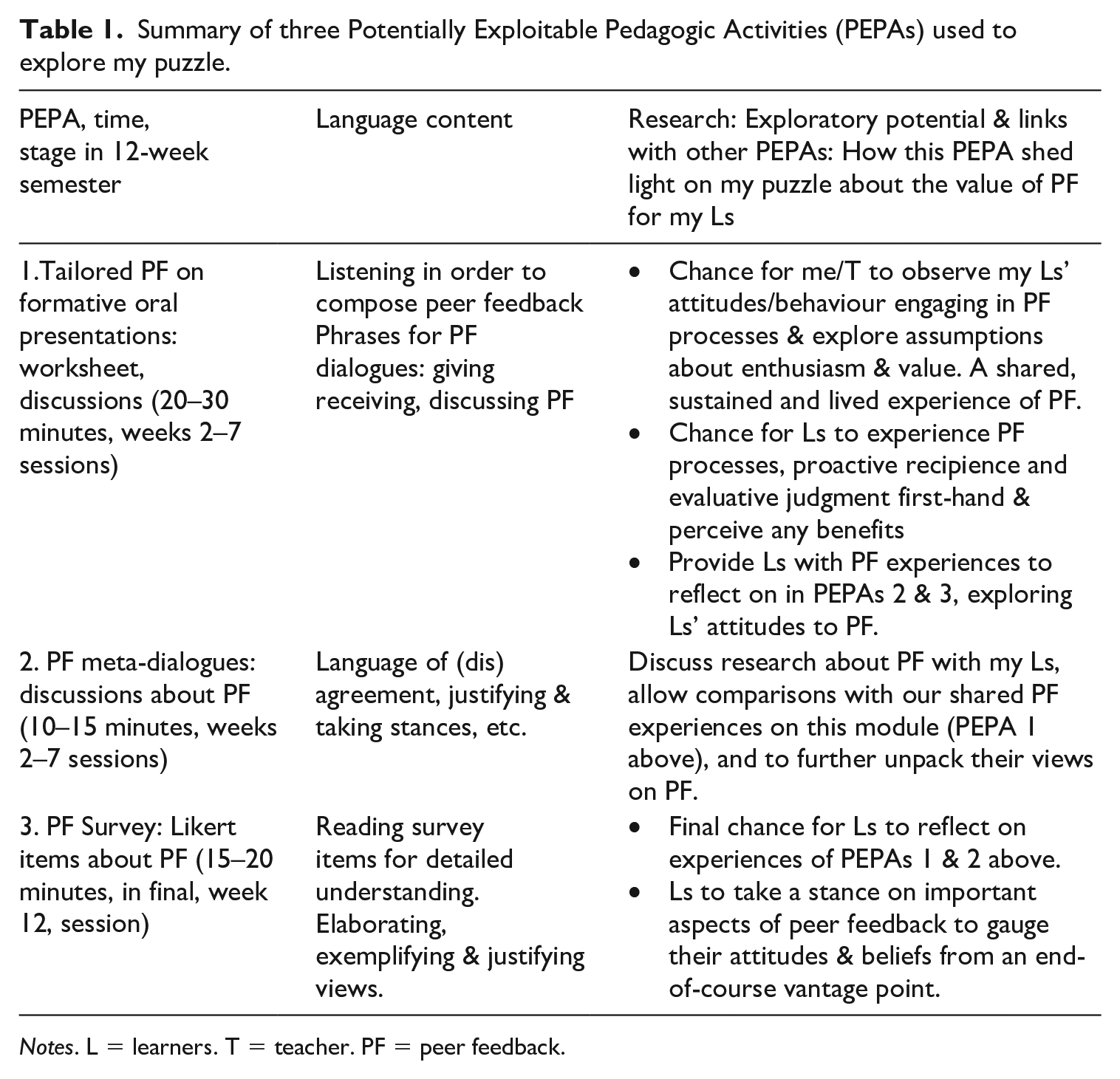
Notes. L = learners. T = teacher. PF = peer feedback.
a Tailored peer feedback on formative oral presentations
Oral presentation assessments on academic or business topics were common to both my EAP and BE classes. A clearly defined process was established in both my modules and scaffolded through pair work and group work at formative stages, with tutorials to close feedback loops prior to summative individual presentations in week 8 or 9. The presentation tasks aimed to develop learners’ oral communication skills for academic or business audiences. Different students (in pairs) presented each week and I observed this PEPA in action from weeks 2–7. With previous cohorts I had simply asked learners to listen and provide presenters with feedback as they saw fit. With this adapted pedagogy, I encouraged presenters to be proactively recipient and audience members to develop evaluative judgment through these steps:
Before presentations: I required presenters to tell peers (audience members) three aspects of their work, chosen from assessment criteria documents, they wanted peer feedback to target.
During presentations: Peers/audience composed feedback notes on a worksheet.
After presentations: presenters reflected on their delivery together. Peers/audience discussed and collated feedback in small groups. A group spokesperson provided feedback to individual presenters, again in small groups. Presenters responded/clarified feedback with peers.
Step 3 repeated until all groups had provided feedback to both presenters.
A group spokesperson posted written feedback for peers to the class Virtual Learning Environment (VLE). Peer feedback typically consisted of 3–4 compositions, depending on class size.
This final step ensured we captured the peer feedback so that it could be discussed, and action agreed in one-one tutorials in week 8. The investigative potential of this PEPA lay in providing me and my learners with a shared and lived experience of peer feedback, designed and mediated by me, their teacher and one which we could all observe and reflect on. Importantly for me, it was also one which reflected my current state of understanding about peer feedback. I also wanted learners to be able to draw upon this experience for PEPAs 2 and 3 below.
b Meta-dialogues
I incorporated the principle of ‘little but often’ by planning short discussions about aspects of peer feedback throughout the semester:
Research suggests that it is actually the peer giving feedback who may benefit more because the process helps them to understand what quality is (make evaluative judgments) and then improve their own work. (Liu & Carless, 2006; Nicol et al., 2014).
Based on Rubin (2006): Peer feedback is a normal part of academic life. Academics engage in it through journal peer review processes and so should students.
Constructing peer feedback is ‘a fundamental requirement in professional settings’ and thus a skill transferable to the workplace (Nicol, 2011, p. 4).
I initiated these discussions using statements on Powerpoint slides or gave learners short extracts to reading from the research articles. I scaffolded discussions with basic comprehension questions, then pair/group work leading into whole class discussion. In addition, I posted a summary of my peer feedback puzzle for debate on our VLE as a fourth meta-dialogue, asking my learners for their views on it. Finally, I used week 8 tutorials as a fifth meta-dialogue in which I focused on linguistic and cultural aspects of peer feedback, feeling learners might appreciate the one-to-one context of these discussions.
At this point, it is important to acknowledge that while I believe that productive practitioner research should not shy away from a frank exchange of views, I was, nevertheless, aiming to strike a balance with the way I discussed peer feedback with my learners. I did not want to preach about peer feedback or give learners a ‘hard sell’. Experience tells me that, in any case, students do not respond well to such approaches, but also, and in line with EP’s principles, I was keen to allow them space for their own curiosity and puzzlement.
c Survey
Whilst surveys alone are not enough to unpack respondents’ attitudes and beliefs, by directly asking my learners at the end of the courses about peer feedback, and specifically about our shared experiences of it, I would gather further data that I could compare with that from the first two PEPAs. The survey consisted of five-point Likert items about aspects of peer feedback (appreciation, making judgments, managing affect and taking action) developed from my interpretation of Carless and Boud’s (2018) features of feedback literacy. I piloted the survey with colleagues who provided improvement ideas for layout and wording. In addition to the closed items, survey respondents were strongly encouraged to enrich their responses with comments, examples or caveats, resulting in both qualitative and quantitative data.
Taken together, these PEPAs represented a subtle yet significant adaptation of my pedagogic practice. From a practitioner research perspective, they offered me an opportunity to see how learners engaged in and later viewed a process designed to develop proactive recipience through tailoring peer feedback, how learners responded in discussions about peer feedback, and how they reported their views on our shared peer feedback experience when directly asked.
5 Data collection and analysis
The two student populations, academic and BE, were available to me as their teacher and module leader. I reflected on and analysed the data from all three PEPAs, cross-referenced it and identified key themes to discuss which I felt would resonate strongly with fellow language teachers and teacher-researchers. I calculated survey data separately for the two groups to draw out variations in responses. The closed item survey responses were calculated as modes, recommended as the most meaningful measure for analysing Likert items (Dornyei, 2007). I used a professional learning journal to capture post-session reflections about learner behaviour, attitudes and beliefs which emerged from the meta-dialogues.
6 Ethics
Learners gave written informed consent in line with my institution’s ethical requirements. I preserved anonymity when writing up the research and stored all data securely. In accordance with EP’s integration principle of exploratory practice-as-research (Hanks, 2019), I maintained a language focus during and after PEPAs by giving learners language feedback on their language use during these activities.
IV Understanding and discussion
Forty-three learners (BE = 14, EAP = 29) fully completed the survey. Selected survey results are presented (as bar charts) in the discussion below with quantitative and qualitative data from the survey interwoven with data from the meta-dialogues and my own practitioner researcher observations and reflections. As EP focuses on gaining understanding, this term is preferred to the more traditional ‘Findings’ as a title for this section.
1 Most learners strongly agreed that peer feedback processes were potentially worthwhile . . .
During our first lesson, I told learners that in future weeks they would be receiving formative feedback from peers as well as feedback from me, the teacher. At the outset, the general consensus in class was positive, with most students who voiced an opinion at this stage stating that they felt ‘the more feedback the better’. In the meta-dialogue about the benefits of composing peer feedback and evaluative judgment, attitudes seemed very positive in relation to composing as well as receiving it. One EAP learner stated his belief that peer ‘teaching helps learning as well’ and that it facilitates a deeper perspective. Another group member stated that she felt peers could empathize and were thus well-positioned to provide helpful feedback. One learner even suggested in the meta-dialogue that peer feedback could be ‘inspiring’. At the end of the course, too, the survey statement: ‘I understand the potentially helpful role peer feedback can play in improving my work’ had met with strong or very strong agreement from both groups of learners (see Figures 1 and 2). Only one EAP learner, commenting on my puzzle in our meta-dialogue, warned that ‘A student might not take a peer’s feedback as seriously as a teacher’s feedback’. These generally open attitudes to peer feedback helped me advance my understanding of my puzzle by indicating that many of my learners saw potential value in peer feedback. With this in mind, I began to rethink the true meaning of the lack of enthusiasm I had previously observed.
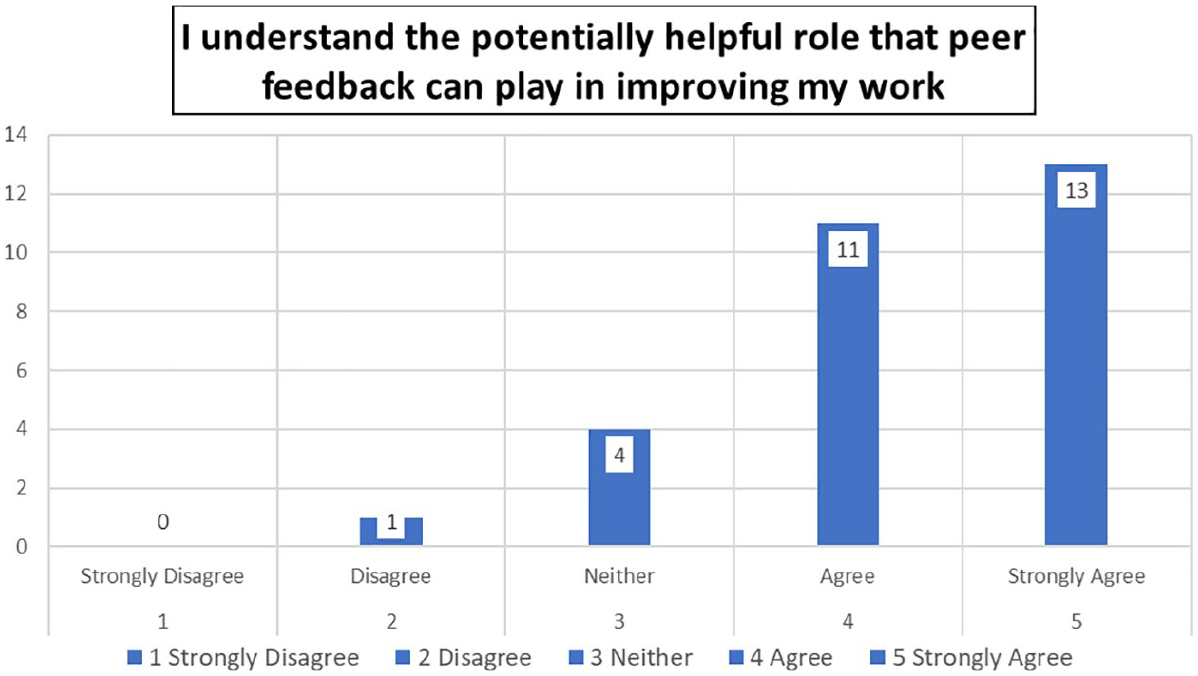
Responses of learners of English for academic purposes (EAP) to survey item about the potentially helpful role peer feedback can play in improving the quality of work.
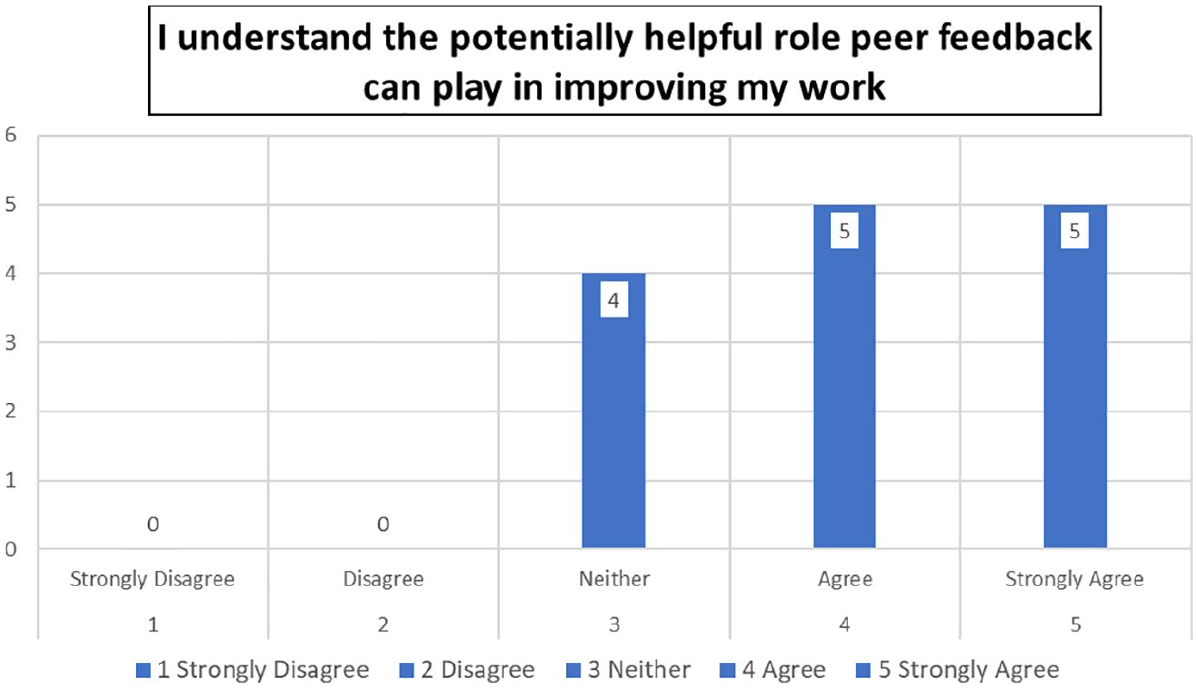
Responses of learners of Business English (BE) to survey item about the potentially helpful role peer feedback can play in improving the quality of work.
2 . . . and learners’ detailed engagement suggested they were finding the peer feedback process worthwhile
The first learners to present and request tailored peer feedback struggled with a core aspect of proactive recipience: choosing areas for peers to target in their feedback. Rejecting a tailored approach, they insisted ‘just tell me everything’. This was particularly the case with the EAP learners, perhaps cautious as newcomers to university life. To help learners decide, I suggested they consider their responses to a previous language self-assessment task to help them choose from the assessment criteria document. Overcoming these initial difficulties, future presenters grasped the idea and I observed that presenters were coming prepared not just with general areas for peers to tailor feedback to (e.g. vocabulary), but, hearteningly, becoming more specific (e.g. vocabulary about marketing). When students take extra, unprompted steps like this, it indicates to me that they are finding pedagogy worthwhile. Similarly, students came better prepared than I expected to discuss their peer feedback with me during tutorial meta-dialogues and most of them implemented at least some peer feedback in their summative presentations. This would be helping build perceptions of a worthwhile process.
I also observed that being expected to compose peer feedback was prompting far more attentive listening from peers in the audience, giving them a defined yet manageable focus (peer feedback could only be requested in three areas). Again, this indicated, to me, an investment in the process. It also, in turn, enabled the feedback givers to compose helpfully specific and detailed feedback. Analysis of the written summaries of the peer feedback on the VLE revealed that for ‘Materials’, ineffective slide design and structural deficiencies were highlighted in an actionable way (‘. . . next time you could include a conclusion at the end to summarize all of your points’), helping feedback recipients to see how to improve. Similarly, for pronunciation, problematic words accompanied more general comments: ‘the pronunciation could be improved . . . words such as Teenager, bachelor and preschool weren’t pronounced right’. From a teacher’s perspective it was encouraging to observe this level of specificity. Oral presentations can be quite a stressful performance task but for pronunciation at the level of individual words, students can at least anticipate the core vocabulary they will need. By giving specific examples to others of hard-to-pronounce items, the feedback composer would provide themselves with a powerful reminder to anticipate similar issues in their own work. I started to see new opportunities for my teacher feedback, too. For instance, when pronunciation feedback focused on individual words, I made comments about connected speech or intonation The deeper engagement which composing this detailed feedback entailed, was, I felt, further evidence of learners finding the adapted and more structured peer feedback process worthwhile.
3 Enabling language helped learners compose and delve deeper with peer feedback while . . .
Data from the meta-dialogues, the tutorials and the learners’ VLE posts on my puzzle suggested that they had most of the linguistic resources necessary to compose and discuss peer feedback. In the tutorial meta-dialogues, none of the students suggested that language issues had hindered them in completing the peer feedback activities in class. On occasions, nuance was evident as they used the framing language: ‘Perhaps a bit more eye contact with your audience would have made your presentation better’. Treating the peer feedback, in part at least, as a language task and providing learners with relevant linguistic phrases necessary to do this on the worksheet for tailored peer feedback worked seemed to work well. At times, I observed lively post-presentation discussions, a marked change from the lack of enthusiasm I had previously observed. I saw learners get past the headline statement of the peer feedback and discover the specific issues with, for example, their pronunciation or use of presentation signpost language. When encouraged to do so, learners even contested peer feedback, evolving a constructively critical perspective. Having the framing language to do this helped support such engagement. This suggested to me a process that students would, upon reflection, view as worthwhile.
4 . . . psychodynamics and culture were concerns only for a minority
Psychodynamics and cultural dimensions were, for some of my learners, a barrier to exploiting the potential value of peer feedback. When discussing peer feedback in relation to academic journal peer reviews, one EAP learner explained that it was hard for a freshman learner ‘to criticize others’, especially when even [he] himself does not want to get feedback’. Meanwhile, in the BE classes, when discussing Nicol’s 2011 research about the complexities of giving peer feedback in the workplace, one student claimed: ‘I’m too nice to be honest’. In the same BE meta-dialogue, another student worried that his feedback might cause offence to the receiver. However, in the survey, other BE students recognized that peer feedback represents ‘a judgment of . . . work . . . not the person’ (BE4) and that, although ‘giving feedback is harder [than receiving it, it’s] something I’m comfortable with’ (BE2).
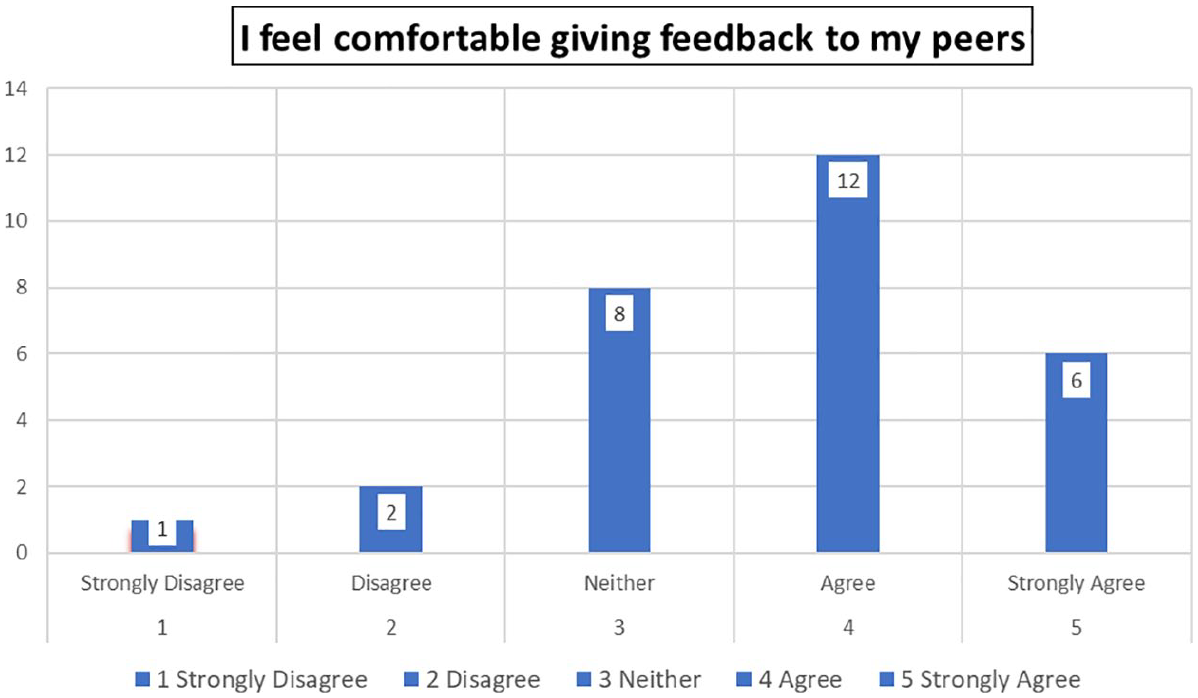
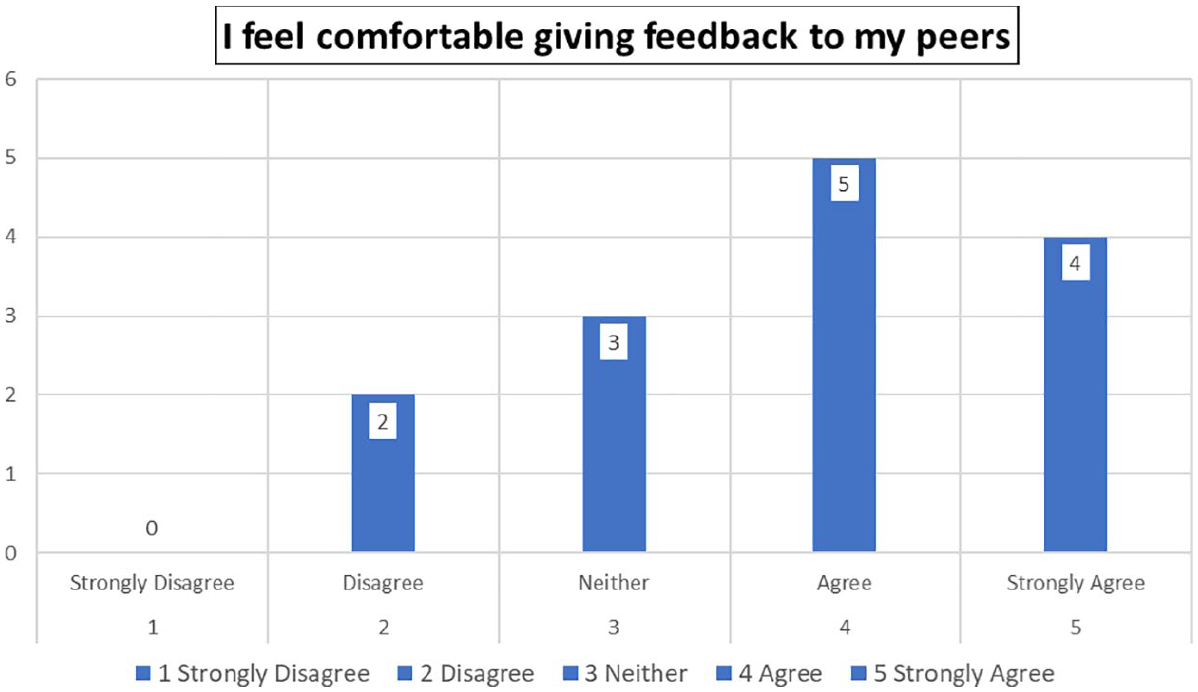
In relation to a cultural dimension to peer feedback attitudes, there were few hints it played a wide role. Learners from east Asia, often those suspected of struggling most to take on roles traditionally viewed as the teacher’s domain, were amongst those providing the most detailed peer feedback comments in class. Of course, this does not preclude the possibility that they were just extremely diligent students. Only one East Asian learner voiced a cultural concern about the tailored peer feedback process, admitting in a tutorial that she found it hard to criticize when composing peer feedback because ‘we don’t usually do that’ in Japanese. These learner responses, taken together with survey data showing broad agreement from both EAP and BE learners that: ‘I feel comfortable giving feedback to my peers’, suggested that socio-emotive barriers were not over-riding (see Figures 3 and 4).
Responses of learners of English for academic purposes (EAP) to survey item about how comfortable they feel giving peer feedback.
Responses of learners of Business English (BE) to survey item about how comfortable they feel giving peer feedback.
5 Learners were lukewarm about the usefulness of the peer feedback they received and a few learners resisted peer feedback processes very strongly
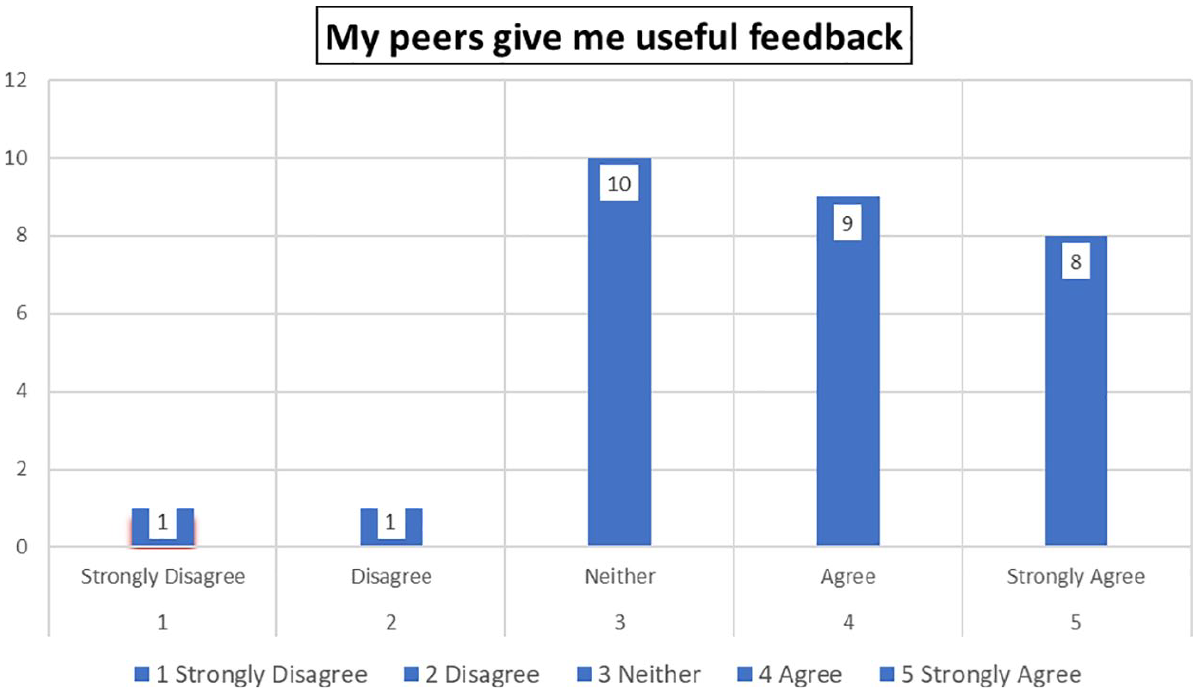
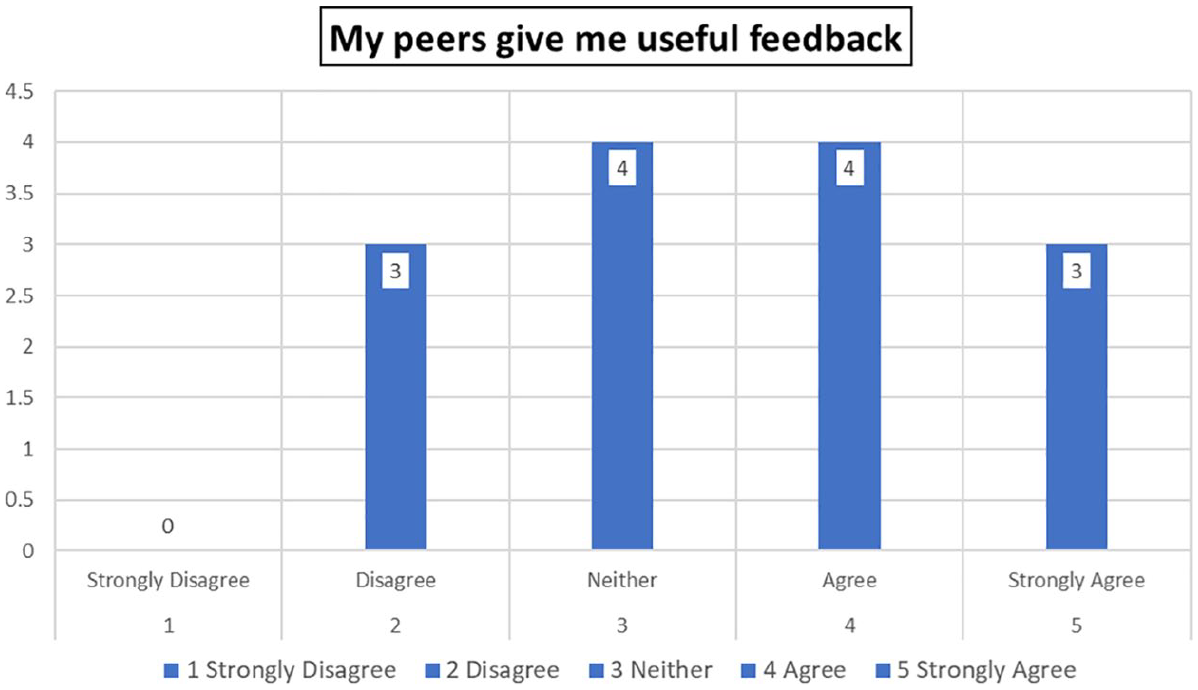
Despite the detail of some peer feedback and generally high engagement levels I observed, learners’ stated beliefs in the survey about the usefulness of the peer feedback they received were somewhat surprising. Overall, the survey item: ‘My peers give me useful feedback’ received the lowest mode score (3) of all survey items from both the EAP and BE learners (see Figures 5 and 6). Whilst the novelty of peer feedback led some learners to comment that it was useful ‘Because I’ve never got the peer feedback before’ (EAP1), there were more negative comments than positive added to the survey. One learner responding to whether peer feedback was useful stated rather diplomatically: ‘It’s not what is always happening’ (BE3). Another felt that ‘the teacher give[s] me better [feedback]’ (EAP29) or that only more experienced peers provide helpful feedback: ‘Most of [the] feedback I take under consideration . . . are from more experienced students’ (EAP9).
Responses of learners of English for academic purposes (EAP) to survey item about the usefulness of peer feedback.
Responses of learners of Business English (BE) to survey item about the usefulness of peer feedback.
In fact, the ability of peer feedback to provoke powerful responses was evident in the data. During the tutorial session meta-dialogues, one BE learner felt comfortable to initiate a conversation with me that we might not otherwise have had. He said that he did not particularly like giving peer feedback on the course as he had too often been forced to concentrate on language aspects when, as a business student, he would prefer to give peers’ business analysis his full attention. This simple but thoughtful problematization of the process reminded me that learners might be well-placed as audience members to offer peer feedback, but we should take care not in the quest for proactive recipience not to stifle learners’ natural interests.
Another powerful voice came from a survey respondent who warned ‘sometimes it [peer feedback] can do more harm than good’ (BE13). Another felt that ‘the comments towards my work were irrelevant and misdirected’ (EAP9). Given my attempts to ensure that feedback was given by groups, pooling credibility where possible, precisely to mitigate such concerns, the frustration experienced and expressed by this learner was, frankly, hard to read. This student’s comments seem to reflect their perception that the feedback providers, their peers, were just not ‘expert’ or knowledgeable enough. This view was also evident in the meta-dialogue with EAP learners about using academic journal peer review processes as a way to normalize peer feedback at university, it emerged that one learner felt peer feedback in general was too challenging for students as ‘You cannot judge in the professional way’ and others complaining that peer feedback lacked consistency and another student echoing my view that peer feedback needed to be specific. When I probed on this last point in the meta-dialogue, the learner in question said that he wanted detail to allow him to revise and honesty, suggesting that he felt peers sometimes had a tacit agreement to take it easy and avoid publicly criticizing each other’s work. Reflection on my own practice leads me to question whether the characteristics of an expert are fixed or circulating. For instance, as an EAP teacher, an academic generalist rather than a disciplinary specialist, I often cede the role of business expert to a business student when discussing the ins and outs of business. However, I usually re-inhabit the expert role for work on language and academic skills and this back-and-forth process is one I’m now accustomed to. The role of the more experienced Other is extremely relevant to this discussion because my efforts to encourage proactive recipience had inadvertently led learners to position peers as experts in areas where they would struggle for credibility and which might then influence whether or not the process was ultimately seen as worthwhile.
6 Why might my learners not view peer feedback as worthwhile?
Many of my learners viewed peer feedback as worthwhile in principle. However, these open attitudes to peer feedback sat alongside only moderate levels of agreement that peer feedback received had been useful. My key understanding was that the credibility of the provider was the main barrier to learners seeing the process as worthwhile, with language and cultural aspects, whilst relevant to some learners, seemingly of less overall importance. I also encountered very strongly negative resistance from a small minority of students. However, based on my observations of my learners and our shared experiences of peer feedback, I would still recommend developing learners’ proactive recipience and evaluative judgment as a means to positively shape their experience of and thus attitudes towards peer feedback. I did observe better engagement and some enthusiasm for it in my classroom. For me, this will remain a key indication that learners value a pedagogic process.
V Implications
1 Personal implications
This enquiry, lit by a pedagogical spark-of-interest around peer feedback, prompted a pause for thought and understanding, and then the design of an inclusive process of investigation. My enhanced understanding inspired me to make changes to peer feedback processes, which I would argue were enhancements of practice. Reflecting on this practitioner research reminds me that student resistance might be grounded in attitudes and predispositions towards an aspect of teaching and learning, or in the perceived or actual practical benefits (or lack of) that learners identify for themselves. I see a broader implication here, too: when, as teachers, we meet resistance to our pedagogy and diagnose the issue (e.g. my learners don’t value peer feedback processes), we should remain open to rethinking these initial interpretations as the diagnosis may not fully untangle the often-complex interplay between teachers’ and learners’ attitudes, beliefs and practice. Research findings may suggest approaches that practitioners feel they can adopt, but it is ultimately, the task of the teacher to sell it to learners and make it work in the classroom. It would be unrealistic to expect 100% buy-in from all learners with all aspects of our pedagogy, indeed this is rare, and continued resistance expected from at least some quarters. However, I have learnt that resistance should certainly not deter classroom practitioners from exploring, and I would argue that a key benefit for teachers who conduct practitioner research is an increased sense of confidence in both noticing and exploring resistance they may encounter with their pedagogy. It is also often the case that pedagogical changes prompted by shifting understanding are likely to run more smoothly in subsequent enactments. In the meantime, though, this practitioner research has reminded me that it is important to maintain a responsive and attentive outlook when introducing theorized pedagogy with my learners. Here are four further practical implications, prompted by my enquiry, for fellow language teachers and practitioner researchers.
2 Use meta-dialogue style tutorials to highlight the complementary value of peer and teacher feedback
My research indicated my learners were positively predisposed to peer feedback. It also proved instructive for me, highlighting how my teacher feedback had space to focus elsewhere. As language teachers, we should build on any openness towards peer feedback and encourage proactive recipience in class. By gathering both teacher and peer feedback, we can highlight how they can add value to each other, resulting in richer overall feedback. We can organize feedback tutorials before assessments to draw out this added value in a structured way. Learners could also be asked questions about peer feedback processes in localized settings and/or to prepare questions specifically about their peer feedback. If done regularly, knowing that the feedback remains live and ripe for discussion will help learners engage more fully with peer feedback processes in the classroom.
3 Scaffold proactive recipience with concrete reference points for language learners
To develop proactive recipience through tailored peer feedback, language learners will initially need support in choosing areas for peer feedback to target. Language teachers should refer learners to assessment criteria documents, but this may not be sufficient. Teachers can also refer learners to needs analysis self-assessment activities, feedback from previously taken language tests or diagnostic activities. This will scaffold what is likely to be a novel process for many students. In addition, we should ask learners to justify their choices, explaining, for example, that ‘I would like feedback on my vocabulary use because when practising for IELTS I always got a relatively low score in this area.’ Prompting learners to take this additional step will allow them to draw upon previous feedback experiences to ground the process and later be more likely to see value in it.
4 Teach enabling language for peer feedback
In addition to the useful language resources developed by educational researchers (e.g. Winstone & Nash, 2016) which focus on feedback meta-language, more materials which offer learners the linguistic frames necessary to enable dialogues about peer feedback should be developed (e.g. phrases to praise, sensitively critique, clarify meaning). Language practitioners, including EAP teachers and teachers of modern languages would be well-placed to draw up banks of such language and provide it to learners in their localized contexts to use whilst engaging in peer feedback in language classrooms. Once learners in one cohort have composed peer feedback using these frames, their feedback, could be anonymized and shown to future cohorts and then analysed to elicit the linguistic moves for new cohorts, an inter-cohort dialogue.
5 Encourage proactive recipience but be careful not to stifle feedback composers
My BE learner who was steered away from his preferred business analysis of a peer’s presentation exemplified the potential for tensions that might arise when developing proactive recipience in class. Remember to allow peers composing feedback on oral work (as audience members) or of written work (as readers) to retain an element of choice in the areas they target. For instance, students composing peer feedback on presentations could retain at least one area that they themselves would like to focus on. Do not lose sight of learners’ natural interests or preferences when managing proactive recipience or leave them feeling too restricted when composing tailored peer feedback. Instead, promote an inclusive peer feedback process alongside encouraging proactive recipience.
VI Conclusions
From a practitioner researcher perspective, my learning journey has led to significant enhancement of my understanding of peer feedback, its potential and why my pedagogic practice with my learners might be playing out in the ways that it does. This practitioner research led me to confront the classroom complexities of peer feedback. It also highlighted how I could benefit as a teacher from untangling learners’ attitudes and beliefs about potential value and the real perceived usefulness of pedagogy. While it was discouraging that learners were only moderately enthusiastic about the quality of peer feedback they received in class, I observed many learners engage with the peer feedback processes and, I believe that many will have benefited from it, despite the caveats and reservations some expressed and the strong resistance from a smaller minority. I feel that, overall, most learners took some important first steps towards becoming proactively recipient and developing their evaluative judgment, and in the process attaching increased value to peer feedback. The peer feedback meta-dialogues, whilst not providing definitive answers, offered me fresh inspiration and practical ways of working to take forward into dialogue with future learners. The overall process reminded me that there are few more illuminating ways than practitioner research to survey my pedagogy and satisfy my professional curiosity about my practice.
