



Abstract
Australian students come from a wide range of linguistic and cultural backgrounds with each context providing unique challenges. Tensions however exist between the intentions to address diversity and the competing influence of a high-stakes context that prioritizes monolingual classroom practices and diminishes teachers’ use of engaging pedagogy. Viewed through the lens of socio-spatial theory, these tensions highlight how the ideal of education for diversity is re-shaped by the everyday practices in schools and systems. This can result in monolingual ‘firstspace’ practices that do little to develop the knowledge of language and culture that is central to students’ engagement with learning. This article reports ethnographic research in which secondary subject English teachers challenged routinized monolingual practices and re-imagined their classroom practices. The use of translanguaging and the reading and writing of poetry – translanguaging poetry pedagogy – created ‘space’ to support a dynamic process in which students could use all their linguistic resources to produce identity texts. The use of translanguaging and identity texts disrupts a transmission pedagogy that positions the student as a blank slate. Teachers reported how translanguaging poetry pedagogy moved from a ‘thirdspace’ practice to a ‘what we do’ or ‘firstspace’ practice as they came to see that using students’ full language repertoire is a way to return the power of language to their students. The resultant translanguaging space and the symbolic propensity of poetry helped students to develop powerful personal representations and reinforces the need for pedagogies that acknowledge students’ diverse backgrounds, and honor the languages and identity of all students.
I Introduction
Like many countries, Australia is characterized by a complex, super-diverse (Vertovec, 2007) cultural and linguistic landscape with many cities and neighborhoods being multilingual environments. Many Australian classrooms are comprised of students from diverse backgrounds who draw on multiple ways of thinking and communicating about their knowledge and experiences. Whilst the diversity of Australian schools is recognized and promoted in policy documents such as the Australian Curriculum (ACARA, no date a), tensions exist between the stated intention to address diversity and the often competing influence of a high-stakes context that prioritizes monolingual classroom practices, and often diminishes teachers’ use of engaging, inclusive pedagogy (Berliner, 2011; Dutton & Rushton, 2018b). The resultant monolingual practices remind students from diverse linguistic backgrounds that their language knowledge is not valued in school contexts and do little to maintain and develop the students’ knowledge of their language and culture that is central to engagement with learning, literacy, and well-being (see also Cummins, 2000, 2005; D’warte, 2014; García, Johnson & Seltzer, 2017).
Viewed through the lens of socio-spatial theory (Lefebvre, 1991; Soja, 1980), these tensions highlight how the ideal of education for diversity is re-shaped by the everyday practices in schools and systems thus enacting the characteristics of, and interactions between the ‘perceived’, ‘conceived’ and ‘lived spaces’ of representation. Within the English language classroom, for example, Australian students are required to engage with and draw upon their own lived experiences – culturally and linguistically (ACARA, no date a; NESA, 2019). With notions of language and culture intimately interconnected (Cummins, 2000), by implication, denying students access to the breadth of their linguistic resources arguably denies them access to their equally complex and evolving representations of culture, thus limiting their ability to explore and express issues of language, culture and identity. There is therefore a continued need to re-imagine the classroom practices that we employ in our multicultural classrooms, to work in the ‘thirdspace’ (Soja, 1996), and explore new possibilities that challenge the routinized everyday monolingual practices.
In the research below we report findings from a multi-phased ongoing professional learning initiative in which we have been involved over the last five years. The ‘Identity Texts Project’ (Dutton & Rushton, 2018b) emerged from the keen desire of the participating English teachers and we, as their University partners, to engage in professional learning to enhance students’ literacy and language outcomes, acknowledge students’ identities, and strengthen students’ connectedness with their cultural backgrounds. The project, which now involves three secondary and three primary schools, utilizes inclusive pedagogy that honors students’ linguistic and cultural knowledge, and their agency in the learning process. In the phase of the project reported below, we looked to the use of translanguaging and the reading and writing of poetry – translanguaging poetry pedagogy – as a way to create ‘space’ for students in a multicultural classroom to voice their perspectives on language, culture, and identity.
Transforming the classroom into a translanguaging space (Li, 2014), supports a dynamic process in which multilingual speakers can employ a flexible use of their individual linguistic resources (Allard, 2017). Translanguaging offers teachers and learners the opportunity to acknowledge the ‘flexible and meaningful actions through which bilinguals select features in their linguistic repertoire in order to communicate’ (Velasco & García, 2014, p. 7), embrace the use of multiple languages, and in so doing move away from a monolingual classroom. Student agency is made central to the process, and creativity is supported by acknowledging the power relations in the classroom and the lived experience of learners (Freire, 1975) resulting in a transformative pedagogy (García et al., 2017; Jones, 2017; Ollerhead, 2018).
Poetry offers an ideal vehicle for this transformative ‘thirdspace’ translanguaging pedagogy. Despite being a mandatory component of subject English in Australian schools, writing poetry can be a marginalized activity in English classrooms due to perceived time constraints associated with high stakes testing (Dutton & Rushton, 2018a), as well as low levels of teacher confidence (Weaven & Clark, 2013). Poetry has, however, been shown to have the capacity to: give voice to students’ individual linguistic, meta-cognitive (Song & Cho, 2018) and social capacities (Li, 2014); to support unique language practice and ways of knowing (Vogel & García, 2018); and to create space to experiment with languages and symbolically articulate personal representations of identity (Dutton & Rushton, 2018a). We argue, therefore, that poetry writing offers rich possibilities as a medium in which students can employ their full linguistic repertoire and represent their identities as shaped by their family background and experiences in contemporary Australian society.
In reporting our research, we begin with a review of research pertaining to translanguaging as a practical theory and the characteristics of poetry that facilitate representation of language and identity. The ‘Identity Texts Project’ from which the research emerges is then outlined, with the project and research data contextualized within the socio-spatial frames of ‘translanguaging space’ in Lefebvre, 1991; Li, 2011; Soja; 1980. These spatial theories are then used to explore how the everyday practices of school and classrooms can be shaped by the prevailing monolingual ideologies of schools and systems, and the impact this can have on student engagement and teacher practice in multicultural classroom contexts. Finally, the article considers how ‘thirdspace’ practices in the form of translanguaging poetry pedagogy can challenge deficit views of students from diverse language backgrounds, support student agency, and give voice to students’ symbolic representations of language and identity.
II Review of the literature
Across Australia and particularly in urban settings the population is becoming increasingly multilingual, a situation noted in both current and ongoing research (Chik, Benson & Maloney, 2019; D’warte, 2014). Australia has always been a multicultural and multilingual country. Presently, over 350 languages are spoken in Australia, including Indigenous languages that are passed on as a mother tongue, those that are being awakened and revived, as well as emerging pidgins, creoles and lingua francas; migrant languages; and English, the de facto national language of Australia (Eades, 2013; Lo Bianco & Slaughter, 2017). In contemporary Australia teachers are therefore attempting to recognize and build on the linguistic and cultural resources that their students bring to school. While educational success is dependent on the development of literacy in English, a broad range of research stemming from the Multilingual Turn (May, 2013) in education argues that success is not achieved by narrowing the curriculum or with pedagogical approaches that focus on the acquisition of English only (Cummins, 2005; García & Kleyn, 2016; Hammond, 2012; Schalley, Guillemin & Eisenchlas, 2015).
1 Translanguaging as a practical theory
Originating in Williams’ (1996) research in the Welsh context, translanguaging has been further developed to refer to ‘new language practices that make visible the complexity of language exchanges among people with different histories, and releases histories and understandings that had been buried within fixed language identities constrained by nation-states’ (García & Li, 2014, p. 21). The now widely used term ‘translanguaging’ (Creese & Blackledge, 2015; García, 2009; Williams, 1996) differs from earlier conceptions of bilingual language use such as ‘code switching’ that position bilinguals as choosing to privilege the use of separate linguistic systems in particular contexts (Velasco & García, 2014, p. 7). Instead, translanguaging describes the multilingual practices of bilingual speakers as the starting point allowing flexible bilingualism to operate without ‘clear boundaries’ and be positioned ‘at the heart of the interaction’ (Blackledge & Creese, 2010, p. 22). Rather than a strategy, translanguaging is a ‘framework for conceptualizing the education of bilinguals as a democratic endeavour for social justice’ (Velasco & García, 2014, p. 7).
Research has demonstrated that translanguaging practices can support language development including metalinguistic awareness and cross-linguistic flexibility (Cenoz, 2017; García-Mateus & Palmer, 2017) and greater language development in the second language (L2) (Allard, 2017) or dialect (Eades, 2013). Furthermore, the self-directed use of translanguaging strategies offers possibilities for developing proficiency in negotiating language use resulting in a strengthening of metalinguistic awareness (Cenoz, 2017). Translanguaging practices should therefore not be equated with a deficiency in linguistic, cognitive or social capacities (Li, 2014) but rather as exemplifying a high level of skill in multilingual or transnational students.
A broad range of research, focusing on various elements of dynamic language use have shown the benefits of facilitating student engagement with their breadth of linguistic resources. For example, academic benefits for multilingual students have been shown to include the further language learning ability afforded by expanded spheres of communication and the opportunity to develop self-regulation and direction when completing tasks and projects (French, 2016). A low-risk environment (Worthy et al., 2013) in which students are situated as possessing important cultural and linguistic knowledge provides a safe space which allows students to experiment by sharing personal and cultural knowledge and perspectives. Optimal learning of both concepts and language can therefore be achieved through student engagement in complex discussions using both their first (L1) and second (L2) languages, especially when they are able to use higher-order speech acts in complex oral interactions (Duarte, 2019; Hamman, 2018). Translanguaging has been shown to benefit students both academically and socially as well as supporting teachers to develop a transformative pedagogy that is truly inclusive (Cummins, 2000; Skutnabb-Kangas, 2013).
The co-construction of knowledge (Duarte, 2019, 2020) and the development of critical thinking (Creese & Blackledge, 2015) are supported by translanguaging strategies while at the same time supporting teachers to deepen their knowledge about their students’ understandings and abilities (Li, 2014; Sayer, 2013). Research also demonstrates that translanguaging helps to create genuinely inclusive classrooms in which equitable, empowering language learning can take place (Cenoz & Gorter, 2017; García & Leiva, 2014; García & Li, 2014; García, Flores, & Woodley, 2012; Garrity, Aquino-Sterling & Day, 2015; Gort & Sembiante, 2015; Sayer, 2013; Vogel & García, 2018). This is an authentic step towards social justice in an educational context (García-Mateus & Palmer, 2017) because it transforms the power relations between teachers and students (Creese & Blackledge, 2015). This shift can become the basis of a new way to establish connections between the home and school (Pacheco & Miller, 2016) through the authentic development of bilingual identities (García-Mateus & Palmer, 2017). Translanguaging can thus enhance well-being as it confirms the equal value of all linguistic resources and gives agency to individuals to choose when and where to deploy their skills (Alamillo, Yun, & Bennett, 2016; Fielding, 2016; Rosiers, Van Lancker & Delarue, 2018).
Teaching practices that do not embrace the translanguaging framework have been shown to undermine the learning rights of language-minority students (García, 2013; Velasco & García, 2014). This is clearly the case where students do not have the opportunity to formally learn or even to use their first language for learning. The implementation of a translanguaging framework also impacts on monolingual students and teachers whose cultural and linguistic awareness can be broadened in contexts where language is central to learning (Fielding, 2016; García & Li, 2014; García-Mateus & Palmer, 2017; Hamman, 2018). Furthermore, teachers’ own perceptions may be challenged or confirmed by the benefits that students experience (Holdway & Hitchcock, 2018). García, Johnson and Seltzer (2017) identify four purposes for the strategic use of translanguaging in education which include supporting students to develop linguistic practices to further their academic learning and to make space for both ‘students’ bilingualism and ways of knowing’ thereby supporting both their ‘bilingual identities and socioemotional development’ (p. 7). When plurilingual development is supported, students can collaborate on projects that afford opportunities for the rich discussion that helps to develop both language and literacy (Li & Luo, 2017; Lotherington, 2013). Furthermore, when students are supported to legitimately use all their linguistic resources in a language aware classroom it results in the development of both first and additional languages and dialects (Allard, 2017; D’warte, 2014).
2 Poetry and translanguaging
An important aspect of translanguaging in practice is that it is the student who makes linguistic choices, not the teacher. Agency is given to the learner to select from her/his own personal resources to respond and create. As contemporary poetry experiments with fluid language practices and values the tensions between different ways of representing meanings, it similarly creates space for multilinguals to showcase the complex negotiating strategies they use when writing and interpreting texts (Canagarajah, 2013). Poetry allows students to develop proficiencies as strategic users and negotiators of language (Canagarajah, 2013), selecting words, phrases and forms by which to express their ideas and emotions orally (Bauer, Colomer, & Wiemelt, 2020) and in writing. It is a form that lends itself to personal expression and nothing is more personal than choosing in what way you wish to express yourself (Halliday, 2004). In this sense, poetry can function as a transgressive medium that offers scope for cultural expression and the exploration of the boundaries of nationalities (Fu, 2009) and languages. Michael Rosen observes that: ‘poetry, when handled well, offers autonomy. It does this . . . through several channels: suggestion; reflection; juxtaposition; physicality of language; mutability of language and interculturalism’ (Rosen, 2009).
Poetry can also function as a form of ‘interim discourse’ between students’ ‘primary discourses’ and the ‘secondary discourse’ or more academic discourse that is the goal of schooling (Gee, 2000) and also allows the production of high-order speech acts (Duarte, 2019). These characteristics, coupled with the brevity of the poetic form, set multilingual students up for success and, we argue, more safely support their move from spoken to written language (Dutton & Rushton, 2018a) whilst supporting them to give voice to their symbolic representations of language and identity.
The next section offers a theoretical framing for the research outlining how socio-spatial theory frames both the ‘The Identity Texts Project’ from which the data is drawn, and the analysis of the reported data. It outlines how translanguaging and poetry can function as ‘thirdspace’ practices, challenging dominant classroom routines and embracing creativity and criticality.
III The theoretical frame: The trialectic of spatial practices
The trialectic of spatial practices (Lefebvre, 1991; Soja, 1996), specifically as interpreted in Soja’s (1996) ‘thirdspace’ and Li’s ‘translanguaging space’ (Li, 2011, 2018) offers an effective lens through which to view the characteristics of, and interactions between, the various ‘spaces’ that together comprise educational systems and teaching and learning. Lefebvre (1991) argues that space ‘is neither subject nor object’ but rather is a ‘social reality’, and ‘a set of relations and forms’ (p. 116). ‘Itself the outcome of past actions, social space is what permits fresh actions to occur, while suggesting others and prohibiting yet others’ (p. 73). Spaces are always contested, political and ideological (Lefebvre, 1991). Lefebvre’s ‘trialectic of spatiality’ generates the perceived, conceived and lived spaces of representation. These spaces function simultaneously whilst possessing distinct characteristics (see also Ryan, 2011) and the conceptualization of these spaces for schools is outlined below.
1 The space of everyday practice: Perceived real space
Lefebvre’s perceived real space is the space of normal or everyday practice, relationships, settings and systems. Labeled ‘firstspace’ by Soja (1996), in schools this ‘perceived’ space is ‘signified by what students, staff and community members do . . . and the nature of their established routines and practices’ (Ryan, 2011, p. 887). It includes the ‘this is what we do’ and ‘this is how we do it’ elements of a teacher’s work and a student’s learning that can also serve to normalize the monolingual classroom (Kramsch, 2009). These ‘firstspace’ practices, whilst becoming routines and constructing a sense of cohesion for the organization and participants, are not necessarily coherent ‘in the sense of being intellectually worked out or logically conceived’ (Lefebvre, 1991, p. 38). In schools, the routines include the rhythms associated with bell times, class organization, seating plans, teaching units of work, assessment tasks as well as the relationships that comprise faculty and full school relationships.
2 The dominant space of the ‘ideal’: conceived ideal space
In schools, the ‘secondspace’ (Soja, 1996) representations of the ‘ideal’ emerge from historical educational artefacts, educational policies and curriculum documents, teaching accreditation protocols and long held societal views about the nature of education and professional standards. These comment on and inform ‘firstspace’ practices with the intention of aligning the everyday ‘firstspace’ practices with the ‘ideal’ practices conceived by the dominant voices in education. The dominant space in any society, the conceived; ideal space (Lefebvre, 1991) is the space of ‘scientists, planners, urbanists, technocratic subdividers and social engineers . . . all of whom identify what is lived and what is perceived with what is conceived’ (Lefebvre, 1991, p. 38). The ‘firstspace’ routinized practices in turn influence the ‘secondspace’ perspectives in a continuous dialectic relationship of ‘real-and-imagined’ space (Soja, 1996).
The teaching of subject English in Australia functions within the ‘conceived spaces’ of curriculum policy, teaching professional standards and government education policy aimed at generating quality learning outcomes for students. Continued assertions of poor literacy standards (Kostogriz & Doecke, 2011; Parr, Bulfin & Rutherford, 2013), significant workload issues (Day, 2017; Day & Gu, 2014; Manuel, Carter & Dutton, 2018) and a focus on results on high-stakes tests such as the Programme for International Student Assessment (PISA) and the National Australian Program: Literacy and Numeracy (NAPLAN) means the current ‘firstspace’ practices of English teachers are a site of contestation. In some schools, teachers are teaching on a metaphorical ‘high wire’ (Dutton, 2017) as they negotiate the political and educational tensions (O’Sullivan, 2016; Sawyer, 2010) fueled by the ‘secondspace’ policies and media representations of effective teaching practice. Often this involves routinized emphasis on content and strategies that prepare students for the tests and reducing other activities to maximize the impact of scarce resources (Brass, 2015; Comber, 2012; O’Mara, 2014) with overworked teachers reaching for ready-to-teach resources (O’Sullivan, Carroll & Cavanagh, 2008, p. 174) or narrowing pedagogy (Berliner, 2011; Carter, Manuel & Dutton, 2018; Parr et al., 2013; O’Mara, 2014). This often leads to the marginalizing of lower stakes, creative endeavors such as poetry writing and the compliant valuing of canonical texts – with both strategies designed to align with the ‘ideal’ space voices.
The resultant narrowing of curriculum and pedagogical repertoire has unanticipated consequences especially for marginalized groups from culturally and linguistically diverse backgrounds with the ‘real-and-imagined’ tension seen in the area of student wellbeing. The Australian Student Wellbeing Framework (Education Council, no date), for example, sets out the strong association between safety, wellbeing and learning. ‘Students who feel connected, safe and secure are more likely to be active participants in their learning and to achieve better physical, emotional, social and educational outcomes.’ These aspirations however are constrained by the resource limitations, school structures and practices of the ‘real’ space’. Research and media reports increasingly document the significant anxiety experienced by many students confronted by the ‘ideal’ of high performance as measured on single sitting high stakes tests such as NAPLAN (Howell, 2017; Manuel et al., 2018). Additionally wellbeing objectives are not always aligned with the historical and societal beliefs that construct Australian schools as monolingual learning spaces despite the research evidence showing the academic and wellbeing benefits of valuing all of students’ linguistic and cultural resources (Creese & Blackledge, 2015; Duarte, 2019; French, 2016; Rosiers et al., 2018).
3 The ‘thirdspace’ of subversion and re-imagining
Labeled ‘thirdspace’ by Soja (1996), this space is characterized by ‘extraordinary openness’ and is a place of critical exchange defined by collective resistance and choice. It is a meeting place for those who have been marginalized from dominant societal interactions (Soja, 1996, p. 50). The ‘thirdspace’ is a space for ‘new possibilities and imaginings of how things can be, a space of transgression and symbolism’ (Ryan, 2011, p. 888). In this third representational space ‘the imagination seeks to change and appropriate’ (Lefebvre, 1991, p. 39).
Over 25 years ago, Maxine Greene (1995) argued that the ‘taken for granted’ need to be questioned and put into an unfamiliar perspective. The ‘created space’ of schools and classrooms in Australia often involves ‘taken for granteds’ based on hegemonic views of race, language and education such as ‘English only’ classroom and playground rules that marginalize students from culturally and linguistically diverse backgrounds (CALD) or language backgrounds other than English (LBOTE). It is for this reason that multicultural Australian classroom teachers seeking to promote student well-being, agency and quality learning in diverse classrooms often feel constrained. The ‘thirdspace’ is where English teachers can interrogate their teaching and view their current practice from an unfamiliar perspective. In an Australian multicultural classroom this might involve ‘transgressive’ pedagogy that sees students using L1 when completing an oral task and evaluating the student learning and wellbeing outcomes. Decisions such as these challenge the everyday routines and adopt resources and transformative pedagogies that give voice to aspects of students’ knowledge and skills that are often silenced, normalized or habituated (Greene, 1995, p. 23). As Greene argues, once this is done ‘we can see our givens as contingencies, then we have an opportunity to post alternative ways of living and valuing and to make choices’ (p. 23).
‘The Identity Texts Project’ reported below explores these possibilities. The project embodies ‘thirdspace’ strategies and resources that resist any narrowing of the curriculum in response to the high stakes testing milieu. Greene (1995) argues that: ‘What is crucial is the provision of opportunities for telling all the diverse stories, for interpreting membership . . . for making inescapable the braids of experience’ (p. 17). ‘The Identity Texts Project’ sets out to do this by supporting teachers to shape the ‘translanguaging space’ in their classrooms and allow space for students to use all their linguistic resources to voice their understandings of language and identity.
4 Translanguaging as ‘third space’ pedagogy
Because it challenges prevailing school practices in most schools, translanguaging can be viewed as a ‘thirdspace’ practice with the ‘translanguaging space’ being a space typified by openness and creativity (Li, 2011). The ‘translanguaging space’ is a transformative space meaning the process of cultural translation between different traditions takes place and different ‘identities, values and practices . . . combine together to create new identities, values and practices’ (Li, 2011, p. 1223):
[It] creates a social space for the multilingual user by bringing together different dimensions of their personal history, experience and environment, their attitude, belief and ideology, their cognitive and physical capacity into one coordinated and meaningful performance. (Li, 2011, p. 1223)
The ‘translanguaging space’ embraces both creativity and criticality (Li, 2011). By breaking the boundaries between old and the new and the acceptable and the challenging, (Li, 2011) the ‘translanguaging space’ embraces creativity – a dimension of education under threat in many educational contexts (Berliner, 2011; García & Kleyn, 2016; Jefferson & Anderson, 2017). The translanguaging perspective (Blackledge & Creese, 2010; García & Kleyn, 2016; Li, 2011, 2014, 2018) creates the capacity to think ‘beyond the boundaries of named languages and language varieties’ (Li, 2018) and allows bilinguals to make flexible use of their repertoire of linguistic resources in order to make sense of their worlds. Multilingualism also enacts tension, conflict, competition, difference and change (Li, 2011). As ‘thirdspace’ pedagogy, adopting translanguaging theory involves challenging the ‘real-and-imagined’ and the hegemonic monolingual model of education. To achieve this, intentionality of practice is required (García & Kleyn, 2016; Li, 2011, 2014). The next section describes the steps undertaken to use the translanguaging space to support students from diverse language backgrounds to represent their language and identity through poetry.
IV Research methodology
1 Research context
This Human Ethics Research Committee (HERC) approved study, adopted a qualitative, ethnographic design. The study is located in the tradition of phenomenological research and seeks to represent the lived realities of the participating teachers and their students (Creswell, 2013; Denzin & Lincoln, 2011). The multiple site case study design was chosen for the capacity to yield rich description while acknowledging the limitations this places on generalizability. The trialectic of spatial practices (Lefebvre, 1991; Soja, 1996) is adopted as a theoretical frame for interpreting the practices and perspectives that emerge from the data.
The site for this research was one of the two secondary schools and two primary schools whose teachers are engaged in ongoing professional learning as part of the ‘Identity Texts Project’. Nine teachers of Year 7 and Year 8 English from this school in South Western metropolitan Sydney, Australia accepted the invitation to be involved in this most recent phase of our research. Ninety-seven percent (97%) of students at the school have a language background other than English (LBOTE) or speak English as an additional language or dialect (EAL/D) and therefore speak one or more languages other than English. 65% of students come from the bottom quarter of socio-educational backgrounds as indicated by the schools’ Index of Community Socio-Educational Advantage (ICSEA) ranking on the Australian My School website (ACARA, no date b).
The research commenced with a series of meetings during which teachers were engaged in professional dialogue and reflection (Timperley, 2011) focused on their identification of the literacy and wellbeing needs of their students The professional collaboration and sustained intervention involved several cycles of information gathering, meetings with school leaders; delivery of professional learning and development and evaluation of teaching programs and resources. Strategies to better address linguistic diversity and enhance student wellbeing were identified as areas for development with teachers also expressing the desire to prepare students effectively for the mandatory high stakes tests such as NAPLAN and the HSC (NSW Higher School Certificate examination). Teachers were keen, however, to explore new possibilities that were engaging for students and that did not involve a narrowing of pedagogy and curriculum.
Because translanguaging has been shown to be an effective pedagogical practice in contexts where the language of instruction is different to the languages of the learners (Li, 2014), we outlined strategies to help students use their home languages in English lessons. As argued above, the epistemological function of translanguaging can facilitate access to background knowledge (Sayer, 2013), develop critical thinking, and deepen understandings and socio-cultural engagement (Creese & Blackledge, 2015). Translanguaging also has the potential for liberating the voices of minority language students (Creese & Blackledge, 2015) and this aligned with the desired learning and wellbeing outcomes for students. As part of the professional learning, these research-based benefits of translanguaging were shared with teachers.
Working ‘elbow to elbow’ with the teachers we also shared examples of quality literature by poets from a diverse range of cultural and linguistic backgrounds and which employed translanguaging. We then introduced teachers to the concept of identity texts (Cummins, 1981, 1986, 2000; Cummins & Early, 2011) as being any products of students’ creative work that connect to the student’s cultural background and community and disrupt what Freire (1975) termed a transmission pedagogy, whereby students are viewed as blank slates. Identity texts arguably offer an accessible, focused way to draw attention to ‘essential aspects of the link between identity affirmation, societal power relations, and literacy engagement’ (Cummins et al., 2015, p. 556) and importantly for this project, they help bring the voices of multilingual students to the fore.
The ‘Supportive Strategies for Multilingual Classrooms’ framework (Dutton et al., 2018, p. 2) was employed to design the learning and teaching sequences. The approach utilizes a range of procedures including: engagement with multiple languages; progression through the mode continuum from spoken to written language; using multimodality tools; providing a rich print environment, and positioning students as powerful communicators. Strategies included language mapping (D’warte, 2014) to foster metacognition relating to language and acknowledge students’ existing linguistic and cultural knowledge, as well as drama pedagogy to support kinesthetic and broader engagement in learning (Ewing, 2012). These emphases and strategies characterize the ‘translanguaging poetry pedagogy’ employed in the unit of work and these are outlined in Appendix 1.
2 Data sources and analysis
Project data reported in this article include the following anonymized artefacts gathered from the poetry unit ‘Identity’ which was developed and then taught to Year 7 (13 year olds) and Year 8 (14 year olds) as part of the ‘Identity Texts Project’. Consent was received for the release of the following teacher selected project artefacts to the researchers for analysis.
Teacher reflections on the teaching programs and resources prior to professional learning and on completion of teaching the ‘Identity’ unit of work.
Student work artefacts written in response to poems by published poets from diverse language backgrounds. This comprised artefacts from students from each of 9 classes comprising a representative range of abilities and backgrounds. The artefacts were written responses to the poems, reflections on the writing process, and draft and final versions of student created poems.
Teacher professional dialogue concerning the implementation of translanguaging poetry pedagogy captured in writing or via digital social media platforms and completed at irregular junctures as chosen by the teachers.
Researcher reflections completed at key junctures during the project.
The data were analysed inductively, iteratively and recursively. Data sources were analysed separately in a process of ‘enhanced, intensified reading’ (Gallop, 2007, p. 183) and key features and patterns were annotated using socio-spatial theory as a lens. Coding the data was an iterative process across multiple re-readings and ‘toing and froing’ to capture the ‘essence’ of the data and generate the ‘bones’ of the analysis (Saldana, 2013) using the lens of socio-spatial theory. Lean coding (Creswell, 2013) was undertaken for each data source to winnow the data and organize it into primary themes relevant to the research. This analysis constituted the ‘development of issues’ phase (Denzin & Lincoln, 2011, p. 123). Detailed notes were made using a table format that included quotations. When each data source had been ‘lean coded’ the themes were expanded, collapsed or amended as needed during subsequent re-readings and reviews of the data. Sub-coding was employed as required to generate sub-themes to allow a more nuanced analysis of the data (Saldana, 2013). When possible, the themes were labeled ‘in vivo’ reflecting the desire to present the ‘voices’ of the teachers and students in an authentic way. After coding was completed, comparisons were made across the data sources to identify patterns and/or inconsistencies. Of interest were key themes present in students’ responses to a poem that employs translanguaging and represents language and identity, and the patterns that emerged whilst the teachers sought to transition their classrooms into spaces that value each student’s full linguistic repertoire and identity.
Credibility was established through the use of anonymized multiple data sources (Guba, 1981) with an emphasis on thick descriptions to develop conceptual themes (Merriam, 2002). Member checks were completed, and data analysis, coding and interpretations were independently evaluated to minimize unrepresentative interpretations and strengthen inter-rater reliability. Notes, annotations, coding definitions and textual analysis were retained as an ‘audit trail’ (Cohen, Manion & Morrison, 2011). Definitions were developed and employed for each theme to support stability of observation, and consistency of interpretation was facilitated by multiple, independent spaced readings of the data.
V Results and discussion
1 Students’ poetic representations of language and identity
This section reports data from poems composed by students as personal responses to reading Sujata Bhatt’s poem ‘Search for my tongue’ (see Figure 1). Bhatt’s poem represents the struggle to hold on to the mother tongue and the transition to the new language.
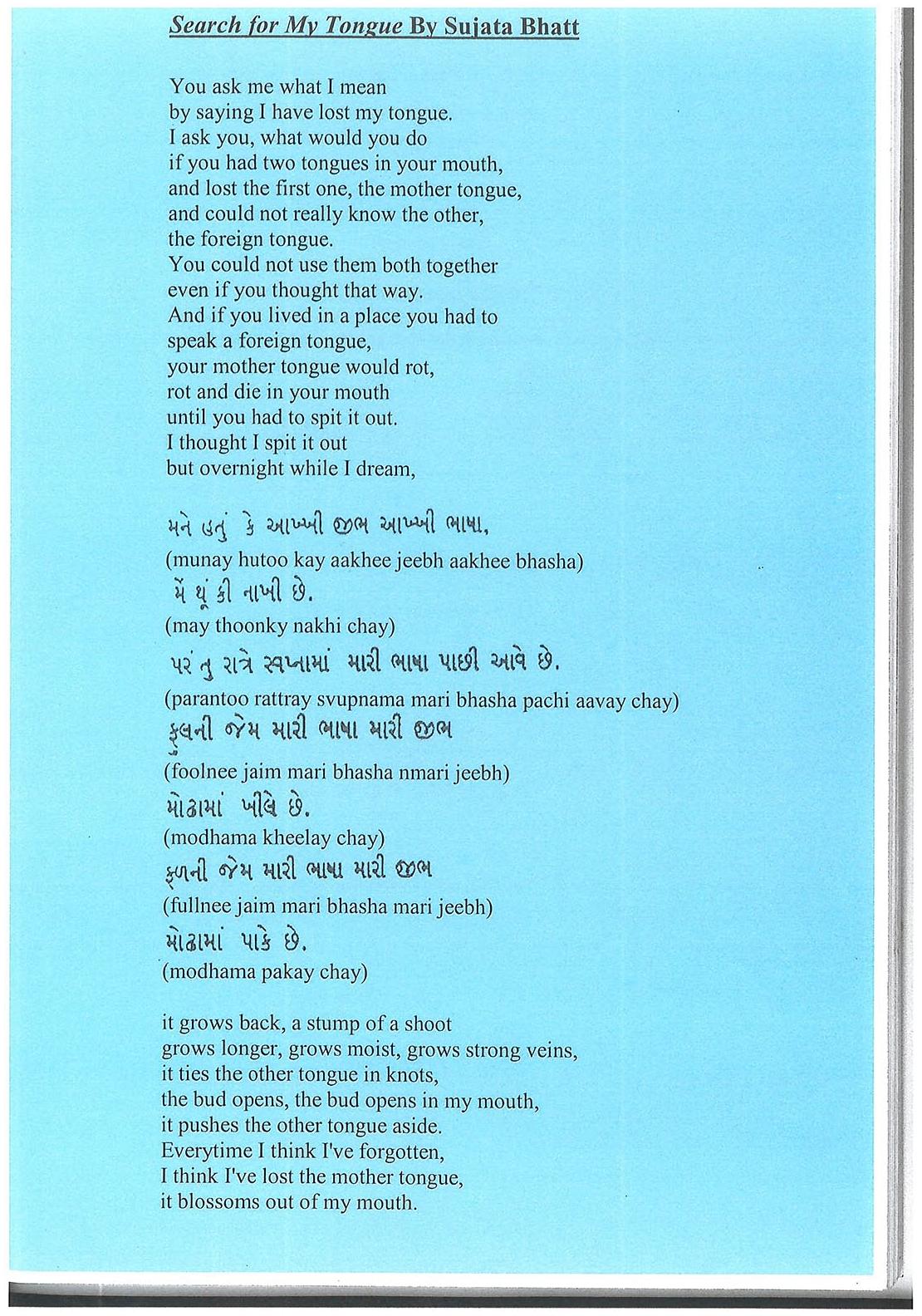
‘Search for my tongue’ by Sujata Bhatt.
Bhatt’s poem employs translanguaging in the form of Gujarati script, phonetic transcription, and invokes imagery from the natural world to symbolically describe the ‘stump of a shoot’ of her first language that periodically ‘buds’ and ‘pushes the other tongue aside’. The poem resonates with the experiences of EAL/D students and offers a model for their poetry writing. As Kramsch (2009) argues: ‘Teaching the multilingual subject means teaching language as a living form, experienced and remembered bodily, with a relation to an Other that is mediated by symbolic forms . . .’ (Kramsch, 2009, p. 191).
The student poems provided below were selected as representative, illustrative examples on the basis of different language backgrounds, ability levels, and symbolic representation of language and identity. They were drawn from the poems written by the 13 students of a lower ability Year 8 class of students from diverse language backgrounds and taught by an early career English teacher. Analysis of the poems identified three key themes relating to language and identity and these are explicated below.
a Juxtaposition of worlds: Representation of tensions
The symbolic propensities of poetry were used to represent the disjunctions and resulting tensions between the different language and cultural worlds the students inhabit. Representations employed a range of devices including: relative sizes (‘my garden is very small’), physical capacity (‘duckling that can’t fly’; ‘not strong enough’) and growth stages (‘like a caterpillar’s wings’; ‘it thrives and blooms’) to depict the power imbalance between their receding or incompletely acquired language and the dominant English language of their school interactions.
The poem ‘My garden of languages’ A.N. (see Figure 2) employs Vietnamese in a direct address to the ‘new plant’ that symbolizes the French language that is being added to her ‘flower of origin’ (Vietnamese) and ‘shrub of English’ and that must also be accommodated in her small garden. A.N. shares her challenges in managing her linguistic repertoire in the context of the dominant English language and ‘secondspace’ practices. In NSW, schools mandate the study of additional, often European languages during Years 7 and 8. A.N. asks rhetorically ‘French, do we really need this?’ and places the new plant ‘in the middle / Half sun, half dark’. The ‘thirdspace’ translanguaging poetry pedagogy has created room for her to articulate and challenge this practice. Ultimately A.N. begs her flower (her Vietnamese language) to ‘Grow now, grow and be the one true mother of the garden’. The use of two languages and imperatives emphasize A.N.’s yearning to reposition her ‘flower of origin’ so that it, like her ‘shrub of English’, can flourish in the ‘sun’.
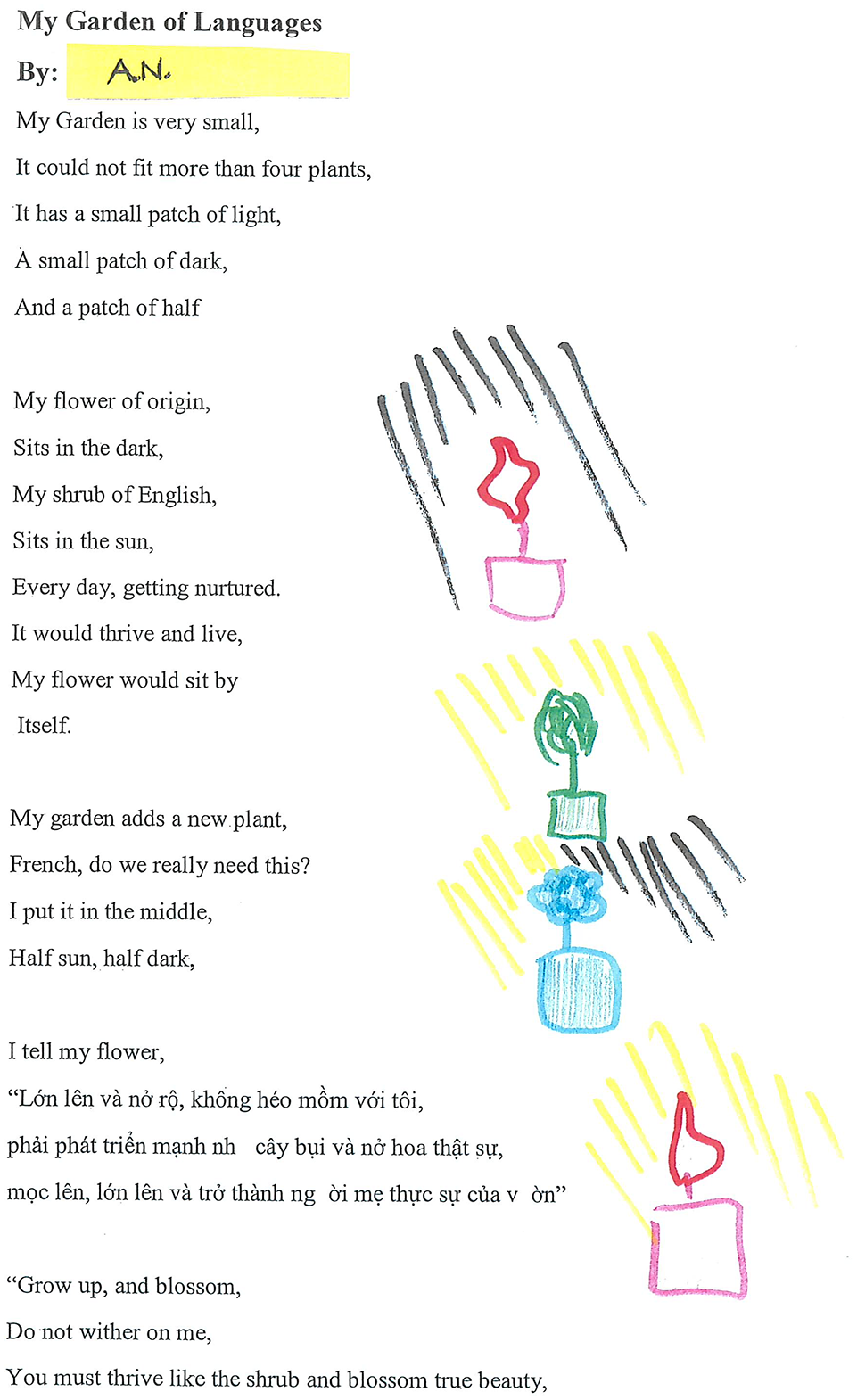
‘My garden of languages’ by A.N.
Whereas A.N. employed natural imagery, Z.Z.’s poem ‘Mother tongue’ employs violent physical imagery to symbolically enact the language power struggle.
‘Mother tongue’ Something’s missing Why can’t I understand my first language? Why can’t I speak my mother tongue? I’m kidnapped in this place Where it is hard for me to embrace, my mother tongue Everyday I slowly keep forgetting I see my parents fluently speaking my mother tongue My foreign language Slowly taking over Suffocating my mother tongue Controlling my mind Forcing my mother tongue Go to the back of my mind. Every time I try to fight back My mind goes blank I tell myself, don’t give up I tell myself, there is still some hope And finally it comes out, Like a butterfly from a cocoon (Z.Z., Year 8 secondary school)
Denial of voice and linguistic background is depicted as being literal and metaphoric with the speaker being unable to find their missing first language or to speak their ‘mother tongue’ with the parents’ competence juxtaposed with the poet’s silence and use of English only.
In V.C.’s poem (see Figure 3) the metaphor of the race is used to indicate how she feels about the gradual loss of her language and to symbolically represent the tensions between the dominant new language and her ‘cultural one’. The personification of the two languages employs a pattern of negative words to describe the gradual loss of the first language. Use of images such as: ‘with dust kicked up by the other’; ‘lack of exercise’; ‘no chance’; ‘well behind’; ‘struggling to get up’ express the author’s view and are focused on developing affect and moving the reader. The juxtaposition of the two worlds enacts a power struggle in which there seems only to be one winner and shows a clear understanding that the practices of the ‘real-and-imagined’ space that value English mean the student’s ‘cultural language’ is being marginalized (‘left alone’) and covered in the dust of the dominant language practices. The speaker symbolically represents how her sense of identity resides with her home language (‘my cultural one’) and literally and metaphorically categorizes the English language as ‘the other’ despite acknowledging in the opening that both are her languages (‘my two languages’). In this way the speaker gives voice to the inherent tension between the practices of the ‘real-and imagined’ space that promote English language acquisition and construct maintenance and use of the home language as a ‘thirdspace’ practice.
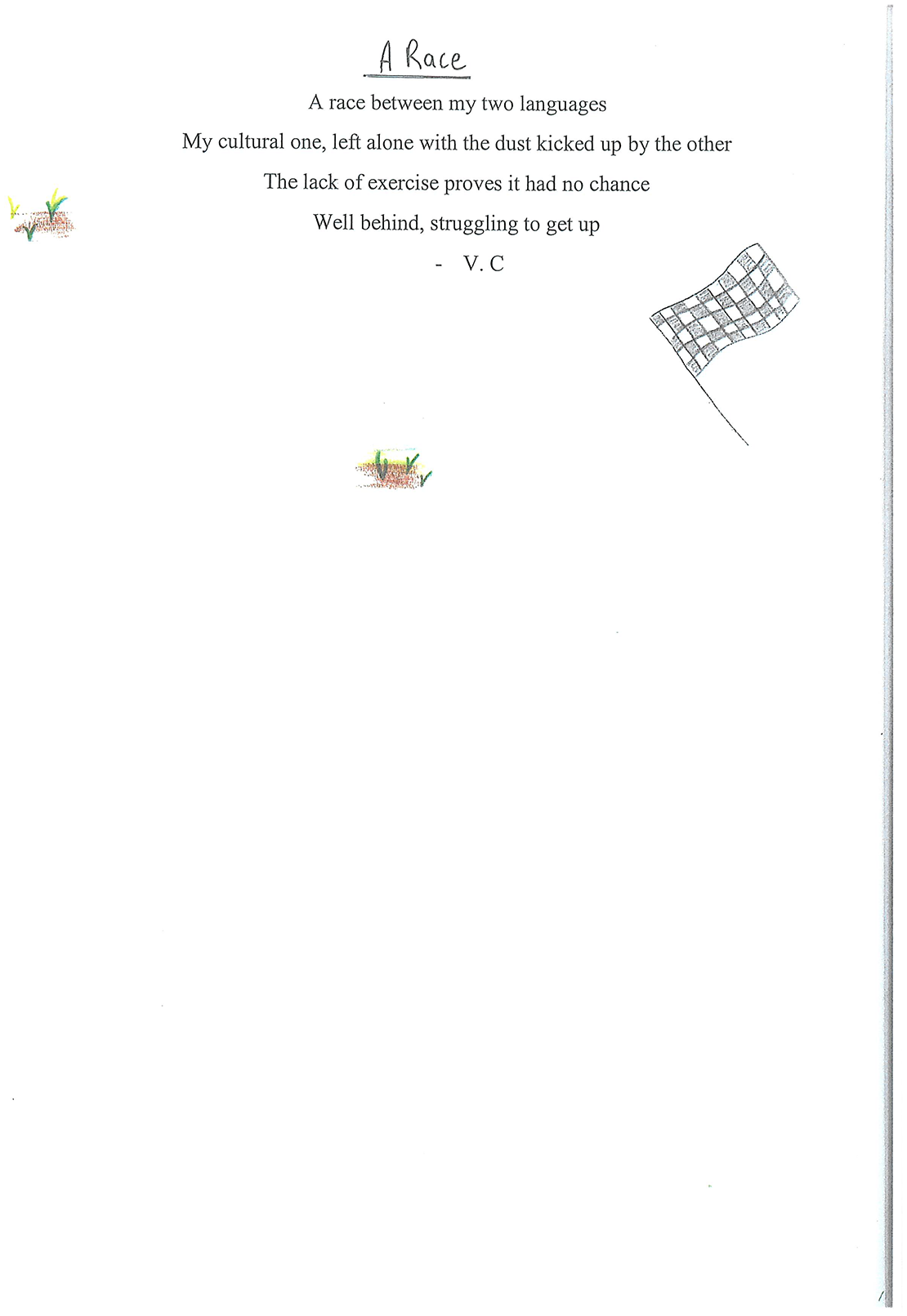
‘A race’ by V.C.
Although the opportunity to choose from all her linguistic resources had been supported during the drafting process, in this case V.C. chose to use English only. This was perhaps due to her stated reduced ability in her home language and the impact of the ‘real’ and ‘conceived’ practices of her prior classroom experience whereby English had been highly valued.
Analysis of the data reveals how the poetry writing task and learning about their language backgrounds equips the students with terminology with which to articulate their experiences of multilingualism and allows them to give voice to and potentially understand their language and classroom experiences more effectively. Vygotsky (1962) poses that being able to name a phenomenon brings it into being and helps with sense-making. When the developmental trajectories of emerging multilinguals inform the pedagogical stance (Bauer et al., 2020), the symbolic action of acknowledging their languages can be made even if students are not proficient in the languages. It is important to create a third space (Lotherington, 2013) in which this can be achieved.
b Expectations of others: First language and English
A second key theme identified in the students’ poems is their struggle to meet the expectations of others. This struggle is shaped by the tensions between the ‘real-and imagined’ school and societal practices that prioritize English only. In the current Australian school context deeply held beliefs about the significance of language and identity (see also Cummins, 1981, 1986, 2000, 2005; Greene, 1995) too often are positioned as ‘thirdspace’ practices.
The expectations of others are symbolically represented in A.T.’s poem (see Figure 4) by binary ‘voices’ which confuse the speaker’s sensibilities and capacity for decision-making. In A.T.’s poem, home language and English are employed in consecutive lines for verisimilitude. The opportunity to use the home language has been shown to support writing about a unique personal experience (Velasco & García, 2014) and in this example, the presence of the dual voices symbolizes the lived experience of the student. The dual voices result in an action of resistance and denial when A.T. defensively crouches down and blocks her ears. The metaphor of fog constructs the confusion experienced when attempting to reconcile the two voices amidst the nuanced complexity of multilingualism.
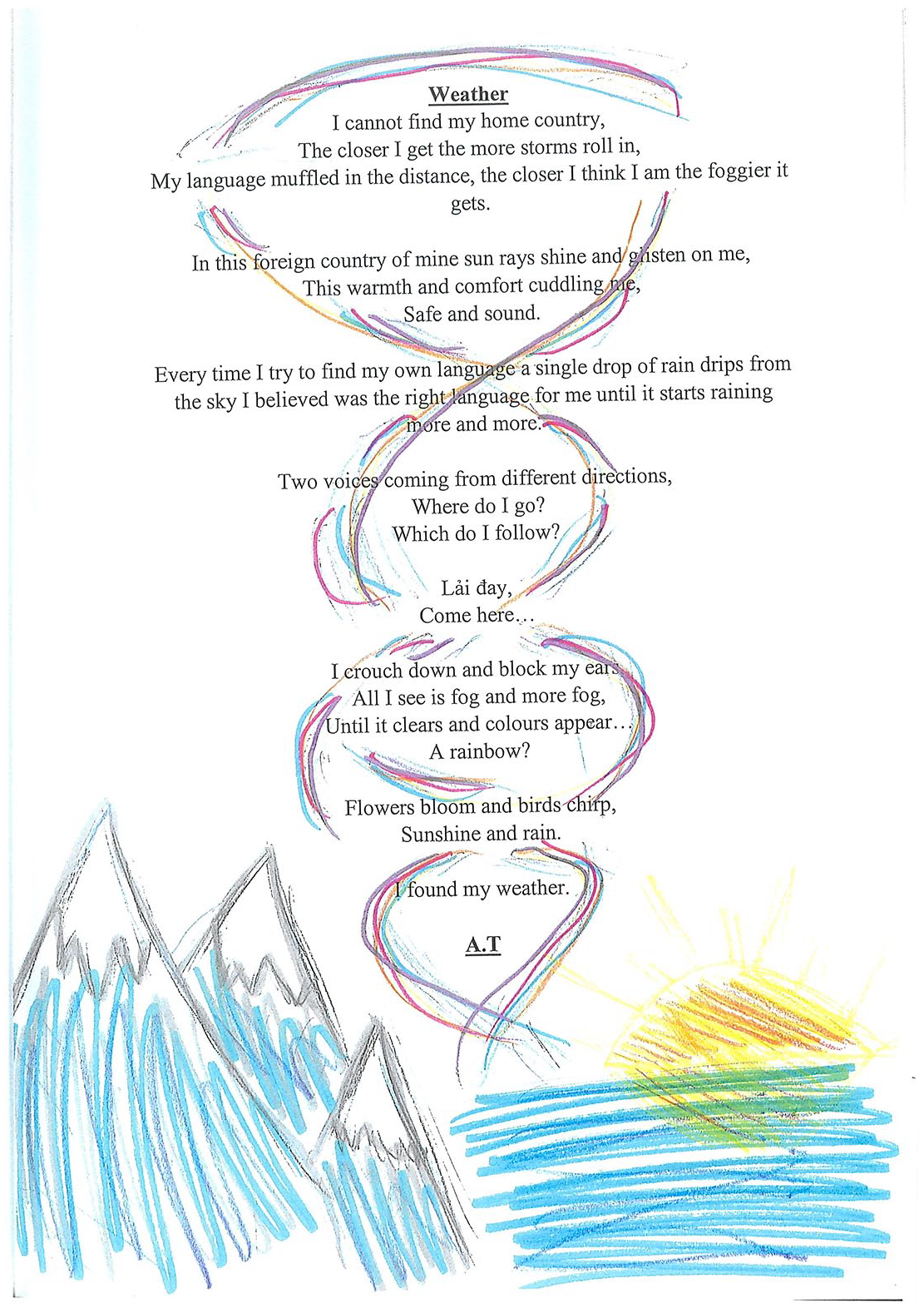
‘Weather’ by A.T.
In a poem by S.E.A. (see Figure 5) outlining the impact of subtractive bilingualism, the expectations leave the speaker ‘tangled’ and ‘clinging’ in the nest while other birds are ‘chirping and singing’. The poem’s closing sequence includes a ‘bigger bird’ offering reassurance that ‘strength is only in the heart / Where your second language lays’.
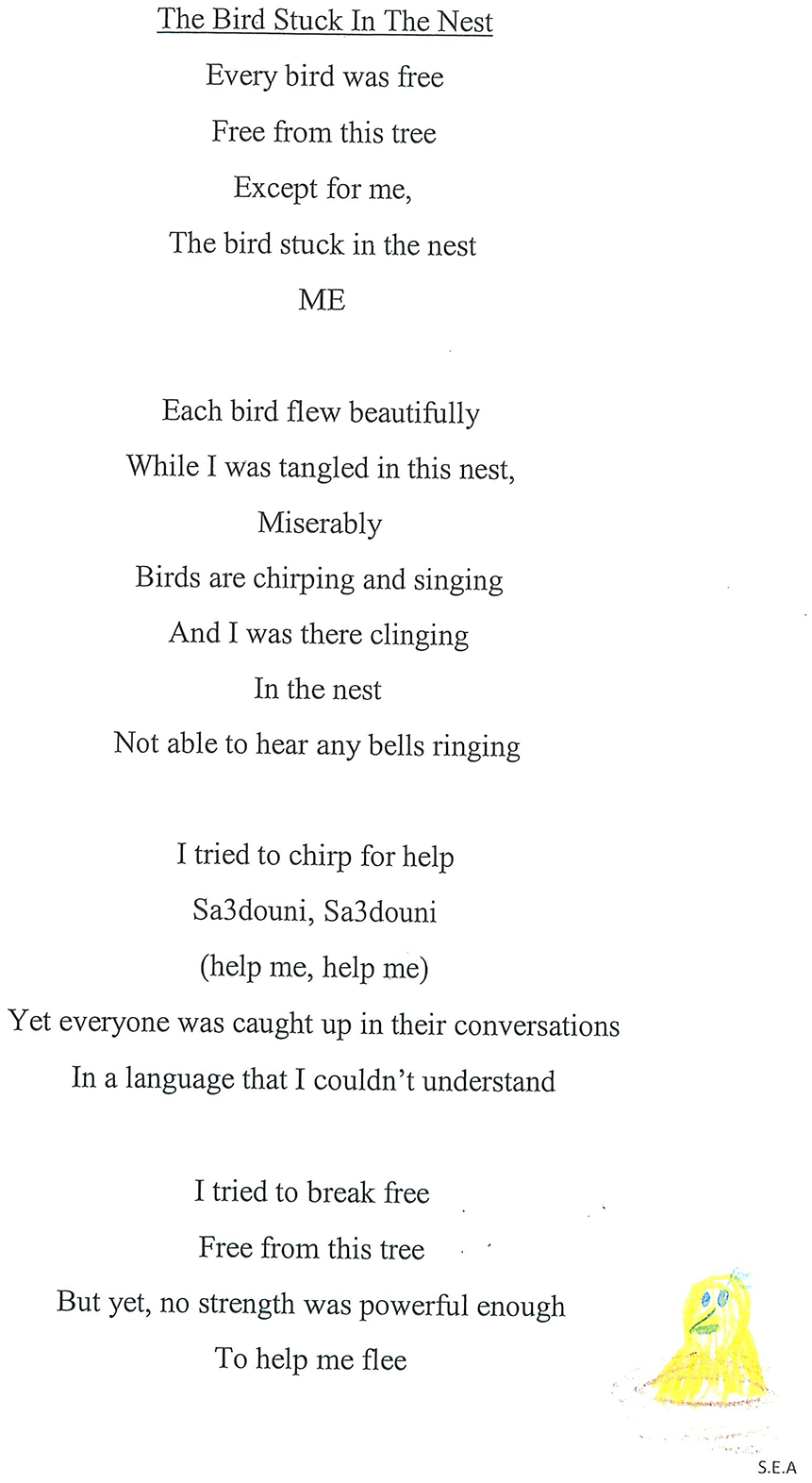
‘The bird stuck in the nest’ by S.E.A.
The use of metaphors thus enables students to voice complex understandings of the impact of societal expectations and to illustrate the type of deep discussion about and exploration of language that can take place in a context where translanguaging is supported (Cenoz, 2017; Creese & Blackledge, 2015; García-Mateus & Palmer, 2017; Jiménez et al., 2015).
c Language and identity: The search for self in ‘firstspace’ and ‘secondspace’ practices
The third theme relates to the role of language and identity in shaping the students’ sense of who they are and where they belong in the context of ‘firstspace’ and ‘secondspace’ practices. These practices construct pressures to adopt exclusively the practices and world-view of the dominant language. All poems reveal examples whereby students have been able to articulate the relationship between their languages and their identity using a range of symbols and metaphors that both appropriate those of Bhatt’s poem but also shape original ‘thirdspace’ territory.
References to notions of home were common, with the associated connotations of warmth and safety functioning to highlight the desired comfort. A.T.’s poem reflects this pattern with the original metaphor of a rainbow being used to depict the color-filled place where the tension between the ‘home country’ and the ‘foreign country’ resolves creating a fecund world where ‘Flowers bloom and birds chirp, / Sunshine and rain . . .’ Ultimately ‘weather’ becomes a metaphor for the student’s identity with the final line asserting a wholeness in the image of ‘. . . I found my weather’. Interestingly, agency is ellipsed in this poem with no articulation of how the tensions between the real-and-imagined’ space practices concerning monolingual language and dominant language and the heritage language background are reconciled.
The metaphoric title of B.S.’s poem ‘Without my language, I’m a broken tree’ (see Figure 6) is representative of the way students were able to symbolically articulate the struggle to confirm their identity in the face of the challenge to maintain their home language.
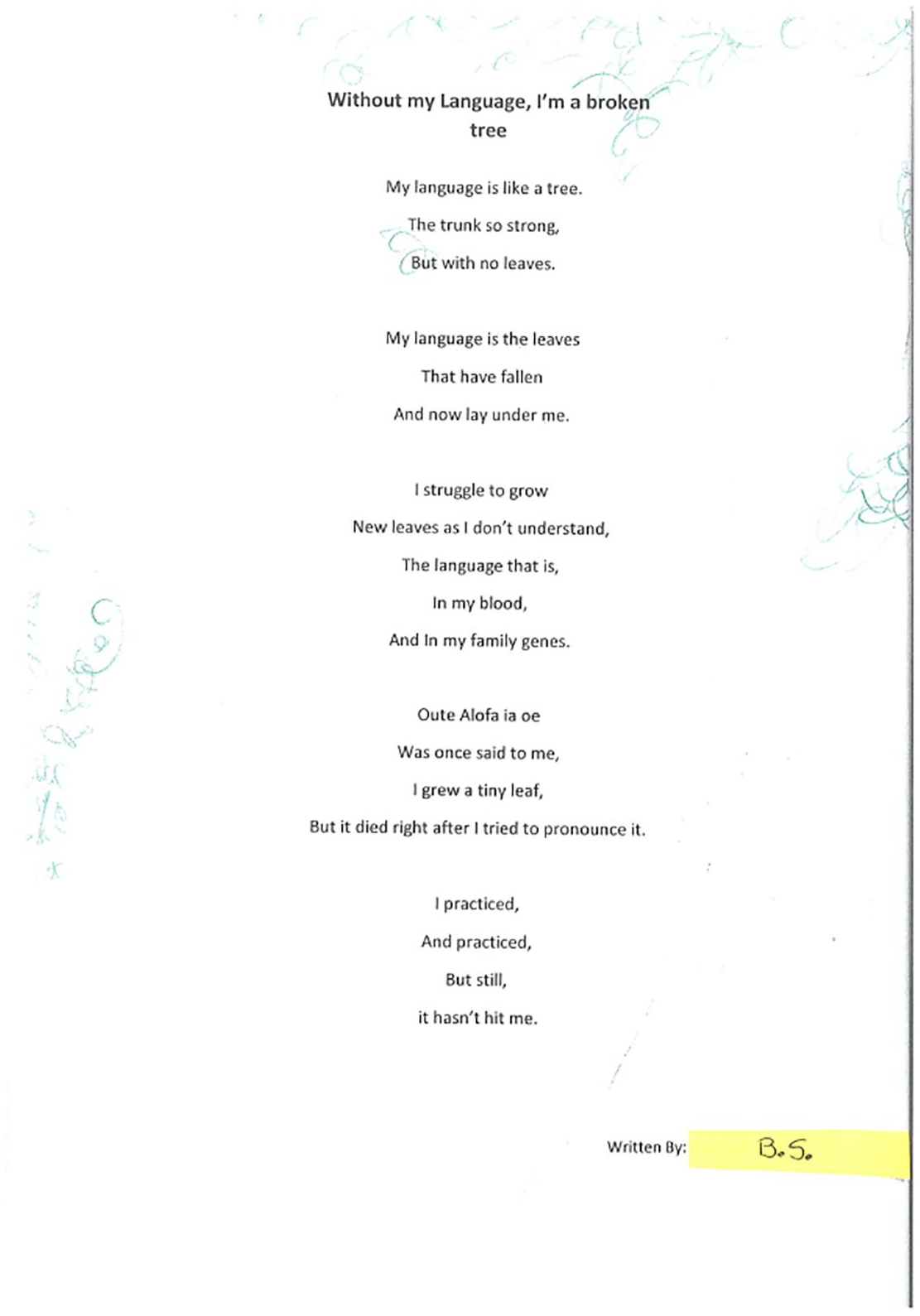
‘Without my language I’m a broken tree’ by B.S.
Language is defined in terms of the components of a tree in an appropriation and original extension of the model poem’s ‘stump of a shoot’. Imagery associated with absence is employed for example: ‘no leaves’ and decay ‘. . . leaves / that have fallen / And now lay under me.’ B.S. mourns that ‘the language that is, / In my blood / And in my family genes’ is not understood by the ‘new leaves’ her language tree is growing whilst immersed in the perceived and conceived practices of school and society. The magnitude of the struggle is evident in the evocative bilingual lines in stanza 5 (translation not in original).
Oute Alofa ia oe [I love you] Was once said to me, I grew a tiny leaf, But it died right after I tried to pronounce it
Here the student is cognisant she is disconnected from her language heritage and recognizes that this has had a negative impact on her sense of self, leaving her a ‘broken tree’. S.E.A.’s poem depicts her loss of voice and agency when attempting to free herself from the nest in which she is literally and metaphorically trapped.
I tried to chirp for help Sa3douni, Sa3douni [help me, help me] yet everyone was caught up in their conversations
Resolution is not always present with the impetus to adopt the ‘real-and imagined’ space perspectives leaving the speakers in many poems stranded or feeling incomplete.
Interestingly, some resistance to ‘thirdspace’ translanguaging practices was evident with teachers reporting students opting not to include home languages in final draft versions of their poems that were to be shared with peers and family. It is possible to read this as students retreating to ‘lower risk’ and ‘secondspace’ sanctioned practices because they did not feel confident in a public display of their home language(s). Alternatively, it may indicate the intrusion into students’ writing practice of ‘secondspace’ institutional beliefs that prioritize / value English and/or ‘firstspace’ classroom practices. More research is needed to fully establish the factors impacting on this resistance.
As these poems demonstrate, however, writing poems and using translanguaging can facilitate meaning making. In so doing students were able to create ‘names’ for what they are experiencing as they negotiate the ‘firstspace’ and ‘secondspace’ practices of school and their world. Poetry writing can thus function as a ‘thirdspace’ pedagogy that supports multilingual students to find symbolic representations of their experiences; their languages; and their identities.
2 Teachers’ experiences of translanguaging poetry pedagogy: Subversion and re-imagining in the ‘thirdspace’
Analysis of the data related to the teaching of poetry demonstrates how the teachers embraced translanguaging poetry pedagogy as a ‘thirdspace’ practice capable of sustaining translanguaging practices in their classrooms. Given freedom to choose resources for their poetry units, teachers selected culturally relevant texts (see also Worthy et al., 2013) and a variety of multilingual and multimodal teaching resources (Li & Luo, 2017). Recurring themes relating to ‘liberation’ and ‘excitement’ were identified in the data with many teachers experiencing epiphanies regarding the rich possibilities of using multi-lingual texts, and students’ home languages and cultural backgrounds more intentionally in the classroom. The poems teachers selected after their professional learning subverted their original selection of canonical poems with emerging, contemporary and Indigenous Australian and international authors such as Bronwyn Bancroft, Lionel Fogarty, Ali Kobby Eckerman, Omar Musa and Sujata Bhatt featuring as more transgressive choices. The poems and texts used as models for poetry writing all embodied political and societal perspectives creating potential for students to give voice to complex personal meanings about cultural identity, language/languages and power structures whilst subverting the monolingual status quo.
Teachers also used their own cultural stories as prompts for writing – a transformative practice for most. They found the translanguaging poetry pedagogy (see Appendix 1) shifted the power dynamics in the classroom, giving agency to students (see also Creese & Blackledge, 2015; Cummins, 2000; García-Mateus & Palmer, 2017), with use of students’ and teachers’ home languages ‘bringing us all together’ and ‘bridging a gap between teacher and student’. One teacher told her class of her grandmother’s escape from a prisoner of war camp and reported: ‘I felt proud to be vulnerable. Sharing personal details about myself and my grandmother made me so invested in my grandmother’s journey . . . (which I hadn’t known before) and she was so proud to have her story shared’ (Year 7 early career English teacher).
Analysis of the data also indicated that there was an increase in collaboration both student to student (Creese & Blackledge, 2015) and teacher to student as teachers were positioned as co-learners. A stronger sense of home-school connections was developed by a focus that positioned students as experts in their own linguistic resources and familial cultural backgrounds. An emphasis on connectedness to language and identity (see also Pacheco & Miller, 2016) helped to genuinely define learning and teaching roles in a dialogic, collaborative classroom.
VI Conclusions
We have seen that language learners make meanings in ways that are sometimes different from the way most native speakers make meaning in their daily lives . . . As they use symbolic forms to give meaning to their environment, even the environment of the classroom, they rely not on cool reason, but on the embodied aspects of a cognitive and socialized self: emotions, feelings, memories. (Kramsch, 2009, p. 53)
The student poets in this study were able to give voice to poignant and complex symbolic representation of language and identity. Using translanguaging pedagogy allowed students to ‘soft assemble’ their various language practices in ‘a seamless and complex network of multiple semiotic signs’ (García & Li, 2014, p. 25). Responding to and writing poetry allowed the linguistic, cognitive and social capacities of all the students’ languages (Li, 2014) to be used to interpret texts (Canagarajah, 2013) and support writing. The poetic form allowed economical expression of complex ideas and provided students with a purposeful and creative way to reflect on their language choices supporting the development of metalanguage (Cenoz, 2017; Creese & Blackledge, 2015; García-Mateus & Palmer, 2017; Jiménez et al., 2015). The poems craft poetic juxtapositions of the tensions between the students’ linguistic and cultural worlds, articulate the weight of expectations they experience in relation to achieving competence in their languages, and emphasize the role of language in shaping the students’ sense of identity. Analysis revealed the multiple ways that the students were positioned by the first and second space practices of their school classrooms and social interactions and they were able to represent these symbolically in the ‘thirdspace’ medium of contemporary poetry.
Furthermore teachers developed a ‘transformative stance’ (García & Kleyn, 2016, p. 21) in that they came to see that using the students’ full language repertoire is a way to return the power of language to their students. The teachers did not have to be bilingual to implement a pedagogy that supports translanguaging (Lasagabaster & García, 2014) and, in the absence of any official policy on the use of multiple languages in formal schooling in Australia (French, 2016), the role of the teacher is of vital importance (Henderson & Ingram, 2018; Velasco & Fialais, 2016). The teachers were able to act as policy makers (Langman, 2014) when developing a ‘thirdspace’ pedagogy that supported translanguaging strategies. Ultimately, the teachers whose work is reported in this study now see the ‘translanguaging space’ and translanguaging poetry pedagogy as ‘what we do’. This ‘normalizing’ of translanguaging practices shifts it to the perceived or ‘firstspace’ of the classroom English teachers but the hegemonic, monolingual (Chik et al., 2019; D’warte, 2014; French, 2016; García & Li, 2014) high stakes test focused (Ball, 2003; Darling-Hammond, 2011; Manuel et al., 2018; O’Sullivan, 2016) ‘secondspace’ educational ‘ideal’ persists.
Teachers have the potential to support the engagement, well-being and academic success of multilingual students, to address the restrictions of the high-stakes testing context (Dutton & Rushton, 2018a, 2018b) and challenge views of the marginalized linguistic and cultural groups (Allard, 2017; Cummins, 2000). By employing resources and pedagogies that acknowledge students’ diverse backgrounds, and ways of thinking and communicating, we can build academic success, enhance wellbeing and honor the communities, languages and identity of all our students.
Footnotes
Appendix
Emphases and strategies for the ‘translanguaging poetry pedagogy’ employed in the unit of work.
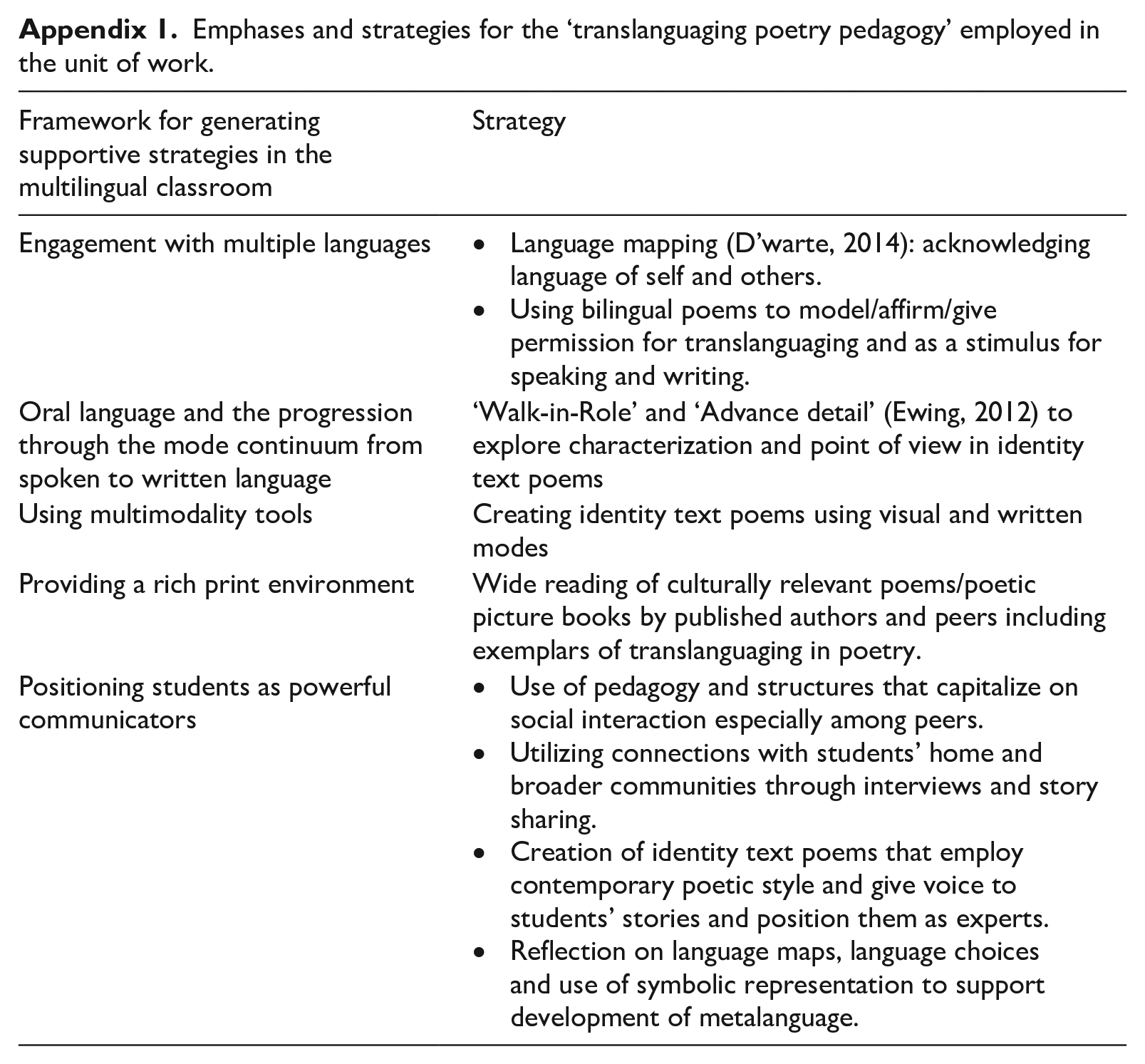
| Framework for generating supportive strategies in the multilingual classroom | Strategy |
|---|---|
| Engagement with multiple languages | • Language mapping (D’warte, 2014): acknowledging language of self and others. • Using bilingual poems to model/affirm/give permission for translanguaging and as a stimulus for speaking and writing. |
| Oral language and the progression through the mode continuum from spoken to written language | ‘Walk-in-Role’ and ‘Advance detail’ (Ewing, 2012) to explore characterization and point of view in identity text poems |
| Using multimodality tools | Creating identity text poems using visual and written modes |
| Providing a rich print environment | Wide reading of culturally relevant poems/poetic picture books by published authors and peers including exemplars of translanguaging in poetry. |
| Positioning students as powerful communicators | • Use of pedagogy and structures that capitalize on social interaction especially among peers. • Utilizing connections with students’ home and broader communities through interviews and story sharing. • Creation of identity text poems that employ contemporary poetic style and give voice to students’ stories and position them as experts. • Reflection on language maps, language choices and use of symbolic representation to support development of metalanguage. |
Funding
The author(s) received no financial support for the research, authorship, and/or publication of this article.
