




Abstract
It is estimated that during the winter of 2023–2024, over 2 million people visited a warm space in the UK. More than 4,000 warm spaces were set up, primarily by third-sector organisations, to support people facing spiralling fuel prices and the cost-of-living crisis. This research uses a single-case-study design combining observations and 21 semi-structured interviews at a warm space in England. The article analyses warm spaces as an emerging form of localised welfare provision, investigating the lived experience and resilience of attendees in the face of austerity and the role of the warm space in responding to it. We use austerity localism as an analytical framework to explore the broader policy backdrop against which warm spaces emerged. Our findings contribute to a growing evidence base demonstrating the impact of welfare state retrenchment on local organisations, which are increasingly compelled to provide essential services traditionally seen as a function of the state. While providing a safe and welcoming environment for attendees, the regressive consequences of austerity localism were evident as the warm space was unable to resist and challenge the hardship and inequalities provoked by the rolling back of the state.
Introduction
In North America, ‘warming centres’ are a well-established community function providing shelter for vulnerable citizens during periods of cold weather (Buck-McFadyen, 2022). In the UK, marginalised citizens have long used community facilities such as day centres or libraries as refuge from the cold (Johnsen et al., 2005), but it wasn’t until the winter of 2022–2023 that a coordinated network of ‘warm spaces’ emerged in response to the cost-of-living crisis and spiralling fuel prices (UK Health Security Agency, 2023). The sharp increase in fuel poverty during this decade has been a key driver in the growth of warm spaces.
There is no definitive UK warm spaces dataset, but the limited available information demonstrates that many warm spaces are delivered by voluntary and community sector groups, libraries, faith-based organisations, and sometimes by local authorities. Set up to provide a facility for people who are experiencing fuel poverty, over 2 million people visited a warm space delivered by over 4,000 providers staffed by over 10,000 volunteers in winter 2023–2024 (Warm Welcome, 2024).
The emergence of warm spaces as a response to fuel poverty and the cost-of-living crisis is an under-researched area in both academic and grey literature. Expanding on studies exploring the role of the third sector in responding to social inequality and poverty (Bridge et al., 2020) in an increasingly fragmented ‘local ecosystem’ (Edmiston et al., 2022: 776), this study has two main aims. First, to explore the experiences of warm space attendees and staff at a large provider in the East Midlands of England. Second, by using austerity localism as a framework, to examine the dynamics of third-sector support as the UK moves to new forms of austerity-driven localised welfare provision.
The article opens with an analysis of warm spaces as a new manifestation of austerity localism and the changing role of voluntary sector organisations during austerity. The methodology and findings are then presented, focussing on the responses and resilience of the warm space to attendees’ lived experience. Using austerity localism as a framework we discuss the emergence of new forms of community support against a backdrop of regressive national policies.
Austerity, (fuel) poverty, and localism
The programme of austerity pursued in the UK from 2010 has been described as a ‘failed experiment’ (McKee et al., 2012: 346) with regressive economic and health impacts, particularly in the most deprived areas (Stuckler et al., 2017). Housing costs in the rented sector are increasingly unaffordable for many low-income households. The COVID-19 pandemic exacerbated existing inequalities, with little sign of subsequent recalibration (Asthana, 2022). Since late 2021, there has been a reduction in real-term disposable incomes, adjusted for inflation and after taxes and benefits (Hourston, 2022), leaving many people less resilient (Finch and Tinson, 2022). Coupled with poorly insulated houses, rapid increases in energy prices from late 2021 (Office for National Statistics, 2023) and inflation reaching a 41-year high (Harari et al., 2022), an estimated 13.4% of households (3.26 million) have been unable to afford to heat their home adequately. An increase of 13% on the previous year (Department for Energy Security and Net Zero, 2023).
In response to the cost-of-living crisis and escalating fuel costs, the UK government introduced a range of intermittent, lump-sum payments to support low-income households, many of which were administered by local governments. Analysis indicates that these payments were poorly targeted, reaching only 68% of fuel poor households (Keung and Bradshaw, 2023) and raising the level of social security benefits would have been more effective.
It is this policy environment which triggered the growth in warm spaces as community organisations mobilised to provide a range of facilities and resources as a bulwark against fuel poverty and the cost-of-living crisis.
The pathways to warm spaces have been catalysed by austerity, welfare reform, precarious work, housing insecurity, decline in community spaces, and the COVID-19 pandemic (illustrated in Figure 1). Although fuel poverty and the cost-of-living crisis were the ‘tipping point’ leading to the emergence of warm spaces, it is important to recognise these longer-term causal factors which have had a disproportionate impact on some marginalised groups.
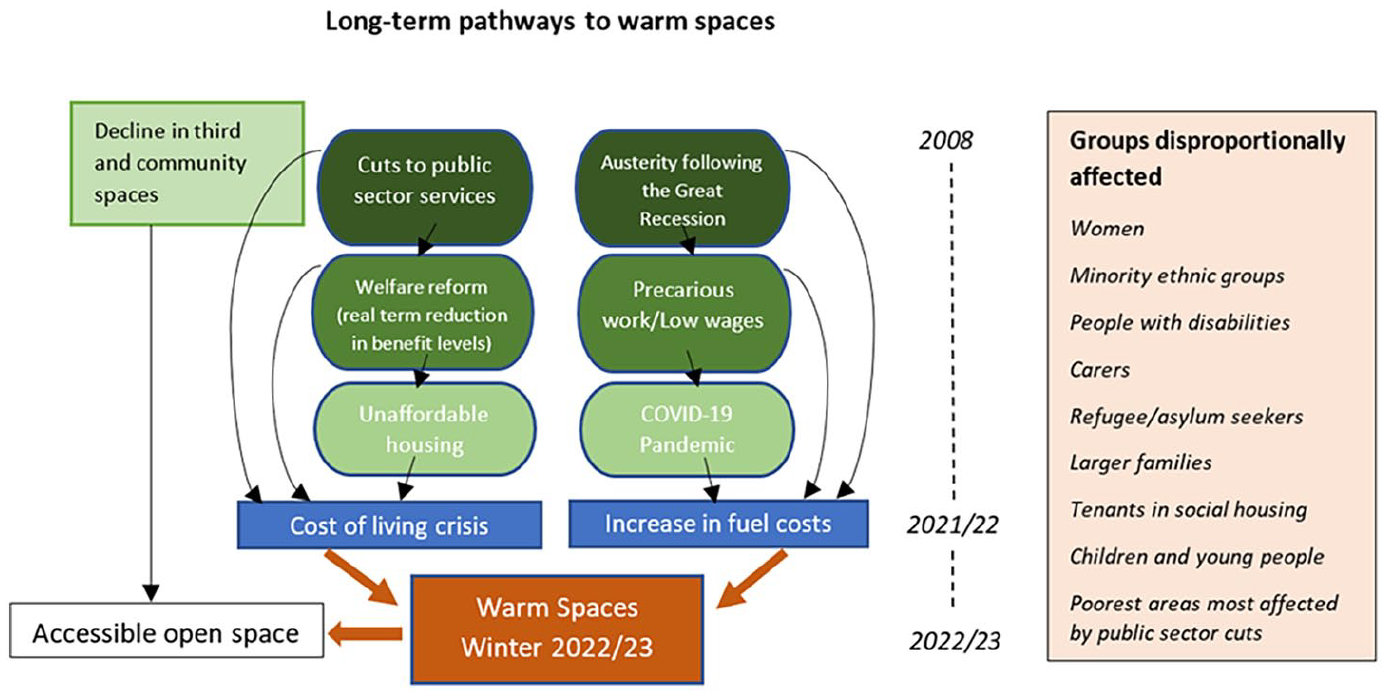
Antecedents to warm spaces.
We present warm spaces as a manifestation of austerity localism, a framework which conceptualises the changing relationship between state and local provision as a result of ‘roll-back’ neoliberalism (Featherstone et al., 2012). Attempts to locally mitigate centralised cuts have international currency (Kim and Warner, 2020).
The central pillars of austerity localism, welfare retrenchment and community-based interventions, were a policy feature in the UK for both the Thatcher and New Labour administrations (Dagdeviren et al., 2019). However, austerity localism was crystallised in the austerity measures introduced by the Conservative-Liberal Democrat coalition government of 2010, and subsequent Conservative administrations. This is epitomised by a ‘cut and devolve approach’ (Colliver et al., 2024: 7) where withdrawal of state support is coupled with an expectation that private, voluntary and community sector organisations provide a replacement safety net. Emphasising localised agency and empowerment, it promotes community-based solutions as superior and encourages volunteerism and self-reliance of communities and individuals (Ward et al., 2015).
Austerity localism creates many moving parts, as new forms of vulnerability within and between communities emerge and can only be superficially responded to. These inconsistent outcomes are created, in part, by a lack of a coherent political ideology (successive governments have espoused the value of localism but moulded it to fit with changing political priorities) and the expediency of public spending cuts (Lowndes and Pratchett, 2011).
The changing role of voluntary sector organisations during austerity localism
In the UK, there is a long tradition of community organisations playing a pivotal role in tackling poverty and fostering support networks. Examples include domestic policy (e.g. food banks), support for specific groups (e.g. striking miner in the mid-1980s) and neutral gathering spots like public parks (Smith et al., 2023), libraries (Wood, 2021), and community gardens. These groups and places have long been perceived as fostering empowerment, resilience, social action (Lewis, 2016), and wellbeing (Gilchrist and Taylor, 2022).
The localism agenda and its notion of empowerment of ‘voluntary action’ have led to a great expansion of the third sector (NCVO, 2022). By offering third spaces for communities and providing health and social services, they are seeking to fill gaps in service provision which the government does not (sufficiently) reach (Manville and Greatbanks, 2013).
However, in the last decade, a lack of resources and increasing demand for public services have compounded existing challenges. Local authorities are in increasingly financially precarious positions (Jones et al., 2016), attempting to coordinate local services and respond to local needs (Colliver et al., 2023). The uneven distribution of financial resources between communities led to the closure or privatisation of many public spaces, particularly in disadvantaged areas (Rimmer, 2020).
This created a new dynamic where social networks (Hill et al., 2021), communities, and the voluntary sector (NCVO, 2022) are increasingly relied upon to provide for basic needs (Colliver et al., 2024). Many voluntary sector initiatives have become de facto frontline services, taking on functions far beyond initial intentions. These include food banks (Lambie-Mumford, 2015), support provided to destitute asylum seekers (Mayblin and James, 2018) and dementia/memory cafes (Akhtar et al., 2017).
Increasingly, austerity localism reflects a broader neoliberal agenda, which shifts the responsibility for welfare from the state to the community or individuals who step into the role of the state (Milbourne and Cushman, 2015). Such a reliance on voluntary organisations to fill systemic gaps risks normalising poverty as a charitable issue rather than a human and public right (Riches, 2002).
Warm spaces are funded through a multiplicity of sources, the most common being grant-making organisations, including the National Lottery Community Fund, and central and local government (360Giving, 2024). Given the range of service providers and funders it is difficult to be precise about the number of UK warm spaces. During the first year of their rollout, Save the Children (2022) found that of 355 councils in England and Wales, 143 were delivering their own warm space initiatives, and a further 51 funded voluntary sector projects.
In common with other forms of voluntary support, warm spaces are reactive in nature and seek to fill a vacuum where inadequate state protection has heightened social exclusion (Manville and Greatbanks, 2013). The emphasis of the Warm Welcome Campaign has quickly changed from winter crisis response to a more holistic community movement which aims to connect individuals and communities. This indicates a need for warm spaces where providing a respite from adverse weather conditions sits alongside other services such as social welfare advice, internet access, refreshments, and befriending (Warm Welcome, 2024).
Taking ‘austerity localism’ as a conceptual lens to investigate how the warm space adapted and responded to increasing fuel poverty and cost of living, we highlight the growing tension between community resilience and the structural inequities perpetuated by austerity policies. We provide insights into how the warm space initiative both mitigated and exposed vulnerabilities created by localist welfare policies.
Methods
As one of the first studies providing an in-depth analysis of a warm space in the UK, we used a single case study. The Warm Space at St. Ann’s Advice Centre in Nottingham, England in the UK was selected because it provided a representative example of warm spaces in the UK, run by a voluntary organisation and hosting characteristics as described by the UK Health Security Agency (2023). St. Ann’s Advice Centre provided explicit consent to name them as the warm space venue after the data collection phase of the research (anonymity of participants was protected). This allows us to discuss their delivery model in detail and to specifically analyse the relevance of location.
Using a typical case study, we provide analysis of this new social phenomenon and its contextual conditions (Yin, 2009). Single case studies aim to look at the phenomenon of interest in depth. We combined direct observation and semi-structured interviews with participants and staff to explore the impact of this local community initiative.
Data sampling and collection
Data were collected by two researchers at six sessions of the warm space between February and mid-March 2023 following ethical approval from Nottingham Trent University. Warm space attendees were given a participant information sheet, and interviews and observations were conducted with written consent.
Initial participant observations, being in the space and interacting with the participants, helped us to understand the dynamics of the warm space and its attendees and established trust with participants and staff.
We triangulated observations with 17 semi-structured interviews with attendees and four interviews with staff. Basic demographic detail and information about energy providers was gathered via a short post-interview questionnaire. Through the interviews we obtained a comprehensive understanding of the value and impact of warm spaces for attendees. Interviews with staff provided an organisational perspective and account of the challenges in sustaining the warm space. Pseudonyms are used to refer to the participants.
The profile of attendees interviewed at this warm space broadly aligns with the groups disproportionately affected by long-term economic and policy trends (Table 1). As with other forms of deprivation, an emerging body of literature demonstrates fuel poverty vulnerability for women (Petrova and Simcock, 2021), young people (Petrova, 2018), older people (Geddes et al., 2011), and people with disabilities (Dessouky and McCurdy, 2023).
Participant demographics (self-reported)
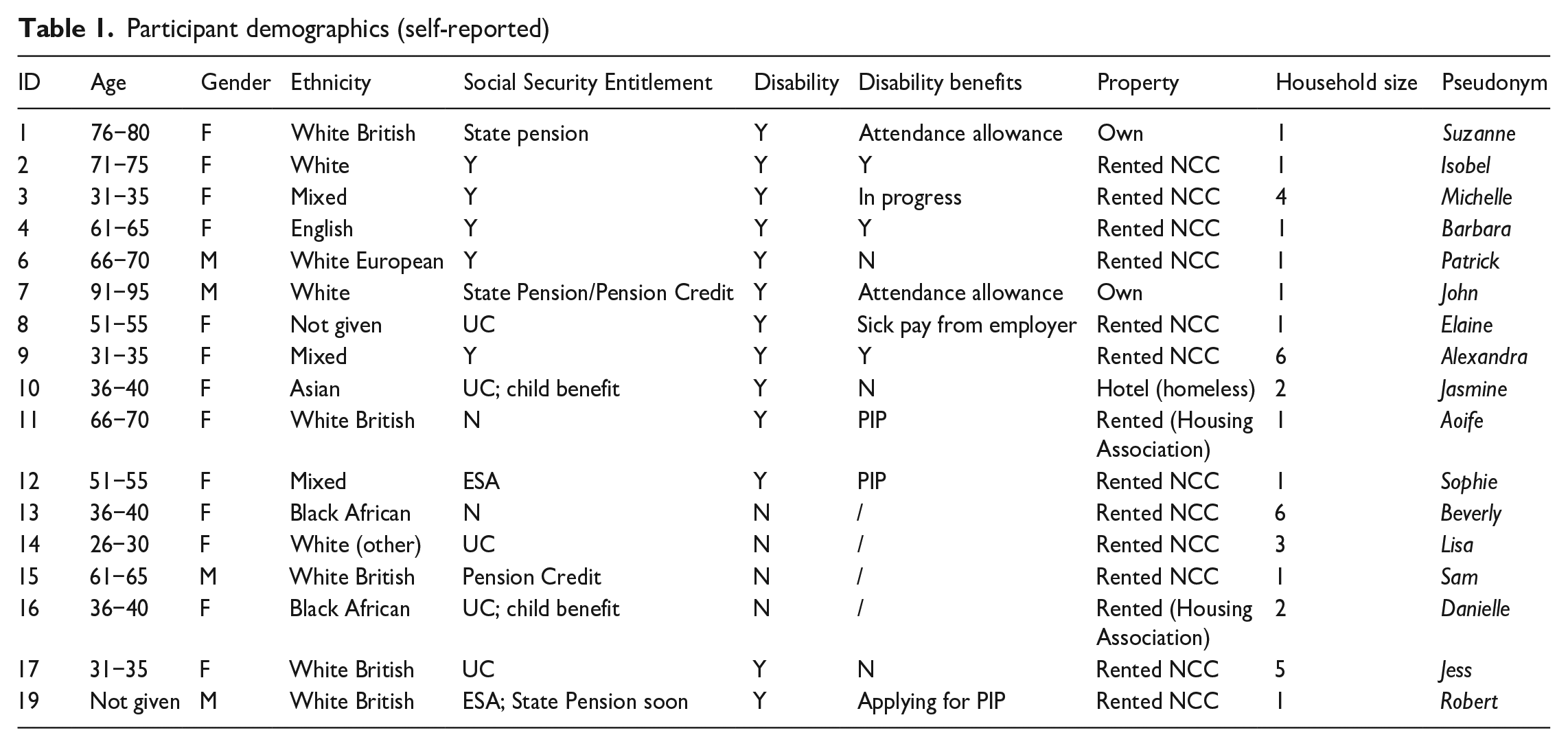
In our sample, over 70% lived in social housing, and 76% self-identified as having a disability. Over 40% were from a minority ethnic group. Ages ranged between twenty-nine and seventy-seven. Older attendees were retired or unable to work due to disability. There was a clear gendered dimension to attendance at the warm space, over 80% of our research participants were women, of these 7 described the financial and practical challenges of looking after dependent children. Two were lone parents. Female participants seemed more open to talking to us about their experiences as reflected in the balance of the participant quotes in the findings below.
Interviews 5, 18, 20, and 21 were staff interviews. They are referred to as: Monica, Heloise, Sarah, and Anne.
Data analysis
Data were systematically recorded and managed through NVivo. Fieldwork notes were written up after each session and compared at the end of the project. Interviews were transcribed, anonymised, coded iteratively, and thematically analysed (Ritchie et al., 2013), capturing the different nuances of meaning (Guest et al., 2011). A preliminary coding framework with four main codes on the impact of fuel poverty, reasons for engagement, the value of the warm space, and challenges to attend, were established after five interviews. Sub-codes emerging in subsequent interviews were added to the coding schedule and previously coded interviews revisited. Subsequent transcripts were coded deductively.
During our fourth visit to the warm space, we presented a summary of preliminary findings to participants and asked for feedback. While this did not generate new findings, it proved helpful in consolidating the trust of the participants and increased the validity of our findings by confirming our initial reflections.
St. Ann’s advice centre warm space in Nottingham
The warm space reviewed here is located in the East Midlands city of Nottingham where austerity localism has created a tense relationship between the local authority and the voluntary and community sector. In November 2023, Nottingham City Council issued a section 114 notice (Local Government Finance Act, 1988) with no reasonable prospect of income meeting forecast expenditure in 2023-4 (Merrick, 2023). Media outlets widely reported that the Labour run authority had declared itself ‘bankrupt’ although this is not legally possible (Vaccari and Yseult, 2022).
The tensions between central and local government which austerity localism creates are an important backdrop to this research. The devolved responsibility inherent in localisation is problematic for local authorities with the authority’s predicament attributed to ‘pure and simple local mismanagement’ (BBC News, 2024) by the government rather than reduced governmental services and funding. Nottingham City Council has been a vocal critic of central government austerity (Jones, 2024) on both ideological and fiscal terms, however, the section 114 notice dictated that future spending was ostensibly restricted to statutory services.
These political tensions are consequential for voluntary sector organisations, as impoverished local authorities lean on community-based organisations to deliver services to residents, often with inadequate levels of funding (Arnold and McKenna, 2024).
This warm space is located at St. Ann’s Advice Centre. Operating for more than 20 years, it provides advice on a wide variety of welfare matters. With a population of nearly 25,000, St. Ann’s is the fifth most deprived neighbourhood in Nottingham and nationally ranks as the 453rd out of 32,844 measured areas (Ministry of Housing Communities and Local Government, 2019).
Observing that many of those attending the advice centre were struggling with the rising cost of living and fuel, staff secured council funding for the warm space with the backing of the local ward councillor.
The warm space operated Wednesday afternoons 4 pm–7 pm from October to March 2023 on a drop-in basis in an area of the advice centre which serves as a community hub and café, and since the pandemic, a food bank.
Most people who attended lived locally; only two of our interviewees attended from another part of the city. Fourteen of the attendees said that they attended most weeks that the warm space operated from when it started in December 2022. Many came to the Advice Centre several days a week to access other services. The proximity of the centre to their homes likely contributed to people’s regular attendance.
At the start of our fieldwork in February 2023, the warm space was already well established, and during our first observation, people voiced concern about its closure.
Findings
The findings explore the lived experience of attendees and how St. Ann’s Warm Space responded to their multiple needs, strengthened support networks, and community wellbeing. They detail the external pressures that limited active resistance and more sustainable empowerment.
The lived experience of warm space attendees
Fourteen of the 17 attendees stated that fuel price and cost-of-living increases were difficult to manage. Elaine, for example, used to put £40 on her metre monthly, but now was paying almost £100 a month, leading her to borrow money from a friend.
The price increase also created vulnerabilities in other areas. Twelve participants said they were frequently skipping meals or unable to afford a healthy diet, facing the ‘heat-or-eat’ dilemma (Burlinson et al., 2022): There are some times if it’s very cold, and you’re running out, you’ve got to cancel the food and heat up. (Danielle)
Eleven reported cutting back on food, transport such as driving the ‘car to the places I want to go to’ (participant ID 11), new clothes (participant ID 16,4), Internet, phone bills (participant ID 4,6), television and devices for children (participant ID 17), and laundry (participant ID 14). In order to keep warm, Suzanne was ‘not really late to bed [. . .] Because you can’t afford to put your heating on, can you?’
With increases in energy and food prices, several of the attendees’ physical and mental health was negatively affected. Jess, who manages a household of five, struggles with anxiety about keeping her family warm and fed and being able to pay the bills: Quite often I sit there and cry, and it’s not because of, that something’s upset me, it is like, what am I going to do next week, because I can’t afford to do what I need to do. I check my gas meter every day. [. . .] Am I going it be able to keep them [the kids] warm?
Studies of the fuel poor report that people undertake various activities to save energy such as staying in cafes and fast-food outlets, going to bed early, and using blankets (Harrington et al., 2005; Middlemiss and Gillard, 2015). They often cope by rationing energy consumption, food, medication, or other essential expenses (Sovacool, 2015), which can have an adverse impact on social participation and mental health (Gillard et al., 2017). This was corroborated by the warm space attendees. Eight participants reported being unable to keep the house warm or needing to reduce the hours for which they used heating, and adopted strategies to stay warm at home, such as using hot water bottles, blankets, hats and gloves, heating only one room, or staying in bed. As a result, they were often cold in their own home, Michelle said: You go into somewhere that’s still cold that should be warm. [..] I should be able to just go in the house and know that [it’s warm]. . . then I think to myself, no, let’s not even turn the electric on, let’s not turn the heating on, let’s not touch anything. And then we just live in dressing gowns and blankets when we’re indoors, just to make it last longer.
For those with physical health conditions or households with children, keeping the heating temperature at low levels (or off) was problematic or not an option: My house is getting damp, my baby is poorly a lot, coughs, colds. When I feel him, it’s obviously, he doesn’t walk, so he’s on the floor a lot, which means he’s feeling the cold, he’s crawling around. He doesn’t ever feel warm to touch in my house. (Jess)
Several participants explained that they coped with the increase in energy prices, by reducing expenditure in other areas, such as food, transport, leisure, or visiting family.
Responding to multiple needs
This warm space was primarily launched to provide a place for people to be warm and to save fuel.
However, it was also apparent that attendees had a broader range of needs, and this was recognised by staff. The café was linked to an established food bank, enabling some donations to be distributed among the community. Leftovers from the café were distributed at the end of a session, and participants welcomed the affordability and quality of the food.
An important function of this warm space was to address attendees’ needs holistically and to offer support with social welfare concerns. Warm space staff emphasised that they wanted ‘new people to come along and to find out what was in the centre, and all the other services that we could support them with’, and providing an ‘immediate place where peoples’ worries, questions about energy cost of living could be answered and dealt with unsupported, straight away’ (Sarah – Staff). Sarah also hoped to inform people about cost-of-living payments, changing behaviour and ‘getting them to be more energy efficient, thinking about turning off the lights, do I have to put the heating on’.
To support greater energy efficiency and help attendees to stay warm, staff distributed items such as winter clothes, hot water bottles, hats, snoods, socks, gloves, blankets, hot water flasks, and slow cookers.
Suzanne told us how important this support – which extended beyond proving a place to stay warm – was to her: [Staff member]‘s sorting things out for me. This is it, you see, when you’ve got nobody to sort anything out for you, you can come here, they help you. I wouldn’t have known anything I’ve got to claim for or anything.
Strengthening support networks by promoting social connections and social integration
Fuel poverty (and other forms of deprivation) often leads to social exclusion and loneliness. The provision of a warm space, food, and welfare advice was important for attendees and triggered attendance at the warm space. However, it was the social network they formed that led them to attend regularly.
I think that people may have originally come because of [saving heat], but I think that people got far more from it, [a] space for people to come and feel safe. (Anne – Staff)
Participants of different backgrounds came together and formed friendships, including ‘people that they may not have made friends with otherwise’ (Monica – Staff); some then spent time together outside the warm space.
The importance of the friendships made at the warm space was mentioned often. The observations highlighted the importance of social activities and shared meals which fostered a sense of community.
Isobel, who uses a wheelchair, said the warm space has ‘been very good, because I’ve made new friends. And I’ve got somebody that’s been coming to visit me on a Saturday, which has been good’. These connections helped people with different aspects of their lives such as bereavement and poor health.
St. Ann’s Warm Space was the only provision of this type which operated in this locality during the late afternoon/early evening (up to 7 pm), pointing to the significance of a ‘social space’ for people to engage with. Participants repeatedly said that they wished ‘there were more hubs like this’ (Jasmine) and that ‘you don’t find somewhere that you can go and keep warm and socialise for free’ (Sophie).
Sarah highlighted the value of the warm space being located in St. Ann’s, which helped revive the confidence to socialise which had been diminished during the pandemic: People were cautious to come out cause it’s quite, you know, poorly lit and everything but just having somewhere to go, it’s sort of almost within St. Ann’s and just like everything shuts down at 5–5:30, then people go into their houses, there’s no pubs, there’s no social clubs or you know what I mean? (Sarah – Staff)
Five attendees found that the warm space helped them to feel less socially isolated. Suzanne, who lives on her own, ‘wasn’t seeing anybody you know, and I was getting very, very depressed’. Michelle, who also struggles with her mental health, found the warm space to be a safe environment to be with other people and go out: I was secluded at home a little bit, and my circumstances at the moment [. . .]. But hiding away with it was making nothing for me. So, they were sort of saying to get out your house . . . I just come, you know rather that sit at home on my own, and worry.
The support and connections people built could extend beyond the warm space, as observed by staff member Sarah: This is the first time I’ve seen quite a large group of people come together where they’re spending days and days out with each other and doing stuff outside the centre. So, they’re going to each other’s houses now, which they’ve never done before, they’re going shopping together or, you know, they’re planning day trips, they’re going to town.
Finding ‘that they’re not the only ones going through certain things’, she considered fostered a sense of community for warm space attendees and contributed to their social integration and wellbeing: ‘A group of people in the community [who] are struggling and responding to that’.
Fostering empowerment and resistance?
The warm space was a place ‘where people can just come’ (John), connect, and share experiences.
The findings show that the warm space transcended its role as a provider of material support to a site where participants built relationships and countered the isolation and stigma that is often associated with accessing welfare services. Unlike food banks, for example, which participants often describe as a stigmatising experience (Garthwaite, 2016), none of the attendees voiced concerns around stigma and discrimination: When you come down here, you’re all here for the same thing you know, and everybody just talks to you the same way . . . (Aoife).
We found that this was likely due to the welcoming atmosphere, which fostered a sense of community across different ages, ethnicities, and backgrounds, transforming the space from merely a ‘support service’ or ‘warm bank’ into an accessible community space. Participants, who shared similar lived experiences, told us that they enjoyed coming to the warm space, and most would attend regularly.
The presence of staff members, some of whom reported lived experience of hardship themselves, contributed to this environment, creating a more empathetic and supportive setting where power dynamics were minimised and attendees were made to feel welcome regardless of their level of need: Whoever wants to come, should be able to come, and you know, socialise, make friends, pass a couple of hours here. (Monica – Staff)
However, the empowerment was often tempered by broader structural challenges. The reliance on short-term funding and emergency measures left both staff and attendees feeling concerned about the sustainability of the space and the support they were receiving.
While attendees appreciated emergency fuel vouchers and support, this came with frustration at the insufficiency of these measures and was frequently described as a ‘sticking plaster’ (Heloise). Attendees faced multiple dilemmas in managing finances, finding themselves in a cycle of welfare dependency and ‘poverty-dept traps’ (Edmiston, 2024): You’re [the government] not giving us enough, like I’m in debt for £2000 in my council house, I’ve only been in it two years. Because I don’t get enough income to pay you £300 a month, if I pay £400 a month on electric and heating. [. . .] Because I can’t give you £70 of heating a week, £100 electric a week, my shopping, whatever activities the kids have got going off at school, and anything, if the kids need anything or whatever. I haven’t got nothing left, so how am I going to pay you rent? (Michelle)
Staff feared that when cost-of-living and winter fuel payments ran out, people were left to their own devices. While running the centre and working extra, they felt, ‘we’re doing our bit, and it’s not enough’ (Sarah – Staff).
Staff were particularly critical of government responses to fuel poverty and poverty in general, which they viewed as tokenistic and disempowering, perpetuating reliance on the welfare system.
It shouldn’t be a project that the government’s doing, like ‘oh aren’t we nice, look what we’re doing for you’. It’s that idea you know, let’s feed the poor . . . Go, get lost kind of thing. Let’s make sure, no and that shouldn’t be the mindset, it should be normal. (Monica – Staff)
The warm space became a site where these narratives could be contested and resisted. However, financial survival and deteriorating social welfare provision made a more active resistance impossible. While more responsibility has been transferred to voluntary organisation, power to resist these dynamics and provide a relief from the systemic causes of multiple needs and poverty has not (Milbourne and Cushman, 2015).
Discussion – the warm space in the context of austerity localism
The findings reveal a complex picture of local need and support, provided against a backdrop of increasingly regressive national policies. Austerity measures and the closure of public spaces have led to new forms of community support. In this context, warm spaces have emerged as positive local authority-voluntary sector partnerships providing a welcoming and inclusive environment as a trusted agency in times of crisis.
While initially set up to support fuel poor households with coping strategies and delivering energy advice (Ramsden, 2020), these were only two elements of a broader provision of social welfare support. As depicted in Figure 2, warm spaces became a critical response to the hardship people experienced as a result of the antecedents depicted in Figure 1, stepping in where state provision has diminished. St. Ann’s Warm Space bridged an important gap between welfare support and social integration, providing a space for people to socialise and rebuild community, when other public spaces (and their accessibility) are in decline. For many, particularly older participants, this alleviated some of the loneliness and isolation they were experiencing.
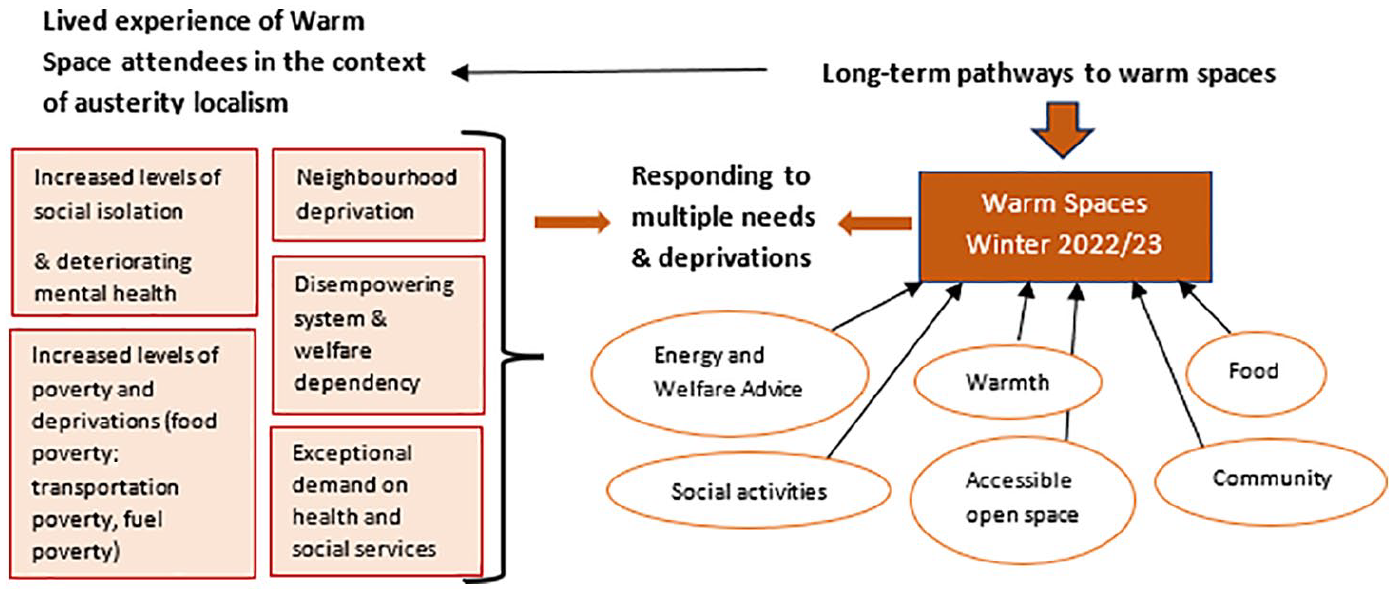
Warm Space responses to the lived experience of attendees.
The significance of place in fostering a sense of community and the impact it had on social integration, wellbeing, and support among the attendees is critical to this study. The success of St. Ann’s warm space as a community space did not happen by default, but was driven by the motivation and leadership of key players at the Advice Centre and the levels of resilience of the local voluntary sector ecosystem. For many attendees there was a strong sense of connection to St. Ann’s and the advice centre in which the warm space was located. This connection to St. Ann’s has been explored in a number of studies most notably by Coates and Silburn (1970) who found that despite high levels of poverty and poor-quality housing, residents recognised and valued a strong sense of community cohesion. Revisiting this study, McKenzie (2012: 472–473) described a process where marginalised residents turned to the local community by ‘engaging in what is local and available’ as a way of compensating for socio-economic challenges. This is also reflected in the wider context of industrialisation and erosion of the welfare state, with recent scholarship describing the resilience of communities to survive (Lewis, 2016).
We observed the warm space built upon these pre-existing social connections, as the advice centre was a known and trusted location for attendees. St. Ann’s warm space was not just a response to a physical need for warmth but a symbol of the community’s resilience and ‘reclaiming community’ (Taylor, 2011). This dynamic may not be so evident in warm spaces delivered in different locations, from different facilities (such as a council building or church) or organised by different providers.
In this context, warm spaces could be perceived as an example of ‘Progressive Localism’ (Featherstone et al., 2012). This form of localism is inspired not by the political right, but through a reimagining of localism as a community-driven and outward-looking strategy that ‘creates positive affinities between places and social groups’ (Featherstone et al., 2012: 179). Progressive localism envisions a localism that is decoupled from regressive public sector cuts and underpinned by a commitment to social justice, participation and tolerance. The agency which hosted the warm space embedded some of the fundamental attributes of progressive localism, an outward-looking organisation creating positive community connections, demonstrating how long-standing community relationships and the provision of both practical and social welfare support can counter some of the negative impacts of austerity localism.
However, this stands in contrast to the broader socio-economic and political context which has become increasingly hostile towards marginalised communities. Looking beyond the immediate experience of attendees and warm spaces service delivery, the regressive elements of localism and harsh realities of austerity (Cooper and Whyte, 2017) were too apparent. The rolling back of state support has created multiple vulnerabilities which an initiative in a community-based centre cannot address (even when it attempts to provide holistic support), and will ultimately continue to exacerbate inequalities.
Our findings suggest that while warm spaces are a positive example of community resilience and engagement, they are also an austerity-imposed necessity (Arrieta and Davies, 2024). While providing some short-term relief and addressing immediate crises, staff were acutely aware of their role in providing a ‘sticking plaster’ for a limited number of people in the community. The warm space had a primarily reactive role, powerless to resist the fundamental damage created by a sustained period of austerity and unable to foster longer-term empowerment. Austerity localism has shown to create a double bind for the warm space provider, in attempting to provide a safe space and wrap-around provision for an increasing number of service users with complex needs, while facing the impossible task in trying to mitigate the gaps caused by the ‘disassembling of the state’ (Cooper and Whyte, 2017: 20).
Within this context, the potential for empowering vulnerable individuals and creating voluntary support depends on the ability of organisations and community leaders to go beyond their roles to help navigate, resist, or overcome increasingly restrictive welfare conditions.
Conclusion, limitations, and policy implications
Warm spaces are a significant initiative for people who live in poor-quality, cold accommodation and who often do not benefit from the ‘psycho-social factors’ of a home. The warm space profiled here can be seen as an example of good practice. It provided a valuable resource and community space beyond those offered by statutory services and addressed some of the multiple needs faced by attendees during the winter months. It provided an example for other service providers of how to engage with the community and foster a sense of community for service users. Flexible opening hours, the provision of food and wrap-around services and genuine recognition of the lived experience were key. The Warm Welcome campaign provides further guidance for service providers, demonstrating the social value of warm space and examples of best practice (Warm Welcome, 2024).
However, warm spaces are not a viable long-term solution. They are a manifestation of austerity localism and their need will persist where high levels of poverty and vulnerability endure. The warm space was unable to provide attendees with adequate resources to heat their homes and alleviate root causes of poverty, housing insecurity, social isolation, and mental ill-health.
As warm spaces are an emerging phenomenon which exhibit great variety across areas, some findings may not be transferable to other warm spaces in the UK. As the value of third places is subjective, multifaceted, and complex (Oldenburg, 1989), there is a need for further research of their role in the voluntary landscape and testing different delivery models across locations. Further research could help with providing evidence for the effectiveness of such interventions (and programmes to alleviate fuel poverty) as well as by highlighting systematic and policy failures.
Austerity localism compels the voluntary and community sectors to balance funding pressures, organisational priorities, and community need (Edmiston et al., 2022) which can perpetuate inequalities towards socially marginalised groups (Fitzpatrick and Stephens, 2014). While our findings point to some diversity in attendance, especially in terms of ethnicity and age, and the attempt to create an inclusive space for everyone, we were unable to further investigate the impact of different intersectional dimensions and gender imbalance on people’s use of the warm space.
The future of warm spaces in the UK is not clear. In the winters of 2022/2023 and 2023/2024, they quickly became an important feature of community-based support for people struggling with fuel costs, low incomes, and access to public services. It would be easy to speculate that if these pressures ease in the future the need for warm spaces will diminish. In the short-term this seems unlikely. Although liable to change the current spending plans of the new Labour Government would see the majority of public services (most notably in local government and criminal justice) performing more badly than before the COVID-19 pandemic (Hoddinott et al., 2024). Energy prices spiked in 2022 but remained high and were expected to increase further in the last quarter of 2024 and remain at this level in 2025 (Bolton, 2024). It seems likely, therefore, that warm spaces will continue although their precise function will evolve to reflect community needs.
Footnotes
Acknowledgements
We thank the warm space attendees who participated in the research and welcomed us in their space. We also thank Rachel Graham and Debbie Webster from St. Ann’s Advice Centre for enabling and supporting this research. Thanks to Johanna Roberts and Professor Jill Manthorpe for useful comments on an earlier draft of this article. Thank you to the journal’s anonymous peer reviewers for their comments which helped to shape the final article.
Author contribution statement
The authors equally contributed to the data collection and analysis and drafting of the final version of the paper. Richard Machin is the first author as he made final editing decisions.
Funding
The author(s) disclosed receipt of the following financial support for the research, authorship, and/or publication of this article: This work was supported by Nottingham Trent University QR Funding (reference: CPCS_RMachin_00)
Ethical statement
The Schools of Business Law and Social Sciences Research Ethics Committee (BLSS REC) at Nottingham Trent University approved all elements of this research (approval: An Exploration Of The Need For And Use Of ‘Warm Spaces’) on 06 February 2023. Respondents gave written consent for review and signature before starting interviews.
