




Abstract
Since 2018, there has been a notable increase in recognition of the global youth climate movement. Young activists have come into the spotlight through extensive street demonstrations, school occupations, and engagement in other collective actions with the purpose of promoting alternative visions of the future. Multiple scholars have delved into activists’ profiles, their media representations, and other topics. Nevertheless, there is still a lack of research exploring their political imaginaries. This article aims to contribute to understanding how young activists in Portugal assess the current social and political landscape and construct visions of political futures. After analyzing online texts from four climate groups, we identified four themes that offer insights into the political imaginaries of these groups. The four groups discursively negotiate political imaginaries that correspond to a wide spectrum of perspectives, ranging from collective resistance against the neoliberal capitalist system and proposals of decentralized democracy to strategies based on individual ethics and the prevalent discourses of sustainable development and ecological modernization. The plurality of political imaginaries reflects the diversity of sociopolitical stances within youth-led climate movements in Portugal and their commitment to exploring alternative ways of governing climate change.
Introduction
Worldwide, young people have gained much visibility as climate activists since 2018. Through large-scale protests, school occupations, and other forms of collective action, young climate activists envision and promote alternative futures (Bowman, 2019). Previous studies have examined these groups from various perspectives (de Moor et al., 2021; Evensen, 2019); however, their views on what is politically appropriate to address climate change remain understudied.
This article aims to contribute to understanding how young activists assess the current social and political landscape and construct visions of political futures in Portugal in face of the climate crisis. We ask: What kind of society is envisioned by young activist groups, and how do they propose achieving it? We get inspiration from the concept of political imagination as formulated by Machin (2022), McAfee (2017), and Taylor (2002), among others. Our analysis of political imaginaries will also draw on critical perspectives on discourses about environment and climate change (Dryzek, 2013; Herbert, 2021; Machin, 2013); the relationship between social change, politics, democracy and justice (Castoriadis, 2005; Fraser, 2000; Linnér and Wibeck, 2019; McAfee, 2017; Mouffe, 2005); and youth imaginaries and narratives (Marquardt, 2020). Based on those theoretical contributions and extensive exploration of empirical data, we conducted a critical discourse analysis to explore different political imaginaries.
Critical Discourse Analysis (Fairclough, 2001) is used to understand how groups make sense of the present and future sociopolitical reality and how they employ discursive actions to articulate – and/or demarcate themselves from – alternative visions (e.g., Molek-Kozakowska, 2021). The texts produced by young climate collectives allow us to grasp various political imaginaries and the more or less politicized nature of the discourses (Pepermans and Maeseele, 2016). We will present the analysis of online texts from four groups in Portugal, composed of young people, significantly active and employing different action repertoires: Climáximo, School Strike for Climate Portugal (henceforth SSC-PT), LIDERA a Década do Clima (henceforth LIDERA) and Ambiental-Ist. The analysis is organized into four themes that emerged from an exploratory analysis through a deductive-inductive and iterative process. The themes allow us to understand activist groups’ positioning regarding: the prevailing sociopolitical and socioeconomic systems and alternatives, climate justice, and senses of political agency.
Political imaginaries and discourses on climate change
According to Charles Taylor (2002), a social imaginary describes how ordinary people envision and understand their social environment. This encompasses shared expectations, common understandings of collective actions, and a sense of relationships and belonging. McAfee (2017) adds that political imaginaries are the collective unconscious beliefs and perceptions about politics that shape our understanding of who the key actors, groups, and decision-makers are in society. Even though they operate unconsciously, imaginaries play a significant role in shaping our political worlds, influencing our political identities, relationships with others, and the broader political culture (idem). Social imaginaries blend factual observations with normative ideals, concerning not just how things typically occur but also how they should ideally unfold, with an awareness of what actions might disrupt or invalidate social practices (Taylor, 2002). Similarly Machin defines political imaginaries as ‘dynamic constructions of political reality that enable practices, orient expectations, inform decisions, and determine what is politically legitimate, feasible, and valuable—and what is not’ (Machin, 2022: 2, our italics). Political imaginaries are associated with power dynamics involving hierarchies, forms of inclusion and exclusion (e.g., ‘We’ and ‘Others’), and notions of community and rights, which dictate what is (and is not) legitimate, who has the authority to decide, ‘what constitutes political participation and who is allowed to participate’ (Machin, 2021: 554).
The question of what is valid/legitimate (or not) holds political significance, as it involves the clash of multiple (emergent and) competing imaginaries, rather than a single unified vision (McAfee, 2017; Williams, 1977). Looking at relations between climate and change democracy, Machin emphasizes competition among various political imaginaries – skeptical, rational, and radical –, each of them supporting different trajectories of democratic life (Machin, 2022).
Political imaginaries and discourses are mutually constitutive. We view discourses as meaning-making practices enacted via texts in verbal, visual and/or other languages, which are produced and ‘consumed’ in the context of other sociocultural practices. Discourse operates at the symbolic level, by socially constituting reality, identities, social relations, and systems of knowledge (Fairclough, 1995), and has important implications at the material level. A given text can turn certain proposals or expectations legitimate, ‘natural’, and limit (or allow) them to be subjected to alternative understandings. As McAfee (2017) argues, ‘[a] political imaginary will rarely be recognized as such. Rather, it will be taken as ‘just the way things are’; ‘the ways politics work’; and ‘how things get done’’ (McAfee, 2017: 919). Hence, in the analysis of views on climate change, we should question how particular political ideas are normalized, taken as unquestionable truths through discourse (Fairclough, 1995), and incorporated in the form of ‘stereotypical images, which dominate public discourse (. . .) such as catchphrases (. . .)’ (McAfee, 2017: 917).
The dominant political imaginary in recent times has been primarily marked by the dictates of (neo)liberal democracy, a form of ‘market-driven politics’ (Leys, 2003) in which elected representatives facilitate the operation of the free market and the scope for state intervention gets reduced (Eckersley, 2004; Pichler et al., 2020). The market system evolved into an autonomous entity. Paradoxically, in its pursuit of self-regulation, the market led to its own deregulation, even influencing the imaginaries of citizens who, under laissez-faire principles, placed their faith in the self-regulating market (Polany, 1994).
In this context, citizen participation seems ‘unnecessary’ because ‘all that is political melts into economics’ (McAfee, 2017: 920). This perception poses a challenge: it risks depoliticizing the discourse surrounding the climate debate. Market responses suppress dissent, which is foundational to democracies (Mouffe, 2000, 2005). Moreover, the dominance of the socio-technical-economic matrix in climate change governance and discourse (Carvalho, 2019; Machin, 2013) often leads discussions to focus solely on technological solutions and specialized knowledge, potentially hindering the politicization of the debate – that is, accounting for the political (and other power-related) choices and decisions underpinning structural causes of climate change, thereby opening the debate to alternative socioenvironmental futures (Pepermans and Maeseele, 2016).
Nevertheless, Machin (2021) observes how the environmental movements revive the democratic life. These movements emerge as creators of alternative political visions, actively reshaping the societal landscape and performing diverse democratic expressions within their own frameworks.
Since 2018, a wave of student-led protests has emerged – mainly represented by Fridays for Future (or School Strike for Climate) – challenging political inaction in face of the severity of climate change. The FFF movement presents a very clear purpose: to pressure governments to respond to the climate emergency (Fridays For Future, n.d.). At its inception, the movement aimed not only to spread the call to ‘listen to the science’ but to reshape forms of political action, especially by pressuring conventional institutions to move beyond business-as-usual.
In Machin’s (2021) analysis, FFF is associated with a ‘green democratic imaginary’ – involving a form of decentralized decision-making, ‘taken by an inclusive demos, who passionately participates in politics through direct action in order to disrupt unsustainable conventions’ (p. 560). In addition, FFF embodies a ‘radical imaginary’, rejecting societal expectations for youth (e.g., attending rather than missing school) (Machin, 2022: 8). The FFF movement has brought the discussion about the dysfunctionality of neoliberal democracy into the public sphere by opposing the dominance of fossil fuels and the maintenance of the status quo. They raise the banner of Climate Justice and seek to recognize and include multiple voices associated with the climate crisis, especially the most vulnerable ones.
The youth climate movement represents an effort to politicize the climate debate, pinpointing areas of contention and promoting discussions about social contingencies (Machin, 2021; Marquardt, 2020). In this context, young activists are the producers of contestation discourses, questioning the current state of affairs to varying degrees, challenging the crystallization of hegemonic meanings (e.g., the definition of justice) (Newell et al., 2021), and presenting alternative futures.
Resistance to two forces – the neoliberal market and traditional political power institutions – permeates the movement’s action repertoire (Marquardt, 2020). FFF believes that nonviolent direct actions (such as street protests), civil disobedience, and strengthened dialogues in local spaces are forms of action capable of generating social change. In a study of FFF in Germany, Marquardt (2020) noted how climate protests have opened up possibilities for rethinking the system and for collective participation of the population. He identified ideas oriented toward systemic changes ( ‘post-development or degrowth’) – which align with a ‘radical imaginary’ – as opposed to capitalist logic. A more ‘moderate imaginary’ with a focus on science-guided and technological-based reforms was also identified. Those contrasting perspectives within the FFF movement are testimony to the emergence of alternative thinking outside of hegemonic and institutionalized spheres.
Young climate movement in Portugal
In Portugal, climate groups highlight the need for social transformations, pressuring governments and advocating action at international, national, and local levels (Malafaia, 2022; Malafaia et al., 2018). Over the past decade, Portuguese environmental and climate movements have gained more prominence in the streets (Fernandes-Jesus and Gomes, 2020), and the youth climate movement has acquired significant visibility (Malafaia et al., 2018).
For this study, we selected four activist groups: one international movement represented in Portugal – School Strike for Climate – and three national initiatives – Climáximo, LIDERA, and Ambiental-Ist. These groups are mainly composed of young activists who are active and visible in public spheres, exhibiting diversity in profiles (for instance, some are clearly associated with students while others are not), action strategies, and approaches to social change (e.g., advocating more or less profound changes).
In Portugal, SSC-PT took the designation of Greve Climática Estudantil and began its activities in 2019 during the first Global Strike for Climate. SSC-PT consists primarily of young students, ranging from underage school students to university students. On Instagram, their profile (
Self-described as ‘an open, horizontal, and anti-capitalist collective’ (Climáximo website, 2021), Climáximo started in 2015 and joined the international Climate Justice Action Coalition. Operating from Lisbon, the majority of the movement’s members are young adults. Although not solely focused on youth, Climáximo attracts many young individuals who follow and participate in its activities. As the first activist group engaging with climate justice in Portugal, Climáximo has led key campaigns and is known for building a network of labor and environmental movements and unions around the Climate Jobs Campaign. Their Instagram profile (
LIDERA a Década do Clima was created in 2020 and their first known action was a Bootcamp. They also wrote an open letter titled ‘The future we want; A letter from Portuguese youth to the country’. Endorsed by nearly 1,000 subscribers under 35 years old, youth-led non-governmental organizations and 300 supporters over 35 years old and other organizations, it was delivered to the national Environmental Minister. LIDERA refers to itself as a ‘generation’ and adopts a hierarchical organizational structure, consisting of designated ‘leaders’ and other organization members. On Instagram, their profile (
Formed in 2019, Ambiental-Ist – Núcleo Ambientalista do Instituto Superior Técnico – gained visibility in 2021 with the publication of the Open Letter to Higher Education for the Climate, signed by more than 60 associative structures. The group believes that ‘the student community can be a driving force for large-scale change; we aim to revitalize the historic Portuguese student fight, this time with a focus on climate’. (Ambiental-Ist website). Their profile (
A critical discourse analysis of activist texts
Recent studies have delved into the profiles (de Moor et al., 2021; Neas et al., 2022), opinions (Buzogány and Scherhaufer, 2022; Piispa and Kiilakoski, 2022), and media representations (Santos et al., 2023) of young climate activists. Yet, the understanding of what young people deem politically appropriate or preferable in addressing climate change remains scant. What kind of society is envisioned by activist groups, and how do they propose achieving it? We address this question via a critical discourse analysis of a corpus of texts from the websites and (in some cases) also the Instagram accounts of the four selected groups. Here, ‘text’ encompasses website content and Instagram posts that consist of a title and a textual body, functioning as a cohesive unit. Spanning various communicative genres, this includes manifestos, calls to action, press releases, wrap-ups, open letters, interviews with experts, and essays. Our analysis focuses on verbal content and does not extend to non-verbal material.
The relevance of Critical Discourse Analysis (CDA) (Fairclough, 2001) in this study lies in its potential to grasp the discursive actions employed by activist groups to represent and position themselves regarding the prevailing political and socioeconomic systems, as well as potential alternatives (e.g., Molek-Kozakowska, 2021). CDA helps understand whether and how activist groups politicize the debate on the social transformations needed to move toward a more sustainable and fairer society (Pepermans and Maeseele, 2016). Given the nature of activist work, individuals and social groups tend to ‘recontextualize’ (Fairclough, 2001) social practices and give them new meanings through discourses. Discursive actions include acts of foregrounding and positioning, lexical choices and grammar (e.g., modal verbs, etc.), figures of speech and other rhetorical elements (Fairclough, 2003). Both mentions and omissions are highly relevant to CDA (Fairclough, 1995). What is not said informs us about different groups’ non-priorities and non-discussions, influencing how the problem is formulated (namely, whether it is politicized or depoliticized).
Browne and Diehl (2019) maintain that political imaginaries emerge from a collective symbolic structure that institutes the political. Yet, operationalizing the concept proves challenging, due to its complexity. We consider that political surfaces through discourse, highlighting key actors and institutions under scrutiny, positioning them, and proposing alternatives for change.
To address this complexity, we organized the analysis in two stages: in the first stage, exploratory analysis involved the identification of narrative elements in discourses, of provisional categories of analysis supported on the literature review, and of related and recurring elements in the texts, such as forms of decision-making, conceptions of societal organization, the role assigned to citizens, values, and proposed policy actions (see Hopwood et al., 2005; Levy and Spicer, 2013; Marquardt, 2020). The four core themes that were developed (Table 1) allow us to understand how imaginaries are shaped by political and economic systems (the ‘broader political culture’), who enters the debate (the ‘relationships with others’) and their roles as agents of power ( ‘our place within the political world’ and ‘our political identity’) (McAfee, 2017). Our second stage analysis investigated the discursive enactment of each theme. The combination of the characteristics of each theme points to different political imaginaries, as discussed below.
Core themes in political imaginaries on climate change.
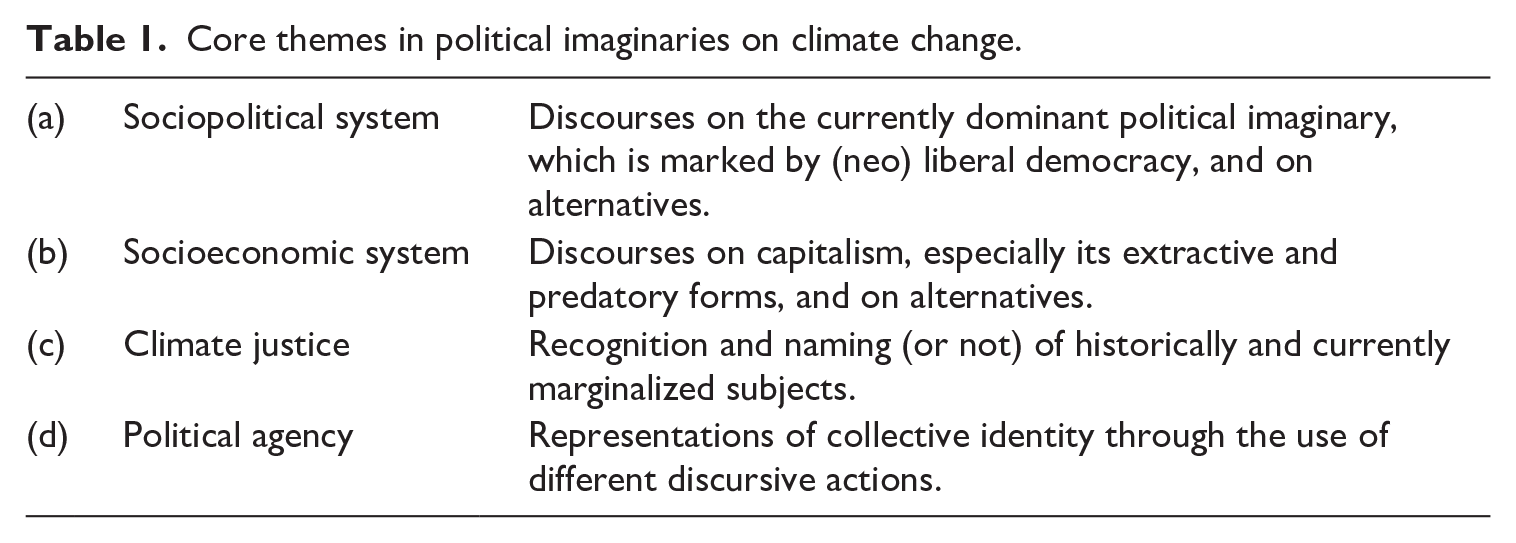
We collected texts from the websites of the four groups, as well as from the Instagram profiles of two groups, and analyzed a corpus of 454 texts (287 from Climáximo, 86 from SSC-PT, 57 from LIDERA, and 24 from Ambiental-Ist) published between 2018 − the year when school strikes by Greta Thunberg began and gained media visibility – and December 2022. Instagram profiles were used when text in groups’ websites was limited, namely in the newest groups, LIDERA and Ambiental-Ist.
Activist groups have produced texts belonging to different communicative genres and aimed at diverse audiences, constituting different ways of ‘talking’ about climate change. However, our analysis focuses solely on the public image each group decided to present to a broader audience. We have only collected texts from platforms that are publicly accessible. Although the names of the groups are identified, we have not identified the names of the authors of texts. All excerpts were translated by the authors.
Analysis
In this section, we examine activist groups’ texts in light of each of the four themes mentioned above.
Sociopolitical system – discourses of rupture and continuity
As represented in the analyzed texts of all four groups, current political power exhibits deficiencies that need to be overcome. In some texts, it is argued that the political system should be completely transformed. The current political system is seen as a constraint on climate action since it cannot meet the demands of abrupt changes in the planet’s biophysical systems and increasing social inequalities.
For activist groups like Climáximo and SSC-PT, the current Portuguese electoral-representative democracy limits climate action as it does not represent the ‘true’ interests of the population. They point out various types of dysfunctions in this mode of political representation. One of the purposes of groups such as Climáximo and SSC-PT is to ‘unmask’ and expose the unequal power dynamics that permeate social reality, positioning themselves in stark opposition to those dynamics. They claim for a series of actions and aim to create an identity around a contestation, which is critical to ‘the political’ (Laclau and Mouffe, 1985). The ways in which they frame the problem – as political inaction based on a ‘historical contradiction’ between ‘a restricted group’ and the ‘majority of humanity’ (SSC-PT_2020) – and how they distance themselves from its causes ( ‘Governments are. . . But we.’..) politicizes the analysis of climate change:
‘Governments are experts at signing papers. But we have an international climate justice movement that has been built over decades, and
These two groups demand a ‘real’ democracy in the sense that it should be ‘participatory’ and ‘deliberative’ ( ‘The open deliberative processes, daily plenaries, and action delegates’ plenaries reflect the participatory form that democracy should take.’, Climáximo_2019). Instead of ‘bringing people into decisions’ (in a top-down hierarchy), the aim is to ‘give back’ power to the people, which was ‘stolen’ in the past (e.g., by colonialist practices):
‘Together with different sectors of society around the world, led by those that are most marginalized,
SSC-PT calls for expanding decision-making power to ‘multiple places of speech’ (SSC-PT_2020). Both groups oppose neoliberal positions that prioritize a capitalist logic ( ‘#PeopleNotProfit’, ‘power in the hands of people, not corporations’, Climáximo_2018). SSC-PT maintains that ‘the necessary change will not come from politicians [and] it will not happen through negotiations. Change comes from people taking to the streets to demand climate justice’ (SSC-PT_2021, our brackets).
In these two groups – Climáximo and SSC-PT –, we can see a solid critical position toward the government’s role in responding to what constitutes ‘real needs’. The noticeable emphasis on the ‘real’ indicates how the policies advanced by the current system subvert the population’s needs. Reflected in the excerpt is how SSC-PT opposes the maintenance of a system through the narrative of ‘we vs them’ – those who apply ‘cosmetic reforms’ (associated with the Mayor of Lisbon, Carlos Moedas) and those who have ‘political strength to demand a new system’ (activists): ‘(. . .) in order to mitigate and solve the climate crisis with social justice, we need to
Contrasting with Climáximo and SSC-PT, LIDERA and Ambiental-Ist adopt a discourse of continuity with traditional institutions. The following excerpt from LIDERA presents voting as an act of resistance and collective protest. The use of one of verses from the song ‘Grândola, Vila Morena’ (1974) – ‘the people are the ones who command’, a symbol of Portugal’s 1974 ‘Carnation Revolution’ that overturned dictatorship – is a rhetorical trope capable of activating national memory. For representative democracy to be effective, they argue, it would be enough for the population to be informed about the ‘problem’ and to act in their daily lives through conscious consumption:
”As citizens, we need to fight determinedly for the future we want. Through our vote, our daily choices, demonstrations, or letters like this one. Because the citizens of a democracy, when they act collectively, are the ones who command”. (LIDERA_2020)
According to the group, education for sustainable development, especially in higher education institutions, and changing lifestyles are the means of action for responsible environmental citizenship. This is a path that promotes ‘(. . .) public participation in order to ensure full representation of everyone’s interests’. (LIDERA_2020).”
LIDERA’s conception of society foregrounds ‘leaders’ and ‘experts’. Their open letter (2020) constitutes these subject positions and highlights their roles in addressing climate change. The group is intent on recruiting charismatic voices – ‘We need voices that echo in the same direction. (. . .) leaders with a common goal’ – and qualified voices – ‘Because no one knows everything, but if we bring together several people who know a lot about their areas, it is possible to form a stronger and more capable community’. (LIDERA’s open letter, 2020) – in proposing solutions to the climate crisis. The stated aim of including the ‘everyone’s interests’ while prioritizing charismatic and qualified voices offers cues about the group’s understanding of democracy. LIDERA’s stance aligns with discourses categorized as ‘leave it [climate change] to the experts’ by Dryzek (2013, our brackets), where committees of experts stand out in the regulation of political affairs.
In the corpus of Ambiental-Ist, only one text includes a reference to democracy. It allows us to understand how the group perceives ‘[t]he climate crisis and socioeconomic asymmetries’ (Ambiental-Ist_2021). Grounded in the idea of sustainability (‘safeguarding the planet for future generations’), ‘democratic will’ is mentioned in opposition to profit-driven and extractive logic ( ‘(. . .)fill the pockets of those who once profited from the destruction of the environment(. . .)’), carried by ‘a tiny portion of the population’ (Ambiental-Ist_2021). This group advocates collaboration between formal international and national institutions. While addressing higher education institutions in their open letter (2021), they call for ‘collective commitment on a global scale, ambitious government measures, and collaboration between countries and supranational organizations. (. . .)’ (Ambiental-Ist_2021). Nevertheless, local-level investment is identified as ‘the key to global change (. . .) [where] only a society composed of communities with a strong sense of social and environmental duty can come closer to climate justice’. (Ambiental-Ist_2021, our brackets)
In summary, although the first two groups (Climáximo and SSC-PT) resist and call for the annihilation of dominant, top-down forms of political power, they consider that some of the existing institutions (such as municipalities) continue to be necessary as facilitators of climate action (e.g., on energy policy), where experiences of decentralized and deliberative decision-making stand out. LIDERA and Ambiental-Ist are committed to disseminating qualified knowledge (interviews with experts or organization of training events) so that the population has sufficient knowledge to engage in climate action. Their understandings correspond to two types of democracy explained by Pichler et al. (2020): (A) ‘Participatory environmental governance’ where representative structures prevail and instruments of participation and deliberation complement democratic decisions and (B) ‘Post-political and socio-ecological conflicts’, in which formal democratic processes remain intact but have little decision-making power as market logics and bureaucratic processes are favored. In contrast, in the discourses of Climáximo and SSC-PT, we found hints of (C) ‘direct democracy and consensus-based decision-making from below’, a democratic practice based on direct democracy and decentralized in local units, opposition to the electoral-representative state and the reproduction of the domination of specialized knowledge.
Socioeconomic system – from modernization to degrowth
The transformations proposed by Climáximo and SSC-PT should have ‘life at the center, instead of profit’ (Climáximo at the climate camp Ende Gelände_2022), as echoed repeatedly in their texts. Both groups consistently promote visions of ecosocialism and degrowth (with the former being more explicit) to describe the politics ‘for’ the future, that is, that are needed in order to guarantee that there is a future:
‘Ecosocialism is a political movement for the future, based on safeguarding ecological balances, preserving healthy environments, defending workers, and rejecting the capitalist mode of production’ (SSC-PT_2020).
SSC-PT explains what ecosocialism entails: ‘The solution is not a “general limitation of consumption”, but rather a change in consumption, away from ostentation, waste, alienation, and accumulation that prevail in the capitalist order’ (SSC-PT_2020). The group suggests replacing ‘having’ with ‘being’ in a fairer society, foregrounding values of empowerment and personal care – ‘working fewer hours and seeking personal satisfaction through cultural, sporting, artistic, erotic, and political activities, instead of having compulsive ambition for the accumulation of lifeless objects and property’ (SSC-PT_2020).
Despite an apparent opposition to capitalism by LIDERA and Ambiental-Ist, it is interesting to note how these two groups practically omit the term ‘capitalism’ from their texts. In all the texts of Ambiental-Ist that we analyzed, there is only one mention of the word ‘capitalism’ in the context of planned obsolescence ( ‘It is the perfect tool in a capitalism paradigm’, Ambiental-Ist_2022). LIDERA does not mention the term ‘capitalism’ a single time in its 57 texts.
The discourse of LIDERA primarily falls “within the system” by suggesting reforms in banking, the allocation of funding, regulation, and attention to indicators such as Gross Domestic Product. The group emphasizes that ‘[m]oney continues to be a crucial focus in the lives of the overwhelming majority of the members of society, be they individuals or companies. It is essential not to overlook this fact to outline an appropriate strategy for sustainable development’ (LIDERA_2020).
The discourse of Ambiental-Ist can be interpreted in light of the frames of sustainable development, individual ethics, and ecological modernization (Dryzek, 2013; Machin, 2013), with a strong focus on entrepreneurship (the presentation of ‘green’ start-ups and expert interviews) and the responsible-green consumer-action motivated by a “general increase in income, combined with (. . .) awareness” (Ambiental-Ist_2020). Ultimately, action is based on an environmental ethic that understands the individual as a responsible-rational-green consumer. As in the individual interpretation of the “techno-economic” discourse, the emphasis is placed on being a “good citizen” and on the correct way to act (Machin, 2013: 30–43).
The analysis of texts from Climáximo and SSC-PT points to a more transformative imaginary (Herbert, 2021; Pichler et al., 2020). In opposition to capitalism, proposals such as degrowth are discussed; social well-being is understood as a priority above economic interests; the climate emergency is seen as the greatest threat to society, significantly affecting marginalized groups. In turn, groups like LIDERA and Ambiental-Ist reproduce a technical-centered discourse, choosing expressions such as ‘energy certification and management’, ‘Internet of things’, and ‘environmental and sustainability criteria’ (Ambiental-Ist_2020). In our understanding, this type of discourse delays discussions about the strong (and growing) social inequalities caused by anthropocentric changes. Instead of reflecting on transformations, these groups prefer to talk about improvements and reform of social institutions, aligning with a more ‘moderate imaginary’ (Marquardt, 2020) and the maintenance of the status quo (Hopwood et al., 2005).
Climate justice – recognition and intersectionality vs a global voice
With varying degrees of detail, the proposals for democratic governance put forth by the examined groups imply the recognition of those most affected by climate change. Injustice is clear: ‘Those who contribute the least to climate change are the ones who suffer its consequences the most’ (SSC-PT_2021). Climáximo and SSC-PT precisely identify the population(s) most affected by climate change in their texts. Their analyses target conditions related to work, gender, sexuality, age, social class, etc., revealing the intersectionality of this crisis. This ‘intersubjective recognition’ (see Fraser, 2000; Fraser and Honneth, 2003) reveals the intent of these groups in exposing the social inequalities involved in climate change. In the texts of Climáximo and SSC-PT, spatial injustices are also identified. This involves naming multiple regions at the national and international levels that are affected by disasters as well as by repressive governments. Following the steps of the international movement, SSC-PT references MAPA (Most Affected People and Areas) (Reyes and Carderón, 2021) as a form of spatial recognition (Svarstad, 2021).
LIDERA and Ambiental-Ist instead tend to offer depoliticized discourses. In LIDERA‘s Open Letter, written during the COVID-19 crisis, the group begins by stating that: ‘(. . .) as a generation that will inherit the outcomes of today’s decisions, we could not help but write this letter to
Through their discourse, we understand the group’s position: the goal is ‘recovery’ (the ‘storm’, that is, the COVID-19 crisis, will eventually pass), suggesting that this is not the time to ‘scale back the already outlined green policy objectives’. In the sociopolitical context of the climate crisis LIDERA does not specify who the subjects involved are, whether ‘governments’ or ‘citizens’, and it is not possible to understand what ‘needs of citizens’ are experiencing. The presentation of problems as generalized and global (‘decisions that will influence the history of humanity’) carries the risk of homogenizing and simplifying an issue of enormous complexity (Hulme, 2009; Kenis, 2021). The group’s Letter indicates a limited openness to acknowledging diversity and heterogeneity: the choice of very generic expressions throughout the letter (‘all social classes’, ‘our health’, etc.) encourages a detached perspective and prevents a politicized discussion about what to do about the problem (Hulme, 2009). LIDERA’s discourse exhibits traces of continuity with the modes of environmental problem management typical of the international political agenda that has been hegemonic in climate change governance (Dryzek, 2013):
‘At this moment, governments around the world are making decisions that will influence the history of humanity. We understand that the current needs of citizens and governments are many, and with them, the temptation to solve problems with short-term solutions grows’ (LIDERA_2020).
Ambiental-Ist discusses climate change through the lens of sustainability. In the text ‘The Climate Crisis and Socioeconomic Asymmetries’, the group recognizes the countries most affected by climate change using rather broad categories such as ‘developing countries’ and ‘poorer countries’ (Ambiental-Ist_2021). The piece closes with an appeal that points to a generalist sustainability discourse – a vision that is homogenizing (‘we are (. . .) as a species’), oriented toward an undefined future (‘ensure the planet for future generations’), to vague (‘species’ and ‘planet’), and where responsibility is ambiguous (it is not clear who is supposed to enforce ‘democratic will’).
In their efforts to recognize social injustices, these groups do not account for systemic and intersectional nature of climate change, which is arguably not just a crisis ‘in parallel’ (LIDERA_2020) or something to be addressed alongside ‘structural problems’ (Ambiental-Ist_2021). In the discourses of Climáximo and SSC-PT, the climate crisis emerged as constitutive of and constituted by political, social, and cultural life. Naming the populations and regions most affected, giving them a voice, and including them in activist texts can be seen as politicizing discursive actions which dispute a single, hegemonic narrative regarding climate change. Conversely, using abstract, homogenizing expressions prevents the exposure of the multiplicity of voices involved in this discussion.
Political agency – building a ‘we’
The final part of our analysis looks into the construction of activist groups’ modes of political agency. SSC-PT and Climáximo operate with great public exposure through demonstrations (mainly in the streets but also in digital spaces) and civil disobedience actions (blocking companies and streets, occupations, and taking the risk of police arrests). In turn, Ambiental-Ist and LIDERA privilege more intimate settings, such as community retreats (in rural locations), volunteer actions, forums, and workshops in institutionalized spaces (university institutions, co-working spaces, etc.).
All groups place the onus of action on a collective identity through the pronoun ‘we’. This shows how the groups represent themselves as agents of power and how that power is rhetorically constituted via their discursive practices. As argued by Gamson (1992), ‘Collective action requires a consciousness of human agents whose policies or practices must be changed and a ‘we’ who will help to bring the change about’ (p. 8).
In the texts of Climáximo and SSC-PT, ‘we are’ ‘victims of the harmful effects of capitalism’ (SSC-PT_2021), but also part of the problem (‘(. . .) we recognize that we too are contaminated to some extent by this toxic system that generates hatred and division’, Climáximo_2020); ‘we are’ responsible for cutting emissions and ensuring climate justice; ‘we are going to’ ‘ensure’ that we know ‘how to act’ (Climáximo_2020). Critically, ‘we are’ ‘experts in exposing’/denouncing (Climáximo_2019) and ‘we are’ ‘the last hope’ (Climáximo_2021).
Multiple roles or positions (e.g., victims, responsible parties, and excluded individuals) are combined in describing the problem and how to go about it. Still, strengthening political agency and commitment to the climate cause stands out through the use of modal auxiliary verbs (‘we will ensure’, ‘we will prepare’, ‘we will not allow’, ‘we will fight’, etc.). Climáximo claims to have members of ‘various social and political backgrounds’ (Climáximo_2020) that are in some way representative of the population (not just one generation) and intends to show the ‘truth’.
LIDERA and Ambiental-Ist present themselves differently, primarily as representing ‘citizens’. In Ambiental-Ist’s discourse, ‘we’ mainly represents the Portuguese student community capable of ‘being a driving force for large-scale change’ (Ambiental-Ist_2021). Their Open Letter to Higher Education for the Climate states that ‘we have come’ to ‘demand’, and ‘we want’ to ‘put pressure on our leaders’. ‘We aspire’ to ‘build a movement’ (Ambiental-Ist_2021); ‘We assume’ the responsibility of ensuring ‘the future of everyone without exception’ (Ambiental-Ist_2021). This is a rather grand but vague discourse. LIDERA maintains that ‘we are’ part of a ‘community of young leaders’ from ‘diverse professional fields’ (LIDERA_2020). Therefore, ‘we choose’ to ‘work with leaders’ (LIDERA_2020), indicates that the audience is restricted. The group aims to garner support from a particular audience, seeking to evaluate candidates to becoming part of the group – ‘No matter where you come from, if you are under 35, have an entrepreneurial mind-set, and leadership spirit, apply through the link in our bio!’ (LIDERA_2022).
Agency is discursively constructed in how they represents themselves and in modes of engagement with society. For Climáximo and SSC-PT street actions, blockades, and emotional appeals (‘we are the last hope’, Climáximo_2021) are key in their public action. In the case of the more moderate or reformist discourses, groups’ actions are legitimated by dominant modes of functioning, particularly institutionalized modes (e.g., delivering an Open Letter to the Minister of the Environment).
Final reflections
In this article, we look at the political imaginaries of young activist groups through a set of four themes that were generated from a deductive-inductive exploration of activists’ texts: sociopolitical systems, socioeconomic systems, climate justice, and political agency. The way groups position themselves in the present in relation to certain conventional institutions and behaviors suggests their visions about what the future might be like and how they might be achieved.
Strong collective opposition to the neoliberal capitalist system, whether holding political institutions or large Portuguese oil companies accountable, stands as a fundamental aspect of groups with more transformative discourses, such as SSC-PT and Climáximo. By opening possibilities for rethinking the political system, these groups challenge the prevailing electoral-representative model, which maintains close ties with large capitalist entities. Within these groups, there is a desire for a radical democracy that represents the ‘people’, mostly those most impacted by climate change. These groups invest in counter-narratives to focus on climate justice and expose the structural inequalities of Portuguese society, often adopting an antagonist narrative of ‘us vs them’. Critical thinking is fostered within these groups, notably exemplified by Climáximo, stemming from their enduring connections with Portuguese associations, labor unions, and grassroots movements. While SSC-PT and Climáximo share some perspectives, SSC-PT occasionally exhibits ambivalence regarding its involvement with conventional political institutions. In contrast, more ‘moderate’ groups like LIDERA and Ambiental-Ist tend to perpetuate a discourse advocating for strategies grounded in individual ethics, the concept of ‘sustainable development’, and ideas associated with ‘ecological modernization’ (e.g., green entrepreneurship). Their political imaginary leans heavily toward working ‘within’ the system, for instance, advocating for the reform of dominant guidelines concerning climate change and promoting national/international political agreements. Their communication methods reflect their views: preferring open letters, conducting interviews with experts, and showcasing green projects, often employing technical language. The drawback of this kind of discourse is that it lacks in-depth, inclusive, and plural dialogue about the issues. It tends to restrict what can be done, determine what is valuable or not, and define the means of participation, including who participates and what actions are permissible. These groups operate within specific contexts that influence their communication strategies. For instance, Ambiental-Ist consists of students from a single institution, while LIDERA represents a cohort of young leaders engaged in training sessions and awareness-raising activities that align with conventional modes of environmental citizenship.
Youth climate groups have attempt to reinvigorate the discourse on an issue perceived as complex and unappealing within democratic frameworks. In our study, it became evident that different imaginaries coexist. Transformative groups challenge the prevailing neoliberal narrative, question established structures, expose unequal social dynamics, and demand to be heard and included in climate decision-making processes. In doing so, youth are positioning themselves as actors of their imaginaries, bringing the political future to the present and resisting hegemonic structures.
The plurality and heterogeneity of political imaginaries within the Portuguese climate movement align with previous research on young climate activism (Marquardt, 2020; Piispa and Kiilakoski, 2022). With contrasting interpretations of who should act politically and how, multiple modes of action are activated by different Portuguese climate groups in promoting democratic approaches to decision-making, whether through top-down formal institutions (such as cooperation with political parties, youth wings, and green startups) or horizontal and cooperative communities.
Elements of a dominant political imaginary about climate change persist, yet alternative forms of thinking – particularly assertive about issues of recognition (inclusivity and plurality) and climate justice – are also gaining traction. While emergent and residual imaginaries only exist in the presence of a dominant imaginary (see Taylor, 2002), the emergence of alternative imaginaries energizes and revitalizes the democratic debate on climate change (Machin, 2022; McAfee, 2017). Disagreement and conflicting views are prerequisites for the maintenance of democratic debate. Discussions and negotiations on the governance of climate change will be permanently marked by uncertainties and conflict and will never be fully satisfactory for everyone. This is a defining characteristic of the democratic imaginary – there is no guarantee of societal unity and no final suture of ideological differences (Laclau and Mouffe, 1985). Therefore, the political imaginaries studied here are viewed as competitors and adversaries, meaning they are read agonistically and not antagonistically (Mouffe, 2000, 2005).
Given the nature of our data and analysis, some limitations must be acknowledged. First, this is a textual analysis that did not account for other semiotic modes. A multimodal analysis (looking at text, image, and video) would allow us to complement and delve deeper into the imaginaries described here. Furthermore, different communicative genres can condition meanings and that was not fully examined here. The same applies to texts produced for digital platforms, where the goal is primarily to make a call to action. The structure and affordances of some digital platforms restrict the possibilities of complex explorations and discussions. Finally, this analysis refers to a corpus of texts from a period of about four years, but we did not look at the texts from a longitudinal perspective. In future research, it would be helpful to consider how key political moments, both national and international, may have shaped political imaginaries over time.
Footnotes
Funding
The author(s) disclosed receipt of the following financial support for the research, authorship, and/or publication of this article: This work received funding from the Fundação para a Ciência e a Tecnologia (FCt) for the research project “JustFutures: Climate futures and just transformations: Young people’s narratives and political imaginaries” via grant [PTDC/COM-OUT/7669/2020].
