




Abstract
Although addressing the lives, perceptions, and practices of others, sociological research has an ambivalent association with the category of lived experience. Despite its use not always being accompanied by a precise definition, lived experience appears prominently in much academic research and teaching, descriptively standing in for direct firsthand engagement with a wide range of issues. But we know little about how it is implemented in research in contemporary academic sociology. Analysing the content of six years’ worth of British Sociological Association (BSA) journal articles that contain ‘lived experience’ (n36), the aim is to illuminate how sociologists practically deploy the category in their published research. Addressing questions of definition, method, authority of knowledge claims, and coherence of topical inquiry, a central contention is that in the articles reviewed lived experience – despite its often taken-for-granted character – does crucial categorical work with respect to how sociological research is produced and framed.
Keywords
Introduction
Lots of colleagues advised me against writing this article. Their warnings took several forms: ‘you’re asking for trouble’, ‘it seems like punching down’, and – a personal favourite – ‘don’t prod the bear’. Their portentous discouragements reaffirmed my sense that lived experience is a somewhat febrile topic in contemporary sociology; this served to further pique my interest in what the category is taken to mean by academic sociologists as they go about their research. In this article, rather than developing my own definition of what lived experience is or is not (or should or should not be), I set out to establish how it has been deployed by my academic peers in their papers published in sociological journals. For my own part, I have an ongoing and long-standing interest in what sociological categories can usefully illuminate about the social world, and what elements they leave opaque (for example, see Jones and Krzyzanowski, 2008; Pötschulat et al., 2021). This general curiosity brings me to the present study. Quite simply, and modestly, my aim here is to add some understanding to what ‘lived experience’ is used to do in contemporary peer-reviewed sociology journal articles.
In terms of the structure, additional to this introduction and the conclusion, the article is in four main sections. In the ‘Sociology and categories’ section, I give a brief overview of the role of categories in sociological thinking. The next section turns to the category of lived experience in particular, charting some foundations from the perspectives of distinct-but-overlapping intellectual traditions (Feminism, Phenomenology, and Marxism). I then describe and report on my empirical study of the contemporary use of lived experience in published academic articles. The ‘Studying lived experience in sociological use in academic journals’ section gives an overview of the study, which entailed analysing the articles published in British Sociological Association journals over the last six years that mentioned lived experience. This part of the article also provides a rationale explaining what I wanted to find out and why I did what I did. Following this the original analysis is based around four subsections, each of which reports on findings prompted by a distinct-but-related research question. Framing findings with respect to definition, methods, authority in the research process, and the coherence of different accounts, I hope to follow others (Back, 2007; Scott, 1991; Skeggs, 1997) in exploring ‘the advantages and risks of relying on lived experience . . . to pluralize knowledge [production]’ (Voronka, 2017: 189).
Fundamentally then, the article has positive rather than negative intent. It is designed as an aid to thinking sociologically about the use of lived experience, an important category for our discipline. The article is certainly not one that problematises sociologists who use lived experience in their work, and I am not setting out to propose my own definition that I think superior to that of others (either would, I think, be a rather self-regarding thing to do). Nor am I undermining the important positions of those participants who generously give of their expertise, experiences, and time in the furtherment of our shared understanding of the social world. Rather, my hope is that this article will make a small contribution to vibrant and important research debates addressing lived experience from a variety of perspectives, so in the process sharpening our academic analyses of contemporary social life.
Sociology and categories
Ways of grouping people and/or things understood to share some properties in common, ‘[c]ategories are at the root of human action and society, embedded in our minds, discourses and social practices’ (Harrits and Østergaard Mølller, 2011: 229). A fundamental way that we organise our social knowledge of the world as we move through it, 1 categories such as gender, race, and class are collectively constructed devices maintained through their practical use in describing – and helping to analyse – sets of characteristic similarities that are thought to exist in social reality (Douglas, 2002 [1966]). Accordingly, when used in sociological analysis, categories include diagnostic assumptions about the ways things are – so foregrounding some elements of the world and backgrounding or ignoring others – and in the process helping us demarcate our objects of study. But, while the use of categories may promise to forestall any immediate requirement to define every statement we make by helping us articulate our shared senses of phenomena, they are far from being unproblematic accounts of society. Precisely because they are social constructions, we should not take categories for granted, or essentialise or over-stabilise them.
In fact exploration of how categories are ‘culture-bound’ (Banton, 2011: 187) and represent of the social world imperfectly characterises critical sociology. Questioning who ascribes which commonalities to categories allows analysis of how power operates in knowledge production (Smith, 1990, 1999). As part of the generalisation offered by categories, certain types of knowledge and hierarchical thinking are normalised, and their critique is a starting point for decolonising methodologies or disciplinary assumptions more widely (Smith, 2021 [1996]). Certain groups have their knowledges misrecognised or overlooked altogether, and assumptions projected onto them by more powerful actors and what are ostensibly straightforward groupings of people such as ‘women’ (Pearce et al., 2020) or ‘the working class’ (Paton, 2021), or of superficially similar activities – for instance ‘the student experience’ (Pötschulat et al., 2021) – or places such as ‘the Global South’ (Dados and Connell, 2012) are saturated with all manner of assumptions, complexities, and contestations. Critical sociology can help unpack the normalisation of the partial nature of these and other categories, all of which have implications for how certain experiences are made sense of (or not, as the case may be). Mechanisms for ordering the world, categories are politicised devices contingent on the creation of some degree of agreement on how the society is arranged, and which groups should be included in or excluded from analysis (Harrits and Østergaard Mølller, 2011). Further complicating this starting point, associations between and across categories grow from other sets of assumptions (Haraway, 2019 [2017]).
As a fundamental building block of our knowledge about the world, categories are not the sole preserve of sociologists (Banton, 2011; Brubaker and Cooper, 2000; Harrits and Østergaard Mølller, 2011). 2 In a superb article that substantively addresses identity but whose argument is relevant here, Rogers Brubaker and Frederick Cooper (2000) identify two different forms of knowledgeability: categories of analysis – an ‘experience-distant [category] used by social analysts’ (p. 4) – and categories of practice, groupings used in ‘everyday social experience, developed and deployed by ordinary social actors’ (also see Pötschulat et al., 2021, which also uses this article in analysis of ‘the student experience’). A heuristic, Brubaker and Cooper’s binary distinguishes between categories as they are deployed in academic social science and as they are used in everyday life. Although both types of category use – inside and outside of the academic space – are thinking tools for navigating and making sense of the world, they have very different characters, and are – or, from Brubaker and Cooper’s perspective at least, that should be – used to do different types of things. Addressing the broader issue associated with categorical precision in academic analysis in particular, Brubaker and Cooper (2000) warn about the dangers of ‘unintentionally reproducing or reinforcing . . . reification by uncritically adopting categories’ (pp. 2–5). 3 Brubaker and Cooper’s distinction highlights the power discrepancies between different forms of knowledgeability, and in the context of this article this helps us make sense of how the usage of lived experience in sociological inquiry in particular can be studied practically. Generally, one can expect to find technical and precise language underpinning the use of categories in social science, which themselves are entangled with ‘families’ of other categories (that in part characterise commonly held assumptions of disciplinary fields and topics of inquiry, Krause, 2021). Before turning to specific analysis of how contemporary academic sociologists have used the category in their publications, what are some prominent general assumptions grouped together when sociologists have previously discussed lived experience in their research?
Lived experience: a central but fuzzy category in sociology
A formulation of the moment (Neal et al., 2017), and a category in common parlance within and out with the academy, there are lots of places one could – in principle – find uses of lived experience. Outside of the academic space, and when used as a category of practice in Brubaker and Cooper’s (2000) terms, lived experience is a way that the so-called culture wars associated with ‘identity politics’ are framed (in the process becoming mired in all manner of politically motivated oppositions, cancellations, accusations of wokeness, and claims to authority (Prospect Magazine, 2016)). Leaning into these politically manufactured positionings for a moment, my sense from the use of lived experience ‘in the wild’ across political dialogue, TV, talk radio, social media, newspaper op eds, and literary genres is that lived experience is favourably associated with rights claims and empathetic, progressive politics by the left wing, and problematised as solipsistic, unrepresentative, and impressionistic by those on the right. Against this backdrop, the formulation lived experience crops up in the charitable sector, where National Lottery has a Leaders with Lived Experience Fund for example, or in healthcare where for example the East London NHS Trust running an Academy of Lived Experience, where the ‘knowledge and skills of . . . service users and carers train and develop staff through best practices’ (https://www.elft.nhs.uk/service-users-and-carers/academy-lived-experience-ale). Elsewhere, X – formerly Twitter – has been a particularly lively site of lived experience talk over these last years, with the hashtag #LivedExperience home to much social claiming and counter claims-making, often regarding the role of service user’s knowledge vis-a-vis that of experts. Generally speaking, X is a social media platform that overlaps in analytically interesting ways with academic fields of discourse; as a result, tensions evident there around the values associated with lived experience are entangled in different genres of discourse. Hypothetically though, they often involve critiques and projections of the experience-distant knowledge production of elites. 4 Also, over the last decades, instances of the term lived experience have grown dramatically in texts that exist in Google Books, as is illustrated in the Ngram below.
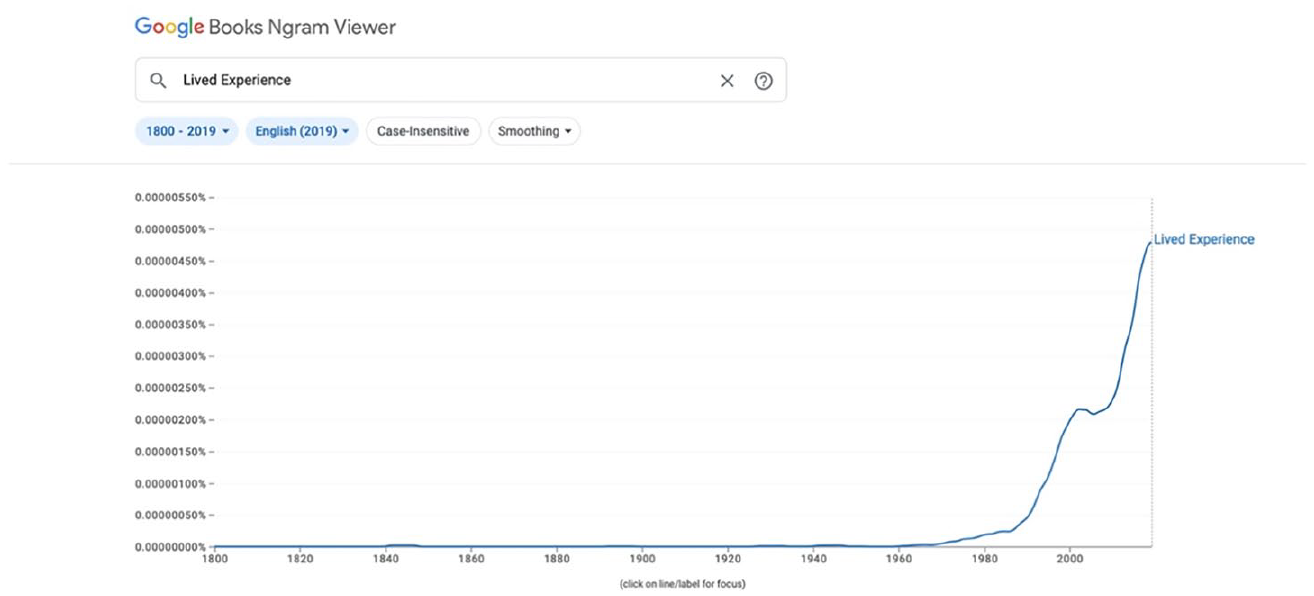
To return to Brubaker and Cooper’s (2000) analysis discussed above, such usage cannot be assumed to do the same things as it does in sociological analysis; in their sense, ‘lived experience’ is used both as a category of analysis and as a category of practice, with frequent and prominent use in the academic space.
However, activity grouped together under the category of lived experience – even fuzzily defined – seems to be squarely within sociology’s remit. At the time of writing, 42 academics have it listed as a topic of inquiry on Google Scholar, there is a funding stream of the British Academy called ‘Lived Experience Projects’, and some UKRI funders require lived experience input on projects they fund. In addition, there are numerous networks, conferences, and academic meetings organised that address lived experience in one way or another. In my own role as an academic sociologist and previously as a journal editor at The Sociological Review I frequently encountered use of the term in articles and in presentations; additionally prominent, widely cited monographs – for instance, Neal et al. (2017) – use lived experience in the books’ titles and throughout.
Away from the contemporaneous academic research literature, explicit discussion of lived experience is to be found in some major intellectual traditions. For many feminists in the late 20th century, for example, the study of lived experience allowed for the discovery of ‘actual people active in the social relations that the categories express and reflect but do not make observable’ (Smith, 1999: 76). As uneven, gendered power relationships underpin regimes of canonised knowledge production, so the creation of categories – and the denigration of others – is a key issue for feminism. Indeed, the critique of a denial of embodied, materially embedded perceptions and practices is a basis of much foundational feminist critique (Kruks, 2001; Scott, 1991 for a summary). A general feminist assumption is that members of marginalised gender groups have privileged positions – special insights – relative to structures and the quotidian arrangements they are entangled with; these perspectives are often overlooked in the knowledge production regimes of the powerful. 5 Against this backdrop, Patricia Hill Collins (2008 [1990]) addressed the lived experience at length. Collins (2008 [1990]) argues that the production of legitimate knowledge reflects struggle and contestation associated with structures of race, class, and gender. The ideological basis of these conditions means that such knowledge is often undermined or overlooked altogether. Hill brings black feminism, and an intersectional perspective (see Cho et al., 2013 for a summary), to bear when suggesting lived experience as a complex meshing of varieties of social identities, which compound the complexity of the relationship between the everyday and seemingly distant structural conditions of action. 6 Collins suggests that when situated in dominated social positions, participants with direct, firsthand experience have knowledge of that system – including of the dominant – while the reverse is seldom the case (Kruks, 2001). As such, accounts emerging from, and addressed to, lived experience can be a basis for tighter, more credible sociological accounts that critique the narrations of the dominant (Collins, 2008 [1990]).
While it may be stating it a little bluntly to say that the ‘goal of phenomenological enquiry is to fully describe a lived experience’ (Mapp, 2013: 308), certainly developing accounts that emerge from and resonate with experience is mainstay within this tradition. Phenomenologists’ attempts to describe and analyse social reality involves de-categorising the world and our practices in it, illuminating how phenomena are understood in practice by members of society. Eschewing technical accounts of the world and challenging accounts that posit the non-rationality of participants within it, phenomenological research gives primacy to the grounded and meaningful accounts of participants that emerge from their lived experience. The intellectual task of the phenomenologist is to draw out the perspectives of others and situate them vis-à-vis participants’ social contexts so that they become sensible, generating depth, non/anti-universal accounts from particular perspectives and specificity of lived experiences rather than generalities (Findlay, 2013). Take, for instance, Carol Stack’s (1983) All Our Kin, a phenomenological account of gender and the ghetto that focuses on the specific and meaningful conditions of practical action in that context. In this book, Stack takes oblique aim at the arguments of detached right-wing ‘underclass’ commentators and their accounts that projected deficits onto the poor (that in turn act as explanations for poverty). Stack’s close engagement in the practical worlds she studies reveals profound and unexpected realities of gender in poor black urban communities. Rejecting economistic ‘New Right’ accounts, Stack shows how local, face-to-face trust relationships are a crucial form of capital in the sites she studied. It is only by proximity to the lives and experiences of others that allows Stack (1983) to show how participants’ decisions and practices become sensible and ‘rational’.
Given its overwhelming tendency towards structuralist accounts, Marxism is, on first glance, an unusual tradition in which to find discussion of lived experience. However, many have argued the desirability of Marxist analysis developing a closer connection to the practices and understandings of the working class, repositioning lived experience in this context (for instance, see Paton, 2021). From this general perspective though, individual subjectivity is oftentimes positioned as a myth when disconnected from collective material structural positions of action; ideological misrepresentations happen when individuals’ lived experience is stripped from class relations, labour, and other forms of capitalist realities. However, elsewhere within the Marxist tradition, and although not using the exact formulation ‘lived experience’, Raymond Williams includes ‘experience’ in his Keywords account (pp. 126–129). In a characteristically brilliant entry, Williams defines experience as (1) Knowledge gathered from past events, whether by conscious observation or by consideration and reflection, and (2) a particular kind of consciousness, which in some contexts can be distinguished from ‘reason’ or ‘knowledge’ (pp. 126–127). Williams tells us that in contemporary usages, experience is synonymous with ‘the fullest, most open, most active kind of consciousness [that] includes feeling as well as thought’ (p. 127). Of course, in these accounts Williams is not so much defining the term as a dictionary would, but rather showing how it is mobilised in ways constitutive and reflective of material reality.
As this whistlestop tour makes clear, despite the marked differences in uses of lived experience observable in different spaces the category signals moving beyond conceptual renditions of reality and instead foregrounding direct engagement with phenomena as a key font of social knowledgeability (Ellis and Flaherty, 1992; Hoop, 2009; Neal et al., 2017). Lived experience is a category that suggests a relationship to other sets of categories though, to broader ways of thinking and producing knowledge. Changing the focus, but not the spirit, of Mary Douglas’ (2002 [1966]) famous quote regarding dirt, where there is lived experience there is a system. While drawing together the classic and contemporary accounts of lived experience to create a kind of meta definition is tempting, instead I want to see how contemporary sociologists actually use the category in their published articles.
Studying lived experience in sociological use in academic journals
To reiterate, my aim in this article is not so much to define lived experience separate from the analysis that animates it, but rather to see how the journal article authors in my sample use the term in their work. This interest is a genuine one, motivated by my own attempt to gain understanding of a category I see a great deal of in academia, but that I would struggle to define beyond superficialy. In seeking to address this gap in my own knowledge, the broader project on which I report below presented itself as one fitting with my broader set of research concerns regarding the production of conceptual sociological tools.
To get a sense of how those publishing in academic sociology used the category of lived experience in their analyses, I studied articles in the four British Sociological Association (BSA) journals: Sociology; Work, Employment and Society; Cultural Sociology; and Sociological Research Online, reviewing six years’ worth of articles (June 2017–June 2023) in each journal – a timeframe that spans my starting to develop the idea of this project and to bringing this article to submission. Within this six-year sample of BSA journals, using the library retrieval system at the university where I work, I searched for instances of the term ‘lived experience’. As is the case with most commercially available digital retrieval systems, the exact criteria used by the search engines are not made fully transparent. But in the user-defined elements of the search engine, I searched for instances of lived experience in the Title, Abstract, main body, or Conclusion of the article (instances where the category appeared in the References alone were excluded). On journal selection, while any number of academic publications could potentially have been selected, the four BSA journals constitute a sample that is sufficiently generalist and high profile to be reflective of general intellectual currents in contemporary ‘British’ academic sociological publishing. Crucially, these journals are an appropriate group that provided the data to allow my research questions (below) to be meaningfully addressed. And, although authors featuring in these journals are not necessarily sociologists per se, given their placement their articles can reasonably be considered sociological in nature.
This sampling strategy yielded 36 articles that contained occurrences of lived experience; 15 came from Sociology, 12 from Work, Employment and Society, two from Cultural Sociology, and seven from this journal, Sociological Research Online. 7 Having identified this sample, I wanted to address four research questions – detailed below – to reveal the practical ways the category was being deployed in contemporary sociological analysis. To labour a point, the aim of the research was not to develop my own definition of lived experience, but rather to illuminate some of the common features of its use in generalist academic sociology journals. Having identified these 36 articles, my research analysis was a non-technical one, based on close reading to address the research questions. Methodologically speaking, this approach gives access to the actual outcomes of sociological research. To this end, I carefully read each article in its entirety, and noted down my interpretations to the four research questions, which – along with some other identifying bibliographic data and supplementary sub-questions – were entered into a spreadsheet. In effect then, this is a selective coding of the corpus, addressed to the specific questions that, along with details regarding frequencies of usage of the category lived experience, were captured alongside descriptions of (1) the existence or not of definitions of the term and (2) the papers’ methods. Although these were relatively straightforward to capture, the elements for the third and fourth research questions – concerning (3) the authority afforded to participants’ lived experience in accounts, and (4) the extent to which lived experience sociology could be considered a coherent subfield – were more interpretive and involved greater explication of my own analysis.
In a study such as this one, reliant on methods of textual interpretation, there is the trap of over-interpretation, whereby the very appearance of ‘lived experience’ can be used as evidence to conjure up far-reaching projections concerning the authors’ intentionality (which cannot be determined using my method). Guarding against this tendency, I have sought to avoid attributing wide-ranging significance or importance to instances of the term, while at the same time being analytically attentive to patterns of use as they emerged. If over-interpretation is one danger with a study such as this, then over-generalisation is another. Even though usages of lived experience in the sample were often fleeting, and the corpus was relatively small, it can be tempting to use empirically circumscribed claims – in the 36 articles – to extrapolate a set of wider arguments that reach far further than the evidence can reasonably support. I have sought to not smuggle in reflections or conclusions beyond the empirical limits of what the study reveals; the article does not make claims regarding lived experience vis-à-vis the discipline broadly understood, but rather focuses tightly on the patterns of deployment of lived experience in the sampled articles. Where I have hinted at wider emerging questions of method or theory broadly speaking, these are suggested as further lines of inquiry rather than findings per se.
The analysis
Discussion of the research analysis is framed around four research questions that, for the sake of clarity, invite closed answers:
Do the authors of the articles studied use the category of lived experience without defining it?
In short, yes. None of the 36 articles defined lived experience in any substantive way, and all usages were cursory inasmuch as they were brief and led to no further unpacking of the conceptual or categorical implications of using such. Relatedly, more than half of the sampled articles (n21) mentioned lived experience three times or fewer. Despite this ostensibly superficial usage, there was sometimes prominent placement of the term, with seven of the 36 articles using lived experience in the Abstract (in fact five papers used the term solely in the Abstract, and on one occasion a single mention of the category was in the article title). What can be made of this?
As was suggested earlier in the article, lived experience has a useful shorthand affordance, with its use foregrounding direct experience of the issue under investigation; in this respect it acts as a perfect ‘place-holder . . . signalling a stance rather than words conveying a meaning’ (Brubaker and Cooper, 2000: 11). Pushing this argument further, paradoxically it is precisely the messy and variant character of participants’ social lives demands proxy formulations; ‘lived experience’ helps academics to communicate more simply what are infinitely complicated situations. In this sense, lived experience fulfils its categorical purposes, as it can go unclarified while communicating something meaningful implying a taken-for-granted understanding on behalf of the community. Accordingly, this finding should certainly not be interpreted as a criticism. Just like everyone else, sociologists cannot define every category they ever use, and categories commonly understood within our membership group are necessary if we are to move on in the world (Douglas, 2002 [1966]; Harrits and Østergaard Mølller, 2011; Schegloff, 1999).
So, I would suggest that a major appeal of lived experience lies precisely in the fact that it represents a nod to the messy and complex entanglement of practice and structures while paradoxically both acknowledging and ‘bracketing off’ further discussion of the entangled quotidian relations and positionality of participants. And, as a great deal of definitional work associated with lived experience has been carried out by predecessors (such as for example Collins, 2008 [1990]; Ellis and Flaherty, 1992; Neal et al., 2017; Scott, 1991; Williams, 1998 [1976]), lived experience is now sufficiently mainstreamed to give meaningful context to its contemporary attempts to frame a wide range of otherwise ill-structured issues associated with direct experiences, perceptions, and knowledges emerging from lifeworlds. Lived experience is a formulation that is generally understood – even very roughly speaking – within the sociological field, meaning that it travels smoothly, bridging effectively between genres of knowledge and accounting for any shifts away from participants’ own normal language and more academic terms (Billig, 1999: 573), facilitating a reasonably easy transition and translation between categories of practice and categories of analysis in Brubaker and Cooper’s (2000) terms.
Do the research articles assessed tend towards a particular methodology?
Yes, they do. All the assessed articles were qualitative in nature and 31 of the 36 included interviews (albeit sometimes in conjunction with an additional qualitative method, such as ‘zine making, video diaries, or ethnographic observations. Of the five articles that did not include interviews, three were autoethnographic, one was a discussion regarding the challenges associated with sampling in socially diverse contexts, and one was an ethnographic account drawing on participant observation. 8 This tendency towards interviews as a method among the sampled articles is perhaps unsurprising. As Dorothy Smith (1990) explains succinctly, ‘experience is a method of talk . . . how people talk, the categories they use, the relations implicitly posited between them’ (p. 394). Also, and perhaps notably in this context, there were single interview cases in five of the sampled papers – three of which were autoethnographic – lending some weight to the earlier phenomenological stance concerning lived experience associated with depth, locally meaningful accounts rather than generally representative ones (as per Stack, 1983). And, without wanting to open an extensive methodological discussion about the efficacy or otherwise of interviews here, it is key that participants’ words are afforded authority in the articles assessed; this is not the same as suggesting that lived experience should de facto trump other forms of understanding, but the relationship between authority, lived experience, and the authorial position does warrant some further reflection.
Does having lived experience confer authority to participants’ claims?
Yes. Where they were present, interviewees’ words were afforded an authority, and understandably so: accounts were based upon participants’ perceptions regarding social issues that they had experience of. The definitive linkage between experience and understanding in all usages of lived experience gives us pause. If on the one hand there is a problem of obliterating the practices, worlds, and words of others – that is addressed by the participatory stance accompanying the research sampled – then there could be an equal and opposite issue associated with understanding them as authoritatively definitive accounts. In other words, a central plank of the debate here concerns the extent to which having directly lived an experience gives a special insight into the phenomena at hand (Neal et al., 2017). But if it is ‘only those that have experienced phenomena can communicate them [fully] to the outside world’ (Mapp, 2013: 308), then fundamental questions for the sociological enterprise itself are raised (Back, 2007; Bottero, 2020; Skeggs, 1997). While not at odds with sociological sense making, an assumption of factual accounts deriving solely or primarily from lived experience is one that raises fundamental questions for the discipline: not only are those with lived experience not a singularity, nor in universal agreement with others with ostensibly similar experiences, but the relevance or otherwise of sociologists’ own background and positionality, and the status of their own analysis, are also put into play by such a starting point. In this sense, there is potential that sociologists are in an ambivalent, even somewhat invidious, position with respect to lived experience, whereby their own claims must march in step with those of participants/co-producers, or – with apologies for another flat, adversarial framing – that participants’ direct experience is considered superior to the accounts of academic researchers.
In articles reviewed here, the normative basis of participants’ accounts chimes – in large part or wholly, implicitly or more explicitly – with the authors’ implicit or explicit normative position. Although I am far from being the first to make the general point (Back, 2007; Billig, 1999; Bottero, 2020; Neal et al., 2017; Scott, 1991), the literature reviewed does point to interesting and unresolved wider sets of questions concerning the extent to which lived experience automatically confers an authority on participants’ claims.
But across the articles, there is the sense of using ‘lived experience’ to create a space for the ‘experiential authority’ (Voronka, 2017) for participants. Conclusions in almost all (31 of the 36 articles at hand) drew in some part from the words of participants. Moreover, and this is perhaps another uncharitable framing, but what analysis do sociologists do in a context whereby participants’ analysis derived from their lived experience has primacy? Other than amplifying these voices, what does the sociologist add in these circumstances? Despite the input of participants’ words to conclusions, none of the articles straightforwardly reported on participants’ quotes or experiences; all were analytic and there was a clear role for academic sociology. Crucially the creation of context around lived experience was a key part of the sociological work being done, with article authors situating the words of the participants vis-à-vis structural conditions of action (and academic literatures addressing such). Connecting individual biographies to wider conditions is part of the craft of the discipline, and aligning participants’ voices both with an academic literature and the normative positions of the author is a skilled undertaking. In these cases though, there is a kind of cyclical logic at play, whereby the literature reinforces the words of the participants, which give grounded reality and verisimilitude to the more abstracted sets of social arrangements. The words of participants with lived experience were key to the evidencing of arguments being forwarded in the articles, so how they emerge and are assembled invites scrutiny; the absence of coding strategies or similar as being absent from the articles reviewed here goes beyond the simply stylistic and could be the basis of a sociological exploration far beyond the empirical limits of this article.
Can sociological analysis of lived experience be understood as a singular field of study?
Across the sample, lived experience refers to a stable set of objects of study in some respects. While on the one hand the topically disparate nature of the articles under review makes for a highly fragmented field, on the other hand, there are underlying commonalities of approaches. In terms of such stability, in all the articles sampled the category lived experience was used as an antonym for social structure and as a synonym for private life, feelings, and perceptions (also see Denzin, 1985; Hoop, 2009; Neal et al., 2017). The ways in which this commonality was expressed did reflect analysis of the rounded ways – symbolic and material – that social position implicates one’s sense of self, the way that the structural and the everyday overlap and intersect with each other. The commonalities of the qualitative method discussed above compound the impression of a common subfield of inquiry.
But in other ways though – from therapy to criminal justice, from poverty to gender-based violence, from mental health to welfare – the category is influenced by all sorts of sub-disciplinary field effects. As ‘many [sociological] analysts’ real interest in subjective inequality rests in how people’s understandings affect their consent or challenge to relations of inequality’ (Bottero, 2020: 3), this is perhaps an unsurprising finding, but nonetheless underscores an important contextual point. Selecting participants who have direct experience of the marginalisations and dominations of structures characterised by power imbalances is characteristic of sociological research using ‘lived experience’. Participant sampling was an interesting, related stability; most of the papers – 29 from 36 – addressed groups who are subject to oppression and domination. Lived experience was connoted as emerging from membership of a marginalised group rather than elite or otherwise powerful ones (as per Collins, 2008 [1990]), at least as nowhere in the sample was lived experience deployed alongside accounts of the powerful concerning their position of power. In some cases, participants were subject to discrimination due to intersecting combinations of oppression. When participants occupying ostensibly more privileged positions were the focus – such as women who were business owners, a junior doctor’s reporting from the Covid wards, and internationally mobile female Professors – emphasis on their subjection to exclusionary or marginalising interactions was foregrounded. However, the headline across the sample in general remains that lived experience stands in for firsthand experience of discrimination. This does raise the question of whether the category of lived experience is a proxy for having direct experience of oppression. Indeed, from my reading, this would be in line with the articulation of the category made by Collins (2008 [1990]), but not with that of Williams (1988 [1976]), who employs a broader sense of the term in his writing.
So, based on the corpus analysed here, not only does lived experience seem ill-fitting for categorising the lives of the economically powerful, more controversially it is a somewhat awkward framing for the experiences of those with whom the sociological author would disagree. 9 As such, there is an implicitly normative element to the ways lived experience in used in the sample; it is not so much that those in dominant positions do not have lived experience, but that those in marginalised positions certainly do; there is an implicit analysis of power in play here. But participants with lived experience of the same topic do not necessarily agree and are not to be understood as representatives of groups, but rather of their own sets of experience as lived (this formulation sounds like a tautology, but the crucial point here concerns non-universalism of subject positions). This opens a far broader set of discussions concerning lived experience that are methodological in character (Frechette et al., 2020).
Conclusion
The promise of lived experience as a category is to allow sociologists to make sense of ‘how people perceive, interpret and understand issues of inequality [and] of how such understandings are located in everyday concerns’ (Bottero, 2020: 1). However, in the process of writing this article, I have come to understand the category of lived experience as reflective of a sociological controversy; the very use of the category by some, or in certain contexts, is prone to raise hackles. This is perhaps due to a simultaneous combination of normalisation of lived experience in academia and the fact that – while it alludes to material circumstances associated with a range of issues such as inequality, violence, and discrimination – at the point of use it is seldom precisely articulated. Accordingly, ‘representational contestations’ (Voronka, 2017: 190) around the meaning and use of the category mean that lived experience can be framed as a problematic in two senses: first as a topic of inquiry for sociology (as in, ‘lived experience is a problem to be investigated’), and second as a subject of critique at a conceptual level (‘the use of lived experience weakens analysis’). My argument here is not that using lived experience in and of itself equates to a coarsening of academic sociology – as in the latter – but that the category does meaningful work in framing a disparate set of problems to be investigated sociologically, as per the former.
My analysis of BSA journals 2017–2023 finds that contemporary sociological uses of lived experience therein are unaccompanied by definition of the category. While the reasons for this cannot be ascertained for certain via my method, across the papers there was a sense of a common taken-for-granted meaning being attributed, which perhaps reflects its status as an ‘ordinary language’ (Billig, 1999; Schegloff, 1999) of academic sociology in the contemporary moment. This ‘ordinariness’ leads to the projection of an elastic sense of meaning associated with the category, which makes it extremely effective at standing in for a bundle of inter-related practices but an undesirable quality in sociological categorisation (Brubaker and Cooper, 2000; Harrits and Østergaard Mølller, 2011). So, paradoxically, while at one level deployment of lived experience helps sociologists and others make sense of otherwise insensible, infinitely complex, situations associated with everyday practice and marginalisation, at another the opaque use of lived experience has consequences for how we describe and make sense of the practical implications of structural forms of inequality and domination.
Intriguingly, lived experience is a category that seems to imply sets of sociological ‘moves’, methodologically and epistemologically speaking. Across the papers sampled, the category lived experience was accompanied by qualitative methods in general, and interview-related techniques in particular. While perhaps a function of the journals sampled – which are overwhelmingly qualitative in nature – this association does open an interesting and pertinent set of issues with respect to the ways in which lived experience is investigated and articulated. Put another way, lived experience is suggestive of a symbiotic relationship both between types of issues that fall under its rubric and ways of investigating such. The sampling tendency observable across the papers, that is, to address everyday accounts of those from structurally marginalised communities, intensifies this issue. A perennial point regarding the authority of knowledge claims in social science (also see Back, 2007; Billig, 1999; Bottero, 2020; Schegloff, 1999; Scott, 1991; Voronka, 2017) is also reanimated in the context of the analyses of lived experience that were reviewed here. As sociology takes struggle and domination as a central thematic for analysis, the affinity between the category and the direct experience of domination is clear across the sample. But the relationship between participants’ experiences and the independence from such in the analysis of the researcher remains somewhat uncertain in the sampled papers.
Questioning how knowledge is created is key to how we understand our disciplines. Accordingly, assumptions folded into the category of lived experience can be interrogated sociologically; one of the privileges of academic life is to be able to think deeply about the tools we use in our analysis to ensure we capture the ways in which the abstract and the everyday are enmeshed. Despite promising the contrary, and as Voronka (2017) suggests, lived experience can be essentialised in research, so ‘risk[ing] effacing the material, ontological and epistemological differences among us that matter’ (p. 189). In this article, I have argued that disrupting the ready, and increasingly normalised, use of the category can help to retain its dynamism and analytical purchase. Donna Haraway (2019 [2017]: 12) favourably summarises Marilyn Strathern when noting ‘it matters what ideas are used to think other ideas’; my modest attempt to follow this line of inquiry with respect to lived experience is aimed at helping keep the category sharp and in-touch, all the better placed to illuminate the things it sets out to.
Footnotes
Appendix
Aldossari M, Chaudhry S, Tati A, et al. (2023) Catch-22: Token women trying to reconcile impossible contradictions between organisational and societal expectations. Work, Employment & Society 37(1): 39–57.
Allen-Collinson J, Crust L and Swann C (2018) ‘Endurance work’: Embodiment and the mind-body nexus in the physical culture of high-altitude mountaineering. Sociology 52(6): 1324–1341.
Bend GL and Priola V (2023) ‘There is nothing wrong with me’: The materialisation of disability in sheltered employment. Work, Employment & Society 37(3): 645–666.
Britton J (2019) Muslim men, racialised masculinities and personal life. Sociology 53(1): 36–35.
Buse C, Twigg J, Nettleton S, et al. (2018) Dirty linen, liminal spaces, and later life: Meanings of laundry in care home design and practice. Sociological Research Online 23(4): 711–727.
Chatzitheochari S and Butler-Rees A (2023) Disability, social class and stigma: An intersectional analysis of disabled young people’s school experiences. Sociology 57: 1156–1174.
Chaudhry S, Yarrow E, Aldossari M, et al. (2021) An NHS doctor’s lived experience of burnout during the first wave of Covid-19. Work, Employment & Society 35(6): 1133–1155.
Cohen L, Duberley J and Bustos Torres BA (2023) Experiencing gender regimes: Accounts of women professors in Mexico, the UK and Sweden. Work, Employment & Society 37(2): 525–544.
Collins H, Barry S and Dzuga P (2022) ‘Working while feeling awful is normal’: One Roma’s experience of presenteeism. Work, Employment & Society 36(2): 362–371.
Friedman S, O’Brien D and McDonald I (2021) Deflecting privilege: Class identity and the intergenerational self. Sociology 55(4): 716–733.
Goodson L and Grzymala-Kazlowska A (2017) Researching migration in a superdiverse society: Challenges, methods, concerns and promises. Sociological Research Online 22(1): 15–27.
Harrison P, Collins H and Bahor A (2022) ‘We don’t have the same opportunities as others’: Shining Bourdieu’s lens on UK Roma migrants’ precarious (workers’) habitus. Work, Employment & Society 36(2): 217–234.
Hine C (2020) Strategies for reflexive ethnography in the smart home: Autoethnography of silence and emotion. Sociology 54(1): 22–36.
Hughes ES, Dobbins T and Murphy S (2018) ‘Going underground’: A tube worker’s experience of struggles over the frontier of control. Work, Employment & Society 33(1): 174–183.
Irwin S (2018) Lay perceptions of inequality and social structure. Sociology 52(2): 211–212.
Jana M and Hammer N (2022) Reproductive work in the Global South: Lived experiences and social relations of commercial surrogacy in India. Work, Employment & Society 36(5): 945–966.
Kirk S (2021) Sticks and stones: The naming of global talent. Work, Employment & Society 35(2): 203–220.
Luotonen A (2023) Temporalities of friendship: Adults’ friends in everyday family life and beyond. Sociology 57(1): 20–35.
McCormack M and Wignall L (2017) Enjoyment, exploration and education: Understanding the consumption of pornography among young men with non- exclusive sexual orientations. Sociology 51(5): 975–991.
McKenzie J (2017) ‘The person god made me to be’: Navigating working-class and Christian identities in English evangelical Christianity. Sociological Research Online 22(1): 213–225.
Meliou E, Mallett O and Rosenburg S (2019) Being a self-employed older woman: From discrimination to action. Work, Employment & Society 33(3): 529–538.
Moraes C, McEachern Gibbons A and Scullion L (2021) Understanding lived experiences of food insecurity through a paraliminality lens. Sociology 55(6): 1169–1190.
Nash M and Moore R (2018) Exploring methodological challenges of using participant-produced digital video diaries in Antarctica. Sociological Research Online 23(3): 589–605.
Nash L (2024) There and back again: Neuro-diverse employees, liminality and negative capability. Work, Employment & Society 38: 262–278.
Newlands G (2022) Anthropotropism: Searching for recognition in the Scandinavian gig economy. Sociology 56(5): 821–838.
Norberg I (2022) Austerity as bureaucratic violence: Understanding the impact of (neoliberal) austerity on disabled people in Sweden. Sociology 56(4): 655–672.
Pitimson N (2021) Work after death: An examination of the relationship between grief, emotional labour, and the lived experience of returning to work after a bereavement. Sociological Research Online 26(3): 469–484.
Pors JG and Kishik S (2023) Future-making in an uncertain world: The presence of an open future in Danish young women’s lives. Sociology 57(2): 398–414.
Pybus J, McEwan J, Garthwaite K, et al. (2022) It’s our story: Parents and carers’ experiences during the pandemic. Sociological Research Online 27(3): 604–674.
Riach K, McDonald P, Grant-Smith D, et al. (2017) The temporal shaping of young people’s financial lives. Sociology 51(4): 800–815.
Scheiring G (2020) Left behind in the Hungarian rustbelt: The cultural political economy of working class neo-nationalism. Sociology 54(6): 1159–1170.
Sims-Shouten W and Barton S (2020) Contextualising relationships between mothers and practitioners: Social structures, causal factors, and generative mechanisms. Sociological Research Online 25(3): 369–385.
Towers L (2023) Knowing what you’ve got once it’s gone: Identifying familial norms and values through the lens of (sibling) bereavement. Sociology 57: 1175–1190.
Van den Broek D and Groutsis D (2017) Global nursing and the lived experience of migration intermediaries. Work, Employment & Society 31(5): 851–860.
Acknowledgements
Over the years it took to write this paper lots of people were extremely generous in offering sharp comments on it. Many thanks to Joe Greener, Annie Grey, Arshad Isakjee, Monika Krause, Ruth Patrick, Kay Poor, Maike Pötschulat, Daniel Silver and anonymous journal reviewers for sharing their bright insights with me.
Funding
The author(s) received no financial support for the research, authorship, and/or publication of this article.