




Abstract
Concepts of empowerment pervade popular discourses on youth and the term is often applied uncritically as a means to leverage young people’s perspectives on matters that affect their lives. Despite such focus, little critical work exists that unpacks young people’s own meanings of the term, or indeed considers the possible unintended consequences that may emerge from these framings. Drawing on interviews and focus groups with 59 young African migrants aged 15–24 years in Ghana, we examine young people’s understandings of empowerment and consider the concept’s usefulness for supporting young lives. Findings were analysed thematically and highlighted how socioeconomic conditions shaped young people’s agency and (limited) the opportunities to effect change. Our analysis raises critical questions about the relevance of empowerment to the lives of marginalised youth who live and work in contexts of vulnerability. The paper advances the conceptual elaboration of empowerment as it relates (or not) to the lives of young African migrants and considers how best to harness these perspectives in actions that support positive youth futures.
Introduction
Concepts of empowerment pervade international discourses on young lives, and the term is frequently applied (uncritically) as a positive strategy to foreground young people’s perspectives on topical concerns that support better life chances and outcomes for young people (Spencer, 2014). In this paper, we examine the concept of empowerment as understood by young African migrants in Ghana. In doing so, we aim to advance current uses of the term and its usefulness for enhancing the lives of young people living in contexts of vulnerability. Our analysis questions the meanings and relevance of the term for young people occupying precarious contexts where significant socioeconomic barriers hinder opportunities for young people to take action against the multiple forms of disadvantage they experience – all the while acknowledging how agency can take place in restrictive contexts (Dankyi et al., 2022).
Empowerment is often used to enhance young people’s confidence and self-esteem to bring about change in their lives and as echoed in the United Nations (UN) (2015) Sustainable Development Goals. Likewise, the term has been popularised within the African Plan for Action for Youth Empowerment (African Union, 2020) and other political statements, such as Ghana’s National Youth Policy (2022–2032), that aim towards creating opportunities for young people to participate in political decision-making processes (Adu-Gyamfi, 2015; Ile and Boadu, 2018; Tagoe and Oheneba-Sakyi, 2015) and support their economic empowerment.
Concerns about young people and their futures has triggered the development of a range of empowerment-based initiatives in line with such policy discourses (Abraczinskas and Zarrett, 2020; Grauenkaer and Tufte, 2018). Yet, despite its popularity, little critical work exists that considers young people’s own meanings of the term and its relevance to their everyday lives (some exceptions are discussed shortly). Indeed, empowerment is often assumed to un-problematically translate into positive actions and outcomes without due regard to the outcomes that matter to young people, or indeed with a full-fledged engagement with the contextual factors and relations of power that shape young people’s possibilities to act and bring about change in line with their own perspectives (Spencer, 2014). More often, dominant perspectives and approaches to empowerment appear to assume that young people view their lives in the same way as conventional (read adult) strategies (Spencer, 2014). In the context of the Global South, youth empowerment may hold very different meanings – particularly where childhood/adulthood binaries are blurred or might be culturally less relevant as young people take up ‘adult’ roles and positions early in life, often as part of their strategies for survival and income generation (Dankyi et al., 2022; Howard, 2014).
Unpacking empowerment
Empowerment has been used and differentially defined across a range of disciplines including health, education, gender studies, social work and international development. Definitions of empowerment vary in their focus on individual, community, or socio-political elements –often highlighting the importance of ‘bottom-up’ or grassroots action (Laverack, 2005) and the multi-level aspects of the term (Jennings et al., 2006) to bring about social change (Ross, 2017). The literature makes a conceptual distinction between psychological or individual notions of the term and more collective or community-based understandings. Individual perspectives foreground the building of psychological attributes, such as self-esteem and self-efficacy, to enable individuals to act autonomously in line with their own frames of reference (Rissel, 1994) – often grounded in theories from social psychology. In contrast (and often in criticism to individual conceptions), collective forms of empowerment highlight the coming together of individuals to identify and take action against the disempowering effects of the social context – often drawing on critical social theory and in particular, Freire (1996) notions of Critical Consciousness Raising (CCR). This latter conception highlights the importance of social action and change as evidence of empowerment processes and the centrality of (shifting) dominant relations of power to the achievement of empowerment (Laverack, 2005; Ross, 2017; Spencer, 2014). Other definitions capture both elements, with psychological empowerment being a precursor for collective action, and as echoed in UNICEF’s (n.d.) definition of youth empowerment:
A personal journey during which an adolescent (age 10–19), through increased assets and critical awareness develops a clear and evolving understanding of themselves, their rights and opportunities in the world around them, and through increased agency, and voice and participation, have the power to make personal and public choices for the improvement of their lives and their world (p. 2).
As this definition suggests, youth participation in decision-making processes is underscored to ensure young people’s perspectives are leveraged within policy and practice arenas (Ile and Boadu, 2018); crucially, pointing to the concept of power to the achievement of such processes. Although the concept of power is considered the root word of empowerment (Laverack, 2005), many uses of ‘empowerment’ sidestep the tricky issues of power as terms such as involvement, voice, and participation are privileged as evidence of ‘empowerment’. The Ghana National Youth Policy (2022–2032), for example, underscores the importance of participation as part of young people’s empowerment, with a particular focus on economic empowerment to drive forward the country’s sustainable development priorities:
[P]roviding opportunities that support young people acquire knowledge, skills, competencies, and the right attitudes needed to realise their potential for optimum productivity through adolescence to adulthood. It is about young people becoming active members of society, contributing to national development, fostering positive relationships, and building their leadership strengths (Government of Ghana et al., 2022: 13). The youth, being the base of the labour force require the acquisition of the necessary skills and attitudes that enable them to participate fully and meaningfully in the economic transformation and political advancement agenda of the country (Government of Ghana et al., 2022: 78).
By pre-identifying the ‘right’ choices and attitudes for young people, this policy (and other framings of youth empowerment) seems to be at odds with the theoretical underpinnings of the concept and the idea that empowerment centres on the outcomes that matter most to young people, which may be less well determined and defined (Spencer, 2014). The tendency to privilege economic forms of empowerment via the development of sustainable livelihoods in support of young people’s economic engagement (both nationally and globally) arguably pre-defines and sets the scope for, and limits to, young people’s empowerment – undermining the ‘bottom-up’ processes of the term that are grounded in the perspectives and experiences of (disenfranchised) individuals and groups (Laverack, 2005). Furthermore, such approaches overlook the socioeconomic inequalities and disenfranchised positions some young people experience. These inequalities illustrate how any possibilities for empowerment or agency are often set within a narrow range of limited options (Dankyi et al., 2022; Howard, 2014).
Recent research with young people in Ghana and other African countries, for example, has sought to challenge these dominant (economic) framings of empowerment – often identifying the socioeconomic barriers and limits to young people’s (political) participation and (economic) engagement (Adu-Gyamfi, 2015). Other research takes a more nuanced approach and examines possibilities for agency in contexts of vulnerability – foregrounding young people’s strengths and determination to influence the direction of their lives despite facing significant socioeconomic challenges (Wrigley-Asante, 2014) and develop a sense of ontological security (Giddens, 1991) in the face of adversity. Indeed, labour migration in Africa has been understood as an active strategy to enable migrants to shield themselves from economic insecurities (Nyamnjoh, 2017). Other research has examined how such migration strategies offer evidence of the ways young people actively redefine dominant constructions of African childhoods as one of dependency and crises (Dankyi et al., 2022; Twum-Danso Imoh, 2019). For example, Wrigley-Asante (2014) examined how young female (internal) migrant traders used their work and migration to influence the direction of their lives – highlighting their agency, rather than vulnerability, despite the difficult circumstances in which these young women lived and worked. These contributions challenge the simplistic notion that empowerment is a straightforward, linear process and open-up opportunities to examine more variable elements of the concept, which are shaped by dominant (and subversive) social structures and norms that influence sociocultural contexts and the possible forms of young people’s empowerment and their search for meaning and security in their lives.
Conceptual framework for understanding empowerment from young people’s perspectives
Despite widespread privileging of youth empowerment in research and policy, many current uses of the term remain adult-defined or led by adult priorities for young lives. Such forms of empowerment are thus assumed to un-problematically translate into positive outcomes for young people without (1) understanding young people’s own perspectives of the term and the things that matter most to them; and (2) how these perspectives are themselves shaped by varying sociocultural contexts and inequalities. Indeed, empowering young people has become so popular that a full-fledged appreciation of what the term means to young people (if anything) has been relatively overlooked – including an examination of some of the less known unintended consequences of empowerment (Spencer, 2014). Jennings et al. (2006) called for advancement of critical youth empowerment theories highlighting the multi-level and intersectional aspects of power involved. Indeed, many theorisations of empowerment draw attention to the tricky issues of power (Laverack, 2005; Spencer, 2014) – necessitating the transformation of dominant power relations that are otherwise uncontested to (re)produce multiple forms of oppression. Feminist perspectives, for example, challenge individualistic notions of empowerment and focus on structural and systemic transformation to effect positive change (Ross, 2017).
Some theorisations of empowerment have sought to interrogate (and reconcile) the tensions between (1) privileging young people’s own frames of reference; and (2) the tricky issues and intersections of power that shape the sociocultural and political inequalities that young people experience (see Spencer, 2013, 2014). Underpinned by critical social theory and Lukes’ (2005) tripartite perspective of power (power to, power over, power through), Spencer’s (2014) conceptual framework for empowerment as it relates to young people illustrates how differing conceptions of power can produce different forms of empowerment that intersect (and sometimes compete). This framework usefully highlights the more dynamic nature of different forms of empowerment and how these are shaped by the social context and the operation of (different forms of) power within those contexts. This framework has been used in research to illustrate the multiple forms of resistance and contestation young people employ to act against dominant knowledge systems (Bjønness et al., 2020; Schneider-Kamp and Askegaard, 2020) and crucially, from differing conceptions or levels of power. For example, drawing on Spencer’s framework, Schneider-Kamp and Askegaard (2020) illustrate how both strategic and tactical forms of empowerment are used to oppose dominant perspectives, which enables different actions to unfold.
By contrasting dominant (read adults’) perspectives on empowerment with young people’s own frames of reference, Spencer identities six conceptually distinct forms of empowerment underpinned by different conceptions of power (power to – impositional and dispositional; power over – concessional and oppositional; power through – normative and transformative). This framework enables a multi-dimensional understanding of empowerment from different perspectives and thus offers a useful analytical lens to unpack and contrast young people’s own conceptions, alongside dominant framings of empowerment that are frequently applied to young people. For example, research by Ross (2017) with Israeli and Palestinian youth has shown how dispositional forms of empowerment can give way to ‘moments of empowerment’ by enabling young people to narrate and generate their own meanings of otherwise challenging circumstances. Similarly, Bjønness et al. (2020) found evidence of oppositional empowerment in their examination of young people’s participation in mental health care. In this context, oppositional empowerment enabled young people to oppose the opinions of health care professionals by drawing on their own concerns about stigma and thereby counter a position of dependency.
Spencer’s framework also enables the exposure of some of the unintended consequences of empowerment, including how the term can result in more variable and less desirable outcomes. These undetermined outcomes can inadvertently result in the reproduction (normative empowerment – defined as the reproduction of dominant knowledge systems), rather than transformation (transformative empowerment – evidenced by shifts in power and social change), of existing forms of inequity and inequality (Spencer, 2014: 4).
Materials and methods
This paper draws on a qualitative study with 59 young African migrants including Ghanaians living in Ghana. Taking young people’s perspectives as its starting point, the main aim of the study was to advance theorisations of empowerment and better understand the concept’s relevance for enhancing the livelihoods of young migrants in Ghana.
Recruitment and sampling
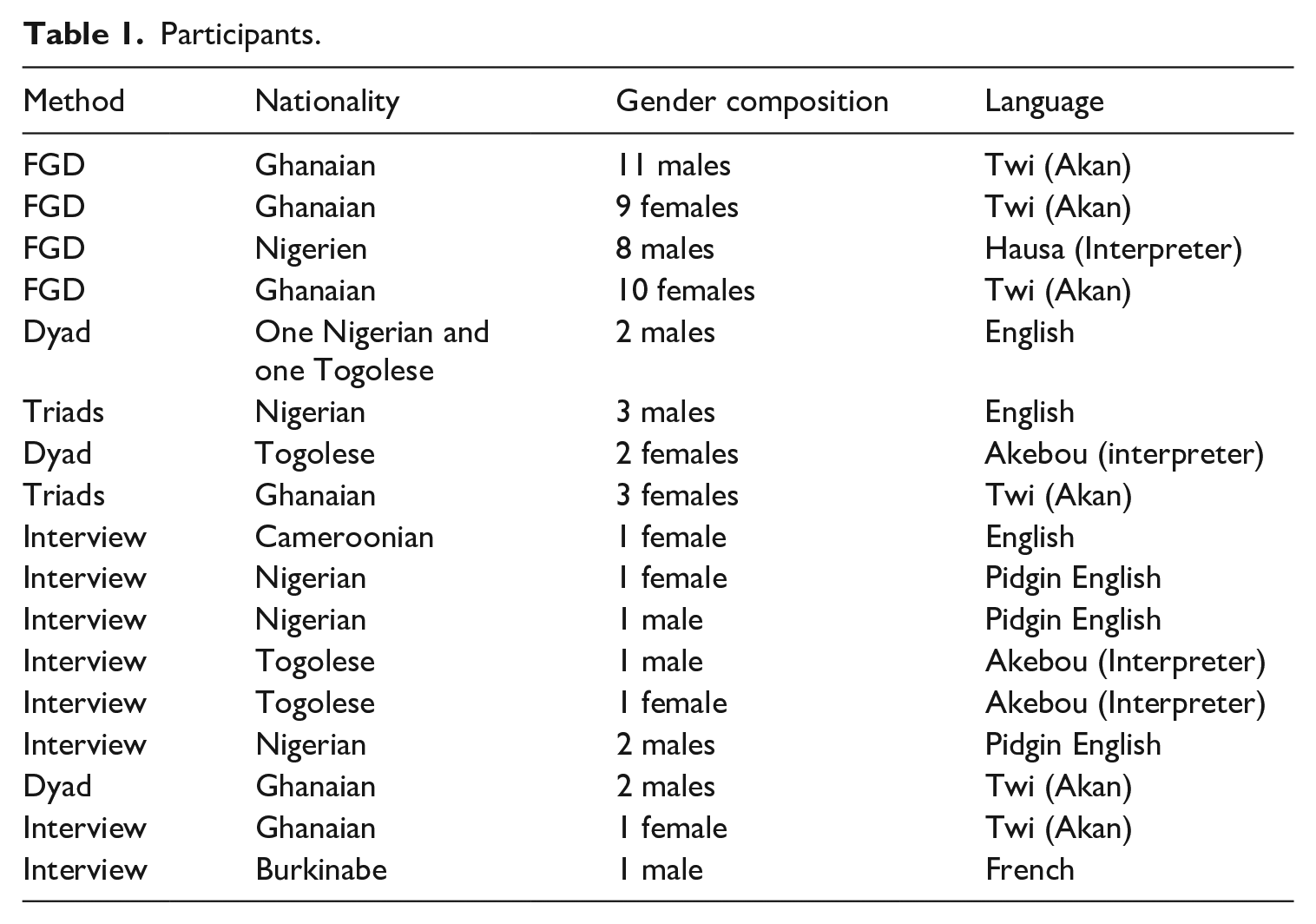
In Ghana, 35.3% of the population are aged 15–24 years (Ghana Statistical Service, 2021). There is also a large number of young migrants (internal and international) in the country and who face significant socioeconomic inequalities and vulnerabilities. We thus aimed to recruit young migrants aged 15–24 years (in line with the United Nations (UN) definition of youth) according to a theoretically informed sampling frame based on age, gender, and migration status (international/internal) via our established contacts with local community organisations supporting young people. While we aimed for a balanced sample in terms of age, gender, and migration status, due to the fluid nature of this population and sensitivity of migration issues, we also used a snowball sampling technique. Participants were from six nationalities (Ghana, Nigeria, Niger, Cameroon, Togo and Burkina Faso) (see Table 1).
Participants.
Data collection
Four group discussions, three dyads and two triads, and seven individual interviews were undertaken. Participants selected how they wished to participate, with some expressing willingness to participate only in a group context or dyad, with others preferring a one-to-one interview format. Data collection took place in various localities in Ghana’s capital city and mostly in marketplaces, community centres, slum areas, or key street localities where participants worked. A relatively quiet place was found in these areas (which was sometimes difficult to achieve) to undertake interviews and group discussions.
A discussion guide was developed based on the extant literature and in line with the study’s main aims and in consultation with our project Young Person Advisory Group members. Questions included an exploration of participants’ migration journeys, work and livelihoods, opportunities and barriers for decision-making, influence and control in their lives, and finally their understandings of empowerment and power (as the root word for empowerment). The latter concepts were explored by asking participants what the terms meant to them, along with times they had felt powerful/powerless or examples of opportunities in their life to act in line with their own frames of reference and make changes. Discussions lasted between 40 and 90 minutes and were audio-recorded with participants’ consent. Data were collected by ED and our four research assistants who had experience in qualitative interviewing, and could speak fluent Akan (Twi), the widely spoken local dialect in Ghana. For some interviews, we used interpreters as languages such as Ewe, which is mutual to Ghana and Togo, had marked differences in how they were spoken. We also used interpreters to assist with the interviews conducted in Hausa, Akebou (a local dialect in Togo, similar to Ewe in Ghana) and French. The interviews were translated verbatim with the help of the interpreters.
Data analysis
Data were analysed thematically by the research team following Braun and Clarke (2017). The first stage of analysis involved careful (re)reading of transcripts and identifying initial descriptive codes that captured the meaning of the data. These codes were then scrutinised by two authors (G.S. and J.T.) to confirm an inductive coding frame. This involved extensive review and coding of all data and identifying any new codes that emerged from an emic perspective. The full team then discussed the emergent codes as part of the next stage of the analysis. These discussions enabled data to be grouped into core categories, which were then further discussed to develop thematic areas drawn directly from the data using an iterative process. For example, by comparing developing themes with the initial coding frame. Themes were then analysed by gender and migration status (e.g. international/internal) to compare consistencies across the data and points of departure. Final stages of analysis included theoretical explanations to help advance understanding of young migrants’ experiences and own notions of empowerment.
Ethical considerations
Research ethics approval was granted from a UK university Research Ethics Committee and the respective Ethics Committee in Ghana. The study appointed an ethics advisor to ensure the research was conducted to the highest ethical standards and because of the potential sensitivities tied to the research. For example, some participants were under the age of 18 years and had migrated independently of parents/caregivers. The team considered possible safeguarding concerns and sensitive topic discussion areas and given that many of our participants lived and worked in precarious and vulnerable contexts. By working closely with local community organisations, we ensured participants had access to local support systems should these be required. Participants were provided with written and verbal information about the study. All participants were asked to sign a consent form and were offered a small honorarium for their contribution.
Results
Our analysis of young migrants’ accounts of empowerment raises critical questions about the meaning and usefulness of the term to young people living and working in precarious, ever-changing contexts marked by poverty and significant disadvantage. In the analysis that follows, we unpack participants’ concepts of empowerment and power – including the limits these young people experienced to act in line with their own frames of reference and bring about change in their lives. Our final discussion considers how these findings advance differing conceptions of empowerment and their relevance for supporting young lives.
Young migrants’ understandings of empowerment and power
Findings from our discussions with young migrants suggested that many did not know what empowerment meant or had never heard of the word. For others, there was a tendency to refer to government uses of the term and related initiatives that focused on young people’s economic empowerment, primarily through job creation and financial support. Such understandings thus reflected more top-down (impositional – defined as the imposition of dominant systems of meaning, Spencer, 2014: 4) notions of the concept as participants described empowerment in terms of what the government might give (or impose on) young people. Yet, participants seemed to have little insight into how such initiatives might work in practice or how to access them. Because of this, government-led initiatives seemed of little interest to these young people, and largely because they had limited access to the socioeconomic factors and opportunities that would enable access to meaningful, sustained forms of employment to support their (economic) empowerment:
What do you understand about the word empowerment?
If government say that they want to empower the youth, people that do not have job, the government will create job for them [. . .] and empower the youth that they will find something for them to be doing and getting income.
(Male, aged 18, Nigeria).
They want to empower the youth. Like government can give the youth a job or find materials or tools to work with. That is empowerment.
Aside the government, you’ve never heard the word empowerment before?
No
(Male, aged 22, Ghana).
These quotes highlight the disconnect between ‘top-down’ imposed notions of empowerment and the lived realities of young migrants’ working lives. However, although often suggesting less relevance to their everyday lives and their socioeconomic realities, at other times, (economic) notions of empowerment were described in highly aspirational ways and as a means of realising one’s (financial) dreams. However, the achievement of which was closely tied to having access to financial resources and support – or, as stated in the above examples, meaningful employment. Perhaps because of this, such forms of empowerment were again deemed largely out of reach for participants and because of the difficult and economically disadvantaged contexts they occupied. This, in part, may help to explain the apparent lack of awareness of the term for some of our participants. Indeed, our discussions highlighted participants’ more immediate priorities in relation to their work and living circumstances – often prioritising a need to ‘survive’ as a conditional or concessional notion of empowerment (defined as compromise being reached within existing conditions, Spencer, 2014: 4):
It [empowerment] means giving other people the chance to fulfil their dreams. What I mean by that is if I have an idea and I don’t have capital to start it. I have an idea and you help me with capital to start my business, then it means I was privileged to fulfil my dream. That is empowerment (Female, aged 22, Nigeria). Because I am not working, and I need to pay bills. Even if it is water bill, rent, I have to pay. I want to work and have empowerment, but I don’t want that empowerment that you will be giving me plenty conditions. My own understanding of empowerment is maybe an organization empowering young people with maybe if you have a creative idea and you don’t have capital to start. They provide you with capital, [but] then they will be monitoring everything you do (Female, aged 22, Nigeria).
There were, however, some important differences in the understanding of the term across different groups of young people. For example, young men spoke about empowerment in relation to their working lives and hopes for economic success. Likewise, international migrants more often referred to advancing their skills in pursuit of a desired career or business. Some young women referred to government initiatives directed towards girls’ empowerment and apprenticeships to build their skills in dressmaking. Inevitably, these descriptions may well emanate from differential exposure to dominant (government) narratives of economic and gender empowerment within different countries – or indeed, reflect the recent emphasis on such forms of empowerment in African nations, particularly in the context of the SDGs and promoting gender equality:
What does empowerment mean to you?
It means power.
It means strengthening someone.
I also know that the work we are doing here is for empowering girls.
I also heard it from our teacher at school.
I heard it when we went for a church meeting. It was mentioned when they talked about starting your own business.
(Focus group, girls aged 15–22 years, Ghana)
The uptake of dominant discourses on (economic) empowerment in the above extracts left little room for other understandings of the term to emerge, with many participants indicating that they had no other sense of the word or its meaning to young lives. Inevitably, responses of this kind may be a result of procedural influences, including issues of translation or language barriers. As noted, we did translate the term into participants’ preferred language. However, lack of awareness of the term and its meaning(s) also raised critical questions about its relevance to these young people. To address these possible procedural limitations and ‘open up’ possibilities for alternative perspectives, we also asked participants about their understandings of power. The term power seemed to be better understood – or at least, more readily talked about. Power was usually discussed in terms of having control over their lives which, once again, was equated with the acquisition of money and thus, having the economic power to live the life desired:
It’s money for me, I want to buy a house, a car, and marry. That will give me power because that’s all-what life entails (Male, aged 20, Nigeria).
What does the word power mean to you?
Power is when you have greater control or authority over something or someone (Female, aged 18, Togo).
Power means once you control those things under you, power means everything, you will have right to cover some people (Male, aged 21, Nigeria).
These accounts highlight power over conceptions whereby participants described power as having control over something or someone. The latter conceptions were particularly notable in young men’s accounts (especially Nigerian men) as they described power as physical strength and aggression:
Power means having the strength [to] do something that others can’t do. Like being able to carry certain things in the gym that others cannot carry or being able to beat someone in a fight.
Can you tell me a time that you felt powerful?
The last time I felt powerful was when I fought with a senior student and beat him in front of our colleagues, and they went to inform my mother that I beat somebody and that I have power. I also feel powerful when I am able to carry these things like this barrel alone. I felt powerful the days that I was able to do a lot of farm work and received applause from my mother.
(Male, aged 24, Nigeria).
These young men’s privileging of physical power can be understood as part of their uptake of dominant gender norms and the importance of demonstrating (physical) strength and control. Similarly, young women’s accounts also reflected dominant gender norms and power over conceptualisations – yet they often talked about having little or no control over their own lives (and because of socially ascribed gender roles). At other times, young women equated having power with being able to do the same things as men, such as acquiring money or learning skills to find employment – both of which commanded respect:
What does the word power mean to you?
It means having the ability to control something.
It means being able to do what man can do as well. Because when a woman too has money, a man respects her.
It means having the strength to do so many things.
Can you tell me about a time you felt powerful in your life?
Getting this opportunity to learn and acquire this skill makes me feel powerful.
I feel powerful because I have this opportunity [. . .]. We are being taught how to behave and defend ourselves when we go out and that makes me powerful. (Focus group, girls aged 15–22 years, Ghana).
Lack of power– possible limits to empowerment
Although participants described their understandings of power, and to some extent empowerment, their accounts more readily offered examples of times when they felt they had little control over their lives or felt disempowered. Notwithstanding possible procedural influences (e.g. we did specifically ask participants about times when they felt powerless), these accounts reflected the everyday vulnerabilities these young people experienced and their disenfranchised positions which, for some, triggered a loss of meaning in their lives and suggested a sense of ontological insecurity (Giddens, 1991):
Lack of education, lack of job, sometimes you will not get anything, you will go back to the house thinking about how your life is, you don’t understand some of the things going on around your life and you will be feeling powerless (Male, aged 22, Ghana).
When I feel powerless is when I want to buy a particular thing and I don’t have money. I want this particular lifestyle and I cannot afford it. I am powerless because I cannot do anything about it. What I mean by lifestyle is the place I want to live, I am unable to pay, I feel powerless, and I didn’t have authority because I didn’t have the money (Female, aged 22, Nigeria).
The experiences of economic precarity may help to explain the tendency for participants to foreground (a lack of) economic power, with limited control over their everyday working lives. Although participants positively reported their decision to migrate to the city to find meaningful employment and a better (economically) prosperous life, the lived reality of navigating difficult socioeconomic conditions often meant that these young migrants had little choice over the types of work they took up. Indeed, many described a lack of control over their working conditions, reporting long working hours and engagement in poorly paid, unregulated and exploitative jobs:
Is there a time you ever felt powerless?
The place I rent, if the landlord comes for his money and I don’t have [it], I feel powerless. If you have power, you can talk. For instance, where I am picking the peanuts, if I don’t pick them well and the owner is complaining, you can’t talk. You have to be quiet and obey the person so that you can get your money in return. That makes me feel powerless [. . .]. I feel bad, but I can’t say anything [. . .]. The only thing is that you control yourself and you keep quiet and do whatever you are doing and make sure that you will do it well so that next time the person will not complain (Male, aged 23, Ghana).
Evidence of this kind highlighted how participants felt that they had ‘little choice’, but to comply with their employers or property owners. These experiences left participants feeling disenfranchised and, at times, without hope that things would change. Discussions of powerlessness were also highly gendered. Young men, for example, described how they had ‘failed’ to earn enough income to support their family and be ‘the provider’. Young women talked about not having enough money to buy clothes and other items, along with how their education was not a priority because of their gender. For young women, complying with family wishes or male partners was accepted as part of the normal social order, which resulted in dependency on men:
I felt powerless and unhappy when I wanted to go back to school, and they were unable to support me because there was no money.
I feel powerless when I feel menstrual pains and I unable to stop the menstruation.
I don’t have any power to have a boyfriend since I stay with someone.
I am unable to pick and wear some of my sister’s nice dresses because of the issues it will bring and that makes me feel powerless.
I felt powerless when I wanted to buy a shoe and my mother said no because she was the one going to pay for it.
(Focus group, girls aged 16–22 years, Ghana).
Despite offering negative descriptions of how they lacked economic power, some participants reported these hardships positively – often referring to ‘God’s plan’. Having a strong sense of faith, a key part of Ghanaian culture and many other Western African countries, significantly aided the ways in which participants could make sense of their current (read difficult) circumstances. Indeed, God would ultimately determine their hopes and future successes. While these accounts may suggest a more fatalistic perspective, or potential lack of agency, believing in a higher deity enabled these young people to narrate meaning in their lives and make sense of the difficulties they experienced – all the while remaining hopeful for a different, better future. Because of this, many participants expressed a deep gratitude for any work they could get and since it offered one-step towards financial security, albeit highly limited:
It is only God that gives power. If you want more power, you have to pray to God for him to multiply your power (Male, aged 24, Nigeria). When they say one is powerful, they mean God can bless you and make you powerful enough to do anything. Some people have a lot of money, which gives them a lot of power. If you lack all of these, you are not powerful. I feel powerful when I earn enough money and am able to provide (Male, aged 22, Nigeria).
In some ways, evidence of ‘satisfaction’ with their working lives and current circumstances, and to the extent of being extremely grateful, could be understood as a product of these young people’s uncritical acceptance of the status quo or false consciousness (Freire, 1996). Yet, having a strong faith enabled these young people to manage the felt ontological and economic insecurity brought about by the precarity and temporariness of their current circumstances. Indeed, such belief in God’s plan enabled them to remain positive despite the socioeconomic realities of their lives and retain meaning within their lives. These examples offer some evidence of how these young people sought to reframe their experiences more positively as they negotiated and navigated the socioeconomic realities of their lives – possibly paving their own meanings and way to empowerment, albeit from a very different frame of reference with very uncertain outcomes.
Possibilities for empowerment –social change or reproduction of the status quo?
Despite the significant socioeconomic disadvantages participants faced, some young people did describe times when they had taken deliberate action to achieve their dreams and mitigate the impacts of poverty. These examples were most notable in terms of their original decisions to migrate independently. Other examples were evident in participants’ day-to-day decision-making in terms of the clothes they wore and the food they ate. As suggested, although decision-making alone does not equate with empowerment, such examples may offer the first steps for agency or a form of dispositional empowerment, whereby participants made everyday decisions in line with their own frames of reference and preferences – albeit in highly restricted contexts (c.f. Dankyi et al., 2022):
For me coming from Nigeria to Ghana wasn’t an easy journey, so I think that was when I was very powerful, I was strong I did it. (Male, aged 22, Nigeria). When I started experiencing that [I] am powerful is when I came to Accra and I was living alone, taking care of myself because to come to Accra and live alone is not easy. Feeding yourself, take care of yourself and those things and then there are bad guys that will attack you and it’s not easy. I am working on my own to take care of myself; I have that ability to do something more than they said (Male, aged 18, Togo).
Participants’ descriptions of taking care of themselves and evidence of their strength and autonomy as part of their migration trajectories highlighted the ways in which these young people navigated complex socioeconomic vulnerabilities in order to change their lives. Far from being vulnerable, these young migrants’ decisions to migrate independently to the city in search of work can be seen as evidence of transformative empowerment as they acted against and redefined dominant constructions of (vulnerable) childhood and actively took up ‘adult’ roles to change their circumstances and redefine their futures (c.f. Hart, 2023). Seeking out employment, fending for themselves and earning money to support their families, challenged dominant constructions of childhood that tend to privilege young people’s dependency (on adults) and their assumed lack of capability and capacity to act. Although decisions to migrate were tied to desires to escape poverty, such decision-making was described as part of their deliberate action to change their lives (and that of their families) for the better:
Because when you have the power to do the thing and you don’t have any person that can lead you to the right direction, you will not make it in life and determination too. You have to be determined. I had this amount of money last year, but I did not use it well, what if I have the money now what will I do with it in order to have something in the future and through that you will be able to succeed. (Female, aged 23, Cameroon).
Despite offering possible evidence of transformative empowerment, at times, these actions also seemed to result in the reproduction of existing social and economic inequalities as these young people found themselves living on the streets and taking up exploitative work just to survive. These young people’s migration and livelihood strategies did little to change the harsh socioeconomic realities of their lives and, for some, prompted a worsening of their positions and vulnerabilities. Such vulnerabilities exposed them to exploitative forms of work, but with little choice but to accept (and be grateful) for what they had. Perversely, young migrants’ examples of agency, or dispositional empowerment, ultimately reproduced the vulnerabilities and inequalities they experienced – highlighting the unintended and undesirable consequences of ‘empowerment’.
She has been shouting at us, that we should hurry up:
Does she treat you bad?
Yes, she does not treat us well.
Can you give us example?
When you are tired and couldn’t wake up early, she will insult you and say why didn’t you wake up early.
(Focus group, girls aged 16–22 years, Ghana).
Do you like the work that you are doing?
I don’t like the work, but since I didn’t get some when I came, I have to do it.
(Focus group, girls aged 16–20 years, Togo).
I should have control over my life because somebody should not come and be making decisions for me all the time [. . .]. Maybe if I have money, I can be able to take some decisions by myself.
(Girl, aged 23, Cameroon).
In an effort to push forward opportunities to bring about change in their lives, participants described the things most important to them and their hopes for the future. Perhaps inevitably, many described needing financial help to realise their goals – including support for education and training to advance their career aspirations. The latter usually centred on starting their own business or learning a trade such as masonry, tailoring or hairdressing. Such aspirations for their livelihoods were not only equated with economic security, but as offering a sense of freedom and achievement in their lives – often reporting a desire to ‘be someone’:
Any job that can make me feel happy. I would like office work or like production work. Even as here, I’m able to do electric work, so I can work in an electrical company. If I get a car to work with, I will be okay and feel powerful (Male, aged 23, Ghana).
These discussions highlight some important starting points for policy action that may help redress the disenfranchised position many young migrants occupy and crucially, actions that are grounded in young people’s own perspectives and everyday realities. However, in contrast to more ‘bottom-up’ notions of empowerment, these accounts reflect the importance of, and dependency on, top-down political action to bring about socioeconomic change for young people. Such top-down action reflects the more multi-directional elements of empowerment – promoting new ways of understanding the concept.
Discussion
Concepts of empowerment are frequently applied to young people often without due regard to their own understandings of the term and its relevance to their lives. Such uncritical application is antithetical to the concept’s theoretical underpinnings that emphasise the importance of starting from the perspectives and priorities of individuals and groups (Laverack, 2005; Spencer, 2013, 2014). In this paper, we have sought to unpack young migrants’ own understandings of the term and, in doing so, challenge contemporary (linear and top-down) uses of empowerment. Our analysis raises some critical questions about the meaning and uses of the term. In this study, discussions of empowerment often reflected dominant government-led initiatives or impositional notions of empowerment that are largely ‘top-down’ and imposed on young people. These approaches tend to pre-define the right attitudes and actions for young people as evidence of their empowerment – often downplaying how young people’s opportunities to act are shaped heavily by the sociocultural contexts and positions young people occupy (Dankyi et al., 2022). Indeed, such forms of empowerment were deemed ‘out of reach’ or largely irrelevant to participants as they described more immediate priorities for survival.
Yet, through their navigation of such hardships, participants in this study did offer examples of times when they acted in line with their own reference as evidence of their dispositional empowerment and sought to bring about change in their lives – albeit with varying outcomes. Dankyi et al. (2022) illustrate how young people can successfully navigate their agency and vulnerability to support their livelihoods. Our analysis here supports such observations and advances the understanding of how agency and vulnerability exist concomitantly to shape possibilities for, and outcomes of, empowerment. Of significance is the more variable understandings of empowerment than hitherto articulated as young people continuously negotiated actions and outcomes to support their livelihoods in response to different and intersecting forms of disadvantage.
Crucially, this study has exposed the multiple forms of empowerment that are made possible in response to varying sociocultural and structural conditions and vulnerabilities (Spencer, 2014). Yet, different notions of empowerment can also result in less desirable outcomes and the reproduction of existing inequalities. While young people’s migration decisions have been reported as positive action for change (Howard, 2014), such actions can also result in the worsening of these young people’s socioeconomic circumstances. Occupying such disenfranchised social positions, in turn, provides further impetus for government-led forms of economic empowerment and job creation for young people – highlighting how different forms of empowerment can trigger other forms of empowerment to emerge – working together and against each other, with different outcomes. This more variable conception of empowerment highlights the need to rethink theorisations of the term that tend to privilege more linear processes.
Of particular significance is the role of religion to young people’s understandings of agency and structure. On one hand, understanding disadvantage and opportunity as part of (or deferring to) God’s plan may suggest a lack of agency, yet such understandings also helped these young people to navigate the ongoing and multiple axes of disadvantage they experienced – offering a sense of meaning to otherwise very difficult circumstances (Zinn, 2016). Such complex negotiations highlight how young people sought ways to maintain a sense of self and ontological security and ultimately remain hopeful that life would change. This ontological security enabled them to take ‘risks’ to secure a better life (Zinn, 2016). For some young people, this prompted a desire to change their life while for others; it enabled an acceptance of the life they were living.
These insights highlight different ways of thinking about the empowerment/vulnerability nexus – crucially drawing attention to the variability of young people’s experiences and reminding us of the potential dangers of homogenising young people and glossing over their varying experiences (Cuervo and Miranda, 2019). Indeed, our sample was comprised of diverse young people. Yet, our participants did share a common desire to seek out a ‘better life’, which actively triggered their migration strategies across complex sociocultural contexts and reflecting their autonomy to act in line with their own frames of reference. In this way, they challenged homogenising and normative representation of African childhoods as one of vulnerability and devoid of agency (Dankyi et al., 2022; Twum-Danso Imoh, 2019) as they actively sought ways to change their lives and circumstances. For example, by taking up roles typically reserved for adults, at least from a Global North perspective, such as paid employment and as evidence of their transformative empowerment. Yet, such mobilities were transitory and came out of economic necessity and often resulted in the reproduction, or worsening, of the status quo for these young people – highlighting how one form of empowerment can concomitantly result in undesirable outcomes and trigger other (normative) forms of empowerment to emerge.
Conclusion
This paper has examined young migrants’ own understandings of empowerment and, in doing so, has sought to advance the conceptual elaboration of the term as it relates to the lives of young migrants in Ghana. Our analysis challenges top-down linear conceptions of empowerment and highlights the more variable and reproductive elements of the concept, sometimes with undesirable outcomes. Such uses typically centre on Global North perspectives that privilege individual autonomy and decision-making and thus, may fail to adequately attend to the different sociocultural norms and frames of reference that enable (or not) young people in the Global South to shape the direction of their lives or indeed, position young (African) migrants as especially vulnerable and at risk. Indeed, Spencer’s framework for empowerment was developed with young people in the Global North and thus, some caution is offered here for its use with young people in other contexts and in particular, the Global South. Yet, the framework does offer alternative ways to (re)think about, and conceptualise, empowerment – crucially highlighting how multiple forms of the concept can co-exist – working together, and against each other, and producing highly variable (sometimes undesirable) outcomes. Such understandings highlight the need for new theorisations and further investigation of (different forms of) empowerment, including its potential (or not) to bring about positive actions that enhance young lives in differing contexts. Until then, we suggest that some caution is needed when uncritically advocating for ‘empowerment’, without due consideration of its meanings to young people and how the concept is shaped by the varied socioeconomic and cultural contexts and positions young people occupy.
Footnotes
Acknowledgements
The authors thank all our study participants and our community partners for their time and contribution to the project. We are grateful to Professor Virginia Morrow for providing ethical guidance throughout the study. The authors thank our Young Person Advisory Group and Youth Co-Researcher, Fanny Froehlich, for their contribution and commitment to the study. The authors are especially thankful to the British Academy for the funding to undertake the programme of work.
Declaration of conflicting interests
The author(s) declared no potential conflicts of interest with respect to the research, authorship, and/or publication of this article.
Funding
The author(s) disclosed receipt of the following financial support for the research, authorship, and/or publication of this article: The work was supported by the British Academy’s Youth Futures Programme (Grant number: YF\190090).
Ethics approval
Ethics approval was granted by the Faculty Research Ethics Panel (FREP) at the Faculty of Health, Education, Medicine, and Social Care, Anglia Ruskin University, UK (#20/21/016) and the Ethics Committee for the Humanities (ECH), University of Ghana, Ghana (#ECH 168/ 20–21).
