




Abstract
Drawing on a series of Infrastructural Exploration ‘walkshops’ hosted at the Centre for Urban and Community Research (Goldsmiths), this article reflects on the possibilities offered by walking infrastructural lines to critically engage with urban infrastructure. In these walkshops, we invite participants – academic researchers, students, activists, members of the public – to join in moving through the city and to consider their embodied and emotional contact with the infrastructure we encounter. Traversing different spaces and opening our sociological imaginations to the city, we place an emphasis on collective experiences, happenstance conversations and different forms of knowing. We aim to foster a corporeal, mobile and multisensory attention to infrastructure and its impacts on the urban landscape. In this article, we propose that these embodied and affective encounters with infrastructure can attune us to questions of infrastructure’s social life, the politics of its siting, urban power dynamics, distributional (in)justice and forms of (infra)structural violence. Inspired by Shannon Mattern’s work, the article ends by offering a provocation. We ask readers, as we ask walkshop participants: then what? What are the socio-political potentials in these collective, peripatetic and visceral engagements with infrastructure?
Keywords
Walking lines
We have unexpectedly scheduled a walking event around the waste infrastructures of south London during a heatwave in early June. We have been here before but everything feels so much more intense in the heat. The smell of slowly decomposing rubbish from the incinerator and nearby recycling centre is more potent; fumes from the refuse lorries or the heavy-goods vehicles transporting containers of rubbish feel thicker, catching in our throat, noses and eyes; the rumble of these vehicles seems to carry further; the dust in the air sticks to our sweaty skin; the sun bounces off the asphalt and there is very little shade to be found amongst the industrial units and high-rise residential blocks. About halfway through the walk, we make our way to a small newly created park which runs alongside the railway line and huddle in the shade under one of the few mature bushes whilst looking towards the incinerator’s chimney and its plume.
As this extract from our fieldnotes illustrates, our bodies are thoroughly embedded in urban geographies and closely focusing on our corporeal experiences can draw attention to the smell, dust, air pollution, noise, shade, and heat associated with infrastructures of waste disposal and, perhaps, to the uneven distribution of these across the city. This article draws on a series of Infrastructural Explorations walking events which we have been co-curating since 2018 within the Centre for Urban and Community Research (Goldsmiths). These ‘walkshops’, a term borrowed from Astrida Neimanis and Perdita Phillips (2019), invite participants – academic researchers, students, activists, members of the public – to join in moving through London and exploring the different forms of infrastructure which enable urban life (see Figures 1 and 2). Emphasising an attention to our bodily and emotional experiences, participants are prompted to consider infrastructure’s impacts on the city and those who live there. In this, we attempt to develop ‘an infrastructural literacy’ (Mattern, 2013), tuning into the ‘systems that surround [us] and that [we] subsidise and use’ but which often seem to be concealed from us (Parks, 2009).
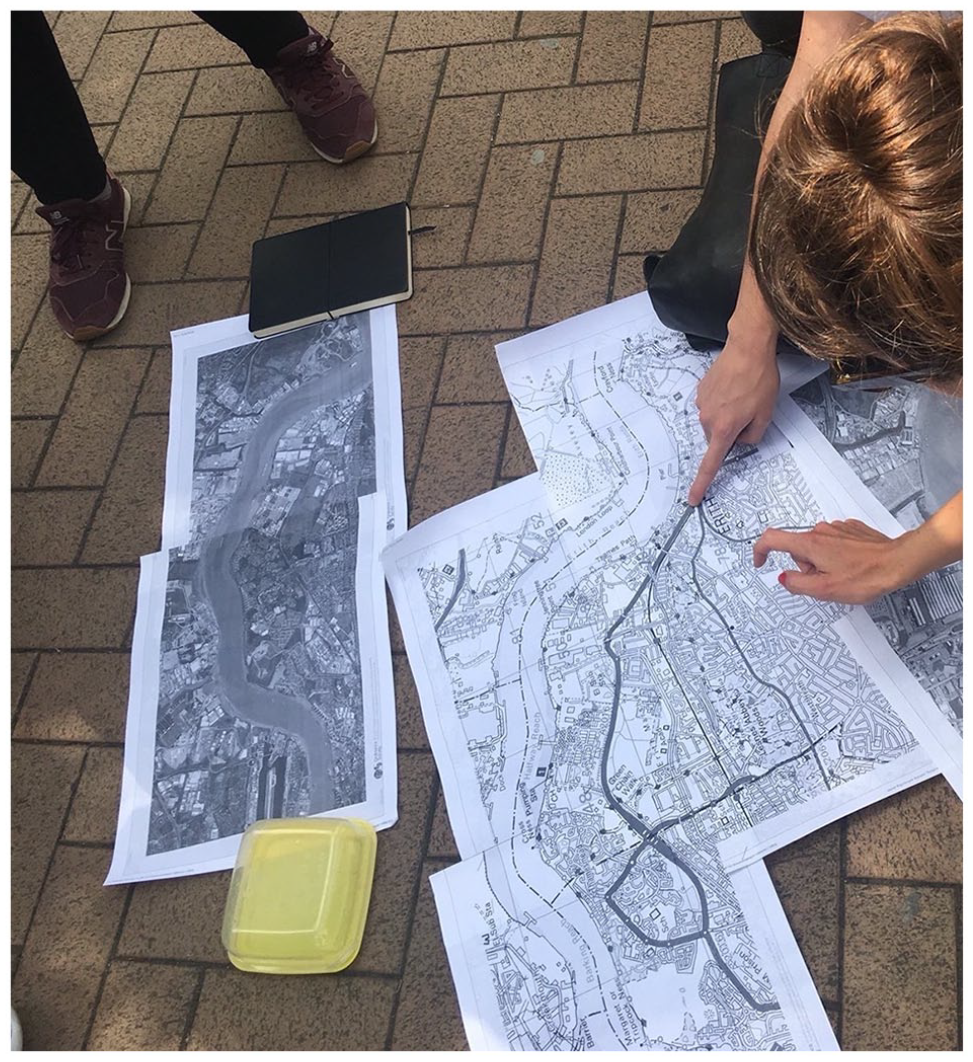
Erith to Belvedere (photo: Emma Jackson, June 2018).
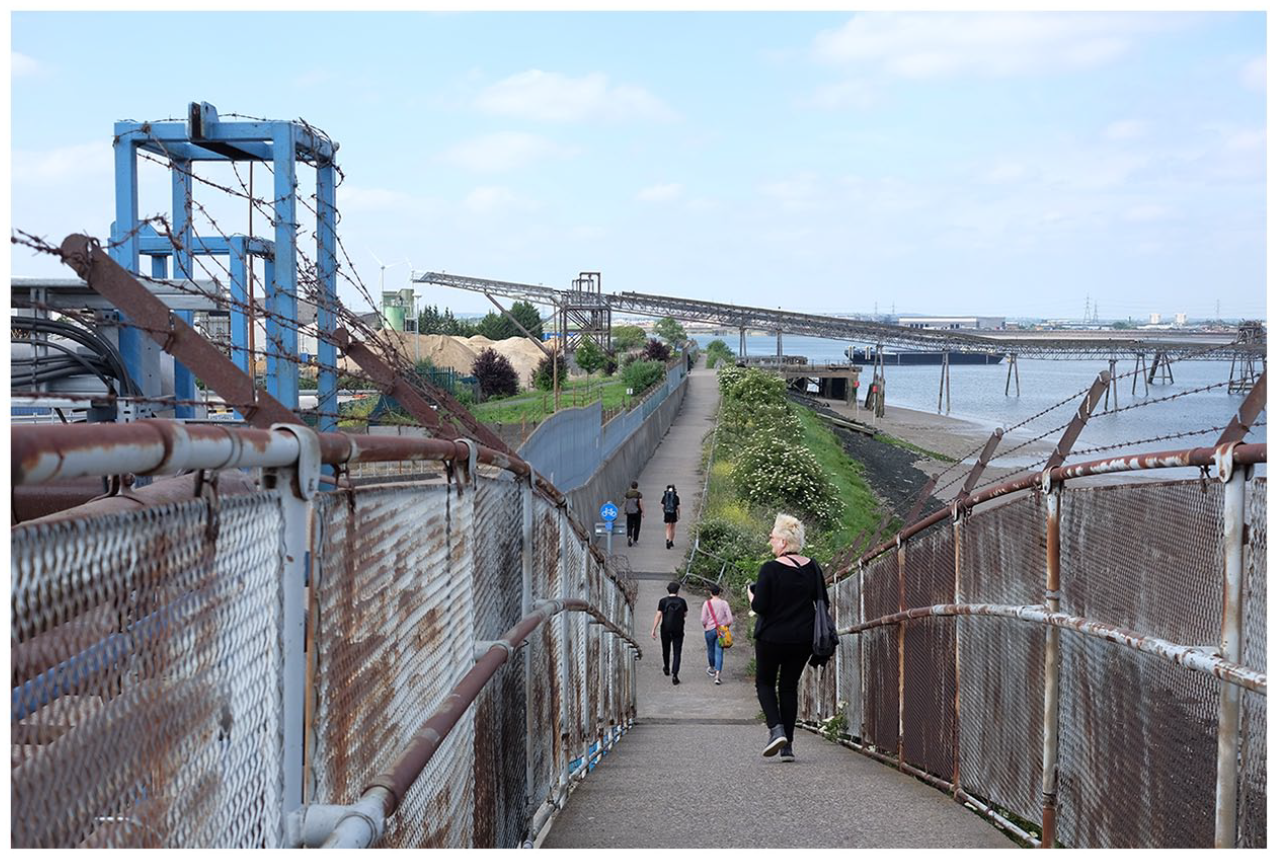
Erith to Belvedere along the Thames (photo: Laura Henneke, June 2018).
For each event, we choose an abstract line on a map that represents one of London’s built infrastructures to then walk the line more or less accurately on the ground trying to attune to its material impacts as we move. Over the years, we have walked alongside train- and tram-lines and taken a dérive along the DLR; we have mapped the routes taken by power lines (see Figure 3); we have followed the Jubilee Underground line looking for above-ground indications of its presence; we have walked by the Thames and discussed the work carried out along and by the river; and we have traced the journeys taken by refuse lorries to municipal waste plants before watching as what is incinerated there is released in a line-like plume from the chimney (see Figure 4). As we walk and talk, we allow our conversations to be prompted by what we experience and the unexpected encounters that characterise urban life (Massey, 2005). We invite participants to open their ‘sociological imaginations’ (Mills, 1959) to the city and to critically engage with the impacts of infrastructure by fostering an embodied, multisensorial, and collective attention, aiming to, as C. Wright Mills (1959: 8–9) instructs, connect ‘personal troubles’ to ‘public issues’. This article presents a reflection on the walkshops and the potentials of such peripatetic and collective encounters for getting to know the city and its infrastructure a little better, putting into relief lived relations with infrastructure and, concomitantly, cultivating an awareness of the power dynamics which permeate urban landscapes.
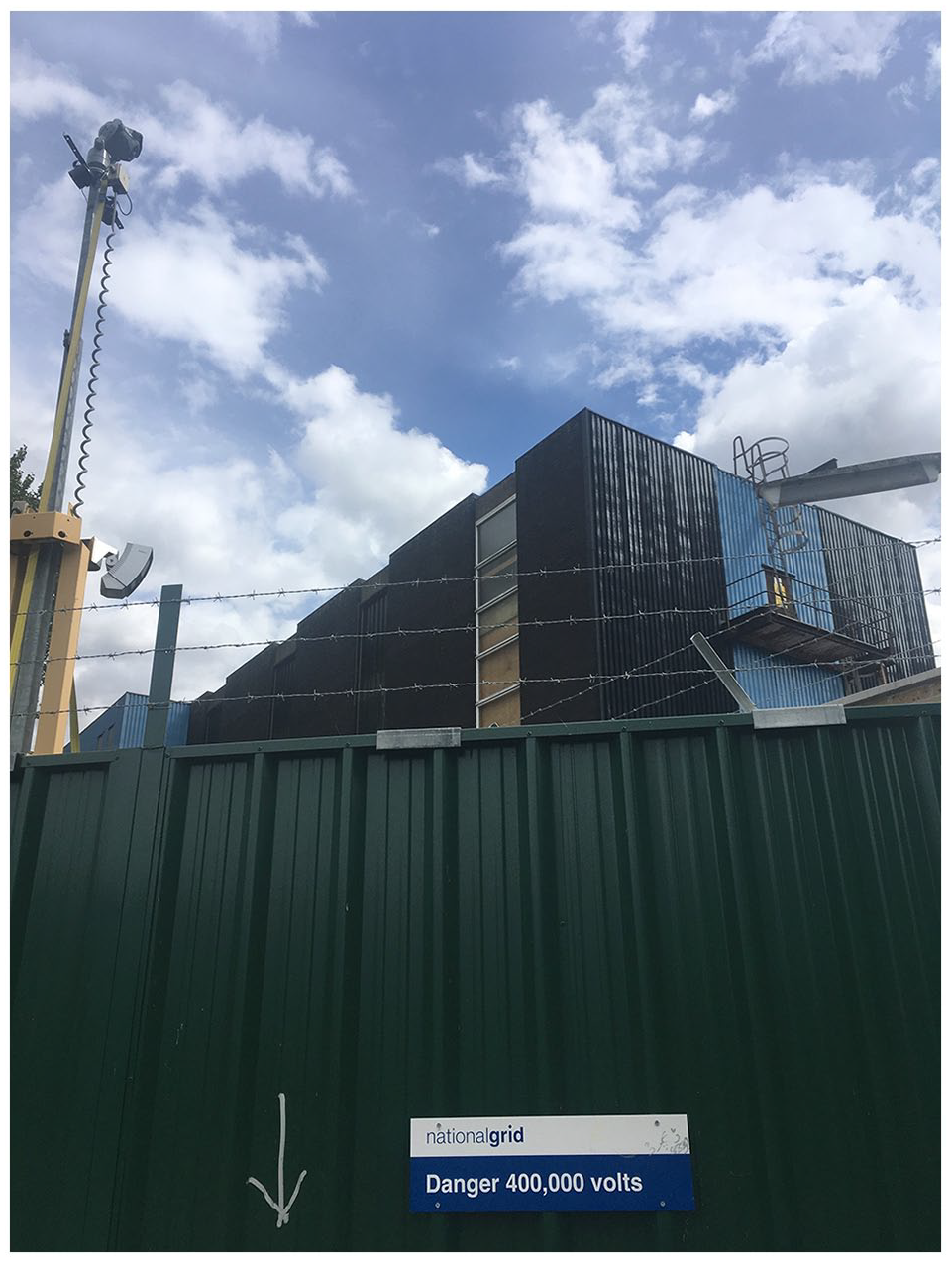
Following the London Power Tunnels: Hackney Substation Headhouse (photo: Laura Henneke, August 2018).
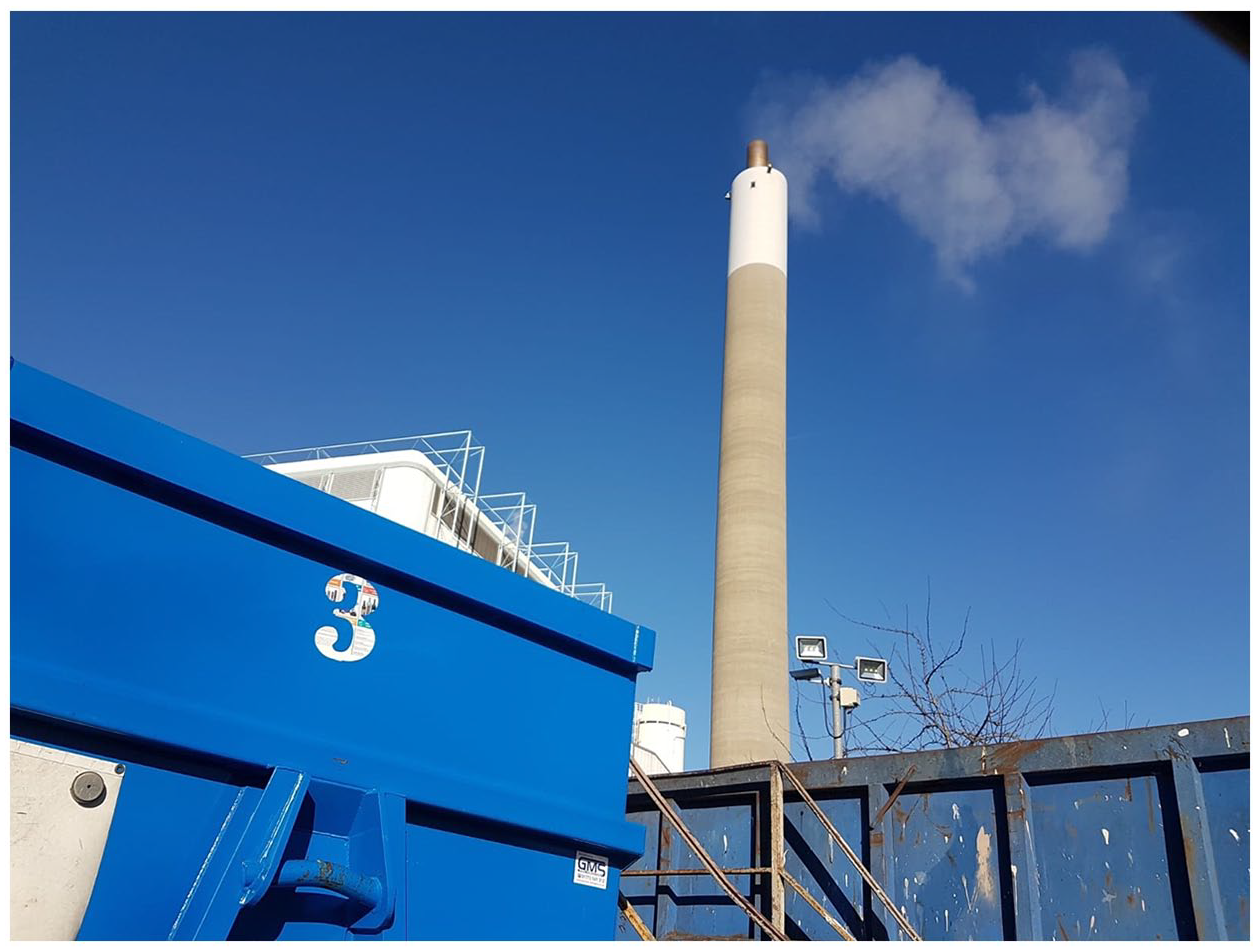
The plume from the incinerator (photo: Louise Rondel, February 2019).
In the following we outline three interlinked theoretical points which underpin the walkshops and our invitation to participants: first, infrastructure is both and at once material and social; second, there are significant emotional dimensions to our encounters with infrastructure; and third, infrastructure as such is fully permeated by relations of power. We then consider the potential of walking as a method that brings to the fore the corporeal and emotional dimensions of urban life and, through these, the ‘power geometries’ (Massey, 1993) which thread through the city and manifest acutely in infrastructure. We contend that walking these lines and cultivating a visceral attention to infrastructure might enable us to hone in on spatialised power asymmetries and forms of ‘infrastructural violence’ (Rodgers and O’Neill, 2012) in the urban realm.
This article contributes to literature on bodies, spaces and infrastructures in two ways. First, by reflecting on how the Infrastructural Explorations unfold, we offer a framework for conducting ‘walkshops’ as a means of exploring infrastructures. Second, we consider the further potentials of our engagements during these walkshops and the ‘infrastructural literacy’ cultivated. Working to connect the personal to the public, we propose that the walkshops are a way of attuning to the power dynamics which permeate cities. We close the article with a provocation. As Shannon Mattern (2013, emphasis added) asks in her article ‘Infrastructural tourism’, we also pose the question, ‘but then what?’. What do we do with this ‘heightened knowledge’ (Mattern, 2013)? Especially when infrastructure seems so fixed and impermeable (Ramakrishnan and O’Reilly, 2023: 92)? We want to prompt ourselves, walkshop participants and readers to consider the possibilities offered by bringing together different knowledges and expertises as we move, attending to our lived and highly visceral experiences of infrastructure and its unequal impacts, and then perhaps, together, identifying moments of intervention.
The social life of infrastructure
Urban infrastructures may well be – as Lisa Parks (2015: 355) describes – ‘stuff you can kick’: concrete, steel, plastic, asphalt, pipework, cables, chimneys, roads, railways; undeniably material. However, as has been recognised in the growing academic field that examines infrastructure, urban infrastructure does more than simply facilitate the circulation of goods, electricity, people, water, rubbish, and so on through the city. Brian Larkin (2013) describes how ‘infrastructures mediate exchange over distance, bringing different people, objects and spaces into interaction and forming the base on which to operate modern economic and social systems’ (p. 330). As well as moving other matter, and inextricable from this material character, infrastructures are also thoroughly social.
In his article on ‘lively infrastructure’, Ash Amin (2014) precisely argues that in recent scholarship on infrastructure, ‘trunk networks, the built environment, and public utilities and services appear not only as subjects of interest in their own right but also as matters implicated in the making of urban functionality, sociality and identity’ (p. 137). For Amin (2014), this research emphasises how infrastructures ‘are implicated in the human experience of the city and in shaping social identities’ (p. 139). Dennis Rodgers and Bruce O’Neill (2012) likewise contend that ‘infrastructure is a key factor in shaping people’s direct relationships both with each other and with their environments in cities’ (p. 402). Viewed in this way, infrastructures are ‘lively’ or ‘active’ in ‘shaping well-being, sociality, and organisation’ and in orchestrating communities and institutions: ‘the social force of infrastructure is unmistakable’ (Amin, 2014: 156, 145). More than a only material feature in urban landscapes but inseparable from their materiality, infrastructures have a social life.
The emotions of infrastructure
As much as infrastructures have a social life, scholars have also argued that they have an emotional life, able to provoke affective reactions in people: ‘Infrastructures excite affects and sentiment’ (Appel et al., 2018: 26). For example, Kai Bosworth (2023) describes how ‘[t]he specific temporalities of infrastructure systems – expectation, repetition, decay, repair, maintenance, and everydayness – are generative of specific kinds of affects, such as despair, frustration, or hope’ (Ramakrishnan et al., 2021 cited in Bosworth, 2023: 56). Similarly, writing on the building of a new road in Peru, Hannah Knox (2017) underlines the emotional dimensions of the ‘lived experiences of this infrastructure’, the ‘thrill’, ‘dismay’ and ‘pride’ (p. 368). In both spectacular and mundane ways, people become emotionally (dis)invested in or (un)attached to the infrastructures which undergird and shape their lives.
Emotions are not merely a personal experience nor are they passive, rather they have a social and productive charge. For example, extending Sara Ahmed’s (2004a, 2004b) work on the politics of emotions and what emotions do, Suzi Hall (2014: 33) highlights their generative spatial dynamics: how they circulate, accumulate, endure (or stick) and, moreover, can transform places or buildings. For Hall (2014), ‘the power of emotion [can be] used to gain cultural momentum for political traction’ (p. 33). What may appear deeply personal, in fact, has social and political dimensions as emotions circulate through and stick to(gether) bodies and places. Indeed, the literature on affective infrastructures emphasises that emotional responses are far from individual experiences and thus may offer a starting point for political actions, even when faced with the apparent ‘impermeability’ of infrastructure (Ramakrishnan and O’Reilly, 2023: 92). For example, as Knox (2017) argues, politics ‘emerges and is reworked through affective engagements with the material arrangements of the worlds in which people live’ (p. 375). In the case of the road-building project, she shows how emotions were ‘capable of energizing politics, mobilizing bodies, and bringing about future forms of change’ (Knox, 2017: 368). Feelings circulate around and stick to infrastructure, and, in turn, through lived experience, ‘people’s messy relations with infrastructure might engender political action’ (Bosworth, 2023: 57), with a potential to transform (Hall, 2014: 33).
The power of infrastructure
Entwined with their materiality, their ‘social force’ and the emotions they provoke, infrastructures are permeated with power dynamics:
[Infrastructure] demarcates both literally and figuratively which points in urban contexts can and should be connected, and which should not, the kinds of people and goods that can and should circulate easily, and which should stay put, and who can and should be integrated within the city, and who should be left outside of it (Rodgers and O’Neill, 2012: 402).
As Susan Leigh Star (1999) (drawing on Bruno Latour and Emilie Hermant (1998)) contends ‘[s]tudy a city and neglect its sewers and power supplies (as many have), and you miss essential aspects of distributional justice and planning power’ (p. 379). Echoing Star (1999), Fran Tonkiss (2015) underlines that ‘infrastructures produce and reproduce distributional inequalities’ and do so ‘in material, and deeply spatial, ways’ (p. 384). For Tonkiss (2015), this is a question of both a lack of access and/or an ‘excessive access’ to infrastructure (p. 387, original emphasis). This is an excess which is manifest materially, spatially and, as we highlight, bodily. The ways in which this access (taken-for-granted or lacking or excessive) is distributed is far from incidental. Rodgers and O’Neill (2012) continue that ‘it could be argued that infrastructure constitutes an often-ignored material channel for what is regularly referred to as ‘structural violence’’ (p. 404; see also Boehmer and Davies, 2018), a form of violence which is ‘built into the structure and [which] shows up as unequal power and consequently as unequal life chances’ (Galtung, 1969: 171). Vulnerability to (infra)structural violence is patterned by intersecting social dynamics such as gender, race, class, wealth, age, able-bodiedness, sexuality, migration patterns, or (post)colonial formations (Massey, 1993). These are some of the vectors along which, as Doreen Massey (1993) identifies, spatialised power relations or ‘power geometries’ work as she highlights how ‘different social groups and different individuals are placed in very distinct ways in relation to [the] flows and interconnections [which make space]’ (pp. 60–61). Infrastructure, then, is by no means experienced in the same way everywhere, nor by everybody/every body.
The materiality of infrastructure, its social life, the emotions that circulate around and adhere to it – sticking us to it – and the ways in which it is entangled with and reproduces power geometries or forms of violence are deeply interlinked. These three theoretical points frame the Infrastructural Explorations as we invite participants to move through London and tune into what infrastructure is doing and where.
Mobile encounters
Towards the end of summer 2018, we are tracing the route that London Power Tunnels 2 will take from Kidbrooke to the Falconwood substation in south-east London. Construction of the Power Tunnels 2 begins in summer 2019 and they will eventually run for 32.5 km from Wimbledon to Crayford. The tunnels will be on average thirty metres beneath ground, three metres in width and are designed to carry the electricity necessary for London’s growing and future population.
For the moment, we approximate the path the tunnels will take, pointing out electricity boxes in residential streets and looking at the currently ‘scrubland’-like space that the headhouse will occupy. As we walk through the suburbs, we also consider the potential disturbances to the households on the route. Above ground, this infrastructure will only be evident in the siting of headhouses and substations, but we speculate about the underground disruptions – will pipes and phone cables be cut through? Will internet connections, gas or electricity go down? We comment on the green spaces – will soil and water be affected? Will this impact on birds, insects, squirrels, foxes?
We are walking through residential areas but we are also following the A2, streets of houses end abruptly almost as if cut in half by this four-lane asphalt slice through neighbourhoods, a main artery from London to the port at Dover. Despite the barriers designed to protect the local residents from the worst effects of the noise and the pollution, we need to speak in raised voices to be heard above the constant traffic. Shepherdleas Woods provides a brief respite before we arrive at the substation. Behind us, we have the green of the woods but we are facing rows and rows of black pylons, the electricity humming and buzzing through the connecting cables and vibrating through our bodies.
(Fieldnotes, September 2018 see Figure 5)
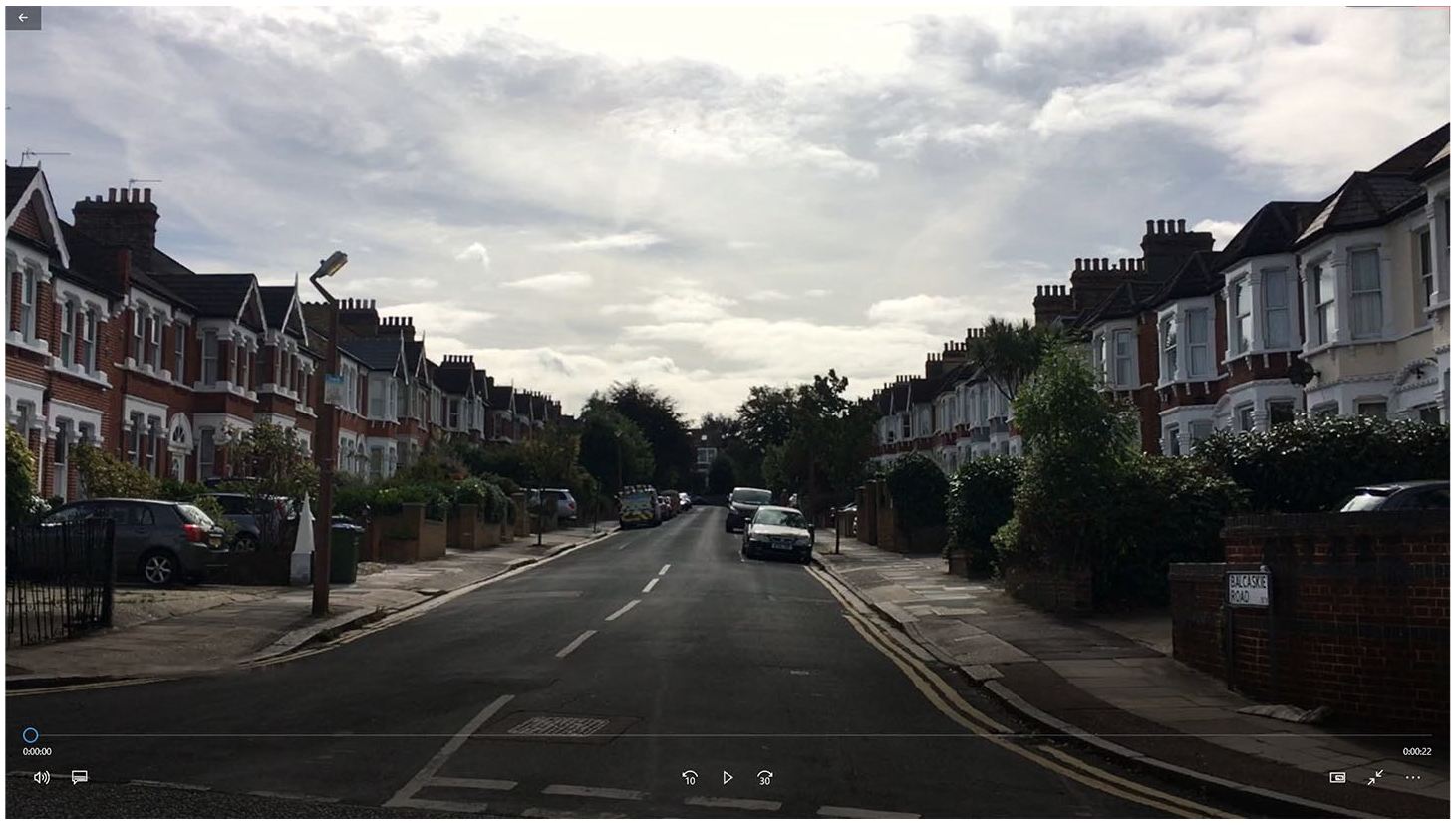
The noisy walk (video: Laura Henneke, September 2018).
As the moniker ‘walkshop’ (Neimanis and Phillips, 2019) indicates, we walk in our attempt to cultivate Mattern’s (2013) ‘infrastructural literacy’, inviting participants to attend to and reflect on the corporeal and emotional engagements engendered by being in and moving through the landscape (see Figures 6 and 7). Indeed, as Charlotte Bates and Alex Rhys-Taylor (2017) advise social scientists:
Walking is a brilliant form of exercise for our stiff bodies and a way of reinvigorating our engagement with the social world. It induces a mobile, grounded perspective and foregrounds corporeal, sensual, affective matters. Walking collects together visions, smells, tactilities, sounds and tastes with various degrees of association and intimacy . . . Moments of encounter forged between feet and the ground remind us of the emotional and embodied textures of our lives and bring to attention the sensuality of social life . . . (p. 4).
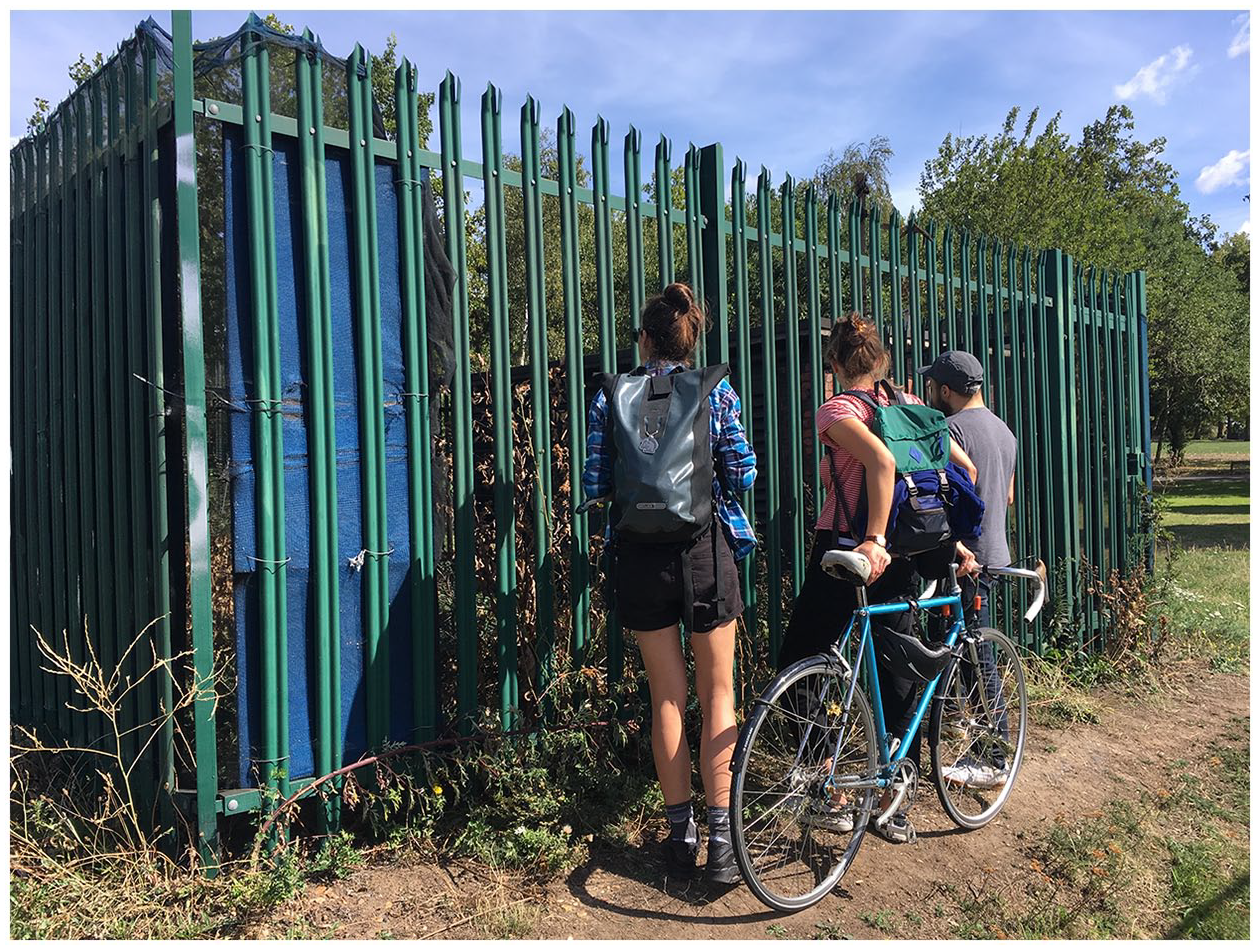
Collectively smelling the fumes of the Piccadilly Line ventilation shaft in Finsbury Park, London (photo: Laura Henneke, June 2018).
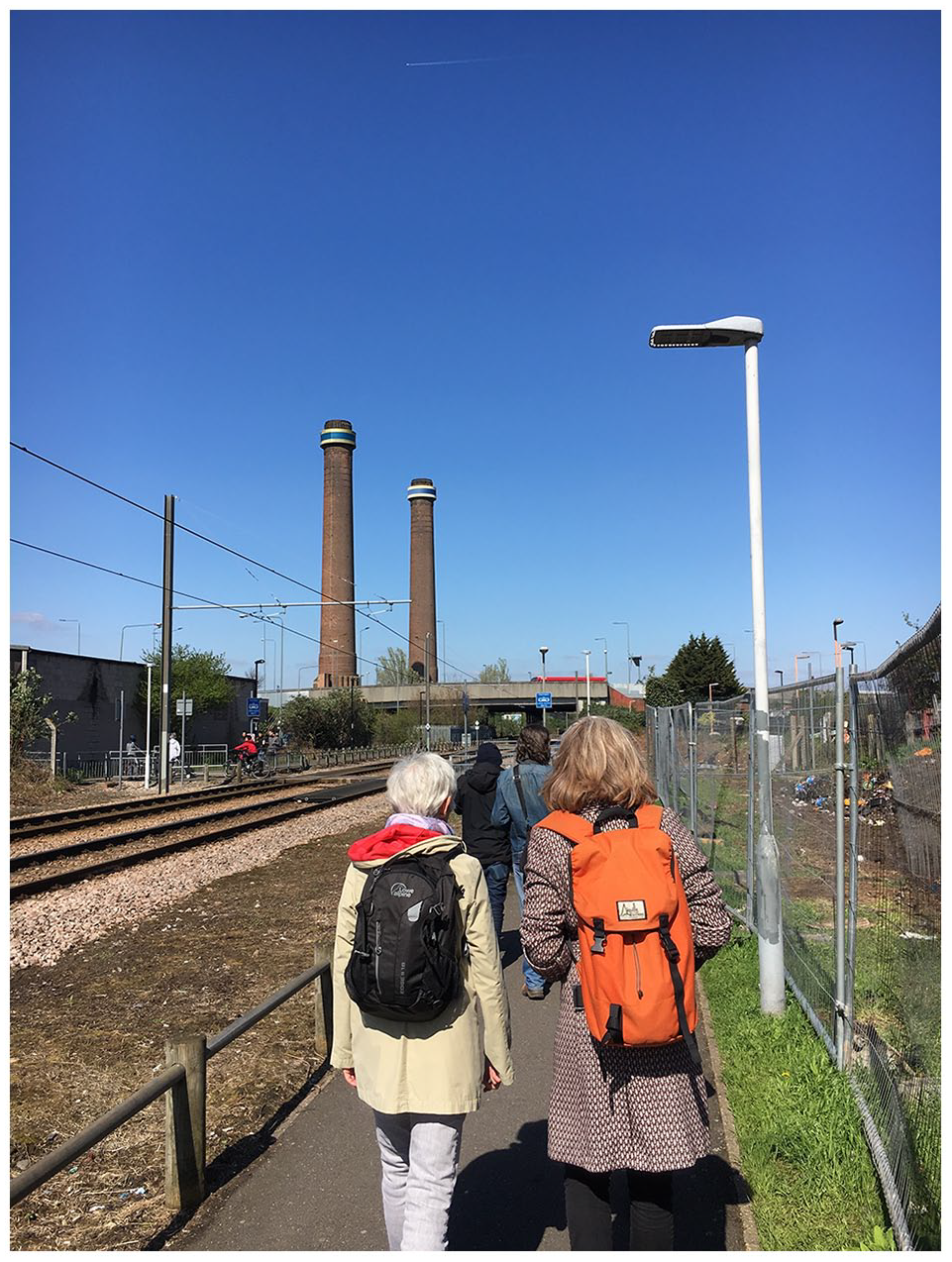
Following the tramline in Croydon (photo: Louise Rondel, April 2019).
Thus, walking through, alongside, or around infrastructure prompts multisensorial, kinaesthetic, proprioceptive and emotional engagements with these spaces. Certainly as we walk their lines, infrastructures are experienced bodily: they are visible (but not always); sometimes noisy; haptic (the vibrations of power pylons or the trucks which transport the city’s rubbish or which carry materials for building, often along streets not designed for such traffic); they smell, in some cases they stink. In some cases, for example, walking alongside waste disposal or sewage processing plants, they smell so much we can taste it. The smell gets into our clothes and hair and lingers on skin long after we have left the site (as most walkshop participants are privileged in our ability to just walk past and not live nearby nor work there). As we move through or by them, these sites of infrastructure also have an affective register: we might be surprised that this thing is located in this place; fascinated by this quiet mechanism which underpins our lives and impressed by how smoothly it functions; dismayed at the forms of pollution emitted into neighbourhood; perhaps angry; relieved that these are ‘not in our backyards’; we might get hot, tired, frustrated; curious or unsatisfied as the walkshops often raise more questions than provide answers. In Ahmed’s (2004a, 2004b) and Hall’s (2014) terms, these emotions circulate with us as we walk, becoming sticky, creating attachments between our bodies and the material form of the infrastructure we are exploring.
Given the uneven distribution in access to infrastructure – both lack of access and, acutely sense-able, ‘excessive access’ – we want to propose that our visceral experiences can attune us to these asymmetries. Taking the waste infrastructures with which we started this article as an example, in following the refuse lorries, power geometries are rendered palpable. Recent research from Greenpeace has shown that in the United Kingdom, incinerators are disproportionately located in areas where racialised and other marginalised communities live (Roy, 2020). Indeed, looking to the planning of a London incinerator in the 1980s, Cristina Elena Parau and Jerry Wittmeier Bains (2008) describe how the decisions on where to locate the facility were made knowing that, as a neighbourhood made up of ‘poor, immigrant, and/or working class . . . residents’, this was a place ‘where resistance was least likely to arise, or was least likely to succeed if it emerged’ (pp. 117–118). In a common spatial pattern of industrial pollution (El-Enany, 2019; Heblich et al., 2021; Mills, 2001; Rhys-Taylor, 2013), it is people from lower-income groups and minority-ethnic-in-the-UK communities who most likely have this potentially toxic and harmful or even just disruptive infrastructure foisted upon them. Those participating in the walkshop might be in the privileged position to be able to walk away at the end of the event, but the smell, the noise, the dust, the heat, 1 the ’toxic compounds including heavy metals and organics such as dioxins and polychlorinated aromatic hydrocarbons’ which are potentially carried in the chimney plume (Van Dijk et al., 2015: 45), or the NOx and particulate matter emitted from the six-hundred movements of heavy-goods vehicles which arrive at the waste plants daily persist for those whose lives neighbour these facilities. The corporeality – both physically and emotionally – of our experiences on that hot day in June (and the fact that, for most participants, we can walk away) puts into relief uneven access to infrastructure, and what it can feel like when this access is excessive. Carefully attending to our ‘personal troubles’ (Mills, 1959: 8–9) can start to bring to the fore the power dynamics which imbue urban landscapes.
The potentials in exploring infrastructure
A contribution of this article is to provide a framework of doing ‘sociology in action’ for other researchers interested in urban geographies, exploring how city life ‘happens’ and the associated socio-spatial inequalities. Indeed, we usually finish the walkshops with participants and us commenting that we have got to know the city a little better or will look at a familiar area in a different way. We perhaps better understand where our rubbish goes or our electricity comes from, and we consider the material and social impacts of this provision. We might think more about the homes adjacent to these key infrastructures that underpin how we live and, for the most, be thankful that this is not our neighbourhood, that we are not living with this ‘excessive access’ (Tonkiss, 2015: 387). The walkshops enable, in the words of one participant, ‘accidental learning’. By engaging publics beyond academia and by emphatically stating that these are not guided tours led by ‘experts’ rather open explorations to which all are invited to contribute, the walks prioritise different forms of knowing and try to establish a nonhierarchical forum for discussion and reflection. Through bringing together different perspectives, knowledges and experiences in this way, as we walk, we have thoughtful, critical and surprising conversations about the urban landscape. We ask each other questions and together we ask questions of the city. Sometimes, someone knows the answer but often we are left thinking about what remains unresolved. Accordingly, these peripatetic and collective encounters with infrastructural lines do much to draw attention to how cities are configured and how they function, and together we start to develop an ‘infrastructural literacy’ (Mattern, 2013).
Building on this toolkit and reflection on how the walkshops unfolded, another contribution of this article is to ask questions about the further potentials of these bodily and emotional encounters with infrastructures. We have suggested how, through connecting ‘personal troubles’ to ‘public issues’ (Mills, 1959: 8–9), we can begin to interrogate the power geometries which imbue the city. With a new-found critical awareness, to conclude, after having walked many (infrastructural) lines, we want to ask the reader the same question that we ask participants and ourselves at the end of each walkshop: ‘but then what? What might happen after all the touring and mapping, the listening and smelling, the playing of games? What do we do with all that we have discovered and identified and sensed?’; with our ‘heightened knowledge’ of infrastructure (Mattern, 2013) and, in particular, its excess and violence? Faced with the brute materiality of all the concrete, steel, pipework, noise, dust and emissions, we might feel frustrated and powerless. Yet as Kavita Ramakrishnan and Kathleen O’Reilly (2023) argue ‘even though such infrastructures seem impermeable, nothing is fixed’ and it is in our lived relationships with infrastructures that the potential for contestation (or even transformation) can be found (p. 92). And attesting to infrastructure’s permeability, as we explore we find out about groups campaigning against the construction of a new incinerator and for clean air measures to be implemented; we meet people holding developers to account on the inclusion of community spaces in building developments; we come across volunteers who have kept libraries open after austerity-induced closures; and we hear of the work of local groups maintaining and campaigning for green and blue spaces as well as those working on and building infrastructural systems. By centring lived – deeply visceral, intimate but also public – encounters with infrastructure, the collective walkshops can serve as a forum for appreciation and for critique. Academic research, citizen science projects, the knowledge of local residents, industry data and activism are brought into conversation as we walk, sense and feel. Through attending to our embodied experiences, reflecting on how we live with infrastructure and drawing on different expertises, there are potentials to identify issues of (infra)structural (in)justice and then perhaps possibilities for intervention.
Footnotes
Acknowledgements
Infrastructural Explorations have been kindly supported by the Centre for Urban and Community Research (Goldsmiths College, University of London). In particular, thank you to Emma Jackson and Les Back, Director and former Director of the research centre and to all the walkshop participants who joined in our explorations. Thanks also to the two anonymous reviewers for their helpful and insightful comments.
Funding
The author(s) received no financial support for the research, authorship, and/or publication of this article.