




Abstract
In this article, I analyse constructions of the self in bestselling self-help books in the United Kingdom. In doing so, I offer a re-appraisal of contemporary therapeutic culture. Therapeutic culture has long been associated with neoliberal governance, and scholars have argued that popular therapeutic narratives promote neoliberal accounts of an autonomous, masterful ‘entrepreneurial self’, able to thrive in the world on its own. However, beginning with the international financial crisis of 2008, neoliberalism has entered a period of serious and accelerating crisis and contestation. The question therefore arises to what extent popular therapeutic narratives might have changed during this period. In response, I analyse narratives of the self and self-improvement in UK self-help bestsellers between 2008 and 2022. Given their high sales and consumption, self-help books are prominent in the constitution of popular therapeutic discourse. I focus on the UK as an emblematic case, given its history of neoliberal politics, the latter’s recent crisis, and the salience of therapeutic culture in the country. Across the analysed period, my findings point to the emergence of alternative, survivalist and spiritual, therapeutic discourses that move beyond the model of the entrepreneurial self, while ultimately retaining its core assumptions about rational, autonomous behavioural modification.
Introduction
In this article, I ask how self-help books construct the social self. Addressing this question, I contribute to a re-appraisal of contemporary therapeutic culture and its place in sociological debates. Recent research has closely associated therapeutic culture with strategies of neoliberal governance. For the past 25 years at least, scholars have tended to argue that popular therapeutic narratives and neoliberal political programmes share an account of an entrepreneurial, autonomous, self-reliant self, able to masterfully forge its own way in the world (Rimke, 2000). Therapeutic culture has therefore been portrayed as reinforcing neoliberal narratives of self, social relationships, and personal development (Rimke, 2000). The dominance of this ‘therapeutic culture as neoliberalism’ narrative has diverted attention from the historicisation of therapeutic culture, and from questions about the ways in which popular therapeutic discourses and practices may change in response to broader social, cultural, economic, and political shifts.
Specifically, since the international financial crisis of 2008, neoliberal globalisation has arguably entered a period of crisis, and profound political, economic, and socio-cultural transformations have challenged the dominance of neoliberal narratives of social life (Davies and Gane, 2021; Walby, 2015). The question therefore arises how therapeutic culture may have responded to this crisis, potentially re-framing its accounts of the self and personal development. Extant research as so far not engaged with this question systematically, and it is my objective to contribute to closing this knowledge gap.
I approach these concerns by analysing recent self-help bestsellers in the United Kingdom. Self-help books are a multimillion-pound business, with millions of books selling every year in the UK and at the international level (Nehring et al., 2016). They are therefore indicative of the deep roots which therapeutic culture has taken around the world, across a wide range of commercial products and services. I analyse the narrative construction of the self and personal development in self-help books listed in top 200 bestseller lists compiled for the UK by the market research firm Nielsen BookScan (2008–2021), and in live bestseller lists hosted by Amazon UK (2022).
My analysis centres on the period from 2008 to 2022 as a time of crisis of neoliberal world order, marked by the global financial crisis, the rise of new ethnic nationalisms and right-wing populisms, and the socio-economic and cultural consequences of rising global inequalities, global warming, and the COVID-19 pandemic (Lupton, 2022; Sassen, 2014). In turn, my analysis focuses on the UK as an exemplary case within the greater international panoply of therapeutic culture, due to its long history of experimentation with neoliberal political programmes (Harvey, 2007), the prominence of therapeutic culture in British society (Gill and Orgad, 2018), and the ongoing crisis of Britain’s model of neoliberal governance, notably in the form of populist politics and Brexit and its aftermath (Norris, 2019). While my focus rests on British society, I do examine, in the concluding section, the relevance of my findings to broader international debates about therapeutic culture and its significance to broader sociological debates.
Therapeutic culture and the crisis of neoliberalism
In this article, I am concerned specifically with the narrative or discursive dimension of therapeutic culture, and I examine how such narratives construct the human self and practices of personal development. I am interested in salient features of such narratives at a time when the cultural and political dominance of neoliberal narratives about the individual, society, and social problems might be coming to an end, or is at least facing serious challenges (Davies and Gane, 2021; Mirowski, 2013). In other words, it is my aim to begin a re-appraisal of the long-standing assumption among scholars that therapeutic culture is closely associated with neoliberalism (Foster, 2015). Adopting a discursive focus, this article complements other papers in this special section (Saari et al.; Frawley et al.) that examine the roles of institutionalised therapeutic practices and modes of governance in contemporary European societies.
My subject matter is important as scholarship on therapeutic cultures has, since the late 1990s, inserted itself into wider sociological debates in ways that might not any longer be productive. By ‘specific ways’, I mean conceptualisations of popular therapeutic narratives, experiences, and practices that hinge on the latter’s close association with processes of individualisation and societal atomisation in the context of neoliberal globalisation (Rimke, 2000). This association continues to define prominent research on therapeutic cultures (e.g. Orgad and Gill, 2022). It is problematic in so far as it diverts attention from the task of historicising therapeutic culture, that is, from examining transformations of popular therapeutic discourses, experiences, and practices in the context of broader social, cultural, political, and economic change. An historical periodisation of therapeutic culture in the UK remains a task for future research, beyond a limited body of scholarship on the rise of popular therapeutic discourses in the Victorian era (Morris, 1981; Richards, 1982). However, in the USA, research in the 1970s and early 1980s suggests an association between the widely felt societal crisis of that period with the rise of a therapeutically motivated ‘culture of narcissism’, focused on spiritual self-cultivation and quite unlike neoliberal self-help’s ideals of entrepreneurial self-making (Lasch, 1984, 1991 [1979]).
The centrality of entrepreneurial self-making to therapeutic culture has dominated attendant scholarship in from the 1990s onwards, in the context of broader sociological debates about individualisation (Giddens, 1991) and the atomisation of social life under conditions of hegemonic neoliberalism (Couldry, 2010). It is against this backdrop of neoliberal social life that Anthony Elliott (2013: 5f.) argues that we now live in a ‘reinvention society’, predicated upon the global economy’s demand for flexibility, adaptability, and continuous self-transformation on the part of individuals.
While Elliott here foregrounds individuals’ ostensibly unfettered agency in reinventing themselves, the institutional forces of flexible neoliberal capitalism that compel such reinvention are equally visible in his argument, from off-shoring to the precarisation of work. Exploring the duality of apparent freedom and societal compulsion, sociologists have highlighted the ‘regimes of subjectivation’ (Bröckling, 2015: 5; also see Saari et al. and Frawley et al. in this special section) that underpin neoliberalism, that is to say institutional processes and power structures at whose intersection individuals’ options for thinking, feeling, acting, and relating to others are defined. The figure of an entrepreneurial self, charged with endlessly reinventing itself on its own, at a distance from others, in response to the demands of the capitalist marketplace, has played a central role in the sociological analysis of these regimes of subjectivation.
Alongside these dominant strands of debate, some scholars have acknowledged alternative forms of popular therapeutic narratives and everyday practices. Thus, Stein (2011) acknowledges that ‘therapeutic culture has at times inspired the politicization of identities, generated critiques of social inequalities, and addressed power imbalances’ (p. 191), while Salmenniemi (2019) portrays it as a source of sociability and collective political engagement among alternative spiritual communities.
However, the question remains unexplored how, if at all, popular therapeutic narratives have responded to the crisis of neoliberal globalisation and the malaise that is now widely felt in many societies, including the UK (National Centre for Social Research, 2022). The societal consequences of global warming, the COVID-19 pandemic, geopolitical tensions between democratic and authoritarian powers, escalating socio-economic inequalities on a global scale, rapid technological change (see de la Fabián in this special section), and at least partially successful internal challenges to liberal democracies all suggest that neoliberalism has entered a crisis moment (Lupton, 2022; Norris, 2019; Sassen, 2014; Stuart et al., 2021). Therefore, it seems pertinent to ask how popular therapeutic narratives respond to this crisis in their proposals for personal development and self-improvement.
Self-help in a time of crisis
I address this question by looking at bestselling self-help books in the UK. In keeping with previous scholarship, I define self-help books as texts that propose a systematic self-examination of certain aspects of readers’ conduct in everyday life, drawing on specific therapeutic techniques for introspection and behavioural control and modification, with the goal of reaching self-actualisation, that is to say external achievement and personal fulfilment to the maximum of readers’ potential (Nehring et al., 2016). Self-help books offer advice on a wide range of topics, from the pursuit of happiness to success at work to finding love to concluding a painless divorce. Written and marketed as guidebooks on personal development and solutions to personal troubles, self-help books are never just concerned with advising individuals on how to improve their lives. For their advice to become meaningful, they also must convince their readers of a specific set of norms and beliefs about the social world – a specific moral grammar (Nehring and Kerrigan, 2019). In doing so, they draw on a heterogeneous register of narrative sources, from psychotherapy and the neurosciences to an array of religious and spiritual beliefs or simply charismatic authors’ life experience (McGee, 2005). This makes self-help a notably diverse genre.
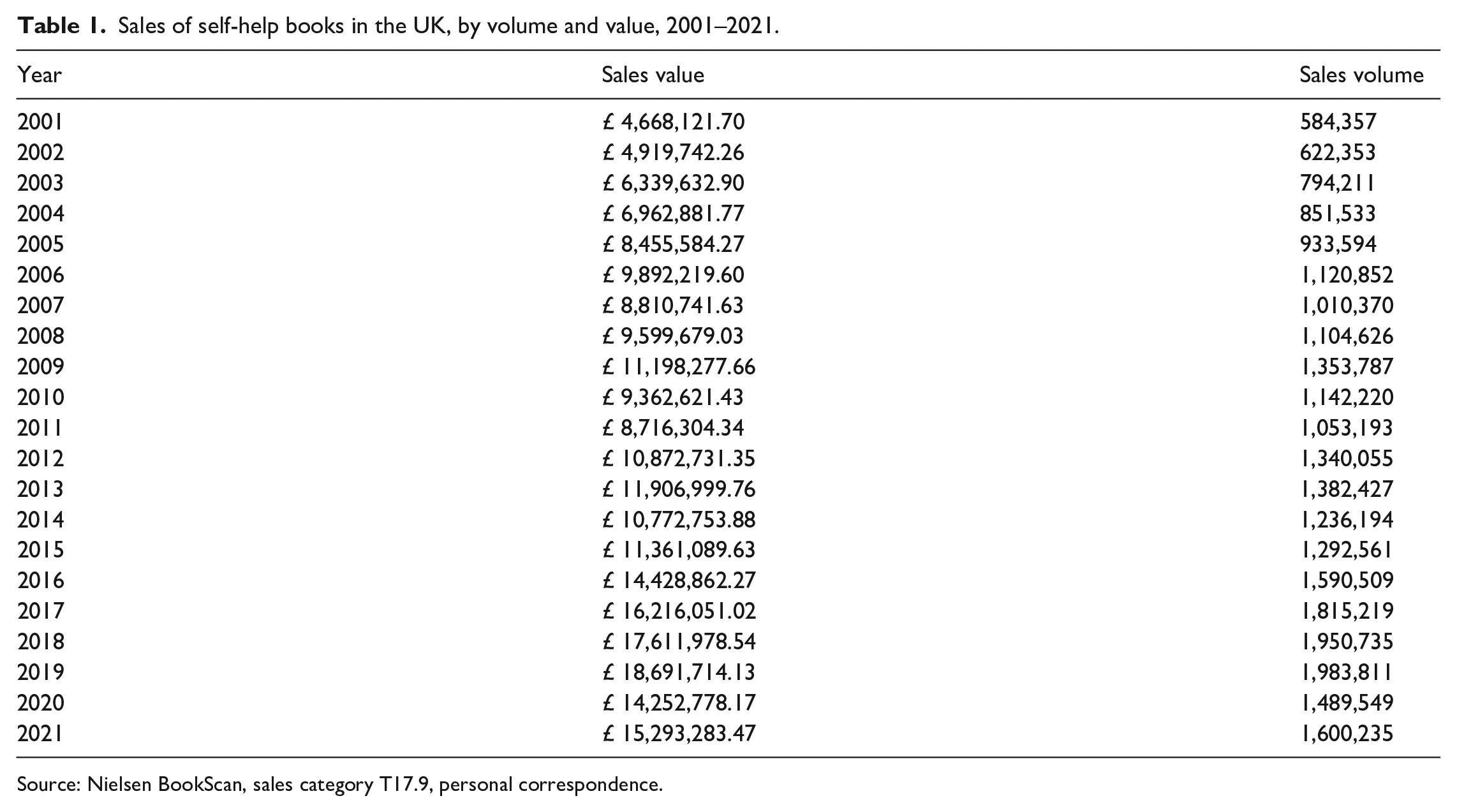
Given their popularity at the international level (Nehring et al., 2016), self-help books are a central element of contemporary therapeutic culture. In the UK, the sales of self-help books have tripled over the past 20 years (see Table 1), illustrating the genre’s broad audience and the importance of public therapeutic narratives in British society:
Sales of self-help books in the UK, by volume and value, 2001–2021.
Source: Nielsen BookScan, sales category T17.9, personal correspondence.
I look at the UK given its history as one of the central sites of neoliberal programmes of socio-economic development from the 1980s onwards (Harvey, 2007), and due to cultural salience of therapeutic culture in the country (Orgad and Gill, 2022). Since the 1980s, the UK has been a central site for the implementation of neoliberal programmes of socio-economic development (Harvey, 2007), which have been bound up with the dismantling of long-established bonds of community and social solidarity, rising socio-economic inequality, and the far-reaching individualisation and fragmentation of social life (Dorling, 2014). Couldry’s (2010) work on the socio-cultural consequences of neoliberalism in the UK captures this fragmentation evocatively, as he shows how the decline of traditional community ties, the destabilisation of work, and the loss of stable and predictable employment trajectories have entailed a loss of ‘voice’ for many. By this, Couldry means that the decline of stable communal bonds has been bound up with an atomisation of everyday experience, which makes it inconceivable to see personal troubles simultaneously as social problems and injustices, which can be addressed on a collective and political level.
At the same time, therapeutic culture has taken deep roots in British society, in the form of discourses that demand ‘resilience’ of workers or promise to address personal troubles and vulnerabilities at an individual level, by promoting ‘mindfulness’, ‘resilience’, ‘confidence’, and other personal, psychological capacities (Nehring and Frawley, 2020; Orgad and Gill, 2022). Extant research on therapeutic research therefore points to the close convergence of public therapeutic narratives in the UK with the cultural and political idiom of neoliberalism, for example, in the form of a gendered moral grammar of confidence and confidence building.
Recent research in this area has remained scarce, though, at the same time that distinct challenges to long-standing neoliberal political programmes have emerged in the UK, notably in the form of a rise of populist politics and its challenge to neoliberal ‘politics as usual’, for example, in the form of the country’s exit from the European Union (Norris, 2019). These developments bear distinct parallels to those in other liberal democracies, such as the USA (Hughey, 2021), making it possible to treat the UK as an emblematic case, whose analysis may offer useful insights for a larger, international and comparative, research programme on the sociology of psychologies in a time of crisis.
Methodological considerations
This article forms part of a larger multi-methods qualitative research programme on therapeutic discourses, experiences, and practices in Global North and South (Nehring and Kerrigan, 2019). In order to construct a sample of self-help books for this study, I relied on market data, including sales statistics and bestseller lists, gathered by media research firms. For the UK specifically (see Table 1), I obtained sales statistics and bestseller lists for the period from 2001 to 2021 through Nielsen BookScan, market research firm specialised in the publishing industry. Nielsen’s sales statistics indicate the total annual sales value and volume of self-help books, while its bestseller lists each rank between 50 and 200 self-help books by sales value and volume. As Nielsen’s lists for the 2022 will only be released in 2023, and in order to construct an up-to-date sample of books, I added to this the 100 books on Amazon UK’s (2022) current bestseller list for self-help.
While yielding a substantial sample, these bestsellers still do not cover the entirety of the self-help book market in the UK, and it may be expected that they do not reflect particular strands of popular therapeutic discourse, such as certain religious or spiritual self-help narratives. However, given their bestselling status, these books offer a window into the mainstream of publicly salient therapeutic narratives. Their analysis therefore supports the objective of this exploratory paper, to generate a baseline of findings and questions that might inform a larger research programme on contemporary transformations of therapeutic culture.
In line with my focus on the period of neoliberal crisis from 2008 onwards, I selected books for analysis that have attained bestselling status during this period, using the academic literature and my own publications on the pre-2008 period for comparisons (e.g. Nehring et al., 2016). Given the large size of the sample resulting from the combined post-2008 bestseller lists, I first analysed the top 10 bestsellers published in this year, subsequently selecting further books for analysis through purposive sampling, for example, to further analyse themes or narrative patterns salient among the top 10 texts, to explore thematic links among particular groups of authors or sub-genres of self-help, and so forth. Additional books selected for analysis include both books listed on Nielsen’s and Amazon’s bestseller lists, as well as books by bestselling authors not ranked in the lists.
The use of top 10 bestsellers as a point of departure for my analysis seemed indicated in so far as the sales value and volume of these books tends to considerably surpass that of other bestselling books, suggesting that the top 10 texts and their particular narratives of personal development are particularly successful with UK audiences. So, for example, the combined sales of the 2021 top 10 bestsellers in the UK amounted to £3,434,628.24 and 363,115 books, while the combined value (£1,659,672.10) and sales volume (165,527) of the bestsellers ranked 11–20 was less than half.
I either obtained an electronic copy or scanned each book I selected, building a data set in MaxQDA for qualitative, textual analysis. Specifically, I combined approaches to narrative analysis in social research (Kim, 2016; Plummer, 2001) and thematic analysis (Braun and Clarke, 2022) to identify salient themes and patterns in the texts and build a typology of self-help writing, focusing on the narrative construction of the self, personal development, and interpersonal relationships. While there are broader questions to be asked about the context of production, marketing, circulation, and readership of the analysed books, these are not my primary concern here, and I have addressed them at greater length elsewhere (e.g. Nehring et al., 2016).
Self-making
Self-help books sold in the UK form part of a larger universe of transnational self-help writing and publishing. Some books are written with a specific, localised audience in mind or only marketed on a limited scale. However, many prominent self-help fashions, such as, notably, mindfulness, are constituted on a transnational scale, through the interaction of entrepreneurially active authors, publishing and media platforms, and international audiences (Nehring and Kerrigan, 2018). In turn, the authors of self-help books are often successful ‘therapeutic entrepreneurs’, marketing therapeutic products and services across a diverse range of media platforms, from books to magazine and newspaper articles, to social media (Nehring et al., 2016).
An initial reading of the UK bestseller lists from 2008 onwards suggests that little may have changed in the world of self-help writing. However, classic authors and classic titles from well before the crisis of the past 14 years continue to be strongly represented in these lists, such as Dale Carnegie, Daniel Kahnemann, Ruby Wax, or Carol Dweck. Thus, in 2021, Dale Carnegie’s (2006 [1936]) was the third-ranked self-help bestseller in the UK, with a total sales value of £277,829.88, while a new edition of Carol Dweck’s (2017 [2006]) Mindset was ranked 19th. These classics tend to promote the liberal ethos of self-making, positing an autonomous, self-enclosed self amenable to systematic introspection and instrumentally rational modification, as the basis for self-directed success in diverse domains of everyday life. Many more recent self-help bestsellers are written in the same vein, and my analysis suggests that a majority of the books on Nielsen’s bestseller lists fit the type of classic self-making, in each of the years in which I analysed these lists.
With the term ‘self-making’, I allude to the iconic liberal ideal of the self-made person, which extends, in diverse permutations, from thinkers like Benjamin Franklin to the contemporary neoliberal figure of the entrepreneurial self, as discussed earlier (Nehring and Kerrigan, 2019). Central to self-making, as a moral grammar of personal development, is a distinctive construction of the social self. Even though self-help authors typically attempt to advance their own, characteristic recipe for personal improvement, as a basis for their brand – James Clear’s (2018) ‘atomic habits’, Dale Carnegie’s (2006 [1936]) method to win friends and influence people, Charles Duhigg’s (2013) recipes for overcoming the power of habit, and so forth – this construction of the self cuts across the narrative diversity of these books.
Steve Peters’ (2011) The Chimp Paradox exemplifies this pattern. A bestseller in 2017, 2020, and 2021, the book draws on neuroscientific knowledge to develop a model for self-improvement. Peters, an English psychiatrist, uses the notion of the ‘psychological mind’ to approach questions of selfhood and personal development. He divided the mind into the following three components: the emotional ‘chimp’, often acting at cross-purposes with our consciously perceived self-identity as a ‘human, and finally the cognitive and rational faculties of the “computer”’. In Peters’ model, productive personal develop occurs through the successful taming of the more counterproductive impulses of the chimp, and he proposes a systematic set of techniques to achieve this. One of these is ‘development time’: Simply put, ‘development time’ is time specifically set aside that is dedicated to reflecting on how you are managing yourself. You will benefit most from the model of the Chimp, the Human and the Computer if you spend time thinking through the concepts involved and then implementing them. The best way to make sure that you establish ‘development time’ is to make it into a habit. [. . .] By reflecting during development time, the Human is reviewing what is in the Computer and modifying it. As we will see in future chapters, this is critical to managing your Chimp. (Peters, 2011: 19)
Peters’ development time relies on the idea of a fundamentally autonomous and rational self. Self-development may be constrained by the irrationality of the chimp, but focused introspection, for instance, in the form of development time, opens the self up to self-directed and self-conscious improvement. The capacity to do so lies fundamentally within the self, for example, in its ability to form habits to shed the negative influence of the chimp. The self is the entrepreneurial agent of its own transformation for the better, enabled by its capacity to learn what is best for it and act accordingly. All that is needed is inspiration by insightful therapeutic entrepreneurs, such as Peters himself.
Notably, social relationships with others do not feature in significant ways in Peters’ model of personal development. His book does contain chapters on relating to others, effective communication, and other social skills. However, other people and the social relationships we form with them are portrayed consistently as an external force, while the development of our self depends fundamentally on how we manage our inner chimp: When we meet someone, we pick up on many things including their demeanour, how they are dressed, their attitude, the intonation of their voice, what they say. In new situations the blood supply in your brain will be directed to the Chimp because there is a potential danger. As your Chimp meets the person it interprets these clues as to the type of person that you are dealing with. Research shows that if your Chimp gets this first impression wrong then it will take it about seven more meetings with that person before it changes its mind! (Peters, 2011: 146)
The Chimp Paradox, the attention it devotes to building relationships with others, is ultimately concerned about the relationship of the self with itself, framed in terms of effective techniques to optimise one’s conduct and the neurobiological processes in which it is rooted. Potentially social problems, from interpersonal communication to, later in the book, professional success, stress, and happiness, emerge in Peters’ account as purely personal troubles.
Peters thus constructs a neuroscientifically motivated account of entrepreneurial self-making. This account shows clear affinity to neoliberal notions of the entrepreneurial self. At the same time, it harks back to much older Western liberal traditions of self-making. Thus, for example, Peters suggests writing daily diaries to systematically record and assess our actions, in a way that is reminiscent of Victorian practices of ‘moral accounting’ (Maas, 2016).
Peters’ (2011) work, in The Chimp Paradox and other bestsellers (e.g. Peters, 2018), may be read as a blueprint for classical self-help writing, cutting across a long historical period, well before the current crisis of neoliberalism. While specific proposals for self-improvement vary widely across the texts in this group, they share common roots in an entrepreneurial understanding of the self, capable of strategically reinventing itself outside of social-structural constraints. The sources of authority through which Peters tries to lend credibility to his narrative equally recur widely in this group of texts, with appeals to the neurosciences and other scientific disciplines, from medicine to psychology, being accompanied by displays of personal expertise (e.g. Carnegie, 2006 [1936]), or privileged life experience and charisma (e.g. Syed, 2015). Underlying an ostensibly diverse genre, there is a surprising degree of narrative homogeneity, between texts and across time.
Some more recent texts take the notion of self-making even further, to the point of magical thinking. Roxie Nafousi’s (2022b) bestseller Manifest is an extreme example of this. A self-help coach active in a variety of public arenas (Nafousi, 2022a) who has received considerable media attention in the UK (e.g. March, 2022; Petter, 2022), Nafousi draws heavily on the earlier work of the Australian therapeutic entrepreneur Rhonda Byrne, a current bestseller in her own right. Byrne’s (2012) model of personal development begins with the assumption that ‘the magic that you once believed in is true, and [that] it’s the disillusioned adult perspective of life that is false’ (p. 2). It is in the recovery of child-like magical thinking that the path to an in some sense better, more successful life lies: ‘When you know what to do to bring forth the magic, you will live the life of your dreams’ (Byrne, 2012: 2).
Nafousi takes Byrne’s model farther, re-grounding it in references to quantum physics and science at large, and using it to develop a seven-step recipe that allows readers to ‘manifest’ their wishes. Fundamental to this recipe is the assumption that focused introspection on one’s most urgent desires is the starting point for making them come true: I should begin by explaining why knowing exactly what you want, and then visualizing it, is so important for manifestation. When we create an experience in our mind, our brain responds as if it is really happening. Neuroscientist Dr Tara Swart explains in The Source that ‘visualisation works because there is surprisingly little difference to the brain between experiencing an event directly in the outside world and a strongly imagined vision of the same event’. [. . .] So, as we visualize ourselves having the things that we desire most, we will create a physiological change that will shift our energetic vibrational frequency and consequently determine what we attract into our lives, by the law of attraction. (Nafousi, 2022b: 11f.)
Nafousi’s and Byrne’s work, themselves grounded in popular psychological traditions that date back to the early-20th century (Nehring et al., 2016), takes the ideal of self-making to its extreme conclusion, as they take mere imagination, here labelled ‘visualisation’, to be sufficient to turn desires into empirical reality. This is a solipsistic account of the self, detached, in the conditions for its development, from social relationships and reliant on its own quasi-magical entrepreneurial abilities.
Self-help survivalism
In the books I have discussed so far, it is impossible to distinguish any understanding of a crisis of contemporary society. This is because society itself remains invisible in these books, given their emphasis on introspection and the capacity of the self for its autonomous transformation. However, crisis, at a societal and personal level is precisely the point of departure for a substantial minority of recent self-help bestsellers. Among these, the ‘f*ck it’ sub-genre of self-help texts is prominent. ‘F*ck it’ self-help, as proposed by a range of authors over the past 15 years, begins with the assumption that today’s world finds itself in a deep crisis. In The Subtle Art of Not Giving a F*ck, one of the UK’s top bestselling self-help books since 2017, Mark Manson (2016) explains this as follows: We live in an interesting time in that, materially, things are arguably better than they have ever been before, yet we all seem to be losing our minds thinking the world is one giant toilet bowl about to be flushed. An irrational sense of hopelessness is spreading across the rich, developed world. [. . .] Meanwhile, the environment is completely fucked. Nutjobs either have access to nuclear weapons or are a hop, skip, and a jump away from getting them. Extremism across the world continues to grow – in all forms, on both the right and the left, both religious and secular. Conspiracy theorists, citizen militias, survivalists, and ‘preppers’ (as in, prepping for Armageddon) are all becoming more popular subcultures, to the point where they are borderline mainstream. Basically, we are the safest and most prosperous humans in the history of the world, yet we are feeling more hopeless than ever before. (p. 16ff.)
Alongside this apocalyptic-sounding account of the state of the world, Manson offers a lengthy description of rising levels of stress and depression and a decline in social trust, while remaining vague as to the origins of these developments. What he is clear about is that both the world and the self find themselves in a period of deep crisis, and his concern lies with proposing solutions to this crisis. Manson’s diagnosis is shared by other authors writing under the f*ck it label, and some of these authors take it farther, rooting the crisis of the self in a narrative about the meaninglessness of being. For example, in F**k It Therapy, John Parkin (2012: Kindle edition, Part I) points out that questions about ‘ourselves and our place in the world’
must ultimately lead to ‘the occasional horrifying glimpse of the likely reality that we have no real point in this huge, uncaring universe’, potentially deepening the crisis of the self, ‘because to see it fully and to realize it deeply would probably lead us to instantly smash our own heads in’.
From this narrative of an uncaring and troubled social world, ‘f*ck it’ author derive a programme of self-improvement that relies on the capacity of the self to realise its true desires and pursue these, disregarding the conventional, unrewarding demands of society: If you love something, please go and do it. If you hate something in your life, please go and change it. If you love yoga and want to become a yoga teacher, and do yoga all day long, do it. Train, teach, and find other people who love it. If you hate your job and you truly can’t stand another day of it, go change it. (Parkin, 2012: Kindle edition, Part V)
‘F*ck it’ authors like Parkin construct a survivalist model of personal development, geared towards the pursuit of individual satisfaction, often short-term, in a dystopian world fraught with conflict. Personal development, in their account, is not about thriving in a rational world. It is about getting what you really want in a world out of kilter.
Outside ‘f*ck it’ writing, this portrayal of the social world is shared by a diverse range of authors across the bestseller lists. Thus, for example, Bear Grylls (2011) early in the 2010s and Ant Middleton (2020) nearly a decade later rely on their military experience to construct an image of a conflictual world that requires survival skills to get by.
Individual’s capacity to ‘go and do it’ in turn depends on their capacity for rational, systematic introspection and behavioural modification. Ant Middleton (2020) frames this capacity in terms of the self’s innate capacity for positive thinking. This is suppressed through socialisation: We’re told to worry about exams, we’re told that we’re not bringing up our children right, we’re told that we should have a particular kind of job by a particular point in our life, we’re told that we should be climbing up the property ladder. Conformity to these sorts of ideas is imposed upon us, and its effect is often very negative. (Middleton, 2020: 19)
However, positive thinking can be systematically developed and form the basis for success in a challenging world. In turn, Mark Manson (2019), writing about hope and personal transformation, briefly references neuroscientific ideas to point towards an inherent tendency of the self towards negativity. Again, self-conscious efforts can be made to overcome this tendency: There’s an insidious quirk to your brain that, if you let it, can drive you absolutely batty. [. . .] We feel bad about feeling bad. We feel guilty for feeling guilty. We get angry about getting angry. We get anxious about feeling anxious. What is wrong with me? This is why not giving a fuck is so key. This is why it’s going to save the world. And it’s going to save it by accepting that the world is totally fucked and that’s all right, because it’s always been that way, and always will be. By not giving a fuck that you feel bad, you short-circuit the Feedback Loop from Hell; you say to yourself, ‘I feel like shit, but who gives a fuck?’ (Manson, 2016: 5ff.)
At first glance, survivalist self-help differs considerably from the classical model of self-making sketched in the preceding section. However, closer analysis reveals constructions of the self that retain a close affinity to the entrepreneurial self, by foregrounding the self’s capacity for autonomous behavioural modification through rational introspection. Both Middleton and Manson, for instance, emphasise an entrepreneurial attitude towards change that may help those who are determined enough overcome deeply engrained patterns of socialisation or workings of the brain. The difference lies, rather, in the assumption that the entrepreneurial self must navigate a troubled world.
The inward turn
Crisis is equally the point for departure for the third type of self-help books my analysis revealed, however in a much more individualist sense. More than a third of the books in my sample begin their accounts with profound personal troubles, from depression (Cotton, 2017) to bullying (Peterson, 2018) to stress (Williams and Penman, 2011). From this, they develop models of self-improvement that focus on the cultivation of inner peace, rather success and achievement in the world. For example, Fearne Cotton (2017) writes about the history of depression that runs in her family, while Ruby Wax (2018) draws inspiration from her encounter with a neuroscientist and a Buddhist monk to promote a ‘mindful’ experience of everyday life.
This inward turn towards self-cultivation sets the books of this type apart. Personal transformation in self-making and survivalist self-help is about the achievement of a masterful self, able to overcome obstacles and achieve material success and recognition in the social world. In contrast, the inward turn in self-help promotes a self that becomes masterful by controlling feelings and experiences. Drawing on Buddhist thought, Jay Shetty (2020) captures this approach well: We may never completely purge ourselves of envy, jealousy, greed, lust, anger, pride, and illusion, but that doesn’t mean we should ever stop trying. In Sanskrit, the word anartha generally means ‘things not wanted’, and to practice anartha-nivritti is to remove that which is unwanted. We think freedom means being able to say whatever we want. We think freedom means that we can pursue all our desires. Real freedom is letting go of things not wanted, the unchecked desires that lead us to unwanted ends. (p. 44)
Shetty’s emphasis is on ‘letting go’ of desires, rather than pursuing them. This emphasis on inner tranquility and detachment is one Shetty shares with the other authors in this group. For inspiration, these authors draw on both religion and science. References to introspective and contemplative forms of spirituality and religion, notably Buddhism, are prevalent in this group of texts, as are references to the neurosciences and evolutionary biology, in line with the latter’s influence on contemporary therapeutic culture at large. Ruby Wax (2018) rejoices at the realisation that negative thoughts ‘are just another by-product of our evolutionary survival kit’ (p. 37) and therefore nothing to be blamed for and works this insight into a larger model of mindfulness. In turn, Jordan B. Peterson (2018) draws on evolutionary analogies with lobsters to explain human behaviour: If you are like most people, you don’t often think about lobsters – unless you’re eating one. However, these interesting and delicious crustaceans are very much worth considering. Their nervous systems are comparatively simple, with large, easily observable neurons, the magic cells of the brain. Because of this, scientists have been able to map the neural circuitry of lobsters very accurately. This has helped us understand the structure and function of the brain and behaviour of more complex animals, including human beings. Lobsters have more in common with you than you might think [. . .]. (p. 31)
Having asserted the neuro-biologically grounded parallels between lobsters and humans, Peterson (2018) surveys the former’s conduct and identifies useful lessons for human self-improvement, such the adoption of an assertive bodily posture that may enhance our self-confidence and, by extension, our social standing: To stand up straight with your shoulders back is to accept the terrible responsibility of life, with eyes wide open. It means deciding to voluntarily transform the chaos of potential into the realities of habitable order. It means adopting the burden of self-conscious vulnerability, and accepting the end of the unconscious paradise of childhood, where finitude and mortality are only dimly comprehended. It means willingly undertaking the sacrifices necessary to generate a productive and meaningful reality (it means acting to please God, in the ancient language). (p. 54)
Peterson’s allusion to Christianity, developed further elsewhere in his book, is noteworthy here. Like many other self-help authors in this group, Peterson draws on simplified discussions of science and religion to establish narrative authority and map out a biologically and religiously fixed order of things that, if properly understood, can guide us towards inner peace and a better life. Mindfulness, in its Western condensation by scholars and therapeutic entrepreneurs such as Jon Kabat Zinn (2018), shares this narrative structure, combining references to Buddhism, psychology, and neuroscience to make a case for the transformative potential of meditation (Purser, 2019).
The self in self-help’s inward turn is not an entrepreneurial self geared towards the pursuit of some sort of material success, winning friends and influencing people (Carnegie, 2006 [1936]) or otherwise trying to make it big. Nonetheless, its central characteristics resemble those in classical narratives of self-making. Scientifically minded authors like Wax or Peterson posit a self that, while beholden to its biology, still possesses sufficient autonomy to overcome the obstacles posed by biology, such as a tendency towards negative thinking. Equally, spiritual writers such as Shetty assume that mind and spirit can be autonomously cultivated, given sufficient time, effort, and guidance. Notably, Shetty (2020: 17) briefly acknowledges the sociality of the self at the outset of his argument, referencing Charles Horton Cooley’s looking-glass self. However, this idea quickly fades from a narrative that emphasises introspective self-cultivation. Obstacles to such self-cultivation arise within us, from our biology or our socialisation and are open to behavioural modification through introspective techniques. Social relationships are external to this process of self-cultivation, featuring as sources of stress, conflict, or encouragement, without forming part of the process of personal transformation itself; there is commonly no substantive account of society and its implication in the making of the self to be found in these texts. The inward turn promotes a strongly individualistic and de-socialised understanding of the self.
Conclusion: thin selves
Not all the texts in Nielsen’s and Amazon’s bestseller lists can be mapped neatly onto the outlined three types. Some narrowly set out certain therapeutic techniques, rather than developing a rhetorically charged moral grammar for the conduct of everyday life (e.g. Foreman, 2011). Others are philosophically sophisticated reflections that eschew self-help’s common objective to persuade readers to adopt a certain self-help model (Frankl, 1984 [1962]). Nonetheless, the three types of self-help books I have presented here are consistently, and with surprisingly little variation over time, prevalent across the bestseller lists from 2008 to 2022. Their constructions of the self offer certain insights into, narrowly, contemporary self-help culture and, more broadly, contemporary cultural understandings of the self and the relationship between self and society.
In comparison with earlier surveys of Anglophone self-help culture (McGee, 2005), the self-help narratives I have sketched in this article are notably more heterogeneous in their assumptions about the world we live in and the objectives of self-improvement. Neither inward-looking spiritual transformation nor accounts of a conflict-laden and unrewarding world feature as large in earlier research as they do in the sample of texts I have analysed. In spite of this narrative divergence, the classical (neo-)liberal construction of an autonomous self able to achieve meaningful and lasting behavioural and experiential transformations by adopting specific introspective techniques persists across all three types of texts. A lengthier account would have documented a much greater variety of self-help recipes, but not a greater variety of fundamental assumptions about the self, personal transformation, and social relationships. In spite of their apparent heterogeneity, self-help books remain surprisingly formulaic.
Their persistent central feature is what might be termed the ‘thin self’, in contrast with Cooley’s (2009 [1922]) aforementioned looking-glass self. Cooley’s sociological conceptualisation of the self emphasises its sociality through the metaphor of the looking glass, highlighting how the self develops through the imagined and experienced judgements of others. In contrast, the thin self of self-help is a de-socialised self, faced with overcoming purely personal troubles on the basis of its own intrinsic capacities. While Lichterman (1992) famously characterised self-help as ‘thin’ in terms of a particular, transient mode of audience engagement, its thinness emerges from my analysis in terms of a distinctive narrative construction of the social self. The institutional arrangements, and the structurally grounded social inequalities that constitute socio-historically contingent varieties of self-identity still do not feature in self-help. The genre today appears exhausted, with little new to offer beyond proto-magical thinking (Nafousi) or exhortations to withdraw from society in ways that only the wealthy could afford (Manson).
While my findings do not allow for empirical generalisations to the universe of UK self-help at large, they are grounded in the analysis of the major bestsellers of the past 14 years, and are therefore at least indicative of such a pattern of persistence. Explanations for this will require further research, to take into account a greater variety of popular therapeutic media, as well as therapeutically informed experiences and practices in everyday life. However, a tentative explanation might be lie in the fact that therapeutic culture primarily reaches its audiences through commercial channels, from paid-for wellbeing workshops to social media products bought on website or in a bookshop. The insertion of specialist psychotherapeutic and spiritual models of personal transformation into everyday life occurs to a large extent through the work of therapeutic entrepreneurs, who market their knowledge through commercial channels (Nehring and Kerrigan, 2019). With this market-based mode of insertion may come a focus on individual consumers, seeking individual solutions to their personal troubles. This may make self-help amenable to de-socialising, individualising constructions of the self, such as those I have documented here.
From the perspective of broader debates about neoliberal culture, the prevalence of inward-looking and survivalist self-help narratives suggests some degree of departure from neoliberal discourses of individual entrepreneurship as the basis for a successful life (Bröckling, 2015). Both the survivalist self-help books and those promoting inward-looking self-cultivation might be taken to promote psychological coping mechanisms in difficult times, rather than material success. While books on the inward turn typically have little to say about the world at large, their frequent references to some form of mental distress or stress are telling in this regard. At the same time, the thin self in which these narratives are grounded shares central features with the neoliberalism’s entrepreneurial self, in its de-socialised individualism and emphasis on autonomous self-transformation. Given the centrality of popular therapeutic discourses in British public life, this suggests that alternative models to neoliberal models of the self have yet to emerge.
Footnotes
Funding
The author(s) received no financial support for the research, authorship, and/or publication of this article.