




Abstract
While sex tourism has been well studied in international contexts, to date, only a few studies have focused on African countries. For Botswana and other African countries, the lack of studies in sex work is surprising, given its prevalence in such societies. In the African context, sex work and tourism are very complex, controversial, and entangled with politics and religious disapproval. Moreover, the few existing studies have mostly focused on female sex workers, hence creating a gap in the literature when it comes to understanding male sex work. Using a qualitative approach, the researcher used in-depth face-to-face and semi-structured interviews with 20 male sex workers in Botswana to explore the motivations, dynamics of entry, and sex work practices in Botswana. This article argues that male sex workers in Botswana could be viewed as situational entrepreneurs seeking economic opportunities beyond legitimised ways. A study that explores the dynamics of male sex work is critical in Botswana, first to determine similarities with other contexts and second, to inform policy on the needs of male sex workers in Botswana.
Introduction
Sex tourism on its own is very complex and has been defined as tourism for which the main motivation or at least part of the main aim of the trip is to consummate or engage in commercial sexual relations, usually by people from rich countries to developing countries (Omondi, 2003; Ryan and Hall, 2001). Kong (2009) also acknowledges the difficulty in defining sex tourism emanating from its association with sexualities, race, and gender, and that it is a subject for contestation regarding issues of normality and abnormality, morality and immorality, health and disease, agency and victimisation, femininity and masculinity, and heterosexuality and same-sex intimacy. Kibicho (2016) asserts that sex tourism is an economic activity where both the sex worker and the sex tourist are involved in a ‘co-production process’ and as the producers and consumers of this process, they must work together to realise their individual and sometimes mutual goals.
Tourism in Botswana was almost non-existent when it gained independence from Britain in 1966 and has tremendously grown becoming the second-largest economic sector in the country by 2002 (Mbaiwa, 2005). Botswana tourism offers vast experiences to tourists: exploring tracts of wilderness, viewing unrestricted herds of game, and roaming in the beautiful plains of Kalahari and Okavango’s waterways, making Botswana the perfect safari holiday. Sex workers, especially male sex workers, have been taking opportunities that tourism brings, hence the study’s argument that they are situational entrepreneurs as they seek opportunities beyond limiting contexts, such as unemployment, underemployment, and poverty. In exploring male sex workers (MSWs) in Botswana, the article addresses three research questions:
H1. What are the demographics of male sex workers servicing sex tourists in Botswana?
H2. What motivates entry into sex work?
H3. How do the male sex workers in Botswana practice sex work?
By so doing, this provides an analysis into how male sex work is practised in Botswana.
Definition of key terms
Male sex work (MSW), for purposes of this study, is defined narrowly as the ‘exchange of real or simulated sexual activity for some form of compensation (favour, reward, value)’ (Cooke and Sontag, 2005). Thus, male sex work or a male sex worker is any man who accepts compensation in exchange of having sex. A sex tourist, on the other hand, is someone who travels to another country for various psychological and physical experiences, personal satisfaction, and to engage in sexual activities as the main or partial purpose of travel (Kibicho, 2016). MSW was preferred over ‘prostitution’ as an acknowledgement of the difficulties in the language used, stigmatisation or exploitation associated with it, and most importantly, to help adequately evoke the various discourses surrounding this phenomenon (Kibicho, 2016: 3; Minichiello et al., 2015: 283). Kibicho (2016) also argues that MSW is ‘indiscriminate, emotionally neutral and denotes specifically remunerated sexual activities’ (p. 1). There has also been an increasing breadth of sex industry markets such as escort services, erotic massages, cybersex, phone sex, and erotic dancing (Cabezas, 2009: 18).
In recent years, the feminist movement has recognised that sex work exists within specific fields of power and cultural contexts, hence calling for it to be recognised as a profession (O’Connell, 1998). This reconceptualised sex work as an income-generating activity, thus rendering it as a form of labour demanding better working conditions and protection (Cabezas, 2009: 18). However, there are still some debates and differing arguments among different factions of feminism (Cabezas, 2009). This is especially pertinent, given that laws are often still quite conservative in many countries and influenced by radical feminist arguments (Kantola and Squires, 2012). While commercial sex in Botswana is illegal and not officially marketed, tourism attracts it, hence sex tourism being viewed as a growing social problem in Botswana. Sections 149, 154, 155, 156, and 157 of the Botswana Penal Code criminalise procuring any person to have unlawful carnal connection or become a prostitute; living on earnings of prostitution; persistently soliciting for prostitution; and aiding prostitution for gain and brothel-keeping. There are disparities in law enforcement between male and female sex workers, according to Mmeso (2015), which could be because unlike females, male sex workers in Botswana do not line up on the streets to get clients. Whowell (2010) argues that differences in law enforcement are partially a result of the relative visibility in public spaces of female sex workers in comparison to MSWs.
Literature review
The sex work–tourism linkage is very complex, especially in the African context, entangled in a web of denial of its existence, religious disapproval, and political views fuelled against it. However, most available research on male sex workers in African countries has been focused on sex workers’ sexual practices in relation to the HIV pandemic and has merely viewed MSWs as a subcategory of men who have sex with other men (MSM) (Baral et al., 2015; MacKinnon, 2011). In addition, in most African contexts, male sex workers are vulnerable to homophobic stigmatisation and often marginalised when accessing sexual health services and the justice system (Maseko and Ndlovu, 2012). Such conceptualisation in existing literature ignores their demographics, needs, and experiences compared to MSM.
There has been minimal interest in studying the effects of sex tourism in Africa, bar some key contributions (End Child Prostitution and Trafficking International (ECPAT), 2008; Kibicho, 2004, 2016). According to ECPAT (2008), because of restrictions being put in place in Asia to tackle the sex tourism phenomenon, combined with a lack of controls in African countries, the African continent has become a destination for sex tourists who had previously gone to Asia for sexual services (ECPAT, 2008). Further, homosexuality is not illegal in Botswana, although it is still stigmatised which restricts behaviours, including gay marriage which remains illegal. This makes Botswana a particularly interesting case because homosexuality is recently legalised, which may draw tourists from neighbouring countries.
While there is dearth of literature specifically related to Botswana, other studies on MSWs in Africa reported financial rewards as motivation for entry into sex work (Boyce and Isaacs, 2014: 303–304). Enhanced social status was also a motivation to engage in sex work (Hawkins et al., 2009). Some researchers demonstrated that apart from material goods and money, sex workers indicated also deriving physical pleasure from some encounters (Leclerc-Madlala, 2003; Poulin, 2007). Sex workers whose primary clientele were men reported a motivation in exploring same-sex desire, given lack of opportunities to express their sexuality, due to illegality and social pressure to marry (Boyce and Isaacs, 2014: 303; Hawkins et al., 2009). However, Boyce and Isaacs (2014) and Poulin (2007) are studies based in Southern African countries (Malawi, Mozambique, and South Africa), and some studies are based in Mexico and the Caribbean. A study that explores the dynamics of male sex work is critical in Botswana, first to determine similarities with other contexts and second, to inform policy on the needs of male sex workers in Botswana.
Methodology
A deductive exploratory qualitative study design was chosen. Bogdan and Biklen (2007: 9–10) argue that qualitative research intersects biography with social context, allowing for seeing the world from the perspective of those marginalised and seldom listened to such as immigrants, criminals, and sexual minorities, hence giving them a voice. Face-to-face in-depth interviews with semi-structured questions were conducted which allowed for in-depth conversations (Creswell and Poth, 2013 [2005]), and for observations of the use of body language as a key communication tool that ensures that messages are correctly understood (Shiner and Newburn, 1997).
Study setting and participants
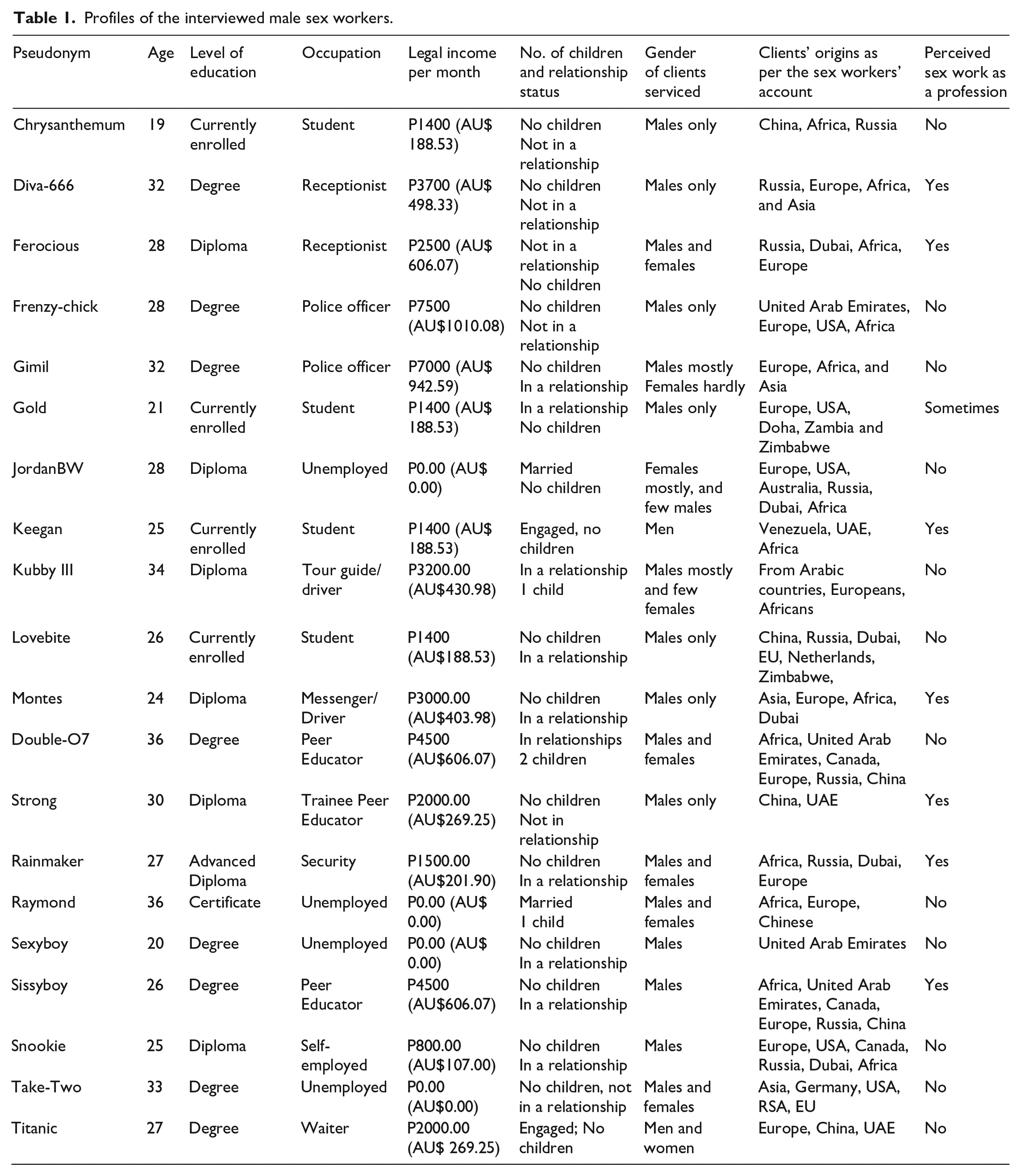
In total, 20 interviews were conducted with 10 male sex workers in Gaborone, the capital city which hosts urban tourism, and 10 in Kasane, which hosts the famous ‘Four Corners’, a point where four countries meet: Botswana, Zimbabwe, Zambia, and Namibia, hence being a gateway to neighbouring tourist destinations (Jagadeesh, 2015). The inclusion criteria were any male sex worker above 18 years of age and retirees who had exchanged sex for money or other benefits in the past 10 years with a tourist. To access the participants, purposive sampling was used where sex workers’ support groups (non-governmental organisations) were contacted first to refer the researcher to participants, as well as advise on procedural issues regarding accessing MSWs. The demographics of the participants are presented in the table below, which includes their pseudonyms, age occupation, level of education, level of income, relationship status, clients’ gender, and whether MSW was considered a profession. The relationship status also included whether the MSWs had children or not to gain their profile understanding without revealing their sexual orientation which could be an identifier. Garnets (2002) states that sexual orientation is not reducible to relationship status. The participants chose their own pseudonyms and this also helped build rapport from the beginning.
Data analysis
Narrative, thematic, and holistic content analysis of the interview data was carried out to generate major themes from the texts. Unlike grounded theory, which is theme-driven, holistic content and thematic analysis focus on paying significant attention to respondent’s overall life and how the themes of interest played a role and played out within each person’s individual experience (Bayer et al., 2014). Narrative analysis ensured that the individual narratives in the qualitative, rich data obtained through in-depth face-to-face interviews were kept intact. These approaches helped provide a fuller understanding of the narrative and richer linguistic data that shed light on various aspects of legal policy and policing MSW. The interview data were organised, sorted, coded, and analysed using Nvivo to explore key themes.
Ethical review
As noted in the ‘Introduction’ section, sections 149, 154, 155, 156, and 157 of the Penal Code of Botswana partially criminalise prostitution (sex work). In addition, as established in the literature review, stigmatisation and marginalisation are exacerbated by confusing it with homosexuality; hence, a thorough process of ethical considerations was engaged. All participants were provided with information sheets with information about the research, expectations, benefits, risks, and protections in place. Anonymity and confidentiality were ensured by use of pseudonyms, scribing and no audio recording, and meticulous data cleaning to remove any remaining personal identifiers. Consent was verbal and explicit. Notes were taken for all the interviews because of the potential for audio recording to breach confidentiality through police subpoena. The researcher conducted all the interviews with the aid of note-taking by a research assistant. The research assistant was appropriately trained, hence understood the task. A private counsellor was hired and provided to MSWs who felt distressed during the interviews; two participants accessed this service. All participants were compensated with BWP200.00 (AU$20), which was adequate in showing respect for their time, expertise, and difficulties, but not as high as to coerce individuals into participating when they would have rather not (Goodman et al., 2004).
Demographic information: age, education, and occupational backgrounds
The profiles on the table indicate that the age range for participants of this study was 19–36 years, with the majority being in their 20s. This age range is closer to that in other studies where the mean age of MSWs was 26 years, with a range from 18 to 37 years (Scorgie et al., 2013), with Bayer et al. (2014) reporting a median age of 24 years, and Tang et al. (2017) in their study of male sex workers in China found out MSWs were likely to be younger compared to general MSM. The table also indicates all the participants had completed secondary school and tertiary education. Studies in Africa and other contexts have also reported high literacy rate among MSWs (Institut National de la Statistique (INS) et Ministère de la Lutte contre le Sida [Côte d’Ivoire] et ORC Macro, 2005; Scorgie et al., 2013; Vuylsteke et al., 2012). The MSW population in Botswana is, therefore, mostly educated and young men, which could account for the services they provide and how they were accessed, that is, through support groups where they obtain their sexual health care services, thus an indication of their understanding of sexual health needs and knowledge on where to access it, as well as the commitment to it.
Table 1 presented the profiles of the study participants. In terms of occupations as shown in Table 1, most were in the hospitality industry in some jobs below their qualifications, four were tertiary students, two were police officers, and two were peer educators, while four were unemployed. With all these occupations, the official monthly salaries ranged from P0.00 (AU$0.00) with the unemployed, to P1400.00 (AU$184.16) with the students only, and receptionists, tour guides, hotel workers, waiters and peer educators averaging P2590.00 (AU$328.81), to the highest being the police officers averaging P7250.00 (AU$1007.19) per month. Although the police officers were the highest earning in the cohort, they lamented being overwhelmed with loan debts and intense demands for family support. Participants lamented life being too hard, with the cost of living rising and with limited opportunities for good-paying employment. Botswana’s poverty problems have led to several policies being developed around empowerment, education, and entrepreneurship; however, job creation is still a problem where many are graduates, but there are no employment opportunities. Botswana’s 2011 statistics indicate disproportionate higher unemployment rate for the educated young generation high rates of youth, and a general unemployment rate of 17.5% (about 248,812 people from a population of 2 million people) (Mogomotsi et al., 2017; Saleshando, 2011; Sechele, 2015). The 2019 statistics indicate no improvement, with unemployment remaining stubbornly high at 17.7% (Mashumba, 2023). These unemployed young people must still take care of their families. The total dependency ratio of the population in Botswana is 60.7% (World Population Review, 2020), which leads to young people migrating to urban areas. It is, therefore, not surprising that some of the MSWs interviewed are part of the people at the receiving end of the unemployment crisis, and this led to entry in sex work for most.
Profiles of the interviewed male sex workers.
Results
Description and motivations for sex work
All the interviewed male sex workers had knowledge and appreciation that the activity they were engaging in was sex work. ‘Ra ithekisa’ or ‘Re gweba ka mmele’ meaning ‘we sell ourselves’ as well as ‘we are called the Rimming Boys’ were phrases some comfortably introduced to the researcher to describe themselves. The following key quotes extracted from the interview data demonstrate the motives of entry into sex work:
I was faced with desperation, I felt no power and just wanted to make a quick buck. Sometimes my business does not go well, and I have debts to pay, so in such a situation where I am in so much need, I just have to find a way . . . a way beyond the financial resources I had . . . (Snookie)
Snookie’s quote captured the ‘situational entrepreneurs’ theme well as he engaged in sex work to cover his monthly expenses and pay off his business debts so he could stay afloat thus creating ‘relative financial security’. Another participant emphasised similar sentiments stating that
Unlike other students who use their student allowances for themselves, I must send some home because I know how bad the situation is at home. I brought over a friend one day to do a group assignment from school together. He was touched seeing my living condition. After some time of talking about being poor, family, and other difficulties he could relate to, he then asked, ‘What if there was a way, I could help you live better? But I would have to swear to never tell anyone’. He explained it, it was a simple deal of living with a foreigner who was touring and seeking business ventures for three months, and they take care of your needs, and you take care of theirs. He introduced me to a guy, he was Zambian, and two weeks later I moved in with him. He left the country last year, but it all started there, it was easy to make money and no longer mope in poverty. I have everything I need now, and even more foreign clients that I just service per week. So, I would say poverty from home drove me into sex work. (Diva-666)
The words used in this quote indicate forms male sex work could assume in Botswana, such as living with a tourist for a certain period, and they take care of the male sex worker’s needs: rent, clothing, food, toiletries, travel, and party life. All these provide financial security to the male sex worker.
Faced with brutal attacks from the loan shark, Frenzy-Chick identified an opportunity to engage in sex work, on which his gains were ‘beyond the initial resources controlled’, hence emphasising entrepreneurship. Frenzy-Chick also discussed the motives for entering sex work and stated the following:
I was once a laughingstock, at work, here with my friends and back in the village. I tried to be smart for the bank and withdraw all my pay before they deduct their loan repayment installment. I thought I would use the funds to pay off the machonisa for two months then let the bank take the money afterward, but the machonisa’s debt was going up every month, it was huge, and you know how these people are cruel if you do not pay. After three months the bank got fed up, they had been calling, sending letters, then finally embarrassed me in front of everyone and repossessed my car. A few weeks later the machonisa took all my furniture, left the house empty I almost went ‘mental’. But yeah, I have recovered now since doing sex work. I work mostly on weekends because weekdays my work schedule is demanding, and, in my unit, I’m rarely scheduled to work on weekends. So that is when I focus on the other hassle. (Frenzy-Chick)
Many other sex workers held the sentiment that sex work offers monetary benefits which offered financial security. Another participant, for example, narrated they offered clients a ‘boyfriend experience’, stated that
I feared stepping out of the house because I owed a machonisa (loan shark), and he was terrorizing me. The day a friend of mine shared her quick money-making schemes my money problems disappeared. I was lucky. My first client was a German. He was on holiday in Botswana for three months, and I would accompany him on long drives through Zimbabwe, Zambia, Namibia, South Africa, Lesotho, and Swaziland. He was great. When his holiday was over, he left me his car and P20, 000.00 (AU$2, 000.00) on top of all the weekly allowances he gave me. (Sexyboy)
As per the above quotes, many other MSWs noted that sex work helped achieve relative financial security, while for others like Ferocious and Gimil, sex work could be viewed as an escape. Ferocious, for example, stated,
I came out of a painful relationship before I got into sex work in 2016. He was abusive; I was not allowed to go out or drink. He denied me my freedom. Now I can have all kinds of sexual pleasures whenever I want, how I want, and load my pockets. I travel to Joburg whenever my clients call without having to seek permission. (Ferocious)
Gimil also noted,
I usually get my trip expenses to South Africa fully by this ‘blesser-bae’ from Doha, and he treats me like a Disney princess. Whenever he comes over for business, he calls me and gets my room ready. We have known each other for two and a half years now. I escort him around during his trip and pampers me and pays me very well. (Gimil)
These two quotes above demonstrate that for some, non-commercial relationships are abusive and turbulent, and sex work provides them the opportunity to enjoy greater stability and more enjoyable relationships. This shows that there is not an easy distinction between pleasure and authenticity within commercial and non-commercial relationships.
Description of services, clients, and preferences
In terms of the types of services provided, some participants stated,
Re ba ntsha tlala (We play a useful role in fulfilling sexual needs) (Raymond).
The quote suggests a perception held by most MSWs that their role is highly significant in society as sexual services they provide are essential life needs. In terms of the types of clients they were servicing as presented on the table, they serviced both males and females; however, sometimes stretched beyond sex tourists to include businessmen, men in positions of power in government, and married men as clients. These participants also narrated making several trips to Johannesburg, South Africa, on weekends, and those unemployed were flexible to travel at any time. They reported having such trips fully paid by their clients and with them possibly earning up to BWP50,000.00 per trip (equivalent to AU$5000.00). Distinctions were made between male and female clients, and these were also mostly dependent on their actual sexual identities as male sex worker:
I provide penetration mostly with females, handjobs with males, massages, escorting, and I do not mind penetrating men as well . . . (Take-Two) I mostly do rimming, handjobs, penetration, kissing, and massages for both men and women. I got a rimming job offer and made P5, 000 (AU$500) in one night, with all-expense paid in Sandton . . . Johannesburg is the place to be because that’s where you find all the ‘blesssers’. (Raymond) My services are for both men and women and range from appetizers like cuddles, massages, to main courses like blowjobs, penetration, to a whole weekend of a ‘boyfriend experience’. (Kubby-III)
The client is also in this quote referred to as a ‘blesser’ which is used to indicate a person in a position to give (bless) and make the sex worker feel a certain way (like a Disney princess). The commercial or transactional relationships could also be maintained for an extended time (2.5 years in this case).
Particular ethnicities or races of clients are preferred over others by male sex workers in Botswana and the following quotes demonstrate such:
Some services pay more, others less, it also depends on who the client is or where they are from, but I generally enjoy providing my services to Arabics and Europeans than Africans and Chinese. The only problem is it is easy to fall in love with some clients, especially if it is like a long service which can take a week or two weeks and they are pampering you from left-right to center! Who does not want that? (JordanBW)
This quote suggests certain benefits being attributed to the client’s race/ethnicity or place of origin. MSWs also indicated they preferred males compared to females as males paid more; their relationships were more effortless; and it offered the gay, transgender, and bisexual male sex workers an opportunity to explore their sexuality. Double-07 added,
I prefer my Arab brothers; they would pay more even with their pencil or chopsticks, and they would want to ‘deliver me’, and it would feel like nothing is happening. However, I would be happy to negotiate with my cousin from Zimbabwe. Those ones can destroy you. (Double-O7)
Coupled with some sarcastic remarks of the penis size of some clients (their ‘pencil or chopsticks’), this indicates a preference based on the penis size as it relates to ethnicity. This was mostly for sex workers who did not identify as ‘bottoms’ but were happy to service a male client, provided they had a smaller penis than big-sized ones. Some also indicated establishing these preferences on their online profiles:
. . . I make clear my preferences on my profiles. Usually, Europeans and Arabs are better. I’m straightforward. With me, what you see is what you get. (Frenzy-Chick) I prefer males on any day. (Chrysanthemum)
The quotes attributed preferences of clients to race/ethnicity (cultural differences/penis size), rewards (wealth), and gender (males are preferred as they pay better than females). The quotes, in many ways, indicate the ‘Othering’ of clients, and the evident intersections between gender, race/ethnicity, and personal wealth/potential for financial remuneration reflect broader societal wealth distribution.
How clients are attracted
Clients of male sex workers were attracted in a few uniform ways, which made it easier to understand how sex work is organised and practised in Botswana. A few quotes below demonstrate this:
Mostly it is taxi drivers, receptionists, waiters, or tour guides who hook us up. I have gay friends who are receptionists who call us when there is someone who wants to hook up. Even the housekeeping staff connect us. (Sissyboy)
This demonstrates that male sex work has several actors in Botswana. Various occupations work together to enable the male sex worker an opportunity to meet a client. The male sex workers indicated rewarding these networks when they receive payment from clients or the client themselves directly pay the cleaners or receptionists for the referrals. Others preferred being completely online or both:
I use Facebook, WhatsApp, Grindr, GayRomeo . . . it is easier, more private, and chats are encrypted. (Montes) When my social media isn’t producing anything, I go to a pub or night club, there are ones that are gay-friendly and you sure to find something, although you might end up with a local, so I’m always careful. I can’t afford my family knowing because our local people talk too much, and Kasane is too small. (Titanic)
Most of them appreciated these as platforms that allow them to describe and set straight from the beginning the types of services and screen clients. In addition, this also demonstrates organisation and consideration of safety factors in terms of staying hidden and undetectable to the police via the use of encrypted sites that also help promote anonymity.
Attitudes and perceptions of sex work
Male sex workers’ attitudes and perceptions towards sex work as a profession varied according to personal and family backgrounds. Sissyboy’s history normalised sex work as a viable option:
I grew up in a setting where female sex workers raised me, I was still in Zimbabwe around 1998. We had sex workers within our house, being born without a silver spoon, although my father was rich, but he was with another woman. Sex work became something which was normal, men would come on daily basis and when they left, they would give them money. So that ringed a bell. As I was growing my cousin who is a sex worker would come to our house with her friends and they would go out and do their own thing out there. Being brought up in the setting of sex workers, I would not say it influenced me because my mother put me through school, but it is something that I have always seen as a profession. (Sissyboy)
Rainmaker’s perception about sex work was as follows:
I consider sex work as a profession. It pays way much better. Do you know a person could be employed as an office administrator and earn P1500.00 (AU$150.00) per month? But that’s money I can make in 1 weekend and even more. But because it’s glamorous to work in an office for many people, they start judging us who earn better through other means, but the reality is we earn and live better fun-filled lives in this profession. (Rainmaker)
Conversely, the following quotes demonstrate the rejection of sex work as a profession:
I do not like sex work. Even sometimes when you do it, you feel like something is missing, the emotional connection, because it is a transaction. Sometimes you wake up hating yourself for doing it. (Chrysanthemum) Sex work could not really be a profession, it has no standards that would qualify it to be a job, so like many other professions out there it really needs a lot of things to happen before it can be considered a profession. (Double-07)
These two quotes demonstrate the rejection of sex work as a profession. These also indicate the emotional involvement of the actors in the trade and a refusal to view it as a profession as it has no standards to qualify it.
Others still held views that it had the potential to be a profession for those with limited choice:
Not yet, but sex work does have the potential to become a profession. Many would opt for it if it was a profession. I cannot say it is by virtue of choice because we all have different challenges in life. You don’t just wake up and decide. It is something that you just find yourself in but not as a profession. (Sexyboy) With my work and being gay, I am just fearing for my life. If I get sick, I don’t know what I will tell my fiancé (Keegan is engaged to a South African male partner). So, I don’t like it, it’s something I do for money, and I’ll leave it as soon as I graduate and get a good job. (Keegan)
This indicates that MSWs’ perceptions of sex work as a profession are complex because they recognised the constraints to their choices. This could also be attributed to the experiences they have had as male sex workers, their life goals, and the community dynamics where their activities attract stigma; hence, all that simultaneously influences participants’ experiences and judgements.
Discussion
The working poor in Botswana have been a growing phenomenon. It is often believed that employment should guarantee workers a decent life. However, in Botswana, the minimum wages as set by the Minimum Wages Advisory Board are not aligned to the actual cost of living (Saleshando, 2011), which renders much of the workers poor, as they are underpaid even with higher qualifications (Matandare, 2018), struggling to survive under the difficult economic situations (Saleshando, 2011). In fact, ILO (2018) reports that in sub-Saharan Africa, more than one in three workers is living in conditions of extreme poverty, while almost three out of four workers are in vulnerable employment. Unemployment and underemployment, coupled with having many dependents, also lead to a lack of access to formal finance, making poor households in Botswana vulnerable to short-terms shocks (e.g. illness, loss of employment). It is also not surprising that the police officers reported struggling with informal cash loans, as commonly referred to as ‘bomachonisa’. These are often known for very high-interest rates and unconventional methods of obtaining their money back with interest (Saleshando, 2011).
Indeed, strain theory argues that individuals are likely to get involved in activities that can help alleviate their strain, in this case, sex work, which is outlawed, because of stressful events in their lives, or conditions they dislike including family financial problems (Agnew, 2001; Aseltine et al., 2000; Hoffmann and Cerbone, 1999). Given these demographics, therefore, this study argues that male sex workers in Botswana could be seen as situational entrepreneurs as they seek opportunities beyond legitimised means. Eisenmann (2013) defines entrepreneurship as ‘the pursuit of opportunity beyond resources controlled’ (p. 1). The MSWs, therefore, engage in sex work to cover for their monthly living expenses, pay off their debts, stay afloat without being limited by the resources they have, and as discussed by Sanders et al. (2017), sex workers also have relative financial security provided through having regular/long-term clients. Julia O’Connell Davidson’s work in 1998 introduced the concept of sex tourists as ‘situational’
a broad term to describe the activities of individuals who, whether or not they set out with this intention, use their economic power to attain powers of sexual command over local women, men and/or children while travelling for leisure purposes. (p. 75)
Situational entrepreneurs are therefore individuals who purposefully or partial purposefully seek economic opportunities beyond legitimised means.
Further analysis also demonstrated sexual exploration as a motivation for entry into sex work for many. Minichiello et al. (2015) argue that there is a need to understand the exploration of sexualities as the driving forces to the organisation of male sex work. Research that often focuses on male sex work and its links to HIV rates, placing the focus of male sex work studies on diseases and risks, according to Knerr and Philpott (2011), perpetuates ignorance of the positive motivations for sex work such as desire, love, and pleasure. The natural and health benefits inherent in sex are ignored, yet fun and positive influences on those involved could be seen (Knerr and Philpott, 2011). Multiple interests may co-exist at the same time (Lorway et al., 2009) and such has been demonstrated by this study findings.
Social media platforms such as Facebook, Grindr, GayRomeo, GayPlanet, and WhatsApp were reported as useful in enabling MSWs to create profiles and market themselves. Organising via social media ensures they are hidden from the public and the police, as such, operating in ways that limit the chances of detection (Sanders et al., 2017). Minichiello et al. (2015) have vouched for the increasing power of the Internet; as seen in this study, the Internet is a powerful tool connecting MSWs to clients. Bernstein (2007) states that advancements in technology and communication allow instant access to networking sites, hence giving sex workers more control over their work and clientele across the globe. It should be acknowledged, therefore the role technology plays in the sex trade-tourism linkage as it enables the ever-changing social relations; mixing of ideas, beliefs, and cultural practices; breaking down the physical, social boundaries, as well as shifting sexual boundaries (Kingston and Sanders, 2012).
In addition to the above, other strategies included having a network that helps attain some clients, especially those who make close contact with ‘foreigners’ such as taxi drivers, waiters, receptionists, tour guides, and housekeeping staff. A study by Dahles and Bras (1999) also reported waiters, receptionists, and other personnel using their privileged positions to approach tourists and offer their services. The results above also revealed the preference of the ‘foreigners’ over ‘local’ men. Some studies in Asia found a similar trend where Thai sex workers preferred Western men over Thai or Asian clients (Herzfeld, 2005 (2002); Pravattiyagul, 2018). This, according to Kibicho (2016), demonstrates there are stereotypes on both sides: the sex tourist who chooses a certain type and the male sex worker who prefers a certain type, hence illustrating stereotypical complexities that exist simultaneously. In other studies, sex workers have often described feeling a sense of accomplishment after servicing a Western man, while the Westerners went for the exotic racialised Other, which demonstrates that both hold post-colonial and crypto-colonial cultural ideologies (Herzfeld, 2005 [2002]; Kibicho, 2016; Pravattiyagul, 2018).
In terms of their perceptions and attitudes towards sex work as a profession, only a few indicated considering sex work as a profession, one that offered higher payments, while most participants remarked it had no measures to qualify it as a profession. A study by Boyce and Isaacs (2014) argues that the one key difference of sex work with other professions was that (a) there is criminalisation or perhaps lack of legislation for it and (b) it has no occupational health rights or labour rights as such there were no proper working practices for sex workers (Boyce and Isaacs, 2014: 299). Also, the study reported that the lack of professionalisation of the trade is a good thing as it kept them free from registrations or surveillance, which might be used to control them. A key recommendation from this study is for the Botswana government to amend the legislation to accommodate and regulate sex work and sex tourism. This is important because viewing sex work as an illegitimate occupation can produce devastating consequences. For instance, when sex work is not properly legislated and regulated, it will be impossible to offer the protections found in other workplaces. An example is hotels that are not registered as places for sex work but could be rented for an hour, a day, or a night without protections associated with other workplaces (Kingston and Sanders, 2012).
Conclusion
The findings of this study indicate that the common motive for entering sex work is the need to make money and provide for the family as most sex workers were faced with financial difficulties. Their preference of sex tourist over locals emanates from the need to conceal their activity and protect their identities, given the local dynamics in Botswana. What was also evident was the ‘Othering’ of certain clients’ ethnicities, quite often emanating from the need to maximise profits by avoiding ethnicities which were known to pay less due to relatively less economic capital and based on stereotypes about penis size. MSWs thus look to maximise their profits by preferring most privileged groups. Males were preferred as they offered higher payments, and for the gay and bisexual men, it gave them more opportunity to explore their own sexuality with the male client in safer settings. In this light, this article posits that indeed MSWs in Botswana could be viewed as ‘situational entrepreneurs’. A key recommendation from this study is for the Botswana government to amend the legislation to accommodate and regulate sex work. Viewing sex work as an illegitimate occupation could produce devastating consequences as it will be impossible to offer the protections found in other workplaces.
Footnotes
Acknowledgements
The researcher is thankful to the research assistant, Mr Thabang Moagi, who scribed the interviews.
Author contributions
The author confirms sole responsibility for the study conception and design, data collection, analysis and interpretation of results, and manuscript preparation.
Declaration of conflicting interests
The author(s) declared no potential conflicts of interest with respect to the research, authorship, and/or publication of this article.
Funding
The author(s) disclosed receipt of the following financial support for the research, authorship, and/or publication of this article: This study was funded by the University of Botswana Staff Development Scholarship Fund.
Ethical approval
This study received ethical approval from the Queensland University of Technology Research Ethics Advisory Board (Approval #1800000834) on 10 October 2018.
