




Abstract
In this article, I am thinking through the social life of time for food in prison from a practice theory perspective. I draw upon empirical data from in-depth qualitative interviews with people serving custodial sentences or recently released from prison in England and Wales who have been on placement at a prisoner resettlement charity (RC). These support findings from Her Majesty’s Inspectorate for Prisons report on Life Inside: Food from 2016, and I consider two aspects from the report, (i) an exploration of the standards and conditions in which food is consumed and (ii) the timings of mealtimes. For people in prison, disruptions to the usual rhythms of everyday life, or chrono-normative expectations, serve as stark reminders of a lack of agency and worth. People in prison are forced to adapt and work within temporal spaces that are subject to flux due to the systemic demands of an under-resourced prison system. These constitute a contravention of social and cultural norms and reinforce the notion of the prison as a place of punishment, and degradation. These temporal shifts contribute to the transformation of civilian to prisoner and form part of a process of de-synchronising with life outside.
Introduction
When considering the social life of time (Bastian et al., 2020), having time to spend on something infers high cultural, economic, social, and symbolic capital (Bourdieu, 1984, 1986). In this article, drawing on interview data from people who have served custodial sentences across the prison estate in England and Wales, I explore the significance of the social life of time (Bastian et al., 2020) in relation to everyday foodways (a term that encompasses the multiplicity of ways of doing food, incorporating all aspects of everyday food practices from acquiring food, growing it or shopping for it, preparing, cooking, sharing, and eating it, to the consumption of food media, Parsons, 2015a). Why does having a meal served outside of culturally normal times illicit such rancour? Is there a chrono-normative (Freeman, 2010) or right time to eat, and if so, how is it acceptable for penal institutions to disrupt the temporal order of things when other institutions, such as hospitals or schools, do not? What is the purpose of this temporal code, this way of communicating meaning through time/timings? What does time spent on food in prison tell us about the status of prisoners and the importance of time for food?
The quote in the title of this article was taken from a letter published in Inside Time, The National Newspaper for Prisoners and Detainees on 18 January 2021 (Broughton, 2021). It is notable that food became a focus during the COVID-19 pandemic, as responses from the free community demonstrated, notably with an increase in demand for vegetable boxes (Evans, 2020), home baking (Askew, 2021) and food bank use (Trussell Trust, 2019). This was no less the case for those in prison, as Tom notes ‘food’s quite important to most people’. Indeed, the author of the letter complains that: ‘Here in this prison, we have our main meal at 11.30 in the morning, yet the Daily Star, last December, reported that the Chief Inspector of Prisons has said ‘evening meals should not be served before 5pm’ (Broughton, 2021).
Broughton (2021) in his letter is referring to an HM’s Inspectorate Report on Life Inside: Food (Her Majesty’s Chief Inspector of Prisons (HMIP), 2016a) that identified how ‘normal’ opportunities for eating across the prison estate in England and Wales were limited, with ‘food often served out of synchronicity with the wider population, for example lunch can be served as early as 11:10 am and dinner at 4:15 pm (HMIP, 2016a: 8)’. In response to the findings, in 2016, HMIP made four recommendations, all of which are yet to be fully implemented: (i) There should be a minimum standard of nutritional values and conditions under which food is consumed (with advice from the relevant professional bodies); (ii) governors should arrange mealtimes at ‘normal’ times of the day; (iii) new prisons should be configured to enable eating together; and (iv) prison governors should provide more self-catering/cooking opportunities (especially for long-term prisoners). The report and its recommendations highlight the significance of the social life of time for food in prison, not only in terms of when the food is served, but where and how.
Indeed, the critique is not just about the nutritional values of food in prison, which are inadequate and not subject to statutory guidelines in quite the same way as other institutions (such as schools and hospitals), but also clearly highlights the social, cultural, and symbolic meanings embedded in everyday (prison) food practices. Again, these can be related to the social life of time, as time spent on the governance, preparation, and conditions in which food is served and eaten carry symbolic meaning (and not just for those in prison, see Counihan, 1999; Counihan and Kaplan, 1998). This is evident not only in terms of breaking with chrono-normative (Freeman, 2010) expectations but also in signifying a lack of care (see Parsons, 2014, 2016; Warde, 1997). Overall, the HMIP (2016a) report on food concluded that ‘the quantity and quality of the food provided [in prison] is insufficient, and the conditions in which it is served and eaten undermine respect for prisoners’ dignity’ (p. 13). This has implications in terms of increasing the marginalisation and alienation of the prison population from the ‘free community’ (HMIP, 2016a: 11).
The focus of this article is on the first two of the HMIP recommendations, specifically an exploration of the timings of meals, the conditions in which meals are consumed, and food standards. This focus directly links to the social life of time and how time is used to disrupt chrono-normative expectations among the prison body. It uses a Foucauldian lens to explore the disciplinary biopower of prison foodways in the production of docile bodies (Foucault, 1980). Disciplinary biopower has two interconnected strands: the anatamo-politics of the body, which is entwined with disciplinary power, and the biopolitical power enacted over the population, creating ‘docile bodies’ through the prison system, schools, and within other disciplinary sites (Foucault, 2003, 2008). These processes of normalisation create docile bodies through regulating action, shaping thoughts, desires, and identities. Hence, prison foodways, or more specifically the times, conditions, and standards of food served in prison, form part of the governance and control of the body of the prison as well as individual bodies and are used to discipline and punish (Foucault, 1980). Moreover, prison foodways represent a form of disciplinary power that impacts upon individual bodies through processes of surveillance, normalisation, and punishment using techniques such as hierarchical observation, examination, and the establishment of routines and norms (Foucault, 1980). These prison foodways become part of the doxic order of things, meaning that they are taken for granted, accepted, becoming ‘a naturalised understanding of how a particular field functions and which resources or types of capital are valuable within it’ (Senn and Elhardt, 2014: 321).
Background and context
To provide some context and background, and prior to a review of the methodology and discussion of the empirical data, I will provide some detail in this section about the recent resurgence of interest in time/temporality and the use of a practice theory perspective in relation to a temporal approach to the social life of time for food in prison. Overall, data suggest that temporal disruptions to the social life of time for food in prison remind those serving custodial sentences of their denigrated status. Furthermore, it indicates that institutional variations in food regimes across the prison estate are acts of symbolic violence, defined by Bourdieu and Wacquant (1992) as ‘the violence which is exercised upon a social agent with his or her complicity’ (p. 67), that contributes to the ‘pains of imprisonment’ (Sykes, 1959 [1958]) and assaults on a sense of self. Indeed, the ways in which the prison regime works to disrupt and reshape cultural norms and values related to food are not only reminiscent of a form of symbolic violence but, as Nixon (2011) outlines, could be considered a form of ‘slow violence’, one that takes time. It is an ordinary violence that works through the depoliticisation of culture (Warin, 2023) and operates through ordinariness (Warin, 2020). It insidiously creeps into everyday life, ‘distributing misery’ (Povinelli, 2008: 162) and wearing people down (Berlant, 2008). Everyday prison foodways therefore disrupts ‘the ready familiarity of the ways the category of time are folded into everyday life’ (Nolan et al., 2022). Overall, this article seeks to contribute to debates on the role of food in carceral spaces and the relationship between the social life of time and everyday foodways.
The social life of time
Throughout this article, the social life of time for food is explored across three interconnecting domains: individual, cultural, and institutional or ideological (Risman, 2004). First, temporal shifts in prison foodways contribute to the transformation of individual civilian to prisoner, through socialisation, internalisation, identity work, and the construction of the self. Hence, temporal changes act as dis-embedding mechanisms (Giddens, 1991), or what McNeill et al. (2022) refer to as systems of de-synchronising with life outside. A temporal exploration emphasises the ways in which connections are established, stabilised, and strengthened through synchronous repetition or weakened or destroyed through asynchronicity (Wanka, 2020). On an individual level, some aspects of identity and associated food practices are strongly socially and culturally embedded (healthy eating or eating together, for example). These become sites of resistance to the prison regime, which serves to disrupt the temporal rhythms of prison life. Second, through disruptions to normative interactional cultural expectations and othering practices, the prisoner is positioned outside of, or marginal to, everyday temporal social and cultural norms relating to food practices.
Third, the focus on the social life of time for food in prison reinforces the differences between institutional and family foodways. Institutions control access to resources as well as ideologies and discourses. In institutional settings from a Foucauldian perspective, the temporal rhythm of prison life and its institutional and social routines are part of a broader biopolitical disciplinary process that involves the creation of docile bodies (Foucault, 2003, 2008). For people serving time in prison, being out of time or failing to keep time with the rest of the population disrupts the temporal order and contributes to the enduring temporariness and precarity of prison life (McNeill et al., 2022).
The emphasis on the temporal is deliberate as it refers to lived time or an experience of time that is structured in specific socio-political and economic contexts (Sharma, 2014: 9). On an ideological level, the social life of time for food in prison is not impervious to neo-liberal discourses of responsible individualism. Again, from a Foucauldian perspective (Foucault, 2003, 2008), disciplinary regimes manage the body of the prison through a series of rewards and benefits that simultaneously reinforce neo-liberal values while negating an individual’s ability to engage in healthy choices or autonomous action.
Temporal practices
Time is increasingly understood as dynamic, multiple, and complex; it is constitutive of ‘social life’. Rather than existing as an external backdrop, time emerges from and structures socio-political relations and power dynamics, including interactions between human and non-human actors (Harris and Coleman, 2020). Sharma defines ‘the temporal’ as lived time. The temporal is not a general sense of time particular to an epoch of history but a specific experience of time that is structured in specific political and economic contexts. The ‘temporal operates as a form of social power and a type of social difference’ (Sharma, 2014: 9). There has been a recent resurgence of interest in time and temporalities, due in part to the suspension of ordinary ‘times’ because of the COVID-19 pandemic and associated ruptures or dis-continuities in social life due to lockdowns (see Bastian et al., 2020; Nolan et al., 2022). In criminology, ‘time’ has been a relatively underexplored field of research. This has been addressed more recently with Miller’s (2021) exploration of the liminality of imprisonment and the afterlife of incarceration. Indeed, McNeill et al. (2022) take this as a starting point for exploring the paradox of the enduring temporariness of everyday life for those caught up in the criminal justice system, with its cycles of reoffending and recalls. Criminal justice-affected people are forced to de-synchronise and re-synchronise to the temporal challenges of time spent in and outside of prison, with all the precarity and vulnerability that this entails (McNeill et al., 2022: 177). For the free community, curtailments to social life during the pandemic drew fleeting attention to some of the ‘pains’ of imprisonment (Sykes, 1959 [1958]), notably the deprivation of goods and services (food shortages) and the deprivation of autonomy (social freedoms).
In taking a practice theory perspective, the focus is on what Bastian et al. (2020) refer to as the double life of time, which demonstrates how time works simultaneously to organise the social and is of the social and produces but also shuts down realities. This highlights the purpose of time, what it produces, and how it performs, particularly in relation to the social life of time for food in prison. For people in prison serving or doing time is a form of punishment that signifies a rupture in the flow of time, it disrupts the chrono-normative expectations of everyday life (Freeman, 2010). Disruptions to the timing of meals are a temporal code that substitutes the need for verbal communication (Wanka, 2020). According to Zerubavel (1987), ‘a temporal organisation of the social world takes place through specific time-coded practices that form a quasi-linguistic nonverbal system of signification’ (p. 253). In this instance, the temporal code confirms the doxic order of the prison regime, that the needs of the individual are secondary to the running of the prison regime. Moreover, this temporal code emerges from and is structured by socio-political relations and power dynamics (Harris and Coleman, 2020). This serves to position the prisoner as other, as marginal to or outside of a civil society that places a high value on good food, prepared with care and served at regular times of the day.
Changing food times
Changes in patterns of consumption over time have been well documented among food scholars in the UK (Cheng et al., 2007; Jackson, 2009; Murcott, 2011; Warde, 1997, 2016; Warde et al., 2007) and beyond (Coveney, 2006, 2011; 2014; De Solier, 2013; Naccarato and LeBesco, 2012). These include an increased demand for ready meals, takeaways, and home deliveries, as well as eating out at fast food and fine-dining restaurants (James et al., 2009; Warde et al., 2007) in a move away from an emphasis on home-cooked food prepared from scratch in the domestic sphere (Meah and Watson, 2011; Parsons, 2014, 2016). Despite or because of these changing patterns of consumption, there is a persistence of conceptualisations of food as either ‘good’ or ‘bad’, what Warde referred to as ‘antinomies’ of taste (Parsons, 2015a, 2015b; Warde, 1997: 194); Arguably, in contemporary neo-liberal societies, responsible individuals seek out food that is good (for the self or society or the environment or in accordance with social, religious, political, or cultural ideologies) and moderate consumption of food that is not (Parsons, 2015a, 2015b). A dichotomous approach to food ensures a continued cultural emphasis on binary oppositions, with good food synonymous with being good (Coveney, 2006). Indeed, there is a long history of dichotomous thinking, with food a source of gratification or displeasure and health or illness (Beardsworth and Keil, 1997). This is further evidenced in the four antinomies of taste used by advertisers in food marketing, identified by Warde (1997: 194) as ‘novelty and tradition’, ‘health and indulgence’, ‘economy and extravagance’, and ‘convenience and care’. These binary oppositions persist in their influence on the social life of time for food and contribute to our cultural habitus or the system of dispositions that enable people to think, act, and navigate the social world (Olsson et al., 2019; Warde, 2016).
Methodology
Since 2015, I have worked on a series of externally funded research projects based at an independent, non-statutory, resettlement charity (RC), that works with men released on temporary licence (ROTL) from the local prison and other criminal justice-affected people referred through probation or other agencies working in the criminal justice system. People at the RC are offered 6–12-month work placements and engage in a range of activities (woodworking, construction, market gardening, pottery, and cooking) developed to build self-worth and social skills, alongside preparation for employment beyond the end of the prison sentence or community punishment. A keystone to the project is a shared community lunchtime meal, prepared on site (see Parsons, 2017, 2018, 2020). Unusually, people who have had a placement remain in contact with the charity beyond the end of their licencing conditions. To date, there have been more than 200 placements, with 97% of these successful in securing employment following the end of punishment and a reoffending rate of 4% (against a national average of 48%) (Gray and Parsons, 2023; Gray, Grose and Parsons, 2022).
Since 2016, I have interviewed people on placement at the RC for evaluation purposes (see Parsons website) and to publish short blog posts for the PeN (Photographic electronic Narrative) project established with funding from (Parsons links). These blog posts are anonymised and only published with permission. They consist of short excerpts from longer interviews, that have been audio-recorded and then transcribed. My approach is participatory to redress the inherent power imbalance in research and facilitate reciprocal knowledge creation (Israel and et al, 2011; Minkler and Wallestein, 2003; Wallerstein and Duran, 2010). To this end, qualitative biographical and life-course perspectives are merged in interviews that follow issues raised by the interviewees themselves rather than adhering to a strict interview schedule (Atkinson, 2002; Roberts, 2002). Broadly, three areas are discussed, experience of the criminal justice system and route to the RC (past), reflections on the placement itself (present), and hopes or aspirations (future). Interviews are audio-recorded and last between 45 and 120 minutes. All interviews are voluntary and adhere to ethical procedures approved by the University of Plymouth. To date, I have over 120 interview transcripts and have published 101 blogposts, based on interviews with 72 people, some of who have been interviewed more than once.
All interview transcripts are coded and thematically analysed following an iterative process, common in qualitative research (Braun and Clarke, 2006). Many of the narratives document multiple traumas, such as being in care, mental health issues, addiction, poverty, homelessness, incarceration, and criminalisation. There are also narratives of hope, recovery, self-awareness, and re-humanisation, with personal accounts of giving something back or ‘generativity’ (Maruna, 2001). There are complaints about structural inequalities and comments on systemic failures as experienced firsthand ‘in care’, in prison, and/or under supervision. Meanwhile, spending time at the RC in a trusting and non-judgemental environment counters the mundane and repetitive banality of prison life; it is a privilege. For those under supervision, it is equally a space to make mistakes without judgement and sanctions. The role of food is a common theme across all of the interviews and is pertinent due to the popularity of the cooked lunchtime meal at the RC, which serves to highlight the ‘lack’ of good food in institutional settings (Parsons, 2020).
The empirical data in this article are taken from a small sample of testimonies on the lived experience of prison from people interviewed during their time on placement at the RC when they were either ROTL from the local prison or recently released (see Table 1). It is notable that the lived experience of prison will vary across the prison estate, depending on the category of the prison, A, B, C, or D, with A reserved for male prisoners who pose the most risk to the public to D that only houses those that have been risk-assessed and deemed suitable for open conditions (Ministry of Justice, 2023). However, the lived experience of prison among the sample ranges from category B to category D, as people move within the prison estate throughout their sentences, while for some, they have had repeated prison stays, including time spent at Young Offenders Institutes. Most people interviewed at the RC, especially those on ROTL were enhanced prisoners from the resettlement wing of a closed and segregated Category C male prison. What is notable is that while each individual prison experience is unique to that person, there are what Mills (1959) refers to as common vocabularies and shared experiences, and these are explored in the next section.
Participant demographics.
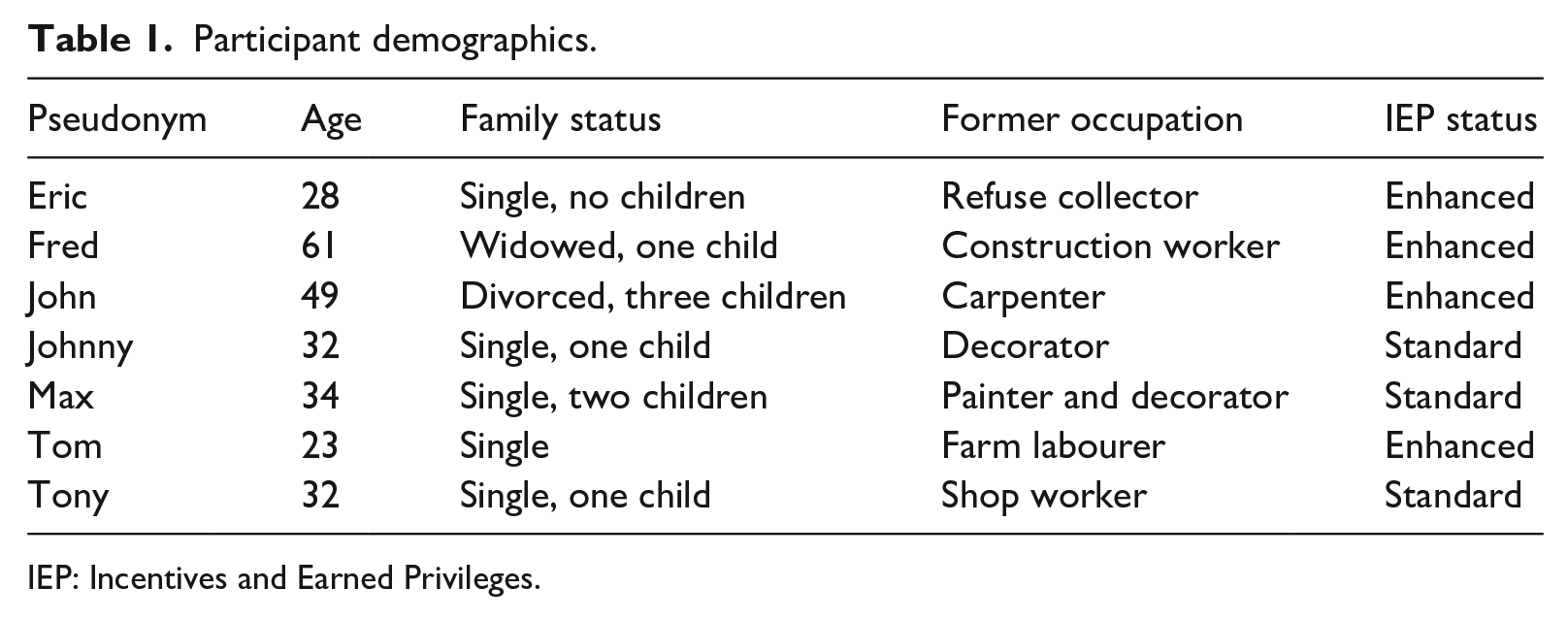
IEP: Incentives and Earned Privileges.
Findings and discussion
The data referred to represents common themes across all interviews and falls broadly into three areas: (i) When food is served, which includes ‘waiting’ for food; (ii) where food is eaten, with reflections on commensality (eating together) and in-cell dining; and (iii) what type of food is served, with comments on quality and quantity.
When dinner is served (or not).
Prior to the discussion, it is important to note that the prison estate in England and Wales operate an Incentives and Earned Privileges (IEP) scheme, with three categories of prisoner status: (i) basic, (ii) standard, and (iii) enhanced (HMIP, 2016b). People in prison start on standard, with basic usually reserved as a punishment. The most trusted and well-behaved prisoners progress to enhanced status, which can give them access to better living accommodation, or more money to spend on the ‘canteen’. This is a list of items that people in prison can purchase weekly from money sent in or from ‘wages’ through the IEP scheme (HMIP, 2016b). Hence, people in prison can purchase food items, as well as toiletries, phone credit, or vapes from a strictly monitored list of controlled items. These are then ‘delivered to the cells in clear plastic bags each week’ (Parsons, 2017: 5, 2020).
In this first excerpt, Fred identifies several ways in which the social life of time is disrupted and out of synch with some of the chrono-normative (Freeman, 2010) expectations of wider society: You can’t sleep in prison without a good day’s work under your belt. There’s no fixed regime. There’s no normality. There’s no obeyance of any structure of time. There’s no 10 o’clock tea-break, one o’clock dinner break. There’s no structure of reality. On a Saturday, lunch can be anything from quarter-to 11, ‘til 12 o’clock. It’s up and down like a flipping fiddler’s elbow. The regime will be quarter-to eight roll call, unlock everything, two minutes to eight, let’s have another cup of coffee. There is no structure. . . . It’s very floating. Same as teatime. It can be anything from four o’clock to five o’clock. There is no set time. I don’t know what that says about the regime (85. Fred_24_10_19).
Fred clearly identifies how the social life of time in prison for food varies due to fluctuations in staffing. It is an insidious undermining of the rhythms of everyday life and forms part of a process of de-synchrony with life outside and a re-synchrony with prison time (McNeill et al., 2022). It reinforces the notion that clock time matters for a sense of social belonging. Moreover, regular, dependable mealtimes allow people in prison to align their body (e.g. hunger) to the wider social rhythms of lunchtime or dinnertime. This tethers people in time, in contrast to the experience of ‘floating’ that Fred describes.
In an interview with John, he reflects on his experience of prison food during some of the most important times for food in the annual cycle of cultural events in contemporary Christian societies. He says: You’ve had your Christmas dinner say at one o’clock or 12 o’clock, one o’clock but then dinner is served at four o’clock, they don’t even really want it by then, it’s quite early innit and you don’t want it sat about on the side, because you haven’t got a fridge to put it in or whatever . . . (John 8_12_16 (02_4).
At these key food times, John notes that the main meal is served earlier than the Christmas mealtime he is used to outside. It is served at midday or 1:00 pm and the food for the evening is also served earlier (4:00 pm) in keeping with the staffing demands of the institution. This serves to undermine an individual’s cultural habitus, drawing attention to the pains of imprisonment (Sykes, 1959 [1958]). These seemingly minor temporal disruptions contribute to the sense of being other, outside of social norms, and not worthy of having food served at the culturally correct time. These unsettle chrono-normative (Freeman, 2010) expectations, as part of a de-synchronising prison process (McNeill et al., 2022). A stark reminder of an individual’s lack of agency or worth and an element of a disciplinary regime aimed at creating docile bodies (Foucault 2003, 2008).
Another common theme across the interviews which can be related to the timing of meals is breakfast. There is not usually ‘porridge’ or other cooked items on the daily prison breakfast menu. Instead for most prisoners, breakfast consists of a pack, which is cereal (packet or bar), milk, and a sachet of sugar (Parsons, 2020). These packs, as Max confirmed in an interview on his release from a 7-month prison sentence, are distributed and mostly consumed in the prison cell not long after delivery, significantly in the evening and not at breakfast time. This disrupts the ready familiarity of breakfast time as experienced in the free community, as well as the routine of three meals a day, which contravenes binding Prison Rules and Prison Service Instruction, ‘that prisoners must be provided with three meals a day, and these should be “wholesome, nutritious, well prepared and served, reasonably varied and sufficient in quantity”’ (HMIP and PSI, 2010).
In terms of the time when breakfast is eaten, Max confirms that: You normally ate it [breakfast pack] the night before out of boredom. That’s what it was like (90. Max 28_1_21).
Again, this contributes to an ongoing, symbolic denigration of an individual’s, cultural identity, and sense of self. It highlights how disruptions to the social life of time for food in prison contribute to the continued degradation of the prison population. Delivering breakfast packs in the evening is a temporal code that signifies a lack of care for those already occupying a marginalised and stigmatised space (see Parsons, 2015b on convenience and care).
Overall, fluctuations in mealtimes are ongoing across the prison estate, exacerbated during the COVID-19 pandemic, but persisting beyond the lockdown, especially at weekends, when due to staff shortages, people in prison remain in their cells for 21 hours or more (HMIP, 2023; Prison Reform Trust, 2022). In Fred’s account, there is no fixed time or a ‘deep intractability of clock-time’ (Hassan, 2003: 233); instead, the ‘clock-time essential to capitalist time-consciousness’ is disrupted, a consequence of staff constraints that works in the interests of maintaining discipline and a docile prison population (Foucault, 2003). The lack of structured food times further reinforces the ways in which people in prison are removed from the usual time for food as experienced in the free community. This is a form of symbolic violence (Bourdieu and Wacquant, 1992) that challenges an individual’s habitus and cultural ideals. This de-synchronising and re-synchronising of the prison population is a slow violence, an ordinary depoliticising of everyday cultural norms (Nixon, 2011).
2. In-cell dining.
Fred also highlights differences in time for association across the living blocks in the prison, he notes that: Association means the upstairs and downstairs wings are open and you can go and have a chat, go and play pool, do what people do . . . You get shutdown about quarter-past five, say, and then six o’clock normally they open up and everybody can go wandering around until seven or quarter-past seven. But if there’s not enough officers, then that’s it, that landing door stays shut. You can still mill around where we are, but if it was on one of the other wings, ** or whatever, then that would be it, you’d be locked in your cell and that’s it (85. Fred_24_10_19).
Fred is in the resettlement wing which is only for enhanced prisoners (there are around 35 enhanced prisoners in this living block from a population of around 700 men). In this instance, it means no shared cells, no in-cell toilet facilities, and open access to the individual wing, showers, toilets, telephones, and basic cooking facilities. Here, the wing may be locked down in times of staff shortages, but not individual prison cells. Others across the prison estate, on the contrary, are forced to eat all of their meals in their prison cells, as John explains: . . . the majority of the prison eat [meals in their prison cells] . . . Christmas dinner we all tend to set the tables up [in the resettlement wing] in the dining hall and everyone’s sort of sat together, I had two Christmas’s on [the resettlement wing] and one on the main wing, we like had a little table set up for 6 or 8 of us and then everybody else copied . . . you might go and sit in somebody’s room with them, go and sit on their bed and eat you Christmas dinner or Christmas evening meal whatever you call it . . . (John 8_12_16 (02_4)).
Hence, not only are enhanced prisoners usually allowed to circulate around the resettlement wing at mealtimes, but when John was on this wing, he made sure they also sat down together around a table to share the main Christmas meal. This is important for John as the ritual of eating together or commensality (see Parsons, 2018), particularly at Christmas, sets him (and the others on the wing) apart from the majority of the prison estate (the non-enhanced prisoners). It also marks this as a special event in keeping with how Christmas is marked for the general population and John when outside of the institution. In John’s account therefore these significant food times provide opportunities for him to impose a sense of his former self on life inside. They remind him of the assaults on his sense of self, as these food times are used as a form of symbolic punishment by the institution (Sexton, 2015) or what Sykes (1959 [1958]) refers to as one of the pains of imprisonment. Indeed, events like this become temporal markers in the prison food regime, a form of resistance to the disruptions to the social life of time.
John’s reflections on in-cell eating are the norm across the prison estate in England and Wales outside of some Young Offender institutes, category D ‘open’ prisons (where enhanced prisoners might be sent prior to release), and resettlement or enhanced prison wings (HMIP, 2016a). Unlike, the common perception of prisoners milling around in a dining room environment, as seen in popular prison sitcoms like Porridge, first aired on BBC television in 1974 (McLaughlin, 2022), staff shortages had already led to the demise of communal eating across the prison estate as identified in the HMIP report on food (HMIP, 2016a; Parsons, 2018). This further serves to disrupt the norms for eating food for most people across the prison, who are forced to eat food out of synch with the rest of the population and in inappropriate settings. These assaults on cultural norms and values are further acts of symbolic (Bourdieu and Wacquant, 1992), slow, or ordinary violence (Nixon, 2011).
Further evidence of how the social life of time for food is disrupted by in-cell eating can be found in Eric’s account. Recently released from prison, he explains some of the differences from across the prison estate he says: In HMP1 (category B remand prison) and HMP2 (category C) you went through the servery with your plate, collect your food, stand outside your door and an officer will let you back in, you go in and eat on your own . . . in HMP3 (Category D ‘open’ prison) you were called a landing at a time, and you’d all sit there and eat your meal together . . . at HMP3, kitchens were all separate, dining halls, kitchen, it was quite nice from eating in your cell, it sounds quite sad really, but I sat there one day just looking at everyone eating and thinking this is quite nice, I know I’m in a room full of paedophiles and murders but this is quite nice . . . (Eric_106_13_04_23(63_2)).
In Eric’s account, his HMP3 category D ‘open’ prison experience could be considered an attempt to re-synchronise people in prison with chrono-normative (Freeman, 2010) expectations on the outside. He says it was a bit like ‘school dinners’ when people were eating together, unlike the first prison he went to on remand, where, as he comments, he had to share a cell. He notes: In HMP1 it was shared cells, but I was only there for two weeks, but in HMP2 they hold you in single cells. I preferred that. It’s not nice when you’re eating your food and your pad mate is going toilet (Eric_97.08_07_22 (63_1)).
This is what the HMIP (2016a) report on food in prison was referring to when critiquing the conditions in which food is consumed across the prison estate, especially for those sharing cells. Indeed, the prison regime is usually structured around out-of-cell time to enable people in prison to engage in purposeful activity. This is defined by Her Majesty’s Inspectorate of Prisons (HMIP) (2021) as education, skills, or work activities. This is also a requirement for being paid on the IEP scheme. Any out-of-cell activity was mostly curtailed during the COVID-19 pandemic, and as highlighted recently, many prisons have failed to revert to pre-pandemic routines. HM Inspector for Prisons reported in March 2023 that ‘most prisoners were spending at least 21 hours a day locked in their cells at the weekend’ (HMIP, 2023). When Max was in prison (during lockdown), he had just half an hour of time outside of his cell every day. This he said was mainly spent queuing for their one hot meal of the day, which they continued to eat in their cells, sat on their beds next to their cell toilets, further disrupting the notion of what might be considered appropriate time and space for eating. Johnny, on the contrary, was quarantined, he says: It was like dungeon cells. You couldn’t come out of your cell for two weeks because it was quarantine. I was in the cell with some guy, I can’t remember his name, Andre or something like that, but he was Romanian, and he doesn’t speak English. So, I was in there for two weeks, washing in the sink, your food brought to you (91. Johnny 22_4_21).
Tony had a similar experience (in prison during lockdown), he says: We were locked in our cell for 10 days. That was quite . . . yeah, mental health wasn’t great. It’s a bit like being in this room . . . that way a little bit more. My cell mate was alright to be fair. He wasn’t an idiot. They brought all your food to you, breakfast, lunch and tea (94. Tony_18_2_22).
Indeed, in Eric’s experience during lockdown in prison, he notes: That’s the time they delivered the food to your door, so they put it in polystyrene containers and that and there was one bloke, they brough his food to the door and he got his food by the door and when they opened it, he booted it, and he goes, what am I a fucking dog? You put my food on the floor for me to eat? No. They changed that, and they can’t put food directly on the floor, so they had to hand it to you . . . (Eric_106_13_04_23(63_2)).
In this excerpt, Eric highlights the further inhumane treatment people in prison received in relation to the conditions in which their food was served during lockdown. He further notes that: With Covid came loss of staff, longest I was banged up was 72 hours and that’s when you do feel like an animal, you’re shouting at the window to talk to someone, just to get some human contact . . . (Eric_106_13_04_23(63_2)).
Again, this serves to reinforce the extent to which commensality or communal eating is important for human connection and sociability (Parsons, 2018). It is also highly valued within carceral institutions as a means of reinforcing a sense of synchronicity with wider society, its rhythms, and cultural norms. It is a means of humanising those who are stigmatised and othered by virtue of being in prison. It is also a way of challenging the disciplinary power of the prison regime.
3. Not for Public Consumption.
Furthermore, Eric comments on some of the differences in prison foodways across the various carceral spaces he has experienced, notably the time spent on preparing food. Indeed, time spent on food preparation carries high social and cultural value (see Parsons, 2015a, 2015b). In some carceral institutions, food preparation is done by prisoners working under supervision from prison staff. He notes: Being at HMP1, the way I see it the blokes coming in, they’ve no kitchen experience and they don’t know what they’re doing, the majority of them are crackheads . . . you’ve got a crackhead cooking a curry, sounds like a channel 4 documentary, they just don’t care about it really, like I say it was slop, literally slop. . . . When you do get someone good in there the quality of the food increases, because they’re eating it, they care about it . . .If you were the first people through, you had the best or if you worked in the kitchen because you ate first or picked what you wanted . . . Food when it’s cooked at the time, when it’s cooked it’s nice but like with the chips, they get freshly fried . . . left on a hotplate in the kitchen. . . if you’re first through you were lucky and had some half decent chips, if you were last cold and cardboard (Eric_106_13_04_23(63_2)).
Here, Eric highlights the significance of time spent in the kitchen and ‘caring’ about the food being prepared and served. However, time also works against those unfortunate enough to be at the back of the queue when collecting their food. In his interview, he understands that people are not in prison for the food and that there will always be people who complain about it. However, he draws a distinction between food cooked without care (by crackheads), that is, ‘slop’, and food prepared by ‘someone good’. This reinforces the distinction between food prepared for convenience and that which is prepared with care, what Warde (1997), refers to as the convenience versus care antinomy (Parsons, 2015a, 2016). Food for convenience continues to undermine a prisoner’s sense of self and contributes to the pains of imprisonment (Sykes, 1959 [1958]).
Moreover, in Eric’s interview, he notes that when working in the kitchen, ‘On the bags of meat it says, I kid you not, MOJ, Ministry of Justice meat, not for public consumption’. He is appalled at this, and the concept that meat deemed not fit for public consumption can be consumed by people in prison. Similarly, John comments on the quality of prison food, he says: and your skinny mince pie, it’s awful . . . everything you get at home really but just not really nice . . . they do loads of food at Christmas, Christmas Eve and New Year’s Eve you get everything, it’s not great but, it’s still like all the bottom of the range stuff and everything, but you do get a lotta, lotta food, they fill you up because they’re locking you up early, that’s what I think anyway, they’re filling you up . . . John 8_12_16 (02_4).
John is contrasting the food he might have eaten at home at Christmas to the food served in prison. His reference to ‘skinny mince pies’ further serves to remind him that he is living outside of society’s cultural norms and the values he has internalised and made his own. The inference is that Christmas is usually a time of excessive consumption and fat mince pies. Indeed, in John’s narrative, he is keen to re-synchronise his sense of self with the foodways he practised before he went to prison.
Max also comments on the type of food he was served during a short sentence over the COVID-19 period, he says: You get seven little sugars a week in HMP*. I’d get my canteen on Fridays. I think they were given £6 a week because of COVID. Normally it’s £3.50, I think I’d get vapes. That was it. Everything went on vapes. You get enough carbs in prison anyway. They just load you up with carbs . . . (90. Max 28_1_21).
Max’s reference to carbs is notable in that he is inferring that it is carbohydrates that are usually purchased through the canteen. Items such as crisps, sweets, and biscuits are available to those who can afford them. He can only afford vapes. Here, Max is demonstrating his knowledge of the prison food environment while simultaneously flagging that he is aware that excessive carbs are not good from a nutritional perspective. In a nod to the fact that the food served in prison is high in carbohydrates, he notes that he is not missing out by not being able to buy additional carbs on the canteen. Eric, similarly, comments on the amount of carbs available in prison, he says: At HMP2 the portions were stupidly big, lots of like mountains, piling you with carbs and all the stuff you can buy on the canteen that’s just sugar and biscuits and all that . . . (Eric_106_13_04_23(63_2)).
This high carbohydrate diet could be considered part of a prison regime that specifically aims to create a docile population (Foucault, 2003, 2008). Moreover, both Max and Eric are identifying a former participation in, and knowledge of cultural norms and practices related to ‘healthy’ eating which are undermined by a contradictory prison food regime, that works on rewards and punishment through food. The weekly canteen deliveries as Eric notes are on Fridays, referred to as ‘black eyed Friday’, when prisoners can resort to physical violence if items are missing or not exchanged as agreed between prisoners. Then again, as Eric says ‘when the canteen was late, Jesus Christ that was badness’. Hence, the regular or potentially irregular time for the canteen delivery is another source of discipline and punishment (Foucault, 1980, 2003; Sykes, 1958) A source of de-synchrony (McNeill et al., 2022) and a temporal code that signifies a lack of care for the individual by the establishment and represents a means of imposing discipline.
Concluding comments
The empirical data in this article provide further evidence to those highlighted in HMIP (2016a) report on food, notably supporting the argument that ‘the conditions in which food is served and eaten in prison undermines respect for prisoners’ dignity, and increases the marginalisation and alienation of the prison population from the ‘free community’ (HMIP, 2016a: 11). On an individual level, people are forced to adapt and work within the imposition of unfamiliar temporal spaces, which are subject to flux due to the systemic demands of an under-resourced prison system. The social life of time for food in prison becomes part of a process of re-synchronising (McNeill et al., 2022) the self, that contravenes the chrono-normative (Freeman, 2010) expectations of life outside of the prison. Individual identities and associated practices are socially and culturally embedded, despite the impact of institutional systems, which can work against or disrupt the usual rhythms of everyday life. In this way, something as simple as moving a mealtime from the middle of the day to the morning or having an evening meal early is a temporal code (Wanka, 2020) that reminds individuals of their lack of agency and worth. People in prison while excluded from society continue to be familiar with wider social and cultural norms and values. They are ultimately familiar with neo-liberal commodity culture. Simultaneously removed but embodying its values, despite or against the constraints of the system. The prison runs on a series of rewards and benefits that further reinforce wider cultural values, such as autonomy and consumer choice, while negating the extent to which people are able to engage in choice or autonomous action. This is particularly the case when considering the social life of time for food in prison as an institution, which runs out of synch with outside time, for the purposes of convenience and not care (Warde, 1997).
Overall, the disruptions to chrono-normative expectations (Freeman, 2010) around food times are temporal codes that reinforce the notion of the institution as a place of punishment. Moreover, the social life of time for food in prison is part of a re-synchronising process (McNeill et al., 2022) that works through incentives and rewards to create a docile prison body for the convenience of a system that needs to control and discipline (Foucault, 2003, 2008). The empirical evidence in this article demonstrates the extent to which acts of symbolic violence (Bourdieu and Wacquant, 1992) disrupt the familiarity of everyday foodways for people in prison. This is a slow and ordinary violence (Nixon, 2011) that undermines an individual’s cultural habitus, as well as working on a more general cultural level, mostly by shifting the times and space(s) for food. On the outside, time relating to food is internalised into circadian rhythms, that are normalised (Nolan et al., 2022) and routinised, so much so that disruption caused by institutional variations are deeply felt. For example, the temporal demands for food over the day, which are coded as breakfast, lunch, and dinner, regardless of whether people choose to eat them, are socially and culturally embedded. They are so neatly and invisibly folded into the fabric of everyday life to be indistinguishable from biological need. Hence, disruptions to ordinary and everyday food routines and rituals in prison simultaneously reify wider cultural norms and values while underlining the extent to which people in prison fall outside of this doxic order.
Footnotes
Acknowledgements
The author thanks the people who participated in this research, whose resilience and fortitude in light of often multiple traumas are a privilege to behold.
Funding
The author(s) received no financial support for the research, authorship, and/or publication of this article.
Author biography
