




Abstract
This study explores how intimacy is shaped through mobile-mediated dating, which is seasoned with culinary preferences and gendered conventions. Drawing on the sociological concept of mediated intimacy and attending to emotionalised culinary experiences and gendered individualism, this study asks three questions. First, how is intimacy represented by dining-dating apps? Second, how do these dining-dating apps approach ‘being single’? Third, what gender relations and what contradictions between romance and consumerism can be identified in dating that is managed by an app and that trades in intimate commodities? By analysing the advertising text, testimonials, and reviews posted online, I demonstrate that individuals are not only invited to manage their intimate life through cultural consumption but are also compelled to adopt accelerated and mediated ways of engaging. I reveal that the limited and regulated access to communicative exchanges and the extended follow-up dinner dates in dining-dating apps is related to concerns about personal and relational investment. Furthermore, I argue that dining-dating apps participate in the mediation of emotions and gender relations by introducing intimate commodities that blur the borders between individualist aspiration and gendered and classed ways of experiencing intimacy. Together, these findings provide a particularly interesting context and open up new avenues for studying intimacy, gender, and cultural consumption in sociology and media studies.
Introduction
This study explores how intimacy is shaped through mobile-mediated dating experiences, seasoned with personal culinary preferences and gendered conventions in the United States. I focus specifically on dating apps that match partners based on their location and culinary preferences, a rapidly growing subcategory of online dating culture that has not yet been explored in current discussion. Promising ‘real’ offline dates rather than ‘artificial’ back-and-forth online talks, these apps, which in the United States include Dine and Dindr, are promoted using slogans such as ‘more dates, not swipes’ or ‘find your #LoveAtFirstBite’. These apps also advertise timely, same-day, and face-to-face dates as their primary goal and have pricing systems that encourage male daters to pay the first restaurant bill.
While there is a trend to enter late into the first marriage for both women and men, and popular culture emphasises the positive aspects of singlehood (such as economic self-sufficiency, emotional freedom, and a flexible lifestyle), being single beyond one’s late 20s still seems to be problematic for many (Taylor, 2012; Trimberger, 2005). Furthermore, dining is often idealised as an intimate occasion shared by family members and romantic partners (DeVault, 1991; Warde, 1997, 1999). However, in modern capitalist societies where working hours are significantly extended and irregular, many people are unable to regularly carry out this activity that they have been socialised to aspire to (Amato, 2009; Cargan, 2007; Gillis, 1997). Moreover, the use of technology in the matchmaking market now plays a vital role in the realm of romantic love (Barker et al., 2018; Elliott, 2023; Illouz, 2007), wherein dating and consumer practices are gender-differentiated by asking men to pay for the access to the potential partners and to the dating experiences, with women being part of the package (Bergström, 2022).
Drawing on the sociological concept of mediated intimacy (Attwood et al., 2017; Barker et al., 2018) by examining emotionalised culinary experiences and gendered individualism, I investigate discourse using Dine and Dindr, which I then examine within the framework of gender norms, individualist aspirations, and the ideal of romantic relationships, wherein cultural consumption and mediation are embedded. I ask three questions: first, in what ways is the ideal of intimacy represented in these dining-focused, location-based dating apps? Second, what are the interventions that mobile dating apps such as Dine and Dindr provide in response to the anxiety of being single and dining alone? Third, what tensions and negotiations between consumerist practices and romantic emotions are present or salient within dining-dating apps?
By analysing the advertising text, testimonials, and reviews posted on the official web pages of each app and on other online platforms, I have found that mobile-mediated intimacy on dining-dating apps demands that individuals reconsider the ideal of intimacy by outsourcing decisions regarding dating locations. On one hand, these locations as settings for intimacy are indications of one’s cultural capital, but, on the other hand, they conceal potential class, social, and gender inequality between two individuals. Dining-dating apps, in combination with other forms of consumerist interventions, seek to optimise the chance of couple formation. Individuals are not only invited to manage their intimate life through cultural consumption, but are also compelled by the transformative nature of the media to adopt modified and mediated ways of engaging. I reveal that the access to communicative exchanges, which is regulated and limited – and is therefore a scarce resource – is related to concerns regarding personal and relational investments made in the matchmaking process. Also, I argue that dining-dating apps participate in the mediation of emotions and gender relations by blurring the borders between individualist aspiration and gendered ways of experiencing heteronormative, middle-class intimacy. This study provides a particularly interesting context and opens up new avenues for studying intimacy, gender, and cultural consumption in sociology and media studies.
Mediating intimacy through dining-dating apps
In the following, I first contextualise singlehood as a gendered pathologised state in relation to the larger social processes of intimate life and consumerism. Second, I trace the transformative role that dining plays in catalysing intimate interactions and embodying romantic relationships. Third, I review discourses of dating in relation to cultural consumption and mediation. These three bodies of literature allow me to set up three unique research questions. In this contextualisation, I revisit the notion of mediated intimacy by attending to emotionalised culinary experiences and gendered individualism.
Modern intimacy, singlehood, and cultural consumption
The modern sense of intimacy is historically and functionally linked to the emergence of individualistic discourses. ‘Marriage’ and ‘individual freedom’ have been popular yet competing constructs in the late capitalist societies for decades (Bauman, 2003). In this regard, individuals are conflicted in wanting the stability and security of long-term intimate relationships as well as desiring opportunities for self-expression and personal growth (Coontz, 1992; Sennett, 2017). Although the practical importance of marriage has declined, its symbolic importance has increased. Often seen as the capstone that follows a series of trials and investments undergone by a romantic couple, marriage has even become an intensely spiritualised union, combining sexual exclusivity, romantic love, and emotional closeness (Cherlin, 2009), all which require individuals’ emotional, economic, and symbolic elaborations. Women especially are often more concerned with the maintenance of romantic relationships. The hybrid idea that women can be fully absorbed in domestic and nurturing work while also being sexually attractive for her male spouse was a 1950s invention that forced and is still forcing many women, both married and unmarried, to seek therapeutic interventions with the aid of commodities that promise a certain level of identity make-over (Hochschild, 1979, 2003; Illouz, 2008; Leonard, 2018). Moreover, economic activities and intimacy often sustain and complement each other, even though the two are considered incompatible in popular discourses (Zelizer, 2005, 2011). Contemporary intimacy is fuelled by gender relations and the tension between the pursuit of romantic love and the sense of self, and harmony is sought in certain forms of cultural consumption.
Meanwhile, underlying the ethos of neoliberal feminist individualism, singlehood thus not only defines individuals by their marital status but also by their everyday cultural consumption and how they negotiate these categories through cultural mediation. Thus, the discourse of single individuals in pursuit of romantic love via particular kinds of cultural mediation and consumption is also an appropriate way to understand societies in which individuals conceptualise intimacy. Also, the notion that consumer practices and their associated lifestyles lead to one’s self-fulfilment and well-being has amplified the ideal of authenticity and individuality that are key concerns of contemporary intimacy (Illouz, 2007). On one hand, social institutions market consumer goods, such as frozen foods, and designated spaces, such as fast-food restaurants and coffee shops, to single individuals (Klinenberg, 2012) and even consider single individuals a consumerist entity. On the other hand, day-to-day practices such as dining are often described as embarrassing for single individuals (DePaulo, 2007). This contradiction shows that problem of being single cannot be easily solved by only relying on cultural consumption.
Therefore, identifying the individualistic language used to describe being single and dining out and examining the culturally mediated hopes and anxieties of single individuals in relation to finding a romantic partner through dining-dating apps reveals how the ideal of intimacy is moulded by intimate commodities mediated by online matchmaking services and vice versa. Moreover, when dining out is promoted as one of the ways in which individuals form and perform their identities as emotionally capable selves flavoured by individualism, dining comes to embody both intimacy and gender relations that require meticulous maintenance.
Individualism, dining out, and embodiments of intimacy
‘Dining’ is a complex cultural process produced by popular discourses and involves relations between individuals and commodities. Culinary experiences produce and reproduce intimacy and gendered identities and redraw the boundaries between public and private spheres (Murcott, 1995, 2000; Vester, 2015). Also, the long-established social trend towards individualisation, which continues to pervade the discourse of modern eating practices (Fischler, 1979), is further strengthened by the ubiquity of eating out options (Finkelstein, 1989). In fact, ‘dining out’, as a culinary expression of one’s individuality, is considered to be practised more by married than by single individuals, which could be explained by the fact that single individuals might not regard everyday eating out as a social outing that is considered to be shared with a romantic partner or family members (Cargan, 2007). However, this idea neglects the fact that marriage becomes less cohesive yet less confining arrangement and married individuals are also eating alone (Amato, 2009).
When dining moves to a public space from a candle-lit table in a household that is perceived to be shared by a set of people having more in common with each other (Gillis, 1997), the contradiction between family life and individualism becomes explicit. With restaurants’ double function of being curators of desire and inventors of the private world through the commodification of experiences, personal desires find their shape and satisfaction through prescribed forms of public conduct (Finkelstein, 1989; see also Amiraian and Sobal, 2009; Arora, 2012; Dibb-Smith and Brindal, 2015, for consumer studies). In consumerist societies, even industrialised ones, standardised food production and consumption demonstrate their discursive association with warmth, intimacy, and personal touch (Warde, 1997, 1999; Warde and Martens, 2000). Individuals thus consume not only the material food and drink but also the embodiments of emotions, intimate relations, and power relations mediated by consumer goods and practices at and around a dining table. However, what makes the imaginary of romantic dining explicit in the culture of dating related to the ideal of self is still unknown among the aforementioned sociological works. In addition, intimacy is even considered as an inevitable outcome under certain prescribed emotionalised dining contexts in many psychological studies on consumer behaviour even though consumers’ experiences may vary (Illouz, 1997; Wardono et al., 2012). Therefore, it is essential to examine the discourse of dining-dating apps to decrypt how consumer goods and services are marketed as an efficient commodity to solve pathologised singlehood.
Also, with regard to culinary practices as social embodiments of intimacy, women have long been assigned the primary role of the meal- and care-provider in a household, regardless of their increasing participation in the paid labour market and the greater availability of prepared meals (DeVault, 1991). Meanwhile, couples in extended dating relationships have found that their decision-making strategies for eating often reflect the female’s independent decision (Bonds-Raacke, 2008). This trend shows that women have long been playing both roles of provider and consumer in dining and underscores how individualistic aspirations even contradict and batter certain forms of embodied intimacy that have been considered feminine. Thus, dining as a commodified cultural practice and an embodiment of intimacy is rooted deeply in gender relations. When individuals conceptualise their intimate life through this cultural consumption validated by gender, what stems from dining out practices is not only the rise of individualism but also the unsettling anxieties about feminised individualism branded in culinary practices.
In a similar vein, as shown in the previous paragraph, the interest in culinary consumption as an expression of individualism is closely linked to modern intimacy. For example, The Official Foodie Handbook contrasts the foodie with the gourmet, by defining foodies as aspiring professional couples for whom food is fashion (Barr and Levy, 1985). Dining out with an intimate partner implies aspects of individualism, such as ‘self-absorption, self-love, self-delusion, and self-confidence’ (Simmonds, 1990) and thus involves immense personal investment and gratification, mediated by social relations and images of what is currently valued in intimate relationships. Foodie discourses are often at odds with historically dominant ways of performing masculinity and femininity but is still constrained by broader social conventions of gender relations and economic structures which help explain gender continuities (Johnston and Baumann, 2015). Therefore, on one hand, dining out involves individuals in the pursuit of a romantic relationship, and the refined dining experience is an embodiment of intimacy, while on the other hand, the female aspiration of being emotionally and functionally independent from a partner and housework is upheld. Both trends demonstrate the significant influence that gendered individualism has on intimacy and culinary practices and show the discontinuity between public and private lives that warrants mediation. By analysing the discourse of dining-dating apps, we can explore how dinning as an intimate commodity is commodified and socialised in the mobile dating culture.
Online matchmaking, economic exchange, and cultural mediation
The ideal of intimacy mediated by particular discourses of cultural consumption, circumstanced often by culinary experiences, is found in the practice of ‘dating’. Since the 1920s, dating has become the legitimised form of courtship and has increasingly occurred in public spaces of distance and anonymity, moving from the obscure and watchful contexts of family members and local communities to the public places of dining and entertaining through economic exchanges and expenditure. Yet dinner dates have always been controlled by social institutions, as shown in Radcliffe College’s Red Book, which stipulates that young women are expected to end a date in an approved restaurant to preserve her reputation (Bailey, 1988). Also, under the going-steady concept, where exclusivity is assumed, men’s money enters directly into intimate relationships in the form of visible tokens given to women, frequent phone calls and dates, and dining costs. This economic model of dating privileges crude competition and values consumption, and involves men showing off their assets and women working hard to win popularity among the middle classes (Bailey, 1988; Holland and Eisenhart, 1990; Weigel, 2016).
With regard to the current dating culture, matchmaking sites and location-based dating apps are relatively novel in that they are intertwined with consumerism. The Internet has become a trendy place for single individuals to meet, so much so that 74% of single Americans searching for partners have used the Internet for romantic pursuits (Madden and Lenhart, 2006). While online dating services yoke together individuals in pursuit of offline relationships and propose multiple ways to rate individuals’ compatibility, these services do not claim to match individuals according to socio-economic variables. Instead, they focus on psychological explanations of successful romantic relationships (Slater, 2013) enriched by shared tastes and experiences testified by personality quizzes and surveys on individuals’ interests, both general and specific (Whitty et al., 2007). In other words, ‘value rationalisation of personality’ plays an important role in online dating culture (Illouz, 2007: 32). In addition, online daters espouse an ‘experimental ethic of self-discovery’, a form of emotional well-being, which must be testified in language and reinforced by consumer culture and which necessitates a type of life experience that it takes resources to procure collectively (Arvidsson, 2006). Therefore, cultural consumption related to online dating involves various, and sometimes contradictory, forms of mediation.
The ideal of femininity in online dating is reflected in the language of individualism and aspirationalism, rendering visible the shift from domestic to professional female identity (Leonard, 2018). Meanwhile, even though individuals use online dating services for all sorts of reasons, the outsourcing of intimate lives to mobile apps shows that mobile-mediated matchmaking services undeniably exist in the cultural imaginary as arenas where couples can make connections that lead to long-term, perhaps even lifetime, relationships. However, in a time where online dating has become a trend, popular discourses that lament the death of dating frequently cite the absence of cultural consumption such as dining as evidence of the decline of romance (Weigel, 2016). The popular discourse of online dating not only shows the cultural mediation of intimacy but also an intensified consumerist and therapeutic demand for reconceptualising both the embodiment of psychological interactions (Ben-Zeʼev, 2004) and the relationship between cultural consumption and intimacy. However, the existing sociological work does not sufficiently focus on the relationship between cultural consumption and mobile-mediated intimacy, which is, in fact, a critical concern in mobile dating. Therefore, it is worth investigating popular discourses of dining-focused, mobile-mediated intimacy, which encourage individuals to maintain cultural consumption and its related intimate commodities. This investigation can provide a better understanding of how gender relations and the contradictions between romance and consumerism in mobile-mediated dating are strengthened or dissolved through intimate commodities mediated by dating apps.
Methods
I used qualitative methods to obtain rich, detailed descriptions of individuals’ expectations, experiences, and interpersonal encounters (Lindlof and Taylor, 2011). The extended case method linked the data and the theoretical research (Burawoy, 2009). I analysed articles, testimonials, and reviews related to the Dine and Dindr dating apps. These were either posted on the apps’ official websites, featured in online ‘lifestyle’ magazines, or, in the case of testimonials and reviews, posted on blogs or on the App Store platform, where both dating apps are available. The examination draws on popular discourses of dining-focused, mobile-mediated intimacy and involves both sociological and semiological levels of analysis.
Dine and Dindr: location-based dining suggestions for a same-day first date
This study investigates the discourses in which dating and dining intersect in a culture of mobile-mediated intimacy. Thus, I selected Dine and Dindr (Figures 1 and 2), two apps available in the US, along with relevant literature as my research subjects. Launched in 2016 by a Tokyo-based start-up company, Mrk & Co., Dine was once featured as the ‘best new app’ in the lifestyle category on the App Store. Dine operates according to the slogans ‘more dates, not swipes’ and ‘guaranteed first dates’ in several US urban areas, including New York City, Washington DC, and San Francisco. Potential daters are asked to create a dating profile (including their photos, age, bio, and preferences), consider three restaurants as potential dating spots, and decide whether to pay for the first date before the matchmaking begins. Then, Dine provides potential daters with two to five matches per day.
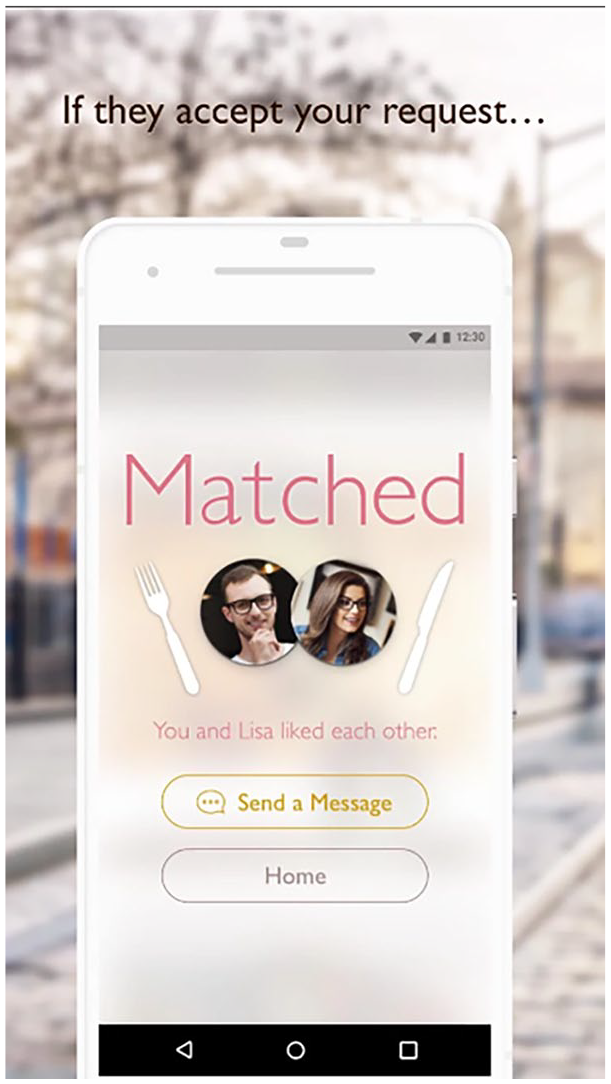
Dine app.
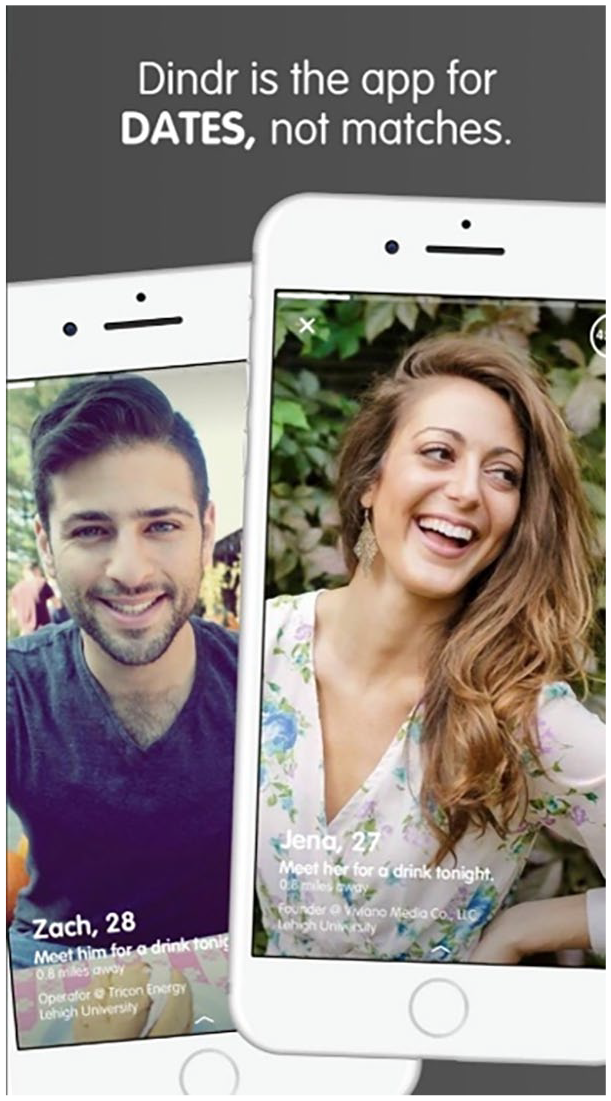
Dindr app.
Dindr, branded with the hashtag #LoveAtFirstBite, also began in 2016. This Boston-based start-up was initially interested in creating an app to facilitate meet-ups between ‘foodies’ but found that users used the service for romantic dating. Therefore, at the start of 2018, Dindr was reformatted as a dating app, focusing on romantic matchmaking and speed-dating involving location-based restaurant suggestions. At noon and 5 pm, Dindr reveals its top matches and sets up same-day meet-ups at its suggested restaurants.
Although Dine and Dindr invite both male and female daters to follow the same instructions by customising their profiles and romantic and culinary preferences, these two apps explicitly apply gender-based pricing policies and dating services. For example, once a match has been made based on the daters’ profiles and restaurant choices, Dine automatically sends a follow-up message aimed at scheduling a first date, offering both free and premium paid membership. Premium membership unlocks access to ‘the most popular members’ on the app and allows unlimited access to communication features that female daters have regardless of their membership type. Meanwhile, men on Dine must rely on a convoluted point system involving digital ‘roses’.
The data collection procedure
Data relevant to my research questions was systematically gathered for textual analysis. Commercial texts and articles published in online magazines were gathered, along with dater reviews, to consider a variety of voices. All the sources collected focus specifically on dining-themed dating apps, refer to a broad social construct of intimacy, and yield new insights, although they vary in terms of platform, format, length, and authorship. In addition, I consider discourses collected online to be no less authentic than those found ‘offline’, since both types are integrated into everyday interactions (Miller et al., 2016) and cultural consumption. I first conducted extensive archival research on Google using sets of keywords, including ‘dine dating app’, ‘dine app’, ‘dindr dating app’, and ‘dindr’, during which the search results for these terms ranged between 6790 and 8,250,000 entries. I concluded the collection procedure when the data reached the point of saturation and redundancy (Maxwell, 2013). In total, 35 online articles were selected (16 related to Dine and were coded from DE01 to DE16; 19 related to Dindr and were coded from DR01 to DR19) as they were relevant to the focus of the research and appeared repeatedly in multiple online media outlets with high visibility (e.g. Vogue, Vanity Fair, and Vice). Some were not only found on mainstream search portals but were also explicitly promoted on the dating apps’ official webpages or hyperlinked to App Store to encourage page views and increase the download rate.
Strategies for coding and data analysis
After the data was collected, I analysed the data using open and axial coding (Corbin and Strauss, 2015; Emerson et al., 2011). Through constant comparison and re-reading, I identified recurring patterns and themes in the data. I then identified the main themes and broader categories. This was followed by fine-grained, focused coding to define subcategories and variations within the broader themes (Emerson et al., 2011) that were relevant to the research questions outlined above. Coding and analysis were iterative processes (Okely, 1994), in which insights and an overview of the data were supplemented by readings of socio-historical, socio-economic, and feminist scholarship on intimacy, dining practices, and dating cultures. Through manual coding of the selected thematic codes and narratives, this iterative process led to creating and refining an analytical lens to explore the way in which intimacy is mobile-mediated through a particular technology and related cultural consumption.
Findings and discussion
Dining out for an optimised intimacy
Logics of same-day, ‘real’ dates
Diminishing the emotional investment or time and money poured into the search for romantic encounters is at the centre of discourses about mobile-mediated dating. The use of dining-dating apps is thus considered to be promising by an app review because these apps are expected to generate a follow-up, face-to-face date in a specific restaurant faster than other dating apps where ‘endless swiping is a problem’. ‘When work gets busy’, or if one is ‘burnt out from going to bars and clubs and spending ridiculous amounts of money’, one will usually ‘resort to dating apps in hopes of meeting new people’ (DE05). According to the app reviews posted by potential male and female users, one of the frustrating aspects of mobile-mediated dating is that an actual date usually demands multiple trials and a certain amount of time, as illustrated in the following quote: ‘liking hundreds of users just to go on a single date! Plus, it’s been shown that the average time it takes from first greeting to the first date is usually around two full weeks’ (DE09). In contrast, Dine, for example, is described by an online dating coach and the sponsored review articles as an effective matchmaking app because of its ‘simple three-step process’ (DE15) aiming for ‘going on dates instead of wasting time’ (DE06). Similarly, Dindr is also characterised as ‘an app that encourages people to get off their phones and meet in person that night’ (DR04).
Dining-dating apps should be read with other forms of interventions that consider the facilitation of intimacy a continuum, regardless of their specialised features stated by corporate marketing. The way in which to maximise the chance of couple formation is the predominant concern of the discourses that I studied; therefore, dining-dating apps serve as a complementary function to the consumerist intervention deemed to solve the problem of being single. A male online dater shares his experiences by mentioning several popular dating apps, ‘Bumble, Happn, and something else I forgot the name of (lol)’ (DE05), and concludes with a positive comment about Dine. Another online dating coach website also suggests using the Dine app ‘in conjunction with other dating apps for the best results’ (DE12). Therefore, dining-dating apps are expected to be used as a method of producing and experiencing intimacy and enabling individuals to overcome the everyday frustration and boredom caused by a series of unsatisfactory mobile matchmaking experiences. The cultural consumption related to online dating is thus recyclable and reproducible, for example, as indicated in the introductory sentence of a review of Dine: ‘I am one of those many people out there who uses dating apps. I usually download them, delete them, and download them again’ (DE05). Even though other mobile dating services seem to be dominating, individuals are encouraged by the lifestyle magazine Entity to ‘take a break from the endless swipes and the unsolicited – ahem – intimate photos’ only because they ‘just need to switch it up!’ (DR18)
Logics of outsourced, sped-up dates
Other elaborated ways of coping with mobile-mediated intimacy are also underscored in related discourses. That is, individuals are not only invited to manage their intimate life through cultural consumption but are also compelled to adopt a specific way of engaging with the transformative nature of mediation. Consumerism is intertwined with mediated intimacy, and individuals are encouraged to employ various forms of consumption, such as consumer goods or services, to ensure that each aspect of mediation is under control. Among various types of mediation, it is common that men’s self-presentation and their ability to initiate a romantic date are stressed, while women’s flexibility and trust in algorithm-based matchmaking are accentuated. For example, extra effort explicitly made to enhance the overall self-presentation of male daters on apps before dining is patently promoted by online dating coach services: Dine’s focus on restaurants and bars might make it easier to choose that all-important first date location, but you still have to put in the work to build up enough attraction for her to actually meet you there. If you’re looking for the easiest way to get dates, why not hire a virtual dating assistant? (DE12)
In other words, even though dining-dating apps are considered to help select dating spots and arrange a meeting time relevant to the ideal of intimacy, other online dating strategies still seem to be needed to create an appealing dating profile and composing engaging messages.
Regarding intimacy, individuals, especially women, are expected to be less burdened by outsourcing all these requested elaborations to, for example, algorithms that find dining spots and matches or dating coach tutoring that offers reliable self-presentation tactics in online dating. In contrast, individuals in the mobile-mediated dating culture are asked to identify their romantic preferences by filling out ‘simple’ quizzes and to respond to a request by clicking or swiping. For example, even the preference setting is based on a ‘checklist’ rather than open-ended questionnaires, and a further setting called ‘smart’ options exists, where daters on Dine are asked to either like or dislike 100 profile photos to improve the algorithm. Contrary to the basic ‘general’ preference setting, this ‘smart’ option is considered to be ‘tedious but worth the time’, backed by the promise that ‘teaching the app about your specific tastes pays off in higher quality matches’ (DE12). Through the preference setting of Dine, we can also note that when intimacy is mediated, the matchmaking process is still required to acknowledge one’s efforts involved in the fabrication of intimacy.
Preparing dinner dates as consumable intimacy
Concerns about the commodification and rationalisation of intimate relationships are present in the discourses that I studied. An ideal mobile-mediated dating experience in these discourses is considered to be ‘not a game’. As one of the testimonials of Dine complains about the mainstream dating app, ‘I find myself swiping right and seeing what I can catch like my phone is some kind of Poke Dex . . . but these aren’t Pokemon, these are human beings’ (DE05). Also, concerns about privacy and commodification of personal information arise. However, the commodified self also facilitates individuals’ entry into the matchmaking market. The contradictory explanations of the concern about one’s privacy reflect the increasing need to justify and legitimise the uncertainty occurring in online dating. For example, when talking about the ‘mixed feeling’ of Facebook logins integrated into Dine app, one blog review suggests: I hate the reality of how our information is exploited and traded on a daily basis, but it’s a quick way to just jump into the app, and it’s discrete. I had a profile up and running within two minutes. (DE05)
Similarly, another blog review suggests that the use of Facebook profiles on Dine ensures that ‘real people can meet real people’, asserting that ‘the app doesn’t do Facebook posts, and messaging cannot occur unless both parties have accepted requests’ (DE06).
Meeting at a restaurant for the first date is regarded not only as a romantic commitment but also as an individual’s self-investment. Also, this cultural practice demonstrates self-management in dating by outsourcing the decision making of dating spots. According to the blog reviews, magazine articles, and advertorials studied, restaurant suggestions that dating apps offer based on the integration of Yelp, local food blogs, and future restaurant sponsorships lessens the uncertainty about others’ tastes: ‘Dine will recommend you top places for a first date, so if you really can’t decide, just pick a few from that list. Their recommended list is pretty promising, so it’s probably your best bet’ (DE05). On one hand, dating spots as embodied intimacy are indications of one’s cultural capital; however, on the other hand, they conceal the potential class, social, gender inequality between two individuals. For example, every time we ask someone where they’d like to go, we typically get the same answer: ‘I don’t care; where do you want to go?’ We know you’re lying. You know you want to go to that eclectic, Indian joint that just opened but don’t want to seem like a hipster food snob. Then again, we feel the exact same way, but are too embarrassed to mention that we’d even contemplate going to that joint. (DE04)
At the same time, underlying the economic concerns in dating that ‘when matches never lead to an actual first date’, as Dine app CEO, Keisuke Kamijo, explains, they introduce ‘Dine Pass’ (restaurant coupon) to add some extra support (DE08). A similar idea can also be found in Dindr: ‘If you’re lucky, Dindr might even pay for your dinner!’ (DR18)
With the set-up of the matchmaking process, it is promoted by several blog reviews that daters can minimise the uncertainty by focusing on the match endorsed by limited culinary options that occur on the first date: ‘You don’t have to worry about messing up the date before it’s even begun. You can’t go wrong simply because it doesn’t let you’ (DE04). It is also promised that ‘no time is lost engaging in endless ponderings of the meaning of life via online chat’, and there are ‘no anxious hours or days waiting to see if someone will respond to your last message’ (DE15). According to the articles published on lifestyle magazines, relational interactions before a casual date are subject to be managed to achieve effective decision: ‘Dindr helps you pick a restaurant and meet someone who won’t leave you hanging, wondering why someone hasn’t responded to you’ (DR16). Couple formation that is sped up by a dinner date ‘focusing on the logistics of meeting up’ (DE01) as the embodiment of intimacy concretises the romantic sense of online dating. Therefore, in this accelerating process of setting up the first date, individuals are ‘not only accepting the person but the specific restaurant or bar’ (DE01). Given that individuals have little knowledge about others’ characters except for the dining choices in the matchmaking of Dine and Dindr, the goal-driven arrangement for a dinner date thus plays a dual role in translating romantic emotions and self-assertion. For example, several sponsored articles suggest that ‘Dine users tend to just consider their matches more seriously because of the strong direct aspect of meeting up for food or drinks’ (DE09). By ‘skipping the “funny business” and hitting restaurants, bars, and cafés with the people you like’ (DE06), through dining-dating apps, daters are expected to find ‘people who are actually prepared to go on a date’ (DE04).
The back-and-forth between one’s screen and a dining table
Communicative exchange on demand
Dining-dating apps urge a date to take place on the same day on which a match is made. They promote access to dates arranged around a dining table by limiting the preparatory time required before individuals meet. However, daters using these apps still keep asking to enforce communicative exchanges after getting matched, even though these exchanges sometimes do not result in couple formation. On one hand, these discourses tend to disregard or avoid mentioning the socio-economic background or any other physical characteristics of individuals as the presupposed criteria for a perfect match; on the other hand, ‘psychological’ compatibility remains uncertain. ‘Being consistently charming in a text conversation, especially with a complete stranger, is not necessarily a perfect indicator of whether you’ll be compatible. That’s why Dine tries to get you in the same room’ (DE01), suggested by an article published on Business Insider. Matchmaking based on one’s restaurant choices does not represent a perfect match but indeed provides a more productive matchmaking process. In the ‘take it or leave it’ speed-dating mode of Dindr that is held twice a day – involving a 6-minute round of chatting for each time – or in Dine where a match expires in 24 hours, daters take the risk of not going deeper for more information about the other but are reassured by the argument from various media outlets (Vanity Fair, online dating coach, and local news) that ‘because potentially every day you can go out for dinner with a different one’ (DR12), ‘even if things don’t work out with the person that you are matched with, at least you can enjoy a good meal’ (DE15) because food is ‘a soul mate that will never disappoint you’ (DR03).
To talk to potential matchers, individuals invest money not only in dining but also in the organisation of normalised emotions such as a better understanding of the other. ‘Small talk’ as an icebreaker before dining is thus considered to facilitate a successful match and satisfactory dining-dating experiences. Dine is free to download and use. However, to send messages, one of the daters in a match must have a paid membership. Access to communication as a scarce resource in the online dating culture is thus regulated, controlled, limited, and also related to the concerns of investment paid into the matchmaking process. ‘Upgraded’ dining dating not only promotes communicative exchange as a form of intimacy but also accentuates the popularity of being requested for dates as a competitive marker for individuals, especially male daters, by providing qualified members with the symbolic display of a ‘Gold Member’ emblem; it also translates the token earned from the upgraded service as a merit on a frequent basis. This ‘emotionalised’ money, called ‘roses’ on Dine, is expected to help generate more intimacy, for example, in the form of sending more requests, receiving more potential matches, and gaining access to matchers’ Facebook profiles prior to the first date. Upgrading also helps daters to conceal details that are considered to be private, such as educational and professional information, in online dating culture; it also obscures the actual money paid for the dinner by providing members with a ‘coupon’ for use at certain dining spots to compensate for hidden costs in dinner dates. Also, various special features can be unlocked by purchasing a membership, frequently logging in to the app or inviting friends to use the service. In other words, to optimise the matchmaking result, individuals are not only economically but also emotionally engaged in the cultural mediation of dining-dating apps.
Mediating emotions and gender relation on the calculated dining table
Dining-dating apps participate in the mediation of emotions and gender relations around the romanticised dining table. The appreciation of similar tastes and dinner dates are described by several blog articles as a tradition that makes up the ‘integrity in dating’ (DR10) and ‘has been done for generations’ (DR04). In a similar reminiscent tone, matches rendered by algorithms on Dine are marked as ‘handpicked’ choices. Intimacy is mobile-mediated through dining-dating apps; this form of intimacy calls for individuals’ renewed understanding of self and others when living with this type of mediation. While the urge to meet up, triggered by the frustration of endless talks or social pressure, for example, in the form of V-day daters, becomes explicit, it is through cultural consumption that this anxiety could be resolved. Tastes, in particular, choices of dating spots, thus become a measurable value explaining the compatibility of couples. As indicated, individuals can ‘at the very least’ know that they ‘have one thing in common before going on the first date’ (DE15). For example, ‘a convinced omnivore might have difficulty getting along with an uncompromising vegan. Also, those who like to experiment in the long run could become bored with “traditionalist” food’ (DR12). A dating spot agreed by both daters is thus considered to be an embodiment of romantic love avoiding ‘a badly started story’, caused by different culinary preferences that are ‘destined to end even worse’ (DR13).
Dinner dates arranged through mobile apps as a form of cultural consumption also contribute to the understanding of how gender relations in matchmaking intersect with consumerism. For example, the ‘who pays’ option on Dine shows that economic investment is addressed awkwardly in romantic relationships. In addition, when women are expected to be more economically independent than their previous generations while chivalry is still deemed as common in the dining-dating culture where men are asked to spend more money and incentive such as ‘roses’ on Dine for a match, this option also provides a way in which to look into gender relations in mobile-mediated intimacy: Who pays? This is one of the biggest struggles we’ve ever dealt with. When you go out on a date, do you adhere to the traditional practice of letting the man handle the bill? Wouldn’t it be lovely if you could just skip this super awkward portion of the date? Now you can, when you use Dine. (DE04)
When a ‘my treat’ feature comes into play and is highlighted in one’s dining-dating app profile that is supposed to diminish ‘post-meal payment confusion’ (DE11), what underlies the articles published on women’s lifestyle magazine Spoiled and Refinery29 is not only the uncertainty occurring in the quest of intimate relations but the ambiguity between individualist aspiration and gendered way of experiencing intimacy.
Conclusion
This article examines the discourses of dining-dating apps and the ways in which they facilitate intimacy for individuals seeking a romantic relationship. Dining-dating apps provide a particularly interesting context for studying intimacy, gender, and cultural consumption because they provide a matchmaking service, while also suggesting dating locations. Through an analysis of relevant discourses, the article explores gender norms, individualist aspirations, and the ideal of romantic relationships embedded in cultural consumption and mediation associated with the phenomenon of dining-dating apps.
I posed three questions. First, how do dining-dating apps represent intimacy? Second, how do these apps approach ‘being single’? Third, what contradictions between romance and consumerism in dating are managed by an app that trades in an intimate commodity? These research questions explore the role of mobile-mediated dating and dining in relation to the social anomaly of being single and dining alone. Addressing these questions demonstrates that both intimacy and cultural consumption, such as the culinary practices associated with intimate life, are mediated in mobile dating culture; this mix then fabricates a sense of intimacy during the process of matchmaking.
First, the analysis reveals that dining-dating apps represent intimacy by suggesting potential dating locations. This representation is intricately linked to prevailing gender norms, individualist aspirations, and the idealisation of romantic relationships within the realms of cultural consumption and mediation. Concerns about the commodification and rationalisation of intimate relationships and about personal information and privacy are apparent in the discourses I studied, even though commodifying the self also facilitates individuals’ entry into the matchmaking market. This contradiction reflects the increasing need to justify and legitimise the uncertainty associated with online dating. Meeting at a restaurant for a first date is regarded not only as a romantic commitment, but also as an individual’s self-investment. In addition, this cultural practice demonstrates self-management in dating through the outsourcing of decisions regarding dating locations. Mobile-mediated intimacy related to dining-dating apps thus calls for individuals’ renewed understanding of themselves and others within this type of mediation. On one hand, these locations, as embodiments of intimacy, are indications of one’s cultural capital. On the other hand, however, they conceal potential class, social, and gender inequality between two individuals. Given that individuals using Dine and Dindr have little knowledge about each other, except with regard to dining choices, the goal-driven arrangement of a dinner date plays a dual role in translating romantic emotions and self-assertion into dating practices.
Second, dining-dating apps navigate the concept of ‘being single’ by mediating the social anomaly associated with solitary dining. Reducing the emotional investment and the time and money poured into the search for romantic encounters is at the centre of discourses about mobile-mediated dating. Dining-dating apps, in combination with other forms of consumerist interventions, are thought to maximise the chance of couple formation. Individuals are not only invited to manage their intimate lives through cultural consumption, but are also compelled to adopt a specific way of engaging with the transformative nature of mediation by making dinner dates explicit in mobile-mediated dating. In this regard, consumerism is intertwined with mediated intimacy and individualism, and individuals are perceived as less burdened since they outsource all these requested elaborations to types of mediation, such as restaurant review websites and dating apps. Furthermore, through dining-dating apps, the cultural processes through which intimacy is outsourced become both more centralised and more divided regarding the offering of consumer goods.
Third, the findings indicate that dining-dating apps address contradictions between romance and consumerism by outsourcing decisions regarding dating locations. This process primarily involves the commodification of self for entering the matchmaking market, reflecting individuals’ need to rationalise and legitimise uncertainties associated with mobile-mediated dating. Dining-dating apps encourage dating on the day a match is made. They promote instant access to dinner dates, which limits the preparation time while enhancing related elaborations before individuals meet. However, daters using these apps persist in seeking communicative exchanges after being matched, even though these exchanges cost money and do not always result in couple formation. Access to communication is regulated and limited. It is a scarce resource in online dating culture and is related to concerns regarding personal and relational investments made in the matchmaking process. Dining-dating apps participate in the mediation of emotions and gender relations. Therefore, dinner dates, as a form of embodied intimacy mediated by dating apps, are considered predictable, manageable, and, most importantly, compatible with the ideal of romantic love. The choice of dating locations thus becomes a measurable value that defines the compatibility of couples. It is perceived to reduce uncertainty in the quest for intimate relations and lessen ambiguity between individualist aspiration and gendered ways of experiencing heteronormative, middle-class intimacy.
This article concurs with the concept of mediated intimacy (Attwood et al., 2017; Barker et al., 2018), in which media representations and technologies serve as critical points to understand the contemporary ideal of intimate life, and this mediation is enabled through concepts such as individualisation and disclosure. Furthermore, through the discourses of dining-dating apps that highlight efficiency in matchmaking and that conceal possible gender, race, and class contradictions, this article suggests that both the daily intimate interactions and the sense of romantic emotions and gender relations embedded within cultural consumption are deeply involved in the mediation. In addition, potential daters, both men and women, are encouraged to envision their heterosexual romantic relationship by adopting the gender-differentiated romantic interactions that dating apps mediate. Thus, mediated intimacy should be considered in relation to gendered and emotionalised consumer culture.
Initiating sociological work on intimacy mediated by mobile apps and culinary and other cultural consumption is an important step towards understanding the transformations in private and public life. This study contributes to studies of sociology, gender, and media. Simultaneously, by exploring how intimacy is enacted through intimate commodities and experiences mediated by dining-dating apps, this study reconsiders the role of cultural mediation, which has long been intertwined with modern intimacy yet warrants further examinations. Together, these findings open avenues for additional work at the intersection of intimacy, gender, and cultural consumption.
Footnotes
Funding
The authors disclosed receipt of the following financial support for the research, authorship, and/or publication of this article: This work was supported by the Higher Education Sprout Project of the National Yang Ming Chiao Tung University and Ministry of Education (MOE), Taiwan.
