




Abstract
Immigrants are a popular target of conspiracy theories. Despite the urgent relevance of the topic all around the world today, the number of studies on conspiracy theories about migrants and immigration is limited. Helping to fill this important gap in the academic literature, the research analyses conspiracy theory beliefs about migrants and immigration in contemporary Serbia through survey data from a nationally representative sample (N = 1199). Expanding on the Weberian theory of rationality, the study proposes that people’s values about national sovereignty, social conservatism, and religiosity influence their predispositions to believe in conspiracy theories about migrants and immigration. The findings corroborate the argument by showing a statistically significant link between people’s political, social, and religious values and responses to conspiracy theories. The article concludes that values could play a significant role in people’s adoption of conspiracy theories.
Introduction
We are witnessing The Age of Migration (Castles et al., 2003), as the last decades have been characterised by stormy and turbulent migrations worldwide. The integration and humane treatment of migrants are obstructed by numerous barriers, such as the prejudice and resentment they face in host countries. The hostility towards migrants is often triggered and spread by conspiracy theories. Indeed, 58% of Britons and 55% of Americans believe in the conspiratorial accusation that their governments hide the real cost of immigration to the countries, and 51% of Britons think that the government in the United Kingdom deliberately attempted to create a more ethnically diverse society via its immigration policy over the past 20 years (Gaston and Uscinski, 2018). Jolley et al. (2020) demonstrate that exposure to conspiracy theories about immigrants from the European Union (EU) to Great Britain increased the level of prejudice towards the immigrants among the British sample. In parallel, Kim and Park (2023) demonstrate that perceiving strong threats from China during the COVID-19 pandemic led to higher support of restrictive immigration control with a mediating effect of conspiracy theory beliefs. Although immigrants are a common target of conspiracy theories worldwide, the academic literature on this topic is limited. This may be because academic interest in conspiracy theories has only recently grown, particularly in the 2010s. The core issues in the academic research on migration are predominantly on intensity, transition direction, characteristics of the migrant population, regularity of transition, and pull or push factors (Bobić and Babović, 2013; Lutovac, 2016). This research contributes to filling the scholarly gap in the fields of migration and conspiracy theories by conducting the first empirical analysis of the conspiracy theory beliefs about migrants and immigration in contemporary Serbia.
The focus on Serbia not only expands the geographical scope of the scholarship beyond the Western world but also presents an ideal context to study conspiracy theories about migration. After the disintegration of former Yugoslavia, the country became home to many internally displaced migrants, mostly of the Orthodox religion and Serbian nationality, from Croatia, Bosnia and Herzegovina, Kosovo, and Metohija. Subsequently, Serbia saw the arrival of migrants from the Middle East and North Africa. The highest percentages of these migrants were Afghans, Iraqis, Kosovars, Pakistanis, and Syrians (Bobić and Babović, 2013). For them, Serbia is often not the intended final destination, rather a transit route, which starts from Greece, through North Macedonia and Serbia, ending in the European Union countries (Bukowski, 2019). Unsurprisingly, migration is currently one of the most important social and political challenges in Serbia, polarising the general public opinion. In the environment of rapid social change and existential uncertainty, conspiracy theories prevail in Serbia. This is in line with the argument that endorsing conspiracy theories can reduce people’s feelings of uncertainty (Marchlewska et al., 2018), helping individuals to navigate in the changing and confusing social surroundings (Van Prooijen and Jostmann, 2013).
Serbians’ reactions to Muslim migrants could be influenced by the historical background of the Ottoman period. Serbian national identity is firmly attached to religion, which is evidenced by past symbols about the struggle with Muslims, such as the Battle of Kosovo (Pešić, 2018). The heart of Serbian mediaeval cultural, spiritual, political, and economic heritage was situated in Raška in Kosovo, experiencing its greatest rise before Ottoman rule, which began after the Battle of Kosovo in 1389. Following the war, Serbia became a vassal state of the Ottoman Empire, which could be described as a satellite state in modern parlance. The Serbian Despotate, led by semi-independent rulers known as despots, was allowed to govern internal affairs under Ottoman suzerainty. The Serbian population lived as vassals in the Ottoman millet system, a form of religiously based pluralism in the Ottoman Empire that allowed for a degree of autonomy and self-governance among Jewish and Christian communities. Each of these religious communities was known as a ‘millet’. While they were granted the right to manage their own internal affairs, including matters of personal status, religious practice, and education, they were forced to pay extra taxes and their members could serve as state officers of the empire (Nefes, 2022). The devshirme policy also exemplified the vassal status of the Serbian population. This practice involved forcibly recruiting and training young Christian boys, aged 8 to 18, from subject populations for administrative and military roles. These boys were separated from their families, brought to Istanbul, converted to Islam, and educated and trained for their assigned roles. Serbia remained part of the Ottoman Empire from the 15th to the 20th centuries. The Battle of Kosovo, commemorated on Vidovdan, still holds deep national and religious significance within Serbian identity in Serbia.
This historical background is likely to influence Serbian attitudes towards migrants from the Middle East and North Africa, the majority of whom are Muslims, and could be a mobilising force of pro-violent actions against migrants. Indeed, right-wing groups in Serbia often target migrants’ ethnic and religious origins and portray them as a threat to national and religious identity. This study investigates these factors among others that could influence people’s conspiratorial beliefs about migrants and immigration in Serbia through survey data on a nationally representative sample (N = 1199). It is guided by Max Weber’s theory of rationalisation, which highlights that value-laden rational predispositions could influence people’s opinions. Accordingly, the research expects that people who hold values that are attached to national sovereignty, conservatism, and religiosity would be more likely to believe in conspiracy theories about migrants and immigration. Using Weberian theory presents a novel sociological approach to understanding people’s tendencies to believe in conspiracy theories. In the next section, the article explains how the Weberian theory can help to explain the factors that are associated with believing in conspiracy theories. Second, it presents the methods and empirical findings. Finally, a brief conclusion section discusses the significance of the findings.
Understanding conspiracy theories through the Weberian perspective on rationality
Conspiracy theories are explanations of ‘events in terms of the significant causal agency of a relatively small group of persons-the conspirators-acting in secret’ (Keeley, 1999: 116). They generate enormous socio-political impacts concerning intergroup relations all around the world. For example, the backbone of the Nazi ideology is based on anti-Semitic conspiracy theories (Cohn, 1967). This study uses Max Weber’s theory of rationality to examine the relationship between people’s values and beliefs in conspiracy theories about migration and migrants in Serbia. The Weberian theory helps to delineate value-related reasons for believing in conspiracy theories. It contributes to the scholarship on conspiracy theories, which shows two tendencies concerning rationales for believing in conspiracy theories. On the one hand, one line of research emphasises value-laden characteristics of conspiracy theories and suggests that they are irrational accounts biased by certain value systems. This approach often portrays beliefs in conspiracy theories as a pathology of marginal groups and associates them with extremist values (Bronner, 2003; Cohn, 1967; Goertzel, 1994; Hofstadter, 1965; Pipes, 1997; Robins and Post, 1997). On the other hand, other studies view conspiracy theories as rational attempts to understand reality and as alternative explanations (Birchall, 2006; Bratich, 2008; Brotherton, 2015; Gray, 2010; Nefes, 2013, 2014). For example, Knight (2000) views conspiracy theories as do-it-yourself sociology. This research affords a comprehensive theoretical approach that delineates the significance of value-rational thinking in conspiracy theory beliefs and, in so doing, reaches beyond the theoretical division between focusing either on value-laden or instrumental rational characteristics. In other words, by showing how values could influence rational thinking about conspiracy theories, this research brings together the scholarly tendencies of seeing conspiracy theories either as value-laden irrational accounts or instrumentally rational explanations.
To begin with, Max Weber distinguishes between four types of rationality: formal, theoretical, practical, and substantive (Kalberg, 1980). Formal rationality refers to means-to-an-end calculations by universally applicable rules, which comprise a general rule for any individual situation, such as legal systems and modern bureaucracies. Weber (1978 [1922]) describes legal systems as formally rational to the degree that they present uniformity and methodical law-making. Theoretical rationality, also called intellectual rationality, is people’s attempts to give meaning to reality via abstract cognitive processes, such as the intellectual construction of ethics. Practical rationality means people’s uses of instrumental reasoning to respond to quotidian issues: ‘the type of attitude which sees and judges the world consciously in terms of the worldly interests of the individual ego’ (Weber, 2001 [1905]: 38). While practical rationality is guided by individuals’ everyday interests, substantive or value rationality is people’s interpretation of reality in line with value postulates, such as cultural norms. It emphasises how people’s behaviours and perceptions are shaped by social norms and values. Expanding on the Weberian theory, Boudon (2003, 2008) notes that social action needs to be value-rationally meaningful to the actor, not contradicting the values that she holds. This theoretical approach is parallel to the psychological concept, cognitive dissonance: a process that explains the ways of overcoming the cognitive conflict that can be produced by two or more incompatible beliefs (Festinger, 1962). According to the cognitive dissonance theory, when people hold two ideas or values that are contradictory to each other, this will create stress, and they will alter their ideas or values until they become consistent to relieve this stress. One of the strategies for overcoming the cognitive dissonance might be incorporating the attitudes about political issues, such as the attitude towards the European Union integration, into the religious and conservative values.
While the Weberian theory of rationality and cognitive dissonance theory both offer pertinent insights to this study, they differ in terms of their scope and focal points. On the one hand, cognitive dissonance theory primarily addresses the discomfort that arises from incongruities within an individual’s beliefs or behaviours. On the other hand, the Weberian theory of rationality places emphasis on the significance of various forms of rationality in shaping social action and organisational dynamics. By expanding on the Weberian theory, this study seeks to classify and quantify the specific values and practical considerations associated with the conspiracy theory beliefs about migrants and migration in Serbia. This approach enables an examination of how seemingly disparate or unrelated values and pragmatic motivations might combine to fortify the tendency to believe in conspiracy theories, without necessarily inducing the distress predicted by cognitive dissonance theory. By doing so, the Weberian theory can also be applicable to contexts beyond Serbia and help to examine the interplay between values, norms, and practical rationality in people’s tendencies to believe in conspiracy theories.
Indeed, Weber talks about the macro-level significance of substantive rationality and underlines how people’s values could contrast the formal rationality of legal and economic systems. For example, he argues that value-rationality could undermine formal economic rationality in political systems that based on citizens’ voting: plebiscitary regimes can easily act so as to weaken the formal rationality of economic activity so far as their interests in legitimacy, being dependent on the faith and devotion of the masses, forces them to impose substantive ideas of justice in the economic sphere. (Weber, 1978 [1922]: 269)
In other words, people’s values could contradict the formal rationality of the economy. When people have the power, they could opt for a formally irrational economic system that is in line with their values: pious Muslims could elect a conservative government that might ban banks from distributing interest rates to their customers and lead all citizens to lose some of their savings to inflation. In parallel, Weber (1978 [1922]: 270) contrasts formal and substantive rationalities of legal systems: In Rome, the jurors who tried a case were bound by the instructions of the praetor, and decisions followed the formal law. But, in the Greek heliaia-court, decisions were made in terms of ‘substantive’ justice-in effect, on the basis of sentimentality. Hattery, demagogic invectives and jokes.
From this perspective, one could infer that there could be contradictions between the substantive rationalities of local populations and formally rational legal and economic policies of states concerning migrants and immigration.
This article builds on the Weberian perspective to analyse the relationship between people’s social, political, and religious values and their beliefs in conspiracy theories about migrants and immigration in Serbia. It posits that people could be more prone to believe in conspiracy theories if they are congruent with the values they hold. In other words, the study argues that value-laden rational predispositions could predict people’s tendencies to believe in conspiracy theories. For instance, an ardent follower of a Manichean worldview, which separates between evil and good, could be more readily convinced by conspiracy theories that accuse certain groups of evil. The scholarship on conspiracy theories already presents evidence on the role of value rational thinking in conspiracy theory beliefs: Czech (2022) illustrates that holding religious values, such as Polish Catholic nationalism and religious fundamentalism, is positively correlated with the conspiracy theory belief in Poland; Nyhan and Zeitzoff (2018) demonstrate that belief in conspiracy theories is strongly associated with holding anti-Western and anti-Jewish values in the Middle East and North Africa; Mancosu et al. (2017) show that belief in conspiracy theories is positively associated with higher levels of religiosity in Italy. Studies also demonstrate a significant relationship between holding other values, such as anti-black attitudes (Pasek et al., 2015), and the tendency to believe in conspiracy theories.
In the Serbian context, we argue that three types of values could affect conspiracy theory beliefs about migrants and migration of majority Muslim populations. First, holding religious values might make the Serbian population more prone to conspiracy theories, as they might be more likely to view the Muslim faith of the migrants as a foreign belief system threatening Serbian values. Second, and in parallel, people who have socially conservative values would be likely to believe in the conspiracy theories about migrants and immigration, because they might be more likely to view migrants and immigration as a potential foreign danger to the Serbian social system. Third, we expect that people who have anti-EU sentiments would be likely to believe in conspiracy theories, as they would be more likely to be suspicious about any foreign presence and effects on Serbian society like social conservatives. In short, the core hypotheses of this study are as follows:
H1. The tendency to believe in conspiracy theories about migrants and immigration will be higher if the respondent is more religious.
H2. The tendency to believe in conspiracy theories about migrants and immigration will be higher if the respondent is more socially conservative.
H3. The tendency to believe in conspiracy theories about migrants and immigration will be higher if the respondent holds negative attitudes towards the EU.
Method
Sample
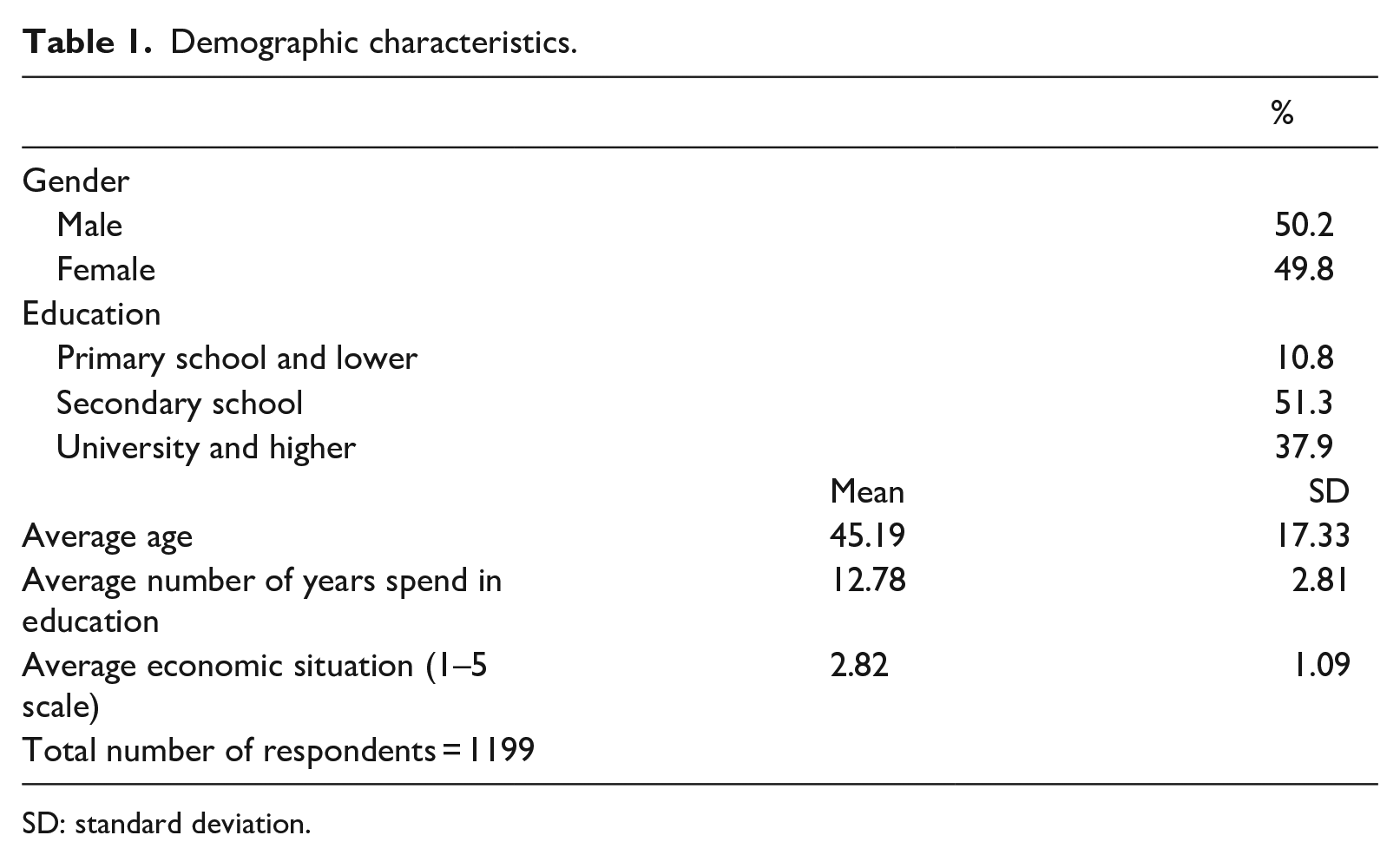
A total of 1199 adult (aged 18+) citizens of Serbia were recruited for face-to-face interviewing in a stratified three-stage probability sampling procedure in July 2022. The research was supported by the Serbian Ministry of Education, Science and Technological Development, granted to the Institute for Political Studies, Belgrade. The sampling frame was based on the data from the latest 2011 Census. Sampling was done in three stages. The first stage of sampling was done by polling station territory. The second stage included households selected by random route technique starting from the randomly selected addresses (seven households by sampling points). The third stage included respondents randomly selected within households. The average length of the interview was approximately 20 minutes. Research procedures adhered to APA (American Psychological Association) ethical guidelines. The research was first approved by the Ethical Board of the Institute of Political Studies. The sample’s demographic characteristics are presented in Table 1.
Demographic characteristics.
SD: standard deviation.
It should be noted that while public opinion surveys often present rich information for studying beliefs in conspiracy theories, they also have limitations. For example, they could record beliefs in conspiracy theories that the respondents had not thought about before the survey (Douglas et al., 2019). This research attempted to avoid this potential problem by using more than one item of conspiracy theories. Moreover, the items enquired about respondents’ level of agreement with each conspiracy theory about migrants and immigration. This could be considered as a less biased and more detailed strategy compared to providing conspiracy theory items as one of the multiple options and asking whether the respondent believes in it.
Measures
Conspiracy theory beliefs about migrants and immigration were measured by the 11 items. Some of the questions are taken from the scale created by Gaston and Uscinski (2018):
The Government is hiding the true cost of immigration to taxpayers and society;
In the last 20 years, the Government has deliberately tried to make Serbian society more ethnically diverse via its immigration policy;
In the last 20 years, the Government has deliberately tried to make Serbian society more religiously diverse via its immigration policy.
We added the following eight items:
Migration has been a threat to our economic stability;
Migration is a hidden process of Islamisation of Europe;
Majority of immigrants are/belong to Islamic fundamentalists;
Immigration processes is a form of genocide towards the white population;
Immigration processes is a form of genocide towards the Christian religion;
Powerful people are creating an immigrant crisis to profit from it;
Immigrants represent a threat to national security;
Immigrants represent a threat to the safety of our women population
All items were assessed by the Likert-type 5-point scale (1 = completely disagree to 5 = completely agree; Cronbach’s alpha = 0.899).
Religiosity was assessed by five items estimated on the Likert-type scale from 1 (it doesn’t apply to me) to 5 (it applies to me completely) (Figueredo et al., 2007). The items are as follows: I am a very religious person; I consider myself a spiritual person; Religion was very important in our family during my growing up; What I like most is being in the company of people who share my religious beliefs; I often attend religious services; Cronbach’s alpha = 0.843.
Social conservatism is measured by the widely used scale, consisting of several issues (such as Abortion; Army & National Security; Religion; Traditional marriage; Traditional values; Family; Patriotism). Respondents have to evaluate as positive or negative (Everett, 2013) on a scale from 1 (complete non-acceptance) to 5 (complete acceptance). Cronbach’s alpha = 0.779.
Support for the EU is measured by one item on a 5-point Likert-type scale estimating the attitude towards the EU (1 means very negative, 5 means very positive).
Besides, socio-demographic indicators were assessed by standard questions about gender, age, education, financial status, and urban/rural settlement. Financial status is measured on a scale from 1 to 5, with 1 representing ‘I do not have enough for food’ and 5 representing ‘Money is not a problem’.
Findings
Missing value analysis
When looking at the missing values in our data set (Religion, Conspiracy Theory Beliefs about Immigrants, Social Conservatism, Support for EU), we see that almost all variables have more than 5% missing values. Our dependent variable had the most missing values, with a total of 25% and no more than 12% per item. Around 48% of the data set had no missing values. Participants with missing values on conspiracy theory beliefs regarding migrants and migration scored higher on conservatism (M = 29.2, SD = 4.6 vs Missing = 30.6, SDissing = 4.6). We can also see similar patterns for the predictor support for the EU (M = 2.5, SD = 1.3 vs Missing = 2.3, SDissing = 1.2). We compared results of multiple imputation techniques to a data set containing only non-missing values. Multiple imputation, with five imputed data sets with matching predictive means, showed best results and thus was used for further analysis (see Table 1 in Supplementary Material).
Content of the conspiracy theory beliefs
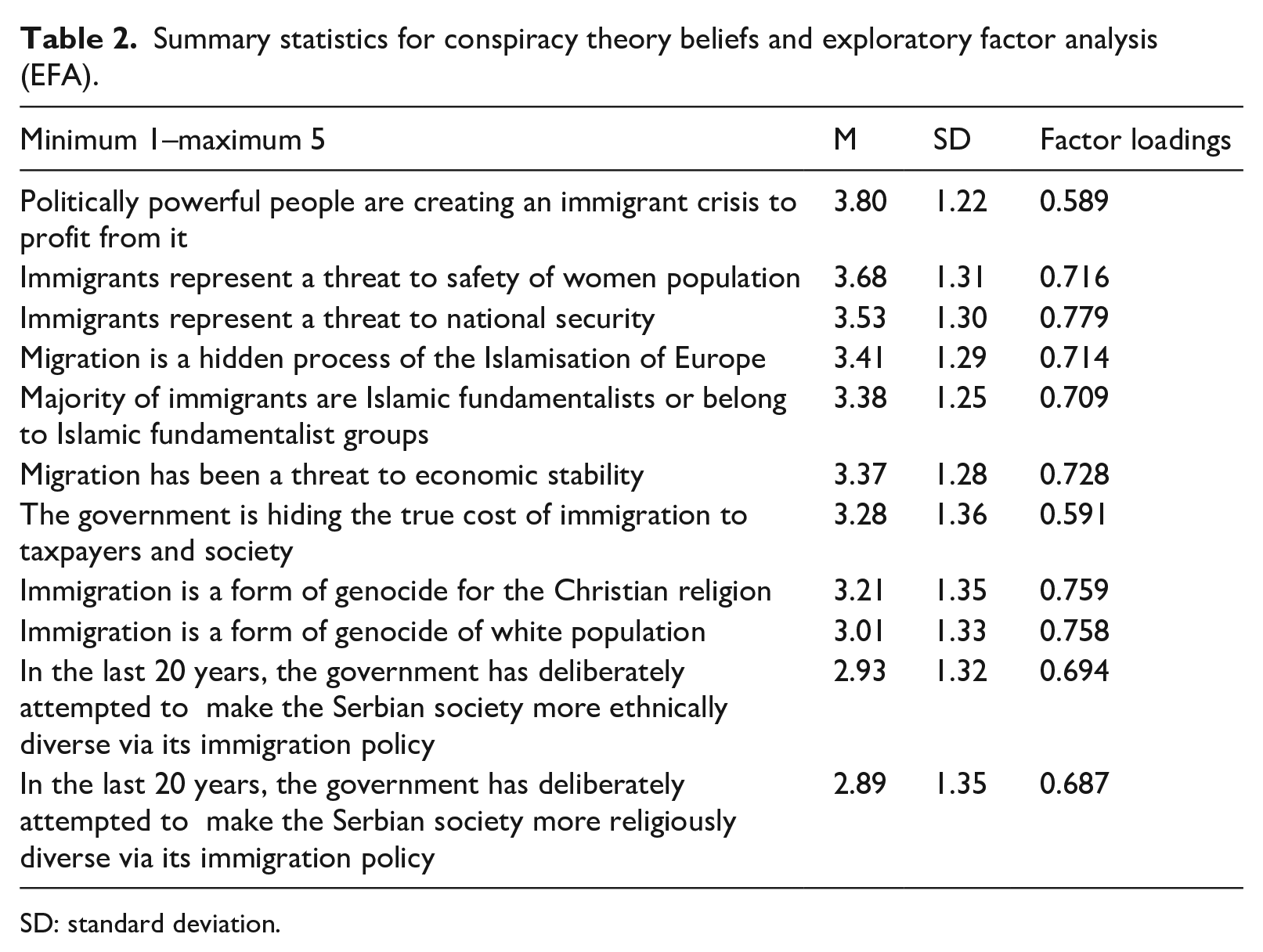
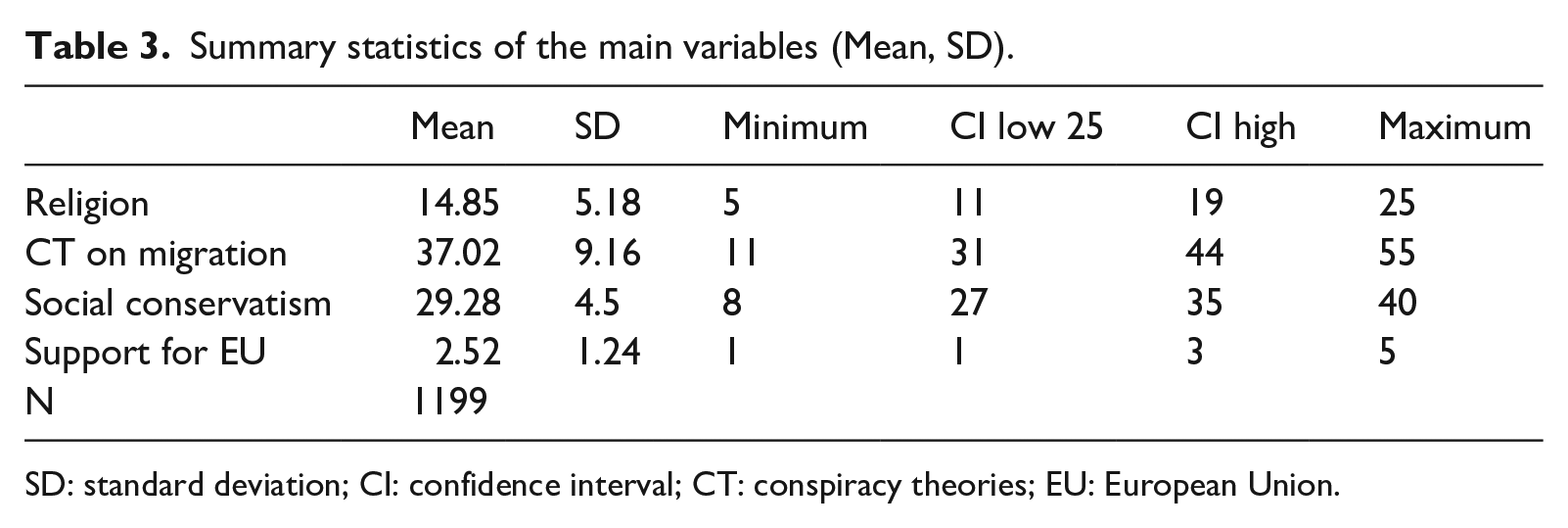
When collapsing the 11 scale items of different conspiracy theory beliefs towards migrants and immigration into one dimension scale, Cronbach’s alpha emerged at a level of 0.897. Two factors emerged in exploratory factor analysis (EFA): the first strongest factor in the EFA accounting for 49.668% of the variances. Conspiracy theory belief is not driven especially by any specific content, it rather represents one factor. It generated a shared structure of religious, political, contextual, economic, and emotional misinformation about migrants and immigration. As shown in Table 2, the most endorsed conspiracy about migration is that the migration crisis has been deliberately created, by politically powerful people, and that migrants represent a threat to local people. Results revealed high endorsement of all measured conspiracy theories as one summary score (M = 37.02; SD = 9.1; t(1198) = 114.898, p < 0.001). The adult population in Serbia while explaining the migration process adopt conspiracy explanations to a significant extent, statistically looking against the theoretical scale midpoint of 3. Figure 1 represents the density plots for both predictor and criterion model variables. Table 3 presents the descriptive statistics for the summary variables measured in the study.
Summary statistics for conspiracy theory beliefs and exploratory factor analysis (EFA).
SD: standard deviation.
Summary statistics of the main variables (Mean, SD).
SD: standard deviation; CI: confidence interval; CT: conspiracy theories; EU: European Union.
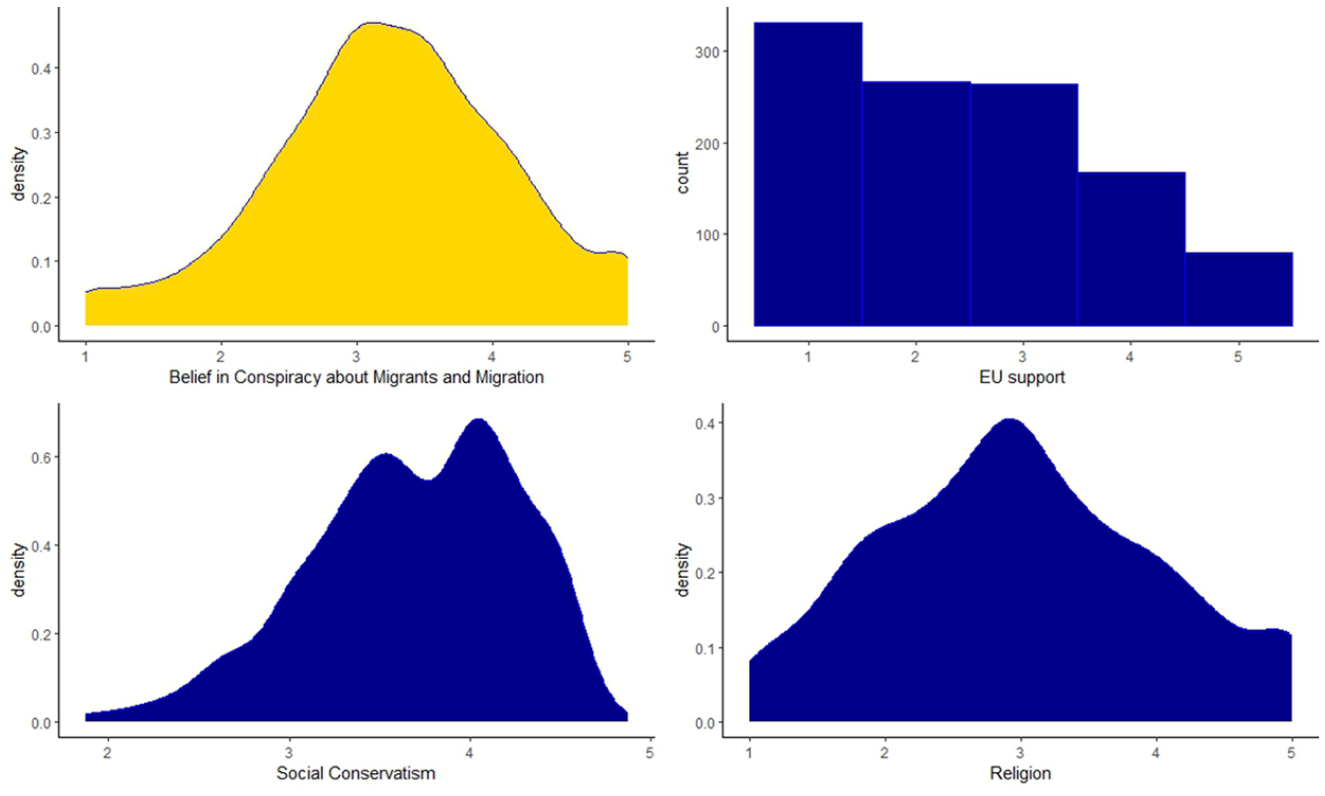
Descriptive statistics.
Variables enhancing/corresponding to conspiracy theory beliefs about migrants
Socio-demographic variables were added as control measures to the statistical model. Figure 2 presents the regression coefficients for the predictors Conservation, Religion, and Support for EU. It is evident that all three variables are good predictors of belief in conspiracy theories regarding migrants – being religious and conservative makes it more likely that the person has a stronger belief in conspiracy theories regarding migrants, while supporting the EU makes it less likely that an individual believes in conspiracy theories regarding migrants and migration.
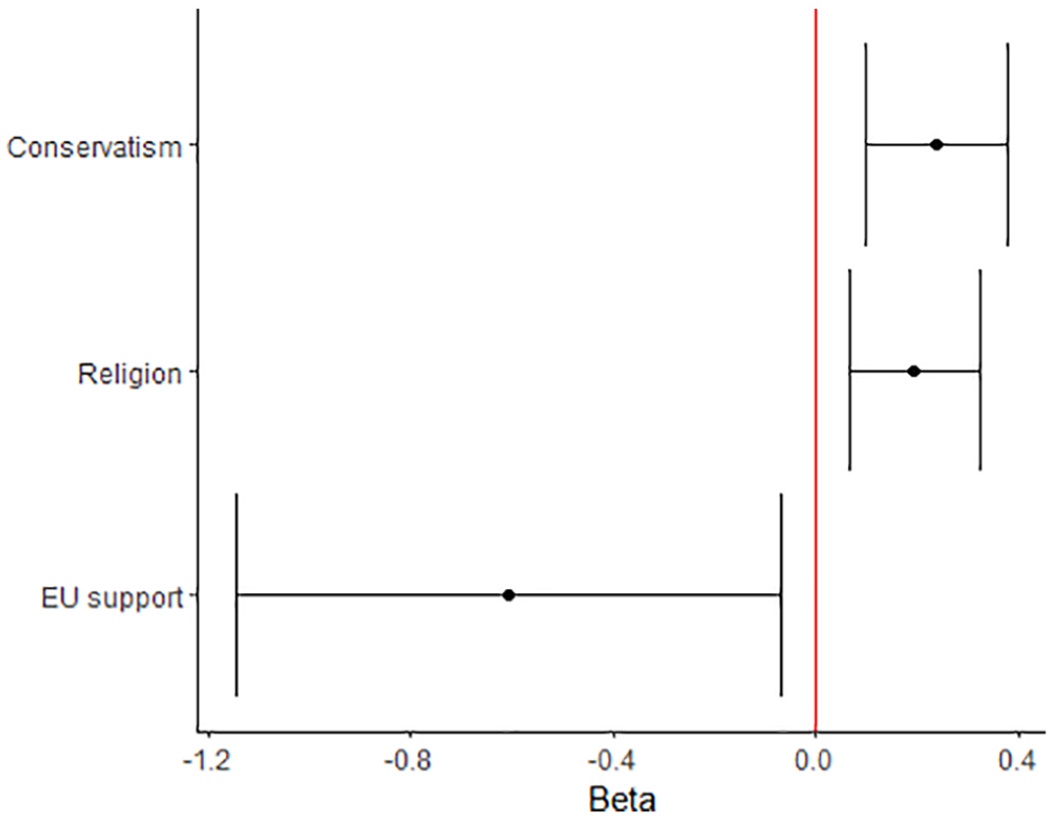
Predictors of conspiracy theory beliefs about migrants.
Three main variables are significant predictors of conspiracy theory beliefs about migration and migrants. Being socially conservative and religious is linked to a higher likelihood of believing in conspiracy about migrants and migration. In addition, supporting the EU predicted a lower likelihood to believe such conspiracies. Our model controlled for the demographic variables (gender, age, education, socioeconomic status). A more detailed analysis of the effects of demographic variables can be seen in the Supplementary Material (see Table 2). The regression model was significant, F = 18.354, p < 0.001, R2 = 0.044 (exact coefficients can be found in Supplementary Material Table 3). All three variables in the model significantly predict the criterion variable.
Discussion and conclusion
This research reports three major findings. First, religiosity is an important predictor of beliefs in conspiracy theories about migrants and immigration in Serbia. People were more likely to believe in conspiracy accounts if they described themselves to be more religious. Second, social conservatism is another statistically significant predictor of beliefs in conspiracy theories in Serbia. Respondents, who reported themselves to hold conservative values, tended to believe in these accounts. Third, people, whose value systems contained anti-EU sentiments, were more likely to be convinced by conspiracy theories about migrants and immigration in Serbia. Overall, these seem to show that when respondents felt higher levels of attachment to and held defensive values about the Serbian nation and its religion, they were predisposed to believe in the conspiracy theories that presented migrants and immigration as a conspiratorial threat. It could be argued that once conspiracy theories comprise perceived threats to the values they hold, people are likely to believe in these conspiracy accounts.
The article concludes that social, political, and religious values could play a significant role in people’s views on conspiracy theories. This has two interrelated implications for the scholarship. First, people’s values could significantly influence the rational processes by which they interpret conspiracy theories. Hence, value rationality along with instrumental interests of practical rationality (Weber, 2001 [1905]) should be accounted for when analysing the beliefs in conspiracy accounts. In so doing, the research could bring together the insights of studies that tend to delineate conspiracy theories either as false explanations biased by values or instrumentally rational accounts. Second, and accordingly, the Weberian theory of rationalisation provides an apt theoretical perspective to investigate values and instrumental reasons that incline people towards conspiracy theories. Indeed, various studies show evidence concerning the combined impacts of practical and value rationality in conspiracy theory beliefs. For example, while demonstrating the importance of religious values in conspiracy theory beliefs in Poland, Czech (2022) notes that not all types of religious beliefs are correlated with conspiracy theory beliefs, but the ones that are strongly linked to a specific ideological stance. It implies that a mixture of practical rationality of partisanship along with value-rational thinking based on religious beliefs and ideological orientation can incline people towards believing in conspiracy theories. Other studies also illustrate the confluence of partisanship and religiosity effecting conspiracy theory beliefs in different contexts (Çalışkan, 2022; Gürpınar, 2019; Mancosu et al., 2017; Nefes, 2015; Nefes and Aksoy, 2023). This might not be surprising, because both partisanship and religious identification are durable attachments that are both formed early in adulthood and shape people’s values, self-conceptions, and opinions (Campbell et al., 1960).
While analysing the Balkan context, it is clear that the wire fence, police violence, and hostility cannot stop the mass movements of people in their search for better life and happiness. Physical barriers will not reduce the migration of poor and vulnerable people with no future in their home countries. According to the latest data from the Commissariat for Refugees and Migration Republic of Serbia (n.d.), the intensity of crossing the Balkan route is not decreasing, and the number of refugees in Serbia is increasing also as a result of the readmission process. Along with this process, journalists observed that the tolerance towards migrants is decreasing, especially in the settlements with refugee camps. Fortunately, the majority of the population does not undertake aggressive acts towards the refugees; the problems are created by a radical extremist minority that does not hold back from hostile behaviour towards refugees, using fake news and fabricated events to upset and mobilise the general public and justify their actions. Despite the obvious political, social, and economic importance of the issues of migration and migratory routes for Serbia, empirical research is scarce, especially those dealing with myths and misconceptions around migrations as motivating forces for attitudes and behaviour. Besides official government sources, empirical studies are funded mostly by international foundations, with a main applied goal to define the strategies for improving the mental health of refugees, or helping professionals in working with refugees (Stojadinović et al., 2020; Vukćević Marković et al., 2020; Živanović and Vukčević Marković, 2020). Academic research in Serbia with systematic investigation of this topic does not exist. Therefore, our study makes a socially significant contribution not only for the academic community but also the general public and policy makers. Our research shows greater prevalence of conspiracy theory beliefs around migrations than the theoretical mid-value in Serbia. Accordingly, significant predictors of conspiracies about migrants were predominant among social values such as religiosity, national identity, and anti-EU sentiments, not socio-demographic variables.
These results suggest that in efforts to create a more inclusive society for refugees, it could be beneficial to target conservative groups, since conspiratorial thinking towards migrants fits into the values of right-wing ideologies justifying their hostile behaviour. In the present political landscape of Serbia, migrants often find themselves as frequent targets of right-wing political activists, exemplified by groups like the People’s Patrols. Unfortunately, the current government demonstrates a lack of sufficient action in effectively penalising these activists and, in some instances, may even align themselves with such groups. Our analysis indicates that this intricate phenomenon could have severe ramifications if it incites acts of political violence. Consequently, a collaborative approach addressing this issue is imperative, encompassing multiple levels: the individual level, group level, and broader social context. Professionals such as psychologists, social workers, and sociologists can play a vital role by engaging with individuals and groups affected by this issue, working both independently and in conjunction with educational and other social institutions. However, it is crucial to secure broader political support in order to marginalise and diminish the occurrence of violent actions perpetrated by right-wing organisations.
Furthermore, the study contributes to the academic literature as the first empirical analysis of the conspiracy theory beliefs about migrants and immigration in contemporary Serbia. Given that the number of studies on conspiracy theories about immigration is limited despite the urgent relevance of the topic, future research should focus on different contexts of immigration. The augmented significance of this matter is substantiated by the assertion posited by certain scholars, namely Juhász and Szicherle (2017), who contend that political parties have the potential to manipulate the public discourse by leveraging the topic of migration, thereby shifting it towards the conservative end of the ideological spectrum. It should be noted that this study is exploratory, and the regression analysis measures a few predictors explaining a small percentage of variance. In the future, it would be important to see the relation of conspiracy theory beliefs with more variables, such as other values as well as instrumental reasons, and individual characteristics (e.g. conspiracy mentality). It will also be very valuable to test the findings cross-culturally. Such endeavours could benefit from the Weberian theory of rationalisation that can guide a detailed analysis of the interplay between values and instrumental reasons in beliefs in conspiracy theories.
Supplemental Material
sj-docx-1-sro-10.1177_13607804231212310 – Supplemental material for With God We Distrust! The Impact of Values in Conspiracy Theory Beliefs About Migration in Serbia
Supplemental material, sj-docx-1-sro-10.1177_13607804231212310 for With God We Distrust! The Impact of Values in Conspiracy Theory Beliefs About Migration in Serbia by Türkay Salim Nefes, Jasna Milošević Đorđević and Milica Vdović in Sociological Research Online
Footnotes
Acknowledgements
We thank two anonymous reviewers for their insightful comments on the article.
Funding
The author(s) disclosed receipt of the following financial support for the research, authorship, and/or publication of this article: This publication is based on work from COST Action ‘Connecting Theory and Practical Issues of Migration and Religious Diversity’ (COREnet) CA20107 supported by COST (European Cooperation in Science and Technology). Data collection in Serbia was funded by the Serbian Ministry of Education, Science and Technological Development, granted to the Institute for Political Studies, Belgrade. In addition, Dr Türkay Salim Nefes wishes to express his profound gratitude to the esteemed Ramon y Cajal research grant (RYC2018-023919-I) for its instrumental role in facilitating the realisation of this study.
Supplemental material
Supplemental material for this article is available online.
Author biographies
 .
.
References
Supplementary Material
Please find the following supplemental material available below.
For Open Access articles published under a Creative Commons License, all supplemental material carries the same license as the article it is associated with.
For non-Open Access articles published, all supplemental material carries a non-exclusive license, and permission requests for re-use of supplemental material or any part of supplemental material shall be sent directly to the copyright owner as specified in the copyright notice associated with the article.
