




Abstract
Mainstream expectations of older age place pressure on individuals––both negative discourses focused upon frailty and isolation and successful ageing narratives that emphasize physical and mental exercise. This article considers whether older people can challenge damaging narratives through participating in the practice of modern dance. Over the course of 4 years, action research and ethnographic-based methods were used as the author worked with a dance company of seven members aged 69 to 89 as they created a modern dance piece. Data included fieldnotes, transcripts of individual interviews and group discussions and a video of the performance. A thematic analysis was applied. Moving away from a health perspective, the literature on ageing and lifestyle is advanced by in examining how the group’s creativity should be understood and valued. Participants went from presenting as active agers to developing a more accepting attitude towards their ageing body. The performance refashioned the space as a site of intergenerational connectivity as the dancers and audience co-produced narratives around the artistry of the older body. An original contribution to the work on embodiment is made by revealing how older men and women use dance differently to negotiate the ageing body. Findings have wider implications for research on inclusion by showing how the embodied practice of dance helps subvert expectations of older age.
Keywords
Introduction
The sociology of ageing has increasingly examined embodiment in later life (Tulle, 2015). This article contributes to this agenda by examining dance in relation to ageing and gender and bringing perspectives from cultural gerontology and performance studies to sociology to examine sociocultural expectations of older age. The findings presented are based on a study that explored how dance as an art form contributes to the maintenance or subversion of discourses of old age. Research on age and embodiment, as well as the project of the self, is developed, by examining how dance changes how older people experience their ageing bodies. Importantly, this article advances research that reports on how older adults internalize ageing, by revealing the cultural contexts that shape such behaviour (Calasanti and Slevin, 2001) and arguing that embodied practices influence inclusion/exclusion. The perspective of dancers is considered alongside the cultural intermediaries involved, and the public.
A modern dance performance was used as a social encounter through which to study societal expectations of old age. There has been a growth in different forms of dance classes targeted at older people that focus on improving mobility and energy levels (Royal Academy of Dance, 2021). Modern dance was chosen because it is a free expressive style of dancing that is used to communicate social issues (Foulkes, 2002). Instead of classes where participants are taught technique, here the group worked with a director to co-produce their own performances. As such, the art form and context lent itself to participants articulating their own perspectives. Also, it was an activity that the participants had only taken up in later life. All these elements meant that this creative practice offered insights into the embodied experience of ageing, and via its performance, a chance to gauge societal responses to ageing. Gathering public responses to the performance is vital if we are to understand the relationship between the production of culture and how it impacts on society (Brooks et al., 2020).
Dance in old age – health or aesthetics?
Policy-focused literature on dance in old age tends to take a health perspective (Keogh et al., 2009). Different aspects of dance have been found to contribute towards well-being, for example, ballroom dancing was found to enable a community spirit and bestow a sense of worth in older people (Cooper and Thomas, 2002). Krekula (2020) made a departure by analysing dance in relation to temporality. She argued that being in synchronization with music is pleasurable and made participants forget about time. She found that this made participants feel younger than their chronological age (Krekula, 2020). Achieving a sense of agelessness is a problematic finding, as could be seen as a form of ageism (Andrews, 1999; Calasanti and Slevin, 2001). While Krekula advanced the field by examining the form of dance, a wider consideration of aesthetics, expression or movement is needed in order to understand what is particular about this practice in understanding the lives of older people.
Ageing narratives
There is an added tension inherent in examining how older people dancing should be understood, which revolves around societal expectations of ageing. On one hand, discourses around frailty, care and social isolation exclude and therefore limit the potential contributions older people make to society (Centre for Ageing Better, 2020). On the other hand, the successful ageing narrative (Rowe et al., 1997) presents a different pressure. Positive ageing discourses promote a physically and mentally active lifestyle with the aim of staving off physical and cognitive decline. Katz and Calasanti (2015) argued that the pervading narrative is that the successful ager exerts their agency through making the right lifestyle choices, while the unsuccessful ager chooses not to. Decline is to be feared, with care homes a ‘cultural repository for fears’ (Chivers and Kriebernegg, 2017: 18). Ageism is not only recognized through ‘othering’ but through trying to make older people who have different capabilities continue to behave like working-age populations (Gilleard and Higgs, 2018). The older person is at risk of exclusion if they do not conform to such ideals.
Modern dance can contribute to debates around the shifting identities of older people as related to consumption culture and the ‘project of the self’ (Gilleard and Higgs, 2010). In the global north, the post-war welfare state and an extended period of prosperity has manifested itself in a notable growth in consumerism among older people (Metz and Underwood, 2005). This ability to invest in lifestyle has created a tension between bodily changes, changing expectations of ‘growing older’ and shifting social identities (Hepworth, 2003).
Embodiment in older age
Gilleard and Higgs (2018) note that many studies on embodiment tend to promote exclusionary successful ageing narratives. Successful ageing discourses govern how older adults view their ageing bodies, with older women in particular perceiving their ageing body as a site of ‘failure’ (Laliberte, 2015). Critical feminist research examined embodied practices relating to body image (Pilcher and Martin, 2020; Twigg, 2004), including cosmetic surgery (Chow, 2022), exercise (Hurd, 2000), diet (Slevin, 2010) and clothing (Twigg, 2011). Older women were shown to internalize and attempt to resist sexist beauty ideals (Clarke, 2010; Pilcher and Martin, 2020).
The notable lack of discussion from men revealed gendered differences in knowledge of embodiment (Pilcher and Martin, 2020). Tying this lack of knowledge about men’s experiences to the gendered nature of dance, norms of sexuality, masculinity and racial identity were attributed as the reasons that many White men refuse to dance (Leeds Craig, 2013). In contrast, one study revealed how dancing the South American capoeira became a way of displaying masculine self-regard (Stephens and Delamont, 2013). Research on older men who dance has the potential to throw light on their embodied experiences of ageing and ageism.
Empowering older people
Despite a pressure to successfully age, low-status groups such as older people are stigmatized and experience social, economic and political exclusion (Walsh et al., 2017). In questioning how expectations of older age can be challenged, and the processes through which stigma can be reduced (Lamont et al., 2014), we need to examine the ways open to older people to participate and advocate for their needs (Goulding, 2019). There are fewer opportunities for education and employment in later life. Civic participation is one useful concept, with Serrat et al. (2019) drawing attention to the spectrum of involvement, from social participation with no apparent political intention which is where this study sits, to forms of engagement explicitly aiming to influence political outcomes. This article views active citizen participation by excluded groups as having a potentially important role to play in facilitating gradual social change by subverting expectations and presenting alternatives. Drawing from Adler and Goggin (2005), dance is seen as a form of active citizen participation ‘in the life of the community in order to improve conditions for others or to help shape the community’s future’ (p. 241).
I draw a link between the literature on citizen participation and research that views performance as political (Harvey, 2013; Jackson, 2011). Fisher described performance as political as it can release ‘forms of reciprocal action and empathic identification on which new forms of sociality might be based’ (Fisher, 2011: 4). It has been argued that political art needs to both socially disrupt the status quo, and coordinate people to advocate for change (Jackson, 2011). This literature strongly advocates participants communicating, collaborating and mutually supporting one another (Harvey, 2013).
Collaboration and communication are central to the co-produced action research project (see Methods section), and as such, the researcher’s role in the process in the role of empowerment is examined. The co-production process has been described as involving collective decision-making (Durose and Richardson, 2016) with the aim of changing power relationships (Rothman and Tropman, 1993 [1987]). As part of the co-production process, critical thinking was incorporated into the rehearsal process as a way of prompting discussion and stimulating the production. The professional researcher is an important contributor alongside community actors, although she no doubt has the potential to shape the outcomes disproportionately (Cooke and Kothari, 2001).
Summary
This study aims to examine whether older age groups can subvert mainstream expectations of old age through dance. Body image is often approached through appearance, and embodiment approached through the lens of illness, the everyday management of the ageing body and care (Clarke and Korotchenko, 2011). This article fills a gap by providing research on the role the participatory practice of dance can play in both women and men’s attempt to resist the ‘medicalization of appearance’ (Clarke, 2010: 135). Crucially, it highlights the embodied experiences of both men and women in fighting gendered discourses about the ageing body. It will investigate how the dual effect of sociocultural exclusion – both the wider societal narrative and how individuals experience such ageist messages – may affect active citizenship among older people. This article will also take into account the role of the research in contributing to the collaborative process of empowerment.
Research Question 1. How does modern dance shape the experiences and narratives of old age?
Methods
‘Action research’ covers a diverse range of approaches to enquiry, always linked in some way to changing social practice (Kemmis et al., 2014). This study examined a company of older dancers over the course of four years. The project evolved – initially the researcher worked with the group as they produced a public performance. Then, the author moved to researching the impact of participation on members over time, attending a class held over Zoom during the pandemic, and rehearsals once the group was meeting again physically. Drawing from an ethnographic approach the author aimed to ‘be there’ to ‘experience the mundane and sacred . . . aspects of socio-cultural life and, through observations . . . and conversations, to come to an understanding of it’ (Lewis and Russell, 2011: 400). The data comes from 11 rehearsals and a performance. Data included recordings of group discussions, interviews and conversations with company members. It also includes follow-up interviews with company members and the host of the cabaret night where the performance took place. Please see Table 3 for a breakdown of audience members.
It was not possible to interview all the audience for the live performance so additional data was collected from participants in an opportunity sample representing a range of ages, social locations, and experience or non-experience of the arts. A snowballing technique via social media and social networks was used. Participants were shown a video of the performance and then gave their feedback either via email, or via an interview conducted over Zoom.
Selection of case study
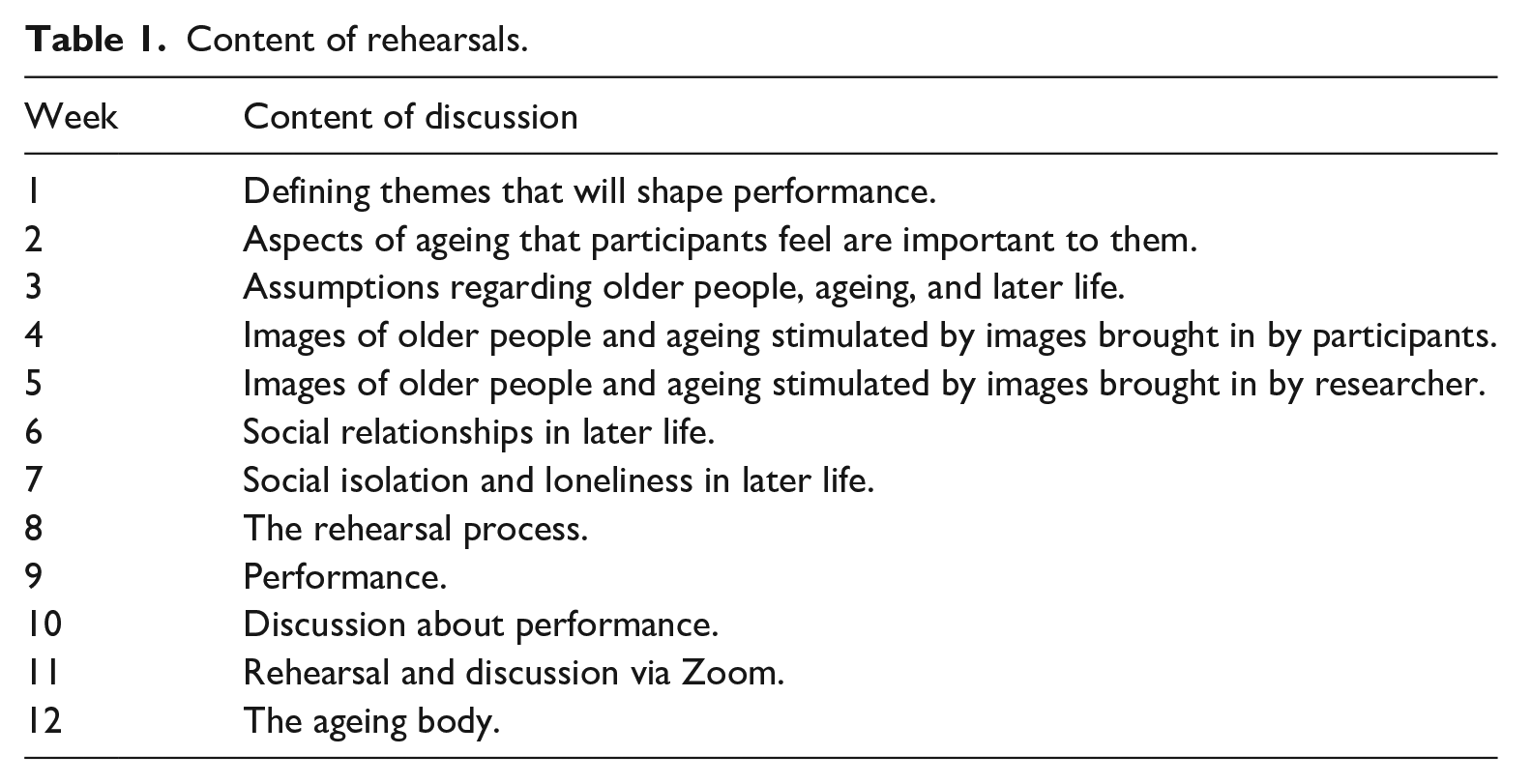
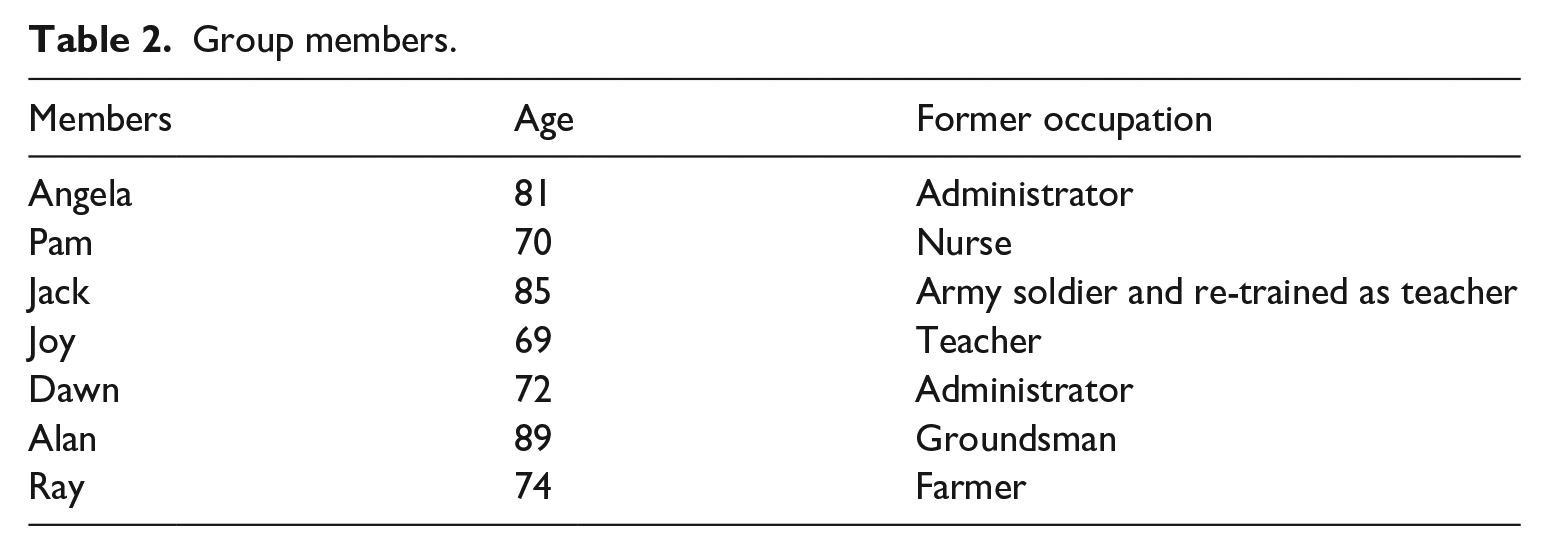
The collaboration between researchers and the company began after three meetings during which shared interests in cultural participation and inclusion were discussed. The director suggested that the researchers’ scientific knowledge about old age could inform the performance. The older people company members and researchers met a further three times to decide themes related to ageing that would be explored: representations of ageing and social relationships. For each of the six sessions, for the first half of the session, the researchers led a discussion around one of the themes. For the second half of each session, participants choreographed and rehearsed a section of their performance informed by the discussion. Please see Table 1 for the content of the rehearsals attended, and Table 2 for a breakdown of the dancers.
Content of rehearsals.
Group members.
Audience participants.
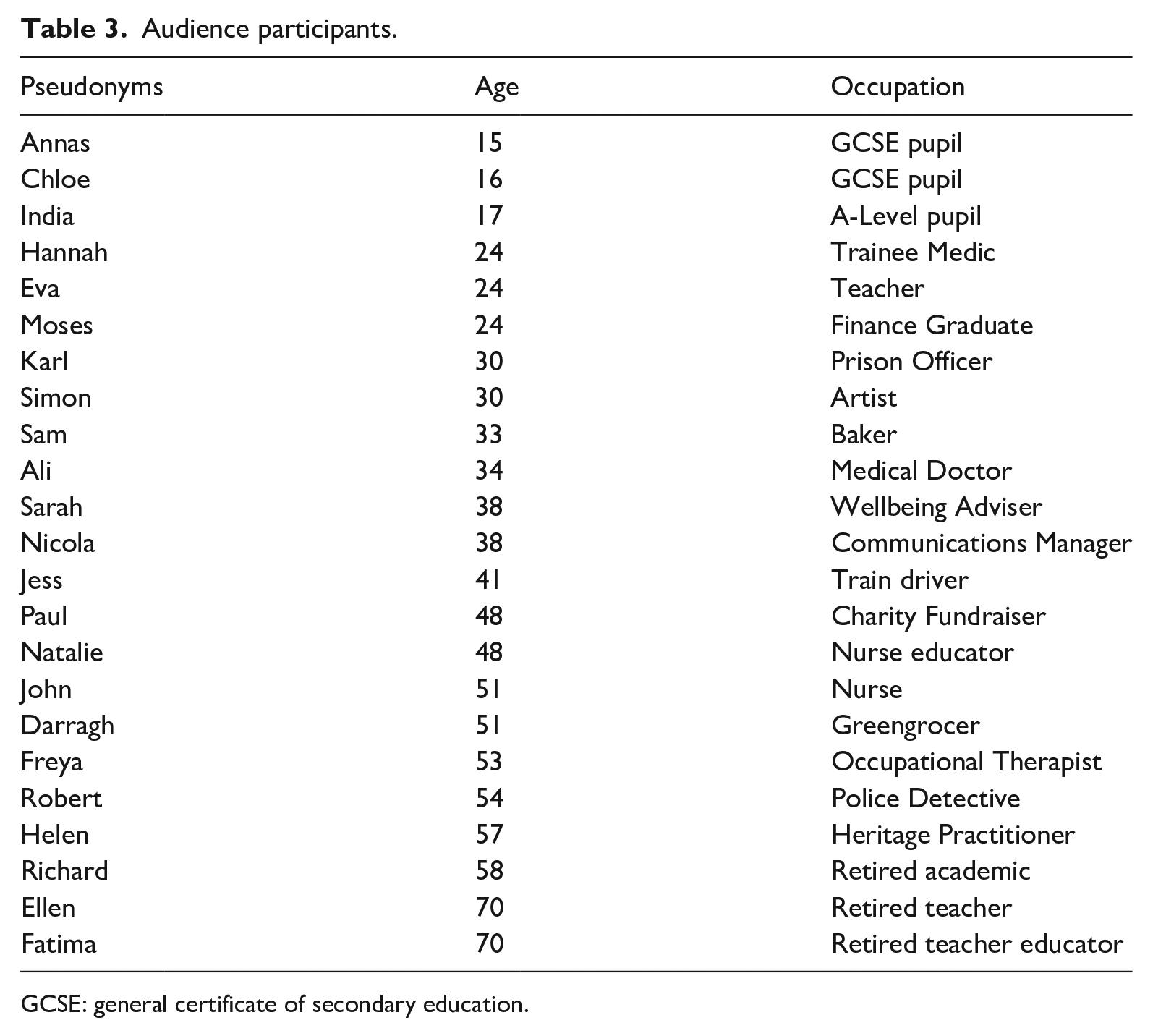
GCSE: general certificate of secondary education.
Data collection
Fieldnotes were made during sessions. Follow-up interviews were conducted with all stakeholders a year later and then company members 3 years later. Longitudinal interviews were used to gauge shifts in perspectives and the development of the group over a few years as opposed to capturing an unrepresentative snapshot in time. Both individual and focus group discussions were used to give participants an opportunity to share their perspectives in confidence and for ideas to be co-constructed through dialogue. Interview topics covered motivation to participate, the experience of participation, the experience of ageing and how dancing related to other aspects of participants’ lives. Baseline data of pre-determined themes was not captured to provide a subsequent point of comparison as the project advanced. Instead, the author probed issues that were raised and reflected upon by the dancers as time progressed.
For the audience perspective, those who watched the video were not told beforehand that the performers were older people. They were asked what they thought of the performance.
In total seven dancers, the director, the cabaret producer and 23 audience members participated in the study.
Audio recordings of the discussions and interviews were transcribed by the author.
Data analysis
A constant comparison process of analysis was adopted (Glaser and Strauss, 1967). To interpret the fieldnotes, interviews and the video recording of the performance, the author repeatedly read, reread the transcripts and fieldnotes and watched the video, gradually identifying key categories and connections. A systematic method of analysis was adopted which involved coding the data (Denscombe, 2003). At the initial phase of analysis, the categories were subject to a process of refinement. The categories were as follows:
Motivation.
Aesthetic meaning.
The ageing body.
Citizenship/political participation.
Expectations of old age.
These emergent categories mapped onto the initial research questions. At this stage of analysis, three main themes were developed that all address the overarching question. The main themes were as follows:
- The body and age as a project.
- Embodiment and age.
- Narratives of old age.
In the discussion, the findings are structured according to these three themes.
Ethical approval
Ethical approval was obtained from Newcastle University Ethics Committee. Ethical considerations included iteratively seeking informed consent, both in written form and then verbally before the start of each rehearsal and each interview. Although no distress arose from issues raised, the researcher and director developed a distress policy, signposting participants to further support if needed. Having worked with older people for 16 years the author was confident that they had gained participants’ trust to the extent that power dynamics were flattened as far as possible. Findings were shared with participants.
Introduction to the dancers
Dance was an activity all members took up post-retirement. All participants were white British. All but one were married and one was a carer to her husband. Five were physically healthy, while one had a heart condition and another’s knees deteriorated over the course of 4 years. Participants had joined the group after seeing an advert in the local press or in their doctor’s surgery.
Results and discussion
The body and age as a project
When the rehearsals began, the group talked about the physical benefits of dancing, confirming that positive ageing discourses govern how older adults view their ageing bodies. Participants saw their body in continual need of management (Laliberte, 2015) – five of the group had started to dance as they wanted some form of exercise to stay healthy. Not all members were physically fit, and over the course of the 4 years, Jack’s knees deteriorated. Alan had a serious heart condition and died during the pandemic.
Participants initially denied challenges associated with being old and claimed they did not experience age-based prejudice. For the first few discussions, the men in the group largely stayed silent. The women stressed the individual agency they employed post-retirement: You’re not rushing for work. You can choose how you spend your time. This is ‘me’ time. (Joy) But you have to put in the effort. You have to join in. (Angela)
Members were determined to present themselves as active agers. After six rehearsals, one participant, however, described how she felt as though she had to conform to social norms: I tried on these culottes and I looked at myself in the changing room mirror and thought, ‘Oh no!’ You don’t want to be mutton dressed as lamb. (Pam)
On the sixth week, Dawn described how she felt old people were resented by younger people as taking up health and social care resources: You’re [hospital] bed blockers! (Dawn)
These more negative examples were only voiced after 6 weeks of discussions with the researchers.
To stimulate the choreography, the group was asked to bring in images of old age to discuss. Joy brought in an advert for holiday insurance which depicted a white, physically healthy, heterosexual couple on the deck of a cruise ship. The comments from the group were positive as Jack described the advert as being a ‘good’ image of a ‘fit and healthy’ and ‘lively’ couple, who ‘look as though they’ve got money to travel’ and who ‘would be welcome to join us’. Identifying with the couple reinforced the group’s identity as active agers. The researchers probed the group further, asking whether the couple were representative of older people. Group members responded positively. The next session, the researcher reminded the group of the advert for the cruise and asked participants what they had remembered from the previous week’s discussion: I’m quite happy with my life. I don’t need all that money and travel. (Angela) I went on a cruise and half the people were in wheelchairs. (Joy)
On this occasion, the group were more critical of the advert for promoting an unobtainable narrative of ‘successful’ ageing. Then the researchers shared photographic images representing a more comprehensive range of older experiences. Ray felt a photograph of a man with dementia was a ‘dignified depiction of a sad reality – there are many of us who may end up drinking through a straw’.
At the end of the project, participants were asked whether the discussions about images of ageing had influenced their thinking or the performance: We did some speaking out in the group regarding misconceptions; what it feels like to receive them. (Joy) It was to challenge – people our age aren’t expected to do certain things and it was to break that mould of what people think about us. (Pam) And sometimes you don’t realise things that you can do. (Dawn)
Members saw taking part in the company as a way to actively challenge limiting ageist stereotypes. They seemed to have internalized negative expectations and to have underestimated their capabilities. Members were both challenging stigmatization, but also attempting to demonstrate how they met the mainstream standards for cultural membership (Lamont et al., 2014).
In the final interviews 4 years later, the men in the group discussed their involvement in the group. While the women articulated the impact of dancing in terms of their bodies, engagement had had a much more profound effect on the men’s wider life. In working with the group, the development of knowledge and understanding about contemporary arts practice could be seen: I’ve wondered why am I here? I’m a man. In my day you were brought up male and female. The moment you pop out of the womb you pick up what’s around you . . . we grew up in this isolated world. But once I tried dancing, it was an eye-opener. Not only had I not had the chance before, but I was ridiculed for going to modern art galleries . . . ‘Those piles of bricks!’ That was our view of artists. Through this I’ve learnt that there’s much more to it, there’s thought, interpretation, telling a story. (Ray)
Engagement had a further impact on his thoughts and actions. As a farmer, he described not having been exposed to non-heteronormative lifestyles. But through meeting dancers of different sexuality and sexual identity and discussing gender identity and inequality with the dance group, he had not only become more aware of non-heteronormative lives, but embraced the difference: It introduced me to many artists and we were discussing these things . . . It brought me into a bigger world that is kept away from you . . . It made me accept other genders, it opened my eyes to gay people, to ‘not sure’ people, to every bizarre way of being. . .It not only made me more tolerant, less critical, but I understood and even liked these other ways of being . . .
Without taking part in this new activity and meeting people from different social locations, he would have been less likely to have had his lifelong views challenged. Cultural workers have distinct cultural values and have been found to be among the most liberal of any occupations (McAndrew et al., 2020), and this finding raised interesting questions in terms of the role of engagement in the arts as promoting cultural values such as inclusion and diversity across all ages. Ray’s perspective revealed cultural values as integral to his experience of participation and how such values can be assimilated by older participants. This was an unexpected finding – not only was dance subverting narratives around old age but also older participants were having their narratives about wider society challenged.
In terms of dancing as a man, Jack noted that when younger he was not aware of dance as something he could do because he was not introduced to it at school and spent all his time playing cricket. However, he enjoyed music and so decided to give the classes a try when he found out there were refreshments. It was only through participating that he found that he loved it. Alan, who was a widower with a serious heart condition, expressed wanting to dance because he would rather ‘feel alive than stay at home and stay safe in a chair’. Both men noted that they did not feel self-conscious as a man when they joined the group because they were focusing on, and became lost in, the movement. These findings are important in terms of reducing barriers to accessing new opportunities as an older man. From observing rehearsals, an inclusive and democratic culture was promoted by the director. For example, warm-up exercises involved pairs mirroring each other’s movement – men did not always pair with women. Joy noted, ‘ Gender is irrelevant. I never think is this a man or a woman I am dancing with’. These findings are important in showing how sexuality as related to normative gender roles in dance was not borne out through the choreography and the social interactions between dancers, despite the intimate physical contact between partners.
Embodiment and age
Although company members had initially joined the group to exercise, by year 4 the aesthetic meaning had become increasingly important: All this glorious music – now I put on the music at home and do all sorts of movement. I don’t do it for keep fit. Creativity. The music. The movement. (Jack) It feels different than keep fit. It’s a group effort. It’s the movement – it makes you move differently. It makes you think. It’s memory and control. It’s balance. Body and mind. There’s more emotion in it. With keep fit it’s more clinical – you just follow the teacher. When you are doing some of these moves – you can put your soul into it. (Dawn)
The women discuss the impact of dancing on their ageing body, placing more emphasis on outward appearance than the men: There is a pressure to stay young and I try to stay young – I’m still wearing make-up. It’s part of imagining that your body is younger than it is. But it [dancing] doesn’t make me think of my ageing body because I enjoy it so much. It helps me so much with my breathing. By the time I leave those aches and pains have gone and I feel much lighter. (Angela)
Angela felt the pressure to maintain a youthful appearance confirming that appearances are central to the way in which older women experience ageism (Clarke, 2010). However, she did not dance to stay young, and in the process of dancing she temporarily forgot her ageing body. Unlike Krekula’s (2020) findings, dancing did not make her feel younger than her chronological age – this was not an example of ageless discourse, but rather dancing could be seen as a mindful act that provided relief to help her live with her ageing body.
In year 4, Dawn noted how dancing was a way to maintain strength – she was working with her ageing body as opposed to trying to look young: I’m aware that I can’t do everything I used to do. That’s not important. You still have to keep moving . . . It was a lifesaver when we started meeting again on Zoom. We were able to maintain that confidence we had gained through moving and talking together . . . It’s about keeping strong. We’re never going to look like when we were 17 . . . We’ve got to be sensible. Unlike . . . other exercise, it’s the creative side of things, to move differently with the body. These are still strong movements.
Dawn was accepting of her older body, but still wanting to maintain confidence in its strength. Here bodily function became tied to confidence and social interaction. However, her response goes beyond research findings that older women shift from evaluating their bodies in terms of appearance to physical function (Reboussin et al., 2000). This new, creative ‘function’ of the body and the accompanying authentic artistic expression can be seen as a process of embodiment transformation, with aesthetic meaning developed through dance.
The men did not refer directly to the appearance of their ageing bodies, but to their body’s functionality, ‘I’m surprised that I can do these movements’ (Alan). Ray articulated his attitude to mental and physical maturity as it developed across the life course: It’s experiencing all those past lives – troubles, depression, anxiety – you need to experience all these things. It’s a continuation of this . . . improvement of . . . knowledge of yourself . . . Did I appreciate my body more? I have aged physically a lot. I catch an old man in the mirror. My mental attitude is the main thing that has changed. But you need to mature, need to have life experiences, need to break the mould and not to be afraid to step into this other world.
Ray saw his physical maturity as at odds to his mental development, but expressed no negative feelings towards his ageing body. It was significant that he used the word ‘maturity’ as opposed to ‘ageing’ – he saw a value in being old. Another comment alluded to sexual attraction: As an old man, you’re not meant to admit to finding younger women attractive.
Societal norms consigned him to the asexuality associated with Fourth Age masculinity (Clarke and Lefkowich, 2018). Ray could be seen to be resisting these norms in presenting himself as a virile third ager.
Participants noted that their younger selves would not have performed in the way their present-day selves did: I couldn’t have put the emotion in it when I was younger because life gives you that. (Angela) We wouldn’t have had these movements in ourselves, the movement vocabulary takes years to build up. I now know that . . . I can lead a movement with my ear . . . Everyone did an original performance, from our own choreography, movements, from the question we’d been asked by the director: How do you get out of bed? When you are 20 you just get up out of bed. You don’t just get out of bed when you are 70. You sit up and wait until the blood pressure adjusts. (Joy) None of us thought we’d have the confidence. It was okay to move at our own pace and bring our experiences to the piece. It was more like a spiritual feeling. (Dawn)
Participants appreciated their age as one of their most hard-earned resources (Andrews, 1999), with their life experiences bringing more meaning to the performance. The physical interaction between the group was integral to the experience. When developing a sequence on social isolation, the bodies met, then parted and huddled together. The group reflected on whether their actions would suggest community to an audience – after developing this sequence, they then voiced more empathetic comments towards people who might not be ‘successfully’ ageing. They communicated, collaborated and co-created through movement. The embodied experience of performing encompasses physical movement, emotional reflection, and non-corporeal spirituality. Pace, strength and meaning in movement was integral to the aesthetic meaning they drew from dancing. The meaning of the piece was not related to physical ability, but to distilling their life experience into movement.
How does modern dance shape narratives of old age?
To describe the performance, ‘Rituals’ was performed at a radical cabaret night. There was a cabaret set-up with a clearing marking the performance space. The audience knew that they would be watching a range of acts but had no idea that they would be watching a group of older people. The dancers were offstage, and the piece started with Joy shouting ‘Hey!’ before Barbara Lewis’ ‘Hello Stranger’ started playing. The dancers hurried into the performance space and began miming different rituals. One washed windows, one swept the floor and one washed their face. At various points, each dancer stopped and spun around in slow motion with their arms outstretched.
Audience members liked the rhythm of the everyday rituals and the way individual’s tasks were related to each other’s. There was also some confusion as to what was actually going on, with the piece disrupting expectations of form: I loved the opening scene with the rhythm of everyday activities performed by the cast and the way they overlapped and carried on in tandem with each other. (Freya, 53, Occupational Therapist) I was like, ‘is this person pretending to hoover in the middle of the social club?’ (Moses, 24, Finance graduate)
Next, three voice-overs from the dancers reviewing their life were played. Ray talked about wishing he had been more adventurous in his business ventures, although acknowledging that ‘one cannot shortcut one’s learning curve’. Audience members were particularly taken with the aural narratives: I didn’t feel embarrassed or shocked because I was taken by the performance. It felt warm and accepting and as an audience member you feel that correspondingly. I liked hearing their stories and that made me think that when you are older, maybe people don’t listen to you. Because the audio had centre stage, no one could interrupt them. I found that powerful. (Nicola, 38, Communications Manager)
For the final section, the dancers gathered to one side and started to move across the space as one connected group. Their arms made elegant sweeping gestures, making more stylised re-enactments of the rituals they performed at the start. The audience read a message of community between the individual and the group in the final act. John related this to his respect of diversity that underpins his nursing practice. For Freya, this emphasized the importance of recognizing people as individuals, irrespective of their chronological age.
All but two of the 23 audience members (Karl, Freya) were surprised to see older people performing modern dance. Annas and Moses observed that in a real-life situation, people would not watch if they knew it was performed by older people, revealing a barrier to staging such shows in spaces that will attract new audiences.
Audience members were quick to question their own preconceptions: The first 10 seconds there was a bit of a shock factor! And then I spent the next minute feeling guilty about my own biases. Why shouldn’t they be representative of what modern dance is!? (Ali, 34, medical doctor)
Participants were surprised by the quality of the artistry involved, suggesting they had different expectations for older, non-professional performers: I didn’t expect to see movement like that. I didn’t expect it to be as artistic as it was (Paul, 48, charity fundraiser)
Participants compared the group of older dancers to younger dancers, although not unfavourably. Ellen was both surprised to see modern dance being performed in a social club venue, and by seeing older people moving beautifully: I wouldn’t have expected to see modern dance by older people there. I’ve seen dance companies doing similar things but with beautiful young people. Here were older people doing beautiful movements. I was surprised. I couldn’t take my eyes of the man in the green jumper (Alan) because if I’d seen him walking down the street, I would have never thought he could have done a performance like that. I would have written him off, and that says a lot about me. It requires a lot of confidence to do something like that when you know that people your age, particularly men, don’t normally do that thing (Ellen, 70, retired teacher)
Her surprise at older men doing modern dance revealed different expectations of different genders in old age. It made her realize that she underestimated old men in terms of their openness to creativity through movement.
The majority of participants were inspired by the creative opportunities it presented in later life: It made me think fun is still on the table, creativity is still on the table. (Natalie, 38, Communications Manager)
People’s responses were governed to some extent by their own professional and personal relationships with older people. Those employed in healthcare professions were normally used to seeing activities in terms of their health benefits. Seeing the performance opened their eyes to creativity in movement: It made me get a lot more involved in that as a creative thing as opposed to them doing a bit of Zumba because it’s good for cardio. (Hannah, 24, Trainee Medic)
For Ali, it made him think about ageism in his own clinical practice: . . . it certainly gives me a reminder not to judge, and makes me more aware of my cognitive biases. And to never assume. It’s actually very relevant for my work too – there’s always that thought process about how frail someone is, and ageism at work, but this is a nice reminder to show that age is merely a number and frailty isn’t necessarily a hindrance to life. Perhaps it enhances it? I think this piece was powerful because of the people involved. And wouldn’t have been as fascinating with, say, younger performers.
He noted that at work there is no time to get to know patients personally, ‘which is heartbreaking, especially for the elderly ones as part of the reason they are in hospital is because of isolation’. He followed up by noting that on his busy ward round, he was going to make an effort to get to know his patients by asking them about their former occupations. There was a reciprocity involved, as he felt forming relationships would also make his shift more engaging and less stressful.
Moses, who had close relationships with grandparents, did not necessarily give the wider older population the same consideration: . . . when . . . I see an older person I don’t even look twice . . . I think watching that performance . . . they’re still the same people they were when they were twenty, it’s just that they’ve got an older body . . . where they are now is built up of their experiences through their life . . . if you sit there and appreciate them for who they are then it changes how you see them.
He gained a greater sense of connection to older generations and an appreciation of their life experience through watching the performance.
Turning to examine perspectives from the cultural intermediaries, the producer of the cabaret night gave her perspective on the performance: There was a connection between the performers moving and that spread out to the rest of the room – they brought down the house. It felt like a lot of soft and sensitive carving through space. Quality comes from performers leaning into their own perspective . . . it has an honesty to it . . . an immediacy . . . It sits in the context it is in and feels live and important politically.
She emphasized the relationship between performers and audience and the social interaction that the performance invited. She analysed the performance using the same criteria as she would for any age group – it is a piece which had a strong aesthetic meaning in its own right. In drawing from their own lives she felt that the piece had authenticity and was therefore political.
Conclusion
The research makes an original contribution to the sociocultural literature on embodiment (Tulle, 2015), in revealing how older people perceive the experience of their bodies through the aesthetics of dance. Both the older people and the audience members had their expectations around old age challenged. Over the course of 4 years, participants went from presenting as active agers to developing a more accepting attitude towards their ageing body. This was particularly noticeable for the women, who referred to their ageing bodies more than men. Participants started dancing as a way of managing their ageing bodies, but developed a richer embodied understanding which was underpinned by aesthetic meaning, for example, learning the strength in being still, or experiencing ‘soulful’ meaning through movement. Findings reveal the complexity of ageing well instead of being used to promote active ageing agendas (Gilleard and Higgs, 2018).
The engagement by men in modern dance marks an additional dimension to challenging the status quo, with the research enrichening the policy-oriented literature on participation and ageing and providing much needed evidence on men (Pilcher and Martin, 2020). Their willingness to dance reflects how ageing can influence the ways that people enact gender (Calasanti and King, 2018). While the women referenced impact on their bodies, for the men, the impact of participation on their wider lives was starker. Taking up dance and working with cultural intermediaries introduced them to ideas around gender equality, identity and sexuality that they attributed to opening their minds – this finding makes an additional important contribution to the literature on ageing and lifestyle.
Cultural programmes can reduce stigma by developing and promoting work co-produced with marginalized groups, developing understanding of the processes of destigmatization (Lamont et al., 2014). The participants exercised choice and agency through their involvement with the company and were encouraged to critically engage with notions of ageism through the research process – it was only when probed that participants offered more critical perspectives. Due to the ethnographic and grounded theory approach, there was a conscious decision not to collect baseline data. Instead, the themes that the dancers brought up during discussion or were observed were elaborated upon as the project developed. There was not the intention on the part of the researcher to lead the dancers to discussing their ageing bodies from the offset, instead, this theme became more prominent as the project progressed. From having conducted similar projects to this over a period of a few years, the researcher found it typical that the group initially expressed general narratives about old age at the beginning. It is only after getting to know the researcher, working as a group, developing a greater awareness of their bodies through choreographing, co-constructing meaning through a series of focus groups and rehearsals that the participants came out with more refined and reflective ideas about their ageing bodies. It is quite key to understanding the presentation of ageing to a younger researcher that the group would initially present as active agers and talk in a generalized, positive way. The incorporation of critical analysis into the development of choreography is argued to be an effective way of including emotional and expressive contributions of the community actor (Barnes, 2008), thus helping to rebalance power relationships. It is argued here that arts programmes should encourage participants to critically engage with active ageing narratives, while still respecting the older person’s capabilities and experiences.
For the audience members, negative narratives of old age were challenged, including an underestimation of the creativity of men. It was an appreciation of the aesthetics that brought meaning and developed new understandings – in performing their everyday rituals, the dancers were moving as older people, not attempting to imitate younger, more physically agile dancers. It is in this way that the group claimed a space for older age through the art form. This article argues that the art form, and the aesthetic meaning as part of that, is key to challenging ageist narratives. Findings reveal the cultural contexts that shape the internalization of ageism (Calasanti and Slevin, 2001) and crucially, argue that embodied practice influences inclusion/exclusion, making a key contribution to the literature on processes of destigmatization (Lamont et al., 2014).
The research has important implications for policy and practice in terms of supporting programmes of work that empower older people. Programmes need to run over a sufficient length of time and ensure that older participants have sufficient control and ownership. Arts and older people work should be included as part of mainstream programming as audiences have an appetite for such performances.
In terms of limitations, all participants identified as white British and the sample size was small. Inevitably, there was self-selection in terms of those who chose to participate. Furthermore, contemporary dance may have been accessible to some and less accessible to others. However, the fact that there were men involved, and some had serious health conditions, shows that predicting accessibility is not straightforward. In terms of methods, it would have added another perspective to have conducted some form of visual data analysis, particularly as the medium under discussion involved movement.
Dancing together saw participants communicating, collaborating and co-creating (Harvey, 2013), but also by releasing forms of empathic identification on which new forms of sociality became based (Fisher, 2011). The dancers were turning their life experiences into art, which represents a level of development and abstraction. The collective movement in the final performance made a statement about the value in the lives of ordinary people who had grown up post-war. It challenged the audience to recognize and value the everyday lives of older people. The group inventively disrupted the space and refashioned it as a site of intergenerational connectivity – audience members were not only invited to join the performance at the end, but the audience responses revealed a widening perception around who is allowed to perform contemporary dance. Both the dancers and audience co-produced new narratives around the older body. Although there was no manifest political intention on the part of the dancers, in performing in a space previously barred to older people, participation in dance is argued here to be a form of active citizenship facilitating inclusion.
Footnotes
Acknowledgements
Thank you to the dancers and director for inviting me to be part of their rehearsal process. Also thank you to the audience members who generously gave their feedback – particular thanks to those who took time out from busy schedules to watch the performance and reflected upon it with depth. Thank you to Tom Six who pointed me in the right direction to the literature on politics and performance. Thank you also to the reviewers and the journal editors for helping to shape this piece.
Funding
The author(s) received no financial support for the research, authorship, and/or publication of this article.
