




Abstract
Commercialised gambling products have spread rapidly through African countries in recent years and have been woven into the everyday experiences of young people. Research to date has documented this phenomenon through conventional social science methodologies, establishing an important body of knowledge. Absent from this work is research that adopts participatory and creative methods, often argued to be particularly well suited to empowering marginalised groups to co-produce research. In this piece, we describe a co-creative participatory approach to working with 24 young people in Malawi to explore experiences of commercial gambling and its impacts on their communities. Our approach was co-developed with the young people and produced a substantial body of community interviews, photovoice pieces, and creative representations of the research findings. Here, we focus on a song written and recorded by one of the young people that draws on and represents themes of distress, addiction, poverty, and false hope, which were present in the data the young people generated across the study.
Young Malawians exploring gambling in their communities
For many young people in sub-Saharan Africa, opportunities for stable employment and financial security are scarce. As a result, some are turning to commercial gambling products in attempts to generate income or escape from the harsh realities of their daily lives (Adebisi et al., 2021). Researchers have begun to establish a body of work that examines this development (Glozah et al., 2023), charting the intersections of gambling and poverty (Ahaibwe et al., 2016; Bunn et al., 2022), participation in education (Glozah et al., 2019; Surujlal and Akinwale, 2017), mental health struggles (Kaggwa et al., 2022; Sichali et al., 2021) and hope for the future (Schmidt, 2019), among other areas.
While this body of work has produced significant sociological insights into the meanings, extent and consequences of youth participation in commercial gambling in African countries, no research has empowered young people to explore the nuances and consequences of this trend for themselves. In response to this, we undertook a co-creative participatory action research study designed to facilitate young people in Malawi to investigate, represent, and respond to the shifting gambling landscapes in their communities.
The study design was inspired by scholars who have emphasised the emancipatory potential of creative methods, particularly for research conducted with marginalised populations (Lykes and Scheib, 2015). Through a series of workshops spanning 10 days, we collaborated with 24 young people (12 young men and 12 young women, aged 18–25) living in Malawi’s capital city, Lilongwe, to iteratively develop an approach to documenting impacts of the growth of commercial gambling on their communities. The approach crystallised into five broadly distinct steps:
Building trust, sharing knowledge and experience of gambling, defining the research agenda, empowering/upskilling young people in ethical approaches to data generation
Collecting stories from the community through informal interviews, followed by group thematic analysis in a workshop setting
Planning photovoice, shooting photographs (staged, when necessary), constructing and analysing narratives
Creating artistic representations of findings
Sharing study outputs (narrative summaries, photovoice exhibition, and performances) with community leaders, policy makers and gambling support workers, setting priorities for future action
These steps were shaped by ethical concerns relating to the taboo (and sometimes illegal) nature of some aspects of gambling and its impacts on the community. Responding to these concerns, the group decided that the stories collected in step 2 should be represented through photovoice (using staged photos when necessary, for example, to depict a family dispute) and other creative outputs. This approach enabled the re-telling of the stories and the issues they raised, often by combining ‘fragments’ of multiple stories (Abdulla, 2021), while limiting the potential for the subjects of the stories to be identified by community members.
Through this process, young people generated 177 interviews and 24 photovoice pieces. Artistic representations of findings created during step 4 of the research included two songs, a short film, a play, two poems, a personal testimony, stand-up comedy, and a speech. These artistic representations were presented back to the community in which the research took place through a showcase event. The showcase was attended by the three local councillors, headteachers, religious leaders, traditional leaders, community members, and guests invited by the young people, totalling 82 in all.
In what follows, we present and examine a song called ‘Gambling’, written and recorded by Starlic during stage 4 of the research. After presenting his song to the group, Starlic took it to what he referred to as a ‘ghetto studio’, a small room in his neighbourhood equipped with a basic computer, recording software, midi controller and microphone, where he recorded the output we share here, funded by the research project at a cost of approximately £15. Additional funding was secured from the University of Glasgow to produce a music video to accompany the song. In this piece, we focus on a reading of the lyrics, drawing out their connection to the stories gathered from the community and the photovoice process.
Reading Gambling by Starlic
The lyrics of Starlic’s ‘Gambling’ (see Figure 1) provide a powerful and insightful reflection on the complex impact of gambling on the lives of young people, drawing on multiple accounts that the young people gathered during the research process. They touch on the themes of distress, addiction, poverty, and false hope which were constructed through discussions that took place among the young people during the research.
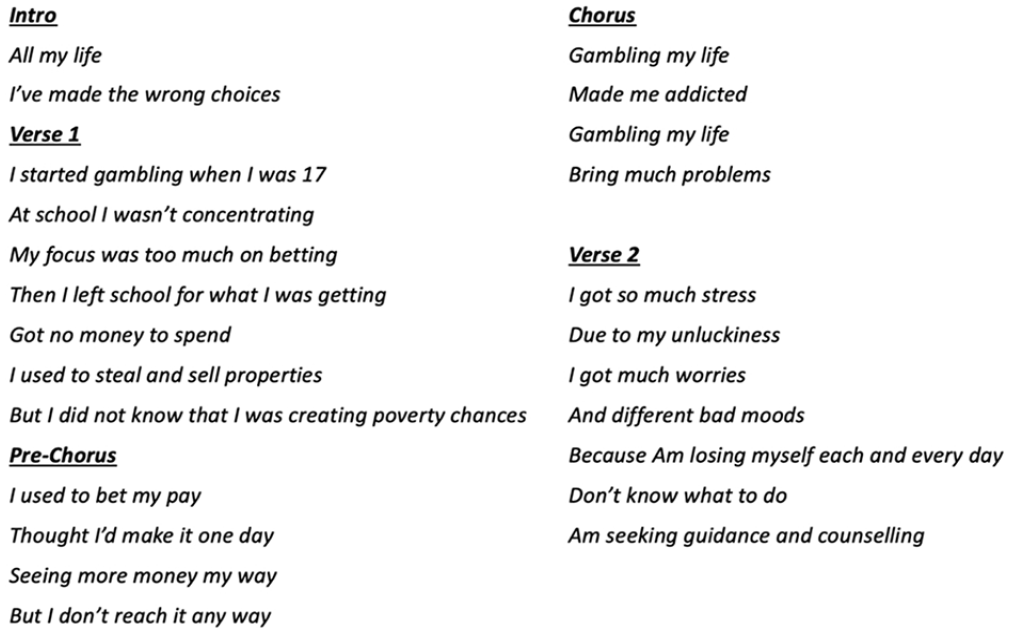
Lyrics to ‘Gambling’ by Starlic.
‘All my life, I’ve made the wrong choices’, the song’s first line, quickly conjures up feelings of distress, emotional turmoil and regret. The song continues, ‘At school, I wasn’t concentrating, my focus was too much on betting, then I left school for what I was getting’, emphasising how an early win can have a powerful influence on the life trajectory of a young gambler, causing them to lose focus on important aspects of their lives, like education. Participants in the sessions shared their experiences of witnessing community members who had dropped out of school because of sports betting. One story described a young man who used a gambling win to start a bicycle-taxi business, leaving school. His reasoning was that the purpose of school is to learn how to earn money. Now that he was already earning money through the bicycle taxi business, staying in school appeared to be a waste of time.
The chorus of the song, which begins with the line ‘Gambling my life, made me addicted . . . bring much problems’, highlights the recurring topic of addiction. The lyrics highlight the negative emotional and financial effects that gambling addiction can have on young people. Participants described how many young people in their community had a persistent urge to bet, and that they did so even when they lost money, betting to recover their losses. Discussions in stage 2 also revealed how some young people are impacted by their parents’ gambling, for example, being sent home from school due to unpaid fees (see Image 1). Perhaps the most powerful dimension of this lyric is the suggestion that it is the subject’s life which is risked through their gambling practice, alluding to its far-reaching consequences.
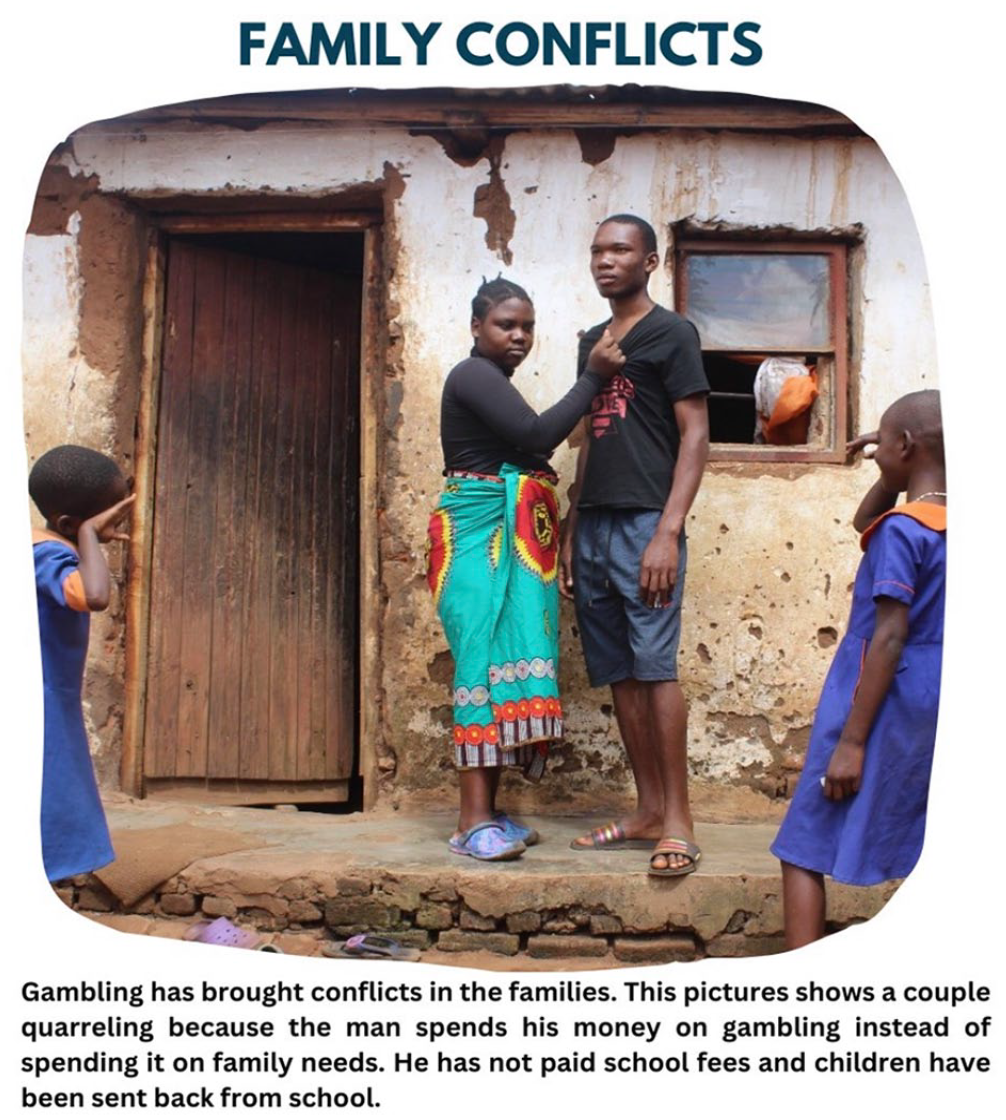
Photovoice output representing ‘family conflicts’.
With the phrase, ‘I used to steal and sell properties, but I did not know that I was creating poverty chances’, the song’s lyrics touch on the subject of poverty. The song emphasises how gambling practices can result in criminal activity, feeding a cycle of uncertainty and poverty. This theft-related concept was derived from multiple stories shared during stage 2 of our research process, which highlighted how people would steal and sell things that belonged to them and their families in order to raise money for betting. Participants re-told stories of a bus driver who had stolen from both his boss and his wife to support his gambling habits as well as an unemployed graduate who stole items from his parents’ home.
False hope is one of the most compelling ideas to come through in Starlic’s ‘Gambling’. The song emphasises how young people can be lured by the promise of winning money, only to end up caught in a vicious cycle of debt and hopelessness, which often becomes entangled with other forms of harmful consumption, such as alcohol abuse (see Image 2). The song’s lines, ‘I used to bet my pay, thought I’d make it one day, seeing more money my way, but I don’t reach it anyway’, refer to the claims that gambling companies frequently make in their advertising and marketing campaigns. These messages have the potential to mislead young people looking for a route out of their difficult situations, creating a sense of false hope that can be devastating when unrealised. In the discussions that preceded this, the young people emphasised the importance of civic education in countering these messages, and the need for more support and resources to help those who have been caught in a web of gambling harms. The lyrics ‘Am seeking guidance and counseling’ highlight the pressing need for understanding and support for the predicament expressed throughout the song, for all young people struggling with gambling harms.
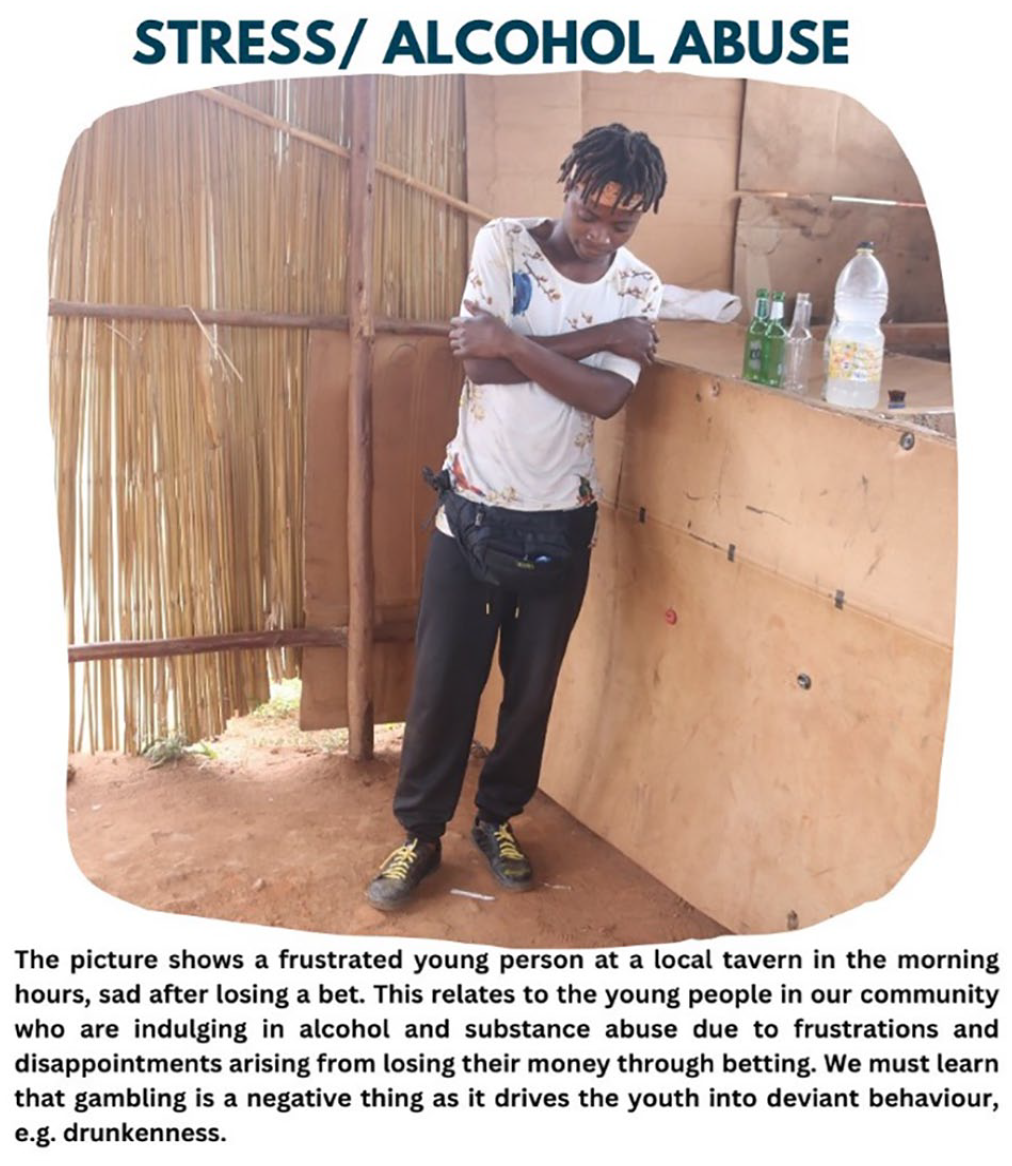
Photovoice output representing ‘Stress/Alcohol Abuse’.
Closing reflections
The lyrics of Starlic’s ‘Gambling’ provide a powerful and creative reflection on the complex and multifaceted impact of gambling on the lives of young people in Malawi, which weave together ‘fragments’ of the stories the young people gathered from their communities. The song represents a response to the expansion of the globalised gambling industry into a community situated in one of the least economically developed countries in the world. With the gambling industry facing increasing scrutiny and more stringent regulation in Europe, expansion into countries such as Malawi is an example of what Harvey (2001) terms a ‘spatial fix’, of capital’s pursuit of new geographical territorialisation to offset potential lost profits in established markets (Reith, 2018). Starlic’s work offers us grounded and affective insights into the human cost of this commercial mobility, highlighting how the gambling industry has engendered false hope among his community, entrenched poverty, and created the conditions for ‘addiction’ and distress.
Footnotes
Ethical approval
Ethical approval for this study was obtained from Malawi’s National Committee on Research in Social Sciences and Humanities (Ref number: P.02/22/625) and the Research Ethics Approval Committee for Health (REACH) at University of Bath (Ref number: EP 20/21 009).
Funding
The author(s) disclosed receipt of the following financial support for the research, authorship, and/or publication of this article: The article draws on original research funded by a ‘Youth Futures’ award from the British Academy/Global Challenges Research Fund (YF190091). Funding for the production of the music video was provided by the College of Social Sciences, University of Glasgow.

Author biographies
References
Supplementary Material
Please find the following supplemental material available below.
For Open Access articles published under a Creative Commons License, all supplemental material carries the same license as the article it is associated with.
For non-Open Access articles published, all supplemental material carries a non-exclusive license, and permission requests for re-use of supplemental material or any part of supplemental material shall be sent directly to the copyright owner as specified in the copyright notice associated with the article.
