




Abstract
Media representations of African underdevelopment are central to the communicative potential and reach of international development in the mainstream public sphere, but they are not without sustained critique and confrontation. By conceptualising the humanitarian-themed campaign – #TheAfricaTheMediaNeverShowsYou on Twitter, as an Afrodiasporic Subaltern Counterpublic, this article considers how UK African diasporic communities have utilised this digitalised environment to oppose the popular but problematic ‘face of development’. Applying Nancy Fraser’s counterpublics theorisation and drawing on social media ethnography and multiple participant interviews, it shows how oppositional counter-discourses among these online diasporic communities challenge problematic African representation within ‘white media’. This is realised in three distinct but interrelated discursive practices: (1) Afrodiasporic solidaristic orientations; (2) Diasporic solidarism as an assemblage(d) response to development’s institutionalised whiteness; and (3) Countering Africa(n) misrepresentations.
Keywords
Introduction
Visualisations of African underdevelopment and, especially, of the poor African ‘Other’ are paramount to the communication strategies of international development organisations for furthering amelioratory interventions and transformative efforts – that is, finding ways to ‘do good’ through the instrumental use of media representations. Moreover, as Enghel and Danielsson (2019) advise, they communicate about development to various stakeholders in the public sphere – finding ways to ‘look good’. As such, whether mediated through mass or digitalised communication technologies like social media, the production and dissemination of such representations are configured for use by development organisations to communicate vital information about the ‘public faces of development’ (Scott, 2014) – underprivileged and underdeveloped African societies. Nonetheless, despite their strategic deployment by development organisations, these problematic media representations and the surrounding colonial-racialised metadiscourses associated with their production and distribution are not without sustained critique and confrontation by popular social media campaigns (see e.g. Richey, 2016; Schwarz and Richey, 2019).
Appropriately, by conceptualising the humanitarian-themed Twitter campaign #TheAfricaTheMediaNeverShowsYou as an Afrodiasporic Subaltern Counterpublic, this article considers how UK African diasporic communities have utilised this digitalised platform to oppose mainstreamed visualisations of African underdevelopment as the accepted ‘face of development’. It achieves this by applying Nancy Fraser’s (1990: 67) counterpublics notion, which describes ‘members of subordinated social groups [who] invent and circulate counter discourses, which in turn permit them to formulate oppositional interpretations of their identities, interests, and needs’. Moreover, by employing a social media ethnographical approach with participant interviews, it reveals how oppositional counter-discourses among these online diasporic communities disrupt and problematise dominant narratives associated with Africa’s representation within ‘white media’. This is realised in three distinct but interrelated discursive practices: (1) Afrodiasporic solidaristic orientations; (2) Diasporic solidarism as an assemblage(d) response to development’s institutionalised whiteness; and (3) Countering Africa(n) misrepresentations.
By spotlighting #TheAfricaTheMediaNeverShowsYou as a specific networked response and diasporic corrective to problematic development representation that bears some resemblance to a counterpublic, the article makes important contributions to counterpublic theorisations and specifically, Nancy Fraser’s (1990) Subaltern Counterpublic variation. It also augments the small but luminous academic literature that explicates digitalised counter-narratives within the wider phenomenon of international development and humanitarianism.
This article is segmented into six, starting with a brief problematisation of continental Africa in development’s representational frame and the institutionalised ‘whiteness’ that sustains this. Following this it explores the distinct impact that development representations have had on UK African diasporic populations. The article then elaborates on Fraser’s (1990) Subaltern Counterpublic as its theoretical framing. A methodological contextualisation of the research follows, including a justification of the appropriateness of #TheAfricaTheMediaNeverShowsYou Twitter campaign as a discursive site for empirical focus. The article then presents the analytical discussion of its findings substantiated by an exemplum of African diasporic social media posts and interview evidence. The final concluding segment reflects on the discursive practices of #TheAfricaTheMediaNeverShowsYou within the broader context of mainstream society.
Development’s representational framing of Africa in the media
International development’s academic programme of study – broadly concerned with the problems of poverty and social deprivation, and how to address these, is well established, as is its policy implementation. Nevertheless, it is largely through the lens of its popular visualisations that Africa’s underdevelopment and impoverishment is communicated beyond the formal intellectualism of social scientists and policymakers, and towards the mainstream populous where it is rendered legible. Whether associated with televised spectacles like the Live Aid event of the 1980s and Comic Relief’s nationwide telethon – ‘Red Nose Day’, or perhaps as features of new(er) media communication technologies such as social media networks. Visual representations are the mediums through which Africa’s ‘inadequate characteristics’ (Andreasson, 2005: 972) are constructed and popularised. New communication possibilities, particularly, complicate the use of these popular visualisations by introducing new affordances and visual modalities into presentation, so much so, that the management of a charity’s social media website is, for instance, as McNely (2012: 1) advises, ‘no longer a peripheral practice in a strategic communication plan, instead, it is central for fostering [development’s] external image’. As such, new digitalised platforms like Twitter have become a fundamental intermediary through which development organisations broadcast visually arresting and provocative materials staged for mainstream and transnational publics (McNely, 2012).
According to Gallagher (2015: 8), African representation produced, negotiated, and circulated in media are, what she denotes, ‘relational’, that is, they are discursive strategies that bestride the ‘interface between underlying “truth” and outlying expectation. But . . . this is not neutral’. Through their dissemination within the contemporary media ecology, discourses are negotiated between constituents of receiving publics, and Africa is articulated through a representational inertia that suspends it within a constellation of thematic ‘shortcomings’ and vulnerability (Andreasson, 2005). These pictorial inadequacies become, as Vestergaard (2010) and others (e.g. Chouliaraki and Vestergaard, 2021; Orgad and Seu, 2014; Richey and Ponte, 2011) argue, the ‘unique selling proposition’ of development organisations and the ‘cultural status associated with it’ (p. 170). Representations of African underdevelopment, then, are designed and orchestrated to legitimise development ‘do-gooding’ interventions to attract donations and gain trust from the mainstream public and stakeholders (Kim and Wilkins, 2021).
Africa’s representational treatment in the development field has not eluded academic problematisation. Critics have highlighted the oversimplified and demeaning ways that development portrays the continent and communities therein, as iconographic victims, infantilised, poor, politically corrupt, unenlightened, and in need of rescue (Chouliaraki, 2010; Dogra, 2012; Heron, 2007; Manzo, 2008; Repo and Yrjölä, 2011). In addition, postcolonial analyses of development discourse have cautioned how its mediated practices shape and sustain colonial-racialised interpretations of Africa that are undergirded by institutionalised whiteness (Majavu, 2022).
Problematisations of the shades and landscapes of development’s whiteness are outlined in various ways and scales (see, e.g. Majavu, 2022). In this context, however, it is the quotidian ‘lens or vantage point through which implicitly Westo-Eurocentric forms’ of representing Africa are mediated within ‘its own white-affirming procrustean frame of reference’ (Ademolu, 2023a). The discursive framing which undergirds this whiteness locates Africa’s (Black racialised) underdevelopment within some permanent prolongation of a historical past, and as maladaptive and lacking the necessary internal diplomacies to help itself. This stands in stark contrast to a supposedly well-resourced, advanced, and forward-looking, white non-African, West (Heron, 2007). As such, if representations of African underdevelopment are the public faces of development, then development organisations via their courtship of, and presence within popular media, are the everyday corporate faces of an ostensibly benign whiteness (Ademolu, 2021a).
Notwithstanding how and the modalities through which Africa is visualised and made comprehensible by development, less considered, at this point of reading, are elaborations on diasporic contestation of these problematic representations. Appropriately, we must consult the counterpublics literature. Before doing that, however, a short intermission is first needed to expound on the distinctiveness of UK African diasporic communities in this current discourse. Why should we know about the oppositional demonstrations of this ethnoracialised public? What makes them distinctively special to garner empirical attention? A very brief review of the impact of development representations of Africa on Black Britons is paramount here.
African representation and diaspora impact: the material and symbolic
Comprehensions of the impact of development representations on so-called beneficiary communities over there in continental Africa now occupies some sizable intellectual space within development-aid publications (e.g. Warrington and Crombie, 2017). However, the broader epistemological ‘shift from alliance to critique of humanitarianism’ (Ticktin, 2014), motivated by a much greater imploration for International Non-Governmental Organisations (INGOs) to reflect on the racialised assumptions upon which the entire development industry operates (Kothari, 2006), has equally seen a few rallied attempts at eliciting the perspicacity of their affect among (and on) diasporic communities over here. Notably, among these scholarly works is Young (2012), who argued that the (re)production of problematic representations of Africa in the fundraising communications of such charities as Oxfam and Save the Children have negative human rights implications for UK diasporic communities (p. 39). Not only do they facilitate the defaming and mischaracterisation of diasporic communities via discursive framings ‘predicated on stereotypes and false imagery’ but their ‘far-reaching consequences beyond any specific campaign . . . implicitly emphasises their otherness . . . and reinforces the perception of them as on the periphery of society’ (p. 38). This, she observes, compromises diasporic ability to meaningfully integrate into broader society and forge convivial relationships of mutual respect and tolerance with non-Black African others.
Similarly, Dillon (2021) cautions that the material impact of popularised atrocity-oriented African representation is also such that some diaspora attribute personal experiences of anti-Black racist abuse, bullying, and taunts to this phenomenon.
Importantly, emphasising the symbolic value of negative images of Africa, in previous publications I too have shown that despite not being the featured subjects of fundraising communications, a recognition of the Self within the representational African Other, cause some UK African diasporic communities to negotiate self-referential positionings and orientations orchestrated by their perceived semblance of ‘ethnoracialised sameness’. The consequences of which suspend these groups in a push–pull state of simultaneous contradiction between ‘seeing and being the visualised other’ (Ademolu, 2021a) complicating their relationships with Africa(ns) (Ademolu, 2021b).
The particularity of African diasporic communities and their attendant meritoriousness for serious contemplation in the context of ‘poverty porn’ development representations are not just the hoarded preoccupation of a few lonesome scholars. Rather, it is an itinerant problem, in that it has traversed the academy and penetrated the contemporary mainstream public sphere, fixating the interest of many popular media outlets and public figures. This is evident in recent remonstrations over problematic African representation by popular UK charity Comic Relief in their biennial telethon-come-celebrity-extravaganza, ‘Red Nose Day’,1,2 promoted by the British Broadcasting Corporation (BBC) since 1998. Specific critiques were directed at how this event has long reproduced particularly negative and culturally insensitive stereotypes of Africa as a space for its salvation, through the use of celebrity-fronted ‘poverty porn’ appeals that reinforce colonial narratives of white saviourism (Keenaghan and Reilly, 2017). Comments made by prominent Black British parliamentarian, David Lammy,
3
for instance, exemplifies this: As I’ve said before, this just perpetuates tired and unhelpful stereotypes. ‘British celebrities’ being flown out to Africa for Red Nose Day to make films that send ‘a distorted image’ of the continent and perpetuate ‘an old idea from the colonial era’. Which ‘many black’ Britons are ‘deeply uncomfortable’ with. (David Lammy)
It is this racialised discomfort explicated by Lammy that illuminates the diasporic distinctiveness with the issues that concern this article. Specifically, the forestalling of their capacity to articulate a counterpublic position on the osmosis-esque impact that dominant discourses of African underdevelopment have on them as culturally identifying groups.
Appropriately, it is here that we turn our attention to the counterpublics literature.
Counterpublics: subalternity, Twitter, and development resistance
Problematisations around the function and characterisation of the so-called ‘public sphere’ in the media and communication field often orbit around the gravitational pull of Jürgen Habermas’s (1991) indispensable theorisation of the bourgeois public sphere. According to him, the public sphere as an institutionalised theatre in which political participation is facilitated through the medium of open and accessible talk among egalitarian folk existed an as an intermediary, connecting the governmental and private spheres. Within this inter-discursive forum of a democratic imagining, citizens of different communities of belonging will deliberate, debate, share, and elicit matters of public and mutual interest to hold states accountable to their constituencies (Squires, 2002).
Nonetheless, the Habermasian notion has been criticised for the revisionist historiography according to which it is idealised. Notably, several critics have rallied to the defence of alternative and contrarian expressions which postulate the exclusionary and marginalising power relations within the bourgeois public sphere. This, they argue, is at the expense of providing opportunities for systematically disenfranchised communities, such as women, the working class, people of colour, and sexual and gendered minorities from participating in this space. Recapitulating these dissident interpretations of the Habermasian public sphere, Nancy Fraser, for instance, highlighted that there was never one singular, unitary public within which communities were implicated. Rather there existed a multiplicity of public spheres – or ‘counterpublics’ – which were comprised of conflictual and antagonistic citizenry (Fraser, 1990). These counterpublics, we are told, sought to respond to, rebuke, and resolve the exclusionary norms, traditions, and elitist sovereignty of the bourgeoisie public sphere (p. 61).
Contrary to the bourgeois visualisation of autonomous settings wholly conceived for discursive contestation, Fraser maintains that the public sphere in its pluralised imagining additionally functioned as the background for the configuration and enactment of social identities (Fraser, 1990: 68). Concentrating on the discursive and contextual nature of social identities, she saw the formation of identities among civic society as a salient feature of their participation. As such, given that public spheres are never ‘spaces of zero-degree culture’ (Fraser, 1990: 116), an imagined egalitarian and multicultural civilisation could not contain itself within the singularity of a comprehensive public sphere. Rather its containment must be distributed within, across, and beyond innumerable publics to accommodate and convey the kaleidoscopic nature of its variations.
In light of this, and amalgamating Gayatri Spivak’s (1988) ‘Subaltern’ with Rita Felski’s (1989) ‘Counterpublic’, Fraser proposes the existence of Subaltern Counterpublics as alternative discursive arenas comprised of non-dominant citizenry operating in parallel to the official public spheres. It is within this substitute space of emancipatory potential that ‘members of subordinated social groups invent and circulate counter discourses, which in turn permit them to formulate oppositional interpretations of their identities, interests, and needs’ (Fraser, 1990: 67).
Importantly, to avoid subscribing to the homogenising notion of a solitary public maintained by the organising logic of communal interest, Fraser rightly cautions that Subaltern Counterpublics also partake in their own exclusionary behaviours and means of informal marginalisation and oftentimes are explicitly anti-democratic and anti-egalitarian (Fraser, 1990: 67). This recognition allows for a variation of counterideologies and discourses that, given certain conditions, coagulate to act in concert, disseminate a shared ideology, and function as a unified, expansive counterpublic, while also leaving room for the presence and articulation of contradictory and contrarian elements within and across these assemblages.
Considerable attention has focused on comprehending the implications and affordances of the advancements in computer-mediated communication technologies such as social media applications, for furthering the cause and transformative possibilities of counterpublics. Jackson and Welles (2015), for instance, considered the strategic deployment of Twitter as a networked platform to produce, organise, and disseminate Black counterhegemonic interpretations and other oppositional activities as challenges to white majoritarian narratives within the mainstream sphere. They inform us that the platform’s automated infrastructure – its stability and scalability, is such that it enables ‘citizens most invisible in mainstream politics radical new potentials for identity negotiation, visibility and influence’ via the mutual exchange and circulation of in-group knowledge and experiences. Also, for ‘conceptually related but otherwise disconnected messages to be stitched together in a networked narrative that becomes newsworthy, even by mainstream standards’ (Jackson and Welles, 2015: 948; 2016: 399). This repository of user-generated commentaries and visualisations as ‘tweets’, produced and propagated by a digitalised counterpublic, enable these agitational discourses to arouse attention and even potentially infiltrate the mainstream sphere.
According to Sharma (2013), an essential component for articulating how and to what degree counterpublics establish themselves on Twitter is through a close reading and theorisation of the prominence and impact of hashtags. For him, Twitter as an emergent digital phenomenon ought to be conceptualised as a conduit for the formation of racialised assemblages that formulate pan-racial and ethnicised comportment. These heterogeneous assemblages are bounded by a set of relations and are adaptable in their fundamental resistance to any notion of permanent territorialisation and hermetic closure. Of great interest to this article is Sharma’s imploration for recognising Twitter as generative of racialised affects, subjectivities, and dispossession, where ethnoracialised congregations construct and challenge race. Within this frame, he notes that a core method of realising this technological manufacturing of race is by studying the so-called ‘racialised hashtags’ (Sharma, 2013: 48) that are generated by elements within these racially minoritised communities. #TheAfricaTheMediaNeverShowsYou exemplifies a digitally racialised assemblage, formed and made legible in the semiosis of racialised hashtags.
With respect to the development sphere, a handful of few and scattered publications observe how online communication platforms provide networked infrastructures that facilitate the rebuke and resolve of development discourse and practice. Of particular interest are social media campaigns: Humanitarians of Tinder (2019) on Tumblr, and Barbie Savior (2019) on Instagram. The campaigns have gained a great deal of new and traditional media traction for their humorous viral chastisements and mocking of misguided white saviourism and virtue signalling in humanitarian encounters with the non-white ‘overseas’ other (Richey, 2016; Schwarz and Richey, 2019).
As regards the specificity of African representations in this domain, Radi-Aid on YouTube (SAIH, 2019) presents as an interesting case of a digitalised counterpublic in terms of its oppositional stance against mainstream media via spoofing videos as a corrective to the continents’ problematic depiction.
Positioning itself within the counterpublic scholarship, this article studies the use of Twitter by UK African diasporic communities, who, excluded from the mainstream public sphere, have developed an alternative mechanism for self-expression, retort, and solidarism.
Case selection and methodology
Initiated by 17-year-old Ghanaian Rachel Marham and her Somali-American friend in June 2015, the viral social media campaign #TheAfricaTheMediaNeverShowsYou sought to unearth: ‘the truth about Africans, to hear our stories and to see the Africa we know and see rather than what some/most media outlets show to them’ (Eggert, 2015). Sharing her frustrations with the problematic mediated representation of continental Africa and its communities of belonging, she explains: ‘Being in Ghana, and being an African as well, I know there is so much more than the poverty, ethnic wars, and the disease. The world deserves to know there is something behind that’ (Eggert, 2015).
Standing in good company with similar other aforementioned digitalised initiatives that precede and follow #TheAfricaTheMediaNeverShowsYou, Rachel’s hashtag Twitter movement – populated by Black ethnoracialised assemblages of continental African and diasporic heritage, offered a visualised retort to Africa’s popularised interpretation. From school graduations and fine dining to architectural design and the banal ordinariness of urban commutes, minoritised publics leveraged the affordances of the social media platform to (re)introduce a more familiar and textured iteration of Africa(ns).
The campaign generated more than 42,000 tweets and retweets over a 3-day track period, reaching a peak of 2,400,000 million users by the end of July 2015 (Banning-Lover, 2015), and attracting considerable media attention by the likes of BBC News, The Guardian, The Huffington Post, and The Daily Mail. #The AfricaThe Media Never Shows You as a humanitarian-themed initiative challenging the dominant modes of seeing and knowing Africa in the problematics of its development representation served as an interesting case for empirical inquiry. The distinctiveness of its ‘racial hashtag’ (Sharma, 2013) that fomented racial assemblage through pan-continental-diasporic African discursive engagement also presented itself as appropriate for selection given its semblance of a counterpublic of Frasers (1990) Subaltern approbation. This study, conducted between 2015 and 2018, is the last of a three-phased project examining UK African diasporic identity formation and engagement with development through media representations. While the first two phases examined diasporic reception and association with development via the conduit of its media representation, the third and last phase with which this article is concerned rounds the previous two off by considering their resistance. Qualitative methodologies – a combination of interviews, focus group discussions, photoelicitation, social media ethnography and postcolonial analysis, were used with over 60 self-identifying African-heritage adults and eight development-aid organisations. This study concerns evidence gleaned from two concurrent methods: user-generated social media content via online ethnography and auditory data from semi-structured interviews, undertaken during April and June 2016, with a sample of 29 UK-based Twitter registered users, of mixed genders, ages, and occupations (see Supplementary Appendix 1).
The social media content comprising user-generated tweets of pictures, some of which were captioned, as well as a handful of textual data (written posts of up to 140-characters long), was downloaded and systematically analysed from the microblogging platform. Systematic analysis began from the date that this third research phase commenced and went back systematically until reaching a sum of 200 pictures. Given that the hashtag initiative is still active, albeit sluggish and much more infrequent, it is unreasonable, and near impossible, to assemble and analyse everything that is ‘out there’ within the corpus of tweets. With that in mind, 200 publicly available tweets (accessed without username–password authentication) were selected retrospectively for a representative sample of sufficient quantity to permit a comprehensive interpretation of overall discursive themes in the digital content. This avoided the corpus selection process being swayed entirely by my speculations around what I assumed or anticipated will be more analytically insightful. Pointedly, the word entirely is italicised here, considering that, notwithstanding our methodological orientations – whether qualitative or quantitative, research ought not to be thought as a virgin territory untroubled by our subjective encroachments (Ademolu, 2023b).
Having now completed the analysis, the quantity of content amassed is deemed adequate for reaching data saturation as is appropriate for qualitative analyses (Bryman, 2012). As a supplementary measure, I also performed an online (social media) ethnography of a selection of roughly 20% of the retrieved material (approx. 40). This involved observing and reviewing all accompanied captions, written comments, and any other publicly accessible information from the Twitter accounts of commenters who contributed to the #TheAfricaTheMediaNeverShowsYou hashtag. This was done to comprehend and substantiate the thematic and contextual issues that were assumed about the tweets and their authors.
Semi-structured Skype video interviews were carried out with the participant sample lasting on average 60 minutes and orbited around the study’s research questions which sought to ascertain their motivations for partaking in the hashtag campaign, as well as their subjective interpretations of their discursive practices. In an effort to enhance the discernability of methodological transparency within this article, it would be remiss of me to not divulge the difficulties with which I had to contend during the participant identification/recruitment stage, far from being a straightforward endeavour, sieving out the continental Africans from the British diasporic, to make the latter salient, seemed unfathomable.
Given that, in social media, the ‘body can be obfuscated and even imitated’ (Florini, 2014: 223–224) through the use of avatars, computerised bots, pseudonymisation, and privacy settings – ‘thereby, obfuscating reliable corporeal signifiers of difference’ (Gutiérrez, 2020: 104) in ethnoracialised identity, nationality, and geographical location. It was thus hard to determine and authenticate with pinpoint precision the identifications and locales of potential participants. As such, deciphering who was who and where they resided, among an assortment of nonidentifiable profiles, brought with it its own unique complications.
Nevertheless, unperturbed by this, and with no (knowledge of) automated technology at the time, to ameliorate this predicament, I capitulated to the laborious task of contacting every single one of the 200-participant sample.
Having my own Twitter account, this was done via direct message on the platform for those who had unrestricted ‘open access’ (disabled privacy) settings. The contact process had two intentions: (1) to ascertain and confirm important demographic details, for example, identity, location, age, and so on, in view of requesting users’ potential participation and (2) actually requesting their participation and providing all necessary research details. Twenty nine UK-situated self-identifying African diasporic users, out of my 200 sample, were identified and had agreed to partake in the study. As is expected of good ethical practice, all users were sufficiently briefed on the study’s purpose and the particularities of their participation.
This briefing included the complexities and limitations of maintaining and guaranteeing complete confidentiality and anonymity given the public availability/accessibility of social media posts, the increased difficulties of defining and differentiating ‘private’ from ‘public’ data, and the fact that digital communication is often more visible, traceable, and with greater permanence (Hennell et al., 2020). As an important precondition for participation and ethical research practice, this candid openness encouraged a common language or ground for all parties to comprehend the nuances and manage the expectations of the research involvement. With the provision of this information, participants were thus afforded the opportunity to not only evaluate it as a fundamental ethical obligation on my part but also make voluntary and informed decisions based on mutual trust and respect.
Nonetheless, all reasonable efforts were made to ensure the highest levels of confidentiality and privacy. Where possible, participant-chosen pseudonyms, direct and paraphrased quotes, social media avatars, and de-identified social media content were used with participants’ permission. The study was approved by the University of Manchester Postgraduate Research Committee of the School of Environment, Education and Development.
The interview narratives and social media data were thematically analysed which involved a thorough (re)reading of participants’ transcripts and social media content, and the systematic coding of key ideas into themes and subthemes (Bryman, 2012). The following section documents the analytical discussion of a selection of participants’ posts and interview excerpts.
Exploring Afrodiasporic discursive practices
Afrodiasporic solidaristic orientations
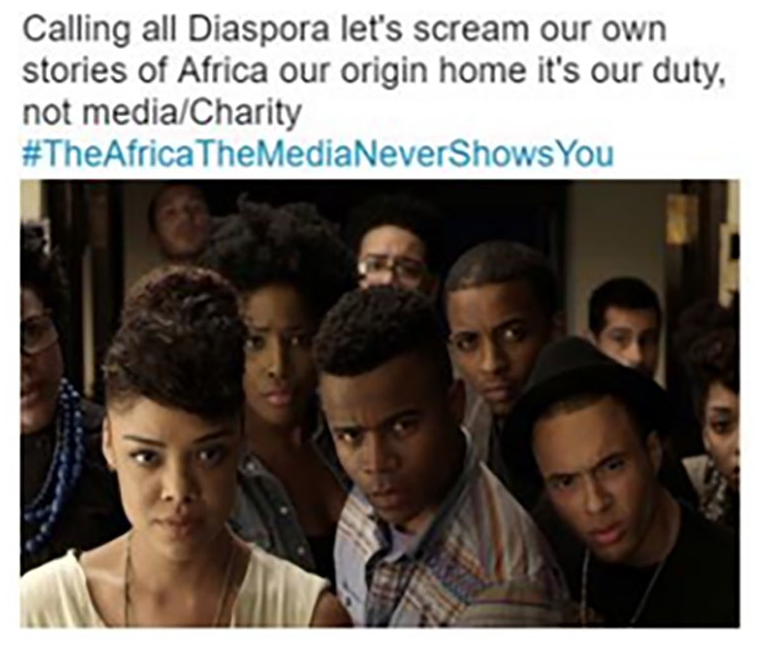
In terms of discursive practices, a prominent theme expressed by almost all participants was the use of the hashtag movement as a conduit through which they could forge communal identities orbited around ethnoracialised solidaristic orientations. They advised that uploading and (re)posting visual and textual material afforded them opportunities to articulate discourses of collective and self-representation within the public sphere where it was otherwise repudiated. Arguing the case that unlike the herculean dominance of the mainstream media through which development organisations set the representational tone and thematic standard against which Africa is seen and knowable, posting in commune with similarly racialised others provided a discursive forum to deploy autonomous and unmanned versions of themselves that stood in direct opposition to the media. For some, this meant self-expressions through pictures articulating a sense of ‘(co)responsibility’ in tackling Africa’s negative rendering as a unified diasporic assemblage. This is exemplified in the post below (Figure 1) by British Angolan, Tobias, a 21-year-old university student.
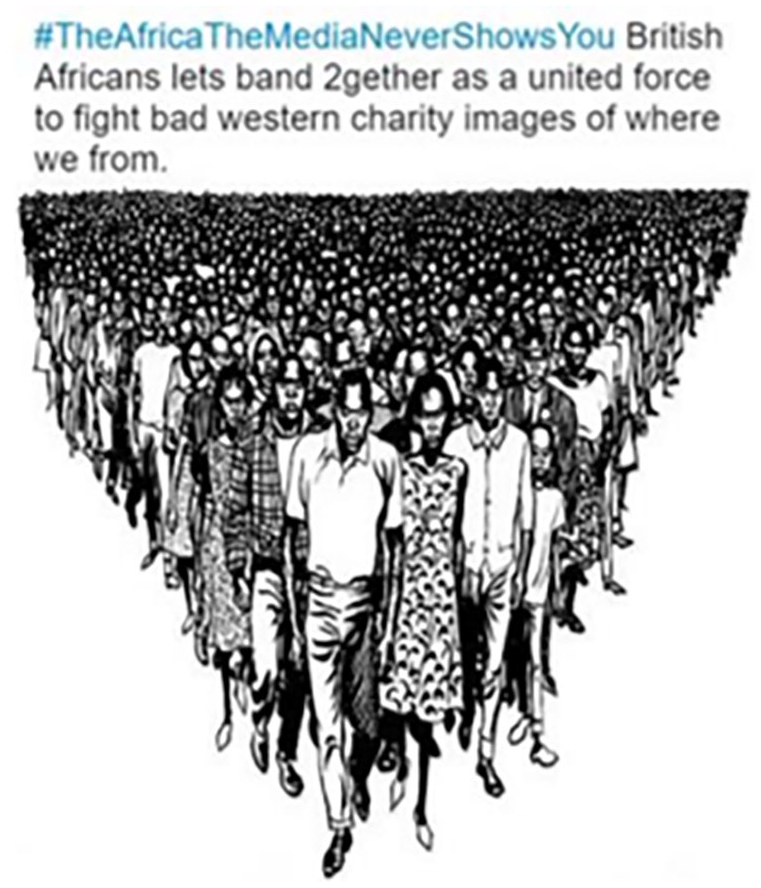
Post by Tobias.
The complementarity of this visualisation and its accompanied caption are striking, not least for its (and Tobias’) summoning for an assembled diasporic configuration of counter-corrective intent, united against the problematics of development-aid representations of a continent from which they originate. We see in this post a vast undifferentiated horde, conspicuous only by a few comprehensible Black faces with determined expressions, fronting what looks like the start of, or mid of, a protest. There is a certain evocation of grassroot ‘on the ground’ community mobilising of militaristic effect – a commune of Black ethnoracialised publics rallied in action and energetic verve. In a conversation with Tobias, he shared the following: What really grinds my gears is that Africa hasn’t got anyone speaking for it on its behalf, no one to help it tell its own stories on a worldwide stage from African perspectives, from people who know about what it means to be African and be from and live in Africa. Where are our stories? Our own African voices? That’s why I joined [the campaign] and shouted for other Africans to rally together to change things. Because we’re African, we have African culture we’re responsible for showing Africa the way we know it to be, it’s a duty really . . . instead of how charities mould it. I hate their images, they’re embarrassing, it’s like they own our image, our stories and that’s messed up. Africans are the only people who can show Africa authentically in a way that people don’t know because of who we are, because of our culture, our experiences of Africa. I want all Africans on Twitter to join the campaign and resist what the world’s been told about where we’re from, you know? (Tobias)
This lengthy but nonetheless illuminating passage unearths a few critical points, especially around the idea of unapologetically taking up self-invited space within the public domain, to make legible the prominent articulation of collective African diasporic voice(s), where they have been ostracised in the marginality of Africa’s media representation. For this participant and many others, continental Africa is without an amplified voice, a pan-racialised diasporic mouthpiece, with which to exercise self-determination of unique intent. Rather its stories, and by extension those of the diaspora, are rendered unintelligible within development’s media-assisted representational frame. Within Tobias’ comments, and as with his picture, he alludes to some sort of ‘ethnocultural authenticity’ bestowed to African-heritage minorities, which afford them permission, through the alembic of mutual identification, to offer a version of Africa against and beyond mainstream gaze. Additionally that, diasporic contributors to the #TheAfricaTheMediaNeverShowsYou movement are bounded by a supposed obligatory solidarism to seize ownership and authorship of representational Africa in public discourse.
These interpretations of discursive practices are not just the private ruminations of Tobias. Rather, solidaristic orientations of self-expression which gestured towards a struggle for mutual intelligibility of diasporic voice in the dominant sphere were similarly deduced by others.
British South African Annett, a 56-year-old midwife, for instance, whose tweet (Figure 2) expressed her contentment at the diasporic embrace of the hashtag and the strength in its unity, said: There’s always strength in numbers, this campaign is mobilising our collective strength and giving us the power as a group of people to take what’s rightful ours, our image of Africa. (Annet)
While 38-year-old Raphael’s post (Figure 3) simultaneously calls out development (namely, Oxfam’s unauthorised monopoly on African representation) and reminds diaspora of their supposed co-authorial responsibility for representing ‘back home’, and he commented that: We have formed of our community here as Africans in England . . . there’s a confidence emanating from our shared pursuit our common goal to be heard. (Raphel)
Relatedly, 35-year-old Angolan-Brit Linda, who was responsible for the post below (Figure 4), which seemingly implores a collective defence of familial siblinghood drawn from her strategic appropriation of the Musketeers ‘all for one and one for all’ motto, shared the following: People have started creating their own families on this platform by joining the campaign. We are truly brothers and sisters in our joint irritations with the media’s idea of Africa. I’m tired. We’re all tired, but at least we’re in this together. (Linda)
In an interview with 30-year-old British Nigerian Dennis, who posted the below tweet (Figure 5), he shared how a diaspora ‘alliance’, as he described it, was fundamental in ‘rebranding Africa’s woe-is-me image’ in mainstream media and how #TheAfricaTheMediaNeverShowsYou has facilitated this: We want the average Joe, the general public, to know about an Africa that we know [about] not them [mainstream media]. We want to show the images that we identify with, images that reflect our culture and what we’ve seen with our own eyes. For too long poverty charities, the media and whatnot, have controlled our image and we are forcing our way to be heard and to give our own input on our own terms so that people can see a different type of Africa. That’s what I like about it [the campaign] it’s a type of retaliation with images. We’re coming together to make African voices matter I guess, we feel we have a duty to help each other because we share cultures, so we help each other. (Dennis)
Again, Dennis’ comments recapitulate shared sentiments across the participant sample in the perception of the construction of a networked community of belonging whose members are joined and sustained, even if momentarily, in a consensual vision and common good. Dennis positions diaspora as instrumental in driving the effort forward to show Africa in a different light through some sort of intra-community sanctioned contestation. Similarly, he alludes to the notion that the media, including representations by charities, have monopolised popular conceptions about Africa(ns) and this has silenced their voices. As such, his message is one of assembling ‘African selves’ in the exclusionary practices of the mainstream.
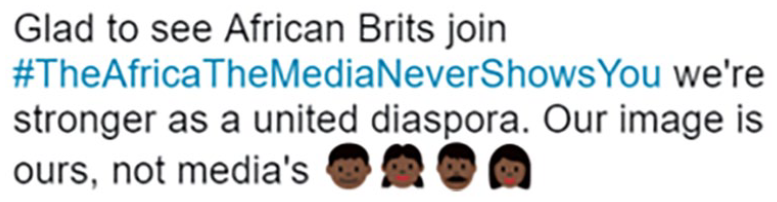
Post by Annett.
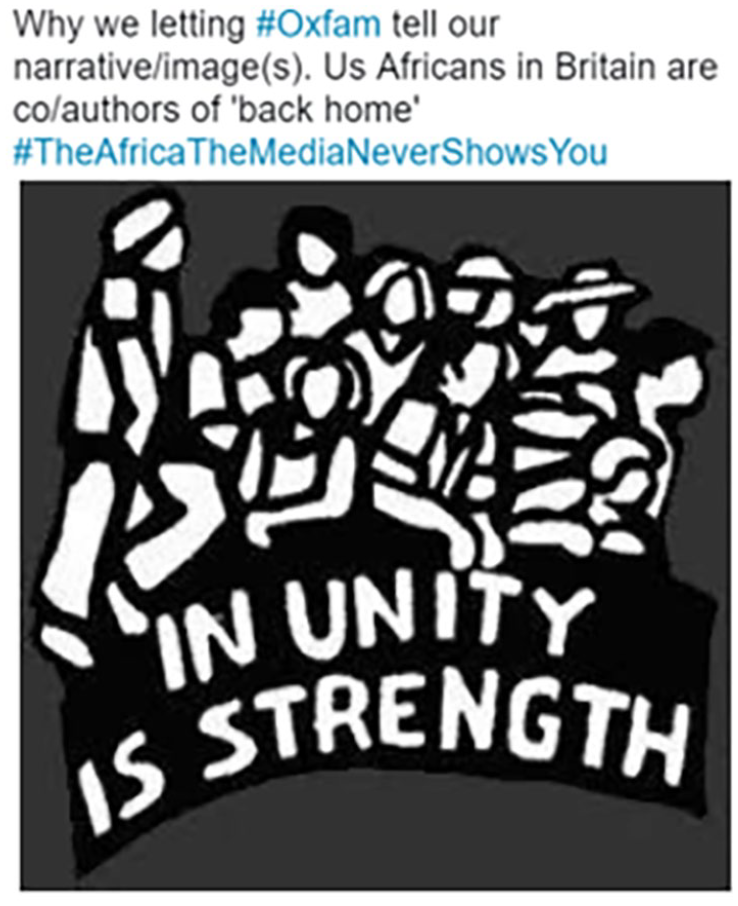
Post by Raphael.
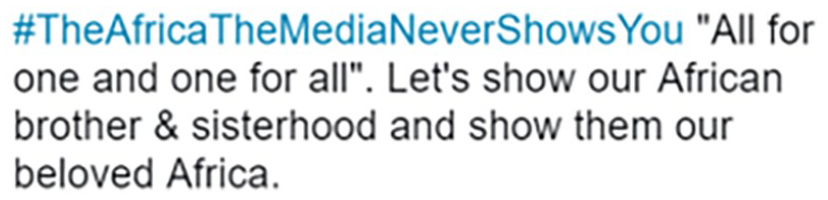
Post by Linda.
Post by Dennis.
Within the parallel discursive arena of the digitalised #TheAfricaTheMediaNeverShowsYou movement, African diasporic communities situated within the UK are thus able to articulate solidaristic orientations around mutually affirming identities that are unperturbed by the interruptions of the media’s dominant representational gaze. This forging of a microblogging virtual alliance tethered to the commune of marginality has close semblance to the subalternity features and hallmarks of Fraser’s counterpublic. We see this in participants’ belonging within a pan-ethnoracialised plural community solidly anchored in the gravitational pull of their subordinated disenfranchisement and their recognition of this as significant in the louding of their hitherto inaudible voices and identities within the mainstream public sphere to enact change.
Diasporic solidarism as response to development’s institutionalised whiteness in representational practice
We are reminded by Fraser’s (1990) interpretation of Subaltern Counterpublics as being circumscribed by the conundrums and opportunities of their internalised polylateralism, among relations of aggrieved communities of colour. So too, that such publics are characterised by their peripatetic nature, which gives rise to contrarian and dissentient voices from within, that travel into multiple splintered directions of thought away from the core of its unifying appeal. Within this frame, another salient theme across the analytical corpus was the branching or splintering of contradictory discourses that added a textured nuance to participants’ interpretation of their Afrosolidarism. What I mean by this is, while several users articulated their ethnoracialised camaraderie within the Black cultural common place of the hashtag movement as a collective voice levelled at some amorphous omnipresent mainstream public, others took this one step further by (re)articulating their oppositional union as a response to and chastisement of an anthropomorphised white (male gendered) media.
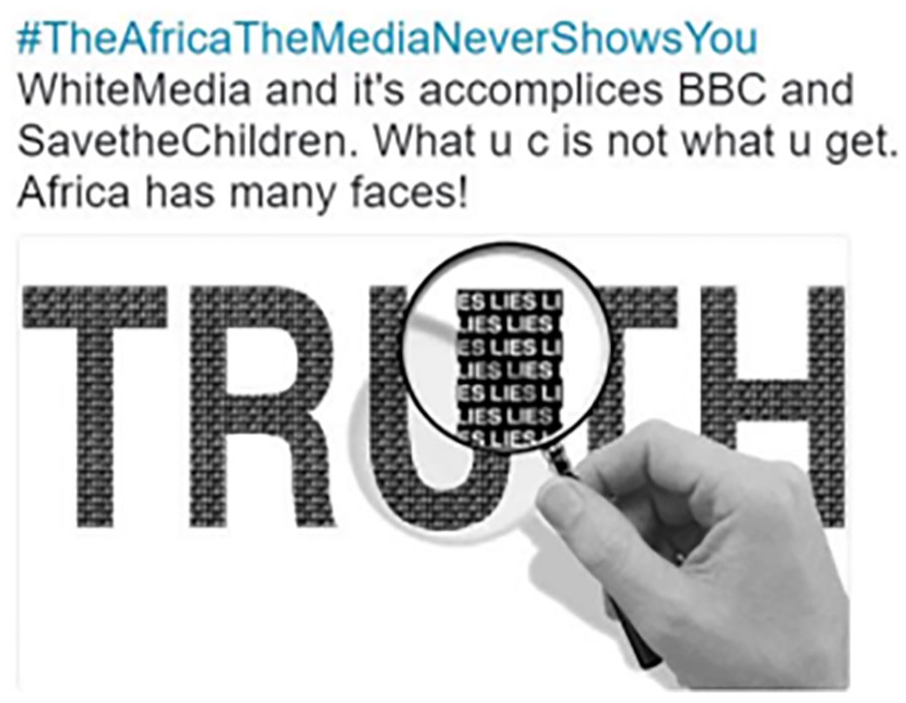
For some, their membership within this networked counterpublic thus constituted a deliberate agitation towards development’s institutionalised whiteness in African representation as mediated through a mainstream, ostensibly white media, including the BBC news and popular charities. This subsect of online diaspora viewed the British and broader Western media as informed and shaped by communities of predominantly white media professionals and their tacit whiteness, who are themselves responsible for contorting Africa’s negative image. This is shown in the following posts accompanied commentaries:
We see here, for instance, (Figure 6), that there is some sort of conspiratorial attribution of complicit whiteness to the BBC news and charity Save the Children, as supposed emissaries of mainstream white media. Forty-year-old Penelope who was responsible for this post advised that: As my picture suggests we as Black people have to peel off the white media’s onion layers of what they present as the truth about us Africans to reveal the dirt of their falsehoods. It’s their whiteness that we, as a unit, are fighting against. (Penelope)
Post by Penelope.
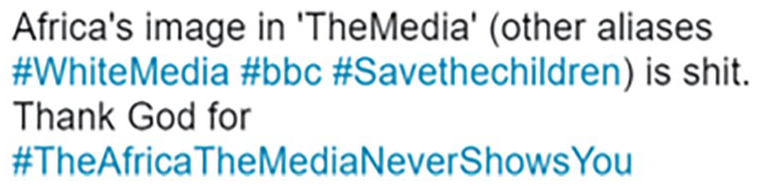
Again, in this post (Figure 7) uploaded by 30-year-old support worker Doubiba, we see similar speculative correlations of the mainstream media and whiteness, with alleged co-conspirators – the BBC and Save the Children, held responsible for Africa’s representational inertia.
Post by Doubiba.
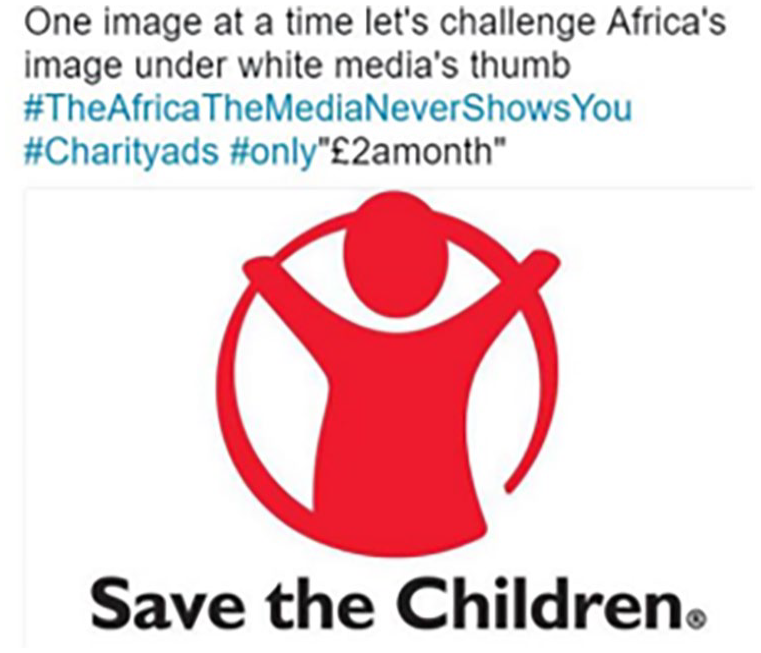
Similarly, for 19-year-old Nigerian Tina (Figure 8), the mainstream popularity of Save the Children and their problematic African representation epitomises an institutionalised ‘white media’. She identifies them and similar development charities as targets for online diasporic resistance, and arguing that: Africa’s image is under the white media’s thumb and the reason why I attached the Save the Children logo is because they are in my opinion one of the main and most recognisable faces of the white media when it to comes African images here in the UK. I just imagine all these white bigwig executives and media professionals coming together trying to come up with yet another way to patronise where I’m from. I just don’t trust these charities and their ways especially when it comes to Black people. (Tina)
In an interview with Hadid, a 28-year-old management consultant of Somalian heritage, who posted the below image (Figure 9), he stated: We have to fight mainstream white media, their TV programmes, news, adverts, all these white people over there in the BBC and Save the Children and so on, behind the scenes running the show and calling the shots, they are the ones that are making decisions about how to show Africa as this awfully poor place. They set the tone, they are the ones that trick people into thinking about Africa in one way or another. They’ve got so much power and influence. I’m not here for it, it’s gone on for far too long. This is our cyber warfare against them. (Hadid)
As demonstrated in this quotation, Hadid’s perceptions of the media’s white(ness) complicity are equally palpable and frames interpretations of his discursive practice(s) as an assemblage of Afrodiasporic resistance or ‘cyber warfare’ as he describes, against the representational sovereignty of the public sphere. The omnipotence of this mainstream is such that, in his estimation and that of other participants, it ultimately determines and orchestrates the means through which Africa is communicated. Indeed, similar sentiments were echoed by 29-year-old Antonia in her anthropomorphised ‘white-man’ media conception of a British media as a racialised rhetorical figure against which a unified diaspora are resisting. Specifically, she cautioned how: It’s the white man’s media that turns the tap off and on about what people know and see about Africa, they are pulling the strings you know? They’re the ones that spread these lies and myths about Africa being poor. That’s why we are here to spread the truth, to say ‘look there are alternative views you know?’ (Antonia)
By understanding diasporic solidarism as response to development’s institutionalised whiteness, the #TheAfricaTheMediaNeverShowsYou movement as a conspicuously Black ‘racialised hashtag’ of Sharma’s (2013) interpretation becomes more salient. In the sense that the racialising element of the movement enters a new realm of meaning from being raced by dint of the diasporic Blackness of its consistent features, towards a racialisation that is conceived as Black-led confrontations of an amorphous whiteness. As such, there is an epistemological shift from the campaigns ‘racialised hashtag’ being a representation of intra-community Blackness towards a Black subaltern self-positioning in relation to dominant discourses of mainstreamed whiteness.
Post by Tina.
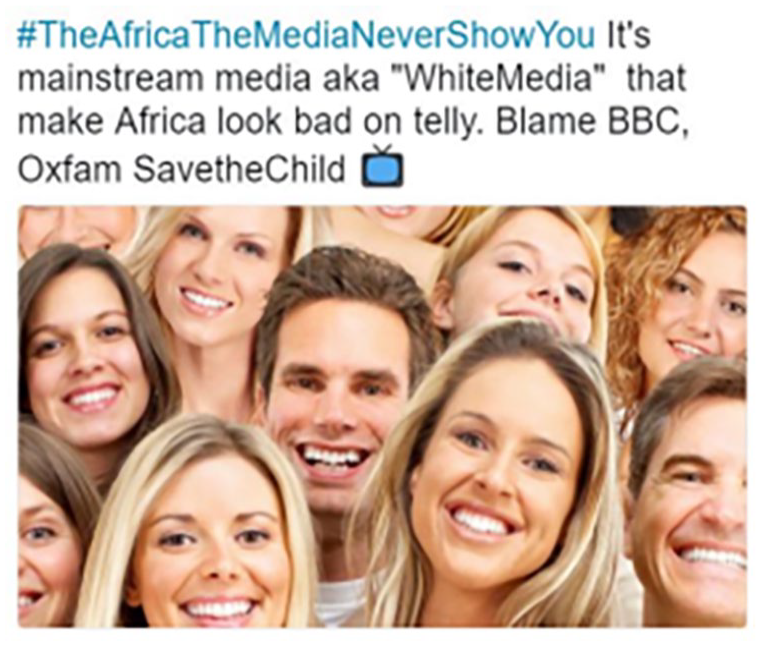
Post by Hadid.
Countering Africa(n) Misrepresentations
If articulations of ethnoracialised solidaristic orientation among networked diaspora characterises the interiorities of their Subaltern Counterpublic discourse and affectivity, their appropriation of #TheAfricaTheMediaNeverShowsYou to counter Africa(n) misrepresentations in the mainstream (white anthropomorphic) sphere demonstrates its exterior expression and intent. All participants maintained that develo–pment via the conduit of mainstream media negatively stereotyped Africa(ns), and that emphasising this point incentivised their discourse. Within this frame, 41-year-old Ugandan Brit Amir advised that diasporic counter-hashtagging often occasioned lengthy impromptu microblogged discussions around how: Africa isn’t authentically portrayed in British media . . . in fact western international media generally, and reduced to a miniaturised image of a charity basket case. (Amir)
They often described how Africa was presented and made publicly comprehensible via negative and hyperbolic mainstream media coverage prioritising discourse(s) around: impoverishment, victimhood, diseases, political ineptitude, economic woes, and social upheaval. Another participant stressed that the hashtag campaign sought to demonstrate Africa’s nuanced everyday ordinariness and accomplishments from a diasporic viewpoint, which otherwise were peripheralised in Britain, and challenged the propensity to view Africa(ns) in framings of ‘inadequate characteristics’ (Andreasson, 2005: 972).
Indeed, these diasporic users felt that a fundamental component of their posts was to over-emphasise the fact that Africa, of a personal recognition, was not sufficiently or fairly represented in UK media or society. As one 36-year-old participant said, ‘There’s an urgency for us to express ourselves, because we don’t feel a place we know, or heard about through our parents and grandparents, is favourably shown by the mainstream’.
In their attempts to create (often witty and sarcastic) oppositional counter-visualities that problematise popularised interpretations about Africa’s underdevelopment, participants reported a joint commitment towards redefining and ‘remixing’ as one put it, the continent’s troubling image. For example, some referred to the fact that they sought to invalidate various legitimising myths and misconceptions that have become seemingly commonsensical such as Africa’s homogenously famished populations. Samuel of Ivorian heritage, referencing his post (Figure 10), argued that: The title is deliberately ironic, I’m shaming the media by pointing out the contradictions between what the media shows and how Africa really is, there’s no drinking from dirty streams, eating bugs or chronically hungry-looking people, just food like every other place has got. (Samuel)
Similarly, 30-year-old Ugandan Brit posted this striking photo compilation (Figure 11), advising that: My caption is a play on words, I’m telling the world that Uganda is a fruitful country, Kampala our capital is known for its roadside fruit vendors. But I also wanted to show how Africa as a whole is fruitful in that it is a bounty of food. We are not lacking as the media purports, they always show Africans as dying and needing food donation, it’s overstated. (Raphael)
If not problematising Africa’s supposed food scarcity amidst its apparent abundance, others stated that their castigating posts questioned underdevelopment as Africa’s publicised face (Scott, 2014). This was achieved through showcasing how the continent is internally differentiated and contradictory, educated, had democracies, scientific advancements, and was a bourgeoning infrastructural and economic giant. As one participant put it: We’re pointing out that it’s [Africa] not as behind the times as these popular charity ads will have you think in the media, but leading it. Africa is truly complex, complicated and a force to be reckoned with. (Nneka, 20)
Others stated that in countering mainstream discourse they sought to discredit widespread secondary notions that Africa did not have contemporary cultural arts and entertainment, luxury lifestyles, or promote tourism and leisure beyond its wildlife conservations. As is evident in the following tweets: Kofi (Figure 12) for example, showcased a popular canopy walk at Ghana’s Kakum National Park frequented by tourists, while Kunle (Figure 13) sought to highlight a luxurious Rwandan hilltop hotel.
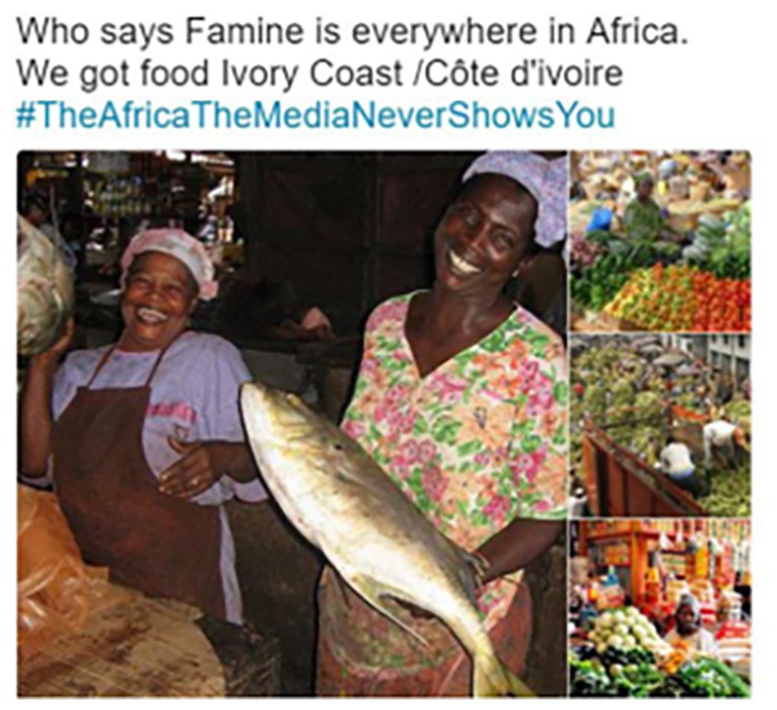
Post by Samuel.
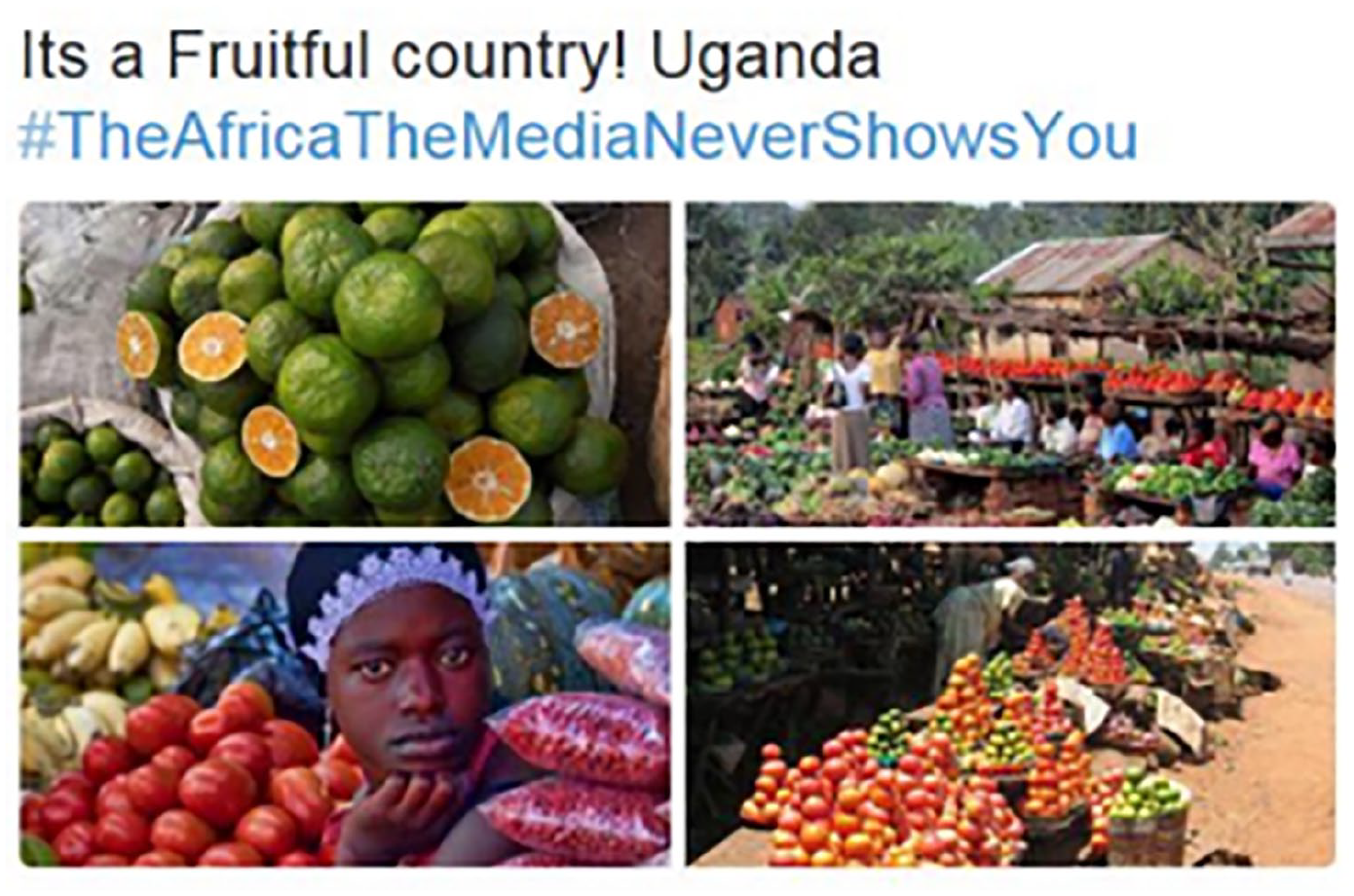
Post by Raphael.
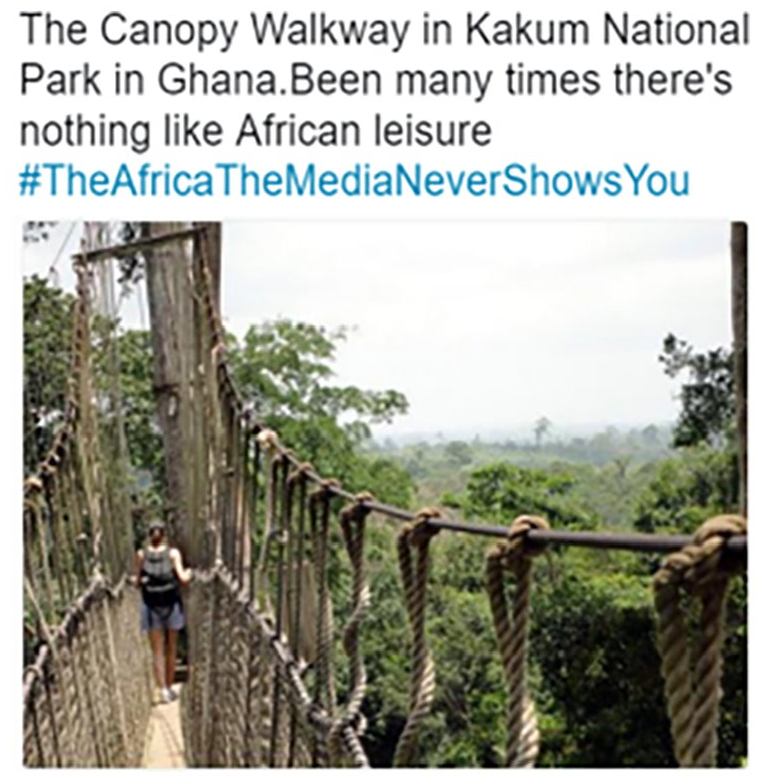
Post by Kofi.
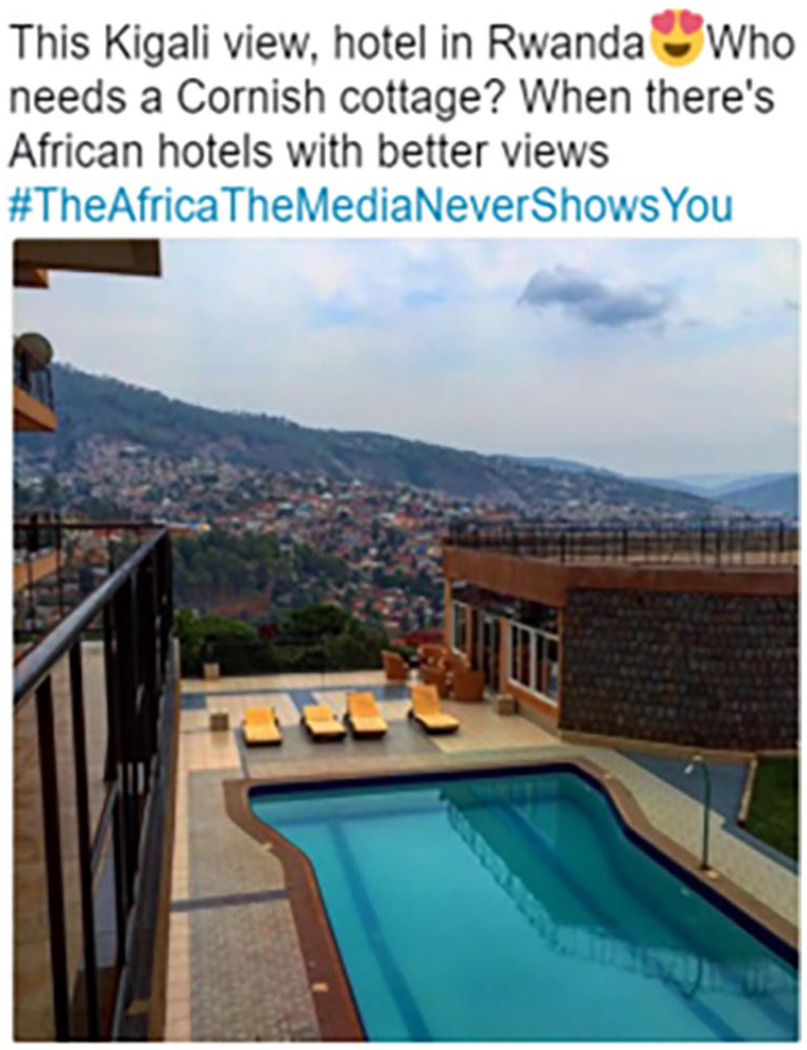
Post by Kunle.
Twenty-one-year-old Beni who uploaded the mocking image below (Figure 14) of Nigerians enjoying an amusement park ride, stated: For some reason the media show Africa as not a fun place, it’s like Africans don’t even know what fun is or have any fun at all. If you watch the TV it always shows us as down-and-out, always miserable and downcast and they give this idea that Africa is like boring or pointless to live in. It’s like charities think we don’t have much else to think about other than being poor yet alone make room for fun. We must show images like this to let people know that we have these things too, fun isn’t a British thing. (Beni)
As such, much in the spirit of Fraser’s (1990) articulation of subaltern counterpublics as the invention and circulation of counter-discourse to describe social reality and facilitate the formation of oppositional identities and uptakes, the chorus of subversive counter-visualities (re)produced and shared by diaspora are their own contestatory discursive creations of often comical-style, intended to redefine and problematise Africa’s representational script in the mainstream populous.
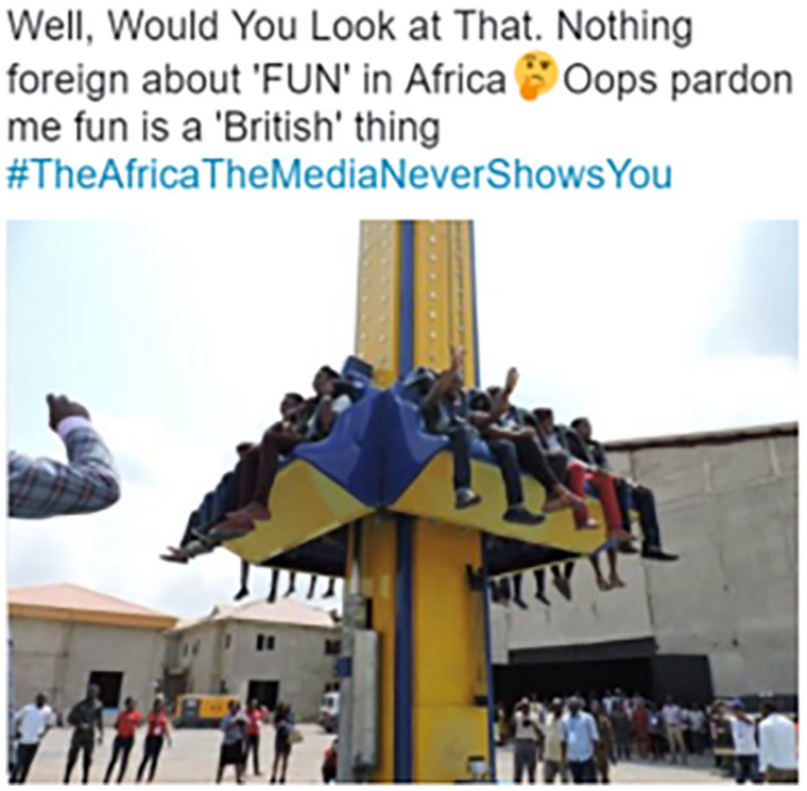
Post by Beni.
Conclusion
As Fraser (1990: 67) advised, within hierarchic inegalitarian civilisations where ‘deliberative processes tend to operate to the advantage of dominant groups’, minority and marginalised sub-populations materialise as Subaltern Counterpublics. These counterpublic formations are parallel discursive forums in which constituent members establish cooperative (sometimes contradictory) identities and interests and oppositional and counter-discourses that challenge dominant, majoritarian discourse and presupposition in the public sphere. Through the complementarity of inter-and-intra(diaspora)public dynamics, this is conspicuous in the context of development-driven media representations of Africa where, denied equitable participation within the dominant public’s representational monopoly, UK African diasporic communities have appropriated the #TheAfricaTheMediaNeverShowsYou social media movement to create an alternative space. As a community of belonging orbited around ethnoracialised Afrodiasporic solidaristic orientations of reciprocated marginalisation, this space afforded them the opportunity to partake in various discursive practices aimed at thwarting and reconstituting Africa’s representational inertia which increasingly constrains its adaptability to nuanced and textured renderings in mainstream media.
Just as Fraser (1990) decried the utopian ideals of Habermas’ bourgeois public sphere, however, caution should be exercised to not overstate and (over)romanticise diaspora solidaristic efforts online as a ‘Ctrl-Alt-Del’ reformatting of the media’s representational zeitgeist for Africa. This is especially true in confrontation with the omnipotent and anthropomorphised whiteness of campaign-driven mediated development which makes any disentanglement of its parasitic relationship with African underdevelopment, and the representation of it, an impossible, arduous task. This questions whether diasporic oppositional attempts offer any reparative possibility given the fixed procrustean lens of whiteness as development’s current term of representational reference.
Nonetheless, diasporic counterpublic tweets constitute part of a broader constellation of discourses that allow them to unmute their oppositional voices in the covalent bonds of networked ethnoracialised camaraderie, where they are otherwise rendered soundless offline. Thus, as an Afrodiasporic Subaltern Counterpublic, diaspora potentially are the pickaxe crevices to the veneer of Africa’s cancerous image.
Supplemental Material
sj-docx-1-sro-10.1177_13607804231193959 – Supplemental material for #TheAfricaTheMediaNever ShowsYou: An Afrodiasporic Subaltern Counterpublic
Supplemental material, sj-docx-1-sro-10.1177_13607804231193959 for #TheAfricaTheMediaNever ShowsYou: An Afrodiasporic Subaltern Counterpublic by Edward Ademolu in Sociological Research Online
Footnotes
Funding
The author(s) received no financial support for the research, authorship, and/or publication of this article.
Supplemental material
Supplemental material for this article is available online.
Notes
Author biography
References
Supplementary Material
Please find the following supplemental material available below.
For Open Access articles published under a Creative Commons License, all supplemental material carries the same license as the article it is associated with.
For non-Open Access articles published, all supplemental material carries a non-exclusive license, and permission requests for re-use of supplemental material or any part of supplemental material shall be sent directly to the copyright owner as specified in the copyright notice associated with the article.
