



Abstract
This article explores the operationalization of transnational habitus by scholars to understand how individuals experience mobilities across borders. Our scoping study of 21 scholarly publications focuses on the various ways in which transnational habitus is defined as well as the different approaches to theorizing a transnational habitus. In critically mapping the relatively short history of transnational habitus, we are interested in what about habitus appears particularly generative to scholars interested in migratory experiences. The study first charts the sociological scholarship to date on transnational habitus and how it is used to understand the ways in which transnational migrants negotiate and navigate their social and cross-border mobilities. Then, to critically appraise these theorizations, the analysis focuses on two key trends in the literature: treatment of clivé/adaptation and the role of time(lag)/temporality before addressing two key silences in the use of transnational habitus – specifically gender and consideration of differences in class background.
Introduction
Bourdieu famously wrote, ‘when habitus encounters a social world of which it is the product, it is like a “fish in water”: it does not feel the weight of the water, and it takes the world about itself for granted’ (Bourdieu and Wacquant, 1992: 127). As Bourdieu conceives of habitus as the social world in the body and the body in the social world (Bourdieu and Wacquant, 1992: 20, n35), he largely confines the social world within the boundaries of the nation-state. In a careful trawl through Bourdieu’s sociological oeuvre we see some discussions concerning neoliberalism and globalization (Bourdieu, 1998c, 2003), the international circulation of ideas (Bourdieu, 1999), as well as global media field (Bourdieu, 1998a) and a field of world sociology (Bourdieu, 1991). However, transnationalism is only sporadically scattered across his publications though his scholarship on a whole does engage with ‘the existence of transnational fields’ (Bourdieu, 2000: 98). Typically, a transnational field is defined as ‘an unbounded terrain of interlocking egocentric networks that extend across borders of two or more nation-states and that incorporates its participants in the day-to-day activities of social reproduction in these various locations’ (Fouron and Schiller, 2001: 544). Transnational social fields, therefore, are spaces for the negotiation and evolution of social relations but are also spaces where mobile individuals become agentic.
Our article is positioned within the plethora of revisionist approaches for putting Bourdieu’s theory into action which result in commonalities, divergences, complexities, and debates. In terms of transnational habitus, it remains a complex concept where one could argue the grounds of the symbiotic relations between field and habitus, in this case a transnational field would structure and would be structured by a transnational habitus. Though this, of course, raises the question of what precisely is a transnational field and what precisely is a transnational habitus. Indeed, Schmidt-Wellenburg and Bernhard (2020) write,
the question arises whether there is such a thing as transnational habitus, or if it exists only in the everyday perception as a caricature and empirically thin mirror image of national habitus. The indication of having lived abroad – in another ‘nation’ – is not enough to define transnational habitus. (p. 11)
Extending this thinking, Carlson and Schneickert (2021) are equally cautious in defining a transnational habitus, specifically in terms of the extent to which the habitus changes through transnational experiences where, drawing on Lahire, they call attention to the ‘range of dispositions as a result of potentially quite varying socialization experiences’ (p. 8). With this in mind, this article is developed to tease out aspects of the consents and dissents surrounding the operationalization of transnational habitus. We ask, what may make a habitus ‘transnational’ and how are scholars defining and operationalizing transnational habitus?
Along with other scholars, we are interested in ‘transnational habitus’ – as a provocative tool to think with – and how it shapes our understanding of a ‘national habitus’ or a ‘home habitus’? Foundational to the work is questioning the analytical advantage of using habitus to further our understanding of transnational migration, instead of the other theoretical concepts frequently used in the migration and transnational fields literature, such as ‘identity’ or ‘sense of belonging’? Furthermore, what role may the digital play? In beginning to answer some of these questions, the article first maps the relatively short history of transnational habitus where we investigate what about habitus appears particularly salient to scholars interested in transnationalism, migration, and globalization. We will focus on how such a tool lends to understandings of the extent, the form, and the degree to which ‘nationality’ and ‘transnationality’ are sedimented in a given habitus (Schmitz and Witte, 2020: 88).
This article is part of a research agenda addressing how concepts and tools are reformulated, redeployed, and re-engaged in transnational contexts, specifically in reference to social class and gender across borders. Fresnoza-Flot and Shinozaki (2017: 871) write there exists a ‘relative absence of systematic discussion around social class in the literature on migrant transnationalism’. This absence has been further addressed by Rye (2019), Van Hear (2014), and Soong et al. (2018) who call attention to the globalized and diasporic nature of class identity today. Regarding other intersectional factors, Pessar and Mahler (2003) has long called for bringing gender into the study of transnational migration where they contend ‘[g]ender is one of the oldest, if not the oldest, forces shaping human life and, accordingly, it influences migration and migrants’ lives’ (p. 182). They propose an analytical framework composed of three building blocks: the ‘geographic scales’ where gender operates on multiple spaces of the body, the family, and the (supranational) state; the ‘social locations’ where gender complicates the positional advantage and disadvantage along social hierarchies; and the ‘power geometries’ where people exert gendered agency to claim access to and power over spatial flows. Informed by these critiques regarding class and gender, we focus on what a transnational habitus lends to the study of identity within and across national boundaries.
To adequately address what transnational habitus may hold for scholars, we next posit some common theorizing on habitus more generally before a discussion of key approaches to the theorization of transnational habitus. Centering our analysis of how scholars have defined and applied transnational habitus, the second half of the article is also where we supply a critical appraisal of these theorizations. After all, in adapting or revising Bourdieu’s tools, certain aspects may get lost and/or enhanced depending on the scholarly focus. For example, in nearly all the articles we surveyed, the word ‘transformation’ and ‘transformative’ plays a role at some point in how a transnational habitus is understood. As we will discuss later in the piece, we would caution against this wording not only because it stretches Bourdieu’s original intent regarding habitus but also because of the entrenched nature of inequality globally and within nation-states.
Analytical foundations in theorizing of habitus
Scholars have found that habitus offers rich explanatory potential in understanding how individuals are seen as agents aspiring beyond their present circumstances. While Bourdieu’s ‘thinking tools’ have been used to explore the nature of social inequality, sociologists and social theorists have found Bourdieu’s tool of habitus to offer generative ways to consider how inequalities work at both a corporeal and a cognitive level in relation primarily to capital and field. There appears to be consensus among Bourdieusians that habitus is a socialized body, a structured body, or ‘a body which has incorporated the immanent structures of a world or of a particular sector of that world – a field – which structures the perception of that world as well as action in that world’ (Bourdieu, 1998b: 81). Habitus, as a ‘conceptual linchpin’ for analysis (Bourdieu and Wacquant, 1992: 120), allows for the study of individual and the collective dispositions while also demonstrating how individuals’ perspectives, values, and actions are formed through an ongoing negotiation.
For Bourdieu (2000), the precise function of habitus is to restore to the agent: a generating, unifying, constructing, classifying power, while recalling that this capacity to construct social reality, itself socially constructed, is not that of a transcendental subject but of a socialized body, investing in its practice socially constructed organizing principles that are acquired in the course of a situated and dated experience. (pp. 136–137)
As the ‘social embodied’ is ‘at home’ in the field it inhabits, habitus is endowed with meaning and interest (Bourdieu and Wacquant, 1992: 128). Bourdieu (2000) further charges the habitus is both ‘systematic (or, on the contrary, divided and contradictory) and constant (or fluctuating and variable)’ depending ‘on the social conditions of its formation and exercise . . .’ (p. 64). However, as Reay (2004: 431) notes, habitus remains ‘a complex concept that takes many shapes and forms in Bourdieu’s own writing’ over his many years of scholarship (for further critique see also Kelly and Lusis, 2006).
We briefly outline the main foundations of habitus across the Bourdieusian corpus. First, habitus is central to Bourdieu’s structuralist constructivist approach (Bourdieu, 1990: 123), an integral part of his attempt to transcend dualisms of agency and structure as well as the objective and subjective. Habitus, as socialized subjectivity, is a tool which allows for both structure and agency, as well as the individual and the collective. In terms of the relational structure between habitus and field, the habitus is never fully determined by structure – instead habitus represents a constant interaction between structure and agency. Second, for many scholars, the habitus is focused on the unreflexive deliberations where it captures ‘the intentionality without intention, the knowledge without cognitive intent, the pre-reflective, infra-conscious mastery that agents acquire in the social world’ (Bourdieu and Wacquant, 1992: 19). Habitus contributes to ‘constituting the field’ as meaningful, 1 a world endowed with a ‘sense and value, in which it is worth investing one’s energy’ (Bourdieu and Wacquant, 1992: 127). Third, the habitus, as a collection of vying dispositions which may be brought to the fore depending on the field, seeks harmony and consensus, what Bourdieu calls a ‘unity of style’ where habitus is a ‘unifying principle’ (Bourdieu, 1988: 49). As a matrix of dispositions, the habitus therefore is often conceived of as a classificatory scheme, a practical sense, actively figuring out the game regarding what is useful and what is not as it seeks to accrue capital.
The fourth analytical foundation extends the notion of harmony and cohesiveness and, therefore, it concerns the notion of disjuncture - what Bourdieu calls a habitus clivé, where a habitus does not accord with the logic of the field and individuals feel like a ‘fish out of water’ (Bourdieu and Wacquant, 1992: 127). Within arguments concerning the habitus clivé, the dialectical confrontation between habitus and field (other than the field of origin) does result in a degree of accommodation, where the habitus accepts the legitimacy of the new field’s structure and is, in turn, structured by it, thus enabling a modified habitus although not immediately due to the durability of the habitus and its attendant ‘hysteresis effect’ (Bourdieu, 1977: 78) or the ‘Quixote effect’ (Bourdieu and Passeron, 1977: 160).
After all, for Bourdieu, habitus and field exist in a conditioning relationship: ‘the field structures the habitus, which results from the incorporation of the immanent necessity of this field or of a set of more or less concordant fields; the disagreements may lead to a divided, even severed habitus’ (Bourdieu and Wacquant, 1992: 102–103). Field, according to Bourdieu, is a ‘set of objective, historical relations between positions anchored in certain forms of power (or capital)’ where each field ‘prescribes its particular values and possesses its own regulative principles’ where it has a ‘specific gravity which is imposed on all the objects and agents which enter it’ (Bourdieu and Wacquant, 1992: 16, 17). However, it is problematic to extrapolate habitus–field relation to transnational contexts without serious treatment of the concept ‘transnational habitus’. It is this concept to which we now turn.
Defining a transnational habitus
Ideas of transnationalism, as an existing social practice highly influenced by globalization, have been explored in numerous sociological domains, for example, the construction of typologies of diasporic space (Voigt-Graf, 2004), forms of economic connections through remittances and ethnic enterprises (Martone et al., 2011), and the transformation of gender relations (Pratt and Yeoh, 2003). In its early conceptualization, transnationalism was used by Bourne (1916) in ‘Transnational America’ to define the importance of the American immigrants maintaining their culture. The concept of transnational offers an alternative lens to look at the social conditions that sustain the flow of migrants, and a different frame with which to understand the experiences of mobile subjects. Within studies of the transnational experience, Soong et al. (2018) assert the notion of transnationalism inherently suggests ‘some form of common identity of cross-border individuals or groups’, one that is based on their cultural or linguistics dispositions or place of origin (p. 243). In this vein, maintaining one’s culture, engrained in the habitus, remains central to the investigation of how transnational individuals grapple with the experiences formed in their country of origin and the mis-match with their present context.
It was Guarnizo (1997) who first introduced the concept of transnational habitus writing: ‘Transnational actors should rather be conceptualized in terms of the kind of transnational practices and powers they have access to and are able to activate’ (p. 292). Within studies drawing on transnational habitus, as a conceptual tool, there seems to be general consensus that the mobility from one field to another brings the habitus into disjuncture, where agents are often presented with a plethora of new challenges and previous affiliations are reaffirmed or rescinded. Returning to Guarnizo (1997: 311), he writes,
The transnational habitus incorporates the social position of the migrant and the context in which transmigration occurs. This accounts for the similarity in the transnational habitus of migrants from the same social grouping (class, gender, generation) and the generation of transnational practices adjusted to specific situations.
Read in this way, a transnational habitus is typically operationalized in reference to how identities are constituted in relation to how inequalities form and are maintained in global and transnational contexts and how migrants/transnationals negotiate and navigate their social and cross-border mobilities. When agents are ‘in-flux’, their capacity to adapt to the new field becomes mitigated by the constraints in the structuring forces of the field of origin.
Over time, theorists who have built on Guarnizo’s work have elaborated different aspects of transnational habitus such as the temporal dimension of the period of readjustment, duality and dissonance, notions of a ‘new’ or secondary habitus, and the role of the digital. For example, recent research has highlighted how, as transnational actors, international students regard their international education as a resourceful vehicle to help them ‘become’ the individuals they aspire, and further shape their transnational mobility (Tran, 2016). Meanwhile, how these actors strategically (re)shape their habitus in a cross-system setting has also been theorized with consideration of the influence of Internet-based technology on their transnational adaptation across different fields (Dai et al., 2020). What is surprising is the inadequate attention to a role the differentiation of class experiences has played in studies using transnational habitus which, we argue, has implications for our understanding of how inequalities are maintained in transnational contexts.
The major advantage of the tool of habitus is its emphasis on how an individual’s sense of agency is formed and maintained within social contexts (e.g. fields), rather than thinking of their actions, motivations and aspirations as simply rational calculative behaviours for accumulating resources (e.g. capitals). Depending on one’s interpretation, not every habitus may become a transnational habitus and/or a transnational habitus may not be acquired with equal ease. An argument could be made that to theorize transnational habitus adeptly requires using habitus appropriately, drawing on commonalities in Bourdieusian studies, and then accounting for diverse and changing contexts as well as how dispositions form within and across those contexts (e.g. fields). However, as we will see, this is problematic given the diversity of approaches to operationalizing a transnational habitus.
Returning to the transnational experience, certainly an individual with a portfolio of middle-class capital(s) experiences migration differently than those with a portfolio of working-class capital(s). Van Hear (2014) notes in the transnational literature migration often presumes access to ‘economic, social, cultural, and other forms of capitals in various combinations’ (p. 111) without restriction where he further argues ‘even though class or socio-economic differentiation used to be mainstays of social sciences, they have arguably been underplayed in much of migration studies in recent years’ (p. 101). Focused on the transnationalizing of field analysis in reference to political sociology, recent scholarship from Schmidt-Wellenburg and Bernhard (2020) asserts there ‘is no such thing as a transnational habitus, only more or less transnational versions in relation to other more or less national or otherwise scoped versions’ (p. 14) where their theoretical work instead calls attention to how all ‘habitual dispositions are stances in the world’ as linked to ‘different sources of symbolic power’ (p. 14).
In structuring our approach to analysis, we are interested in what about habitus appears particularly salient to scholars in transnational and migratory studies. Given its different interpretations, our central focus is on how certain iterations of transnational habitus can work to answer questions regarding class restructuring as individuals migrate from their country of origin to a context that is foreign to them. We consider to what extent certain iterations of transnational habitus work as a tool to explore the inequalities interwoven with global migratory experiences or what Massey (2012) calls ‘power differentials in mobility’. The next section describes how we approached the relevant literature.
Aggregating literature on transnational habitus
Within studies operationalizing transnational habitus, there has been an emphasis on ‘transnational cultural capital’ and ‘transnational/global cultural capital’ (Soong et al., 2018; Zechner, 2017) or ‘migration-facilitating capital’ (Kim, 2018). Clearly habitus exists in relation to capital and field; furthermore, there is a complex and continual dialectic which contributes to analytical complexity when one considers how some migrants become a fish in many waters. However, while we acknowledge the importance of field and capital and the dialectical nature of working with habitus (see Reay, 2004), our article focuses primarily on analysing the commonalities and differences in scholarly theorizations of transnational habitus as tool.
This article presents a scoping study of transnational habitus; scoping studies to date have received surprisingly little attention in the research methods literature. Arksey and O’Malley (2005) distinguish between different types of scoping studies which differ significantly from scoping reviews and systematic reviews, each with their own advantage and disadvantage. They contend that scoping studies may come in four varieties: function as rapid reviews to critique a field of study; can do a preliminary mapping of literature which can determine whether a full systematic review is feasible and relevant; can summarize research findings; and identify gaps where no research has been conducted but it does not assess the quality of existing research. Arksey and O’Malley (2005), and others, emphasize how scoping studies are a consultative exercise.
Our approach to a scoping study was not a systematic review but instead exploratory and more appropriate for researchers ‘interested in the identification of certain characteristics/concepts in papers or studies, and in the mapping, reporting or discussion of these characteristics/concepts’ (Munn et al., 2018: 3). While systematic reviews typically answer a specific question, a scoping review maps the general kinds of studies that have been conducted and the different foci. Scoping studies synthesize and explore relevant empirical studies and what they have found with the aim of providing a snapshot of the topic (Arksey and O’Malley, 2005). We closely followed Arksey and O’Malley’s (2005) five-stage framework consisting of identifying the research question, searching for relevant studies, selecting studies, charting the data, and summarizing (see Table 1). Our research also closely follows what Anderson et al. (2008) refer to as ‘literature mapping’ or ‘conceptual mapping’ where there is scrutinizing of how a particular term is used in what literature. Levac et al. (2010) write how researchers ‘can use scoping studies to clarify a complex concept and refine subsequent research inquiries’ (p. 1). Methodologically, the approach analyses and explores relevant studies charting volume, themes, and the key characteristics as well as how they have been conducted and considers the ontological implications (Arksey and O’Malley, 2005) – a point to which we return in our discussion.
Author/year, overview of discipline, participants/stage of life, and location.
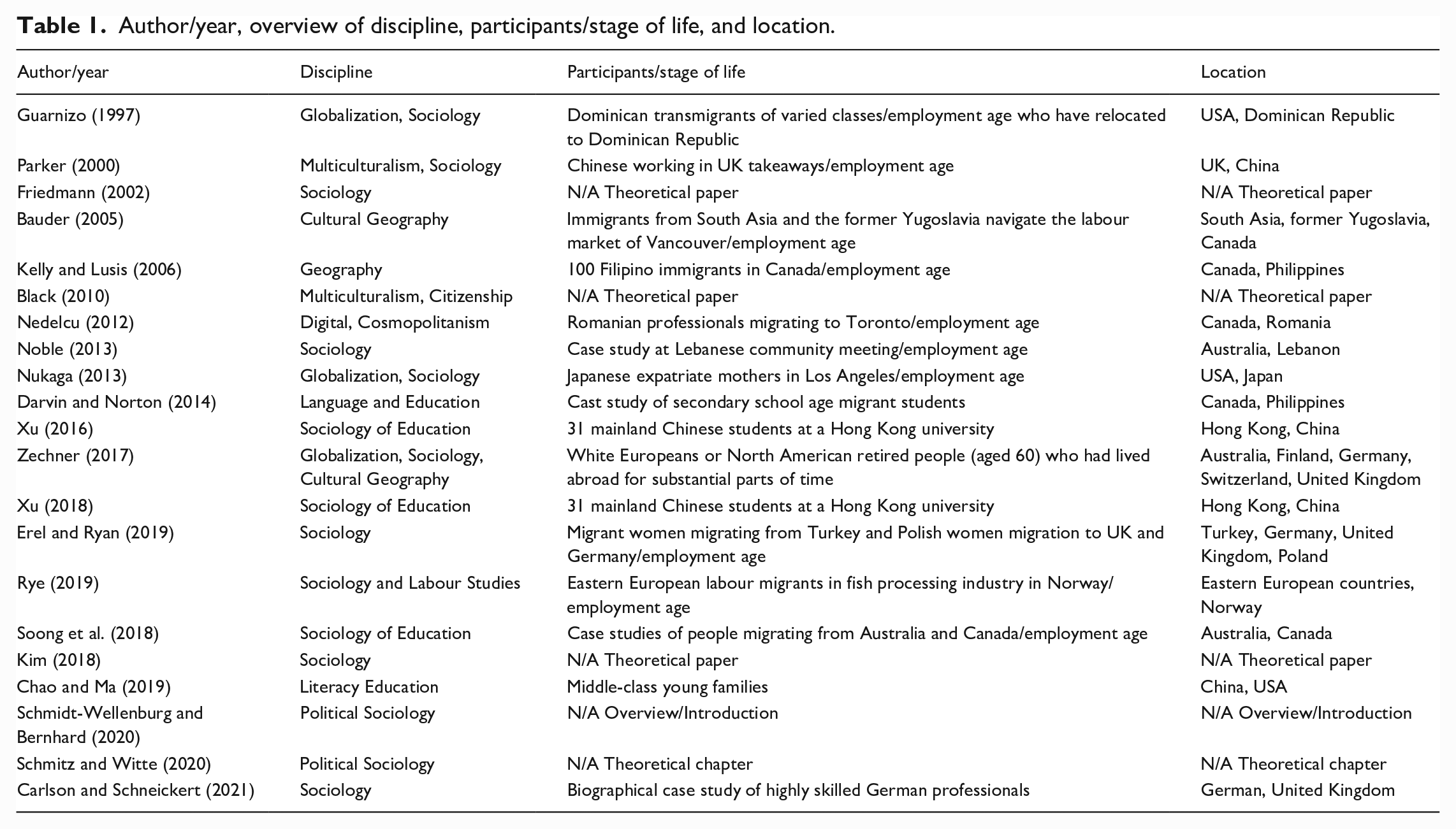
Included in our scoping study were 4 book chapters and 17 journal articles, all published in various disciplines (see Table 1). We first used Scopus, Web of Science, and Google Scholar to survey journal articles and book chapters dating from when Guarnizo (1997) first introduced the concept. As search engines are fallible, we also examined the citation list of each article and chapter. As we surveyed scholarly contributions, our inclusion criteria concerned scholarship which included the term transnational habitus. However, with this in mind, we have also included articles that did not directly operationalize transnational habitus as a key focus, but instead transnational habitus is mentioned to illustrate the wider theoretical context. Furthermore, we note that there were instances where the scholarly publication included the term ‘transnational habitus’ but the authors themselves remained critical. Also, articles focused on ‘transborder habitus’ (Xu, 2017, 2018) are included as well as ‘diasporic habitus’ (Parker, 2000) and ‘cross-cultural habitus’ (Noble, 2013) have been included as they have significantly informed the conversation regarding transnational habitus.
Schmidt-Wellenburg and Bernhard (2020) discuss pluralizing the concept of transnational habitus to include ‘different ‘scopes’: regional, local, national, international, and global contexts of habitus production, thereby abstaining from essentialism and taking the relationality of habitus seriously’ (p. 11). Within the publications we surveyed there was a wide diversity in terms of life course (e.g. new mothers, retirees, students), focus of study (e.g. employment, the digital, cultural conflict) from a wide variety of countries (e.g. Canada, Philippines, Australia, Hong Kong). Also, in terms of the 16 empirical studies, 6 focused on Asian migration to the West with the exception of (Xu, 2017) and Xu (2018). In considering how preceding literature has operationalized transnational habitus to understand the changing lives of individuals, we focus now on two wider key trends which were prominent in the transnational habitus theorizing, namely, treatment of clivé/adaptation and the role of time(lag)/temporality.
Treatment of clivé/disjuncture/duality/adaptation
Within the publications surveyed, there was an emphasis upon how transnational habitus allowed for an analytical consideration of disjuncture and adaptation in the transnational experience, specifically when agents encounter the new country/field but are still constrained by the structuring forces of the field of origin. As the habitus experiences clivé/disjuncture, this can lead to duality and/or adaptation and we consider these processes altogether. In his writings, Bourdieu (2000) claims: ‘. . . I have many times pointed to the existence of cleft, tormented habitus hearing in the form of tensions and contradictions the mark of the contradictory conditions of formation (of which they are the product) . . .’ (p. 64). When there are many people experiencing a tormented habitus, as was apparent in his research in Algeria, Bourdieu called this hysteresis (Bourdieu and Wacquant, 1992: 130). The habitus does not seek torment, it seeks cohesiveness closely aligned with its point of origin. The habitus, therefore, seeks to pursue a field where there is perceived rationality, where there is a logic in the field that complements the internalized logic of the habitus. Attention to the notion of unity is important as sociologists have often operationalized habitus in research on social mobility to explore the uncertainty that comes from disjuncture or a lack of unity (Reay et al., 2009).
Of the eight articles which mentioned ‘disjuncture’, ‘torment’, or clivé (or some version of a cleft habitus), the focus was on what we call negotiated assimilation in two interrelated areas: (1) duality and (2) adaptation. In terms of treatments of habitus and duality, there were seven articles which emphasized the importance of this with explicit mention of ‘dualistic dispositions’, ‘bifocality’, and ‘dual frames’ (Black, 2010; Carlson and Schneickert, 2021; Friedmann, 2002; Guarnizo, 1997; Kim, 2018; Rye, 2019; Zechner, 2017). This, it should be noted, was done in reference to notions of dissonance but drew attention to the generative capacity of the habitus (Bourdieu, 2000). It was Guarnizo’s (1997) seminal work on transnational habitus that used the term ‘dualistic dispositions’ where he considers this integral to how a transnational habitus is theorized as:
a particular set of dualistic dispositions that inclines migrants to act and react to specific situations in a manner that can be, but is not always, calculated, and that is not simply a question of conscious acceptance of specific behavioral or sociocultural rules. (p. 311)
The secondary habitus – or a destabilized habitus – enables agents to accept the particular messages which are doxic in the new field while simultaneously maintaining their key dispositions in their habitus of origin.
Two theoretical papers, by Friedmann (2002) and Black (2010), draw attention to duality, disorder and dissonance as central with Friedmann (2002) making explicit reference to how the habitus seeks harmony. Black (2010) notes how ‘habitus disorder is an expression of this cultural change produced by transnational practices, and the possession of dual citizenship presents socio-cultural implications in “home habitus” and in “host habitus” thus producing a new set of cultural configurations’ (p. 42) where he goes on to consider notions of bifocality which is not clearly defined. This notion of bifocality is also picked up by Zechner’s (2017) work on transnational retirees where he asserts there exists an attachment to multiple places and how the habitus adapts and incorporated new experiences, where the ‘repertoires of habitus are multiple and complex’ (p. 576). According to Rye (2019) and Carlson and Schneickert (2021), the habitus clivé is barely acknowledged, instead the emphasis is on benefits of both locations where, it is assumed, the habitus can successfully navigate these contrasting experiences between ‘here and there’ seamlessly and without cost. These studies, we argue, offer various interpretations of what Bourdieu (2000: 64) means by the ‘contradictory conditions of formation’ that mark the work of habitus clivé in influencing the migratory experiences of individuals.
During these moments of immigration and resettlement, affiliations may be reaffirmed or rescinded as agents are often presented with a plethora of new challenges. In terms of treatments of habitus and adaptation, scholars speak of ‘reinvention’ (Parker, 2000), the capacity to skillfully work across contexts (Nukaga, 2013), and the notion of an emergent ‘secondary’ habitus. 2 Erel and Ryan (2019) focus their attention to ‘gains, losses, reorientations’, while both Rye (2019) and Xu (2018) draw attention to capital conversion and drawing the benefits from both locations. In terms of nuancing the role of adaptation in transnational habitus, Erel and Ryan (2019), who are interested in migrant capital formation and mobility across differing socio-spatial contexts, write how capitals that ‘are valorized or devalued may change over time’; they therefore caution against the idea that ‘migration follows a linear trajectory of loss or accumulation of capitals’ (p. 4). In contrast, Kim (2018) asserts that while there may be clivé, this ‘tormented’ habitus (to borrow Bourdieu’s (2000: 64) own words) is significantly lessened. After all, there is less need for adaptation if agents experiencing transnational movement have ‘migration-facilitating capital’ defined as the various economic, cultural, social, and other capitals that enable ‘migrants to access multiple forms of authorized and unauthorized passages into their desired destinations’ (Kim, 2018: 263). In this assertion, she draws on Martin’s (2003) notion of ‘organized striving’ in which migrants invest in their futures as they navigate unequal and multi-layered fields.
Time(lag)/temporality
Within studies of transnationalism there has been increased emphasis on the socio-spatial but also the importance of time in the adjustment period (Mu and Pang, 2019; Soong et al., 2018). From the articles surveyed, only six articles made explicit mention of time and temporality as a significant aspect of transnational habitus (Carlson and Schneickert, 2021; Chao and Ma, 2019; Erel and Ryan, 2019; Friedmann, 2002; Rye, 2019; Xu, 2017). This is not to say, however, that each author considered time, time lags, or the temporal dimension in the same way. Friedmann (2002) paints a conflicted picture in terms of the time lag where he contends that migrants may adjust their habitus ‘as a matter of survival’ through individual achievements of education and/or marriage (p. 303). He writes of ‘accelerated change of habitus’, yet also simultaneously notes that ‘the impression one gets is that any changes are apt to proceed at a somewhat leisurely pace’ (p. 303) – ‘slow and painful’ (p. 301). Exploring two Chinese sojourner families’ educational, bilingual, and biliterate practices after their arrival in the US, Chao and Ma (2019: 418) articulate four phases of a sojourner child’s education – specifically, excitement, isolation, adaptation, and uplift. Carlson and Schneickert (2021) foreground the gradual process and emphasize how gradation works in terms of the habitus being ‘transnationalized’ through a singular case study. These studies construct very different accounts of what the disjuncture between habitus and field might be, and how temporality might be key to offer a discursive frame with which to understand the transnational habitus of individual migrant life worlds.
Rye (2019) makes a crucial point in the consideration of the time lag by asserting how agents ‘may have moved away physically but were still at home mentally’ (p. 11) where he draws attention to ‘transitionary phase’ where the agent makes judgements and assesses risks. Clearly, some transnational migrants stay within their language-based and ethnic communities and feel a strong sense of belonging to other new migrants which contributes to the formation of their habitus. Many gain valuable knowledges and skills through their networks (see Nukaga, 2013). In Xu’s (2017) treatment of transborder habitus, she notes that her participants embodied a certain sense of privilege and had access to resources, ‘habitus assumed privileges and generated actions that would maximise capital conversion in the new field’ (p. 616). Her participants experienced a ‘notable time lag’ (p. 617) which led to a hysteresis effect but it was not necessarily dehabilitating with the end result being a limit to their power and, for some, an ‘inability to appreciate the symbolic capital’ accorded by the new field (pp. 620–621). In their theorizing and operationalizing of transnational habitus, Erel and Ryan (2019) acknowledge clivé fully (e.g. ‘inner contradictions’) where the notion of lag time appears prominent. Erel and Ryan (2019) write how ‘different capitals are valorized or devalued may change over time’ where it ‘may be assumed that after an initial loss of capitals, migrants gradually begin to accumulate cultural, social and economic resources’ (p. 5). In the study of migration using transnational habitus, the two trends of clivé and temporality are foregrounded though there are subtle differences in how scholars perceive them. Despite these differences, our analysis indicates that scholars commonly emphasize the prominent role played by clivé/disjuncture and temporality while highlighting how a transnational habitus is subject to change largely due to an extended period of acclimatization. And, while acclimatization does occur to varying extents, this work also highlights how the habitus acquired in primary socialization still remains. We now shift to focus on two themes which have received less attention, specifically gender and class differentiations.
Gender
In his account of the role of gender in Masculine Domination, Bourdieu (2001) makes frequent references to common masculinity tropes such as physical virility, pursuit of glory, and the rejection of tenderness to show that the ‘social world constructs the body as a sexually defined reality and as the depository of sexually defining principles of vision and division’ (p. 11). For Bourdieu, gender is felt like a second skin, precisely like a biological essence. This is articulated in Bourdieu’s earlier work on Kabylia where he does not regard gender as secondary to class but rather for him gender divisions are fundamental to social organization and the domestic sphere. This work has been subject to extensive critique. As Mottier (2002: 350) notes, Bourdieu conceptualizes gender primarily in terms of sexual difference, which is why, according to her, his approach remains problematic. Dumais (2002) contends that Bourdieu’s work largely implies that ‘gender is a secondary characteristic to social class’ (p. 45). For the purposes of this article, we consider gender as part of habitus and should not be discounted in understanding the construction of social inequalities. We do note, however, there is no clear line of inquiry into how gender is incorporated in the habitus though revisionist scholars have attempted various theoretical innovations (Adkins, 1999; Coles, 2009; McNay, 1999; Skeggs, 2004).
In the 21 publications we surveyed, gender played a very little role in the operationalization of transnational habitus or the subsequent analysis. Only four articles call explicit attention to gender. Nukaga (2013) focuses on Japanese expatriate mothers in Los Angeles nestled in a small Japanese community and their investment in intensive mothering though, for the most part, it appears these women stay within their communities rather than integrate with American society, which calls into question how not every habitus may become a transnational habitus and/or a transnational habitus may not be acquired with equal ease. Erel and Ryan (2019) focus on women migrating from Turkey and Polish women migrating to the United Kingdom but within the scholarship the gendering of experience receives limited attention. Noble (2013) produces a case study of one Lebanese man but the argument is more centred around the ‘field of ethnicity’ (p. 345) rather than what has been called the ‘field of masculinity’ (Coles, 2009). Given the important role gender plays in migration, it is surprising how studies have not sought to explore the parameters of a gendered transnational habitus. While we recognize this is a complex undertaking, not acknowledging the role gender plays – especially in how gender norms are internalized in the country of origin which may or may not have consequences as migrants enter a new field – seems potentially problematic. Furthermore, during transnational migration, certain forms of employment may be largely in the realm of either one gender or another.
Consideration of differences in class background
We know individuals who are not winners in the game of accumulating capital (economic, cultural, and social) experience different degrees of inferiority which potentially have long-standing emotional effects. In the 21 publications, consideration of differences in class background is apparent in seven articles though – even within these articles – it was not a central focus. Only Guarnizo (1997), Kelly and Lusis (2006), and Rye (2019) address class differentiation often including participants from a variety of class backgrounds. What these studies highlight is the old logic of stable class identities appears no longer tenable and the ‘inherited’ givens of the allocated class positions are becoming more ambivalent and fluid. In this sense, the disposition that characterizes as a form of social distinction of the upper classes in one nation, class, and ethnicity (see Carlson et al., 2017; Igarashi and Saito, 2014) can be less determined and more vicarious when one engages with the opportunities of mobility of globalized times. Furthermore, within consideration of differences in class background there was little attention to ‘exchange value’ (e.g. academic capital to financial capital, financial capital to symbolic capital) within the scholarship which has implications for how theorizations drawing upon transnational habitus attend to the ‘feel for the game’.
We believe it is important that a consideration of differences in class background be more integral to scholarship which draws upon transnational habitus. This is not only because an individual with a portfolio of middle-class capital experiences migration very differently than someone from a working-class background, but because this is important for the consideration of how transnational habitus can be used as a tool which seeks to emphasize the heterogeneity and class-based nature of the migratory experience rather than the homogeneous nature. A consideration of class difference is important when one considers what Nieswand (2014) refers to as the ‘status paradox of migration’ whereby the international migrant comes to occupy multiple class identities and class locations at home and abroad (p. 11). Rye (2019) furthers this by noting that the migrants’ class positions are often inconsistent, citing the example where ‘the middle-class teacher in Poland who works as an assembly line worker in Norway self-presents his/her improved economic position and future social mobility at home where these “class positions alternate and are inherently instable”’ (p. 15). This echoes the heterogeneity and class-based nature of the country of origin as well as the migratory experience subverting notions of immigration as being a homogeneous experience.
Discussion and concluding thoughts
All theoretical tools are subject to modifications as scholars seek to cast them in their own light based on their observations and empirical data. Investigating one revisionist take on Bourdieu’s concept of habitus is largely a study of the ontological implications. In using the tool of transnational habitus to investigate social inequality and human experience, what, for scholars, comes to the fore and what remains in the background? What does transnational habitus offer migration scholars beyond ‘identity’ or a ‘sense of belonging’?
Overall, to date, there are clearly certain weaknesses in the current literature on transnational habitus such as its inattentiveness to gender and class. Furthermore, studies using transnational habitus have been more about the act of immigration as a form of resettlement rather than being used to explore people going back and forth or returning to their country of origin. This is important not only because of implications for the formation and maintenance of ‘national habitus’ and ‘home habitus’ but also because in studies of social mobility habitus has been used to show how agents cannot go back as the habitus is forever changed (Reay, 2004). We draw a connection here to how, according to Bourdieu, habitus is durable and transposable but not immutable. Without a consideration of both the durability and transposability as well as the malleability of the habitus, we limit our understanding of what the habitus may experience during migration. We acknowledge that transnational habitus does not necessarily undergo profound transformation, but some approaches in this article suggest the habitus may be more diversified in its strategies for accumulating capitals.
To extend our critical consideration of transnational habitus further, we observed that the corporeal is overlooked in extant literature, and therefore there is no empirical footing for our analysis of this problematic in the foregoing sections. We therefore bring it to light in our discussion by referencing research on those in elite spaces and ‘third culture kids’ whose bodily hexis is continuously problematized in transbordering contexts. In her study of Nigerian elites, Ayling (2019) makes a compelling argument, regarding how her participants desire elite forms of British and Canadian schooling so their children can come to embody a form of whiteness (accent, decorum, taste – what Bourdieu (1986: 244) calls ‘lasting dispositions of the mind and body’). Extending corporeality further, Ang (2001) documents her autobiographical predicament of not speaking Chinese when her Chinese body moved across borders. Mu and Pang (2019) analyse the trans-spatial, trans-temporal tensions around looking Chinese but not speaking Chinese. These Chinese bodies are doubly othered, first in their country of immigration where their citizenship is constantly questioned: ‘where are you from?’; and second in their country of heritage where their Chinese looking often incurs the question: ‘why you can’t speak Chinese?’. Working across these examples, as a further provocation, we must consider how a transnational habitus engages with the hexis and decodes the valued, mis-valued, or the de-valued symbolic body as it moves through transnational fields.
What gets brought to the fore by migration studies but largely remains silent in studies of transnational habitus is the role of the digital both in capital acquisition and in tying migrants back to their country of origin. For example, for Nedelcu (2012: 1245), who investigates Romanian highly skilled migrants in Toronto, the digital, theorized as a ‘deterrorialized context’ is where the inculcation of habitus and the transmission of values tends to take place. For Nedelcu the digital ‘becomes a tool for social innovation, reshaping concepts such as national borders, space, time and mobility’ (p. 1340) and while Nedelcu does not make this assertion, it could be inferred that such a digital context could mediate a clivé, softening the effects.
This argument concerning the digital and habitus is also reflected in recent research on Chinese students’ learning experiences in transnational higher education programmes (Dai et al., 2020). By using Internet-based tools to support their transnational study, they developed an in-between, diasporic cosmopolitan habitus, which made them become ‘fish in many waters’. Furthermore, the findings reveal some students compartmentalize the demands of the new field to address ‘fish out of water’ feelings. To survive in the new field, the use of Internet-based tools became a mediator to help them hold the durability of habitus as the in-between diaspora. The study reminds us that although people may change their habitus when they encounter cross-field disjunctions, their changes of habitus may not be considered as transformation but instead strategic modification through the adoption of digital technologies.
In investigating various approaches to transnational habitus, we expected to see more attention to habitus restructuring, enabled or disenabled by transnational mobility, interconnected with the dynamic nature of one’s sense of belonging (or ‘feeling for the rules of the game’) as the habitus experiences what Soong (2016) asserts is a third space, a ‘being-in-flux’. Soong (2016) describes how, for migrants, ‘their experiences of living in tension between transnational possibilities and realities require them to keep working on their self-redefinition’ (p. 145). Furthermore, while transnational habitus has been used to investigate ‘body over border’ scenarios, we are interested in the analytical power of transnational habitus in contexts where the border moves over the social body.
Extending this point, many ethnonational communities are separated from their putative national homeland either by a political frontier (e.g. indigenous Taiwanese peoples, and communities of the former Soviet Union as some examples) or by a colonial force (e.g. Nigerians, Hong Kong Chinese) (see Mu and Pang, 2019). These contexts are analogous to then French-colonized Algeria where Bourdieu has shown us the identity work of the ‘cultural sabir’ who are ‘cast between two worlds and rejected by both’, falling prey to ‘frustration and inner conflict’ (Bourdieu and Sayad, 2018: 144). The ‘cultural sabir’ or the ‘depeasanted peasants’ are caught in between, and simultaneous torn apart by the original world with an agrarian tradition and the present world of modern economic exchange (Bourdieu and Sayad, 2018: 144). But these two worlds, however mutually alienating, expose the cultural sabir to ‘alternative ways of behaviour by reason of the intrusion of new values’ (Bourdieu and Sayad, 2018: 144). Although Bourdieu himself has never made it explicit, behind the image of cultural sabir seems to be the potential for habitus change – from a ‘fish in no water’ to a ‘fish in many waters’. Although Bourdieu’s notion of cultural sabir long predates theories of hybridity and mimicry by Bhabha (1994), such sociological arsenal remains an underutilized resource in our surveyed studies of transnational habitus. We ask how would transnational habitus helps to theorize the ‘transnational’ experiences of such agents?
From the publications we surveyed, it is evident that scholars have drawn on transnational habitus to show how individuals experience migration where different aspects of habitus are foregrounded in the analysis in an effort to expand how we understand the phenomenon of transnationalism. Less evident, however, in the scholarship we surveyed is how the durability and the variability of transnational habitus relate not merely to different fields but also to a particular transnational field. This raises many questions. For example, is it problematic to engage with transnational habitus without also empirically and theoretically constructing a transnational field? Or would it suffice to contemplate transnational habitus in transnational fields without even needing to define a transnational field?
To conclude, we have discussed here how transnational habitus has been operationalized and what analytical purchase it holds for scholars in transnational and migration studies. While notions of ‘return’ and ‘assimilation’ seem central in much of the transnational habitus scholarship, it is clear that many of the scholars surveyed acknowledge how the durable dispositions in the habitus come to the fore when migrants face certain barriers (e.g. social, economic). Therefore, it would seem that transnational habitus is not just an indicator of a particular class or subclass, instead, as a tool, it potentially provides scholars with a way to understand layered outcomes of different people, communities, and activities in ever-changing and mobile complexities. Some Bourdieusian scholars contend that the dislocation of concepts has the potential to erode some of the nuances and context that can enrich the use of those concepts. In providing an important caution in regard to the uncritical use of habitus, Reay (2004) notes habitus, as a concept, is as slippery as it is straightforward. We see this article as a contribution to furthering critical scholarship concerning both the operationalization and reworking of transnational habitus.
Footnotes
Authors’ note
The data for this piece are generated from a review of the literature.
Declaration of conflicting interests
The author(s) declared no potential conflicts of interest with respect to the research, authorship, and/or publication of this article.
Funding
The author(s) received no financial support for the research, authorship, and/or publication of this article.