




Abstract
There is growing evidence that London’s disadvantaged youth have a better chance at progressing to elite universities than their counterparts outside the capital. Drawing on case study research in a disadvantaged East London locality, this article suggests that a convergence of structural factors that favour elite university progression may help explain this high progression. These factors include local schools’ valorisation of elite universities and their associated prioritisation of resources and strong framing of university choices to privilege Russell Group progression. Students’ apparent advantageous access to the widening participation provision of elite universities and to internship and networking opportunities arising from London’s corporate philanthropy also appear to play important roles. The article advocates for greater strategic planning by the regulator and further partnerships across all sectors of the economy to enable a fairer distribution of widening participation opportunities nationwide. It concludes with a call to reflect on the wisdom of privileging elite university progression at all costs and asks whether we should really be championing such a narrow vision of social mobility in the first place.
Keywords
Introduction
The UK has striking levels of economic inequality (Dorling, 2014). Research has demonstrated the important mediating role played by elite universities in reproducing these inequalities, with these institutions dominated by those from more advantaged groups (Montacute and Cullinane, 2018) due to the institutional cultural capital that their degrees offer (Bourdieu, 1996) and functioning as a conduit to the top positions in UK society (Savage, 2015). The UK further has some of the highest levels of regional inequality in the industrialised world (McCann, 2020), disparities which largely stem from the spatial divisions of labour described by geographer Doreen Massey (1995). Indeed, the historic spatial structuring of relations of production that she described, with production functions typically located regionally and control functions clustered in the capital, has had lasting repercussions, with many former sites of extraction continuing to suffer from the large-scale deindustrialisation of the last 50 years. In the wake of the UK’s departure from the EU, renewed political attention has been drawn to these ‘left-behind’ areas and addressing the country’s regional inequalities – the so-called ‘levelling up’ agenda – become the current UK government’s top policy priority.
Within the debates stemming from this agenda, the continued political and economic dominance of London – generating almost a quarter of the country’s GDP (Office for National Statistics, 2022) – has been well acknowledged. Less well acknowledged has been the evidence to suggest that London stands out for its greater educational opportunities too, with the capital’s pupils consistently achieving higher attainment than pupils elsewhere within England. Significantly, this is not just the case for its more advantaged young people but also for those from disadvantaged backgrounds (Blanden et al., 2015). There is no agreed consensus on what explains this phenomenon known as the ‘London Effect’. A report by Burgess (2014) has argued that the capital’s ethnic composition entirely accounts for pupils’ greater progress on standard measures. Meanwhile, Plaister and Thomson (2019) have replicated the analyses of Burgess (2014) with more recent data and find that while London’s ethnic composition plays a leading role, the picture is more nuanced than this, with some ethnic groups within London still outperforming similar peers elsewhere. Others (e.g. Baars et al., 2014) have cited school improvement programmes – notably the London Challenge (2003–2011) – as a key factor, a finding disputed by Blanden et al. (2015), who show that the attainment gap in London began to narrow long before these policy initiatives were implemented.
Moreover, as I have shown elsewhere using detailed higher education progression data (Davies et al., 2021), even once their higher attainment and individual characteristics are accounted for, the capital’s pupils also have higher progression rates on average to elite universities than peers in many other parts of England. This finding was particularly notable in typically poorer parts of East London – of importance for ongoing social mobility debates. What then may explain East London’s high elite university progression rates despite the barriers students face there? The major contribution of this article is to take an in-depth look at the convergence of opportunities observed within detailed case study research in an East London locality – opportunities which may play important roles within the area’s high elite university progression. As will be discussed, four principal factors and their interactions became apparent: a shared valorisation of elite universities across multiple local schools, schools’ associated prioritisation of resources and strong framing of university choices to privilege Russell Group progression, students’ apparent advantageous access to the outreach provision of elite universities and students’ interactions with the capital’s elite businesses.
Place matters?
While there has been burgeoning government policy interest in the role of ‘place’ for HE progression (e.g. the nationwide ‘Uni Connect’ programme which targets localities with lower-than-expected HE Progression (Office for Students, 2022) and the more recent ‘levelling up’ agenda), there is a paucity of academic literature here, especially as concerns elite university progression specifically. Much of the academic attention paid to elite university access has focussed on the role of social class, using a Bourdieusian lens to foreground the importance of habitus and social and cultural capital (e.g. Ball et al., 2002; Reay, 2018; Reay et al., 2005). Particular attention has also been paid to ethnicity, with certain ethnic minority groups, notably South Asian and Chinese students, shown to be overrepresented on average at elite universities (e.g. Gibbons and Vignoles, 2012; Hemsley-Brown, 2015), their high university progression rates suggested (e.g. Shah et al., 2010) to stem from the high expectations and ‘aspirations’ of their families.
Schools have further been recognised as influencing students’ likelihood of applying to elite institutions. Academic attention here has typically focussed on schools’ institutional and teacher habitus – extending the application of Bourdieu’s (1990) work on individual habitus to schools – and demonstrated that where students are expected and encouraged to apply to elite institutions, more do so (Oliver and Kettley, 2010; Reay et al., 2005). In contrast, Donnelly (2014) has used Bernstein’s (1975) concepts of classification and framing to consider the ‘hidden messages’ that schools send out about elite universities and has similarly found that where messages are strongly framed – making clear to students with the potential to apply to do so – more do apply.
The literature that has considered the impact of where students grow up for elite university progression has tended to focus on the geography of elite universities and the role of distance. Savage (2015) has highlighted the uneven spatial distribution of the UK’s elite universities, notably the concentration of those typically seen as having the highest status, the so-called ‘Golden Triangle’ universities – generally comprising the University of Cambridge, the University of Oxford, Imperial College London, University College London, King’s College London, and London School of Economics – in and around London. In addition, a small number of studies (notably Gibbons and Vignoles, 2012; Mangan et al., 2010) have demonstrated the typically higher elite university progression rates of students with such universities locally situated.
Concerning the role of ‘place’, while examining HE progression more broadly, Donnelly and Evans (2016) have shown how feelings of attachment to their local area and to Wales more generally had significant impacts upon the university choices of the Welsh students within their study, showing the importance of accounting for the specificity of ‘place’ in understanding students’ choices. Butler and Hamnett’s (2011) seminal work on East London, which describes an increasing feeling of optimism among certain ethnic minority groups here of education providing a meritocratic pathway to social mobility, demonstrates the importance of considering the specificity of ‘place’ for students’ university choices within the case study locality too. Indeed, this suggests a population keen to benefit from the unique convergence of opportunities that the capital enables and thus perhaps particularly receptive to the UK’s prevalent narrow social mobility discourse which privileges elite university progression (Gamsu and Ingram, 2022). Through its examination of the hitherto underexplored role of ‘place’ for elite university progression, and – considering how dominant the capital remains – its focus on an East London locality, this article stands to make a valuable contribution to the field.
Background to the study
The case study data drawn on within this article comes from a wider research project that looked at the geographies of access to elite universities. The initial quantitative phase of this study, the findings of which have been published elsewhere (Davies et al., 2021), showed East London to have almost universally higher-than-expected elite university progression. This led to the decision to conduct a small-scale follow-up case study within an East London locality to build a greater understanding of the underlying structural factors – factors not able to be accounted for within the quantitative research – that might help explain this high progression. A nationwide widening participation organisation referred to as ‘Aspire’ throughout this article, for whom the author used to work within East London and remains in contact with, was approached for support in facilitating the organisation of the case study.
My observations from working with Aspire between 2014 and 2016 provided me with valuable knowledge of the context in which my participants were situated. For example, of the widespread nature of ‘University Access’ teams such as that of Elm Academy discussed within this article and of the ‘wealth of opportunities’ open to students here that staff interviewee, Amy, described. Indeed, some schools in the locality I worked in were reluctant to engage with Aspire because they had so many offers of support already and didn’t want their students to spend additional time ‘off-curriculum’ engaging in further enrichment activities. The extensive interactions with elite universities and elite employers observed within the discourses of my interviewees were also commonplace among many of the sixth form students that I encountered.
My previous employment with Aspire also made me very conscious of the need for reflexivity, something I strove to play close attention to throughout the data collection and analysis. However, it is important to acknowledge that my experiences may mean that I took with me certain assumptions, including about interview participants – assumptions that may have influenced the interviews themselves, as well as my interpretation of the findings. To mitigate this, I have sought to privilege the discourses of my interviewees, using their own words wherever possible, within the article.
Data and methods
The methods used within the case study included (1) a set of detailed interviews and (2) textual analysis of school promotional materials and references to local schools within media and political discourse.
The set of in-depth semi-structured interviews formed the primary component of the case study. The selection of interviewees was carried out by Aspire staff working in the chosen East London locality and was purposive; disadvantaged students with the attainment needed to attend an elite university (predicted at least grades ABB at A-level) and staff members (including Aspire staff) working with local students and having good knowledge of their typical post-18 pathways. Six interviewees were selected; three students (two, Sophie and David, attending an academically selective state sixth form referred to here as ‘Elm Academy’ and one, Mia, at a state sixth form with more typical entry requirements referred to as ‘Sycamore School’), the director, Amy, of the ‘University Access team’ at Elm Academy and two long-standing staff members, Emily and Heather, from Aspire. All student interviewees were aged 17–18, from Minority Ethnic backgrounds (by chance, but nonetheless reflective of the area’s ethnic diversity) and in year 13, the final year of schooling within the UK before progression to university is possible. All were from disadvantaged backgrounds as classed by the criteria of Aspire. Further information about interview participants is provided in Tables 1 and 2. While the number of interviewees was relatively small, the perspectives brought – especially those of the Aspire staff who have worked across all the organisation’s East London centres and which in turn work with many local schools, but also those of the students who not only attend their school setting but through Aspire have contact with young people from across their locality and beyond – are broad.
Contextual information about student interviewees.
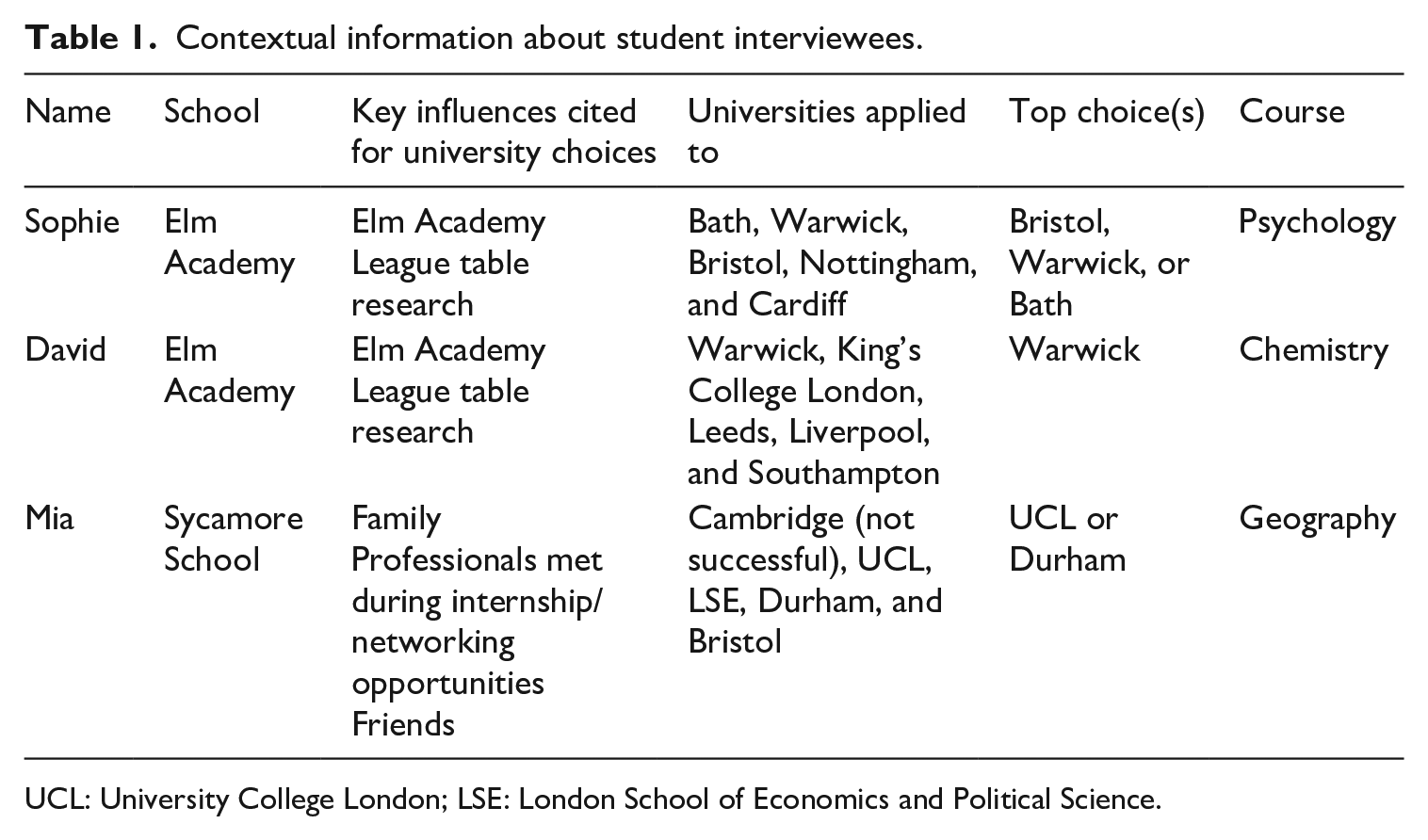
UCL: University College London; LSE: London School of Economics and Political Science.
Contextual information about staff interviewees.
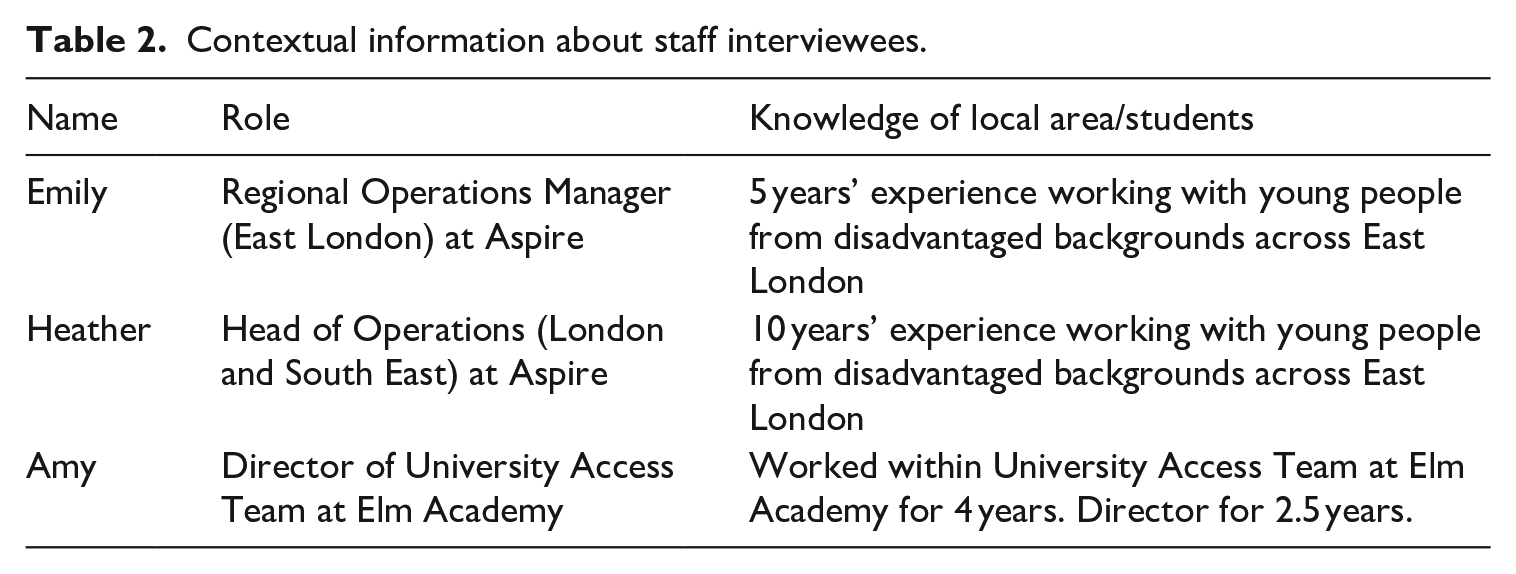
Elm Academy, used as a case in point in the section examining local schools’ framing of university choices, is a highly academically selective sixth form with approximately 300 students per year, the majority of whom are from Minority Ethnic backgrounds and roughly half of whom are from disadvantaged backgrounds. Its Oxbridge progression rates rival those of top private schools.
The semi-structured interviews were conducted by the author, one per interviewee and each approximately 30–60 minutes in length. Two separate interview guides were used for students and staff, with both sets of interview questions focussed on students’ university choices and the factors impacting their decisions. To avoid influencing interviewees’ responses as well as potential value judgements about different universities which could raise ethical issues in causing students to question their choices, the information provided to participants about the study did not reveal the researcher’s interest in elite universities specifically. Likewise, the student interview guide questions did not directly reference elite universities, preferring to allow the relative (un)importance of university status to arise organically in discussion of students’ priorities, or in the absence of this, to be gently elicited, for example, in questions such as ‘Can you tell me about how universities may differ from each other?’
The interviews were recorded and transcribed, and thematic analysis (Braun and Clarke, 2006) conducted to identify common themes across the data. Many of the initial broader themes prevalent across interviews, such as ‘staying local’, ‘family’, and ‘school’, reflected factors highlighted as of importance for working-class students’ university choices within previous research (e.g. Ball et al., 2002; Donnelly and Evans, 2016; Reay et al., 2005). Given the specific focus of the wider research project on the role of place for elite university progression, more detailed coding was focussed on the areas of the interviews and emerging themes most relevant to the research topic. Once all codes had been reviewed and combined where appropriate, four key themes were retained, namely ‘framing of university choices’, ‘local economic context’, ‘resources and partnerships’ and ‘university engagement’.
The textual analysis of school promotional materials and references to local schools within media and political discourse was conducted in complement to the interview data. Due to the COVID lockdown in Spring 2020 when the case study research was conducted, only materials available online were analysed. These comprised eight school websites/sixth form prospectuses, 15 newspaper articles and 6 extracts from political speeches. The analysis found important additional evidence for the key themes that emerged from the interviews, especially in terms of local schools’ strong framing of university choices to privilege Russell Group and Oxbridge progression. It also provided further valuable insight into the education and social mobility discourses prevalent within the locality.
Pseudonyms are used throughout the article to protect the anonymity of all interviewees and organisations.
A convergence of opportunities
The case study identified a convergence of four key structural factors playing potentially important roles within the locality’s high elite university progression rates. These comprised a seemingly prevalent culture of valorising elite university progression, schools’ associated strong framing of university choices to favour Russell Group progression, students’ apparent advantageous access to widening participation resources and opportunities with elite universities, and students’ interactions with the capital’s elite businesses, notably in terms of internships and networking. The following sections of the article will discuss each of these factors in turn.
Valorisation and championing of elite university progression
The case study suggested a seemingly prevalent culture within the area’s multiple high-achieving sixth forms of privileging ‘success’ within the narrow terms of entry to elite universities. This was shown in comments from Aspire interviewees about these schools’ ostentatious ‘celebration’ of students that go on to elite universities – especially Oxbridge – and of the near adulation that the latter students receive from peers: The students who do get places at Oxford and Cambridge are the ones that are kind of revered above all others . . . kind of almost like idolised, and the students will look up to them. (Emily, East London cluster manager at Aspire)
The Press and local community also appeared to play important roles in shaping this culture, by championing local sixth forms’ high elite university progression rates and giving them the impetus to strive to maintain their ‘prestige’: I think prestige has something to do with it . . . the Press will kind of get involved and say, ‘look at this, this is amazing’ or like ‘this sixth form has been able to achieve this’. So, within the area, kind of everyone knows about these high achieving sixth forms. (Emily, East London cluster manager at Aspire)
The nature of the student bodies at these sixth forms further appeared likely to facilitate the shaping of such a culture. Indeed, as Aspire interviewee, Emily, described, students who may have been considered exceptional at their previous schools now find themselves surrounded by ‘300 other students who also got straight As at GCSE’. This thus creates an environment in which elite university progression feels both achievable and desirable. Indeed, as Amy, University Access Director at academically high-achieving Elm Academy commented, applying to Oxbridge has become ‘normalised’: At Elm Academy . . . it’s very rare to find a student that doesn’t think they’re capable of going to Oxbridge or doesn’t have that like self-belief . . . there’s just kind of like an atmosphere around Elm Academy, it’s kind of normalised, so it’s not seen as this really alienating thing to apply . . . (Amy, University Access Director at Elm Academy)
While their schools’ privileging of elite universities has likely played a key role in shaping their aspirations, the interviews suggested that students’ own valorisation of these institutions plays an important role too. Discussing the drive of many local students to study at Russell Group institutions, Aspire interviewee, Emily, said she felt this was fuelled by students’ desire to ‘maximise as much as [they] can out of [their] secondary school education to go to one of the best institutions in the country’. Moreover, the extent to which students subscribed to the normative social mobility discourse came across strongly within the student interviews too.
Mia was the only student interviewee to explicitly comment on family as being influential for her decision to progress to university and to speak of her progression as being a source of pride for them. However, as Baker (2017) comments of his research within East London looking at young people’s aspirations, it is important to consider the underlying impact of the area’s social composition for students’ decision-making. East London is a very ethnically diverse area, and as Butler and Hamnett (2011) have described – and as I witnessed firsthand through my work with Aspire – there is an increasing feeling of optimism among certain ethnic minority groups here of education providing a meritocratic pathway to social mobility. It is possible then that the high value placed on education by certain ethnic minority families here has helped to shape and facilitate the seemingly prevalent culture within local schools of privileging elite university progression.
An important way in which this culture of elite university valorisation appeared to be maintained was through schools’ strong framing of university choices to privilege Russell Group progression. The next section takes a closer examination of this framing.
Schools’ framing of university choices to favour Russell Group progression
Research has suggested that where schools explicitly frame certain universities as being those to which students should apply, higher progression rates result (Donnelly, 2014). This section examines the strong framing privileging Russell Group progression observed within the case study locality using Elm Academy as a case in point.
Central within Elm Academy’s strong framing of Russell Group universities as the best choice for students is the school’s specialist ‘University Access’ team, a team of four full-time staff members with the express remit of facilitating Russell Group progression, and which provides a level of support for university progression that might be more typically expected of a high fee-paying private school. This extensive support includes running in-house enrichment activities to boost students’ subject knowledge and soft skills, organising an annual residential trip to two elite universities for the full year 12 cohort (~300 students), providing highly personalised university application, admissions test, and interview support (including specialised Oxbridge sessions) and sending a weekly roundup email advertising selected programmes at elite universities and internship opportunities at elite businesses.
University Access Director, Amy, explained that the team was created to address a perceived gap between students’ academic achievement and their progression rates to Russell Group universities: [The team] was established to kind of fill the gap that they thought existed . . . The students that were coming to the sixth form were really highly able and were getting an average of As across their GCSEs . . . But still before the University Access team, they didn’t have much success in getting students into Oxbridge or like top Russell Group universities. (Amy, University Access Director at Elm Academy)
Accordingly, in both the internal activities they run and the external activities they choose to advertise, the University Access team privileges Russell Group and equally high-tariff institutions, making explicit to students as to which universities they should be applying. In addition, the nature of the University Access team itself – only employing Oxbridge graduates – also conveys the schools’ university preferences, further marking out these institutions as the most desirable. It also suggests a level of resource that surpasses that of typical state schools – something that will be discussed within the following section.
Elm Academy’s sixth-form prospectus was found to strongly frame the school’s preference for Russell Group universities too, to the extent that, as Heather from Aspire commented at one point in her interview, even before they start at the sixth form, students will be ‘very aware of that group of universities’. Indeed, the prospectus has several pages dedicated to biographies of students from the preceding year who progressed to Russell Group universities, with more than half of those pictured attending Oxford or Cambridge. It also includes statistics showing that in the preceding year 85% of students progressed to Russell Group universities and more than 50 students to Oxbridge (no mention is made of student numbers progressing to other universities), and comments including that the tailored support of the University Access team has contributed to Elm Academy becoming one of the top schools for progression to the ‘prestigious Russell Group’ and that Oxbridge is where the school’s ‘highest achievers’ are encouraged to apply.
A comment from student, Sophie, demonstrated that students are typically keenly aware of the school’s preference for Russell Group progression: In sixth form the conversation was more about which Russell Group are you applying to, not which university are you applying to. So, there was that distinction. (Sophie, student at Elm Academy)
Furthermore, while Elm Academy’s prospectus, and the activities that they choose to offer and promote constitute more indirect – albeit powerful – encouragement of Russell Group progression, the school’s determination to more directly intervene where they perceive necessary was seemingly revealed in an anecdote shared about the desire of many pupils, particularly Muslim girls, to study at an institution within London. Indeed, University Access Director, Amy, described how in these situations, the school has ‘a lot of parent meetings’ to persuade these pupils to include Russell Group universities outside of London within their five Universities and Colleges Admissions Service (UCAS) choices (just in case they don’t get into the London Russell Group institutions they apply to) rather than apply to less ‘elite’ back up institutions within the capital: So, we might say, rather than putting [post-1992 London institution] down, why don’t you put Bristol or Warwick . . . And generally, we find that if . . . they don’t get into those other universities in London then they do normally go to that alternative option . . . So, normally at the point of applying, they’ll say ‘I’ll put it down, but I’ll never go’. But after a year (laughs) we normally manage to get through by that point. (Amy, University Access Director at Elm Academy)
Aspire staff interviewees, Heather and Emily, highlighted the widespread nature of similar messaging within local schools and the powerful peer pressure this can place on students to ‘[be] able to say to, you know, the people you’ve been with at school for two years, “oh you know, I’m going to Durham, I’m going to Newcastle” because they know the prestige that comes behind those names’. While – given the funding model of Aspire which involves financial support from a wide range of university partners – it was expected that neither Emily nor Heather would openly privilege elite university progression, their discourses also seemed to reflect individual discomfort at the pressures some local schools place students under to attend them. For example, Emily recounted how she has worked with several individuals so adamant that they should progress to a Russell Group university that they have taken a gap year to resit their A levels to go to one, even when they have already secured places at other ‘really good institutions that just happen to not be Russell Group’.
The strong framing discussed within this section, privileging Russell Group progression and marking other universities out as somehow ‘lesser’, is clearly highly problematic and symptomatic of the narrow view of social mobility currently championed within the UK. This is an important topic which will be returned to within the article’s conclusion.
Favourable access to elite university outreach and widening participation resources
So far, we have discussed the role of the seemingly prevalent culture within local schools of valorising elite university progression, and schools’ associated strong framing of university choices to privilege Russell Group progression in helping explain the area’s higher-than-expected progression rates. The third key theme to emerge within the case study was evidence that disadvantaged students in East London may have greater access to school widening participation resources and elite university outreach provision than similar peers elsewhere.
The UK’s elite universities are unequally spatially distributed throughout the UK, with a particular concentration in and around London (Savage, 2015). As a result, disadvantaged London students are likely to have easier physical access to a greater number of opportunities at these institutions than similar peers in more isolated locations, a factor that Amy, University Access Director at Elm Academy, felt to be a contributing factor to the school’s high elite university progression rates: I mean I think the biggest thing is just that in London the students have access. They have like 3 or 4 excellent universities that are offering public lectures every evening on different topics. And Oxford and Cambridge, they’re very accessible and they send representatives very often. So just like the wealth of opportunities that they have available I think would be very difficult to replicate in more rural or seaside locations. (Amy, University Access Director at Elm Academy)
While Amy did not expand on which ‘excellent’ universities she was referring to, given the school’s explicit university preferences, it is likely that she meant the London Russell Group institutions. The student interviews certainly corroborated the ‘wealth of opportunities’ that she described also, as each was filled with references to study days, lectures, master classes, and summer schools across a minimum of five different elite universities (and in David’s case seven), including multiple interactions with London Russell Group universities. Each student had also participated in at least one activity at Oxford or Cambridge (in Mia’s case, two Oxford residentials).
Favourable access to other resources may play a role too. In a report examining the significant improvements in the performance of London’s schools in recent years, both financial and recruitment advantages were cited as potential contributing factors (Baars et al., 2014). A comment from Amy, University Access Director at Elm Academy, suggested that such advantages may have indirectly contributed to the school’s high elite university progression too. Indeed, being a popular school in an urban location, Elm Academy are fortunate to be able to recruit staff with relative ease. As such, the school can avoid expensive supply teacher costs, freeing up part of their budget which is channelled into paying the salaries of the University Access team: At Elm Academy we don’t have, erm, they never hire . . . cover teachers. They kind of overstaff in terms of teachers so they don’t lose any money in paying for really expensive cover costs. So, a lot of that like budget comes into the access budget and pays for the staff salaries. (Amy, University Access Director at Elm Academy)
Given that the school’s University Access team appears to play a pivotal role within their students’ high elite university progression rates, the school being in a position in which they can direct a significant portion of their budget towards financing a team of four full-time staff is important. Moreover, Elm Academy is not unique in having such an Access team. Indeed, as Emily, East London cluster manager at Aspire, highlighted within her interview, teams dedicated to outreach and enrichment opportunities are commonplace at the academically high-achieving sixth forms within the local area: So, I know that a lot of these sixth forms in particular will have teams who are dedicated to enrichment. So where in a more conventional sixth form, you know you might have maybe one person working on careers or like outreach or just getting those extra opportunities in, I think they really understand the value that resource can have in terms of supporting a student. (Emily, East London cluster manager at Aspire)
The impact of enrichment activities for elite university progression should not be understated. Indeed, a key part of the UK university admissions process involves writing a ‘personal statement’ and students from disadvantaged backgrounds typically have more limited opportunities for gaining ‘high-status’, pertinent extracurricular activities to draw upon here – a contributing factor to their underrepresentation at elite universities (Jones, 2013). However, what was evident within the discourses of the student interviewees was the high number of very relevant experiences they could each relate. Moreover, it is not just such experiences in themselves which are important for applicants’ personal statements, but also how they are articulated within, something which again those from disadvantaged backgrounds more often struggle with as they do not typically receive the in-depth support in writing these that more advantaged peers do (Jones, 2013). However, once again there was evidence of extensive, individualised support here, such as the multiple one-to-one personal statement meetings with University Access team staff described by Elm Academy students, Sophie and David.
As we will return to in the conclusion, these resource advantages, especially as concerns local students’ apparent greater access to elite university outreach opportunities, may favour the elite university progression of disadvantaged East London students over similar peers elsewhere and suggests that elite universities must act to ensure a more equal distribution of widening participation provision. Moreover, the resource advantages for local disadvantaged students outlined within this section appeared to extend beyond schools and greater access to elite outreach provision, to access to prestigious internship and networking opportunities stemming from the capital’s corporate philanthropy. As discussed next, these opportunities may further help explain local students’ high elite university progression.
Internship and networking opportunities with the capital’s elite firms
There has been little empirical research looking at the geographical distribution of corporate widening participation initiatives; however, research by Gamsu (2016), which has highlighted the involvement of London’s elite finance firms in providing financial backing to widening participation charities – themselves also concentrated within the capital – suggests that corporate involvement in widening participation exists on a scale within London that likely far surpasses that seen elsewhere. Indeed, these elite finance firms, faced with increased scrutiny and public pressure following the 2008 financial crisis and the recent renewed political focus on ‘levelling up’ opportunities including ensuring equal access to high-status professions, are keen to evidence their commitment to reducing inequalities in access to their institutions (Gamsu, 2016). This has thus necessarily included a focus on initiatives to widen university participation and perhaps especially to elite universities, given that they serve as the de facto pathway to many such careers (Brown et al., 2011).
With regard to East London specifically, there are several reasons why a concentration of corporate widening participation activity here appears logical. Indeed, while there are pockets of greater affluence within East London, it has the largest concentration of financially deprived areas within the capital. It is also physically proximate to the two financial districts of the City and Canary Wharf.
A notable finding within the case study related to the prestigious internship opportunities opened up to local students through their schools’ partnerships with these elite businesses. For example, speaking about the sixth form’s requirement that each year 12 students complete a work placement, University Access Director at Elm Academy, Amy, described the partnerships the school cultivates with businesses such as ‘top Law firms’, to source ‘very high quality’ placements. Moreover, while she caveated that these are not opportunities ‘exclusive’ to their students, Elm Academy’s sixth form prospectus certainly suggests some advantageous affiliations as a dedicated ‘Partnerships with Employers’ section outlines.
Moreover, the student interviews demonstrated how interactions with the capital’s elite businesses can impact upon students’ university choices, favouring Russell Group progression. For example, Sycamore student, Mia, spoke about her involvement with a widening participation organisation that works with employers to help disadvantaged young people access high-quality work placements, and a description of her first interaction with the organisation – held at an elite firm – showed how it enhanced her and fellow attendees’ knowledge of the Russell Group: They have kind of regular sessions that they have, they hold at firms . . . And . . . I think it was a launch, where they gave out this handbook and it was asking about universities and . . . like there was a game where we had to guess all the Russell Group universities off a list and half of us didn’t realise. (Mia, student at Sycamore School)
Mia went on to complete two internships via this organisation at investment banks in the City and Canary Wharf, opportunities that – in addition to her now fuller understanding of the Russell Group – helped raise her awareness of the expectation of following this pathway if she wished to work within the sector. Indeed, Mia described several networking opportunities and how most of the people she met had PhDs and Oxbridge degrees. Furthermore, while she commented that no-one ever explicitly said to her that she should go to Oxbridge or a Russell Group university, it did make her reflect on her next steps – ‘it was kind of like . . . ok maybe that’s where I should go’ – showing that even the subtle messaging that such interactions carry can be pervasive.
In addition, the important advantages for students drawn from interactions with these employers extend beyond increased knowledge of the UK higher education system and expected pathways within certain professional sectors to the more concrete benefits discussed earlier of being able to draw upon these ‘high-status’ internships within their personal statements to better stand out from the crowd. For example, Elm Academy student, Sophie, had completed two work placements highly applicable to the course she planned to study (Psychology) at a children’s mental health charity and in the Human Resources department of a prestigious business organisation.
These internships may not appeal to all students, and we should be cautious of advocating that such work placements are – as Amy implied – of higher ‘quality’ than others. Nevertheless, it is undeniable that those in ‘elite’ professions wield the most power in society and that these professions are still overwhelmingly dominated by those from more advantaged backgrounds (Sutton Trust and Social Mobility Commission, 2019). On the one hand then, the exposure to such professions that disadvantaged students in the case study area appear able to gain, building their awareness of the expected pathways to careers there, and to perhaps feeling – as Mia appeared to – that this is something achievable for them, could be argued as a step in the right direction. However, if it is primarily disadvantaged students in the capital that benefit from these opportunities, then this arguably further compounds the already heightened disadvantage of being from a less advantaged background and living in an area without the resource advantages of London (Davies and Donnelly, 2023).
Discussion and conclusions
London dominates the UK economically (Office for National Statistics, 2022), and this dominance increasingly translates to greater educational opportunities too. Indeed, the capital’s youth gain consistently higher attainment than similar peers elsewhere (Blanden et al., 2015) and, as the initial quantitative part of the broader research project in which the case study discussed here has shown (see Davies et al., 2021), also have higher progression rates on average to elite universities than peers in many other parts of England, even once their higher attainment is accounted for. The notable higher-than-expected progression observed across East London – an area of the city with significant levels of deprivation – led to the decision to conduct the follow-up case study in an East London locality outlined within the article, to explore underlying structural factors that may be contributing to this phenomenon.
While the case study conducted was small in scale and is thus limited in generalisability, it identified a convergence of four key factors that may play important roles within the high elite university progression of students in the locality and could hold relevance for that of the broader East London area too. These factors comprised the seemingly prevalent valorisation of elite universities, schools’ associated strong framing of university choices to privilege Russell Group progression, students’ apparent advantageous access to elite university outreach provision and widening participation resources, and students’ interactions with the capital’s elite businesses, notably in terms of internship and networking opportunities. Through its close examination of these factors, this article makes an important contribution to literature looking at access to elite universities, as ‘place’ has often not been central to this research. Moreover, in reflecting on the potential significance of the intersection of these opportunities with a local population that holds education as an important pathway to social mobility (Butler and Hamnett, 2011), the article further brings valuable insight into the importance of context and specificity of place for progression.
The ‘University Access’ teams that several local sixth forms possess appear instrumental in shaping students’ aspirations to attend elite universities, as well as in facilitating their access to the widening participation opportunities offered by these institutions. However, in addition to this – and to the area’s physical proximity to a greater number of these universities – the case study interviews also suggested that local disadvantaged students may be more heavily targeted by elite universities than similar peers elsewhere. Indeed, while there has been little empirical research looking at the geographical distribution of elite university outreach provision, the findings of an investigation by the University of Cambridge’s independent newspaper, Varsity, into this institution’s outreach showed that London received significantly greater engagement than many other regions (Lally and Hancock, 2018). This suggests that if other nearby elite universities also operate similarly, disadvantaged students within London could indeed have quantifiably greater access to elite university outreach than similar peers elsewhere. Moreover, local students also appeared to benefit from further structural advantages including likely greater access than similar peers elsewhere to internship and networking opportunities with elite firms, and the direct (able to draw on within personal statements) and indirect (increased knowledge of the UK higher education system and expected pathways within certain professional sectors) ways in which these can advantage students.
The findings suggest that elite universities must do more to ensure a fairer distribution of widening participation opportunities across the UK. As discussed elsewhere (Davies et al., 2021), greater strategic planning by the Office for Students, including using elite universities’ Access and Participation Plans to map which areas have been targeted nationwide and identify areas that have been under- or over-targeted, could facilitate this process. There is also a clear need for further partnerships and more collaborative widening participation work across all sectors of the economy to enable a fairer distribution of internship and networking opportunities in professional sectors for all disadvantaged youth.
The seemingly prevalent valorisation of elite universities within the case study locality also raises important ethical questions. Both Aspire interviewees expressed concern that the extreme championing of elite university progression by local sixth forms means that some students are pushed towards studying at elite institutions when they might prefer to study at another university or indeed to follow an alternative post-18 pathway. This thus calls into question the morality of influencing students’ university choices in this way, given that the arguably prejudiced institutional cultures of elite institutions (Reay, 2018) might negatively impact their experiences of university study. Moreover, should schools really be championing such a narrow vision of social mobility in the first place? Research on graduate outcomes suggests that even where those from disadvantaged backgrounds make it to elite universities and careers such as those within the capital’s elite finance firms, ethnic and class pay gaps remain (Donnelly and Gamsu, 2019; Friedman and Laurison, 2019). This then also serves to demonstrate how widening participation practices informed by the existing narrow social mobility discourse do not disrupt the structures that maintain inequality, but implicitly accept and work within them, serving to maintain them.
The Social Mobility Commission recently acknowledged that the social mobility world has become too fixated with a small minority of people from disadvantaged backgrounds making it to elite universities and professions (Social Mobility Commission, 2022). The pressing question now is as to whether this building recognition will lead to genuine reform and – as increasingly called for elsewhere too (e.g. Gamsu and Ingram, 2022) – a new political conversation about social mobility. The real problem lies in the hierarchical structuring of higher education and society in the first place, and true change will only be achieved through systemic change that first dismantles these.
Footnotes
Funding
The author disclosed receipt of the following financial support for the research, authorship, and/or publication of this article: The case study drawn on within this article formed part of the author’s doctoral research which was funded by a University of Bath research studentship.
