




Abstract
This research analyzes Korean professional soccer stadiums using Relph’s concept of placelessness to understand why Korean professional soccer has rapidly declined in popularity and become a minority fan sport. Qualitative research methods were used to conduct a narrative analysis. The interview content was analyzed, and four problems were identified. The findings show that these stadiums are (1) a uniform space that excludes local culture, (2) used as a profit-generating tool for large corporations, (3) spaces controlled by the state, and (4) maximizing economic efficiency. Therefore, they have been used as a uniform space for social, cultural, political, and economic purposes. The Korean national soccer team’s performance in international competitions seems to be satisfactory. However, the domestic professional soccer league is in a vulnerable condition. Thus, these stadiums should be established as true places by removing the element of placelessness in order to recover the popularity of Korean professional soccer.
Introduction
Korean professional soccer stadiums are losing their true sense of place. True placeness is a term that appears in Relph’s theory of placeness (Relph, 1976) and refers to a space where various energies of life such as joy, sorrow, and pleasure co-exist. Since the advent of modernity and professionalization of sports, stadiums have been transformed into commercial venues (Giulianotti, 2015). As a commercial venue, a stadium represents a contradiction of true spatiality, aiming to bring the maximum number of fans together with minimal effort to generate revenue (Besnier and Brownell, 2012). Therefore, in pursuing rationality, a capitalist arena is operated with a focus on maximizing profits through uniform procedures rather than by emphasizing true locality. However, Relph criticizes the uniformity of such a place, as it is a product of capitalism and at odds with humanism. Relph describes the result of a true loss of place as ‘placelessness’ (Relph, 2000) and defines placelessness as a standardization and uniformitization of soulless places (Relph, 2000). However, Augé’s (2009) concept of non-places, which features the absence of relationships between people, lack of historicity, and lack of identity, differs from Relph’s placelessness. As opposed to Relph’s placelessness, which defines true placeness as where the energy of life exists, non-place is dominated by the anonymity of similar characteristics such as can be found in highways, malls, and airports. There is a colorful and crowded appearance on the outside of a non-place, but the human beings in it are anonymous public and lonely crowds; prone to exclusion and alienation, it is a space that is difficult to access without a cost. For stadium research, placelessness is more appropriate because, for professional soccer fields, stadiums are branded with each team’s identity, a patina forms over time, and interrelationships between players and fans are key.
Korean professional soccer stadiums were established during the 2002 Korea–Japan World Cup. It was necessary for Korea to highlight its recovery from the International Monetary Fund financial crisis in the late 1990s (Mohamad et al., 2020). To this end, hosting the World Cup was a useful political tool (Hassan, 2018). To successfully host the 2002 Korea–Japan World Cup, grand stadiums were required. Rather than choosing the right cities based on political and economic factors, the government prioritized building stadiums quickly, sometimes in areas with no local teams. Consequently, all the elements of placelessness have started to emerge 20 years later.
Relph claims that subtopias, conglomerates, central power, and the economic system are factors that lend a place a sense of placelessness (Relph, 1976) and work in tandem rather than individually, ultimately aiming for uniformity. In the quest for uniformity, the focus shifts to maximizing profits through an integrated procedure rather than by forming a real and complex sense of place (Seamon and Sowers, 2008). Lefebvre (2012) called such capitalist space an ‘abstract space’, arguing that it is characterized by the simultaneity of fragmentation (a division of space into saleable parts) and homogenization (an equalization function in capitalism that overwhelms the use value of space). Korean professional soccer stadiums are also embedded in the context of placelessness. This leads to a lack of topophilic elements, such as the regional characteristics of the home team, historicity of the stadium, and identity of the club in a stadium that a team uses as its home ground. It is almost impossible to relocate an already-built stadium to another place because both the cost of relocation and the geographical and socio-cultural issues of the place to be moved need to be considered (Leite et al., 2022). Therefore, once built, the creation of a space such as a stadium should be based on close communication with local residents because they are the ones who will continue to live in the space for a long time after the (mega event) game (Otto et al., 2022). However, the Korean professional soccer stadiums are located in remote areas to reduce friction with local residents. In other words, no subject (local residents) is present with whom the stadium can form an emotional relationship. Manzo and Perkins (2006) explained that the formation of an emotional relationship between local residents and a specific space increases the sense of belonging of local people and provides the space with an identity. The Korean professional soccer stadiums, thus, remain unemotional spaces built in places with few local residents.
As stadiums were built using local residents’ taxes, they are considered quasi-public goods (Drukker et al., 2020). Therefore, a significant portion of the revenue generated from the stadium must be returned to the residents. However, like most sport infrastructure investment projects, they benefit the elite, whereas the benefits for ordinary citizens are questionable. Korean professional soccer stadiums are not owned by the club; most of them are owned by the local government’s facility management organization. For example, in the case of the Seoul World Cup Stadium used by FC Seoul, the stadium was only leased (Song and Kim, 2020). In other words, the club only plays games and rents additional facilities such as snack bars. As such, the club cannot voluntarily use the stadium because it is rented. Even when considering the needs of club fans or local citizens, environmental conditions do not allow for them to be met. Furthermore, the facility management corporation, the main body of stadium management, does not attempt to use the stadium for the good of citizens (Kim, 2016) because there are concerns about possible damage to the stadium infrastructure and the cost of restorations. Consequently, local citizens are neither provided with tax refunds nor allowed to use the stadium freely (Kim, 2017a). Idealistic post-Fordists argue that stadium construction reproduces slums that face a lack of moral and financial support (Giulianotti, 2015). Ordinary citizens pay taxes for the construction, but they do not visit the stadium unless they are fans of the soccer club. This vicious cycle is repeated in Korean professional soccer stadiums.
This study finds that one of the causes of the low popularity of the Korean professional soccer industry is the placelessness of professional soccer stadiums. Therefore, this research aims to use Relph’s theory of placelessness as a theoretical framework. From Relph’s perspective, people are more likely to be topophobic than topophilic (Leach, 2020). Hence, rather than focusing on individual place experience, Relph is concerned about how the dominant place experience, such as placelessness, penetrates citizens’ lives concerning changes to the dominant economic system. Thus, this research utilizes Relph’s concept of placelessness to analyze professional soccer stadiums, which are located at the center of the economic system.
Korean soccer stadiums and their background
Currently, the Korean professional soccer league ‘K-League’ operates leagues ranging from K1 to K7, with K1 and K2 being the professional leagues. Among them, K1 is the first division, and teams within this league could be relegated to the K2 League, while teams within the K2 League team could be promoted to the K1 League through the playoffs. There are 12 teams in the K1 League, of which 5 are large corporate-managed clubs, including 2 from Hyundai Group, 1 from Samsung Group, 1 from Pohang Group, and 1 from GS Group, and 7 are civic clubs. However, the largest corporate clubs consider themselves to be advertising tools for their companies, while civic clubs are not interested in generating profits because they are used for attracting votes for local politicians (Kim, 2017b). Thus, various social and cultural values, such as the service provided to fans and the identity and history of teams and stadiums, are neglected. In the case of the English Premier League, the clubs have a considerable revenue source, including admission revenue, stadium rental, sponsors and stadium advertising, sportswear, TV broadcasting rights, souvenir sales, supporters’ communities, food and beverage sales, soccer funds, and stock markets. They have fans worldwide through the diversification of identity (Ireland et al., 2022). Conversely, Korean professional soccer clubs rely solely on admission revenue and cover most of their operating expenses through support from their parent companies.
Immediately after the semifinals of the 2002 World Cup, which represents the height of popularity of Korean soccer, the average number of spectators at the K-League stadium was 26,441, and a bright future was expected for this sport. However, the number of spectators gradually decreased, and 10 years later in 2012, several large club supporters that were at the center of the sports achieved an average audience of only 7067. Approximately 10 years later, the average number of spectators per game was recorded at 1382 in 2021, representing an average seating share of about 5% of the stadium (Prosports Data Portal, 2022). Only a few fans take interest in Korean professional soccer. In addition, various negative incidents have occurred in Korean professional soccer since the 2002 World Cup, such as match-fixing, deviant behavior by individual players, and poor performances by players, leading to a decrease in the number of spectators (Hwang, 2018). Nevertheless, many factors over the 20 years after the World Cup led to the decline in the popularity of professional soccer, for which individual players cannot be blamed.
Many studies have applied the theory of space to sports, and the field of sports tourism frequently uses Relph’s theory of placeness. In particular, Relph’s geographical concept provides a useful framework for sports tourism researchers to analyze individual motivations to participate in sports tourism (Higham and Hinch, 2006). Relph’s theory criticizes the overly rational approach taken by all materials, architectural styles, designs, and spatial planning of sports tourist attractions, which reveals the difficulty of experiencing the specificity and uniqueness of sports tourist attractions (Gordon, 2013). Ritzer and Stillman’s (2001) ‘The Postmodern Ballpark as a Leisure Setting’ is a representative study that applied the theory of placeness to professional sports stadiums. They discussed the McDonaldization of baseball fields, implying that the size of the baseball fields continued to grow and became more commercialized. Giulianotti (2015) argued that the McDonaldization and de-McDonaldization of stadiums eventually created a topophobia of the stadium and pointed to Bale’s ‘Space, Place and Body Culture’ (1996) as the evidence. Bale (1996) explained Tuan’s (1974) dominance and affection for space and place as a form of topophilia. However, this eventually provided Relph with a basis from which he developed his criticisms. Relph suggested that Tuan focused on topophilia and overlooked the topic of topophobia, which led Relph to interpret the spatiality of modern society within the framework of placelessness.
The literature on professional sports stadiums was analyzed from the perspective of placeness, which revealed two schools of thought. First, based on Tuan’s (1974) article of place attachment, a significant body of research was conducted using the framework of topophilia. Second, based on Ritzer and Stillman’s (2001) framework of topophobia, the second school of thought focused on the McDonaldization and de-McDonaldization of stadiums. In contrast, it was difficult to find research that analyzed modern professional sports stadiums using Relph’s concept of placelessness, which criticized ‘uniformity of place’ and ‘commercialized fake place’ and considered both factors to be results of industrialization. The spatiality of professional sports stadiums in Western societies can be fully explained by the concepts of topophobia, McDonaldization, and de-McDonaldization. Nevertheless, it is difficult to implement McDonaldization in the Korean professional soccer stadium for the following reason. To apply McDonaldization to Korean professional soccer, the parent company of the club, local governments, or the government – the main managing bodies of a club – must use the stadium extensively for commercial purposes. Moreover, a clear beneficiary must appear to be criticized using the McDonaldization theory. However, it is difficult to find commercial elements in current Korean professional soccer stadiums. Considering that the previously mentioned seat share of professional soccer stadiums is approximately 5%, McDonaldization does not seem to apply. Therefore, this research considered Relph’s theory of placelessness as an appropriate theory to analyze the locations of Korean professional soccer stadiums, aiming to reveal why fans are turning away.
Method
Research design
The core question of this research is whether fans perceive a true sense of place in the stadiums, which are structures created by the entity that occupies them economically, politically, and socially. Therefore, the fans’ perception of the stadium changes depending on their social structure, and Relph’s framework of place was used to guide this perception. Meaning is densely distributed from the phenomenal spaces to those in which meaning is culturally constructed by various public codes. Hence, it is necessary to reconstruct the meaning analytically in a rich and persuasive manner. Interviews with local sports fans as research participants were conducted to overcome the limitations of text analysis; the placeness of a sports stadium is relevant when club fans and local residents interact with each other, but a text analysis alone limits the search for the meaning of stadium placeness that occurs during such interactions. Therefore, this research conducted interviews with local sports fans to identify the true placeness of sports stadiums.
Participants
In this research, a public forum was prepared for six participants to express their thoughts on Korean soccer stadiums. Specifically, this study started on 10 October 2021, and continued until 30 December 2021. Three people were fans of clubs that used the 2002 World Cup stadium as their home stadium, and the other three were fans of clubs that used a newly constructed soccer stadium as the home stadium (six interviews were conducted with six fans). A snowball sampling method was used to recruit participants for the research. The inclusion criteria were as follows: (1) participants must have experienced the 2002 World Cup as an adult; (2) they must have watched and supported Korean professional soccer for more than 20 years. Therefore, all recruited participants were adults aged over 40 years. They had direct or indirect experiences of the creation and disappearance of the stadium’s host team, stadium history, and stadium relocation process.
Prior to starting the interviews, the researchers conducted pre-interviews with participants including an explanation of the overall research, such as the research background, the research purpose, the research problem, Relph’s theory of placeness and placelessness, and the expected effect of the research results. In particular, when explaining Ralph’s placelessness, the contents of the placelessness were summarized and delivered via e-mail. Moreover, informed consent was obtained from the participants. When recruiting a supporter for each team, the researcher called the supporters and explained the intention of the research, purpose, interview process, and privacy protections. Subsequently, they were asked whether they agreed to participate in the interview. Interviews were conducted individually, and each interview ranged between 1 hour and 30 minutes to 2 hours.
Data analysis
A qualitative data analysis was performed for an in-depth analysis of the collected data. A four-step analysis procedure used in previous studies was performed. The steps and content of the in-depth interview are illustrated in Figure 1.
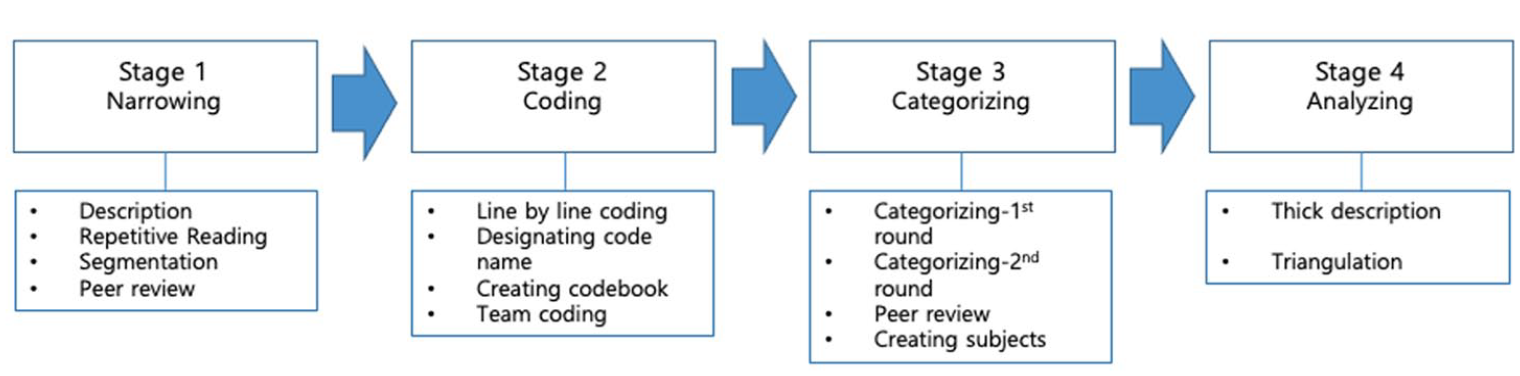
In-depth interview procedures and content.
At the first stage, the collected content was classified and analyzed. The preliminary survey and interview data were classified and organized by content, and data were prepared in a Word file. The organized results were checked by the interviewees for confirmation at the second stage, the categories were confirmed in the process of reading the material. To check the code, the process and categorization were recorded and confirmed. The first step of categorization is a key activity that generates codes and categories from raw data. In this process, it was necessary to go through segmenting work by finding and marking sentences or words to clarify the meaning of the data. Subsequently, segmenting work was performed on repeated words or keywords to confirm the connectivity with the topic. Finally, an analysis was conducted to confirm the relationship between the code that appears most frequently among the previous codes and the interview outcome. In the analysis stage, the researcher fully revealed the complexity and specificity of the content derived from the categories and attempted a thick description to reconstruct the content persuasively.
Discussions
A standardized space for sports that excludes local culture
Owing to considerations regarding the cost of construction and land purchases required for the construction of the stadiums, most stadiums in Korea are located near highways outside the city. Although this may have been economically efficient when they were built, many stadiums are too far away from city centers for local residents and fans, who define the meaning of the stadium (Joo et al., 2017).
Europe and South America, where the World Cup games have previously been held, frequently remodeled large historic soccer stadiums in the middle of urban areas and hosted the games there. Conversely, in Korea, when the 2002 Korea–Japan World Cup was held, stadiums were often built in large cities, but due to high land acquisition cost, many stadiums were located on the outskirts of the city. Consequently, fans do not go to the stadiums today. The surrounding atmosphere means that the stadium is not at all symbolic (Participant B).
Seoul, Busan, and Incheon are excellent locations in terms of being transportation hubs. However, the five cities of Seogwipo, Jeonju, Daejeon, Daegu, and Ulsan have stadiums located far from existing downtown areas. Hence, many fans do not go to the stadiums. Across the country, similar-looking stadiums are abandoned on the outskirts of the cities. (Participant D).
Interview participants reported the inconvenience of the geographical characteristics of the newly built stadiums constructed to host the World Cup. They stated that the burden of land purchase costs arising from the construction of 10 new stadiums in a small land area was the reason for building new stadiums on the outskirts of the city. They pointed out that stadiums built on the outskirts because of such cost burdens did not reflect regional characteristics, which inevitably caused fans to turn away from the stadiums. Subtopia can be defined as a symbol of uniformity and homogeneity – an unconscious place (Dung, 2012). Relph (2000) explained subtopias by giving examples of dwellings. For example, suburban homes in the UK are semidetached, and the signage is displayed in soft tones. France has identical public apartment districts in every town. It is difficult to identify regional characteristics from these buildings because they look and feel the same, as the subtopia has been developed in a rather abstract and distant way from reality, such as a map or plan. A housing planner was not allowed to design the cities after experiencing the area directly (Birnbaum et al., 2021). This is how the Korean professional soccer stadiums were built – for successfully hosting the 2002 Korea–Japan World Cup. Similar stadiums were built at similar locations near highways outside the host cities. As they were built solely to host the World Cup, it was difficult to infuse local characteristics into the stadium. As the participants mentioned, the stadiums were built in a short period, and land purchase costs were prioritized. Consequently, both the team currently using the World Cup stadium as their home stadium and those that built new stadiums owing to the poor location of the World Cup stadium have disengaged local residents and fans. Furthermore, unused World Cup stadiums are treated as tax-eating hippos.
Stadiums affect local economies and residents alike. Many English soccer fields were built prior to 1914 in densely populated areas. Some local residents have criticized a stadium’s ‘negative appearance’, including noisy singing, drinking, urinating on the street, vandalism, and fighting between fans (Riess, 2017). However, the current Korean soccer stadiums aspire to have these negative external appearances. Topophilia and topophobia are created when fans have expectations and affection for the team and stadium (Leach, 2020); however, Korean soccer stadiums have neither topophilia nor topophobia. Consequently, professional Korean soccer has been reduced to a minority sport, with only the enthusiasts visiting a stadium. Subtopia, a component of placelessness, is the loss of feelings for a place (Relph, 2000). ‘Fictionality’ defines a sport (White and McTeer, 1990). The fictionality of sports means that it elicits certain emotions to direct or indirect sports participants. For example, if your team wins against their opponent in a sports game, your confidence increases. Further, at mega sports events such as the Olympics or World Cup, fans feel determined, even though they are not athletes, ahead of the national team games. These feelings are similar to patriotism (Giulianotti, 2015). As such, the ‘fictionality’ of sports enables people to harbor invisible emotions that are difficult to experience daily. Nevertheless, the subtopia of professional Korean soccer stadiums erodes the fictionality that can be uniquely experienced from sports. Subtopia is a powerful element that breaks down topophilia and topophobia and transforms a stadium into a place without any life.
Space for sports as a profit-making tool for large corporations
The landscape of subtopia is caused by the activities of large corporations (Relph, 2000) that promote the placelessness of professional Korean soccer stadiums. It is difficult to talk about Korean professional soccer without mentioning the ‘Hyundai Family’. Hyundai has contributed significantly to the growth of Korean soccer at the corporate level. Hyundai’s involvement in Korean soccer society extends beyond elementary, middle, and high schools to women’s soccer, the K-League, and the national team. Nevertheless, one company monopolizing a field does not help to create true placeness for a stadium.
Domestic professional soccer is run by a few companies, including Hyundai, GS, and Samsung. However, the soccer clubs owned by Hyundai are Jeonbuk Hyundai, Ulsan Hyundai, and Busan I’Park. Thus, in the K-League, it seems that only Hyundai has a proper corporate team (Participant C).
Including Chairman Chung Mong-joon, the ‘Hyundai Family’ seems to traditionally determine the fate of domestic professional soccer. Therefore, numerous advertisements for Hyundai are present at all stadiums. In the past, when many mid-sized conglomerates such as Daewoo, SK, and Ilhwa operated professional soccer teams, each had its own characteristics, and the place’s regional characteristics were reflected in the clubs. Unfortunately, it is difficult to find such a diverse scene now (Participant B).
Fans who participated in the interview expressed discomfort with Hyundai’s role in the professional soccer league. Participant C considered Hyundai’s investment in the professional soccer league and their clubs as monopolizing the league. Participant B expressed regret that in the past, various companies could not reflect their identity in the club and link that to regional characteristics. A number of large companies, including Hyundai, used affiliates to run professional soccer teams after the 2002 World Cup (Horne and Manzenreiter, 2013); however, because the stadium was used without regard to placeness, it merely served as a billboard for the parent company (Wise and Harris, 2019). Hyundai, commonly mentioned by the participants, seems to dominate the professional soccer game, implying that professional soccer clubs have not been extremely helpful in corporate management in the past. Professional soccer teams run by companies should be managed, not merely ‘run’ (Moraes et al., 2022).
By law, corporations cannot fully own the stadium and freely engage in marketing activities (Giulianotti, 2015). Therefore, companies only use their home stadiums for publicity. However, this may impede the securing of soccer fans. Local stadiums provide a genuine sense of place to local fans because they are built with taxes paid by local citizens (Bradbury, 2022b). Nevertheless, owing to the conflict between the monopoly structure of professional club companies and the characteristics of sports spaces as public goods, Korean Professional Soccer Stadiums have become an ambiguous structure that does not reflect regional identity.
When a company makes a product to pursue profit, the location is rarely considered – regardless of whether it is the process of production, management, and sales or using the product to improve the scenery. However, in the case of sports arenas, fans do not seek stadiums that lack a narrative (Parry et al., 2017). The participants also expressed regret about this. Advertisements of clubs’ parent companies are often available through on/offline media and TV advertisements. Nevertheless, soccer clubs should be operated by considering their hometowns and local residents as consumers. The participants indicated that the corporate behavior of simply considering the stadium as a billboard for the parent company of the club could stop local fans from visiting the stadium.
A number of implications can be drawn for Korean professional soccer from the English Premier League. It is not uncommon for English Premier League stadiums to have historical and regional characteristics. For example, Emirates Stadium encountered some challenges during its relocation. Due to the size of the former Arsenal Stadium, which was smaller than other soccer clubs’ stadiums, it has been seeking expansion since the late 1990s (Georgantas and Lekakis, 2021). However, as the stadium is surrounded by public pavement, residential areas, and historical views, this idea has caused opposition from locals, local councils, and a number of businessmen (Ziesche, 2020). Nevertheless, the club used Highbury Stadium to house local residents while Emirates Stadium was being constructed in Ashburton Grove, and the new stadium is operating successfully (Coates, 2019). As another example, FIFA has designated the Estadio Centenario Stadium in Uruguay as a World Cup legacy. The stadium was built to commemorate Uruguay’s 100th anniversary of independence and is still used as the home stadium for Uruguay’s national soccer team (Crawford, 2020). Furthermore, Japan and Vancouver have reused sports legacy facilities used during past Winter Olympics and are continuing to use them for local residents’ health (Kietlinski, 2021; Scheu et al., 2021). It can be observed that many existing stadiums, especially those used for Winter Olympics as well as soccer games, have been transformed into places with a new identity while retaining their historical nature, as opposed to simply demolishing them or using them solely for commercial purposes.
The above examples support the ‘feel-good factor’, one of the five legacies of sports spaces. Grix et al. (2017) classified the legacies that can be obtained after sports mega events into five categories: (1) economic revitalization, (2) urban regeneration, (3) national pride/feel-good factor, (4) increased participation in physical activity and sport, and (5) international prestige and soft power. Here, the feel-good factor is a psychic income – the sense of happiness and belonging to the community felt through the presence of the stadium – that the use of the sports space provides to the local community.
Moreover, the Korean professional soccer stadium does not belong to any of the legacy categories classified by Grix et al. (2017). These stadiums were economically unprofitable and not built in connection with regional development. They did not contribute to the revitalization of sports through active utilization of the stadium, making them merely dead buildings for local residents. Cases similar to those found in Korea can be found abroad as well. A study in Taiwan showed that hosting international sports events in certain regions had a positive effect on the creation of a legacy related to health, environment, infrastructure, and culture, but it did not have a positive effect on the development of sports or the creation of emotional legacies for locals (Ma and Kaplanidou, 2017). Furthermore, the British government predicted that the 2012 London Summer Olympics would dramatically increase participation in sports among British citizens, including Londoners. According to research, the government, however, failed to achieve its original goal of increasing sports development and participation following the Olympics (MacAuley, 2015).
It is necessary to consider why the number of soccer fans has decreased over the years. Rather than merely advertising their products to fans visiting the stadium, the management should consider efforts to overcome placelessness and restore strong symbolism in their stadiums.
State-controlled sports space
As Relph (1976) explains, authority exerted by the central power is used to expand many forms of placelessness (Relph, 1976). Several years prior to the 2002 World Cup, the central government’s designated city was selected as the actual venue for the event, causing many problems. A venue for a national sports event is usually selected through competitive bidding (Shin, 2006). However, there was no competitive bidding process involved in the selection of the 2002 World Cup venue; it was determined based on the central power’s preferences.
The 2002 World Cup had the biggest impact on why the professional teams and their arenas are currently spread out in 10 different cities across the country. At that time, soccer was particularly popular in some cities – the most representative being Pohang. Of course, Pohang should have been included as a host city for the World Cup, but there were several political voices suggesting that many of the arenas were in the Daegu, Ulsan, and Busan region. Hence, one of the arenas was built on Jeju Island (Participant A).
Usually, when mega sports events are held, countries enter a bidding process. However, there was no local bidding from Korea. The central government and the political authorities decided on and designated the regions. Local infrastructure, communication with local residents, etc., were never considered. I think the fundamental reason for the decrease in Korean professional soccer fans started with this allocation of stadiums (Participant F).
The participants of this research considered ‘central power’, one of the causes of placelessness in Relph’s theories, the most problematic issue. Central power exerts its decision-making rights using its power and the legal rights to manage the tax revenue. This absolute power also influenced the selection of the arena, excluding cities with soccer infrastructure and building new infrastructure in new cities. Law is the basis for the authority of the government, and building facilities as per the law will only result in standardization and uniformity (Poon, 2019). As Participant B mentioned, using competitive bidding to allow an appeal of locality without being coerced by central power could have enabled the construction of a stadium reflecting locality and history. Since the central government selected the area for stadium construction, serious problems related to its use following the World Cup were encountered. In the end, the central government came up with the idea that ‘local governments can create soccer teams and use the stadium with them’ (Kim and Kang, 2021), which pressured local governments, resulting in the creation of unnecessary soccer teams in a city with a stadium but no affiliated soccer team.
Soccer teams created without prior formal planning produced two problems. First, they were not profitable (Thormann and Wicker, 2021). Before the COVID-19 pandemic, FC Seoul had the highest income in 2019, with approximately 3.8 billion won, followed by Daegu FC, Suwon Samsung, and Jeonbuk Hyundai with 2.2, 2.1, and 1.9 billion won, respectively (Kim, 2020). Most of the other clubs earned around 1 billion won, but the amount of money spent on usage fees was as high as the income earned, eventually leading to losses. The second issue is related to the recruitment of local fans (Bielsa, 2021). Participant B suggested that an important factor for recruiting local fans is communication with local residents. It is not likely that many soccer fans will visit teams created without regard to regional characteristics or advance plans. Further, soccer teams created without communication and stadiums that accommodate them are regarded as placeless spaces by local residents (Relph, 2000). It is therefore imperative that central power ensures the club’s autonomous marketing activities based on a broad perspective and encourages it to develop measures to attract local residents and fans.
Space for maximizing economic efficiency
Most of the stadiums built to host the 2002 World Cup were sports complexes (Yue, 2016) with plans to host events other than soccer in future. However, large-scale sports events cannot be held every year to utilize the stadium, leading to the construction of soccer-only stadiums suitable for the K-League. Subsequently, Incheon United, Daegu FC, and Gwangju FC, which were founded to use empty World Cup stadiums after the 2002 World Cup, relocated to soccer-only stadiums.
Exclusive stadiums were built closer to the city centers, and the number of seats was drastically reduced. Moreover, the distance between the spectators and field was reduced by eliminating the athletics track in the stadium (Kim, 2020). Daegu FC relocated to such a soccer-only stadium. Although Daegu FC suffered from chronic deficits when using the World Cup stadium, the number of fans increased after the relocation, and the surrounding commercial area became developed. Consequently, other clubs that used World Cup stadiums as home arenas decided to build soccer-only stadiums as a path to success (Yue, 2016). Exclusive stadiums built according to the needs of the home team allow a team’s identity to be incorporated into them. Conversely, as existing World Cup stadiums were built as general stadiums to host mega sports events and serve multiple purposes, most stadiums did not have a symbolic color or identity to represent the club.
The Seoul World Cup Stadium is currently being used by Seoul FC, but it does not reflect the identity of the club. It is a team for the Seoul Capital Area. The Seoul World Cup Stadium was not built solely for the World Cup. Moreover, unlike other World Cup stadiums, in the case of Seoul’s stadium, there was a plan to include a commercial complex during construction. Hence, there are large warehouse stores, movie theaters, saunas, and wedding halls, which generate the core revenue for the stadium (Participant E).
Not all stadiums can be operated like the Seoul World Cup Stadium. Seoul is a large city where half of Korea’s population lives. Stadiums in small and medium-sized cities, unlike those of large cities, do not have age groups to service even if they have multiplex facilities like in Seoul. Moreover, I am worried that all the current usage plans for World Cup stadiums will seek to operate stadiums like the Seoul World Cup Stadium (Participant D).
Participants in the study were concerned that many small and medium-sized city soccer clubs were trying to build multiplex infrastructure, aiming to compensate for the stadium’s operating deficit. The relocation to a soccer-only stadium and use of the existing World Cup stadium as a multiplex facility address economic problems caused by supply and demand (Bradbury, 2022a). However, capitalists and government officials who looked at the positive side of these economic systems have attempted to operate the stadium uniformly. Small and medium-sized city soccer clubs have tried to imitate clubs’ facility utilization plans in metropolitan areas such as Seoul. The city clubs follow the logic that if they apply the operation plans used by large cities, they will be able to earn a surplus. The plan to operate stadiums in certain small cities is a good role model for small cities. However, this can only be applied when the construction is completed with such a plan in mind from the initial construction stage.
Coates (2019) cited the characteristics and harmony of residents in the relocated region as the most important factor to consider when relocating a stadium. The characteristics include the identity of the relocated region’s local residents, and the relocating club should be in harmony with the identity of the local residents. Finally, clubs need to build an infrastructure that comprehensively considers demographic characteristics as well as the income level and consumption propensity of local residents.
In a rational economic system that seeks to increase profits, stadium operation shows a uniform behavior according to the flow of capital. Schimmel (2001) stated that if local residents wanted to retain teams and stadiums, which are important to their structures of feeling, they should pay more for corporate privileges. Corporate club owners try to increase profits through existing and newly built stadiums, and fans are reduced to being custodians of a placeless stadium.
Conclusion
This research used Relph’s concept of placelessness to critically analyze the meaning of professional Korean soccer stadiums and investigate the reason for the decline of the popularity of soccer over the years. Korean professional soccer serves as the foundation for the Korean national soccer team, with no apparent problems in terms of performance, team support, and other league operations. Nonetheless, a problem is found in the sense of the stadium’s placeness, which has led fans to take less interest in the domestic league and be less inclined to visit stadiums. Therefore, this research analyzed the problems faced by the professional Korean soccer stadiums and suggested measures for professional soccer stadiums to have a real sense of place.
Relph believed that subtopia, large corporations, central power, and economic systems were sub-factors that contribute to placelessness (Relph, 1976). In this article, placelessness is defined as the standardization and uniformity of a place without a soul. In sociology, Relph’s theory of placelessness is used to criticize two major issues: (1) the negative impact of place structure on human relationships (De Joode, 2018; Germond-Duret, 2022) and (2) the criticism of the standardization of urban design (Kortelainen and Albrecht, 2021). Humans often interact with strangers, and placelessness affects individuals’ social life and informal social interactions between strangers. Moreover, the standardization of urban design hinders various extensions of human thinking (Poon, 2019). The expansion of placelessness eventually leads to the disconnection and fragmentation of human relationships (Keleg et al., 2022). As such, sociology criticizes the negative impact of a place on humans from the perspective of placelessness.
The spatiality of professional Korean soccer stadiums has similarly been discussed from the perspective of sociology. Subtopia, one of the components of Relph’s placelessness, is defined as the epitome of uniformity. In constructing stadiums, several steps must be taken to establish infrastructure, including the consent of local residents and selection of a construction site. However, the World Cup organizers did not take these steps. They paid no heed to the characteristics of the region or needs of the local fans. With a focus on construction efficiency, almost all stadiums were located on the outskirts of cities where real estate prices were low. Even if the arena was relocated, the identity of the stadium was not developed. They could not consider elements of social existence such as ‘topophilia’ or ‘patina’—the characteristics of true placeness.
The results of this research are expected to provide meaningful foundational data for analyzing the spatiality of professional sports stadiums in the future. Most studies covering existing stadiums in Korea or abroad have analyzed the stadiums from the perspective of industrial revival. However, this research critically analyzed Relph’s theoretical framework of placelessness and extended it to stadiums. This theory can be used to analyze, from the perspective of stadium placeness, not only Korean professional soccer but also the issues of the decline in fans visiting overseas sports league stadiums and the diminishing popularity of professional sports. In addition, applying placelessness theory to the stadiums provides an opportunity to reflect on what true placeness is. This allows for the opportunity to present future directions in which the placeness of sports stadiums should strive. Nevertheless, this research has some limitations. For example, the research was limited to the Korean context and only considered soccer, which may affect the generalizability of the findings. However, this research applied Relph’s theory, which is universally applicable in analyzing placeness. Therefore, the results of this research are expected to be a useful reference for future studies, particularly those on the recovery of topophilia and the removal of topophobia.
Footnotes
Declaration of conflicting interests
The author(s) declared no potential conflicts of interest with respect to the research, authorship, and/or publication of this article.
Funding
The author(s) received no financial support for the research, authorship, and/or publication of this article.
