




Abstract
While the power of legal exclusion in stigmatisation is undeniable, its impact on ally behaviour has never been explored. This gap in stigma, law, and allyship is the focus of the present study. More specifically, this study shows how exclusion of the stigmatised from a legal system increases prejudicial attitudes expressed by allies. Using sexual prejudice, negative attitudes towards sexual minorities, as a proxy for stigma, this study explores ‘Superficial Allies’ or those who express full support for sexual minorities while refusing neighbouring proximity to them. Using attitudinal data from the Integrated Values Surveys (1981–2016), a large international (113 countries/regions) cross-sectional time-series survey, this study investigates the role of legal inclusion and social obedience in sexual prejudice expressed by those who fully support sexual minorities and those who fully reject them. The results of logistic regression models suggest that the absence of legal recognition and protection for sexual minorities at the national level increases expression of sexual prejudice among both allies and the stigmatisers. While social obedience plays a significant role in stigmatisers’ expression of sexual prejudice, it shows no significance for the ally population. Theoretical and practical implications are discussed.
Deemed as a steppingstone to discrimination, social stigma is commonly understood as an extreme disapproval of an individual or group based on a perceive deviance from social norms. Stigma is a powerful agent that can be detrimental to the quality of one’s social life as it often comes with extreme punishments ranging from social exclusion to death. Goffman (1963) was among the first to offer an understanding of the dynamics of stigma and its key actors. Although Goffman’s seminal and insightful work echoes throughout the mainstream narrative in this literature, his apolitical stance on the matter ignores the role of structural origins in perpetuating and propagating stigma (Tyler, 2020). Fortunately, recognising this shortcoming in Goffman’s approach, many have examined the relationships between social factors like laws and stigma. For example, Page (1984) makes a vivid connection between administrative policies and stigmatisation of the poor while Parker and Aggleton (2003) link stigmatisation of people with HIV (PWH) to inadequate global response to the HIV pandemic. Accordingly, Tyler and Slater (2018) argued any study of stigma outside of these social contexts is incomplete if not entirely incorrect.
Legal inclusion, understood here as the degree to which a society’s legal institutions recognise and protect one’s identity, can play a powerful role in the reduction of stigma (Herek, 2011). Past research has consistently shown increased legal inclusion, ranging from mere recognition of an identity to granting full protection and inclusion in social institutions (e.g. marriage, neighbourhood, workplace, school), have dramatically reduced stigmatising sentiments and behaviour (e.g. Skitka et al., 2009). While the impact of legal inclusion on stigmatising attitudes has received scholarly attention, its impact on allies of the stigmatised remained significantly understudied.
Goffman’s (1963) original taxonomy of key stigma actors introduced the ‘wise’ or those who do not see any wrong in deviating from the norm. Washington and Evans (1991) relabelled this group as the ‘allies’ and works like Stotzer (2009) operationalised them as those who scored lowest in prejudice scales (for review see Goldstein and Davis, 2010). Due to their acceptance of the stigmatised, allies are powerful actors in normalising and protecting an otherwise marginalised population (Fingerhut, 2011). In terms of stigma around homosexuality, those who do not believe homosexuality to ever be wrong are considered as allies (Obeid et al., 2020; Pitoňák and Spilková, 2016).
In 2021, Glas and Spierings explored an interesting population of those whom, despite rejecting homosexuality, do not mind living next to a gay neighbour. More specifically, using data from the World Value Survey, they showed that 1 in 5 individuals in their sample of 9000 participants did not mind living next to a gay neighbour despite expressing extreme distaste of homosexual individuals. While Glas and Spierings (2021) posit religiosity as the key contributor to this phenomenon, they failed to recognise how the social context, especially laws against homosexuality, is drastically different across the nine nations they examined. For example, while homosexuality is not illegal in Jordan, it is illegal but tolerated in Lebanon, and although it has never been enforced, it is legally punishable by death in Yemen (Awada, 2019; Ferchichi, 2011). By doing so, inadvertently, Glas and Spierings (2021) pointed to another paradox: a considerable number of ‘allies’ expressing extreme sexual prejudice, negative attitude towards sexual minorities (Herek, 2000; Herek and McLemore, 2013), by refusing neighbouring proximity to sexual minorities. This shows that within allies exists a sub-population that only expresses sexual prejudice in closer proximity to sexual minorities while generally holding supporting attitudes of the stigmatised from afar. Although this inconsistency in allyship has been mentioned in works like Plummer (1975), LaSala (2010), and Smith (2012), it has never been studied in the stigma and heterosexism (i.e. heterosexual privilege) literatures.
Past research in social distance explains this phenomenon by positing that one’s attitude can be drastically different depending on proximity to a social issue (for review see Trope et al., 2007). This means that stigmatisation is different when the stigma is near – is evaluated concretely – versus when it is at a distance – is evaluated abstractly. Although other researchers have briefly reported on this paradox for some allies in passing (e.g. Glas and Spierings, 2021; LaSala, 2010; Plummer, 1975; Smith, 2012), the broadly accepted contact hypothesis (Allport, 1954) denies the existence of such superficial allyship. This dominant narrative in allyship posits that closer proximity with the stigmatised reinforces supporting attitudes (Herek and Capitanio, 1996; Maunder et al., 2020; Pettigrew and Tropp, 2013). In the case of superficial allies, this might not be entirely true, as closer contact would increase the expression of stigmatising attitudes and behavioural intent like rejection of neighbouring proximity.
Since stigma is a socially enforced construct (Phelan et al., 2008) the role of contextual factors like legal climate and ally’s degree of social obedience, in expression of superficial allyship should be investigated. This is the aim of the current study. Specifically, this study asks what type of legal climate prompts an ally to reject proximity to sexual minorities. Further exploring this phenomenon not only adds to our current understanding of allyship and its dynamics, but also it will inform campaigns and strategies for structural change towards an inclusive society. To explore this question, this study employs a predictive modelling algorithm (i.e. logistic regression) using data from Integrated Values Surveys (IVS 1981–2016) which is born out of the combination of two large-scale, cross-national, and cross-sectional time-series survey research programmes: the World Value Survey and the European Value Study (EVS, 2021; Haerpfer et al., 2021).
Literature review
Distance and societal-individual frame
The literature on decision making and social distance falls into two major frames of Gain–Loss and Societal–Individual (Nan, 2007). Stemming from prospect theory (Kahneman and Tversky, 1979), the gain–loss frame only concerns itself with the relative persuasiveness of the value of gains against the value of losses of a given decision (Levin et al., 1998). With this frame being the most heavily researched stream in this literature (see O’Keefe and Jensen, 2006), less attention has been given to the frame of societal–individual.
The societal–individual frame contrasts between compliance for societal interest and compliance for the interest of the self. In the societal frame, one would consider complying with or ignoring a certain action on behalf of society, like quitting smoking to avoid harming others with secondhand smoke. On the contrary, the individual frame concerns itself with obeying or disobeying a certain action on behalf of the individual self, like quitting smoking to avoid damaging personal health.
Through these framing mechanisms, one develops a sense of what attitudes should or should not be expressed (Iyengar, 1990). Accordingly, Hochschild (1984) argues that one’s attitudes towards a matter are regulated by how they perceive norms, rules, values, and social practices. Hochschild further proclaims that these ‘feeling rules’ are governed by the ‘framing rules’ which in turn are developed by how one interprets social cues pertaining to a specific matter (Turner and Stets, 2005). Therefore, it can be argued that attitudes are calibrated to one’s framing rules, whether it is societal or individual (Vandekerckhove et al., 2009; Von Scheve, 2012). In his symbolic interactionist explication of stigma and homosexuality, Plummer (1975) hints that stigmatising ‘words and deeds’ are often inconsistent, as many have expressed unaccepting attitudes towards homosexuals while maintaining close relationships with some ‘honourable exceptions’ (p.104). Plummer further argues that this inconsistency in attitude might be due to (mis)interpretation of ‘societal reaction’ on a matter, and that public opinion is highly reliant on what the ‘authority’ deems as conventional (p.111).
Based on predictions from the frame of societal–individual, it is expected of allies to manifest two distinct and perhaps contradictory attitudes when evaluating a social stigma in different proximities. In other words, the ally behavioural intent towards the stigmatised changes once the ally becomes more proximate to the said stigmatised person or group. However, the direction of this change and whether support becomes stronger or weakens depends on contextual factors like the ally’s level of social obedience and the social cues on the overall treatment of the stigmatised in their society.
Stigma and law
Perceived deviant identity is the first step to being stigmatised (Shaw, 1991), which per Goffman (1963) disqualifies the stigmatised individual(s) from full social acceptance before a group of ‘normal’. Following this logic, Falk (2001) added the ‘expectation of a group’ as a necessary parameter for deviance. Furthermore, Falk (2001) theorised the concept of societal deviance where a condition is widely perceived, well in advance and in general, as being deviant and hence stigmatised. Therefore, an extreme societal consensus on the ‘abnormality’ of a behaviour is required for societal exclusion of the stigmatised. Homosexuality, in heteronormative cultures, is a good example of this. Having these pre-existing expectations on what is deviance and what is normal often leads to creation of practices that support the ‘normal’ and condemn the ‘deviant’.
It is strongly assumed that regulation can change morality (see Mooney and Lee, 1995), meaning that changes in laws have the power to shift public opinion about a social stigma (Bilz and Nadler, 2014). Aligned with this, Skitka et al. (2009) showed a positive change in public sentiment about the morality of Physician Assisted Suicide after the US Supreme Court’s decision on Gonzales v. Oregon. Similar reduction in anti-gay sentiment after legalisation of same-sex marriage was shown by Ofosu et al. (2019) as well as Aksoy et al. (2020). More specifically, Ofosu et al. (2019) tracked implicit and explicit anti-gay bias of nearly 1 million Americans over a 12-year period. During this time, researchers reported a swift decrease in otherwise stable anti-gay bias following legalisation of same-sex marriage via local or state legislations, or state court rulings. Aksoy et al. (2020) found similar effects in a sample of over 325,000 respondents across 32 European countries between 2002 and 2016. During this time, 13 European countries legally recognised same-sex marriage and witnessed a robust increase in supportive attitudes towards sexual minorities.
In short, evidence has shown that change in legal systems can impact stigmatisation accordingly (Tyler, 2020). Criminalisation of a behaviour will reinforce the stigma, whereas making the law inclusive of the said behaviour will reduce it. Superficial allies should not be exempt from this effect. Ergo, it is expected that allies will show consistent support for sexual minorities in the presence of stronger LGBT legal inclusion. Formally:
Hypothesis 1. Superficial allyship is more likely to occur in nations with lower degrees of legal inclusion for sexual minorities.
Social obedience
While the evidence robustly shows that stigma does not reside in a person but in a social context (Major, 2006), one major debate in this literature remains about the inherent characteristics of stigma and stigmatisation. Therefore, the current literature debates whether stigmatisation is a personality trait (e.g. Arikan, 2005) or is something that can be remedied or enforced by a broader culture or climate (e.g. Link and Phelan, 2001).
According to Williams Institute’s Global Acceptance Index (Flores, 2021), in the case of sexual minorities, between 2010 and 2020, most legally inclusive nations like Iceland, Norway, Sweden, and Canada experienced increased levels of LGBT acceptance. At the same time, countries with little to no legal inclusion for sexual minorities, like Peru, Mozambique, Barbados, and Saint Kitts and Nevis report little to no change in LGBT acceptance. The report highlights the impact of social context on acceptance of sexual minorities.
Most works published in this domain focus solely on transition from a stigmatiser to an ally in the presence of inclusive policies and climates (e.g. Rani and Samuel, 2019; Shore et al., 2018). In other words, the most investigated dynamic remains the one where stigmatisers reduced their stigmatising attitude due to exposure to inclusive policies in certain legal climates like the workplace (e.g. Lyons et al., 2017a, 2017b), military (e.g. Sundevall and Persson, 2016), or sports teams (e.g. Melton and Cunningham, 2014). Despite its fruitfulness, this stream of research neglects another form of transition in stigmatisation: those allies who express stigmatising attitudes in non-inclusive cultures or climates.
Based on arguments set forth by the societal–individual frame, those who are obedient to the overall social norms are more likely to base their expressed support (or lack thereof) on the perceived well-being of society and follow what the majority expects of them, regardless of their own personal stance on a matter (Fan et al., 2021) such as stigma. This means that allies who are socially obedient are expected to express
Hypothesis 2. Superficial allyship is more likely to occur among socially obedient allies.
Cross-level interactions
The relationship between dependent and independent variables are often non-linear and may be a function of an interaction between two or more independent variables (see Brambor et al., 2006). It was hypothesised that the overall legal treatment of sexual minorities is a contributing factor to allies’ expressing rejection of proximity to sexual minorities. It was also hypothesised that an ally’s rejection of proximity to sexual minorities is a condition of their levels of social obedience. Therefore, the interaction between the levels of one’s social obedience and the degree of legal inclusion for sexual minorities in their nation could contribute to one’s decision to express distaste in proximity to sexual minorities. This interaction between a micro-level (i.e. social obedience) and a macro-level (i.e. legal inclusion) variable is included in the models as a third hypothesis:
Hypothesis 3. Superficial allyship is more likely to occur among socially obedient allies in nations that lack legal inclusion for sexual minorities.
Methods
Data
The data analysed in this study is assembled from a combination of the World Value Survey, the European Value Study, and Social Acceptance of LGBT People in 141 Countries.
For the construction of the data, first the WVS (1981–2016) and the EVS (1981–2014) were merged to develop the Integrated Value Surveys (1981–2016). Both sets are from two large-scale, cross-national, and cross-sectional time-series survey research programmes that include a plethora of attitudinal variables which have been repeated annually from 1981 to 2016. These variables are the result of many in-depth face-to-face interviews conducted by a global network of social scientists interested in documenting change in human values (Janssen and Scheepers, 2019).
These data are collected using national random and quota sampling which allows for a cross-national comparison of values (Inglehart and Baker, 2000). Cases include an interview with a single subject with responses tied to a country per year. Both sets are accompanied with a wave-based longitudinal data file to allow for time-series analysis.
This merge is made possible by harmonisation between the datasets using a common dictionary agreed upon by principal investigators of WVS and EVS. The final dataset includes 6 waves of survey data collected between 1981 and 2016, clustered within 113 countries/regions. This set consists of 1427 variables across 506,268 unique cases. Despite 35 years of data collection, the final dataset is not a true longitudinal panel data as it does not follow the same respondents over time.
Several cases were not included in the final analysis due to missing information on the dependent, independent, or control variables. Since these data are systematically missing (e.g. not asked in the survey), multiple imputation or other stochastic imputations could not be employed (Allison, 2001).
To complete the dataset, data on the legal inclusion of sexual minorities per country-year developed by researchers (Flores and Park, 2018) at the Williams Institute were added to the above-mentioned.
Measures
Proximity preference (DV)
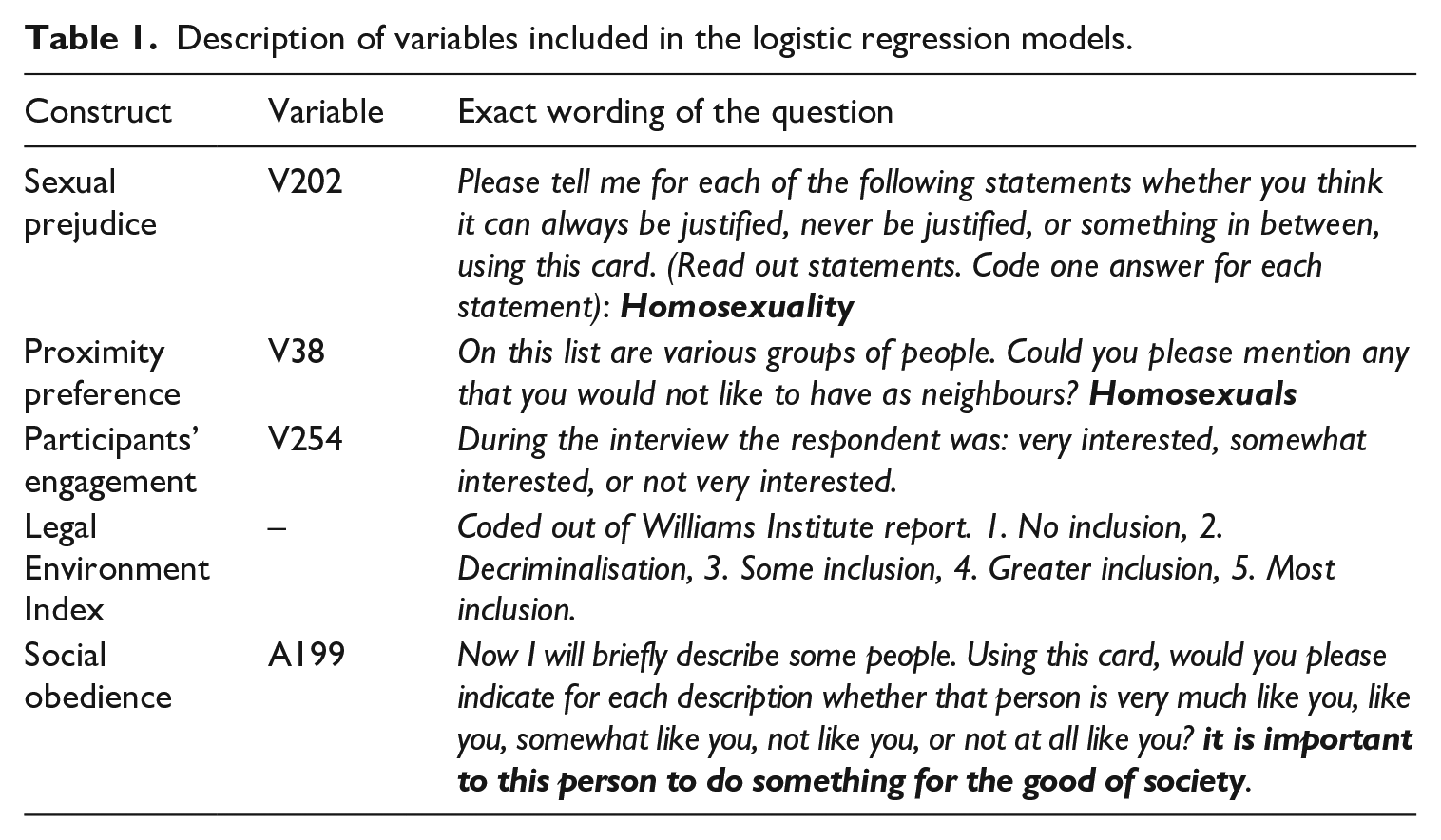
The following question asks participants to state their preference on whom they do not want to live next to: ‘On this list are various groups of people. Could you please mention any that you would not like to have as neighbours?’ One possible answer is homosexuals.
Independent variables
Acceptance of homosexuality
Participants were asked about the justifiability of homosexuality on a scale of 4 ranging from never be justified (coded as 1) and can always be justified (coded as 10). Inglehart and Welzel (2005) used this question to craft an acceptance measure. The scale has been used as a gold standard of measuring sexual prejudice in many published works (e.g. Adamczyk, 2017; Adamczyk and Pitt, 2009; Jäckle and Wenzelburger, 2015; Janssen and Scheepers, 2019).
Social obedience
Social obedience is the degree to which one is willing to follow the will of the majority within their society. Schwartz (1992) argued that those who are willing to act aligned with the will of the society gain a sense of control through doing what they are told and conforming to agreed laws and statutes. Accordingly, Schwartz cultural scale (Schwartz, 1992) operationalised this characteristic via the following statement: ‘it is important to this person to do something for the good of society’. Participants in IVS were asked to indicate how accurately the above-mentioned statement describes them. Responses were collected using a 6-point Likert-type scale ranging from ‘very much like me’ (coded as 1) to ‘not at all like me’ (coded as 6) in which a lower number is indicative of a more socially obedient individual.
Nation’s LGBT legal inclusivity
Overall legal treatment of sexual minorities per every country-year was coded based on a 5-level scale developed by Flores and Park (2018). The measure is known as the Legal Environment Index (LEI), which measures the levels of legal inclusiveness of sexual minorities each year in each country (see Table A.1. in Flores and Park, 2018). The scale was developed using well-cited reports of sexual minority treatment throughout the world from a collection of ILGA’s State-Sponsored Homophobia report, reports from the Hague Centre for Strategic Studies, Palm Center, LGBT world legal wrap up survey, and Europe Rainbow Map Index. The scale has 5 levels ranging from ‘No inclusion’ (coded as 1) to ‘Most inclusion’ (coded as 5). A higher number means more legal integration and protection for sexual minorities within the boundaries of a nation (see Table 2 in Flores and Park, 2018).
Cross-level interactions
Social obedience × nation’s LGBT legal inclusivity
The interaction between the levels of one’s social obedience and the degree of legal inclusion for sexual minorities was developed using the dummy variables for one’s social obedience (i.e. Schwartz cultural scale), and the nation’s degree of legal inclusion (i.e. LEI).
Control variables
Demographic and value variables
Past research has empirically linked several demographic and value variables to expressions of heightened sexual prejudice (for review see Herek and McLemore, 2013). These works attest to the importance of socio-demographics and value variables in prediction of superficial allyship, which makes any contextual analysis without controls for these significant variables incomplete. Therefore, all models in this study control for variables found to be significant in the past – these include gender, age, educational attainment, religiosity, and sexism.
Participants’ engagement in the interview
Consistency in human values is assumed within the social science literature (see Feldman, 1988). Hence, an inconsistency in sexual prejudice expressed in these data can be attributed to a ‘mistake’ due to participants’ lack of engagement in the interview. Fortunately, interviewers documented the level of engagement of the participants during the interview. The variable has three levels of ‘very interested’ coded as 1, ‘somewhat interested’ coded as 2, and ‘not very interested’ coded as 3. Models in this analysis control for participants’ engagement to ensure inconsistency in expressed sexual prejudice is not due to mistakes born out of participants’ lack of engagement in the interview.
Influence of nested data
Due to its panel nature, collected data is clustered and nested within country-year. Inappropriate analyses of clustered data have resulted in recent criticisms (e.g. Moen et al., 2016) of social science literatures’ approach when analysing longitudinal datasets that include nested data. Hence, to avoid the influence of nested data, it is appropriate to control models for clustering elements (Aarts et al., 2014) which, in this case, are country and year of interviews. Therefore, all models in this study control for these clustering elements.
Table 1 lists the description of variables mentioned above, and Table 2 shows the summary statistics and correlation between the said variables.
Description of variables included in the logistic regression models.
Correlations and summary statistics on dependent, independent, and control variables.
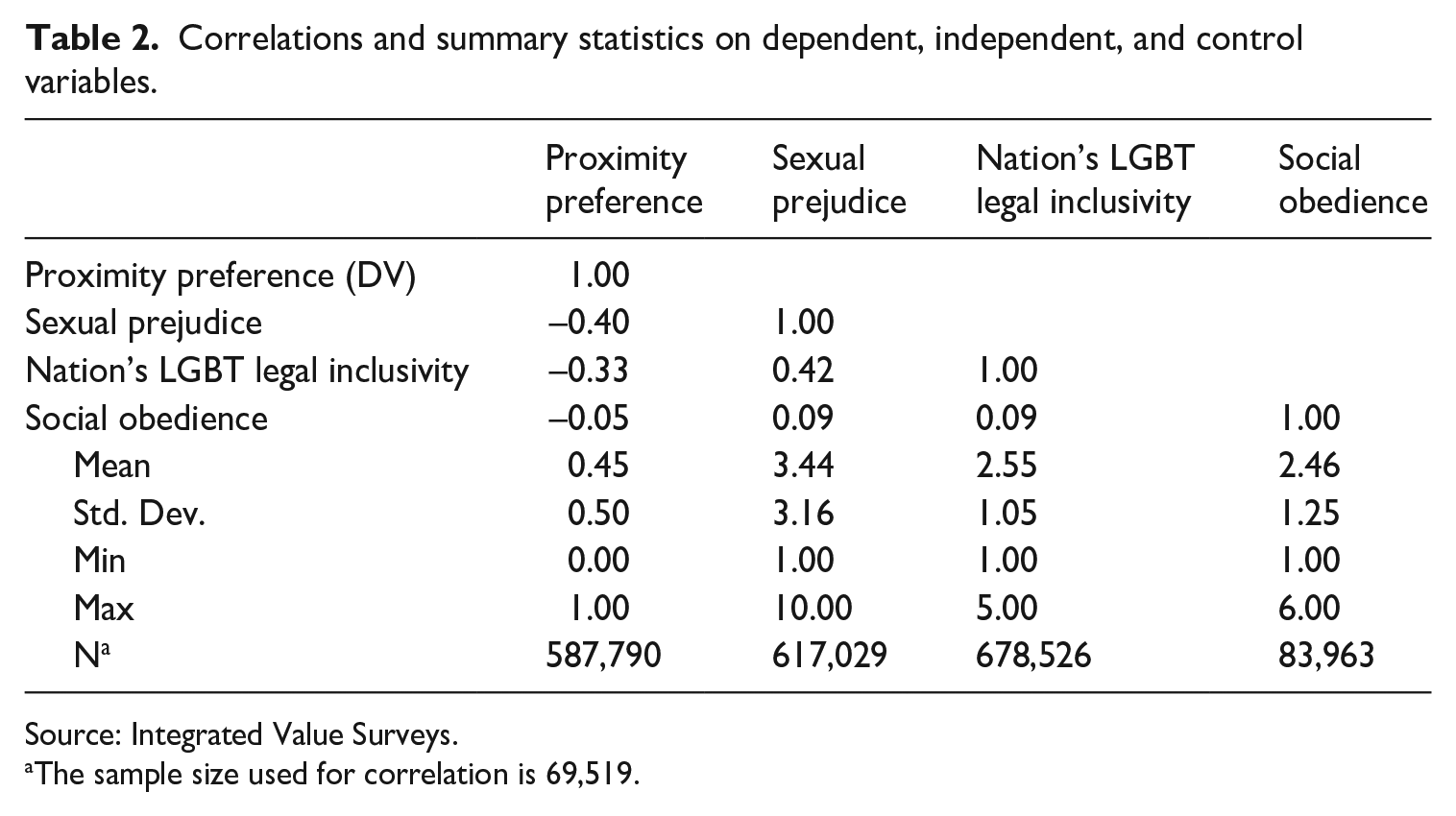
Source: Integrated Value Surveys.
The sample size used for correlation is 69,519.
Study population
Following in the footsteps of Glas and Spierings (2021), the population of interest for this study comes from the cross-tabulation of two measures of sexual prejudice at two different social distances. Per Goldstein and Davis (2010) and Stotzer (2009), allies are often those who score low on prejudice scales. Consistent with this, when developing their acceptance scale, Inglehart and Welzel (2005) posited that those who do not believe homosexuality to ever be wrong (scored 10 on their 0–10 homosexuality acceptance scale) should be considered as allies or the ‘wise’ per Goffman (1963). This has become a norm in many published works on this domain (e.g. Adamczyk, 2017; Adamczyk and Pitt, 2009; Glas and Spierings, 2021; Jäckle and Wenzelburger, 2015; Janssen and Scheepers, 2019; Souza and Cribari-Neto, 2015).
This being said, when running a cross tab between a direct sexual prejudice scale and an indirect measure like neighbour preferences (see Table 3), roughly 10% of ‘allies’ express extreme sexual prejudice by refusing to live next to homosexual neighbours. On the contrary, more than 36% of those who hold extreme sexual prejudice express no distaste in living next to homosexual neighbours. Labelling theory calls these types of anomalous behaviour a secretive deviance (Becker, 1963), which is present in both the stigmatisers and the allies. These two groups are the population of interest in this study.
Cross-tabulation of sexual prejudice and attitude towards neighbours.
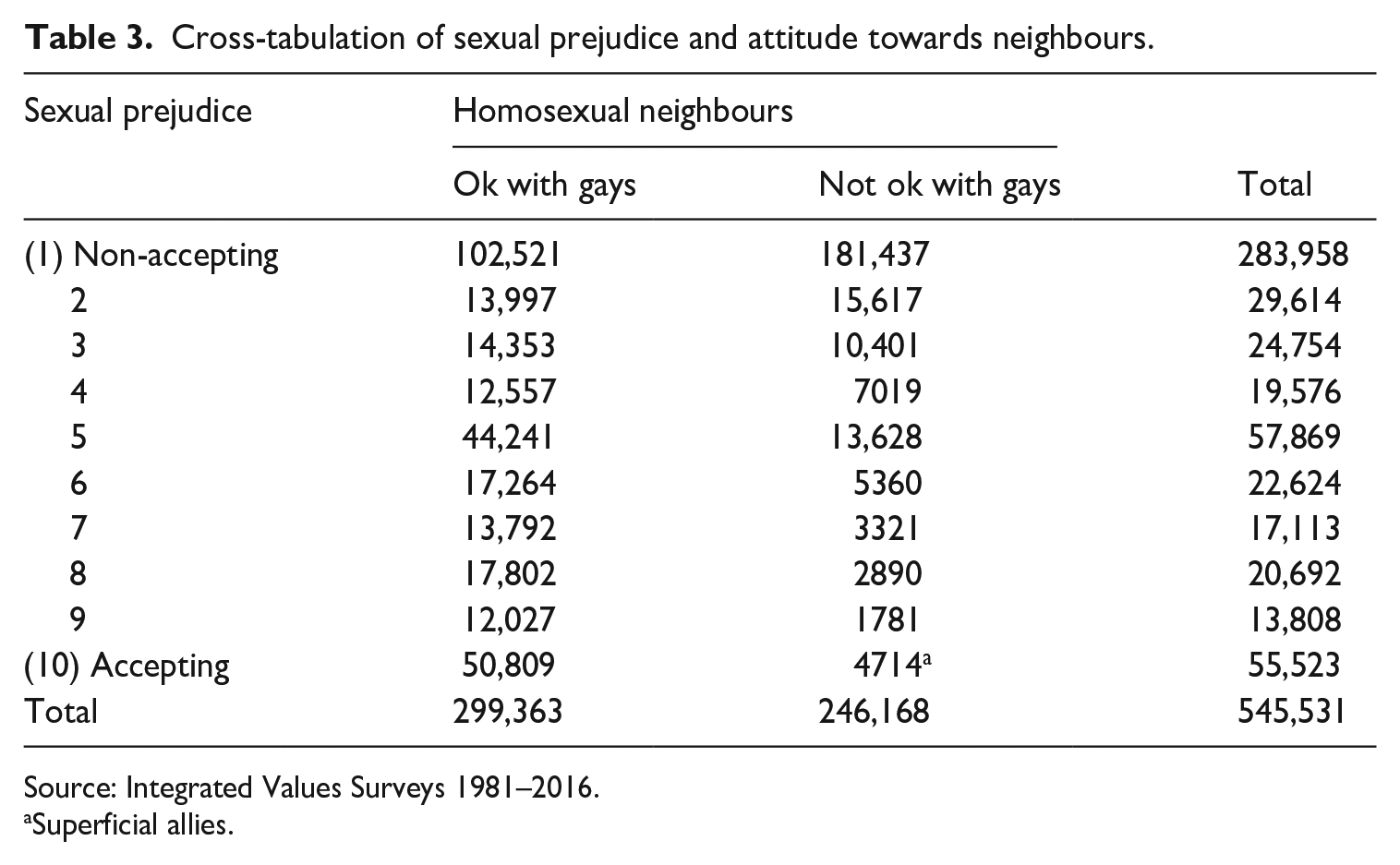
Source: Integrated Values Surveys 1981–2016.
Superficial allies.
Analysis
The appropriateness of the analytical method depends on the premises of the research question coupled with what the nature of data allows (see Tacq, 1997). To investigate the dynamics behind rejecting proximity to homosexual neighbours in an ally population with micro-level-dependent variable and macro-level explanatory variables, a multilevel analysis is appropriate (see Hox et al., 2017). More specifically, since the DV is a dichotomous variable, logistic regression, which is designed to test the relationship between a dichotomous DV, and multiple IVs is an appropriate approach. Therefore, models using multiple logistic regression were developed to measure the stated preference on proximity to homosexual neighbours (DV) on measures of social obedience (IV) and nation’s degree of legal inclusion of sexual minorities (IV) in two samples of non-accepting and accepting participants. The interaction between the two independent variables was also included in these models. The similarities between the two samples were later examined using chi-square test (this is also called a test of homogeneity and is often used to determine whether two populations are statistically similar). All regressions controlled for the participants’ levels of engagement in the interview. Controlling for the panel variable (i.e. country-year) prompted the use of fixed-effects models to reach a more precise parameter. Moreover, the standard errors are robust and are clustered at the country level.
Results
The results of the logistic regression show a significantly negative coefficient for national legal inclusion of sexual minorities in both samples of non-accepting, β = −0.451, z = −4.77, p < 0.0001, 95% CI [−0.63, −0.27], and accepting, β = −0.770, z = −4.13, p < 0.001, 95% CI [−1.13, −0.404], after controlling for country-year, demographics, and value variables. Regardless of their acceptance levels (e.g. non-accepting, or accepting), those in countries with less supportive legal climate for non-heterosexuals are more likely to reject proximity to homosexual neighbours than those who live in countries with more LGBT inclusive legal climates. Significant results for the chi-square test, χ2 (1, N = 36,313) = 25.30, p < 0.001 shows the two samples are statistically different from one another.
Social obedience shows effects with mixed results – there are significantly negative effects for the non-accepting sample, β = −0.078, z = −3.15, p < 0.01, 95% CI [−0.13, −0.03], but positively non-significant effects for the accepting sample, β = 0.067, z = 0. 48, p = 0.630, 95% CI [−0.20, 0.34]. In other words, non-accepting individuals who are socially obedient to the overall will of the majority in society are more likely to reject proximity to homosexual neighbours than non-accepting individuals who are less socially obedient. In addition, differences in social obedience do not impact proximity preference to homosexual neighbours among accepting individuals. However, the non-significant chi-square test χ2 (1, N = 36,313) = 0.11, p = 0.74 shows potential similarity between accepting and non-accepting samples on effects of social obedience.
Interaction between a nation’s LGBT legal climate and social obedience is interesting, but results are mixed. Within the non-accepting sample, results show a positive and significant effects, β = 0.026, z = 2.70, p < 0.01, 95% CI [0.007, 0.045]. However, there are negatively non-significant effects for the accepting sample, β = −0.025, z = 0.33, p = 0.442, 95% CI [−0.09, 0.04]. This means that those with non-accepting attitudes who are more socially obedient in nations with less legal inclusion for non-heterosexuals are more likely to reject proximity to a homosexual neighbour compared to their less socially obedient counterparts. However, results show that this interaction (Social Obedience × legal climate) has no bearing in rejecting proximity to homosexual neighbours in the accepting sample. Furthermore, the non-significant result of the chi-square test χ2 (1, N = 36,313) = 0.33, p = 0.56 suggests a similarity between the two samples of non-accepting and accepting regarding the interaction between social obedience and the nation’s LGBT legal climates (Table 4).
Results of logistic regression on stated preference for proximity to homosexual neighbour for non-accepting and accepting samples using clustered robust standard errors.
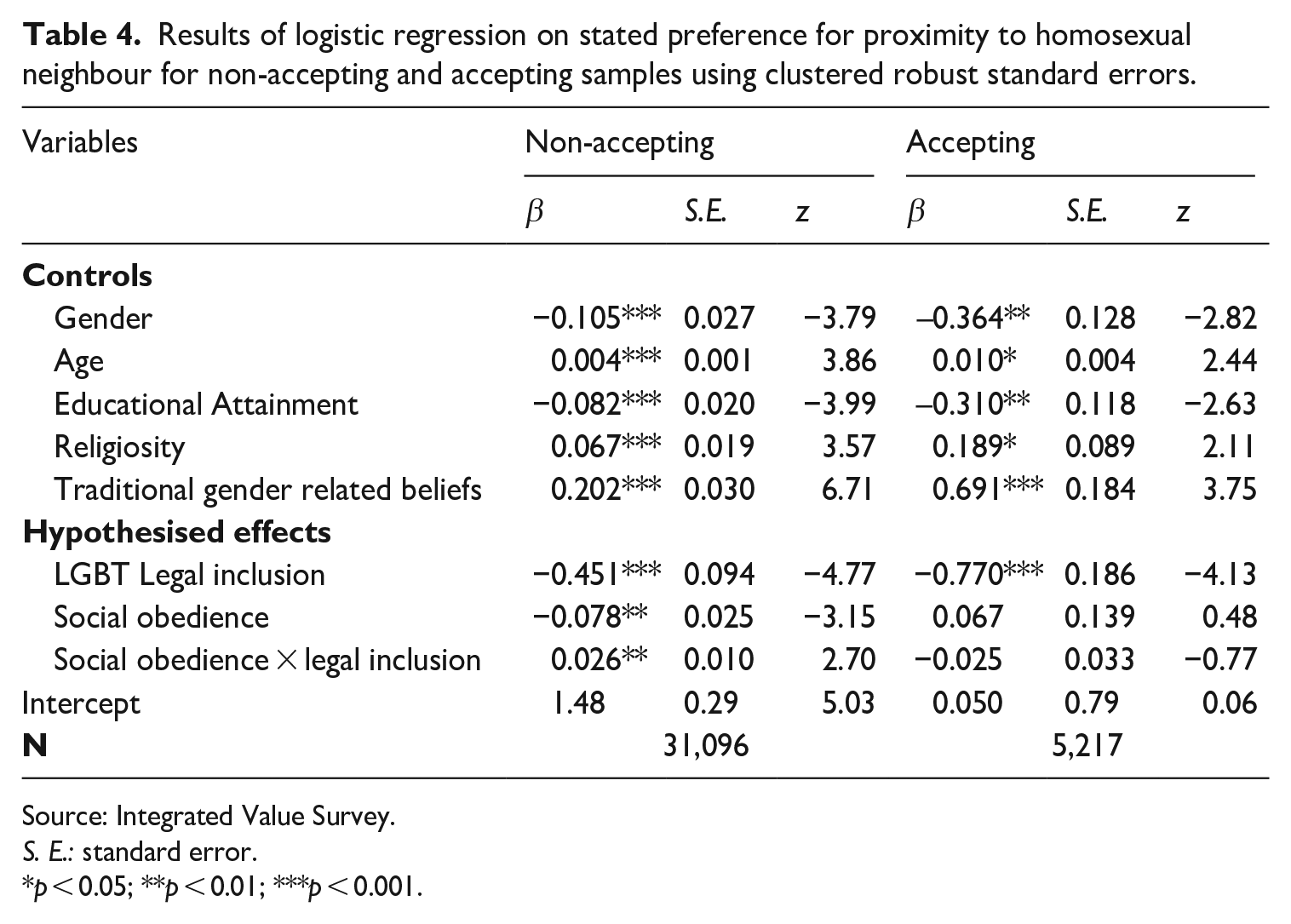
Source: Integrated Value Survey.
S. E.: standard error.
p < 0.05; **p < 0.01; ***p < 0.001.
Discussion and conclusion
In his original taxonomy of key stigma actors, Goffman (1963) assumed that being ‘wise’ about a stigma is enough to separate an ally from a stigmatiser. Furthermore, Goffman (1963) assumed that as a personal trait, allyship is solely based on the ally’s perception of stigma and the stigmatised. These assumptions later became the staple of the stigma literature (see Markowitz and Engelman, 2017). Therefore, the mainstream narrative on allyship defines allies as those who do not believe a certain behaviour is ever wrong or to be excluded (e.g. Devine, 1989; Goldstein and Davis, 2010; Ostrove and Brown, 2018). This definition led to a practical approach which strongly posits that an increased understanding of a behaviour is the path to destigmatising it (Smith, 2007, 2012). Hence, activist organisations began dedicating their resources to educate masses in order to successfully destigmatise a certain behaviour or trait (e.g. National Academies of Sciences Engineering and Medicine, 2016). Homosexuality in a heteronormative culture has been one of these stigmas. With this, efforts have been made to increase mass awareness about the diversity of sexualities in order to increase the population of those who do not associate any wrong with homosexuality and sexual minorities, assuming that having a large number of supporters and allies would facilitate the integration of the stigmatised into the society (McDonagh, 2019). However, this simply might not be the case, as the population in this study represents those who do not stigmatise sexual minorities yet refuse neighbouring proximity to them (see Table 3).
The mere existence of a sub-population of the ‘wise’ who express stigmatising attitudes in proximity casts a shadow over the mainstream assumption that internal attitudes about a stigma would translate into expressed allyship. This paradoxical attitude towards sexual minority neighbours suggests the involvement of social and structural factors beyond simple acceptance of sexual minorities. Exploring the role of social obedience and legal inclusion of sexual minorities in society on this paradox was the point of departure for this study.
Legal climate and perception of society are two major factors in the process of stigma (Tyler, 2020). Both factors determine right from wrong and have the power to enforce penalties on those who are deemed deviant (see Falk, 2001). However, by recognising their own privilege, it has been long assumed that allies tend to not follow stigmatising guidelines set by law and society (see Brown, 2002). This assumption is why allies are often deemed as powerful actors who support the stigmatised (Washington and Evans, 1991). This assumption is missing both the nuance that exists among the allies and its close tie to a nation’s legal climate.
The results of this study strongly suggest that even stigmatisers who firmly express distaste in accepting homosexuality, end up not rejecting closer proximity to sexual minorities when their nations offer more legal inclusion for sexual minorities. The interesting point, however, is that allies behave similarly to stigmatisers. This means that even those who wholeheartedly expressed allyship reject proximity to sexual minorities when little to no legal inclusion or protection for sexual minorities is offered in their nation, something that is only expected from stigmatisers, and never from allies.
Moreover, social obedience, or the tendency to follow the will of the majority, is only a key factor for stigmatisers and not for allies. Results show that stigmatisers who are socially obedient to the overall will of society are more likely to express acceptance in closer proximity to sexual minorities, whereas allies who are either socially obedient or disobedient equally would express rejection of proximity to sexual minorities.
What is interesting here is the power of law and legal inclusion over the influence of personal morals, and attachments to orders of society. Superficial allies morally show no conflicts with homosexuality; however, in the absence of legal inclusion for sexual minorities, both socially obedient and disobedient allies would reject proximity to those for whom they express full support.
This paradoxical attitude might be a stigma reduction or stigma avoidance strategy utilised by superficial allies as they are trying to reduce or avoid chances for them to be stigmatised by association. Initially labelled as a courtesy (see Goffman, 1963), a person can be stigmatised simply by the company they keep (Kulik et al., 2008). Those who are stigmatised by virtue of mere association with ‘deviants’ often face the same treatment as those who bear the stigma (Pryor et al., 2012). Since in the absence of legal protection for the stigmatised, the consequences of some stigmas can be severe (e.g. social exclusion, imprisonment, or death), it is reasonable for superficial allies to act like the stigmatisers and avoid proximity to the stigmatised in order to protect themselves from social backlash. This explanation becomes salient, since the role of Nth order enforcement (see Ozono et al., 2016) has not received much attention in the stigma literature. In this form of enforcement, the enforcer bases their enforcement of social stigma not on their personal beliefs but on the perception of punishment they might receive if they do not ‘punish’ (e.g. reject proximity to) the stigmatised (i.e. I punish you, so they won’t punish me). In other words, and based on the results of this study, those allies living in stigmatising legal contexts see no choice but to punish the stigmatised by rejecting proximity to them to protect themselves from similar social isolation. These findings are important and have implications for developing diversity initiatives in the workplace and social movements.
In the workplace, two of the most recommended destigmatising strategies are mixed interactions (Corrigan et al., 2012; Livingston et al., 2012; Yamaguchi et al., 2013) and for the stigmatised to seek support by confiding in allies (Brooks and Edwards, 2009). These recommendations are made based on a commonly held assumption that contact will reduce stigma (e.g. National Academies of Sciences Engineering and Medicine, 2016).
When generalised, the results of this study show these recommendations are ineffective in the absence of legal protection or inclusive policies for the stigmatised. The results also show that in absence of legal inclusion, mixed interaction has a strong potential to end in a rejection of the stigmatised by both the stigmatisers and the allies. Therefore, it is strongly recommended, especially to organisational leaders, to consider developing, implementing, or further reinforcing supportive and inclusive policies and practices. Since legal inclusion has been shown to reduce rejection of proximity to sexual minorities in both stigmatisers and allies, the said policies at the very least would help facilitate mixed interaction among all workers, which can in part increase productivity and overall performance (see Pichler et al., 2017).
Social movements often prioritise attention and resources to ally development (Myers, 2008), believing that the rise in allyship will consequently lead to further de-stigmatisation (e.g. LaMantia et al., 2015). Based on the results of this study, this approach might not be an entirely effective strategy – in the absence of legal protection, just like the stigmatisers, some allies would reject proximity to the stigmatised despite their moral convictions and acceptance. Therefore, it is recommended that movements re-focus their attention to advocacy efforts that would result in a meaningful increase in legal protection and inclusion for the stigmatised. Skitka et al. (2009) showed that changes in laws can effectively change the societal morals and convictions around a social issue. This means that increased legal inclusion of the stigmatised can consequently lead to a stronger ally base.
It is understood that allies play a vital role (Goldstein, 2017) in any movement against injustices faced by the stigmatised (Washington and Evans, 1991), but since they are a severely understudied group (Fingerhut, 2011), there is not much known about the portion that share a behavioural intent with the stigmatisers (e.g. express rejection in proximity). Hence, researchers are encouraged to further pursue the paradox of superficial allyship by paying attention to factors that can predict inconsistencies in allyship. With such knowledge, social movements can narrow their ally development strategies to invest in allies who remain committed to the stigmatised even in absence of legal protection.
Although similar inconsistencies have been studied before (e.g. Glas and Spierings, 2021; Penner and Saperstein, 2008), criticism of this work may attribute this inconsistency to a mistake in data collection. More specifically, since the data used in this study are from in-depth, face-to-face interviews, it can be assumed that participants expressed contradictory attitudes towards members of the same group due to a mistake born out of lack of engagement or interest in the interview. To remedy this, the principal investigators of the IVS included a variable that measures participants’ levels of engagement in the interview. No significant effect was observed when controlling for this variable in models showing that expressing contradictory attitudes towards sexual minorities is least likely to be attributed to lack of interest or engagement in the interview.
This study is not without limitations. Due to data limitations, analyses mostly depended on measures of expressed attitudes or expressed behavioural intents instead of actual behavioural measures. Hence, analyses in this study could benefit from more concrete behavioural measures of allyship (e.g. attending support rallies, donating to a movement, or volunteering for a supporting campaign), and proximity to sexual minorities. Also, to better capture change in allyship, analyses in this study could be replicated using experimental designs with pre–post-control groups. Furthermore, aligned with its scope, this study is limited to the stigma of homosexuality. Hence, the literature can be further expanded if allies of different types of visible (e.g. race and gender) and invisible (e.g. religion, HIV status, criminal past) stigmas and different distances (e.g. family member, work colleague, friend) are studied. Likewise, the use of mainstream operationalisation of allyship (i.e. scoring low on prejudice scale) can be criticised by saying that allyship is meaningful only when participants express support for social inclusion and civil rights for the stigmatised. With this, some work (e.g. Averett et al., 2011) indicated supporting sexual minorities’ right to marry or to adopt children as alternatives to operationalise allyship. Hence, future research is encouraged to test the robustness of this phenomenon (i.e. superficial allyship) and the variables predicting it by developing models using different measures of allyship. Finally, the quantitative nature of this study forces this analysis to appear too categorical which might not fully capture the complexity of superficial allyship. Perhaps qualitative research using a case-oriented approach can further illuminate the nuance that exists among allies.
This study has been the first to explore sexual prejudice from the vantage point of allies. By linking legal inclusion of the stigmatised to superficial allyship, findings of this study advance our understanding of allyship and its dynamics. These outcomes can help guide social movement campaigns in their ally development strategies.
Footnotes
Acknowledgements
The author is grateful to the Editor and two anonymous reviewers of this journal, as well as to Dr. Gregory Phillips II, for their support and helpful comments on an earlier version of this work.
Funding
The author(s) received no financial support for the research, authorship, and/or publication of this article.