




Abstract
How does television taste function as cultural capital in contemporary China? This study shows how Chinese youth engage with global television fiction to mark their positions in China’s changing social and cultural hierarchies. Using multiple correspondence analysis (N = 422) and interviews (N = 48) with college students in Beijing, we identify three taste dimensions: (1) disengaged versus discerning viewers; (2) TV lovers versus TV dislikers; and (3) ‘Western’ versus ‘Eastern’ TV taste. Dimensions 1 and 3 are cultural capital dimensions; they differ in criteria and type of cultural knowledge used to make distinctions and in connection with economic capital. Highlighting cosmopolitan capital as a distinct form of cultural capital, we analyse shifting global systems of cultural distinction, from a Chinese vantage point. Our analysis expands theories of culture and inequality by showing that (and how) tastes reflect and reinforce social stratification in the previously unexplored Chinese context, but with distinctive Chinese characteristics.
Introduction: a ‘chain of disdain’ in Chinese television tastes?
In April 2012, the popular Chinese magazine City Weekly devoted its lead article to the bishi lian – literally, a ‘chain of disdain’ – in cultural consumption. The article described hierarchies (‘chains’) of cultural prestige in clothing, music, magazines, games, television, and movies. In television, English-language programming sat on top of the ‘chain’. Its viewers looked down upon people watching Japanese TV, who in turn despised fans of Korean TV. Hong Kong and mainland Chinese shows ranked even lower, and shows from Thailand were at the bottom (China Daily, 2017). While tongue-in-cheek, the widespread notion of a ‘chain of disdain’ suggests a hierarchy of tastes and boundary-drawing based on it, pointing to a contemporary Chinese version of cultural capital. Singling out English-language shows as most prestigious, it follows a logic that sociologists would qualify as cosmopolitan (Lavie and Varriale, 2019). Inspired by this discourse of the ‘chain of disdain’, this article examines Chinese youth’s tastes in fictional television and their potential function as cultural capital in contemporary China.
China is a quickly changing society with a growing middle class and new elites. Economic growth and globalisation have heralded an era of cultural abundance, which has given rise to new forms of cultural capital (Goodman, 2016; Zhang, 2020). The discourse of the ‘chain of disdain’ hints that in China, as in Europe and North America, deepening globalisation adds a new dimension to taste hierarchies: cosmopolitan prestige versus disqualified local fare. The scarce studies of Chinese cultural distinction suggest that China’s cultural classifications and consumption patterns follow ‘local logics’ that diverge from European and North American patterns (Wang et al., 2006; Zhang, 2020). The Chinese case therefore extends theorisations of the relation between cultural tastes and social hierarchies in a globalising world.
Our analysis of cultural capital in China focuses on young people’s consumption of fictional television, a popular, globalised cultural form encompassing a range of genres from sophisticated ‘quality drama’ to accessible soaps. Since the 1990s, the quality and variety of domestically produced Chinese television has grown (Zhu and Berry, 2009). Technological advances and cultural globalisation expanded Chinese audience’s viewing options to Asian, American, and European television, including Japanese drama and the ‘Korean wave’ (Yoon and Dal, 2017). This variety of genres, origins, and intended audiences make TV a strategic case to study the relation between cultural consumption and social stratification. First, people of all backgrounds consume TV, but they often sort into stratified ‘taste cultures’, consuming ‘quality TV’, popular programmes for wider audiences, or stigmatised ‘trashy’ TV (Kuipers, 2006; McCoy and Scarborough, 2014). Second, although TV content can be cheap or even free to those with technological know-how, accessing foreign programming in China requires consumers to be culturally and technically savvy (Gao, 2016). Thus, studying the consumption of global television allows us to analytically separate the effects of cultural capital from economic capital. To consume high-status TV in the fragmented TV landscape, you do not have to be rich; you just need to have the embodied cultural capital to recognise ‘quality’ content and get (digital) access to it.
Using 422 surveys and 48 in-depth interviews with college students in Beijing, we examine whether and how Chinese youth engage with global fictional television to mark their positions in China’s changing social and cultural hierarchies. By analysing taste hierarchies and cultural capital outside the Euro-North-American context, our study expands sociological insights on the role of culture in shaping and reproducing social inequalities, and the relation between cultural, economic, and cosmopolitan capital in today’s globalising world.
Cultural capital and social distinction in comparative perspective
In struggles for social status, European and North American elites express their cultural capital by drawing symbolic boundaries from others who do not share their ‘legitimate’ tastes. Across cultures, material wealth – or, in Bourdieusian terms, economic capital – is often signalled by conspicuous consumption. Cultural capital, in contrast, is indicated by cultural tastes that are only accessible to those ‘in the know’ (Bourdieu, 1986). These legitimate tastes become ‘embodied’ through socialisation and education: they become so deeply ingrained as to feel natural and self-evident. Such embodied cultural knowledge gives people from privileged background a head start in formal (educational) institutions, leading to an accumulation of ‘institutionalised’ cultural capital: diplomas and other formal credentials.
In today’s democratised cultural fields, elites increasingly demonstrate ‘omnivorous’ tastes (De Vries and Reeves, 2021; Peterson, 2005). High-cultural capital (HCC) consumers adopt erudite styles of appreciation while consuming cultural forms traditionally labelled as commercial or artistically inferior, like television. In doing so, they rely on their embodied cultural capital to draw symbolic boundaries between themselves and the culturally less privileged (Jarness, 2015). Studies on distinction in TV consumption have shown how people draw symbolic boundaries in different ways: by shunning less prestigious content (Kuipers, 2006), or by adopting distanced or ironic viewing styles while watching ‘bad’ television (McCoy and Scarborough, 2014).
Paradoxically, this seemingly democratic shift to omnivorous distinction and cultural ‘openness’ (Roose et al., 2012) often benefits people from privileged backgrounds, particularly those with greater parental cultural capital. As Lizardo (2019) argued, the ‘deep’ aesthetic disposition cultivated through early immersion in HCC environments is more transposable to less legitimate cultural forms than more ‘shallow’ cultural capital acquired through formal education. Contemporary cultural capital thus entails appropriate knowledge to single out ‘quality’ and engage with less legitimate culture in a sophisticated manner (Flemmen et al., 2017; Friedman and Reeves, 2020; Prieur and Savage, 2013).
Aligned with ‘omnivorous’ cultural consumption, younger, educated Europeans gravitate towards foreign cultural products (Coulangeon, 2017; Krolo et al., 2020; Meuleman and Savage, 2013). This openness to foreign cultures departs from the cultural seclusion of older elite tastes, suggesting the emergence of cosmopolitanism as a new form of cultural capital (Prieur and Savage, 2013; Regev, 2019). The capacity to stand outside one’s national frame can signal high-cultural status in non-Western contexts, too (Hedegard, 2015; Kim, 2011). However, despite expanding cultural globalisation, whether and how cosmopolitanism functions as cultural capital remains dependent on national context (Cicchelli et al., 2021).
Existing theorisations of cultural capital are based on studies in Europe and North America. Whether and how cultural tastes function as an arena for status struggle and thus affect life chances in other continents remains a question (Lizardo, 2018). The gap in our knowledge is especially glaring in the case of China, where global media flows reshape cultural consumption, and where economic and political changes caused unprecedented social mobility and expansion of higher education (Lu et al., 2021).
Until the mid-20th century, China was an estate society with a largely hereditary stratification system and limited social mobility. Consequently, there was less active policing or negotiation of social boundaries than in (Western) European or North American class societies. In the 1980s, market-oriented economic reforms created new social hierarchies based on education, occupation, income, and consumption, that is, class (Bian, 2002; Lu et al., 2021). Because of this unique trajectory, the rising Chinese middle class did not have an established bourgeoisie to emulate; they also lacked institutions like charity or arts patronage that allow elites in class societies to accumulate cultural capital (Osburg, 2013). In addition, Chinese social differentiation is unfolding under deepening globalisation. These characteristics render status struggles in contemporary China distinct from European and American patterns.
Research on contemporary Chinese stratification suggests that in China, cultural capital is not clearly distinguished from, or opposed to, economic capital (Davis, 2000; Goodman, 2016; Osburg, 2013). Studies about cultural reproduction in Chinese education find that parental economic and cultural capitals work in tandem to benefit youth from middle-class households (Sheng, 2014, 2017; Wu, 2012). A recent study finds that HCC consumers in China do not reject materialism; rather, they engage in conspicuous consumption to distinguish themselves from others, including the less educated new rich, who lack the sophistication to recognise ‘quality’ (Zhang, 2020).
Economic and cultural capitals are entangled when manifesting in cosmopolitan tastes. For example, when McDonald’s entered China in the 1990s, many Chinese chose to dine there despite the relative high price and ‘strange’ taste of American fast foods because they relished the cultural symbolism of modernity imbued in this quintessential American brand (Yan, 2013). Similarly, despite the prohibitive costs and uncertain returns of foreign degree attainment, Chinese students are racing overseas in ever greater numbers (Xiang and Shen, 2009; Yang, 2015). The outward-bound wave was driven by the symbolic value of a foreign degree – as a touchstone for status and success for the entire family (Fong, 2011; Xiang and Shen, 2009; Yang, 2015).
Few studies of Chinese cultural consumption have addressed the (possibly growing) importance of cultural capital as distinct from economic capital. A pioneering study of reading habits (Wang et al., 2006) showed that educated Chinese read more and more highbrow literature, demonstrating a connection between stratification and cultural tastes partly independent of economic status.
These scattered studies support the impression given by the ‘chain of disdain’: in China, cultural taste can be a means of distinction. However, many questions remain, notably regarding the relation between economic and cultural capital, and the importance of local versus cosmopolitan cultural capital. In addition, these studies tell us little about the boundaries drawn: what criteria are used to evaluate social groups and cultural tastes? What and who are excluded in this process? Are these boundaries specifically Chinese, for instance, because they are rooted in traditional Chinese values (Zhang, 2020)? Finally, apart from Gao (2016), no studies have looked at Chinese cultural distinction in television. TV is among the most widespread and international cultural forms. For those who know their way around the Internet – like Chinese university students – TV content is affordable if not free, making it uniquely unsuited for conspicuous consumption to display economic capital. Television fiction therefore offers a strategic site to (1) explore cultural taste with minimal interference of economic capital and (2) compare cosmopolitan and non-cosmopolitan cultural capital.
Studying taste in China: methods and data
Inspired by the discourse of ‘the chain of disdain’, we investigate whether and how cultural tastes function as cultural capital in contemporary China, focusing on the television tastes of Chinese college students. We combine survey data and in-depth interviews to investigate (1) what patterns of cultural knowledge and appreciation exist in the television tastes of young Chinese and (2) what underlying logics structure knowledge and appreciation of TV shows. Specifically, we look for evidence of hierarchical taste patterns related to TV programmes’ geographical origin (which we see as expressing cosmopolitan capital) and purported quality (expressing cultural capital). To assess whether these taste patterns indeed reflect status-based distinction, we investigate (3) whether people draw symbolic boundaries – that is, judge others or pride themselves (Friedman and Kuipers, 2013) – based on their likes or dislikes.
Sample and instruments
We sent an advertisement to a random sample of 1800 students in a prestigious national university in Beijing. A total of 422 students completed the survey (response rate: 23.4%); of the 422 survey takers, 48 participated in follow-up interviews. We chose to study university students for practical and theoretical reasons. Practically, VPN and university-based Torrent sites allow students easy access to international television programmes at low or no cost. Theoretically, significant expansion of education in China diversified student bodies in national universities (Lu et al., 2021). This is confirmed by our survey respondents, who vary greatly in social background and international experience (see Table A1 in the Methodological Appendix). Following Lizardo (2019), we expect to see these variations in parental cultural capital expressed in tastes for fictional TV – a less legitimate cultural form.
The survey asked about respondents’ social backgrounds and cultural and economic resources, including parents’ education and profession, family income, region/urbanity, foreign language skills, and international experience. To gauge respondents’ TV tastes, we asked them to indicate their knowledge of and preferences for 60 fictional TV shows, 10 each from China, Hong Kong, Japan, South Korea, the UK, and the US, representing 10 main genres. We used Douban, a Chinese review site that is highly reputable and popular among younger, educated Chinese people, to sample the shows. Specifically, we used the site to rank shows by ‘trendiness’ (indicating popularity) and user rating (indicating general quality), and selected the show with the highest overall rank to represent each genre/country. To rule out highly rated cult favourites that may reflect elite tastes, only shows with at least 5000 user ratings on Douban were considered. The resultant sample is a mix of old and new shows, combining mainstream and niche programming (for a detailed discussion on the selection of the shows, see Methodological Appendix Section 4). Using the US and Chinese TV as an example, Table 1 shows selected shows for each genre. Respondents were instructed to rate shows on a 5-point scale or to check ‘unfamiliar’ if they did not know the show.
Genres in the survey, with examples of American and Chinese shows.
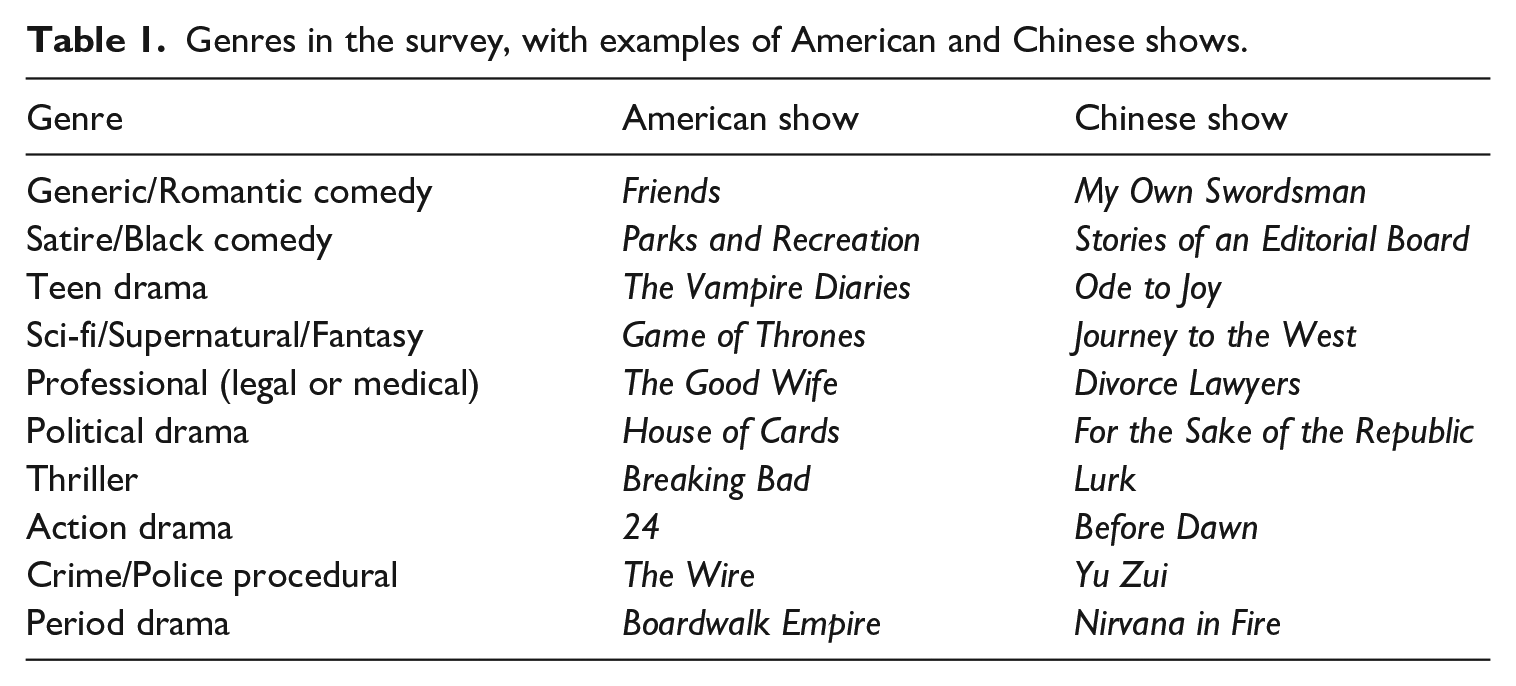
Forty-eight respondents (21 males, 27 females) were selected for in-depth interviewing. As an indicator of institutionalised cultural capital in a respondent’s household, we averaged parental education levels to approximate parental cultural capital. Parental cultural capital is operationalised variedly, from simple (e.g. mother’s highest educational attainment) to complex aggregates of parental education and cultural participation (Davies and Rizk, 2018). By considering the institutionalised cultural capital of both parents, our measure aims to strike a middle ground. Fifteen interviewees had low cultural capital (LCC), 17 had medium cultural capital (MCC), and 16 had HCC. We used a semi-structured interview protocol with questions about respondents’ television taste, cultural practices, leisure activities, family background, international experience, and personal ambitions. Interviews were conducted face-to-face, in Mandarin Chinese, by the first author.
Analysis
We analysed our survey data with multiple correspondence analysis (MCA), using the MCA module in R (Greenacre and Blasius, 1994; Nenadic and Greenacre, 2007). MCA can be used to inductively identify patterns in categorical data. It was used by Bourdieu (1984), and in subsequent influential studies of cultural taste and social background (e.g. Bennett et al., 2009; Roose et al., 2012). Our respondents rated the shows they knew on a 5-point scale or indicated they did not know the show. Because in today’s fragmented TV landscape, nobody knows all the shows; ‘unfamiliarity’ is retained as a meaningful category. To create categorical variables, we recoded respondent ratings of the shows to three modalities: (1) dislike/indifference (1–3 on a 5-point scale), (2) like (4–5 on a 5-point scale), and (3) unfamiliar.
As expected, most informants knew fewer than half the shows. As a result, a first analysis that included all 60 shows was strongly skewed towards lesser known shows. We therefore based our primary analysis on the scores of 27 shows known by at least 25% of respondents. This provided a picture of what we could call the ‘overall’ television landscape. Ratings of the other 33 shows were included as supplementary variables: they were not used to compute the dimensions, but their scores on each dimension were computed afterwards (Greenacre and Blasius, 1994; Nenadic and Greenacre, 2007). Thus, niche (elite or fan) tastes were included in the analysis, without skewing the analysis in the direction of such outliers. Based on the MCA scree plot and the inertia (a measure of explained variance), we selected a three-dimension solution. At 23.7%, the inertia is relatively low but not atypical for MCA (Benzecri, 1992).
We computed the 48 interviewees’ scores on all three MCA dimensions (see Methodological Appendix Section 5) and used the interview data to interpret these dimensions in a first round of coding. In a second round, we conducted an inductive thematic analysis of all 48 interview transcripts to uncover the cultural logics guiding people’s evaluations of TV programming, focusing on discourses about a show’s place of origin, about ‘good’ versus ‘bad’ television, and symbolic boundary-drawing based on TV tastes.
Results: television tastes in China
Cultural knowledge in a fragmented TV landscape
The average informant rated 19.5 (33%) of 60 shows, marking the others as ‘unfamiliar’. This confirms that in the abundant, fragmented Chinese TV landscape, knowing everything is impossible. When informants gave a score, appreciation was high: 3.94 out of 5. However, knowledge and liking of shows varied considerably across shows and persons. Table 2 shows the average evaluation and knowledge of shows by place of origin. For an overview of the most and least popular shows among informants, see Table A2 in the Methodological Appendix.
Evaluation and knowledge of TV programmes by place of origin.
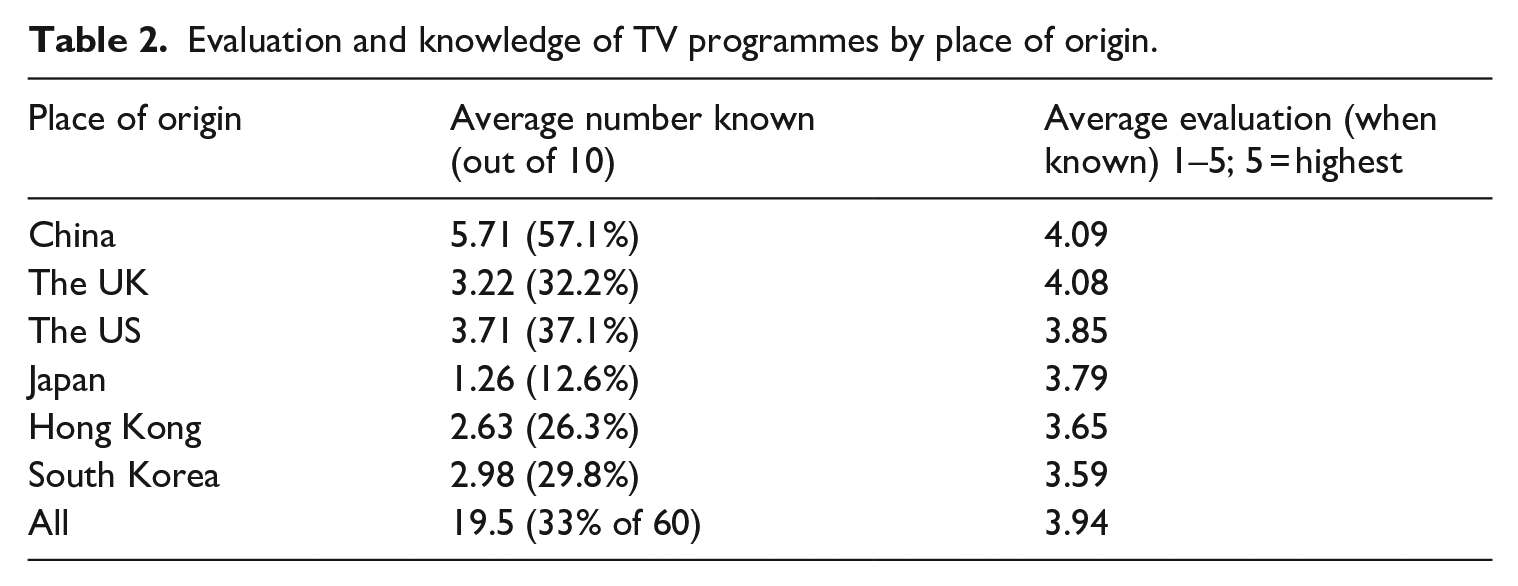
Chinese series are both the best known and most liked. This appears to defy our expectations regarding a ‘chain of disdain’, which suggests preferences for foreign TV. Instead, it corroborates the well-known phenomenon that people prefer local television because of its ‘cultural proximity’ (Straubhaar, 2007). Other elements of the ‘chain of disdain’ are confirmed: UK TV and US TV rank directly below Chinese TV as the best known and best liked. Television produced in South Korea and Hong Kong is fairly well known but less liked. Japanese shows are least known but better liked, suggesting a niche taste. However, there were significant variations in respondents’ knowledge and appreciation of shows. The MCA revealed three dimensions that structure the TV tastes of the respondents. Below, for each dimension, we first discuss the MCA results and then use the interview data to interpret the cultural logics underlying this dimension.
Dimension 1: disengaged versus discerning viewers
The first dimension differentiates informants with limited TV engagement from those with extensive but critical TV knowledge. ‘Disengaged’ viewers report unfamiliarity with must-know shows that are known by over 50% of our sample, including global hits (Friends, Downton Abbey), popular shows from South Korea and Hong Kong, and Chinese blockbusters like Ode to Joy, often dubbed the Chinese Sex and the City. At the other end of the spectrum, ‘discerning’ viewers like Chinese and US quality drama. However, as Figure 1, which only shows the modalities contributing above average, illustrates, this dimension is primarily defined by dislike/indifference towards well-known shows, including classics (Doctor Who), acclaimed contemporary shows (Downton Abbey, Breaking Bad), and highly regarded Chinese shows, with a special dislike for Korean shows.
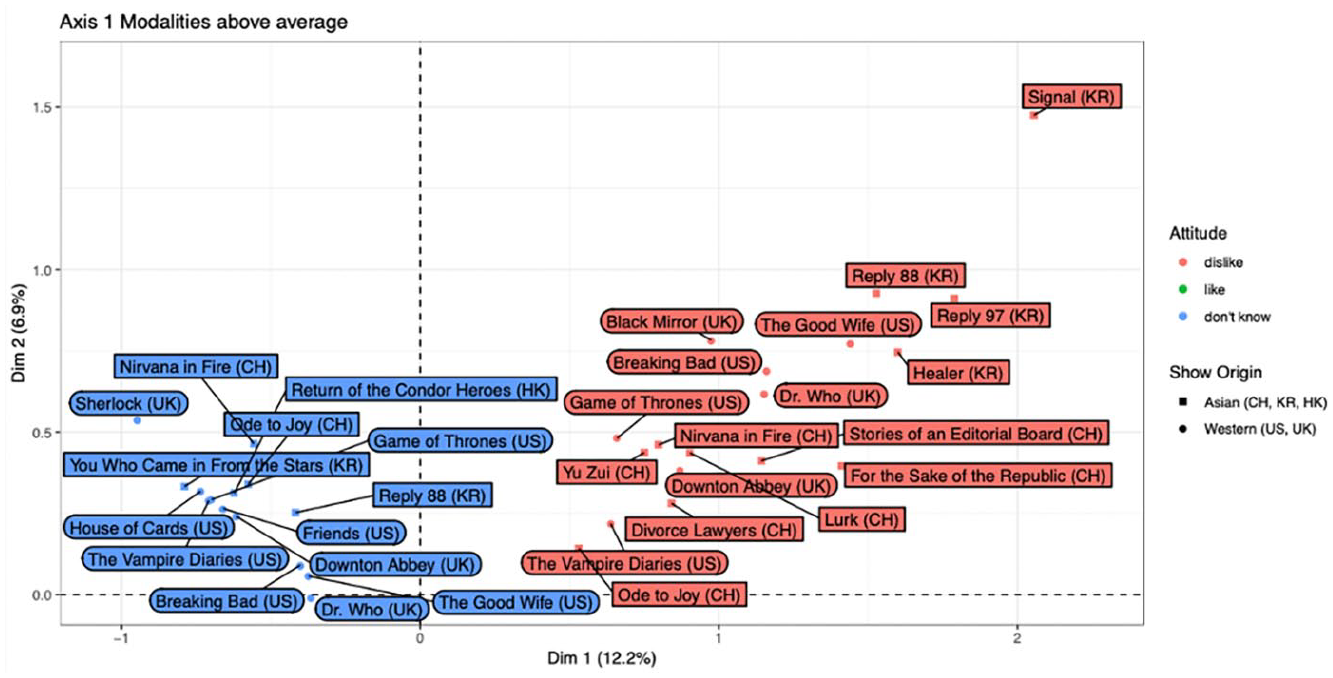
Dimension 1: Disengaged (left) versus discerning (right) viewers. Shows only modalities contributing above average. Series name in blue box: do not know; red: dislike/indifference (1–3 on a 5-point scale); green: liking (4–5 on a 5-point scale).
What is striking about this dimension is that appreciation and dislike/indifference cluster at the same pole, but dislikes make the strongest contribution and yield the most extreme scores (thus showing up in Figure 1). This finding resembles Kuipers’ (2006) MCA of Dutch TV comedy: the first dimension revealed a similar opposition of unfamiliarity versus both like and dislike/indifference. Additional analysis including shows known by less than 25% of informants yields a similar opposition of unfamiliarity versus critical, often negative appraisal of well-regarded shows from all regions. This dimension, with the highest inertia or explanatory power, is not about liking versus disliking, but about lack of cultural knowledge versus discerning, critical tastes that find many things lacking. In classic Bourdieusian style, rejection appears to be a stronger driver of distinction than preference (cf. Roose et al., 2012).
The interview data help us understand the cultural logics underpinning this dimension. Informants with negative scores are characterised by limited cultural interest and a ready deference to prevailing opinions. Zou Yang, a typical disengaged viewer (lowest Dim1: -2.10; M, 21, MCC, MidUrban; see Methodological Appendix for more information on informants), barely watches any TV. Quick to declare British television ‘the best’, he admits to having only seen one episode of Sherlock and two episodes of Downton Abbey and ‘wasn’t into either despite the good reviews’. ‘It’s the general opinion’, he explains, ‘Everyone says British shows are good’. Yu Xin, another disengaged viewer (Dim1: -1.33; M; 20; LCC; MidUrban), favours Hong Kong dramas that he grew up watching. Professing what Bourdieu (1984) calls ‘cultural goodwill’, he acknowledges the superiority of tastes that he does not share: ‘British drama is more realistic and well made’ and American TV is ‘better produced and more hip’, although he rarely consumes either and only watches mainland Chinese shows.
People scoring positively on dimension 1 are ‘discerning’ viewers: well aware of cultural offerings, they find many things falling short of their exacting standards. Yao Jing (highest Dim1: 2.88; M, 20, MCC; HighUrban) enjoys mocking ‘bad’ shows for being formulaic and predictable: Korean dramas are too tropey: the steely-eyed male lead wrestles with his profound love for the down-and-out female lead; a secondary male lead pines for the female lead and is always waiting for her outside by his posh car. And let’s not forget the secondary female lead, who’s obsessed with the second guy and madly jealous of the first girl . . . It’s always like that!
Despite his critical sensibility, Yao Jing likes to display his rarefied tastes. Thrilled that the interviewer enjoys the British political satire Yes Minister, he calls the show ‘one-of-a-kind’ and ‘definitely not for every Chinese viewer’.
Similarly, Hu Wen (Dim1: 1.35; M; 21; HCC; HighUrban) draws a sharp boundary between good, ‘complex’ TV like Game of Thrones and mass-produced ‘trite’ TV offering cheap thrills for large audiences: Nobody [in China] bothers to create something like Game of Thrones . . . A much lousier show based on a trite plot and stuffed with bombshells and heartthrobs would still be propped up by a colossal teen fanbase . . . I prefer more complex shows, like Game of Thrones. The epic storyline reminds me of [classic Chinese novel] Romance of the Three Kingdoms.
Hu Wen flaunts his cultural and cosmopolitan capital by insisting that ‘one must watch shows like Game of Thrones with the original English soundtrack . . . It’s more authentic’.
Structured around an opposition of disengagement and deference versus critical engagement and appraisal, dimension 1 also has a geographical dimension. ‘Discerning’ viewers like Yao Jing and Hu Wen especially despise formulaic Korean and Chinese entertainment. Proud of their tastes for hard-to-access American and British shows, they draw boundaries from those with limited knowledge and undeveloped tastes. ‘Disengaged’ viewers, in contrast, have limited cultural knowledge, and insofar as they watch TV, like popular, older Chinese or Hong Kong shows. They accept the legitimacy of ‘good’, mostly US and UK TV, even when they do not watch or like it. This taste hierarchy is accepted by those not ‘in the know’.
Dimension 2: TV lovers versus TV dislikers
The second dimension, shown in Figure 2, contrasts a general appreciation of TV with dislike of television. On the negative side, the most contributing factors are ‘likes’ for a range of genres and countries; on the positive pole, the most contributing modalities are ‘dislikes’ of mainstream shows from around the world, and unfamiliarity with Nirvana in Fire, a well-regarded Chinese drama. Further analysis including supplementary variables yields a similar pattern: a contrast between ‘like’ and ‘dislike’ that spans all genres and countries.
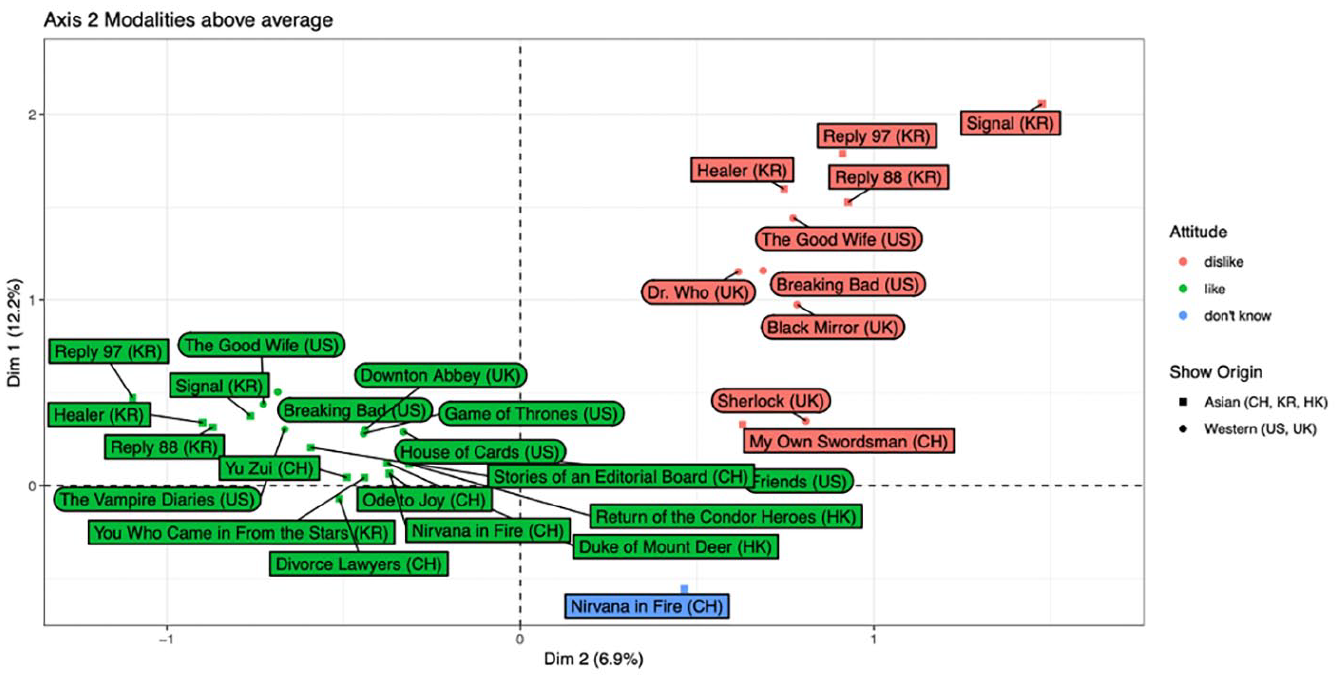
Dimension 2: TV lovers (left) versus TV dislikers (right). Shows only modalities contributing above average. Series name in blue box: do not know; red: dislike/indifference (1–3 on a 5-point scale); green: liking (4–5 on a 5-point scale).
With a self-deprecating laugh, TV lover Du Lan (Dim1: 0.18; Dim2: -1.30; F; 21; HCC; HighUrban) calls herself a ‘TV junkie’: I need to watch shows every day . . . During the semester, I spend 2-3 hours a day watching shows, and sometimes I binge-watch. During breaks, sometimes I’d watch shows in bed from the moment I wake up till it’s bedtime again.
Despite a broad taste in TV, Du Lan is an enthusiast for Japanese shows. After devouring the popular courtroom dramedy Legal High, she followed the lead actor to his new series Hanzawa Naoki and was again impressed: ‘good Japanese shows abound, like Kazoku no Katachi, 99.9: Criminal Lawyer, and We Married as Job. I haven’t missed an episode!’
TV lovers rely on the Internet and social media to learn about TV and find new shows. For example, ‘discerning’ TV lover Zuo Ling (Dim1: 0.77; Dim2: -1.27; F; 22; HCC; HighUrban) spotted her favourite show Narcos (US crime drama) in a top-10 list online. Applauding the show’s ‘tremendous attention to detail’, she says, The protagonist is well cast. I also appreciate their shooting locations: the story happens in South America and the US, and I read online that many of their scenes were actually shot in Colombia. Many actors are locals, so their looks and accents are authentic.
Similarly, Li Zhi, another ‘discerning’ TV lover (Dim1: 0.72; Dim2: -1.19; F; 22; MCC; LowUrban), calls the Chinese historical drama Nirvana in Fire ‘quality TV’, pointing to its ‘meticulously designed costumes and props’, ‘well-executed special effects’, ‘fast-paced, exhilarating plot’, and ‘expressive and relatable acting’. For TV lovers, quality TV is not so much marked by country of origin or subject matter as by technical and stylistic quality. They enjoy researching TV as much as watching it.
On the opposite end of dimension 2, TV dislikers stand out for their lack of appreciation for, and disinterest in, any kind of television. For example, Liu Jun (Dim1: 0.21; Dim2: 1.67; M; 21; MCC; LowUrban) claims to have no time for TV during the semester but dabbles in American sitcoms during breaks. When asked about popular shows like House of Cards and Game of Thrones, he shrugs: ‘I couldn’t watch either for longer than a few minutes. I just don’t like their vibes’. In contrast to the discerning viewers’ critical appraisal and the disengaged viewers’ deference – both in dimension 1 – the TV dislikers in dimension 2 have a sweeping disapproval of television, which often manifests in a more non-committal ‘cultural laissez-faire’ attitude.
Dimension 2 differs from dimension 1 in being not hierarchical or exclusive. TV lovers like TV, quite indiscriminately. While well informed and articulate about their beloved shows, they draw no sharp distinction between shows of different genres or countries. Moreover, they neither draw symbolic boundaries based on TV taste nor take others to task for not sharing their preferences. On the other end of this dimension, TV dislikers simply do not care about the medium much. No boundary-drawing happens on either side of this dimension.
Combining dimensions 1 and 2, we see four clusters: disengaged versus discerning TV lovers and disengaged versus discerning TV dislikers. Game of Thrones fan Hu Wen is a discerning TV lover (Dim2: -0.68); critical Yes Minister enthusiast Yao Jing is a discerning disliker (Dim2: 1.22). Zou Yang, who calls British TV ‘the best’ because everyone says so, is a disengaged disliker (Dim2: 1.59). Yu Xin, who likes the Hong Kong shows he grew up with, is disengaged with a mild TV dislike (Dim2: 0.43). Disengaged TV love seems something of an oxymoron and, as Figure A1 (Methodological Appendix) shows, the left bottom quadrant is indeed quite empty.
Dimension 3: ‘Western’ versus ‘Eastern’ TV taste
The third dimension, shown in Figure 3, reflects taste variations related to geographical origin. On one side are lovers of American and British series and Chinese quality drama For the Sake of the Republic and Lurk, who are unfamiliar with popular shows from China, Korea, and Hong Kong. Their counterparts like Korean shows and the popular Chinese drama Ode to Joy, dislike ‘serious’ Chinese drama, and do not know well-regarded American and British series. This dimension thus distinguishes two types of international tastes: a ‘Western’ taste and a ‘Eastern’ taste for popular East Asian TV.
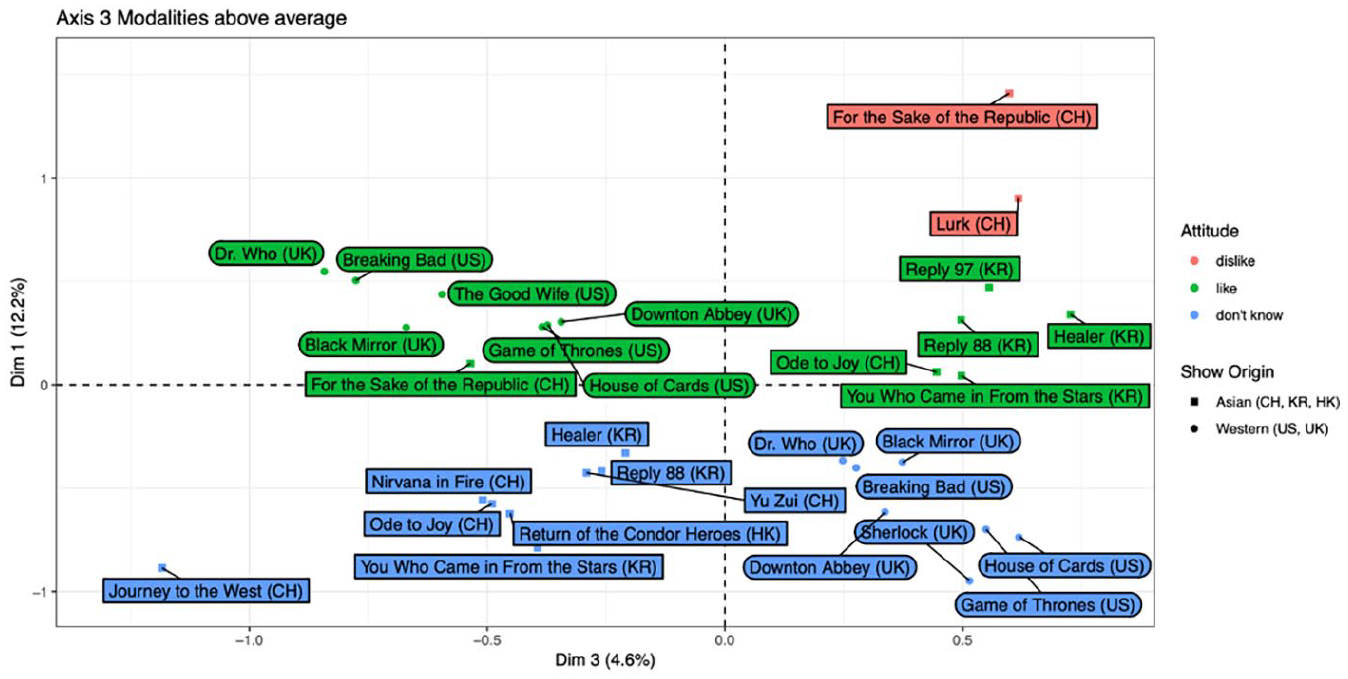
Dimension 3: ‘Western’ (left) versus ‘Eastern’ (right) taste. Shows only modalities contributing above average. Series name in blue box: do not know; red: dislike/indifference (1–3 on a 5-point scale); green: liking (4–5 on a 5-point scale).
Further analysis of lesser known shows yields a surprise: most Japanese shows cluster with ‘Western’ shows and are disliked by people with the ‘Eastern’ taste. Taste patterns of lesser known Hong Kong and Chinese shows are scattered across this dimension, with popular, youth-oriented shows clustering with the ‘Eastern’ style, others more dispersed. American and British series show a consistent pattern: likes to the left, unknowns to the right.
Low scorers on dimension 3 are drawn to their favourite (mostly Western) shows for being ‘smart’ or ‘brainy’. Like Lai Tao (Dim1: -0.07; Dim2: -0.08; Dim3: -2.21; M; 18; MCC; LowUrban), they are often explicit in linking the superiority of shows to their own superiority: Black Mirror (UK dark sci-fi show) is . . . on a completely different level than anything I’ve seen: it’s more substantial, and it prods you to reflect on social problems. It’s more in line with my status as a college student . . . You need language proficiency and a certain outlook to appreciate this kind of TV.
Like Lai Tao, those with a ‘Western’ taste often allude to their English skills and transnational cultural knowledge, which allow them to appreciate global TV that is edgy, even niche. For example, Wei Zhen (Dim1: 0.08; Dim2: -0.15; Dim3: -1.02; F; 21; HCC; HighUrban) extols the avant-garde BBC3 comedy The Mighty Boosh for being ‘endearingly bizarre and mind-blowing’: The humour is subtle . . . but once you get it you can’t stop laughing. There are lots of pop culture and music references in British comedies. I get those references because I follow many British bands. I like that feeling of being in on the joke.
The feeling of being ‘in the know’ is integral to Wei Zhen’s sense of distinction. Her explanation for preferring UK TV to US TV illustrates this logic: House of Cards (US) tries too hard . . . Yes Minister (UK) is more low-key. The British have a wry sense of humour, but once you get it, it’s absolutely hilarious.
‘Getting’ the dry, understated British humour requires English skills, transnational cultural knowledge, and a cosmopolitan propensity. Domestic exposure to foreign content helps cultivate this cosmopolitan taste for prestigious Western television. For example, Wei Zhen’s mother, an English teacher, signed her up for English lessons when she was very young. She describes how she moved from American fantasy Supernatural, to global megahits like Downton Abbey, to esoteric shows like The Mighty Boosh. The evolution shows how her cultural knowledge expanded and developed.
Wei Zhen’s passion for Western TV differentiates her from positive scorers on this dimension who have an ‘Eastern’ taste. For example, Yu Hua, a somewhat disengaged TV lover with an Eastern taste (Dim1: -0.41; Dim2: -1.49; Dim3: 2.53; F; 20; LCC; MidUrban), likes the Korean popular dramas dismissed by many: Boys over Flowers [Korean rom-com] is a straight Cinderella story. The plot is trite, but I don’t care. It feels so dreamy, and all I remember is how cute the two leads are [laughs] . . . I also enjoy You Who Came from the Stars [Korean rom-com] . . . The show is full of suspense and keeps you on the edge of your chair.
Embracing the K-pop aesthetic of beauty, fun, and suspense, Yu Hua feels distanced from UK and US shows: Their culture feels so far away from ours . . . Even the poster [of Downton Abbey] turns me off – the traditional clothing seems so stiff and strange . . . Everyone is watching Game of Thrones, but I’m not into epic shows. They feel too complex, and too far away from here and now.
Others shun Western shows for similar reasons, describing UK TV particularly as ‘grim’, ‘dull’, and ‘draggy’. They find watching English-language shows ‘too much work’, having to ‘keep an eye on the subtitles all the time’. Sun Ke (Dim1: -0.10; Dim2: -1.20; Dim3: 1.57; F; 18; LCC; LowUrban) explains her avoidance of English shows by emphasising the insurmountable cultural gap between China and the West, particularly the US: I can’t always get American humour, and it’s not just about translation. Sometimes I have to think really hard and still don’t get what’s so funny. It’s frustrating.
Like dimension 1, dimension 3 is a cultural capital dimension. While devotees of Western TV attribute the attraction to their transnational cultural knowledge, lovers of Asian pop culture like Lin Yi (Dim1: 0.86; Dim2: 0.04; Dim3: 0.90; F; 22; LCC; MidUrban) show ‘cultural goodwill’ regarding higher status tastes by maintaining ‘the “chain of disdain” makes sense’: Korean shows are usually sappy romance. No wonder those who like Korean TV are seen as ‘brainless’[chuckles]. American and British shows deal with more diverse topics, like sci-fi, the Apocalypse, and other more sophisticated stuff.
The cultural logic structuring this dimension differs from dimension 1, although HCC respondents in both dimensions draw on overlapping repertoires of evaluation. Unlike the discerning viewers in dimension 1, informants with a ‘Western’ taste are less likely to refer to formal characteristics such as complexity, focusing instead on the transnational knowledge and cosmopolitan disposition needed to appreciate Western and sophisticated Asian fare. Informants with an ‘Eastern’ taste, in contrast, reject Western shows and ‘serious’ Asian programming as boring, difficult, or strange. However, unlike the disengaged viewers in dimension 1, who have limited cultural knowledge and minimum interest in television in general, those with an ‘Eastern’ taste speak at length about the characteristics of ‘good’ shows. Their praise is grounded in a ‘popular aesthetic’ of fun, romance, and escapism.
Cultural capital? TV taste and social boundaries
We have identified dimensions 1 and 3 as cultural capital dimensions: they show taste variations based on cultural knowledge. People on one pole show off their cultural sophistication and engagement (cf. Roose et al., 2012), while people on the other pole disengage from but revere ‘legitimate’ tastes. Both dimensions, though in different degrees, demonstrate a West–East distinction, in line with the ‘chain of disdain’.
Additional analysis, included in the Methodological Appendix (see Table A3 and Figure A3), shows that affinity with the more legitimate poles on these dimensions is indeed related to more privileged social backgrounds in terms of cultural capital: higher parental education, urbanity, and foreign travel experience. The ‘Western’ taste on dimension 3 is additionally associated with privileged economic backgrounds – a high perceived socioeconomic status (SES), parents (especially fathers) with higher professional positions, and better English-language skills. Economic and cultural capitals therefore are partly independent, and economic capital is most strongly linked to cosmopolitanism. Dimension 2 is related to gender: women are more often TV lovers. However, it is not related to economic or cultural privilege.
However, to function as cultural capital, cultural classifications must be related to boundary-drawing and social hierarchies (Jarness, 2017). In this section, we delve into our interview data to examine whether and how respondents engage in boundary work to mark their positions in Chinese society based on their own and others’ TV tastes.
Our interviews show that people on the ‘high status’ poles of dimensions 1 and 3 use TV taste to pass negative judgement on others. Hu Wen, the discerning TV lover who adores Game of Thrones, denounces rural or less educated people who do not share his refined taste: Most Chinese viewers are in second- or third-tier cities, like my hometown, where many people have never gone to college, let alone watching British or American TV shows . . . When I go back, I feel I can no longer understand their cultural life.
Wei Zhen, who relishes cult UK shows, says she does not so much disdain as she is ‘disappointed at clueless teenagers’ for ‘lapping up the shoddy shows churned out by the Chinese cultural industry’. Lai Tao, who claims Black Mirror is more suitable for his ‘status as a college student’, is more forthright in drawing boundaries: I don’t really ‘disdain’ people who watch certain shows, except maybe Korean shows [laughs]. But seriously, I feel like somehow people who watch Korean shows are ‘brainless’ . . . I don’t know anyone with good grades in my high school watched Korean TV.
Mirroring these disparagements, Wang Jia (Dim1: 0.45; Dim2: -0.55; Dim3: -0.23; F; 21; LCC; LowUrban), a middle-of-the-road respondent on all three dimensions, expresses admiration towards people with purportedly sophisticated tastes: I think people who can appreciate British shows are more cultured. Their English is better, and they’ve probably travelled abroad. I hang out with those people, you know, those who like watching European films, especially the arthouse sort that few can endure [laughs].
While many respondents see the ‘chain of disdain’ as a facetious saying, most find its underlying logic justifiable. Zhang Tian (Dim1: -0.04; Dim2: 0.78; Dim3: -0.53; M; 20; HCC; HighUrban) approximates the ‘average viewer’ in mainly watching and preferring Chinese shows. A while back, his friends who were fans of Game of Thrones gave him grief for watching a Chinese show about soccer. ‘It’s a pretty crappy show’, Zhang Tian chortles, ‘But what can I say? I love soccer! . . . I don’t take the “chain of disdain” seriously, but US TV is undoubtedly better than domestic programming, so it’s understandable’.
Finally, people with ‘low status’ tastes are well aware of their position in this taste hierarchy. First-generation college student Yu Hua, who has an outspoken ‘Eastern’ taste, grew up with her grandmother in a small city, while her divorced parents both remarried and had more kids. While sounding almost unabashed when professing her love for ‘dreamy’ Korean shows with ‘cute’ leads, Yu Hua reveals insecurity in a world to which she does not quite feel she belongs: Whenever I’m in a [sociology] theory class, I feel dumb and shallow, like I don’t read enough, or my mind is empty. I feel as though . . . I’m not capable of deep thinking.
Yu Hua does not explicitly connect her cultural taste – her attraction to ‘trite’ but ‘dreamy’ Korean drama and avoidance of ‘epic’, ‘complex’ Western TV that ‘everyone is watching’ – to her sense of incompetence in college. However, she acutely feels the tension between her taste and the cultural hierarchies she has internalised. Her despondent tone reflects a ‘habitus clivé’ – a sense of a torn self and dislocation – resulting from upward social mobility (Friedman, 2016); the lack of parental cultural capital may have contributed to her sense of alienation.
Discussion and conclusion: cultural, cosmopolitan, and Chinese distinctions?
Inspired by the popular discourse of the ‘chain of disdain’, this article explores whether and how Chinese college students’ engagement with television marks their positions in China’s swiftly changing hierarchies. Our analysis identified three taste dimensions: (1) disengaged versus discerning viewers; (2) TV lovers versus TV dislikers; and (3) ‘Western’ (and Japanese) versus ‘Eastern’ TV taste. Dimensions 1 and 3 are cultural capital dimensions: respondents on the ‘high status’ end distinguish themselves from those on the ‘low status’ end, who in turn accept the implied taste hierarchies.
The two dimensions differ in criteria and type of cultural knowledge used to make distinctions and in connection with economic capital. Discerning viewers on the first dimension mainly make distinctions based on aesthetic criteria: complexity, depth, and authenticity. The ‘Western’ taste on the third dimension, in contrast, combines aesthetic distinctions – complexity, depth – and cosmopolitan distinctions: foreign language skills, appreciation of a multicultural mélange. While on both dimensions, those with more legitimate tastes are culturally privileged, lovers of ‘Western’ fare are more ‘exclusive’: they are more economically privileged and cultivate ‘rarefied’ tastes more explicitly, taking pride in their knowledge of the exotic unknown to the majority. These findings confirm the existence of cultural capital as distinct and partly independent from economic capital in contemporary China, and of a transnational ‘chain of disdain’: while local television is best known and overall best liked, Western (and Japanese) television is most prestigious; Asian, especially Korean, commercial culture is ranked lowest.
As one of the first explorations of cultural capital in China, this study has implications for the sociology of culture, inequality, and cosmopolitanism and for our understanding of Chinese stratification in a global context. First, it contributes to the sociology of culture and inequality by identifying well-known mechanisms linking taste to social stratification outside the Euro-North-American context. Among contemporary Chinese youth, taste is strongly connected with cultural knowledge that is employed to decode and enjoy cultural fare and to disparage those who are not ‘in the know’. The criteria used to distinguish ‘good’ from ‘bad’ TV resemble those known from studies in Europe (e.g. Bennett et al., 2009) and the US (e.g. Childress et al., 2021): the sophisticated joys of complexity, technical quality, and emotional depth versus the fun, immersion, and beauty of more generic popular fare. We also get a glimpse of what Bourdieu has called ‘symbolic violence’: some informants casually dismiss millions of people based on their preference for local Chinese or Korean TV; others willingly embrace cultural hierarchies that disparage them.
Second, our study shows that cosmopolitanism is an important element in Chinese cultural distinction. The prestige of Western TV has to do with the status associated with the English language and international experience, possibly enhanced by a lingering belief in the superiority of Western culture (Fong, 2011). Highbrow cosmopolitan taste is associated with indicators of culturally and economically privileged parental backgrounds and thus works as ‘enhanced’ cultural capital (cf. Varriale, 2021). In addition, what makes Chinese cosmopolitanism uniquely Chinese are its Others: popular Chinese TV, and Hong Kong and South Korean TV. Thus, both high status and low status are signalled by non-local tastes. This reminds us that cosmopolitan distinctions are shaped by transnational fields (Varriale, 2021). The ‘chain of disdain’ reflects the hierarchies and logics of two transnational fields: a global cultural field with English-speaking centres (Kuipers, 2011) and a regional East Asian cultural field with Korean cultural industries at its apex.
Finally, this study enriches our understanding of China’s stratification in a global context. Even in our relatively homogeneous sample, we see significant variations in the popular taste for fictional TV. Moreover, this study debunks clichéd images of Chinese consumption as materialistic or ostentatious and of Chinese popular tastes as shaped exclusively by Western influence. It is important to remember that although our informants find US and UK shows most prestigious, ultimately most of them watch and love local shows the most.
This study raises a number of questions for further research and has limitations that follow-up studies can hopefully address. First, although our study demonstrates an important expression of cultural capital – boundary-drawing based on hierarchical cultural tastes – this offers only a first glimpse of cultural capital in China. Our findings resonate with those of earlier research (e.g. Wang et al., 2006) that suggested in China, cultural consumption marks social status partly independent of economic status. Importantly, our findings also resonate with studies of other Asian countries, where transnational TV consumption is a badge of distinction (Chadha and Kavoori, 2022; Kim, 2008; Rodríguez, 2018). Further studies could investigate Chinese patterns of distinction in other cultural fields (music, art, literature, and games) to compare taste patterns and their underlying cultural logics and social categorisations.
Second, our sample is rather small and homogeneous, although it is well suited to address our research question: if cultural capital exists in China, it should be visible among young people at a prestigious educational institution and likely to join China’s cultural and economic elites. Moreover, these urban, privileged students have access to a wide range of cultural goods, which means they are in unique position to use their cultural knowledge to pick and choose legitimate TV. However, future research is needed to investigate the generalisability of our findings to wider Chinese society: do only a ‘vanguard’ of Beijing-based educated youth care about cultural capital, expressed in TV tastes or otherwise, or does this reflect wider patterns in contemporary China?
Specifically, further research could investigate how rural or urban background affects cultural and cosmopolitan capital. Our analysis shows that participants from bigger cities have more cosmopolitan tastes than those from more rural backgrounds (see Table A3 and Figure A3 in the Methodological Appendix). It is likely that cultural and, especially, cosmopolitan capitals are more easily acquired in urban environments. It would be interesting to compare budding elites who remain in smaller cities with those who moved to bigger cities like Beijing, to assess how urbanity might ‘boost’ cultural or cosmopolitan capital.
Third, our analysis suggests that the cosmopolitan taste for prestigious Western television is associated with exposure to Western culture. This requires the opportunity and technical ability to access foreign content. Future studies could investigate what forms of capital are needed to develop cosmopolitan tastes, and whether cosmopolitan cultural capital manifests in other cultural consumption, including traditionally highbrow culture like literature or arts. Moreover, while TV consumption has few economic barriers, the Chinese government’s increasing restrictions on cultural importation and Internet access have erected new cultural and political barriers. Consequently, the taste for ‘Western’ fare may dwindle, even among younger generations. Transnational TV flows are embedded in wider political fields, which have become increasingly volatile since our data collection. For instance, rising (government-led) Chinese nationalism prompts increasing delegitimation of ‘Western’ as well as ‘Eastern’ TV imports (cf. Gong, 2022). Follow-up research could investigate how new Chinese nationalism affects boundary-drawing. For instance, does it boost the status of Chinese TV or does it become a new impetus to produce high-quality domestic programming?
Last but not least, further research is needed to establish to what extent the logics of distinction we uncovered are specifically Chinese. Our study provides no evidence that our informants’ TV tastes are rooted in ‘traditional Chinese values’, as Zhang (2020) suggested. While we find a classic Bourdieusian distinction between sophisticated and popular tastes, and an ‘emerging’ pattern of cosmopolitan versus regional tastes, we do not see the other opposition in the Euro-North-American model of cultural fields: economics versus culture. In Europe, cultural capital is often seen as antithetical to economic capital, even in the money-driven television field. We find little evidence of a Chinese belief in the incompatibility of cultural worth and economic profit. While this may spring from our focus on television, it is also possible that in China, economic capital does not diminish the value of cultural capital.
Supplemental Material
sj-docx-1-sor-10.1177_13607804221149796 – Supplemental material for Cultural Capital in China? Television Tastes and Cultural and Cosmopolitan Distinctions Among Beijing Youth
Supplemental material, sj-docx-1-sor-10.1177_13607804221149796 for Cultural Capital in China? Television Tastes and Cultural and Cosmopolitan Distinctions Among Beijing Youth by Yang Gao and Giselinde Kuipers in Sociological Research Online
Supplemental Material
sj-docx-2-sor-10.1177_13607804221149796 – Supplemental material for Cultural Capital in China? Television Tastes and Cultural and Cosmopolitan Distinctions Among Beijing Youth
Supplemental material, sj-docx-2-sor-10.1177_13607804221149796 for Cultural Capital in China? Television Tastes and Cultural and Cosmopolitan Distinctions Among Beijing Youth by Yang Gao and Giselinde Kuipers in Sociological Research Online
Footnotes
Acknowledgements
We thank Ken Kolb, Claire Whitlinger, Svetlana Kharchenkova, Jeroen de Kloet, and the anonymous reviewers and Sociological Research Online’s editors for their helpful suggestions and constructive comments on earlier versions of this article. In addition, we want to thank our research assistants Jiwen Wang at Renmin University of China and Johannes Aengenheyster at the University of Amsterdam for their invaluable help with the data analysis.
Funding
The author(s) disclosed receipt of the following financial support for the research, authorship, and/or publication of this article: Results presented in this article are based on data collected for the project ‘TV Consumption as Cultural Distinction among Educated Urban Chinese Youths’. This project received funding from the Internal Research Grant awarded by Singapore Management University (2016–2018), under the project fund number 16-C242-SMU-010. The authors would like to thank Singapore Management University for funding this research.
Supplemental material
Supplemental material for this article is available online.
Author biographies
References
Supplementary Material
Please find the following supplemental material available below.
For Open Access articles published under a Creative Commons License, all supplemental material carries the same license as the article it is associated with.
For non-Open Access articles published, all supplemental material carries a non-exclusive license, and permission requests for re-use of supplemental material or any part of supplemental material shall be sent directly to the copyright owner as specified in the copyright notice associated with the article.
