




Abstract
Recent research into religion’s intersection with social class, specifically in the UK, represents a conspicuous gap in recent scholarly work. I seek in this article to help fill this gap by focusing on the specific element of social capital. Adopting the lesser used lens of Bourdieu, and using a UK-wide survey, I measure various elements of social capital and employ advanced statistical methods to ascertain social capital composition for various groups of religious identity. Results show that the primary difference between religious groups is social network variety. Those who assert multiple religious identities show the highest level of social network variety. Therefore, results suggest that as either a product or cause, it is those asserting multiple religious identities who may possess the greatest amount of aggregate and bridging social capital.
Introduction
While the role of social class in societies, particularly British society, has been of particular interest for sociologists, research into the intersection of religion and social class has been generally absent and ignored (McKinnon, 2017). Economic circumstances, however, were critical considerations in theories of religion and society for classical sociology. Marx and Engels (1964) argued that forms of consciousness, perhaps especially the religious, were contingent upon material circumstances. Engels (1966) went further than Marx in describing these relationships, outlining religious beliefs that were most characteristic of different classes, although coming to a similar conclusion that religion is determined by social class (McKinnon, 2017). The nature of Marx and Engels’s class analysis is one focused almost solely on aspects of economic capital and relations to it. Weber’s (1930) sociology of religion was likewise linked to economic wellbeing. Weber argued for different affinities between social classes and religious traditions. These included economic and labor orientations, a prominent example of which can be found in Weber’s (1930) argument of the affinities between Protestant traditions and logics of capitalism. Outside of sociology, even the economic thinker Adam Smith (2003) addressed the role that religion can play in economic outcomes in his most famous work, The Wealth of Nations. Since this time, however, research into these affinities has been relatively absent (Smith, 2008; Tracey, 2012). Those studies that do exist find mixed evidence for economic relationships to religion. For instance, Bettendorf and Dijkgraaf (2010) find a negative effect of religion on income for low income countries, and a positive effect in high income countries.
In this article I seek to provide one building block to fill in the existing gap in the literature, that is, understanding classed dynamics of religion. This gap is particularly large within empirically driven work, as some have argued for the importance of this work and started to conceptualize these relationships (e.g. McCloud, 2007; McKinnon, 2017). In this article I focus on social capital and how it intersects with religious identity in the UK. I therefore seek to represent a helpful exploration into ‘new and hitherto underexploited resources for understanding the intersection of religion and social class’ (McKinnon, 2017: 169). Understanding if and how social capital is stratified among religious groups can give insight for both scholars and practitioners into the potentiality and limitations of religion to span social hierarchies.
With reference to, and consideration of, other scholarly versions of social capital, this article primarily considers Bourdieusian approaches to social capital and empirically investigates how they may intersect with religious identity. I focus on Bourdieu’s theoretical approaches to social capital because they are the most prominent example of arguments around social capital’s connection to social class location. This connection for Bourdieu is generally one of stratification and exclusion. Therefore, this study represents an important intervention for the existing literature on religion and social capital that almost exclusively focuses on its positive potentiality, mostly disregarding or downplaying any exclusionary power that it may hold in these respects (McKinnon, 2017). I therefore in this article test if religion in the UK is strongly stratified by social capital between religious groups, or whether there are signs of religion’s potential to be a site of social bridging between those of differing societal status.
From these investigations, I can start to understand different social network affinities bound up in religious identity. Indeed, McKinnon (2017) argues that it is Bourdieu’s work that offers the most efficacious starting point for investigating religion’s intersections with elements of social class. This article therefore seeks to be one empirical answer to the call for research into ‘the affinity of particular class positions and particular religious identifications’ (McKinnon 2017: 161). Using UK-wide survey data, I use both simple and sophisticated statistical methods to first identify social capital resources associated with major religious identities of UK society. These results are then interpreted through existing theories of how social capital may relate to religion and social position. To accomplish these aims, I seek to answer the following guiding research questions:
Do different religious identities have different relationships to social capital in contemporary UK society?
Are these relationships configured according to recognizable affinities of particular social class positions and if so, how?
Social capital and religion
Although mentioning social capital in his Distinction (Bourdieu, 1984), and also in his ‘Forms of Capital’, Bourdieu’s (1986) theories of social capital are much less comprehensive than his theories of cultural capital. He also used it sparingly, often when he needed it to do some specific conceptual work (Ward, 2004), and ultimately never outlined how he would go about measuring the concept (Pinxten and Lievens, 2014). For that reason, some of the social capital literature that I rely upon in this article represents complementing theories of social capital. Complementary theories of social capital are generally those that focus on the stratifying elements of social capital and where social capital intersects with inequalities.
The concept of social capital has gained increased scholarly attention in recent decades. Some of this comes from theories regarding its necessity for maintaining community relationships and civil society (e.g. Putnam, 2000). But while Robert Putnam’s influential theories of social capital argue that social ties form from collective social engagement, which in turn strengthens the collective conscious and encourages civic engagement and community wellbeing, Bourdieu offers a different approach.
Bourdieu presents social capital as a marker of social class position, a driver of class inequalities, and also for their reproduction. Therefore, Bourdieusian arguments of social capital assert that social capital’s exclusionary properties are even stronger than its democratic potentialities (Savage et al., 2015). These exclusionary properties present mechanisms by which privileged persons or groups of society can entrench and reproduce their already advantaged social locations. For instance, previous research (e.g. Erickson, 1996; Granovetter, 1995) finds that those from more advantaged backgrounds and more prestigious occupations have more prestigious and fuller social networks by which they are then able to access coveted jobs, even better jobs than they currently possess, or more easily and seamlessly be promoted in their current professions.
However, regardless of the specific theory of social capital, social capital as a concept relies upon assertions of certain rewards gleaned from an investment in the social (Widdop et al., 2016). For Bourdieu, the investment includes expanding one’s social network to include people who are the most strategically rewarding for that individual to know. In his ‘Forms of Capital’, Bourdieu (1986) argues it in this way:
Because the social capital accruing from a relationship is that much greater to the extent that the person who is the object of it is richly endowed with capital (mainly social, but also cultural and even economic capital), the possessors of an inherited social capital, symbolized by a great name, are able to transform all circumstantial relationships into lasting connections. They are sought after for their social capital and, because they are well known, are worthy of being known (‘I know [them] well’); they do not need to ‘make the acquaintance’ of all their ‘acquaintances’, they are known to more people than they know, and their work of sociability, when it is exerted, is highly productive. (pp. 250–251)
It is for this reason that I focus on occupational prestige in capturing the beneficial force of one’s social network. Social capital is thus a product of the composition of this network, and more importantly the capital resources that those in one’s network can subsequently summon. Indeed, Bourdieu (1986) argues that
Social capital is the aggregate of the actual or potential resources which are linked to possession of a durable network of more or less institutionalized relationships of mutual acquaintance and recognition – or in other words, to membership in a group – which provides each of its members with the backing of the collectivity-owned capital, a ‘credential’ which entitles them to credit, in the various sense of the word. (pp. 248–249)
Therefore, credentialization and group membership are key components of these networks. The type of group within which one can, through a type of symbolic or tangible credential, gain membership includes, for example, those in certain occupations and those with certain educational experiences and credentials. Oftentimes, these two are connected. In this article, I therefore use occupational prestige as a primary proxy for the capital resources and symbolic capital value of each connection. The other is variety or diversity of social network. Within these connections, variety is a critical component. In his famous paper, ‘The Strength of Weak Ties’, Granovetter (1973) argues that because those who are less close to us share the least number of redundant traits, be them experiences, knowledges, or social contacts, these weaker ties are more advantageous to personal social networks and provide more social capital and increased social capital multiplier effects.
In studies explicitly probing the intersection of social capital and religion, the questions posed as to the benefits and returns of investment in the social are often one-sided. What research that does exist investigating social capital and religion tends to take up studies of social capital’s capacity to build community, echoing Putnam’s (2000) approach, opting for more positive framings for the role of religion (McKinnon, 2017). Indeed, Putnam (2000) argued for religious participation as a prominent source of social capital. But while, for instance, Hirschman (2004) found that religious participation provided resources for immigrant communities to shelter from hostilities of broader society and a space from which to succeed; Alba (2005) found that that these types of immigrant-based religious communities are often apt for more social distinction and to come under more discrimination as a product of these more pronounced boundaries.
Much research has also focused on linking social capital, again for its positive characteristics (e.g. Edgell-Becker and Dhingra, 2001; Park and Smith, 2000; Smidt, 2003). These types of linking social capital generally include either bonding or bridging types of social capital. Bonding social capital ‘refers to the interpersonal solidarity that is often present among people who associate in small groups, local communities, and other settings over extended periods of time’ (Wuthnow, 2002: 670). Bridging social capital refers to the types of links between people of different groups, communities, other settings, and social locations.
Among other studies of bridging social capital and religion, Lim and MacGregor (2012) find mixed results. While they find bridging effects within social networks, this could not be generalized to broader civic life. Specifically, while non-religious persons are more likely to volunteer in their community if they have religious persons within their friend network, the non-religious community is actually negatively associated with the volunteering activity of the religious community within that locality. Also focused on bonding and bridging social capital as church-related and civic-oriented volunteerism, respectively, Nisanci (2017) finds that income and racial homogeneity are associated with bonding social capital. Congregational homogeneity of age and education, however, were found to be negatively associated with bonding social capital of church volunteerism, but positively associated with bridging social capital in the form of civic volunteerism. These types of studies, while paradigmatic of existing studies of religion and social capital, ultimately represent a slightly different approach than I take in this article.
In a study that is somewhat closer to the approach of this article, Wuthnow (2002) also explicitly focuses on religion’s bridging social capital between different status groups of society. In a study that assessed the association between religious involvement and influential social network resources, Wuthnow (2002) found that religious congregation membership was positively associated with influential friend networks, while frequency of religious attendance did not confer such social capital. However, Wuthnow (2002) is circumspect as to the nature of these connections:
Such contacts do not necessarily suggest that congregations make use of such social capital to further egalitarian ends; the members who have these contacts may, for instance, use them solely to their personal advantage or to acquire leadership positions or prestige within their congregations. But these contacts hold potential for activities that bridge status distinctions, such as securing resources for congregations that in turn use these resources to assist the disadvantaged or to develop ministries to the wider community. (p. 682)
Munn (2019) argues that social capital can also play a key role in reproducing the racial inequalities of religious institutions. While elements of all these approaches to religion and social capital can indeed be interpreted as more complementary than contradictory to Bourdieusian perspectives of social capital, it is still true that Bourdieu focuses mostly on the stratifying effects of social capital. The approach in this article is focused on where social capital resources fit within the social location of different religious identities. I am thus primarily concerned with how social capital is patterned within various religious identity groupings of the UK and how it informs understandings of the social position of these groups, or inequalities between them.
However, the idea of bridging social capital does resemble the potential dynamics bound up in the type of social capital connections that this article investigates. Therefore, while this article focuses on testing a Bourdieusian conception of social capital, I do so with consideration to bridging social capital. This is because I primarily focus on the make-up and diversity of personal social networks, which have the ability to be exclusionary or ‘bridging’. Because occupational prestige (and the capital formations bound up with it) in social networks is of primary concern for Bourdieu in understanding exclusionary and elite-producing dynamics of social capital, it is occupational prestige that I focus on here, and which has generally received less attention (Gemar, 2021). As regards considerations of bridging social capital in this study, it is also entirely possible that religion is a site where people of varying occupations mix and form bridges between different levels of prestige, and thereby differing levels of capital resources and symbolic capital. For this, it is social network diversity that is most salient. It is this dual potentiality that this article tests, and it this dual potentiality that is neglected in studies of religion and social capital.
Methodology
Method
To carry out the analysis of this article, I first use basic descriptive statistics to understand a raw measure of social network diversity that is the average number of unique occupational connections for members of each religious identity group. I then prominently employ the advanced statistical method of latent class analysis (LCA). LCA is used to identify typological groups within data, and is a highly effective method for this purpose. I use LCA for assessing typographical groups of social networks. This allows me to assess different make-ups of social networks for respondents in the dataset, and therefore also assess likely compositions for the social networks of different groups of religious identity. To these ends, Table 2 presents the LCA profile of social network composition and Table 3 provides cross-tabulations of religious identities with the LCA groups. Table 3 presents a multinomial logistic regression model to assess the predictive capacity of religious, social class, and demographic variables for latent class group membership. This allows us to understand how important religious identity is, or is not, relative to other variables, in organizing social capital resources.
The data
The pursuit of this kind of work is relatively absent, not least because of the lack of relevant datasets of requisite size in the study of religion generally (McKinnon, 2017). This article uses such a UK-wide dataset – gathered over 2 months in 2016 through an academically commissioned online survey using the recruited population of the company Momentive, 1 which is designed to be representative of the UK population, although it is a population that has volunteered to be part of this online, survey-taking population. This dynamic, however, led to an 80% response rate on the distributed survey. The sample of responses from this population was gathered using quota sampling methods, with sex and age as the census quota variables. Race and region balanced out naturally. The extent to which this is the case can be viewed in Table A1 (see Supplemental Appendix). Perhaps the most disparate category is age, where there is a 4%−5% inversion of the two oldest age groups, perhaps as a consequence of the online nature of the survey.
Although I recognize arguments for the limitations of non-probabilistic survey execution (e.g. Yang and Banamah, 2014), online survey methods have become increasingly common and reliable in the past decade, with many social researchers moving toward this type of survey method (Kennedy and Deane, 2019). Many scholars have likewise utilized quota methods, such as Savage et al. (2013, 2015) who used a smaller but similarly sized quota sample (n = 1026) to create a new typology of social class for Britain. I do not attempt something quite as ambitious in this study. Therefore, since the demographics of the survey tracks census data, and is of requisite statistical size for the population, I argue that it is a valid data source for the research project of this article. A limitation, however, is the lack of booster samples for minority religious groups, which would aid the article’s analysis of these religious groups.
With regard to religion, the survey asked respondents to ‘Please choose any of the following religious traditions with which you identify yourself’ (see also Supplemental Appendix). The focus on the concept of religious identity is similar to that of other prominent analyses of religion in the UK (e.g. Voas and Bruce, 2019). Provided with a list of common religions for the UK, respondents could also write in an alternative response. A critical component of this survey question for our purposes is that this survey question allowed multiple responses. I take advantage of this fact and use all those that responded with multiple religious identifications (including the identification of ‘no religion’) as a religious identification type, along with other religions. The results for religious identification in the survey appear in Table 2. These results are similar to those in the 2018 British Social Attitudes survey (Voas and Bruce, 2019). For the core analysis of this article, I exclude those religious identities with very small subsamples. This unfortunately excludes Hinduism and Sikhism, among others, from the analysis. It is an unfortunate side effect of the advanced statistical methods used in this study that I must exclude these, as such small subsamples would not glean meaningful statistical outputs. Therefore, the total size of the sample used in the statistical analysis of this article is 1303.
Multiple religious identities
The inclusion of a classification for multiple religious identifications is an important addition to the research of religious identity. This classification is able to capture recent trends in ‘buffet-style’ or ‘pick-and-mix’ approaches to religion (Kuzma et al., 2009; Tiemeier, 2010; Watts, 2019). It can also reflect the liminality between religion and non-religion argued by some scholars of religion (e.g. Lim et al., 2010), or between religions, often resulting from tensions between culture and belief. This is also a particularly important allowance because religious identity may often be more of an expression of ethnic identification than religious identification (Voas and Bruce, 2004). Therefore, those in multiple religious families, particularly those that are readily identifiable with an ethnic minority group, may very easily claim multiple religious IDs. For instance, Davenport (2016) finds that for racial self-identification among biracial Americans, religious identity plays a key role. Philips and Fishman (2006) also find that among American Jews, increased social capital positively predicts intermarriage. Indeed, a survey explicitly probing multiple religious identifications revealed that 6% of Americans identify with multiple religions, and those who describe growing up in more than one religion are more likely to identify with multiple religions as adults (Lipka, 2016). The category of multiple religious identifications includes many who chose a traditionally ethnically embedded religious identity with another religious identification.
In the survey used for this analysis, there was not explicitly a category for multiple religious identification. Rather, respondents were given the option to choose multiple religious IDs, including filling in any religious affiliation that was not listed. For any of those who wrote in clear sub-affiliations alongside the broader category (e.g. Christianity and Anglican), they were classified under the broader category. This, however, was not common. The category for multiple religious identifications in this article takes all those who chose, or wrote in, multiple religious identifications and groups them into one category. The ability for respondents to choose more than one religious identification based on the founding assumptions of arguments, such as the above, in other national contexts that argue for the existence of a nontrivially sized group in contemporary societies that report multiple religious identifications. Indeed, while still relatively small, it is not a new phenomenon, but it is a growing one (Cho, 2018).
This approach produced 21 different combinations of religious identity. Of the 112 respondents classified as having multiple religious identifications, the most common of these was Buddhism and Christianity (26), followed by Christianity and no religion (21), and those who chose all of the religious identities (i.e. all but ‘no religion’ – 10). The combination with Buddhism likely shows the increasing adoption of Eastern religious and spiritual practices in the West, such as meditation. The combination of Christianity and no religion may reflect a type of contemporary decoupling between cultural heritage and religious practice, or liminality by which these respondents may ‘stand halfway in and halfway out of a religious identity’ (Lim et al., 2010: 596). Finally, those choosing all of the religious options may be signaling a type of omnism or religious tolerance. The inclusion of the ‘no religion’ category within the multiple religious ID category is an important one for our topic of social capital, as being able to navigate this non-religious social space may provide the greatest social capital benefit of any religious identification contemporarily, as it now represents a plurality or majority in the UK and a number of other Western contexts.
While outside the scope of this particular article, a number of scholars have explored more deeply the nature and substance of multiple religious identity and expression. For instance, Duane Bidwell (2018) explores the construction and practice of such identities in the book When One Religion Isn’t Enough: The Lives of Spiritually Fluid People. David Cho (2018) builds on the approaches of Bidwell (2008) and others via narrative analysis to probe how Christian and Buddhist beliefs can coexist in a multiple religious identity, arguing against a linear, ‘either-or’ model of identity which is unable to capture the intricacies of how multiple religious identity and practice are constructed. Much of the lived experiences explored in this work on multiple religious identities and practices, whether explicitly broached or not, can also reasonably be viewed through the lens of late modernity and globalization. Proponents of late modernity argue for more fluid and reflexive constructions of self, which can also entail specific types of ‘cosmopolitization’ (Beck, 2012) or ‘tourism’ (Bauman, 1996) in the construction of the self, identity, and one’s cultural practices, particularly in contemporary globalized, interconnected, and multicultural societies.
Results
In the analysis, I seek both to identify social capital network compositions for those in the UK and examine whether there are discernible patterns related to religious identity. For these investigations, I use data from the survey regarding the social network connections of each respondent. These connections are produced in the form of occupations within which the respondent knows somebody ‘socially’ (see also Supplemental Appendix). Eighteen possible occupational positions were included as options for the respondent to choose. Both the question wording and response options mirror the Great British Class Survey (GBCS) and represent occupational positions of high, middle, and low prestige in contemporary British society (see also Savage et al., 2015).
For a raw measurement of social network diversity, I first look at the average number of different occupational connections for members of each religious identification (with 95% confidence intervals). Those with multiple religious IDs have the highest number of distinct occupational connections at 8.1 (7.7–8.5), followed by Christianity at 7.1 (6.9–7.3), no religion at 6.8 (6.6–7.0), Judaism at 6.0 (5.1–6.9), Islam at 5.5 (5.1–5.9), and Buddhism at 4.4 (3.8–5.0). Therefore, it appears that differences in social network variety and diversity, in terms of occupational connections, varies between religious identity group. But for a more sophisticated analysis that also combines occupational prestige, a key metric for Bourdieu, I perform an LCA.
Table 1 presents the LCA profile for the typographical groupings of occupations within the social networks of respondents, 2 creating groups of 34%, 28%, 26%, and 12%, respectively. The first of these four is characterized by low probabilities to know people in any of these eighteen occupations. It therefore represents a ‘small social network’ group of respondents.
Latent class (LC) profile of social capital network variables. Occupational rankings in correspond to those produced by Savage et al. (2015).
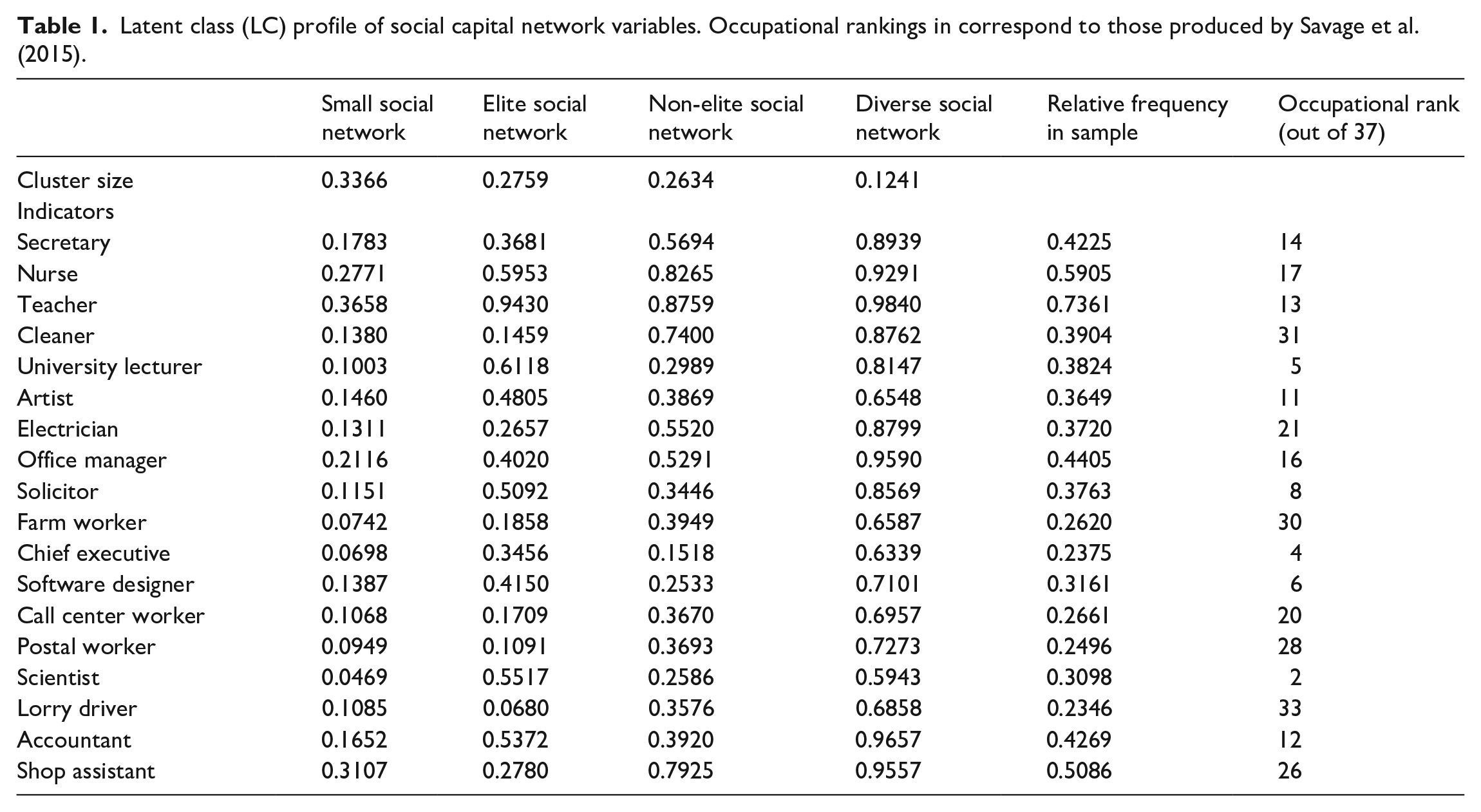
Latent class two includes only those occupations that are in the upper half of the occupational prestige ranks. It also includes all occupations from the survey that have prestige rankings in the top 10. For these reasons I characterize respondents in this group as having an ‘elite social network’. Those in the third latent class group, in contrast, are not likely to know someone in any of the top 10 prestige occupations of the survey. This group is, however, likely to know occupations in the middle, and especially lower tiers of occupational rank. For these reasons I describe this group as having a ‘non-elite social network’. Finally, the fourth latent class group includes both these non-elite and elite occupations within their social capital networks. Because of this, I characterize those in this group as having a ‘diverse social network’.
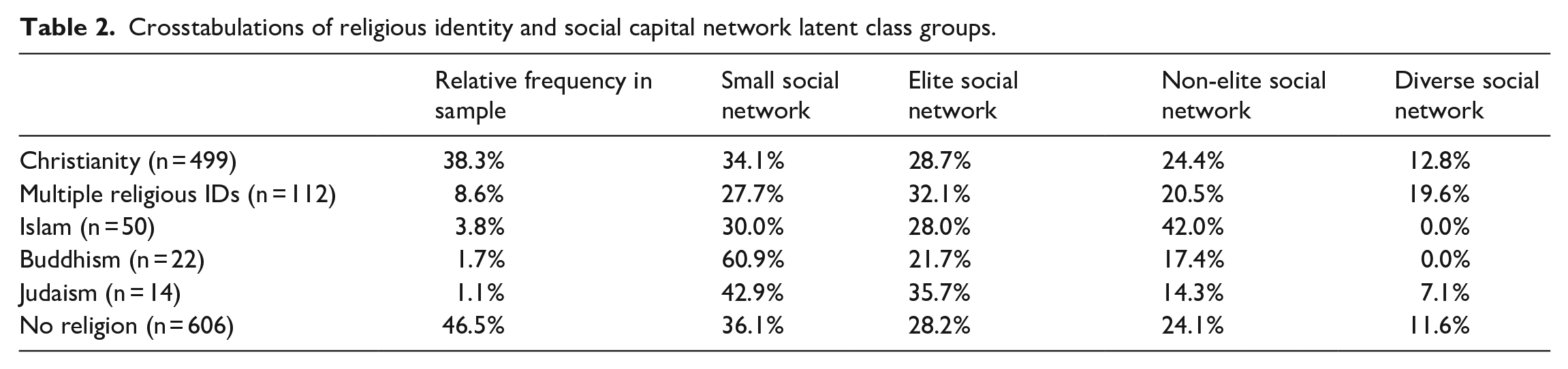
To assess which social capital network mix those identifying with the major religions under investigation are relatively most likely to have, I include both in a simple crosstabulation (see Table 2). This shows the highest proportion of those identifying with Buddhism included in the small social network latent class, and the lowest proportion for the diverse social network group. Both no religion and Judaism likewise have their highest proportions for small social networks, followed by elite social networks, and their lowest proportions in the diverse social network group. Islam has its highest proportion in the non-elite social network group, followed by small and elite social networks, and lowest in the diverse social network latent class. The proportions for Christianity are more evenly distributed across the four groups, especially compared with the variable latent class sizes. Finally, those with multiple religious identifications have their highest proportions relative to class size in the diverse social network group, although in absolute terms the highest for this group is for elite social networks.
Crosstabulations of religious identity and social capital network latent class groups.
In order to understand whether these religious differences are superseded by social class differences when those are considered alongside religion, I performed a multinomial logistic regression (Table 3), with the small social network group as the reference group. As one might hypothesize, income and education are also highly predictive of social network group membership, at least for some. It is especially true for elite social networks, although those with multiple religious IDs are still predicted in this group to statistically significant levels. Non-elite social networks are predicted by middle income, age (younger), and gender (women), while those with Muslim identities are also predicted for this group, all compared with a small social network. Finally, compared with small social networks, having a degree or higher, and gender (men), is predictive of a diverse social network. However, those with multiple religious identities are the most predictive variable for membership in the diverse social network group.
Log odds ratios from multinomial logistic regression of social network groups in the UK, including religious identification. a
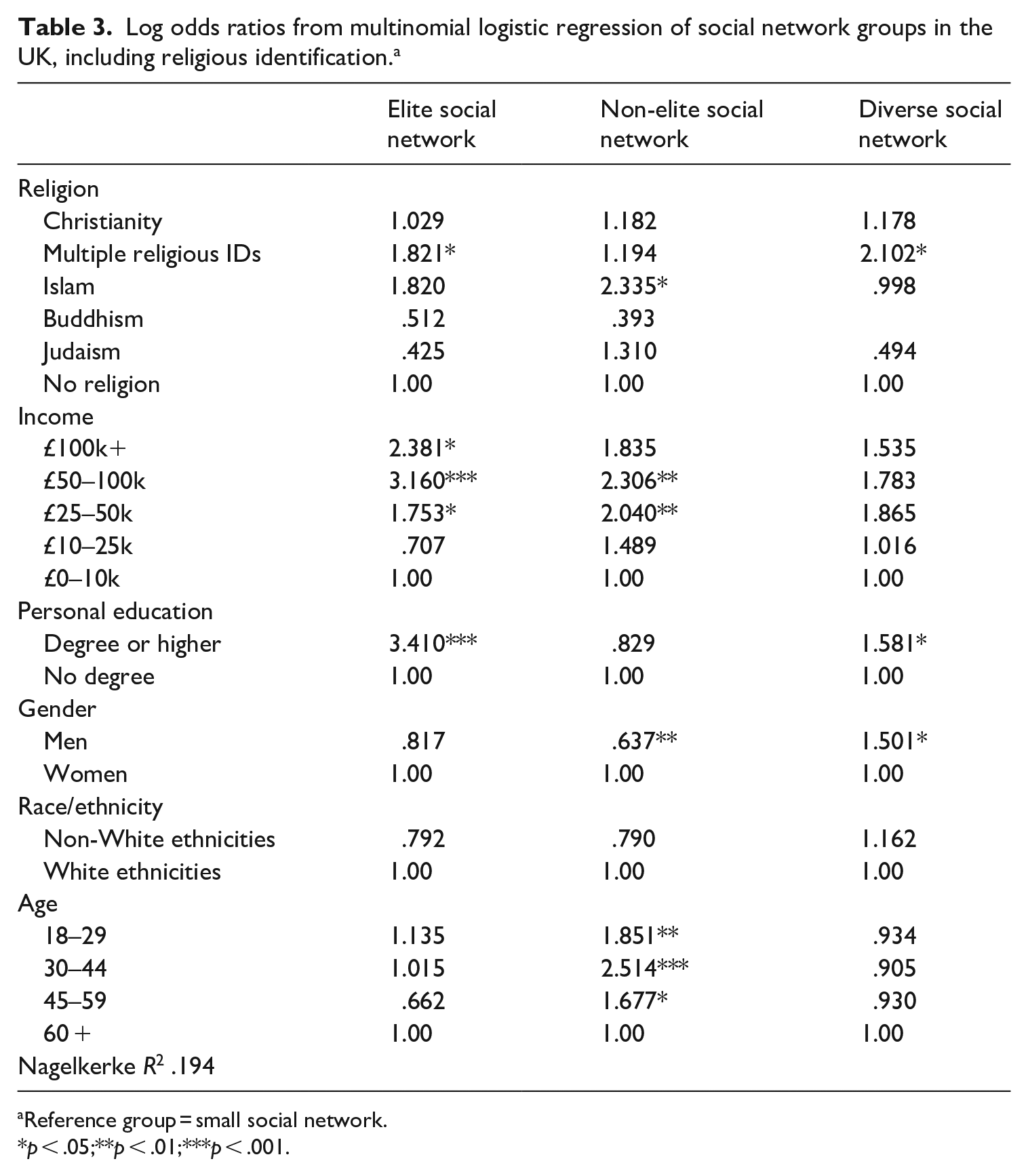
Reference group = small social network.
p < .05;**p < .01;***p < .001.
Discussion and conclusion
I have in this article tried to provide a study to help fill the prominent gap that is the consideration of religion in studies of social class. I fill this gap through an empirical investigation of the contemporary UK context, considering religious identity and how it intersects with social capital. A primary empirical contribution is identifying and investigating the degree to which people in the UK may be holding multiple religious identifications at once (including no religion), and how this might shape social capital resources for this group. Indeed, the results of this article show that this group may be particularly salient for the theoretical concerns in this article and similar types of research. It appears from the results of the analysis in this article that this type of orientation to religion may be indicative of being likely to or able to have a more diverse social network and higher social capital resources.
The results also generally show that the largest groups of religious identification, no religion and Christianity, are less differentiating than more minority religious identities when it comes to social capital accumulation. It could be the case, however, that while not having particularly diverse or elite networks, these groups, being embedded in the broadest range of occupations, may still have large networks, but ones concentrated among coworkers or neighbors in the same profession. This article is unable to capture this type of dynamic. However, if I apply the theory of Granovetter (1973), these concentrated networks, no matter the size, do not provide the same kind of social capital benefits of more diverse networks. This is because they are more redundant within one’s social network and do not offer the same kind of social capital multipliers that diverse connections can offer by opening up new network opportunities that the person themselves are less likely to be able to form.
Among the smaller groups of religious identity, none of Buddhism, Judaism, or Islam showed results that they had ready access to diverse social networks. These results suggest evidence that smaller religious groups, such as these (particularly where closely related to ethnicity), may have a tougher time integrating into the number of environments (e.g. employment) by which larger and more varied social networks may be formed (e.g. Cheung, 2014; Connor and Koenig, 2013; Reitz et al., 2009). Some findings dispute this dynamic (e.g. McAndrew and Voas, 2014), with some arguing that while overall integration may resemble wider society, expressed feelings of alienation and fewer ‘elite’ connections are observed issues for these groups (Wuthnow and Hackett, 2003) – a finding that the results of this article also suggests, and connections that would be necessary to build the most diverse networks. However, while these results comport with prior research, it should also be noted that the subsamples for these groups are still small, and would benefit from increased research as to their social capital profiles and resources.
The most original findings of this article come from assessing the previously unexplored social networks of those asserting multiple religious identities. This is the case even as recent studies have asserted trends of the increased adoption of practices from different religious traditions within personal religious and spiritual behavior (e.g. Kuzma et al., 2009; Watts, 2019). To the degree that the adoption of various religious traditions can be characterized as ‘trendy’ (Tiemeier, 2010), this may aid in the accumulation of social capital. Indeed, it is this group asserting multiple religious identities that has the highest levels of social capital according to the findings of this article. This may be for a number of reasons. The first prominent reason is that the ability to connect beyond ideological, and oftentimes ethnic, boundaries represent prime examples for the potential proliferation of ‘weak ties’ (Granovetter, 1973), ties that can also act as a force multiplier to capital resources within a social network, and can represent ‘bridging’ forms of social capital.
Similarly, the increasing prevalence and possible trendiness represented by those asserting multiple religious identities may confer a type of cultural capital associated with openness (e.g. Chan, 2019; Coulangeon, 2017; Gemar, 2019), the ‘exotic’ (Johnston and Baumann, 2007), or elements of late modernity such as Beck’s ‘cosmopolitans’ or Bauman’s ‘tourists’. Popular associations with some of these religious identities and their practices may indeed signify these values contemporarily. The social network variety of those with multiple religious identifications may therefore also be a product of more cultural dynamics of this configured cultural capital of openness. Erickson (1996: 277) argues that ‘(social) network variety is important. . .because contact with different types of people includes contact with different types of culture’. Thus the greater social capital of this group may likewise represent a greater openness to a wider variety of people, as either a product or cause of this group’s multiple religious identities. Their ability to access other forms of symbolic capital from their multiple religious traditions may be a direct prerequisite for the ability to form diverse social networks. In addition, in terms of utilizing religion as a source of legitimization, it is plausible that this group can easily do so via justifications of their increased capital resources, and thus elevated place in society, on the grounds of virtues such as ‘openness’ in a multicultural global society that represents new and reconfigured forms of capital (e.g. Gemar, 2020, 2022; Johnston and Baumann, 2007). Likewise, the increased religio-cultural knowledge of those with these patterns of identity likely allows for a broader range of social connections and greater levels of bridging social capital among different types of persons. This is perhaps particularly true within business and work environs, where cultural knowledge is perhaps most potent in generating valuable social capital network connections (Erickson, 1996).
The limitations of this article also provide calls for future research into similar or different topics of social class and religion. While thorough, and more comprehensive than currently exists to answer the specific research questions that I pose here, this study is also not exhaustive and future studies of social capital networks could particularly benefit from increased data on minority religious groups, the inclusion of sect or denominational identities, and data on specific behaviors associated with these religious identities. Likewise, although the subsample was too small for an efficacious parsing, further studies of multiple religious identities would ideally be able to ascertain whether the results found in this article differ between different combinations of religious identities, and if so, how. While constrained by elements of survey design and concerns over response fatigue, studies of this kind could also benefit from the largest list, and broadest possible variety of occupations or persons. Future research could include some or all of these variable possibilities. However, given the current lack of empirical data to carry out studies such as this (McKinnon, 2017), this study provides a crucial starting point for scholars to further take up the challenge of considering theoretical perspectives of social capital, more broadly investigate those with multiple religious identifications, and do more work on the intersections and affinities of social class and religion more generally.
In conclusion, I set out in this article to fill an empirical gap on the study of social class and religion, specifically and conspicuously in the UK. I did this through the less frequently deployed lens of Bourdieu’s work on social capital, with consideration and comparison to other theories of social capital and religion. The general relative make-up of religious identifications found in the data also reaffirm the rise of the non-religious and identifies those asserting multiple religious identities as a prominent form of identification in the UK today. In terms of social capital, the primary difference between religious groups is the diversity of their social networks. It is thus perhaps unsurprising that minority religious groups have less diverse social networks, reflecting previous research on barriers to social integration and network formation, along with feelings of alienation among religious minorities. Christians, and especially those of multiple religious IDs also have the most diverse social networks, although perhaps for slightly different reasons. Therefore, results suggest that it is those with multiple religious identities (including non-religion) who may possess the greatest amount of bridging social capital. This may be a product or cause of their multiple identifications. In sum, I lay out in this study a complex examination of the social capital compositions for various religious identity groups of the UK. I also identify a newer form of religious identification which asserts multiple such identities around religion and possesses more varied and diverse social networks by which to accrue and access social capital resources.
Supplemental Material
sj-docx-1-sro-10.1177_13607804221141098 – Supplemental material for Religion and Social Capital: Examining Social Networks and Religious Identification in the UK
Supplemental material, sj-docx-1-sro-10.1177_13607804221141098 for Religion and Social Capital: Examining Social Networks and Religious Identification in the UK by Adam Gemar in Sociological Research Online
Footnotes
Funding
The author(s) received no financial support for the research, authorship, and/or publication of this article.
Supplemental material
Supplemental material for this article is available online.
Notes
Author biography
References
Supplementary Material
Please find the following supplemental material available below.
For Open Access articles published under a Creative Commons License, all supplemental material carries the same license as the article it is associated with.
For non-Open Access articles published, all supplemental material carries a non-exclusive license, and permission requests for re-use of supplemental material or any part of supplemental material shall be sent directly to the copyright owner as specified in the copyright notice associated with the article.
