



Abstract
This article explores how the concept of emotional labour has moved from sociological into lay discourse as a case study of the double hermeneutic and concept creep, demonstrating the effect sociological concepts can have on lay actors’ understanding of their everyday lives. From an analysis of 41 news and magazine articles about emotional labour, we identify the various meanings the term carries as well as the ideologies and logics that underpin them. The concept has become a tool used to frame discussions around gender inequalities in unpaid work, including housework, emotion work, and providing support. However, the Marxist underpinnings of the original concept have been subverted within a lay discourse that is largely reflective of a liberal feminist and neoliberal ethos.
Introduction
Sociological knowledge is shaped by, and partly constitutive of, lay knowledge. Sociologists inevitably draw from the social world to develop concepts that then circulate within the social world they describe, being appropriated by lay actors. This dialectical interplay–the process of interpretation and understanding–has been dubbed the ‘double hermeneutic’ by Anthony Giddens (1984). This article aims to shed further light upon the double hermeneutic by presenting a case study of emotional labour–a sociological concept which has seen drastic reinterpretation upon entering lay discourse, primarily via lifestyle magazine and newspaper articles.
The appropriation of the term ‘emotional labour’ 1 displays the extent to which lay reinterpretation of sociological concepts can stretch, distort, and invert their original meaning in potentially problematic ways. It also displays how the political context, in this case, the dominance of neoliberal logic, operates as a ‘filter’ for interpretation of academic concepts into lay usages. This forces us to engage more deeply with the ways sociological knowledge is deployed in the social world.
Emotional labour in academia
Emotional labour was coined by Arlie Russell Hochschild in her influential 1983 book The Managed Heart. 2 Hochschild begins her study by drawing a comparison between the case of the exploited child worker of Karl Marx in Das Kapital and a modern-day flight attendant. There is between them, she argues, a crucial difference and similarity. The difference lies in the nature and the product of their labour; while the boy’s job requires mostly physical labour, the flight attendant is expected to perform physical, mental, and what Hochschild calls emotional labour, defined as ‘the creation of a publicly observable facial and bodily display’ (Hochschild, 2003 (1983): 7). Later she specifies that this involves the worker manipulating their feelings with the goal of producing a desired emotional state in the customer; for example, retail workers maintaining a smiling and welcoming disposition despite the rudeness of their customers. These emotional displays are to a large degree set and controlled by the employer. The product of the emotional labourer is the provision of ‘good service’ and customer satisfaction when, for example, a passenger feels pleased that the flight attendants were polite, while for the physical labourer it is a material product. What unites them is, according to Hochschild, the danger of becoming estranged from their labour and ultimately from themselves.
Hochschild borrows from Marx again while drawing a distinction between emotional labour and emotion work. She argues that while both involve manipulation of feelings, emotion work is done for private non-compensated benefit and therefore has ‘use value’ – it satisfies a human want or need (Marx, 1990 (1867) 126). Emotional labour occurs in paid work where feelings are imbued with ‘exchange value’; their management on the job becomes quantifiable and can be exchanged for a wage. In this situation, the ‘feeling rules’ are set by managers and company protocol, and the exchange becomes inherently unequal. While Ashforth and Humphrey (1993) have argued ‘feeling rules’, given they relate to internal emotional states, are too difficult to capture empirically and thus prefer ‘display rules’ which can be observed, this emotional impact in Hochschild’s formation is, as we can see, part of a conceptualisation of emotional labour as exploitative in the Marxist sense. Hochschild calls this process the ‘transmutation of an emotional system’ (Hochschild, 2003 (1983): 19), choosing a purposefully grand wording in order to communicate the sinister implications of commodifying and commercialising emotions. Doing so can lead not only to further exploitation of the worker but to negative psychological effects such as alienation and burnout (Hochschild, 2003 (1983): 187). We have discussed these Marxist underpinnings of Hochschild’s work in some depth since, as we will see, they seem to get lost or inverted within the mainstream discourse on ‘emotional labour’.
There is also a gendered dimension to emotional labour, as Hochschild posits that ‘of all women working, roughly one half have jobs that call for emotional labor’ (Hochschild, 2003 (1983): 11). According to Creighton (1982), the gender role socialisation through which women acquire social and domestic skills is used by employers who hire them for jobs involving such skills. These skills are presumed to be natural for women and the emotional labour performed goes uncompensated or at least undercompensated (England and Folbre, 1999; Guy and Newman, 2004; Steinberg, 1999). Simply put, while the performance of emotional labour is necessary for the service sector, it remains a largely invisible and undervalued form of labour, which has real material consequences for workers in the industry, who are disproportionately women.
Reviewing the secondary literature on ‘emotional labour’, Wharton (2009) suggests these studies can be grouped into two broad categories. On the one hand, we have research, largely qualitative, which is concerned with the interactions required by certain roles. The second body is mostly quantitative and is concerned with how workers manage emotions. This second group of research has identified some consistent findings, including a positive correlation between ‘surface acting’, the ‘putting on’ of an emotional state, and burnout (Glomb and Tews, 2004; Van Dijk and Brown, 2006). However, ‘deep acting’, making ourselves actually feel the emotion, has generally been found to not have these negative effects, with some researchers suggesting it contributes to job satisfaction and personal accomplishment (Brotheridge and Grandey, 2002; Yang and Lee, 2019).
These findings spurred on critiques of Hochschild’s conceptualisation of emotional labour as oversimplified and absolutist (Korczynski and MacDonald, 2009; Wouters, 1989). Indeed, it has been suggested the concept presents the workers as ‘emotionally crippled actors’ devoid of agency (Bolton and Boyd, 2003: 290) and overlooks how emotional responses may flow naturally from the situation, be accommodated peacefully within an existing identity (Ashforth and Humphrey, 1993), and potentially be liberating (Tolich, 1993). These critiques are notable because their authors tend to differ from Hochschild not only in argument but also in the extent to which their texts are driven by politics with the distinct radical underpinnings of Hochschild’s writing mostly absent.
The aforementioned qualitative research maintains a critical, but not necessarily normative, focus. Here the most significant focus has been on the gendered elements of emotional labour (Wharton, 2009), for example work that points to the requirement for female bartenders to navigate sexual harassment while not breaching the feeling rules of their profession (Coffey et al., 2018; Green, 2022). These critiques have also increasingly been focused on the intersectionality of emotional labour. MacDonald and Sirianni (1996) developed a class-based notion of the ‘emotional proletariat’. This is a group, largely female, with little power and subject to monitoring who are nevertheless expected to show friendliness and deference to customers without training and support, such as the aforementioned bartenders. Meanwhile, Orzechowicz (2008) points to a group of ‘privileged emotion managers’. Largely middle class and male, this group have professional jobs which not only provide training in dealing with emotions but support and reward those who do this work with gendered outcomes For example, Pierce (1995) points to how a classic group of privileged emotion managers, lawyers, in America have para-legals, largely female, supporting clients experiencing distress, while their male legal colleagues do the well-rewarded performance of emotion in courtroom oratory.
It has been noted that a difference from when Hochschild wrote is not only the expansion of service work but the increasing percentage of people of colour who fill those roles. Wingfield (2021) notes how some of the above examples can intersect class, gender and race. For example, Black men may not be able to practice the controlled anger of their white male lawyer colleagues (Wingfield, 2010) while Black female airline attendants have to negotiate significant, and notably crass, sexualisation differently from their white counterparts (Evans, 2013).
Awareness of these inequities of emotional labour gave greater urgency to the normative perspective of Brook (2009) who contends that the alienation thesis in The Managed Heart is incomplete. Hochschild explicitly applies only two of Marx’s (1844) four dimensions of alienation, which directly relate to the workplace–labour process alienation and product alienation. Brook argues that by bypassing the remaining dimensions–alienation from species-being and from fellow humans–she avoids presenting alienation as inherent to capitalism which ‘blunts her overall critique of the generic commodification of human feelings’ (Brook, 2009: 19) and prevents her from accounting for the dialectical nature of emotional labour, one which encompasses the contradictory potentialities of estrangement and class conscious resistance (Brook, 2009: 26). Critical scholars (Taylor and Bain, 2003) have tried to correct this theoretical gap, studying emotional labour using Marxist labour process analysis, which recognises the relations of production as comprising both compliance and struggle. As these studies indicate, the normative ends of emotional labour is a significant point of disagreement which, as we shall see, is further clouded in lay discourse. In a sense, the complex question of the politics driving Hochschild’s conceptualisation have, as we shall see, been displaced in lay discourse by accommodation to neoliberal logic.
The Managed Heart as public sociology
Whatever limitations Hochschild’s emotional labour thesis had, it was a highly influential work of public sociology. Its purpose was to engage with and educate the public, and in doing so politicise our understanding of service sector work. The Manged Heart did manage to spark a public debate and, as evident from Hocshchild’s afterword to the 2003 edition, has to an extent penetrated into lay perceptions, particularly of those who it concerns most; flight attendants. However, since 2015, the term ‘emotional labour’ has entered into feminist public (particularly online) discourse with some considerable vigour. But as we shall see, in transitioning from the academic to the public sphere it took on some distinctly new meanings.
This is on the whole unremarkable and indeed can be seen as inherent to sociology which, as a social science is distinct from the natural sciences. The latter, to quote Zygmunt Bauman, places a ‘strict and irreversible division of status between ‘subject’ and ‘object’’ (Bauman, 2011: 162). The astronomer or the biologist enjoy the privilege of making pronouncements over their objects of study without having to worry themselves over the possibility that they will talk back and dispute their findings. The social scientist does not have this advantage, although they may try to achieve it by wrapping their texts in dense metalanguages, seemingly impenetrable to the casual reader (Bauman, 2011; Giddens, 1987). Hoping to maintain this division between subject and object in sociology is not only futile but begs the question of what sociology is for, if not engaging with our fellow humans to achieve a better mutual understanding of the world.
Public sociology such as Hochschild’s rejects this division and seeks to utilise what Anthony Giddens (1984, 1987) calls the ‘double hermeneutic’. The natural sciences are single hermeneutic disciplines as their concepts do not circulate between the subject and the object of study. The social sciences, on the other hand, deal with ‘concept-using beings, whose concepts of their actions enter in a constitutive manner into what those actions are’ (Giddens, 1987: 18). This inevitably leads to a dialectical interaction between the concepts of lay actors and those created by the social scientists. The ‘second order’ concepts (Schütz, 1962: xxxv) and metalanguages created by the sociologist cannot be kept from being appropriated by lay actors and becoming ‘first order’ concepts (Schütz, 1962: xxxvi), ultimately informing and shaping lay actors’ understanding of themselves and their behaviour. This is perfectly illustrated by the case of the numerous flight attendants who spoke to Hochschild after her book was first published and thanked her for giving a name to a frustrating part of their work (Hochschild, 2003 (1983): 199).
During this process of transition between the lay and the scientific spheres, the hermeneutic aspect is always present; interpretation and reinterpretation are continuously happening, and this can lead to a distortion of the original concept. Specifically, in a way not discussed in Giddens’ outlining of the double hermeneutic, the distortion in meaning tends to happen via an expansion of the concept to encompass new phenomena. Nick Haslam (2016) coined the term ‘concept creep’ to describe a general pattern of mostly harm-related psychological concepts’ tendency to gradually encompass more phenomena than originally intended. He identifies two ways in which this semantic broadening happens; ‘horizontal creep’ refers to the definition of stretching to include qualitatively different things, and ‘vertical creep’ refers to the inclusion of milder versions of the same concept. These are not mutually exclusive–concepts can expand both horizontally and vertically–and can even be difficult to distinguish from one another.
Naming and drawing attention to concept creep, Haslam (2016) was at pain to establish his ultimately neutral position regarding the phenomenon. However, as Cascadic and Brown (2016) point out, reckless expansion of definition can lead to ambiguity. For example, Crombag et al. (2020) show how legal concept creep–specifically the expansion of the term ‘intoxication’–can lead to overcriminalization of vulnerable people. Seeking to explain why harm-related concepts creep, Haslam et al. (2020) hypothesised a possible causal relationship between the phenomenon and a cultural shift that took place in the 1980s, wherein liberal backlash to the new era of neoliberalism, the rise in critical theories, and proliferation of post-materialist values resulted in a growing concern about harm.
If we accept the likely premise that concept creep is driven by societal factors, it can then be viewed as a consequence of the double hermeneutic. Concepts like emotional labour have broadened because academia does not and cannot hold sole authority over them. If lay actors stretch or alter the meaning of a term because they feel it describes their lived experience in a meaningful way and do so as part of a collective there is nothing that stops them from doing exactly that. As we shall see ‘emotional labour’ had its own concept creep when it encountered the lay experience of neoliberalism.
Method
There are two key questions this research aimed to answer:
What meanings does the concept of ‘emotional labour’ take on in lay discourse and in what ways do these meanings differ from Hochschild’s (2003 (1983)) original definition of the term?
What logics and ideologies underpin the lay discourse around ‘emotional labour’?
Answering these questions required access to lay understanding and debate of emotional labour. These have primarily been sparked by think pieces published in major newspapers and magazines, beginning with Jess Zimmerman’s contribution to The Toast titled ‘Where’s My Cut?’: On Unpaid Emotional Labour. Running the phrases ‘emotional labor’ and ‘emotional labour’ through a major search engine and modifying the search in a way that only displays results posted prior to Zimmerman’s (2015) article yields largely academic articles. However, a focused search for the term post July 2015 results in a plethora of online newspaper and magazine articles written in English which treat the concept in a markedly different way, many of them referencing Zimmerman. While lay discussion of emotional labour has also taken place on social media, these articles were chosen as more suitable for analysis, given their length, descriptive powers, and the wider discourse-shaping power and authority given to them by virtue of being written by professional journalist and published on (mostly) renowned platforms (Van Dijk, 2001: 355).
Articles were chosen for analysis if they met the following two parameters: (1) their main focus was ‘emotional labour’ conceptualised in a way that did not correspond to Hochschild’s definition (regardless of whether the author agreed with the new conceptualisation), 3 and (2) they offered either a definition, examples, or a general discussion and critique of the term’s use. The sample was identified in the following way: the phrases ‘emotional labour’ and ‘emotional labor’ were run through Google. The resulting articles were read for relevance, particular attention being paid to whether they used the term explicitly. After the Google search results were exhausted, the term ‘emotional labo(u)r’ was run through the search engines of various individual anglophone news websites and online magazines, and this yielded a couple more results. In addition, more were identified through cross-references in previously identified articles. The final sample numbered 41 articles from 22 publications between the years 2015 and 2020.
The subsequent analysis was carried out twice, each time using a different qualitative method. The first question this research asks–does the concept of emotional labour take on new meanings outside of academic discourse and what are those meanings?–is inherently descriptive in nature and best answered by employing qualitative content analysis (QCA). The second question is concerned with the ideologies that underpin the lay discourse and is answered utilising critical discourse analysis (CDA). The specific focus of CDA is on power and ideology, the way they manifest in language, and the impact this has on perpetuating structures of unequal power dynamics (Catalano and Waug, 2020). It is thus very well suited here.
Defining lay meanings of ‘emotional labour’
Two key differences between academic and lay understandings of emotional labour became clear quickly: (1) ‘Emotional labour’ is a primarily seen as a feminist issue–Rose Hackman even designated it to be ‘feminism’s next frontier’ in her 2015 piece for The Guardian. In much of the sample, the problem of emotional labour is presented as being inherently a women’s problem–this is already a significant departure from Hochschild (2003 (1983)) to whom emotional labour offered a way of conceptualising working conditions and power relations in service-related workplaces. As indicated earlier, gender is a key dimension in this due to the gendered nature of the service sector, but emotional labour was never as much a gender issue as it was a class issue. And (2) there is a difference between the contexts within which ‘emotional labour’ is discussed. While academics study emotional labour in the context of paid employment, the lay discourse presents it almost exclusively within the context of private life.
The ambiguity of ‘emotional labour’
Identifying a singular definition of ‘emotional labour’ in lay discourse proved impossible; instead, ambiguity and multiple meanings were reoccurring themes. This is often explicitly acknowledged by authors, for example Wilkinson (2018) admits that ‘Emotional labour means many things to many people’. However, it can also be derived from the fact that definitions differ across and within articles. A good example of this is presented by Bartz (2017) in her article for COSMOPOLITAN, wherein she first defines ‘emotional labour’ as ‘the non-physical, largely thankless work that goes into running a family unit’s lives . . . noticing, remembering, delegating, anticipating.’ . . . and goes on to use her personal experiences to expand upon this definition: ‘Noticing that a female colleague’s comment was ignored and repeating it with credit . . . : That’s emotional labour. Arranging office happy hours: Yep, emotional labour, too’. Bartz is thus actively contributing to the ‘domain expansion’ (Best, 1990: 66) of ‘emotional labour’ in order for it to align with her own experiences. A tentative explanation of the of term’s ambiguity is offered by Thom (2016), who wonders ‘How can I define something that resists definition, that is made up of a million separate moments and unique experiences that ultimately form the shape of my life?’. This suggests that the process of designating something as ‘emotional labour’ is in itself quite emotional rather than bounded by definition. The term thus becomes an easy way of addressing a multitude of gendered grievances.
However, there are conceptualisations and examples of ‘emotional labour’ across the text which appear more consistently than others. A summary of these can be seen in Figure 1.
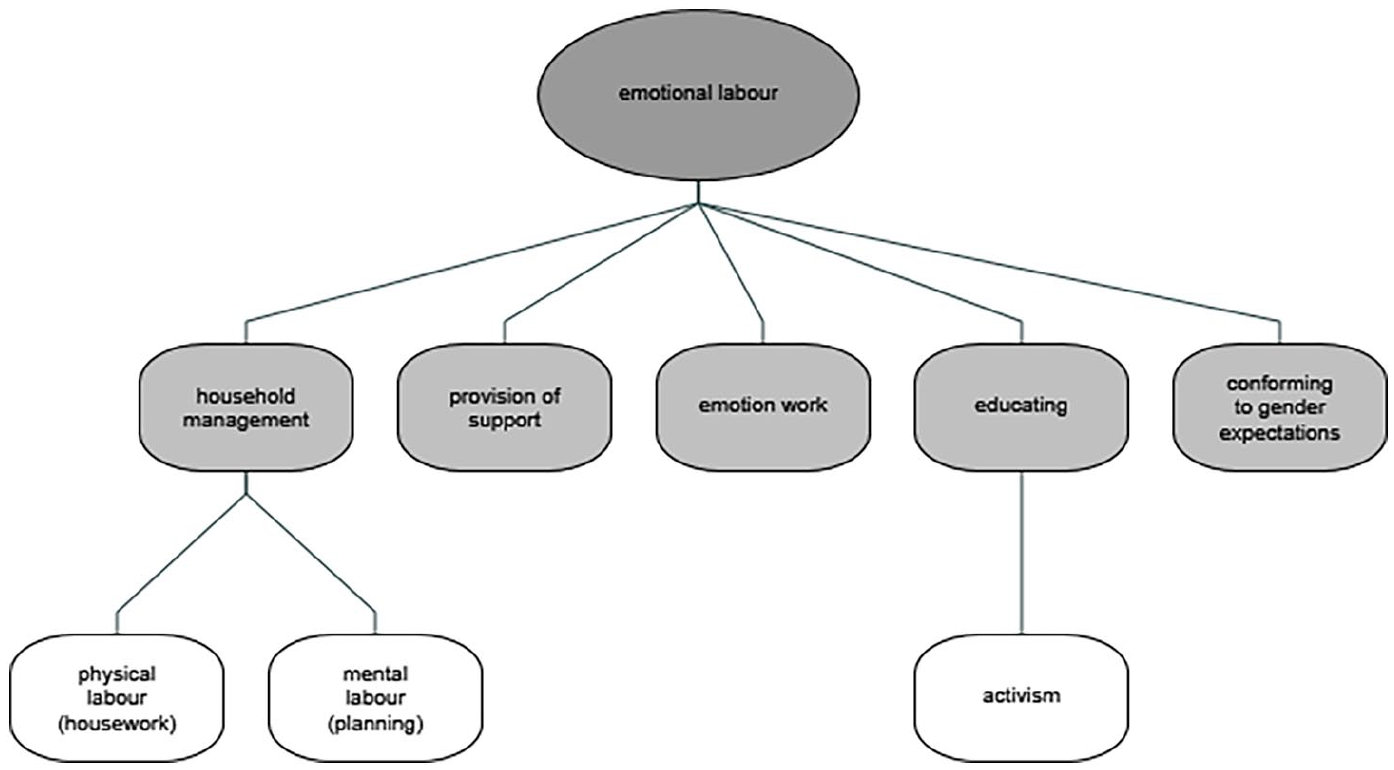
Meanings of ‘emotional labour’ in lay discourse.
‘Emotional labour’ as household management
One of the most prevalent definitions of ‘emotional labour’ is of it as being equivalent to the work involved in managing a household. Authors sometimes refer to this as ‘the mental load’ using this somewhat misleading term to describe ‘the list-making, and juggling work and home, coordinating the different activities, cooking and decorating’ (Agarwal, 2019), essentially all the ‘largely thankless work that goes into running a family unit’s lives’ (Bartz, 2017). It includes all the physical labour (housework) that goes into maintaining a household as well as the mental labour involved in planning, remembering, worrying about, and delegating this work.
These types of labour together accounted for the majority of examples offered by authors of the articles under examination. Gemma Hartley (2017b) lists her ‘emotional labour duties’: reminding [my partner] of his family’s birthdays, carrying in my head the entire school handbook and dietary guidelines for lunches, updating the calendar to include everyone’s schedules, asking his mother to babysit the kids when we go out, keeping track of what food and household items we are running low on, tidying everyone’s strewn about belongings, the unending hell that is laundry. . .
While all of these tasks certainly constitute both mental and physical work, the emotional aspect is only to be found in the consequences of carrying it out on a regular basis: the mental exhaustion and resentment felt towards a partner who is not participating in or even acknowledging this often-invisible work.
‘Emotional labour’ as the provision of support
‘Providing support’ was also a frequently reoccurring theme of what constitutes ‘emotional labour’. Most often this was presented in the context of heterosexual romantic partnerships, wherein the woman provides emotional support to her male partner who is not reciprocating to the same extent. Hutchinson (2017), a therapist, describes a case of unequal distribution of ‘emotional labour’ in her client’s former marriage. During this, she classifies her client’s ‘ongoing emotional support in the form of . . . mirroring, curiosity, acknowledgement, validation and empathy’ as ‘emotional labour’. Schaffer (2015) describes ‘emotional labour’ as ‘the exhausting work of being a tolerant, gentle, nurturing, listening woman in our relationships with men, at all times’. Her interviewee Lauren Chief Elk, originator of the #GiveYourMoneyToWomen hashtag which will be discussed later, summarises it as ‘the amount of things that women have to do, acting as the therapist to men’.
‘Emotional labour’ as emotion work
In many instances, the term ‘emotional labour’ was simply used to describe what Hochschild (2003 (1983): 18) calls emotion work–the act of managing (usually suppressing) one’s own emotions in the private context. In one instance, this was discussed in relation to Black women feeling the need to ‘police their language and behaviour’ to avoid ‘the angry black woman stereotype’ (Wilkinson, 2018). In most cases, however, it relates again to navigating romantic relationships with men. A common example was suppressing anger or frustration at one’s partner to avoid confrontation (Bartz, 2017; Gilmour, 2018; Schaffer, 2015). To Hartley (2017b) for example, ‘Even having a conversation about the imbalance of emotional labour becomes emotional labour’, as she feels the need to regulate her emotions so her husband does not get angry when she asks him to take on more chores.
‘Emotional labour’ as educating others and activism
Sharing knowledge and providing education was also a salient theme, although less so than the ones mentioned above. This type of ‘emotional labour’ ranges from teaching the (usually male) people in one’s life how to ‘negotiate their own needs’ (Gilmour, 2018), or communicate about plans effectively (Bartz, 2017), to the activist efforts of black women who ‘routinely spend hours educating white folks on the disparities people of color suffer in medical treatment, education, criminal justice, environmental justice, and so on’ (Threads of Solidarity, 2018). Spratt (2018) even complains about the ‘emotional labour’ performed by women who wore black to the 2018 Golden Globes in protest of sexual harassment and gender inequality in the film industry. Here again we see that the term ‘emotional labour’ operates as a stand-in for any kind of labour which the author feels emotionally about.
‘Emotional labour’ as conforming to gendered expectations
In the broadest sense, which can easily encompass all of the above, ‘emotional labour’ is understood as ‘the unpaid, unappreciated effort that goes into conforming to societal expectations’ (McCoy, 2018) of being a woman. This conceptualisation is particularly evident in an article by Weiss (2016) wherein she lists 50 ways people expect constant emotional labour from women. This list includes examples of emotion work, domestic labour, and interpersonal support, such as listening to friends talk about their problems. For the most part, however, it catalogues all sorts of gendered societal expectations which women are expected to meet, whether they pertain to wearing make-up, having and providing for children, presenting in a feminine way, or ignoring sexist behaviour. Kasana (2017) lists 15 examples of ‘emotional labour’ that is expected of women, starting with ‘automatic expectations of maternalism’ and ‘our language must be feminine – always’. This extremely broad definition is not widely used, but its existence points to the inherent ambiguity of the term. It demonstrates that in absence of a generally accepted definition, ‘emotional labour’ is stretchable to such an extent that it becomes equivalent to the act of performing gender, specifically femininity.
We can see then that the discourse surrounding emotional labour shows a deep frustration with traditionally gendered work, whether that be physical, mental, or emotional, and its unequal distribution between women and men. Such frustration is only to be expected. Despite women’s entry to the labour market, there has been little change to work distribution inside the home, leading to what Hochschild and Manchung (1989) call ‘the second shift’ for women. Federici (1975), argued that upon entering the workforce, many women ‘have discovered that the overalls did not give us more power than the apron; if possible even less, because now we had to wear both and had less time and energy to struggle against them’. In addition to this, feminist economists have begun to theorise about the ‘third shift’, referring to the emotion work which women are also expected to perform the vast majority of (Power, 2020: 67). To employ Hochschild’s (2003 (1983)) terminology, the societally set ‘feeling rules’ guiding emotional gift exchange in the private sphere reflect the traditional gender norms which assign to women superior emotional intelligence and skills with handling emotionally charged situations, thus adding to the list of gendered responsibilities. In these circumstances, growing alienation, frustration and mental exhaustion are the natural consequences. Perhaps equally understandable then is the employment of a term that combines the notions of labour and emotion (which is often the consequence of labour) and grants the authors’ concerns legitimacy by virtue of its scientific origins: ‘Women put up with a lot of bullshit, and we have a science-backed term for it: Emotional labor’ (Schaffer, 2015). However, we have other concepts, such as ‘doing gender’, to capture this.
Class, employment, and ‘emotional labour’
As already mentioned, the explicitly classed and employment-related nature of emotional labour almost disappears in the lay discourse. However, that is not to say that (1) the authors are unaware of it or (2) that the lay discourse itself is not classed in a number of implicit ways. Hochschild’s work is referenced across 15 articles, as some authors begin their pieces by briefly acknowledging the original meaning of the term before delving into how it is used now. Mayne (2020), puts it thus: Although the concept of emotional labor was first conceived in 1983 by sociologist Arlie Hochschild, who related to managing emotions as expected by certain professions, it has expanded and taken on a wider meaning that reaches beyond the workplace and into the home.
The formulation is significant because the reader is led to regard Hochschild’s definition, which seeks to highlight the potentially harmful conditions of work in the service sector, as somewhat outdated and no longer as relevant as the term’s new expanded version. Besides the fact that journalistic work is naturally led to focus on ‘current’ issues, it is possible that this prioritisation of the term’s new meanings is also due to the authors’ own life experience.
It is telling that the event that drove Hartley to write her highly influential Harper’s Bazaar piece was her husband cleaning their bathroom himself, thus avoiding the ‘emotional labour’ of finding, vetting, and ordering a suitable cleaning service, like she wanted him to. We learn from this that Hartley is someone who feels like she does more household-related work than her husband but that she is also someone who can afford to outsource some of the domestic tasks and regularly hires professional help to clean the bathroom. Crompton (2018) presents an example of a woman refusing to undertake the ‘emotional labour’ of messaging her hired dogwalker upon her husband’s request and instead instructs him to do it himself. In another Harper’s Bazaar piece, Hamlett (2019) complains about men unloading all of their emotional baggage onto the women in their life and suggests they attend group therapy, which costs around $75 per session, as an accessible alternative. When class is mentioned explicitly, it is usually in the context of Hochschild’s work or as a quick nod of acknowledgement to the concept of intersectionality (Gao, 2020; Kasana, 2017; McCoy, 2018). From this, we can derive that the lay discourse around ‘emotional labour’ largely prioritises middle-class feminist narratives.
The discourse seems largely in line with liberal feminist ideology, with its focus on altering gendered socialisation and gender roles without interrogating the larger oppressive structures at play (Acker, 1987: 423). The authors argue that the solution to the unequal distribution of ‘emotional labour’ lies in individual conversations with one’s partner (Gilmour, 2018; Hartley, 2017b), men going to therapy and learning to get in touch with their feelings (Hamlett, 2019), or a broad cultural change in how society raises boys (Strauss, 2015). However, there is also a self-proclaimed ‘radical’ tendency within the discourse which argues that the performance of ‘emotional labour’ should be compensated financially. Although this view is only present in about 10% of the sampled articles, it seemed to have been much more dominant on social media and indicates an interesting potential ‘stretching’ of the concept, though, as we shall suggest, one which in many ways reproduces, rather than challenges, neoliberal logic.
‘Emotional labour’ and neoliberal pay
The assertion that ‘emotional labour’ is yet another form of unpaid labour was particularly apparent in the early years of the discourse, beginning with Jess Zimmerman’s viral piece for The Toast in July 2015. Zimmerman’s is the earliest identified article which utilised the term ‘emotional labour’ in a new way and has been credited with ‘making the concept familiar’ in the mainstream (Wong, 2018). In it, Zimmerman defines emotional labour as ‘offering advice, listening to woes, dispensing care and attention’ to men and argues that these should not come free. She references a then 2-months-old social media hashtag #GiveYourMoneyToWomen originated by the aforementioned Lauren Chief Elk, explaining that ‘the basic idea behind the hashtag is that a woman’s time and regard has value – it cannot be had for nothing’ (Zimmerman, 2015, our italics). In an interview for Vice (Schaffer, 2015), Chief Elk expands on this by saying that the hashtag calls for monetary compensation for (1) gender-based violence (as an alternative punishment to incarceration) and (2) emotional labour. Chief Elk presents this as a radical anti-capitalist act of wealth redistribution and a solution to both the gender pay gap and the historical exploitation of women of colour, even claiming that while White women have been upset by the hashtag, ‘women of color have been rejoicing in song over this whole movement’. Ascertaining the existence of this ‘racial divide’ in responding to #GiveYourMoneyToWomen was sadly outside of the scope for this project.
Compensation for the performance of emotional labour in the workplace is undoubtedly appropriate and necessary. However, when the concept is removed from the sphere of work and understood in the context of private life, such demands become more problematic. There is of course an established precedent in the socialist feminist tradition for demanding compensation for housework (Federici, 1975), and as long as ‘emotional labour’ is conceptualised as equivalent to, or at least inclusive of housework, this would constitute an interesting revival of such politics. However, as already established, Chief Elk conceptualises ‘emotional labour’ in terms of doing emotion work in a relationship and providing emotional support to men, saying: men get so much from us, they drain us for our knowledge, our support, our validation, our attention, no! If you want this, hand over your fucking money. Give me your cash, right now, if you want all of this
Zimmerman (2015) echoes this definition and even makes an explicit distinction between housework and emotional labour. Witt (2016) and Threads of Solidarity (2018) both call on Black women to demand financial compensation for the ‘emotional labour’ they perform while engaging in anti-racist activism, both in-person and online. In fact, all articles calling for compensation explicitly avoided conflating ‘emotional labour’ with housework.
This constitutes a fascinating inversion of Hochschild’s original thesis. While The Managed Heart essentially presents a Marxist critique of the commercialisation of human emotions in the service sector, a self-described radical section of the lay discourse goes in the opposite direction and actively calls for the commercialisation of interpersonal relationships in the private sphere. More often than not, this idea of turning kindness and support into tradeable commodities is wrapped up in progressive and socialist rhetoric, invoking ‘wealth redistribution’ (Schaffer, 2015) and ‘shake-patriarchy-to-its-core revolution’ (Hackman, 2015). However, a critical analysis reveals that this approach is embedded in distinctly neoliberal notions of marketisation and individualism (Harvey, 2005). By stating that heretofore selfless acts ought to be monetised because ‘a woman’s time and regard has value’, Zimmerman (2015) reveals a tendency to only conceptualise worth in terms of exchange value (Marx, 1990 (1867)) in other words, to only see things or acts as valuable if they have a calculable worth and can be purchased. This tendency carries over into the language of most articles analysed within the scope of this research. Even the ones that do not explicitly call for compensation tend to assert that emotional labour is unvalued because it is unpaid, or that men who do not reciprocate the support provided to them are ‘emotional gold diggers’ (Hamlett, 2019).
The entry of market language into a discourse which is effectively concerned with the home and personal life is notable. Demands for monetary compensation for the performance of selfless acts of care and service betray not only a deep sense of alienation from these potentially fulfilling acts and the people they are performed for but also the extent to which the logic of the market permeates most aspects of life. It is particularly fascinating that this should be so evident in the case of emotional labour, a concept originated by an author whose later work is concerned precisely with the growing prevalence of market language outside market spheres and the increasingly blurry distinction between work and home. In The Outsourced Self, Hochschild argues that market values are in the process of subtly distorting family values, as ‘we are bombarded with language that urges us to think in market terms’ (Hochschild, 2013: 13). In her earlier work (Hochschild, 2003) she posited that this expansion of the commodity frontier is being facilitated by feminism in a way that parallels the role of the Protestant work ethic in enabling the development of capitalism. Kristin Blakely expands upon this by arguing that it is specifically liberal feminism that ‘provides the ideological groundwork for the commodification of family life’ (Blakely, 2008: 642). This assertion seems to be at least partly supported in discussions of ‘emotional labour’. 4
There is a range of feminist scholarship exploring the manifestations of feminism within a capitalist and neoliberal context (see for example Banet-Weiser et al., 2020), pointing out how this foreground the importance of individualism, choice, and agency (Gill, 2007) along with self-help and the idea of a healthy work–life balance (Rottenberg, 2014) in ways that fit comfortably within the existing hegemony. Rottenberg, for example argues that while neoliberalism has no lexicon to recognise care work, neoliberal feminism solves this tension by ‘positing balance as its normative frame’ and therefore ‘helps to maintain a discourse of reproduction and care work while ensuring that all responsibility for these forms of labour. . .falls on the shoulders of so-called aspirational women’ (Banet-Weiser et al., 2020: 8). The lay discourse around emotional labour can be viewed as a backlash against this ideal of balance, a proof of the failure of this attempt at reconciling feminism with neoliberalism. Nevertheless, it is a backlash that remains firmly positioned within the same ideological terrain. The proposed solutions, as shown, are still rooted in the mind-set of self-help and individual empowerment and further extend the market frontier to private emotional lives.
The concept creep of ‘emotional labour’
In terms of insights which can be derived concerning ‘concept creep’ (Haslam, 2016), it is clear that there are both benefits and drawbacks to the phenomenon. The semantic expansion of ‘emotional labour’ happens for the most part in a horizontal way, as the concept is stretched to include qualitatively different phenomena. The positive consequence of such stretching is acknowledged within the articles. Zimmerman states that she was floored by the amount of feedback she received after her article for The Toast went viral – ‘hundreds and hundreds of women commented in fervent agreement, thanking her for giving them a vocabulary for what they experienced’ (Hackman, 2015). Hartley experienced the same thing, as countless women wrote to her about how her viral piece changed their relationships, ‘. . .finally giving them the language they needed to speak openly and honestly with their partners about emotional labour’ and many men, including her own husband, responded to her by ‘vowing to change the course of their actions now that they finally understand the concept’ (Hartley, 2017a). The positive responses that both Zimmerman and Hartley received are evocative of Hochschild’s (2003 (1983): 199) own experience following the publication of The Managed Heart. They also lend some credibility to Cikara’s (2016) assertions that concept creep can serve as a source of empowerment by helping people make sense of various phenomena in their lives.
On the other hand, there are also negative consequences of the semantic stretching of ‘emotional labour’. Understanding the concept as pertaining to private interpersonal relationships obscures the importance of its original meaning, and reorients collective attention away from systemic issues in the service economy, where the term could have been utilised in organising for demanding appropriate remuneration, to individual issues in the home (as West, 2019 notes in a dissenting opinion). While, of course, it could be argued that it is not for sociologists to condemn lay actors using a concept ‘incorrectly’ to make sense of their life, in the case of emotional labour, the decision to call effectively any kind of traditionally feminine work ‘emotional labour’ not only potentially reinforces the socially constructed notion of women as inherently more emotional than men but also overlooks that we have other sociological concepts we could use to describe this phenomenon (such as patriarchy or ‘doing gender’). In the sense then of Hochschild’s goal of orientating focus towards the emotional exploitation of service capitalism the blurriness and growing ambiguity of the term is not analytically useful (Cascardi and Brown, 2016) and can impede any struggle which could be waged against the very real issues raised in the analysed lay discourse. As Bauman (2011: 171) notes, in the process of dialogue between sociology and lay actors we need skilfullness in ‘reconnecting and making whole again’ the influences on individual’s lives and ‘in uncovering the doxa’ shaping these lives. While the lay use of emotional labour we have discussed here may help individuals narrate their experiences, unlike Hochschild’s original usage, it suffers in this more structural goal.
Conclusion
The aim of this article was to provide insights into an often underappreciated yet ever-present aspect of sociology–the double hermeneutic, (Giddens, 1984). To this end, it utilised the example of emotional labour, a sociological ‘second order concept’ (Schütz, 1962: xxxvi) which has become a ‘first order concept’ (Schütz, 1962: xxxv) by entering into lay feminist vernacular.
We found that the expansion of the term’s meaning has been collaborative and continuous in nature. Many of the analysed articles actively engage in assigning additional meanings to the term according to the authors’ life experiences, which while they may have helped narrate those individuals’ lives, stretched it ever further and left it with virtually no analytical use. The dissimilarity in understanding the term between the lay and sociological is likely due to the fact that the term ‘emotional labour’ is not immediately evocative of what the concept is intended to convey. The lay interpretation of it is much more literal–it refers to virtually any labour which produces emotions in the person carrying it out. This might suggest a need for scientific ‘second order’ concepts to be as meaningfully descriptive as possible in order for them to become ‘first order’ concepts without ‘creeping’ in problematic ways. This is particularly important when it comes concepts with a normative social agenda behind them. As demonstrated earlier, the new ‘emotional labour’ has virtually no connection to the issues of highly regulated service work, thus preventing a crucial conversation around labour relations.
Furthermore, we suggest that changes have occurred on two levels; besides the shift in meanings which are conveyed via the term ‘emotional labour’, there has been a shift in the concept’s ideological underpinnings. The original socialist ethic evident in The Managed Heart (Hochschild, 2003 (1983)) has been lost in lay discourse and replaced by a liberal feminist and sometimes distinctly neoliberal logic which lacks virtually any social class perspective and instead introduces market-inspired logics into a discourse around care-based relations with friends and family. Echoing Blakely (2008) this suggests that this encroachment of market logic and language is to a degree facilitated by liberal feminism, an ideology that demonstrably drives the lay conversation around ‘emotional labour’ and recommends future research into this process while also facilitating a deeper understanding of the implications of both concept creep and the double hermeneutic. Future investigations of not just broader uses of ‘emotional labour’ but other concepts which have travelled from academia into popular lay knowledge (i.e. the male gaze, intersectionality) are encouraged to determine whether processes similar to those laid out here play out more broadly.
Hochschild in a recent interview has said she is ‘horrified’ about how emotional labour is being applied (Beck, 2018). While Hochschild suggests she is pleased to see the concept being used she is worried about the ‘blurry thinking’ in which it, as we saw, is used to refer to more and more things. We end this article the way Hochschild ends that interview, highlighting the normative ends of the concept and its link beyond gender to class (and potentially race) with the experience of alienation. For her emotional labour should be: Added to a feminist concern for equity – not taking that away, adding to it – we need to add clarity about our social-class position and explore the idea of alienation. When things stop being meaningful and fun. Let’s not just sweep that aside, because I don’t think it’s a solution if both husband and wife are now 50–50 with alienated labor . . . I’m adding a concern about why things don’t feel fun for both of them (Hochschild, in Beck, 2018)
Footnotes
Funding
The author(s) received no financial support for the research, authorship, and/or publication of this article.