




Abstract
This article contributes to new scholarship on family change as bricolage and institutional layering. Focusing on the classic topic of parental values and aspirations for their children, we used a retrospective qualitative longitudinal analysis to trace the evolution of four overlapping cultural configurations across the 20th century: (1) standing back and not interfering, (2) cultivating achievement, (3) encouraging positive relationships, and (4) promoting happiness and self-fulfilment. We show that there was a directional change in the emphases and inflections placed on these configurations, and in the moral ambivalence that parents displayed as they reconciled them in their narratives. Meanings centred on autonomy and cultivation were layered onto relatedness across changing social contexts. Engaging with recent debates on the value of qualitative interviews, our analysis demonstrates how qualitative longitudinal research can provide rigorous analysis of long-term cultural change.
Introduction
Throughout most of the 20th century, sociologists viewed family change through an institutional lens. However, diversification of family patterns since the 1970s undermined the representation of family as institution. Two strands of theorizing emerged to explain these trends (see the study by Knapp and Wurm, 2019). The first depicted family change as ‘de-institutionalization’. Focusing on marriage, Cherlin (2004) argued that social norms had weakened such that people now constructed their own ‘marital worlds’. In developing his argument, Cherlin drew on theories of late modernity on the growing individualization of personal life. The second strand comprised a broad range of perspectives critical of both institutional and individualization arguments. Scholars in this ‘diversification’ strand focused on how people (re)constructed diverse family configurations, meanings, and displays in their everyday lives.
Across both strands (individualization and diversification), moving from an institutional lens entailed a shift towards ‘horizontal relationality’, making it difficult to describe and explain macro-social trends (Knapp and Wurm, 2019). Recently, two broadly defined responses to this challenge emerged. Reviewing his thesis on de-institutionalization, Cherlin (2020) invoked ‘new institutionalism’ to suggest that change ‘is facilitated by the multiple, overlapping cognitive and cultural frameworks that may be available to individuals’. Even when the fundamental structure of an institution is altered, older institutional forms may remain, layered beneath newer forms. Duncan et al. (2020) argued that ‘new institutional’ approaches cannot explain why some people actively modify the cultural scripts that tend towards institutional inertia. They elaborated the alternative concept of ‘institutional bricolage’. Faced with new challenges, people ‘adapt what they already know’ to arrive at a solution. Over time, ‘[n]ew social arrangements are pieced together using diverse parts of available existing norms, values, and practices’ (Duncan et al., 2020: 443).
These approaches offer interesting new ways to think about family change. But like the ‘individualization’ and ‘diversification’ perspectives from which they emerged, they document and explain institutional change at different levels of analysis. To understand family change over longer periods, we must link the micro-processes of ‘bricolage’ to macro-level trends in ‘layered’ cultural scripts. We focus on a classic topic in family sociology – changes in parents’ values and aspirations for their children – to examine layered institutional change at the meso-level. Engaging with recent debates on the value of qualitative interviews for ‘measuring culture’ (Mohr et al., 2020), we demonstrate the potential of a retrospective, qualitative longitudinal method (hereafter RQL; Neale, 2018: 49). Drawing on an archived life history project, we identify four, overlapping cultural configurations (Patterson, 2014) within narratives of values and aspirations for children, across three 20th century parental cohorts in Ireland, namely: (1) standing back and not interfering, (2) cultivating achievement, (3) encouraging positive relationships, and (4) promoting happiness and self-fulfilment. By situating participants’ narratives within the socio-historical contexts of their lives and times (Brannen, 2004), we show how these configurations exhibited layered, directional change.
We begin by reviewing existing scholarship, showing how qualitative research added complexity to survey findings, sometimes generating paradoxical results. We then place the literature on parental values within changing theoretical ideas about cultural and institutional change, and methodological debates surrounding the value of qualitative interviews. Extending the argument by Rinaldo and Guhin (2022) that ethnographic interviews provide access to ‘meso-level public culture’, we argue that contextualized biographical interviews reveal emergent and layered patterns of institutionalization. Following a summary of survey evidence on parental values in Ireland, we describe our RQL data and methodology. We then summarize the overlapping cultural configurations revealed by our analysis of 69 life story interviews. This is followed by detailed discussion of how people mobilized those configurations across changing socio-historical contexts.
Literature review
Relying principally on survey data, scholars demonstrated a long-term shift in child-rearing values, away from conformity and obedience towards self-direction and autonomy (for comprehensive reviews, see the studies by Alwin, 2001; Alwin and Tufiș, 2021). Increased levels of education are most strongly associated with this change, but scholars also built on classic research by Kohn (1989) showing variation by social class. Another strand of research examined association with religion – both secularization, and differentiation across religious groups and cultural zones, (Fjellvang, 2011; Sieben and Halman, 2014; Starks and Robinson, 2007). There is also evidence of variation by gender (Xiao, 2000) and racial and ethnic background (Baker and Barg, 2019). Recent studies show a ‘curvilinear’ pattern of change across birth cohorts in the USA, with younger parents valuing autonomy less than those born at mid-century (Starks and Robinson, 2007), alongside increasing emphasis on ‘hard work’ and ‘caring for others’, and narrowing social class differences (Nomaguchi and Milkie, 2019; Ryan et al., 2020). Alwin and Tufiș (2021) concluded that parental education remains the most important predictor of child-rearing values, mediated by occupational class, with religion having a secondary effect.
Theoretically, changing parental values are understood as part of a transition in the exercise of authority, away from total institutional control towards self-regulation (Alwin, 1988; Alwin and Tufiș, 2021: 317), within the overarching process of modernization (Fjellvang, 2011). Although mostly scholarship focuses on a single dimension (from conformity to autonomy), Kağıtçıbaşı (2012) argued for a second centred on ‘relatedness’ and ‘separation’. In western scholarship, relatedness is often treated as incompatible with personal independence. In the majority world, however, educated parents increasingly want their children to exercise personal autonomy while remaining connected to the wider community and its traditions. Changing values, according to this perspective, should be mapped across two orthogonal dimensions: ‘Along the vertical axis, it is possible to think of parents encouraging their children to be relatively autonomous or relatively heteronomous (or obedient to their parents and others). Along the horizontal axis, parents can encourage their children to be separated from others or more related to others’ (Tudge et al., 2018: 78).
Qualitative research drew attention to complexity, ambivalence, and contradictions in parental meanings and practices. Building on Lareau’s (2003) classic ethnography, Weininger and Lareau (2009) identified ‘paradoxical pathways’ in parents’ class-differentiated strategies to realize values for their children. Middle-class parents – who most valued independence and autonomy – engaged in ‘concerted cultivation’ that entailed intensive scheduling and supervision, whereas working class parents – who valued obedience and conformity – adhered to a ‘culture of natural growth’. 1 Qualitative interview studies revealed within-class and racialized variations in accounts of parental values and aspirations (Gauthier, 2015; Irwin and Elley, 2011, 2013; Vincent et al., 2013). Irwin and Elley (2011) showed how apparently similar values had different frames of reference for working and middle-class parents. Perrier (2013) described how middle-class mothers articulated contradictory and morally ambivalent attitudes to concerted cultivation. Sherman (2017) described how elite parents experienced conflict between cultivating their children’s individual capacities and their moral selves. Related work suggested that the ‘family values’ of working-class parents were more similar than different to those of middle-class parents, and that variations in parenting practices reflected ‘culturally-conditioned responses to structural differences in opportunities’ (Sherman and Harris, 2012: 67). In general, therefore, qualitative research added complexity to survey evidence about parental values, raising questions about how values correspond to meanings and practices.
Recent scholarship indicates that survey and qualitative research may capture different forms of culture. The ‘institutional family’ was underpinned by a model of enculturation in which coherent value systems were internalized through socialization. Contemporary ‘cognitive sociology’ provides new concepts for understanding correspondences and disjunctures between culture ‘in people’ and culture ‘in the world’ (see the studies by Lizardo, 2021; Lizardo and Strand, 2010). Lizardo (2017) distinguished between ‘personal declarative culture’, acquired rapidly through symbolically mediated engagement with public culture, and ‘personal non-declarative culture’, acquired slowly through repeated exposure to consistent patterns of experience. Declarative culture is ‘open to inspection’; on reflection, people ‘know that they know it’. Non-declarative personal culture is analogous to ‘skills’ deployed in ‘real time’ without deliberation. Because they are acquired through different paths of enculturation, expressions of declarative and non-declarative personal culture may be strongly or weakly ‘coupled’, depending on how they intersect with public culture. Where there are multiple, potentially conflicting codes within public culture, dissociation may occur between personal ‘declarative commitments’ and ‘non-declarative practices’ – as in the ‘paradoxical pathways’ between class-differentiated parental values and observed parenting practices (see the study by Lizardo, 2017: 106–107).
Extending these insights to institutional change, Lizardo (2019) highlighted the importance of specifying what is being institutionalized, distinguishing between ‘doings’ (practices, habits and routines) and ‘sayings’ (vocabularies of motive, structure and organization). Processes of institutionalization may occur across these ‘cultural objects’ in ways that are temporally discontinuous and only partially overlapping. Values sit somewhere between ‘doings’ and ‘sayings’, forming part of the ‘grey zone’ (Lizardo, 2019) connecting personal to public culture. ‘Once formed, value activation and application to behaviour is pre-reflective, but it can become conscious when routine forms of action fail and people must creatively decide how to meet the joint demands of values and situations’ (Miles, 2015: 683). Values become public ‘via people’s meaning-construction and objectification processes’ (Lizardo, 2019: 225). Thus, both as ‘doings’ and ‘sayings’, values are subject to processes of institutionalization, acquiring pattern in the form of ‘organizational routines’ and ‘vocabularies in fields’. What then, do we measure, when we ask questions about values in qualitative interviews?
This question has been the subject of scholarly debate. Some authors concluded that, because they are cognitively less demanding, surveys are more effective than qualitative interviews for capturing practical cultural knowledge (Vaisey, 2009, 2014; Vaisey and Lizardo, 2016). It is unsurprising that qualitative interviews reveal contradictory and ambivalent meanings, because people are poor at articulating the moral reasoning behind their actions. Qualitative interviews illustrate how people make sense of their judgements and actions ‘after the fact’, but cannot capture the pre-conscious processes through which meanings shape action. Jerolmack and Khan (2014) argued further that both surveys and qualitative interviews are subject to the ‘attitudinal fallacy’ that people’s behaviour can be inferred from what they say. They claimed that ethnographic observation (such as that carried out by Lareau), provides a better guide to the context within which meaning-making and action occurs.
Other scholars pushed back against these claims, maintaining that in-depth interviews transcend the ‘individualist bias’ of surveys, yielding insights on how people situate themselves within public ‘repertoires’ (Lamont and Swidler, 2014; Pugh, 2013). Researchers should embrace the contradictions in qualitative interviews, because they reveal ‘the bricolage that blends together existing schemas and practices from disparate sources in new ways, that serves as the source of social innovation, of cultural change’ (Pugh, 2013: 48). As we illustrate below, when participants talk about values for children, they connect them to aspirations for their futures, place them within wider social relationships, contrast them with those of putative others and tell (sometimes contradictory) stories about how they put them into practice In Pugh’s (2013) felicitous phrase, qualitative interviews reveal ‘cultural work’.
RQL analysis of parental narratives revealed diverse and overlapping patterns of situated declarative culture. These patterns are congruent with the depiction by Rinaldo and Guhin (2022) of the ‘meso-level public culture’ revealed in ethnographic interviews. Meso-level public culture refers to beliefs and practices that are ‘shared and emergent from aggregated individuals’ within defined social settings. It sits between (and interacts with) personal and public culture. We distinguished the patterns we identified using Patterson’s (2014) concept of ‘cultural configuration’: an ‘ensemble of cultural knowledge and practices structured around a core set of values and norms motivated by a common set of interests, goals, or needs’. People ‘know and have access to a variety of cultural configurations’ (Patterson, 2015: 41). This feature is critical to understanding their layered and overlapping distribution across the narratives in our study. Before proceeding to a detailed description of our RQL data, we briefly summarize evidence from survey data on Irish parental values.
Survey evidence on parental values in Ireland
To our knowledge, just one study focused explicitly on Irish parental values. In a survey of Dublin parents, Hynes (1979) found an association between ‘higher social class and an emphasis on self-direction rather than conformity’, with some variation by gender (see also the study by Hynes, 1985). More generally, researchers found that overall Irish values have ‘modernized’ since the 1980s (Fahey et al., 2006; Hilliard and Nic Ghiolla Phádraig, 2007; Whelan, 1994). For background, we conducted a descriptive analysis of Irish parental values in the European Values Survey. 2 We selected the key values analysed by Fjellvang (2011): (independence, imagination, religious faith, and obedience). We added ‘good manners’, because Hynes found this to be more strongly associated with class in Ireland than ‘obedience’. We also included ‘hard work’ and ‘respect and tolerance for others’, because recent international research showed an increase in the importance of those values.
Between the 1980s and early 2000s, Irish people increasingly selected values associated with autonomy (independence and imagination) as ‘important for children to learn at home’ (Figure 1). Growing proportions selected hard work, while ‘good manners’ and ‘tolerance and respect for others’ were highly selected across all three waves. ‘Religious faith’ declined steadily.
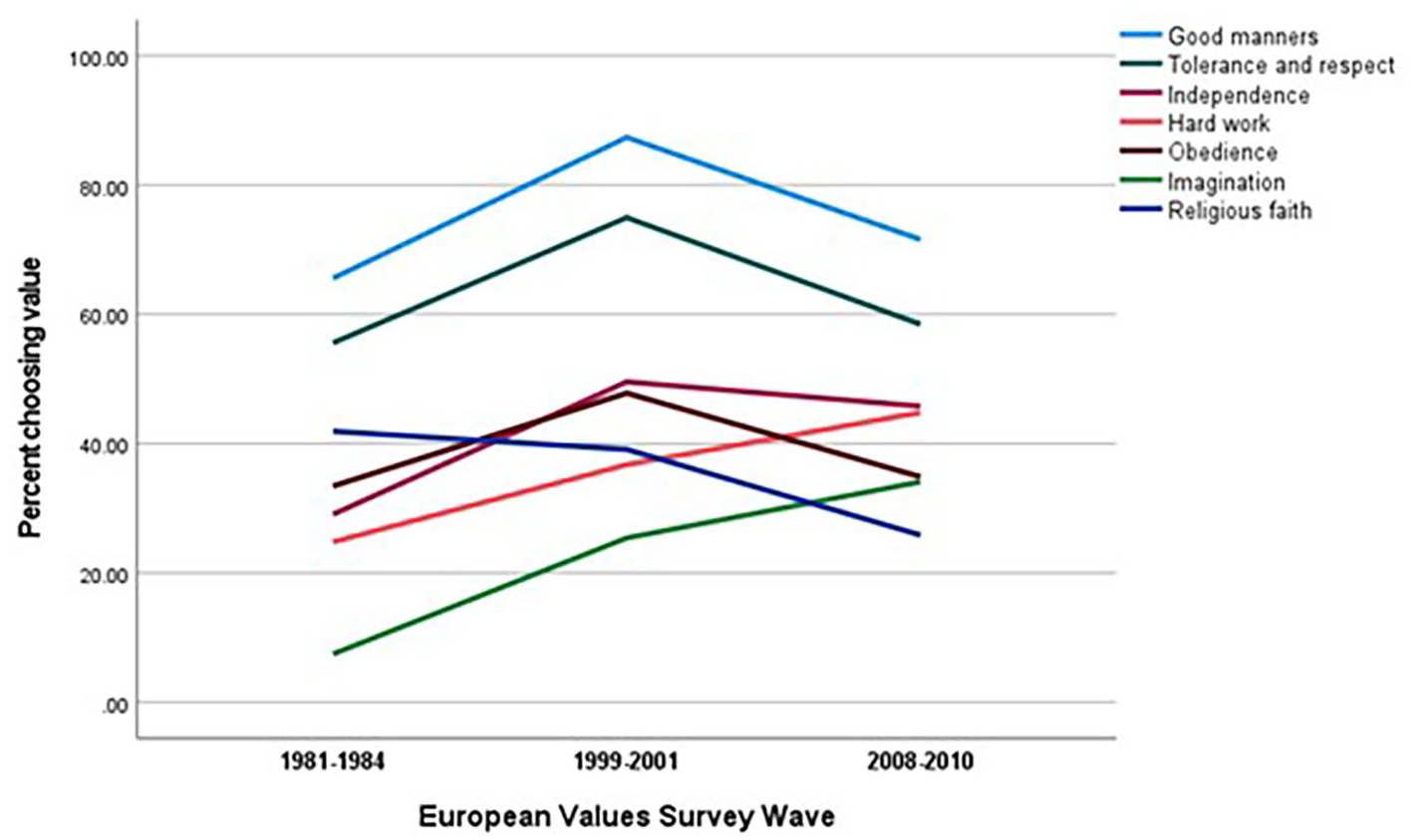
Values important for children to learn at home, Ireland, 1980s to 2000s.
Table 1 summarizes how these values varied by social group in 2008. Older people were more likely to choose religious faith. Younger people and those with higher levels of education, were more likely to choose values associated with autonomy (independence and imagination). Older people and those with lower levels of education appear somewhat more likely to value ‘good manners’, but more than 80% of people in each category selected this (excluding cases with missing values). Tolerance and respect for others was similarly highly valued across all groups, but especially among those with higher levels of education.
Values important for children to learn at home, Ireland, 2008.
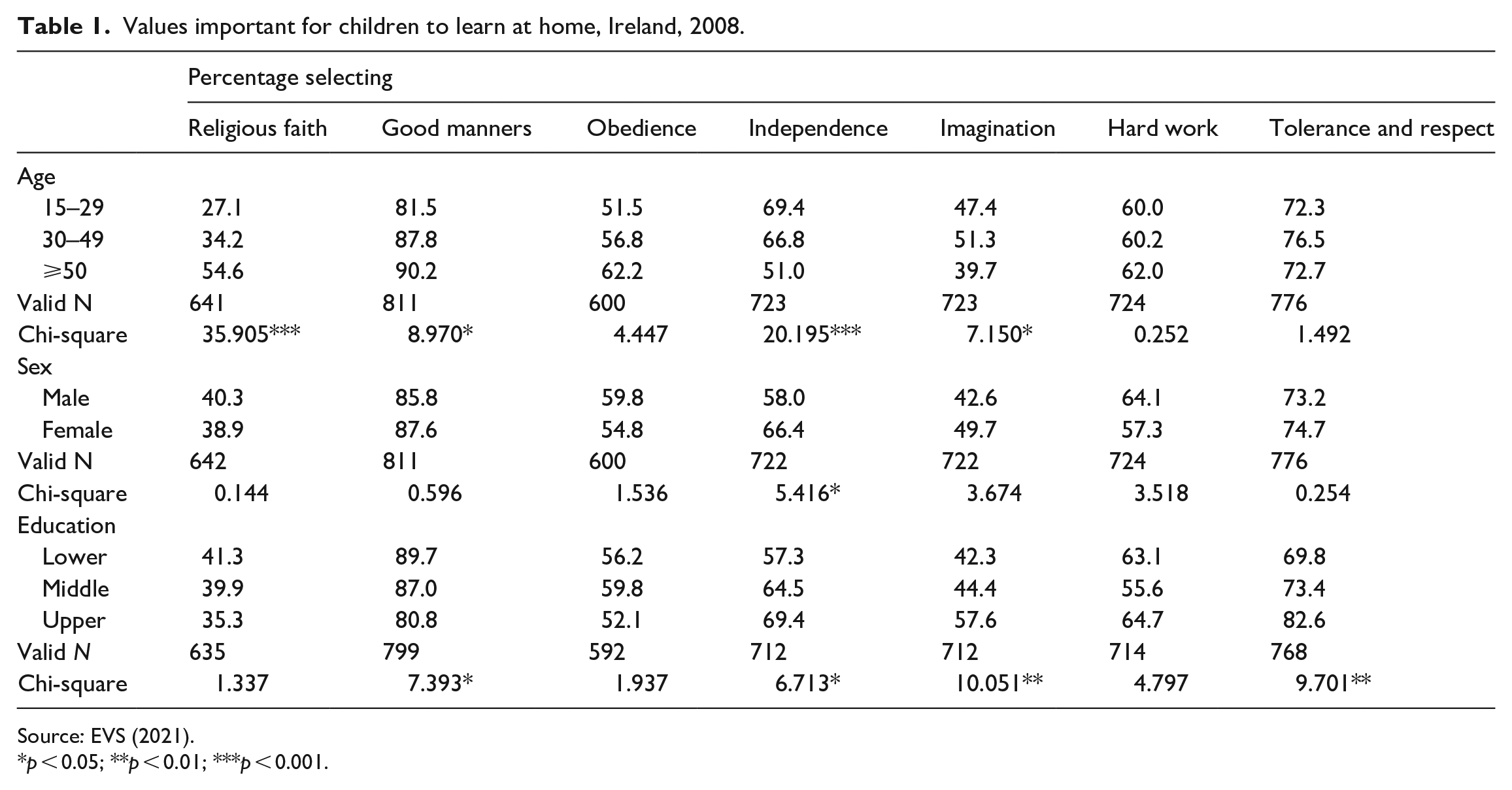
Source: EVS (2021).
p < 0.05; **p < 0.01; ***p < 0.001.
Survey evidence on Ireland is thus broadly consistent with a ‘modernizing’ trend towards secularization (Dargent, 2017: 105–6) and an increased emphasis on values associated with autonomy and hard work, consistent with international research. However, comparatively high proportions of respondents continue to choose obedience, similar to other countries in the ‘Roman Catholic zone’ in 1990–1993 (Fjellvang, 2011: 206).
Study data
Our RQL study drew on data collected for the Life Histories and Social Change Project (hereafter, LHSC; Gray et al., 2015). Between 2005 and 2008, guided life story interviews were conducted with participants from three birth cohorts, who had earlier taken part in a nationally representative panel study, ‘Living in Ireland’ (LII). 3 The interviews are lightly structured biographical narratives covering a wide range of topics across participants’ whole lives. The interview guides included prompts on values and aspirations for children. 4 Each participant also completed a life history calendar and retrospective social network schedule.
Table 2 profiles the 69 LHSC participants who contributed responses relevant to our study. Women and those from a higher socio-economic background are over-represented, and there were fewer eligible cases within the youngest cohort. Especially among older participants, household income at the time of interview might not correspond to when they were raising children.
Characteristics of participants included in analysis (all participants who discussed values and aspirations for their children).
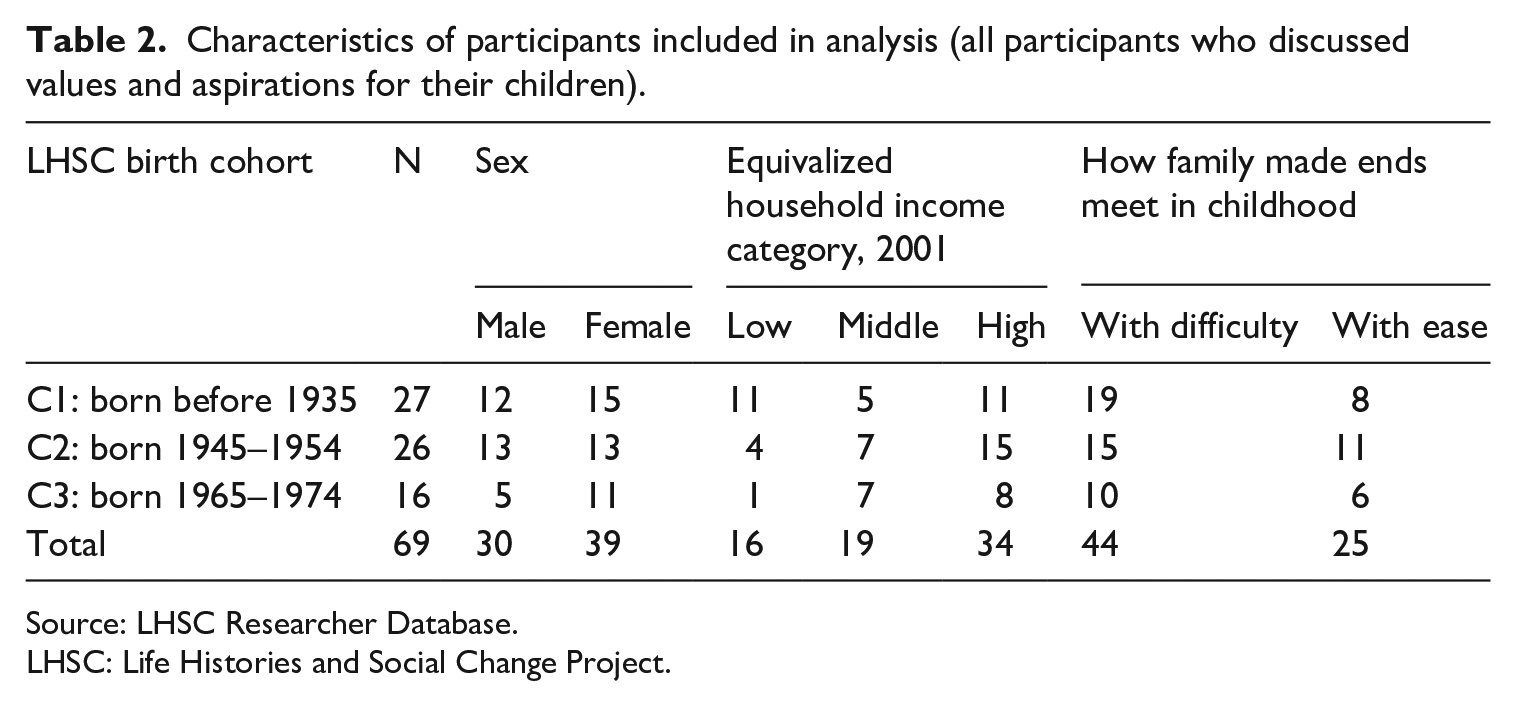
Source: LHSC Researcher Database.
LHSC: Life Histories and Social Change Project.
Some participants in C2 and all in C3 were parenting children of primary school age at the time of interview (see Figure 2). Especially among older parents, reflections on past values and aspirations were shaped by memory, subsequent experiences, and cognizance of how shared values had changed over time (Brannen, 2004). There is evidence that people adjust their memories to support perception of personal consistency and to match societal trends (Jaspers et al., 2009; Scott and Alwin, 1998). Addressing these challenges required us to triangulate our interpretive analysis with evidence on historical context, including contemporaneous social research (Brannen, 2013; Rinaldo and Guhin, 2022; Scott and Alwin, 1998).
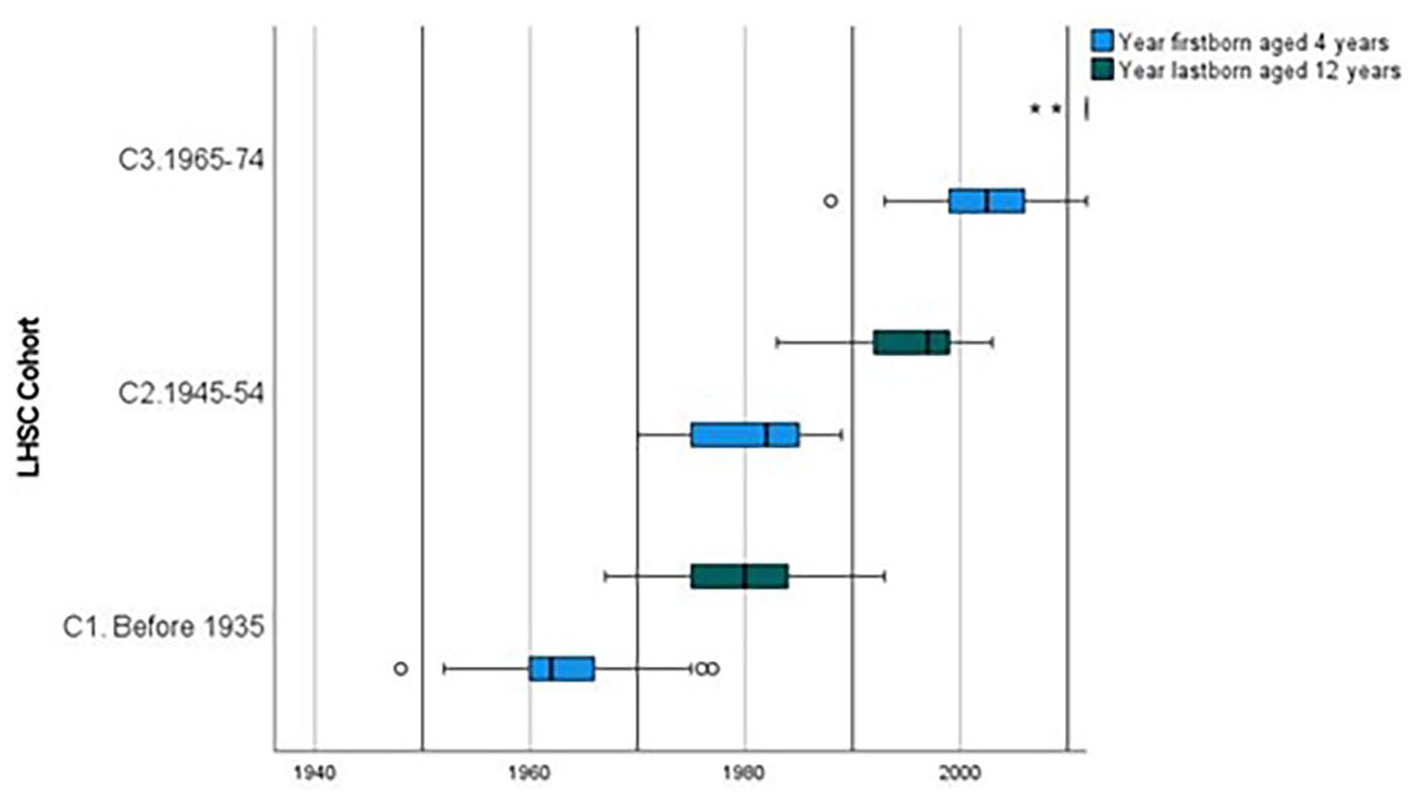
Years study participants (men and women) were parenting primary school-aged children, by participant birth cohort.
Surveys tend to ask separate questions about parental values and aspirations (Hitlin, 2006). Across LHSC narratives, values and aspirations were linked by participants, and sometimes by interviewers, although included as separate prompts within the interview guide. Consistent with other qualitative studies (Perrier, 2013; Sherman, 2017), participants frequently constructed narratives that linked aspirations to ‘good’ ways of being in the world, and values to hopes and expectations about educational and occupational attainment. Consider this extract from the interview with Anne Marie [LH305, b.1966, High SES]:
[W]hat particular values, would you like to instil in your own kids?
Well, honesty, and a sense of fairness, and – my kids are hilarious – I can’t stand cheats. I can't bear it and if they cheat in a game I’ll say, ‘well if you cheat now I’m not going to play with you,’ and all their pals come up here and the rows that start when the pals start to cheat. ‘Mammy, Mammy she's cheating’. So you don’t realize how much it actually influences them until they have pals coming in so fairness and honesty and a sense of loyalty. They would be the main things I would like and confident – that they would be confident enough to do what they [need to] do to reach their full ability.
Anne Marie transitions from her desired values for her children (honesty and fairness) to a statement about aspiration (that they should reach their full ability) illustrated through a morally framed anecdote about how these values differentiate them from others. Some participants answered questions about aspirations with straightforward statements about occupations or desired levels of education, and questions about values sometimes elicited responses about moral or behavioural attributes unconnected with expectations about future status. Nevertheless, most responses were both ‘morally inflected’ insofar as they referred to concerns about ‘the world and the well-being of what we value in it, including ourselves’ (Sayer, 2005: 949) and ‘future-oriented’ in the sense that normative ideas of the self were linked to lifetime aspirations. They were also often morally positioned relative to ‘other’ parents (Perrier, 2013).
Participants sometimes positioned values and aspirations for children relative to their own parents’ values and their personal biographies. Doreen [LH201, b. 1945, Low SES] emphasized continuity with her parents’ emphasis on honesty and self-sufficiency, even though she contravened her mother’s values by becoming pregnant outside marriage. Asked if she had encouraged her children to do well in education, she drew a contrast with her sister, who frequently expressed pride in a highly educated son: There’s none of ‘em achieved brilliant things. But they’ve all worked all their lives . . . And that’s all I’ve ever wanted. That they wouldn’t take – you know, that you won’t live off the state. You know, that you have some bit of ambition in yourself . . . Whatever you get in life, you get yourself.
These examples illustrate how participants constructed narratives that brought together ‘evaluative beliefs’ about how to be in the world with parental hopes and expectations, including how parents should act to realize desired outcomes. They positioned narratives within their own biographies, family relationships and experiences, relative to particular or general ‘others’, whose parenting values and practices were different from theirs. Next, we describe the method we developed to identify patterns within the narratives and to trace distribution across cohorts.
Method
We began with a thematic analysis of responses to prompts about parental values and aspirations. Having identified four tentative ‘configurations’, we adopted a systematic approach to visualizing and refining our analysis. To capture how the configurations overlapped and varied within and across cases, we used the principles of fuzzy-set coding (Ragin, 2000). We allocated scores to the narrative responses according to our judgement of their ‘membership’ within each configuration. ‘One’ represented a response fully within a configuration and ‘zero’ a response fully outside. The scores 0.25, 0.5, and 0.75 reflected our judgement of degrees of membership in the configurations, relative to each of the others.
We first allocated scores independently. We then compared our coding, revealing a number of cases where we assigned different scores, although there were none where we assigned narrative segments to a different configuration. By collaborative reading, interpretation, and discussion, we further refined and clarified our understanding of the four configurations through the process of agreeing on a shared set of scores. The four configurations were: (1) standing back and not interfering, (2) cultivating achievement, (3) encouraging positive relationships, and (4) promoting happiness and self-fulfilment (Figure 3). It is important to remember that these configurations overlapped within individual narratives. Figure 3 shows that ‘standing back’ was less frequently articulated within C2 and C3 and that ‘happiness and self-fulfilment’ was increasingly emphasized.
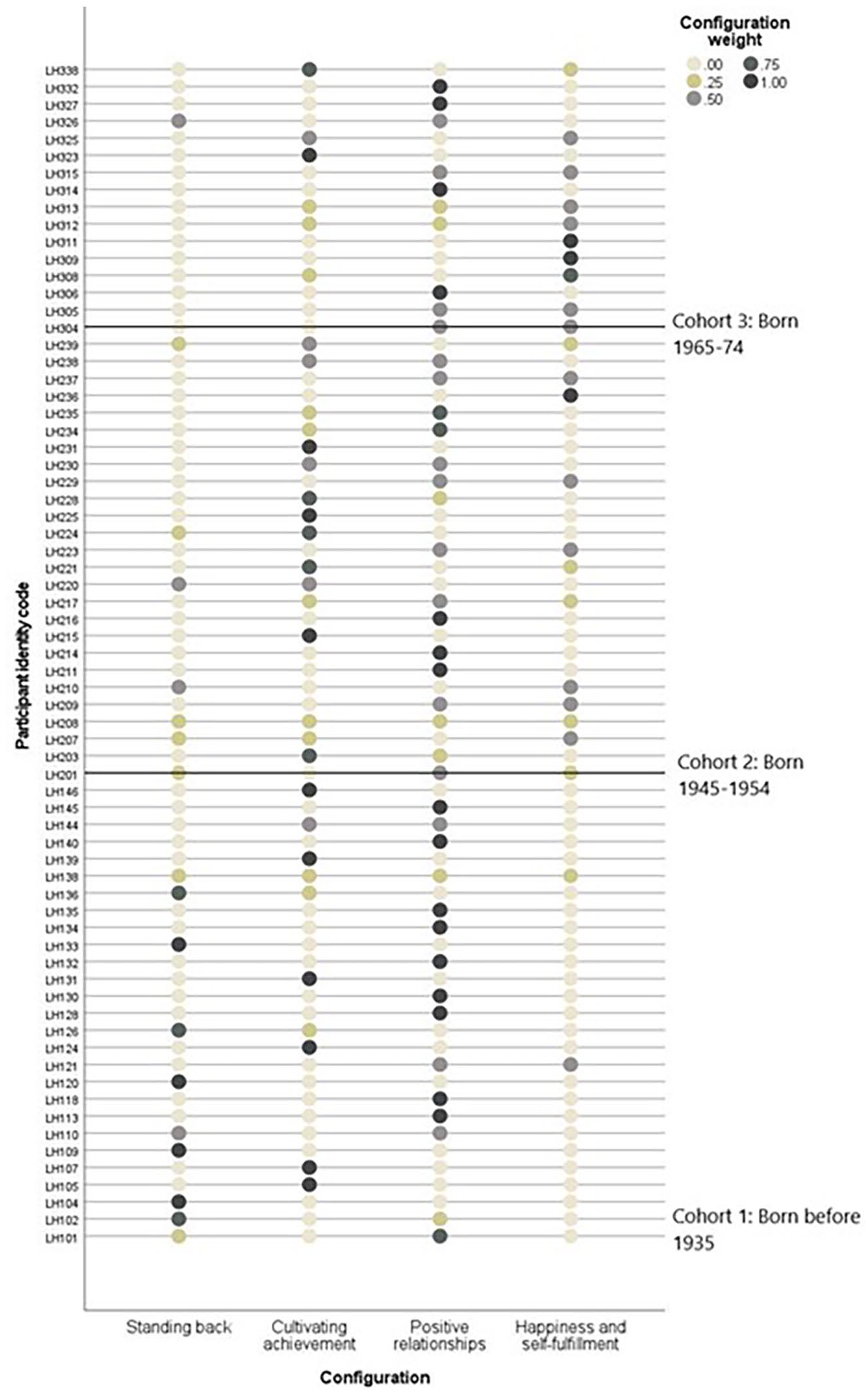
Configurations by LHSC participant and configuration weight.
‘Standing back’ and ‘cultivation’ may be conceived as opposite ends of a single dimension centred on parenting practices oriented towards individual achievement. Similarly, ‘positive relationships’ and individual ‘happiness and self-fulfillment’ can be construed as a dimension centred on personal development. Figure 4 shows the distribution of cases across the two dimensions. C1 participants were more common in the lower left quadrant, with greater emphasis on ‘standing back’ and ‘positive relationships’. C2 participants gravitated towards the lower right, with continued emphasis on ‘relationships’ but more weight on ‘cultivation’. Finally, C3 participants predominated in the upper right, with comparatively greater emphasis on both ‘cultivation’ and ‘individual happiness’.
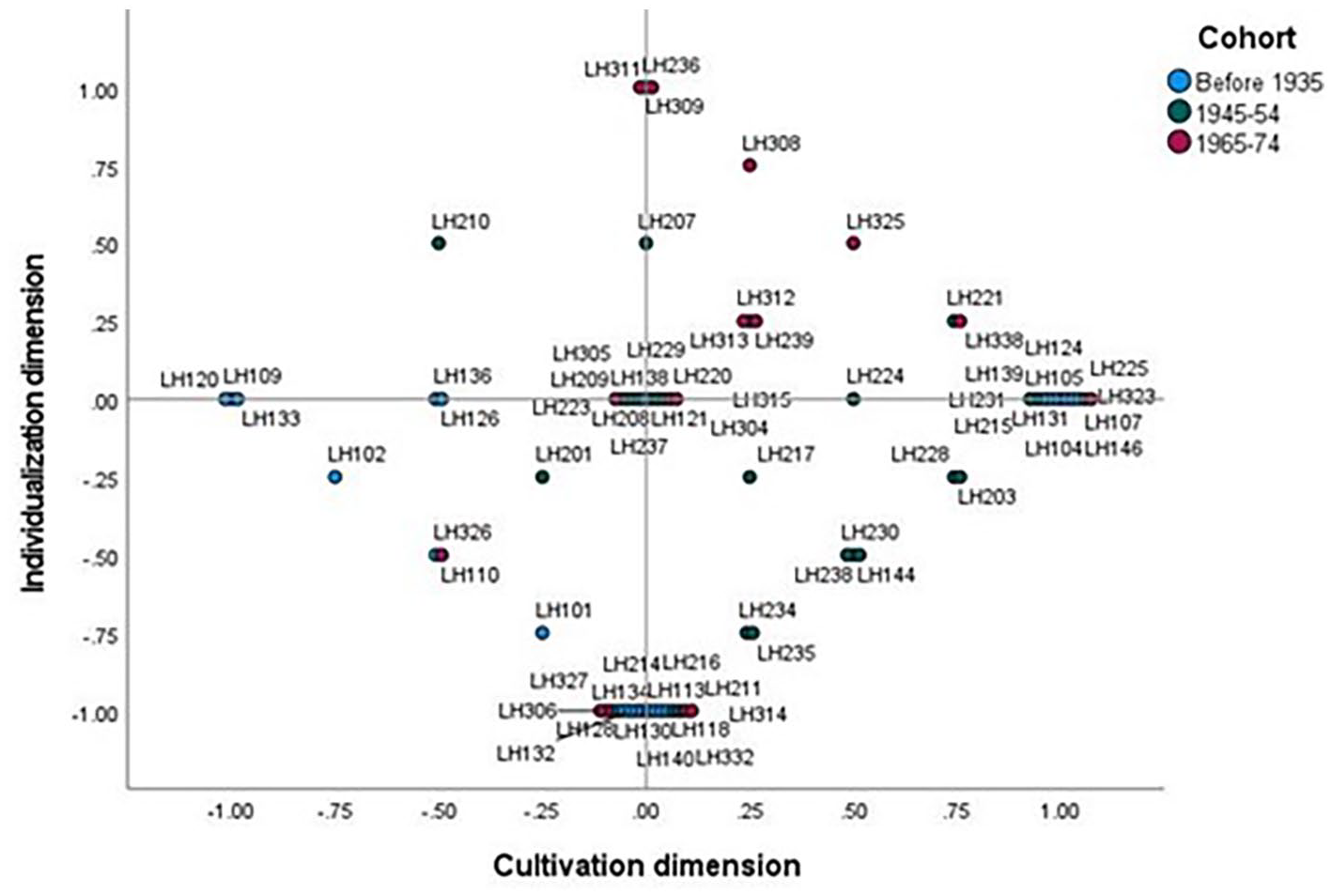
Scatterplot of cases by configurational dimension.
In the remainder of this article, we elaborate our analysis of change in how parents expressed cultural meanings across the four configurations, placing the narratives in socio-historical context.
C1. Parents born before 1935
C1 participants grew up in a society dominated by smallholder agriculture and a political ideology of ‘rural fundamentalism’ (Hannan and Commins, 1992). The Catholic Church’s influence on Irish social and political life at this time is widely acknowledged (Inglis, 1998). The needs and aspirations of children and young adults were subordinated to those of the patriarchal family-household (Gray et al., 2016). In most cases, C1 participants’ children reached school-going age in the 1960s, a period of change as state policy shifted away from protectionism, leading to increases in urban, non-agricultural employment (Breen et al., 2016). Because of larger family sizes, many continued to raise young children through the 1970s (see Figure 2).
Based on survey evidence, we expected that C1 parents would prioritize religion in their narratives about values for children, and indeed four participants mentioned the importance of instilling religious faith. Responding to a direct question, Graham’s [LH132, b.1931, Middle SES] wife replied that ‘absolutely’ religion was important. However, this discussion occurred after Graham identified responsibility towards others as the most important value to be learned at home: ‘I’d say respect for everyone else, work ethic, you do your job, you look after your family, they are the most important thing’. Religious values were encompassed within the broader configuration centred on relationships. While incorporating the language of conformity and obedience, the normative orientation of these sentiments centred on respectful relationships with others. According to Clifford [LH113, b.1926, High SES]: ‘One thing we tried to preach at them was respect for other people and other children’. Similarly, Andrew [b.1934, Middle SES] asserted that parents should give ‘a good example to work hard and to be a good neighbour and a good friend’.
A configuration centred on ‘standing back’ was sometimes forcefully articulated. William [LH126, b.1930, High SES] responded with a question of his own: ‘Do you deliberately try to say to your children . . . to mould them really? I think you just have to leave them, take life and you know’. Clara [LH138, b. 1933, High SES] stated that: ‘We never tried to push them in any way, it was up to them what they did because we felt that they would be happier in their lives if they were making the decisions and they were going the way they wanted to go without being preached’. When asked about their hopes and aspirations for their children, James [LH109, b.1924, Low SES] and his wife responded:
Well, ah, nothing special. Nothing planned anyhow, no.
That they’d get a job
I think putting pressure on people is wrong. Won’t you agree?
Among some in C1, ‘standing back’ reflected perceived limited opportunity: ‘[T]here wasn’t as much talk of education and all and university or anything like that, you were damn lucky if the child went into do its Leaving [certificate] you know’ [Peter, LH121, b. 128, Low SES]. ‘Standing back’ was also partly a rejection of the constraints these parents experienced themselves when growing up. Although continuing to express support for many of the values inherited from their own parents, C1 participants were often critical of the limitations placed on their own lives (Gray et al., 2016). The determination by many not to ‘interfere’ in their children’s choices represented an abdication of traditional parental control in favour of promoting freedom to pursue new opportunities.
This interpretation is consistent with 1950’s research. Humphreys (1966) found that artisan (skilled working class) Dubliners aspired to ‘better the lot of each of their children’, but allowed them to choose whether to continue with their education (if financially possible), and which occupations to pursue, in contrast to their own parents who ‘generally just told their sons what they were to do and that was the end of the matter’ (quoted in Humphreys, 1966: 152). Parents in white-collar and managerial classes were more directive about expected levels of education and occupational attainment. In our study, there are similar cases of C1 parents who adopted a directive approach. Claire’s [LH131, b.1931, High SES] children ‘knew from early on’ that she expected them to attend university and that in the case of one son who was ‘mathematically bright’ there was ‘never any question’ but that he would become an engineer like his father.
Cohort 2. Parents born 1945–1954
C2 participants shared with C1 similar economic and social constraints when growing up. Most were born too early to benefit from free secondary education, introduced in 1967. Limited economic opportunities meant continuing high levels of emigration. Previous research showed this led to enhanced awareness of inequality of opportunity (Gray and O’Carroll, 2012). Completed fertility declined rapidly within C2 leading to smaller family sizes. Their children began to reach school-going age in the 1970s (see Figure 2), a period marked by rising expectations, economic turmoil (Ferriter, 2012), and cultural conflict and anxiety about parenting (Ryan, 2012: 121–164).
Within C2 there was a distinctive new emphasis on promoting happiness and fulfilment. For example: [W]ell obviously I want them to be happy, happy and confident and well able to care for themselves in the world and all of that and to do what they want to do. [Anne, LH237, b.1953, High SES] That they’d be happy, they’d be . . . like, do what they wanted to, follow whatever career they wanted, like, never to let anything stand in their way [Doreen, LH201, b.1945, Low SES]
As in C1, educational achievement was highly valued. However, in C2, we see emerging a greater emphasis on parental cultivation: Well I suppose like everyone else, the best that you can give them and you did everything you could for them, you’d bring them here, there and everywhere, whatever they wanted to do. [Sharon, LH231, b.1951, High SES]
Seán [LH234, b.1952, Low SES] regretted his lack of achievement, which he blamed in part on his mother not being a ‘pusher’. Asked about values for his own children, he emphasized activities and the capacity to mix with a wide range of people: Well basically speaking [. . .] like morally they were told this, this and this, and you’re not to do this. It’s not that they did anything wrong the kids had normal lives as such, the two boys were altar boys, [. . .], they all did a bit of speech and drama, they all did a bit of badminton, they all did a bit of sport, they mixed with nice and not so nice.
Francis [LH235, b.1952 High SES] made a distinction between ‘moral values’ and ‘economic values’, weaving the two together in his thoughtful account. Noting that he and his wife worked hard to ensure his children would ‘never have to worry themselves’, he found himself reluctant ‘just to hand it over to them now’, because ‘you could make things too easy for them’. He described his moral values for his children as: [T]hat they are straight and decent and honest and they don’t rob anybody and take anything that doesn’t belong to you. We’d like them to have good jobs and decent living conditions. [. . .] [I]t doesn’t matter if they are poor or rich, if they have decent values I suppose is the main thing and they didn’t disappoint us.
Among those who emphasized positive relationships, ‘traditional’ articulations appeared, similar to those in C1. However, C2 participants introduced a new inflection, that their children would have good personal relationships. Rob [LH238, b.1953, Middle SES] wished his children would meet somebody they ‘saw eye to eye with’ and that they would ‘talk it through with their boyfriends or girlfriends’ when misunderstandings arose. John [LH217, b.1946, High SES] contrasted past and present approaches to intimate relationships: Well I’d say that they’d be happy in their relationships. That is probably one of the drawbacks, I know that long ago people stayed married when they shouldn’t, they hated the sight of each other. But I think sometimes it is too easy now for girlfriends or boyfriends to walk out or even in some cases to be unfaithful . . . So good relationships and their jobs, that they generally have a good job.
In summary, while there are continuities between C2 and C1 with respect to values regarding educational achievement and respect for others; in C2, we see the emergence of a distinctive new aspiration for happiness. We also see emerging a shift towards communication and kindness in relationships, and towards parental responsibility for cultivating achievement.
Cohort 3. Parents born 1965–1974
Most C3 participants grew up during economic recession accompanied by ‘culture wars’ surrounding personal and family life. Their childhoods traversed political turmoil around the legalization of contraception and divorce, and a constitutional amendment guaranteeing the right to life of the unborn (Fahey and Layte, 2007). They raised their own children during the ‘Celtic Tiger’, when Irish national income rose to exceed the OECD average in 2002, from 20% below that average in 1995 (Nolan and Maître, 2007: 28).
‘Promoting happiness’ predominated over ‘cultivating achievement’ within C3. Some participants discussed the continuities and changes they observed with their own parents’ values and aspirations. Lorraine [LH312, b.1969, Middle SES] described her father as ‘strict with us and like punctuality and doing your homework and all those kind of values would’ve all been important and would’ve been what he would’ve stood for’. Asked to compare her own parental aspirations and values, she answered: ‘[A] lot of similar ones, I think’. Her extended elaboration suggested something different, framed through the limitations of her experience: I kinda want them to be happy, I want them actually to get a good education. I kinda got my degree late, in my thirties at night. I want them to go to college after school, I want them to travel, we never travelled, it was something we always said we regretted, myself and [husband] [. . .]I would like [them] to have those sort of experiences before they settle down [. . .] A job that would give them, that they could afford the life that they wanted and I do want them to go to college, I do think they need to, I think it’d be good for them to experience college.
For Lorraine, the goals of educational and occupational achievement were interwoven with aspirations for happiness and enriching experience. Referring more explicitly to values, she spoke about how, compared to when she was growing up, religion was the only thing that ‘really doesn’t play a part in our life here at all’. Even this was qualified by a reflection that: [W]e should make an effort to go and just stick at it, and we did for a while and we . . . both sort of felt we didn’t . . . get a whole lot out of it but then we should be thinking what the kids might get out of it.
Bringing ‘promoting happiness’ together with ‘cultivating achievement’ sometimes required parents to ‘nudge’ their children in the right direction. While expressing the view that ‘the only thing you really would like for your children is that they are happy and trouble free’, it is clear from Rachel’s [LH325, b.1972, High SES] extended discussion that educational achievement and financial success were closely linked to her idea of happiness: Well from the day they are born you are nearly looking forward to their wedding . . . but no pressure there either. Like as I said [my son] is very clever . . . and he will probably go into third level and I would hope he does well. But at the moment his main passion is cars and we had this conversation, you know the usual, what would you like to be when you grow up? And given that he is a very good reader, very good at maths and all that, his outlook was, I’d like to work in a factory. So you can imagine that was a bit of a . . . you can’t say anything [. . .] But anyway he started to elaborate a bit, so . . . working in a factory became working in a factory in France, and then it became testing the cars that the factory made in France [. . .] so he had the test track beside the factory and he was driving them and actually he was the boss of the factory. So it took a while to get there but. . .
Rachel’s narrative illustrates how configurations centred on promoting happiness and cultivating achievement could lead to moral ambivalence on the part of parents who also acknowledged the norm of ‘standing back’.
In C3, an inflection on kindness and understanding emerged within the configuration of values centred on relationships. This is consistent with survey evidence that parents are increasingly likely to value compassion (Nomaguchi and Milkie, 2019; Ryan et al., 2020). Ruth [LH314, b.1971; Low SES] recounted being upset when her son was ‘smart’ with another child in public: You know, it was mean and I didn’t like it and I explained to him that people get hurt, some people are different than other people are, some people have thicker skins and other people don’t and you could hurt that child if he doesn’t understand what you are going to do.
Elizabeth [LH313, b.1970 Middle SES], similarly, connected her aspiration for her children to be ‘happy with themselves’ with neither looking down on other people, nor thinking other people are better: ‘I’d like them to have confidence because I don’t feel . . . I wouldn’t have an awful lot myself and I’d like them to be confident in themselves, you know, and kind of look out for other people’.
In summary, within C3, ‘cultivating achievement’ was subordinate to ‘promoting happiness’, leading sometimes to moral ambivalence, especially among parents who valued educational and financial achievement but who also associated happiness with the freedom to make alternative choices. C3 parents continued to emphasize the importance of relationships, with a stronger focus on kindness and understanding. Finally, the configuration of standing back is no longer evident, except perhaps, in traces of moral self-positioning in opposition to ‘pushy’ parents.
Summary
We traced the evolution of four configurations of parental values and aspirations in Ireland from the 1950s through the first decade of the 21st century. Consistent with the argument that newer institutional forms are layered over old (Cherlin, 2020: 68), all four configurations appeared with different emphases and inflections across each of the parental cohorts we examined, within an identifiable pattern of directional change.
Across the three cohorts, parents drew on a cultural configuration centred on positive social relationships. However, there was a shift in how this was inflected away from obligation and respect (C1), towards greater concern with communication and the quality of inter-personal relationships (C2), and with kindness and understanding (C3). C1 parents spoke of standing back to allow children find their own way in life. We suggest that this configuration emerged as a rejection of the hierarchical constraints experienced in their own childhoods, and was part of an extended trend towards promoting autonomy. As education became increasingly important for socio-economic attainment, it faded in significance. While some parents in all three cohorts articulated values and aspirations centred on cultivating achievement, among those born after mid-century this was increasingly qualified by a desire to promote happiness and self-fulfilment. The emergence of a cultural configuration centred on happiness was the most notable 20th century innovation in Irish parental values. In contrast to members of C1, for whom ‘standing back and not interfering’ was the morally right way to promote their children’s well-being in adulthood, parents in C3 who wished their children to find ‘happiness and self-fulfillment’ felt obliged to nudge them in the direction of achievement, even at the expense of some moral ambivalence about being too ‘pushy’.
Conclusion
Scholars are beginning to develop new ways of theorizing institutional family change. This article engaged with two key contributions: Cherlin’s (2020) adoption of concepts from ‘new institutionalism’ to explain changes in the ‘logic’ of family and the ‘layering’ of new beliefs and practices over old; and the use of the concept of ‘bricolage’ by Duncan et al. (2020) to explain institutional innovation. We developed a meso-level analysis to capture institutional change between the micro-processes of bricolage and macro-level institutional layering.
Focusing on parental values, our analysis revealed the evolution of institutional change through innovation and alterations in the mobilization of shared cultural meanings. Contemporary scholarship emphasizes the connections and disjunctures that may occur between habitual practices, declared personal motives, and public culture. This has led to debate about the comparative merits of surveys and qualitative interviews for capturing cultural change. Within the parental values literature, surveys identified an overarching trend towards autonomy and separation, but qualitative research uncovered ambivalence and paradox in how values are expressed in talk and practice. We suggest that understanding institutional change – that is, changes in how culture ‘gains pattern and organization’ – will require diverse methods, including qualitative longitudinal approaches, such as that developed here, to capture the complexity of meso-level ‘cultural work’.
Footnotes
Acknowledgements
The authors thank Eoin Flaherty for his assistance. Any errors are the sole responsibility of the authors.
Funding
The author(s) disclosed receipt of the following financial support for the research, authorship, and/or publication of this article: Original data collection for the Life Histories and Social Change project was funded by the Irish Research Council for the Humanities and Social Sciences
