




Abstract
This article seeks to provide a detailed account of emotional labour adopted by female bartenders when faced with unwanted sexual attention at work. In the field, I implemented an ethnographic research design and maximised opportunities for data collection through the use of interviews with eight participants and participant observations while employed at the same venue. Drawing on previous theoretical thought, the data gathered will outline the learnt, and most common, forms of display rules barstaff demonstrate while engaging with unwanted interactions, and, from the viewpoint of the female barstaff, the expected display rules envisioned by some male customers. I also detail the collapse of display rules during some unwanted scenarios (e.g. infrequent) and the inevitable impact of implementing emotional labour under the duress of unwanted encounters–emotional dissonance and burnout. I conclude with a suggestion that there is a potential for a multitude of display rules that are adopted by barstaff dependent on the customer interaction (e.g. aggressive, sickness due to intoxication) in a public house.
Keywords
Introduction
A public house (pub) 1 has historically stimulated the imaginations of authors in opposing fashions. For George Orwell, the mythical moon under water was a perfect pub with architecture and fittings resolutely Victorian and comprised cast-iron fireplaces and a ceiling stained yellow by patrons’ tobacco smoke. For others, pubs were seen as a germ of the new industrialism devoid of individuality (see Jennings, 2011). However perceived, overall ‘the public house has [. . .] occupied a central place in the nation’s imagination . . .’ (Jennings, 2011: 11). History has also revealed that pubs have been a male-dominated arena with, for example, Victorian women struggling to obtain liquor licences by themselves without a male influence (married, widowed, or licence previously held by a male relative), their job roles entrenched with regular household tasks (Jennings, 2011), and single women rarely entering a pub alone, ‘lest they be mistaken for prostitutes’ (Gutzke, 1994: 368). Nowadays, women can be seen occupying positions at both sides of the bar without their physical presence automatically linked to sexual deviancy and the need for a male counterpart to be (omni)present, but the sexualisation of them persists.
Previous social science research that investigates the social actors of licenced venues (pubs, bars, and clubs), focuses heavily on barroom behaviour. This includes the expressions of sexuality, performances of masculinity and femininity, and sinister encounters of unwanted sexual attention directed towards (predominantly female) patrons by other patrons (and bartenders) (Anderson et al., 2009; Brooks, 2008; Christmas and Seymour, 2014; Fileborn, 2012, 2016, 2017; Graham et al., 2014; Grazian, 2007; Griffin et al., 2013; Gunby et al., 2020; Kavanaugh, 2013; Nicholls, 2018; Spradley and Mann, 1975; Waitt and Jong, 2014). While there is limited research conducted on female barstaff’s experiences of unwanted sexual attention at work (e.g. Aborisade, 2020; Green, 2021), there is also little known of the aspects of emotional labour that these ‘emotional proletariat’ (Macdonald and Sirianni, 1996: 3) must adopt while interacting with the sex seeking customer. In general, barstaff are bound to a dichotomy: to manage their own feelings as well as cater for, comfort the, and/or instil emotions into whom they serve.
Arlie Hochschild’s (1983) innovative concept on emotional labour has been explored, critiqued, and furthered by countless researchers worldwide since its conception. However, linking the theoretical construction, and dedicating analysis, to the practises implemented by barstaff is limited. There has been a relatively small amount of research conducted in the bars and clubs of Australia that considers the practises of affective labour (a tenet of Hochschild’s initial theory), rather than the subjective emotional manipulations of employees (see Coffey et al., 2018; Farrugia et al., 2018; Threadgold et al., 2021). For example, Coffey et al. (2018) understand that female bartenders perform ‘in the forms of sociality and friendliness. . . in ‘keeping the buzz’ for customers, creating a fun, pleasurable, and sexy ‘vibe’ through flirting and sexual charge’ (p. 740). They argue that this form of body work is naturalised for women in the service sector, however, it is not made compulsory as part of their employment requirements. With staff of venues obliged to provide service, there is an inevitable expectation from customers to receive that good service. The forms of service (male) customers anticipate may differ from place, space, and worker and thus has the potential for the blurring, and overstepping, subjective acceptable boundaries.
In the UK, a small portion of literature pertains to how bartenders gain knowledge of emotional displays at work and how they are managed, as well as some of the workforce engaging with behavioural and emotional resistance due to work demands (Sandiford and Seymour, 2011; Seymour and Sandiford, 2005). Seymour and Sandiford’s (2005) study supplies thought provoking assessments of emotions of the working population of pubs in England. They explored how employees develop emotion rules, how they react to them, and how they are controlled and monitored by management. The authors noted that, rather than formal training, managers adopted informal approaches to gradually socialise staff into acceptable (and appropriate) service behaviour and emotional display. For smaller working units, managerial influence was not the only factor that shaped bartenders’ emotional management as basic presentational rules (Bolton and Boyd, 2003: 297) learnt from, for example, attending other workplaces, and own feeling (display) rules were seen to influence interactions. It was suggested that through this trichotomy ‘employees must learn to negotiate and select between these different and sometimes competing frameworks of emotion rules’ (Seymour and Sandiford, 2005: 555–556). The Watch Tower (pseudonymised name), where this research was conducted, is considered to be a small business unit with, for example, no more than two members of barstaff working on less busy periods at one time (e.g. a usual Monday, Tuesday, and Sunday).
The aim of this study is to add to existing knowledge of bartenders’ use of emotional labour while at work. I also intend to detail the female labour forces’ management of emotions as a result of experiencing unwanted sexual attention at a pub in Camden, London. This article will outline the female bartenders’ use of emotional labour through surface acting (Hochschild, 1983) while informally adopting, and formally breaking, their ‘display rules’ (Ashforth and Humphrey, 1993) during unwanted sexual attention with some (expecting) customers. Further, I will describe the emotional impact that implementing forms of emotional labour has on the workforce while under the duress of unwanted sexualised encounters.
Welcoming emotional labour into the pub
Hochschild (1983) described emotional labour as a previously undiscovered (although present) resource that was beginning to be embraced by business leads for a competitive advantage. Focussing on emotional labour through the lens of the public marketplace, Hochschild argued that ‘it behaves like a commodity: the demand for it waxes and wanes depending upon the competition within the industry’ (Hochschild, 1983: 14), and thus has exchange value. There are three qualities that a job role must retain for it to involve emotional labour: including physical and/or vocal interaction with the public; the need for the worker to produce an emotional state in another person (e.g. customers); and, through training and supervision, allow employers to obtain a degree of control over the emotional state of their employees. I align this research with Morris and Fieldman’s (1996) definition of emotional labour as ‘the effort, planning, and control needed to express organizationally desired emotion during interpersonal transactions’ (p. 987). There are two key theoretical perspectives taken from Hochschild’s work on emotional labour that will be evaluated: surface and deep acting and feeling rules.
Surface and Deep Acting. In surface acting ‘the body, not the soul, is the main tool of the trade’ (Morris and Fieldman, 1996: 37). It is a way of altering expressions to fit expectations of a certain job, it is also an adoption of an outwardly display that differs from internal feelings. In deep acting, a worker will consciously modify their emotions to express the required feeling. Unlike surface acting, when deep acting is successfully implemented, workers evade the feelings of phoniness, and a sense of satisfaction is felt. Hochschild argues that there are two ways of doing deep acting: ‘directly exhorting feeling, the other by making indirect use of a trained imagination’ (Morris and Fieldman, 1996: 38). The findings of this study will discuss surface acting implemented by bartenders at work while receiving unwanted forms of contact (verbal or physical) by customers.
Feeling Rules. We can understand what feeling rules are by asking ourselves ‘what do I feel’ and ‘what should I feel’. We can recognise a feeling rule by inspecting these questions, assessing our feelings, acknowledging how other people assess us, and approvals we issue to ourselves and from others (Morris and Fieldman, 1996). Hochschild notes that different social groups have unique ways in which they acknowledge feeling rules and provide rule reminders. Rule reminders are suggested either through thoughts to ourselves about how we should feel or actions supplied by others. Feeling rules are also embedded in a social hierarchy with those at the social bottom looking for guidance from the social top as ‘it is mainly the authorities who are the keepers of feeling rules’ (Hochschild, 1983: 75).
There are consequences when adopting emotional labour – for example, emotional dissonance and burnout. Emotional dissonance occurs when expressed emotions to satisfy feeling rules collide with the inner feelings of the employees. Thus ‘the worker can become estranged or alienated from an aspect of self – either the body or the margins of the soul – that is used to do the work’ (Hochschild, 1983: 4, emphasis in original). Furthermore, according to Grandey (2000), burnout is an outcome of stress and is usually found in the service industry and ‘occurs when an employee becomes overly emotionally involved in interactions with customers and has little way to replenish those emotional resources being spent’ (p. 103). Burnout may reside in the form of emotional exhaustion, depersonalisation, and reduced personal accomplishment. This article will investigate the discrepancies between the feelings and presentations that the female bartender encounters while interacting with some customers (predominantly male), which unavoidably causes a state of emotional dissonance and burnout (see below).
Adding ‘sides’ to emotional labour
The concept has been developed via multiple academic disciplines with differing fields focusing on distinct aspects of emotional labour. For example, emotional labour as part of occupational requirements occurs frequently in sociological literature (e.g. Hochschild, 1983; Warhurst and Nickson, 2009; Wharton, 1993), emotional displays in organisational behaviour (e.g. Ashforth and Humphrey, 1993; Seymour and Sandiford, 2005), and processes that exist or occur in the mind in psychological studies (e.g. Grandey, 2000; Morris and Feldman, 1996). I have plucked the following concepts, out of a seemingly endless pool of theoretical construction and critique, to equip this study with sturdy and relevant tools for analysis: display rules, scripts, feeling labour, and fantasy.
Advancing the notion of feeling rules, Ashforth and Humphrey (1993) prefer the use of the term ‘display rules’ (Ekman, 1973) rather than ‘feeling rules’ (Hochschild, 1983) when focusing on service providers. Rather than ‘what do I feel’ and ‘what should I feel’ the functions of display rules are ‘what do I feel’ and ‘what should I display’. They argue that service sector workers conform to expression norms or display rules ‘through surface acting, deep acting, and the expression of spontaneous and genuine emotion’ (Ashforth and Humphrey, 1993: 89). For the authors, surface and deep acting does not necessarily require conscious effort as they may become routinised and effortless for employees to adopt.
It has been acknowledged that ‘all servers occupy a subordinate status to customers’, and as part of their role they are expected to serve (Hall, 1993: 457). By implementing a range of scripts, formed dependent on the type of venue, customers’ social class, and gender stereotypes, the serving workforce establish good service (Hall, 1993). Scripts are an assortment of impression management techniques that consist of cognitive (e.g. understanding of an interaction) and behavioural (e.g. performance) elements. They are described as ‘a predetermined, stereotyped sequence of actions that defines a well-known situation’ (Schank and Abelson, 1977: 41). Hall (1993) found in their study on restaurants that waiters/waitresses who provide good service are expected to perform three forms of scripts – ‘friendliness, subservience, and flirting’ (p. 465, emphasis added). In some situations (‘low prestige restaurants’), waitresses admitted that they flirted but confessed ‘it’s not really flirting. . . it’s a friendly flirt’ (Hall, 1993, emphasis in original), thus showing that this act is ‘an unnamed job-related, restaurant-constrained behaviour that differs from general flirting’ (Hall, 1993). This form of work-related scripts led to some of the participants of the study to experience sexual harassment from male customers. While flirting scripts may be planned in some circumstances (e.g. to get tips), they can also occur during spontaneous interactions (e.g. wanted sexual encounters). Korkman’s (2015) ideology of feeling labour, that ‘synthesizes the insights of emotional and affective labor scholarships’ (p. 198), allows the inclusion of planned and unintended expressions potentially used by service workers who engage with various emotions at work (e.g. bartenders) as it ‘enables the creation, involvement, and display of service employees’ free expression in addition to their intentional scripted emotions to get the job done’ (Seger-Guttmann and Medler-Liraz, 2018: 106). Spontaneity is not bound to the action of flirting as impulsiveness is a part of emotional makeup of human beings. This, accompanied with the concept of scripts, will be assessed during unwanted sexual encounters below.
Beyond the concept of scripts, is the ideology of fantasy (Gabriel, 1995, 2010). While Hochschild (1983) and others structure their arguments around the management of feelings and/or displays, Gabriel (1995: 491) argues that fantasies, and its landmarks (e.g. myths, jokes, nicknames), derive from unmanaged territories that ‘constantly emerge, even if ephemerally, in the stories and narratives that people (including managers) create’. Events (e.g. ordering from a female bartender) are said to be, in some circumstances, ‘moulded according to wishes and desires, evading organizational controls, giving vent to fantasies in which the pleasure principle prevails over the requirements of veracity and accuracy’ (Gabriel, 1995). For what will be assessed here is not the workers’ narratives of fantasies in their workplace, surrounding internal workplace matters, but rather the construction of fantasies they presume that others (male customers) expect during service encounters which may lead to uncontrollable and unwanted service interactions.
Describing unwanted sexual attention
Bianca Fileborn’s (2012) definition of unwanted sexual attention provides a foundation to the ominous interactions social actors witness in the night-time economy, specifically in licenced venues. This includes ‘any unwanted advances or behavior that participants interpreted as being sexual in nature and intent’ (p. 244). For the current law in the United Kingdom, the difference between unwanted sexual attention and sexual assault is physical as without carnal intrusion (e.g. unwanted touching), an offence is not initially deemed as criminal (see Sexual Offenses Act, 2003). However, if verbal (e.g. sexualised comments) or non-verbal (e.g. sexualised staring) unwanted sexual interactions did occur more than once, this would potentially be criminalised under the Protection from Harassment Act (1997). Nevertheless, in July 2021, the UK government announced that they are committed to introducing legal protection against third-party harassment (e.g. customers) in the workplace ‘when parliamentary time allows’ (GOV.UK, 2021). For many barstaff and visitors of venues, unwanted interactions are shaped by a variety of interconnecting factors, including the perceived physicality and seriousness of the experienced behaviour, cultural factors (shifting boundary of wanted/unwanted sexual attention), and the context and identity of the action – this is fundamental in understanding whether an exchange is deemed as ‘unwanted and harmful’ (Fileborn, 2017: 2, emphasis in original).
Methodology
The research questions that will be addressed in this article are: How are display rules constructed for barstaff? Are there suggestions? Or are they learnt on the job?; What forms of display rules do the female bartenders adopt? Are they broken during unwanted encounters?; How does receiving unwanted sexual attention emotionally impact the female bartender while on (and off) shift?
Methods
The methods utilised for this study encompassed an ethnographic research design which included interviews and participant observation. The field of inquiry was located at a pub in the London Borough of Camden which has been operating and serving numerous amounts of guests since the 1920s. While I began working at The Watch Tower in October 2016, the participant observation began in October 2017 and ended in July 2018 and involved 30–35 hours per week of performing work tasks and duties, observing interactions, and documenting fieldnotes. My work patterns were inconsistent as I tended the bar on a mixture of day (e.g. 11 am to 6 pm) and night (e.g. 6 pm to 12 am) shifts. Much activity of unwanted sexual attention was produced in common (e.g. non-physically and verbally) and infrequent (e.g. unwanted physical contact and stalking) forms and occurred during the night shifts and on ‘heavier’ drinking days (Thursday, Friday, and Saturday). The semi-structured interview process took place during the participant observation period which began in March 2018 and ended in June 2018.
Sampling
I implemented a purposive sampling technique to recruit participants for this study. This procedure allows the researcher to deliberately choose the participants ‘due to the qualities the participant possesses. . . Simply put, the researcher decides what needs to be known and sets out to find people who can and are willing to provide the information by virtue of knowledge or experience’ (Etikan et al., 2015: 2). Once ethical approval was granted, I began discussing the research with current and former front-of-house members of staff (e.g. Bartenders, Team Coaches) to gauge their interest in the study and, after a satisfactory response, I requested their contribution. I was able to recruit all but one current member of staff (male) for an interview as they believed that unwanted sexual attention at the pub was not an issue (field note). The employee, however, did not take issue with me performing observations and documenting field notes during and after work. Following this, I contacted previous front-of-house employees who I believed would be willing to detail their experiences with unwanted sexual attention while working at The Watch Tower. In total, ten current employees (five male and five female) and five former employees (three female and two male) were enlisted in the study.
Reflexivity
Some may suggest my dual identity of a bartender/researcher theoretically situates me as somewhat of an outsider, as Razavi (1992) notes that ‘by virtue of being a researcher, one is rarely a complete insider’ (p. 161). However, retaining this dual identity is somewhat distinct as is it is true that myself and other barstaff have experiences in common. I have faced unwanted sexual attention from customers (at a much lesser extent than the female barstaff), with, for example, one customer requesting for me to “cum inside them” (field note). I, therefore, stand in a special position in terms of understanding the subjective aspects of unwanted sexual attention (Bridges, 2001). While retaining commonalities, I have also displayed a sense of care and concern towards understanding the ‘other’s possibility’ (Tierney, 1994: 105). The ‘others possibility’ in this sense is that of the female bartender’s subjective relationship with unwanted sexual attention which has been utilised through the use of ethnography. Although I am an ‘insider’ as I was positioned as a bartender before becoming a researcher and continued my role as a bartender during the research process, I accept that I have ‘outsider’ tendencies as I am delving into the lives of others and fishing for information to produce a footnote within academia and history.
Analytical strategy
The data gathered from both interviews and field notes were examined through the use of thematic analysis (Braun and Clarke, 2006). I applied inductive reasoning and analysed the data with the aid of the NVivo software. During the analytical process, with the support of the literature review, I constructed three interlinked themes: display rules and unwanted sexual attention; breaking display rules, severing scripts; and emotional dissonance and burnout: the impact of receiving unwanted sexual attention at work. Although male bartenders were recruited as part of the sample, their voices will not be heard in the subsequent section. This is not an attempt to ignore male workers’ experiences of unwanted sexual attention as it did occur during the research process with, for example, explicit details of unwanted interactions with customers being discussed during the interviews. However, the majority of common and infrequent forms of unwanted contact was heavily skewed in the direction of the female barstaff, which took place on a daily basis (see Green, 2021; see the characteristics of the female barstaff interviewed in Table 1). Therefore, the negotiations of emotions and acts that female barstaff have to perform while at work are distinct from their male counterparts. With emotional dissonance and burnout being a dominant factor in the female bartenders’ daily life (see below), many male bartenders (including myself) generally contested with issues surrounding job satisfaction and the monotony of the daily tasks (robotism) (field note).
Characteristics of the female barstaff interviewed. a .
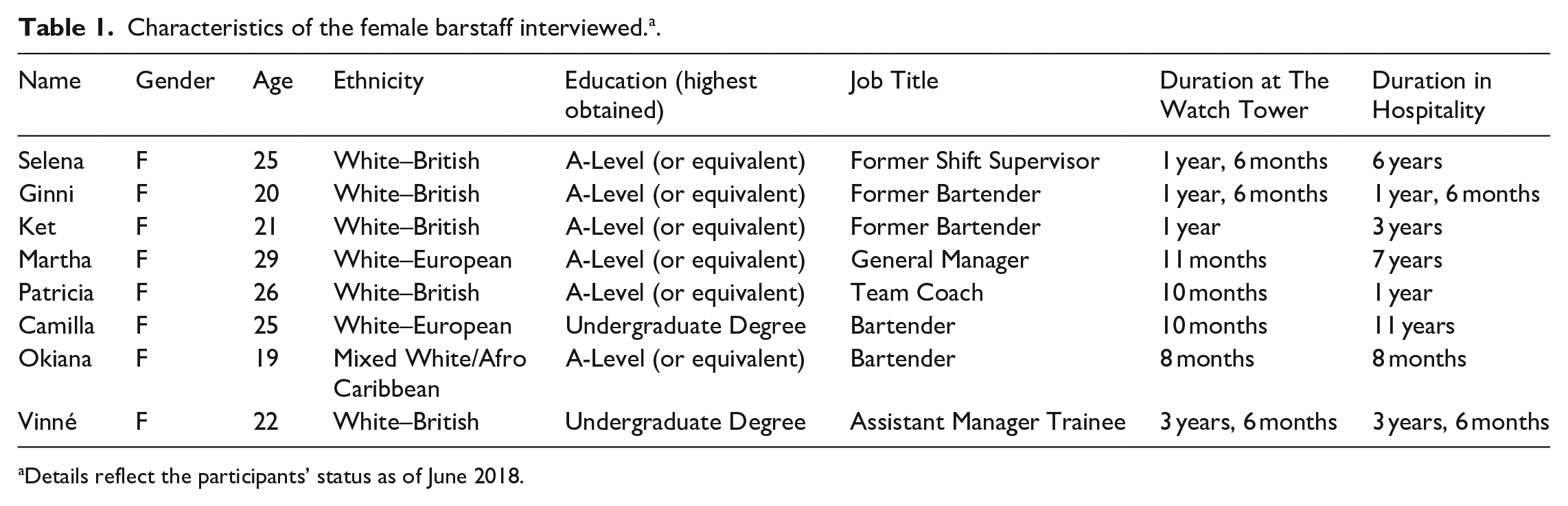
Details reflect the participants’ status as of June 2018.
The female bartender as a surface actor
Display rules and unwanted sexual attention
It has been argued that in this workplace realm ‘formal training in emotional labour is considered to be inappropriate’ (Seymour and Sandiford, 2005: 561) – but is it? How should a bartender display themselves while experiencing unwanted sexual attention from a customer? In The Watch Tower, there are a number of resources that the workforce can access to understand how to become a ‘professional bartender’, however, there is no mention in these documents that sexualised interactions will be present and thus no recommendations are provided (field notes). A new starter, upon joining the company, is provided with online training on how to behave when interacting with the public, which is supported by managerial observations and guidance. There are several stages to the online training which includes recommendations of being courteous, kind, and smiley for the public and, if any issues with customers, to report it to the managerial team (field notes). The knowledge on how to be a professional bartender (display rules), acts as a foundation when interacting with customers who conduct themselves in non-sexualised ways, however, it fails to provide support when encountering sexualised conversations or acts. Initially, those who are most affected by sexualised interactions initiated by customers are the barstaff who are unequipped with strategies – newly employed workers. Many of the participants admitted being naive (Green, 2021) when beginning work at The Watch Tower, as they were unaware on how to act during unwanted sexual encounters, as Patricia notes: . . . as I cleaned the glasses and turned and moved away one of them did slap my arse really hard and it was only my first week there . . . I wasn’t expecting it . . . I didn’t know if it was real . . . I wasn’t even comfortable in the pub yet . . . I didn’t know how much power I was allowed to use . . . Do I have to be professional in that situation or can I start screaming and swearing cuz they’ve touched me inappropriately? Because all boundaries have been blurred . . . I genuinely didn’t know what to do . . .
Throughout many of the interviews, the female participants detailed a sense of expectation, or fantasy (Gabriel, 1995), that many (male) customers wanted them to fulfil during service. The term I shall adopt for this is ‘expected display rules’. Throughout history there are numerous accounts of female bartenders (barmaids) being viewed as sexualised attractions for men due to the generic understanding of their physical presence being ‘bustled and breasted, a sexual lure’ and them wanting a ‘beautiful barmaid’ to provide them with alcohol (Kirkby, 1997: 167–168). There are also sexualised and derogative synonyms, like buxom, ‘strumpet’ (Patricia), and wench, that customers use(d) when formally addressing them for service (field notes; Kirkby, 1997). Depictions in history show that little has changed from the point of view of the female bartenders, with some male customers expecting sexualised interactions: when you’re serving someone, they get this idea in their head where you are the maiden or maid . . . fucking . . . if that’s what you’re into . . . keep it in the bedroom, though . . . It’s all about give and take, I don’t stare at my customers dicks at the bar . . . it’s unprofessional both ways . . . (Selena) Partly, I think, it’s some sort of weird fantasy. I think, they think . . . you’re serving them so they deserve to have this, sort of, interaction . . . (Vinné)
During the interviews, I questioned the barstaff on whether there was an expectation for them to flirt with customers. All participants advised that there was no expectation from management to perform flirtatious acts for monetary gain. Many would flirt with customers to instil an entertaining and relaxed atmosphere (sometimes instinctively for personal tips), although there were generally boundaries set to avoid blurring acceptable conversations and/or actions. However, in some scenarios, flirtation was used to combat unwanted sexual attention:
are there any expectations for you to flirt with customers?
I find that really blurry. . . I think sometimes yes in terms of. . . if you sense a situation is getting dodgy sometimes the only way to get out of it is to be, kinda like, ‘oh I can’t give you my number, I’m not allowed’ and it seems that, kinda of, peaceful way of getting out and it probably could be a bit. . . flirty.
In various circumstances, the expected display rules were often misinterpreted with the display rules recommended by the public house operators. As simple service scripts (e.g. smiling to acknowledge the customer) was noted to be misconstrued with personal forms of flirtation, as Vinné (feeling embarrassed) points out: I was just embarrassed, really, because I wasn’t . . . that’s the thing, I wasn’t giving them any attention, or like even really smiling. I was smiling politely at one of them, but that was because he handed me a glass . . . I think, it’s some sort of weird fantasy. I think, they think . . . you’re serving them, so they deserve to have this, sort of, interaction.
Building upon their knowledge of display rules and the fantasised expected display rules leads the female bartender to become a veteran in her field (Green, 2021). The sample uncovered subtle mechanisms of display to combat forms of unwanted sexual attention (Green, 2021; Gunby et al., 2020). Learning on the job proved pivotal in understanding the management of their displays which had been developed through, for example, previous knowledge, innate means, and discussions with colleagues. The scriptural displays adopted by the female bartenders included physical (e.g. straight faced) and verbal ignorance, and deferring tactics (e.g. flirtation) to the sexualised male patron, specifically when encountering common forms of unwanted sexual attention, as Ket (feeling disgusted) and Ginni (feeling uncomfortable) describe: . . . you don’t really know how to tell them to go away. So, it’s just, kinda like, I’m just going to wait for this to stop . . . its quite disgusting. You’re like eww. (Ket) Even though you want to say something you feel like, as if, no [laughs]. (Ginni)
Overall, display rules for female barstaff when receiving forms of unwanted sexual attention were learnt on the job and encompassed scripts which attempted to defer, disregard, and detach physically and verbally while experiencing various emotions internally. This would allow the bartender to still be perceived as professional by customers as some participant’s felt that ‘every time there is a service involved you have to be nice to your customers. . .otherwise you’ll just seem like you’re bad. . . at your job’ (Okiana). Implementing unwritten forms of scripted display when sexualised scenarios occurred allowed the bartender to internally create a guide on how to act during these episodes, which proved to be pivotal in taking back control of the undermining situation. Being professional in the bartending realm is not the same as being professional in, for example, a banking corporation. With acts of flirtation flourishing throughout the space, there is, for the female bartender, a need to professionalise this form of interaction and incorporate boundaries. While professionalising such acts, it can be used as a form of defence when interacting with expecting (male) customers as noted by Patricia earlier. There are some actions – infrequent (Green, 2021)–that could not be ignored, or brushed off, and resulted into breaking their (self-) learnt pacifying displays to respond with feistiness (Green, 2021; Gunby et al., 2020).
Breaking display rules, severing scripts
. . . I think a lot of it I kinda just take on the chin and just . . . unless it’s something really fucking shitty and horrible . . . (Martha)
With the barrage of unwanted sexual attention at work, many of the sample were continuously weighing up options by either suppressing or expressing their feelings as many felt ‘you’ve got to pick you battles’ (Camilla). When the battle was decided, the response(s) incorporated spontaneous (Ashforth and Humphrey, 1993; Korkman, 2015) forms of feisty femininity (due to the impulsive action of the perpetrator). The concept of ‘feisty femininity’ was initially created by Gunby et al. (2020) who suggested that female bargoers in the UK perform differently on a night out that ‘speaks back to unwanted attention’ (p. 18). In speaking back to unwanted sexual attention, female bargoers were documented as reacting with verbal overt responses (e.g. saying ‘fuck off’) or strategical retaliation (mimicking unwanted interactions and bestowing them onto the male perpetrator). I furthered this concept which enabled ‘feisty femininity’ to incorporate not only female bargoers, but also female bartenders, as their encounters with (male) customers and experiences in the night-time realm are similar. In addition, I added to the facets of retaliation which included physical and verbal conflict and the acquisitions of a dominant demeanour (see Green, 2021). Breaking self-imposed display rules, thus severing service scripts, usually encompassed combative strategies and forms of feistiness including physical and verbal retaliation (Green, 2021; Gunby et al., 2020). Typically, this was implemented by veteran bartenders as, for example, sexualised intrusion of the body had to be counteracted with impulsive opposition: . . . somebody . . . groped my bum. We were having a conversation and I walked away and he grabbed my arse, so I slapped him . . . (Martha) . . . I’m like ‘don’t touch me’. This is not, like, appropriate . . . (Camilla)
The generic guidance provided by the online training recommended bartenders to be professional while engaging with patrons, however, in circumstances that were unwanted and sexualised, breaking the recommended, and self-imposed, display rules were a must. This was not only to indicate to the perpetrator that the sexualised interactions were unwelcome, but also that harm had entered into the equation (Fileborn, 2017). When unwanted sexual attention did occur, and display rules were broken, the actions taken by the victim were usually supported by the general manager, the supervisors, and other members of staff. The need to implement and break display rules during unwanted encounters has the ability to emotionally impact the workforce which not only spills into their working hours but also life outside of work. Through the use of their emotional and feeling labour (Hochschild, 1983; Korkman, 2015), the above has detailed how female bartenders plan scripted, and deliver spontaneous, displays in face of unwanted sexual attention from customers and their sexualised expected display rules.
Emotional dissonance and burnout: the impact of receiving unwanted sexual attention at work
It is difficult for the female bartender to sustain impassive displays when the quantity of unwanted interaction is high. Emotional dissonance is, therefore, a consequence to the unwanted sexual attention received and the display rules put in place. Even though they retained feelings of, for example, disgust (e.g. Ket) and embarrassment (e.g. Vinné), the sample mostly implemented a straight faced, ignorant demeanour until the contact ceased. By definition, emotional dissonance ‘occurs when expressed emotions are in conformity with organizational norms, but clash with true feelings’ (Abraham, 1999: 18, emphasis added) – is unwanted sexual attention apart of The Watch Tower’s norms? The lack of recognition towards these interactions suggests that it is not for those who implement trainings (e.g. area managers, directors, head office staff), however, it persists regularly to front-line staff (Green, 2021). Thus, emotional dissonance experienced by the female bartender is not only conformity to organisational norms, but also conformity and rebellion to the expectations of customers that clash with true feelings and display. Camilla made a powerful statement on how daily sexualised staring impacts her emotions while on and off shift. This has led to her feeling forms of burnout (exhaustion and depersonalisation): . . . it alters the way I behave in the world; it haunts me like a vague presence which makes me feel always slightly on edge, always aware. Whilst sometimes it makes me defiant, sometimes, when I’m just too damn tired, it makes me want to shut down, cover up, not because I believe I should but just because when people look at you with that aggression it makes you feel so vulnerable . . .
Throughout the daily bombardment of unwanted sexual attention, the effects of receiving unsolicited acts at work do not only impact the female bartender during working hours, it also impedes on their life outside of work: . . . I’m really hypersensitive to it [customers staring] cuz, if you are, like, walking on the road here it’s also something that you have to notice that if someone keeps staring at you it’s, kinda, dangerous. . . because, what if they follow you home? . . . And, like, if guys are hitting on you, like, I was once drunk and alone on the street and some guys stopped in his car and was trying to get me to go in, and that’s already really, really scary. So, you become hypersensitive to guys trying to hit on you when you’re not interested [at the bar] because, it’s like, are you a predator? (Okiana)
The above findings show that the female bartender is a surface actor who implements a complex layer of display while at work. By incorporating surface acting into their daily lives, they deceive others (until they cannot) about what they really feel, but they do not deceive themselves (Hochschild, 1983). Ashforth and Humphrey (1993) argue that embracing emotional labour does not have to inherently require conscious effort, and that implementing surface (and deep acting) may be routine and require a small amount of energy. The above shows that there is rather a distinct amount of effort that is input beneath the surface of a female bartender experiencing unwanted sexual attention and the display rules implemented. There is also a constant negotiation of what to ‘let slide’ and what to combat which demonstrates a limit to the modes of deception. The concepts of display/feeling rules (Ashforth and Humphrey, 1993; Hochschild, 1983) are fundamentally actions that the serving social actor emits in the form of professionality, but this can only go so far, especially when sexual misconduct is taking place. During service, there is a visible imbalanced power dynamic between both the paying customer and the server which is usually separated by ‘the bar top divide’ (Green, 2021: 14) and the physical presence of barstaff, as Patricia notes ‘I’m drinking, my money is paying for her’ . . . it becomes a bit of a control thing, you know?’ By breaking display rules and speaking back to unwanted sexual attention, they are reminding the perpetrator that they are not only a mere serviceable object, but also a human with emotions.
Conclusion
This study has explored a niche topic of female bartenders’ use of emotional labour while working in a service industry and suffering unwanted sexual attention. It has enhanced the concept of display rules that incorporate a range of presentations while interacting with the sexualised public. The display rules recommended by the public house operators are basic, with most forms of display being learnt while performing job tasks and interacting with the public. They are generalisable and are only helpful in the most generic forms of conversation (e.g. ‘hi there, what can I get for you?’), hence why they are broken in sinister scenarios. Service, in a pub, is much more than a smile. People who frequent businesses in the night-time realm are complex. Unwanted sexual attention is not the only form of malpractice that is witnessed while working at a pub. There are other interactions that require differing forms of display rules to control and act professionally during other ominous situations, for example, hidden or exposed drug use, highly intoxicated individual(s), aggressive customers, and patrons falling unwell (e.g. collapsing, passing out). Further research is required to understand the bartenders’ intricate adoption of emotional labour while at work.
Unless there is a radical shift in some (male) customers’ expectations (combined with sensory experiences) of (female) bartenders’ performances and aesthetics (Warhurst and Nickson, 2009), unwanted sexual attention will undoubtedly be a part of the job for barstaff. An employee policy statement from The Watch Tower operators state that management at all levels have the responsibility to ensure the health, safety, and welfare of all employees while at work. If this is so, why do public house operators fail to inform newcomers and their current staff that unwanted sexual attention is present? And why are there no formal suggestions on how to combat or professionally deal with this? It could be proposed that mentioning the occurrences of unwanted sexual attention has the potential to deter prospective employees from entering the business. They could also be inundated with requests for substantial pay rises as the current benefits 2 provided undoubtedly outweigh the risk. However, without acknowledgement, providing safety procedures and coping strategies they are (potentially) putting their staff at risk of emotional and physical harm. I recommend for public house operators to include information that this type of phenomena exists while working, online training (see Green, 2021) on how to efficiently deal with sex-seeking customers (e.g. providing recommended display rules, talking to management/security staff), and offer contact details for counselling and/or law enforcement if needed. Management could/should begin to address unwanted sexual attention in the workplace by simply having a conversation with their staff. Brad (not real name, former general manager) advised that the interview process developed a desire to discuss the issue at his new place of work: ‘I think next time I will have a meeting, I will probably ask everyone how they deal with it, and whether they think we [management] are doing enough to cope with it’.
Among unwanted sexual attention, there should be mention of the other motive of frequenting licenced venues in the night-time economy – wanted sexual attention (Fileborn, 2016). Wanted sexual attention is not just a feature of the night (or day) for the customer, but also the bartender. Most of the participants detailed that during work they did experience positive forms of sexualised interactions with customers, as Camilla notes: . . . [some] people would flirt with me and erm . . . or I’ll flirt with them and it would be a respectful interaction and they’ll ask my name in, like, a polite way and if I do trust somebody, I will give it to them. I’m not, like, totally uptight about that [sexual attention at work].
Enjoying interactions that include flirtation is subjective, not all bartenders welcome such interactions with every customer, during every conversation or encounter. The tolerability equipped by the bartenders’ display rules is high, however, the daily barrage of unwanted sexual attention does question the level of respect some customers have for their server(s) when appropriateness during interactions is not met. Working in a pub is truly complex with incorporeal lines of acceptability scattered throughout a multiplicity of interactions seen within the space(s).
Footnotes
Acknowledgements
The author thanks the anonymous reviewers for their excellent feedback during the review process and for his mother.
Author’s note
The author whose name is listed above certifies that they have NO affiliations with or involvement in any organisation or entity with any financial interest (such as honoraria; educational grants; participation in speakers’ bureaus; membership, employment, consultancies, stock ownership, or other equity interest; and expert testimony or patent-licencing arrangements), or non-financial interest (such as personal or professional relationships, affiliations, knowledge, or beliefs) in the subject matter or materials discussed in this manuscript.
Funding
The author(s) received no financial support for the research, authorship, and/or publication of this article.
