




Abstract
‘Our Voices’ is an animation co-created with children aged 9–11 during the 2020–2021 global pandemic. A short, stop-start animation of children’s visual, audio and textual representations of their experiences offers a visceral account of the pandemic in England from their perspectives. In making available the animation in this inaugural issue of ‘Beyond the Text’, we have two key aims. The first is to enable children, who have been barely seen and little heard during the pandemic, to voice their experiences in accordance with their aspirations. The second is to reflect upon the process of transforming creative data made by and with children into an animation that is representative of children’s diverse experiences and acknowledges their contributions in ways which enable audiences to engage through ‘seeing’. Accordingly, our accompanying text explores how, through a feminist ethics of care, we sought to co-produce an animation with children which delivers key messages from them and acknowledges their role as co-researchers while maintaining their anonymity. In describing our methodological and ethical practices, we aspire to make visible the relational, dialogic processes inherent in co-production, offering viewers a way of seeing the complexity of children’s experiences through the multi-layered affordances of participatory animation.
Keywords
Introduction
‘Our Voices’ is an animation co-created with 16 children aged 9–11 during the 2020–2021 global pandemic. Foregrounding children’s visual and textual representations of their experiences, it responds directly to the critique that children have been seen but little heard during the pandemic (Spray and Hunleth, 2020). Developed by children, artists and academics during a series of online interviews and workshops throughout the first year of the pandemic, ‘Our Voices’ offers a dense, multi-layered treatment of the children’s visual, audio and textual representations of their experiences. An 8-minute scrap-book, stop-start style animation – its form is constitutive of the multimodal forms of knowledge generation that characterised children’s engagement – contributing, in accordance with children’s wishes, key messages for adults and other children about the ongoing pandemic and the impact of lockdowns, home-schooling and restrictions on children’s everyday lives at this time.
Children’s hand-drawn and digital portraits, audio-clips, speech bubbles, photographs and art work are presented as a sequence of chapters exemplifying key issues which children told us were important. ‘Our Relationships’ depicts both the opportunities and challenges of maintaining important, supportive relationships at home, school and with wider family and friends including online; ‘Our Learning’ represents the availability, and lack thereof, of material resources and IT including software and data, space to study and to store learning and art materials; ‘The Outdoors’ represents the children’s different access to green space in which to play and connect with other people, animals and nature and a final chapter which represents children’s views that their voices be included in policies designed to support their learning and well-being, maximise their capabilities and have control over their lives. The form of the animation embraces a wide range of methods, arts and digital media that the children worked with throughout the period of research (Lomax et al., 2022; Lomax and Smith, 2021), including samples of music created by them while unable to attend school in person, a comic strip to illustrate the challenges of returning to school after lockdown, photographs of learning to make a bird box, playing board games with grandma, and drawings of pets and other animals that children cared for during the pandemic.
A central feature of the animation is the inclusion of children’s self-portraits and audio-clips, through which children express directly the affective experiences of living through the pandemic. Anxiety, wonder, grief, shock, joy and sadness can be heard in children’s narrations of trouble sleeping, missing family and friends and the challenges of adjusting to home learning. These individual voices of children are overlaid with a central narrative which runs through each chapter to convey the collective experiences of the children we researched with. Voiced by two further children who were not part of the main sample (discussed later in this article), this central commentary was scripted by us, the academic researchers, from the narratives generated in interviews and workshops with the core sample of children. Working closely with the children and agreed with them during the editorial process, this meta-narrative communicates the diversity of children’s experiences and feelings. As can be heard, children experienced a shared wish to connect with others, to maintain their learning and to spend time outside. However, opportunities to do so were contingent on their diverse socioeconomic, material and familial circumstances. This meant that while some children enjoyed more time with members of their family (dads who could work at home or were furloughed), other children could not see some members of their families at all. And while some children were able to spend time growing flowers and vegetables and going on walks in green spaces, others had few such opportunities. While some children had help with home learning and access to IT, others did not have access to IT or the levels of support they needed. In making visible the range of children’s experiences through a carefully worded central narrative, images and text, the animation offers multiple ways of seeing and hearing from children in ways which do not attribute disadvantage to particular children or identify them.
In choosing to disseminate children’s experiences through an animation co-created with them, our research exemplifies and responds to ongoing debates within visual sociology, the sociology of childhood and wider social science about how to ensure that the voices and views of children are faithfully portrayed in research and its reporting. This is challenging on a number of levels. How can we be sure that, as adult researchers, we see and hear children’s experiences and viewpoints? There is ‘no clear window into the inner life of an individual. Any gaze is always filtered . . .’ (Denzin and Lincoln, 2000: 12). In childhood research, this filtering can include an ‘othering’ of children whereby children are vulnerable to representations that others impose on them (Nutbrown, 2011). This raises a number of questions for qualitative, arts-based researchers generating research outputs, wherein only a small selection of creative data can ever be included. First, how can we ensure that these selections are representative of the multiple contributions of child participants? Second, how can we reconcile decisions about what to include to ensure a coherent, aesthetically appealing artwork that will both engage viewers and is faithful to children’s intentions? And third, how can we ensure compliance with ethical regulation and guidance which stipulate that children are not identifiable in research outputs while acknowledging children’s contributions (British Educational Research Association (BERA), 2018)?
In this accompanying text to ‘Our Voices’, we consider these questions, exploring how, framed by a feminist ethics of care, we sought to ‘know well and know responsibly’ (Doucet and Mauthner, 2012). We consider how, throughout our creative research with children, we sought to balance our responsibilities to ‘know well’, producing an animation that recognises the multiplicity of children’s experiences, and ‘know responsibly’, reflecting on the process of transforming creative data made by and with children into an animation that acknowledges their contributions, delivers key messages from children and honours our ethical obligations to maintain children’s anonymity. Drawing on sequences from the animation, focusing on extracts of animated portraiture and sound to show how, within a feminist ethics of care (Tronto, 1994), it is possible to represent children’s diverse voices and acknowledge their contributions through the multimodal affordances of animation.
Representing children’s multiple perspectives through animation
This section of our accompanying text focuses on our decision to co-produce and animate children’s hand-drawn and digitally generated self-portraits. Our rationale was that this would both enable children to decide how they wanted to be represented and allow us to acknowledge their contributions without directly identifying them. Animated portraiture is a powerful multimodal medium through which to convey the complexities and nuances of children’s lived experiences in ways which can exceed written description. Working with the artists and children, we included short (a few seconds) segments of audio that had been digitally recorded with children during one-to-one image-elicitation interviews and art workshops. The addition of children’s voices in this way produces a rich, textured account which acknowledges a diversity of perspectives. This is illustrated with reference to the first substantive chapter of the animation in which ‘Gemma’s’ animated rabbit self-portrait
1
(Figure 1) voices her incredulity at Prime Minister Boris Johnson’s announcement that the UK would lock down on 26 March 2020. As Gemma articulates:
Well like . . . the first time that Boris Johnson said it I was I was like
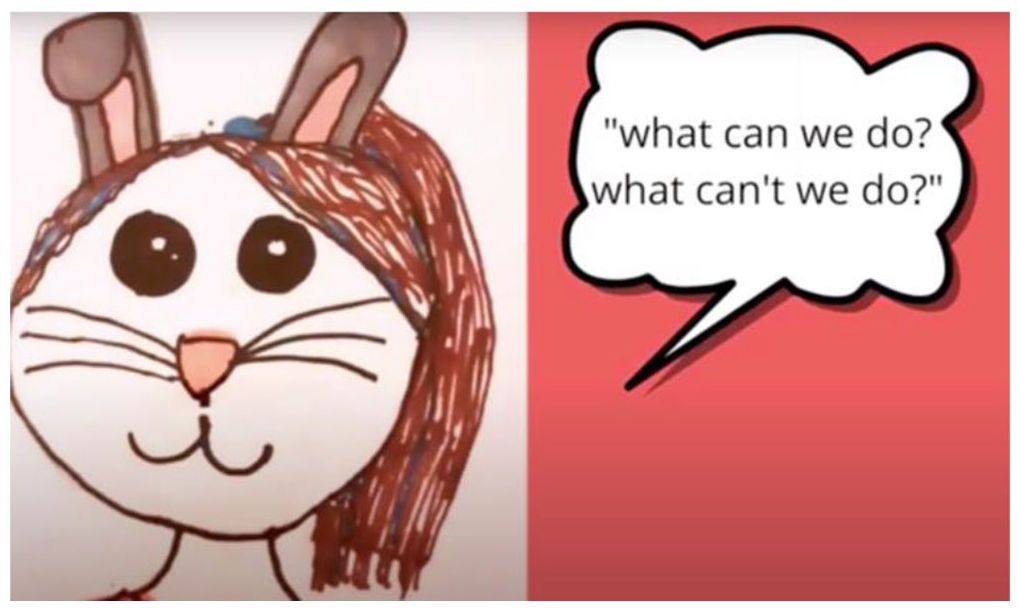
Gemma’s rabbit portrait created for the animation.
The humorous quizzicality, evident in the laughter which bubbles through her utterance, and her intonation at the first use of ‘
Positioning the children materially and semiotically as artists with control over their self-presentation (Thomson and Hall, 2008) enabled the generation of diverse compositional and aesthetic qualities in the portraits which the children told us were meaningful to them. One child drew a picture of themselves as a dragon (Figure 2), explaining that ‘. . . dragons, they’re my favourite . . . I chose a dragon because dragons are friendly and full of happiness’ (Aneka). Another child drew themselves as a shark, explaining ‘I will be a shark . . . because they’re very fast and they live in our country’ (Christoph). Portraits ranged from detailed representational pencil-sketches and ink-drawings as a football player (Carsen), as Harry Potter (Caleb), as an eclectic composite portrait (Oscar, Figure 3) or representations of themselves as a wide range of animals that had meaning for them. For example, a jellyfish from Daniel who had enjoyed jelly fishing the previous summer and a cat, reflecting Alicia’s fondness for cats. Portraits were generated during online art workshops with small groups of children and provided opportunities for them to work together (conferring together about colour and style), enabling children to control how they wanted to appear in the animation. For example, Owen, who chose to represent himself as a bee, drew an extra pair of wings so that his bee could fly through the animation, Aneka drew extra eyes to give life to her dragon-portrait and Alicia eschewed hand drawing to create an image of herself as meowing cat using a drawing application on her phone.
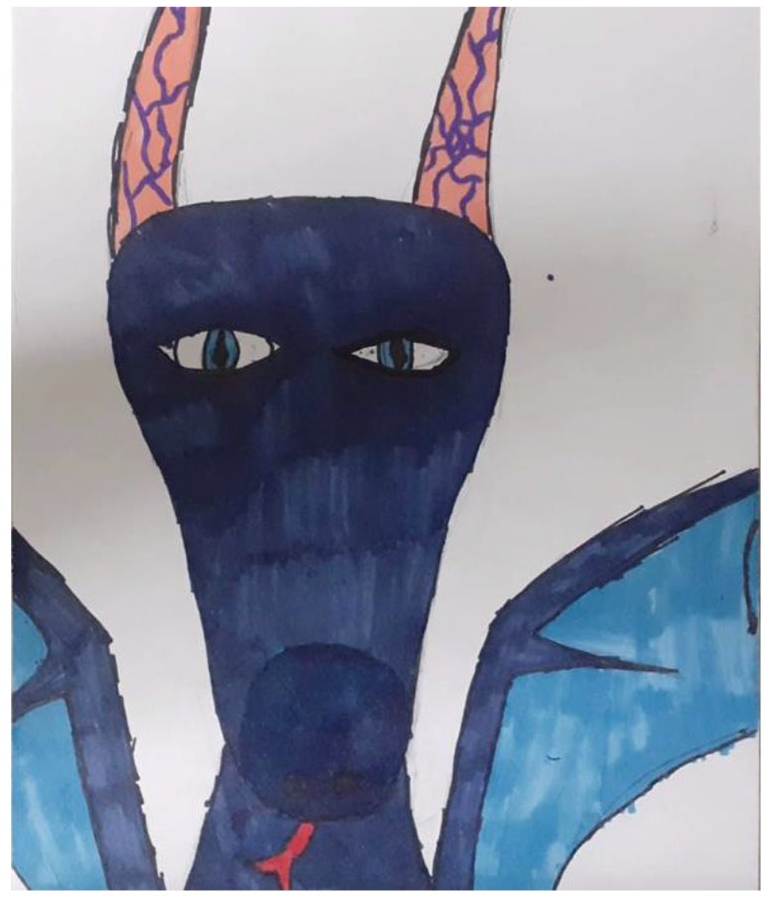
Aneka’s dragon portrait created for the animation.
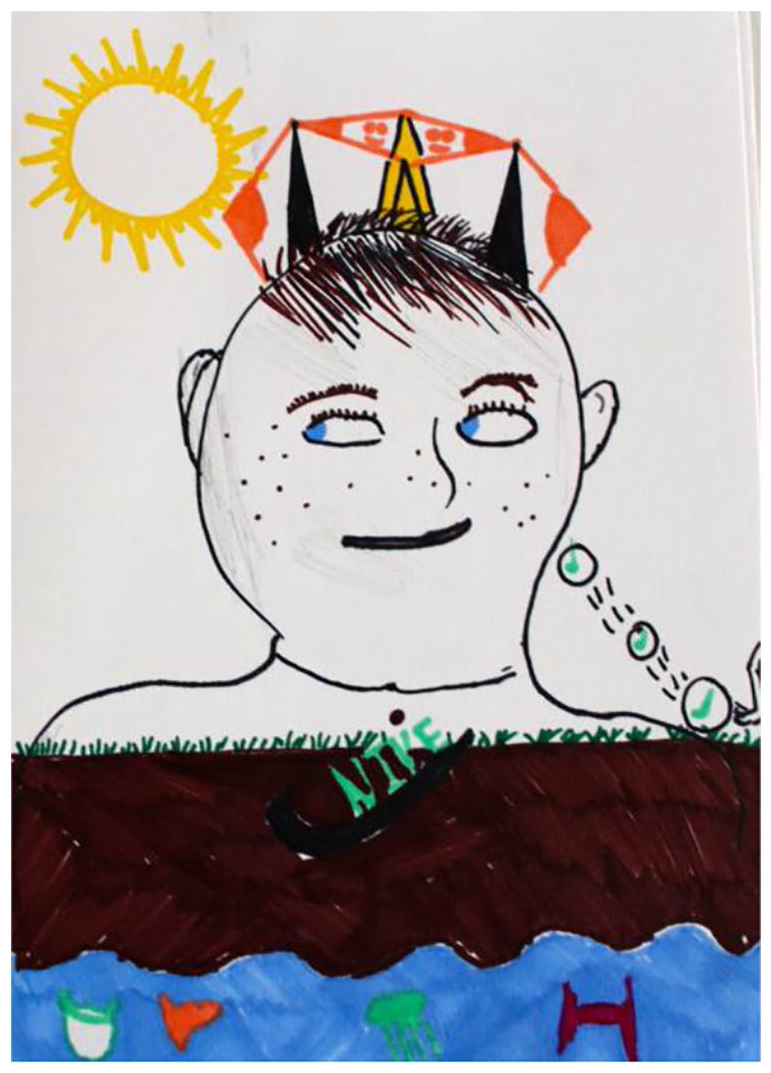
Oscar’s eclectic composite portrait created for the animation.
Careful selection of how and when the portraits were used ensured that every child’s portrait appeared at least once in the animation to share an experience or deliver a key message from them about life during the pandemic. For example, in the chapter ‘Our Learning’, Alicia’s cat describes how her (Alicia’s) laptop had stopped working, ‘it doesn’t come on’, while Jemma’s portrait (Jemma with monkey in the chapter, ‘Our Learning’) draws on her explanation of how mum and dad sat with her to ‘talk me through’ schoolwork during lockdown. Through these carefully animated portraits, viewers are offered insights into children’s experiences that capture the distinct ways that individual children experienced life during lockdown.
Sound files of children’s voices, speech bubbles, moving eyes, mouths and visual features bring to life each child’s portrait to create an aesthetically engaging, energetic animation which reflects the diversity of the children and the nuance of their experiences. Moreover, in facilitating children’s visibility in the research, self-portraits preserve the children’s anonymity in ways that photographs or video would not have achieved, enabling us to address long-standing challenges in visual sociology and the sociology of childhood about how to acknowledge children’s contributions without identifying them (Wiles et al., 2012)
Discussion and concluding remarks
Our intention is that ’Our Voices’ offers an opportunity for children’s experiences of the pandemic to be chronicled and shared. However, centring the experiences of children through a digital animation for dissemination places responsibilities on us as researchers to honour our commitment to foregrounding children’s perspectives in the research alongside our ethical responsibilities to know responsibly (Doucet and Mauthner, 2012). As Roy et al. (2021) argue, ‘film-makers and research team members must question how stories are being told and by whom as well as considering how some connection might be made between those stories and potentially resistant third publics’ (p. 14). As such we faced a number of ethical tensions as we sought to acknowledge child participants as knowledge-producers, with rights to be seen and heard, without being subject to potential harms that may emerge now or in the future due to censure or the revelation of identity (Fink and Lomax, 2016). Therefore, we argue not just for children’s rights as participants in research (United Nations, 1989) but for a feminist ethics of care to be brought to bear on this process.
The use of children’s creative artwork, portraiture and audio in the animation is not meant to provide definitive or conclusive statements about children’s perspectives, but enabled the children to ‘speak’ and be heard while also serving to challenge the marginalisation of children owing to their status as partial citizens dependent on adults to advocate for them (Cohen, 2005). While the overall animation is narrated by child actors to preserve the anonymity of the child participants, the script was derived from their multiple voices generated through the course of the research. In addition, we included extracts of children’s actual voices alongside children’s drawn portraits to make visible the diverse, multidimensional perspectives of children in order to ensure that ‘Our Voices’ should not be reduced to a singular, unified voice. Including multiple children’s voices in this way highlights ‘the polyvocal and multiple nature of voice within contexts that are themselves messy and constrained’ (Mazzei and Jackson, 2012: 746). While centring on children’s voice was inevitably limited by our ability to ever fully comprehend another person’s perspective (Spyrou, 2016), the children’s audio, images and texts selected (and agreed with them), offer a multi-layered account of the manifold and complex discursive formations of children’s experiences during the pandemic. In summary, our aim, in making available the animation in ‘Beyond the Text’, is to enable audiences to engage directly with children’s voices; to hear, through ‘seeing’ (Rutanen et al., 2021); but in ways which do not reduce children’s experiences to a single story. Instead, we suggest that the multimodal visual, textual and auditory affordances of ‘Our Voices’ offer a way of hearing children which makes visible the complexity of children’s experiences at this time.
Footnotes
Acknowledgements
The authors thank the children who researched with them, sharing their stories about the impact of the pandemic on their lives. The authors also thank the teachers and parents who supported the research at this time. The authors also thank the artists – Belinda Walsh ( ), Anna Zelasko (
Funding
The authors disclosed receipt of the following financial support for the research, authorship, and/or publication of this article: Funding for this project ‘Corona Chronicles: Children researching their everyday lives during the Coronavirus pandemic’ (CHEER) was supported by a grant from the Huddersfield Centre for Research in Education and Society (HudCRES) and by a contribution towards artists costs by the participating schools. These are not named to ensure the anonymity of the participating children. The British Academy has since funded ‘Back Chat: Developing arts-based methods of knowledge generation and exchange with children during times of global crisis’ (SRG2021\211308) to support our continuing longitudinal qualitative research with these children through the ongoing pandemic and its aftermath.