




Abstract
In recent years, many households have shifted from employing a full-time or part-time domestic worker to using an outsourced domestic cleaning services company that specialises in professional household cleaning services. Few studies have focused on outsourced domestic cleaning services from clients’ perspectives. While there is limited research on the topic, a possible reason for the increase in outsourced domestic cleaning services might be that the domestic labour needs of the middle-class are changing. The decline in the stigma of voluntary childlessness and better educational and career opportunities for women have impacted household compositions. There has been a rise in one-person households and couples without children. These changes affect how domestic work is approached. Some women continue to perform domestic labour themselves, while others employ domestic workers or use outsourced domestic cleaning services. Against this background, this study sought to establish how changes in household compositions are linked to peoples’ preferences to use outsourced domestic cleaning services to take care of their domestic cleaning needs rather than employing a domestic worker on a full-time or part-time basis. This study draws on 18 qualitative interviews with clients of domestic cleaning services and shows that people who live alone, as a childless couple or in an empty-nest household, use outsourced domestic cleaning services for their convenience, efficiency, and flexibility. Couples with children tend to rely on personal help when it comes to care work but outsource less emotional domestic duties to domestic cleaning service companies. This study contributes to new insights by showing that domestic cleaning services are used by households who can afford and require flexible cleaning services offered by outsourced domestic cleaning services.
Introduction
Paid domestic work, which refers to the performance of household cleaning or care labour for some form of remuneration, is a global phenomenon, with roughly 100 million domestic workers being employed worldwide. It is estimated that 80% of domestic workers are women, of whom nearly one in every five are migrants (International Labour Office (ILO), 2018). A domestic worker is considered any person who engages in domestic work (e.g. cleaning, cooking, or care work) within a bipartite employment relationship with an employer (Estevez-Abe and Hobson, 2015: 133). Employers either employ domestic workers on a live-in basis, where domestic workers live on the employer’s premises or inside their households, or on a live-out basis, where domestic workers work for a family full-time or part-time but return to their homes at the end of the workday (Hondagneu-Sotelo, 2007: 28). In South Africa, domestic workers’ full-time and part-time employment were particularly prominent during the apartheid era (until 1994). Although it is still widespread in South Africa today, and in other countries, domestic work duties can now be procured from outsourced domestic cleaning service companies rather than managed in-house or by employing a domestic worker (Ally, 2010; Du Toit and Heinecken, 2021: 1150).
In North America and Western Europe, outsourced domestic cleaning service companies are bureaucratised firms, where domestic employees are employed on fixed-term contracts by the management or franchise owners (Abrantes, 2014; Devetter and Rousseau, 2009; Safuta and Camargo, 2019). There is a shift from a bipartite employment relationship between employers and domestic workers to a tripartite employment relationship between clients (households who use these services), domestic employees, and managers or franchise owners. The managers have the authority to control what duties are performed, how, and when (Hondagneu-Sotelo, 2007: 164; Safuta and Camargo, 2019: 58).
Similarly, in South Africa, domestic cleaning service companies are widespread in metropolitan areas. The Contract Cleaning Industry estimates that there are approximately 1500 domestic cleaning service companies in South Africa, and approximately 100,000 domestic employees are employed by these companies (Huysamen, 2019: 4–5; Servest, 2020). South African labour statistics reveal that approximately one million, mostly black South African or migrant African women from poor backgrounds, are employed as domestic workers either full-time, part-time, or fixed-term (Ally, 2010: 37; StatsSA, 2019). Many black women employed as domestic workers have low education levels, with many having limited secondary school education. Despite formalisation, the average working hours for domestic workers is 35 hours per week, with median monthly earnings of R1900 (USD130). Less than 1% of domestic workers are members of trade unions (StatsSA, 2019). In this way, the legacy of apartheid continues, where many poor black women are steered into low paid and precarious jobs such as domestic work (Ally, 2010: 54).
Scholarly research on domestic work underscores that the personalisation, which results in the longevity of employment relationships in paid domestic work, is often a key component of this type of work (Hondagneu-Sotelo, 2007) and that it does not disappear with formalisation (Jokela, 2018; Richard-Guay, 2016). Similarly, South African research mainly focuses on the working conditions, employment relations between employers and domestic workers, and the legislation’s impact on paid domestic work (Ally, 2010). For example, Cock’s (1980) seminal book, ‘Maids and Madams’, illustrated that among other issues, the long-term relationship between domestic workers and employers during apartheid was characterised by inequality, dependency, and exploitation. This relationship seems to be on the decline with the rise in domestic cleaning services, where domestic labour can be outsourced on a short-term and hourly basis.
However, it is not clear why there is a need for outsourced domestic cleaning services? One possible reason may be that in large parts of the Western world, including in South Africa, the number of women entering the workplace and the changes in working contracts and arrangements have had a marked effect on family structures and household compositions (Hall and Mokomane, 2018: 32; Stinnett et al., 2017: 69). In addition, fertility and mortality rates and societal values have also affected family and household sizes, composition, dynamics, roles, and shapes. These changes affect domestic labour and the need for outside domestic help in different ways (Button et al., 2018: 602; Hall and Richter, 2018: 26). For example, a one-person household has fewer domestic and laundry tasks than a nuclear family with young children present. Outsourced domestic cleaning services that render short-term but specialised cleaning services are perhaps more sought after by a small household than a larger family that need more regular and full-time domestic and care help.
Against this background, this article’s primary research question is: how do people’s household compositions and domestic labour needs affect their decisions to use outsourced housecleaning services? Apart from international studies by Triandafyllidou and Marchetti (2013) and Lan (2006), few studies have explored domestic cleaning services from a client’s perspective. While these studies provide a useful discussion on domestic cleaning services, they focus on the European and Asian contexts which are different from South Africa. By making clients the object of analysis, rather than domestic workers, this study contributes to the debate on paid domestic work in South Africa, where paid domestic work is available and affordable (Ally, 2010). Therefore, this study contributes to new insights into domestic work and outsourcing debates within South Africa and how changes in middle-class household structures could drive the need for outsourced domestic cleaning services.
Accordingly, this article is structured as follows: The first section discusses the characteristics of domestic cleaning services, followed by a discussion on different household compositions that affect domestic labour. Next, the methodology and findings and reasons for using domestic cleaning services in South Africa are presented.
Domestic work and outsourced domestic cleaning services
Almost all working-aged people perform unpaid domestic labour duties such as cleaning, cooking, and laundry tasks. However, women undertake the bulk of domestic labour (ILO, 2018: 3). Where unpaid domestic labour remains primarily divided by gender, paid domestic work is typically gendered, racialised, and performed by working-class women. In many countries, including South Africa, privileged households typically shift their domestic labour responsibilities onto other women of colour from marginalised or migrant backgrounds for remuneration (Ehrenreich, 2006: 513; Hondagneu-Sotelo, 2007: 7).
Domestic workers are commonly employed directly by employers on a full-time or part-time basis. Despite formalisation, the nature of full-time and part-time domestic work is characteristically personal and unequal between employers and domestic workers. They often know the details of each other’s lives, but employers have the power to support or withdraw support when they please. For example, employers provide gifts, kindness, and care to elicit harder work and favours from domestic workers. The dependency is important but a tension-filled part of the employment relationship (Hondagneu-Sotelo, 2007: 43).
In South Africa, direct full-time and part-time employment of domestic workers was widespread during the apartheid era (until 1994), where policies and restrictions enabled white households to employ black women as domestic workers under exploitative, informal conditions (Ally, 2010: 45–47). However, in post-apartheid South Africa, paid domestic work has been formalised. Employment contracts are mandatory, working hours and wages are regulated, and service benefits are stipulated by the Basic Conditions of Employment Act and the Sectoral Determination Seven. How these regulations are followed remains debatable as many domestic workers are still employed informally without contracts.
However, there has been an unclarified decline in the employment of full-time and part-time domestic workers in South Africa (Alexander, 2013: 1). The increase in personal taxes perhaps affects the need to cut expenses, including the direct employment of domestic workers. Maybe the middle class’s cleaning and caring needs are changing with the rise in smaller households and the delay in marriage and childbirth, reducing the need for regular domestic help.
Simultaneously, the rise in outsourced domestic cleaning services has raised new questions concerning why people may use them instead of directly employing a domestic worker. Research shows that there are several reasons why outsourced domestic cleaning services are sought after by some people. Outsourcing cleaning and laundering duties to domestic cleaning companies free up time for clients to spend on essential activities, such as income-generating work, family responsibilities, and leisure (Devetter, 2015: 365; Du Toit and Heinecken, 2021: 1156). Outsourced domestic cleaning services can be procured on a flexible ad hoc or regular basis, depending on clients’ needs. Clients with unpredictable schedules are perhaps more likely to opt for outsourced domestic cleaning services that offer flexibility to meet their demands (Souralova, 2015: 151).
Domestic cleaning services are also known for their specialisation and service quality. Some domestic cleaning services offer clients a choice between different cleaning deals at different prices (Souralova and Jelinek, 2018: 56). Most domestic cleaning companies train their domestic employees to practice Health and Safety regulations and hygiene procedures to avoid cross-contamination between homes and increase client satisfaction (Fudge and Hobden, 2018: 3). Clients can evaluate services, improving service quality (Abasabanye et al., 2016: 3).
By using a domestic cleaning service company, clients are also offered contractual flexibility. In South Africa, employers of domestic workers must adhere to the Basic Conditions of Employment Act (BCEA) and the Sectoral Determination Seven (SD7) in terms of stipulated wages, working hours, paid leave, and unemployment insurance funds (UIF). In the event of dismissal, employers need to comply with the law and, if disputed, can be taken to the Commission for Conciliation, Mediation and Arbitration (CCMA) for conciliation or by the Labour Court (Matjeke et al., 2012: 3). Hiring a domestic cleaning service company negates the need to deal with labour disputes or responsibilities (Du Toit and Heinecken, 2021: 1156).
There are other benefits for domestic employees too. Domestic cleaning service companies often have financial incentives and encourage teamwork to increase loyalty and commitment. Some colleagues develop friendships and support each other, making isolation and exploitation perhaps less prevalent (Du Toit, 2013: 108). Domestic employees are also trained in cleaning and ironing techniques to increase their employability beyond the domestic cleaning service firm (Abasabanye et al., 2016: 5; Ehrenreich, 2006). There is an added advantage of a promotion, such as becoming a team leader or supervisor, which comes with extra benefits and responsibilities. However, these strategies are not uniform and require a personal commitment by management, depending on their experience and expertise in human relations (Camargo, 2015: 145–147).
However, outsourced domestic cleaning services may not work for everyone, especially in South Africa, where affordable full-time and part-time domestic workers are available (Ally, 2010). First, outsourced domestic cleaning service companies may be more expensive than domestic workers on a full-time or part-time basis. For example, the minimum wages stipulations for contracted domestic employees range from R21.77 to R23.87 per hour (roughly USD1.60–USD1.75) depending on the location in the country (Van Deventer, 2021). However, clients pay between R350 and R700 (approximately USD25–USD50) per session lasting approximately 3 hours (WageIndicator, 2021). Second, some clients may find the impersonal employment relationship with domestic workers awkward. The management of domestic cleaning service companies instructs domestic employees and clients to keep interaction to the minimum (Camargo, 2015: 143). Third, some clients may find it challenging to withhold financial and emotional care for domestic employees from poor backgrounds. Fourth, some domestic cleaning service companies are strict with time for each session and duties included and excluded in the service deal (Devetter and Lefebvre, 2015: 168). Finally, the impact of Covid-19 may also impact some households who may be uncomfortable hiring outside domestic help and may rather do their domestic duties themselves (Perez and Gandolfi, 2020).
Despite the potential adverse effects of using domestic cleaning service companies, it is not clear who are using domestic cleaning services and for what reasons. One way to look at this is to explore how the middle-class households’ cleaning and caring needs are changing with the growth in smaller households and the rise in single-person households and households without children or other dependents. This may reduce the need for full-time domestic help and perhaps a demand for greater flexibility and domestic work specialisation.
Household compositions and domestic labour
Within a South African context, the term household refers to ‘an arrangement of co-residence with shared consumption and production, even though household members may not be co-resident all the time’ (Hall and Mokomane, 2018: 32). Four main types of middle-class households are discussed as they form the focus of this research: One-person households, young couples without children, empty-nest couples, and couples with young children.
The first type of household is a one-person household, which refers to an individual living by himself/herself in a dwelling temporarily or permanently. In South Africa, approximately 22% of people live in a one-person household, although class and race differences exist (Hall and Mokomane, 2018: 34). The growth in one-person households is linked to the notion that many middle-class women are now less financially dependent on men due to the rise in education and career developments (Stinnett et al., 2017: 69). Regarding domestic labour, one-person households may have fewer cleaning and laundering tasks than households with children and may outsource these duties to domestic cleaning service companies when needed, if they can afford it.
The second type of household is couples who do not have children. There is a rise in married or cohabiting couples without children among the middle-class in the western world. In South Africa, in 2017, 10% of couples did not have children (Hall and Mokomane, 2018: 34). The decline in the stigma of voluntary childlessness and women embarking on careers for self-fulfilment and financial independence cause a delay in couples having children or couples’ decision to remain childless (Jaga et al., 2018: 431). Hence, employed women or dual-earning couples, who work long, unpredictable hours in demanding jobs may experience work–life conflict, where the boundaries between work and household responsibilities are permeable and blurred (Boswell and Olson-Buchanan, 2008: 593). This could facilitate the need for outsourced domestic help to solve the household’s domestic labour demands temporarily.
The third type of household consists of empty-nest households, which refers to couples whose children no longer reside with them (Bougea et al., 2019: 330). Once children leave, cleaning, cooking, and laundering tasks are cut, impacting the need for outside domestic help. Perhaps a domestic cleaning service as a short-term solution is sought after until domestic and care demands change (McGoldrick and Shibusawa, 2012: 392).
Finally, another household type is couples with children under 25 years (OECD family database, 2011: 1). In South Africa, in 2017, 19% of households consisted of a couple and children only, a trend that is most notable among white middle-class households in South Africa (Hall and Mokomane, 2018: 34). The presence of children in the household adds to the household’s domestic and care labour. Households who can afford outside domestic and care help may pay others to take these responsibilities. Whether they seek outsourced domestic cleaning services is not clear? Thus, different households have domestic cleaning needs that may be periodically solved by hiring outsourced domestic cleaning services. Therefore, this study focuses on clients’ perspectives and how their household composition and domestic labour needs affect their decisions to use housecleaning services.
Methodology
Research approach and case selection
The study is situated within the qualitative research paradigm to understand people’s experiences and views using domestic cleaning services. It allows for context-specific in-depth views of a subject, which seems appropriate for this study. Three domestic cleaning service companies were selected that render similar cleaning services in middle-class suburbs in two provinces, namely Gauteng and the Western Cape.
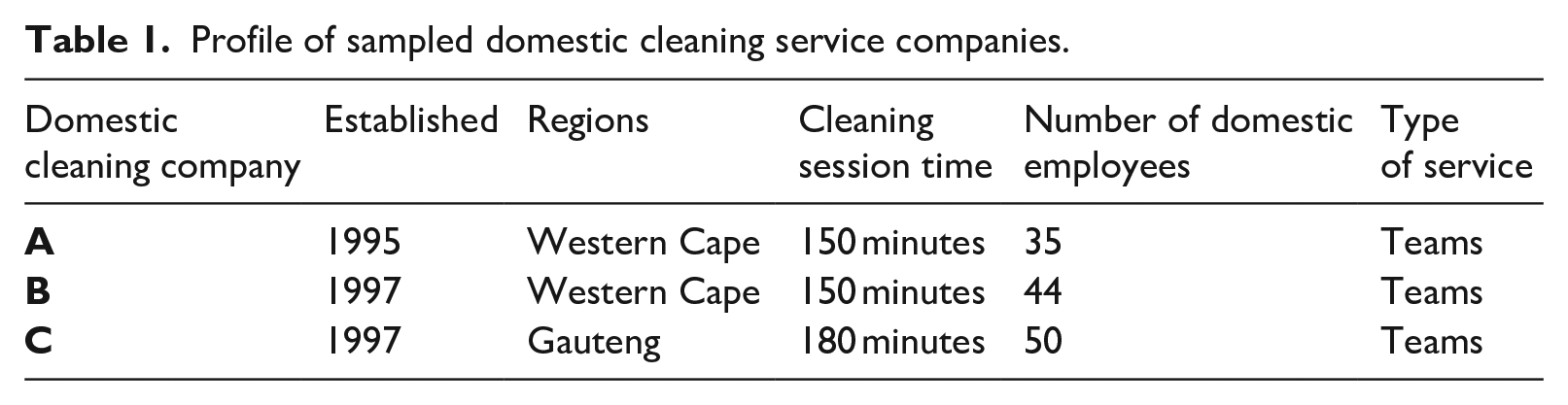
This selection was informed by four main criteria: The type of domestic cleaning services, how long they have been in business, who their clientele is and how cleaning services are rendered. First, all three domestic cleaning service companies specialise in general household cleaning duties: sweeping, mopping, vacuuming, dusting, tidying rooms, washing dishes, organising cupboards, and doing laundry tasks. Second, all three selected domestic cleaning service companies have provided household cleaning services since the 1990s, indicating successful and long-term experience in the service market (Table 1). Third, all three domestic cleaning service companies have a predominantly white middle-class household clientele, while their domestic cleaning staff are predominantly black South African or Zimbabwean women employed on fixed-term contracts. Finally, all three domestic cleaning services companies render cleaning in teams, where cleaning tasks are divided among the team members. For example, one domestic employee cleans the bathrooms and tidy up the bedrooms, another domestic employee is responsible for sweeping, vacuuming, and ironing, while the third cleans the kitchen and lounge areas. The division of tasks is important and must be done fast and effectively, given that a cleaning session generally lasts 3 hours per client.
Profile of sampled domestic cleaning service companies.
Data collection and data analysis
Since interviews with domestic employees or managers of domestic cleaning services were not conducted, the study aimed not to capture the outsourcing of domestic work from their perspectives. Instead, the views from selected clients were focused on understanding why they use domestic cleaning services and how their household compositions and needs contribute to their decision to use outsourced domestic cleaning services. Therefore, this study’s findings are limited and interpreted from one perspective only.
Eighteen semi-structured in-depth face-to-face interviews with clients who reside in different household types were conducted. Participants were selected with the help of managers to reduce the violation of private information sharing (e.g. contact information) with a third party. Interviews were conducted in participants’ homes or coffee shops at a convenient time, lasted about 60 minutes and were voiced recorded.
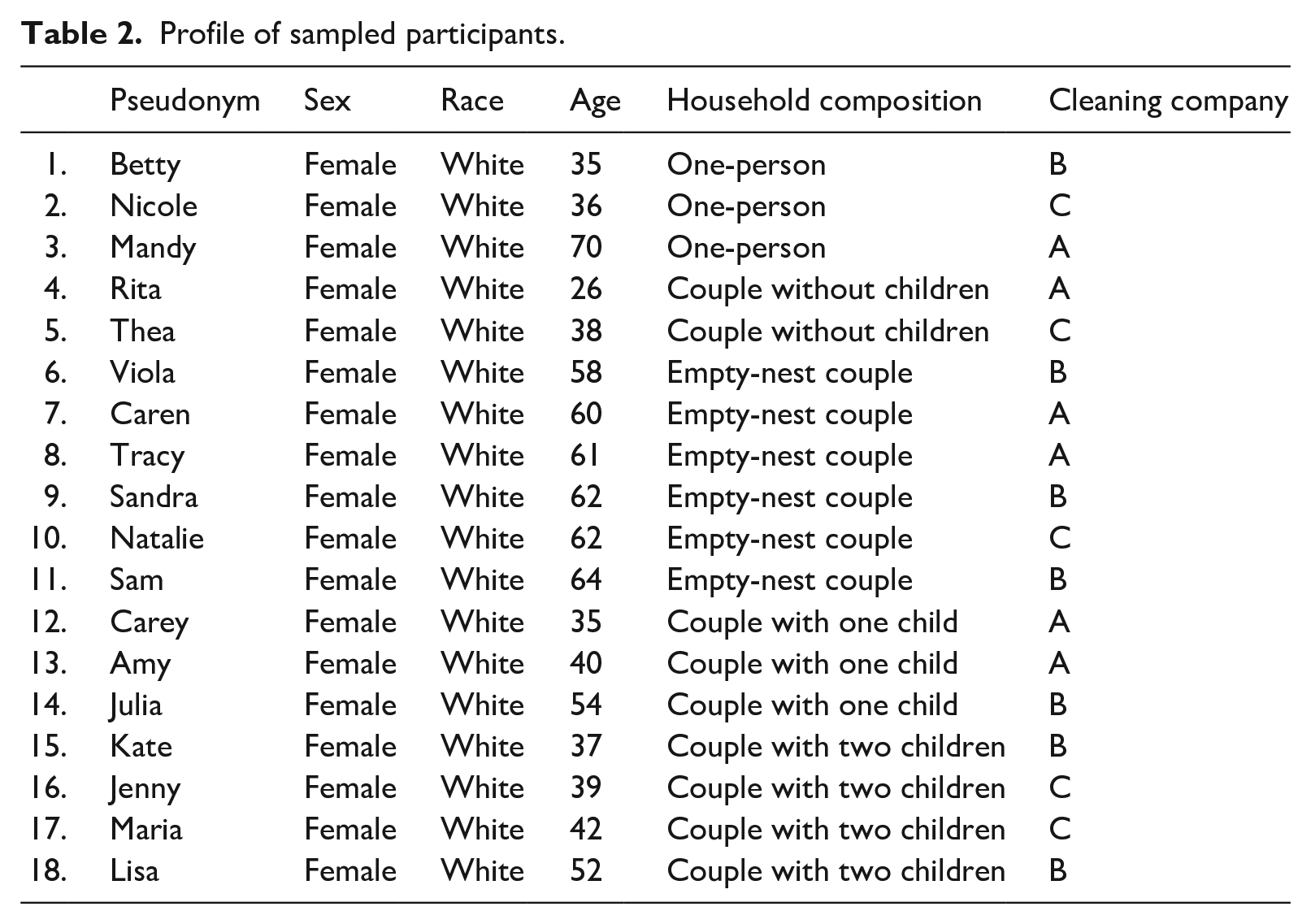
Regarding interviewee participants’ profiles, all were women and white South Africans, which typically reflects the historical pattern of employers of domestic workers in South Africa (Ally, 2010). The average age of the participants was 50 years. There is also a mix of employed individuals, homemakers, and retirees, but these categories are not clear-cut (Table 2).
Profile of sampled participants.
The analysis commenced with the verbatim transcripts of the interviews and uploaded into Atlas.ti, a computer-aided qualitative data analysis software programme. Semi-structured interviews allowed for codes to be developed, where phrases were highlighted with several code names. Hereafter, codes were revised and combined to create themes and sub-themes. Although the analysis is based on all 18 interviews’ narratives, key ones were selected to illustrate and validate arguments.
Ethics and positionality
Concerning ethics, a consent letter was signed before the interview. This letter gave the participant information about the study’s nature and purpose and the underlying ethical considerations. Any information obtained in connection with this study was confidential and was not discussed with the managers who gave access to their clients. Pseudonyms have been used to protect the identification of both clients and domestic cleaning service companies. Participation was voluntary, and participants could refuse to answer questions they felt uncomfortable with and could stop the interview at any time if they wished to do so.
I acknowledge that my positionality has the potential to influence this research and its processes. As a white male middle-class and middle-aged South African, my identity played a role in gaining access to white middle-class female participants from different ages to conduct interviews with. Access to participants was done with the help of the managers of the selected domestic cleaning service companies who called participants on my behalf, and appointments with participants were made with their consent. During these calls, I overheard the manager say to some participants that I was a trustworthy and friendly gentleman and had nothing to worry about. The gender differences between myself and the participants seem to matter less than race characteristics. In South Africa, where some people are still uncomfortable with different races and class groups, access to participants might have been more challenging, especially considering that many of these interviews were conducted in the private homes of participants. Reflecting on the interview process, none of the participants expressed any visible discomfort during the interviews. The reassurance of confidentiality might also have helped participants share their stories and disclose experiences openly, and they realised that their contributions to this study were beneficial.
Second, I have never formally employed a domestic worker or used a domestic cleaning service company, which have likely influenced the questions I initially asked during the interviews and the interpretations. To overcome these potential biases, I relied on several key studies (Ally, 2010; Devetter, 2015; Souralova and Jelinek, 2018) and conversations with people who employed domestic workers formally (or informally) and who had used domestic cleaning services to develop the interview guide. Questions were refined before the start of the data collection phase. I constantly reflected on my positionality throughout the study regarding interpreting the data to eliminate any potential biases and guard against influencing the study. After the first few interviews, I listened to the recordings and transcribed the interviews. Once the interviews were transcribed, I read them several times to develop preliminary codes and themes and rework some of the interview questions. This reflection process helped me to acknowledge potential biases during the interviews.
Findings
Interviews with people who live alone revealed that although they do not have many domestic and cleaning duties, they use domestic cleaning services to do a thorough cleaning once in a while. Mandy (Female-White-70 years), who lives alone after her husband passed away, said, I live alone and clean my home myself. There is not a lot of cleaning or ironing, but I need someone to help me sometimes. I have decided to use a domestic cleaning company now and again. They do the cleaning and ironing, and that is enough.
Using domestic cleaning services is a useful short-term solution for people whose households have become smaller with the departure of children or a spouse, and the need for regular domestic help declines with decreasing household size. For Mandy, using a domestic cleaning service company suits her domestic cleaning needs until they change again. Similarly, Nicole (Female-White-36 years), who is employed and lives by herself, said, I like the idea of just treating myself to a cleaning and ironing service every so often, as I usually do everything myself. My job is quite taxing, so I see it as a treat to have my home cleaned, then I can take Saturday mornings off from cleaning!
It appears from these two statements above that although Mandy and Nicole can do their own cleaning and laundry tasks, they prefer using domestic cleaning services when they need extra help as a short-term practical solution. Another single client, Betty (Female-White-35 years), said she travels a lot for work and needs flexible domestic help. As she mentioned, ‘The contract with the domestic cleaning service is simple. I book, pay electronically, and the team arrives and leaves when done. There are no other commitments’.
Employed couples without children seem to use domestic cleaning services when they do not have time for domestic labour. Rita (Female-White-26 years), who lives with her partner, said, We are really busy. We have a lot of deadlines. Although we mostly clean our home ourselves, we use the company for two reasons. First, when we don’t have time, it is convenient to call a company. Second, we work on our projects from home, and we don’t want to be disturbed. There is nothing worse than the noise from a vacuum cleaner. A team comes in and cleans quickly.
Domestic cleaning services also render quick and efficient services for people who value privacy and convenience. Both Rita and her partner are full-time postgraduate students who use domestic cleaning services when they do not have time to clean their dwellings. Another childless client, Thea (Female-White-38 years), who lives with her husband, said their job responsibilities interfere with domestic work time. Using an outsourced domestic cleaning service company is, therefore, a necessity: I am a full-time academic, and so is my husband. I need someone to clean, even if it is just once a week. The team cleans my house so that I can work more. It is getting worse and worse. I work a lot and over weekends. How do you fit in the cleaning?
Domestic cleaning services enable a better work–life balance for employed clients, regardless of living alone or as a dual-earning couple. Work and family roles require time, energy and commitment, and time pressures and unpredictable demands from work and family increase stress and conflict (Kulik, 2019: 271). Domestic cleaning services are used to relieve the domestic labour duties of people with work responsibilities.
For empty-nest couples, domestic and care responsibilities, such as transport duties, cooking family meals, or attending children’s sports events, are cut once their children leave their home. Domestic cleaning services are used as a short-term solution to domestic labour duties, as Sandra (Female-White-62 years) explained: It is an empty-nest thing. Our children grew up, and then they left our home. We no longer needed a full-time domestic worker. It is only my husband and myself. We decided to try one of these firms bi-monthly, and it works for us.
The departure of children cuts domestic and care labour and, subsequently, regular outside domestic help. Instead of employing a domestic worker on a full-time or part-time basis that comes with legal responsibilities, they use domestic cleaning services on a short-term basis that suits their lifestyle and domestic needs better. As their household is getting smaller, as children leave their parental homes, decisions are made regarding domestic work and expenditures. Like Sandra’s story, Natalie (Female-White-62 years), another empty-nest household client, said that the absence of young, dependent children contributed to her decision to shift to domestic cleaning services. She said the following: I never minded the presence of another person, but that was different because I had young children. She [the domestic worker] looked after them. You know that was the reason why I used her. If I still had children, young children, I would continue using a domestic worker or nanny. They also help with childcare. You know, somebody like that is worth gold. She is like a surrogate mother. Now with the company. We use them only when needed.
Another reason why people use outsourced domestic cleaning services is for their contractual flexibility. As Caren (Female-White-60 years) explained, ‘We often go on vacation now that the children have left home. They give us four weeks of leave a year which suits us perfectly’. Caren’s circumstances have changed since retirement, as she travels more frequently with her husband. Likewise, Tracy (Female-White-61 years), who also resides in an empty-nest household, uses a domestic cleaning service company for its flexibility. Tracy frequently travels, often on short notice, and she uses a domestic cleaning service company because it allows them to hire or cancel cleaning services within the terms and conditions of the company. One of the benefits of using domestic cleaning services is that clients can reschedule or cancel cleaning sessions within the company’s terms and conditions. When domestic workers are employed formally, employers are bound by contracts and service conditions, which are less flexible than the service agreements with domestic cleaning service companies.
Another empty-nest participant, Viola (Female-White-58 years), uses domestic cleaning services is for its luxury of paying for a quick and convenient cleaning service: It is a luxury. They are quick and convenient. One of the main factors is that I don’t have someone in my house the whole day. If I want to sit and watch TV, then I can do it without feeling guilty when someone else is cleaning my home. I am a housewife. My house is my space. They come in, clean, and leave in under three hours.
Like Viola’s sentiments, Sam (Female-White-64 years), who is also a homemaker in an empty-nest household, revealed that she values the luxury of hiring a team of domestic employees who render quick and effective cleaning services.
However, the presence of children in a household changes the domestic and caring responsibilities of parents. Young dependent children require constant feeding, bathing, and supervision, while older children do not. Lisa (Female-White-52 years), who lives with her husband and two teenage children, said, ‘Everyone is doing their part in the house [referring to domestic labour]. We don’t need a cleaner every day’. Thus, hiring a domestic cleaning service company offers a practical short-term solution to the household’s domestic cleaning needs.
In contrast, Julia (Female-White-54 years), who lives with her husband and son, said she remains responsible for most of the domestic labour.
I ask my son to vacuum the lounge, and he looks at me and says, huh? You have to ask him to vacuum the lounge. I am doing the most cleaning in this house. The basic cleaning. The scrubbing and washing part. I don’t mind doing it because it is part of life, but I wouldn’t say I like doing it. I employ a team from the company when I don’t have time to do the hard labour: the scrubbing and sweeping parts.
It seems that women remain responsible for the bulk of domestic labour and use a domestic cleaning service company to relieve them from the burden of domestic labour to some extent. From Julia’s statement, one gets the impression that a domestic cleaning service company is used when she does not have sufficient time to do domestic labour. Although she has time to do the domestic labour herself, she prefers to outsource some parts to a domestic service company when needed. This is a luxury that many women from poorer backgrounds do not have. For example, many domestic workers take over the domestic and care work responsibilities from privileged women, but their own domestic and care labour cannot be shifted to professionals. Often, they need to rely on informal arrangements or perform the double shift of domestic and care labour when they are done with the day’s work.
Parents with young dependent children need more help with domestic labour duties, as childcare is their primary concern. Interviews with both Maria (Female-White-42 years) and Kate (Female-White-37 years), who have children under the age of 6, confirmed that they need more help with domestic and care duties. Both women employ a childminder for childcare duties, while they use an outsourced domestic cleaning service as they do not have time to perform the domestic cleaning tasks themselves. Maria explained, The nanny looks after the children. She also does the basics. She does the maintenance in the house, the laundry, and the necessary preparation of the food. I just felt that our home must be cleaned once a week. She does not have enough time to do everything. So, I need her for my children, because she is lovely with the kids.
Similarly, Jenny (Female-White-39 years), who has a child of 2 years and another one of 4 years, employs a childminder privately to assist with childcare, while the domestic cleaning service firm focuses on the cleaning duties because she does not have enough time to clean her home while having young children.
She looks after the children. To do a deep cleaning of my house is impossible. So, we have a team of cleaners, which comes in once a week and does the general domestic cleaning. Then we have a childminder who looks after the children. Our house is chaotic with two children.
Carey (Female-White-35 years) and Amy (Female-White-40 years), shared Jenny’s sentiments. When asked if they consider placing their children in daycare centres, phrases like ‘I will never do that. Day-care centres are expensive and institutional’; ‘No. Too many rules and regulations. My child needs to be looked after in my home. Thus, it seems people value the humane aspect of caring for their children in the comfort of their homes regarding caring work. Nannies or domestic workers are hired privately to perform the emotional labour of care work. However, when it comes to cleaning, outsourcing is preferred, a luxury that the poor cannot afford.
Discussion and conclusion
Most middle-class households in South Africa continue to rely on outside domestic help to assist with their household cleaning and care responsibilities (Ally, 2010). Whereas many middle-class white households continue to rely on full-time or part-time domestic workers under different live-in and live-out relationships, today, we see a trend in the procurement of outsourced domestic cleaning service companies where trained domestic employees perform domestic work professionally, efficiently, and quickly (Du Toit and Heinecken, 2021: 1158).
Although findings are limited to 18 clients using domestic cleaning services, it does indicate that smaller households use outsourced domestic cleaning services for different reasons than households with young children. First, one-person households use outsourced domestic cleaning services as an ad hoc practical short-term solution to their domestic cleaning needs, or to treat themselves to specialised cleaning services. The luxury to contract in a housecleaning service company that comes with a trustworthy team that cleans and irons quickly and effectively is preferred to a private domestic worker who perhaps needs training, supervision, and a different kind of employment relationship.
The second finding indicates that young working couples without children use outsourced housecleaning services more frequently than one-person households. From a work–family conflict perspective, work, and family roles both require time, energy, and commitment. Thus, time pressures and unpredictable work demands add stress and conflict for employed women, who remain responsible for the bulk of domestic labour (Kulik, 2019: 271). Findings show that inflexible, long working hours and intensive work demands interfere with time for domestic labour duties and causes an increase in work–family conflict. To improve work–family balance, employed couples without children alleviate cleaning demands by contracting them out to housecleaning services, with minimal effort. However, within the South African context, where contracted in private domestic help is widely available and affordable, why do people then decide to contract out domestic labour to housecleaning services on an hourly or short-term basis? Are there other factors that influence this? Based on the responses of participants, one of the main reasons why outsourced housecleaning services are used is that they offer convenience and are considered safer than other alternatives. Housecleaning services are considered safe as domestic employees are often monitored by supervisors or managers to prevent theft (Du Toit and Heinecken, 2021: 1156). Interaction between clients and domestic employees are also kept to the minimum to prevent the sharing of personal information or problems (Camargo, 2015: 143).
The third type of household is empty-nest households’, which refers to when children leave their parental homes. From the findings, it appears that empty-nest households continue to rely on outside domestic help, but they prefer domestic cleaning services that offer short-term and hourly services for their domestic cleaning needs. Three main reasons were provided for why they prefer outsourced domestic cleaning service companies to a domestic worker. First, domestic cleaning services are used as a luxury to have their homes cleaned professionally in a time-effective manner, which is a benefit that most housecleaning services offer their clients (Souralova and Jelinek, 2018: 56). Second, outsourced domestic cleaning services are used as a temporary solution to their domestic cleaning needs. When their cleaning and caring needs change with age, they may consider employing a more regular domestic or care worker. Third, some people travel more since they are not bound to school timetables or other obligations and hire domestic cleaning services for their flexibility. Not only can they hire cleaning services on short notice, but they can also cancel it without penalty (Du Toit and Heinecken, 2021: 1156). Thus, paid domestic work is renegotiated with flexible outside domestic help offered by domestic cleaning service companies.
Finally, couples with young children outsource their domestic cleaning duties to domestic cleaning service companies because they do not have sufficient time to do it themselves. Taking care of children takes time away from mothers to spend on other duties, and those who can afford outsourced cleaning services do so quite frequently. However, one could assume that the private domestic worker who performs mainly care work, also helps with cleaning and laundry tasks when the housecleaning service firm is not present. In this study, cleaning was outsourced to housecleaning services, while childcare was contracted in through a full-time or part-time childminder. In the context of this study, housecleaning services render team cleaning in a quick and efficient, though in an impersonal manner. This finding suggests that when it comes to childcare, there is a desire among some parents to preserve the personal characteristics of care work, rather than placing children in childcare centres or daycare, which is often impersonal and institution-like. The broader literature on the contracting in of domestic labour supports this claim that domestic workers or care workers are often hired by households with young children or other dependents on a full-time and/or live-in basis (Ally, 2010).
In conclusion, this study shows that outsourcing and specialisation have influenced who and under what conditions domestic labour is outsourced to domestic cleaning service companies. The implications of these findings can be interpreted as follows: It seems that housecleaning services do not pose a threat to private domestic workers who work in households with young children. However, changing life cycles, as is the case of empty-nest households, indicate that outsourced housecleaning services are filling a particular niche in the market, by providing greater flexibility and freedom of choice to clients, that the employment of domestic workers in a full-time or part-time employment relationship is not providing. Thus, housecleaning services are providing expertise, convenience, and the flexibility to adapt to changing needs with proficiency (Devetter, 2015: 365; Devetter and Rousseau, 2009: 311). However, the long-term effects of domestic cleaning services are potentially far-reaching, given that households are becoming smaller with the rise in single-person households and childless couples. This study illustrates that the long-term relationship between employers and domestic workers seems to be on the decline. Outsourced domestic service companies are on the rise, and the domestic employee is somebody clients may never meet or care for. However, the truth is that domestic work is still with us, and the changing forms of domestic work need to be understood and future trajectories explored.
Three main limitations stem from this study. First, this study’s focus is merely on one aspect of domestic work, namely household cleaning. However, the definition of domestic work encompasses various levels of domestic labour, including cleaning, cooking, laundering, care work and gardening (Estevez-Abe and Hobson, 2015: 133). To what extent people contract out these other domestic duties to the domestic service market is not fully understood in South Africa. Future studies can also focus on these dimensions of domestic work from a client’s perspective, which could also add insights into an under-researched area of domestic labour. Second, domestic workers’ reasons for working for domestic cleaning service companies should also be studied within a South African context. Do these domestic cleaning companies offer new job opportunities and vocational skills? Do they contribute to the vulnerable and exploitative conditions of domestic workers’ livelihoods? Third, although paid domestic work has moved on to outsourced and flexible options, domestic cleaning service companies continue to evoke stereotypes associated with domestic work. In South Africa, domestic workers continue to be black African or migrant women from poor backgrounds, while the people who use domestic cleaning services are privileged (and seems to be mostly white). A question that needs further exploration is how domestic cleaning service companies shift inequality and racism within the domestic work sector.
Footnotes
Funding
The author(s) received no financial support for the research, authorship, and/or publication of this article.