




Abstract
In recent decades, many scholars have accentuated the role of occupations in social stratification and class analysis. Within occupations, workers compete to improve their labour positioning over time and in the process, create unequal outcomes. Advancement to better positions or improved wages can be dependent on many individual factors such as tenure, skills, experience, and effort. Yet, occupations also allow workers to create relative advantage by closing off opportunities to others or seeking otherwise meaningful distinction. This article aims to explain how the occupational context shapes how those within skilled occupations construct the means of relative labour market advantage. It is based on a wider UK case study of laboratory scientists, software engineers, and financial analysts. It shows that within each occupation, there are distinct forms of creating advantage depending on the nature of the occupation such as the educational composition of the incumbents, the situ of skill development, and the level of educational congestion within the occupation.
Introduction
Labour market advantage comes in many different guises. Whereas a traditional body of sociological literature has highlighted a meritocratic basis of advantage within a modern society such as in respect of skills, experience, and education (Blau and Duncan, 1967; Jonsson, 1992; Parsons and Shils, 1951), others have stressed that workers seek advantages over their competitors using alternative, scarce power-based resources to exclude them, while reproducing inequality (Bourdieu, 1984; Collins, 1979). Some of this positional advantage occurs within occupations. Occupations have long been viewed as central to the stratification system, and there is a growing body of literature on structural disadvantage within access to particular occupations, for instance on how various social groups fare in accessing desirable occupations (Friedman et al., 2015; Triventi, 2013). However, very few have examined advantage throughout workers’ occupational careers. Yet, careers influence people’s life chances and give access to valuable resources. We know that individual characteristics such as technical abilities which benefit hiring and promotion opportunities matter (Gorman, 2015). Far less is known about the before mentioned relative or social dimension of career advancement. How do workers actively seek advantage over others to secure advantageous positions through exclusive opportunities or resources within occupations? Do workers in different occupations use different strategies and means to do so? And what underlying mechanisms shape the choice for a particular strategy? In order to begin answering these questions, this article examines how positional advantage is achieved within three skilled occupations; software engineers, laboratory-based scientists, and financial analysts.
The article draws on interview material from a wider study on the UK graduate labour market. For the three occupations under examination, I investigate empirically how those within the occupation seek advantage over others through the means at their disposal. The article does not provide an inventory of all the strategies and resources available and used in these occupations. Instead, it gives focus to one key type of means of advancement for each occupation, so as to illustrate how the occupational context shapes how workers seek advantage and how successful these attempts are. It shows that within each occupation, there are distinct forms of creating advantage depending on the nature of the work such as the use of skills, the importance of work experience, and the educational composition of the workforce. This article makes three contributions to understanding occupational forms of positional labour market advantage. First, it shows that occupations form relevant contexts in which relative forms of labour market advancement occur. Second, workers use particular positional strategies to create advantage according to the educational backgrounds of the incumbents, the situ of skill development, and the level of educational congestion. Finally, the article highlights that occupational positional strategies for unequal opportunities within occupations contribute considerably to existing wider inequalities at work and the labour market. This challenges Human Capital assumption that productive characteristics increasingly can explain labour market advancement, while supporting closure theory’s emphasis on the role of exclusive resources in these processes. It further advances this theoretical framework by highlighting closure mechanisms that operate within occupations as opposed to closing off to external incumbents and vis-à-vis other occupations. It also adds to the existing empirical work that has examined how occupational contexts shape the opportunity and potency of occupational closure (Koumenta et al., 2014; Traynor et al., 2015).
Getting ahead within occupations
The idea that careers are linked to an occupation goes back a long way (Mannheim, 1940; Weber, 1948). For early-career theorists (e.g. Wilensky, 1961; Spilerman, 1977), careers represent formalised ladders of recognised occupational positions. Careers were understood as sequential and unilinear, having a logical trajectory, moving in most cases ‘upwards’. An assumption was that each position is a technical and social preparation for the succeeding one. Although career progression normally transcends occupation boundaries, many do find (temporary) progression within them.
There are different ways to think about the social dimensions of career advancement over time. A wide range of contributions within and outside sociology has contributed to our understanding of how career advancement takes place, pointing at various factors that influence career trajectories of individuals such as the availability of vacancies (Sørensen, 1977), search characteristics (Parsons, 1973) and tenure (Sandefur, 1981). Many theoretical attempts to explain individual differences in career mobility have focused on individual differences in worker performance. In human capital theory, workers are seen as rational actors who make investments in their productive capacities to maximise lifetime income (Becker, 1964; Mincer, 1974) – aligned with absolute notions of employability (Brown and Hesketh, 2004), emphasising individual achievements such as skills and personal characteristics that directly contribute to job performance. As such, they play a role in how well an individual advances within the occupation (or company) and highlight the absolute dimension of labour market advancement. 1
Of course, it is not only the attributes of individuals per se, but their attributes in relation to organisational positions that shape career opportunities (Krecker, 1994). Organisations have an important influence on long-term career outcomes (Farkas and England, 1988; Spilerman, 1986). Organisations determine which abilities are to be recognised and rewarded and define the criteria by which ability is identified. Organisations can also choose to reward other characteristics and dispositions, such as the willingness to conform to organisational goals and practices. Other factors such as sectors, educational systems, government rules and regulations, and national economies all shape career routes of an individual (Johnson and Mortimer, 2002) and thus, even the absolute dimensions of occupational advancement need to be contextualised – particularly within competitive labour markets, they have relative dimensions.
Workers do not passively accrue or invest in developing work-related capacities but actively, reflexively, and strategically help construct career trajectories. Inequalities in career progression are certainly not necessarily the natural result of workers’ individual qualities. Along the lines of the conflictual tradition within sociology (Collins, 1975), we can see how workers seek advantage over others to access certain jobs or types of work or progress to advanced positions within an occupation. Within this tradition (and its neo-Weberian strand most prominently), advancement within occupations is more like a zero-sum game. Workers do not have equal chances in constructing a successful career. For instance, there is significant evidence on the inequality of opportunity between ethnic and social classes to enter particular occupations (Macmillan and Vignoles, 2013; Wakeling and Savage, 2015). As a result, career advantage can thus be seen as positional and can only be understood within a wider social context. It is also worth noting that both absolute and relative dimensions of advancement can even be based on the same markers of value such as qualifications, knowledge, skills, and work experience. When they are framed and utilised in relation to other labour market competitors, these then become part of positional competition.
Advantage for some is causally connected to disadvantage to others through mechanisms embodied in the concept of social closure (e.g. Murphy, 1988; Parkin, 1979 see also Tilly, 1998). Relative advantage depends on how well competitors or groups of competitors either close off or create unique opportunities for themselves. These forms of closure represent conscious strategies to place oneself in a superior position to others. Competition for jobs and promotion can involve groups seeking to ‘maximise rewards by restricting access to resources and opportunities to a limited circle of “eligibles”’ (Parkin, 1979: 44). 2 Relative advantage does not always depend on the explicit ambition of exclusion of a particular group, as it can also depend on the relative valuations of those workers with particular resources, positions, and social characteristics. Often ascribed status or socio-economic privilege is inherently advantageous within the labour market or organisational hierarchy. For instance, Friedman et al.’s (2017) study on British actors revealed those with privileged backgrounds draw, in multiple ways, upon familial economic resources to advance within the field of acting. Of course, these forms of stratification can constitute potential resources for further deliberate closure.
The mechanisms behind social closure within the labour market have been made explicit by Weeden (2002) who outlines maximising reward approaches of those who share a position in the division of labour (so-called occupational closure). She identifies four strategies relating to representation by occupational associations, unionisation, credentialing, and licencing. Along the same lines, proponents of the microclass perspective (Grusky and Sørensen, 1998; Grusky and Weeden, 2001) argue that these barriers to access a particular occupation have increased the earnings of those within the occupation, explaining much of the growth between occupational earning inequalities (Weeden and Grusky, 2014). Professional groups are regarded as typical collective actors that use closure strategies, limiting or controlling access to the profession (Collins, 1979; Larson, 1977; Weeden, 2002). Brown (2000) highlights that for those working in graduate occupations, in particular, closure occurs within an ever-increasing competitive global labour market. Here, the positional competition for highly rewarded and prized jobs induces certain eligible groups to exclude those groups they consider to be inferior and ineligible, dealing with competitors from both within societies and outside. The closure literature has examined how between-occupational occurs as well as how opportunities have been closed off to access occupations. Yet, how opportunities for relative advancement within an occupation occur has not been thoroughly examined. In particular, there is a need to examine how occupational characteristics shape the means of advancement.
Methodology
This article draws on a wider empirical study on graduate work and which consisted of in-depth investigations of work, skills, career, recruitment, and selection in occupations that are generally accepted to be graduate occupations. The ones under investigation in this article are (a) laboratory-based (non-PhD) scientists working in pharmaceutical and biotechnology companies, (b) software engineers, and (c) financial analysts. These three were selected on the basis of their relation to major changes within the labour market for graduates, in aid of a wider study on graduate work. These shifts include technological change (software engineers) and globalisation (scientists and financial analysts). These occupations are not deemed ‘representative’ of the whole graduate labour market, nor are they intended to be. They are used to investigate how the work that graduates perform is organised, understood, and negotiated within their occupational contexts.
The fieldwork took place between January 2013 and May 2015. Over this period, a total of 81 interviews were conducted (107 for the entire study). The majority of these were with workers with university degrees in the three occupations. In addition, employers, human resource (HR) managers or recruiters, non-graduate workers, and higher education (HE) lecturers from relevant fields were interviewed to create triangulation. Table 1 gives an overview of the sample.
Sample characteristics.
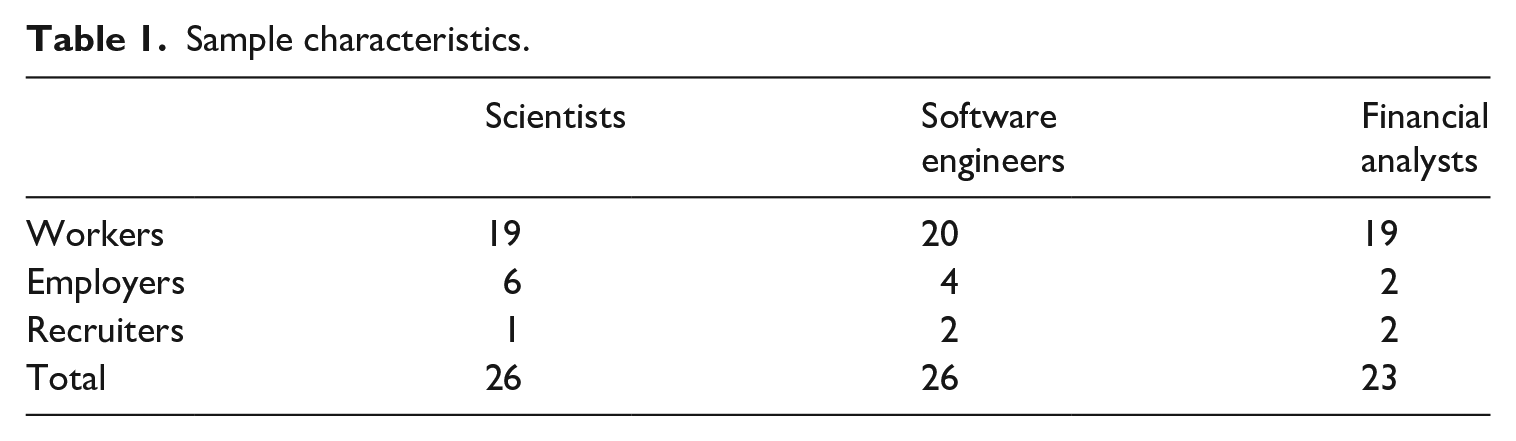
The majority of participants were selected and recruited purposefully from available LinkedIn profiles to allow significant variation in (a) sector, (b) age, (c) gender, and (d) educational background (Small, 2009; Trost, 1986). Exact demographic UK data for these narrow occupational groups that could help structure the sample is currently missing. Instead of seeking representativeness through randomness, the study created greater heterogeneity along the above dimensions. As a result, pertinent shared patterns that cut across the wide variety of cases emerged. In addition, a small minority were recruited through snowball sampling. Participants were located all over the UK, although the majority were in the south of England. There was considerable spread in age and career stages as well as company size. The gender balance was somewhat skewed towards males, in software engineering (67%), lab-based science (85%) as well as financial analysis (75%), reflecting the numerical domination of males within these occupations. A third of financial analysts (N = 7) and engineers (N = 7), and about half of scientists (N = 9) were in advanced positions (such as management positions, head of departments, or independently established position). A clear limitation of this sample is its small size. It is hard to evaluate the transferability of the results and to ‘control’ for demographic variance among the three occupations. As a result, what we can say about how gender, age, industry, geographical area, company size, or position within the organisation shapes occupational strategies remains limited.
One semi-structured interview with each participant was conducted in a setting chosen by the interviewee, often either at work or in a coffee shop. Interviews lasted from 30 minutes to more than 2 hours, with the majority lasting more than an hour. The interviews explored a range of topics such as career development, recruitment and selection, and the role of education throughout the occupation. All interviews were transcribed verbatim and anonymised. After a general reading or listening to a group of transcripts, I thematically coded the transcripts using the NVivo software package to identify themes in the data and then hand-coded the interviews to analyse patterns in the data in more detail. Although various strategies for each occupation were identified, I narrowed them down to one or two positional strategies that were mentioned most often and were understood to be crucial to get ahead within the occupation. A potential weakness of this approach is that it essentialises these and downplays the importance of others. However, in order to assess the relationship between positional competition and occupational context, reducing complexity is deemed necessary. All the participants have been given pseudonyms. The quotes reported in the findings reflect the patterns observed in the narratives of interviewees.
Lab-based scientists
For graduate scientists working in pharmaceutical or biotechnology sectors, an important strategy to advance within the occupational structure is through advanced qualifications in the form of doctoral degrees. Scientists with PhDs occupy an increasing share of these sectors’ workforce. This leaves workers without advanced qualifications at a disadvantage, both in terms of the job tasks aligned with their role and career progression.
Although some companies will let graduate scientists perform much of the traditional scientific work, in other companies they have limited autonomy and work in assistance to PhD-level scientists. James, a lab manager in a biotech company, summarises the role of graduate scientists in his company: They’ll just be doing the basic work, so quite a lot of, you know, the donkey work just setting up experiments and then the analysing of them would then be passed on to the people with the PhDs who’ve got the full expertise in actually, you know, how to read the results and everything like that.
The career opportunities of those non-PhD researchers are likewise capped to lower research positions. This is often seen as unfair and also unnecessary by these workers. Consider the case of Ella, who worked as a research scientist in a biotechnology company for 7 years but was unable to progress: Because I did want to be a senior scientist but I couldn’t because I didn’t have a PhD . . . although I was, you know, running the project as it were . . . I was just classed as a research scientist and although I was doing what I thought was quite a responsible job and taking on more responsibility, I didn’t seem to be, you know, getting anywhere, that I wasn’t really sort of given the credit that I thought I deserved [. . .] You tend to find in the science industry that if you’re in research and you haven’t got a PhD, there is a certain level that you can get to and that’s it –there’s a bit of a ceiling really.
Nigel, a senior scientist in a biotechnology company, has been promoted but feels jaded about how far he can go with his Bachelor in Applied Biology: I mean it’s by no means an official policy, but you . . . you can read between the lines. I mean I’ve recently been promoted to a senior scientist like kind of about six months ago, and I think I could work here for the next five, ten years assuming the company is still here and maybe not achieve much higher than that. I think I’ve kind of reached the ceiling that my education will allow.
Not everyone understands why researchers with doctoral degrees should have this privileged position. Some are not overly impressed with the performance of PhD-level scientists or challenge the value or utility of the PhD qualification within the workplace. The need for a PhD qualification as the means of progression is nevertheless now accepted and well known throughout the industry. There was a consensus among those in the top and lower positions that the PhD degree was a key form of advancement. Those who have entered the field decades ago may have progressed to higher positions such as management roles without PhD qualifications. This is no longer deemed likely. It is important to note that the increase of PhD holders within the workforce has diminished the distinction that previously was attached to the degree. Scientists report that some colleagues with PhDs have left the scientific field because they were getting frustrated due to the lack of opportunities, indicating unfulfilled expectations by those who pursued this path of advancement.
Context
In order to understand why the scientists use doctoral degrees as a means of advancement, we need to examine the occupational context in more detail. The context in which PhD credentials provide advancement is one of increasing educational participation. Many believe that credential inflation has affected the industry, leading to a situation where, increasingly, previously non-graduate technician jobs are taken by graduates and scientific roles increasingly by workers with postgraduate degrees without a greater skill use or demand.
Laboratories are skill-driven environments. Many of the skills needed are learned on the job (Tholen, 2017a). Both recruitment and selection processes, as well as career enhancement, draw on signifiers of relevant research experience. Formal qualifications such as the PhD are rewarded and thus, can serve a positional advantage over others, actively closing off opportunities to those others.
One could argue that having a doctoral degree represents an absolute form of career advancement, based on the abilities of the individual. The more trained scientist would be preferable to employers because of improved productivity, reduced training needs, or just being better suited to more advanced research positions. Also, lab-based scientists draw on specialised knowledge and skills, and thus, doctoral degrees will benefit their productivity. Those who have invested in advanced skills see the rewards of this in superior labour market positioning and mobility (along the lines of Human Capital Theory). Yet, experienced scientists indicate that the need for a postgraduate qualification to perform research-based jobs has not really increased. Many employers shared stories of when they advertise a graduate-level position, a large number of applicants with PhDs apply. Credential inflation occurs in specific occupational domains, resulting in occupation-specific credentialism. In other words, employers ideally want horizontally matched workers. The PhDs offer a rather blunt credential that makes sense within an overqualified context. Their legitimacy is subject to questioning and contention by those in the industry, in particular those below them. 3 As Brown and Bills (2011) observe, ‘credentials are sources of power for individual holders insofar as they effectively block substantive judgments about their actual abilities’ (p. 135). Keeping out, or reducing career prospects of those workers without doctoral degrees relies on constant re-evaluation and redefinition of what a doctoral degree represents in relation to Bachelor degrees within the laboratory context. Within closure theory, it has been stressed that the more or differently educated can set up their job requirements and exclude anyone without the right educational credentials (Collins, 1979). Within a context of general skills widely available with employers looking for specific work experience, advanced qualifications can be used to set a clear ceiling for those with lesser qualifications. The data confirm that hiring practices may show the nature of screening is often based on the relative position, and educational credentials may signal perceived training demands (Thurow, 1975) or other characteristics (Bills, 2016). For workers, closure opportunities are nonetheless less than perfect as the PhD is open for many to pursue, albeit with significant (financial) barriers for many. For scientists, the context helps explain the means through which positional advantage through closure is achieved. PhDs are a credentialised form of predominantly relevant skills. Despite being generic and highly available, and there being some uncertainty about what the PhD stands for, it still allows scientists to create symbolic distinctions in relation to what employers value.
Software engineers
For software engineers, clear absolute markers of career advancement were identified by those in the field. In particular, work experience was highly salient. More work experience means increased labour market opportunities (along with higher wages) as predicted by Human Capital Theory.
In contrast, creating positional advantage within their field is very difficult to achieve. Software engineers do actively construct positional advantage through relying on a distinct social strategy that would vertically differentiate them from competitors. A key mechanism that is mentioned by many engineers is specialisation. Some engineers in the study actively specialise by developing work experience within small demarcated spaces (or niches) around particular coding languages, sectors, or types of work. One engineer expresses this strategy as follows: It could be that you are a technical specialist, so you could be an analyst that has worked for five organisations, so you’re very good at requirements engineering or systems analysis, not a broadly based developer – you can’t do analysis and development and testing, but you’re an analyst that has worked in a number of domains, so you have the experience in a specialist area. That I think is the way it goes. (Thomas, IT consultant)
Specialisation is a risky option. It comes with labour market volatility as well as lack of flexibility, as highlighted by Jennifer and Peter: So if somebody has got very niche skills that not many people have, then if a client recognises that, then they probably would pay the high salary, but the danger of being too niche is there may not be as many companies out there that would need that skill. (Jennifer, IT recruiter) They think that once you get knowledge on a specific topic, it’s really hard to move to a different topic [. . .] So when you are trying to do this career-changing, it’s quite common that you might have to answer a lot of questions and prove that you’re capable of understanding the other problems that belong to the category you want to move to. So actually this is like a brand that follows you. (Peter, software engineer, IT company)
For software engineers, the uncertainty regarding future labour market needs creates great difficulty in how to ascertain whether the advantage of specialisation is not countered by decreased access to a potentially wider range of jobs. When I asked Bruce, a software engineer in an IT company, whether it is preferable to be a generalist or a specialist, he answered, I’m not too sure, to be honest. It’s a case where both have their advantages. A generalist is going to have a much wider market, but not necessarily sort of the skills or more senior technical assistance with any one field. But a specialist has a lot more technical skills in one area or a lot of experience in that area. They might have a much narrower field so they could miss out on stuff just because it’s slightly different to what they do.
Context
Why is specialisation a key means of advancement for those willing to invest in it? The occupational background is one in which employers are not willing to pay for skill development or training. Employers desire skill readiness and tend to select the candidates that can be productive right from the start. This creates significant pressures on engineers seeking (new) employment: They want somebody with the breadth of experience, but then they want somebody with these ten skillsets ‘cause that’s who we’re recruiting today. So, you know, they would go for somebody who has nine out of those ten skills instead of going for somebody who’s got five but could learn the other ones in two months’ time. (Winston, software engineer, IT company)
Although the labour market demand for software engineers during the time of data collection tended to be seen as high, many engineers feel the field is still seen as competitive and most engineers in the study did not receive high financial rewards. Many of them observe that it requires constant skill updating in order to remain employable within the fast-changing labour market: What has happened to me is that I used to earn £75 an hour in England 15 years ago -I now have to go abroad to earn £50 an hour. In England there aren’t any jobs more than about £25, £30 an hour. So the value of the work has dropped drastically. However I say that – it appears that the increase in the market, that the amount of code required to be written, goes up by 28% every year – the number of engineers coming into the market only increases by 17% every year. You’d think that ‘we’d have a higher value . . . but it just hasn’t turned out that way – they’re offering less and less. (Jacob, software engineer, contractor)
Engineers are forced to think strategically about positional advancement under high uncertainty. Those who do not draw on specialisation specifically do acknowledge that they do find ways to anticipate the market through skills development. Many engineers described the challenging nature of creating positional advantage through skill development within a fast-changing technological environment: It’s very easy to drop out of the software labour market . . . it’s much harder to get back in if you’ve dropped out . . . so you have to keep your skills fresh, otherwise um . . . if you want to move on to another job, it can be more difficult. (Linda, software engineer, IT)
Seeking advantage in strategically distinctive skill sets as well as using recommendations makes sense within a context of increasing pressures on getting the right skills for the lowest cost (Brown et al., 2012). Specialists try to monopolise this situation by gambling on the right skill set. Although this strategy may be open for many, its positional nature is expressed through how workers actively seek distinction from others. It also shows that within occupational advantage does not necessarily rely exclusively on closure of opportunity towards others. In contrast, employers rely on recommendations for specific information about the labour market and the skill set and characteristics of potential hires, which engineers can use to actively secure and close off opportunities to other eligible candidates to their own benefit. Seeking advantage through specialisation is an applied strategy to signal relevant work experience to employers. Other strategies that can create positional advantage that engineers may adopt will likely have to draw on the employers’ desire to assess work-readiness. For instance, many software engineers identified networks as crucial in order to improve employability. Through these networks, employers seek information about candidates, but also workers themselves can actively change the selection pool and the employers’ valuations. For engineers, networks present an opportunity to exclude other potential competitors or highlight their availability and suitability for the role. The low availability of specific software development skills and the tenuous relationship with formal education enables specialisation to create positional advantage.
Financial analysts
Unlike lab-based scientists, professional qualifications instead of formal higher education qualifications improve career opportunities for financial analysts. A wide range of providers offer courses tailored to the occupation and linked to particular professional organisational foundations such as the Chartered Financial Analyst (CFA) Institute, the Association of Chartered Certified Accountants (ACCA), and the Chartered Institute of Management Accountants (CIMA). These are generalist qualifications and like other ‘chartered’ professional bodies, their content and numbers are strictly regulated. Many analysts choose to take part in these programmes, often after a few years of work experience, as they are deemed essential to progress into many roles (in particular, during the mid and early career): I think ideally clients want to see a degree and then an entry level position and then you start your qualification and that is when you can sort of move up the ladder. (Angela, a recruiter for the finance sector)
Clifford, an analyst in a jewellery company, highlights how progression in his previous company was tied in with taking professional qualifications in a very structured way: You got a pay rise for every one [CIMA qualification] you passed, and opportunities open up to you once you get further down the career path because obviously, you are more qualified, therefore able to do different roles.
In answering whether one needs the course is, according to him, quite debatable. He comments, But in terms of sort of what you’re doing day to day I would question whether you really need them as a financial analyst. Without those letters after your name, you’re going to put a glass ceiling on your career – a barrier that you’re never going to get beyond. So that getting those letters after your name does open up more opportunities for you.
This means that for those workers without specific professional qualifications, progression is strained. These workers feel a great ambiguity, at the least, as to why professional qualifications should be linked to job opportunities: And I think that in the current climate the minimum you have to have is be part-qualified at CIMA to even get anywhere near what I’m doing. And that’s at a junior level. Now I’m sort of currently in the market looking for new opportunities, and me not having CIMA doesn’t open as many doors for me. Although, as you will see from my LinkedIn profile, I’m highly experienced, and done a hell of a lot of different things. Some companies are very much a stickler for having that piece of paper. (Rick, senior financial analyst, gaming industry)
Likewise, for those who have achieved accreditation, it gave the analyst a sense of freedom and opportunity. Fred, an analyst in the banking sector, notes that ‘it gives you a sort of solid global recognition that, you know, you have the skills and you know the material’. The professional analyst can close off opportunities to other graduates, who are perhaps less invested in a particular occupation and are seeking a career as a financial analyst. But at the minimum, it presents an opportunity for advancement, in particular, for those whose employers are willing to pay for it. All of those in higher positions in the study have taken this path, but not all were convinced it had benefitted them ( ‘It didn’t help me and it didn’t hinder me or anything like that’, according to John, ex-investment analyst, large investment bank). Those analysts who have not invested in a professional qualification are planning (reluctantly) to do so in the future.
Context
The choice of professional qualification as a key means for within-occupational closure can be understood if we, again, examine the occupational context in more detail. It is important to realise that workers with many different educational backgrounds enter the occupation of financial analyst (including many non-finance graduates). Although the qualification provides basic but useful knowledge and skills, the skills used at work can be acquired on the job. Many analysts have already developed these while working before they commenced the programme, claiming that they have learnt very little relevant skills and knowledge. Yet, it seems that the professional qualification provides some type of certainty in the shape of standardised skills and knowledge within an uncertain labour market. As Andrea, a finance business analyst in a finance company reflects, They [employers] don’t look for anything else. You have to be ACC or similar, that’s all . . . So I think just being ACC qualified tells them that you’ve been through this particular set of studies. I suppose that at every university things can just go to a different level. I mean if you are just a university graduate from finance, well that’s good enough, but probably not all of it. They can’t get really exactly what you are doing. They know what ACC is all about. I think there’s something about . . . actually, I’m not quite sure now, but I think if you belong to ACC Institutes, you have the credibility as a professional better than just being a graduate from a university.
A non-specific credential in a field accessed by many different incumbents does serve as a standardised measure of skill and knowledge that is useful while assessing the supply of candidates for promotion or hire. For employers, possession of a professional qualification provides a rudimentary signal of dedication and suitability within a large pool of potential candidates, rather than direct evidence of advanced educational ability. Over time, they have become a sector-wide minimum standard for hiring. For analysts, professional accreditation provides a means to exclude themselves from non-credentialised or non-chartered competitors. The fact that many analysts are themselves rather ambiguous about the skills developed in these programmes is noteworthy, and strengthens the notion that these professional qualifications very much need to be seen as part of relative, as opposed to absolute, forms of career advancement. We can see that like the doctoral degree with scientists, the professional qualification forms a legitimate yet a contested abstraction for employers and workers to utilise. The professional accreditation remains a distinction that many analysts aim for, knowing full well that barriers for analysts to enter any of these programmes are reasonably low, and thus, its exclusivity is limited.
Concluding discussion
A significant contribution this article makes to the existing literature is that workers use particular positional strategies to create advantage, and these will depend on the characteristics of the occupation. The latter is of key importance in understanding when and where particular strategies are used and how workers within each occupation rely on different means to increase positional advantage. So what can we say about the relationship between occupational context and means of positional career advantage? The study shows there are structural factors that help determine how relative advantage occurs within occupations.
Incumbents
For financial analysts, traditional educational credentials are no longer very relevant as a wide variety of educational backgrounds are deemed suitable to become an analyst. Instead, analysts rely on formalised professional accreditation to signal superiority. This is similar to what Muzio et al. (2011: 451) observed for those who work in project management, management consultancy, and executive search. In these occupations, alternative types of credentials that ‘emphasise competences, transferrable skills, and industry knowledge and experience’ dominate.
Level of educational congestion
The educational makeup of an occupation workforce shapes the role educational credentials play within career advancement (as well as access). For those occupations in which formal knowledge and skills associated with higher education are essential, such as biotechnology and pharmaceutical scientists, workers see the opportunity to differentiate themselves within their occupational field through formal qualifications. The latter can either distinguish themselves horizontally matched – through completion of university programmes closely aligned in knowledge and skills with desired positions – or vertically in which additional years of schooling signifies, in the case of scientists, years of relevant work experience.
For lab-based scientists, the use of doctoral degrees makes sense within the context that rewards relevant work experience. It is in this area that candidates with doctoral degrees can distinguish themselves within a relatively homogeneous educational field. Both lab scientists, as well as financial analysts, rely on a rather generic form of educational credentialism. However, the professional qualification for financial analysts was thought to confer certainty to employers, growing ambiguity exists within bioscience and the pharmaceutical companies about what the doctoral degrees represent, as PhD-level labour market entrants flood the market for lower-level research positions. Advanced degrees are, therefore, likely to be used for relative advantage within occupations that are skill-intensive and educationally homogeneous occupations. For these occupations, other types of means are less common as they would be less able to signal the needed skill profile.
Whereas, laboratory scientists and financial analysts actively aim to monopolise opportunities by investing in educational credentials, software engineers find ways to signal distinction through work experience to advance their position in relation to competitors. This constitutes a specific means for closure for a specific labour market area, sector, or job, excluding competitors with fewer connections or wider forms of work experience. For software engineers, any type of positional advantage relates to (a) perceived scarcity of skills and (b) uncertainty regarding competitors. In a volatile market that is heavily shaped by technological change, this means that these strategies, which are based on non-closure distinction and specificity, are also very fragile and temporary. For occupations such as software engineers, workers will look for any means that can signal work-readiness, and thus, the reliance of specific as generic means such as degrees of professional qualification are not often suitable to signal distinction.
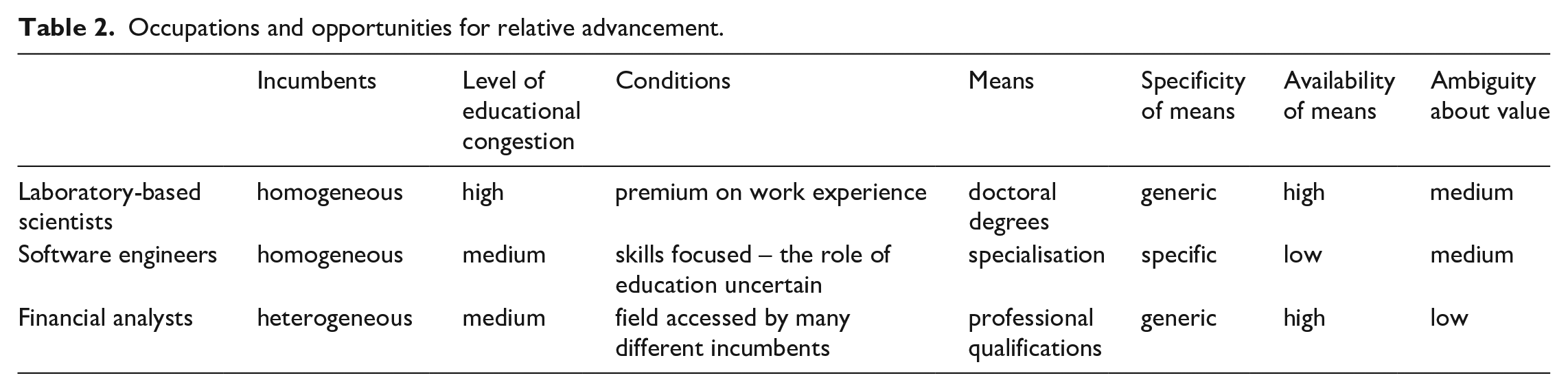
Finally, financial analysts’ key strategy for relative advancement, professional qualifications, also is directly linked to an occupational context in which finance-related degrees are appreciated but not deemed crucial. For occupations such as financial analysts and workers, who will have a wide variety of educational backgrounds, aim to distinguish themselves through generic badges of dedication and knowledge. Although the content of these qualifications may not have high job relevance, it is the best on offer for distinction. Table 2 summarises the findings.
Occupations and opportunities for relative advancement.
The study confirms that deliberate social closure is still relevant in the labour market (see Ruggera and Barone, 2017; van de Werfhorst, 2011). The findings confirm the social closure theories described earlier, but fundamentally extend these theories by demonstrating how within-occupational forms of closure fundamentally shape labour market transitions. The study also indicates that human capital theories neglect the importance of occupations in explaining labour market rewards. The theories also continue to assume that rewards are predominantly based on employers’ assessments of productive characteristics, such as skills and qualifications. Yet, the study also confirms that there are possibilities of advancement through the closing of opportunities to others within the occupation. The study also shows that these remain highly contingent on the scarcity of the resources accessible. Scientists and analysts’ attempts to close off opportunities within their occupation are weakened by the wide availability of the utilised credential and the mixed-signal that the credential demonstrates. For them, educational credentials’ effectiveness in closing off opportunities will depend on whether they can convince others of their value, through classification struggles within workplaces and organisational hierarchies. Here, notions of symbolic closure may come into play (Tholen, 2017b). Prominent status distinctions between categorical groups can lead to systematic differences among workers within workplaces, affecting activities, power, and rewards (Tilly, 1998; Tomaskovic-Devey, 2014). Those with exclusive credentials need to somehow convince others of the special status and alleged abilities that justifies their advanced position. Within both graduate and non-graduate occupations, certain education credentials still can provide individuals with symbolic resources to make claims on relatively higher wages, additional benefits, and promotion opportunities.
Overall, workers in this study have only limited means to create positional advantage. They all find themselves within a wider economic context in which long-term or secure employment contracts are becoming rarer. As a result, career paths are felt to be becoming more fractured, and those aiming to construct coherent strategies face uncertainty in how particular achievements and career strategies translate into positive career outcomes. The strategies are all aligned in a reactionary way towards employer demand.
Of course, strategies of advancement may be connected to wider inequalities. For example, articulating the value of credentials within-occupational settings and convincing others of the value of particular skills and educational credentials within occupational settings, may be highly reliant on the kind of embodied cultural capital (Bourdieu, 1986). Likewise, occupational positional competition could be interacting with organisational and institutional cultural processes that categorise workers into differently valued groups (Lamont et al., 2014). For example, workers who rely on vocational experience or credentials to compete for access or progression can be negatively affected if workers from working class backgrounds are stigmatised within their organisation. The opportunities to develop and maintain means of relative advancement are unequally distributed. For instance, social capital, of high importance to software engineers, is distributed unequally. Due to segregated networks, the opportunity to develop is also organised along class, gender, ethnic, and age lines (McDonald et al., 2009; Pichler and Wallace, 2009; Stainback, 2008). To illustrate, a US study found that increasing work experience leads to greater odds of informal recruitment for men only (McDonald, 2011).
Within-occupational strategies to create positional career advantage have been relatively neglected in the existing literature. The findings outlined in this article supplement the strategies that those in skilled occupations use to create advantage vis-à-vis other occupational groups such as occupational associations, unionisation, credentialing, and licencing (Weeden, 1998). Occupational credentialism and social closure occur multidirectional, both inwards and outwards. In line with Pierre Bourdieu’s (1993) relational approach in social stratification, occupations can be seen as relatively autonomous fields in which individuals occupy dominant and subordinate positions, depending on the amount of specific cultural or social resources that are possessed in relation to other occupants. Although this article has not focused on how dispositions formed in the past shape how well a worker succeeds in competing, we can observe within each occupational field that personal and social capital are being invested in and utilised according to the individual’s understanding of the rules of the game. These rules allow for some to (partially) close off opportunity to others. Some strategies are perhaps more deliberate than others, yet many can often only be understood within an occupational context. These seem to cut across organisational and sectorial boundaries that career research often highlights in explaining career paths. Additional research could provide more insight into any interaction between them.
Footnotes
Funding
The authors disclosed receipt of the following financial support for the research, authorship, and/or publication of this article: This research was funded by the British Academy.