



Abstract
This article examines how corporate, state and donor interests have converged in attempts to craft South Africa’s youngsters into an army of entrepreneurs as the last frontier for creating growth in a post-job world. We investigate the apparatus designed to engineer this entrepreneurial revolution and the actors hoping to seed enterprising aspirations in school-age kids. Our ethnographic findings show that while the ideology of entrepreneurial education enrols kids in anticipation of an entrepreneurial future, it falls short of both its enticing promise and its transformative intentions. As enterprise education fails to deliver on the New South African Dream, we argue, the aspirations it propagates withers, generating disaffection rather than a generation of entrepreneurial subjects faithful to the neoliberal creed of making it on your own.
Introduction: ‘you got to start young’
‘I want to be a rock mechanic, when I grow up; a rock mechanic or a metallurgist maybe’, Cynthia 1 said. ‘Na man’, Noma countered, ‘for me, I’m going to be a businesswoman, then you can be here at Rustenburg, or anywhere’. Cynthia was 10 years, Noma 11 years. Both were attending an extra-curricular schools programme for disadvantaged high-achievers in South Africa backed by some of the country’s leading corporations. Both had been handpicked by corporate selectors who comb through results from public schools in the municipality looking for the ‘thirty-five most promising Historically Disadvantaged South African (HDSA 2 ) kids’ to join others at LearnLife, an elite summer academy in Johannesburg. Like Cynthia and Noma, most aspired to a career in mine management or business. Surprising as this would be for most 10-year-olds, it is less so for kids growing up in the world’s platinum mining centre where good grades and future ambitions fused in one of two destinations: engineer or entrepreneur.
This article investigates how corporate, state, and donor interests converge in attempts to craft young lives (and minds) in South Africa in the model of junior businesspeople and turn ‘generation jobless’ 3 – as the Economist (2013) dubs those coming of age in the new millennium – into job-creators. As the pathway from formal education to employment becomes ever more uncertain, hopes for the future come to rest increasingly on a millennial generation of precocious youngsters, ready to seize the entrepreneurial moment, and create rather than await the opportunity to empower themselves through enterprise. From the top down the agenda is clear, the current generation of pupils cannot rely on (or expect) salaried jobs. They must make their own. Within this post-industrial labour market, ‘education for economic survival’, 4 celebrating values of resourcefulness and resilience has become more than a pragmatic imperative. It has become utilitarian ideology, demanding children bear responsibility not just for their own economic survival and development, but also for the nation’s. Once training focused on under-employed youth, those unable to gain a foothold in formal labour markets hit by decades of jobless growth and consigned to chronic ‘waithood’ (Honwana, 2019; Thieme, 2018). Now the target has shifted to those younger, whose aspirations and ways of thinking – whose very idea of what constitutes a job – can be moulded for entrepreneurship from the outset. This is being fed through both formal education (materialised in a new focus on embedding entrepreneurial thinking and tools in school curricula) and third sector (business and charitable) investment in extra-curricular programmes hoping to extend the entrepreneurial dream beyond the school gates and set Africa’s school-age youngsters on a path to business success from their primary years.
Much has been written on the imperative for education to rise to this challenge, reshaping curricula and classroom practice to produce an entrepreneurial citizenry. Most studies have focused on public sector investment and capacity building for entrepreneurship education in school and higher education and its incorporation in national curricula (see Brixiová et al., 2015; Chigunta et al., 2005; Honeyman, 2017). Although, as Jeffrey notes, diminishing state investment under neoliberalism has turned education into a klondike for ‘education entrepreneurs’ hoping to profit from the opportunity this opens, comparatively less attention has been focused on the growing space occupied by private-sector actors in supplying entrepreneurial schooling across Sub-Saharan Africa (SSA) (Jeffrey, 2010: 499). Meanwhile anthropological work on youth aspiration in Africa concentrates on efforts to repurpose older youth and drop-outs (see Dolan and Rajak, 2016; DeJaeghere and Baxter, 2014; Di Nunzio, 2018; Gough and Langevang, 2017; Mains, 2012). The extent to which the entrepreneurialist agenda has trickled down to extra-curriculum and privatised programming, repositioning Africa’s youngsters as catalysts of economic development has received far less attention. With its advocacy for life skills over classroom pedagogy, the turn to entrepreneurial learning focuses beyond the classroom in extra-mural spaces from kids clubs to summer camps. And, from Lego’s Six Bricks movement, to the Junior Apprentice, the campaign to cultivate entrepreneurial subjects outside traditional schooling is driven more by private-sector financing than state funding. In this article, we investigate this neglected sphere of socialisation sponsored and shaped by corporate investment in programmes that target school-age children as both beneficiaries of the entrepreneurialist movement and as the last frontier for creating growth in a post-job world.
Ethnographies of entrepreneurial education have tended to focus on learners’ agency (or lack of it), seeking to understand how the global shift from wage labour to ‘flexible accumulation’ has reshaped the aspirations of youngsters suspended between the hope they embody and the hazy post-school horizon that awaits them (Martin et al., 2016; Naafs and Skelton, 2018: 2). Against this backdrop, ethnographers have explored how adolescents imagine and attempt to realise their own ‘possible selves’ as acts of self-making (Honwana and De Boeck, 2005; Langevang, 2008; Yeboah et al., 2016); and how young people’s agency contests and sustains political economic power structures and neoliberal ideology (Durham, 2000; Jeffrey, 2012). But as Holloway et al. (2011) note, ‘processes, discourses and institutions’ have received relatively less attention . . . than children themselves’ (p. 2).
In this contribution, we turn the ethnographic lens onto the apparatus conceived to engineer this entrepreneurial revolution, and the actors attempting to implant the belief, that as one informant put it, ‘in the new South Africa, everyone can be a business[person]’. Based on participant observation in corporate-backed education programmes, combined with over 30 interviews with programme staff and their corporate partners conducted over 2 years, we investigate the discourse and practice of actors designing and delivering entrepreneurial education to youngsters. This ethnographic methodology provided a long-term grounded perspective, allowing us to scrutinise the discourse of its advocates against the evolving aspirations of its targets. We show how the proselytism of entrepreneurial education is short-lived (as are the aspirations it seeds); how its capacity to conscript, convert, and discipline SA’s youngsters as entrepreneurial engineers of themselves, is limited.
We focus on four programmes funded by multinationals targeting school-age children from primary to matriculation as beneficiaries and catalysts of an enterprise society they seek to propagate. In all, their corporate patrons had a key role not only in financing, but in design and delivery. All are driven by an evangelical promise of inclusion, yet all are selective. All hybridise global paradigms of entrepreneurial education with local imperatives of black economic empowerment. Two of the cases – The Business and YES (youth enterprise schemes run by mining multinationals in SA’s platinum belt) – are ostensibly home-grown. They emerged in response to local political economic challenges of disenfranchisement but deploy a common register of empowerment through enterprise espoused by their multinational corporate sponsors. The other two are more cosmopolitan in their orientation, backed by diverse transnational corporations: LearnLife (a national-level educational summer academy) and Junior Achievement South Africa (JASA), a global phenomenon with American roots whose gospel of entrepreneurialism found fertile ground in SA.
In the following sections, we trace the entrepreneurial journey figuratively, examining how entrepreneurial education transcends vocational training, claiming to instil moral discipline in quest of a holistic ‘self-mastery’. The first and second sections explore efforts to promote a national ideology of entrepreneurialism and shape the aspirations of youngsters to this imagined enterprise future. In the third section we examine how the inclusive promise of this new South African dream fast turns into an exclusionary project, culling ‘the best’, an elite deemed destined for entrepreneurial success, from ‘the rest’. As we follow youngsters through programmes that aim to unleash their inner entrepreneur in the fourth and firth sections, we reveal a critical tension. On one hand, entrepreneurship is promoted for building resilient futures carved from pragmatism and savvy adaptability to the challenging economic realities school-leavers face. On the other hand, this ‘think big’ South African dream defies realism in favour of gutsy ambition and the (self-) belief in making it against the odds. Far from a strategic response to hard times, entrepreneurship is suffused with fantasy futures unattainable to most. At the heart of the new ideology of enterprise education lies a paradox. For it is both utilitarian and fantastical, demanding children learn to be resourceful and opportunistic, while discouraging pragmatic accommodation as self-limiting.
The project of making entrepreneurs (and entrepreneurial mindsets) is often interpreted as an example of ‘governmentality’ at work, through a Foucauldian frame that dominates anthropological readings of neoliberal subjectivities (Foucault et al., 2008; see, for example, Comaroff and Comaroff, 2005; Dolan, 2005; Freeman, 2014; Rudnyckyj, 2004; Wells, 2014). The apparatus of entrepreneurial training (directed at children or adults) is thus viewed as a technique of subjectification, through which targets internalise the disciplinary process as self-governance, moulding themselves to the goals and values of the market (Peters, 2001). Our empirical findings tell a rather different story. By looking over a long period, at various points in the journey from selection to graduation we reveal how, despite the efforts and intentions of its purveyors, the campaign to socialise kids as agents of enterprise fails to produce the kind of entrepreneurial subjects anticipated by advocates and attributed by scholars to the disciplinary powers of education as putative processes of ‘governmentality’ (Bröckling, 2016; Esson, 2013; Foucault et al., 2008). The empirical findings captured through this approach call into question both the claims of insiders or advocates and the assumption that entrepreneurial education transforms pupils into ‘entrepreneurs of themselves’ (Peters, 2001; Rose, 1989). While the apparatus of entrepreneurial education conscripts kids in anticipation of an entrepreneurial future, we argue, it falls short of both its enticing promise and its evangelical intentions. Recruits do not emerge re-made as entrepreneurs. They exit unsupported by tangible means and concrete ends highlighting the fraudulence of the entrepreneurial future peddled to pupils. As enterprise education fails to deliver either individual actualisation or a catalyst to a collective enterprise revolution, so the aspirations it propagates wither. At the journey’s end, the New South African Dream generates disaffection rather than a generation of entrepreneurial subjects faithful to the neoliberal creed of making it on your own.
Triad of hope: aspiration, education, and youth enterprise
‘The world keeps getting older’ Bill and Melinda Gates noted in their 2019 annual letter, ‘but Africa stays (nearly) the same age’. The letter encapsulates a persistently paternalistic (not to mention neo-colonial), portrait of Africa as the Peter Pan of development discourse which we find pervasive in donor and corporate narratives, nervous of the continent’s so-called ‘youth bulge’, yet, hungry to capitalise on this ‘demographic dividend’ by cultivating its ‘human resources’ from an early age (Africa Play, 2019: 22). This conflation of childhood development with human capital production carries echoes of older vocational pedagogy transfigured for a post or de-industrial millennium. Traditional schooling has lost its currency, in terms of both the skills and symbolic capital it confers (Chea and Huijsmans, 2018; Mwaura, 2017). This has prompted calls to ‘(de-schoolify) learning by reorienting education in and outside schools towards innovation and enterprise’ (Africa Play 2019: 22). This has given rise to a wide spectrum of state, donor, and private sector interventions that target increasingly younger cohorts, aiming to equip them with enterprising skills and values.
Entrepreneurial education is not a new phenomenon. Rooted in the decline of industrial labour markets in 1980s Britain, enterprise education was promoted as the seedbed for Thatcher’s ‘nation of shop-keepers’ (Rees and Rees, 1992: 117) – a new right ideology of enterprise culture and self-reliance which was to begin by resocialising working class children for futures in enterprise rather than industry. Classrooms were to become factories producing the moral fibre of youthful entrepreneurialism - social fabric that would power national economic growth through individual enterprise (Rees and Rees, 1992).
Today, the fusion of education and enterprise has been re-scripted and exported within reigning development orthodoxies of inclusive markets. As poor enterprising culture is increasingly blamed for lack-lustre growth in Sub-Saharan Africa, policymakers turn to the classroom as fertile ground in which to inject a hunger for commerce, smuggling national visions of enterprise society into the personal aspirations of its children (Oviawe, 2010). Across the continent, entrepreneurial values have permeated pedagogical ideologies and practice about how third-world children should be educated in the face of looming unemployment (Nelson and Johnson, 1997).
In South Africa, educationalists faced the double imperative of reversing the racial inequities entrenched through decades of apartheid by building an education system that nourishes the democratic society and helps create a more inclusive economy (Jansen and Christie, 1999). For a substantial portion of South Africans, economic enfranchisement has been slow to follow the ‘precarious liberation’ of 1994 (Barchiesi, 2011; Rajak, 2011). The hyper-neoliberal restructuring of the late 1990s (widespread privatisation, capital flight, and workforce down grading) robbed South African youth of job opportunities, leaving young people (and children behind them) to carve a place of their own in a society that, as Seekings and Nattrass (2005) put it, resembles a game of snakes and ladders with ladders clustered at the top and snakes at the bottom. It is always easier to slip down that it is to climb up (ibid.). The South African National Development Plan: Vision 2030 grimly forecasts, ‘if youths fail to get a job by 24, they are unlikely ever to get formal employment’, citing this as the ‘single greatest threat’ to social, political, and economic security (Herbst and Mills, 2016: 10). The expansion of education since 1994 raised literacy levels and created new opportunities for many millions of HDSA children, giving rise to an ever-increasing pool of highly skilled South Africans ready to enter professional fields. Yet, such investments did not prove the social equaliser many expected. Far from disrupting inequities entrenched under apartheid, formal schooling has, as elsewhere, reproduced social hierarchies and foreclosed opportunity for many. That ‘window of opportunity’ to reverse the crisis of jobless growth is seen to be closing, and those charged with resolving it, younger.
The recent turn to entrepreneurial learning in and outside school proposes a revolution in pedagogy designed to open new outlooks for disadvantaged kids. By promoting life skills over academic learning, this agenda promises to equip youngsters with tools to break out of cycles of poverty and turn the long-standing ‘ideology of education as a liberating force’ (Froerer, 2012: 344) on its head. Students themselves become the liberators, expected to free themselves from poverty and exclusion.
The particular role of corporate South Africa in driving and shaping the enterprise education movement is both significant and contradictory. In the post-apartheid period, under pressure to prove their commitment to a democratic economy, corporate South Africa focused their social investments on education. The country’s industrial and financial giants staked their claims to corporate citizenship on large educational subventions for STEM subjects (Science, Technology, Engineering and Mathematics) subjects seeking both moral capital (as midwives of social mobility) and human capital (creating a pool of technical professionals to replenish their ranks and fulfil the government-mandated Black Economic Empowerment (BEE) targets for HDSA recruitment. Following the 2008 financial crisis, which led to industrial sector job losses on a massive scale, corporate SA reoriented their claims of social responsibility to create opportunity rather than jobs (Rajak, 2016). This too has filtered down to corporate engagement with education. While STEM remains a key focus, it is matched and interpolated with entrepreneurial pedagogies directed at school-age kids, accompanied by a structural shift from institutional support for schools, to outside school initiatives that directly target participants. The nebulous promise of investing in a ‘brighter future’ for SA’s youngsters (see Figure 1) glosses a shift from inclusive educational support to an ethos of picking (and backing) winners. While such programmes offer material support to a small handful of select high-achievers (with an eye to recruitment), the corporate promotion of enterprise learning in fact devolves responsibility for job creation to kids themselves, in an effort to incubate the poor’s putative ‘talent for self-help’ (Elyachar, 2005: 9) at childhood.
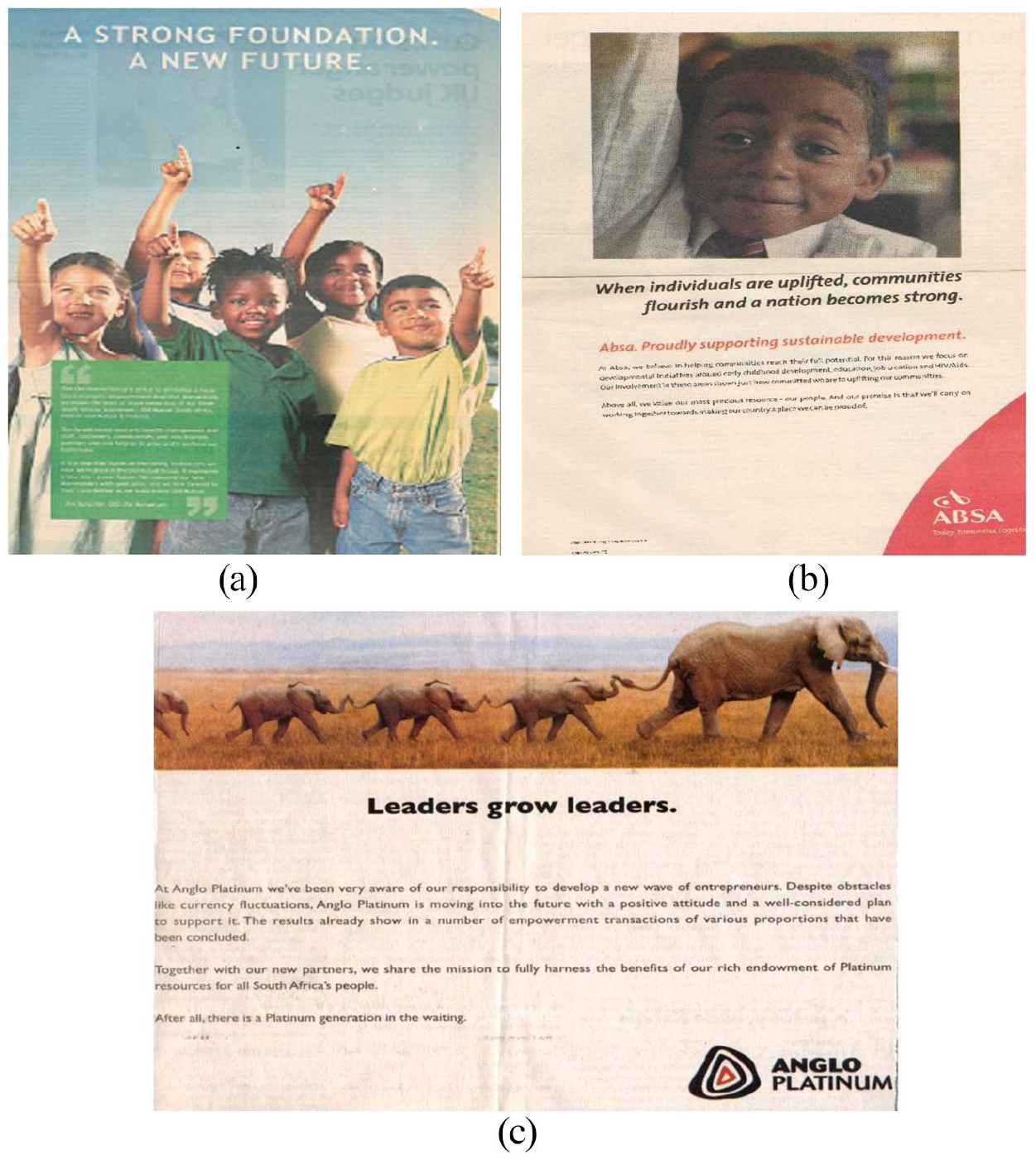
(a) ‘A strong foundation. A new future’, Old Mutual Plc, Mail & Guardian, 5 May 2005. (b) ‘When individuals are uplifted, communities flourish, and a nation becomes strong’, ABSA Bank Ltd, Mail & Guardian, 5 May 2005. (c) ‘Leaders grow Leaders’, Anglo Platinum Ltd, Business Day, 2 May 2005.
Here, we find education reimagined in the image of the neoliberal market as a site of self-empowerment rather than academic discipline. Among advocates this shift is presented as practical and urgent rather than ideological. But underlying the measurable impacts they promise, we find a pie-in-the-sky ideology that sees insurmountable barriers to ‘dream careers’ surmounted, and fantasy futures attained through ‘identity reinvention’, ‘self-picturing’ and ‘self-belief’; in other words, hope (Shittu, 2017: 146).
‘Dream yourself a radical new business idea!’ Remaking ambition
A group of 8-year-olds stand proud in Old Mutual’s advert in the Mail & Guardian, introducing South Africa’s ‘future shareholders of tomorrow’. The iconography of patriotic capitalism positions children as foot soldiers of the new South African dream, and enterprise as the future to which they should strive. A vision perhaps best articulated in the battle cry of ‘The Ultimate Entrepreneur’, an article advertising corporate-sponsored young enterprise schemes on the platinum belt: Surely we are the generation to bring liberty to our children from the disaster that befell our ancestors . . . I believe that in the next generation in South Africa, we will see the rise of a new breed of entrepreneur, a society not dominated by counterproductive bureaucrats and paper pushers! A society where parents will teach their kids, ‘dream yourself a radical new business idea, develop it into a financially successful enterprise and retire before you are 40’. (Zwennis, 2003: 16)
As Zwennis’ entreaty indicates, the campaign to transform kids into budding entrepreneurs begins with transfiguring aspiration itself, seeking to create a seismic ‘cultural and attitudinal shift’ in the way youngsters (and their parents) imagine their future by positioning entrepreneurship as the optimum ‘pathway to prosperity’ (Mastercard Foundation, 2015); or, as UNESCO-ILO proposes, ‘open the mind of young students to consider . . . becoming an entrepreneur . . . and create a job for oneself and for others’ Salzano et al., 2006: x)
Such evangelism for enterprise culture underpins the work of JASA (Junior Apprentice South Africa). Part of Junior Achievement’s global network, JASA sets out to realign societal aspirations for its recruits towards entrepreneurial success, harnessing private sector resources to create a selective infrastructure of opportunity. Established in 1919 to bring the power of free enterprise to dispossessed youth in high schools across the United States, Junior Achievement’s (JA) proselytism for the American Dream went global with the rise of neoliberalism in the 1980s to incorporate 5.7 million students in 122 countries. As it has reoriented towards the Global South, so its subjects have become younger in order to, as one trainer put it, to spark the entrepreneurial spirit ‘at a tender age’ (JA, 2017: 1). This mission – ‘to be catalyst for every young person’s entrepreneurial journey’ (JA, 2017) – is materialised in a portfolio of extra-curricular activities for 6- to 18-year-olds, but also enlists teachers in schools as aggregators or brokers to create a multiplier effect in their campaign to make ‘entrepreneurship a career option’ of choice for pupils when they ‘select their subjects’ for high school and beyond (JA, 2017).
In South Africa, JA has been at the forefront of projecting an entrepreneurial destiny on the nation’s disadvantaged youngsters. Most of the biggest multinationals operating in SA have backed JA’s brand of youth development, from global banks (HSBC, Investec) to extractive giants (Anglo American, SASOL), sponsoring interventions in classrooms and clubs across the country. JA’s ‘More than Money’ partnership with HSBC, for example, took ‘banking the unbanked’ to a whole new frontier of bottom of the pyramid (BoP) finance, attempting to transform 8- to 9-year-olds into novice financial citizens. Such collaborations – the hallmark of inclusive market ventures – incorporate local and national government (often drawing on public as much as private sector resources).
This is as much a political as practical project, targeting policymakers, teachers, and the curriculum they teach, as much as learners themselves. JA has set its sights on getting entrepreneurship into every classroom in the country, lobbying for its inclusion in the curriculum, and providing low-cost teacher training (subsidised by heavily branded corporate subventions) to local school boards aiming to embed entrepreneurialism in every classroom (JA, 2017). As JA becomes a conduit for corporate funding, classrooms, and youth clubs, such as Boys and Girls Clubs SA, become venues for socialising youngsters to entrepreneurial ideals and disciplining or schooling them in financial literacy and the tenets of enterprise.
Zwennis’ critique of salaried work as dull and unproductive, with which we started this section, is a common refrain within discourses of new entrepreneurialism. ‘Why be an employee, when you can be your own boss?’ a manual for the JA Academy asks its young learners, hoping to establish profit in place of professional attainment as the marker of success to which kids should aspire. Positioning profit-maximisation as a central goal of youthful aspiration melds the desire to ‘be somebody’ as pupils often put it, with the desire to ‘make money’. While South African kids and parents may still view professional salaried employment as the height of achievement (James, 2014), the retooling of school curricula, extra-mural initiatives, and transitional programmes for school-leavers increasingly targets them with a message to seek entrepreneurial rather than technical or professional futures. Salaried employment is downgraded as a form of dependence, and old-school education, with its concern for traditional disciplines and passing exams devalued as retrograde and even unprofitable. In contrast, the education for enterprise movement prioritises unconventional skill acquisition, economic productivity, and preparedness, not simply for work, but for the market. The preoccupation with technical skills characteristic of older forms of vocationalism, has been replaced with a philosophy of entrepreneurialism intended to permeate through every discipline and every learning interaction from traditional STEM subjects to health education. Technical skill acquisition has given way to less tangible ‘life skills’ (such as ‘self-actualisation’ and ‘innovative thinking’) and more nebulous learning outcomes (such as ‘self-mastery’, and ‘developing enterprising attitudes’).
JASA promises to ‘transform an ambitious teen into a successful entrepreneur’ in just 3 months by ‘[giving] them the skills they need to take a dream and turn it into a functioning business’ (JA, 2017). Such lofty promises are matched only by the soaring ambition expected of its teenage recruits. Participants are enjoined to be optimistic, to have big dreams and the determination to pursue them (so long as they conform to those sanctioned in policy discourse). If they ‘dare to dream big’ and commit to making ‘those dreams become a reality’, JASA will reward them by ‘handing them the keys to their lives’ (JA, 2017). Conversely, low aspirations are chalked up as a cultural, psychological, and crucially moral failing, revealing the self-limiting mentality of ‘a quitter’ (Macleod, 1987: 4) rather than a rational response to limited opportunity and resources. Indeed, JA’s exhortations reveal the paradox between the promotion of entrepreneurship as a focus for building resilient futures despite challenging economic realities, and the “think big!” South African dream that defies realism in favour of gutsy ambition.
The 10%: selecting the best
Educational systems have long been in the business of sustaining and reproducing social class and economic hierarchy, essentialising kids as ‘academic’, ‘creative’, and ‘technical’ (Blackman, 1992). The turn to entrepreneurialism in South African education and extra-curricular interventions claims to do the opposite: offer radical alternatives to conventional education and challenge social orders and predetermined futures. But the hunt for ‘bright sparks’ among the hoards, and the supposedly meritocratic selection of an elite cadre of future entrepreneurs, in practice mitigates against this agenda of inclusion. Crucially, early school-leavers and dropouts (or future dropouts) are not the main, or even primary target of this campaign to entrepreneurialise aspiration and education. Unlike the earlier incarnation of enterprise education in say Thatcher’s Britain, the turn to entrepreneurship education for development seeks to enlist the highest achievers in the entrepreneurial dream, or as one recruiter put it, ‘we want to cream off the brightest sparks . . . you can be a doctor and save a lot of people, or you can be Bill Gates and save a million’.
At LearnLife – an educational summer camp and after-school programme co-sponsored by five of the biggest extractive, tech and financial companies in the country – the process of recruitment is intensely competitive. Companies vie for their ‘pick’ of candidates who must be both disadvantaged and already show innate potential – ‘the brightest ones the system misses’ as Jane, a corporate selector and sponsor of LearnLife, put it. Ironically, selectors turn to school exam results, trawling for high scores in maths and literacy. These are taken as an indication of a candidate’s potential for entrepreneurial ability, undermining the very message that true entrepreneurialism might come from or offer hope to those unsuited to or excluded from traditional educational disciplines.
All of the companies are heavily involved in the programme, from selection to the exit trajectories of individual students, which ‘combines business principles, technology and adventure’ (LearnLife, 2005: 2). This is not only an investment in social responsibility, and the region, one of the corporate sponsors explained, ‘it’s an investment in our own business, in our own human resources. We want a steady supply of the smartest graduates, and we want to make sure they’re coming to us’. Whether generating future human capital fit for enterprise, or moral capital from corporate social responsibility (CSR), corporate sponsors were single-minded in pursuit of returns on their investment: ‘that’s why we put the money into LearnLife’, an executive noted, ‘because we knew they could guarantee the returns in terms of results’. Despite the collaborative ethos, recruitment was intensely competitive as each company tried to attract ‘future business leaders’ to LearnLife from schools across the district, hoping to win their loyalty before they have even started the programme.
Selection was key to both the ideology of the programme, and its appeal for corporate sponsors. LearnLife’s director explained, We want to make a big impact . . . the bottom line is, the only way to do that is invest heavily in those who themselves are going to make the biggest impact on others . . . you can’t do that in schools.
LearnLife’s prospectus makes the case for its ripple effect plainly: We believe that only 10% of society ultimately accepts responsibility for leadership. We are therefore focusing on this 10% in order for them to change the lives and environment of the 90% that follow them. (LearnLife, 2005: 2)
While opening opportunity for its hopeful recruits, LearnLife discursively forecloses it for the 90%, contradicting the very idea of democratising opportunity for the disadvantaged on which the ideology of inclusive growth relies. Meanwhile, the 10% who are ‘given the opportunity’ for inclusion, are expected to pay it forward and create opportunities for the remaining 90%, an expectation we return to in the final section of the article.
Even within the programme, learners face further orders of competition and exclusivity: for example, the A-Team, an elite cohort of LearnLife superstars. The idea behind the A-Team’s creation, explained Grace, one of its corporate sponsors, was to ‘take exceptional kids, from bad backgrounds, and give them the edge’. To find them, they began by ‘testing 300’ kids picked from the results rolls of schools across the district. From these, ‘100 were brought in and given different tests and exercises’. Grace and her team then whittled the 100 down to 35 (the A-Team): ‘It’s not a hit and miss thing how we pick kids – it’s a very calculated affair’. For Celeste, director of YES (a Young Enterprise Scheme sponsored by Rustenburg Mines Plc) picking ‘future winners’ was more about instinct than metrics: ‘YES learners have a spark in their eye – I know when I see it, doesn’t matter what age’.
Grace’s goal was ‘to select the brightest and the best at a young age and invest in excellence . . . to change their mindsets’ so that they may ‘visualise a different future path’. Despite hot competition, Grace’s company had been able to get ‘first dibs’ on the best students in the region: ‘when we started doing the A-Team, I said, “no way am I giving money to kids I haven’t seen. I want to see the school records . . . so that I can pick the brightest and the best”’. The process of ‘empowerment through education’ represents an exclusionary process of identification, isolation, and elevation of an elite group of beneficiaries, making the company the architect of a new class of empowered subjects. Gill, a co-sponsor in LearnLife from another of its corporate partners was equally committed to this philosophy of selection: You can uplift anyone but for it to be . . . meaningful . . . they must have potential . . . cut out the middleman . . . Don’t go through teachers, don’t go through schools . . . we’re not in the business of taking bad students and making them better.
School, according to Gill, is simply a middleman. Grace agreed, ‘I can take a good kid from a beleaguered school and give him what his teacher is not’. Although recruits may come to them green, they were expected to exhibit ‘learnability’ – an inherent capacity for self-development and growth. And ‘learnability’, according to JASA, goes hand in hand with ‘leadership’, as one of the most prized qualities selectors scouted for. Promising candidates were expected to show the right mix of naivety and savvy, creativity and rationality, conforming to a romantic imaginary of future leaders as plucky, ambitious, and fearless (even foolhardy in ways that adults cannot afford to be), unbounded by quotidian concerns and self-imposed limitations.
Despite the discourse of self-making, processes of selection seek those who already show the necessary skills, disposition, and ability for cultivation. In the search for future leaders, there is a little time or space for ‘discovering’ latent talents, untapped aptitude even in the younger primary school-age kids. While the mantra ‘aim high’ resounds as the constant injunction to entrepreneurial kids, from the outset aiming high becomes the privilege of those selected for cultivation. Psychometric testing (a key tool of selection) reinforces this – assessing whether kids as young as 8 years old are more suited for technical jobs, administrative careers or business, laying down internal as well as external measurements of social and economic value. Meanwhile, LearnLife’s tests ask potential recruits aged 10–18 how well they think they would handle specific challenges of running a business, working in a team, being a boss. Kids are scored against a set of criteria: ‘self-confidence’, ‘stickability’, ‘competitiveness’, ‘leadership’, ‘forward-planning’, ‘business ability’, ‘financial literacy’, and even ‘ambition’. On this basis, youngsters are invited to imagine particular futures suited to certain targets; discouraged for others. Joseph (10 years old) was described by Grace as ‘a natural businessman, he’s so sharp’, while Philemon (12 years old) was ‘perfect for [corporate], I can see him in head office’. Such designations enable selectors to classify and rank aptitude early and decide if a candidate is worthy of investment.
Finally, an unspoken vector of selection is age. ‘The younger they come to us’ Lizwe, a LearnLife trainer said, ‘the more chance we have to set them on the right track’. Despite rising unemployment, corporate donors are pitching their social investments at younger cohorts. The goal, according to Celeste (director of YES), was to target ‘the entrepreneurs of tomorrow’ (arguably a more appealing option than investment in job creation today when companies are cutting jobs). Smart social investing, according to Celeste, meant ‘reading the writing on the walls’ for the current generation jobless, and turning attention to youngsters to transform the old economy into an enterprise society 10 or 20 years in the future: It’s like financial investment. You can get big returns today, tomorrow, but if you want sustainable returns we have to look 10-15 years ahead . . . what kind of a South Africa do we want to create, and who do we get to create it!
The double bind is that to merit selection and prove themselves deserving of such beneficence, applicants must show they do not need it. Even at primary age, selectors look for signs of self-reliance and industriousness deemed pre-requisites for success, setting one 8-year-old apart from others in much the same position. In line with the discourse of inclusive growth, the turn to entrepreneurialism within education claims an inclusive ideology. In practice, the meritocratic values that underpin this mission subvert the promise of inclusion making it an exclusionary (and at times elitist) project that fails to shake up entrenched inequities and discriminatory processes tied to formal schooling.
But while selective interventions reach only a few, they affect many more. Like the bootstrapism of the American Dream, or the football boot-wearing hopes of Ghanaian youngsters in Esson’s (2013) study, the successes of a few offer a canvas onto which youngsters project hopes of self-determination and escape from realities of limited agency and scarce opportunity. The parable they tell – ‘in the New SA, anyone can be a businessperson’ – carries much wider appeal (and ideological portent) than the minority who actually access its targeted interventions. A similar ideology of patriotic entrepreneurialism was seeded in post-conflict Nepal as a focus for youth aspirations, commanding youngsters ‘every household will be a micro-enterprise’ (Snellinger, 2018: 66). Entrepreneurial education preaches an ideology of inclusion, mobility, and democratic opportunity for all, but is premised on exclusionary processes of ranking and selection. Despite high attrition rates among recruits, this exclusivity sustains, rather than dispels the wider mythology of entrepreneurialism hinged on the heady mystique of a promise that seems both every day (and every-person) and tantalisingly just beyond in reach.
Realising your potential . . . Help yourself!
Those who make it through selection, join other 10- to 18-year-olds at LearnLife’s summer camp for five consecutive years, and additional extra-mural activities throughout the year. The curriculum aims to shape mindsets from early teenagerhood into adulthood, seeking to ‘unlock and develop the abilities of the leader, in fields such as IT, business, economics, marketing and community leadership. In their first year, Grades 6–9 scholars (aged 10–14) set up businesses in banking, lifestyle, media and retail. They assign directorships (CEO, financial officer, marketing manager, human resources, and so on), meeting daily to decide on strategy. Teams pitch their business ideas to investors – a bank or a venture capitalist. With capital raised, the teams prepare for ‘market day’. Profits are counted, winners picked. This, Grace explained, ‘is only the start of their journey’.
To attain the emancipatory power of the market, a conversion is required. Anna-Clare, founder of The Business (an enterprise programme run by a mining company) described the transformation: ‘it’s a mammoth task – transforming someone into a different animal . . . we call it “the army,” not training, because it’s really toughening up . . . people who go through it can say “I am the master of my own destiny”’. Selectees undergo ‘six months of tough entrepreneurial army training’, following a model developed by the American Foundation for Teaching Entrepreneurship, tried and tested on ‘youth at risk’ in the Bronx. Through individual transformation, The Business promises to ‘break the poverty culture . . . extinguish bad traits (those behavioural patterns of South Africans that perpetuate poverty cycles) and foster the entrepreneurial qualities’ that will ‘turn job-seekers into job-creators’ (promotional brochure). Top of the transferrable skills was ‘job-crafting’ – cultivating the belief that youngsters are responsible not just for carving their careers but for creating the jobs themselves: You can make your own career, your own job, this is something that you own, don’t wait ‘til you leave school and hope someone hands you a job . . . start now! (YES training manual)
Enterprise champions at YES, The Business and LearnLife aim to re-engineer behaviour and mind-set through internal discipline, drilling recruits in virtues more retrograde than cutting edge: participation, punctuality, tenacity. The discourse of enterprise education thus reinvents traditional school values as the assets of the successful entrepreneur, while consigning tardiness, absence and diffidence not simply as vices of errant schoolkids but indicators of limited entrepreneurial potential. The methodology is disciplinary and didactic, clashing with fundamental precepts of entrepreneurial education: self-reliance and autonomy.
Underlying the message of self-help was an ethic of individual maximisation instructing youngsters to help themselves; or as one educator put it: ‘once you’ve made it, then you can uplift those around you’. Meanwhile entrepreneurial training interventions physically and figuratively detach promising learners from mainstream school, offering residential courses, extra-mural activities, and after-school clubs where they can realise their full potential. Trainers at LearnLife encouraged learners to ‘let go of people and other burdens’ that ‘hold them back’. Only when freed from the structures and relations that encumber them – whether formal schooling, over-burdened teachers or their own family networks – can precocious entrepreneurs realise these individual pathways to success. ‘Winners’ in this vision of individual maximisation are, as Carrier (1997: 28) puts it, ‘autonomous, rational and calculating; losers are dependent, muddled and cannot defer gratification’. By recasting success as individual, entrepreneurial pedagogies abstract children’s aspirations, and agency, from moral economies of kinship and sociality (Langevang et al., 2012). The concrete practice of such interventions dis-embeds ‘beneficiaries’ from everyday realities of home and work that children inhabit beyond the school gates, while representing familial dependencies as burdensome and constraining, rather than nourishing and sustaining.
Graduation: risky business
The pedagogy of entrepreneurship contains contradictions, not least the tension between taking and at the same time, avoiding risks. To develop an entrepreneurial mind-set, youngsters must be hungry for success, yet patient; plucky but not reckless. LearnLife emphasises ‘character skills’ described by the director as ‘non-cognitive skills, they’ll need in the real world’. This focus on socio-emotional learning borrows from older theories on reforming delinquency among young offenders or at-risk adolescents (Blattman and Ralston, 2015: 12). Adopted within new paradigms of enterprise education for a post-employment development agenda, this approach seeks to responsibilise kids for their future, fusing financial fitness with emotional and physical well-being. This demands two transformations which appear harmonious but are potentially competing. To secure their financial futures, kids must imbibe the entrepreneurial ethic that encourages them to take risks and seize opportunity wherever they see it. To secure their physical and emotional selves, kids are told to avoid ‘risky behaviours’, from gangs and radicalism, to drugs and unprotected sex (Ansell et al., 2017; J-Pal, 2013). Realigning self-care to self-actualisation is not simply rhetorical. It inscribes individualist values of self-maximisation at the heart of this entrepreneurialist paradigm of child or adolescent development. Individualism and profit-maximisation are offered as prophylactic against the risk-taking tendencies and putative ‘self-destructive and aggressive behaviours . . . associated with . . . growing up’ (Oviawe, 2010: 114); an antidote to the lures of lawlessness that await them if not properly channelled. The Business was set up by its corporate sponsors with precisely this mandate: The [company] commanded us to change mindsets of . . . local youth . . . who were perpetually toi-toi-ing for jobs . . . [We] created a whole new entrepreneurial culture and out went the riotous spirit!
Initiatives like The Business, LearnLife, and JA curate case studies of the transformative journey to success, enticing new entrants with aspirational role models and limitless possibility. Elias Sebola’s story is given as inspiration for newcomers at JASA. A recent graduate, Elias offered a parable in the journey from risky behaviour to responsibility. ‘What gets you up . . . in the morning?’ asked the interviewer. Sebola’s answer repeated in video clips and prospectuses was a lesson in self-mastery: ‘[knowing] . . . my responsibility to help people overcome negative emotions, beliefs and attitudes’. His super-power of choice: ‘the power to give all youth the ability to live beyond the systems that limit us’ (JASA, 2017: 5). Sebola’s story teaches youngsters that circumstances and systems, no matter how punishing can (and should) be overcome with emotional discipline. As a role model, Sebola’s story attests to the emotional development (and resilience) that entrepreneurial education claims to offer. Puleng Motupa, a fellow ‘JA veteran’ and evangelist of youth enterprise for the post generation-Z was touring classrooms across the country as the ‘super-charged entrepreneur’, sharing his ‘journey of innovation and entrepreneurialism’. At 15 years, he invented a solar-powered mobile charger which was picked up by a multinational, built into a national brand, and exported (JASA, 2016: 29).
Figures like Puleng embody the doctrines of entrepreneurial learning: how to overcome counterproductive behaviour; how to cultivate self-control; and above all, how to ‘turn adversity into opportunity’. The refrain was echoed by trainers at LearnLife, like Sipho: ‘I tell the kids, if you put your mind to it, you can do anything, look at me, look at Tokyo, ha!’ He spoke of Tokyo Sexwale, mega-tycoon, and front man of the TV hit, The Apprentice. Self-made millionaires, rising from townships to build empires become the superheroes of kids as young as 8 or 9 years old. Sipho himself likes to inspire the kids at after school clubs with his own story of rural poverty transcended through grit and self-belief: ‘you have to fight to win in everything, you have to want to succeed, then you can catch your future’. From Sexwale’s swaggering rise, to Sipho’s own more measured upwards trajectory, these ‘against the odds’ parables find traction in South Africa’s post-revolutionary neoliberal state, where economic empowerment replaced redistributive justice as the reigning ideology. As Ismail (2016) shows, the mythology of celebritised entrepreneurs taking Nollywood by storm has similar sway over youthful imaginaries in Nigeria. The power of entrepreneurial icons like Sexwale is as material as it is rhetorical. Buy-in from corporations and business leaders as collaborators is crucial to sustain the enterprise education movement.
Such rhetoric aims to spark the enterprising spirit in youngsters before, (as one trainer put it) ‘real life’ dampens their enthusiasm or blunts their ambitions. But aspiration is never purely utopian. From a young age, children are compelled by circumstances to recalibrate their dreams against necessity, no matter how soaring the rhetoric that urges them to disregard their social situation and reach for the sky. The power of this ‘new’ South African dream to recruit followers lies, as it does with the American dream, in the anticipation, not the fulfilment of that illusory yet persistent promise. Programmes like LearnLife look to recruit disadvantaged kids from zones of economic exclusion, where the prospects of success in starting a business are slim, the risks are great, and likely offer little more than an insecure livelihood. Nevertheless, the message is clear; if they fail to do so, they have only their own deficiencies to blame.
Conclusion: pay it forward
Against the pessimistic crisis narratives of generation jobless, entrepreneurship education offers optimistic visions for a new economy of development fuelled by the enterprising dreams of African school children. But far more than individual mobility is pegged to dreams of entrepreneurship. Personal aspiration is part of the bigger picture; a collective dream for national economic growth powered by precocious future entrepreneurs. As the brochure for LearnLife reiterates, ‘we are . . . empowering people to empower others’. JA has similar expectations of its recruits, priding itself on cultivating the virtues of good citizenship alongside the emphasis on personal autonomy and maximisation as core to the entrepreneurial spirit. Apprentice entrepreneurs must embody both the individualist maxims of the entrepreneur and the civic-minded ethic of community, a double duty to secure their own future and pay it forward to the good of their country. The multiplier effect they are expected to catalyse must ripple outwards, but also onwards down the generations, creating economic opportunity through their ventures for future decades. Responsibility for future job creation is displaced onto the narrow shoulders of children themselves, accelerating the transition (already foreshortened) from childhood to adulthood (Biaya, 2005; Jeffrey, 2010; Robson, 2004).
The entrepreneurialisation of childhood sits within a broader ideological campaign to unseat (and delegitimise) claims of entitlement and state support, promoting the myth that sapling entrepreneurs will solve the shrinking job market that awaits them. This campaign to challenge entitlement with entrepreneurialism begins with primary school children like Noma and Cynthia, who opened this article, set on an entrepreneurial path by LearnLife before a sense of entitlement to opportunity, employment, or social assistance takes root. Celeste, director of YES explained, ‘at YES we’re trying to break kids out of that culture that “the [company] owes me” or “the government must support me”’. Likewise, JA claims to transform cultures of dependency into ‘a culture of #opportunitymakers’. This deflection of entitlement defers economic responsibility onto a future generation of entrepreneurs yet to be made, pedalling the notion that even opportunity can be conjured from nothing, given the right mind-set.
As the expectation that everyone can be a businessperson is seeded, so the gap grows between aspiration and opportunity. Nonetheless, often the sheer resilience of (pre) adolescent hope at times defies the reality of impoverished opportunity and slim prospects for economic upgrading. The endurance of hope against the odds makes youngsters such an enticing target for entrepreneurialist agendas, and fertile fodder for discourses of enterprise development. But while this narrative heroises children’s capacity to transcend their circumstances, it imputes failure to those who cannot. Against these realities, the fear of squandered opportunity and wasted lives serves to demoralise rather than spur. The aspirations of youngsters such as Cynthia and Noma, with whom we started the journey, sit in stark relief to the reality that their graduating counterparts (future selves) confront. The discourse of enterprise education overstates the agency the young have to make their own futures, irrespective of constraints; making those as young as Noma and Cynthia accountable for their own success and survival. The political power of this hope lies not in its magical capacity to overcome hardship and conjure agency from disenfranchised childhoods, but as an ideological tool for the architects of the enterprise education agenda, instrumentalising ‘next generation’ hope to divert from developmental failures of the present.
Footnotes
Funding
The authors received no financial support for the research, authorship, and/or publication of this article.