




Abstract
This article offers a critical assessment of the challenges for policy- and practice-oriented social research of ‘diffractive methodology’ (DM): a post-representational approach to data analysis gaining interest among social researchers. Diffractive analyses read data from empirical research alongside other materials – including researchers’ perspectives, memories, experiences, and emotions – to provide novel insights on events. While this analytical approach acknowledges the situatedness of all research data, it raises issues concerning the applicability of findings for policy or practice. In addition, it does not elucidate in what ways and to what extent the diffractions employed during analysis have influenced the findings. To explore these questions, we diffract DM itself, by reading it alongside a DeleuzoGuattarian analysis of research-as-assemblage. This supplies a richer understanding of the entanglements between research and its subject-matter, and suggests how diffractive analysis may be used in conjunction with other methods in practice- and policy-oriented research.
Keywords
Introduction
Our specific focus in this article is sociological and cognate research designed and conducted primarily to supply evidence to inform practice or policy (Nutley et al., 2002). Areas for such applied research include work and employment, education, health and social care, crime and justice, environmental sustainability, and many other issues (Bickman and Rog, 2008: x). Topical examples might include research to inform policy on sexual harassment and sexual violence in the workplace or educational settings, or to develop health education strategies to address vaccine hesitancy in particular segments of the population. Such research may be funded by government agencies, charities, or commercial bodies, who are seeking outputs that will guide their decision-making and, crucially, positively address a social problem or issue, or lead to improvements in practice (Nutley et al., 2002: 7). On occasions, such sponsors may even specify aspects of methodology or public involvement (Brown, 2010: 230).
In this article, we address a potential tension within applied sociological research. On one hand, there is a need for research findings applied to practice or policy to be relevant, evidence-based, and to accurately and dependably reflect the social world. On the other hand, a range of critical, post-structuralist, feminist, and materialist sociologists have queried both the capacity of social inquiry to accurately ‘represent’ or ‘reflect’ the social world it studies (Lather and St Pierre, 2013; Latour, 2005; St Pierre, 2014; Thrift, 2008). Alongside or in place of representation, some of these critical voices have promoted a ‘minor science’ perspective (Braidotti, 2019: 115; Deleuze and Guattari, 1988: 373) that follows the problems, flows and ‘becomings’ of a world in flux.
At the outset, we assert our broad sympathies with these feminist–materialist and minor science perspectives that aim to displace representation as the sole trope within social inquiry. On the other hand, we are also committed to a view that sociology should possess the capacity to generate evidence that can productively inform practice, policy, and activism, and hence enhance social practices and challenge social injustice (Fox and Alldred, 2017: 176ff.). With this tension in mind, our aim in this article is to assess what theoretical refinement is needed to enhance the capacities of one such minor science perspective – ‘diffractive methodology’ (DM) – to contribute productively to social inquiry addressing policy or practice.
DM, sometimes also called diffractive analysis, is a feminist materialist approach founded in the scholarship of Donna Haraway (1992, 1997) and Karen Barad (1996, 2007) that has seen recent interest among researchers in social science disciplines (Dunk, 2019: 4). Haraway (1992, 1997) describes diffraction as a way to map where the effects of difference appear (p. 300) and as an approach to social inquiry that explores the engagements and ‘interferences’ between world and social researcher (p. 16). Drawing together the post-structuralist theories of Foucault and Butler and the quantum theory of physicist Niels Bohr, Barad (2007: 73) considers diffractions as entanglements and differences within a changing and contingent physical and social world. ‘Diffractive methodology’, as Barad (2011) argues, is a means for social researchers to make explicit these entanglements and differences, via analytic techniques that read data ‘through’ other texts, personal experiences, or other data (p. 445).
For Barad (1996: 186), the context-specificity that such multiple readings produce is not a constraint upon research’s capacity to reveal the character of the social world. Instead, this human involvement in data analysis assures us that research findings are relevant and applicable to that world. Despite this assertion, the potential for DM to generate a near-infinite multiplicity of contingent – and different – conclusions from research data poses a challenge for its users to produce the kind of ‘evidence’ conventionally sought by policy-makers and practitioners. 1
To inform the application of post-representational and minor science approaches, such as DM to applied sociological research, we adopt Barad’s own diffractive approach: drawing disparate threads into entanglement by reading their work alongside a cognate materialist analysis of the social inquiry process: a ‘new materialist’ and Deleuzian framing of ‘research-as-assemblage’ (Fox and Alldred, 2015a, 2015b) that offers a nuanced assessment of how and to what extent observer entanglements impact on research evidence. After a descriptive summary of DM and some of the studies that have adopted it, we note various criticisms of Barad’s ontology: those proffered by other writers and our own. We set out four key questions for social methodologists concerning precisely how, and to what extent, observation affects data, which we suggest diffractive methodology fails to answer. We seek these answers via a diffractive reading of Barad alongside Deleuze and Deleuzian scholarship. This, we conclude, allows for a broadening rather than narrowing of methodology (cf. Dixon-Román, 2016; Lenz Taguchi, 2017: 708).
Diffractive methodology: from quantum phenomena to ethico-onto-epistemology
DM is a research approach set out by feminist–materialist social theorist and former physicist Karen Barad (1996, 2007) as part of an ‘ethico-onto-epistemology’ (Barad, 2007: 185). Ethico-onto-epistemology (hereafter EOE) entangles inextricably a researcher’s responsibility for the practices of research and how its outputs make a difference (ethics), that which is observed (ontology), and the research apparatus – observers and their methods of observation (epistemology). ‘Diffraction’, Barad (2007, 1996) suggests, is about the ‘entangled nature of differences’ in the social world (p. 381) and how sociomaterial processes ‘intra-act’ (p. 179) from moment to moment. Studies of such diffractions ‘highlight, exhibit, and make evident the entangled structure of the changing and contingent ontology of the world, including the ontology of knowing’ (Barad, 2007: 73). Because research is part of this world, when a researcher observes social processes, the very act of observation diffracts what is observed (Barad, 2007: 185). Consequently, the data produced by social research are not a straightforward ‘representation’ or ‘reflection’ of that world (Barad, 2007: 49). Rather, it is always and unavoidably a diffraction.
DM addresses two ‘mutually exclusive’ objectives (Barad, 2007: 73). First, it may explore ‘diffraction phenomena’ (Barad, 2007): the ways in which social processes diffract the world as they intra-act and interfere. Second, diffractive analytic approaches can be used as a ‘way to tune’ data analysis to enhance understanding of studied phenomena. Strictly speaking, neither of these approaches amount to a methodology in the sense of a research design. Rather, the first may be regarded as a research focus upon the diffractions and interferences in social processes, while the latter is a data analytic method.
Barad’s (2007) take on social research – and their adoption of ‘diffraction’ as their descriptor for how data emerge in social research – derives from a reading of quantum mechanics alongside feminist and post-structuralist social theory (p. 25). In particular, Barad (1996) drew upon physicist Niels Bohr’s ‘Copenhagen Interpretation’ of puzzling phenomena at the sub-atomic or ‘quantum’ level, where materials behave in contradictory ways in different experiments (p. 169). Specifically, one of Bohr’s quantum physics experiments unexpectedly revealed that when electrons (conventionally understood as particles) were fired through a diffraction grating (two or more slits in a partition), they produced the diffraction or interference patterns characteristic of a wave (Barad, 2007: 102).
Bohr explained these contradictions by suggesting that observing or measuring quanta affected how they behave, so that observed and observer become inextricably entangled. He argued controversially that an electron could act as both particle and wave, and that – at a quantum level, the apparatus used to make observations affected how it behaved – or ‘performed’ (Barad, 2014: 173). As a consequence, at the quantum level it is meaningless to talk of a pre-existing or independent object of research. Bohr referred instead to ‘phenomena’, meaning specific instances of entanglements between quanta and observers/measurement devices/theories (Barad, 1996: 169–170).
Barad extends these findings to encompass the social world and social research, arguing that here too observation inevitably influences the phenomena observed. This leads them to propose an ‘agential realism’ (Barad, 1996: 179) that acknowledges the entanglement of researched and research apparatus (including human observers), and replaces positivist notions of an observer-independent reality with a focus upon ‘things in phenomena’ (Barad, 1996: 176). Every time a researcher uses a specific research design, method, or theory, or even asks a specific research question, it establishes one particular point of view upon the object of study. These myriad different points-of-view, Barad (2007: 185) refers to as ‘agential cuts’.
In the context of social inquiry, Barad (2007, 2011) defines DM as ‘attending to entanglements’ (p. 30) and ‘a practice of reading insights through one another while paying attention to patterns of difference’ (p. 445). They suggest that science’s successes in both explaining and predicting the world has not been due to sophisticated methodologies that acquire objective (observer-independent) knowledge (the ‘realist’ view of science). Rather, it is because all research data in both natural and social sciences are produced by human engagements that the knowledge generated about phenomena are relevant to the human enterprise (Barad, 1996: 186). Diffractive approaches are engaged and creative, and incorporate researchers’ experiences and insights as means to specify a particular data analysis ‘cut’ (Lenz Taguchi and Palmer, 2013).
The secondary literature that has applied EOE and DM in the social sciences acknowledges these two distinct aspects of DM: a focus upon entanglements, diffractions, and interferences in social processes and a data analytic method entailing reading texts together. In terms of the former, advocates have argued that ‘diffraction’ offers a way conceptually to ‘question the nature of space, time, number, and life’ (de Freitas, 2017; 747), or to enable researchers to examine ‘the entanglement of bodies, texts, relationships, data, language, and theory’ (Mazzei, 2013: 745). Barad’s (2016) commentary on Hiroshima explored the interferences and diffractions between nuclear physics, culture, geopolitics, and life. Pienaar et al. (2017) explored how dualisms, stereotypes, and biomedical or other discourses associated with drug use produced differing agential cuts in social perspectives upon drug use. Viewing statistical means (averages) as specific diffractions of observed phenomena, such as bodily measurements, enabled Dixon-Román (2016) to disclose the effects that quantification can have on the social world, but at the same time rehabilitate the use of quantitative methods within critical social science.
Most empirical studies have focussed, however, on Barad’s diffractive analytical approach of reading data or texts together. Analysing an interview with one of her respondents, Mazzei (2014) generated multiple diffractive readings by reading data from different theoretical perspectives, producing ‘a spreading of thoughts and knowledge’ (p. 744). In their ‘feminism in schools’ research project, Renold and Ringrose (2017) drew together data from two disparate case studies alongside each other, to ‘re-animate’ their analysis of gender and power. In a study of ill-health and well-being in a girls’ school, Lenz Taguchi and Palmer (2013) applied specific agential cuts to produce diffractive readings of their data: The two of us would sit together in one of our studies, surrounded by all the data: the articles and books, written stories, photographs and images, or different web-sites on the internet on the screen in front of us. We read data out loud to each other or put the photographs into different software to highlight or downplay parts of them. (p. 675)
While Lenz Taguchi and Palmer conclude that diffractive analysis does reveal the complexity of intra-actions between elements in a school setting, they also acknowledged that the approach means that researchers are responsible for the choice of agential cuts. This choice may well have been affected by their own identities ‘as white, middle-class, female academics and mothers of daughters’ (Lenz Taguchi and Palmer: 684). We return to this issue in the following section.
Possibilities and problems in DM: a constructive critique
We now explore the possibilities that diffractive analysis offers for social inquiry, before addressing concerns and problems that the approach brings with it. As part of the latter, we will introduce our concerns with EOE diffraction as a basis for social scientific research, social engagement, and activism.
The opportunities presented by Barad’s work are two-fold. First, the approach, in common with various other perspectives that have been grouped under the portfolio terms ‘new materialist’ (Coole and Frost, 2010: 5) and ‘minor/nomadic science’ (Braidotti, 2019: 115; Deleuze and Guattari, 1988: 373), presents an ontology of the social that is relational and contextual rather than essentialist, and dissolves nature/culture dualism (van der Tuin and Dolphijn, 2010: 165). Materialities (be they bodies, physical objects, social formations, or abstractions) are not prior, fixed, stable entities, but are emergent, possessing attributes, or properties that are context-specific. Barad’s coining of the neologism ‘intra-action’ emphasises this: as phenomena are extensive, there is nothing ‘beyond’ with which to interact (Barad, 2003: 815).
Second, Barad’s reading together of quantum mechanics and core post-structuralist writers, such as Foucault, Haraway, and Butler, has offered some reassuring continuities for social researchers and theorists. For the past 30 years, these latter writers have supplied the theoretical and epistemological inspirations for a constructionist thread within social research: particularly within feminism, post-colonial and queer studies, and bolstered qualitative approaches that emphasise the situatedness and researcher-specificity of research findings. Though Barad’s (2003, 2007) feminist semiotic-materialism rejects both constructionism and reflexivity (pp. 801, 87), it retains much of the language and concerns of feminist and post-structuralist thought around performativity, discourse, and ethical responsibility, smoothing the ontological shift from texts and meaning towards a re-immersion in materiality (Braidotti, 2013: 50; Coole and Frost, 2010: 6).
Barad’s thesis has attracted various critiques. Given that Bohr (1976) himself acknowledged that classical Newtonian/Euclidean physics theory was wholly adequate to predict the physical behaviour of objects at the level of daily life, Barad’s extension of findings from the scale of quantum theory to the world of the everyday has raised surprisingly few eyebrows (Hollin et al., 2017). However, their embrace of Bohr’s ‘Copenhagen Interpretation’ of the entanglement experiments has been criticised for failing to acknowledge that other explanations have been offered for these findings, such as the ‘hidden-variables’ approach (Bohm, 1952: 168) which explains the apparent wave behaviour of particles in terms of as-yet-undiscovered variables, and without recourse to notions of researcher/researched entanglement. Pinch (2011) suggests – from the perspective of science and technology studies (STS) – that Barad too swiftly put their trust in the ‘truth’ of the Copenhagen Interpretation, without acknowledging ‘the messy history, the lacunae, or the grasping and stumbling in the dark, and . . . most of the social and historical context’ (p. 434) that led to Bohr’s ascendancy. This poses the interesting proposition that Bohr’s theory of quantum entanglement (and hence Barad’s theory of EOE) is itself one ‘agential cut’ or diffraction among many. What one wonders, would Barad offer as the theoretical implications for social research were Bohm’s ‘hidden variables’ or an entirely different explanation of quantum phenomena to be confirmed?
To these critiques, we would add some further concerns about DM deriving from our positions as materialist social scientists who seek both to understand the social world and to use research findings to ameliorate social problems, inequalities, and inequities. First, despite Barad’s (2007: 73) proposition that DM includes both the study of diffraction phenomena and the application of diffractive analytical methods, many of the empirical studies that have engaged with DM (as reviewed above) solely address the latter. This has meant that DM has focussed upon data analysis and reporting phases of research, leaving to one side concern with how research design and data collection affect findings.
Second, the analytical cuts applied by such diffraction analytic studies are strongly driven by researchers’ analytic decisions, and may draw on a researcher’s history, experience, or perspective to ‘diffract’ data. Earlier, we noted Lenz Taguchi and Palmer’s (2013) anxieties that their own cuts were generated by ‘white, middle-class, female academics’. If research conclusions depend entirely upon the particular agential cut or diffraction applied, this poses questions about the researcher biases that such agential cuts might engender. 2 While context-specificity of findings has been considered by most qualitative researchers as a benefit rather than a shortcoming (and indeed is celebrated by Barad (1996; 186) as a means of assuring relevance), dependence of conclusions on a researcher’s choice of agential cut suggests that DM is one of the most researcher-centric and context-dependent analytic approaches yet devised. Furthermore, the underpinning of diffractive analysis by Barad’s EOE perspective rules out mixing DM with less context-dependent methods, such as quantitative analysis of data. This puts severely in doubt the transferability of conclusions, and their potential as a basis for social policy or professional practice that can improve people’s lives.
Finally, Barad’s argument is that diffractive analysis allows the exploration of a number of different cuts through data, revealing unexpected and rich conclusions and insights. However, while they acknowledge the situatedness of all research data, this acknowledgement does not itself supply answers to some further key subsidiary questions of concern to researchers:
How does an observer affect an event?
To what extent are data affected by the inquiry process?
In what ways are research data affected by the inquiry process?
Do some kinds of observation affect data more than others?
DM supplies no means to assess whether the effect of observation in a piece of research is minimal (and can thus cautiously be ignored or accommodated, as has been done by physicists and other natural scientists when studying macro-level physical systems) or massive and hence fatal for the entire social research enterprise. Perhaps as significantly – because social scientists are in the business of understanding social processes – it is reasonable for them to wish to discover precisely how an act of observation affects an event. It is not as though the social sciences lack evidence of the effects of observation on events: ‘Hawthorne effects’ of observation on productivity have been found in a range of settings (McCambridge et al., 2014); asking leading questions affects respondents’ answers more than open-ended ones (Loftus and Palmer, 1974); interviewers’ characteristics similarly affect responses (Cleary et al., 1981). Meanwhile, ethics codes have been devised to reduce the negative effects of social research on respondents’ physical, mental, or emotional well-being.
However, the conceptual toolkit supplied by EOE (e.g. ‘diffraction’, ‘interference’, and ‘spacetimemattering’) do not provide clarification of the precise nature of observer/observed intra-actions in the social world, nor does DM offer a means to evaluate the effects of observation on events. EOE thus offers only the proposition that any and all research efforts provide a partial diffraction of an event, but without supplying insight into how or to what extent the specific research methods or techniques have influenced findings and conclusions. To address these concerns of the empirical social scientist, we need additional concepts. For that, we must diffract EOE itself.
Diffracting DM with Deleuze and the ‘research-assemblage’
Though based in different ontologies (Hein, 2016), and entirely unrelated heritages (Spinozist ethics as opposed to quantum mechanics), the materialist ‘ethology’ of Gilles Deleuze has some points of convergence with Barad’s EOE (Bryant, 2016; Lenz Taguchi, 2012: 268). 3 Both ontologies are monist, rejecting any notion of structures or systems beyond the immediacy of interactions/intra-actions (Fox and Alldred, 2018b). Both are relational rather than essentialist. Importantly, both question representation as a model for social inquiry: Deleuze and Guattari (1988: 369–370) contrast the concern of a scientific endeavour to generate data that reproduce researched events truthfully with a ‘minor’ science that ‘follows’ a flow of events as they unfold. Their analogy: rather than observing and documenting a river and its contents from a fixed point on the bank, minor science takes to a boat and becomes part of the flow (Deleuze and Guattari, 1988: 372). This is a perspective congruent with Barad’s conceptions of EOE, in which the observer is very much part of the phenomenon under investigation (Lenz Taguchi, 2013: 272), with diffraction as an alternative model of research to ‘representation’. It is worth noting, however, that Deleuze and Guattari (1988) consider that minor science should run alongside representational ‘major’ science, rather than entirely substituting for it (p. 367).
These convergences suggest that – in the spirit of a Baradian diffractive approach of ‘reading insights through one another’ (Barad, 2011: 452; Note 5) – a diffractive reading of Barad’s approach through Deleuzian scholarship can enable further refinement of both DM and minor science methodology, and how they may be employed in applied sociological research. 4
Deleuze (1988) summarised his Spinozist ontology in just a few pages (pp. 123–127). Bodies, objects, thoughts, social formations, and other materialities (relations in Deleuze’s (1988: 126) terminology) are not to be defined by form, substance, subjectivity, or fixed attributes, but simply by their emergent capacities to affect or be affected – their affects (p. 124). In his work with Guattari, these affective arrangements (Buchanan, 2017: 465) of bodies and things are described as assemblages (Deleuze and Guattari, 1988: 22): fluctuating, unstable yet productive constellations of matter (Bennett, 2005: 445; Potts, 2004: 19). The affective interactions or affect economies (Clough, 2004: 15) within an assemblage determine what a body or other thing can do (its capacities) within that particular assemblage/context.
This ontology requires that the assemblage replaces the individual or body as the focus of attention (Deleuze, 1988: 127). The task of social inquiry consequently becomes to analyse events and interactions (e.g. between employee and manager in a workplace or teenagers’ use of social media) to disclose the affect economies in these assemblages, and the capacities these affects produce in bodies and other matter. These affective flows and capacities together constitute what an event-assemblage can do, and how it produces micropolitical movements of power and resistance, social divisions and hierarchies, and opportunities and constraints (Fox and Alldred, 2017: 183).
From this perspective, DeleuzoGuattarian scholars have suggested that research should also be considered as an assemblage (Coleman and Ringrose, 2013: 17; Fox and Alldred, 2015a, 2015b; Shildrick et al., 2018). Each and every research act assembles from specific research tools (such as questionnaires, interview schedules, or scientific apparatus); recording and analysis technologies, computer software and hardware; theoretical frameworks and hypotheses; research literatures and findings from earlier studies; the ‘data’ generated by these methods and techniques; the physical spaces and establishments where research takes place; the frameworks and cultures of scientific research; ethical principles and committees; libraries, journals, books, and editors; researchers; and end-users and research sponsors (Fox and Alldred, 2015: 404; Mannion, 2019; Warfield, 2017). The outputs of the research process derive from the multiple affects between these human and non-human materialities in the research-assemblage, not merely from the intentional or unintentional agency of the researchers. 5
This analysis of the research-assemblage has the potential to supply additional insights into Barad’s (2007, 2003) similar analysis of research apparatuses as open-ended and unstable material-discursive phenomena that ‘reconfigure spacetimematter’ (pp. 142, 145, 170), while being ‘perpetually open to rearrangements, rearticulations, and other reworkings’ (pp. 816–817). Diffractively framing an apparatus/assemblage via a Deleuzian ontology of affects and capacities also acknowledges its creativity – an apparatus/assemblage’s affect-economy producing new capacities in the assembled materialities, with consequences for how it engages with events. This focus upon affects and capacities supplies a way to delve inside this research-assemblage/apparatus, to understand the micropolitical processes that produce ‘research knowledge’.
This ‘interference’ between apparatus and assemblage opens up new avenues by which to explore entanglements between events and research. For any research-assemblage/apparatus to gain useful knowledge about an event it sets out to study, its affect-economy needs to be capable of being affected by that event (Fox and Alldred, 2015a: 5). For example, in research exploring different approaches to delivering sexualities education (the event-assemblage), the tools to be used (such as interviews, observation, focus groups, and thematic analysis) must have a capacity to be affected by the social processes involved. If this were not the case (perhaps because the researcher could not gain the confidence of respondents, or the questions asked were ill-informed), the information gathered during research would be irrelevant and inappropriate to guide sexualities education policy and practice. At the same time, the affects in a research-assemblage/apparatus have the potential to overwhelm those in the event-assemblage, with the consequence that the research-assemblage produces not only the intended consequences (doing ‘research’ and producing ‘data’), but also unintended effects upon findings (e.g. biases, inappropriate generalisations, or loss of granularity). Sometimes (as in the ‘Hawthorne effects’ mentioned previously, or in Bohr’s two-slit experiments), these research affects may be so powerful that they alter the very event they are attempting to describe. On the other hand, some research-assemblages will have little effect on the events with which they engage.
This affective analysis of research supplies the opportunity to begin to answer some of the questions for DM that we posed in the previous section. The concepts of affects, capacities, and micropolitics enable the entanglements within applied research apparatuses/assemblages to be unpacked further: to assess what all kinds of research designs, methods, and techniques actually do, how they turn the events they study into recommendations for practice or policy guidelines, and who gains and who loses in the process (Fox and Alldred, 2015a). This can reveal how and to what extent social inquiry (measuring, observing, and experimenting) affects what data are produced and the entanglement between research-assemblage and the researched event-assemblage.
At the level of research designs, it enables us to analyse the broad effects of different research-assemblages. Two examples: a qualitative interview assemblage first privileges human respondents’ accounts of events over other perspectives and then ascribes further privilege to a researcher to interpret these accounts, side-lining other perspectives on what happened in the original event, and restricting the data produced to the researcher’s conceptual framing. A randomised trial assemblage establishes a controlled environment and uses statistical techniques to control-out the affective capacities of ‘confounding’ factors. This enables the research-assemblage to model the effect of one variable upon outcomes, but inevitably divorces the study from ‘real-life’ conditions where ‘confounding variables’ are a feature of how policy or practice plays out in everyday settings. In both these designs, research findings from the events they sought to represent will diverge in particular, differing but documentable ways.
However, this ontology of research-as-assemblage enables us to delve even further into the micropolitics of research apparatuses. This can be achieved because a research-assemblage can be decomposed into a series of simpler research machines, each of which perform specific tasks within a research process – such as data collection, data analysis, or ethical review. Each machine has a specific affect-economy that makes it work (Fox and Alldred, 2015a; Warfield, 2017: 67). Thus, a ‘data collection machine’ takes aspects of an event as its raw materials, and by the means specific to its design (interview, survey, etc.), generates ‘data’. An analysis machine processes data according to rules specific to an approach (e.g. thematic analysis, discourse analysis) to produce ‘findings’ in the form of generalities or summaries, and so forth. Research techniques, such as sampling, ethical approval, user/public involvement, can all be treated as machines within a research-assemblage, each enabling particular research capacities within a methodology.
Micropolitical analyses can be conducted on the individual research machines that comprise research designs. This enables great precision in assessing how a research-assemblage transforms the affects in the event it studies, with each constituent machine evaluated to identify its effects on the data it generates (Fox and Alldred, 2015a). For instance, affects in a thematic analysis machine will summarise qualitative data by artificially reducing its complexity and aggregating disparate events together. All the tools and techniques of research (e.g. sampling, ethical review, questionnaire validation) may be assessed, to enable precise assessments of how and to what extent all the affects in a particular methodology impact on the data generated and the conclusions drawn. Understanding these impacts is crucial if findings are to be used to inform policy, practice, or activism.
A review of a broad range methods and techniques used in social research (Fox and Alldred, 2015b) suggested that almost all privilege the perspectives of researchers over researched; most tend to aggregate data to produce uniformity and underplay real-world changes; and some may indeed alter the very events that they purport merely to observe. At the same time – despite the highly aggregative and researcher-privileging affect economies of most research methods and designs – this analysis of event/research entanglements recognises that in all inquiry (other than studies that intentionally falsify data), something of the studied event will always find its way through the affects of the research-assemblage. In some studies, not much may be left; in others the traces of the event-assemblage will be more visible within the findings. The challenge is to identify – using the conceptual toolkit outlined here – how and to what extent a specific research method, technique, or tool transforms (‘diffracts’) the event it is studying.
This analysis suggests how the insights of EOE into researcher/researched entanglements can be further refined by diffracting it through a Deleuzian ontology of research-as-assemblage. Just as macro-scale physical systems are not noticeably affected by research-assemblages/apparatuses (Bohr, 1976), social research designs and methods can be adapted to reduce the impact of specific research affects on the social world, and offer some assurance that findings may be of use in practice or policy-making. We suggest how this may be achieved in the concluding part of this article, where we further diffract DM through a discussion of major and minor science. However, before concluding this section, we will use the interference pattern between the differing ontologies of research apparatus and research-assemblage to assess the micropolitics of diffractive analysis itself.
Taken on its own terms, diffractive ‘reading together’ aims to produce a particular analytical ‘cut’ through data. To achieve this, data from a study are read in relation to another source of affect, for instance, deriving from the analyst’s own experiences, memories, emotional responses, or theoretical position. Thus, to take the example of Lenz Taguchi and Palmer’s (2013) study of ill-health and well-being in a girls’ school mentioned earlier in this article, here the researchers read and discussed the data together, sharing stories from their own lives to collaboratively produce knowing in [a] rhizomatic zigzagging flow. . . . This might be a memory or experience evoked in one of us, or associating to another field of research, such as architecture or art, or connecting different data to each other in previously unexpected ways. (p. 675)
Diffracting this diffraction via a micropolitical analysis of the research apparatus/assemblage reveals that these scholars’ entanglement with the event they studied produced a specific ‘agential cut’ through the data. This cut was powerfully affected by the researcher’s own affect-economy, privileging the researcher’s perspective over that of the respondents. This ‘re-diffraction’ suggests that, as analytical approaches go (Fox and Alldred, 2015b), such a diffractive analysis represents one of the most researcher-centred research machines currently applied in social research. We take up the implications of this for practice- and policy-oriented research in the following discussion.
Discussion: the micropolitics of EOE
Barad’s EOE has supplied social theory with a closely argued ontological framework within which to acknowledge entanglements between events and research apparatuses/assemblages (Barad, 2007). For Barad, the inevitability of entanglement between event and research apparatus led them to propose a diffractive approach that renounced any effort at representation of events, and instead celebrated the multiplicity of possible knowledges of the world. Earlier we expressed concern about the implications of this research strategy for providing relevant, evidence-based knowledge to inform practice and social policy. We asked four questions about entanglement that EOE, as presented by Barad, is unable to answer:
How does an observer affect an event?
To what extent are data affected by the inquiry process?
In what ways are research data affected by the inquiry process?
Do some kinds of observation affect data more than others?
We suggest that the diffractive reading of DM through a DeleuzoGuattarian micropolitics of the research-assemblage that we have undertaken in this article provides the insights to address these questions; thereby mitigating the tension identified earlier between the propositions of EOE concerning entanglement and the requirement for relevant and evidence-based applied research that can inform policy and practice. This diffraction has supplied an additional conceptual toolkit that enabled additional insights into the micropolitics of the research-assemblage/apparatus. It provides a sophisticated analysis of the ways in which research designs, methods, and techniques entangle with the studied event, and how these entanglements affect (‘diffract’, ‘interfere with’) the data that research produces. However, it also reveals that designs and methods do this to greater or lesser extents, and in different ways: these differing effects may be assessed and their consequent distortions/diffractions assessed. Significantly, despite these distortions/diffractions, something (though on occasions, not a lot) of the studied event remains in the outputs of every research study (Fox and Alldred, 2015b: 411).
Such meticulous micropolitical analysis of precisely how and to what extent each aspect of the research-assemblage/apparatus affect (diffract) data enables a more nuanced understanding of what different research machines actually do. In place of a blanket abandonment of all conventional research methods, tools, and techniques in favour of the diffractive analytical approach that Barad advocates, it suggests that the use of specific research methods, tools, and techniques can be calibrated to provide outputs that take into account the requirements of a particular research study or its sponsors.
Elsewhere (Fox and Alldred, 2018a: 200), we suggested a number of strategies that may be used to design a research apparatus/assemblage appropriate to these needs. These are set out in Figure 1. Used strategically, these approaches can produce findings that acknowledge the effects that research has upon our understanding of the social world, while also enabling assessment of the extent of these effects, and also the extent to which the effects of the research apparatus/assemblage must be taken into account when critically appraising the utility of research evidence. They allow appropriate ‘health warnings’ to be appended to applied research outputs addressing practice and policy objectives.
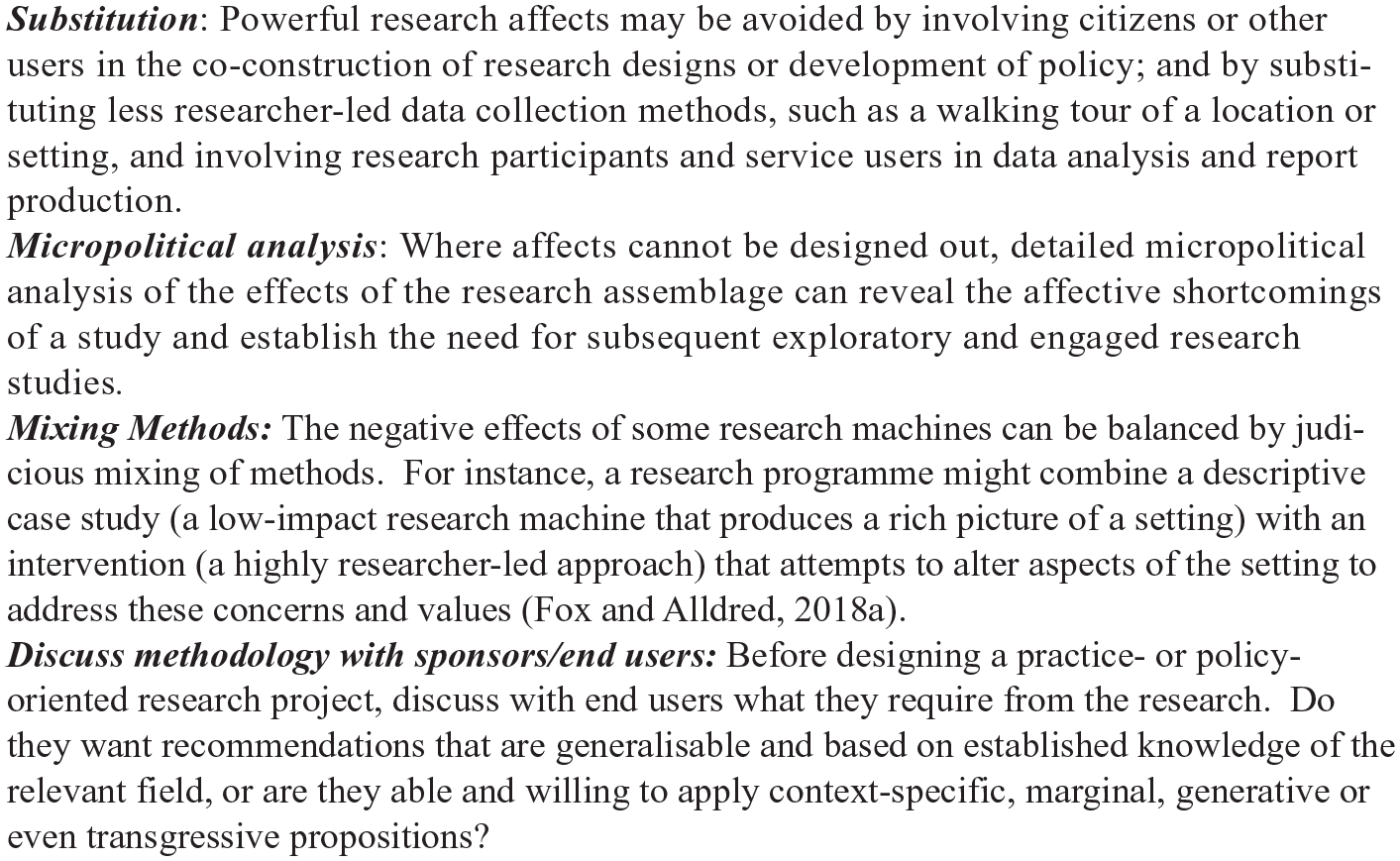
Strategies to manage researcher-affects.
While this supplies a pragmatic (small ‘p’) resolution of the tensions that we have explored in the article, we wish to conclude by addressing another insight enabled by a DeleuzoGuattarian diffraction of EOE and DM. At various points in this article, we have mentioned the distinction between ‘major and ‘minor’ science (Deleuze and Guattari, 1988: 373; see also Braidotti, 2019: 112–115; DeLanda, 2016: 91). These writers describe ‘major’ or ‘state’ science as practices that – in hock to authority and/or capitalist social relations – supply axiomatic knowledge of the world: authoritative knowledge that can be used to manipulate the natural or social world to serve and sustain privilege (Braidotti, 2019: 115; DeLanda, 2016: 90). By contrast, ‘minor’, minoritarian and participative science is engaged in the nitty-gritty of researching everyday life, following the problems, flows, and ‘becomings’ of a world in flux, and offering the disempowered opportunities to make sense of their own circumstances (Braidotti, 2019: 115; Deleuze and Guattari, 1988: 373).
Barad’s espousal of EOE falls firmly into the latter category; but so too do most qualitative research designs that ‘follow’ problems and use inductive reasoning to draw conclusions. Indeed, the definition of minor science as one that follows events and problems applies to virtually the entirety of empirical sociology and sociological research methods, with axioms notable by their absence and inductive reasoning from particular to generality the norm. That, however, is not a reason to abandon major science: after all, major science physics still works well at scales above the quantum level (Bohm, 1952: 166). Unlike Barad, Deleuze and Guattari (1988: 367) did not reject a major, representational science out of hand, nor does Braidotti (2019) in her recent promotion of a critical posthumanities (p. 116). DeLanda (2016: 95) meanwhile cautions against too strict a dualism: recognising that science like the rest of the world is itself a becoming, that minor and major approaches are both in flux and in dialogue (see also, Braidotti, 2019: 127).
These scholars acknowledge that both major and minor science have a part to play in understanding the world, and we would suggest that the insights into how research and event inter/intra-act in the research-assemblage offers further support for a research practice that is methodologically open and inclusive, cutting across a major/minor science dualism. Applied sociological research might then be considered as a minor science that is tentatively becoming-major (DeLanda, 2016: 95), to the extent that it offers insights and possibly theoretical models that allow data to be generalised to other settings. At the same time, as a critical discipline, there is a continual becoming-minoritarian movement in applied sociology.
It seems to us that practice- and policy-oriented research (where a need for validity and generalisability may outweigh contextual granularity) are situations where (as with macro-level natural science) representational approximation and theoretical elaboration may be used cautiously, by adopting one or more of the four approaches just outlined. The value of EOE lies in its reminder of the inevitable entanglements between researched and researcher; the opportunity that analysing research-as-assemblage brings is to enable us to assess how and to what extent these entanglements affect the data we produce. Social researchers should no more abandon efforts to enhance societal or individual well-being through practice and policy than those undertaking biomedical or environmental scientific research. They need to pro-actively manage their methodology and methods, choosing approaches (including diffractive analysis) best suited to their research aims (Lenz Taguchi, 2017: 708; Thomas, 2017: 684): from exploratory research through to policy development. We may draw upon (and where appropriate mingle) the plurality of designs, methods, and techniques at our disposal – from trials and surveys to exploratory and innovative methods, but always fully aware of how these research-assemblages diffract the data they produce.
Footnotes
Funding
The author(s) received no financial support for the research, authorship, and/or publication of this article.

Notes
Author biographies
Pam Alldred is professor in the Social work, Social Care and Communities department, Nottingham Trent University. She researches sexualities, parenting, and sex education, and has lead two large international projects on gender-related violence and then on sexual violence, with European Union co-funding. Pam recently published Sociology and the New Materialism (with Nick J Fox, Sage, 2017) and is co-editor of the Handbook of Youth Work Practice (Sage, 2018).