




Abstract
At a time of rising right-wing populism, the heightened political salience of immigration as an issue is linked to conceptions of ‘the national’. In this article, we analyse tweets from non-elites, defined as isolated users with low network influence, engaged in a ‘conversation’ about migration on Twitter. We investigate the values embedded in these attitudes, and what these tell us about constructions and contestations of the symbolic boundaries of the nation among ordinary people. Our corpus includes tweets posted in temporal proximity to the lifting of transitional controls on Romanian and Bulgarian migrants in the UK (1 October 2013 to 1 March 2014). Thematic analysis reveals a cohesive set of anti-immigrant or anti-immigration sentiments linked to UKIP and that express an exclusionary nationalism based on assumptions about race, ‘whiteness’ and entitlement. Also evident is a counter-narrative of pro-immigration sentiments that draw on multiple and sometimes contradictory values. Some of these values contest racialised understandings of the nation but do not coalesce in ways to disrupt the dominance of right-wing anti-immigrant sentiments on Twitter. Our findings demonstrate the importance of investigating values embedded in both anti and pro-immigration attitudes among non-elites and what these values indicate about the possibilities of re-framing migration debates among non-elites in ways that construct more inclusive symbolic national boundaries. In addition, in using the networked properties of Twitter engagement to identify non-elite users, we make a methodological contribution to scholarship on immigration attitudes.
Introduction
At a time of rising right-wing populism across Europe, as well as on-going migration and refugee flows across national borders, it is important to understand how attitudes to migration shape the cultural politics of belonging. The 2016 UK referendum on European Union (EU) membership exposed deep concerns about the impact of ‘Europeanised’ migration (Hearn, 2017). Indeed, political and media debates about Europe have focused on immigration since the early 2000s (Dennison and Geddes, 2018) and these have been reflected in the views of the British public. European migration has stirred up ideological questions about ‘British’ identity: ‘who are we?’ and who belongs. We examine a ‘conversation’ focused on migration among non-elites on the social media platform Twitter over a 5-month period in proximity to the lifting of temporary transitional controls on free movement from Romania and Bulgaria, 7 years after the two countries became full EU members. We consider the meanings and values embedded in immigration sentiments and whether these reproduce or contest elite (mass-media and politicians) discourses to analyse what these imply for the cultural politics of belonging in Britain. We define non-elites as those with low digital capital (or low online network influence measured in terms of reach and scale; Ignatow and Robinson, 2017: 952). We ask, what values are embedded in anti-immigrant and pro-immigrant sentiments among non-elites on Twitter? And, what do these values signal about who is included and excluded in the nation?
Our study confirms the presence of highly polarised immigration attitudes among non-elites on Twitter found in previous research on immigration attitudes online (Rutter and Carter, 2018). However, our study also extends existing research with its focus on values and beliefs embedded in these attitudes. We find anti-immigration sentiments signal a cohesive set of values that express an exclusionary nationalism based on assumptions about race, ‘whiteness’ and myths of essentialised singular cultures (Bhambra, 2017). These findings complicate dominant narratives linking Brexit to the ‘left behind’ (Becker et al., 2017). Also present are pro-immigration attitudes that draw on multiple, and sometimes contradictory values. Some of these values contest racialised understandings of the nation and construct more inclusive symbolic boundaries. However, the range of values embedded in pro-immigration sentiments does not coalesce in ways that can develop a counter-movement (Roth, 2018) to challenge the rise of right-wing populism. Our findings demonstrate the importance of investigating values embedded in both anti and pro-immigration attitudes and what these values indicate about the possibilities of re-framing migration debates among non-elites in ways that construct more inclusive symbolic national boundaries. In addition, in using the networked properties of Twitter engagement to identify non-elite users participating in Twitter ‘conversations’ on immigration, we make a methodological contribution to the study of immigration attitudes.
In the remainder of the article, we briefly review literature on British attitudes to immigration and draw on scholarship on the politics of belonging to present our theoretical framing. We then discuss our methodological approach to using social media data, with a focus on ‘non-elite’ Twitter users. This is followed by a presentation of our findings and discussion of their ramifications for the construction of inclusive national imaginaries.
British attitudes to immigration
Since the 2016 EU referendum, British public attitudes to immigration are softening but the issue remains politically contentious. Recent surveys indicate that while half of British people hold increasingly polarised attitudes towards immigration (Ford and Lymperpoulou, 2017), the other half can be described as ‘balancers’ (Rutter and Carter, 2018) who see both positives and negatives with current migration trends. These attitudes vary by age, education, and social class (Ford and Lymperpoulou, 2017; Rutter and Carter, 2018: 40–43). Older generations, those with few qualifications and in low-skilled jobs express stronger anti-immigrant views. Younger people and those with higher educational levels or better paid skilled jobs are linked to greater support for immigration, though these factors have limited impact on anti-immigrant attitudes among those younger people who have been socialised in the context of strong far-right, anti-immigration mobilisations (McLaren and Paterson, 2020).
Research on what shapes attitudes to immigration focuses on economic factors (labour market competition or public welfare burden) or cultural impacts (the threat to national identity and associated values and beliefs). National majority groups across North America and Western Europe are not concerned with personal self-interest and labour market competition (Hainmueller and Hopkins, 2014); rather, there is consistent evidence for sociotropic considerations (concern with impact of cultural markers such as race, religion or language on the nation), and can include concern with economic impact on the nation (Hainmueller and Hopkins, 2014). However, UK studies indicate concern with labour market competition from immigrants and perceptions of immigrants as a burden on public services (Duffy and Frere-Smith, 2014; Rolfe et al., 2018; Rutter and Carter, 2018). In fact, Larsen et al. (2018: 1) observe a form of ‘welfare nationalism’, where immigration attitudes are linked to the perceived economic strain of immigrants on the British welfare state, rather than a desire to preserve an ‘authentic’ national culture. Furthermore, concerns about the impact of immigration on national identity and culture are also present alongside appreciation for immigrant contributions to food and music (Duffy and Frere-Smith, 2014). However, different types of immigrants activate different types of threat perceptions, with Eastern European migrants linked to economic concerns and crime, and Muslim immigrants associated with security and cultural threats (Hellwig and Sinno, 2016).
The presence of an ‘ethnic hierarchy’ (Ford, 2011), reflected in preferences for White, English-speaking, European, and Christian migrants, further complicates understanding of factors shaping immigration attitudes in the UK, even among those holding positive attitudes to immigration (Blinder and Richards, 2020). Other research indicates a greater emphasis on migrants’ skills and education over ethnicity (Ford and Lymperpoulou, 2017: 8–10) and support for migration that is both economically beneficial and socially useful rather than simply highly skilled (Rutter and Carter, 2018: 50–51).
Overall, existing scholarship indicates that immigration attitudes are driven by a broad set of concerns related to the cultural, and to some extent, the economic impact of immigration on the nation. We build on this research to investigate the meanings and values embedded in non-elite immigration sentiments and what these imply for constructions and contestations around the symbolic boundaries of the nation.
The cultural politics of belonging
The politics of belonging are concerned with the symbolic boundaries of an imagined community and are delineated and contested by those who have power. Cultural schemas that draw on criteria such as (the myth of) common descent, common culture (e.g. religion, language), and common values that contribute to loyalty and solidarity, ultimately defines who belongs to the nation (Yuval-Davis, 2011: 20–21). Anderson (2013) argues that ideas of the nation often overlap with a ‘community of value’, such as upholding the rule of law, rewarding hard work, respecting human rights, and free speech. In other words, a nation comprises an imagined collectivity that shares common ideals and patterns of behaviour that are expressed through ethnicity, religion, culture, or language. Those who uphold these values and practices are identified as the ‘good citizen’; those who are perceived as incapable or fail to live up to these values, such as ‘benefit scroungers’ or criminals, are viewed as ‘failed citizens’. Here, Shilliam’s (2018) analysis of the intersection of class and race in the racialised production of those deemed ‘undeserving’ in British society is instructive in understanding who are likely to be viewed as ‘failed citizens’ in Britain.
Categories of the ‘good citizen’ and the ‘failed citizen’ also link to the non-citizen or the migrant. To be included in the community of value, migrants must present themselves as ‘good citizens’ who display cultural competencies such as language and knowledge of ‘British values’ as well as behaviours like responsibility, commitment, and self-improvement (Turner, 2014) to prove they are worthy of being included in the ‘community of value’ (Anderson, 2013). This neoliberal view of citizenship is rooted in liberal ideals about the individual, autonomy, and freedom (Anderson, 2013), but also emphasises the self-reliant entrepreneurial self. Neoliberal definitions of the ‘good citizen’ are likely to be reinforced in the post-Brexit era but may also be malleable given the pandemic.
The political processes of determining those who are included or excluded from the ‘community of value’ draw attention to power (Yuval-Davis, 2011: 18). Those who are deemed to be outside the ‘community of value’ (most often along lines of race and culture) are defined by immigration and citizenship regimes (Anderson, 2013; Shilliam, 2018). In recent years, right-wing populist political movements and parties have become a key feature of the European political landscape (Brubaker, 2017; Widfeldt and Brandenburg, 2018; Wodak, 2015). A common denominator among these parties is ethnic nationalism and a desire to protect the nation’s majority culture from dangerous ‘others’ (Rydgren, 2017: 485), which has implications for anti-immigrant sentiments. Scholarship on right-wing populism draws attention to the mediatisation and politicisation of the immigration debate in elite discourses, which others have linked to the cultural politics of entitlement, belonging, and citizenship (Fox et al., 2012; Gupta and Virdee, 2018; Schierup et al., 2018). These critical analyses underscore the importance of scrutinising elite (mainstream political elites and mass media) discourses on immigration and their implications for the cultural politics of belonging.
However, there is more limited understanding of how and whether elite discourses and values are simply absorbed and accepted, or indeed contested by the wider population. We agree with Thompson (2001: 28–29) that examining the values, beliefs, customs, conventions, habits, and practices of the ‘British nation’ that individuals actively draw on to make sense of events, individuals, or characters encountered can lead to a sociological understanding of how differences between ‘us’ and ‘them’ are conceptualised and the community of value that is constructed among non-elites.
Social media and non-elite immigration sentiments
We argue that social media offers a window into the ‘conversation’ on immigration among non-elites and gives insights into uncensored public views of the nation and the cultural politics of belonging. Micro-blogging platforms such as Twitter have become popular ‘space[s] for online citizens to publicly express their reactions to events’ (Williams et al., 2017: 1151) and news, and have played a key role in protests against Brexit (Roth, 2018) and counter-movements such as Black Lives Matter and Me Too (Caliandro and Graham, 2020).
In contrast to the limitations of surveys (Blinder, 2015) that are traditionally used to research immigration attitudes (Hainmueller and Hopkins, 2014) and the potential for performance and social desirability bias in qualitative methods, Twitter offers opportunities for the ‘bottom-up’ study of public opinion on immigration. Tweets provide ‘spontaneous’ or unsolicited insights into what users think and say on a given topic ‘in an inductive way’ and offers real-time opinions on ‘rapidly evolving events’ (Flores, 2017: 344). In this way, tweets offer a ‘posed view of the backstage: [where] we see what people want us to/let us see’ (Murthy, 2012: 1065). Scholarship on debates on migration on social media has focused on elites (Bennett, 2018) or how Twitter itself structures conversations in ways that also still privileges established media, political, and humanitarian non-governmental organization (NGO) elites and narratives (Siapera et al., 2018). Other research illustrates how platform affordances (retweets, likes, recommender algorithms) ‘organically’ enable ‘crowdsourced elites’ that challenge mainstream media (Papacharissi and de Fatima Oliveira, 2012). We argue that social media offers the potential for targeting narratives on migration outside those broadcasts by mainstream media or elite political dialogue, to study values embedded in immigration sentiments and how the politics of belonging are shaped and challenged by non-elite actors online (Jackson and Foucault Welles, 2015).
Following Ignatow and Robinson’s (2017: 952) Bourdieusian conceptualisation of digital capital – where ‘a person’s stock of digital capital corresponds to the reach, scale and sophistication of [their] online behaviour’, we define users with relatively low ‘digital capital’ as non-elites. On Twitter, reach and scale correspond to the observable ways that tweets are situated within networked interactions (retweets, replies, and hashtags) that circulate, propagate, and centre particular narratives from a range of elite and non-elite users. We use retweets as a proxy for digital capital to identify non-elites (with correspondingly low reach and scale) and we explore the ‘community of value’ embedded in tweets from both anti- and pro-immigration non-elites to investigate constructions of the nation.
Data and methodology
To investigate non-elite attitudes towards immigration, we targeted historical tweets posted in proximity to the lifting of transitional controls on Romanian and Bulgarian migration to the UK in January 2014. The project purchased public, undeleted tweets created between 1 October 2013 and 1 March 2014 containing the keywords ‘immigration’, ‘immigrant’, ‘migration’, or ‘migrant’ from a commercial company providing access to the full historical Twitter firehose (100% of tweets that matched our criteria). 2 This initial collection yielded almost 2 million tweets, which we subjected to two further selections; we filtered the data using the keywords Bulgaria/Bulgarian or Romania/Romanian and England, the UK, or Britain (136,960 tweets), and by geo-location and time zone metadata to produce the corpus of 47,978 tweets. 3
Social network analysis, using the R programming language, revealed a small number of highly influential users in the centre of the whole retweet network diagram (Figure 1): mainstream British media outlets from the right and left of the political spectrum, a pro-migrant group and a network of academics and practitioners facilitating research on the lived experiences of border control. Our corpus also indicated that 95% of tweets were never retweeted during the 5-month period, with a large proportion of isolated users shown on the periphery of the network diagram.
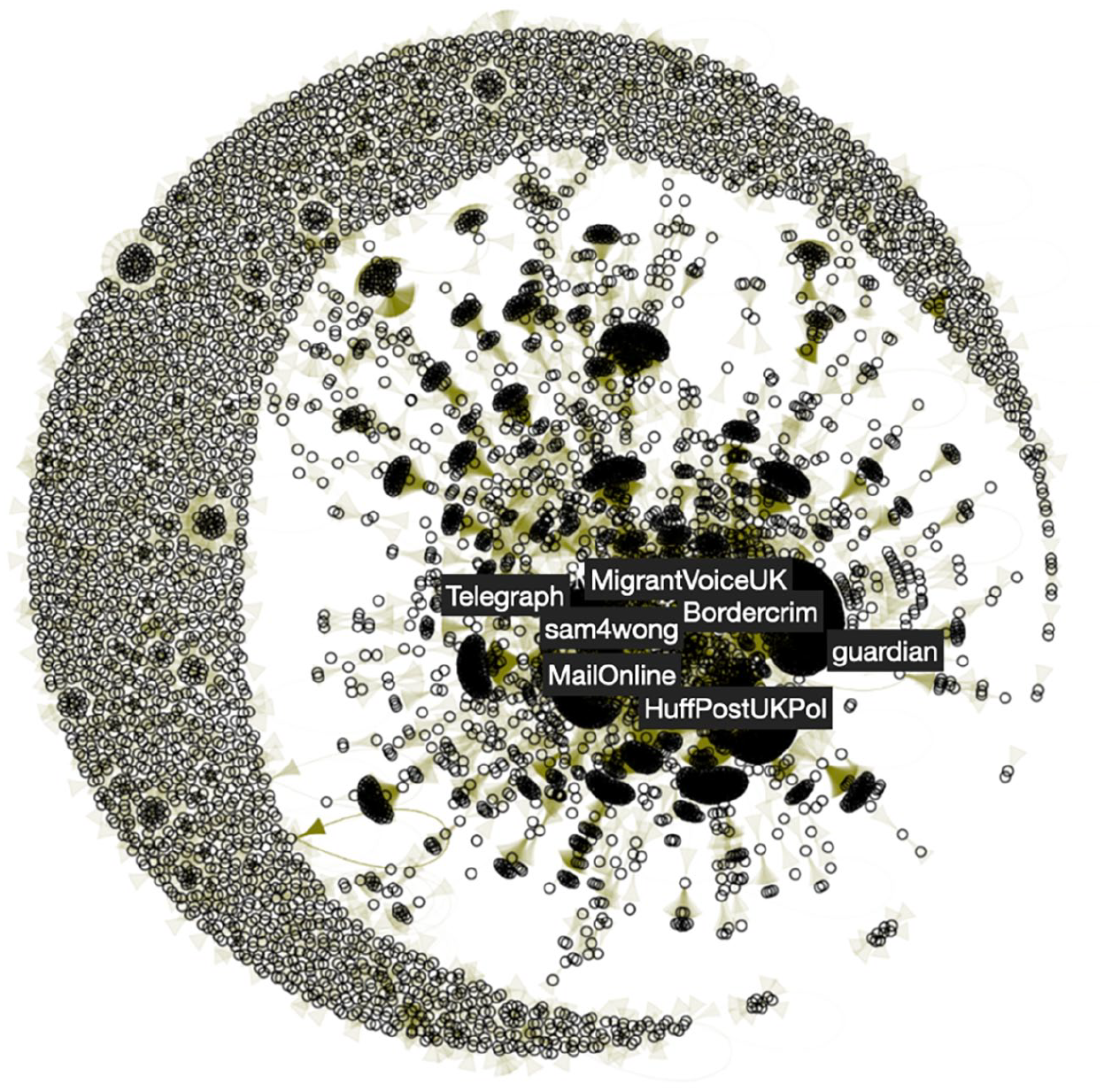
1 October 2013 to 1 March 2014 retweet network showing a band of isolated ‘non-elites’ in the periphery of the network.
Based on their position in the retweet network, this led us to identify these isolated users as ‘non-elites’. We argue that they are nevertheless participating in Twitter ‘conversations’ on immigration. As boyd et al. (2010) note, Twitter’s affordances facilitate the networked dispersion of conversations with interconnected actors so that ‘many people may talk about a particular topic at once, such that others have a sense of being surrounded by a conversation, despite perhaps not being an active contributor’.
We then conducted thematic coding on a 5% random sample of tweets that had not been retweeted for each of the 5 months. We followed Braun and Clarke’s (2006) six stages of analysis to collectively familiarise ourselves with the corpus and generate codes based on our literature review and themes observed across the data. We began with general codes for tagging tweets according to the ‘positive’, ‘negative’, or ‘neutral’ sentiment conveyed using NVivo. Where we could identify sentiment, approximately 60% of tweets were anti-immigration and 40% were pro-immigration. In stage 2, we inductively (and iteratively) refined the set of codes within tweets exhibiting positive and negative sentiments to tag specific topics emerging across the 5% random sample. The tree-map in Figure 2 illustrates the final coding families we collectively agreed.
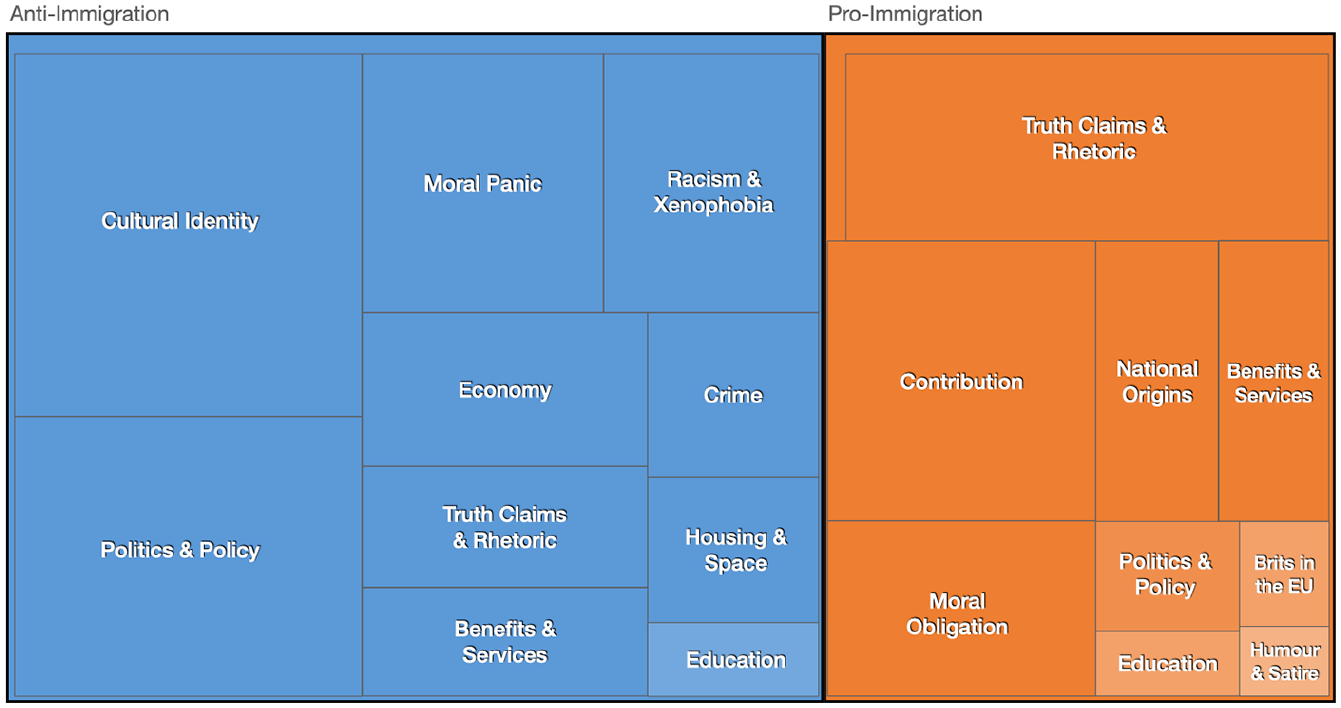
NVivo tree-map of coding families. The size of boxes is proportionate to the number of tweets assigned to the code family.
Methodological reflections
Despite the opportunities, using Twitter data for studying attitudes to immigration highlights several methodological considerations. First, we acknowledge that Twitter users do not constitute a representative sample of the UK population; they are mostly male, and while the young are predominant, there are a growing number of older users than previously thought (Sloan, 2017). In addition, a disproportionately higher number of users tend to come from managerial, administrative, and professional occupations relative to the UK population. We readily recognise that Twitter users are a self-selecting population, and that windows into the meanings and values embedded in their immigration attitudes are inherently shaped by the sociotechnical affordances of the platform and social media data itself. However, the networked properties of Twitter afford opportunities for targeting non-elite users or tweets with limited reach and scale (Ignatow and Robinson, 2017) – where we define ‘eliteness’ as an emergent networked property of Twitter engagement rather than that linked to demographic or otherwise ‘fixed’ characteristics of users (Papacharissi, 2015).
Second, scholars point to the proliferation of semi-automated ‘bot’ social media accounts, their use in amplifying particular viewpoints and their deployment in politically polarised information ecosystems online (Bastos and Mercea, 2019; Bradshaw and Howard, 2017). While we cannot rule out the presence of automated tweets in our sampled dataset, by focusing on tweets with a low degree of network centrality and the discursive constructions of the nation themselves (rather than the prevalence of particular constructions), we have reduced the likelihood that bots had a significant influence on the nature of our findings and interpretations.
Third, several ethical issues surround the use and repurposing of public Twitter data for research. While recognising that these data are already in the public realm, and that users who agree to Twitter’s terms and conditions legally consent to Twitter making public posts available to third parties, we heed calls (Markham, 2012; Williams et al., 2017) which advocate for the rights of social media users in the face of now ubiquitous use of these forms of ‘big data’. In the absence of informed consent from Twitter users, we have made every effort to anonymise and mask tweets using a ‘bricolage style’ for reconfiguring the original tweet in ways that protects users’ identities, while still representing the intended meaning (Markham, 2012).
In the following sections, we present our findings and illustrate these with masked tweets in bullets.
Anti-immigrant sentiments
Anti-immigration attitudes display a community of values linked to the sociotropic concerns of immigration. Key themes focus on immigrant’s moral worth, but also reveal anxiety about the impact of immigration on national space and culture. Also, of significance is that these sentiments echoed sociotropic concerns about immigration that were articulated by the UK Independence Party (UKIP). In total, 47% of tweets that mentioned political parties either mentioned UKIP or mentioned both UKIP and another mainstream political party. These users can be described as the ‘Eurosceptic’ class (Widfeldt and Brandenburg, 2018); they viewed UKIP as the only party that would steer Britain out of the EU and reclaim British sovereignty over immigration.
Socio-economic impact of immigrants
Despite the EU Citizens’ Rights Directive that guarantees EU citizens a range of social and economic rights, including the right to work in any member state (Dennison and Geddes, 2018), EU migrants were portrayed as immigrants who had no rights to ‘our’ social resources: Unemployed EU Immigrants Cost £1.5 Billion to the NHS Alone 600,000 scrounging immigrants in Britain, they shouldn’t be here we owe them nowt Will all the people who welcome immigrants to UK be happy when they can’t get job, council house, school for kids or NHS appt I hate what my country has become. England invites breeding, sponging immigrants who have ruined our lives
These tweets convey discourses of ‘welfare nationalism’ (Larsen et al., 2018), and a community of values rooted in liberal ideas that link immigrants’ welfare ‘deservingness’ to belonging and prior contribution. A figure of ‘600,000’ unemployed EU migrants circulated in the October tweets, underscoring the discourse of immigrants as welfare scroungers, and overwhelming our social infrastructure. EU migrants were also perceived as undermining economic opportunities (Hellwig and Sinno, 2016) and decent jobs for English people, with blame attributed to political elites in mainstream parties for Britain’s membership in the EU and implementing immigration policies that have led to mass immigration: blame liebour for this, mass Immigration drives down wages. Good for business A million unemployed . . . 3.5 million EU workers making it near on impossible to get work! it is a BIG LIE that Britain needs mass immigration. We can easily train-up indigenous Brits. When UKIP is in power it will ban mass immigration, job outsourcing and zero hour contracts. UKIP cares about English people
Antipathy to immigrants or immigration is largely based on concerns about negative impact of immigration on the British labour market and welfare state rather than individual economic self-interest (Hainmueller and Hopkins, 2014).
Over the 5 months, most tweets used labels such as ‘immigrants’, ‘illegal immigrants’, or ‘EU immigrants’, demonstrating UKIP’s success in the circulation of the label ‘EU immigrant’ in public debate (Dennison and Geddes, 2018: 1140) and political saliency of Europeanised migration. Very few use the label ‘Eastern European immigrants’ and it is only in December and January that the label ‘immigrants’ is linked to the national category ‘Romanian’ and ‘Bulgarian’ more frequently. In addition, Romanians and Bulgarians are referred to indirectly, for example, in the following tweet where ‘low life immigrants’ alludes to Romania as one of the poorest EU countries: EU is forcing its low life immigrants to come to UK this is a blatant attempt to destroy our country . . .
Portrayals of Romanian and Bulgarian migrants as degenerate (Anderson, 2013) and undeserving parallels shifting attitudes towards Polish migrants from ‘desirable’ to ‘threatening’ in the tabloid media and some political discourse since the 2008 financial crisis – which has intensified since the EU Referendum (Rzepnikowska, 2018). This suggests a presence of an ethnic hierarchy (Ford, 2011) in relation to Eastern European immigrants (see Fox et al., 2012).
Moral panics over ‘national space’ invaders
There is palpable moral panic (Cohen, 1972) in December about the implications of lifting transitional controls. The word ‘immigration’ was more likely to be preceded by descriptors such as ‘uncontrolled’, ‘wave of’, ‘influx of’, ‘flood of’, ‘unfettered’, and ‘uncapped’ in December and to some extent in January. Cohen argues that moral panics emerge when the media and those in authority construct particular groups or an issue as a threat to established norms and values. Vicol and Allen (2014) found heightened concern with being overwhelmed with large numbers of migrants in established media portrayals of East European migrants. These racialised portrayals draw on migrants’ putative essential cultural and social characteristics to portray them as racial ‘others’ (Fox et al., 2012) and a threat to the nation. Such metaphors point to the fluidity in the supposed shared Whiteness that can legitimate exclusion or create contingent inclusion.
Fear of opening the ‘flood gates’ relates to concerns about protecting the ‘national space’ from those threatening material entitlements for those perceived as belonging to the nation. Tweets expressing this concern project a sense that the UK has become overcrowded and overwhelmed, creating a ‘Broken Britain’: Romanian & Bulgarian immigrants only been allowed in the UK since January and half the country is already sinking Labours mass immigration put’s chronic pressure on housing, schools, welfare; created massive resentment across Britain IMF upgrades UK growth. Economy growing but means more immigrants will flood UK, living standards & Uk society worse
Concern with the scale of migration and its impact on Britain has been a feature of the British press leading up to the Brexit vote (Allen, 2016). Attitudes to immigration reflected in the tweets presented earlier may reflect influence of the media and UKIP, but also suggests sociotropic concerns with the long-term implications of immigration on national resources and space (Garner, 2012), rather than direct experience of competition.
Protecting the community of value from cultural ‘others’
The ‘Broken Britain’ theme is interspersed with narratives related to the social and cultural threats posed by new migrants, as well as established Asian communities. They are portrayed as cultural ‘others’; as uncivilised compared to the ethnic majority population in Britain: immigrants, gypos bog off the uk don’t want you here your scum thieves murders rapist Roma girl put newborn for sale in park . . . The Future!!! Genuine asylum seekers YES. Illegal immigrants and criminals entering UK. NO 88% of crime in London by immigrants. . . . We’ve got diseases in UK we haven’t had in years. In UK we queue & in case you don’t know what that is we will give you a lesson on arrival
It is not clear whether both Romanians and Bulgarians are linked with criminality in our data. Previous research (Fox et al., 2012; Vicol and Allen, 2014) finds that tabloid media often identifies Romanians as Roma and links them to crime and anti-social behaviour. These migrant groups are also seen as outside the ‘community of value’ signalled by shared norms of civility such as queuing (Leddy-Owen, 2014: 1127), providing further evidence for contingent forms of Whiteness (Anderson, 2013) that disrupt the ‘ethnic hierarchy’ in migrant preferences (Ford, 2011).
Although data collection occurred around the period of removal of transitional controls on Bulgarian and Romanian migrants, concerns about protecting the community of value also extended to settled Asian communities. As Rutter and Carter (2018) find, anti-Muslim prejudice is widely prevalent and sometimes influences views on immigration: curry houses are full of illegal immigrants with terrorism DVDs . . . send the fuckers back home. Nothing wrong with immigration. Some Asians make UK better country. non integrated BRITISH islamik nazis are the problem. . . . if you want live in Britain you have to live by British way of life end off. ‘Racist’ is favourite label for any complaint about immigration, backward ways of foreign nationals/religions If second generation immigrants can’t behave as per norm in Britain & commit crime they must be sent ‘home’
Although not always named, tweets expressing sentiments towards settled minorities conveyed concerns with lack of integration and disloyalty among Muslims, who are linked with security and cultural threats to the British nation and culture (Hellwig and Sinno, 2016; Rutter and Carter, 2018).
Erosion of local (White) communities and cultures
Particular vocabulary and rhetorical strategies such as the use of capital letters in some tweets reflect heightened anxiety and perceptions of Muslims, Roma and the second-generation as cultural others. Some tweets display concern with erosion of local communities and cultures, with the sub-text of such erosion affecting White communities and cultures: Flooding of England with 3rd world is not immigration but ethnic cleansing Vote Labour, destroy England as they will continue mass immigration & eradicate the ENGLISH! Britain was made up of white Brits before mass immigration and we’re the indigenous of the land applaud Britain for accepting immigrants, they weaken your country, your heritage, your culture
A sub-set of these tweets embody concern with cultural and racial genocide of White Britons or ethnic cleansing of White Britons. They address the perceived cultural, symbolic, and spatial threat from present and past migrations and emphasise autochthonous belonging for the ethnic majority in England. As the dominant group, they position themselves as the powerful and symbolic owners of the national space who feel entitled based on bloodlines and prior contributions (Garner, 2012).
Pro-immigration sentiments
Although smaller in proportion, our corpus of tweets also included a significant level of pro-immigration sentiments that contested truth claims and rhetoric in the anti-immigrant public sentiments. As Rutter and Carter (2018: 67) find, many users were concerned that the wider immigration debate was based on stereotypes, emotions (rather than evidence), and the tendency in traditional media to conflate categories such as refugees, asylum seekers, and migrants (Blinder, 2015). Pro-immigration tweets also addressed sociotropic themes and pointed to immigrants’ moral worth. In addition, they displayed concerns with the impact of current immigration policies on migrants and highlighted Britain’s moral obligations. These attitudes are not linked to a specific political party or organisation, and embody multiple, and sometimes contradictory, communities of value.
Earned citizenship?
Earned citizenship was a key theme among pro-immigration tweets. Some users challenged perceptions of Eastern European migrants as a drain on the economy, highlighting the economic and social contributions of immigrants: From East England Farmers – without East European immigrants there will be no business. Lazy Benefit Street British If immigrants boost the economy they are welcome. Open the flood gates, but, don’t give them benefits. Immigrants paid £25billion more in tax to UK economy than they claimed in benefits Immigrants under- appreciated in their role in NHS and social care in UK. Immigrants have contributed to Britains wealth, cleaned toilets, picked fruit, stock shelves but now we don’t want them! Wow
As Rutter and Carter (2018) found, these users applaud migrants’ economic and social contributions and support migration that is ‘useful’. In viewing these migrants as ‘good migrants’, these attitudes also embody a neoliberal conception of earned inclusion: migrants can be welcomed into the ‘community of value’ (Anderson, 2013) because they have proven themselves to be deserving through their ‘self-responsibilisation’ and productivity (Walters, 2004). In contrast, some users turned attention away from migrants’ earned inclusion through ‘good behaviour’ (Walters, 2004) to the ‘bad behaviour’ of British class elites: Tories: No human rights, no NHS, no welfare state, no trained teachers, no immigrants. Just posh boys, housing bubbles and hedge funds The vindictive uneducated comments on welfare, immigration or just sharing wealth shows how the Tories have made a divisive Britain. charging ‘immigrants’ for A&E is unethical waste of time. Shd focus on big UK business & make sure paying fair tax.
These users attributed anti-immigrant sentiments among segments of the British population to the impacts of neoliberal economic and political projects, particularly under Conservative governments that have facilitated ‘abuse’ of the economy by class elites and undermined social rights. This was perceived as creating competition for social resources between immigrants and the working classes. In so doing, they contested liberal ideas (Anderson, 2013) embedded in the community of value.
Challenging racial exclusion; celebrating cultural enrichment
Some users displayed explicitly ‘pro-migrant’ attitudes through their concern with the impact of the 2014 Immigration Bill that was being debated in UK Parliament at the time. This Bill reinforces the view that illegal or irregular migration is criminal and underscores that migrants who fall into these categories fail to meet the criteria of the ‘good migrant’. However, the Bill goes further by criminalising individuals or statutory bodies who fail to enforce existing immigration laws. There was a perception that, if passed, the Bill would lead to the denial of social rights for immigrants and result in ‘everyday bordering’ (Yuval-Davis et al., 2018) and exclusionary effects for asylum seekers and migrants: Uk #immigration bill will harm communities and marginalise refugees and asylum-seekers Appalled that amendment tabled to Immigration bill will ban ppl with HIV from living in UK NHS staff to make patient pay, BEFORE treatment? Unethical waste of time Immigration bill will introduce pass laws to UK.
These tweets are likely to be from immigrant and refugee advocates who embrace a language of social and civil rights for asylum seekers. They embody a conception of citizenship for refugees as a right, rather than that which is earned through good behaviour and respect for ‘our values, our way of life’ (Walters, 2004: 247). Some users were concerned that the Immigration Bill, and wider anti-immigration/anti-Romanian and Bulgarian sentiments were contributing to heightened racial divisions. They demonstrated concern with the xenophobic exclusionary narratives promoted by right-wing populist parties and increasingly incorporated by some mainstream media and political parties (Wodak, 2015): Somewhat worrying that UKIP is obsessed with white race. I thought it was EU migration they had a problem with So many bigoted opinions about the Romanian/Bulgarian immigration. DC Warned, Stop ‘Pandering To UKIP Prejudices’ And soften Tone On Immigration – too late, damage done. More worryingly is that racist & anti-immigration attitudes have become mainstream. BNP made UKIP electable.
Other users challenged anti-immigrant sentiments by pointing to the ways in which the class and race privileges of some migrant groups makes them invisible in the public discourse on immigration: I am an immigrant. Most UK folks don’t see me as such, because I’m white, educated, fluent in english. Double standards Migrant=poor=welfare claimant. No ‘US migrant’ or ‘JP migrant’ visible in public discourse.
These tweets allude to preferences for certain migrant groups that are perceived as ‘integratable’, and therefore desirable (Sobolewska et al., 2017: 19) in anti-immigrant attitudes and in some pro-immigrant sentiments. Overall, pro-immigration tweets highlight how Britain’s migration policies and popular understandings of migrants are structured by Whiteness that creates shifting hierarchies of belonging (Yuval-Davis et al., 2018). In doing so, they contest ethnic conceptions of the nation and desire to protect the nation’s majority culture embedded in anti-immigrant sentiments. Other users explicitly valued ethnic and cultural diversity brought about by immigration: Welcome to Romanian migrants to Britain. The richness of migrant cultures has enriched life for everyone I am sick of immigrant bashing – what about the richness and culture that they bring to UK? Little Britain – is disgusting All this immigration anger is just #tory / #ukip / #racist #propaganda. Immigration has made London for one a better place. Immigrants . . . saving the Church in the UK! #UKIP and Nigel Farage will be very confused!
In addition to balancing out an ageing population and reviving local communities, immigrants were perceived as positively contributing to multicultural and global Britain.
The past shapes the present
Some users highlighted that the physical and symbolic boundaries of the nation have always been porous to challenge what they perceived as a ‘Little England’ mentality in anti-immigrant sentiments: keep Britain British! Yeah let’s by ignoring Celtics Romans, Normans, Anglo-Saxons, Vikings Farage’s ancestors were Huguenots. A bunch of ‘bloody immigrants harping about human rights’ In recent immigration history to UK, amazing how the Irish are left out – seen as ‘other’ until quite recently.
Drawing attention to historical migration flows also involved remembering Britain’s colonial history and the contribution of colonies to Britain’s development: Just saw UKIP picture that said Britain isn’t great because we have immigrants . . . they forget what made us Great. When you remember countries we have ransacked in the past it’s outrageous to moan about immigration.
By urging people to remember historical flows, these users expressed pro-immigration attitudes by challenging what they perceived as the myth of a homogeneous nation centred on Whiteness and amnesia around imperial histories (Bhambra, 2017).
Discussion and conclusion
Debates among politicians and established media on migration leading up to the 2016 EU Referendum highlighted concerns about Britishness: who ‘we’ are and who belongs to the nation. Much scholarship on the politics of belonging focuses on these elites but we do not fully understand whether elite discourses on the nation are accepted and reproduced or contested by non-elites (Thompson, 2001). In using the networked properties of Twitter engagement to identify non-elite users whose tweets had limited reach and scale (Ignatow and Robinson, 2017) but are nevertheless, participating in Twitter ‘conversations’ on immigration, we make a methodological contribution to the study of immigration attitudes.
Our study also extends scholarship on immigration attitudes by investigating the values embedded in both anti and pro-immigration attitudes, and what these values indicate about the possibilities of re-framing migration debates among non-elites in ways that construct more inclusive symbolic national boundaries. The findings confirm that anti-immigrant or anti-immigration sentiments are concerned with the sociotropic impacts of both EU migration and settled minority communities. Some users express resentment and fear of loss of entitlements for the ethnic majority resulting from mass migration. The values embedded in anti-immigrant sentiments reveal an exclusive construction of the nation that holds the possibility for some Eastern European migrants to be included in the ‘community of value’ (Anderson, 2013) and identified as ‘good citizens’. However, while Whiteness represents respectability (Shilliam, 2018), not all ‘White’ migrant groups are equally privileged. Romanian and Bulgarian migrants are not viewed as upholding the ‘community of value’; they represent a ‘degenerate’ and contingent form of Whiteness (Anderson, 2013: 45; Fox et al., 2012). In contrast, Muslim groups are deemed to be incapable of adhering to British ideals and patterns of behaviour that are expressed through ethnicity, religion, and culture, which Brubaker (2017: 1194), links to the salience of Christianity as a civilisational identity evident in some right-wing nationalist movements in Europe. The contemporary cultural politics of belonging among segments of users in our data corpus underscores the persistence of race in constructions of an ethnic conception of the nation.
Values embedded in anti-immigrant sentiments coalesce around UKIP’s position on national sovereignty, economic, and social impact of mass migration (Widfeldt and Brandenburg, 2018) and the ethnic conception of the nation promoted by UKIP (Kenny, 2014) that are increasingly reflected in mass-media and mainstream political parties (Wodak, 2015). The dominant influence of right-wing populism is in line with other research on the framing of the refugee issue in Europe on Twitter (Siapera et al., 2018). The presence of such concerns in our data complicates the perception that UKIP’s position resonates with the White working class who are said to have been ‘left behind’ (Garner, 2012: 451). Given the demographics of British Twitter users, at least some of those expressing sociotropic concerns about the impact of immigration on resources, space, and culture may be middle-class Britons. Recent analysis of the Brexit vote confirms the influence of White middle-classes (Becker et al., 2017) and a discourse focused on Whiteness, national identification, and indigenous status (Mondon and Winter, 2018: 7).
Our analysis also reveals pro-immigration sentiments and the multiple communities of value embedded in such sentiments. Some users exhibit a rational calculus in highlighting economic and cultural contributions of immigrants in general, and implicitly their appropriate cultural competencies, which make them worthy of being included in the ‘community of value’ (Anderson, 2013). These conceptions of the ‘good migrant’ are rooted in neoliberal ideas about deservingness and earned citizenship. In contrast, other users focus on Britain’s immigration policies, history, and obligations or challenge aspects of anti-immigrant rhetoric. The political or ethical values embedded in these pro-immigration sentiments highlight concern with growing class divisions, anti-racism, multiculturalism, and human rights, or foreground Britain’s racial and imperial histories to challenge beliefs about autochthony, belonging, and entitlement based on Whiteness, as well as neoliberal conceptions of the ‘good migrant’.
These pro-immigration sentiments may be linked to established media and groups on the left that emerged as influential in our social network analysis (Figure 1), however, these counter narratives among non-elites on Twitter have not disrupted the dominance of right-wing anti-immigrant sentiments on the platform (see Siapera et al., 2018). In post-pandemic Britain, it remains to be seen whether these political and ethical values will gain visibility, especially among ‘balancers’ (Rutter and Carter, 2018) and coalesce into a counter-movement (Roth, 2018) around a particular political party or group to create an alternative community of value. Although we acknowledge that, while Kumar (2003: 272–273) identifies the seeds of an open and expansive Britishness that can transcend the exclusionary Englishness we have witnessed in the Brexit debates, Valluvan (2019) reminds us that nationalisms, even progressive, cosmopolitan nationalisms, are always already racially exclusionary.
Our study also raises questions about the role of social media platforms in mediating a public arena where non-elites can freely debate an issue such as migration. Certainly, our methodology and findings show that social media platforms offer an opportunity for non-elites to by-pass elite (mass-media and established politicians/parties) as gate-keepers to publicly challenge anti-immigrant sentiments and exclusionary constructions of the nation. While we have focused on non-elites, future research would benefit from examining the online information ecosystem underpinning engagement with emotionally charged issues such as immigration, including how narratives move between elite media or political actors to circulate among or are contested by those with lower digital capital, and the role of Twitter’s recommender, trending and feed algorithms in shaping the ‘conversation’.
Footnotes
Acknowledgements
The authors would like to thank their former colleague Justin Murphy for filtering the data to produce the final corpus of tweets, and conducting initial social network analysis to create the retweet network diagram; Silke Roth and Lambros Fatsis for their comments on previous versions of this article; and the three anonymous reviewers and SRO Editor for their extensive engagement with the article and constructive comments.
Funding
The author(s) disclosed receipt of the following financial support for the research, authorship, and/or publication of this article: This research was supported by a University of Southampton Web Science Institute Stimulus Fund grant.
