




Abstract
In this article, we combine a number of related elements – YouTube films, autobiographical methods, diaries, letters, and walking – to explore the sociological value of the films of Nelson Sullivan (1948–1989). Sullivan was a film maker who documented New York, and elsewhere, in the mid-late 1980s; however, the films are ‘vlogger style’ and offer richly detailed, relational, and dialogical accounts of the ever-changing figurations between Nelson and a cast of other characters. Here we aim to walk sociologically with Nelson. We explain of how we analysed Nelson’s films before considering the implications of repositioning ‘vlogs’ as something of a hybrid between letters and diaries. We then explore walking as an autobiographical act a little further. Finally, we conclude by considering the implications of Nelson’s work for past, present, and future sociological practice which uses YouTube videos and vlogs, by emphasising the importance of the ‘dialogic exchange’.
Introduction
In this article, we combine a number of, what for us are, related elements – YouTube films, autobiographical methods, diaries, letters, and walking. We use these as a ‘lens’ through which to explore the ‘sociological value’ of the films of Nelson Sullivan (1948–1989): If there was an open bar, a loud dance beat, and some cross-dressers, Nelson Sullivan was there, his video camera a cumbersome yet essential extension of his body. Nelson was the videographer of the downtown stars, voraciously trailing the scene queens . . . Thanks to his scrupulous attention, Nelson’s left behind a treasure trove of late-night videos that, even, more than the Warhol diaries, trenchantly capture the party years in all their gleeful, decadent fun. If you’re not in one of these Videos, you’ve been home too much and homo not enough. (Mutso, 1989: 27)
While the cultural significance of Nelson’s films is alluded to by Musto (1989), their sociological value has yet to be considered. Indeed, the very notion of something having ‘sociological value’ depends on one’s orientation towards data and research design. Yet, for us, these films are valuable for sociology as they offer various analytical possibilities for a wide range of subject areas including LGBTQ+ communities, the production of life writing, and documents of life or even the gentrification of space. Here, and perhaps more pragmatically, we approached these films at a time when the opportunities for an active, face-to-face, immersive, outdoor, primary research were limited. While the impact of COVID-19 may recede somewhat, the global pandemic has had very real consequences for how sociologists do research and how we understand and use data. These effects will remain for some time. Yet, it is precisely because of these limitations that sociologists need to continually reflect on how we do research, how we collect data, and continually re-consider what actually constitutes data (see Hughes and Goodwin, 2014). Indeed, any researcher beyond those with an immediate concern with media and film analysis might want to perhaps consider alternative data sources, such as the re-analysis of film, as a proxy for the full immersive fieldwork. We are far from suggesting these are new sources of data (see Przybylski, 2021) but that when combined with a ‘biographical lens’ and considered ‘afresh’ they have the potential to offer something additional including insight into a social world of which they are a part. Moreover, for anyone with a historical comparative perspective, wanting to understand the linkages between past, present, and future (see Hughes, 2013), need to be open to such sources of material.
Like the analysis of archival materials, the exploration of historical manuscripts, and the analyses of auto/biographical materials following the biographical turn, films such as those produced by Nelson Sullivan have a great deal to offer both in terms of their form and content. They ‘become’ sociological material, or more precisely material suitable for sociological analysis given the analytical possibilities that they offer. Our orientation here is less about aesthetics or the artistic merit of what Nelson has achieved, but instead how we can use the materials to inform and understand. The films offer so much more to sociology than static snapshots of one location or the standard disembodied, bedroom-based talking head of much YouTube material. Walking the streets of New York and Kershaw allows the viewer to be immersed in Nelson’s life. The films are not simply (or only) nostalgic pieces documenting a version of New York ‘lost’ in the historical ether, nor are they titillating curiosities depicting ‘groups’ and ‘lifestyles’ that ran counter to dominate trends and discourses in Reagan’s 1980s neo-conservative America. Instead, these are autobiographical materials of the first order and of the highest quality. Walking virtually and sociologically with Nelson through richly detailed, relational, and dialogical films examines the ever-changing figurations between Nelson and a cast of other characters, which provides an assortment of relational clues (Hughes and Goodwin, 2014) to lived lives, loves, life chances, power balances, opportunities, disappointments, and social change and transformation well beyond the lens.
In the remainder of the discussion, we cover three main areas. After reintroducing Nelson, we offer an explanation of how we have approached Nelson’s films and how this analysis centralised some of the key questions and issues we discuss in this article. This is not to offer a full analysis of the films which is beyond this article (see Goodwin and Parsons, 2020) but more to highlight the ‘possibilities’ as mentioned above. Second, we consider the implications of repositioning vlogs from being predominantly taken as ‘online diaries’, to autobiographical materials that are something of a hybrid between letters and diaries. This is not to codify or reclassify these films per se but, instead to draw and highlight out further their epistolary and relational content. Third, after observing that movement through place is a key feature of Nelson’s films, we explore walking as an autobiographical act a little further. Finally, we conclude by considering the implications of Nelson’s work for past, present, and future sociological practice which uses YouTube videos and vlogs, by emphasising the importance of the ‘dialogic exchange’.
(Re) Introducing Nelson Sullivan
Nelson Sullivan was a film maker, a ‘videographer’, who documented New York, and elsewhere, in the mid-late 1980s. Sullivan was described by Sean (2010) as a comparatively ‘. . . penniless music-store worker originally from the repressive confines of the rural South, he began renting an unassuming apartment at 5 9th Avenue in the Meatpacking District in the early 1980s’ (p. 1). While working in the music store, and after spells in college and owning a beauty salon, Sullivan’s interests in film and the New York LGBTQ+ club scene combined and he began to record his experiences and the experiences of others. According to Dick Richards, Nelson’s school friend and long-term collaborator (see, also Rivera, 2016; Sanchez, 2002; Sean 2010), Sullivan started filming on a cheap handheld VHS video camera before advancing to an 8-mm camera. Empowered by cheaper and more accessible technology through which to create film, Nelson was one of the first (if not the first) ‘vloggers’. As he himself suggests in 1989, he was one of the early pioneers of ‘pointing the camera at themselves and walking around’ (Nelson Sullivan, 2016b [1989]) talking into the lens to document the everyday, the mundane and the spectacular for a largely anonymous and undefined audience. It is suggested that during a 7-year period, he shot almost 2000 hours of footage (Sean, 2010). In this footage, Nelson records and observes in great detail much which is commonplace and everyday about his own life–the shopping trip, walking his dog, buying food at McDonalds, or clothes at a thrift store, through to the animated city street scenes and the ‘daily ballet’ of sidewalk life (Jacobs 1961: 64). From the mundane to the spectacular, Nelson richly documents an important New York scene ‘on the edge’ and at the margins. Nelson’s films offer unique insights, from multiple angles, into the New York LGBTQ+ party scene of that time: [Nelson] Why don’t people think of that? Why am I the only person I’ve ever seen pointing the camera at themselves and walking around? I mean, nobody’s ever seen that, obviously, and people just stop dead in their tracks and turn around and look when I’m doing it. It’s like they’ve never seen that. I think that’s highly unusual. There’s something . . . something that needs to be . . . some study needs to be done on why that is such a rare occurrence. [Dick]: Well, I think it’s because the cameras are so new. [Nelson] I think this year is the year that everybody is going to turn the camera around. It’s a ‘turn the beat around’ [world/whirl]. (Nelson Sullivan, 2016b [1989])
Nelson Sullivan died later that year on 4 July 1989. After his death, it was his friend Dick Richards who took over responsibility for managing the films and eventually made them available for public access either via the Fales Archives, at New York University, or the YouTube channel ‘5ninthavenueproject’. In an interview, he said: Once I had recovered from the shock of Nelson’s sudden departure, I made plans to go to New York and bring Nelson’s tapes back to Atlanta. We had a video partnership, and all our videos belonged to one another . . . [They] recognized the importance of Nelson’s tapes and looked after the tapes until I arrived. It took a while to box them up, but, with the help of UPS, all 600 of them arrived safely in Atlanta. Today, Nelson’s tapes have returned in New York and are being preserved in the Fales Archives at NYC, located in the heart of Downtown Manhattan where many of Nelson’s videos were made. They are available for anyone to see and use . . . (Dick Richards in Rivera, 2016)
The films on YouTube have received anywhere between 8 and 10,021,000 views with the 5ninthavenueproject channel having over 100,000 subscribers. While in no way systematic, reviews of the comments on the videos are overwhelmingly positive, reflecting on a different New York and the endless possibilities of what Fisher (2014) might refer to as ‘lost futures’. There is a recognition that what Nelson was doing, while commonplace now, was new. Yet, his practice of filming himself walking and talking into his large video camera means his films offer a contemporaneous, even ‘authentic’, vantage point of a time and a place. Well before the ubiquitous live-stream, speech to camera or ‘talking head’ of current social media, Nelson invites later viewers into his world. This world, Nelson’s world, is continually on the move – from parties, to lunch, for coffee, uptown, downtown, private clubs, and public spaces. Rather than attempting to describe this scene ‘after the fact’ as many vlogs and video diaries attempt to do, Nelson’s films invite us to ‘walk with him’ through New York and Kershaw, South Carolina.
Encountering Nelson: our orientation
Six films were iteratively chosen to form the basis of our focus (although we have watched considerably more than this), beginning with ‘Stopping at McDonalds in 1989’. This was the first video of Nelson’s that we watched and was suggested to us by the YouTube algorithm. On further exploration, it was clear that it was stylistically different from Nelson’s documentary videos as it used the selfie-style of filming. Nelson himself acknowledged that this was unique for the time (see previous section). Similarly, these films were substantively different from Nelson’s earlier videos as well, moving away from documenting the LGBTQ+ night-life scene, to capturing more mundane occurrences of Nelson’s day-to-day life. This included ordering McDonalds, waiting for his brother at a restaurant, going downtown with friends for drinks, and taking the dog for a walk. When talking to his friend Dick about his new camcorder, Nelson finds his ‘daytime’ videos to be significant too, echoing our focus and agreeing that there is something to be gleaned from these: I’m going to start going out in the daytime instead of at night. I mean, I’ve done the nightclubs. I love them, but there’s so much more going on in the day . . . (Nelson Sullivan, 2016b [1989])
These two changes were primarily what we were interested in exploring and is reflected in the six videos focussed on.
The ‘information’ available in Nelson’s films is multi-faceted. We position Nelson’s films as auto/biographical materials, in which time and space are crucial. This is particularly pertinent in Nelson’s films as Nelson himself moves through a variety of ‘times’ and ‘spaces’ during his recording. This includes filming while walking through downtown New York as well his hometown of Kershaw, South Carolina. Nelson also ‘visits’ and moves through particular locations in both. For example, he takes his mother and aunt to the World Trade Centre when they come to visit him in New York. As Stanley and Dampier (2006) highlight, auto/biographical documents are ‘never…an unproblematic direct representation of “real reality,”’ (p.39). Instead, as Goodwin and Hughes (2011) suggest, they are ‘themselves (part and parcel of) processes involving relationships past, present and (possible) future’ (p. 680). They show what Edensor (2010), in his consideration of walking rhythms, might call a ‘flow of experience’. This is not only relationships, experiences or events ‘within’ the films (or other auto/biographical documents), but could point towards that which lies ‘beyond the lens’ too. Finding a way to adequately capture and analyse these films in all their relational multi-modality, without ‘loosing’ parts of the footage, posed a challenge. Our solution has been two-fold. First, to unpack the films into three formats: a series of vignettes, dialogue transcriptions, and stills from the films using screenshots. Second, we spent considerable time iteratively watching the films themselves and discussing them at length (both before and after we selected the six to be made into vignettes).
Three of the six vignettes created are included here, with the rest available online (https://madeinleicester.com/documenting-downtown-nelson-sullivan/). These show Nelson in three of the major locations that feature in his films; in New York, in Kershaw and ‘on the road’. Despite our best efforts, the ‘sound’ and the ‘flow’ of the films is almost completely lost for readers of this article. There is no substitute for watching the films and we recommend that you take an opportunity to do so (see Appendix 1).
Alongside the vignettes we include some stills taken from Nelson’s videos. Credit for the stills used here is attributed to Good Dog Blackout LLC. Permission has kindly been granted to us by Good Dog Blackout LLC to include them here.
Vignette 1 – Nelson Sullivan’s 39th Birthday (Nelson Sullivan, 2018 [1987])
The video opens as Nelson is half-way through a sentence telling the camera it’s his 39th birthday. He is in the downstairs of his house, which seems to be a mostly open-plan space, so that when he moves around you see kitchen, then living room. The room is bright. He is constantly moving as he talks to the camera. Nelson has got ready to go out with friends for his birthday, wearing a smart jacket and scarf. He has a moustache. You can faintly hear his footsteps as he moves. Nelson listens to his phone messages. The camera is focused on the phone as he clicks a button and the tapes start moving – one message is from Eric, the other is from Ru Paul. The area around the phone is cluttered, the calendar is a month behind. The video seems to cut in and out where Nelson has stopped and started the camera. He moves inside and outside during the course of the video. First alone, then later with his friends Eric, Liz and Lana. Outside, city sounds can be heard, including car horns and moving cars. He gives us a moving view of the neighbourhood, focussing momentarily on buildings, road signs, meat trucks, and lorries. He smokes a cigarette, ruffles his hair and tries to find the best angle to record himself from. He looks up and down from the camera to the street, conscious of people looking at him as he films. When Eric, Liz, and Lana arrive Eric takes a photo of Nelson and they walk into his house. When Nelson talks to his friend Paula on the phone, Eric is mouthing something to Nelson, before Nelson finishes the call and they head out. Before leaving, the camera lingers on a portrait of Nelson. They all say goodbye to Nelson’s cat – Eddie – and dog – Blackout. The video closes as they go out to ‘have fun’, the last shot lingering on their colourful shoes.
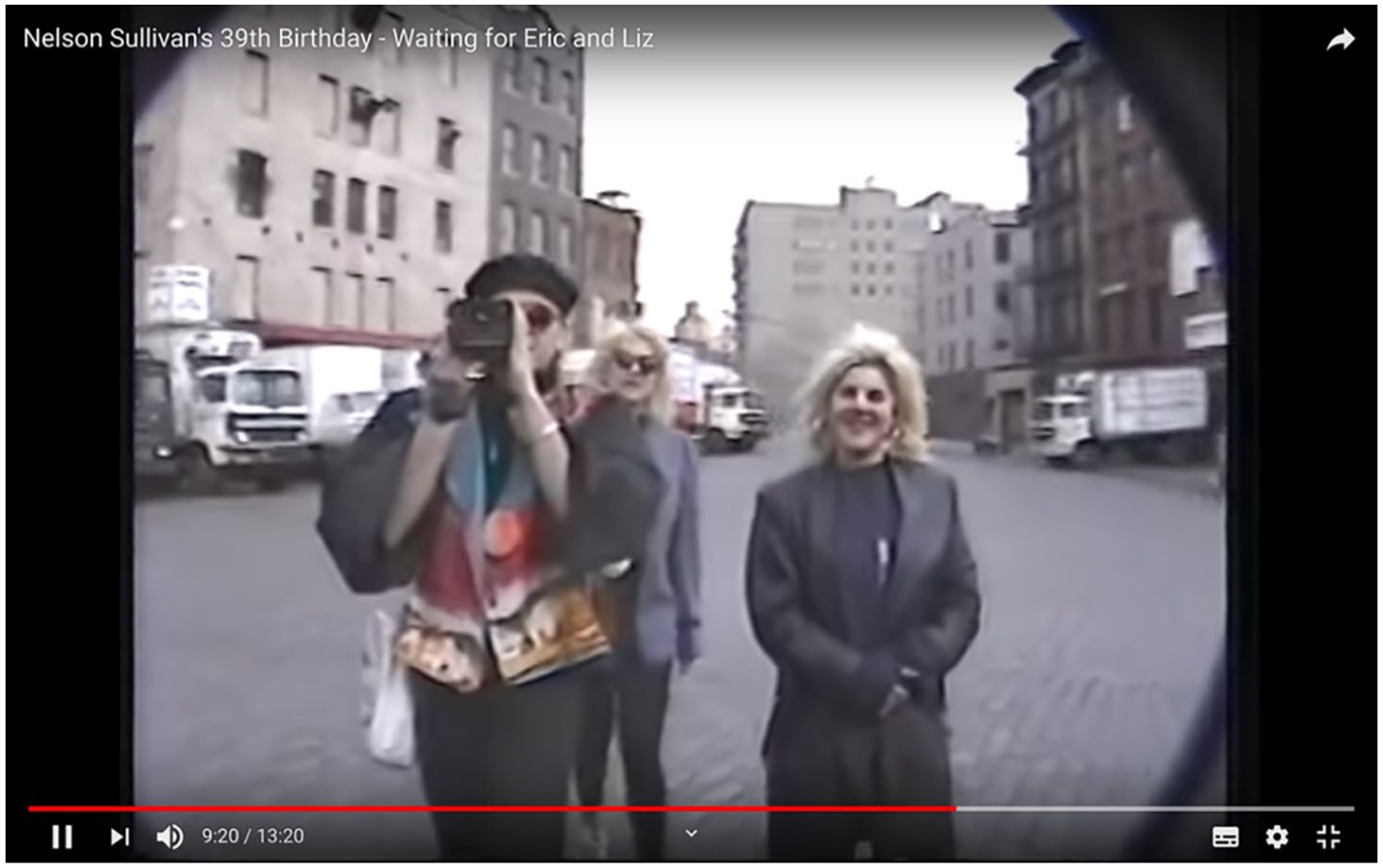 Nelson’s friend Eric takes a picture of Nelson as they approach, singing Happy Birthday.
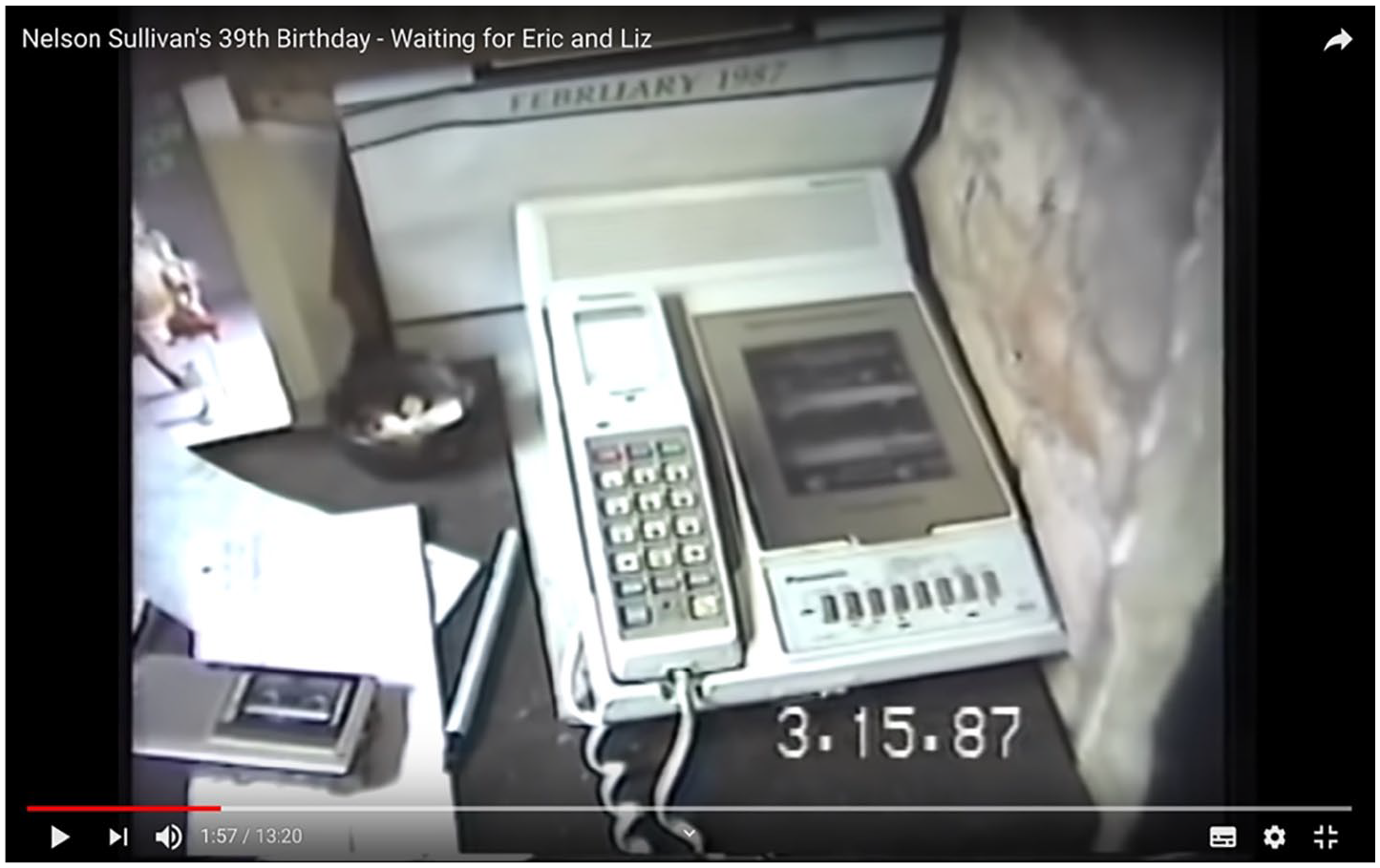 Nelson’s phone and items surrounding it as he listens to a ‘happy birthday’ message from Ru Paul
Vignette 2 – Stopping at McDonald’s in 1989 (Nelson Sullivan, 2016c [1989])
The video opens on Nelson in a car with his friend Dick. They are somewhere in Georgia stopping for gas. It appears to be evening time, the sun is setting. The sound of the car radio and other cars can be heard in the background. Nelson moves the camera to look at the gas station as they pull in through the passenger window. Nelson gets out while Dick fills the car with gas. Nelson moves about and takes in some of the views. As Nelson moves he is sometimes brightly lit and other times it is much darker. He points out West, North, East, and South. Nelson gets back in the car to wait for Dick. He sits quietly, looking at the camera and then looking around. He shows us the view he can see and the steering wheel. They then drive out onto the super-highway and towards a food complex to stop for ‘McDonald’s food’. Nelson contemplates putting the camera away but turns it on again when he is ordering. Customers and staff around Nelson are in shot; many of them look at the camera. Nelson counts out the money with one hand. He twists around a lot – not moving the camera but himself – taking in all angles of the McDonald’s. They pick up napkins, say hello to some children then head back out to the car. Dick gets a vitamin C out of the trunk. Nelson walks around the car, taking it in with the camera, as he talks to Dick. They get back in the car with all of their McDonald’s food and Nelson turns off the camera so they can eat. The camera turns back on at night-time. It’s very dark, Nelson is barely visible. They have arrived at a care home of some kind to visit Nelson’s Aunt Nancy. The halls are empty, it seems quite late. No-one is around. When they finally find Aunt Nancy, they hug and say hello, and Nelson smiles widely, getting himself and Aunt Nancy in shot.
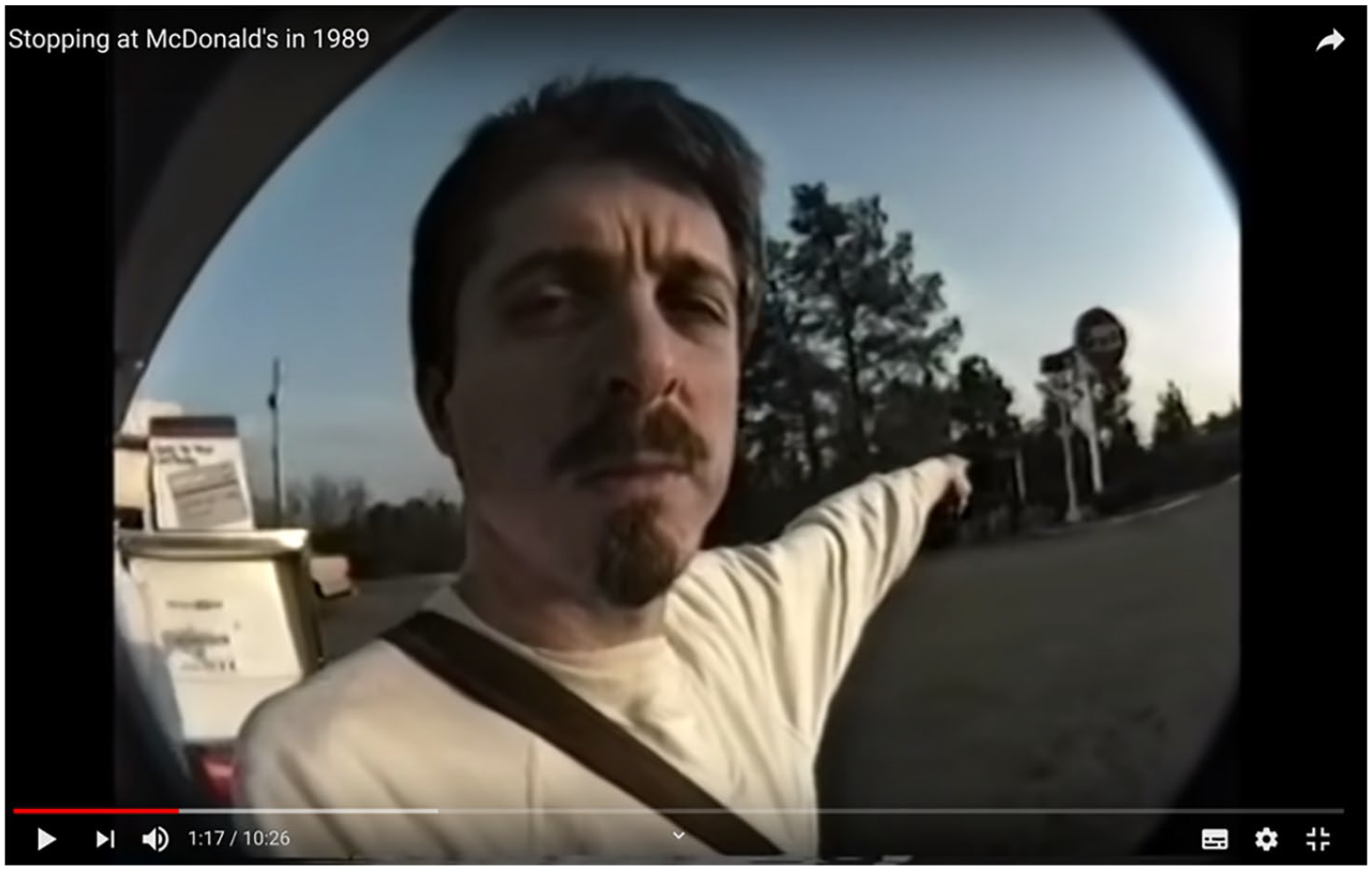 Nelson pointing out West, North, East and South at the gas station.
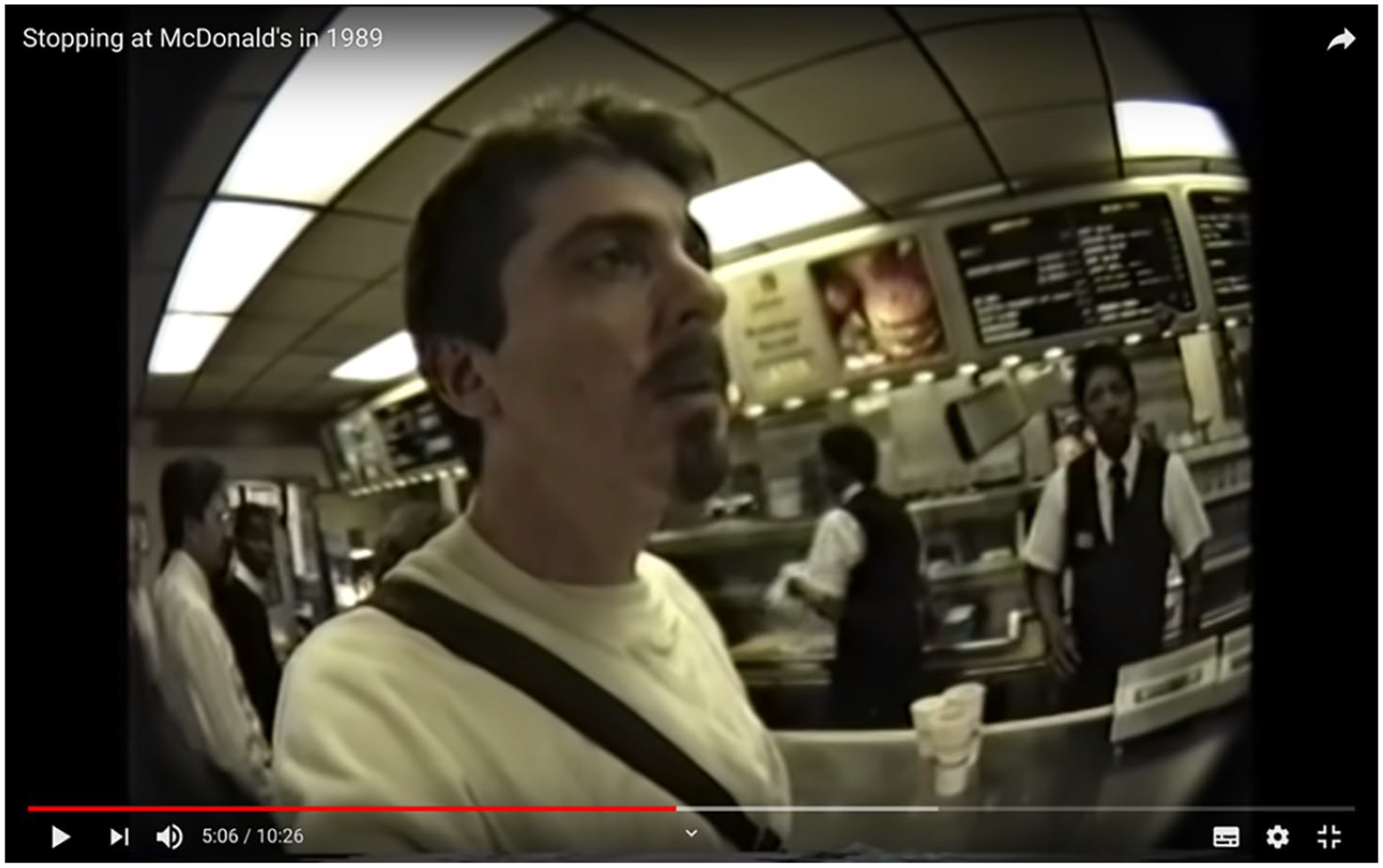 Nelson placing an order in McDonalds.
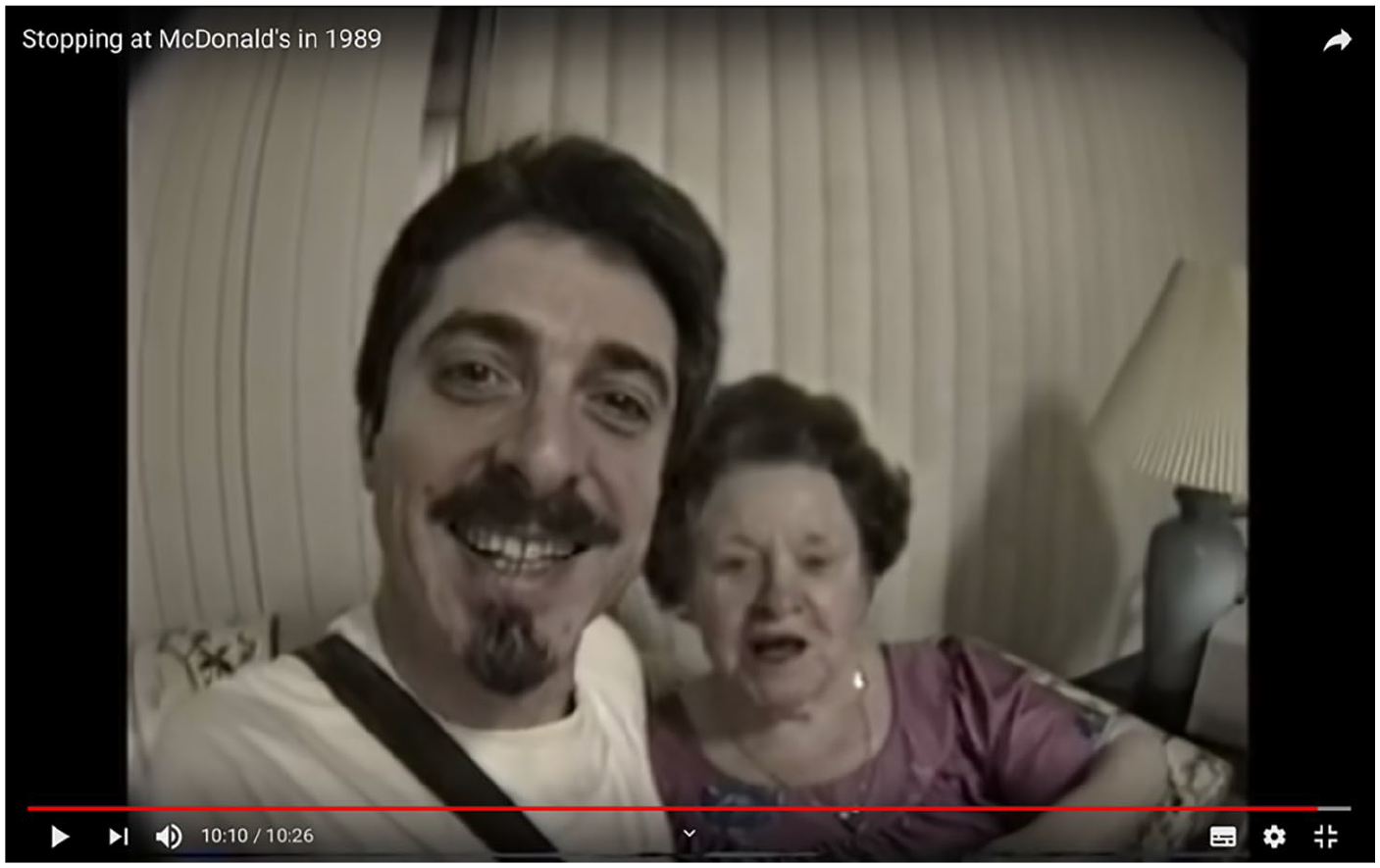 Nelson with Aunt Nancy.
Vignette 3 – Nelson’s last visit to his hometown in Kershaw (Nelson Sullivan 2015a [1989]
The video opens with a close-up of the green and brown mossy bark of a tree. It zooms out and moves over to Nelson, who has a bandage covering part of his left cheek. Nelson is walking through the quiet streets of Kershaw, South Carolina. This is his family hometown and where he was born. Nelson is walking; we hear the crunch of his shoes on the floor, cars passing by and lots of birdsong. The shot moves and lingers on Nelson’s Grandmama’s house. It is a big, Southern house with white columns, a side-porch, and a vast yard area. There are a lot of trees and plant-life around. We get in a zoomed-in shot of the columns and the front steps. Nelson walks across the side-porch to the door and goes in. His voice and footsteps echo through the big house, which is undergoing renovations. The walls are a patch-work of plaster and paint. He strokes a small dog and chats to the construction workers. Nelson is walking around the house looking for his relative, Jeanie, who he finds looking in a dressing table mirror rolling up her hair with rollers. This room is not undergoing renovations but has light green patterned wallpaper and what seems to be a small portrait on the wall. Nelson chats to Jeanie then leaves. He shouts his goodbye on the way out of the door. He shows us around the backyard; he takes us into the old garage – climbing some rickety, dirty white stairs, the camera focused on his feet. The upper floor of the garage is full of books, rugs, old beds, horsemanship awards. Nelson shows us a 1954 Broadway Playbill for ‘Ondine’. Then, Nelson takes us through the backyard to the old gazebo. Nelson walks across to his neighbour’s house, Miss Maubley. We can see his breath. He stops to show us a huge magnolia tree in his mother’s front yard which has grown to be bigger than the house. Nelson knocks and calls through the door of Miss Maubley’s house. He chats for a little while to Miss Maubley, moving around the kitchen as he does, pointing out the cooking. Miss Maubley is in shot behind or next to Nelson for a few seconds here and there. As he talks, Nelson looks mostly at Miss Maubley but looks at the camera every now and again as well. Miss Maubley walks Nelson to the door when he leaves and sees him down the steps as they say goodbye. The video ends looking at the pink and green blooms of a Quince tree, which Nelson reminisces about and wishes to say goodbye to.
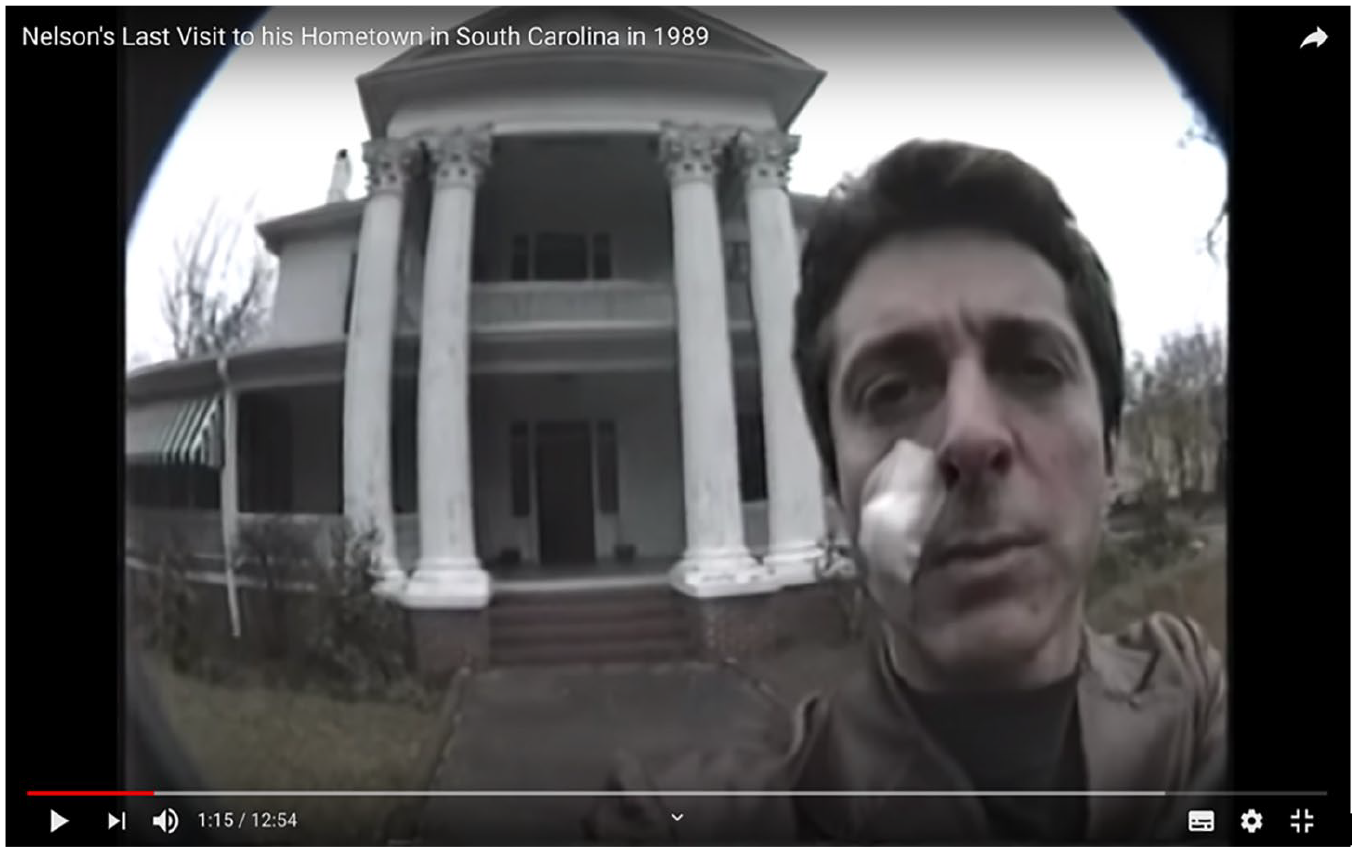 Nelson outside his grandmama’s house in Kershaw, South Carolina.
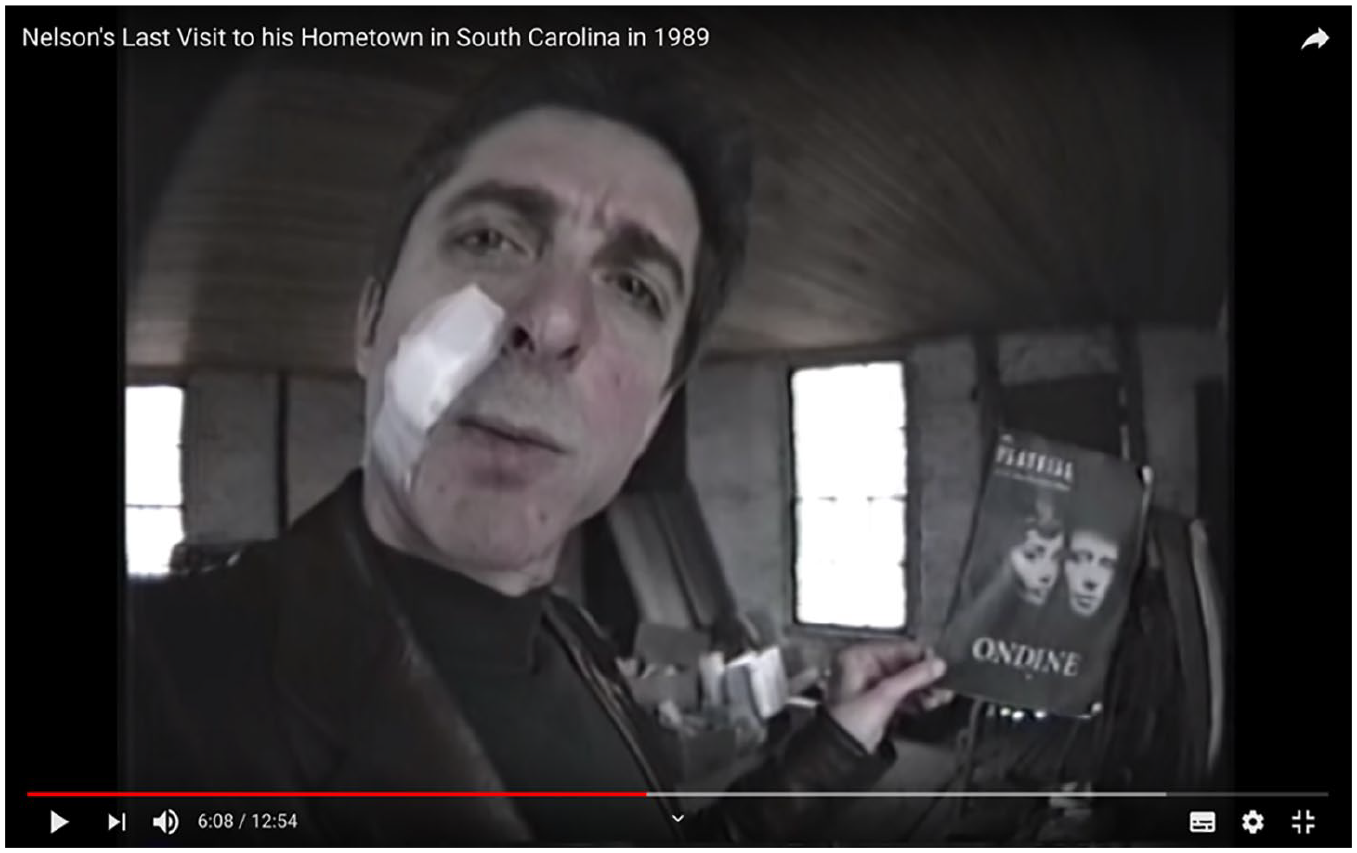 Nelson in the room above the old garage at his grandmama’s house, looking at an old Broadway Playbill.
Reading Nelson’s films as diary-letter hybridity
[Nelson] was like a mentor for us [because] he taught us about all these films. He had all the films of Tennessee Williams and Fellini . . . and Michelangelo Antonioni. (RuPaul, 2016)
Many others have written about, and sought to classify, the range of human documents, documents of life, and autobiographical materials (see Plummer, 2001; Roberts, 2002; Stanley, 2004) available to sociologists. Typically, these range from letters, diaries, photographs, films, fiction, autofiction, oral histories, official documents, and so on. Others have pointed to how ‘new’ communication technologies and platforms, such as YouTube, have facilitated an ever-growing variety and wider dissemination of auto/biographical stories and representations (see, for example, Strangelove, 2010). Given that Nelson’s films were shot in a pre-YouTube era, this standard characterisation prompted us to reflect on the characteristics auto/biographical materials used in sociological analysis and where Nelson’s films might fit into this spectrum of materials. This reflection crystallised around three main questions – are the films diaries or letters (or a combination of both)?; who were the intended audience(s) for Nelson’s films?; and what was the intent beyond the initial creation of the films?
The power of writing diaries and letters is well acknowledged as mechanism for capturing ‘living moments’. Whether writing a diary was part of a craft-based writing tradition (Nin, 1947) or writing letters was as a devise to ‘warm-up’ (Steinbeck, 2001), and everything in between, through these forms the author reveals glimpses of their life routines, creative processes, incidental interests; the mundane, the ordinary and even the trivial enactments of everyday life – ‘it is autobiographical material in the first order’ (Steinbeck, 2001: vii). It is these glimpses that can be used as empirical evidence which offer insights into the social world and tell us something about the social conditions of their becoming (Elias, 2009). Launched in 2005 YouTube, in particular, has provided many with a platform to share a wide variety of their daily experiences from the ordinary aspects of everyday life through to the spectacular, the unusual and the extreme (see, for example, Berryman and Kavka 2017; McKeague, 2018; Madden et al., 2013; Miller, 2019; Raby et al., 2018). Central to the success of YouTube are the large number of what have become known as daily vloggers – the daily video diarists – who use film and video and produce content ranging from anything shot on a cellular phone through to high end camera equipment, lighting, sets and more. These daily vlogs are perhaps one of the most recognised and popular form of auto\biographical expression on the Internet. Indeed, vlogging, in particular, is often referred to as an extension of the diary (see Snelson, 2015; Sorapure, 2003). For Kennedy (2017): These online life-writing practices are extensions of diary writing, and they constitute contemporary forms of autobiography. Like traditional autobiography, people publish material about themselves, making it available to the public . . .
Or as Strangelove (2010) suggests: Herein I treat any YouTube video that has some confessional or self-representational quality as belonging to the autobiographical and diary genre. Digital diaries cross boundaries of genre and media practice . . . The diary is the location of unstable, contested, multiple, and often incoherent selves, bit it is also a place where we encounter real others. The online diary form may be flawed, but it can provide us with a representation of social reality. (p. 69)
However, while cast as ‘extraordinary videos by ordinary people’, these online biographical materials are still viewed through a tradition lens, as ‘online diaries’ or confessionals. While we do not disagree with Kennedy or Strangelove’s broad assessment, this categorisation prompted us to question whether Nelson’s films could be neatly pigeonholed as diaries, or as ‘vlogs’ (as they appear to have been). In contrast to the confessional, diary format, Nelson’s films contain a ‘dear reader’, direct call for engagement. While the films are now on a vlogging platform and while Nelson clearly used the tools and stylistic traits of a contemporary vlogger, we would suggest the films are more appropriately characterised by what Stanley (2015) describes as a kind of ‘epistolary intent’ and ‘letterness’; meaning that there is an intention to communicate ‘in writing or a cognate representational medium’ (p. 242). This letterness – the intent to communicate – as Stanley highlights is also characterised by asynchronosity, by communication across a separation of time and space. Furthermore, and in line with Goodwin and Hughes (2011) application of Elias’ theoretical work to letters, we would suggest that communicative practices such as vlogs, like letters, point towards ‘relationships past, present and (possible) future, and as referents of changing balances of power and shifting human interdependencies’ (Goodwin and Hughes, 2011: 680). The films are not simply about ‘the individual’ or their distinctive self-world, but instead are suggestive of dynamic relationships, behavioural standards, interdependencies and power balances that extend well beyond the screen. As such, Nelson’s films can be considered a contemporary form of auto/biography. What is more, they constitute a form of auto/biography that combines aspects of both diary writing and letter writing – Nelson’s films are a hybrid of the two.
However, given this, there are two remaining questions; who is Nelson communicating with and what was his motivation for making the films? As suggested above, the films are richly detailed, relational, dialogical, and high-quality auto/biographical materials. They point to the ever-changing figurations Nelson and those he filmed formed. From the early lives of drag artists, such as RuPaul, or the wider array of characters fashioning their own careers in entertainment, art, or music during the hedonism of the 1980s New York party scene. Beyond this too, we are introduced to members of his family; his mother and aunts, his closest companions, and lifelong friends, such as Dick Richards, and childhood neighbour in Kershaw, Miss Maubley. But who is this all for? Who were the intended audience? Audience and purpose are clearly important to contemporary online vloggers as they are creating materials specially for their viewers. In return, the viewers can respond with messages and comments. Yet, for Nelson, these films, while dialogic (he asks questions of his ‘viewers’), they have no obvious or intended audience. As far as we know, Nelson created the films and then stored them in his bedroom. The films bring to mind the cogitations of C Wright Mills, who wrote a series of letters to the fictional character Tovarich: Tovarich, I want to give you, as Walt Whitman once said, ‘some authentic glints, specimen-days of my life’. (But I can’t, of course, do it as he did; I haven’t the guts, much less the skill. Anyway that’s why I’m writing such personal letters to you . . . (Mills and Mills, 2000: 292)
Mills and Mills (2000) allude to ideas of ‘sociological authenticity’ via some flashes of the lived reality of the everyday. Sociologically authentic in the sense they are not reconstructed events but instead practices, habits, behaviours, and observations made and captured at the time. Nor are they authentic because they are the products of a sole actor isolated from the ‘others’ and not shaped by varying degrees of influences (see Hughes and Goodwin, 2014). Instead, they are relational documents of their time that reveal something of the social conditions at that time. In these ‘specimen days’, Mills writes to his imagined Russian academic pen pal, Tovarich, about his then daily work routines in his home office, at the University, writing on the roads, and so forth. Much like Nelson, Mills details the minutiae of life – making coffee, collecting the New York Times – alongside the specifics of his sociological practices. Similarly, Mills and Mills (2001: 293), like Nelson, asks questions of his reader ‘tell me all that you did yesterday’ (p. 293). Yet, as with the case of Nelson’s audience, Tovarich does not exist. These are auto/biographical materials for an implied audience, letters/diaries written with a purpose but for no-one in particular. Mills and Mills (2000: 296) writes the letters and ‘along with this letter, if I ever find your address, I’m mailing you a copy of the book mentioned: The Sociological Imagination’ (p. 96). Comparably, Nelson speaks directly to his audience while not being sure if anyone will even watch or respond. He says, for example, ‘I guess it’s about one o’clock here in Atlanta. I don’t know what time it is where you are’ (Nelson Sullivan, 2015b [1989]). Both Mills and Nelson are ostensibly waiting for a response that never arrives.
This then prompts us so ask: what was the intent beyond the initial creation of the films? It is clear a primary reason behind Nelson’s approach, his motivations for the films, is born out a desire to document his own life and the lives of others. Yet, there is more to the films; these are Nelson’s apprenticeship. He had previously dabbled in local broadcast media and had appeared on niche television programmes. It is also reported that, just a few days before his death in July 1989, he had landed a TV show, which led him to quit his job in the music store. Were these films Nelson’s practice piece; one long audition which he used to hone his craft? The availability of inexpensive camera technology meant Nelson could practice without relying on others. It was a moment in time where we begin to see the ability to ‘broadcast’ was no longer dependent on large studios of expensive equipment. The films thusly mark a transition from craftsmen’s art to artists’ art (Elias, 1993). For Elias (1993), there is a long-term shift in power balances, between ‘craftsmen’s art’ – where art is produced for a patron, usually of higher social standing, and following the patrons ‘taste’ – and artist’s art – where art is produced reflecting the artist’s own taste and desires for an unknown buyer or audience. This is a civilising shift where there is less external control on the artists imagination and artists are no longer subordinate to the tastes, interests and desires of others. The transition to YouTube as a primary viewing platform reflects this long-term process identified by Elias in the shift from craftsman’s art to artists art. YouTube is a vehicle for artists and creators, in many cases, to express their imagination not reliant on funding from mass media producers.
Walking with Nelson: accentuating and locating the auto/biographical
[Nelsons] . . . this queer flâneur artist very consciously floating through the scene. (Colucci, 2014)
Although seemingly accurate at first, Colucci’s (2014) description of Nelson as a queer flaneur does Nelson disservice. His movement through New York, and other places, is central to his films. However, he is not a loafer, a lounger, a saunterer or stroller. Nor is he a dilettante nor an alienated, aimless ‘investigator’ or observer of the city. He is not someone who has abandoned his private realm in order to create an over familiarity with public external spaces (Lauster, 2007), nor was he a leisure obsessed boulevardier. Indeed, Nelson was far from being a ‘figure of masculine privilege and leisure with time and money and no immediate responsibilities’ (Elkin, 2016: 3). An artist attuned to the ambiances of his locale, yes. A member of a downtown LGBTQ+ scene, undoubtedly. Yet in his films, while initially they may appear overly concerned with the transient – even trivial – aspects of life, Nelson had purpose, a direction and a drive to produce films, document, and to explore. He had an ‘angle’ and a subject matter born out of his own life experiences. Central to his ‘angle’ is movement through time and space and, in particular, walking (or riding) the streets of New York, as well his foot-guided tours of his hometown of Kershaw, South Carolina: People think I’m crazy, but then, when they see the tapes, they realise what I’m doing . . . I’ve been doing this about seven years now and I’ve gotten pretty good at it . . . Yeah. I kind of equate myself more to a dancer than anything else because it’s all motion. (Nelson Sullivan, 6 February 1989) Walking is critical to the task because it gets you out there and lets you get to know the city up close. However, you cannot merely walk through a city to know it. You have to stop long enough to absorb what’s going on around you. (William Helmreich, 2015: 3)
Walking is a well-established, if not regularly used, research tool in sociological and ethnographic practice. Whether it is ‘walking the field’ to delineate a research area (see Jephcott, 1963), the use and analysis of walking tours as an ethnographic method to give ‘shape’ to sex worker research (Aoki and Yoshimizu, 2015), the walking practices of hunter gatherers (Tuck-Po, 2016), improvisational walking through industrial ruins (Edensor, 2016), exploring city life (Bendiner-Viani, 2005; Helmrich, 2015), the ways in which walking produces time-space and the experience of place (Edensor, 2010), or shared walking experiences with research participants as attenuation (Pink et al., 2010), to name but a few. Likewise, the idea of walking through a space as a form or enactment of auto/biographical practice is not a new idea. It features, for example, as part of Milgram’s (1977) the ‘individual in a social world’ research and in his writings on mental maps and urban psychology studies. Milgram reveals the close interrelationship between the resident and their neighbourhood; wander too far beyond your block, the fewer people you know, and the less you feel ‘at home’.
Walking provides a mechanism through which to observe and experience practices and everyday activities which are part of the ‘production of material and social realities’ and of ‘being in the world’ (Pink, 2008: 178). The experiential nature of walking is immersive and participatory. Undertaking walking tours, or any of the other ethnographic ‘walking’ practices highlighted above, can add context to the partial knowledge gleaned from other types of documents or research data. As highlighted, the significance of this is already well-recognised in sociology and other social scientific literature. However, we highlight and reiterate it here because this experiential ‘walking with’ Nelson is mediated through the virtual environment. Walking videos are becoming more and more commonplace on YouTube. Some have begun to explore the possibilities of recording video while walking as a research practice with participants (Pink, 2007), with important emphasis placed on how this ‘communicates a sense of other person’s emplaced experiences that might be interpreted empathetically by its audiences’ (p. 250). Beyond this, however, much less has been said about how walking videos produced for and available on YouTube could be utilised as research data in and of themselves. Given the impacts of COVID-19 and current restrictions on people’s movement both globally and locally, and the (im)possibility of meeting face-to-face and in ‘real time’, the opportunities provided by such walking videos for sociologists and ethnographers alike should not be underestimated. Distinctive to these, as highlighted above, is that many of these videos – and especially Nelson’s videos – have an unknown audience and may be watched by an audience the creators may never have intended for or imagined. While we have already suggested in this article that this reflects a move towards more unrestricted imaginative expression, the question remains; does the mediation of this walking experience through virtual means limit, impact or alter the analytical and research possibilities provided by such videos? Our answer to this question crystalises around two central issues.
First, despite the perceived physical and temporal ‘distance’ between the videos and the audience, it is still possible to experience the videos on a sensory level and thusly maintain aspects of the participatory experience associated with walking as a research practice. Through the pioneering use of selfie-style video-making, Nelson invites his audience into the rhythms of his everyday life. He takes us on an auto/biographical ‘tour’ of the significant and insignificant aspects of the different neighbourhoods he inhabits. In this, location, and Nelson’s progress through it, is centralised; New York, Kershaw and elsewhere become as vivid a part of the videos’ content as Nelson himself, and the people he introduces us to (for further exploration of Nelson’s experience of walking through these different places, see Goodwin et al., 2021) It is possible to feel and understand the sense of nostalgia and loss as Nelson walks through his grandmother’s home and tries to articulate his memories of it. In part this is because throughout the videos we experience things as Nelson does; we hear the birds sing as he hears the birds sing. While some other sensory experiences may be limited to us in watching the videos, which would otherwise be available to us if we were walking there ourselves, our perception or imagining of how it might feel has a similar effect. When Nelson is at a coffee shop or restaurant, for instance, we may draw on our own experiences of this to ‘fill in the blanks’. This works to create a sense of identification, or empathy, between Nelson and his audience – in this case, us – across time and space.
Walking these streets, virtually, alongside Nelson also gives a clear sense of how place and locality intersects with Nelson’s biography. For example, instead of simply describing his family neighbourhood and background as a series of biographical bullet points, Nelson offers what appears to be a spontaneous and relatively unplanned walking tour. This walking signals a form of continuity where ‘before’ and ‘after’ become blurred – even irrelevant (Tabboni, 2001). It points us towards patterns of continuity and discontinuity, to change and continuation over time. In this way, we are caught up in Nelson’s continuous ‘flow of experiences’ (Edensor, 2010). This is not just isolated to Nelson’s own ‘time’ either. Cultural and historical artefacts captured by Nelson’s films – the 1954 Broadway Playbill, the cancelled cheques, cousin Jeanie’s horsemanship awards, Eddie’s vintage 1972 Chevrolet – represent past continuities and discontinues, as events and ‘moments’. Nelson (2015a [1989]) describes these things as of ‘another era’, but he experiences them in the ‘present’, as it was at the time of recording, and now by us 20 years later as we watch his footage. Nelson’s walking through space becomes a kind of temporal ‘unfolding’, through which we see Nelson – and all that he interacts with – in a constant state of becoming and as ‘a past which in some sense is still living in the present’ (Collingwood in Kumar, 2015: 275). In this way, the videos enable what could be described as ‘bringing-into- being’ (Inglis cited by Stanley et al., 2013).
This brings us to our second issue in answering the question highlighted above. This unfolding is not simply a direct or ‘one way’ imparting of information. It requires some imaginative and empathetic engagement from the audience; to ask questions about what is happening in the videos, to ‘fill in the blanks’, as well as questioning what may be happening ‘beyond the lens’. As Pink (2008) highlights walking goes beyond ‘representation’ and enables a process of ‘mediation’, of sharing, exchange, and experience which brings out and makes more noticeable previously insignificant or overlooked details. ‘Details’, in this context, could also be described as the ‘relational clues’ (Goodwin and Hughes, 2016) we highlighted above. Take, for example, the references made to friends, family, places, and events by Nelson but who the audience never meet or experience in the videos directly, or which he only engages with for a fleeting moment. In cases such as these, the process of mediation, empathy, and exchange highlighted above is heightened as we engage with Nelson’s videos via YouTube 20 years after they were originally recorded. While it is tempting to see this as a ‘problem’, we would argue it extends exciting opportunities for different kinds of research relationships. It forces us to confront the partial and incomplete nature of all research ‘data’ and encourages researchers to reconsider their position in relation to this. Taking this in combination with our orientation to the videos as auto/biographical, sociological material, then, our engagement with Nelson: … becomes more than a co-production of ‘life story’ telling, but a reciprocal relationship that is impactful and leads to change. (Goodwin, 2019)
Discussion and conclusion: prioritising the dialogic exchange
Nelson’s videos, as auto/biographical materials, are ‘highly selective and partial’ (Goodwin and Hughes, 2011: 680) and involve ‘a degree of self-censorship, perhaps even artful misrepresentation’ (Stanley and Dampier, cited by Goodwin and Hughes, 2011: 680) which can occur at the moment of filming (as well as during any editorial processes). Nelson – as he walks and moves through New York, Kershaw and all the other places he takes us to – co-constitutes those spaces and makes logistical and creative decisions on the constraints and possibilities of producing film. Many of these may be unintended. Examples could include having to turn the camera off so he can eat in the car; or, producing dim footage due to limited light on a night-time drive. We also know there are certain places Nelson could not take a camera, and his commitment to filming meant he would be reluctant to leave the camera behind: ‘I don’t really want to go because they won’t let me video in there’ (Nelson Sullivan, 2018 [1989]). Rather than thinking of this as something contrived, this can be understood as demonstrative of authenticity. Authenticity, as highlighted above, in this sense relates to negotiation of constraints and possibilities of Nelson’s interdependency with the world at the time, and with his unknown audience/s in the future, and vice versa.
Nelson’s purpose and motivation appears to stem from his wish to share this ‘authenticity’; to document his life and the lives of others; ‘I want to share my experience’ (Nelson Sullivan, 2016b [1989]). Elias (2010) highlights why this is crucial, as he suggests; ‘whether or not people’s lives make sense to them depends on whether or how far they are able to realise their wishes’ (p. 60). However, it is only with the proliferation of the Internet that Nelson’s films have found wider attention and recognition which he had hoped for. In this way, the films demonstrate a ‘bringing-into-being’ (Inglis, cited by Stanley et al., 2013) – a cultural and sociological process of dialogic exchange – over 20 years, since the films were first created. As part of this process are the past, present and (possible) future relationships (Goodwin and Hughes, 2011) direct us to consider, and so now we too – the authors – are participants in this as well, as one of the (possible) future relationships which Nelson may not have imagined for his films.
We consider Nelson’s videos and our study of them not only as an ode to Nelson, the individual – his life and craft – but also as dialogic exchanges which oscillate around Nelson’s authentic flow of experiences (Edensor, 2010) and our encounter with them. Through Nelson’s videos we witness something which is contingent and temporal, it is continuously ‘in process’. They are archival and cultural artefacts which signal and capture social change, and which are what Nelson describes as a; ‘direct way to communicate experience, depending on how, you know, how good . . . both parties are’. To acknowledge Nelson’s suggestion, we conclude by advocating for a re-orientation of approaches to YouTube videos, and to vlogs, particularly. Instead of taking them as present-centred ‘online diaries’, which provide an opportunity to ‘see inside the mind’ of isolated individuals, they are better considered as auto/biographical artefacts that are something of a letter / diary hybrid which provide a multitude of analytical possibilities. In this way, we prioritise the dialogic exchange; the interdependence of vlogger and audience, and beyond.
As part of our exchange with Nelson comes the task and responsibility we have begun to fulfil in this article. First, to (re)centre Nelson’s films as among the earliest examples of vlogs; second, to (re)establish their significance as auto/biographical material capturing processes of social and technological transformation. Nelson was right when, in 1989, he mused: ‘I think this year is the year that everybody is going to turn the camera around’ (Nelson Sullivan, 2016b [1989]). Nelson is pointing us to broader questions about the rise of ‘global public intimacies’ (Gibson, 2016) and the future role of YouTube and vlogging as part of global relational and dialogic practices. This demonstrates Stanley et al.’s (2013) assertion that ‘historical and cultural sociologies have closely-related concerns’ (p. 288) and, further still, Mills’ (2000 [1959]) reminder that biography is closely tied with history.
Footnotes
Appendix 1
Acknowledgements
Thanks and acknowledgement for this paper goes to Nelson Sullivan for producing his work, to the 5ninthavenueproject for preserving and making publicly accessible Nelson’s work on YouTube, and to Good Dog Blackout LLC for providing us with permission to include the YouTube stills from Nelson’s films in this paper.
Declaration of Conflicting Interests
The author(s) declared no potential conflicts of interest with respect to the research, authorship, and/or publication of this article.
Funding
The author(s) received no financial support for the research, authorship, and/or publication of this article.
