



Abstract
In this article, I extend the discussion of aspirations as a conceptual tool by exploring how young Colombians plan to pursue them and by seeking to understand their aspirations as a way of navigating towards what they see as a good life. Drawing upon insights from fieldwork, I use Vigh’s concept of social navigation to emphasise the importance of the social environment, and the available opportunity structures and resources, which shape young people’s aspirations and their ideas of a good life but which, more importantly, influence their navigational strategies to pursue them. I argue that Colombian young people from poor backgrounds do have aspirations and that these go beyond educational and occupational goals. Their aspirations provide information about their desire for a more stable future in an uncertain world but do not necessarily match the opportunities available to them. The young Cartagenians featuring in this study, therefore, struggle to overcome contextual and structural constraints in their social navigation, which is aimed at achieving a good life. I conclude that the young people featured in this study live amid uncertainty about their future and follow a form of doxa in formulating their aspirations. However, while the combination of economic constraints and doxic aspirations that are usually unachievable create barriers to their imagined futures, the young people socially navigate according to the opportunities that emerge and become available to them, to achieve a form of what they perceive as a good life, whereby educational and occupational goals became a means to an end.
Introduction
Research on young people’s aspirations frequently focuses on their ability to develop and have aspirations, with aspirations defined as educational and occupational goals (Bok, 2010; Brown, 2011; Zipin et al., 2013). In this article, I add to this literature by conceptualising aspirations as a crucial part of social navigation (Vigh, 2006, 2009), showing that aspirations may be less of a desired end goal and more of a navigational tool to enhance life conditions. In contrast to much of the existing literature, which often sees aspirations as desired educational and occupational outcomes, in this article, I claim that aspirations go beyond these often doxic goals and serve rather to steer young people towards what they see as a good life, for example, stability and security in the future.
I analyse the aspirations of young people in Cartagena, Colombia. This emphasis on aspirations as a means for social navigation requires taking account of the role played by the young people’s constantly changing social environment and the resources available to them, and paying attention to shifting opportunity structures that influence young people’s ability to pursue their aspirations. What are young Cartagenians’ aspirations for a good life in the future? How do they aim to pursue them and what barriers do they encounter within their social environment when they try to follow their planned trajectories? By adopting a view of young people as agents interacting with the social forces within their social environments (Langevang and Gough, 2009; Vigh, 2006, 2009), I explore these questions, to contribute to the literature in the social sciences on aspirations and social navigation.
Nevertheless, some of the aspirations expressed by the young people in this study can be characterised as doxic with educational and occupational goals following dominant discourses of success rather than matching the real opportunities available (Zipin et al., 2013). This mismatch of aspirations and opportunities requires the young people to adjust their aspirational strategies to achieve what they understand as a good life. I therefore analyse the young people’s aspirations as ways of socially navigating an uncertain social environment in which they try to actualise their life trajectories by manoeuvring between different perceived opportunities and horizons (Vigh, 2006, 2009, 2010). The expression of, in particular, educational and occupational, aspirations is an agentic effort (Hardgrove et al., 2015: 163) to navigate towards the horizon of the good life that they, as young people, aspire to.
Consequently, I argue that aspirations go beyond educational, occupational, and material goals, and concern more subjective notions of a good life, such as health, family, decision-making power, safety, (economic) stability, and a higher quality of life, which unfold through the conditions of the social environment (Brown, 2011; Ray, 2003; Wilcox et al., 2021), as is shown by the responses of the young people in this study. Educational and occupational aspirations therefore become both a means to achieve what they see as a good life, and a form of social navigation requiring them to adjust and attune their aspirational strategies according to the changing opportunities available to them.
Aspirations and social navigation
What are your plans for the future? I ask.
Miguel looks at me and says, Well, short term, I think, well I don’t know . . . entering a company where they need someone who does all these things with metal. But I always liked to do something in relation to construction sites. I guess I have that in my blood from my father and uncle, who are builders themselves. I like metalwork but I would prefer architecture. This is a more serious career than acting and it offers more opportunities in terms of income. But my principal goal is being an actor in the future; that is for sure. My second choice would be architecture and my third choice working in metalwork because this would provide me with the necessary financial resources to pay for the architecture studies. And with architecture I could find a stable job to earn enough money to be able to study to be an actor, which is my passion.
Aspirations have become a prominent concept in research concerning young people’s social mobility and future horizons. Other terms for describing aspirations range from ‘hopes’ and ‘dreams’ to ‘concrete expectations’ and ‘possible future selves’, and different ideas of how to understand aspirations exist in different disciplines (Appadurai, 2004; Copestake and Camfield, 2010; Hardgrove et al., 2015; Prince, 2014; Stahl et al., 2019; Zipin et al., 2013).
The notion of aspirations, while conceptually ambiguous, can provide valuable information about people’s motivation to act and move socially and spatially. For example, research on aspirations has explored the idea that young people’s educational goals are a tool for achieving change in their material and social conditions, in both the global South and North (e.g. Altamirano et al., 2010; Del Franco, 2010; Holloway and Pimlott-Wilson, 2011; Naafs and Skelton, 2018; Sellar et al., 2011). Other research has highlighted young people’s mobilities and migration activities as a means of pursuing their aspirations to achieve better life chances (e.g. Azaola, 2012; Boyden, 2013; Crivello, 2015; Wilcox et al., 2021) and emphasised the importance of place and space in relation to the development and attainment of their aspirations (e.g. Kintrea et al., 2015; MacLeod, 2009; Prince, 2014). Aspirations have been identified as people’s internal motivation to change their social conditions and to achieve what they perceive as a good life (Ray, 2003). Furthermore, aspirations are not always perceived positively and they sometimes feature in research about failed aspirations that turn into a form of fatalistic behaviour (Bernard et al., 2011; Dalton et al., 2016).
In addition, research on young people’s aspirations has a tendency to focus on educational and material outcomes as ends in themselves but pays less attention to aspirations beyond those goals or to young people’s strategies for pursuing them. If aspirations are viewed as a means of social navigation, as they are in this article, educational and occupational aspirations are a means of achieving one’s own idea of a good life, an idea that goes beyond material goals.
Miguel, for example, aspires to take up different occupations, each one of which could then become his main focus. He studies metalwork at a state vocational training centre called Servicio Nacional de Aprendizaje (SENA), specialising in work with aluminium. 1 He also mentions he wants to become an architect and an actor. While all those aspirations could be understood as ends in themselves, Miguel provides information about how one aspiration, training in metalwork, would help to achieve one of the others, becoming an architect. Thus, rather than understanding these aspirations as ends in themselves, he sees them as aspirational and navigational strategies.
In addition, Miguel is supposed to gain experience through an internship, for which he sent many applications without receiving a positive answer. A couple of weeks later, he had still not received any response and was considering changing his plans. Instead of trying to find employment, he was considering applying for a degree in a construction-related subject.
Conceptually, then, aspirations include two components: first, the capacity to develop and have aspirations, and second, the capacity to be able to create pathways to pursue them successfully. Appadurai (2004) refers to the latter as a map of routes that individuals use to navigate towards achieving aspirations, shaped by the ‘thick of social life’, a complex range of social, cultural, economic, and political influences within one’s social environment.
Miguel’s story demonstrates this second aspect of aspirations: the navigational aspect of achieving them within a social environment of changing opportunities and constraints. His story suggests that young people in Colombia from poor backgrounds need to be flexible about their aspirations and future trajectories and perform what Vigh (2006) calls ‘social navigation’. He describes this as ‘the way in which agents seek to draw and actualise their life trajectories in order to increase their social possibilities and life chances in a shifting and volatile social environment’ (Vigh, 2006: 11).
This concept includes an implicit aspirational aspect but one that young people cannot follow in the form of a linear path because their social environment and opportunities change. As Vigh (2009) points out, social worlds are in motion, with changing opportunities and resources. The concept captures the complexity of the praxis of young people trying to plot and actualise trajectories by formulating aspirations and pathways to achieve them according to their changing social environments and horizons (Vigh, 2009: 426).
Vigh defines horizons as the spaces of possibility that young people use to orientate themselves while moving and navigating as agents and being moved by their social environment. They set the framework for young people’s navigational possibilities and endeavours within their spaces and places (Vigh, 2006: 30–31). Horizons, then, are a form of possible, imagined futures and aspirations. Understanding aspirations as part of social navigation gives the concept an additional focus on young people’s movement from the present into their imagined futures and horizons. They have to actualise this trajectory according to emerging constraints and opportunities within their uncertain social environments (Di Nunzio, 2015; Langevang, 2008; Langevang and Gough, 2009; Vigh, 2009).
Research context and methods
Cartagena is Colombia’s main tourist destination and consists of prosperous inner-city neighbourhoods with colonial features, high apartment buildings along the sea front, and small neighbourhoods of detached or semi-detached houses, alongside deprived neighbourhoods with dense, overcrowded housing. It is one of the most unequal cities in the country, with poor neighbourhoods, which are not easily accessible, located in close proximity to wealthier areas of the city (Marzi, 2018). The majority of the population in the poorer parts of the city is of African descent and low socioeconomic status and has lower education levels. This inequality divides the city spatially and leads Cartagenians to refer to Cartagena as ‘two cities’. The rich areas have greater access to high-quality education, transport, healthcare, and occupational opportunities, and the poorer, predominantly Afro-Colombian neighbourhoods struggle with crime and drug trafficking and afford fewer opportunities (Bolaño Navarro et al., 2009). For the study of aspirations, Cartagena is especially interesting, as it is a strikingly unequal place, with young Cartagenians living in marginalised areas of the city able to see at close proximity what living standards and wealth the city could offer them.
The young people featuring in this study live in two neighbourhoods in Cartagena: La Popa 2 and El Pozón, which have been chosen because of their different locations and related opportunity structures for young people from poor backgrounds. The neighbourhood of El Pozón, one of the biggest neighbourhoods in the city, with 43,491 inhabitants (DANE, 2020), is located an hour’s bus drive from the city centre. The city centre is the main area for cultural events, shopping, and entertainment, and most of the historic sites are there. It provides many occupational opportunities, especially in the tourism sector. Pozón contains all essential shopping facilities, as well as primary and secondary schools (11 in total), and it has a medical centre (DANE, 2020; Marzi, 2018). On the other hand, the neighbourhood regularly reports high homicide rates, and young people suffer from related stigmatisation, in addition to being spatially, economically, and educationally disadvantaged (DANE, 2020; Goyenche González et al., 2018; Martínez and Gómez, 2017; Marzi, 2018). The area of La Popa, with approximately 35,000 inhabitants (DANE, 2020), provides greater opportunities for young people because of its spatial access to educational and occupational opportunities. The neighbourhood is located close to the city centre, the beaches, the airport, and the central market. However, La Popa also suffers from gang violence and high crime rates (DANE, 2020; Goyenche González et al., 2018; Marzi, 2018). Both neighbourhoods are classified as poor and known as barrios populares. Their distinct locations, however, offer young Cartagenians different perspectives from which they can plot their aspirations and trajectories.
Data were collected through focus groups and interviews in 2013–2014 and follow-up interviews in 2020. I recruited 29 young people, aged 15–23 years, of which 12 lived in La Popa and 17 in Pozón, through gatekeepers with close connections to Non Governmental Organisation (NGOs) with youth programmes in the neighbourhoods. Sixteen of them participated in all research activities, as my core group, and I am still in contact with many of them (Table 1).
Composition of sample.

All the young people in this study were at secondary school, often at the stage of doing their bachiller (equivalent to British A levels, and the educational qualification necessary to enter university) or they had started tertiary education, at university, or at SENA. While it is usual for young people of all social classes to finish secondary school – although the quality of education differs substantially depending on whether the school is in a richer or a poorer neighbourhood – over 60% of the young people in Cartagena who had obtained a bachiller were unemployed (De la Hoz et al., 2013) (Figure 1).
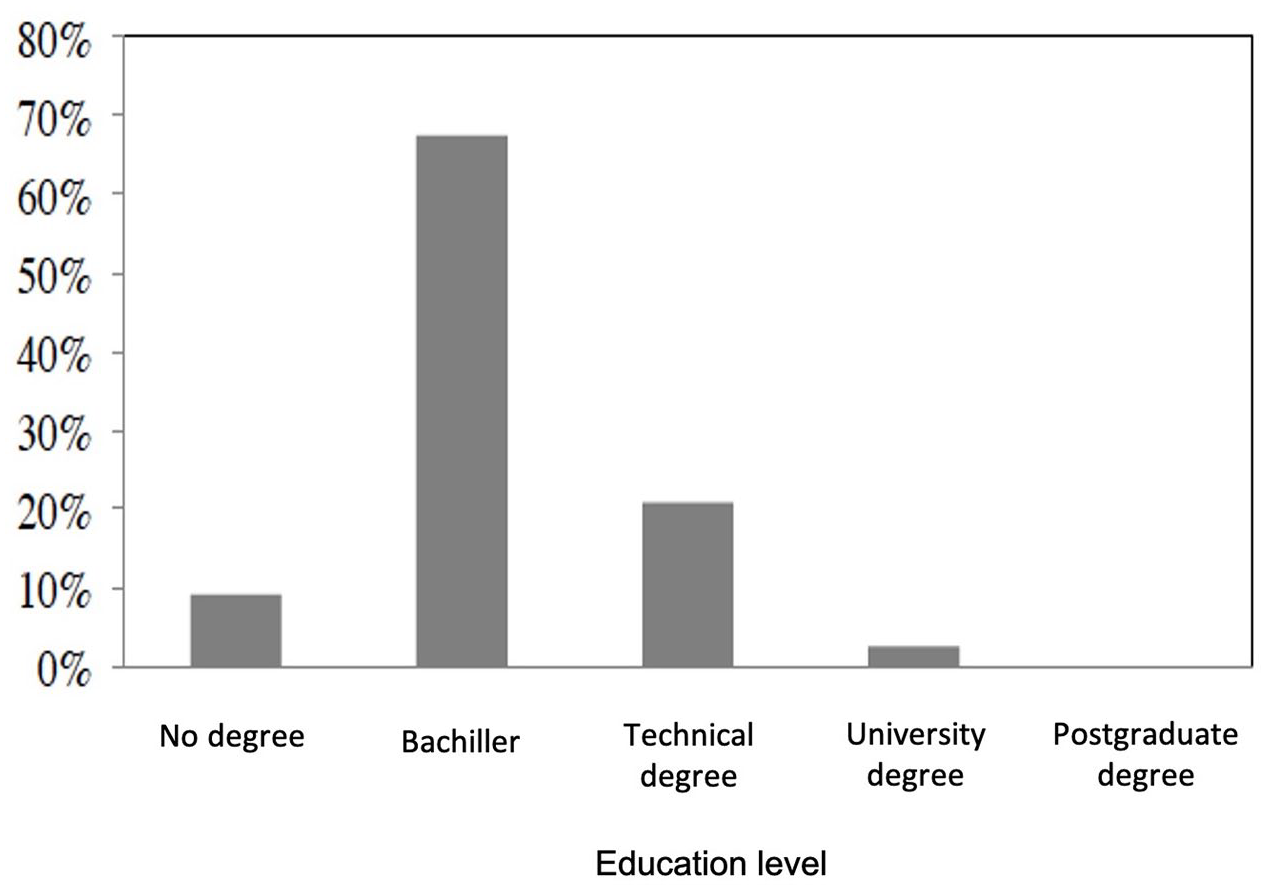
Youth unemployment and education level in Cartagena, 2010.
These data also suggest that many do not enter tertiary education, either because they prefer to enter the labour market directly or because they cannot afford to pay the fees (De la Hoz et al., 2013).
Furthermore, the majority of unemployed young people were from poor neighbourhoods, classified as socioeconomic strata (estratos socioeconomicos) 1 and 2, while almost no young people from richer neighbourhoods (estratos 5 and 6) were unemployed, suggesting that the neighbourhood one lives in correlates with educational achievement and employment across Cartagena (De la Hoz et al., 2013) (Figure 2).

Young people employed and unemployed in Cartagena, 2010, according to socioeconomic stratum.
Interviews with the young people in my study explored their aspirations and their plans to achieve them. In addition, mixed-gender focus groups of five to eight participants discussed their aspirations and perceptions of a good life. In total, we conducted two focus groups per neighbourhood plus several informal group interviews. The focus groups allowed for additional observation of interactions between the young people and provided a more relaxed environment, as the young people know each other well. Discussions of a good life often shifted to existing inequalities, such as unequal access to good-quality education and other constraints on achieving a good life. These activities provided me with rich insights into their understanding of aspirations and their perceived difficulties in achieving them. In this article, I will focus on a selection of cases in more detail, to provide more in-depth data about young people’s social navigation over several years.
The names of the young people have been changed to pseudonyms to assure anonymity, and all young people provided informed consent in written form. Data were transcribed in Spanish and later translated by the author to retain the original meaning as much as possible. The management and coding of the transcripts and other data were completed with NVivo, while the analysis of the data was guided by a thematic analysis approach open to emerging themes (Coffey and Atkinson, 1996).
Aspirations and opportunities in Cartagena
The majority of young Cartagenians in this research either aspired to go on to tertiary education or were already there and they aspired either to find employment that matched their degree or to continue with a specialism at university (see Table 2 for an overview of the young people’s aspirations). During interviews and focus group discussions, the young people expressed their aspirations mostly in terms of occupational and educational pathways. However, many of the stated aspirations can be classified as doxic, as they followed dominant discourses of success and did not match opportunities within the Cartagenian labour market.
Aspirations of the young people in the study.

James, one of the older boys from El Pozón, told me that after studying civil engineering, he aspired to find work and then start his own his own company: First, I need to find work in a company . . . so that they pay, but thinking well into the future . . . I would like to have my own company . . . a company that employs people who work on construction sites and lends equipment to construction sites [. . .] I also want to specialise after my degree. Maybe doing a master’s . . . in designing construction material. [. . .] I also like the administrative part of projects. I like to work with people and to coordinate [. . .] However I have to pay for it from my own money, as I cannot borrow more [money] from the state. I would like to do a master’s in a foreign country because this gives you additional value on your CV.
James is planning his trajectory according to his present experiences. Yet looking towards the future, he already acknowledges the possible economic problems that may prevent him from obtaining a master’s degree. James attends a private university financed through a student credit. Private universities in Colombia are at the top end of the education spectrum and are expensive by international standards (World Bank, 2003: 52). In 2016, for example, a business administration degree at the private university of San Buenaventura would have cost 3,171,000 Colombian pesos (£666) per semester, while the Universidad de Sinú, another private university, charged 8,080,500 Colombian pesos (£1697) per semester in tuition fees for a medicine degree. The minimum wage at the time of the study, in 2016, was 689,454 Colombian pesos (£159) per month (Marzi, 2016a). Consequently, only young people with scholarships or student credits, or those from richer backgrounds, are able to afford private tertiary education. Places at the public university are limited; for example, there are only 90 places per year for studying medicine. Student credits are available, but they require security such as a house, which few poor families can provide. Consequently, poor young people may aspire to go to university but economic difficulties might prevent it. James, too, is aware that it might be difficult to create a linear pathway towards his aspirations because of limited economic capital.
The majority of the young people in my sample told me that they were afraid of not being able to enter university for economic reasons or because of the limited number of places at the public university. Some of the young people, therefore, try to navigate in more complicated ways towards achieving their occupational aspirations. For example, Lenard, from La Popa, told me in an interview that he was studying nursing and wanted to change to medicine and specialise in neurology. He wanted to go to the only public university in Cartagena because he could not afford a private one, but he planned to finance his studies by working as a nurse.
So when I am a nurse, I start working in a hospital or a health agency and with the money I earn I can pay for my medicine studies. I want to study at the public university. [. . .] Until now I have not failed a single module and if I continue with marks like these, I can begin a degree in medicine without taking the entrance exam. [. . .] if I can specialise in neurology, uuh I can find work even at places like Harvard.
Lenard demonstrates that his educational aims become a form of social navigation. He is already studying at the public university and is aware that if he gets good grades, he will not need to take an exam to study medicine. He thus progresses towards his goal by first trying to achieve his aspiration of finishing a nursing degree and then doing a degree in medicine.
Moreover, he provides interesting insights into how training as a nurse becomes a means to an end. One of his goals is to study medicine but even more so there is a hint of the wish to achieve some form of prestige, given that he mentions Harvard. Thus, it is not just about the occupation but rather the status this occupation and profession may provide him with.
This way of aiming for very high outcomes is a form of doxic aspiration, which is grounded in beliefs and influential discourse about the professional jobs that young Cartagenians should aspire to ‘become someone’ or, in Spanish, ‘seguir adelante’, even though these aspirations may not be achievable and may thus become a form of symbolic violence towards poor young people (Zipin et al., 2013). ‘Seguir adelante’ is a phrase that could be translated as ‘getting on’ or ‘becoming someone in the future’. As in a study by Langevang (2008), the phrase was mentioned several times during interviews and focus group discussions, when young people explained why they aspired to particular occupations and degree courses and expressed their wish to improve their social status.
This form of doxic aspiration is even more evident in the statement made by Katja from El Pozón about her aspirations, where she refers to ‘having a career’ and then lists several possibilities that have no grounding in her present interests or studies.
I will have a career because I want to be an executive secretary. If I cannot be an executive secretary, I want to be a paediatrician. If I cannot be a paediatrician, I would like to study hotel and tourism studies.
Even after my probing, Katja was not able to clarify her future plans. She said she wanted to go to university, although not all her aspirations would require a degree. While Katja was one of the younger girls in my core group, and not being able to formulate a clear pathway could be related to age, her aspirations reflected the doxa that young people should aim for higher education, which devalues other occupational opportunities that may be much more achievable for young people.
The aspirations of the young Cartagenians, moreover, suggest a mismatch between actual work opportunities and the kind of jobs young people aspire to. Other young people mentioned that they wanted to study English, social communication, nursing, or business and wanted to become a medical professional or a teacher, or work at Ecopetrol or own a business (see Table 2). By contrast, one of the most significant economic sectors in Cartagena is the tourist industry. Many foreigners and nationals spend their holidays in Cartagena. In addition, Cartagena has an industrial port and one of the biggest oil refineries in Colombia (Ecopetrol). While some of the young people, such as Hannes from La Popa, told me they would like to work at Ecopetrol, only a few (including Katja, above, and Larson) expressed a desire to work in the tourist industry, even though most of the employment opportunities in Cartagena are in this sector, in particular in restaurants and hotels (30.7% of the Cartagenian population worked in the tourist industry in 2015). Only one girl, Alessandra from La Popa, was studying social work, the second largest employment sector (24.2%), and only two boys from Pozón, James and Miguel, mentioned a desire to work in the construction industry, one of the sectors that is growing and offering employment, with 8.9% of the Cartagenian population working in it in 2015 (Figure 3).

Distribution of the employed population, Cartagena, 2015.
This is in accordance with findings from De la Hoz et al. (2013), according to which young people mentioned the tourism industry as something of a last resort.
The aspirations of the young people, then, may not match the actual occupational opportunities within Cartagena. It could be that rather than focusing on the opportunities available to enhance their economic conditions, the young people focus on educational and occupational goals that stand doxicly for stability and security, such as high-status jobs and educational routes. Aspirations encompass several aspects of life, and are rarely only individual, and their development and roots are ‘in interaction and the thick of social life’ (Appadurai, 2004: 67; Hart, 2016). The young people featured in this study live in unstable and crime-affected areas, and the majority of them refer to occupations and tangible goals that would improve their life conditions significantly by raising their status in society.
Aspirations to a good life: ‘having money is not everything . . . but . . . money gets everything moving’
Young people’s aspirations for a good life go beyond specific educational and occupational outcomes and focus equally on the desire to have a family, live in a safe place, enjoy good health, and live with economic stability (Brown, 2011; Ray, 2003). Consequently, aspirations emerge out of the context that young people live in, for example, aspirations for a safe place to live or aspirations to maintain and/or develop good relationships with others in the community. Table 2 shows that almost all the young people desired quietness and a family life, reflecting higher crime rates in the neighbourhoods that generate this desire. Being quiet or quietness (ser tranquilo) does not refer exclusively to noise in Spanish. Especially in poorer, crime-affected areas in Colombia, it rather encompasses a concept of calmness (ser tranquilo/calmado) and being free of the fear and insecurity caused by violence and crime.
During focus group discussions in El Pozón, Larson describes this relationship between aspirations and a good life.
I have an aspiration. I want to have a restaurant . . . I want to make this happen; I mean something bigger, perhaps even in another city . . . I start with one, the restaurant . . . but one realises the other and from there . . . [He pauses for a moment] I mean from there I will start to get out of poverty.
Larson’s comment about leaving poverty behind gives several insights into his perspective. First, he is aware that he lives in disadvantaged conditions, and he is willing to put time and effort into changing his social status to achieve a better life in the future. Second, Larson is trying to navigate his possible futures (Vigh, 2006), to leave poverty behind, which is the actual end he wants to achieve, with the restaurant being a possible means to this end.
Recent research drawing on Sen’s (1999) capability approach suggests that ‘realising a good life is about maximising the range of choices one has reason to value’, highlighting that education may then ‘be seen as instrumental to realising this good life’ (Huijsmans and Piti, 2020: 4). With a good life perceived as a better life than the current one, it includes both positive change and stability (Brown, 2011; Wilcox et al., 2021). The young Colombians featured in this study discuss this relationship between their aspirations and their idea of a good life. Specific educational and occupational choices, as illustrated in their statements, are a way of achieving what they perceive as a good life more generally.
In addition, Yorlanda, from La Popa, describes how a good life is more than material aims.
Apart from this, a good life is finding the necessary conditions to live, such as good nutrition, a good house, health and a good relationship with your social environment.
For the young people, living well, being comfortable, being able to help their families, and being on good terms with the people in their often-violent social context – things that provide a sense of security in their volatile and insecure environments – are all aspects of a good life in the future. Thus, the young people’s idea of a good life is really based on the emotional, relational, and social aspects of life. Yet that does not mean that the young people are not aware of the need for material well-being. Hannes says, Having money is not the essential thing. I know many people who have money and they are not happy. But money gives you things you need to be well; education in Colombia is expensive, for example. So money gets everything moving: education, health, housing, and nutrition, practically life.
Feeling at ease in one’s social context, especially in poor neighbourhoods, was mentioned several times as a high priority for the young people, highlighting the importance of conviviality. Yet, the material aspects of life are also clearly identified as a means of socially navigating to the good life, as they ‘get everything moving’. This understanding of a good life, expressed here by Yorlanda and Hannes, is not uncommon and provides a good picture of how these notions of a good life are related to the young people’s past and present experiences and plotted into future aspirations. It is clearly linked to the need to move and to navigate one’s moving social environment (Vigh, 2006, 2009), and it also highlights how money can create the capacity to be the one doing the moving and not the one being restricted by the social context and its instability. Thus, young people’s aspirations to follow prestigious educational and occupational routes illuminate their desire for a life that people from the higher social classes can attain. A neurologist is able to live in a safe and rich neighbourhood, support his family, and access good healthcare. Someone who owns a company that serves the booming construction sector will be able to gain economic stability, which translates into access to better living conditions.
In summary, in a similar way to Brown’s (2011) study with young British people, my study shows that the aspirations of young Cartagenians to better possible futures and a good life are linked to education and stable employment, which would allow their material and emotional needs to be met. Yet the specific educational pathway or desired occupation is not always the end itself. It may not be a good life to be a neurologist, but rather, it is a form of social navigation, interchangeable with other opportunities that lead to the realisation of a good life.
Social navigation to achieve a good life
In 2020, I was able to reconnect with some of the young people in my study through online interviews. During these interviews, I explored how the young people’s aspirations and life trajectories had changed and what their future plans were. Being aware that many of the aspirations they had previously stated were unlikely to have been achieved, I was particularly interested in whether their social navigation had helped them to achieve a form of their version of a good life. Below I will focus on three of them.
A year after I left Cartagena, Miguel, who had had plans to become an architect and actor before, had failed to find a job as a metalworker and started studying construction technology, the first step towards a civil engineering degree. He chose a technical degree as he was not able to pay university tuition fees and the transport costs to attend classes. The technical institute was located closer to El Pozón and the state provided him with a student credit to attend it. Miguel also obtained a scholarship to study arts and acting at the University of Bellas Artes, his greatest dream appearing to come true. However, he was not able to access the Internet in time to confirm his participation, and as a result, he lost the scholarship. He wanted to apply for the scholarship again the following year, reluctant to give up his dream of being an actor in the future, but he never managed to do so. For Miguel, education did not function as a way of improving his standard of living. For him, as for many of the other young people, education became a stop-gap solution (Brown, 2013), offering a slim chance of better employment and providing a face-saving mechanism. Even if Miguel could not access employment in the future, he had at least tried to improve his social status. Today, Miguel works as a delivery driver for grocery shops. He worked at some construction sites briefly, something he really enjoyed doing, but he was unable to find permanent employment in the building trade. However, he says he is content living with his girlfriend at his parents’ house, with a separate entrance for their room, and is still optimistic that after the pandemic, he might be able to return to working at construction sites.
In a similar way, Caro, from La Popa, also struggled to continue her education as planned. Here again, economic hardship was the reason she dropped out of her education, a technical business administration degree (3 years) at a private university in 2014. When I spoke to her in 2020, she had married, even though she had been against marriage and children in 2014, fearing that it would reduce her chances of professional success. She moved to Medellín for a couple of years before returning to Cartagena with her husband. She did not finish her degree in business administration but obtained a job in a coffee shop and received recently a promotion to the position of team leader. When I asked Caro why she thought her aspirations had not been realised and what her aspirations for the future were, she answered that life interfered and unforeseen things happened.
The cases of Caro and Miguel both provide a good picture of how aspirations are not an end in themselves and how a good life can be achieved via different routes. Both had to adjust their aspirations and plot new trajectories for their future (Vigh, 2006, 2009), being prevented by social forces and painful disadvantages from following their initial plans. However, both started their own families by living with their partners, something which was mentioned as being an important part of a good life by almost all the young people in 2014.
James, on the other hand, did not start a family, and in 2015, he had to interrupt his studies as his student credit was terminated and, like the majority of young people in the lower ‘estrato’ (De la Hoz et al., 2013), he as well was not able to pay the tuition fees to continue. Instead, he worked as a waiter in a hotel in the tourist area of the city, but the hours were long and the hotel he worked at was more than an hour’s bus ride from his house. Not being satisfied with this, he applied for other jobs and obtained a position in the purchasing department of a medical clinic. This is his current job, and he is responsible for purchasing anything the clinic needs. He enjoys his job and feels he is paid well and that he can advance professionally.
Out of those I was able to reconnect with in 2020, only Patricia and Yorlanda had managed to follow their initially planned trajectories and become teachers, but none of the young people had achieved a change in social class at the end, and while some had migrated temporarily, they all live in the same neighbourhoods as in 2014 now. Thus, the majority of my participants had had to change their desired life trajectories and socially navigate according to emerging constraints and the opportunities that became available to them (Vigh, 2006). However, if we understand aspirations and a good life as the ability to make choices with the aim of realising and enhancing a subjectively defined living standard (Huijsmans and Piti, 2020; Wilcox et al., 2021), then the young people of this study have been successful and/or are still on a path to a good life. Huijsmans and Piti (2020) stress that the status conferred by being in successful self- or salaried employment might be a form of good life in and of itself, but the link to a good life may also be realised through the increased income resulting from this and the consumption and associated lifestyle it permits.
For example, James may not have started his own company and Caro may not have finished her business degree, but their employment provides them with a sense of accomplishment, economic stability, and future prospects.
Consequently, the three cases have shown that young people in Cartagena, especially those of lower social classes, do need to be flexible with their aspirations and desired future trajectories and perform what Vigh (2006) calls ‘social navigation’. This provides also an explanation to why their aspirations in 2014 were rather vague and varied, following a form of doxa but reflecting an awareness that the desired future trajectories were insecure, non-linear, and might need constant changing and adjusting, according to opportunities available. Thus, the young people have demonstrated how to ‘draw and actualise their life trajectories in order to increase their social possibilities and life chances in a shifting and volatile social environment’ (Vigh, 2006: 11) without following a linear path but with aspirations being a flexible means to an end: to realise a good life within their uncertain social environments.
Conclusion
In this article, I have argued that aspirations are often reduced to occupational and educational goals and analysed as desired outcomes in themselves. I provide data about young Colombians which show that these kinds of aspirations can often be characterised as doxic, and thus following a dominant discourse of success (Zipin et al., 2013) that does not necessarily match the opportunities available to young people to change their living standards.
However, the findings that I have presented in this article about young people’s aspirations show that the way these young Cartagenians expressed their aspirations has provided information about their strategies and social navigation. This is important for understanding that, rather than being ends in themselves, these aspirations are more of a means to realise a good life, while educational hopes are more about maximising their choices (Huijsmans and Piti, 2020) in the future than following one particular linear path. Here, young Cartagenians’ vision of a good life goes beyond educational and occupational goals to an enhanced quality of life and, like the respondents in a study by Brown (2011), the young people featuring in this research aspired to a life of stability and security, with a family and free from economic hardship and crime, which is their current reality within the neighbourhoods they live in.
This is where Vigh’s (2006, 2009) concept of social navigation provides a structure-agency-driven framework that assists in the theorisation of this notion of aspirations in all its complexity. While the young people aimed for a good life, the mismatch between their educational or occupational aspirations and the labour market often meant they had to socially navigate their situations and actualise their initially plotted trajectories by manoeuvring between different perceived opportunities and constraints (Vigh, 2006, 2009, 2010), something shown clearly by the trajectories of Miguel, Caro, and James.
This ability to socially navigate through plotted aspirations and adapt them to changes in their social environment provides the young people with a feeling of being able to accomplish at least parts of the good life that they wished for in the past. For example, Miguel and Caro started their families, and James as well as Caro enjoy employment with future prospects and greater economic stability.
While this study does not present a sample representative of all young people in Cartagena and will not provide a conclusive answer to the question of how and whether the majority of young people in Cartagena will achieve a good life, it does provide valuable information and data to abstract further how young people navigate socially and how aspirations become an important part of this concept analytically. Especially young people in the global South develop aspirations ‘within a context of uncertainty’ (Crivello, 2015: 38) and thus plot their desired future trajectories within shifting landscapes of opportunities and constraints. Conceptually then aspirations cannot be understood as goals and as an end themselves but instead as a form of social navigation within shifting horizons and changing circumstances. Therefore, the research presented here raises important questions about the conceptualisation of aspirations beyond occupational and educational goals and provides food for thought for future research about the aspirations and social navigation of young people in Latin America.
Footnotes
Acknowledgements
I wish to thank Dr Esther Priyadharshini and Dr Ruth Judge for their constructive feedback on earlier drafts of the article. I also would like to thank the anonymous reviewers for their insightful comments that helped me to sharpen my argument. Special thanks also to the editors for a responsive editorial process. Finally, thanks to the young people of this study who shared so many aspects of their lives with me and allowed me to write about it here.
Funding
The author(s) disclosed receipt of the following financial support for the research, authorship, and/or publication of this article: The author is grateful to the University of East Anglia, Social Science Faculty, which financed this research.
