




Abstract
Based on data taken from lesbian, gay, bisexual, and transgender (LGBT+) youth and community workers, this article highlights the occupational stressors experienced by LGBT+ professionals who provide emotional support to service users and theorises the potential for vicarious victimisation to occur as a result. Research suggests that the emotional harms of ‘hate’ can indirectly victimise those with a shared identity as the primary victim, through emotional contagion. However, little research has been carried out on those who support victims of hate. I theorise that vicarious victimisation may occur where an individual, who shares the primary victim’s identity, takes on their experiences through a therapeutic relationship as a negative consequence of the emotional labour performed.
Keywords
Introduction
This article emerges from a hate crime project that explored lesbian, gay, bisexual, and transgender (LGBT+) experiences of ‘hate’ in the North East of England. The focus of the project examined how LGBT+ people negotiate, navigate, and reconcile the identities for which they were victimised. The project explored anti-LGBT+ hate across three community sectors: voluntary (youth and community users and workers), education, and the police.
In this article, I highlight the experiences of youth and community workers who support victims of hate. This article explores the emotional burdens of working with victims of hate and seeks to develop a criminological understanding of the potential victimisation process one may vicariously experience when supporting an individual who has been directly victimised because of their identity (identity-based violence) while also sharing that identity. Using the case of LGBT+ individuals employed as voluntary sector youth and community workers, I examine the emotional tolls placed on service workers as a consequence of performing emotional labour while supporting service users who have experienced identity-based violence. I suggest that vicarious victimisation may occur as a negative consequence of this emotional labour.
Iganski’s (2001) seminal piece proposes that the harms caused by hate-motivated violence move beyond the initial (primary) victim, like a ripple effect: at first to the victim’s neighbourhood group (such as close LGBT+ friends, family members), then to the primary victim’s group beyond the neighbourhood (such as local LGBT+ community or ‘scene’), then to other communities beyond this (other LGBT+ communities and spaces that may be national, international, or online), and eventually into society’s norms and values. As Figure 1 demonstrates, these ripples of harm are messages of hostility sent, in terrorem, to those who share in the identity of the primary victim, letting them know that they are also targets (Perry and Alvi, 2011).
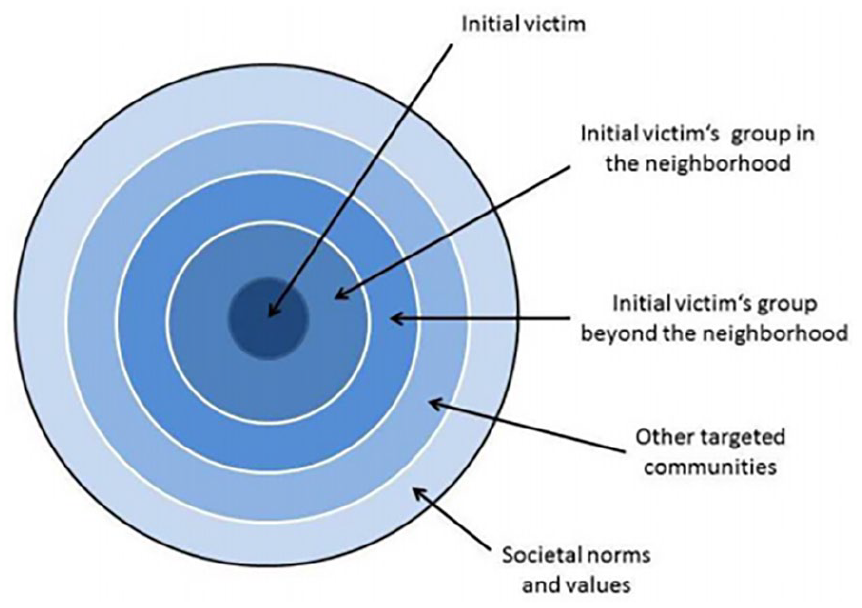
Waves of harm generated by hate crimes.
These contributions have largely been theoretically grounded within criminological inquiry. Recently, Paterson et al. (2018, 2019) have produced empirical data, which demonstrate that those who share the same identity as the primary victim experience similar, yet indirect, emotional harms as that victim. There has been little scrutiny, however, of how this takes place for those who support victims of hate. Iganski’s (2001) work, while a key foundational text to this article, utilises a generalist framework to theorise how hate events carry harm and victimise beyond the primary victims more generally. I propose that vicarious victimisation is an additional victimisation process that occurs in therapeutic occupations, when an individual, who shares the primary victim’s identity, takes on their experiences through a therapeutic relationship. I, therefore, analyse the data presented through the lens of emotional labour in order to advance Iganski’s (2001) waves of harm model. While findings presented in this article cannot be generalised, they yield such rich discussion on the emotional impact of supporting victims; it is of merit to contribute these to scholarly discourse.
Background literature
High-profile cases such as the murder of Stephen Lawrence (see Macpherson, 1999) have raised awareness of criminal violence, aggravated by hostility towards identity (Crown Prosecution Service, 2007), within the public and academic consciousness. Although scholarly definitions contest and problematise its phraseology, such crimes are often termed ‘hate crimes’ (Chakraborti and Garland, 2015). Criminologically, theorising the specificities of ‘hate crime’ and ‘hate’ in terms of its impact (the harms associated), tangibility (how it manifests), and complexity (what the differences are between ‘hate’, prejudice, bigotry, bias) is an ongoing process (Hall, 2013). Currently, there are two types of hate phenomena recognised, operationally, by criminal justice agencies in England and Wales: hate crimes and hate incidents. Hate crimes are acts made illegal under criminal legislation, such as violence against the person, which are specifically aggravated by hostility towards a personal identity or ‘characteristic’. Hate incidents are targeted acts that do not meet the criminal threshold but are aggravated, nevertheless, by hostility towards a personal characteristic (Clayton et al., 2016; Crown Prosecution Service, 2012).
Legislatively, hate covers five key strands of identity in England and Wales: race, religion, sexuality, disability, and transgender identity (Duggan and Heap, 2014). The Race Relations Acts of 1965 and 1976 protect against the incitement of racial hatred, amended in 2006 to offer protections against the stirring up of religious hatred. LGBT+ people are specifically protected under Section 146 of the Criminal Justice Act 2003 which ‘empowers courts to impose enhanced sentences for offences involving hostility directed towards the victim’s sexual orientation, disability or transgender identity’ (Chakraborti and Garland, 2015: 10). The latest statistics for England and Wales show that 15,835 and 2540 hate crimes were recorded between 2019 and 2020 against sexual orientation and transgender identity, respectively (Home Office, 2020).
Hate crimes are not the establishment of new crimes; rather, they are used to provide an uplift in sentencing. Iganski (2001) justifies this enhancement by arguing that hate crimes ‘hurt’ more psychologically (Chakraborti and Garland, 2015; McDevitt et al., 2001) than non-hate crimes. Due to the intrinsically personal nature of an individual’s identity being targeted, those who are victimised by hate experience higher levels of emotional and psychological distress, anxiety, suicide ideation, depression, anger, and feelings of reduced safety (for a comprehensive overview, see Dragowski et al., 2011; Herek et al., 2003; Herek et al., 1999; Iganski and Lagou, 2015; Paterson et al., 2018) than victims of non-hate crime. This article focuses on two of the five strands – sexual orientation and transgender identity – and uses participant’s own definitions and understanding of ‘hate’ regardless of whether it meets a criminal threshold. Thus, for ease, I acknowledge that both hate crimes and incidents are a form of identity-based violence that can cause emotional harm.
Mason (2007) argues that hate crimes are, by definition, crimes of emotions. She posits this for several reasons. Utilising Nussbaum’s (2001) work on ‘emotional thinking’, Mason first acknowledges that the sympathy or compassion we – as a society – feel towards victims is helpful in delivering justice. Without compassion, the harms caused to victims are unable to be recognised. She advocates that hate crime be acknowledged as a moral category that promotes tolerance over prejudice. Thus, ‘the concept of hate crime is designed to make a symbolic “moral claim” that prejudice is wrong and should be rejected in favour of tolerance and respect for oppressed groups’ (Mason, 2007: 251). Second, she posits that emotions are central to both the perpetrator’s rationale for committing a hate crime and the victim’s experience of the crime. Perpetrators of hate are motivated by a hostility, prejudice, or bias towards a person (Perry, 2003), specifically their identity; a profoundly emotional drive. Third, the targeting of identity to commit violence carries detrimental emotional harms. Much focus, however, has been spent on the primary victims of hate, with little empirical research examining the experiences of indirect victims.
Recently, Paterson et al. (2018, 2019) provide empirical data that show those who know and hear about someone being directly victimised for an identity that they themselves share demonstrate comparable feelings of anxiety, vulnerability, and stress as those directly victimised. They apply intergroup emotions theory, explaining that . . . when group identities are salient, individuals redefine themselves as group members rather than as individuals and consequently think, feel, and act on the group rather than the personal level. So, what happens to the group is felt and responded to as if it has happened to them personally. (Paterson et al., 2019: 212)
In their study, victims who had experienced both direct and indirect hate crimes were more likely to experience vulnerability, shame, and anxiety. According to Paterson et al. (2018), . . . other group members respond with anger and anxiety because they feel as though their group – and by extension themselves – have been attacked . . . these emotional reactions are also predicated upon the meaningful ties that bind group members together; that is, group members do not just respond as group members to feelings of threat, they also feel empathic concern for their fellow group members. (p. 222)
The authors find that empathy plays a demonstrable role in vicarious victimisation, implying that LGBT+ peers, friends, and associates provide emotional support to those directly victimised. Thus, as found by Paterson et al. (2019), youth and community groups, specifically LGBT+ groups, bring individuals together, strengthen group bonds, and allow victims to feel safer, protected, and less vulnerable. However, the authors do not unpick the community dynamics within their study. Thus, the implications for those working with hate victims, such as the youth and community workers described in this article, are currently unknown. It is reasonable to suggest that those who provide such emotional support, by performing emotional labour through their occupation, may experience similar forms of vicarious victimisation.
Performing emotional labour to provide victim support
Hochschild’s (1983) original definition of emotional labour posits that emotions and feelings are managed by workers in order to strategically display emotional cues that are expected within the workplace. The concept originated from service work (e.g. customer service) analyses (Ashforth and Humphrey, 1993a; Hochschild, 1983) by examining how emotions can be deployed and utilised by workers as a source of their labour. Arguably, emotions are managed in order to do what is occupationally expected for economic gain and profit (Hochschild, 1983). Contemporary advances to emotional labour, however, have expanded its application to other professions, such as nurses, lawyers, social workers, academics and researchers, and even those volunteering in a community setting.
Mauno et al. (2016) argue that most occupations and organisations have explicit rules or scripts about how emotions should be expressed. Emotions are therefore ‘managed’ by workers to suit the appropriate context and fulfil specific occupational norms. Emotional management strategies ‘can be cognitive (reinterpreting an event or situation), behavioural (controlling emotional displays), or physical (reducing arousal through the use of psychoactive substances) in character’ (Pugliesi, 1999: 126). As can be seen in Paterson et al.’s (2018, 2019) research, emotional work can be employed by friends, peers, and family members who provide an emotionally supportive relationship. By distinction, emotional work is generally unpaid and does not contribute towards an income through labour. Furthermore, it is rare that emotional work is provided on a consistent basis as an institutionalised requirement. I therefore utilise the concept of emotional labour to analyse data taken from youth and community workers.
Hochschild’s (1983) initial premise argues there are two ways emotional labour manifests: surface acting and deep acting. Surface acting is where the inner emotions felt are not in correspondence to the emotions that are displayed – sometimes leading to emotional dissonance (Rafaeli and Sutton, 1987) – and a surface act is performed and imparted. Deep acting is where the inner feelings are altered to align with the occupational or organisational norms. Ashforth and Humphrey, (1993a) advance this proposition to include a third process of emotional labour: genuine emotions. This is where worker’s genuine emotions, such as empathy, are regulated to varying degrees in order to give an appropriate response or emotional display depending on the occupational/organisational ‘rules’. These rules are not immutable, however, as Bolton (2000: 582) posits that workers can ‘evade organizational or professional prescription in order that they may offer their emotion work as a special gift to patients in their care’ and add something extra to the worker/client relationship without expecting a return.
Unlike other face-to-face occupations – for example, nurses who are specifically trained to show empathy and sympathy while caring for patients (Mauno et al., 2016) – youth services have never operated using a formalised script on how to manage emotions and conduct emotional labour. Arguably, this has continued in the past 10 years, as youth work has seen increasing decline in training provisions due to an ideological shift to de-professionalise the sector, in line with austerity cuts (Jones, 2015). There are, however, informal workplace norms around safeguarding and boundary keeping, which cue youth workers to manage both their own and other’s (client’s and colleague’s) emotions when in practice (Hart, 2016). These are termed occupational or organisational ‘feeling/display rules’, where the feelings deemed to be in line with occupational norms are conformed to (Hochschild, 1983). Bolton (2000) identifies such practice as prescriptive emotionality, as emotional management strategies become aligned with professional or ethical rules of conduct (e.g. see National Youth Agency, 2004, 2007)
Performing emotional labour on a consistent basis can both positively and negatively impact workers. For instance, emotional labour strategies can positively empower some workers to remain in control of their emotions so that they can perform their jobs efficiently (Pugliesi, 1999). Indeed, research has demonstrated that workers who deep act and genuinely feel the emotions that they are expected to display are shown to exhibit higher levels of job satisfaction (Wharton, 2009). Furthermore, managing one’s emotions successfully may help workers to maintain positive working relationships by processing negative emotions and enabling them to distinguish between their professional and their personal life. Conversely, continuous surface acting over an extensive period of time can cause some workers to feel inauthentic and increase the likelihood of experiencing emotional exhaustion and burnout (Brotheridge and Grandey, 2002). Managing one’s emotions in this manner can also make some workers feel self-estranged and detached from their work by undermining their sense of professionalism (Morris and Feldman, 1996).
Some work environments require more intense performances of emotional labour than others, however. Work involving trauma is particularly emotionally laborious and carries the risk of workers becoming overly attached to traumatised clients and over-identifying with their emotions. By experiencing and exhibiting genuine emotions, such as empathy, those who work in a caring capacity are at risk of becoming emotionally overinvolved (Evdokia, 2017) with their client’s trauma and experiencing it for themselves, vicariously. Over-involvement increases the risk of stress and compassion fatigue (Grey, 2009), described by Evdokia (2017) as the ‘cost of caring’, resulting in the worker experiencing similar levels of trauma as the client. In fact, Moran and Asquith (2020) argue that even criminological researchers are at risk of experiencing vicarious trauma due to the emotional labour performed when researching topics, such as sexual abuse and hate crime, particularly when they have a personal connection to these topics.
Jordan’s (2010) work on military therapists theorises that the likelihood for vicarious trauma to occur is shaped by many factors, such as the number of individuals the worker is supporting, personal history of trauma, professional history of trauma, perception of training provided, peer supervision, availability of social support, self-care, and resiliency. Campbell and Wasco (2005) argue that it is more likely for vicarious trauma to occur when there is a shared identity between client and professional, such as in this research. For instance, women counsellors who deliver therapeutic work to those victimised through rape and sexual assault can start to share in their client’s trauma, through their womanhood (Campbell and Wasco, 2005). It is in this shared identity – within the therapeutic relationship between the LGBT+ individual and the LGBT+ youth and community worker – that I situate my analysis to suggest that vicarious victimisation may occur.
Youth and community workers tend to hold intense emotional attachments to the young people that they support and are often passionately invested in their profession (de St Croix, 2013). Thus, it is compelling to foresee that those who work with hate victimisation within the voluntary sector are expected to employ emotional labour strategies, in order to carry out their daily capacity of care within their day-to-day working life. Indeed, Riley and Weiss (2016: 12), in their review of emotional labour, acknowledge that ‘managing distress, suffering, trauma, death, bereavement, anxiety and anger, for example, were a common source of emotional labour for many participants’ with over-identification with the client group being a significant factor in contributing to the worker’s burnout. When a person’s professional, personal, and social identity overlaps, such as being an LGBT+ youth worker providing support to LGBT+ young people, the empathic (genuine) emotional connection felt between worker and client is arguably very significant. While the data provided in this article highlight these emotional labour strategies and shed light on the occupational stressors experienced by LGBT+ service workers, further empirical work is required to confirm whether this shared connection over the victimised identity carries the risk of vicarious victimisation.
In addition, it is important to remain mindful when discussing identity-based violence that identity groups are not homogeneous identical communities. Indeed, LGBT+ people experience violence across numerous intersecting social structures and dynamics that shape their experience across class, gendered, and racial lines (Meyer, 2010). Oppression and victimisation are therefore shaped in different ways by these dynamics. For instance, intracommunity conflict has been observed within the LGBT+ spectrum, most recently seen in the trans-exclusionary politics of some lesbian activists who seek to exclude trans people from specific spaces (Pearce et al., 2020). Thus, LGBT+ people do not experience violence or oppression in the same way and their lived experiences are as diverse as any other social group. Nevertheless, as demonstrated by Paterson et al. (2019), there is a sense of shared emotional harm when a group member is victimised due to the complex ties and power structures that connect LGBT+ people. This article only represents a small sample of worker participants and therefore does not have the scope to theorise beyond speculation how vicarious victimisation may be distinguished or experienced intersectionally. However, it is reasonable to question, for example, whether a gay man may experience the same vicarious victimisation when supporting trans people than he would another gay man and vice versa.
Method
The study concerning this article is a qualitative exploration of anti-LGBT+ hate in relation to voluntary sector, education, and criminal justice pathways. This article draws on interviews from voluntary sector youth and community workers to examine the impact of supporting individuals who have experienced hate.
Sampling
LGBT+/Queer communities are frequently seen as ‘hard to reach’ for research purposes (LaSala, 2009; Swann and Anastas, 2009) in part due to their communities, bodies, and identities being marginalised from mainstream spaces (Dwyer, 2012). Voluntary sector youth and community groups, within the North East of England, were therefore targeted. LGBT+ groups sampled were specifically used as meeting places for LGBT+ people – predominantly young people under the age of 21 years – to socialise, seek peer support, access information on LGBT+ events, and access support from community workers. A time-space sampling (TSS) method was therefore used to recruit participants. ‘TSS techniques seek to recruit respondents in places and at times where they would reasonably be expected to gather and to ask them about their experiences within the place or space’ (Muhib and et al, 2001: 217). A non-ethnographic style, this method does not enable to the researcher to observe and immerse into the groups that participants are a part of; rather, it allows researchers to recruit and interview participants in their familiar spaces.
Although not specifically aimed at providing hate crime provisions, youth and community groups offered hate crime support to their service users as part of a range of support packages that include mental health support, sexual health guidance, socialisation with peers, counselling one-to-ones, and so on. Usually, they are spaces where LGBT+ people socialise at specific times (e.g. a community group may run every Tuesday, 5–7 p.m.). Chief executives and managers of the organisations were initially approached with requests to recruit participants who worked for (service workers, n = 6) and who utilised the services offered (service users, n = 11). Seventeen participants from the voluntary sector were interviewed in total using a semi-structured method and lasting between 35 and 90 minutes; all participants were LGBT+. All service workers held youth and community roles within their organisation. Service workers were aged between 43 and 62 years. Service users were aged between 14 and 67 years, although the majority were under the age of 21 years and classified as ‘young people’ by these services. Nine participants were cisgender; eight were trans with three identifying as non-binary. Seven participants identified as gay, four as lesbian, three as pansexual, one as bisexual, and two identified their sexuality outside of fixed labels. All participants except one were White English.
Analysis
Interviews were audio-recorded, transcribed, and thematically analysed using Braun and Clarke’s (2006) six-phase process. This involved looking across the dataset to establish core repeated patterns and meaning. These patterns were coded and organised around the broad theme of LGBT+ hate crime victimisation. Data were coded to distinguish between LGBT+ service users and LGBT+ service workers. I draw on these interview data in order to explore the emergent themes and argue that voluntary sector services provide a vital community network and support system for LGBT+ people who have experienced hate, and suggest that service workers who support LGBT+ people may take on their service users’ victimisation and experience hate vicariously by performing emotional labour.
Ethics
Using the principles outlined in the British Society of Criminology (2015) Statement of Ethics, ethical approval was obtained from the ethics panel at the author’s institution. Participants highlighted in this article are anonymised using pseudonyms. Information sheets and consent forms were used to ensure that participants remained aware of their right to withdraw from the study. Due to the semi-structured nature of interviews, it was made clear to participants that they could co-shape the interview dialogue and could refuse to answer any questions that made them uncomfortable.
Limitations
The main limitation when theorising the potential vicarious victimisation of workers is the sample size; only six youth and community workers were interviewed in total. However, there are few LGBT+ youth and community services in the voluntary sector in the North East. Three services were approached for this study, and two workers from each service were interviewed. Despite this low sample number, a cross-section was achieved across such a specific cohort. Furthermore, the aims of the study did not set out to directly examine the work lives of LGBT+ youth and community workers using the lens of emotional labour. Rather, these data emerged organically during discussions about the impact of hate crime on the people that workers supported. Thus, the work presented here, while rich in empirical data, is designed to facilitate dialogue on the emotionality of workers who support hate victims and the potential for vicarious victimisation. Further empirical work is needed to confirm the nature of vicarious victimisation in relation to hate crime.
Findings and discussion
The three key areas of data discussed in this article are as follows: emotional labour and over-identification, coping with occupational stressors, and the potential for vicarious victimisation and trauma. Service users utilised LGBT+ youth and community groups to seek support for their experiences of marginality and find other LGBT+ peers and friends. I begin by exploring the personal reasons workers gave for supporting LGBT+ individuals.
Emotional labour and over-identification
Supporting individuals around identity-based violence carried heavy emotional challenges for service workers, especially as they themselves shared the identity for which service users were victimised. All workers had themselves experienced hate crime in the form of verbal and physical abuse. For example, I have had physical abuse, violence, verbal abuse walking home with friends from the pub, you know individuals walk out and see me and you know start yelling tranny. (Caroline, 54, pansexual, trans woman, SW)
The average age for workers was 51.8 years. It was therefore common for workers to relay their experiences of hate using an empathetic historical lens, as they had all experienced anti-LGBT+ hate in a time when socio-legal protections for LGBT+ people did not exist: I came to work with the organisation as when I came out as trans I found no support for me so I tried to set up support that I wish had been there when I came out and when I came looking for support. (Karen, 43, pansexual, trans woman, SW)
The emotional labour provided by workers, in the form of emotional support, was therefore intimately tied to their own experiences of anti-LGBT+ hate and the lack of support available to them. Another participant described at length that having her adopted child taken away from her, for being a lesbian, in the 1970s caused her significant emotional trauma, resulting in a mental health breakdown. After receiving therapy, she decided to establish her own service to support LGBT+ people who had been victimised: When the court case came about, when I had to give up my adopted child, that really affected me. For ten years I couldn’t talk about it. I didn’t realise how much hate there was in the world or how much homophobia there was. I can’t really explain it, it just affected my confidence and self-esteem. So after coming through it I decided to set this (charity) up. I did panic because I thought I might get some homophobia . . . but I wanted to help other people out there. (Molly. 60, lesbian, cis woman, SW)
When asked why they worked in the area of LGBT+ support, workers outlined that their own experiences of anti-LGBT+ hate helped them to understand and empathetically connect with other LGBT+ people. Indeed, having first-hand knowledge of homophobia and transphobia was (a) the impetus for working with LGBT+ people and (b) equipped youth and community workers with a deeper understanding of the support mechanisms required for many of their service users.
All workers reflected on how growing up in homophobic and transphobic environments made them feel unsafe, prompting a desire – as can be seen in the quotations above – to support other LGBT+ people and provide a space where they could feel safe. It is important to affirm here that this shared experience with service users, while difficult to navigate, can be an asset when working with victims due to the shared understanding and meaning making that can be brought together for personal growth and trauma resilience (Pack, 2013). However, providing support around anti-LGBT+ hate required workers to negotiate their own experiences of victimisation with their client group’s victimisation, an emotionally tasking process. Moran and Asquith (2020: 3) argue that . . . justice-doing through witnessing demands that the witness be deeply present, leaning into the victim’s experiences and their personal and political meanings. Emotional labour in this context is complex and demanding; it is not simply a matter of performing emotion and connection in the desired way . . . this kind of presence, engagement with suffering and the emotional labour of witnessing cannot help but transform the witness. (Moran and Asquith, 2020: 3)
Thus, a great deal of empathy and complexity, by ‘perceiving, understanding, experiencing, and responding to the emotional state and ideas’ (Barker, 2003: 411) of service users, is required of youth and community workers, in order to provide emotional support and navigate the experiences of victimisation that they themselves share with the service user. Huynh et al. (2008: 199) view empathy as a ‘multi-dimensional process that practitioners, specifically nurses, discern the world of others, their communication of this understanding and the others’ perception of being understood’. The importance of empathy in caring professions is critical in gaining positive outcomes – such as fostering positive relationships, communication, and reducing anti-social behaviour (Gerdes and Segal, 2011) – particularly with young people (National Youth Agency, 2007). However, empathy, as highlighted previously, is an emotion that places workers at risk of over-identification and burnout from taking on much of their client’s emotions (Heffernan et al., 2010). Both participants’ statements above indicate that service workers presented strong relational identification with their client group, specifically their client’s victimisation. This was demonstrated during the fieldwork of this research, as, when relaying some of the issues that they were currently supporting service users through – homelessness, homophobic family members, bullying, hate crime – several workers became emotional and tearful while being interviewed. Consequently, feeling emotionally drained, stressed, cynical, worried (about service users), and angry were framed, as expressed by Caroline (54, pansexual, genderqueer transwoman, SW) as ‘part of the job’.
For those doing victim and trauma work, a shared history of trauma can potentially have both negative (vicarious trauma) and positive (vicarious posttraumatic growth) emotional and schematic consequences. Cohen and Collens’ (2013: 577) meta-synthesis finds that both ‘vicarious trauma and vicarious posttraumatic growth stem from an empathic engagement with traumatized clients and occur as a result of challenges to current cognitive schemas that lead to their adaptation’. By witnessing the growth of those one is supporting, vicarious posttraumatic growth can be experienced by the worker who finds meaning in their clients’ emotional healing (Cohen and Collens, 2013). By providing the support for LGBT+ individuals that service workers historically lacked in their own lives, it is possible that workers are able to find personal meaning in helping younger LGBT+ people.
Coping with occupational stressors
As highlighted previously, the ability to manage occupational stressors – such as over-identification or being emotionally attached to a service user’s pain – has an impact on how workers carry on supporting individuals. If workers experienced occupational stressors, strategies to buffer the negative impacts that arise can be employed. Several participants advised, You don’t let all your emotions be sucked out of you. You have to guard your psyche so that emotionally your psyche is not drained. It is self-preservation. (Karen, 43, pansexual, trans woman, SW) Everything else is kind of; you have that force field around you so you don’t let it affect you . . . So I have barriers, coping mechanisms, for dealing with all of the stuff. And it is very useful for me as a worker who daily deals with this shit far too often, because I am the person who has to pick up the pieces and threads of broken lives. (Caroline, 54, pansexual, genderqueer transwoman, SW)
Coping strategies were mobilised as a means to buffer (Hochschild, 1983) the emotional burnout and harms stemming from working with young LGBT+ people. They were employed by participants to continue working with, and supporting, LGBT+ people while preventing mental health deterioration. Both extracts above suggest some form of detachment to ‘guard your psyche’ or develop a ‘force field around you’ to balance the negative emotions that arose from working with victimised people. Affirming to themselves the positives of being a youth and community worker – such as the ability to create space for young LGBT+ people to socialise and express their identities, in ways that they themselves were unable to do in their youth – was discussed as a key mechanism to prevent mental health deterioration. Caroline for instance, expressed that supporting people and seeing the practical benefits of her work were used to balance the negative, often traumatic, aspects of working with victimised people: It is very easy to destroy yourself in this sector. There is a time to say I can’t fight this battle so pick a different one. In a way I have the best job in the world, but it is also the worst job in the world because you see a lot of really bad shit. But when you see the good shit and you see someone walking off smiling and knowing that you have made a difference, you can go home and think ‘this has been a good day’. (Caroline, 54, pansexual, genderqueer transwoman, SW)
Mental reminders to focus on the positive aspects of working life are common techniques for professionals trying to avoid burnout (Korczynski, 2003). This allows one to continue with the more stressful aspects of a person’s job and helps to manage the emotional tolls placed on workers so that they are able to maintain a healthy work/life balance. Due to the personal pull of providing victim support to those with a shared victimised identity, it can be understandably difficult to create a work/life balance or separate work life and personal life. In this instance, youth and community roles were reflected on as being, paradoxically, the worst and best occupations to hold, due to the constant polarity of witnessing ‘a lot of really bad shit’ and also ‘knowing that you have made a difference’. Although it is difficult to ascertain whether workers experienced vicarious victimisation, a worker’s resilience and ability to employ buffering strategies are key factors in the likelihood for potential vicarious trauma to occur (Adams and Riggs, 2008; Jordan, 2010).
The potential for vicarious victimisation and trauma
Much psychological evidence has shown that those who counsel and work with traumatised and victimised individuals begin to vicariously take on the trauma of their client and experience professional burnout, brought on by emotional exhaustion (Jenkins and Baird, 2002; Newell and MacNeil, 2010; Trippany et al., 2004). In a professional context, vicarious trauma is where ‘providing services to survivors, the caregiver is exposed to traumatic material that begins to affect one’s worldview, emotional and psychological needs, the belief system, and cognitions, which develop over time’ (Salston and Figley, 2003: 169). Consequently, it is common for therapeutic workers – doctors, nurses, counsellors, youth workers and so on – to share similar experiences of identifying with the client group and being emotionally invested in the issues affecting them. Vicarious trauma is therefore a complex process that affects a therapeutic professional’s cognitive schema of the world and is influenced by the number of individuals the professional is supporting, personal history of trauma, resiliency and stress buffers, supervision, and a healthy balance between work and leisure (Jordan, 2010). The true influence of a person’s history of trauma over whether or not they will experience vicarious trauma is unclear, as it involves a multitude of additional factors. However, several studies suggest that a person’s history of trauma does influence the likelihood of experiencing vicarious trauma (Kadambi and Ennis, 2004; Michaelopoulos and Aparicio, 2012) due to their established beliefs about the world being shaped by their life events. As stated previously, this project did not originate as a youth and community project, and therefore data on service worker’s full work lives were not captured. What is important for the purpose of this argument is the personal history of victimisation (and trauma) of anti-LGBT+ hate shared between service user and worker.
All worker participants acknowledged that their youth and community practice was influenced by service users’ experiences of victimisation. Indeed, one youth and community worker expressed that she managed her LGBT+ identity to avoid victimisation and experienced anxiety over her service user’s victimisation: I have become hyperaware of people around me. I think I do manage my (LGBT+) identity when I’m on the street and I worry when I have got young people out that they are going to be victimised. I get very anxious when other people are around. (Sue. 48, lesbian, cis woman, SW)
Sue’s account above, as part of a much longer conversation, describes her anxiety about taking LGBT+ young people away from their youth centre for day trips out. Similar to Westaby et al.’s (2016) research on probation officers, working with ‘vulnerable’ people and supporting them with their daily issues arguably caused Sue, in her capacity as a worker, to become hyperaware and anxious, evidencing a type of work–life spillover that may contribute, in this context, to taking on another’s victimisation vicariously. Spillover is where one domain of a person’s life, such as their work or professional practice, seeps into another life domain, such as impacting their private/personal life (Sirgy et al., 2001). A potential consequence of performing emotional labour when supporting a group for identity-based violence, while sharing the victimised identity with the group, is such spillover and eventual vicarious victimisation.
Although the above extract is premised on perceived risk, Sue arguably experiences the emotional harms of hate, highlighted by Iganski (2001), through a fear that her service users will be victimised. The data here are unclear, but it is possible that she may experience this fear vicariously through a combination of two things: (a) her shared LGBT+ identity and the genuine empathy she feels towards the LGBT+ young people and (b) the emotional support she provides and is required to display to young people for their victimisation. This would support Paterson et al.’s (2018, 2019) hypothesis that community members become indirectly victimised by hearing about direct victimisation. Within this context, the emotional labour undertaken in the form of emotional support may be an integral part of the vicarious victimisation process, as professionals who share in the victimised identity of their client group have to navigate both the negative consequences of the emotional labour involved when providing support and the in terrorem harms of identity-based violence.
Although emotional support for identity-based violence can be provided by peers, friends, professionals, and family, youth workers in this case study, by distinction, provide daily support as a core component of their work to those with a victimised identity that they themselves share. As expressed by Caroline, When I first started this (job) I used to take on every little bit of their lives and I would emotionally invest in everything. Within two years, I got to the point when I was burning out. I recognised that a damaged broken me is no use to anyone. (Caroline, 54, pansexual, genderqueer transwoman, SW)
Both Sue and Caroline’s extracts describe how their professional practice, and ultimately their day-to-day lives, is impacted by providing emotional support to service users. Caroline’s description of taking on ‘every little bit of their lives’ suggests over-identification with the victimised LGBT+ people that she works with, due to the empathic emotional investment described.
The data provided highlight that service workers provide ongoing support and empathise on a personal level, due to their shared experiences, with the client group. Empathy, personal history, and coping mechanisms are all key factors in influencing the likelihood of experiencing vicarious trauma. I suggest that vicarious victimisation takes places when there are three core factors that take coalesce – (1) identity-based violence, (2) shared identity between the support worker and victim, and (3) emotional labour performed to support the primary victim. For future research, it is useful to consider vicarious victimisation as a negative consequence – of which there are many – of performing emotional labour. The following four points detail this process and lay out how I speculate vicarious victimisation to occur:
Identity-based violence. The primary instance of violence directed towards identity. This violence is experience on a fundamentally personal level due to the identity of a person being victimised. This can degrade and brutalise the self of a person, contributing to spirit injury.
Shared identity. This violence is extended to all who share in the victimised identity. Identity-based violence is not specifically hostility towards the individual but their identity or membership of a particular social group. The in terrorem harms of hate are shared to all those with a shared identity.
Emotional labour. Emotional labour performed in the form of emotional support to the direct victims by those who share in the victimised identity. This sharing of identity risks over-identification with the primary victims. As such, emotional labour strategies are required to buffer these consequences (Ashforth and Humphrey, 1993; Ashforth et al., 2000).
Vicarious victimisation. A negative consequence of performing emotional labour and having a shared identity. Negative consequences of emotional labour, such as burnout, fatigue, spillover, and over-identification with the victim, can occur to all workers, regardless of whether they share an identity with the client. Vicarious victimisation occurs when the worker, who already experiences the harms of social oppression and the in terrorem harms of hate, takes on the victimisation of the primary victim through the emotional labour they perform.
Concluding thoughts
While the case of LGBT+ service workers has been provided to highlight the occupational stressors of working with hate victims, additional data and research are required to further substantiate the process of vicarious victimisation. Although an emotional labour model is a useful lens with which to theorise, it is restrictive in its work-based premise. Paterson et al. (2018, 2019) have found that providing empathy and support is a demonstrable factor in whether indirect victimisation occurs. Thus, this typology may not be restricted to those working with victims of hate, as anyone with a shared identity can perform emotion work to support direct victims. However, it is unlikely that emotional work has the same impact as emotional labour due to this labour being performed consistently on a daily basis as an organisational requirement. Nevertheless, using the case of workers presented here begins a conversation on the support needs of those providing emotion support to victims of hate.
For the case of vicarious victimisation, emotional labour in the form of emotional support may be integral to vicarious victimisation. Workers reinforced that there were numerous aspects of their jobs that were distressing and emphasised the importance of ‘not taking on’ the pain of their service users by emotionally investing too deeply. However, it was also rewarding when they witnessed improvements in the people that they supported. Focusing on these positives was the way all workers coped with the emotional labour that they performed. The emotionality of hate runs through every process in which it manifests, as identity-based violence has structural, social, and macro foundations. While this article has begun the conversation, I advocate that future scholarship seek to analyse the emotional support provided to victims of identity-based violence much more comprehensively.
Footnotes
Acknowledgements
I would like to extend my great appreciation to my friend and colleague Dr Chalen Westaby, the queen of emotional labour, for supporting me through the many iterations and drafts of this paper.
Funding
The author(s) received no financial support for the research, authorship, and/or publication of this article.
