



Abstract
Since Granovetter’s seminal works, the influence of personal networks on the labour market has attracted widespread attention. This article analyses the role played by contacts in the context of the labour trajectories of young people in Spain, for whom the use of personal networks represents one of the most important job-searching methods. Using narrative data extracted from a life-history grid and ego-network generator, the analysis brings to light nine mechanisms in which personal contacts intervene in job-searching and job-finding in a sample of 90 young people living in the Barcelona Metropolitan Area. The article emphasizes that contacts play primarily three roles in these processes as informers, employers, or influencers. This distinction offers a renewed framework for the study of networks in the labour market, further complementing the debate on the strength of ties. Using this framework allows me to create a map of the mechanisms that shed light on personal networks as tools with which to deal with labour insecurity and unemployment among young people, thus providing resources that to a large extent reaffirm the objective character of class differences. The article offers innovative insights into how social capital operates in the labour market and helps understand how youth precarity, which is widespread in Spain, is experienced in a relational way.
Introduction
The relationship between personal networks and the labour market has fascinated social scientists across time and contexts (Burt, 1992; Chen and Volker, 2016; Granovetter, 1973, 1974; Lin, 1999; Mouw, 2003; Requena, 1991, 2008). The reasons explaining the interest of scholars in this subject are well rooted in the sociological tradition. For example, we know that asking friends, family, or colleagues for help is one of the main strategies adopted by job-seekers in Europe (Bachmann and Baumgarten, 2012), albeit with differences from country to country (Pellizzari, 2010). This key role of personal networks in the labour market has many consequences because a plurality of mechanisms of social reproduction emerge through the way contacts help one find a job. For example, there are strategies and ambitions that highlight class disparities, as well as structural inequalities and vulnerabilities, and therefore privileges and discriminations. As is well known, we are connected to others through our class and social backgrounds, making personal networks the result of unequal life courses and professional pathways (Vacchiano and Spini, 2021). Research has shown compellingly down the years that ‘who you know’ is an intrinsic aspect of social inequalities, and that these are created in the labour market in an eminently relational way (Chen and Volker, 2016).
This article sheds light on this role of personal networks in the context of youth labour trajectories in the Barcelona Metropolitan Area (Spain). This Mediterranean region is particularly interesting for exploring the role of personal networks in the labour market for several reasons. First is the persistence of a southern European social model in which local ties, such as family ties play a central role in supporting young people during the transition to adulthood (Gentile, 2015; Serracant, 2013). Moreover, one of its structural characteristics is the large number of small- and medium-sized firms, which have been previously associated with the use of employee networks as a recruitment method (Martín and Lope, 1999; Rieucau, 2008). In this area, in which the incidence of temporary occupations and youth unemployment is very high (Verd et al., 2019), the use of personal networks has been previously noted as the main job-searching and job-finding methods among young adults (Vacchiano et al., 2018). By studying these processes, novel and meaningful insights may shed light on the important role played by contacts in other Mediterranean regions as well (Naldini, 2004).
Applying qualitative content analysis to narrative data collected through a hybrid questionnaire (Axinn and Pearce, 2006), the main contribution of this research is therefore to identify nine mechanisms through which young adults sought and found jobs through contacts in Barcelona. These nine mechanisms offer novel insights primarily in the sociology of work using network and social capital theory (Lin, 2001). While most of this research follows a quantitative approach when studying the causal nexuses between networks and job outcomes (Chen and Volker, 2016 for a review of the ‘Mouw-Lin’ debate), this article uses narrative data to highlight the social mechanisms underlying these nexuses, and thus the rationale behind the interactions between job-seekers, contacts, and employers during job-matching. A qualitative approach, also used by authors such as Marin (2012), Newman (1999), or Smith (2005), helps to explore more precisely why, where, to whom, and how contacts offer help in the labor market (Smith and Young, 2017:172). This allowed me to make original distinctions between the roles played by contacts as informers, employers, and influencers in job-searching and job-finding. That leads me to a map of nine mechanisms that not only increase knowledge of the influence of social capital on the labour market, but also build understanding of how labour insecurity was experienced during the Great Recession in Spain (Marí-Klose, 2020). Hopefully, as we discuss in the conclusions, this map will provide a fruitful framework for building novel research hypotheses and obtaining innovative results in many other research contexts.
Precarious lives: the role of personal networks in youth labour trajectories in Spain
Today young people’s labour trajectories are more insecure and unstandardized than ever in many Western countries (Cairns, 2012; Furlong and Cartmel, 1997; Hardgrove et al., 2015; Kalleberg, 2018). Although young people in Spain have higher educational levels than previous generations (Cardenal de la Nuez, 2006), they suffer from high unemployment (Marí-Klose, 2020), labour insecurity (Verd et al., 2019) and increasing dependence on their families of origin (Gentile, 2010), as in other Mediterranean countries affected by the Great Recession (Marí-Klose and Moreno-Fuentes, 2013). Scholars point out that, while labour trajectories tended to be more predetermined in the past, today’s youth trajectories are more flexible, diversified, fragmented, and complex (Serracant, 2013). In this context, young people may be unemployed at various times, overcoming their difficulties through different strategies, such as multiple training, part-time, and odd jobs, or emigrating abroad in search of opportunities (Gentile, 2010; Verd et al., 2019). It is now a truism that non-standardization makes any labour trajectory somewhat unique without necessarily changing the unequal nature of the labour market. As often happens in sociology, this put at the heart of the debate the interplay between individuals’ strategies and their structural determinants to understand the specifics of todays’ youth labour trajectories (Furlong, 2013).
The study of the functioning of personal networks is key to understanding these processes (Lozares and López-Roldán, 2012; Vacchiano and Spini, 2021). Individual strategies and social determinants are widely linked to the way young people access social capital and therefore to the support of contacts with unequal resources (Bourdieu, 1986; Lin, 2000). Social capital has been defined as ‘the extent of diversity of resources embedded in one’s social network’ (Lin, 2001: 3). A substantial portion of this social capital is certainly linked to the individual’s social origins. Indeed, families not only transmit economic and cultural resources to youth trajectories (Serracant, 2013), but they also help in job-searches through recommendations and information, which is in many ways linked to their status and social prestige, and with the influence they can exert on other people in the labour market (Vacchiano et al., 2019). Contacts are in fact a source of extraordinary inequality: in many cases it is the ability to access certain social circles that allows young people to access those qualified sectors offering the prospect of a satisfactory job, whether in the cultural industry or other professional fields, despite also being undermined by labour insecurities (Brook et al., 2020).
What seems clear is that, beyond class disparities, the use of networks as a job-search method is a structural element of the Spanish market (Ibáñez, 1999; Requena, 1991, 2008), a useful tool in a context where, paraphrasing Standing (2011), ‘the precariousness of work is the new norm’ (p. 37). Personal networks represent a rapid job-searching method suited to the frequent occupational changes that characterize youth labour trajectories, as was particularly true during the Great Recession (Verd et al., 2019). Interestingly, while the use of personal networks has often been associated with job-seekers who are in weaker positions in the labour market (Ibáñez, 1999; Lin, 2000 for Spain), our evidence from Barcelona shows that personal networks are the main job-searching method among young people. This is regardless of class disparities, level of education, gender, or whether they are foreign or native to Spain (Vacchiano et al., 2018).
Informers, employers and influencers: how networks matter in the labour market
This high use of contacts as a job-searching and job-finding method in Spain requires understanding the mechanisms generated by these processes, especially in a context of high unemployment, in which contacts are a source of additional inequality for young people. With this aim in view, many important questions arise. Through what strategies do young job-seekers mobilize their contacts? Which needs of youth trajectories are met by these strategies? Why do contacts offer help, and in which segments of the labour market? And how do all these processes take place during job-searching and job-finding? By answering these questions, this analysis aims to provide further insights into why, where, with whom, and how contacts influence the Barcelona labour market (Smith and Young, 2017). This article uses network and social capital theory to answer these questions, distinguishing three roles played by contacts while job-searching and job-finding: informers, employers, and influencers.
First of all, we know that in many cases contacts are informers for young job-seekers (e.g. Lin, 1999). The debate on ‘structural holes’ (Burt, 1992) underlines the importance of mobilizing weak ties (Granovetter, 1973) to access more diverse and more valuable information in the labour market. The reason is that intimate and local ties most likely offer bonding social capital, that is, support and caring, though the information they provide is often redundant (Lin, 2000). However, Maya-Jariego and Holgado (2005) stress that strong ties may indeed offer a multiplicity of forms of support. In this respect, previous research suggests that, where obligation and reciprocity are basic values, as around the Mediterranean, strong ties play a wider and more crucial role in the labour market (Vacchiano et al., 2019). Aral and Van Alstyne (2011) suggest that accessing networks of weak contacts certainly produces a structural advantage, but so does seeking help from strong contacts. These contacts provide greater amounts of information, often more complex and detailed, based on their knowledge of job-seekers ‘needs, which are potentially of greater value than information provided by weaker connections (Aral and Van Alstyne 2011 on the diversity–bandwidth trade-off).
In addition to being informers, contacts may crucially intervene as potential employers in young people’s networks (Smith and Young, 2017). This means that contacts have a ‘direct influence’ over the recruitment process and can therefore choose candidates according to more or less formalized procedures. What is particularly interesting in a familialistic regime is understanding how these processes work through relatives. The family is often seen a safety net for disadvantaged groups alone (Lubbers et al., 2020), but is also a truism that upper-class family networks are more resourceful, allowing relatives to play an even more crucial role through nepotism (Aina and Nicoletti, 2014). Research also suggests that, when contacts are employers in low-skilled sectors, they may be more worried about the reliability of employees rather than their skills. Martín and Lope (1999) suggest that having trust in reliability is a key feature of job-matching in Spain and that personal networks are a very good way of seeking trustworthy candidates (Rieucau, 2008). This helps employers reduce the cost of the job-search and aids job-seekers in coping with the frequent changes of employment that are typical in a situation of labour insecurity (Serracant, 2013).
Beyond being informers or employers, Yakubovich (2005) suggests that contacts can also exert an ‘indirect influence’ during the recruitment process, for example, by putting in a good word with employers for a friend or family member. Although research has previously addressed these processes, the role of ‘influencer’ is still little theorized in the literature. Of course, many inequalities are involved in these processes as well. Family and professional networks are the result of class backgrounds (Lin, 2000; see McPherson et al., 2001 on the homophily principle), and it seems clear that, having access to contacts with greater social prestige, the upper classes can influence employers more effectively (Vacchiano et al., 2019). Research has also shown that, in disadvantaged groups, issues with social capital are not only limited to accessing it, but also involve convincing contacts to share their resources, for example, making a recommendation (Smith, 2005). In addition, researchers are also asking for more attention to be paid to contacts’ influence on formal recruitment processes. Many vacant positions are allocated through public competitions and open calls. Exploring the influence of social capital on these processes may help build further understanding of the interaction between informal and formal methods of recruitment (Shen, 2015).
Methods
Data and sample
The analysis presented in this article is part of a research project (REDEMAS, Spanish Ministry of Economy, ref: CSO2012-36055) using a sample of 250 young adults aged 20–34 to analyse the advantages and disadvantages provided by personal contacts – seen as a form of social capital – in youth labour trajectories. The participants were selected from the Barcelona Metropolitan Area by means of a non-probabilistic sampling strategy based on proportional quotas by sex, age, neighbourhood, country of birth, and educational level (Institut d’Estadística de Catalunya, 2011). The interviewees were recruited by means of advertisements and contacts with youth institutions, backed up with snowballing using interviewees’ own contacts. Following the ethical standards laid down by the Code of Ethics of the Catalan Association of Sociology (ACS), written informed consent was obtained from participants to use the information provided for purposes of research.
The fieldwork was carried out from February to November 2014 by the nine members of the research project team. It was based on computer-assisted personal interviews administered by EgoNet software (Axinn and Pearce, 2006; McCarty et al., 2019). The interviews were structured by a hybrid questionnaire consisting of four modules that collected different types of data. Due to the complexity of the questionnaire, it was considered necessary for a team member to be present at each interview, which therefore took the form of a structured interview, with differences and specifics determined module by module. The four modules were designed as follows. A first set of questions was designed to collect standard sociodemographic data. The second module consisted in drawing a life-history grid to collect data retrospectively on employment trajectories. The third module consisted of three open questions gathering narrative information about the role played by contacts in labour trajectories. A fourth module used a standard ‘name generator’ to collect ego-network data. The second module made it possible to build a dataset of 1734 jobs, while data collected through the fourth module created a dataset of 5000 contacts within young people’s personal networks (see Bolíbar et al., 2019 and Vacchiano et al., 2018 for additional information about data collection).
The interviews were audio-taped to collect narrative information about each module, and their average length was 2 hours. This study analyses narrative information collected through the second and fourth modules for a sub-sample of 90 respondents selected according to two criteria. First, to acquire richer information on the role played by contacts, respondents who reported that personal networks were the most important source of support in their own labour pathways were selected. Second, among these respondents, I selected only those who provided unstructured information about the role played by their contacts in job-searching and job-finding. That means that, during the collection of the life-grid (second module) or the description of a contact (fourth module), these 90 respondents provided additional information on the structured questions about their job-matching experiences. In doing so, they freely narrated a specific life event (e.g. getting a job), thus explaining the role played by their contacts (e.g. how a friend helped them get that job). These specific pieces of information were transcribed and analysed for the purposes of this study.
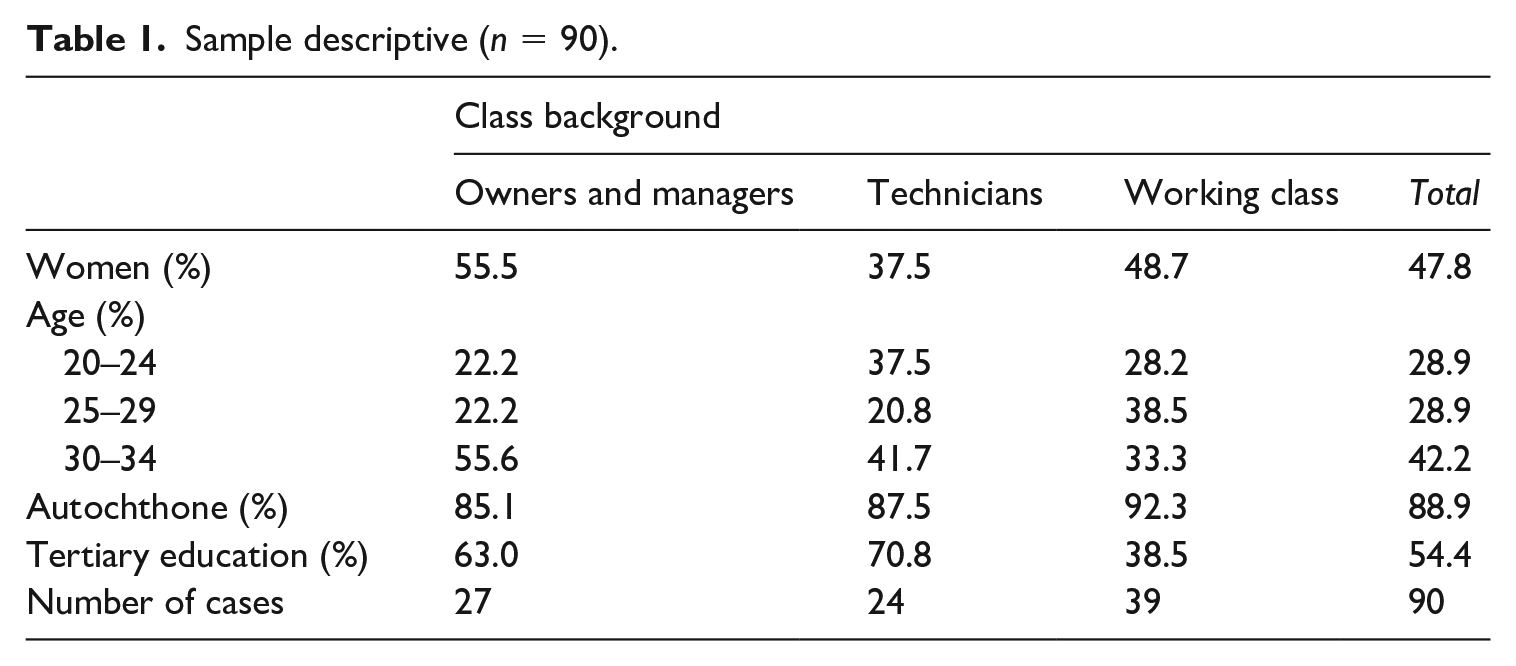
The characteristics of this sub-sample well reflect the diversity of the original sample and are shown in Table 1 according to class background, age, gender, and origin. Following Fachelli and López-Roldán (2015), class backgrounds were classified in accordance with the highest professional positions occupied by the respondents’ father or mother (e.g. also in Erikson, 1984). Thus, the first group includes the owners and managers of firms and self-employed professionals (owners and managers). This group is mainly composed of self-employed, highly qualified workers and owners of small companies. The second group (technicians) consists of qualified employees, the third group (working class) of manual and non-manual employees and middle-rank supervisors. In a similar sense to Olin Wright’s (2015), this classification divides, on one hand, those occupational categories that benefit from direct control over productive resources (owners and managers), on the other hand, those groups consisting of skilled (technicians) and unskilled (working-class) employees, respectively.
Sample descriptive (n = 90).
Analytical approach
To determine the different relational mechanisms involved in job-searching and job-finding, a qualitative content analysis (Schreier, 2012) was performed using a datasheet containing quotes concerning the interviewees’ job-matching experiences, that is, their processes of searching for and/or accessing employment according to the classification presented in Table 2.
Qualitative content analysis: categories of analysis.
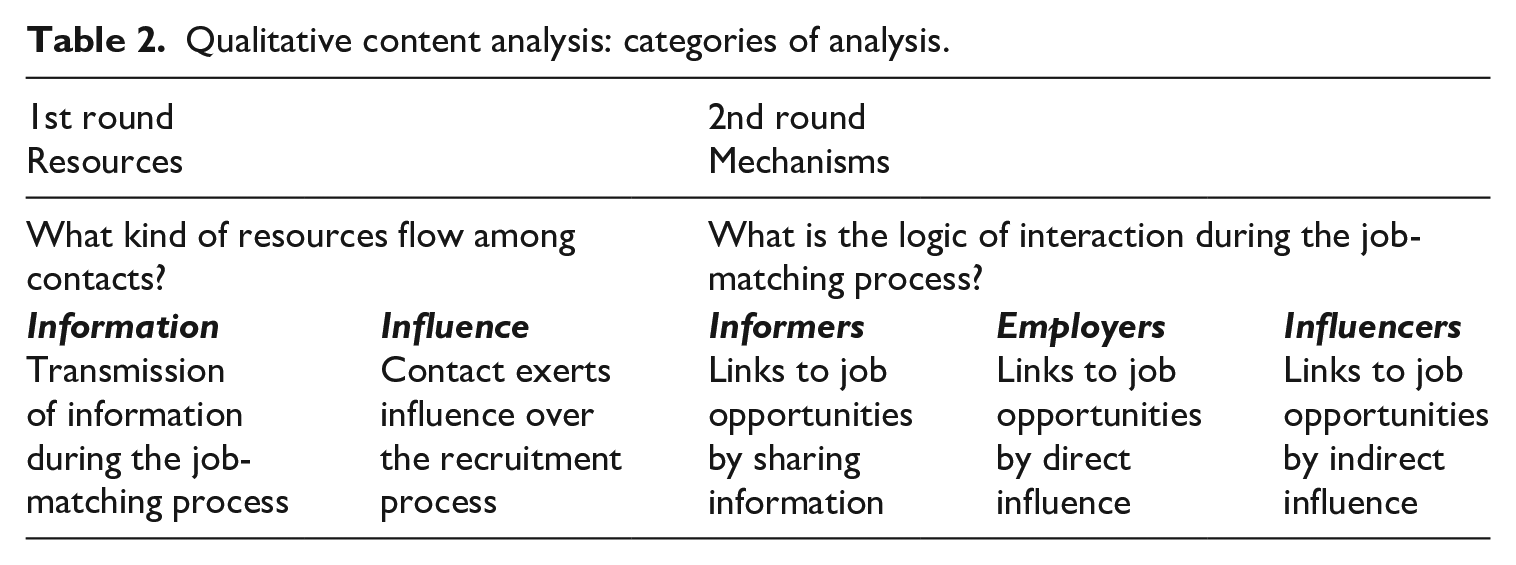
In the first round, we analysed the information provided about the resources that were mobilized (‘information flow’, ‘influence flow’) during job-matching to link the narrative data with our broader conceptual framework, thus identifying three emerging categories: (1) contact as informer: respondents provided information about the role played by a contact giving access to job opportunities by sharing information; (2) contact as employer: respondents explained the role played by a contact who offered them employment and (3) contact as influencer: respondents explained the role played by a contact who influenced a process of recruitment.
In the second round, in which narrative data relating to these three broad categories were categorized, we used an informed coding scheme to register the information separately (Miles and Huberman, 1994: 58). We marked off segments of data by means of sub-codes – for instance, Informer-st (strong ties), Employer-ne (nepotism), Influencer-fm (formal mechanism) – to determine why, where, to whom, and how contacts provided information about job opportunities, offered a job, or influenced a recruitment process. This allowed us to move inductively towards a map of mechanisms having sub-codes in common, thus making them distinctive from each other. These categories extend earlier findings by offering a unified framework of job-searching and job-finding mechanisms (Vacchiano, 2017).
Results
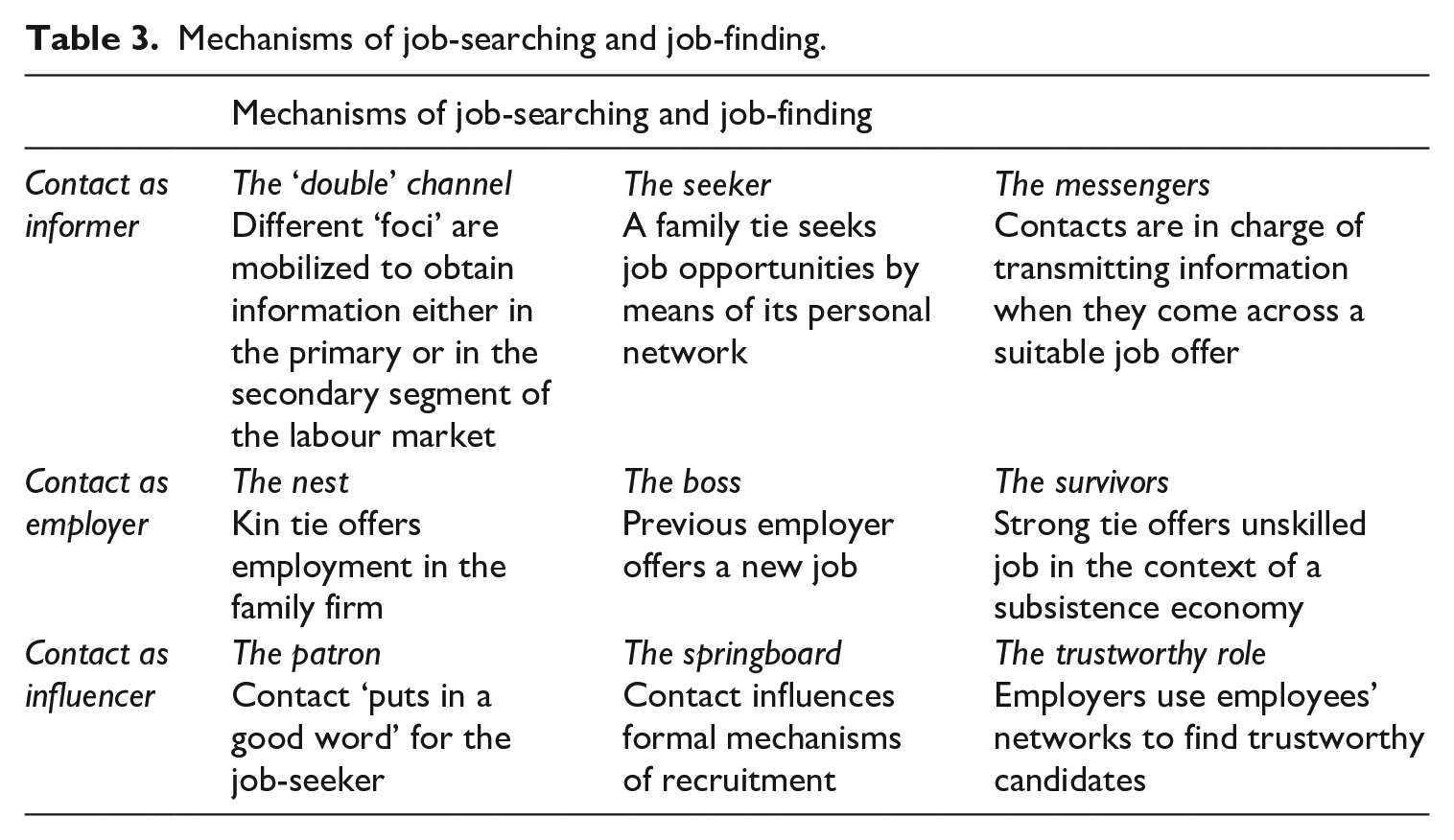
Nine job-searching and job-finding mechanisms were identified (Table 3). We streamlined our main findings into three sections corresponding to the roles played by contacts as informers, employers, or influencers. Illustrative cases have been selected to improve understanding of the specifics of each mechanism in the context of a particular trajectory, thus listing the pseudonym, ID number, age, gender, and class background of each respondent mentioned.
Mechanisms of job-searching and job-finding.
Contacts as informers: the ‘double’ channel of seekers and messengers
Sharing information about job opportunities is one of the main forms of support provided by contacts to help job-seekers (Lin, 1999). This role of contacts is crucial because through them young people access opportunities they are unaware of but that can fulfil their needs and ambitions. Although social capital theory stresses the importance of mobilizing weak connections to gain new information about job opportunities (Granovetter, 1973), research suggests that strong ties may also play an important role, especially in those contexts where obligation and reciprocity are core values, as this research also highlights (Vacchiano et al., 2019; Bian, 1997). Our results bring to light three mechanisms whereby weak and strong contacts play different but complementary roles in information-sharing.
A first mechanism is what we call ‘the double channel’ (13 cases). Respondents stated that one strategy for obtaining information about opportunities in different segments of the labour market is to mobilize a plurality of contacts belonging to diverse relational contexts (also ‘foci’, Feld, 1981), such as family, friends, acquaintances, or co-workers. In a context of widespread precarity, mobilizing different ‘foci’ is a good strategy for acquiring a greater diversity of information (Aral and Van Alstyne, 2011), being particularly important for those young people who combine skilled and unskilled jobs during their labour trajectories. For example, Carlos (ID 80, 31, male, owner, and manager) explained that although he had studied acting at the most prestigious school in Barcelona, his employment in the entertainment industry was often unpaid, so he had always needed to find complementary side-jobs (Brook et al., 2020 on job insecurity in the cultural industry). While Carlos mobilizes his friends and acquaintances to seek job opportunities as a waiter, it is only by mobilizing his ‘colleagues at [acting] school’ that he finds opportunities at one of the city’s theatres. Similarly, Alberto (ID 121, 29, male, technician) seems aware of the need to mobilize people with the right resources to find a job that suits his career aspirations. Family members know nothing about his job as a sound technician, Alberto explained, so he mobilizes them only ‘to get small jobs’, while professional contacts help him find work as a technician. The ‘double channel’ helps young people find jobs in both the primary and secondary segments of the labour market, thus tailoring their job-searches to the need to hold down skilled and unskilled jobs at the same time.
The second mechanism is what we call ‘the seeker’ (9 cases). Our findings show that young people not only seek information through contacts themselves, but others also do it for them. Our findings suggest that this mechanism cannot be understood without accounting for the interdependence of family bonds. Relatives moved by obligation and reciprocity act as ‘seekers’, mobilizing their own networks on behalf of their young people. As Julia (ID 66, 29, woman, working class) explained, when her mother sees her frustrated by job-seeking, ‘she does what she can, she talks with the people she knows [to find job opportunities]’. Of course, this increases inequalities, as this form of support is provided by families with unequal capacity to access high-status contacts, which our previous research found to be the most effective in leading successfully to a job (Vacchiano et al., 2018). For example, Eva (ID 94, 31, woman, owner and manager), from an upper-class family, explained that her mother has been important in seeking job opportunities on her behalf: ‘She tried to speak with some of her friends who are presidents of an institution’, Eva explained. The role of ‘seeker’ suggests that strong ties bridge young people with opportunities embedded in weaker connections, a role often neglected by the theory of ‘structural holes’ (Burt, 1992).
The third mechanism is what we call the ‘the messengers’ (23 cases). We have seen that, when young people look for a job, they often mobilize contacts from very different environments according to their goals and needs. These contacts may be strong or weak, acquaintances or even strangers, such as friends of friends. Young people often find an advantage in exploiting a good diversity of contacts to reach more opportunities in different sectors of the job market, helping them face labour insecurity and unemployment. However, sometimes job-seekers lean more precisely on those contacts with better knowledge of their skills and needs. These contacts are tasked with transmitting information about any potential and suitable job offer. As Oriol explained (ID 239, 31, man, working class), his parents know what kind of job he is looking for and try to help with the job-search. ‘When they see any piece of paper or an ad [about a suitable job offer], they tell me about it’. Knowing job-seekers’ needs is important because, when it comes to information, it is not just a matter of how ‘novel’ it is, but whether it suits the job-seeker. Sara (ID 22, 23, female, working class) explained that while she was studying for her bachelor’s degree she met people with her same needs and skills. It is by sharing this knowledge with one another that information flows ‘about jobs or grants, information that later leads you to a job’, she said. Young people not only try to mobilize diverse networks, but they also search for more precise and detailed information. Paraphrasing Aral and Van Alstyne (2011), they look for greater bandwidth as well as more diversity. The ‘messengers’ know what the job-seeker is looking for and share information accordingly.
Contacts as employers: the nest, the boss, and the survivors
Young people’s personal networks are made up of many different contacts, some of them particularly important because they can directly offer them a job. As employers, contacts have a direct influence on the recruitment process and can choose candidates according to different criteria (Yakubovich, 2005). In doing so, they may offer very different types of jobs, either permanent, temporary, skilled, or unskilled. The access to these employments often depends on young people’s class backgrounds and to how they are connected with these contacts (Lin, 2000). In our analysis, we found three mechanisms shedding light on this role played by contacts as employers: the nest, the boss and the survivors.
The fourth of our nine mechanisms is therefore what we call ‘the nest’ (12 cases), that is, a relative offering employment to a young job-seeker. Of course, relatives enabling this mechanism must have the ability to recruit, and thus, all 12 young respondents who reported this type of job insertion come from families that own a company. In a general sense, this mechanism might be considered an example of favouritism whereby families can support young job-seekers during different stages of the labour trajectory. Jonah (ID 101, male, aged 33, technician) explained that the family firm ‘has always been a bit of a ‘fall-back firm’. When I couldn’t stand working in stores any longer, I went there [into the family firm] as a refuge’. Similarly, Lidia (ID 215, woman, 22, owner and manager) said: ‘My family has a bar, and I work there a bit as a mutual favour. They need someone to do “extras” when there is too much work, and so, I go there to help them and, at the same time, to earn some money’. In general, families offer employment not only in response to young job-seekers’ needs, but also to reproduce the family’s status. Alejandra (ID 96, woman, 32, owner and manager) explained that she came back from Canada because her parents wanted her in the family business, so now: ‘We all work in the same company group’, she explained.
The fifth mechanism, ‘the boss’, involves a previous employer offering a job to a young job-seeker (6 cases). In a context of labour insecurity, this mechanism highlights the importance of maintaining connections with employers to cope with rapid changes of occupation (Furlong, 2013). Respondents emphasized that trust and reliability are very important in maintaining such ties. Having a good relationship with one’s employers, Paula (ID 100, woman, 31, working class) explained, is the key to working as a domestic keeper. ‘Making good relationships with them [employers] is something that works for me [. . .] so later they call you again for work’. Young people and employers are often tied by relations of trust and mutual interest that shape the logic of the interactions with this type of job-insertion. In fact, informal and rapid job-insertion is what young people often need to go along with a main educational or work activity. Daniel (ID 31, man, 24, technician) explained: ‘The boss of the bar is a friend; he always calls me occasionally to work [. . .] Easy . . . I go there, I get paid, and that’s it’, he said.
The sixth mechanism we call ‘the survivors’ (seven cases). In the context of the severe marginalization in which a significant proportion of young people were forced to live during the Great Recession (Marí-Klose, 2020), personal networks can often be a safety net and a source of many forms of support (Lubbers et al., 2020). Seven young respondents reported that one of these forms of support involved a job offer made by a strong tie. In a subsistence economy aimed at satisfying basic needs, a relative or close friend may offer a job to show support and reciprocity. For example, Manuel (ID 64, man, 29, working class), was employed as a house painter by his cousin, while Lucas (ID 126, man, 25, working class) took up his aunt’s offer to help build her house. Unskilled and precarious jobs are mostly those that flow into these vulnerable networks, being high in homophily and poor in resources (Lin, 2000). ‘My mother gave me the job of building cleaner of a community that she has had for a long time . . . although it was only for few hours a week . . .’ said Julia (ID 237, 23, woman, working class). In the context of a subsistence economy, the family obligation to help satisfy basic needs emerges through mechanisms of reciprocity and mutual support.
Contacts as influencers: the patron, the springboard, and the trustworthy role
Contacts are also important because they can influence the recruitment process indirectly.
The seventh of our nine mechanisms is what we call ‘the patron’ (17 cases). This mechanism sheds light on those contacts who endorse job-seekers with an employer by ‘putting in a good word’ for them and advocating their suitability. In this respect, one of the advantages of high-status young people seems to be not only accessing better social capital, but also having the capacity to make contacts influence employers, which is often more difficult for disadvantaged groups (Smith, 2005). For instance, Lucas (ID 69, 30, man, owner and manager) explained that his father is a general manager of a bank and that thanks to his social prestige ‘he managed to get the dean of the college where I was studying to consider me suitable for switching directly from a student to a professor’. Similarly, when Laura (ID 237, 23, woman, technician) discussed one of her jobs, she explained that her uncle was working in the same company. ‘He spoke to the manager. I don’t know if they would have hired me, but of course it’s always easier if you know someone working there. I had half a foot inside’. However, having a referral is not just a question of status, but also an obligation of close ties. As Flavia (ID 128, woman, 34, owner and manager) explained about her work as tourist guide, ‘I told my friend Sandra to talk to the manager . . . to set me up in that job’. This was less reported of disadvantaged groups, which often experience problems in mobilizing social capital (e.g. Smith, 2005).
The eighth mechanism is what we call ‘the springboard’ (17 cases). Young people in Barcelona are forced to pursue strategies to face rapidly changing types of job application. Social capital is also helpful because contacts may help to accelerate or skip steps in the formal process of recruitment. Whereas the use of personal networks is commonly considered an informal method of job-searching, the use of narrative data also helped me disentangle the way contacts influence formal processes of recruitment. Manel (ID 90, 31, man, technician) explained that, while he was looking for a job as a commercial agent, a friend who was working in a tyre company told him about an open call and explain the procedures for applying through an online job-search platform. ‘So, I sent the CV by means of the online application, and so the fact that my friend was working in the company worked as a referral for the firm’, Manel explained. Similarly, Alejandro (ID 41, 24, man, working class) said that, while he was looking for employment in the service industry, a friend working in this company showed him how to skip some formal procedures: He told me, ‘Look, you have to go to this webpage and put the CV there’ . . . and so on . . . so after introducing the CV he could see my application from the system and he could make a referral for me . . . he could support my candidature from the website’.
Many vacant positions are allocated through such formal procedures, suggesting that exploring the role of contacts’ influence may further understanding of what Shen (2015) called ‘informal-formal job-search channels’.
The ninth mechanism is what we call ‘the trustworthy role’ (11 cases). Respondents said that employers mobilize the employee’s networks to find reliable candidates during the recruitment process. This mechanism has been reported especially by those who experienced very informal and unskilled labour insertion. For instance, Carolina (ID 12, 21, woman, working class) described her sister’s mediation as key for making her first steps in the labour market for babysitting: ‘Yes, I got a job because my sister was babysitting a baby from the school . . . so, the lady [employer] was looking for someone trustworthy to take care of her sons, and so my sister told me that . . .’ Similarly, Neus (ID 23, 23, woman, working class) found work as a waitress because the owners of the restaurant where her sister worked asked her specifically about hiring someone trustworthy. Personal networks are a good recruitment method for firms (Rieucau, 2008). Choosing friends or relatives of ‘good workers’ reduces the risk of hiring an unreliable worker and therefore employers’ costs in searching for employees (Martín and Lope, 1999).
Discussion and conclusion
This article identifies nine mechanisms of job-searching and job-finding through contacts in the context of the labour trajectories of 90 young people in Spain. These mechanisms offer a rich outlook on the different ways in which contacts intervene in the labour market, thus contributing to knowledge of the influence of social capital in an original way. This map of mechanisms has been identified by first rationalizing the role played by contacts during job-searching and job-finding as informers, employers, or influencers. Researchers have particularly focused thus far on the role of contacts in the transmission of information, and there is also a growing interest in the way contacts make recommendations and offer employment (e.g. Smith and Young, 2017). However, although research can be found on these aspects taken one by one, we believe that classifying contacts through these three roles may provide a renewed framework for the study of personal networks in the labour market.
In the context of destandardized and insecure labour trajectories, the analysis sheds light on the key role played by contacts in providing information (Lin, 1999). The results show the need for young people to access a wide diversity of information to cope with rapid changes in different segments of the labour market. In this way, strong and weak contacts are mobilized in several ‘foci’ (Feld, 1981) to access a greater diversity of job opportunities combined in skilled and unskilled sectors (‘the double channel’). However, young people combine the need to access greater bandwidth with this strategy (Aral and Van Alstyne, 2011). That is, they not only search for diverse information, but they also rely on those contacts who know their needs and skills and who can offer more detailed and complex information (‘the messengers’). In this search for the diversity and complexity of information, the role of family members emerges as opportunity ‘seekers’ for young people. Indeed, many parents mobilize their own personal networks in search of job opportunities that lie within ‘structural holes’, as embedded in weaker connections (Burt, 1992).
When contacts are employers, the family still has a fundamental role. Relatives are often seen as a safety net in disadvantaged groups (Lubbers et al., 2020), but in a familialistic social model like Spain’s, and particularly Catalonia’s, upper-class families seem to play a more important role (Vacchiano et al., 2019). This is because many job placements occur precisely in family businesses, often small- or medium-sized enterprises, which thus have the important function of protecting these young people from unemployment (‘the nest’). To a different extent, this happens among the most disadvantaged young people as well. In the context of marginalization, in which a significant portion of young people lived during the Great Recession (Marí-Klose, 2020), relatives offered them odd jobs, manual, or otherwise unskilled, as a form of support. Outside of the family bond, it is clear that the employers who appear in young people’s networks are those with whom they have built a bond of trust (see ‘the boss’). It is this bond that leads employers to approach them repeatedly with job offers, helping young people to face the fragmentation of their labour trajectories flexibly.
Ultimately, contacts are also ‘influencers’ of recruitment processes (Yakubovich, 2005). Many inequalities come into play during these processes as well. Whether the upper classes can access recommendations of greater influence over employers (‘the patron’), in disadvantaged groups these mechanisms appear to be linked more with trustworthiness than social prestige (‘the trustworthy role’). That is because networks are a good means of recruitment for firms. Employers mobilize the friends or relatives of ‘good workers’ because of their greater reliability and can thus speed up the evaluation of potential candidates (Martín and Lope, 1999). In addition, respondents stressed that contacts also influence formal recruitment processes. When young people’s contacts work within companies offering jobs through an open call, they help them understand the formal steps to follow, speeding up job applications and helping candidates by serving as referrals (‘the springboard’). This is an example of interactions between formal and informal channels of job-search that are often neglected in the literature (Shen, 2015).
The graphic representation of these nine mechanisms in Figure 1 attempts to illustrate how information and influence flow between job-seekers (an ‘ego’ in social network analysis; McCarty et al., 2019) and their social relationships (an ‘alter’) during job-matching. Future research may find advantages in looking at contacts as informers, employers, or influencers to streamline these resource fluxes in other research contexts. It is nevertheless important to clarify one main limitation of this study: as has often been noted in network research, respondents often experience memory bias when they talk about contacts retrospectively and use forms of self-justification to find a logical thread in past events. This calls for further studies using narrative information that is more attentive to addressing time issues (Hollstein, 2018). Moreover, although the uses of mixed and qualitative methods are well rooted among network analysts (e.g. Maya-Jariego and Domínguez, 2014), in the context of hybrid questionnaires more attention is needed to link longitudinal, network and narrative data together. Nevertheless, taking into account these limitations, our findings provide a rich map of the role played by contacts among young job-seekers in Spain and offer a fruitful framework for disentangling mechanisms of job-searching and job-finding in other research contexts. Hopefully, this will yield new ideas and knowledge about social capital in the labour market.
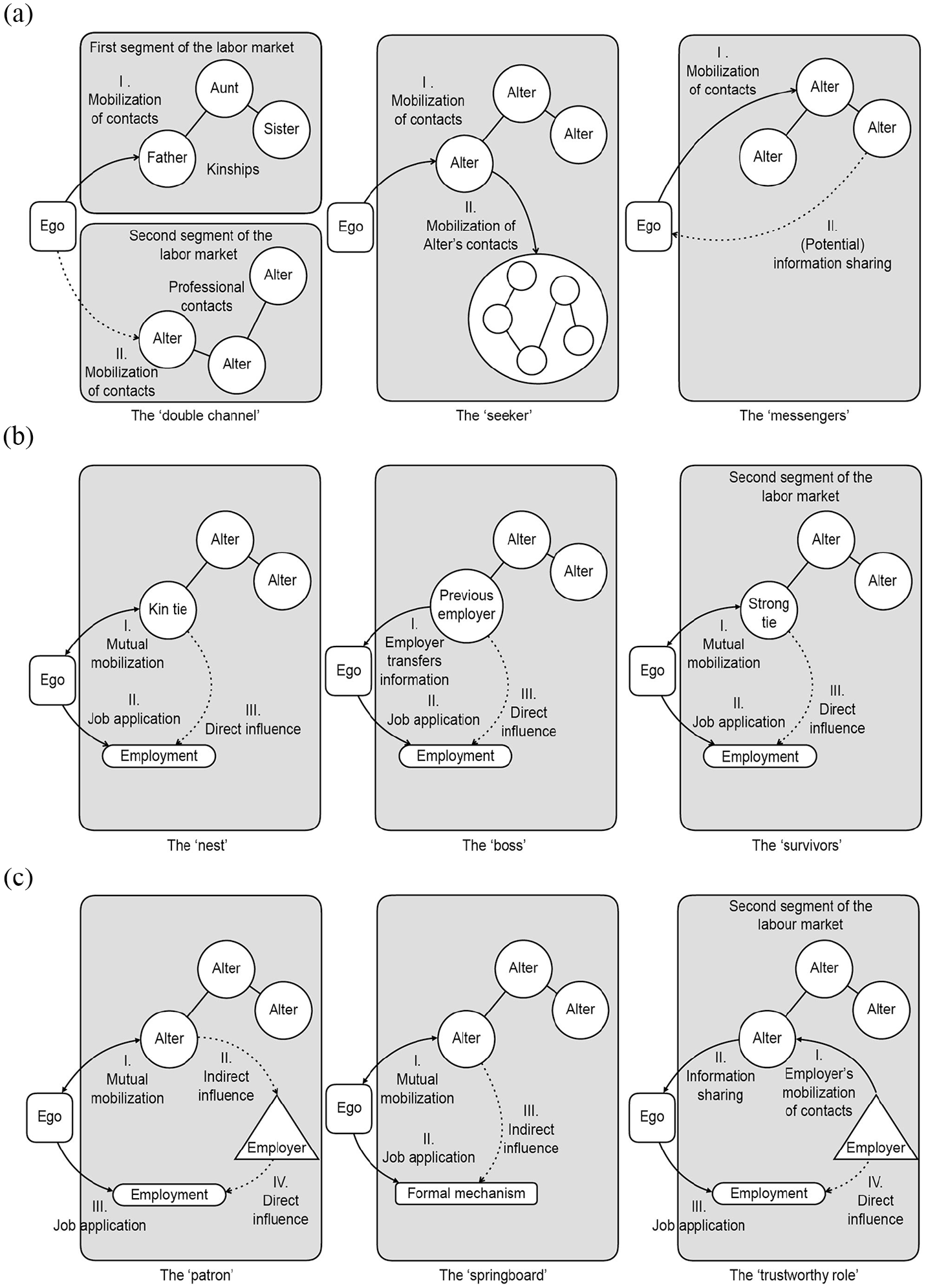
Mechanisms of job-searching and job-finding. Graphic representation: (a) contacts as informers, (b) contacts as employers, and (c) contacts as influencers.
Footnotes
Acknowledgements
The author is indebted to all those who participated in this study, developed by the Centre d’Estudis Sociològics sobre la Vida Quotidiana i el Treball (QUIT) of the Autonomous University of Barcelona. He extends his thanks to Robert Parkin for his valuable work in revising this text.
Funding
The author(s) disclosed receipt of the following financial support for the research, authorship, and/or publication of this article: This article has been produced within the research project ‘Social networks in their different modalities as mechanisms in the search for employment and social support among young people’ funded by the Spanish Ministry of Economy (ref: CSO2012-36055). Its publication has also benefitted from the support of the Swiss National Centre of Competence in Research LIVES – ‘Overcoming Vulnerability: life-course Perspectives’, financed by the Swiss National Science Foundation (grant number: 51NF40-160590).
Author biography
 ) holds a PhD in Sociology from the Universidad Autònoma de Barcelona. Currently, he is senior SNF researcher at the Swiss Centre of Expertise in Life Course Research LIVES at the University of Lausanne. His research combines network and life-course theory to address a wide range of sociological issues: work and occupations, leisure activities, social media use, mental health and social insecurity. His scientific project aims to build a portrait of Generation Y by analyzing their labour precarization, digital behavior, family models and emerging lifestyles. His methodological tools include both quantitative and qualitative techniques, which he uses to study longitudinal, network and narrative data.