




Abstract
In recent years, the practice of mindfulness has become increasingly popular, but there is very little evidence on how many and what kind of people have heard of and learnt to practise mindfulness. Using data from an online survey on a sample of 1013 adults in Britain in November 2018, this study aims to estimate the prevalence of mindfulness use among adults in Britain and to identify the sociodemographic and political characteristics associated with awareness and experience of mindfulness. The findings suggest that 15% of adults in Britain had learnt to practise mindfulness, which is significantly more than the finding that 2.5% of adults in the United States in 2012 had practised mindfulness in their lifetime. Although widespread, awareness of mindfulness was more common among women, unmarried adults, adults from middle and high-income households, and those who voted Remain in the 2016 Brexit Referendum. Higher levels of engagement with mindfulness, beyond awareness, were more likely among young and middle-aged adults, but otherwise not concentrated in any particular groups.
Introduction
Mindfulness refers to the quality of awareness that emerges from purposefully and nonjudgmentally paying attention to the present moment with an attitude of openness, acceptance and curiosity (Kabat-Zinn, 2003). It is an inherent human quality that can be cultivated through mindfulness-based practices and programmes, many of which have been introduced into the education system, the healthcare system, the criminal justice system, the workplace and the military (Creswell, 2017). The practice of mindfulness has become increasingly popular in society and has even been taught to British politicians in the UK Parliament, where the policy applications of mindfulness-based interventions have also been considered (Bristow, 2019).
While the effects of mindfulness-based interventions on mental health have been systematically examined (Goldberg et al., 2018; Hofmann et al., 2010; Kuyken et al., 2016), there is a lack of research on the prevalence, patterns and predictors of mindfulness use across sociodemographic and political groups in the general population. The survey research to date has mostly focused on the prevalence of mind-body practices (yoga, tai chi, qigong and meditation) and has generally been based on nationally representative samples in Australia (Penman et al., 2012; Sibbritt et al., 2011; Steel et al., 2018; Vergeer et al., 2017, 2018) and the United States (Birdee et al., 2008, 2009; Burke et al., 2017; Cramer et al., 2016a, 2016b; Kachan et al., 2017; Lauche et al., 2016; Olano et al., 2015; Park et al., 2015; Upchurch and Johnson, 2019; Wolsko et al., 2004), where statistically significant differences have been observed based on age, gender, marital status, education and household income.
There are specific questions about mindfulness training in the National Health Interview Survey (NHIS), which Burke et al. (2017) analysed to estimate the prevalence of mindfulness use among adults in the United States in 2012. The findings suggest that 2.5% had practised mindfulness in their lifetime and 1.9% had practised mindfulness during the 12 months prior to the survey interview. Taken together, the data from the NHIS suggest that mindfulness use is less likely among older adults and more likely among women, unmarried adults, adults without minor children in the family, employed adults, university graduates and residents in the West of the country (Burke et al., 2017; Macinko and Upchurch, 2019; Morone et al., 2017; Simonsson et al., 2020).
There are several theoretical models designed to explain and predict healthcare utilization behaviour (Mechanic, 1962; Parsons, 1951; Suchman, 1965), but one of the most widely used frameworks is the Andersen (1995) Healthcare Utilization Model. The model identifies three main determinants of healthcare utilization: (1) predisposing factors – an individual’s characteristics and predispositions to use health services; (2) enabling factors – the means an individual has available to access and pay for health services; and (3) health needs – the need an individual has for healthcare. The determinants in the model have been used to interpret findings on mindfulness use in the United States (Macinko and Upchurch, 2019), but this study intends to apply the same theoretical framework to predict awareness of mindfulness and level of engagement with mindfulness in Britain.
Using data from an online survey carried out on a sample weighted to be representative of the adult population of Britain, this study expands on earlier descriptive studies on the prevalence of mindfulness use in the general population and applies the Andersen (1995) Healthcare Utilization Model to better understand what kind of people have heard of and have learnt to practise mindfulness. Based on findings from previous studies (Burke et al., 2017; Macinko and Upchurch, 2019; Morone et al., 2017; Simonsson et al., 2020) and the Andersen (1995) Healthcare Utilization Model, it is hypothesized that awareness of mindfulness and higher levels of engagement with mindfulness is less likely among older adults and more likely among women, unmarried adults, adults without children below 18 years, employed adults, university graduates, adults from middle and high-income households, residents in London, voters for the Labour Party and the Liberal Democrats in the 2017 General Election, and Remain voters in the 2016 United Kingdom European Union Membership (Brexit) Referendum.
Data and methodology
An online survey was carried out on 26th and 27th November 2018 in conjunction with Deltapoll, a British polling company and a member of the British Polling Council, from their online panel on a sample of 1013 adults in Britain aged 18 and above. The sample size was relatively small compared with many other surveys, but a sample size of 1000+ is standard for opinion polls and still adequate for getting initial estimates with reasonable precision using questions that have not previously been posed (Leonard, 2016). The data were also weighted to be representative of the adult population of Britain. The data can be accessed through the Open Science Framework (OSF) at https://osf.io/d4s6t/.
In this article, cross-tabulations and percentages are used to display an overview of awareness and experience of mindfulness in Britain in November 2018. The cross-tabulations and percentages are followed by bivariate and multiple regressions to calculate coefficients with 95% confidence intervals and identify the groups that are most likely to have awareness of mindfulness and higher levels of engagement with mindfulness. A coefficient with a greater score than 0 implies that individuals in that group were more likely to have the measured characteristic than the comparison group. Conversely, a coefficient with a score of less than 0 implies that the individuals in that group were less likely to have the measured characteristic than the comparison group (Pollock and Edwards, 2018).
Measurement of dependent variables
The dependent variables on awareness and experience of mindfulness are derived from the following survey questions:
1. Some people practise a form of meditation known as ‘mindfulness’. Many have never heard of this. How about you? Please indicate which of the following comes closest to your experience?
The respondents had the following options: (a) I have learnt how to practise mindfulness from a course, book, app, or other source; (b) I have heard of mindfulness meditation, have not practised it, but I am interested in it; (c) I have heard of mindfulness meditation, have not practised it, and I am not interested in it; (d) I have never heard of mindfulness meditation; (e) Don’t know.
If respondents reported that they had learnt how to practise mindfulness, the following two questions were prompted:
2. Generally speaking, which of the following best describes how often you practise mindfulness?
The respondents had the following options: (a) Hardly at all since first learning about it; (b) I practised fairly regularly for a while then I stopped; (c) I practise from time to time; (d) I practise most days for just a few minutes each time; (e) I practise for several hours a week.
3. How did you learn to practise mindfulness? Please tick all that apply.
The respondents had the following options: (a) Attending a course; (b) Reading a book; (c) Watching a video or DVD; (d) Visiting a website; (e) Using an app; (f) Some other way; (g) Don’t know. The order of the options was randomized, except for options f and g which were fixed.
The first and second questions were coded into two dependent variables: (1) having heard of mindfulness and (2) level of engagement with mindfulness. For the first dependent variable, the options that indicated the respondents had heard of mindfulness (1a, 1b and 1c) were coded as 1 and the options that indicated the respondents had never heard of mindfulness (1d and 1e) were coded as 0 – a binary variable. For the second dependent variable, the respondents who selected 1c were coded as 0, the respondents who selected 1b were coded as 1, and the respondents who selected 1a were coded as 2 if they had learnt to practise mindfulness and had stopped to practise (2a and 2b) or 3 if they had learnt to practise mindfulness and still practised (2c, 2d and 2e) – an ordinal variable. Note that 1d and 1e are missing from the second dependent variable.
Measurement of independent variables
The dataset also contained information on sociodemographic and political characteristics: age, gender, region of residence, education, marital status, family composition, employment status, household income, as well as voting behaviour in the General Election on the 8th June 2017 and the Brexit Referendum on the 23rd June 2016. The independent variables were derived from the original survey questions and were coded to suit the analyses. The exact wording and recoding of all the questions and answers can be found in Appendix 1.
Results
Frequency distributions
In this section, frequency distributions were used to display an overview of awareness and experience of mindfulness in Britain in November 2018. The overall percentages are presented below in Tables 1 to 3, but a more detailed list of the percentages for each sociodemographic and political group can be found in Tables 6 to 8 in Appendix 2, which should be interpreted in light of the number of observations for each variable before weighting.
Awareness and experience of mindfulness in Britain.
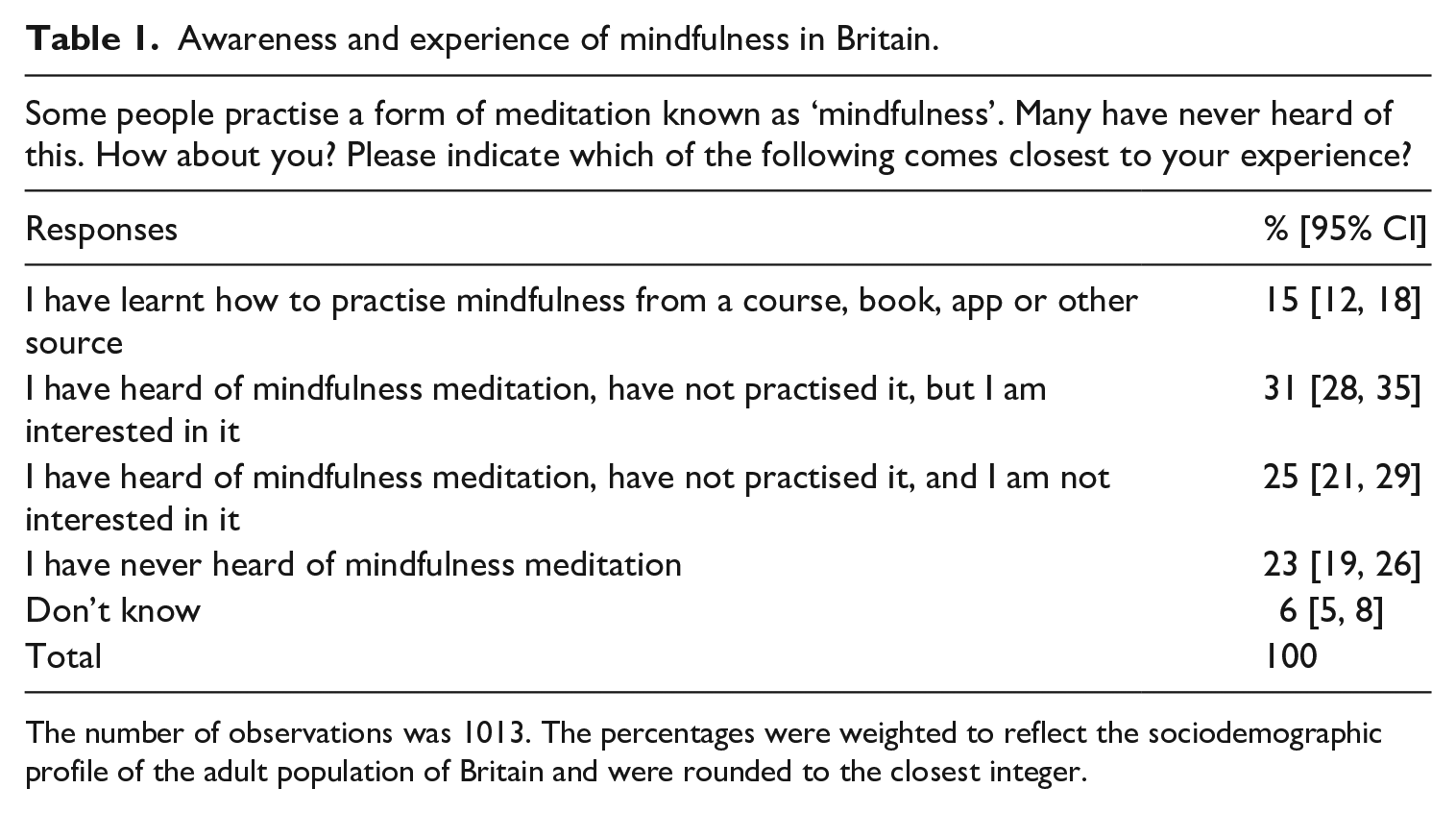
The number of observations was 1013. The percentages were weighted to reflect the sociodemographic profile of the adult population of Britain and were rounded to the closest integer.
Frequency of mindfulness practice in Britain.
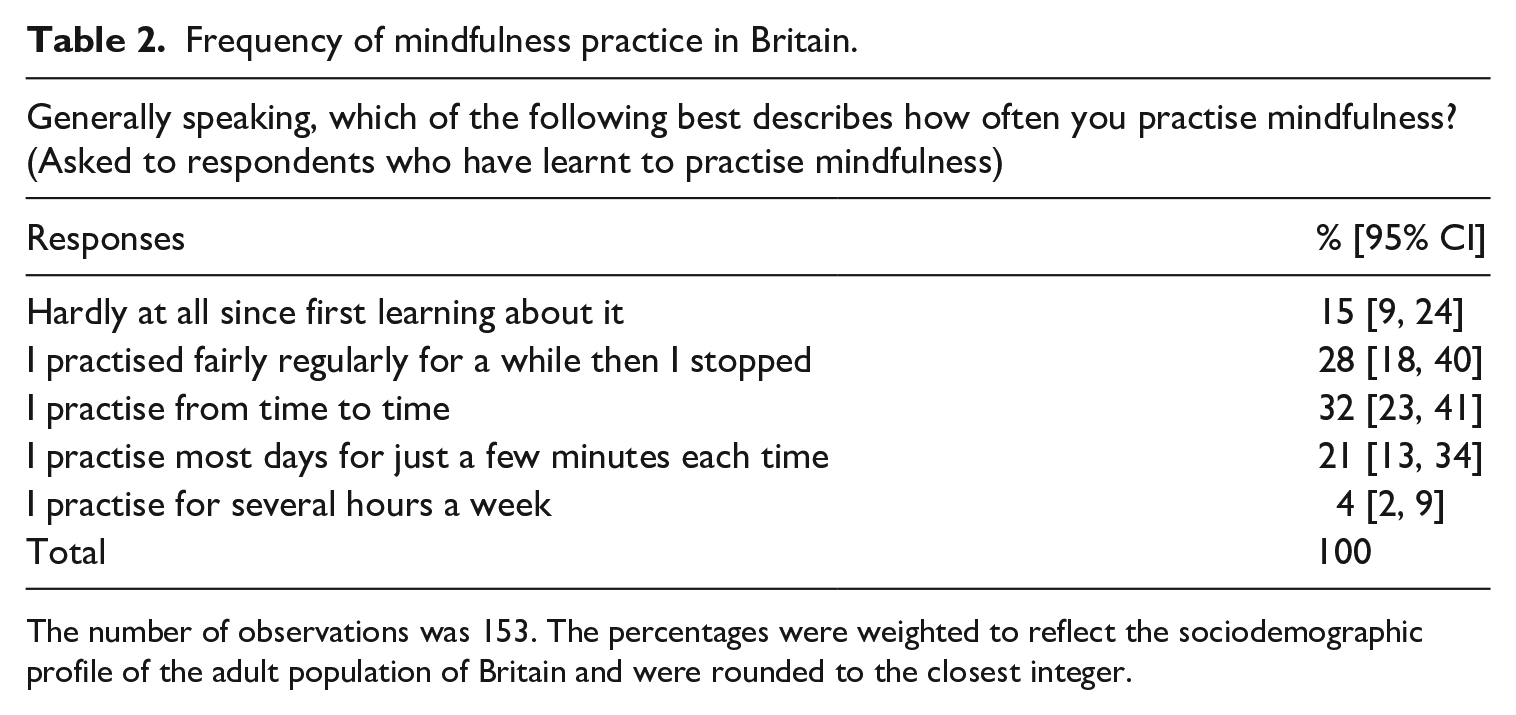
The number of observations was 153. The percentages were weighted to reflect the sociodemographic profile of the adult population of Britain and were rounded to the closest integer.
Pathways to learning to practise mindfulness in Britain.
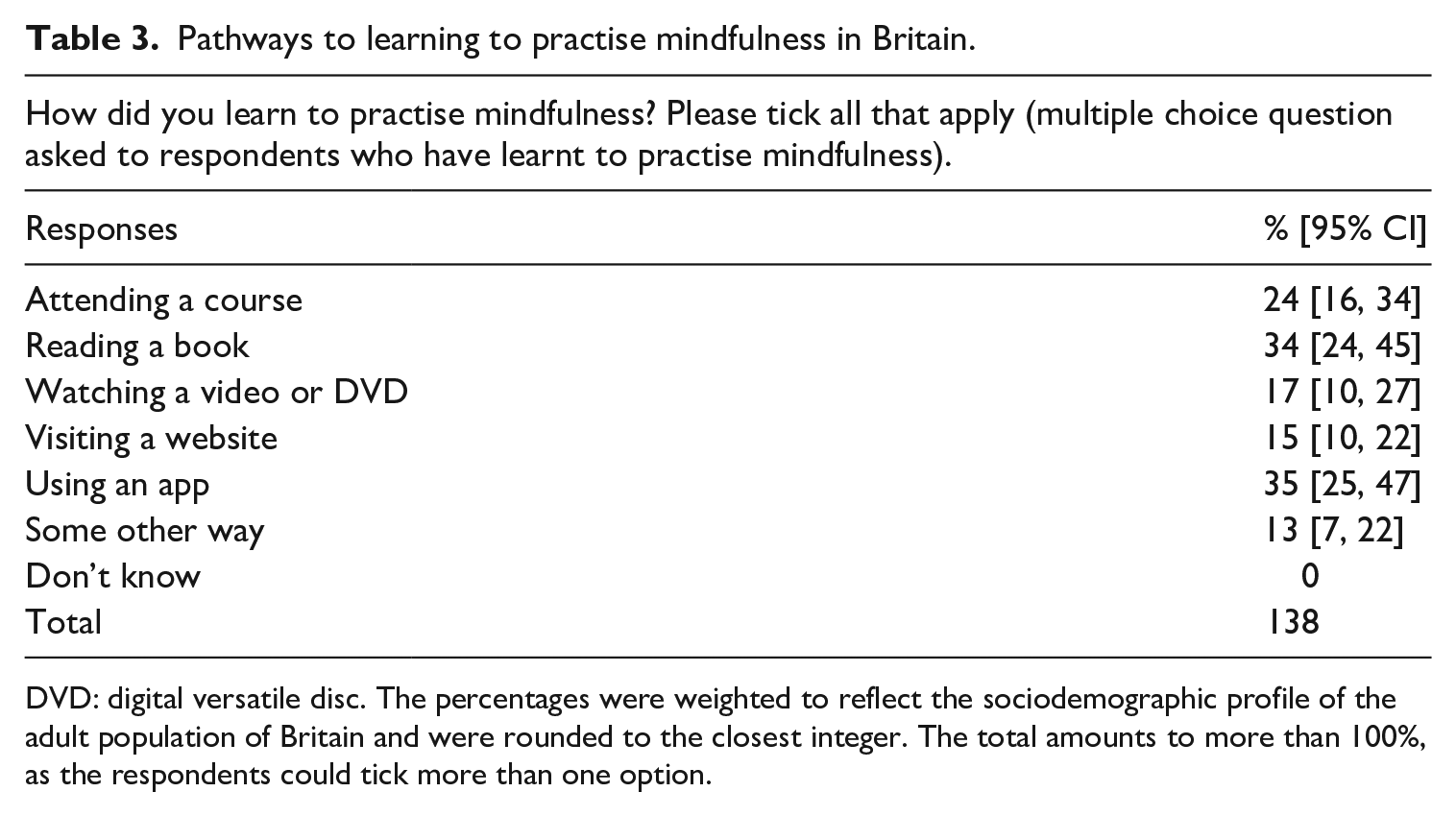
DVD: digital versatile disc. The percentages were weighted to reflect the sociodemographic profile of the adult population of Britain and were rounded to the closest integer. The total amounts to more than 100%, as the respondents could tick more than one option.
Table 1 presents the descriptive statistics on awareness and experience of mindfulness in Britain. In total, 23% of the sample reported that they had never heard of mindfulness, whereas 15% of the sample reported that they had learnt to practise mindfulness. Hence, it can be estimated that just below 8 million adults in Britain had learnt to practise mindfulness and around 12 million adults in Britain had never heard of mindfulness, based on the latest mid-year estimate of the UK adult population above 18 years of age (52,078,496) from the Office for National Statistics (ONS, 2018).
Table 2 presents the descriptive statistics on frequency of mindfulness practice in Britain. In total, 43% had stopped since learning to practise mindfulness, 32% practised from time to time, and 25% maintained a regular practise that ranged from just a few minutes on most days to several hours a week.
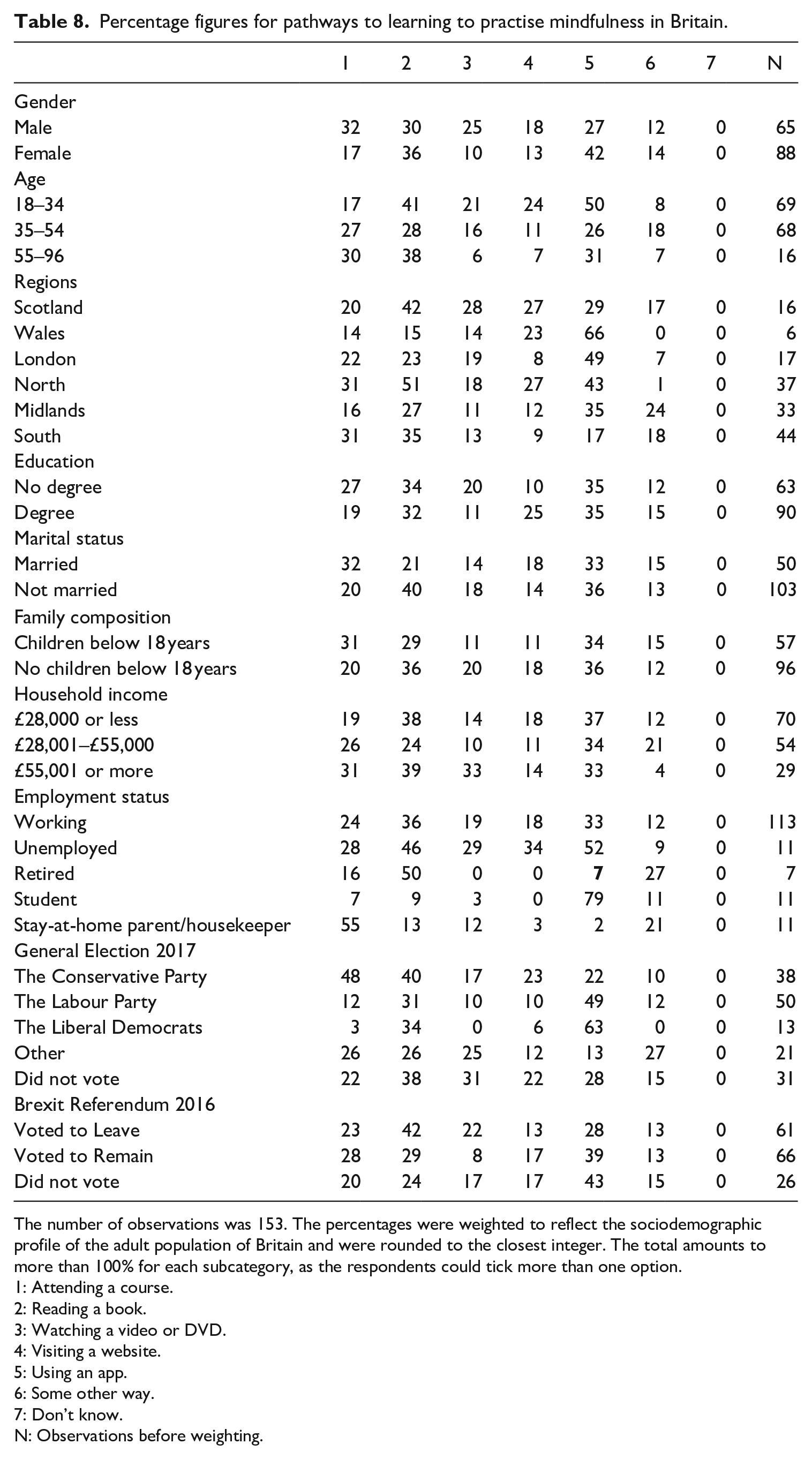
Table 3 presents the descriptive statistics on pathways to learning to practise mindfulness in Britain. The most common ways of learning to practise mindfulness were ranked in the following order: (1) using an app, (2) reading a book, (3) attending a course, (4) watching a video or DVD, (5) visiting a website and (6) some other way.
Logistic regressions
Logistic regressions, each with just a single predictor, are listed under a single ‘Bivariate’ column in Tables 4 and 5, even though the coefficients for each variable (counting categorical variables with multiple coefficients as single variables) are taken from different models. The logistic regressions shown under ‘Model 1’ and ‘Model 2’ in Tables 4 and 5 are constructed so that Model 1 only includes sociodemographic variables, whereas Model 2 includes both sociodemographic and political variables.
Logistic regression models – Awareness of mindfulness in Britain.
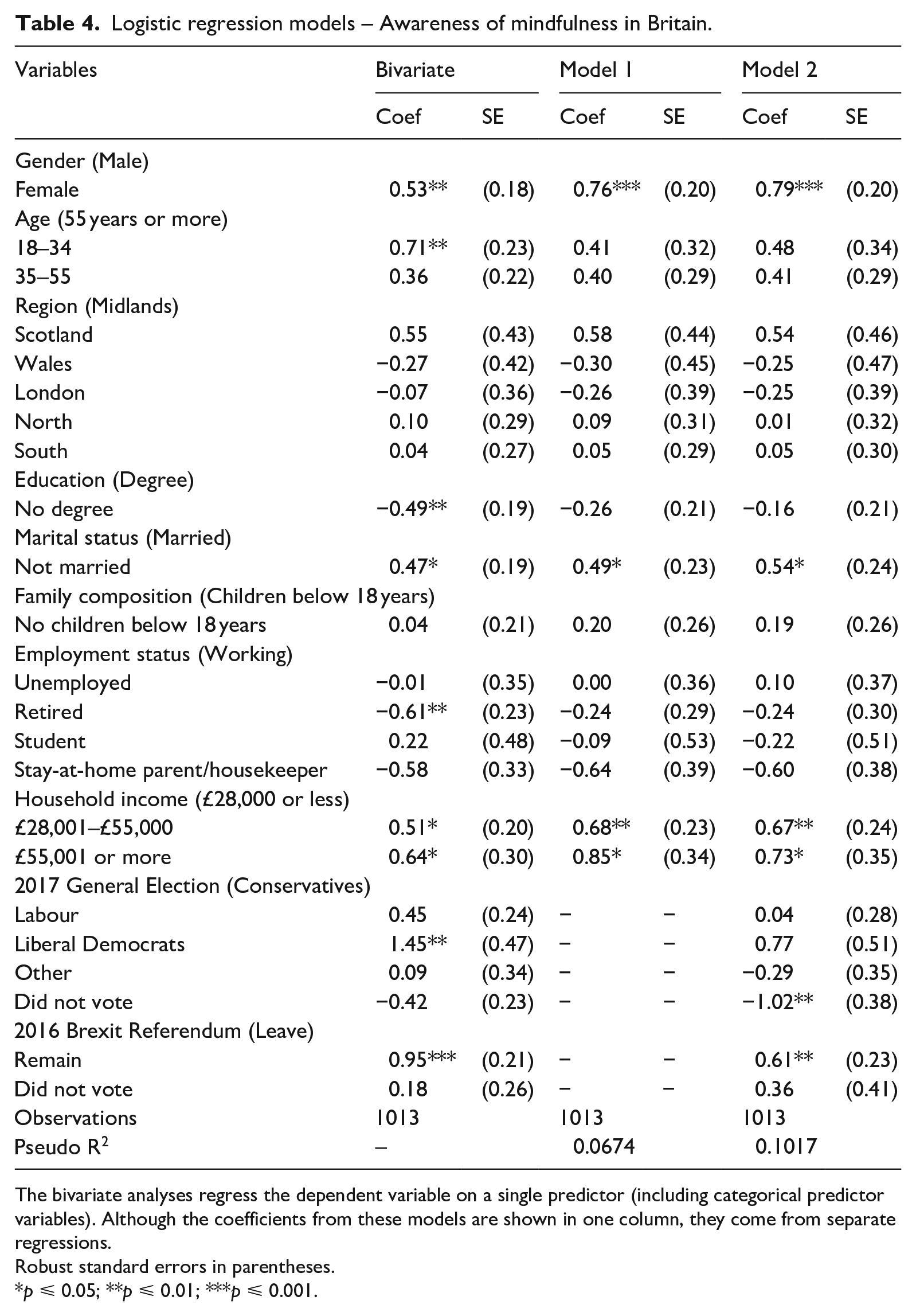
The bivariate analyses regress the dependent variable on a single predictor (including categorical predictor variables). Although the coefficients from these models are shown in one column, they come from separate regressions.
Robust standard errors in parentheses.
p ⩽ 0.05; **p ⩽ 0.01; ***p ⩽ 0.001.
Ordered-Logit regression models – Level of engagement with mindfulness in Britain.
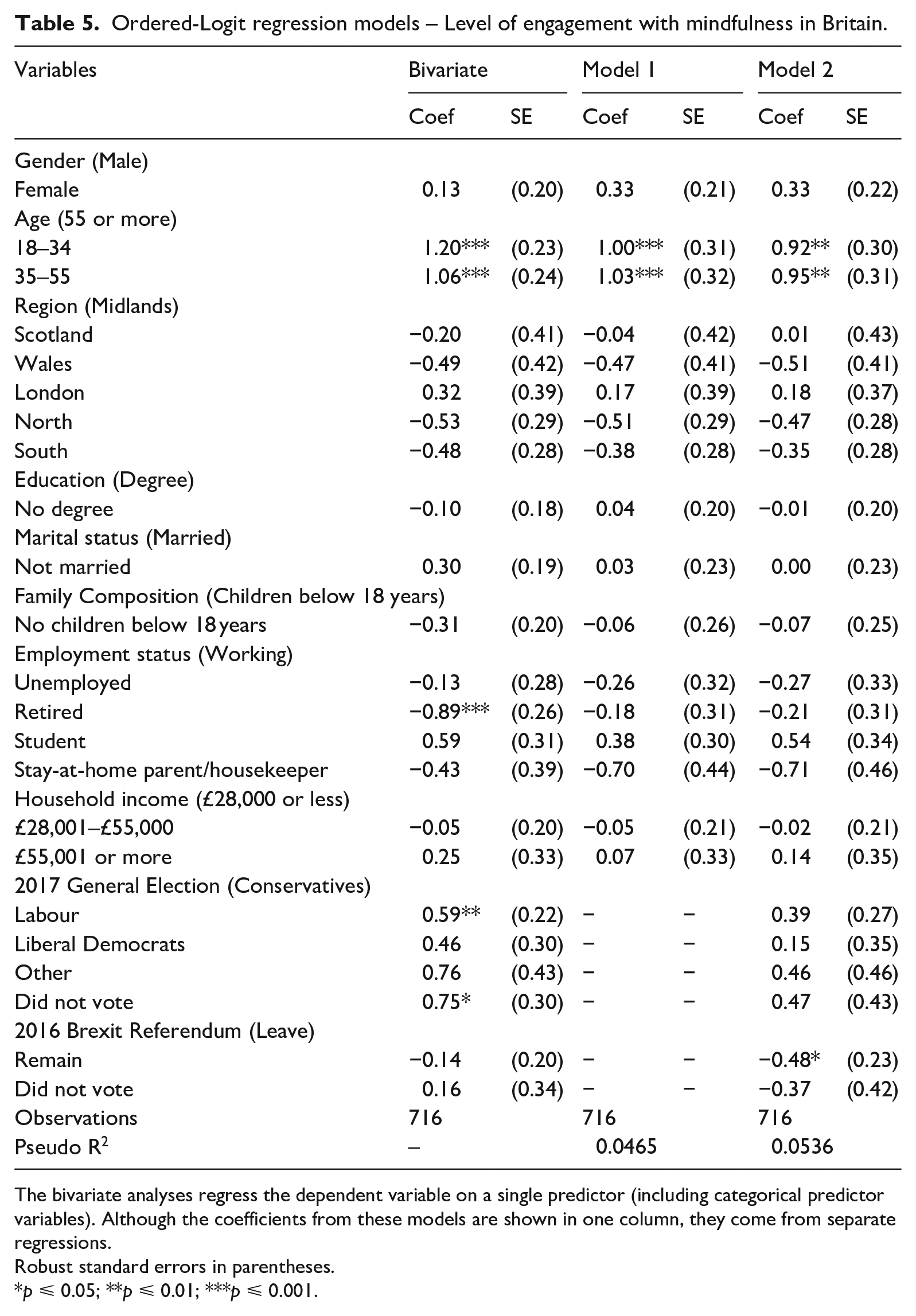
The bivariate analyses regress the dependent variable on a single predictor (including categorical predictor variables). Although the coefficients from these models are shown in one column, they come from separate regressions.
Robust standard errors in parentheses.
p ⩽ 0.05; **p ⩽ 0.01; ***p ⩽ 0.001.
Awareness of mindfulness in Britain
Table 4 presents the results from the regressions on awareness of mindfulness in Britain. While awareness of mindfulness in Britain was not associated with region of residence, family composition, or employment status, there were still statistically significant associations for several sociodemographic and political characteristics. Most notably, awareness of mindfulness was more common among women, adults from middle and high-income households, unmarried adults, and those who voted Remain, even when sociodemographic and political covariates were controlled for.
Level of engagement with mindfulness in Britain
Table 5 presents the results from the regressions on level of engagement with mindfulness in Britain. While level of engagement with mindfulness was not associated with gender, region of residence, education level, marital status, family composition, or household income, there were still statistically significant associations for several sociodemographic and political characteristics. Most notably, higher levels of engagement with mindfulness were more likely for young and middle-aged adults, even when sociodemographic and political covariates were controlled for.
Robustness checks
The proportional odds assumption of the multiple ordered-logit regression model with political variables has been checked for robustness in statistically significant variables. The robustness check started with the construction of binary logistic models for each possible transition. There are three possible transitions: from level 0 to level 1 and above; from level 1 and below to level 2 and above; and from level 2 and below to level 3. A binary logistic model is fitted for each of these. For the first transition, 1c was coded as 0 and the rest (1b, 2a, 2b, 2c, 2d and 2e) were coded as 1. For the second transition, 1c and 1b were coded as 0 and the rest (2a, 2b, 2c, 2d and 2e) were coded as 1. For the third transition, 1c, 1b, 2a and 2b were coded as 0 and the rest (2c, 2d and 2e) were coded as 1. If the proportional odds assumption holds, the coefficients should be the same in all three of these models. While they were of course not all the same, they were all in the same direction and of a similar magnitude. Overall, the proportional odds assumption is upheld, which means the use of the multiple ordered-logit regression model is justified.
‘Prefer not to say’ was coded into the subcategory with the largest sample within each independent variable, but it is important to note that the overall findings were broadly the same when ‘Prefer not to say’ was coded as a missing variable.
Discussion
This study was an online survey carried out on a sample weighted to be representative of the adult population of Britain. The findings suggest that 15% of adults in Britain had learnt to practise mindfulness and most of them had learnt to practise by using an app, reading a book, or attending a course, but not many of them maintained a regular practice of mindfulness. Although widespread, awareness of mindfulness was more common among women, unmarried adults, adults from middle and high-income households, and those who voted Remain in the 2016 Brexit Referendum. Higher levels of engagement with mindfulness, beyond awareness, were more likely among young and middle-aged adults, but otherwise not concentrated in any particular groups.
While 15% of adults in Britain in 2018 had learnt to practise mindfulness, the corresponding number for adults in the United States in 2012 was 2.5% (Burke et al., 2017). The surveys are separated by 6 years and different national contexts, which limits the comparisons that can be made. Michalak and Heidenreich (2018) suggest that historical, social and psychological factors have driven the dissemination of mindfulness-based interventions, but the findings in this study suggest that the spread has been unevenly distributed across groups in society.
First, women were more likely to have awareness of mindfulness and 16% of women versus 14% of men had learnt to practise mindfulness, which corresponds with previous findings on the link between mindfulness use and gender (Burke et al., 2017; Macinko and Upchurch, 2019). The association might reflect gendered patterns of health behaviour, but it is equally plausible that women are more open to mindfulness-based practices as therapeutic and spiritual practices hold values associated with prevalent cultures of femininity and still offer a means for women to negotiate the dilemma between self-care and care for others (Sointu, 2012; Sointu and Woodhead, 2008; Swan, 2019).
Second, unmarried adults were more likely to have awareness of mindfulness and 18% of unmarried adults versus 11% of married adults had learnt to practise mindfulness. Burke et al. (2017) did not find a significant association between marital status and mindfulness use, but it is possible that fewer family responsibilities make unmarried adults more able to set aside time for self-care and learn to practise mindfulness. The findings in this study warrant more research into the relationship between mindfulness use and marital status, which could shed light on barriers to mindfulness use in the context of marriage.
Third, adults from middle and high-income households were more likely to have awareness of mindfulness and a much higher percentage of adults from high-income (than low and middle-income) households had learnt to practise mindfulness. Burke et al. (2017) did not find a significant association between household income and mindfulness use, but Bourdieu (1984) viewed cultural taste and consumption as inseparable from class position, which suggests that mindfulness use might vary as a function of social class. In fact, the most prominent advocates of mindfulness use have broadly been described by Kucinskas (2018) as elites with financial resources well above the average household. The option to set aside time for self-care and learn to practise mindfulness can, after all, be dependent on financial resources, at least in the modern context (Carlson, 2018).
Fourth, young and middle-aged adults were more likely to have higher levels of engagement with mindfulness and a much lower percentage of older (than young and middle-aged) adults had learnt to practise mindfulness, which corresponds with previous findings on the link between mindfulness use and age (Burke et al., 2017). Inglehart (1977, 1990, 1997) argues that rising existential security has led to an intergenerational shift towards postmaterialist values, including self-expression, autonomy and quality of life. It is, therefore, plausible that young and middle-aged adults are more likely to seek out and engage with mindfulness-based practices to improve mental and physical wellbeing, although future research could do more to better understand the relationship between mindfulness use and age.
The independent variables that were associated with awareness of mindfulness were generally not associated with level of engagement with mindfulness – and vice versa. For instance, those who voted Remain were more likely than those who voted Leave to have heard of mindfulness, but (out of the respondents who had heard of mindfulness) those who voted Remain were less likely than those who voted Leave to have higher levels of engagement with mindfulness. These findings are in line with research on personality traits and voting behaviour, which suggest that those who voted Remain score higher on openness to experience and those who voted Leave score higher on conscientiousness (Sumner et al., 2019). The higher scores on openness to experience should, in theory, make those who voted Remain more likely to seek out and hear about novel interventions, while the higher scores on conscientiousness should make those who voted Leave more likely to maintain a regular mindfulness practice. Both assumptions find support in this study. In fact, 63% of Leave voters versus 82% of Remain voters had heard of mindfulness, whereas (out of the respondents who had learnt to practise mindfulness) 33% of Leave voters versus 26% of Remain voters maintained a regular mindfulness practice. Future research should investigate which psychological mechanisms predict awareness of mindfulness versus level of engagement with mindfulness.
While voting behaviour has not been linked before to awareness of mindfulness or level of engagement with mindfulness, the association between mindfulness use and the political left has been documented and discussed (Kucinskas, 2018; McMahan, 2008; Rowe, 2016; Wilson, 2014). The leading advocates of mindfulness use have been individuals with politically liberal worldviews (Kucinskas, 2018) and mindfulness use has been popular in groups associated with political left, including Occupy Wall Street (Rowe, 2016). Bristow (2019) reports that British politicians from across the political spectrum have received training in mindfulness, but most of the members of the All-Party Parliamentary Group on Mindfulness in the UK Parliament are affiliated with the Labour Party (Parliament, 2017). Hence, the differences in mindfulness use across political groups mirror the findings in this study that 17% of Labour Party voters versus 10% of Conservative Party voters had learnt to practise mindfulness. While self-selection likely explains the association between mindfulness use and the political left, future research could investigate whether mindfulness training affects voting behaviour (Ferguson, 2016).
Strengths and limitations
There are several strengths and limitations with this study that need serious consideration before the results are interpreted. First, the sample has been weighted to be representative of the adult population of Britain, which allows for reliable population estimates. The sample might have been too small, however, to detect statistically significant differences on several sociodemographic and political variables. Second, a large-scale, high-quality probability survey would likely have produced more precise results, but this study used weighting to reduce bias and the risk of common survey errors (Cornesse et al., 2020). Third, the cross-sectional design of the study only allows for analysis at a single time point. It is, therefore, not possible to observe the causal effects of changes in many of the independent variables, including age, employment status and household income.
Conclusion
This study has provided an overview of how many and what kind of people have awareness and experience of mindfulness in Britain. The findings suggest that mindfulness use has become sufficiently widespread to be worthy of investigation in sociology, especially given that awareness of mindfulness and level of engagement with mindfulness varies substantially across sociodemographic and political groups. While both the concept of mindfulness and the practice of mindfulness have been used as tools of investigation in sociology (Lee, 2015), there has been a lack of sociological inquiry into how mindfulness-based practices are perceived and used across different groups in society. Future research on mindfulness-based practices should, therefore, supplement quantitative data with qualitative data, including in-depth interviews with various sociodemographic and political groups to better understand why mindfulness-based practices are more common in some groups than others.
Footnotes
Appendix 1
Appendix 2
Percentage figures for pathways to learning to practise mindfulness in Britain.
| 1 | 2 | 3 | 4 | 5 | 6 | 7 | N | |
|---|---|---|---|---|---|---|---|---|
| Gender | ||||||||
| Male | 32 | 30 | 25 | 18 | 27 | 12 | 0 | 65 |
| Female | 17 | 36 | 10 | 13 | 42 | 14 | 0 | 88 |
| Age | ||||||||
| 18–34 | 17 | 41 | 21 | 24 | 50 | 8 | 0 | 69 |
| 35–54 | 27 | 28 | 16 | 11 | 26 | 18 | 0 | 68 |
| 55–96 | 30 | 38 | 6 | 7 | 31 | 7 | 0 | 16 |
| Regions | ||||||||
| Scotland | 20 | 42 | 28 | 27 | 29 | 17 | 0 | 16 |
| Wales | 14 | 15 | 14 | 23 | 66 | 0 | 0 | 6 |
| London | 22 | 23 | 19 | 8 | 49 | 7 | 0 | 17 |
| North | 31 | 51 | 18 | 27 | 43 | 1 | 0 | 37 |
| Midlands | 16 | 27 | 11 | 12 | 35 | 24 | 0 | 33 |
| South | 31 | 35 | 13 | 9 | 17 | 18 | 0 | 44 |
| Education | ||||||||
| No degree | 27 | 34 | 20 | 10 | 35 | 12 | 0 | 63 |
| Degree | 19 | 32 | 11 | 25 | 35 | 15 | 0 | 90 |
| Marital status | ||||||||
| Married | 32 | 21 | 14 | 18 | 33 | 15 | 0 | 50 |
| Not married | 20 | 40 | 18 | 14 | 36 | 13 | 0 | 103 |
| Family composition | ||||||||
| Children below 18 years | 31 | 29 | 11 | 11 | 34 | 15 | 0 | 57 |
| No children below 18 years | 20 | 36 | 20 | 18 | 36 | 12 | 0 | 96 |
| Household income | ||||||||
| £28,000 or less | 19 | 38 | 14 | 18 | 37 | 12 | 0 | 70 |
| £28,001–£55,000 | 26 | 24 | 10 | 11 | 34 | 21 | 0 | 54 |
| £55,001 or more | 31 | 39 | 33 | 14 | 33 | 4 | 0 | 29 |
| Employment status | ||||||||
| Working | 24 | 36 | 19 | 18 | 33 | 12 | 0 | 113 |
| Unemployed | 28 | 46 | 29 | 34 | 52 | 9 | 0 | 11 |
| Retired | 16 | 50 | 0 | 0 |
|
27 | 0 | 7 |
| Student | 7 | 9 | 3 | 0 | 79 | 11 | 0 | 11 |
| Stay-at-home parent/housekeeper | 55 | 13 | 12 | 3 | 2 | 21 | 0 | 11 |
| General Election 2017 | ||||||||
| The Conservative Party | 48 | 40 | 17 | 23 | 22 | 10 | 0 | 38 |
| The Labour Party | 12 | 31 | 10 | 10 | 49 | 12 | 0 | 50 |
| The Liberal Democrats | 3 | 34 | 0 | 6 | 63 | 0 | 0 | 13 |
| Other | 26 | 26 | 25 | 12 | 13 | 27 | 0 | 21 |
| Did not vote | 22 | 38 | 31 | 22 | 28 | 15 | 0 | 31 |
| Brexit Referendum 2016 | ||||||||
| Voted to Leave | 23 | 42 | 22 | 13 | 28 | 13 | 0 | 61 |
| Voted to Remain | 28 | 29 | 8 | 17 | 39 | 13 | 0 | 66 |
| Did not vote | 20 | 24 | 17 | 17 | 43 | 15 | 0 | 26 |
The number of observations was 153. The percentages were weighted to reflect the sociodemographic profile of the adult population of Britain and were rounded to the closest integer. The total amounts to more than 100% for each subcategory, as the respondents could tick more than one option.
1: Attending a course.
2: Reading a book.
3: Watching a video or DVD.
4: Visiting a website.
5: Using an app.
6: Some other way.
7: Don’t know.
N: Observations before weighting.
Acknowledgements
The authors would like to express their gratitude to Deltapoll for collecting the data and to Morag Hendersen and Michael Biggs for providing comments on the article.
Author contribution
Otto Simonsson analysed the data and wrote the manuscript. Stephen Fisher and Maryanne Martin supervised and edited the final manuscript.
Declaration of conflicting interest
The author(s) declared the following potential conflicts of interest with respect to the research, authorship and/or publication of this article: Stephen Fisher has a very small number of shares in Deltapoll, but he does not consider this to be a significant conflict of interest.
Ethical approval
All procedures performed involving human participants were in accordance with the ethical standards of the 1964 Helsinki declaration and its later amendments or comparable ethical standards. The procedures were approved by the Research Ethics Committee of Department of Sociology (DREC) at the University of Oxford.
Funding
The author(s) received no financial support for the research, authorship and/or publication of this article.
