




Abstract
Narratives of why people migrate can be primarily associated with the study of migration in terms of people’s drivers of leaving and returning to homeland. Greek people have been very familiar with the idea of leaving as well as returning home, throughout modern Greek history; yet, due to the ongoing Greek crisis and prolonged austerity, a new migration wave has been formed associated with young professionals and scientists (brain drainers). This study utilises the qualitative collection and analysis of 31 narrative interviews contacted with Greek brain drainers currently living in the UK, in an attempt to examine, understand, and explain the drivers of leaving and returning to homeland. We argue that factors leading to the decision of leaving as well as the consideration (or hesitation) of returning are associated with (a) macro-factors relating to the socio-economic situation of the origin country (associated with the eliminating economic and personal development) as well as (b) powerful drivers of enduring cultural and social mentalities, associated with a mosaic of distinctive norms formed and established beyond the Greek crisis.
Keywords
Introduction
Leaving homeland can be easily associated with migration, regardless of the period of time the migrant remains away from homeland. In this respect, migration has been defined as the process of going from one location/region/country of residence to another. Migration can be classified according to the voluntary or involuntary movement of people within or across nations. The latter has been associated with educational, social, economic, and political reasons (Bhugra and Becker, 2005). In Georg Simmel’s classic work The Stranger (1950 [1908]), a stranger ‘is someone who arrives today and stays tomorrow’ (1950 [1908): 402); this depiction of movement and settlement is perhaps the first sociological reference to the concept of migration (Donato et al., 2006; Majivar, 2010). The study of migration is thus about the study of movement of populations and the practices of the settlement (Amelina and Horvath, 2017; Khoo et al., 2011). Migration forms an indeed complex phenomenon with social, economic, political, psychological, and institutional aspects, which could be perceived as ‘any geographical movement of individuals or groups, related to one another, which results in a structural change of the group’ (Startup, 1971: 177).
More than 244 million international migrants were estimated to live in a foreign country in 2015, making migration a global phenomenon (Castelli, 2018). Therefore, people leaving homeland in search of a better future is a rather common as well as an old concept. A relatively new concept, however, relates to the ‘drivers’ of migration used in an attempt to facilitate or constrain human agency rather than to explain the causes of migration. Drivers are related to more external material forces that influence mobility and along with the study of aspirations and desire of migration enable researchers to capture the wider reasoning behind the atomistic preferences and decision making relating to migration (Carling and Collins, 2018). The drivers determining the final decision of a person to migrate relate to (a) macro-elements: largely independent from the individual, for example, socio-economic factors leading to inadequate human and economic development, dictatorship, or war; (b) meso-elements: related to individual but not fully under her or his control, for example, awareness of improved living conditions elsewhere through diasporic links and communication technology; and (c) micro-factors: personal characteristics and attitudes, for example, personal and family circumstances, and attitude to migration (Castelli, 2018). This article aims to study those drivers determining the reasons why Greek brain drainers have left their homeland and the drivers that may contribute to their return. To do so, 31 semi-structured, in-depth narrative interviews with Greek migrants residing in various areas in the UK took place during December 2018 and February 2019. The participants narrated their lived experiences about leaving their homeland, residing in the UK, and considering their return home.
Leaving homeland
Notably, people have always moved in search of better living conditions and indeed Greek history in rather familiar with such movements. The term Greek diaspora identifies the sizeable Greek population that settled in different countries and parts of the world especially over the past century, initially for reasons of basic employment and, eventually, due to lifestyle choices and in pursuit of better living standards. Migration in Greek history is a phenomenon that has been reported through the permanent presence of Greeks in Central Europe from the 15th to 19th centuries as well as the USA, Australia, Canada, and South Africa during the 20th century, reflecting social and political changes in Greek society (Korma, 2017).
Greeks are, therefore, familiar with the idea of leaving homeland in search of a better future, and it has been quite common to find themselves being strangers in various parts of the world in many different points in time. Although Greeks who have left Greece have a long tradition of maintaining links with their homeland, they have also achieved becoming integrated to the country of destination by maintaining the distinctiveness of their origin (e.g. typical ‘Greek neighbours’ have been formed in New York: Astoria, Toronto: Danforth street, Chicago: Greektown, Melbourne: Precinct, London: Bayswater, and Paris: Quartier Latin). Alba and Nee (2003) emphasise the importance of the relationship between the migrant and the host country/nation as well as the country or nation of origin, whereas Legido-Quigley and McKee (2012) emphasise the ways in which people who have left their homelands maintain relations with families and friends, which within the Greek cultural context is known as nostos of the ‘omogeneis’ or Greek diaspora.
Castelli (2018) synopsises two main reasons why people leave their homeland. The first relates to forced migrants (asylum seekers and refugees) and the second refers to labour (or economic) migrants. Greek scholars identify three migration waves during the 20th century, mostly associated with migration related to economic reasons. The last, and bigger, wave occurred in the middle of the century, with Greeks seeking employment in Germany and also in the United States, Canada, Africa, and Australia. Since then, the next Greek migration wave took place during the military dictatorship of 1967–1974 and had a distinctly political character. More recently, and before the 2008 economic crisis, especially in the 1990s and the first decade of the new century, Greece experienced a so-called ‘educational migration’ attributed to the gaps in the Higher Education provision. This period led to the ‘over-education’ of the Greeks (Labrianidis, 2014) as Greeks started (and keep on) investing significantly in Higher Education (Koniordos, 2017; Pelliccia, 2013), which had an unintended adverse effect: it became impossible for all the highly skilled individuals to find employment adequate to their qualifications, thus eventually leading to Greek brain overflow.
Why are they leaving today?
According to Castelli (2018: 3), the drivers determining a person’s decision to migrate are categorised according to macro-elements (beyond individuals’ control related to political, demographic, or socio-economic factors), meso-elements (partly but not completely under the individual’s control related to links in a foreign country and communication technology associated with destination), and micro-elements (personal reasons associated with personal circumstances and attitudes along with education and even religion) The Greek crisis can be associated with the macro-element of socio-economic factors; this can be said because, especially after 2010, Greek brain drainers formed a sizeable migration wave, resulting from the shrinking of the Greek economy, the lack of employment opportunities in one’s field of specialisation, the lack of employment opportunities more generally, and the rapid rise of unemployment (Labrianidis, 2014; Pelliccia, 2013; Theodoropoulos et al., 2014; Triandafyllidou and Gropas, 2014). Karakioulafi (2017) notes that unemployment, in conjunction with salary cuts and the dramatic shrinking of the social provision, resulted in high socio-economic uncertainly. To these factors, Mitsakis (2017) adds the lack of meritocracy, the deterioration of employment rights and working conditions, and the limited opportunities for career progression. During that time, youth unemployment (up to 25 years of age) peaked at 70%, gradually dropping to around 45%, with women being worst affected by the crisis (ELSTAT, 2018).
The combination of the above characteristics is described by Karakioulafi (2017) as ‘lived precarity’ and can hardly be captured by statistics. The ways in which precarity is dealt with by groups and individuals vary, depending on factors such as age and socio-economic capacity (Chalari, 2015, 2021; Chalari and Sealey, 2017; Chalari and Serifi, 2018), as well as gender and family situation (Karakioulafi, 2017). It often has serious well-being and psychological repercussions (Mouzakis, 2017). In the Greek case, the pervasive sense of distrust (Koniordos, 2014), uncertainty, and lack of security, led a large part of the workforce to seek employment abroad (Giousmpasoglou et al., 2016; Koulouris et al., 2014), forming distinct drivers of migration (Carling and Collins, 2018). The so-called ‘brain overflow’ contributed in this direction, that is, the inability of a country to absorb the domestic highly skilled work population (Iravani, 2011). In the Greek case, a part of the workforce ‘surplus’ had been educated abroad during the 1990–2000 educational migration, but also relates to the continued Greek investment in Higher Education (Koniordos, 2017). Livanos (2010) points out that unemployment in Greece is related to over-education, which occurs when the ideal number of graduates per capita is in excess (Livanos, 2010). Consequently, the lack of competitiveness and innovation and the increasingly widespread unemployment, especially for the young, increased the brain drain towards the traditional countries of emigration (Pelliccia, 2013).
Labrianidis and Pratsinakis (2017) estimate that the Greeks who settled abroad between 2010 and 2015 reach 240,000, with the UK being one of the most popular destinations. Bhugra and Becker (2005) explain that people from around the globe chose to migrate to the UK primarily for better educational and employment opportunities. Overall, the estimated number of Greek migrants is high but hard to determine with accuracy, as free movement within the European Union renders the task very difficult. In any case, Theodoropoulos et al. (2014) and Mitsakis (2017) agree that the mass exodus of educated and talented young Greeks will have repercussion in the future, regarding the country’s competitiveness and development. As Koniordos (2017) explains, the collective exodus of educated Greeks – defined as brain drainers – to North-western Europe is part of a wider international migration tendency with which the Greeks are certainly familiar. According to Labrianidis and Pratsinakis (2017: 15–18), at least two-thirds of the Greeks who left the country after 2010 had higher education qualifications and left Greece to find better working conditions. In this context, Castelli’s (2018: 3) analysis of the driving factors of contemporary migrants includes the separate category/macro-factor of ‘inadequate human and economic development’, which emphasises the fact that human development (personal and professional) is enormously unbalanced in the various regions of the planet and it is associated with economic and political reasons. This particular driver of migration may explain, up to a certain extent, the increased tendency of Greek brain drainers’ leaving homeland. This study, however, aims at exploring the possibility of additional driving factors that extend beyond the characteristics of the Greek crisis.
Are they coming back?
In Mitsakis’ (2017) study, 99% of those who were asked whether they wish to returned to Greece in the future said they would, based on certain preconditions. Fotiadou (2017) explains that Greek professionals in London are hesitant in transferring knowledge back to Greek (by returning) due to the cultural barriers perceived about their co-nationals and generally about the Greek society. Fotiadou explains that for the migrant Greek participants in her study, the ‘Greek mentality’ of people living in Greece is the biggest obstacle for the return of Greek brain drainers.
Certain Greek mentalities have been identified by Greek scholars as forming distinct ways of thinking and acting within Greek culture. Tsoukalas (2008) and Alexakis (2008) explain that the lack of rational organisation of the Greek state allows the dysfunctional operation of Greek society, whereas Mouzelis and Pagoulatos (2003) emphasise the lack of solidarity and civil society. Alexakis (2008) and Voulgaris (2006) have stressed the tendency of Greeks to act in an individualistic manner, investing in their own personal rather than the collective interest; Tsoukalas (2008) concludes that the Greek mentality of ‘tzampatzis’ (‘free rider’: those who are only concerned about their own personal benefit) is the main reason why Greek society remains dysfunctional and incapable of forming and maintaining a comprehensive and efficient state and effective political system, whereas Panagiotopoulou (1996) and Koniordos (2014) have focused on the study of distrust among Greeks and the government, also reinforced by Mouzelis and Pagoulatos (2003).
More recently, Chalari (2021) and Tsekeris et al. (2015) identify some of the dominant characteristics of the Greek mentality which he defines as ‘persistent stagnating conditions’, and this study reveals the characteristics of nepotism, corruption, fraud, cartelisation, patronage, familial and cliental links, lack of reforms, and political instability. Marangoudakis (2018) summarises the individualistic forms of Greek interactions using the indicative terms ‘anarchic individualism’ and ‘amoral familism’. Similarly, Labrianidis and Pratsinakis (2017) explain that Greek migrants hesitate coming back to Greece not only for economic but also for socio-cultural reasons, although Chryssomalidis and Tsakanikas (2017) note that Greece should prioritise and enhance the competitiveness of the Greek economy so as to retain the highly skilled workforce which every economy needs in order to thrive. Koundoura (2012) adds that Greek cultural reality has made ‘homecoming’ impossible, although the desire for return is getting stronger.
Methods
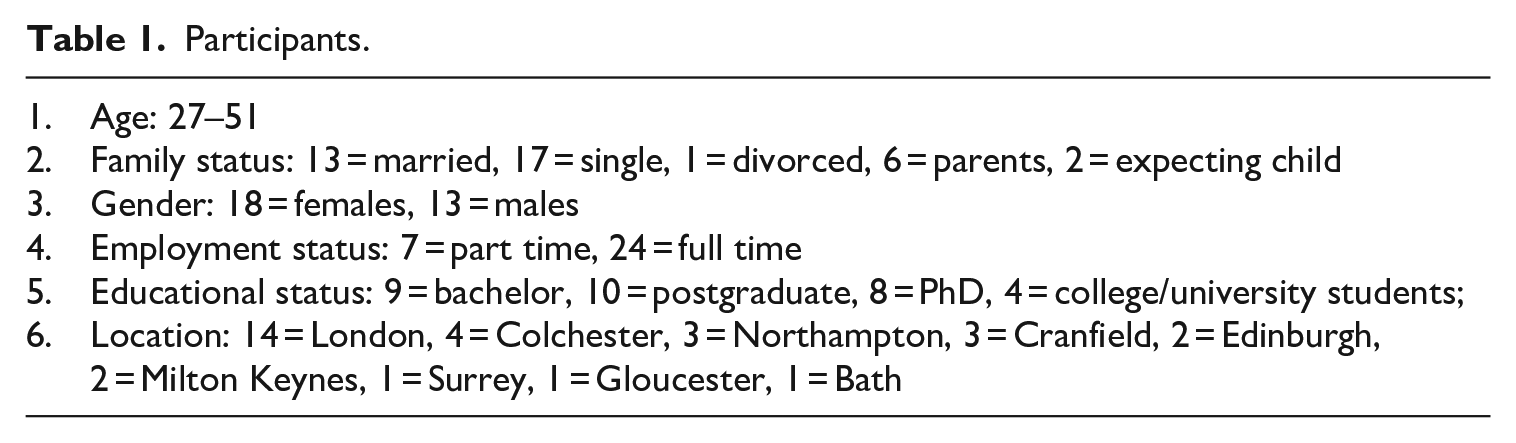
To explore the lived experiences of a group of Greek brain drainers living in the UK, 31 semi-structured, in-depth narrative interviews (Maxwell, 2013) took place in the UK during December 2018 and February 2019. The sample consisted of Greek professionals permanently relocated from Greece to the UK during the Greek crisis (i.e. since 2010). Participants were selected to ensure as wide diversity of sampling as possible (see Table 1); the sample was opportunistic as the recruitment strategy in all geographic areas used ‘snowballing’ (Becker, 1963), with some of the participants introducing the researchers to others. The research questions addressed during the interviews were informed by the research literature and were asked in an open-ended format (Light et al., 1990; Kvale, 1996); each interview lasted between 30 and 90 minutes. Participants were encouraged to express their personal experience (Roseneil and Budgeon, 2004) of moving to the UK, the reasons contributing to this decision, and whether they would return.
Participants.
Thematic analysis (Ryan and Bernard, 2003) consisted of repeated readings of the translated transcripts of the interviews, focusing on meaningful and relevant categories and themes associated with aspects and elements related to participants’ migration and integration experience. Contiguity-based relations between themes were identified, revealing relations among parts of transcribed texts (Maxwell, 2013). The identification of these themes (formed after the completion of the initial transcript analysis) allowed the emergence of patterns regarding the drivers leading them to leave and what it may take for them to return.
All participants were adults (above 18 years) and agreed to participate by conforming with a consent form stipulating confidentiality and anonymity. They were also informed that they were not obliged to participate in the research and that they could stop at any time, refuse to answer any question, or ask for clarifications. The questions asked were identical for all respondents in terms of content and order; the questions did not raise any sensitive issues although ethical authorisation has been received by the University of Northampton Social Sciences Ethical Committee.
The study focused on the exploration of experiences associated with Greek brain drainers relocating to the UK, and the purpose of the study was not to ensure a representative or random sample. It would therefore be more appropriate to refer to this study as an exploratory investigation (Hoaglin et al., 1983) which reveals possible tendencies. Furthermore, the researchers (both Greeks living in the UK) were familiar with the specific cultural context of the interviews as well as the subjective evaluations and understandings involved in qualitative research, and consequently, a conscious attempt was made to maintain a distance from the participants, which has enabled the elimination of bias towards the responses of the participants. The application of qualitative thematic analysis allowed a lower level of interference interpretation rather than a more abstract interpretation as it focuses on the explicit description of the content of communication with a limited reflection on its implicit meaning (Vaismoradi et al., 2016).
Analysis/findings
The findings of this study are not organised according to the questions participants were asked, but rather according to the thematic patterns revealed through the interviews. These patterns relate to participants’ reason for leaving, associated with professional improvement as well as certain Greek mentalities and their considerations about coming back.
Why did I leave?
Although the participants were not asked directly, they all felt the need to explain why they left Greece. Notably, 28 out of 31 participants explained that they had a job in Greece which they left in the hope of finding better working conditions or a job closer to their own expertise, a reason already identified by Giousmpasoglou et al. (2016) and Koulouris et al. (2014). In accordance with the definition of the term ‘brain drainer’ (Koniordos, 2017), this group of professionals immigrated in the hope of achieving a better quality of life rather than trying to get any kind of job; quotes derived from Dinos, Anna, Eftihia, and Miltos form typical examples:
I was working in Greece at the public sector but not on my area of expertise; I wanted to begin an academic career and I realised that this was not possible in Greece. (Dinos, 42, Milton Keynes) In Greece I was not even able to get a job on what I have studied because I was too young and I did not have any professional experience. I was getting any job I could find. I never had the chance to get any experience on the area I had studied [young children education]. But here (England) I found easily a job on my profession without even speaking English that well. (Anna, 28, Bath)
Similarly, Eftihia and Miltos were primarily concerned about their professional prospects as their educational and professional skills had not been utilised in Greece, due to the inability of the Greek state to absorb a specialised workforce (Labrianidis, 2014):
After the beginning of the Greek Crisis I was perceived to be overqualified and thus I’ve decided to leave. I had a good job with a good salary in Greece but I felt that my degrees would never had been payed off in Greece. (Eftihia, 36, London) England is more meritocratic compared to Greece and I thought that I could find more professional opportunities. I had already studied in England so it felt more familiar. I was working in Greece but without any professional prospects and this is why I left. (Miltos, 34, London)
Confirming Castellis’ (2018) macro-element (related to inadequate human and economic development) determining migrants’ decision to leave their homeland, most participants explained that they left Greece primarily in order to search for better working conditions and the prospect of professional development.
Established Greek mentalities in everyday life
Without being asked, most participants felt the need to express their understanding and perceptions about Greece in more general terms. These narratives reveal participants’ common feelings of distress and disappointment regarding certain Greek social norms and patterns practised between Greeks in everyday life, as well as between Greeks and the government/state. These patterns primarily relate to the lack of politeness, transparency, and reliability and increased distrust, meritocracy, and corruption (Alexakis, 2008; Marangoudakis, 2018; Mitsakis, 2017; Tsekeris et al., 2015; Tsoukalas, 2008), forming a platform of more specific social and cultural drivers leading participants to leave their homeland.
Indicatively, Iason describes elements of the Greek life style and the inability/unwillingness of Greek people to act in a self-critical or polite manner:
I feel very sad when I see how people in my age think, and our parents’ and grandparents’ inability to realise their mistakes as they always blame someone else. I get upset every time I go out with my friends in Athens and we have to go to [trendy] areas full of people working as waiters although each has a Masters degree. I can’t stand the attitude of staff acting as if they make me a favour because they serve me. These are some of the worst things I have experienced in Greece. (Iason, 27, Colchester)
Following Koniordos’ (2014) explanations of increased distrust in Greece, Thodoris very characteristically explains the results of the fact that he was raised in a country that does not cultivate the importance of trust:
I was raised in Greece and because of that I am very suspicious about everything even in UK. My relocation to UK forced me to confront my own self. We have not been taught how to trust [. . .]. In Greece you help your family because you have to prioritise your family first and then yourself. Your own self holds you back. (Thodoris, 38, Northampton)
Confirming Alexakis (2008) and Tsoukalas’ (2008) notes on the lack of transparency and a rationalised system of governance, as well as Mitsakis’ (2017) views on distrust towards the Greek state and government due to meritocracy, and absence of transparency or reliability, Vasilis and Hristos’ narratives describe the Greek government as corrupted and promiscuous:
The state cannot reinforce legal regulations and thus allows me – and anyone – to disobey the law in favour of my family. There is no sense of collective interest. The government does not control anyone and therefore I can protect my family even in an unlawful way! No one controls anyone in Greece so why shouldn’t I break the law? The politicians are the firsts to break the social and legal regulations! (Vasilis, 51, Cranfield) I cannot rely on the Greek state. I do not think that any state will be bothered about any form of injustice against me; they only care about votes. (Hristos, 36, Edinburgh)
Vasilis and Thodoris further explain politicians’ contribution:
The great mistakes of the [Greek] politicians and their damaging practices have forced us, the neo-immigrants, to leave our country. (Thodoris, 38, Northampton) I am very worried about all those [Greek] organisations that use peoples’ money for their own benefits. The Greek political scene has not changed at all in my country so we have learned nothing from our mistakes. (Vasilis, 51, Cranfield)
The above narratives reveal and confirm prominent Greek mentalities forming current social norms in Greece, as previously discussed by Panagiotopoulou (1996), Voulgaris (2006), Tsekeris et al (2015), and Marangoudakis, (2018). Such norms relate to the lack of respect and trust towards and between Greek people and also towards the Greek state and politicians. Perhaps the distance participants experience between their homeland and the new country of residence allows them to become more critical, even judgemental and dismissive of a wide spectrum of Greek mentalities. Although some of them (like Vasilis) admit that they have actually followed those mentalities themselves, they still describe aspects of Greek society and state through a shared attitude of disappointment and distrust. Again, a profound emotional link with the homeland is indeed notable (as Koundoura (2012) maintains), although this time the emotions are perhaps closer to feelings of anger, disapproval, and disappointment. Such feelings have been identified in previous studies relating to migrants’ mental health, although they have been primarily associated with the new country of residence rather than the homeland (Bhugra and Becker, 2005).
Established Greek mentalities in the workplace
Regardless of their educational background, all participants had acquired professional experience both in Greece and in the UK. As the concept of brain drain refers to the geographical as well as professional movement (Koniordos, 2017; Marinakou et al., 2016), it was considered vital to ask participants to compare and contrast their lived experiences of the working conditions in both the countries. Most participants contributed a plethora of comparisons that were not primarily related to economic factors or unemployment. As most of them had left a job in Greece before relocating to the UK, they were able to discuss about the differences in the working ethos deriving from prominent Greek cultural mentalities rather than solely from the unstable Greek economy.
Following the findings of the previous section, and confirming Castellis’ (2018) macro-factor drivers, a dominant as well as common characteristic deriving from all narratives related specifically to the absence of professional development and recognition in Greek working relations compared with the promising professional prospects in the UK. Such absence is revealed through lack of politeness and rational organisation in the workplace, nepotism, exploitation, mediocrity and corruption, lack of solidarity, anomic individualism, diminished collective interests, free-ridership behaviours, and clientelism.
In this context, Dimos explains that
First of all, the issue of respect in professional relations. The working environment in Greece was toxic whereas here is healthy. In England companies invest on people through training, they offer clear prospects whereas in Greece this is not possible. (Dimos, 35, London)
The significance of politeness (or lack of it) in the relationships between the employer and the employee is depicted by Marina:
I have worked with Greek and British employees and my line managers in UK have certainly been more relaxed. They don’t shout. This was one of the worst things in Greece. If I was doing something wrong my boss was shouting at me, screaming and cursing making me feel like trash even in front of others. Whereas here, my boss will even ask my opinion in case a change has to be made! He will even say ‘thank you’ and ‘please’. The deference is huge! (Marina, 32, London)
These narratives reveal established Greek mentalities closely related to Tsoukalas (2008) and Alexakis’ (2008) views on the lack of rational organisation and the anomic individualistic attitude of the ‘free-rider’. Similarly, participants emphasised the lack of diversity in terms of gender and motherhood as discussed by Hristos and Zoe:
In UK there is an attempt to cultivate respect towards diversity, gender equality and towards the one in need, whereas in Greece anyone can insult you easily, persistently and offensively. I refer to academia. In England there is politeness based on respect and some short of sensitivity on justice and equality. Although nothing is perfect in UK you can surely ask for justice whereas in Greece you are simply ignored. (Hristos, 36, Edinburgh) I was working in the private sector in Greece and I felt I was exploited. As most women in Greece, I was harassed whereas in England this does not exist. In England I can leave my work if my children need me, I feel respected as a mother but this is not the case in Greece. (Zoe, 43, Cranfield)
Miltos, Eftihia, and Peggy offer a very characteristic collection of Greek mentalities describing the absence of professional development and recognition through the forms of nepotism, mediocracy, corruption, and exploitation, as has been indicated in the relevant literature (Alexakis, 2008; Marangoudakis, 2018; Mitsakis, 2017; Voulgaris, 2006). Similarly, Mouzelis and Pagoulatos’ (2003) analysis of the lack of solidarity, especially within the workplace, is profound:
If you work in a Greek company, your boss feels that he owns you. You can’t resist or refuse what you are told to do. If you are good in what you are doing, this is not beneficial because you are asked to work more without any return or recognition. There are no professional prospects. I used to work 12 hours a day and receiving 900 euros. The salary was not the problem. The professional prospects I was offered in UK are completely different. The first time I ever herd ‘well done’ was in England. I get promoted very often whereas in Greece people thanked me for giving up my job because they wanted to take it! (Miltos, 34, London) Working conditions in Greece are as follows: you are working as a dog, your work is not recognised and they think you are lazy. We believe that Greeks are lazy but moving to England, made me realise that Greeks work much more than anyone else. (Eftihia, 36, London) In England I have experienced extensive competition but also prospects for progression whereas in Greece competition is limited but progression is not an option. Colleagues are not willing to help but to diminish the value of your work if they feel you are better. Certain people will never change their way of thinking. The people who prefer things to remain static are responsible of what is happening today. (Peggy, 28, London)
Participants’ narratives compose a homogeneous description of the working conditions in Greece, as well as a comprehensive depiction of the drivers of leaving homeland. Following the findings of the previous section, and keeping in mind participants’ distance from the homeland and the prominent emotions towards their own country (disappointment, sadness, and anger), it seems that in terms of working conditions, established characteristics described by the relevant literature as aspects of Greek mentality may form powerful drivers of migration associated with the various forms that absence of professional development and recognition can take (nepotism, imposed mediocrity, and lack of professional solidarity, exploitation, and corruption). In this context, Karakioulafi’s (2017) term ‘lived precarity’ might depict the content of such narratives while reinforcing a rather complex mosaic of established Greek mentalities. Castellis (2018) explains that macro-level drivers lead migrants to decide to leave their homeland due to economic, political, and social reasons totally or partly beyond their control, adding the factor of absence of economic and human development and recognition. However, specific established social and cultural norms of the origin country have not been identified as distinct drivers of migration; the above analysis indicates that in the case of these specific Greek brain drainers, it seems that established Greek mentalities can become additional (on top of the social and economic drivers related to Greek crisis), albeit powerful, drivers of migration.
Prospect of return?
The prospect of returning to homeland is primarily determined through the form and intensity of Greek brain drainers’ bonds with their homeland (Legido-Quigley και McKee, 2012). These bonds are not necessarily financial but cultural and emotional; most participants referred to the difficulties their friends and family are experiencing; they also referred, even more abstractly, to the difficulties their own country is going through. Following the findings of previous studies (Chalari, 2015, 2021; Chalari and Serifi, 2018; Mouzakis, 2017), most participants share pessimistic views regarding the Greek crisis, and they refer to cultural rather than economic factors as Dinos, Iason, and Antonis explain:
Greek crisis is not merely an economic crisis but a crisis of values. This is why I can’t see a proximate or definite solution. (Dinos, 42, Milton Keynes) It is not about money. It’s all other things that need to be fixed in Greece so that this country improves. Money is the least. (Ioason, 27, Colchester)
In the same vein, Dimitris, Miltos, Stavroula, and Eftihia describe their own disappointment, sadness, and pessimism about the Greek crisis and the people they left behind:
I don’t feel well. It bothers me. I am sad that my family and friends as effected. I can’t see anything positive, there is no prospect. (Dimitris, 35, London) It is not easy or pleasant to leave away from home, family and friends. I think that Greeks are very angry and impatient. They get easily upset with no reason. People just do what they have to do automatically, they operate in a zombie mode. (Miltos, 34, London) I can’t see any improvement and this makes me really sad. There is not option for me to return back. This is a very hard realisation. (Stavroula, 35, Gloucester) Leaving Greece and coming here [England] make me feel depressed for what is happening back home, for what my friends and family are going through. It’s a shame and it is unfair. Young people in Greece study, and they try their best to create a better future, but we [older Greeks] end up telling them to settle with as little as we give them or just leave! (Eftihia, 36, London)
Participants displayed a common interest – ‘caring’ for their homeland; they feel pain for their friends and family. They are not indifferent; on the contrary, they try to understand what is going on back in Greece while they express their distress. Therefore, the participants are certainly linked with their homeland through a rather intense emotional manner. Such manner could probably be portrayed through collective feelings of sadness, disappointment, as well as empathy and compassion. As discussed in the previous sections, participants were indeed concerned (in different forms and levels) about the political, economic, and social developments in Greece. Furthermore, they reported emotional connections with their family and friends as well as Greece as their own country (Koundoura, 2012). Perhaps this is the reason why, at a high percentage, they visit Greece 2–4 times per year consistently (regardless of financial ability). These accounts indicate the continuous intention of the participants to maintain and further invest on their connection with their homeland and relationships with their family and friends, who remain in Greece.
What does it take to come back?
In the same vein, participants expressed an almost homogeneous intention to return to Greece, albeit under certain conditions. Most of the participants (regardless of the duration of their residence or professional status in the UK) confirmed the findings of previous studies (Labrianidis and Pratsinakis, 2017; Mitsakis, 2017), which present high percentages of the intention of coming back, but always under certain conditions. Although nostalgia for family and friends is dominant (Koundoura, 2012), the main question relates to the conditions of return brain drainers refer to. Although they were not directly asked, the participants define (each of them from their own point of view) what they think has to change in Greece, so that they will decide to come back. Once again, the participants did not prioritise financial reasons or economic conditions. In accordance with the findings of the previous sections, and the study of Fotiadou (2017), most of the participants’ concerns relate to their aversion of certain characteristics of the Greek way of life and the dominant cultural mentalities relating to lack of rationalised organisation, distrust, meritocracy, corruption (as indicated by Tsekeris et al., 2015), as well as their need for peacefulness and dignity. Parent participants were commonly concerned about the poor quality of Greek education.
Peggy and Erato characteristically state that although they would like to come back, they feel disappointed and even frightened of the Greek mentalities:
I would like to return back but only under certain conditions, which I do not know if I can find. I am afraid of Greece because she
1
has ‘burnt’ me many times, every time that I have trusted her. And I do not trust that circumstances will improve because I do not have any strong network in Greece, no backup, so I feel like barefoot in the woods. (Erato, 41, London) I miss my people and the places I love, and Greece as my country but on the other hand, I do not miss the Greek mentality and the lack of structure in Greece and the fact that you work without any recognition. . (Pegky, 28, London)
Lia and Thodoris explain that they do not look for financial comforts but basic preconditions that relate to dignity and peacefulness:
Yes [I would return] but under preconditions. If I knew that I could do [in Greece] everything I can do here even with less money. Quality of life, peacefulness. (Lia, 27, Northampton) Yes, I would like to. All Greeks want this. But prerequisites are essential at least for basic living. Not simply to get by. To live with dignity. (Thodoris, 38, Northampton)
Stavroula (like most of them) is nostalgic about her family and friends, but she is concerned about distrust and the poor quality of Greek education (Pelliccia, 2013). Dinos characteristically explains that he does not want to lose what he has achieved for himself and his child:
Yes, I would like [to return] because of my family, my friends, and the way I lived my daily life [. . .] [but] I do not think that I could support my child effectively and I do not think that my child would receive a good education at school. (Stavroula, 35, Gloucester) I don’t think that there exists a Greek person who does not want to return back. But I want to return back under my own terms. I do not want to lose what I have built in England although I know that it will never be my homeland. But I know that it is my daughter’s homeland, who is growing up here. (Dinos, 42, Milton Keynes)
For the participants, the prospect of returning is a significant concern and they become specific when they discuss the conditions upon which they would consider their return. In agreement with the previous sections, these conditions relate to the confrontation of the drivers that influenced these Greek brain drainers’ decision to leave their country. And these reasons relate to both Castellis’ (2018) definitions of macro-elements (social, political, and economic factors) and established cultural and social mentalities of the country of origin. These Greek cultural mentalities can also be classified as cultural and social ‘drivers’ of migration (following Carling and Collins (2018) definition), which should be recognised as additional as well as distinct drivers of leaving homeland or prohibiting return to homeland.
Conclusion
Greek people’s familiarity with regional movement and relocation relates to multiple migration waves driven by the search for a better future and an improved quality of life. The analysis of this study’s data, in accordance with the relevant literature, reveals that the interviewees left their homeland for (a) macro-factors related to the social, economic, and political circumstances formed in Greece during the crisis. Such factors are primarily related to limited human and economic/professional prospects of improvement (as defined by Castelli, 2018). However, unlike previous waves of Greek migration, the drive for leaving homeland is not exclusively or primarily related to financial or educational factors alone. The data also revealed specific drivers associated with (b) social and cultural mentalities of the homeland. Such mentalities are proposed to form additional and distinct social cultural drivers of migration in the sense that these drivers capture the wider reasoning behind the atomistic preferences and decision making related to migration (Carlings and Collins, 2018).
These separate drivers have been identified as the shared meaning given to a mosaic of Greek mentalities, already identified in the relevant literature and revealed in this study in a synthesised manner. Such mentalities may form powerful drivers of leaving homeland, including anomic individualism, clientelism, free-ridership behaviours, increased distrust between Greeks and towards the state and government, broader lack of transparency, and limited diversity, allowing the occurrence of nepotism, exploitation, imposed mediocrity, corruption, absence of professional development and recognition, and lack of professional solidarity. Undoubtedly, these dominant Greek cultural mentalities have deprived the participants from prospects of progression at both the professional and personal level.
This grid of mentalities and customs has actually created distinct drivers of migration, leading this group of Greek professionals and scientists to leave homeland in search of professional and personal progression. This particular anticipation has been effectively achieved, as it seems that participants have been successfully integrated within the economic, social, and political environment of the UK, following the long tradition of previous Greek migration waves relocating to various parts of the world.
The underlying and ultimate question of this study is related to the prospect of return for this group of Greek professionals and scientists. The anticipated incentive for such a decision is certainly driven by a dominant nostalgia for the homeland, family, and friends. Also, the links between the participants and their home have been clearly expressed through intense feelings even in the form of sadness, disappointment, anger, disapproval, as well as empathy compassion and caring. Yet, participants clearly articulated that their return is dependent upon specific prerequisites, which are not primarily or exclusively financial. In fact, such prerequisites relate to the elimination of certain hostile cultural characteristics of the homeland, namely, the mosaic of Greek mentalities forming the socio-cultural drivers of leaving homeland, which fuel the disappointment and pessimism of this group of interviewees and ultimately prohibit their return.
The fact that the prerequisites of return discussed by the participants are not limited to financial conditions leads to the conclusion of this study, that this specific group of Greek brain drainers did not leave their homeland only due to macro-factors of migration, relating to the socio-economic situation of the origin country (associated with the eliminating economic and personal development). They also left their homeland because of additional powerful drivers of migration, associated with established social and cultural mentalities of Greek society. This added realisation suggests the formation of distinct powerful drivers of migration primarily associated with wider external everlasting forces leading to leaving homeland, rather than solely concrete socio-economic factors directly related to the Greek crisis. Such conclusion allows an understanding of the drivers rather than reasons of leaving and returning to homeland associated not merely with the Greek crisis but also with established socio-cultural mentalities that extend beyond the circumstance of the prolonged Greek crisis.
Footnotes
Acknowledgements
The authors express their gratitude to Dr Angie Voela for her invaluable input and support.
Funding
The author(s) received no financial support for the research, authorship, and/or publication of this article.