




Abstract
Democratising social inquiry is particularly relevant in the context of Hong Kong’s recent social movements, where political divisions have created rifts among families and friends. In exploring the Umbrella Movement’s personal impact on activists, bystanders and opponents, we developed a new methodology: collaborative focus group analysis (CFGA). Designed to create a safe space for communicating political differences, the methodology also aims to break down the distinction between researchers and researched and engages the latter as co-researchers. In our first application of CFGA, solidarity was exhibited across political and cultural divides, demonstrating the methodology’s potential to support collaborative knowledge-making among co-researchers with different political stances and educational and cultural backgrounds. By analysing the patterns of interaction that emerged within CFGA, we identify strategies for building ‘situated solidarity’ and maintaining ‘non-hierarchical dialogues’. In so doing, we assess CFGA’s potential and limitations.
Introduction
The fight for democracy in Hong Kong, from the 2014 Umbrella Movement to the 2019–2020 protests inspired us to think about how to do research in times of political turbulence. As scholar-activists supporting and researching Hong Kong democratic movements (Ho et al., 2018a; Ho et al., 2018b), we seek to bring democratic ideals into our research practice. In this article, we reflect upon one such attempt, carried out after the Umbrella Movement, and its applicability to the current situation in Hong Kong. While there is some continuity between the two phases of Hong Kong protests – both are part of a wider campaign for democracy and against the Beijing government’s authoritarianism and undermining of Hong Kong’s autonomy – there are also differences.
The Umbrella Movement was sparked by Beijing’s decision to renege on the commitment to allow democratic election of Hong Kong’s Chief Executive. It involved a mass occupation of roads in three central districts in the city for 79 days. This static, peaceful protest contrasts with the mobile, fluid and much more confrontational tactics of the 2019–2020 protests. These movements prompted citizens to reflect on the kind of society Hong Kong is and ideally should be (Kaeding, 2015), but also engendered political polarisation between Yellow Ribbons (pro-democracy) and Blue Ribbons (pro-establishment). In the pro-democracy camp, political splits also emerged between those prioritising ‘peaceful, rational and non-violent’ strategies (和平、理性、非暴力) and those prepared to be more militant in the pursuit of ‘a revolution of our times’. Ever since the Umbrella Movement, political disagreements have entered everyday life, often leading to discord and tension within families and among friends and, at times, relationship breakdown (Ho et al., 2018a).
These experiences informed a new, solidarity-based ethics that underpinned the early stages of the 2019 street protests over the proposed Extradition Law Amendment. The notions of ‘no division, no betrayal’ (不割席, 不篤灰) and ‘we go together, we come back together’ (齊上齊落) are at the heart of this ethic, emphasising care and connectivity in collective action. As the campaign’s demands widened beyond the now withdrawn extradition bill, and in the face of increasingly repressive police tactics, the protests became more combative and violent. The escalating cycle of violence has placed strains on the ethics of solidarity and exposed its darker side – the paradoxical implications for freedom of speech. To speak out against the culture of violence from a pro-democracy position is to be a traitor to the movement.
Hong Kong academia has not been insulated from these political changes. Since the Umbrella Movement, there have been indications that academic freedom is being undermined in the context of the persecution of movement leaders, Beijing’s intransigence towards any prospect of increased autonomy and attempts to limit what can be discussed on campus (Carrico, 2018). In Hong Kong, as often elsewhere, academic work is regulated through the rhetoric of apolitical academic culture. In many fields, including social movement studies, scholars adopt an ostensibly disinterested stance, a mask of neutrality, in the pursuit of ‘objectivity’ (Hale, 2008). Social movement scholars rarely involve those who participated in or were affected by the movements they study in defining research objectives or in analysis. The distinction between researcher and researched is also evident in analyses of Hong Kong’s radical/localist politics and associated social movements (see, for example, Choi et al., 2020; Kaeding, 2017; Ng and Chan, 2017; Veg, 2017; Zhang and Lee, 2018). The primacy of objectivity reduces the scope for social movement participants (and non-participants) to contribute to analysing their own experiences. Yet, objective stances are rarely as disinterested as they seem; objectivity is at best situated, as is all knowledge production (Letherby et al., 2012).
In the post-Umbrella Movement period, we developed a new methodology – collaborative focus group analysis (CFGA). Our intention was to challenge the distinction between researcher and researched by locating those whose lives we investigated as co-researchers rather than respondents or participants. We aimed to provide a space for co-researchers to have ‘a voice, a vote, and a veto’ (Kara, 2017: 289). Moreover, in a context in which political divisions had created rifts among families and friends, we wanted to create a safe space for the communication of political differences. In what follows we begin with an outline of our approach, drawing on feminist and participatory research traditions. We then discuss how our CFGA design promotes the decentralisation of knowledge-making power from academic researchers to participant researchers and facilitates the reconstitution of identities to reduce antagonism. We focus on our first experimental use of CFGA, presenting both the effective and unhelpful practices we identified, and discuss what we learnt from this process. While acknowledging its limitations, we suggest that CFGA can, in some circumstances, potentially democratise everyday research practices.
Developing collaborative focus group analysis: rationale, design and processes
As we have noted elsewhere, the impact of social movements on everyday life and personal relationships has attracted limited attention (see Ho et al., 2018a). Much of what does exist is based on survey research charting the impact of activism on the life-course (see, for example, Giugni, 2004) rather than enabling activists to reflect on themselves in relation to their ties to others. We took more inspiration from qualitative work focusing on the ways in which movement participants experience a break from their past selves or world views (Blee, 2016; King, 2006; Yang, 2000). We take this further by adopting a relational approach, exploring the interplay between shifting self-perceptions and relationships with families and friends. We thus bring a sensibility deriving from work on practices of intimacy (Jackson and Ho, 2020; Jamieson, 2011) to the study of a social movement. Beyond this, when a movement has an impact on the whole society, it is important to consider how it affects the lives and relationships of bystanders and opponents as well as activists.
In developing a qualitative study of the Umbrella Movement’s consequences for interpersonal relationships, we sought to create a non-antagonistic space for dialogue among those with differing political perspectives in a society that has long emphasised ‘hierarchical harmony’ (Ho et al., 2018a). We followed Rayaprol (2016) in aiming to minimise marginalising experiences and avoid trivialising certain interpretations of lived realities. It was these principles that led to the development of CFGA, influenced by feminist research practices, which have long been concerned with reducing power differentials between researchers and researched (Letherby, 2003; Ramazanoglu and Holland, 2002). The methodology’s design recognises the situated and contingent nature of knowledge (Davids and Willemse, 2014), considering data as generated in the interactional encounter among co-researchers in a specific setting rather than as pre-existing material ‘collected’ by objective, politically neutral researchers (Ellis and Berger, 2003; Ho et al., 2018b; Nencel, 2014).
In defining ourselves as scholar-activists, we acknowledge our positionality as participants in and/or supporters of the Umbrella Movement. We are not conducting action research, 1 which aims to effect change in people’s lives or their behaviour (Kemmis, 2009) beyond the immediate research context. Rather, we are attempting to align our academic practices to the ethos of a movement for democracy by mitigating the power differences intrinsic to academic research and knowledge production. Scholar-activism, for us, is an attempt to bring our identities as activists and academics together by democratising the research process (cf. Cox, 2015; Hawthorne-Steele et al., 2015; Khasnabish and Haiven, 2015).
Part of what we sought to achieve was a sense of solidarity among co-researchers with different political perspectives to avoid the hostilities deriving from the Umbrella Movement and its aftermath. Here, we are not using solidarity in the context of social movement mobilisation, where it is usually seen in terms of the ends and means of political struggle (Diani, 1992). Instead, we are viewing it in terms of everyday interaction where a sense of solidarity is situated and performative (McDonald, 2002), depends on the continuous (re)construction of ‘we’ in a relational manner, and on the ability to avoid treating the ‘other’ as essentially different and thus deserving of hostility (Mouffe, 2013). We, therefore, sought to build relationality into the research process.
Starting from this position, we consider how ‘situated solidarity’ (Routledge and Derickson, 2015) can be fostered by democratic research practices and new methods of scholar-activism. Routledge and Derickson (2015) identified six ‘scholar-activism’ practices that can bring about situated solidarities: being moved, dispersing power, resourcing potential, resourcing solidarity, challenging assumptions and norms, and sustaining collaboration. These practices all unsettle traditional roles and hierarchies, including those embedded in academia. In our experiment with CFGA, we found two of Routledge and Dickenson’s practices productive: ‘dispersing power’ and ‘resourcing solidarity’. In this article, we discuss how these practices were enacted during the research process and elaborate upon them, identifying the practices conducive to fostering a sense of solidarity and democratising knowledge-making.
To address the power imbalances between researcher and researched, in intersection with those between ‘knowers’ from the East and West, our CFGA experiment engaged Umbrella Movement activists, opponents and bystanders as partners in inquiring into their experiences of the movement alongside academics from the UK, Canada, Hong Kong and China. In the process, we aimed to decentralise knowledge-making power and facilitate collaborative analysis. We acknowledge, however, that as academic researchers, we retain the ultimate power of interpretation, particularly in our role as authors of this article. Rather than claiming that this research was entirely participatory, we here present a methodology that deliberately subjects the analysis of academics to scrutiny by participant researchers. In doing so, it expands the space for dialogue and, if only momentarily, subverts the conventional knowledge-making hierarchy.
The idea for CFGA first emerged in a research team meeting to prepare for an international conference, held in Hong Kong, on practices of intimacy. We wanted to enable both overseas and local researchers to learn more about the personal consequences of the Umbrella Movement through conversation with people from all walks of life and with differing political views. We brought together a focus group comprising participant researchers (local Hong Kongers) with varied orientations to the Umbrella Movement and a reflecting team composed of local and international academics. Operationalising CFGA on this occasion involved four stages: (1) the planning stage, which involved only the research team (the initiating researchers), (2) reflecting team observation of the focus group, (3) focus group observation of the reflecting team and (4) dialogue between the focus group and reflecting team (see Figure 1).
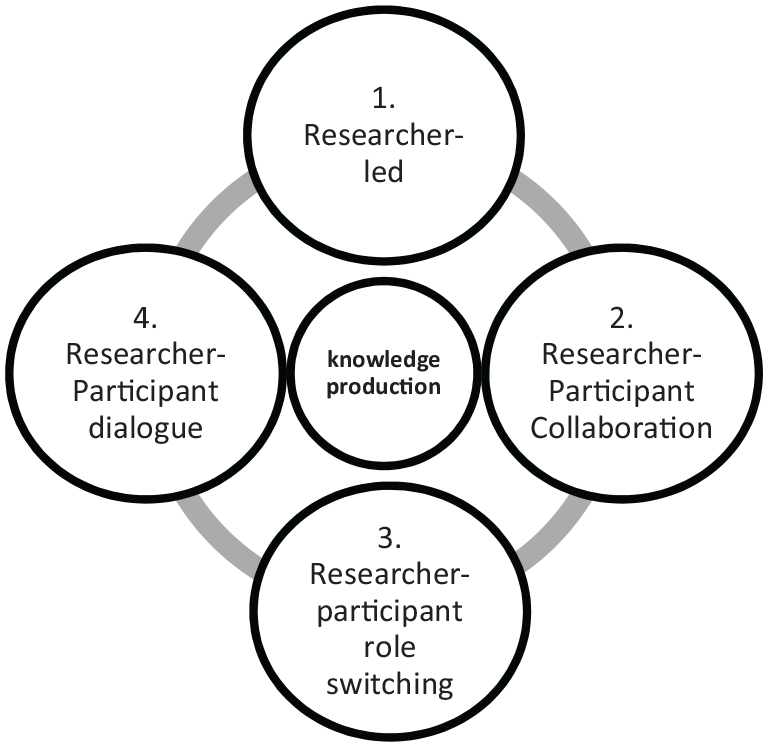
Changing researcher-participant relationships in CFGA.
The Umbrella Movement participants, opponents and bystanders were invited to share their stories in a focus group (F1), while the reflecting team observed them 2 (Anderson, 1987, 1995). The presence of overseas academics in the reflecting team enabled individual stories to be heard by an international audience, thus elevating their importance for the participant researchers. After F1, the reflecting team members switched roles with the F1 participants; they were asked to share their analyses of the participant researchers’ accounts of their Umbrella Movement experiences in the form of a focus group (F2), while being observed by the F1 participant researchers. In the final stage, when the focus group and reflecting team came together in a face-to-face situation, the participant researchers were invited to comment on and discuss the academic researchers’ analysis (see Figure 2). This required the academic researchers to step back from the centre stage, allowing the participant researchers to challenge their analyses and thus their authority. This methodological design reduces the power and privilege of academic researchers by making the reflecting team subject to the gaze of the participant researchers.
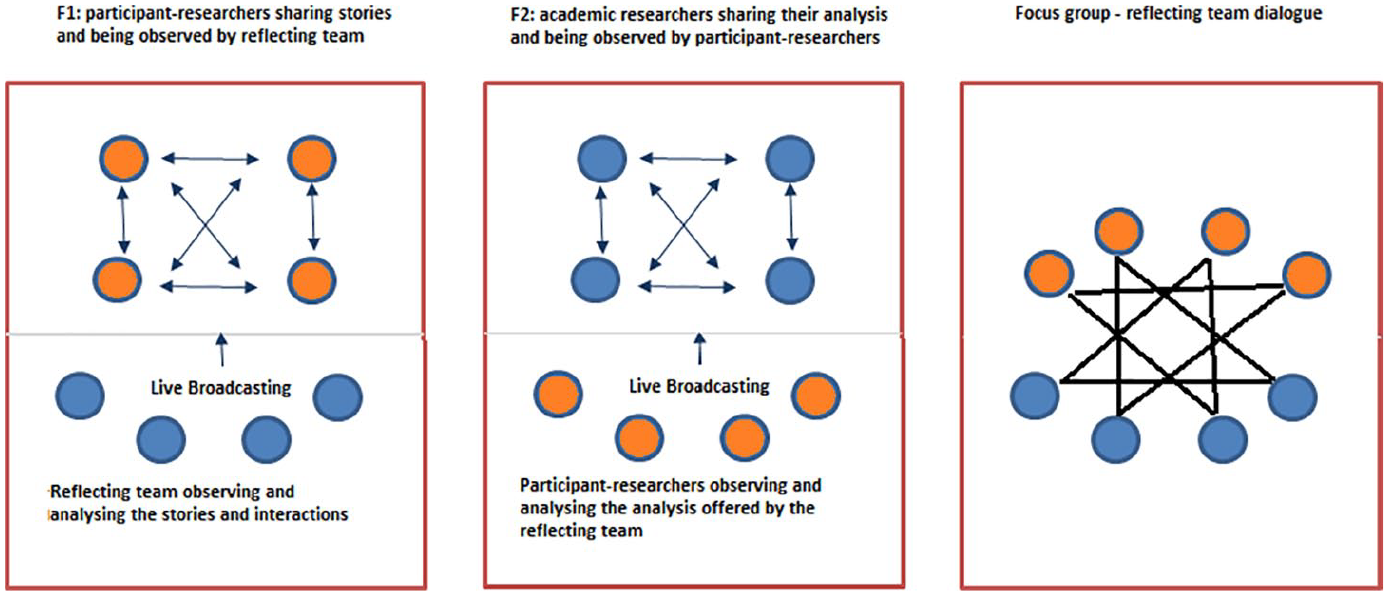
Diagrams illustrating the CFGA process.
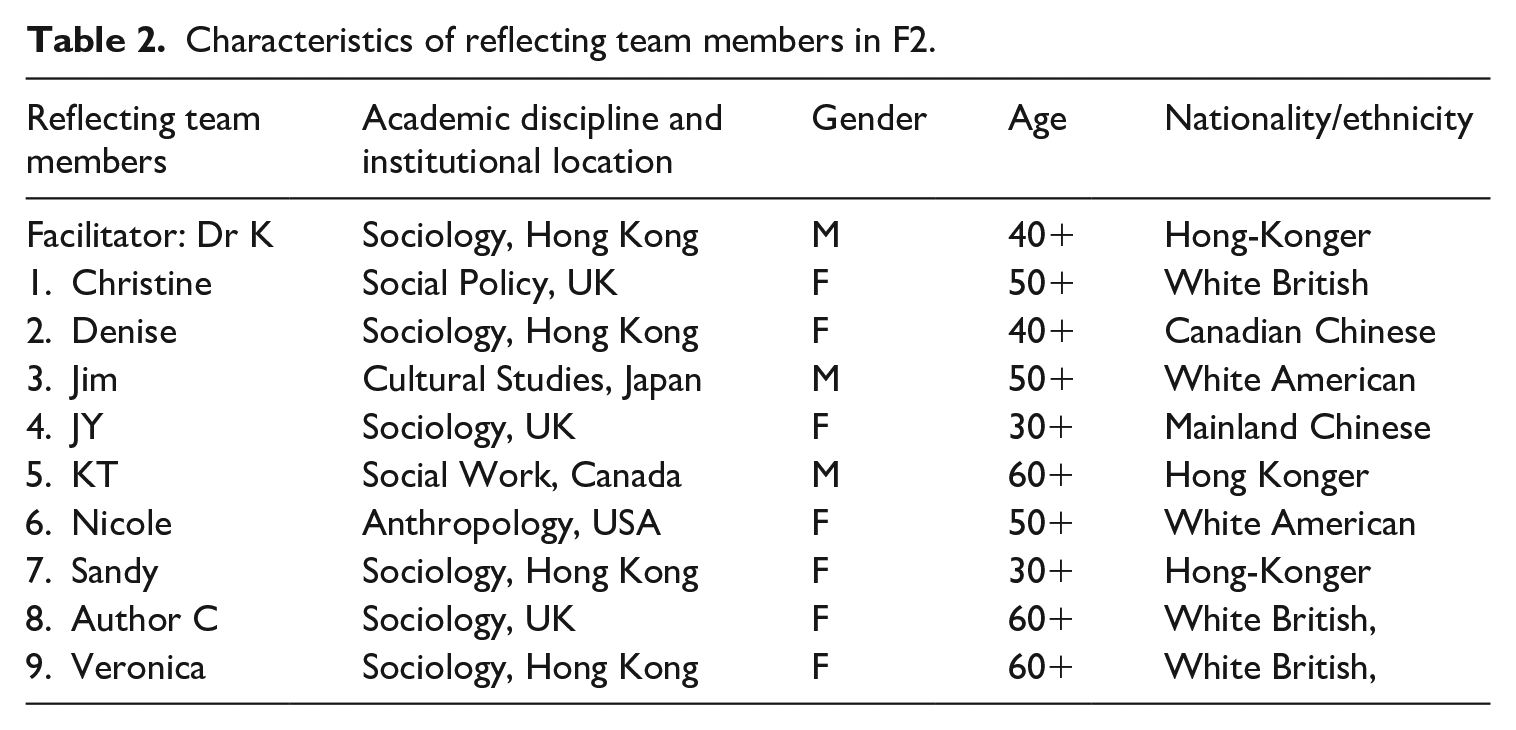
Ethical approval was obtained from the imitating researchers’ university. Two research team members, including Petula Sik-Ying Ho (co-author), facilitated F1, which involved 11 participants of different ages, genders, sexualities, and social and political positions (see Table 1) which was facilitated by Dr K, comprised academics from a range of disciplines and cultural backgrounds (see Table 2). The entire process was video-recorded and later transcribed verbatim. The use of video not only provided us with a record of the research process, but also heightened the co-researchers’ self-awareness, as those involved had to perform in front of the camera.
Characteristics of participant researchers in F1.
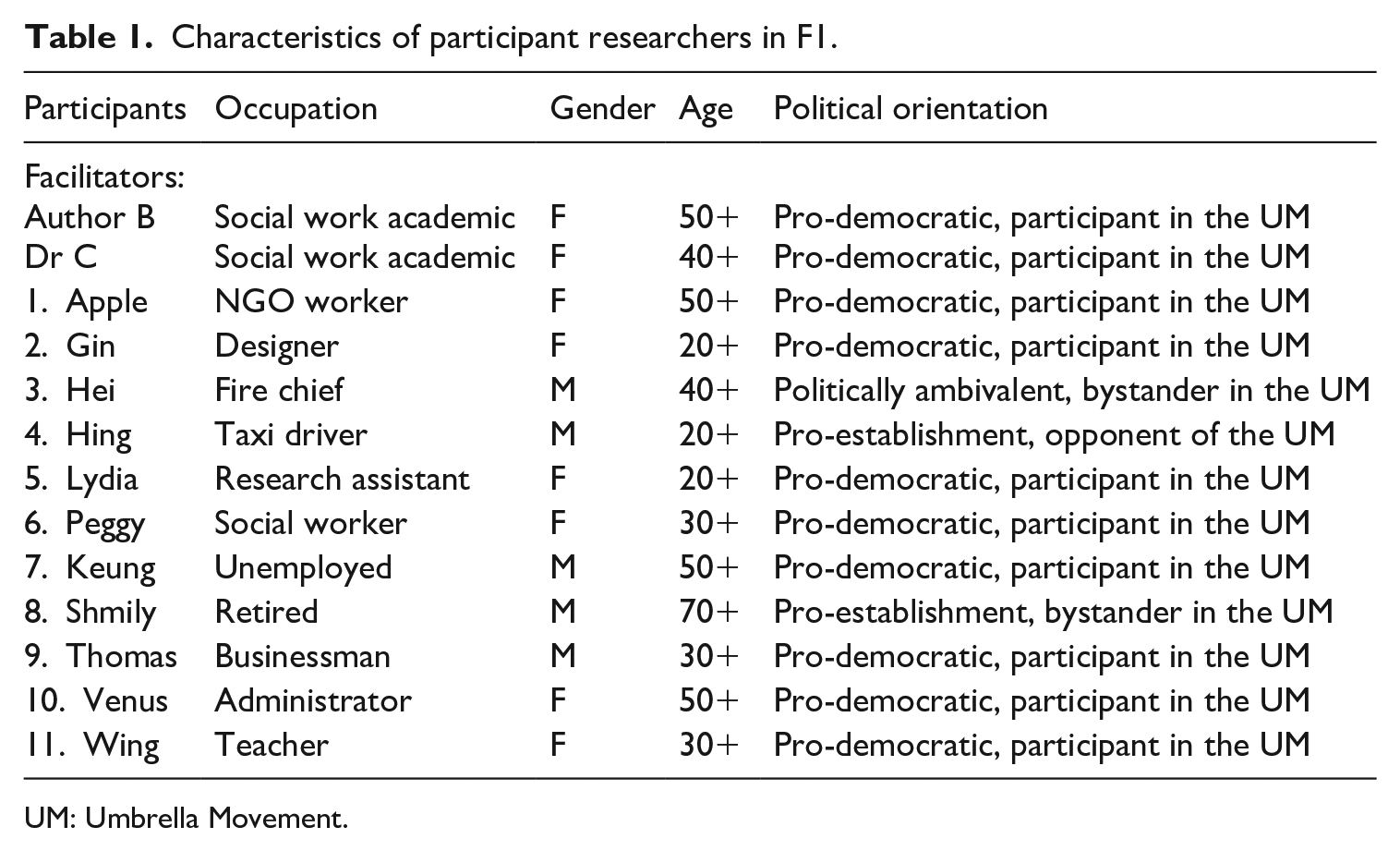
UM: Umbrella Movement.
Characteristics of reflecting team members in F2.
Stage 1: Planning stage: forming the research team, reflecting team and focus group
The planning stage, at which the initiating researchers identified the area of interest and recruited participants, was inevitably researcher-led. Purposive sampling was employed to maximise diversity in terms of age, gender, occupation and political stance for the focus group and academic background for the reflecting team. Recruitment for work of this kind potentially poses challenges. We were asking lay participant researchers to invest more time and commitment than would be required in more standard qualitative research. We were also expecting our academic participants to open themselves to scrutiny and challenge by the lay participant researchers. We were able to manage this for a number of reasons particular to the setting and our own research histories.
The activists were relatively easy to recruit since they were part of our social and political networks and were interested in the process and its outcomes. The non-activists were individuals who had already been involved in projects conducted by members of the research team. They thus had some experience of involvement in academic research and a relationship of trust with the researchers had already been established. These conditions may have made the process less daunting. The academics involved all knew the research team well and on that basis were willing to take a risk and try something new.
We have referred to our participants as co-researchers and participant researchers in order to highlight our attempt to democratise knowledge production, but they may not have seen themselves as such. They were told that we were trying to produce collaborative knowledge and to break down hierarchies between researchers and researched and give latter the opportunity the answer back to the former. This was initially discussed in the informal context of a shared early evening meal provided for all involved where the process was explained. The participant researchers were assured that the academic researchers would listen to them and respect differences of opinion. Members of the two groups were also invited to introduce themselves to one another (using pseudonyms if they wished), and ground rules emphasising confidentiality and mutual respect were laid out. All participants were allowed to use a pseudonym during CFGA and in the outputs generated therefrom if they so wished.
The introductory session set the stage for CFGA by allowing the parties involved to become acquainted with one another and enabled the participant researchers to have face-to-face contact with the academic researchers. It also helped to alleviate any anxiety and uncertainty among the two groups and encourage them to be less guarded in the subsequent discussions. At this time, consent forms were distributed and signed by both participant researchers and the academics. The decentralising process thus started when consent was sought. The process was explained again in the more formal setting immediately before the focus groups took place.
From the introductory sessions onwards the initiating researchers had to suspend their pre-existing knowledge of the topic and create space for the participants to articulate their lived experiences and values (Beresford, 2000; Kong, 2016). Prior to F1, participants were told,
Here we have everything. Blue ribbon, yellow ribbon and whatever other colour . . . I hope you won’t mind. What is most important is to allow [all of] our experiences to be heard through the participation of each one of you. These experiences will then become sources of knowledge. . . . [Knowledge] cannot be dictated by experts, but our lived experiences are of interest to academics . . . [to] develop theories or concepts. (Author B, 50+ years, Female, Professor, Social Work)
We found the ‘not knowing’ position (Anderson, 2005) to play an important role in fostering dialogue and communication. In particular, given that the initiating researchers were publicly identified as ‘Yellow Ribbons’, temporarily suspending their views on the Umbrella Movement encouraged participants of different political stances to talk freely about their experiences and views even when those views were contrary to those of the researchers.
Stage 2: Focus group discussion (F1) and reflecting team observation
The second stage marked the beginning of researcher-participant collaboration and was aided by practices aimed at decentralising the power of interpretation, shifting it from the initiating researchers to the participant researchers. The following three useful decentralising practices and processes were identified: valuing ambiguity to create dialogue, what we call ‘becoming-in-conversing’, and building inter-relational reflexivity to reduce antagonism. The focus group discussion among participant researchers (F1) lasted 1.5 hours and was broadcast live to the reflecting team members seated in a separate room. The reflecting were asked to make on-the-spot analysis during their observation for presentation in the next stage (F2), when they would be observed by the F1 participant researchers.
Valuing ambiguity to create dialogue
The space for dialogue in knowledge-making is restricted not only by academic authority (Jowett and O’Toole, 2006), but also by the dominant discourses shaping understandings of the issue under study. The use of ambiguity, enabling differing and less rigidly defined meanings of events to be considered, can create space for new narratives to emerge among participants as ‘conversed about’ and ‘conversing’ subjects (Hawes, 1998: 274). The focus group began with an evaluation of the Umbrella Movement in terms of its success or failure, which engaged participant researchers in revisiting and articulating their experiences during the movement. It encouraged participants to continue to reflect on the kind of society that Hong Kong could be (Kaeding, 2015). Because there was no dominant assessment of the Umbrella Movement at the time, they enjoyed a free discursive space in which to negotiate an understanding among themselves, as evidenced by some participant researchers’ expression of ambivalence in discussing their experiences:
I was a bit ambivalent just a moment ago, [as] I am not very sure that the Umbrella Movement was a success. I think it’s not only about [social/political] awakening, but more importantly the demonstration of humanity to each person in society. (Gin, 20+ years, Female, Designer) The success [of the Umbrella Movement] is not about political achievement of any type, but about placing the request [for universal suffrage] on the public agenda. Wherever you go, no matter whether that is your family [home] or workplace, you have to confront that. Everyone is talking about it. (Lydia, 30+ years, Female, Research Assistant)
The participant researchers elaborated further on these points in comparing and contrasting their own experiences to highlight perhaps unacknowledged successes of the Umbrella Movement, as manifested in their social/personal lives:
My friends and family weren’t particularly enthused by politics . . . but many people started to take an interest in it [the Umbrella Movement] . . . talking about it . . . and discussing what’s right and what’s wrong. (Keung, 50+ years, Male, Retired)
Venus found the Umbrella Movement helpful in ‘screen[ing] out some bad friends’, whereas Peggy regarded it as having facilitated her personal growth. This process of evaluation created a discursive space for participant researchers to re-examine the role of their social positions in shaping their understanding of success/failure.
Becoming-in-conversing
The process of evaluating the Umbrella Movement was therefore also a process of reconstituting oneself. By emphasising the importance of ‘being yourself’ and ‘talking freely’ at the beginning of the focus group, the participant researchers were engaged in a never-ending project of ‘conversing selves’, in Hawes’(1998) terms – a site for the micro-production and reproduction of ideologies in their everyday life, leading to the construction of a framework in which the values, feelings and experiences of conversing participants could be understood. By refusing to see themselves reductively as Yellow Ribbons or Blue Ribbons or to identify themselves merely by their political identity/affiliation, the participant researchers manged to articulate social-relational-existential selfhood, which is very often forgotten or ‘invisibilised’ in purely political self-narratives. The socio-relational-existential-political selves constructed in the focus group conversations provided space to talk about and make sense of participant-researchers’ fear, helplessness, indifference and appreciation of humanity, aesthetics, kindness and virtue, as well as their politically reconstituted relationships or conflicts with family members (Ho et al., 2018a). For example, Shmily expressed his fear of participating in street politics, his location as a gay man and his powerlessness in the face of authority:
When I was young, there was a riot that made me feel scared to go out. I remember my cousin, a leftist, kept chanting something that really scared me. I was afraid of these things, and would never participate. I was actually quite happy after the occupation started because everywhere was so empty, and I could get a seat easily [in restaurants]. I felt good about it. For me, a gay man, [I believe that] if you do not have political wisdom, you should not participate in politics. You just don’t understand it, so why bother to talk about it? . . . I didn’t see things [that others saw] because I never went [to the occupation sites] . . . it was none of my business. Only Ah Yae [literally paternal grandfather, symbolising the Beijing government] knows. (Shmily, 70+ years, Male, Retired)
Politicising usually apolitical everyday practices engaged the participant researchers in making sense of their (non)participation in the Umbrella Movement, enabling them to evaluate the movement from social positions beyond the Yellow Ribbon-Blue Ribbon dichotomy. For example, it helped them to make sense of how their (non)participation in the movement had been shaped by their institutional (Hei), generational (Gin, Lydia) and familial-hierarchical (Wing) positions, as well as by their sexuality (Shmily, Wing) and personal beliefs (Lydia, Peggy).
This conversational and performative space was created by the decentralising strategies employed by the initiating researchers. First, the initiating researchers refrained from imposing identity definitions on any of the participants in relation to their gender, sexuality, political stance or educational background at the beginning of the conversation: ‘the most important thing today is for us to participate and share our experiences with others . . .’ (PSY Ho). Thus, the participant researchers had a performative and dialogical space in which they could construct and together explore the possible identities, relationships and social positions at work when they were asked to evaluate the Umbrella Movement. Second, the initiating researchers’ emphasis on the free-flow of conversation seems to have facilitated the co-inquiry process among the participant researchers, who constantly cross-referenced one another’s experiences in formulating their own views. Such cross-referencing and the comparing and contrasting of the family practices and relationships that had shaped their (non)participation in the Umbrella Movement led to the expansion of the evaluative framework for assessing the success/failure of that movement beyond a focus on political or constitutional change.
Building inter-relational reflexivity to reduce hostility
Given the antagonism within the pro-democracy camp (between left and right), and between pro-democracy and pro-establishment camps, a critical task was supporting the deconstruction and reconstruction of antagonistic political identities to make differences intersubjectively comprehensible. CFGA provides space for listening and responding to arguments and disagreements in ways that can reduce antagonism. We are aware that because most of the participants in F1 were Umbrella Movement activists (10 of the 13, including the initiating researchers), the tone that was set seemed to favour the Yellow Ribbons who tended to see the Umbrella Movement as a democratic movement and a partial success. To evaluate how far democracy was realised in the first focus group, the disagreements that arose in evaluating the movement are worth examining.
The disagreements in F1 took the following two main forms: (1) Disagreeing within an agreed framework and (2) constitutive disagreement. The first form of disagreement did not affect the terms of discussion. Apple and Wing agreed that the Umbrella Movement was a democratic movement, but disagreed about whether it was a success owing to its negative social and relational consequences. The revelation of these differences, rather than giving rise to antagonism, reinforced a common definition of the ‘reality’ that the Umbrella Movement was a democratic movement for social justice. The second form of disagreement, in contrast, fundamentally rejected that definition, viewing the Umbrella Movement instead as undemocratic and ‘exclusive’:
I have unresolved doubts about democratic pursuits and intimacy. If I believe that democracy is about inclusiveness as compared to authoritarianism, I do not understand why the process of pursuing democracy [in the Umbrella Movement] was so exclusive in nature? It even damaged filial relationships . . . that, I couldn’t understand. (Hei, 30+ years, Male, Fire Chief)
Defining the Umbrella Movement as undemocratic in nature allowed Hei to question the rationality of the movement’s participants and to attribute their participation to ‘following the herd’ rather than consciously pursuing democracy and justice. These incompatible constructions of ‘what the Umbrella Movement was’ also reflect the major political division between the Yellow and Blue Ribbons in Hong Kong society. In F1, however, that political division did not lead to antagonism. For example, Gin (20+ years, Female, Designer) responded to Hei by expressing her ‘appreciation’ and ‘empathetic understanding’, contextualising disagreements before she proceeded to contest his views and definition of reality. Her approach seems to have dampened any potential hostility as it avoided presenting the ‘other’ as an enemy. It also demonstrates the ability of disagreeing parties to develop a sense of responsibility for each other and acknowledge shared problems, such as relationship tensions. Gin’s response to Hei illustrates negotiation over and the actual performance of what constitutes democracy – inclusivity rather than antagonism (bracketed words in bold are codes developed by the authors):
I think Hei has asked a great question . . .
Stage 3: Reflecting team discussion (F2) and participants’ observation
The aim of the third stage of CGFA was to reduce the knowledge-making power differential between the participant researchers and academic researchers by switching their roles. This stage put the academic researchers into the position of being observed, and the participant researchers into the position of offering analysis. After listening to the F1 discussion, the reflecting team entered the discussion room to conduct a discussion (F2), facilitated by Dr K, while the F1 participants observed their analysis through live broadcast.
Analysis of the F2 data demonstrated that subjecting the academics to the gaze/observation of the participant researchers was only partially effective in cultivating inter-relational reflexivity (Gilbert and Sliep, 2009). To challenge scientific neutrality and the researcher-researched distinction, we also needed to create micro-conversational spaces that would enable this to happen. In the event, the way the facilitator was instructed to frame the discussion – as academic analysis – worked against the aim of displacing academic identities. There was little opportunity for them to perform aspects of non-academic selfhood, such as ‘gwai lo/gwai poh (male/female foreigner)’ or ‘mainlanders’, which informed their understanding and analyses. F2 began with the facilitator providing an overview of the issues raised in F1 and of the expectations of the reflecting team, the analysis they should produce and the questions they should address. At times, the F2 participants were described and positioned by the facilitator as academics, political outsiders and cultural outsiders:
[W]e actually talk a lot about different themes, and so you might comment about all of the different themes or maybe there might be one or two missing themes that you want to articulate . . . or conceptualise the discussion using academic terms, concepts, whatever . . . the third area is about methodology, so you might also want to say something about methodology, for example, the choice of respondents, and then the interactions among them, and then the format. (Dr K, 40+ years, Male, Sociologist)
The F2 participants were thus asked to perform as academics, to ‘do being academics’. Although the facilitator drew attention to most of them being from outside Hong Kong – ‘[Y]ou’re all . . . coming from different contexts, and countries’ – this was not used to encourage reflection on how their cultural backgrounds might affect their perceptions. In consequence, the effects of the academic researchers’ institutional, cultural, emotional and relational selves on their sense-making became barely visible.
Doing being academics but nothing else?
The most prominent practices observed in F2 were theory application, theme construction, content theorisation, methodological discussion and evaluation of existing theories. Academic selves, such as anthropologist or theorist, were thus constantly signified, responded to and sustained during the F2 conversation. Exceptions were when Author C and JY voiced ways of being other than academic selves, but such instances of doing non-academic selfhood were rarely responded to or sustained. Author C occasionally raised the issue of how her physical being (tiredness, given that F2 was held late at night), cultural being (as a female foreigner) and historical being (memories of living in Hong Kong during the 1967 disturbances) may have affected her understanding of the stories told by the Umbrella Movement participants, opponents and bystanders. However, none of these comments were picked up on by other F2 participants or the facilitator. The F2 participants were thus discouraged from linking their interpretations with their own socio-cultural-historical positioning, which worked against the reflexive and relational practices we hoped to promote.
Developing inter-relational reflexivity through ‘doing-being-observed’
Towards the end of the F2 discussion, there was some reflection on the relationship between the academic researchers and participant researchers. It appears that the imminent face-to-face exchange between the academic researchers and participant researchers led the former to perform ‘doing-being-observed’ (Hazel, 2016) by attending to how they were being perceived by the latter as academics from the West and Hong Kong and China. Veronica talked about how Western culture may have shaped the academic researchers’ interactions:
I think it’s true to say [that there is] a cultural inhibition about getting fired up in public. It’s not generally considered to be proper and decent behaviour, and people try to tamp themselves down. There isn’t so much of the ‘if you feel it, say it’ kind of ethos. (Veronica, 60+ years, Female, Sociologist)
Only when the relationship between the academic researchers and participant researchers was brought to their attention did the former discuss the emotional register in which the latter talked:
[I] was quite surprised at the emotional revelation and depth of what was shared amongst a group of strangers. I think that in itself is an indication of how important these issues were . . . I’m not surprised by what I think of as the ‘strangers on the train’ phenomenon, the things you say to strangers that you can’t say to those who are supposedly your nearest and dearest because there will be long roll-on consequences, you can say things to strangers and walk away, you don’t have to live with the consequences, and you don’t upset them very often by, or at least they’re not personally connected, so they don’t feel any guilt or blame from listening to you. Whereas your family do. (Veronica) Talking to a researcher is often very therapeutic in that you can say things to someone just because they’re not family. But it’s not like talking to a stranger whom you’ll never hear from again and where the knowledge will just disappear in a day, [as] it can live on in ways you may not expect, and that’s I think the danger of it in a way. (JY, 30+ years, Female, Sociologist)
Stage 4: Focus group-reflecting team dialogue
Dialogical knowledge-making (as opposed to expert-led knowledge-making) requires all participants to be able to bear the dual role of researcher-participant, to be able to communicate their thoughts and experiences of being both a subject of discussion and a subject who discusses. CFGA is designed to ensure that all participants have experience of observing and being observed before they enter into the practice of dialogical knowledge-making. We cannot dismiss the privileging of the expert knowledge of academic researchers. Therefore, in the fourth stage of the CFGA, the focus group and reflecting team were co-present in the same room, enabling face-to-face interaction. The participant researchers were first invited to give feedback on the analysis of the academic researchers, who were in turn invited to give their responses to that feedback. The focus group facilitators, through summarisation and reflection on content and feelings, made sure that everyone’s views were acknowledged and clearly heard.
Behaving like guests: feelings and sense-making
The participant researchers described the academics’ analysis as ‘detached’, ‘objective’ and ‘distant’. They regularly used the term 客氣 (haak hei, that is, behaving like guests: overly polite, distant and detached) to refer to the academic researchers’ manner in interpreting their lived experiences:
In the focus group, we always shared our feelings and experiences. The scholars were rather objective and distant. (Keung) I think they were trying to be ‘haak hei’. There was more to learn from the focus group. The scholars are really too ‘haak hei’. (Shmily)
The academics’ distance and objectivity, instead of conveying a sense of understanding, were perceived as dismissal of the affective aspect of the participant researchers’ experiences. Lydia offered an explanation for the haak hei of the academic researchers, which she attributed to the cultural differences in intimacy/family practices between the West and East:
I felt the distance [in the analysis] regarding our emotional feelings. We come from very different cultural backgrounds. For example, our families are very intimate. We have to go home every day and there is no way we can avoid our parents . . . unlike students in other countries [who] can move out when they enter university, and so don’t have to see their parents’ every day. This cultural difference determined how we [the participant-researchers and academic researchers] understood what happened. (Lydia)
In response to these criticisms, the academic researchers reflected on and then gave an account of how they understood themselves as researchers. Rather than cultural differences, Denise, a researcher of Chinese ethnicity, examined how ‘academic culture’ had shaped her ‘guest manners’ and proposed alternative approaches to dialogical sense-making by rekindling her feminist background:
I must say that our haak hei manner is taught by our schools. We are taught to distance ourselves. I am not the most distant kind [of researcher] as I have a feminist background. However, when I am in the role of an academic, I seem to act totally distant . . . We have listened to so many of your stories about your relationship with your families, but we have talked only about academic stuff. (Denise, 40+ years, Female, Sociologist)
In addition to the objective and distant stance emphasised in academic culture, the shortage of time to formulate a response and the academic researchers’ lack of personal investment in the issues (i.e. historical link and emotional commitment) were also said to be factors contributing to their ‘emotionlessness’:
We are not as personally invested in it [Umbrella Movement] as Hong Kongers are. I think part of our distance is, yes, the academic strategies we are using, the devices we are using in our talk, but also because most of us are not heavily invested in it. (Author C, 60+ years, Female, Sociologist)
Although the academic researchers in F2 displayed less emotional engagement with the stories of the participant researchers relative to F1, we believe that ‘empathic solidarity’ (Banks, 2014) with the participant researchers was displayed in both F1 and F2. In F2, Christine explicitly empathised with Hing, the Taxi Driver from F1, saying that she felt that socially disadvantaged people could be marginalised from political participation and even victimised by it because of the disproportionate financial costs a social movement might impose on them. In addition to ‘empathic solidarity’, the academic researchers also developed ‘strategic/instrumental solidarity’ with the participant researchers by attributing the creation of a safer space for emotional disclosure to their own status as ‘strangers’ and ‘foreigners’. One academic researcher also found that the focus group format inhibited her expression of care compared with her experience of conducting individual interviews:
When I am doing research, I usually talk to one or two people at the same time, not a whole huge group. So when it is one or two people, I feel that it is much easier for me to share back and be more intimate. Also to give back in ways that are more culturally appropriate. In Hong Kong, it is like bringing you food, sharing or giving something that shows I care [about] getting to know each other. (Nicole, 50+ years, Female, Anthropologist)
The relatively covert exhibition of emotional engagement by the academic participants could therefore have been the result of many situational factors, including the culture of neutrality emphasised in certain academic traditions, the way that F2 was set up, and different cultural practices.
Concluding discussion
The opportunity to experiment with this methodology depended on a number of factors specific to the time and place. First, there was the presence of overseas researchers who were willing to participate in a collaboration that laid them open to being observed and challenged by the participant researchers. Furthermore, their willingness to do so was particularly important at a time when Hong Kong people were desperate for international recognition and validation of their struggles. Conversely, it was important to the process that the participant researchers were willing to challenge academic authority by sharing their observations and giving feedback and comments to the scholars.
In developing CFGA, our dual aim was to challenge the power relations and hierarchies within and outside academia and to provide space for the deliberation and communication of political and cultural differences in a non-hierarchical setting. We cannot know, however, whether all those involved considered themselves to be co-researchers. The academics did see their involvement as an exercise in co-constructing knowledge. The lay participant researchers may not have understood it in this way, but they were clearly aware that they had a right to challenge academics’ analysis of their discussions and did so without holding back. Relationality was both incorporated into and demonstrated in the process through participant researchers’ responses to each other’s experiences and to the academics’ interpretations of their accounts. The CFGA experiment did, therefore, succeed in creating an environment in which it was possible to explore how Hong Kong people from a variety of backgrounds and political perspectives constructed accounts of self and others in assessing the consequences of the Umbrella Movement.
While the conventional understanding of scholar-activism pertains primarily to scholars participating in social activism organised outside academia or critiquing the apolitical research culture (Hale, 2008), this article advocates an approach to scholar-activism that involves the transformation of everyday research practices into activism for democracy. Among the six practices of scholar-activism proposed by Routledge and Derickson (2015), dispersing power and resourcing solidarity were found to be the most relevant to our first experimental use of CFGA. These two practices were realised through the design of CFGA, while the conversational strategies deployed by participants promoted democracy within CFGA at two levels: reducing antagonism and encouraging non-hierarchical dialogue. Both were needed at a time when Hong Kong people were seeking ways to express political disagreement without it leading to confrontation (Ho et al., 2018a). Despite the political divisions and differences in educational backgrounds, occupations and sexuality among the participant researchers in this study, listening and responding to others’ personal stories about the Umbrella Movement created a strong sense of solidarity among them and enabled sharp exchanges without creating antagonism. This form of solidarity relies on an empathetic understanding of others’ pain, suffering, hopes, fears and pleasures (Banks, 2014), shared understanding of living with familial-hierarchical harmony as a father, husband, wife, daughter or son (Ho et al., 2018a), and the common experience of living under the authoritarian rule of ‘Grandpa China’.
However, the reflecting team’s experience was framed in such a way that ‘doing being observed’ required them to perform as academics, to offer expert analysis rather than explore the emotional resonance and embodied experiences that often underpin sense-making. Their discussion was clearly out of step with the expectations of the participant researchers. This could be remedied in future by setting-up the process differently and encouraging academics to empathise as well as analyse and to make clear (as is often encouraged in feminist research) the way their own social locations influence their academic analysis. CFGA potentially offers a critique of academic knowledge-making practices, but it could also allow academic researchers to ‘do being academics’ differently by attuning ‘to the affective impact of meaning making’ which can help researchers ‘attend to and record (in a disciplined way) telling detail in the contexts they are studying’ (Thomson et al., 2012: 319). Even with the necessary modifications, heavy reliance on ‘words’ in running CFGA may favour academic researchers by handing them the powers of interpretation and representation (Butterwick, 2002). And ultimately, even with greater equality in generating data and initial analysis it is academics who write up and interpret what has been going on – as we have done here.
We have continued to experiment with this method (Ho et al., 2017) and to think of new ways in which we can develop and enhance this way of working with participant researchers. Involving them more in the processes of analysis and writing would be ideal but this may be a step too far (Nind, 2011) and demand too much of them, which they have every right to refuse. Despite its limitations, we believe this approach offers a way of doing meaningful, politically engaged work in situations of political unrest and contestation, which are increasingly prevalent across the world. While it is recognised that intense involvement in social movements can have a profound impact on activists’ lives and relationships, there has been little methodological development in this field. Conventional qualitative and narrative analyses do yield insights (Blee, 2016; King, 2006) but tend to focus on activists as individuals or only on their relationships with other activists rather than their ties to those outside movement circles. CFGA has an advantage in framing these issues as relational and also in including those outside the social movement. It can, therefore, address the broader interpersonal reverberations of major protests. This can be particularly productive where a movement has been socially divisive and disruptive to bonds of family and friendship – and useful in understanding that movement’s wider impact. 3
We would add a caveat here. We do not think it is feasible to do this when tensions are at their height. We conducted the original CFGA after the Umbrella Movement. We certainly could not operationalise this method during the current phase of the protests in Hong Kong; there is too much violence and open hostility across political divisions. Moreover, activists are too busy to expend time and energy on a research process requiring considerable commitment. We hope, however, to pick up the project again if or when the situation becomes calmer. We should continue, when researching the marginalised, disadvantaged and oppressed, to do more than simply represent their voices; we should strive to bring the struggle for democracy and equity into our research practices and give those we research the chance to challenge our priorities and analyses.
Footnotes
Acknowledgements
We would like to thank Celia Chan who, with Petula Sik Ying Ho, originally co-designed the methodology for our first experimental use of Collaborative Focus Group Analysis and co-facilitated it. The evaluation of the process provided in this article, however, is entirely the responsibility of the authors.
Declaration of conflicting interests
The author(s) declared no potential conflicts of interest with respect to the research, authorship and/or publication of this article.
Funding
The author(s) received no financial support for the research, authorship and/or publication of this article.
