




Abstract
Drawing on data from a UK study conducted in 2014/2015, based on qualitative interviews with 25 working parent, heterosexual couples on their domestic division of labour, I argue that the interactive methodology of the ‘Household Portrait’ not only provides data on the distribution of household labour but also reveals gender differences in how domestic labour is conceptualised and measured. Disagreements and inconsistencies between couples over who ‘mostly’ does various tasks embody gendered perceptions of the meaning of doing domestic tasks and the appropriate temporal frame for evaluating individual contributions. Partners’ joking competition over their respective contributions highlight not just the normative expectations guiding what women and men feel they should do but also the criteria that they think should be used to measure their contributions.
Introduction
Research on the domestic division of labour has used various qualitative and quantitative techniques to explore changes in timing, tasks, and responsibilities. Changes in the domestic division of labour have been gradual (Kan, 2008), with much household labour and childcare still divided along gendered lines (McMunn et al, 2020). This article argues that studies of unpaid domestic labour need to go further than identifying men’s and women’s relative contributions and explore how gender shapes the ways men and women identify and calculate their contributions in the first place.
As I demonstrate, sociologists have made considerable strides in their ability to measure the relative contributions of individuals living in heterosexual couple households, as well as to identify the continuing lacunae in and biases of the questions asked in large-scale surveys of unpaid household labour (Warren, 2011). But studies are still mainly concerned with measuring relative input and how it has changed. In this article, I take a different approach, using Doucet’s (1996) visual, interactive ‘household portrait’. This method of producing data on household labour reveals not only disagreements within couples in how much labour they see themselves and each other doing, but also highlights different (gendered) normative assumptions about what counts and who counts (and who does the counting). It shows that the question of how much household labour couples do – and our ability to measure it – is inseparable from the subjective, highly gendered ways couples compare their contributions in everyday life.
The ‘Household Portrait’ methodology allows the researcher to examine how the allocation of domestic tasks is worked out, providing insight into how couples understand their domestic tasks and divisions of labour by observing their attempts to assess and compare their contributions. The article first considers how quantitative and qualitative methods have been deployed in studies exploring domestic divisions of labour. Second, it outlines my use of the Household Portrait technique. Third, the main part of the article shows how, as a methodology, the household portrait generates explicit dialogues between partners that can reveal disagreements in the ways they conceptualise and recall their contributions to domestic labour. It identifies differences in the criteria they use to assess their input to childcare and housework tasks, criteria that may be obscured in surveys, time-use diaries and other interview formats. Finally, I consider the ways in which couples reconcile their disagreements, not always amicably. The study shows the importance of adopting data collection techniques that not only measure input, such as tasks and time allocations, but also make it possible to explore the construction of such measures and their connections to the establishment of gender divisions of labour within households.
Researching domestic divisions of labour
Attempts to document domestic labour, along with the contribution of unpaid work to family well-being, go back a long way (Blood and Wolfe, 1960; Oakley, 1974; Young and Wilmott, 1973). In the past 60 years, theoretical approaches to the domestic division of labour have become more sophisticated, while quantitative methods have long generated important findings about the (de)gendering of domestic tasks over time (Berk and Berk, 1979). They have also identified variation in domestic divisions of labour according to a number of socio-demographic indicators, such as social class (Warren, 2003), ethnicity (Kan and Laurie, 2018), education (Sullivan, 2010), and gender ideology (Lachance-Grzela et al., 2019) among others. However, the use of quantitative methods, usually surveys or some time-use studies, often assume that the time spent, whether the duration of time spent carrying out a task and/or the frequency with which it is done, is the most important aspect of the gender division of labour and often, in survey research, temporality is synonymous with the question of who takes responsibility for tasks. Large-scale surveys such as Understanding Society (Kan and Laurie, 2018) and the British Household Panel Survey (Warren, 2003) rely on information from individuals in couple relationships, asking one partner at a time to estimate the number of hours that they spend on housework, as well as to identify who ‘mostly’ carries out particular household tasks, including whether the task is ‘shared’. Warren (2011) argues that large-scale surveys often fail to recognise the multi-dimensional nature of unpaid work, including aspects like responsibility and management, and proposes the inclusion of new questions which could better capture the meaning of domestic labour and how it is understood.
Time-use data is perceived to provide more accurate measures of how domestic labour is divided than other methods (Kan, 2008), as it does not require retrospective recall. For instance, time-use diaries (Sullivan, 2010, 2013; Gershuny and Sullivan, 2019) may require participants to record time spent on a wide range of domestic tasks, within 10/15-minute intervals, as they carry them out. This allows measurement of both frequency and duration of time spent, and the distribution of activities, generating a more detailed record of task completion than survey data. While these measures have generated data on how much time is spent on different domestic activities, according to Gershuny and Sullivan (1998) the data produced often shows ‘considerable limitations in respect of other facets of time’ (p. 72). They argue that time-use diary research potential goes much further, citing studies that reveal the rhythm and sequencing of time spent on household tasks and gendered experiences of the intensity of time when couples carry out domestic tasks separately and together (Gershuny and Sullivan, 1998). Some quantitative studies also explore other attitudinal and experiential aspects of domestic work, for instance who takes responsibility for tasks (Sullivan, 1997) or the level of enjoyment involved in carrying out tasks (Sullivan, 1996), while research using surveys have explored associations of men’s and women’s housework hours with gender-role attitudes (Kan, 2008).
Quantitative researchers are aware that men and women in couples report their own and their partner’s domestic responsibilities differently (Press and Townsley, 1998). As a result, partners are usually interviewed separately. Lee and Waite (2005) compared a series of estimates of time spent on housework from husbands and wives using both survey responses and estimates from a form of time-use diary. Comparing results from these two data collection methods, they conclude that wives make accurate estimates of their husband’s housework time while husbands overestimate their own housework time. They also found survey estimates based on the wives’ responses on their own time spent on housework was significantly higher than those documented in time-use diaries. They conclude that ‘respondents think more globally than do researchers constructing survey questions, and so include time planning for housework tasks or doing several at once’. Unexplained discrepancies between partners’ individual characterisations of ‘shared time’ in time diaries have also been documented. Vagni (2019) highlights that ‘when partners are both caring for a child together, women could perceive and report this situation as shared childcare or shared domestic chores, while men might report it as shared leisure’ (p. 505). Time diary data, as yet, is unable to explain discrepancies although the further use of ‘camera diaries’ in time-use research (Gershuny et al., 2017) may go some way to explain inconsistencies.
Scholars argue that data on the interactional level may be best solicited through qualitative methodologies (Sullivan, 2013), especially on how meanings and understandings are worked out between partners. But this is difficult if only one member of a couple participates in the study (Armstrong, 2006; Robertson et al., 2019) or if partners are interviewed separately (Daminger, 2019). Interviewing members of a couple separately may have the advantage of preventing couples from trying to provide a consistent story and give participants an equal voice (Taylor and de Vocht, 2011). In contrast, interviewing couples together can provide rich verbal and observational data generated by disagreements (Bjornholt and Farstad, 2014). Interviewing couples together should make it possible to eavesdrop on ‘marital conversations’ (Benjamin, 1998) that could reveal important impediments to women’s negotiations with their husbands. This seems preferable to asking members of couples who have been interviewed separately to discuss inconsistencies between their accounts, as this would breach confidentiality (Norlyk et al., 2016).
There is also the question of how easily face-to-face semi-structured interviews can retrieve the subtle and complex ways in which individuals measure and understand their contributions. As Doucet (1996) argues, ‘much of the information on how a household operates on a day to day basis is difficult to remember and conceptualise, much less to articulate’ (p. 160). Similarly, Martens (2012), arguing for visual methods, challenges the exclusive use of ‘language and talk’ for understanding domestic practices like dishwashing, contending that while talk may reveal their ‘organisational’ dimensions it usually misses out the sensual aspects of ‘activity’.
Doucet’s (1996) participatory methodology, the household portrait, shows us how a method for interviewing couples together may enable us to capture a couple’s different ‘speaking positions’, offering clues to how gendered roles are established (Valentine, 1999). Each participating couple’s joint construction of their household portrait makes visible complex differences between partners in how domestic labour is conceptualised and measured. Doucet’s technique has inspired the creation of other visual, participatory methods in studying intimacy, such as emotion maps (Gabb, 2008). But although recognised as ‘efficient in getting at the amount of change and the detailed processes involved’ in domestic divisions of labour (Sullivan, 2004: 219), it has been surprisingly little used. In what follows I outline my use of the household portrait and then go on to discuss what it revealed.
The study
As part of a wider study, the participating couples each compiled a ‘household portrait’ in my presence, discussing and allocating 25 different domestic tasks. Couples’ joint construction of a household portrait allowed me to examine disagreements between couples over how they divided tasks between them, revealing gendered understandings of their allocations that might otherwise not be articulated. This is important, as it provides clues to how couples recognise, but at the same time sustain and reconcile, gendered views of domestic labour in everyday life.
My interviews in 2014/2015 with 25 heterosexual working parent couples across the UK West Midlands focused on how they divide housework and childcare tasks, especially in relation to the type of jobs (public or private sector) they held (although this is not discussed here). I initially distributed adverts in children’s centres, nurseries, playgroups, and community noticeboards. At the outset I had a few responses, all but two couples withdrew their offers, citing work or family commitments. Although there is always the danger of self-selection bias, my conversations with those who refused to participate suggest that it was a question of time and convenience rather than not feeling sympathetic to the topic.
From those who initially agreed to be interviewed I then recruited other interviewees through snowballing, asking participants to recommend other possible participants in nearby towns, villages, and cities. Personal recommendations resulted in more interviews than my initial blanket approach. I chose to interview couples with children, as other research has found that time spent on domestic tasks increases with the presence of children, with women tending to bear the increased domestic load (Baxter et al., 2008). The number of children in the households ranged from one to three and their ages ranged from 12 months to 13 years old. This age range allowed me to explore potential differences in the experiences of working parents with pre-school and older children. The imposed limit of a child of no more than 13 years old intentionally narrowed the sample, in order to ensure greater comparability between couples.
Although the individuals in the sample came from a range of occupations, most could be defined as middle class, based on the NS-SEC classification of social class (National Statistics Socio-Economic Classification (NS-SEC), 2010). Despite my attempts to arrange interviews with participants who identified as BME (Black and Minority Ethnic), the sample was predominantly White, with three participants who identified as Asian. The relative absence of minority ethnic or working-class participants was unfortunate, as the full range of experiences are not included, particularly as both social class and ethnicity have been linked to domestic labour contributions (Kan and Laurie, 2018; Miller and Carlson, 2016).
All the couples lived together and all but one were married. All but one of the interviews took place in the couples’ homes; the majority on a weekday night after their children had gone to bed. Pre-school children were present during the eight interviews conducted at the weekend. The interviews averaged about 2 hours, ranging from 1 to 3 hours. The household portrait method was used as part of a semi-structured interview in which work histories, workplace policies, and work–life balance were also explored. Following ethical guidelines at all times (British Sociological Association (BSA), 2002, Statement of Ethical Practice), I was aware of my responsibility as a researcher to deal with disagreements sensitively, both within the interview and in subsequent analysis: I was asking couples to discuss matters that could potentially invoke resentment and conflict, thus increasing the potential for my interview to create unintended harm. I attended to this throughout the interview by looking for unspoken indications of reluctance, discomfort, or annoyance, in order to ensure that informed consent was continuous throughout the time I was in their home. On occasion, I felt the conversation was becoming too heated, so I elected to move on to a discussion of the next task. After every interview I sent an email to the couple to thank them for their time but also to check on their well-being and to ensure that they were comfortable with the interview, their level of disclosure, and to give them an opportunity to write back and withdraw consent if they so wished. None withdrew their consent or expressed dissatisfaction with the interview.
I used NVIVO computer-aided qualitative data analysis software (supplemented by manual coding) to aid my analysis of both the visual household portraits, described below, and the interview transcripts. The analysis included the discussions and disagreements that took place while couples completed their household portraits.
The household portrait
In the second half of the interview, I asked each couple to work together to construct a household portrait showing how they divide up household tasks. They were given a set of sticky-backed cards, each listing a particular housework or childcare task, and asked to decide which member of the couple undertook each task most of the time. Once they agreed, they then stuck the cards in one of five columns on an A1 sheet of paper. Each column indicated different divisions of labour and was titled accordingly. The columns were labelled, following Doucet, as (a) woman only, (b) woman (man helps), (c) shared, (d) man only, and (e) man (woman helps). Participants were instructed to consider a ‘shared’ task to be divided 50/50, while a partner ‘helping’ was considered to be undertaking the task some of the time, but not the majority of the time. The couple were also invited to write down on blank cards any housework or childcare task that had not been included and to annotate the existing cards if they felt further clarification was required.
Figure 1 shows an example of a completed household portrait constructed by Victoria and Lee, who have two children, aged 12 and 13, and who both work full-time as secondary school teachers. It exemplifies a portrait in which the division of housework and childcare is evenly distributed across the five categories, yet one in which some tasks are typically gendered. As I show later, the portraits vividly present the variety of different tasks which couples see as important. For example, this couple added cards for ‘disciplinary issues’ and ‘emotional welfare’, tasks that were not present in the portraits compiled by couples with pre-school children.
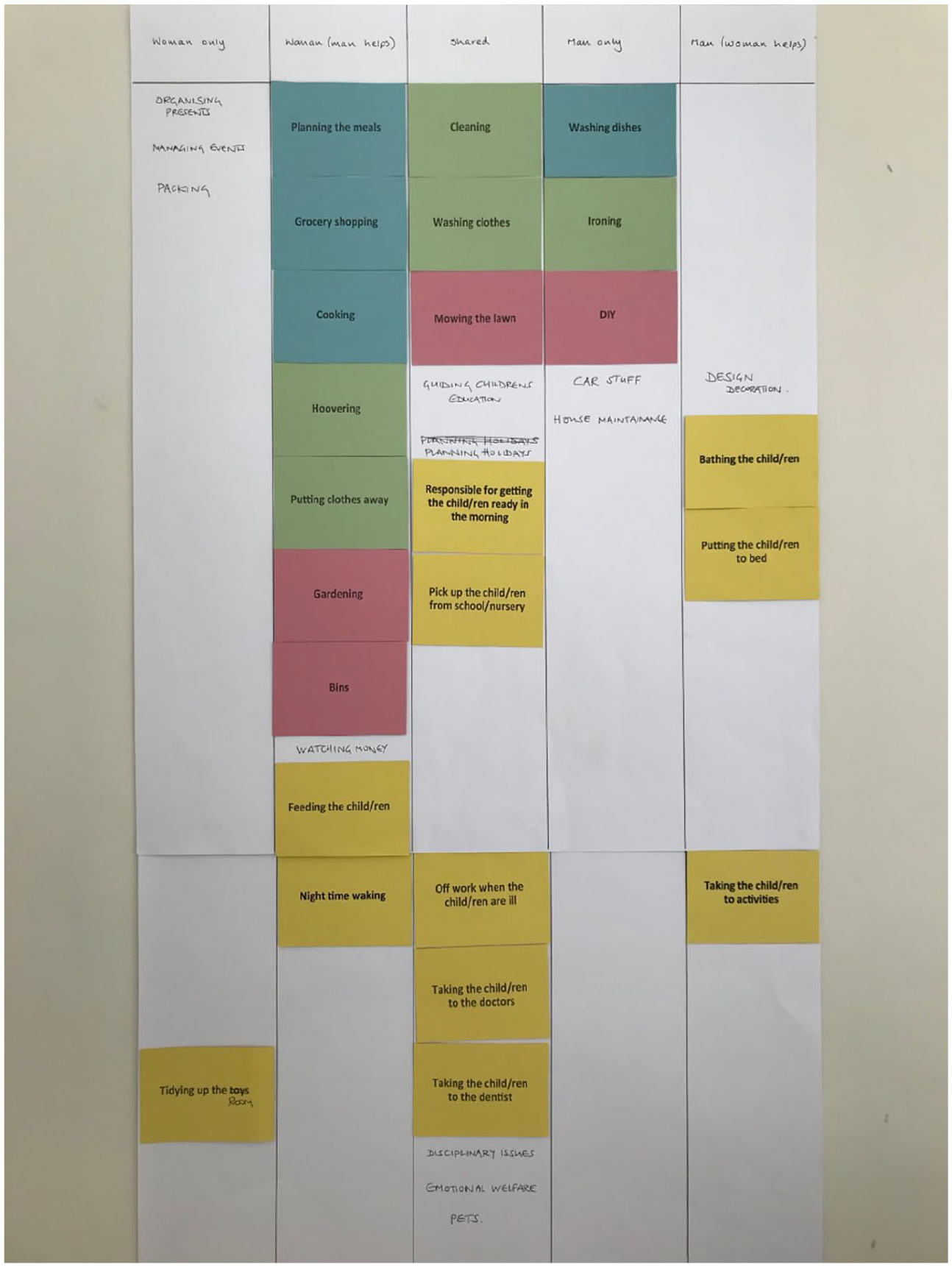
Household Portrait of Victoria and Lee.
This use of additional cards allowed couples to individualise their portraits by adding tasks that were particularly important to their households, or to discard cards denoting tasks that neither of them undertook. Some couples further divided individual tasks, revealing the micro aspects of task accomplishment (Martens, 2012). For example, some of the couples divided ‘washing clothes’ to include who put the wash on, who took the wash out, who pegged out clothes, and who then took them down and folded them. This shows the importance of looking at tasks individually, and in detail, if we are to gain a deeper understanding of how household tasks are divided. A literature search identified only a handful of qualitative studies which examine how couples divide individual household tasks and these all involved food work (Beagan et al., 2008; DeVault, 1994; Martens, 2012). Although time diaries provide an opportunity for couples to record micro tasks, the bulk of research using time diary data does not document tasks in this level of detail. Among some of the most commonly added tasks were ‘shopping for children’s clothes’, ‘holiday planning’, and ‘holiday packing’, showing the importance of measuring tasks which do not necessarily happen every day. The most commonly discarded card was ‘cleaning the car’ as some couples did not clean their car at all or chose to take it to a car wash. These additions attend to the idea that not all households are the same.
Second, and as important, constructing the household portrait encourages participants to discuss the tasks and their distribution in front of the researcher. It encourages couples to debate, discuss, agree, and disagree with each other’s perceptions of who undertakes particular tasks. Their conversations with each other and me included varying understandings of what it means to ‘mostly’ carry out a task, different definitions of the tasks themselves, and the varied criteria which couples draw on to rationalise their perceptions of who does what and why. Although, unlike time diaries, the designated columns in the household portrait do not directly generate information on tasks done as a secondary activity, couples discussions revealed some tasks to be done simultaneously, revealing gendered experiences of time spent undertaking tasks. For example, some of the men expressed enjoyment in washing the car, mowing the lawn, or doing DIY as they did this alone, while listening to the radio or music. In contrast, none of the women described their task accomplishment in terms of leisure, as they often carried out tasks while caring for their children. The household portrait also encourages couples to discuss how their domestic divisions of specific tasks may have changed over the years, making explicit some of the processes through which change may or may not take place. For example, couples identified food shopping as a task they had done together on a weekend prior to having children.
The requirement for couples to agree before placing a card in a designated column meant that the interviews themselves were interactional accomplishments, as couples had to discuss where to place the cards. During these deliberations, couples often talked about how and why they had decided who should do different tasks, especially childcare tasks which were often planned and coordinated to the very last detail alongside partners’ respective work schedules. Deciding where the cards were placed also revealed the non-negotiability of task divisions among some couples and that established practices were not always based on who had the most time. This was implicit in some women’s accounts of repeatedly asking their partners to carry out a task (e.g. planning an evening meal, putting away his clothes) which either was unacknowledged by their partner or met with accusations of ‘nagging’. Every interview involved at least one conflict, with the men and women disagreeing about the frequency of the contribution that they each made to a particular housework or childcare-related task. Twenty-three couples disagreed at least four times in the course of completing the portrait, and two couples disagreed about nearly every task. Disagreements were just as likely to occur over how housework was divided as they were over childcare, although cleaning stood out as a task on which the majority of couples were likely to disagree. This was related to different understandings of what it meant to do a proper job which will be discussed later. Although inconsistencies in couples’ reports on domestic divisions of labour is not new (Press and Townsley, 1998), the data generated through the household portrait shed light on these inconsistencies by making visible the reasoning employed by couples and the criteria they draw on.
The meaning of ‘mostly’
For the couples taking part in the household portrait, disagreements over contributions to domestic tasks were largely the result of a disparity between partners’ individual understandings of what it means to ‘mostly’ undertake a task. Although UK surveys such as Understanding Society ask about who ‘mostly’ undertakes a particular task, I argue that we do not really know how people understand the term. It is not clear how frequently tasks need to be done by either partner to count as ‘mostly’ done by one partner or as ‘mostly’ ‘shared’. If ‘mostly’ is understood on the basis of how frequently a task is done by a member of the couple, then does a partner need to undertake a task 99% of the time to be classified as ‘mostly’ doing the task? How much (or how little) does someone need to contribute to be classified as ‘helping’? Does this imply a 60/40% split or a 70/30% split? Does ‘shared’ suggest that each partner must undertake a task exactly 50% of the time? Research does not provide an answer to these questions, but it is clear from my findings that partners do not agree.
The underlying assumption by some researchers and the majority of the men I interviewed seems to be that how frequently a task is done, or the amount of time it takes, equates to a straightforward representation of the gendered division of labour. This is also the case when participants are asked to complete time diaries or asked how much time they spend on particular tasks in order to ascertain who does more or less. In contrast, my women participants’ understanding of who ‘mostly’ does a task was not just about frequency, but also involved other criteria (discussed below) for ‘counting’ how substantial the contribution was. In my study, completing the household portrait encouraged partners to discuss (or disagree about) their understanding of ‘mostly’. This then determined whether they placed a housework or childcare task in the column for either partner solely doing a task, whether it was ‘shared’ or whether one partner was understood to have a ‘helping’ role.
In the rest of this article, I discuss four distinct criteria that participants adopted to measure their own and their partners’ contributions: temporality, task hierarchy, doing a ‘proper’ job, and management and instruction. These criteria varied by task and they were not always consistently applied; yet every participant in the study drew on at least one of these measures at one time or another in constructing the household portrait. I then consider similarities and differences in the ways the women and men approached the task of completing the household portrait.
Temporality
Partners often used different temporal criteria to make sense of how domestic labour was divided. Women drew on longer temporal frames to justify their claims to the task being undertaken by them, thinking about habits established over months or years, whereas men drew on much shorter and more recent temporal frames, such as their contribution over the last couple of weeks. This suggests that time diaries that take a snapshot of task allocation may fail to capture how the temporal framing underpinning perceptions of domestic divisions of labour is gendered. For instance, when Annabel and Peter discuss which of them washes clothes, Annabel sees it as ‘woman only’, whereas Peter sees it as ‘woman man helps’. 1 Annabel responds by saying to me, ‘Sorry, washing clothes is definitely me – eighteen months ago he didn’t even know how to use the washing machine’. Here, Annabel is drawing on a longer temporal frame to justify her view that mostly the task is hers. They did finally agree that Peter had recently been contributing to the washing and therefore the task was placed in the ‘woman man helps’ column. Had this couple been responding to a survey question of who carries out the task then two contradictory responses would have been given, since our discussion revealed that they were using different temporal criteria on which to base their claims.
Similarly, Sarah states that ‘taking children to activities’ should be in the ‘woman man helps’ column but Mike disagrees, seeing the task as ‘shared’. They finally agree that Mike does ‘share’ taking the children to gymnastics and school discos, so Sarah concedes, saying
No, no it’s definitely shared. A couple of years ago when they were all at gymnastics I used to be running around like goodness knows what.
Again, we see that Sarah’s initial reaction was to draw on her experience of a ‘couple of years ago’, using a longer temporal frame, whereas Mike was focusing on what was happening now. Even if the men had recently undertaken more of the task than they had previously, the majority of the women saw this as a ‘flash in the pan’, which, in their opinion, did not equal the women’s historical contribution, or, they may have assumed, what was likely to happen in future.
Hierarchy of tasks
Understandings of ‘mostly’ were also connected to the meaning of the task to each partner. For the women, some elements of the task were more crucial than others, for instance, as regards food preparation. Some of the women were unlikely to give their partner credit for doing the cooking if he did not cook the evening meal. Some of the women were also reluctant to say the man carried out grocery shopping if he did not do the ‘big shop’, when most of the food was purchased, but did only the ‘top-up’ shops for the ad hoc items that run out during the week, mostly identified as milk and bananas. The women implicitly saw doing the main supermarket shop as more onerous or time-consuming than the men’s top-up shops, but both wanted recognition for their contribution. Will and Rachel are discussing whether to place ‘grocery shopping’ in the shared column, as against one of them merely helping the other:
Grocery shopping. Shared?
I tend to do more though, don’t I?
Hmmm I think you think you do more, but I think it is shared. Like where have I been this morning?
Yeah, you went shopping. I mean I tend to do the bigger shops, on the days when she [daughter] is in nursery, but then you tend to do the milk and banana shops. You know, the top-up shops.
Here, the household portrait allows us to see how the men participants understood their contribution to mean how frequently they go into a shop and buy groceries, whereas the women understood grocery shopping to include different elements, some more important than others. Who did these more ‘important’ elements determined whom the women credited with carrying out the task. Male partners’ assignment of the task was often challenged by the women if they usually had to tell him what to buy or to shoulder the ‘mental work’ of ensuring there was the right food in the house. This supports research that shows the division of domestic responsibility to be strongly gendered (Offer, 2014), while highlighting the complexity of domestic labour. For all the women, tasks were multi-dimensional. This may be because they have overall responsibility for instigating and organising domestic work, and this gives them an overview of what the tasks entail. If men are instructed to carry out particular tasks or only carry out one aspect of the task, they may have a limited understanding of the task as a whole and therefore consider their contribution to the task as evidence of ‘sharing’. This has implications for how we understand the gendered division of labour, as different components of tasks may or may not be undertaken by the same person, may not hold the same meaning or importance to the two individuals, and therefore may not be reported in the same way.
Doing a ‘proper’ job
For most of the women, who ‘mostly’ does a task was also connected to another set of criteria, which was whether a housework or childcare task has been done ‘properly’. For them making sure that it is done properly is linked to who is responsible for it. This was particularly evident when couples were discussing who cleans or who tidies up toys or their child’s bedroom, which all the women instigated and managed:
Define cleaning
Cleaning the bathroom, polishing.
On a weekend [he points to the woman man helps card], in a week [he points to woman only].
When did you last clean the bathroom? Cleaning the bathroom does not just involve putting bleach down the toilet.
OK, but there are more rooms in the house than just the bathroom. You volunteer for the bathroom, I might do the bedrooms or downstairs.
OK, when did you last pick up polish? [Anna places the cleaning card in the woman only column, James agrees].
James draws on frequency to show that he ‘helps’. He sees that he cleans at the weekend, so is helping, but Anna refutes this by listing aspects of the task that he never undertakes, such as polishing or cleaning the bathroom, beyond the use of toilet bleach, in order to defend her assertion that the task is wholly done by her. These are gendered differences in understanding of what it is to ‘clean’, with all the men focusing on how frequently they may undertake a particular task and all the women, again, understanding cleaning to involve a greater number of tasks than their partners do.
Similarly when couples were discussing where to place the task card for ‘tidying up the toys’, there was a gender difference in how this task was understood, with men generally seeing the task as putting toys out of view after the children had gone to bed and women seeing the toys being put away in some sort of order. The women were questioning the men’s claims of ‘helping’ and ‘sharing’ on the grounds that when she does the task it is done ‘properly’, whereas the man only makes a ‘quick job of it’. Men appear to be taking the task at face value, that is, was a toy picked up and moved or was bleach used on the toilet, whereas women invoke a set of criteria that need to be met in order for the task to be seen as accomplished. Some of the women appeared to be keeping a mental record of men’s contributions to the multiple aspects of tasks, evident when they asked their partner ‘when did you last . . .’ when disagreeing with his perception of divisions. Again, this standard setting can be seen to be linked to the women’s overall responsibility for maintaining a clean home, as the majority of the men tended to be instructed to clean rather than taking the initiative themselves.
Management and instruction
The household portrait generates discussion that reveals other aspects of domestic task accomplishment including planning, organising, and allocating tasks. The household portraits made visible the responsibilities these women had, contributing to research (Robertson et al., 2019) that reaffirms the importance of looking at the mental dimensions of task performance, what Mederer (1993) calls women’s ‘invisible orchestration of family work’. In this context, the use of the household portrait provides a more nuanced picture of domestic divisions of labour than surveys or time-use measures alone. For example, women were unlikely to give credit if they had instructed their partner to do a task. This is illustrated in the following discussion between Jess and Ben, who disagree over where to place the ‘putting clothes away’ card:
Putting clothes away. I would say that is me.
I would say that is shared
When did you last put the clothes away?
Yeah but if you leave it by the side of the bed and moan at me long enough then I do put it away. You don’t put my clothes away. Shared.
I would say woman man helps.
No shared, shared.
I disagree
I put my clothes away – just after I have been nagged twenty times.
Why do I need to nag you though?
This task sparked strong disagreement. Ben sees himself as ‘sharing’ this task because he puts his own clothes away, even though Jess puts away their child’s clothes as well as her own. He draws on a masculine discourse of the ‘nagging wife’ and trivialises the task, partly because he sees the task in limited terms. Jess asking rhetorically ‘Why do I need to nag you though?’ reaffirms her responsibility for tasks being done and also shows that having to ask for the task to be done signifies part of the ‘work’ for her. Other women also saw the ‘nagging’, ‘asking’, and ‘reminding’ as work, affecting how they defined who mostly did a task. Ben’s and Jess’ exchange is one of a number of examples in which one partner changes their answer after discussion with their partner. Although there was no particular pattern relating to which partner conceded to the other’s opinion, the exchanges made visible the ways in which domestic tasks are co-constructed. How the couples identified and understood the ‘responsibility’ and ‘management’ of tasks and how much importance they attached to its management was clearly gendered. The majority of the women saw it as important because they were responsible for getting tasks done on time and properly. The responsibility for and management of housework and childcare is time-consuming, but their invisibility as separate tasks may de-legitimise women’s claims that they do more than their partners (Robertson et al., 2019). Responsibility and management are often not recorded in time diaries, since participants may not be able to convert the mental work they involve to so many hours or minutes (Daminger, 2019).
Joking aside: competition for recognition
The household portrait made visible the women’s larger input in the management of and responsibility for tasks, the disparity between the men’s and women’s contributions and the men’s relative power to choose which tasks they could ignore, and which they took on board or ‘shared’. As the quotes above show, couples’ interaction when compiling the household portrait was marked by competition, as each partner sought to have their input recognised, and the resulting tensions were only partly dissipated by jokey remarks. These tensions were connected partly to conflicting normative expectations regarding men’s contribution, which involved both the ideal of the sharing couple and ‘involved’ fatherhood (Dermott and Miller, 2015), and partly to a sense that men were able to choose, without penalty, what to do. On the contrary, some of the women were still affected by the expectation that how well the home was run reflected on them; three of them appeared embarrassed that their contribution fell behind their husband’s, rather than celebrating their more than usually progressive division of labour.
Men’s and women’s attitudes to compiling the household portrait differed from the outset. Some of the men said that they knew, even before looking at the first task card, that they risked being found not to contribute enough and were almost immediately on the defensive. From the start 10 of the men joked, saying things like, ‘This is where we get to fight’ or asking me, ‘Does this normally turn into an argument?’ One man began the household portrait by saying, ‘I am a bit worried about this activity. It is about cleaning isn’t it? How much cleaning someone does, and this is going to cause conflict’. Behind this apparent jokiness may be genuine uneasiness. There may have been arguments in the past, or ongoing arguments, about how tasks are divided, and the women may have had to compromise. This was certainly alluded to during the interviews, as some of the couples jokingly referred to me as a ‘marriage counsellor’ or ‘therapist’. Equally, the men might have felt uneasy because they assumed that, as a woman, I would inevitably take their wives’ side. In contrast, none of the women commented on the likelihood that completing the household portrait would cause tension or argument, indicating that, unlike the men, they did not anticipate being criticised for their lack of contribution. Or, again, my gender may have positioned me as an ally; this was implicit when a woman struggling to get her partner to agree with her point of view effectively asked me to take sides, drawing on what was assumed to be women’s shared perspective on domestic life.
In the competitive jostling, both partners were eager to demonstrate that they did tasks. For some of the women, this was connected to normative understandings of their gendered role and the moral understanding that they should not only be caring for their children but also making a home, while all the men certainly recognised the moral force of the idea of the sharing couple and the expectation that they should also be carrying out tasks or, at least, sharing them. As the task cards were placed in the columns denoting who undertook each task, it became clear whether the overall burden was weighted towards one member of the couple or the other or whether they were ‘shared’. The method sometimes became a game of who could amass the most cards in their column. For example, when a task card was placed in the ‘man only’ or ‘man woman helps’ column, the men would draw on a masculine discourse of winning, stating ‘That’s me. Did I get a point?’ or asking me ‘So who won? Did I win?’ The men who joked in this way tended to have household portraits which were more heavily weighted towards their partner carrying out the majority of tasks. It was clear that they felt uncomfortable and joking in this way trivialised their lack of contribution. Other men were not only keen to demonstrate that they were ‘helping’ or ‘sharing’ but were eager to show that they contributed more than their partners:
Nothing in the ‘woman only’ pile here!
Taking the children to activities that would be me because I’m doing the days in the week. Oh, I have a ‘woman only’ because you have never been to a class with her [child] have you? I am the one that takes her to classes and stuff and toddler groups. Yeah, I’m on the board!
. . . .Massively outnumbered though, aren’t you? ‘Woman helps’, ‘man only’!
By presenting themselves as ‘winning’ these men were recognising these divisions as atypical since, to them, they were worthy of special recognition and praise. Having the couple’s domestic life presented visually was a powerful reminder for some partners of the extent of their contribution. The men described household portraits that were weighted towards the woman as ‘pretty bad’, with one man saying that ‘I am trying to justify my existence’, clearly embarrassed by the large of number of task cards in his wife’s column. The men recognised that the women doing most of the tasks was not morally acceptable, acknowledging changing social perceptions of what constitutes appropriate levels of domestic work for a man.
The competition took a different form for the women and was only expressed when a man was amassing more cards in the ‘man only’ column than she had accumulated in the ‘woman only’ column. In these cases, the women would question the accuracy of the emerging picture. Some women in the sample reacted to this by threatening to remove cards, or, in two cases, actually taking cards off their partner’s column. For instance, at the end of the household portrait with Rachel and Will, Rachel moved the ‘washing dishes’ card from ‘man only’ to ‘man woman helps’, explaining,
I am going to have to move washing dishes because I do them in the morning and I do the baby’s in the day. I am trying to make your pile smaller. And on gardening I am going to write that we have a chap because you don’t even do gardening. We have a ‘man only’ gardener, but it’s not you, it’s a gardener. So, I am getting rid of your pile.
Moving these cards equalised Rachel and Will’s respective columns, leading Rachel to say ‘Yeah that is better, isn’t it’? Portraits that showed tasks solely undertaken by the man outweighing those solely undertaken by the woman made some of the women uncomfortable. This may have been because many of the women who worked reduced hours felt compelled to make sure that the portrait reflected an equal distribution, according to the couple’s time availability, because the partner who works more hours can justify fewer contributions to household tasks (Cunningham, 2007). However, it was not only in the cases where the women worked reduced hours that they seemed to feel threatened by there being more tasks in the ‘man only’ than in the ‘woman only’ column. For both partners, there was an expectation that there should be some semblance of equality in the distribution of tasks although, in practice, equality was not always realised.
At the end of the interview, as compared to their men partners, many of the women took great pleasure in being able to see how the portrait provided a visual representation of their own and their partners’ relative contribution to housework and childcare. The women made comments such as ‘Can I take a quick photo?’ For the women there was something powerful about having the domestic tasks they carried out laid out before them and their partner so explicitly. They joked that they would like a copy of the portrait to keep, almost anticipating that their partners might otherwise forget the strength of their contribution. Over half of the women also alluded, in the beginning, to the men seeing themselves as carrying out more domestic tasks than they actually did in practice. The process of creating the household portrait gave the women some ammunition in their struggle to get the men to recognise the major contribution they make to the running of the household. By the time one couple had finished compiling the household portrait, Eleanor responded to her husband’s surprise at how many tasks had been tabulated as ‘woman only’ by saying ‘I told you I would [have more in her column]’. This morning he said [to me] ‘I am going to have a full column. You don’t do anything around the house. I do more than you think’.
This reaffirms that much of what these women did in the household continued to be taken for granted, trivialised, or was invisible, whether this be the actual carrying out of tasks or, when they were not carrying them out, being the one to notice that they needed doing and remaining responsible for their management and completion.
Conclusion
It is important to evaluate the efficacy of methods for measuring how couples divide domestic labour and how creative methodologies can contribute to a more nuanced and textured picture of domestic life. In my study the different criteria men and women adopted for constructing their household portrait, including the partners’ disagreements over how to decide who ‘mostly’ does a task, suggest that quantitative surveys and time-use studies may be papering over some of the difficulties of accurately recording domestic divisions of labour. In contrast, asking couples to complete Doucet’s (1996) household portrait helps to clarify which criteria couples adopt and why.
First, there is the question of interviewing couples separately or together. Most surveys and qualitative studies have sought to get candid answers to questions about partners’ respective input by interviewing them separately. Ironically, however, it seems that if one wants to capture men’s and women’s distinctive criteria for measuring and evaluating domestic work, it may be better to interview couples together, so long as the methodology encourages them to articulate their reasoning and express their disagreements.
Second, the way participants approach the task of completing the household portrait may provide clues as to how they make decisions about domestic labour itself. Using this method also showed ways in which gender was not only constructed through the partners’ interactions with each other during the interview but also through the couple’s interactions with me as the interviewer.
Finally, and more speculatively, there may be links between broad methodological approaches and gendered perspectives on domestic labour. On one hand, there seems to be an affinity between some quantitative research which add up men’s and women’s respective labour input and what seems, in my study, to be men’s eagerness to count how many times they recently went to the supermarket or put bleach down the toilet. Using quantitative measures in this way, while important, may foster an assumption that it is mainly time spent that counts. Qualitative methods may better capture women’s insistence on qualitative distinctions in assessing their own and their partners’ contributions, such as how ‘properly’ a task was done or which aspect of a task was undertaken, which coincides with sociological interest in the gendered division of labour as a question of normative expectations, or of who has the power to decide how much household labour to undertake. Nevertheless, the results of this study, presented in this article, could be used to inform future discussions around how we might further develop both quantitative and qualitative methods to take account of these gendered distinctions in how domestic labour is conceptualised and measured.
Footnotes
Acknowledgements
Thanks to Carol Wolkowitz, Nickie Charles, and the anonymous reviewers for their helpful comments on earlier versions of this paper. Thanks also to the research participants who agreed to be interviewed as part of this study.
Funding
The author(s) received no financial support for the research, authorship, and/or publication of this article.