




Abstract
This article examines the effects of the vertical disintegration of production on airport terminal workers through the theoretical lens of occupational belonging, highlighting themes of sensory and embodied experience, changing dynamics of employment relationships, and new patterns of inclusion and exclusion. The article contributes to efforts to produce nuanced empirical accounts of the dynamics of post-Fordist work, showing how restructuring had the effect of disrupting employment relations and activity rhythms, while nevertheless preserving ‘the airport’ as a symbolic and relational setting in relation to which occupational belonging could be constructed. The article examines how the work of binding people and jobs, previously undertaken by integrated organisations, was taken up by workers themselves through their personal relationships and will to belong. The article highlights the capacity to undertake this work of belonging as a central dynamic of occupational inclusion and exclusion, a capacity which in this empirical context was experienced as being shaped by age and the ability to make use of personal relationships in navigating precarious employment relations. Based on this empirical analysis, the article argues for belonging as a valuable perspective for studies of materiality, symbolic identification and relationality in post-Fordist work.
Keywords
Introduction
The concept of belonging has recently been addressed in a body of sociological literature, most noticeably in the sociology of ethnicity, migration, and citizenship. While belonging has been a key theme of the classical sociological analyses of Tönnies, Durkheim, and Marx (Yuval-Davis, 2006), recent analyses have opened up new perspectives on social relations as processes in which the personal, political, and material are intertwined and contested. In relation to everyday practices, belonging has been analysed as a temporal unfolding of relations with people, places, and histories (Miller, 2003), mediated through the everyday materiality of sensory environments and activity rhythms (Bennett, 2015; May, 2011). Others have drawn attention to the broader politics of belonging, in which patterns of inclusion and exclusion are organised and contested (Pfaff-Czarnecka, 2013; Youkhana, 2015; Yuval-Davis, 2011). Throughout this literature, there is an intent to understand the connections between embodied everyday practice and its conditions of production in contested situations or in relation to marginalised categories.
Thus far, this emergent literature has rarely foregrounded labour issues. In the sociology of work, questions of belonging and its conditions have more often been developed in relation to the concept of occupational community. This literature has focussed on the relation between community and identity, treating the latter as processual, collective, and reproduced through social structures (Mackenzie and Marks, 2019). Occupational identity has been analysed as identification with a self-image formed in relation to occupational value systems, marking the self as part of a group distinct from others (Salaman, 1971; Strangleman, 2012). Work groups, particular workplaces and employers, places including factories, ports and industrial towns, and broader occupational groups have all been distinguished as linchpins of occupational communities (Salaman, 1971; Strangleman, 2001, 2015; Turnbull, 1992). Material and social practices in work processes have also been analysed as being integral to the reproduction of occupational identity and community (Bechky, 2006; Mackenzie et al., 2017; Turnbull, 1992). Through historically contextualised studies, this literature has addressed the complicated relations between collective occupational identities and transformations of work produced by capitalist development, with many accounts pointing to frictions between workers of different generations and categories (Sallaz, 2004; Strangleman, 2012; Turnbull, 1992). Studies have also addressed the role of occupational communities and networks beyond the work through which they were formed, after job loss, and industrial decline (Mackenzie and Marks, 2019; Strangleman, 2001). As belonging is often problematised only when it comes under threat (Yuval-Davis, 2006), in a similar fashion occupational community has in recent decades often been represented through accounts of loss and decline related to industrial work. Among sociological perspectives on work, the framework of occupational community itself seems in danger of being relegated to the past, while perspectives placing more emphasis on individualised reflexivity (such as identity work, see Caza et al., 2018) are in the ascendant.
This article draws on the literature on belonging as one way to revitalise approaches to occupational community and subjectivity under the shifting conditions characteristic of post-Fordist production. While post-Fordism has been deployed as a concept by different schools of thought on the macro-level of political economy (see Amin, 1994; Neilson and Rossiter, 2008), this study is concerned with post-Fordist transformation on a local level, focussing on the dynamics between restructured conditions of labour and their connected formations of affect, subjectivity, and lived experience (Millar, 2017; Muehlebach, 2011). Granting that imaginaries of both ‘Fordism’ and its ‘post-Fordist’ breakdown may take different local forms, this study focus on restructuring and drives towards flexibilisation as providing windows on shifting dynamics of occupational belonging of potentially broader relevance. Flexibilisation transforms labour conditions through the utilisation of practices such as outsourcing arrangements and contingent employment contracts (Davis-Blake and Broschak, 2009; Kalleberg, 2009; Weil, 2014). Flexibilisation is often accompanied by restructuring processes, the impact of which on workers’ well-being has often been found to be negative (De Jong et al., 2016; Eräsaari, 2002; McCann, 2014), although studies have also pointed to mixed outcomes such as the upskilling of jobs alongside increased demands (McCann et al., 2008). Overall, qualitative studies of restructuring have rarely considered issues of occupational community, while the exceptions (e.g. Eräsaari, 2002; McCann, 2014) have usually assumed the organisation to be the site of restructuring. Considering the importance attached to spatial concentration in theories of flexible production (Kalleberg, 2001), it would seem worthwhile to address occupational communities beyond organisations in empirical studies of workers as well.
This article draws on belonging as an ideal analytical framework for investigating the relationship between labour conditions and subjectivity in the restructuring of work, highlighting the relations of belonging developed through work as uncertain achievements subject to transformation, disruption, and struggle. This perspective is applied to an empirical investigation of aviation workers’ experiences of restructuring at Helsinki-Vantaa International Airport. The study focusses on the everyday materialities highlighted by the literature on belonging, showing how it was generated among aviation ground service personnel through the materiality of places and things (Youkhana, 2015), and shared and embodied experiences of the sensory environment and activity rhythms (Bennett, 2015). This everyday material foundation of belonging is examined in relation to changes in the labour process produced by outsourcing and vertical disintegration, which disrupted employment relations while preserving the airport space as a sensory and rhythmic infrastructure in relation to which occupational belonging continued to be constructed. Organisations are contrasted with the spatially and sensorially grounded sense of ‘airport work’ as different bases for occupational belonging. The article examines how outsourcing and vertical disintegration have produced a shift in workers’ relations to airport work as a regime of belonging (Pfaff-Czarnecka, 2013) in which effort is exchanged for recognition. Generational position is shown to be significant both in informing workers’ interpretation of this shift (Sallaz, 2004; Strangleman, 2012) and their capacity to adopt the practices demanded of capable actors (Ketokivi and Meskus, 2015) in a new regime of occupational belonging. Finally, the article considers materiality, symbolic identification, and relationality as aspects of belonging of broad relevance in further studies of post-Fordist work.
The study
The airport at Helsinki-Vantaa serves as the hub for international air travel to and from Finland by multiple airlines, as well as a transfer airport for Finnair’s international route network between Europe and Asia. The operation of these routes depends on ground services provided at the airport, both within the terminal and on runways and ‘ramp’ areas. The provision of these ground services in Europe was opened to market competition by a directive of the European Commission (Directive 96/67/EC), a measure aimed at undoing monopolised provision of these services by major airlines and airports. At Helsinki-Vantaa Airport, the major airlines Finnair and SAS began outsourcing ground services departments in the 2000s. These restructuring operations coincided with repeated lay-offs at both airlines as they adopted strategies in which parts of their ground service operations were defined as ‘non-core’ activities (Finnair, 2009: 9; SAS Group, 2009). In Finland, the aviation ground services union IAU has been embroiled in repeated industrial disputes with both airlines and independent ground service providers regarding lay-offs, labour utilisation practices in vertically disintegrated production, and the demarcation between collective bargaining agreements applicable to aviation ground services and other forms of service work. Restructuring, lay-offs and industrial disputes were particularly intense in 2009 to 2010, when both Finnair and SAS outsourced major parts of their ground service operations. Since then, periodic lay-offs, restructuring of companies, and industrial disputes have continued to occur.
Interview design and analysis were informed by research objectives of seeking to understand the ways in which workers made sense of the restructuring of airport work, how this restructuring had reshaped the relations of occupational belonging in which their identity as workers was made and sustained, and possible differences between workers of different backgrounds in their experiences of restructuring. Interview design and analysis were also methodologically guided by the notion of airport work as a relational setting of relationships, narratives and practices (Somers, 1994: 625–626). Interviews were considered as involving a mutual search for the formulation and communication of meaning related to the interlocutors’ point of view regarding this relational setting (Potter, 2019), and also as attempts to elicit information regarding the practices of workers and employers. Within the interviews, sections related to sense-making involved workers’ paths into airport work, their experiences of restructuring and lay-offs at their workplaces, and their experiences of navigating transitions between employment relationships. This perspective on the interviews was complemented by information elicitation as another mode of investigation, in which issues of interest to the researcher are systematically objectified as research data. This was accomplished through the mapping of employment biographies involving the construction of a chronological listing of employers, jobs, and transitions between jobs for each interviewee.
The dialogue between two methodological perspectives produced valuable insights. Early on during the conduct of interviews, a distinction between older workers originally hired directly by airlines and younger workers more recently hired by subcontracting companies emerged as particularly salient in workers’ understandings of restructuring. This generational gap in sense-making was reflected in differently structured employment biographies between these workers in the interviewed group. The employment biography also served to ensure the systematic addressing of transitions between employment relationships in the interview. In this way, perspectives of sense-making and information elicitation complemented each other in both the conduct and analysis of interviews.
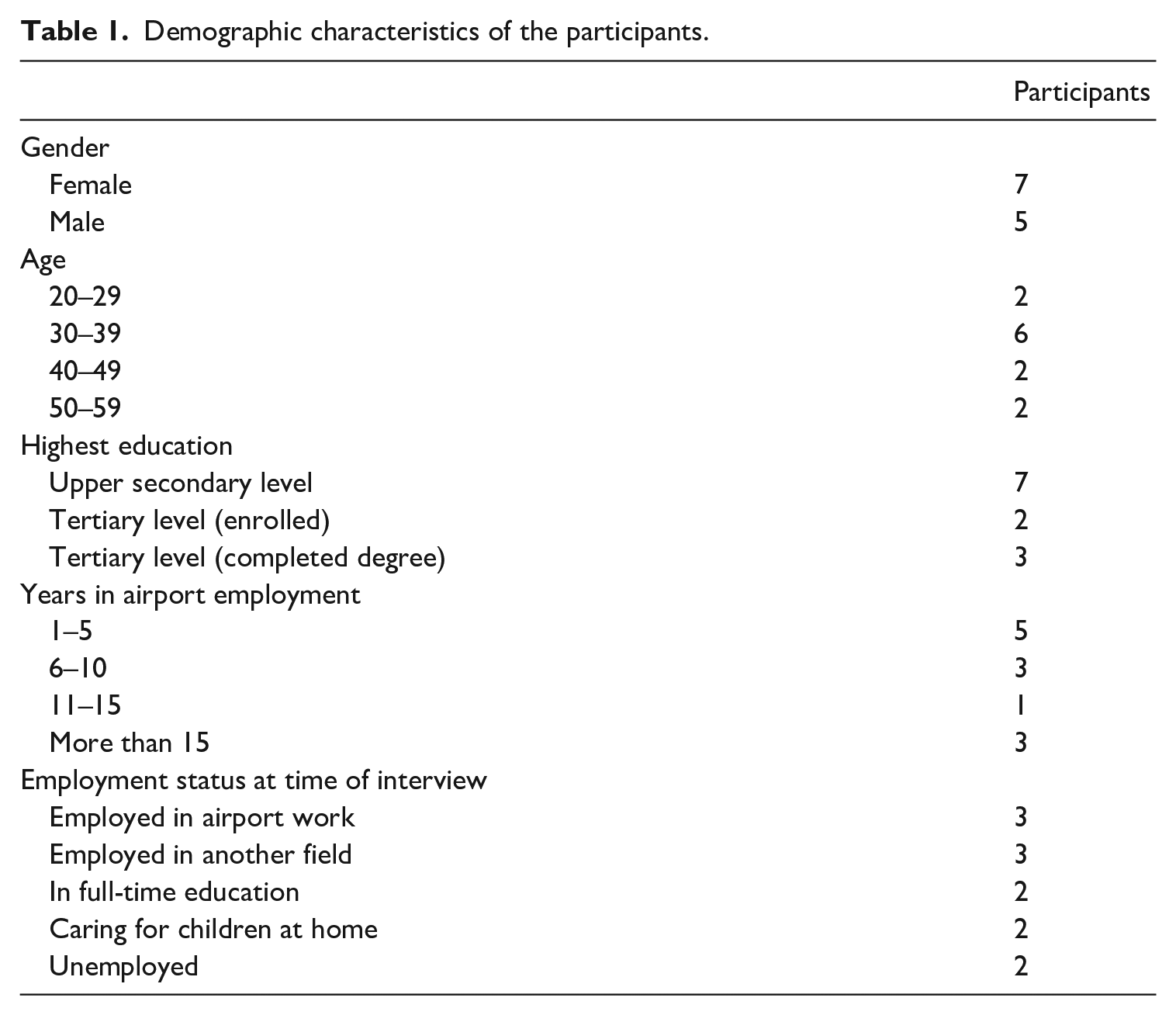
While the study of a small group of workers cannot be generalised to any population, the objective of this study is to describe the dynamics of occupational identity and community uncovered in analysing experiences of restructuring through the perspective of belonging, dynamics which are of potentially broader significance under conditions of vertical disintegration and precarious employment relationships. The workers in this study proved to be a valuable source of information for understanding such dynamics due to the variety in their ages and employment backgrounds (Table 1), combined with shared experiences of the consequences of restructuring and outsourcing. This combination produced different perspectives on the same processes, illuminating the ways in which flexibilisation was remaking the conditions of belonging in a fragmenting occupational community.
Demographic characteristics of the participants.
Airport work as a setting apart: environment and rhythms as the infrastructure of occupational belonging
Theories and empirical investigations of occupational community have repeatedly stressed identification with a group distinct from others as a central precondition for occupational community formation (Mackenzie and Marks, 2019; Salaman, 1971; Strangleman, 2012; Turnbull, 1992). In relation to belonging, Bennett (2015) has highlighted the synchronisation of routines in time and space and immersion into a sensory environment as material foundations on which senses and definitions of belonging may develop. The connection between distinctive occupational identity and materially embodied experiences of work was evident in participants’ depictions of airport work as set apart both from everyday life and other lines of work. In these depictions, a sense of the airport as a particular environment with a distinct atmosphere was constructed in multiple ways. Participants described the need to remain responsive to the 24-hour rhythms of air traffic and its regularly recurring ‘rush hours’. Proficiency in terminal work entailed maintaining awareness of these rhythms, particularly when serving in multitasking roles. At the same time, terminal workers often encountered disturbances produced by unforeseen events, ranging from delayed aircraft to weather events or industrial disputes. In such situations, customer service workers were put under pressure to resolve passengers’ problems while bearing the brunt of their frustration. In these ways, the airport environment itself worked to produce a sense of occupational distinctiveness.
For younger workers in particular, their initial entry into the ‘world’ of airport work was still fresh in their minds. This entry was usually described as a serendipitous outcome of responding to a job advertisement, without any prior connection to the field. Nevertheless, several of the younger workers recalled a sense of excitement on taking up job offers at the airport. As Otto put it, Well I’ve always been interested in the airport. It was pretty sweet to get work there, and even to get it so easily [. . .] Kind of how it’s so different with all the planes so big and all, and still there’s people there too, so it’s not like laying asphalt or something like that [. . .] and there are always these interesting situations.
Sini, another participant recently recruited into airport work, recalled the sense of ‘excitement’ and ‘situations’ as pleasures of the work: Yeah, I really did think that once I graduate I’ll stay on there. It was still so fresh to me, and I wasn’t so exhausted since it wasn’t so hard yet. Or if I was exhausted, it was just on account of getting up for the early shifts [. . .] It was an exciting place, there was always something, it was never dull with the people and situations all the time. I’m the kind of person who needs some excitement or something new [. . .] Just the situations you get there, they make the day more interesting even if they’re not always positive! Especially with the customers.
The literature on belonging has highlighted spaces, sites, and material worlds as generative of attachments (Bennett, 2015; Pfaff-Czarnecka, 2013: 17–18; Youkhana, 2015). Bennett (2015) in particular notes how senses of belonging are developed and articulated in relation to the sensory environments of places and the rhythms of activities. Here the pull of airport work was elaborated through the distinctiveness of its environment and rhythms, produced by the constant movement of aircraft and passengers, as well as the periodic occurrence of disturbances in these rhythms. For these front-line customer service workers, encounters with passengers formed another important aspect of the experience of work. When the smooth flow of airport operations broke down, such encounters could become emotionally charged, and they also provided opportunities for occupational satisfaction and recognition, adding to an energising sense of variety which many participants valued in the work.
In the general sense of being set apart as a world of distinctive environments and rhythms, depictions of work in the terminal resemble other examples of logistics work such as that of railwaymen (Salaman, 1971; Strangleman, 2012) and dockers (Turnbull, 1992). This sense of inhabiting a distinct environment is embodied, as the working body is acted upon and mobilised by a distinctive sensory and rhythmic environment in multiple ways: although ‘exhausted’ by early shifts, it is invigorated while the work is still experienced as ‘fresh’, all the while threatened by potential subjection to monotony. Insofar as such embodied sensory and material experiences were pleasurable, they contributed to a will to belong to airport work, as a hope to ‘stay on’.
Eeva explained how the sense of becoming immersed in a distinct world with its particular demands also produced a sense of togetherness among workers: It was somehow its own world, and when it got tough you hashed it out with your workmates. There was no point trying to explain any of it to your own friends [outside airport work], and that makes for a tight community, and spending a lot of your free time together too.
The excerpt shows how a sense of belonging with others emerges intersubjectively through commonality: the sharing of meaning and experience, in collective practices and representations (Pfaff-Czarnecka, 2013: 14–15). In airport work, this sense of commonality grew out of embodied experiences of environments, rhythms, and encounters with passengers, interpreted as impossible to be shared by outsiders. In this way, the everyday experience of the work and its intersubjective interpretation with colleagues constituted the infrastructure of a distinctive sense of occupational identity and belonging.
In contrast to younger workers recently initiated into the ‘world’ of airport work, the accounts of older airport workers foregrounded rhythms underlying occupational belonging over longer timeframes. Prior to outsourcing, their employment histories had been anchored by the organisational framework of the airline. The past conditions of airport work were portrayed as having a grip, a capacity to grasp workers who initially only arrived for a summer job. Risto recalls his plans for applying to university falling by the wayside after he got his first job on the airport ramp: I had this idea of just going for a summer job and applying to university. Well, I only managed to buy the book for the entrance exams, and I never did take them. I was getting paid every two weeks, and being an adult – it was just like bright lights and so on, and you get stuck in it somehow. [. . .] It was a good job and good time off as well. Seven shifts [of 14 hours] in three weeks and you could swap shifts. It was great actually. There’s nothing like it anymore.
Another participant, Leena, described how her first temporary summer job developed into a career spanning three decades, during which she made several transfers from one position to another within the airline’s internal labour market. While she did not always get the position she sought, she developed a broad understanding of airport operations and their interrelations by serving in a variety of different departments, ranging from customer service to planning and technical tasks. These transfers also unfolded in relation to her family situation. Finding shift work difficult to reconcile with the demands of family life after the birth of her first child, she was able to transfer to a back-office position with regular working hours. Once her children were older, she took the opportunity to apply for a transfer to a customer service position, work which suited her, and which she had always enjoyed. As Leena put it: ‘That airport was my life, our whole family’s life’.
Belonging in the group of older workers which Leena calls ‘airport people’ was produced in relation to particular material practices: the integrated airlines and their internal labour markets, the rhythms of shift work, company events and get-togethers, discount tickets, and spaces shared with other workers. Becoming airport people might thus be summarised as a process of deepening connections with particular people, places, and histories, and of coming to belong and feel ‘at home’ through this process (Miller, 2003). In their careers, the rhythms underlying occupational belonging developed as an interplay of variation in the job through internal transfers, and repetition through practices such as company summer outings and Christmas parties. The practice of offering discounted tickets to airline workers also encouraged the development of intra-airline friendships, as groups of workers might arrange to catch a flight and spend their days off together on an impromptu European trip. This likewise constructed airport people as a category apart, as recounted by Paula: You could leave on the morning flight, go around shopping and so on, and then come back on the evening flight, which was completely unbelievable at that time. My regular friends were always wondering, damn, your life is actually like that?
In these ways, airline workers evolved in their attachments to repetitive practices relating to a specific social space (Yuval-Davis, 2011: 15; see also Somers, 1994: 625–627), which as time unfolded produced a sense of ontological belonging as ‘a way of being-in-the-world’ (Bennett, 2015: 959). The airline employer and its practices served in many ways as a guarantor of this sense of belonging, a role which was fundamentally altered through outsourcing and restructuring.
Unmaking attachments, disrupting rhythms: occupational belonging in vertical disintegration
The accounts of the airport workers in this study were fundamentally shaped in relation to ongoing processes of restructuring in the aviation industry and their experiences of these processes, reflecting ways in which their sense of belonging (or not belonging) developed in relation to ongoing social transformations (May, 2011). In this section, workers’ accounts of the transformation in aviation ground services are examined, showing how older workers in particular experienced restructuring as a disruption, and highlighting belonging as an intersubjective accomplishment dependent on negotiation for its continuation (Bottero, 2010). Central to these workers’ experience of restructuring was a sense of being deprived of their right to belong as recognised members of an occupational group, an everyday example of how the politics of belonging (Pfaff-Czarnecka, 2013; Youkhana, 2015; Yuval-Davis, 2011) shape access to participation in social worlds. Younger workers also constructed their accounts in relation to restructuring, but for them the central narrative was not of loss and displacement, but of disruptive changes in the everyday sensory environments and rhythms that had originally been experienced as attractions in airport work.
The strategies of flexibilisation adopted by airlines were tangibly confronted by the older group of former airline workers through the outsourcing, transfer, or termination of their jobs. As Risto described his experience regarding the outsourcing of his old department, The whole thing was sort of sprung on us. I think it was the day before that I got the phone call saying that there was going to be some kind of briefing the next day. They told us that [two departments] were going to be merged [and outsourced]. [. . .] Well I told them I wanted to go [to another department which would remain part of the airline] and they told me, ‘well, we already decided that you’re going to [the outsourced department]’. So that was that then.
Older workers’ experiences of restructuring were dominated by accounts of encountering relevant decisions as already taken in negotiations above their heads, communicated to them as faits accomplis. The policies of restructuring adopted by airline employers were communicated as decisions regarding outsourcing, acquisitions, and lay-offs, to which workers had to adapt, denying them a part in collective decision-making, which has been identified as a crucial aspect of belonging (May, 2011). These experiences contributed to a new sense of cynicism regarding employers and their conduct (see also McCann, 2014). As Paula reports regarding the sale of their previously outsourced department from one subcontractor to another, I remember it like . . . nothing will ever come close to the shock of being outsourced the first time [from the airline]. But it was like, well, here we go again, so you get used to it that, well, nothing lasts forever.
Even after the shock of outsourcing, former airline workers could still hold onto the belief that their skill, experience, and long years of service would allow them to keep their jobs, even if under changing employers. These hopes were dashed after the subcontractor that employed them closed down their department, with one of the former airline clients insourcing their part of the service. Some former airline workers hoped that they might be hired by the airline to continue to perform these jobs, as Leena attested: ‘they [the airline] hinted that we could apply for positions that were opening up at the airline, but we never got the chance’.
Older workers’ most bitter experiences of mistreatment in restructuring concerned lay-offs, a process which made them feel as if they and their capacities were disposable. As Leena put it, We gave good customer service, we handled everything really well, and we had a nice gang, and it kept us there. We counted it up before the end [. . .] we had over 500 service years between us [. . .] and then this other company comes along; they didn’t care, and they weren’t interested in taking on board all that experience. We were bitter because we knew that job – and wondered what the savings really were in the end.
In their experiences of lay-offs, these experienced former airline workers found that their occupational belonging had been ultimately based on a tenure relation (see also Youkhana, 2015: 16). In the last instance, the employers in relation to whom airline workers’ occupational capacities and identities had been constructed also held the power to cut workers loose from the regime of belonging in which these occupational identities might be enacted. For workers originally employed directly by airlines, this use of force broke with expectations that giving good customer service and knowing the job would secure them in their positions in restructuring, and this was interpreted by them as a breach of reciprocity and an erosion of the values upon which their sense of occupational identity had been founded (see also Strangleman, 2012). As Eeva, one of the younger workers, put it regarding attitudes to the lay-offs, There were the oldest ones who might have worked 20 years for [the airline], thinking that oh, [the airline] will come and save us. Either they didn’t get it or they just didn’t want to get it.
In comparison with the former airline workers, those workers who had initially been recruited into airport work by independent ground-handling service providers gave accounts of restructuring with an emphasis on its everyday effects in particular workplaces. Tomi described how competition was translated into intensified demands for effort in the labour process: Management says that competition is tough, so we have to cut prices. Well the biggest expense is personnel, so that means people had to go. And then it starts to be that we don’t have enough people [. . .] so that you constantly have to be in five places at once. I mean it [the airport] was never the kind of place you could just stand in one place from 8 to 4 but [. . .] you go with the timetables and the planes, and if many are late, then you’ll find a way to be in several places at once. But since it’s already like that due to losing a lot of people, it gets to be too much.
In contrast to older workers’ narratives of occupational decline and devaluation, here the effects of restructuring are portrayed in more local terms, in relation to everyday experiences and practices. Tomi’s account shows how restructuring was felt through the disruption of the rhythms that had constituted both the particularity and pleasures of airport work. These disruptions were often depicted as being specific to a particular period with a particular employer: They were constantly letting people go, experienced people too, and had done so before I arrived. It just got worse and worse, with them [the management] saying ‘Oh it’ll get better’. So what I did, I applied for a job at [a different subcontractor] and just moved right over there.
Most of these younger workers had work experience with multiple companies providing ground-handling services. In evaluating the effects of restructuring, these workers made comparisons with what they knew firsthand, namely working conditions with the various employers they had encountered along their fragmented career trajectories in airport work. While they might be highly critical of particular employers, changes in the industry as a whole were not fateful in the sense of impinging on ‘my life, our whole family’s life’, as Leena put it in the section above. For these workers, navigating transitions between employment relations within airport work constituted a recurring storyline in their accounts. The following section examines these accounts and workers’ experiences of occupational inclusion and exclusion in the vertically disintegrated labour process.
New demands of occupational belonging: navigating employment relations in vertically disintegrated production
For the workers in their 20s and 30s who had recently been recruited by independent ground-handling providers, much of their accounts revolved around the challenges and possibilities of building occupational belonging as part of a ‘sustainable life’ (Strangleman, 2012) in the circumstances of vertically disintegrated production. For this group of workers, the spatial concentration of multiple employers within the terminal buildings of the airport enabled a form of occupational belonging compatible with vertically disintegrated production. This form of occupational belonging was lightly attached to organisations but embedded in and facilitated by personal relationships, through which transitions between precarious employment relations could be navigated. Navigating transitions in this way constituted a central demand in a regime of occupational belonging which workers recognised (Pfaff-Czarnecka, 2013), and in relation to which they were called upon to take up the position of a ‘capable actor’ (Ketokivi and Meskus, 2015). Given the variety in their backgrounds, the workers confronted the struggle to belong from different positions and were informed by different stakes in relation to this regime. Former airline workers with aviation-centric careers encountered the new regime as one of ageist exclusion. For younger workers, who had more education and diverse histories of employment, there was great variation in what airport work represented, corresponding to differences in the need to maintain the will to belong in the face of precarious employment relations.
Jutta describes witnessing six or seven rounds of lay-offs at her first airport employer (a ground service subcontractor) over a period of 8 years. As yet another round of downsizing at her workplace was becoming imminent, she and a co-worker secured a job offer for themselves from another subcontractor, whose manager they had become acquainted with through working in the same airport hall:
How did you come to hear about the jobs at [another subcontractor]?
Yeah, so this [other subcontractor] had offered us positions. It was through Erkki, a guy we already knew. He’d offered us positions and we decided to take up the offer. It was the same salary and conditions but something a bit different and some certainty, so we’d have that job in case we got fired [because of layoffs at their current subcontractor employer].
Insecurity and deteriorating job quality in a particular employment relationship often spurred younger workers to seek better conditions in other jobs within the field of airport work. Through their responses to employers’ practices, workers themselves contributed to the institutionalisation of new patterns of occupational belonging (May, 2011), in this case, the navigation of precarious employment through personal relationships. In the data, transitions from one airport job to another were usually assisted by a connection in the organisation they were joining (11 out of 13 such transitions in the data). This was a phenomenon that participants recognised:
For sure people are networking at the airport, beyond firms. I guess this happens a lot on a broader scale, when people talk and find jobs in the same place as their acquaintances.
Connections helped in various ways, by providing information about available jobs or people to contact, by ‘putting in a good word’ for the applicant in their own organisations, or even by hiring workers directly when they were in a position to do so. As Jutta put it: ‘Everybody’s on the same merry-go-round, all the same people, just in different uniforms’. This practice of networked navigation demonstrates the importance of reciprocity as a dimension of belonging (Pfaff-Czarnecka, 2013: 16). For these younger workers, the normalisation of vertical disintegration had shifted the level on which reciprocity was expected: from employment relations with organisations to the social relationships between workers themselves.
The networked navigation of precarious employment relationships was facilitated by the material and spatial organisation of airport work, which concentrated workers in the area of the airport terminals, producing recurring encounters in which relationships of familiarity might develop:
How did you get that reference [from inside the company] for your first application?
Just by getting to know those people [from other companies] [. . .] because when you share a kitchen, you end up discussing a lot of stuff.
Likewise, the spatial concentration of the work funnelled staff into similar routes in which serendipitous encounters leading to employment opportunities might emerge:
So how did you manage it [switching jobs to another subcontractor]? Just by asking someone at the airport?
Yeah, I was on my way home [from work] on the bus and their recruiter was on the phone with someone they were recruiting, so I went up and asked if they had any openings. I went to the interview and got the job.
Was this recruiter someone you already knew?
No, but I understood from the conversation what it was about.
Hence, the environments and rhythms that in workers’ accounts shaped airport work as a world apart also provided a crucial infrastructure for practices in which occupational belonging was constructed in personal relationships and encounters. The airport as a workplace of multiple employers, shared kitchens, and bus routes produced material conditions in which workers themselves might exercise some agency over the attachments between people and organisations (Youkhana, 2015: 16). For the younger workers, this provided them with some overall employment security in airport work, even as they confronted job insecurity in particular employment relationships. This measure of security was contingent upon the capacity to take action in and through relationships, and in informal interactions. This can be read as one form that the contemporary generalised demand for capable agency (Ehrenberg, 2010; Ketokivi and Meskus, 2015) can take under conditions of production characterised by organisationally precarious employment relationships.
Workers’ relations to this regime of occupational belonging in the making were shaped by their differing attachments elsewhere, as well as their differing capacities to claim occupational recognition in the face of its demands. There was a marked differentiation in the younger workers’ accounts with regard to what airport work represented for them in relation to their life plans. Jutta described her employment at the airport as an ‘extended gap year’ between secondary and tertiary education. On finishing her university degree, she had transitioned from airport work to professional work in the field of her studies. In contrast, Eeva had no tertiary education and 10 years of work experience in another field in the service economy with which she had become disillusioned. She described her relationship to airport work in very different terms: It’s a field where I’d still like to work in the future [. . .] it doesn’t matter to me what I do in it, there’s a lot of interesting work, but the field is nice and I’d like to be able to stay in it.
For her, the sense of belonging to airport work assumed central importance in building a sustainable life, as an opportunity to find new meaning in work, and develop a sense of a capable and recognised occupational identity. In this way, airport employment appeared as a fragile achievement (May, 2011), one which the worker herself was called on to reproduce through both capable action and maintaining the will to belong.
Meanwhile, the former airline workers in this study confronted this new regime of occupational belonging through displacement from airport work and exclusion from enacting occupational identities in the context in which they had been formed and valued. None had any optimism about returning to employment at the airport, even though positions at subcontractors were intermittently available. Leena explicitly connected the difficulties faced by older displaced workers to companies’ practices of cost-cutting: None of us even got an interview. They got the workers they needed in-house [from other departments]. Aged 20 and so on. We [older workers] would have had the age bonuses, which they would have had to match if they had rehired us for similar jobs.
For this group, displacement from airport work demanded a reworking of self-identity, which they struggled with in various ways. Leena, studying for a degree in practical nursing at the time of the interview, was determined not to allow the disappointments of the past to determine her hopes of a future of meaningful work beyond the airport: I never look at those planes flying in the sky anymore. I don’t give a fig what goes on at that airport. [. . .] I was bitter back then, but that’s all in the past. So this is what it is now. There’s no age limit in this; at [one nursing home] I was working with a 73-year-old. Age is not a problem in this. I believe I’ll get a job. This is what I want to do . . . I’m not the kind of homebody that just lies around the house all day.
For Leena, reconstituting her sense of occupational identity meant being prepared to break with both past hopes and disappointments, emphasising her capability to continue to work instead, and to construct belonging in relation to a new occupation, in which she felt her age and experience would be valued rather than discriminated against. Other older workers struggled with making such transitions in situations where moving on appeared to require the acceptance of an unjustly inflicted occupational diminishment. Age and the capacity to forge useful social relationships thus shaped workers’ capacities to navigate transitions in the employment relationships of flexible production, demonstrating how institutionalised patterns of inclusion and exclusion are produced through localised, historically shifting regimes of belonging (Pfaff-Czarnecka, 2013; Youkhana, 2015).
Discussion
The article aimed to show how airport workers’ efforts to build a sustainable life (Strangleman, 2012) were shaped in relation to employers’ drives for flexibilisation through outsourcing arrangements and differentiation between core and auxiliary services. The article argued that analyses of workers’ experiences in such post-Fordist transitions call for sociological frameworks capable of addressing occupational identity as relational, bound up with dynamic assemblages of belonging involving people, places, and practices (May, 2011; Youkhana, 2015). This final section will build on the empirical analysis to highlight materiality, symbolic identification, and relationality as aspects of belonging potentially more broadly useful for analyses of post-Fordist work.
In this study, restructuring and vertical disintegration dissolved a form of occupational belonging founded on lifelong employment relationships within integrated airline organisations. Nevertheless, a broader sense of belonging in the occupational field of airport work continued to be constructed through the sensory atmosphere and activity rhythms of an environment experienced as set apart. Shared spaces, routes, and activity rhythms provided for a material infrastructure of occupational belonging, compensating in part for weakened organisational commitments. This points to material mediations of occupational belonging as a topic for research particularly in situations where organisational commitments towards workers are weak. The material infrastructure of occupational belonging may include shared workspaces as well as channels of information and mutual support, including virtual ones. The importance of access to such infrastructures, and its inequalities, may be heightened when organisations fail to sustain occupational belonging. Studies of freelance and gig workers’ experiences of occupational (dis)belonging might be particularly instructive in this regard.
This study highlighted a contrast between an organisationally supported regime of occupational belonging and a new regime of looser commitments in which workers themselves were called upon to maintain their own occupational belonging. This points to a post-Fordist dynamic in which value-generation relies on the mobilisation of workers’ own will to belong to symbolically valued occupations (see also Walker, 2015). In relation to occupational worlds of symbolic value (such as those of creative work or service work in relation to valued forms of consumption), workers may find themselves taking up the work of sustaining their occupational belonging, providing employers with ready resources of skilled labour which would otherwise have to be developed through institutionalised commitments, such as long-term employment relationships. The contradictions and pressures this demand places on workers in such fields and how these relate to pathologies of work addiction, anxiety, and depression might be studied through the analytical lens of occupational belonging.
The weakening of employers’ commitments to workers highlighted how occupational belonging was relationally sustained. Networks of trusted former co-workers enabled some of the younger workers to effectively navigate transitions between precarious employment relationships. This relational navigation of shifting employment relations appeared in connection with a weakening of the collectives held as significant for occupational belonging, with trusted groups of friends and co-workers gaining in importance in the place of broader occupational communities anchored within organisations. Meanwhile, older workers in this study felt shut out from employment opportunities in the new conditions of vertically disintegrated production. Further research on the relationship between imperatives of networking and occupational belonging might focus on the labour of sustaining belonging through relational agency, the forms the demand of the relationally capable actor takes in different fields, and how these can produce informal patterns of occupational inclusion and exclusion. Another line of inquiry might consider the implications of sustaining occupational belonging through trusted relationships for workers’ collective agency: does particularistic relationality preclude wider collective identification, or are there circumstances in which it might serve collective projects of mobilisation?
Beyond networking imperatives, occupational belonging as a relational perspective might be used in analysing the various groups and categories in relation to which occupational identity is constructed. In addition to co-workers and employers, these may include those on behalf of whom work is performed, particularly in service professions such as care work (see Olakivi, 2018). This study concerned workers in a customer service role, and participants often drew on an ethic of good customer service as an occupational value. Further studies might connect occupational belonging to political projects in which the interests of workers are articulated in relation to the interests of those making use of their services. For such studies, front-line service workers in the public sector caught between entrepreneurial management ideals, austerity measures, and the daily task of delivering needed services form one group whose experiences of occupational belonging might become increasingly socially consequential.
Footnotes
Acknowledgements
The author would like to thank the editors and the anonymous reviewers for their comments, which were very helpful in developing this article for publication.
Correction (June 2024):
This article has been updated with minor grammatical or style corrections since its original publication.
Funding
The author(s) received no financial support for the research, authorship, and/or publication of this article.