




Abstract
The armed forces veterans’ support sector is vast and, some would argue, overprovided for. At a time when some long-established ex-armed forces support organizations appear to be losing members, Armed Forces and Veterans’ Breakfast Clubs (AFVBCs) continue to grow. This article examines this phenomenon arguing that AFVBCs, which are organized in a somewhat unconventional way, provide a safe domain for veterans to reminisce, provide mutual support with others who share the same experiences, and understand military service and the difficulties of transition to civilian life, all factors which contribute to their well-being. They enable the generation and protection of military identity which is highly salient and prominent for many veterans. This study sees AFVBCs as a veteran’s self-help community which can also provide a focus for those responsible for implementing the Armed Forces Covenant. A total of 250 veterans contributed to this study, the majority being those who ‘do well’ in civilian life but with a minority who suffer in some way and need help. Veterans attending AFVBCs come from all branches of the armed forces, some having served for a short period and others a full career. Data were collected face-to-face at one AFVBC, from a study of online testimonials, conversations with the AFVBC founder and an online survey.
Introduction
Many organizations exist to support armed forces veterans and their families including, for example, the Royal British Legion 1 (RBL) SSAFA 2 and the Army Benevolent Fund 3 (ABF). Evidence suggests that many long-established veterans’ associations are finding it difficult to retain members, attributable in part to the reduction of the UK armed forces, from 207,000 (The Guardian, 2018) in the year 2000 to 155,474 in 2018 (House of Commons Library, 2018). A similar decline in numbers has also been observed in the veteran’s charitable sector. For example RBL membership has declined from 342,000 in 2012 (RBL, 2012) to 217,000 in 2016 (RBL, 2016). Recent additions to the veterans support sector are Armed Forces and Veterans’ Breakfast Clubs (AFVBCs). While the RBL’s membership may be decreasing, AFVBCs are increasing, from just one club in 2007 to over 300 clubs by the mid-2019. As an army veteran and member of both the RBL and an AFVBC, I was drawn to look closely at AFVBCs. I wondered what was attracting veterans to join a different type of organization and the growth of AFVBCs was considered worthy of enquiry. The study set out to answer the following question: ‘Why are AFVBCs proving so successful?’
This article contributes to studies of British armed forces veterans by providing an analysis of those who self-identify as veterans and contribute, via their attendance and active participation to the formation of what are effectively informal self-help communities. Those attending AFVBCs attach importance to maintaining a link with their military past. The study drew on data collected using a mixed method approach involving 250 veterans attending AFVBCs.
Evidence shows AFVBCs contribute to meeting the needs of those who, as the literature reveals, express feelings of loss, missing their mates and, for some, of not being understood by civilians (Jolly, 1996). AFVBCs appear to be successful because they reject accepted formal, conventional organizational norms, adopting instead what can best be described as a post-modern ethos. As such, they attract veterans from all branches of the armed forces young and old and of either gender. It is clear many veterans, even if they do not need help or support, do like to maintain some contact and gain enjoyment from their former military identity by attending AFVBCs. It is also clear that some do need help, and it is these ex-service people with whom this study of AFVBCs is concerned.
Background
Many formal UK veterans’ membership organizations adopt a conventional, formal, organizational structure, such as that followed by the RBL. These bodies generally have a President, an elected Chairman, Board of Trustees, a Membership Council, or similar body, with paid administrative staff and several subcommittees. They also often enjoy charitable status and raise funds to finance their activities. RBL members pay a membership fee and belong, generally, to a local branch, with a Chairman, Secretary, and Committee. In this way, most ex-armed forces organizations like the RBL adopt a formal structure. According to Mullins (1993), . . . a formal organisational structure makes possible the application and process of management through which the organisation can be planned, organized, directed and controlled. (p. 301)
In addition to the RBL, all veterans can, if they wish, join veterans’ associations relevant to their armed forces branch. In recent years, the number of veterans’ organizations has increased to the point, some argue, of being problematic. Ashcroft (2014) believes there are too many military charities, saying that 350 charities are equal to one for every 57 people leaving the services. He says that because only 14% of veterans fall into the vulnerable category, there is effectively one charity for every eight service leavers. However, Lt General Sir Andrew Ridgway, chair of the Confederation of Service Charities (Cobseo), disagrees, arguing the following: . . . the diversity of the sector is actually a huge strength, not a weakness because it ensures all the needs of our potential beneficiaries are met. (Sharman, 2014)
The possibility of overprovision was recognized in 2017 when an umbrella organization was established to form ‘Gateway’ – ‘The first point of contact for veterans seeking support’. (Veterans’ Gateway, 2018). Despite the Gateway initiative, Prince Harry, speaking at the 2018 Veterans’ Mental Health Conference, warned military charities to stop competing for publicity and profile, urging them to put veterans’ health above their ‘individual brands . . .’ According to the Prince, veterans with mental health needs come up against a ‘confusing array of support’ (Furness, 2018). Notwithstanding these overprovision arguments, research shows most veterans do not suffer but do well in civilian life. Iversen et al. (2005), for example, found the following: The majority of service leavers do well after leaving and are in full-time employment . . . Only a minority of veterans fare badly after service . . .’ (p. 181)
Lamb (2006) likewise argued that most people leaving the armed forces successfully integrate back into civilian life. These findings, linked to Ashcroft’s (2014) assertion that only 14% of service leavers are in the vulnerable category, beg the question why are AFVBCs so popular?
AFVBCs began in 2007 when a former Royal Engineers soldier, Dereck Hardman, 4 sought help from a former Royal Electrical and Mechanical Engineers mechanic to work on a vehicle he was restoring. Hardman says former army friends would drop in to chat and enjoy a snack. The banter was reminiscent of his army days. The concept of veterans meeting up informally to talk and help each other emerged, leading to the establishment of the first Breakfast Club. Since then, word of mouth and the development of a dedicated website ‘www.afvbc.net’ led to the eventual formation of over 300 AFVBCs, mainly in the UK. The majority of clubs meet once a month, some more often.
The AFVBC name is registered with Companies House, but while AFVBCs are not businesses, Hardman attached great importance to developing a clear vision statement, cognizant perhaps, as argued by Gallo (Conversation with S. Klein at The International Family Enterprise Research Academy (IFERA) meeting at Amsterdam University, April 2000, cited in Astrachan et al., 2002) that as a business grows, entrepreneurs become increasingly removed and distant from employees. Hardman (2017) explains the following: Breakfast Clubs exist simply to facilitate veterans and often serving Armed Forces personnel, meeting face-to-face, in a relaxed, safe, social environment. That’s it . . . they do not exist to raise funds for any national charity, organisation or business. Their primary aim and function . . . [is] to allow veterans to ‘return to the tribe’.
AFVBCs operate independently but are guided by Hardman’s ethos. For overall governance, a small team of volunteer administrators communicates, primarily by email, to disseminate guidance to clubs and maintain Hardman’s informal approach. Anecdotally, absence of detailed regulations has led to disagreements, but this is not explored further here. AFVBCs are run on a no-cost basis with a pub or cafe welcoming the regular custom and making no room charge. Veterans attending pay for their ‘breakfast’ with all monies going to the venue. While some clubs do raise funds for charities, this is not to do with the running of the club. Where some clubs are said to maintain a small ‘kitty’ to finance veterans who are ‘financially challenged’, Hardman advises those clubs holding cash to have a treasurer and open a bank account with more than one authorized signatory, although clubs do not require a ‘committee’ or ‘chairman’, just someone to arrange the venue. The structure of AFVBCs does not fit with Mullins (1993) formal structure theory, and this approach can best be described as unconventional. The AFVBC has a registered trade mark, and branded items are sold online, which helps fund its website.
Hardman admits to being influenced by Sebastian Junger who speaks of veterans, combat experienced or not, continuing to have feelings of loss on returning to civilian life and of not being understood because civilian and military lives are, usually, very different. He says usually because, in Israel, everyone has to spend some time in Israel’s armed forces. On return to civilian life, they rejoin a society which does understand them (Junger, 2014). Similarly after World War II until 1963, most UK families had a relative who had served in the military while completing compulsory national service.
Veterans’ research
Research reveals that while most veterans do well and make a smooth transition to civilian life, some do not. There is a growing literature on veterans who suffer from a variety of social and health issues including homelessness (Dandeker et al., 2006; Higate, 2001); unemployment (Ashcroft, 2014; Humensky et al., 2012); alcoholism, (Murphy and Turgoose, 2019); drugs misuse (Benda, 2005); criminal behaviour (Wainwright et al., 2016); and psychiatric illnesses, including delayed combat disorder symptoms (Stacy et al., 2017). This concentration on those who suffer to some extent ignores Iversen et al.’s (2005) ‘most do well’ findings. Williams et al. (2018) believe there is a paucity of social science research examining veterans’ support experiences. Williams et al. (2018) also found some, especially older, veterans suffer identity challenges turning, for example, to the RBL to construct a ‘modified military self’. As Kenny (2018) observed,
People don’t know how many veterans there are out there, but they need somewhere where they can meet regularly and support each other.
This comment perpetuates what appears to be a belief that all veterans need help, although, in 2018, a UK Government Commons Defence Select Committee report said veterans are not ‘mad, bad or sad’(UK Gov, 2018). Serving military personnel are identifiable to civilian eyes, especially in the media, via the symbols of uniform, headgear, and badges. These symbols form part of a service person’s military identity. Their removal, on discharge, strips away status and identity; they no longer belong to and veterans can no longer return to, or even enter, the locations of their former military lives.
Veterans have to create a new identity which, for some, can be an easy return to their former civilian selves, while for others, transition is more problematic. Herman and Yarwood (2014) believe the military is neither a monolithic nor a homogeneous institution, either in the service personnel it produces or the experiences it offers. From this, it is clear that as there can be no single all-embracing definition of a veteran, their experiences and their needs as civilians will also be different.
The human perspective
In literature, veterans report they miss the camaraderie and ‘banter’ with their mates (Koenig et al., 2014). Another common theme is the feeling that a veteran’s military service is not appreciated. The Falklands War was seen in Britain as a ‘good war’ (Quora, 2017) with returning service personnel receiving flag-waving receptions. Historically, World War II veterans are usually afforded positive attention in the media. However, for some veterans, their military service in such places as Northern Ireland, or the Gulf War, is perhaps less well understood. The realization that service for one’s country is not appreciated can be demoralizing, as evidenced by the experiences of returning Vietnam War veterans (Cutter, 2013). Burnell et al. (2006), researching Falklands War veterans, highlighted the role of ‘social support’ via families, veterans’ associations, and comradeship; noting while wives and families provide physical, practical, and emotional support, combat trauma discussion was avoided; veterans’ associations aided reconciliation of traumatic memories through narrative reminiscing. Burnell et al.’s (2006) work studied high-level post-conflict post traumatic stress disorder (PTSD) suffering, and it is clear from literature that how the public perceived veterans’ military service was important to them.
Themes emerging from literature centre on identity, belonging, loneliness and loss, and not being understood; it was considered important to explore these in the context of this study.
Theoretical perspective
From an ontological perspective, the social reality of people as social actors has implications for this research. Being a veteran is a construct located in the subconscious, feeding on experiences, memories, beliefs, views, and identities. The notion of being an ex-armed forces person in civilian life may be located within similar views of social realities in the way individuals view themselves as ‘different’ because they have had experiences others have not. This study was concerned with social relations, with exploring veterans’ views of how the relatively new concept of AFVBCs helped, influenced, or was important to them with respect, for example, to problems of identity and loss of comradeship. Epistemologically, this study attempted to understand what veterans believed to be their social situation and living environment could begin to explain AFVBCs’ success. This article draws on a number of symbolic interactionist theories to help examine veterans’ views of how their self-concept and identity, as a product of how others see them, and a sense of who they are within society, contribute to their need to belong to veterans’ organizations.
Mead (1934) believed man is continually manipulating his environment in the way he uses it and, any time the social order changes, there is a necessary change in one’s self and a reconstruction through the mind. Symbolic interactionism theory suggests dependency of human behaviour on social interactions and surroundings. Humans tend to live or do certain things on the basis of other people’s thinking. Mead posited that human thought, experience, and conduct are essentially social; humans need one another and must live among each other, learning to anticipate what others are doing by reading gestures as signs of the behaviour of others. In this way, individuals initiate and direct their own actions while, at the same time, being influenced by the attitudes and expectations of others (Mead, 1934). As Blumer, a student of Mead, argued, society must be seen as an ongoing process of interaction with actors constantly adjusting and interpreting situations (Blumer, 1962). Thus, the individual forms a ‘reflective’ conception of his or her self. Cooley (1902) formulated the ‘looking-glass self’ theory that contains two fundamental proposals. First, self-consciousness involves continually monitoring ‘self’ from the point of view of others. As Cooley (1902) put it, we ‘live in the minds of others without knowing it’. Second, living in the minds of others imaginatively gives rise to real and intensely powerful emotions of either pride or shame. Generally, Blumer (1962) argues, in most social interactions, people know in advance how other people will act, even though there is no precise procedure followed each and every time. Symbolic interactionism has, to some extent, become a diversified cluster of approaches, and this study, while acknowledging the presence of many other strands, focuses around Mead’s views on communication and language and their relevance to veterans, as they negotiate different environments, language, and ways of communicating in the different arenas of military and civilian life.
Social identity theory is also relevant in this study since, as Haralambos and Holborn (2000) point out, while it is individuals who have identities, identity can also relate to the social groups to which they belong and identify with. Jenkins (1996) believes social identity is our understanding of who we are and who other people are. It involves comparing people’s similarities and differences, aligning self with those who are similar and distinguishable from those considered different. For Jenkins (1996), social identity is about meanings which are socially constructed rather than being essential differences between people. According to Tajfel and Turner (1986), people seek a good, positive social identity which they enjoy and like. In the armed forces, individual identity is subsumed via imposition of military culture, and differences are in part delineated through rank, military discipline, and military law (see for example Cooper et al., 2016). The enforced nature of armed forces culture moulds civilians into their military roles; they adopt a different identity. However, within the military’s hierarchical structure, soldiers in a tank crew, for example, through social interaction become an identifiable group with a social identity. Social interaction effectively leads to identification of differences; junior ranks see senior ranks as ‘different’, while commissioned officers are also seen as different. There is a bias towards those sharing the same social identity. In Roccas and Brewer’s (2002) theory of social identity complexity, people are said to look kindly and positively on those within their in-group, while those not in the group may be viewed less positively; this comparison is based on personal value priorities and the level of tolerance to out-group members. Brewer (2007), however, challenges the assumption on in-group bias, arguing that in-group attachment is independent of out-groups and relies more on belonging and distinctiveness. This notion of in-groups is reflected in the bonds which form in military service, especially in war and which continue into civilian life.
Who a veteran is, within society, reflects Hall and du Gay’s (1992) argument that societies can be characterized by the existence of fragmented identities whereby people do not have a single conception of who they are but possess ‘several’ sometimes contradictory or unresolved identities. Akerlof and Kranton (2004) likewise argue that each of these identities can be more or less salient at any moment in time and the relative salience of different identities can significantly affect behaviour. Brenner et al. (2014) say identity theory invokes two distinct but related concepts, identity salience and prominence. In social psychology, identity salience refers to the likelihood that a given identity will be active across situations, while prominence (or importance) according to Rosenberg (1979) relates to the significance of a particular aspect such as identity and whether it is a major or minor part of ‘self’.
The next section explains the study’s organization and methodology.
Methods
A mixed, largely qualitative, interpretivist approach was adopted, based on the assumption that the thoughts, ideas, and feelings of veterans who attend AFVBCs would provide the richest source of data; in other words, to recognize individuals’ lives as ex-armed forces, people in a civilian world seek to understand their ‘reality’.
Permissions were gained to access AFVBC online Facebook pages and for data to be collected in person at Breakfast Clubs. An ethical approach was observed throughout, and words used both face-to-face and in research instruments gained informed consent and ensured participants were aware of how their input would be used, including assurances of confidentiality and anonymity.
In 2017, when this study began, there were 190 geographically spread AFVBCs with attendance rates estimated at between 10 and 30 people per session. To gain access to all these would have proved problematic; therefore, the study employed direct observation and conversation sessions at just one AFVBC (face-to-face phase), then studying veterans’ online testimonials (testimonial phase) before conducting an online survey using EasyQuest, a proprietary software package (the survey phase).
Recruitment to the face-to-face phase was opportunistic with the selection criteria being that participants had to be veterans, had attended an AFVBC, and were willing to be interviewed. The aim was to gain a feel for AFVBCs and those who attended them, rather than to document individual stories. This took account of the need for an ethical stance and due regard for confidentiality, an approach that Crowhurst and Kennedy-Macfoy (2013) describe as a ‘less formalized agreement’. The revelation that I was also a veteran enabled me to establish empathy and defray any fears of a covert approach.
Examination of the AFVBC website revealed a facility for veterans to upload personal testimonials which provided useful ‘documentary evidence’. However, using online testimonials raised questions of validity (Hart, 2005). These data might be considered less valid than those obtained more directly, but the 57 testimonials examined included the club name of each individual testimonial author, indicating the writer had been authenticated by the relevant site administrator and was considered valid. Attention was paid to the club location for each testimonial to negate the risk of double counting. The testimonials were edited into a single document and then analysed using Bruner’s (1991) functional approach which emphasizes how the writers interpreted their individual experiences as veterans. Praise for AFVBCs emerged as the most frequently occurring topic of testimonials along with the notion of veterans ‘missing their mates’.
Thirty-two veterans participated in the face-to-face phase. Veterans mainly wore casual clothes but veteran’s badges and military insignia were worn by 30% of those attending. These sessions took place in the restaurant area of a public house on six Saturday mornings (weeks 1–6). Conversations with eight small groups were conducted during a period of approximately 12 hours in total. By week 6, when a total of 32 different observations had been completed and no new information was being gathered, data saturation was deemed to have been reached. Notes from the face-to-face phase were examined and were found to closely match those found in literature, namely, identity, belonging, loneliness and loss, and not being understood by civilians. A consistent theme was that of missing aspects of military life.
To ensure data validity and to avoid overlap, care was taken to ensure face-to-face participants did not also complete the online survey. This was easily achieved since all the face-to-face sessions took place in the same club and no survey invitation was sent to this location. Survey participants also provided their club location, enabling this aspect to be controlled.
Themes emerging from the first two phases informed the development of topics for the two-part survey. The first part collected demographic data, while the second asked open-ended questions on the participant’s views on AFVBCs, other veterans’ organizations, and what they missed about military service.
The survey was enabled via an invitation to administrators of AFVBC Facebook pages who uploaded it with an individualized coded link to the survey document. Completed surveys were automatically uploaded to the EasyQuest server, and I was able to view each return as it arrived. After 10 days, the rate of returns dwindled, and the survey link was terminated at 218 returns. Analysed data in this study are drawn from these 218 participants, plus the face-to-face participants, and are further supplemented by interviews with the AFVBC founder 5 and one AFVBC administrator.
The next section presents relevant extracts from the data. Selected participant quotes are followed by an arbitrary code with additional explanatory comments in square parenthesis.
Analysis
Demographic data from part one of the survey were summed, examined, and compared before being presented here as totals or percentages. Of the 218 survey participants, 185 were male and 33 were female. One hundred forty were married, 23 single, 16 were widowed, 36 divorced, while 3 preferred not to say. Participants’ ages covered a spectrum from 25 to over 65 years, with the majority between the age of 45 and 54 years (see Table 1).
Survey participants’ age.

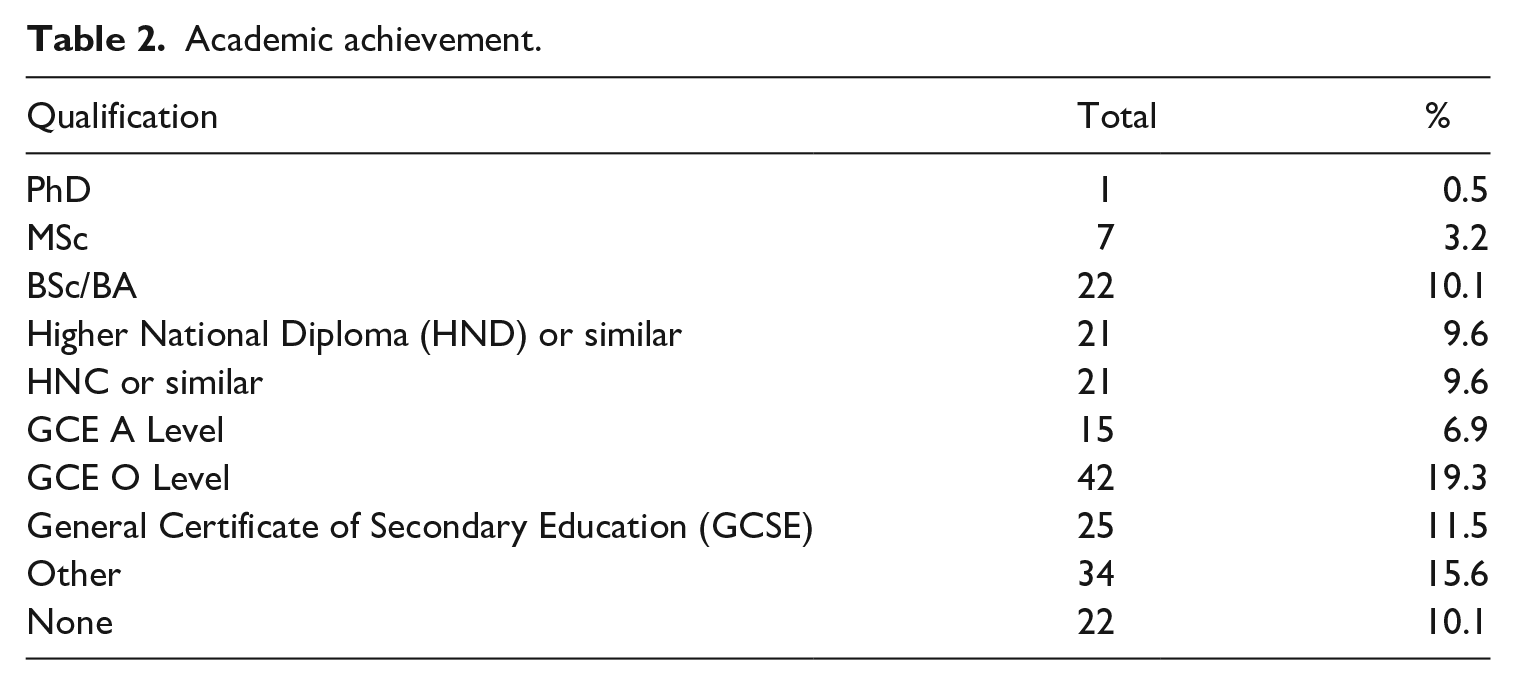
Participants were asked to indicate their highest level of academic achievement. The largest grouping (19.3%) was for those with the General Certificate of Education: Ordinary Level (GCE O Level), while ‘other’ (15.6%) includes a mix of City and Guilds and armed forces qualifications. A total of 10% claimed to have no academic qualifications (see Table 2).
Academic achievement.
Participants were asked about their employment status. Seventy-three participants were retired, 101 were working full time with 22 working part time. Eighteen were unemployed and five preferred not to say. No one was still serving in the armed forces. Excluding the retired and those who preferred not to say, the 18 unemployed represents 14.6% of this group which is less than the national average (21.2%) of those classed as economically inactive (Office for National Statistics (ONS), 2017).
Participants were asked a series of questions about their service experience.
Which Branch of the Armed Forces?
The majority of the participants, 163 (74%), had served in the army, with 36 (16.6%) in the Royal Air Force and 19 (8.7%) in the Royal Navy. One hundred eighty-eight participants had served as Regulars (full time) and 20 had served only with Reserve forces, while 10 had served in both the Regulars and the Reserves. None had completed national service. In terms of length of service, 24 were early service leavers – those leaving before completing their 3- to 4.5-year minimum service contracts. Ninety-nine had served between 5 and 12 years, while a similar number, 95, had served between 13 and 22 years or more.
Across all the three branches of the UK armed forces, rank structure is similar with a distinction between ‘commissioned officers’ and ‘other ranks’. ‘Other ranks’ have rank titles steeped in history relevant to their specific service, and these have been grouped into three categories for this study: warrant officers (WOs) and senior non-commissioned officers (SNCOs); junior non-commissioned officers (JNCOs), and those at the lower or entry level such as seaman for the Royal Navy, private (or similar) for the Army, and airman for the Royal Air Force. There were just nine commissioned officers (4.1%), whereas the ratio of officers to other ranks in the regular armed forces is approximately 17% (ONS, 2014). The majority of the participants had achieved WO/NCO or JNCO status with just fewer than 30% achieving no further promotion (see Table 3).
Distribution by former rank.
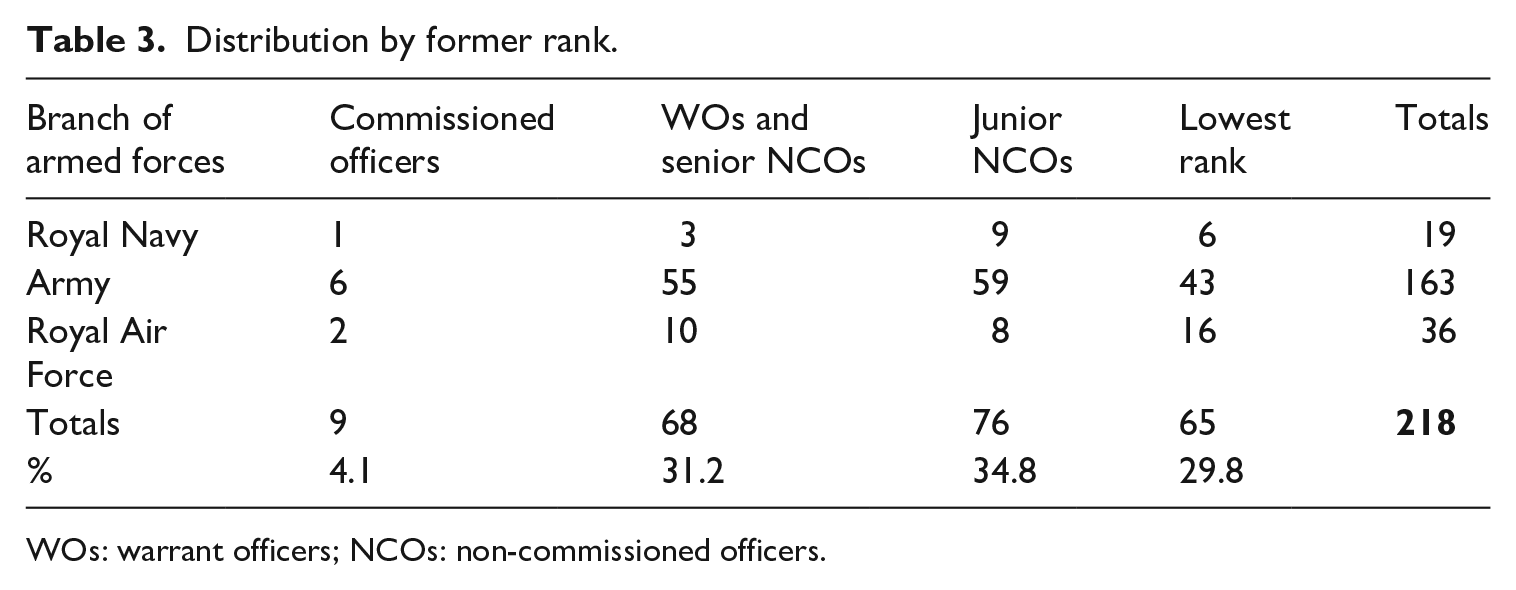
WOs: warrant officers; NCOs: non-commissioned officers.
The number of years since veterans had been discharged, up to and including 2017, ranged from 0 years for one veteran, who had served for 17 years leaving the army in 2017, to 60 years relating to an army veteran who had served for 3 years, before being discharged in 1954.
Participants were asked if they had been in combat (combat not being further defined). A total of 108 of 218 respondents answered ‘Yes’ and 109 answered ‘No’, with 1 not responding. Three of those with Northern Ireland experience added ‘Yes, if you include Northern Ireland’ Operational deployments, for those who had experienced combat, ranged from the Malayan Emergency in 1948 to Afghanistan in 2014. Other areas of operations included Cyprus, Indonesia, Aden, The Falklands, Balkans, Iraq, and Sierra Leone. Sixty-six respondents had served in Northern Ireland, with stories of witnessing comrades being killed or injured. Two respondents qualified their ‘Yes’ answer by explaining that they had served in Afghanistan, spending the whole tour within the confines of a fortified army base and did not ‘go out on patrol’ adding ‘. . . but I still got the medal’. Similar remarks reflect a degree of honesty with some stating they were ‘ex-armed forces’ or ‘ex-army’ and they believed, real veterans had fought in World War II. How operational deployments were referred to varied widely from simply, I was in Afghanistan’ (A038) to use of operational code names such as ‘I was part of Op Herrick. [Afghanistan] (A116)
The use of operational names by participants face-to-face was occasionally accompanied by a quizzical look as if the veteran was trying to determine if I knew what the terms Op Banner (Northern Ireland) or Op Telic (Iraq)) meant.
Why are AFVBCs proving so successful when other, similar support organizations appear to be losing members?
Responses to open ended questions in part two of the survey data were examined systematically, employing Schreier’s (2012) method of qualitative content analysis, whereby each part of the data, that is in any way relevant to the research question, is assigned to categories of a coding frame. This was an iterative process where the data were looked at several times and the categories were further refined leading to descriptions, interpretations, and a level of understanding which was considered sound.
Participants were asked what they missed the most about serving. Common responses being ‘missing my mates’, ‘missing the service family’, ‘missing being part of something important’, or similar phrases. Data were examined and compared across several variables. However, in comparing age, gender, marital status, length of service, service branch, rank, distance in years from discharge, and respondents’ comments, with respect to what they missed about the armed forces, consistently referred to ‘missing their mates’ and ‘belonging to the armed forces family’ with some additional remarks including the following: I miss the free travel and flights with Crab Air in the 70s [an irreverent reference to the RAF]. (054)
A comment possibly reflecting the availability of generous perks, in what was then [1970s] a much bigger army.
The same interrogation was made of the data comparing remarks from those who had been in combat with those who had not. No difference was found, with respect to what they missed but with additional remarks such as the following: I miss the excitement. (A200) [Had seen combat]
Participants were asked if they belonged to any other veterans’ organizations as well as AFVBCs. Of the 218 survey respondents, 157 (72%) with an average age of 56 years belonged to one or more veterans’ organizations with 34 belonging to just one. Seven were members of Royal Navy vessel associations. Fifty-six belong to army regimental or similar organizations. Nineteen were members of the RAF association and 56 (with an average age of 78) were members of the RBL.
Participants were then asked if they had anything else to say about AFVBCs. A recurring theme was that of not being understood. Responses were re-examined to look again for any differences between those who had not experienced combat and those who had. Participant (A092) had not experienced combat and said the following:
At a Breakfast club is the only way I can talk with people who understand me.
While participant (A089) who had experienced combat said with respect to his view on other organizations that he was a member of the RAF Association: . . . don’t go as it’s boring and is run by civvies who don’t get it. (A089)
Two veterans, who had experienced combat, mentioned suffering from PTSD, while two others reported suffering mental health problems: I suffer with PTSD & running a breakfast club as a Veteran for Veterans gives me the feeling of being back where life is organized & secure. Outside this, I am frightful, angry & mistrusting toward anyone who has never been in the forces. (A111) It works because there is no committee and everyone is equal. (A128)
Most responses reflected little or no difference in views between those who had experienced combat and those who had not.
Findings and discussion
A total of six themes emerged from the data: organizational informality; belonging; identity of self; loneliness and loss, including missing service friends; not being understood; and a yearning for aspects of military life, which AFVBCs appear to meet in a meaningful and practical way. These themes reflect those found in literature and emerged, albeit with the use of different words, at all phases of the study.
While many participants found membership of the more formal veterans’ organizations to be overbureaucratic, 72% clearly felt it important to belong to something related to their military service, reinforcing Jolly’s (1996) view that their military identity never really leaves them. However, the strong liking for AFVBC informality, especially the absence of a committee and rules, is at odds with Williams et al’.s (2018) argument that older veterans seek to construct a modified military self via membership of the highly regulated RBL. So while there was a strong desire for participants to belong, this is probably more in the sense of being identified as a veteran by simply socializing with other veterans, rather than ‘signing up’ to a membership organization and having to, perhaps, take on tasks and responsibilities and follow rules inherent within formalized organizations.
Using Mead’s (1934) human interaction view, participants involving themselves actively in AFVBCs are creating their own social environment as well as being shaped by it. For some individual ex-service men or women, self-identifying as a veteran is for them of great importance and attendance at an AFVBC helps to create, generate, and perpetuate these self-help communities as well as protecting and reinforcing, for them, a highly salient and prominent identity. By surrounding themselves with others who share and value this identity, they feel they belong, are accepted, understood, and valued.
Many participants spoke of being able to reconstruct their much missed military selves and being back with the familiar world of military comradeship: It’s like returning to military life, the banter, the comradeship . . . I suffered some serious problems . . . I felt I had nothing to live for . . . now have everything to live for. (A016)
Social interaction via language is considered important to this study, especially its use in humour. As participant (A020) remarked, [Being at an AFVBC is] an oasis of banter that you simply can’t get from civvies as they never quite get military humour.
To be understood was clearly an important aspect, and veterans felt that this was only possible through dialogue with other veterans. However, while participants were keen to identify as veterans belonging to and being part of an AFVBC, there was no strong evidence of general intolerance towards ‘civilians’, supporting Brewer’s (2007) argument that in-group allegiance is independent of the out-group ‘other’. Despite the fact that veterans are also civilians, phrases like ‘Civvies just don’t understand’ were used several times by participants and occur frequently in literature (Demers, 2011), reflecting the notion that veterans do like to reminisce about their military life, but probably only with people who will understand them; inevitably, this will be other service people or veterans. Junger (2014) says when veterans meet and talk, they feel they have ‘returned to the tribe’, to people who understand them. For Haber (2006), reminiscence is not just the simple recall of memories in conversation, but a structured, systematic process deliberately implemented with willing participants. Clearly then, there is a value in reminiscing, and as participant (A012) puts it,
You turn up, buy breakfast and talk rubbish for two hours . . . No one pries,(sic) . . . you just chat. It’s like therapy but more fun.
Many participants evidently suffer from loneliness, missing the feeling of belonging and the support of colleagues experienced when serving. The words ‘community’ and ‘belonging’ appeared frequently in participants’ narratives, and are considered important in the context of veterans’ well-being. Sherlock (2002) argues that a sense of community matters because community is constructed through narratives of place and lifestyle. She stresses the importance of social networks in which face-to-face interaction, a sense of inclusiveness fostered by recognition, good natured gossip, and shared socializing are key components of the sense of belonging (Sherlock, 2002).
Albertson et al. (2017) speak of comradeship and mutual resilience as the implicit strengths of the ‘veteran community’, while Demers (2011) stresses the importance of community in assisting soldiers to reintegrate back into civilian society. Participants clearly appreciate the community spirit which they enjoy and heaped praise on AFVBC organizers: It’s a lovely feeling to be back amongst like-minded people . . . These clubs are a true lifeline for people, thanks to all who run them and long may they run. (A014)
[Name] thought he was alone. . .with the breakfast club, you’re never alone . . .
Breakfast clubs are so important to all veterans, it’s a community . . . (A024)
These participants’ remarks reflect the views of Linley and Warren (2019), which emphasize the therapeutic benefits of mutual aid via social networks. Taylor (2019) describes the notion of ‘communal being-ness’ fostered by shared experiences of place and lifestyle and generated via narratives, which ‘keep alive’ fondly remembered aspects of former work and play environments. However, while place can be important with respect to belonging, for veterans attending an AFVBC, the location of Breakfast Clubs is important in the sense of their being convenient and easily accessible. It is the place to which they go to meet with like-minded others to generate that sense of belonging to what Sherlock (2002) describes as an ‘inclusive collective identity’.
Just 15 veterans (6.8%) spoke directly about serious personal problems, while 12 veterans (5.5%) related stories of other veterans with problems, who had been encouraged to attend and had then been directed to those providing relevant support. Some participants spoke of feeling nervous at the prospect of meeting up with other veterans and needed help to attend an AFVBC. Participants who had initially experienced difficulty related how initial feelings of self-consciousness had dissipated, as they found themselves being accepted as a veteran ‘among friends’. Viewed through the lens of Blumer’s (1962) interpretation theory, identification of self as a veteran among veterans was clearly evidenced in subtle and nuanced symbols and behaviours. Participants spoke of recognizing regimental ties and badges and being able to more easily open up and converse. In language use, references to military equipment, nicknames for remote military bases, and derogatory terms for different branches of the armed forces enabled veterans to reflectively reinforce their identities, evoking Cooley’s (1902) notion of imaginatively living in the minds of others.
While many organizations exist to help those who do struggle, as well as those who may have experienced a relatively easy transition back to civilian life, it is clear there remains for many a yearning for certain aspects of military life, particularly, comradeship and the feeling of belonging. The absence of these can make it hard for veterans to re-connect even with their families and former civilian friends. Veterans participating in AFVBCs speak of the need to be with people who are like them: people who understand them and their experiences. Opportunities to converse with other veterans, to re-create the feelings of camaraderie many say they miss, exist in many ex-service organizations, but the need to formally ‘join’ such organizations may be one of the reasons some are losing members, and their informality is possibly a contributor to the success of AFVBCs.
Conclusion
This study of veterans attending AFVBCs in 2017–2018 sought to determine why they appear to be so successful when similar organizations are losing members. Participants were veterans of all branches of the armed forces, most were in employment and a majority had gained secondary school-level education. Participants were mainly ‘other ranks’ rather than commissioned officers, with most having served in the army. The almost complete absence of commissioned officers attending AFVBCs is interesting and considered worthy of further enquiry. Some participants had seen combat and others not, but nothing was found to discriminate between the two. There was no evidence to suggest people are leaving the RBL (and other organizations) in favour of AFVBCs. So while, as Herman and Yarwood (2014) believe, the armed forces do not produce an easily described single ‘type’ of veteran, for many, their former military identities with opportunities to return to it easily though reminiscing at an AFVBC, plays a salient and prominent role in their well-being.
It is clear that veterans’ expressions of ‘missing their mates’ is a real, if not necessarily a serious issue, and the existence of AFVBCs greatly assists them in regaining the sense of belonging they enjoyed while serving and gaining comfort through acceptance. Being understood is also strongly evidenced with the use of commonly shared language, especially jargon, contributing to meaningful reminiscing which, to quote several participants, ‘a civvie just wouldn’t understand’.
From the data, the small number of veterans actually in need reflects Ashcroft’s (2014) assertion that only a small percentage is vulnerable. Clearly, AFVBCs do provide an important facility which is popular and well supported, providing Kenny’s (2018) ‘. . . somewhere to go . . .’ and Sherlock’s (2002) notion of ‘belonging’.
The history of AFVBCs indicates there was no attempt to duplicate existing provision but rather to establish an easily accessible facility. A small number of participants were also RBL members and viewed AFVBCs as different and not as a competitor. The informal management of AFVBCs is probably an attraction for veterans, whether vulnerable or not, and it will be interesting to see if this informal approach will stand the test of time. The regularity of AFVBC meetings in a set location enhances accessibility for both veterans and representatives of related agencies, providing a means of direct first contact for those seeking help. The relatively small participant group cannot claim to be representative of the veteran population generally and the findings cannot be readily generalized. This study will be of interest to those responsible for implementing the Armed Forces Covenant 4 at a local level. In the meantime, more formally structured organizations might like to take note of the positive remarks made by veterans who view the AFVBC model as a shining example of how some of their needs are being met in what are, effectively, self-help veteran’s communities.
Footnotes
Funding
The author(s) received no financial support for the research, authorship, and/or publication of this article.
