




Abstract
Unpaid labour is an important element of how precarity has been theorised. It is also an issue that is often seen as endemic to cultural and creative work. Questions as to the role of unpaid work, including but not limited to unpaid internships, have become central to understanding how the social exclusiveness of many cultural and creative jobs is reinforced through their precarity. This article uses survey and interview data to outline the differing experiences of unpaid labour in cultural jobs. It contrasts the meaning of ‘free’ work over the life courses of a range of creative workers, showing how it is stratified by social class, age, and career stage. By exploring the stratification of unpaid work as a form of precariousness in cultural jobs, and of who describes their experiences of unpaid work as benign, the article offers new empirical evidence for those challenging the negative impacts of precarious working conditions.
Introduction
Forms of unpaid or ‘free’ labour across the cultural and creative industries (CCIs) are a well-established topic of academic, public, and policy concern. There are currently high-profile interventions in a range of cultural sectors, including visual arts (A-N, 2016) and acting (Equity, 2016), and various policy frameworks (Arts Council England (ACE), 2011) designed to address the prevalence of unpaid work in these sectors. This is against the backdrop of a broader social concern about social mobility and access to professions, of which unpaid labour is seen as a key barrier. This is particularly true with regard to unpaid internships (De Peuter et al., 2015; De Vries, 2014).
In this article, we build on existing research (Mears, 2015; Randle et al., 2015; Siebert and Wilson, 2013; Umney and Kretsos, 2013), using the CCIs to engage with broader questions about contemporary work. Specifically, we explore precariousness and insecurity in the CCIs by demonstrating how experiences of unpaid labour differ according to people’s social class, age, and career stage. Unpaid work is one element of what scholars such as Standing (2011) argue is a move to an economic and social system based on more precarious forms of work. We first outline our field of creative work, before discussing the meaning of precariousness and the importance of unpaid labour to this phenomenon.
Cultural work is often seen as a blueprint for the sort of precarious work that has been emerging in other, traditionally high-status and secure, professions (McRobbie, 2016; Ross, 2010). While there is extensive scholarship critical of the precariousness of the cultural sector, there has been less attention to the distribution and stratification of unpaid work, beyond the important insight that many of the less affluent are excluded from unpaid labour (Perlin, 2011). Here we offer two insights. First, people’s experiences of unpaid labour are mainly based on career stage and age. Second, and more significantly, we show that the stratification of unpaid work by career stage and age is further stratified among new entrants to creative work. While all aspirational CCI workers see unpaid work as an inevitable first step on the way to future, paid, employment, there are striking differences in how this is received between people from different backgrounds. Those from affluent backgrounds describe creative work in the language of self-expression and creative freedom, finding autonomy in particular forms of creative work. These accounts are absent in those without the resources that affluent social origins afford. This latter group are most likely to describe their experiences of unpaid work as exploitative with little sense of autonomy, while knowing the most ‘beneficial’ forms, such as the unpaid internship in London, were closed to them. Thus, we conclude that the stratification of unpaid work according to social origin means that unpaid work is experienced as creative freedom for those with resources; for the rest it is exploitation.
The analysis agrees with McRobbie’s (2016) highlighting of the class dynamics of precarious cultural work, and further suggests the need for attention to class inequalities in future research on unpaid labour precariousness. Moreover, these class dynamics are important in understanding how middle class professions engage in the sorts of precarious working practices that are associated with working class occupations. Demonstrating the social distribution of benign accounts of unpaid work, and thus the stratification of unpaid work as a form of precariousness, challenges meritocratic narratives of the cultural sector.
Cultural work, pay, and precariousness
Cultural work is often seen as an exemplar of precariousness. Unpaid or free work stands out as a core characteristic. The relationship between occupations in the CCIs and precariousness is partially a result of the structures of CCIs, partially of the blurring of work and life in creative vocations, and partially of broader social and economic changes associated with CCI policy.
While the literature on both CCIs, and the specific dynamics of work within CCIs, is vast, the boundaries of what constitutes working in the CCIs are less clear than in other occupational sectors. First, there are questions of which occupations and industries are included. The official UK classification has changed over time (Campbell et al., 2019), most notably with the inclusion and exclusion of IT.
Second, however, there are questions of what ‘counts’ as work within even ‘core creative’ jobs, such as artists, musicians, and actors. Do we include someone who describes themselves as a musician and has received occasional pay for performance, but whose main paid work is as a clerk? Do we include someone who has described themselves as a photographer for a year, but has not had any paid work in that time?
This issue is highlighted in different ways by both Duffy (2018) and Morgan and Nelligan (2018). Duffy focuses on aspiring fashion bloggers, a group including people who never received payment for their work, with the hoped-for monetisation never arriving; nonetheless, these participants thought of themselves as creative workers. The boundaries around work were often fuzzy: participants would attend events for which they were not being paid – not-quite-leisure events – to raise their profiles in the hope of leveraging further work. Participants recognised these events as work, albeit unpaid. By contrast, Morgan and Nelligan’s participants were mostly paid for their work, but in a wide range of different roles; their precariousness was characterised by a mandated flexibility, unable to develop as specialists in individual roles as a Taylorist account of work might imply.
Here, we distinguish by labour contract: between those who are freelancers – including both those who are paid for their work beforehand, such as being cast in a production and being paid for time on stage, and those who are paid for their work retrospectively, such as selling a painting – and those who have a longer term arrangement (c.f. Gerber, 2017 on differing forms of employment status for artists). Within contract types, we distinguish between those who are in fixed-term and permanent roles, and those whose contracts describe part-time and full-time hours, while recognising that the hours people work are rarely limited to those for which they are paid.
These contractual differences accompany different occupational cultures, and different experiences of work and inequalities. Recent work has sought to apply historical (Banks, 2017), gender (Conor et al., 2015), class (O’Brien et al., 2016), and race (Saha, 2016) lenses to questions of cultural occupations. There has recently been significant academic interest in specific areas of CCI work. These include media (Hesmondhalgh and Baker, 2011), arts management (Dubois, 2016), ICT (Gill, 2002, 2010), fashion (McRobbie, 2016), screenwriting (Conor, 2014), and advertising (Koppman, 2016), to name a few examples. Alongside issues associated with working conditions, research has focused on the dynamics of ‘getting in’ and ‘getting on’ in CCIs, exploring barriers of class (Eikhof and Warhurst, 2012; Friedman et al., 2017; Randle et al., 2015), education (e.g. Allen, 2014; Banks and Oakley, 2015; Bull, 2014; Scharff, 2015; Siebert and Wilson, 2013), and social networks (Nelligan, 2015). While what it means to ‘get in’ and ‘get on’ vary – in some fields, the focus is on getting a job and getting promoted, while in others it consists of working in high-status projects – precariousness can be seen as an essential characteristic of creative work across the board.
Curtin and Sanson’s (2016) collection is a good example of this, treating the connection between creative work and precariousness as axiomatic. While many non-creative jobs are as precarious as creative jobs (McRobbie, 2016), particularly for women, people of colour, and migrants, the attachment of precariousness to creative jobs makes them an important site for exploring the concept more generally, in the context of occupations usually associated with the professions.
McRobbie (2016) argues the organisation of creative work, particularly its gendered aspects, stands as an inappropriate blueprint. Weaker employment protections, insecure contractual relationships, deskilling and deprofessionalisation, were all seen to be sweeping economy and society in modernity (see also Morgan and Nelligan, 2018).
It is useful to explore the links between unpaid work and precariousness. In an overview of the meaning of precariousness, Standing (2014) sets out the characteristics of those living with precarious conditions. For Standing, precariousness is defined by unstable labour conditions, a lack of occupational narrative, high levels of unremunerated work (including work preparation and retraining), high levels of education relative to their jobs, low levels of non-wage benefits such as holiday or sickness pay, high levels of debt and associated financial uncertainty, and a reconfigured form of citizenship rights with regard to access to both benefits and public services (Standing, 2014: 10). Meanwhile, in their study of freelance web journalists in Paris and New York, and workers in Boston, Vallas and Christin (2018) explore precariousness as a development of Foucault’s (2008) understanding of human capital, with the individual actor as an economic enterprise in their own right, with increasing governmental power resting on arrangements premised on the workers in question representing homo economicus.
Although moves towards codifying precariousness as an underlying common characteristic of a social class have been subject to debate and critique (see Paret, 2016 for a summary of recent discussions), and the differences between Northern and Southern global experiences of precariousness are important (McRobbie, 2016; Scully, 2016), it is clear that there is much in precariousness that chimes with contemporary creative work.
However, there are also characteristics of the ‘ideal type’ precarious worker that do not fit. Often cultural jobs exhibit strong senses of occupational and vocational identity, whether specialised work in film or television, or the more general sense of self and identity that derives from working as an actor or an artist. The role of education is also important; for Standing, one thing common to members of the precariat is the disconnect between their educational qualifications and their working conditions, with a feeling that they were promised something not delivered. However, for those cultural workers who also went through vocational training, such as an art school or a conservatoire, there is a stronger homology between one’s identity, reinforced through professional training, and their work, however exploitative or irregular (Scharff, 2018).
Creative workers are therefore not over-educated for their jobs; rather, their jobs are under-remunerated relative to other jobs demanding similar levels of education. In addition, the lens of precariousness as a unifying force for the emergence of a potential new social class may draw attention away from important variations of the social distribution of this phenomenon within occupations. These are most notably along the axis of more traditional forms of class, as understood as social and economic origin, and age or career stage.
With these notes of caution in mind, we can turn to a definition of precariousness more specific to the CCIs. De Peuter, building on scholars such as Gill and Pratt (2008) and McRobbie (2016), has done much to develop the idea of precariousness vis-à-vis creative work. He understands precariousness as ‘existential, financial, and social insecurity exacerbated by the flexiblisation of labour associated with post-Fordism. Freelancing, contract work, solo self-employment, temporary work, and part-time jobs are among its paradigmatic employment arrangements’ (De Peuter, 2014: 32), with specific elements of passionate work and exploitation (drawing on McRobbie, 2016), low pay and internships (drawing on Ross, 2010 and Perlin, 2011), and being ‘always on’ (Gill, 2010). Here the question of pay, or lack thereof, is central to understanding the meaning of precariousness in creative jobs.
In this context, we note Fast et al.’s (2016) critique of free labour being used indiscriminately, because ‘pushing the like button on Facebook is a different form of free labor than being deeply involved in the development of a new electronic game’ (p. 965) and that the ambiguity of the free labor concept no doubt contributes to its scholarly appeal, as it pinpoints the fact that a lot of labor performed in relation to media commodities (e.g. films, games, novels, music, TV shows, and news) is done for free (i.e. without monetary compensation).
We distinguish forms of free work in two ways. The first is whether people are working for free in settings where other people are being paid for their work, such as undertaking unpaid internships in the hope of being paid in the future. This can be distinguished from people working for free where nobody else in the (direct) organisation is being paid, such as uploading vlogs to YouTube (with the caveat that money might be made for Google), or participating in an unsuccessful profit share. The second is how proactively people have opted into free work: distinguishing (first) volunteering and pro bono work, for which remuneration is not the goal, from (second) free work that otherwise resembles paid work, with the hope of payment in the future. This echoes Morgan and Nelligan (2018), who describe their participants’ belief that the work they are doing for free will lead to eventual paid work.
Rather than adopt Fast et al.’s ideal types, we aim to add empirical support to their theorisation, by showing how unpaid work is experienced and narrated differently by different categories of CCI workers. We show how the relationship between precarious and unpaid work is socially distributed.
Here, we draw on a recent empirical study by Percival and Hesmondhalgh (2014). In their survey work, they found differences in attitudes towards free or unpaid labour between film and television workers. Moreover, they contrasted those who were established, long-standing workers who had a negative view of unpaid work, and newcomers to both sectors who were either more ambivalent or more willing to highlight the benefits of unpaid labour. Crucially, for the purposes of our analysis, they ground the differences in age and career stage in the ‘acceptance on the part of young workers of what they feel to be an inevitability’ (Percival and Hesmondhalgh, 2014: 197). This acceptance is related to the identification of the non-financial benefits of unpaid labour, contrasted with older and more established workers’ resistance and critiques of the practice.
From this study, and literatures on CCIs and precarity we have reviewed, we derive two research questions. The first is: to what extent is working in CCI occupations precarious? We answer this question by using the example of unpaid labour. Second, is unpaid labour, and thus precariousness, in CCIs socially stratified? We answer this question by highlighting, through survey data, how unpaid labour, or working for free, is seemingly endemic to working life in CCIs, although experience of different forms of working for free is socially stratified. We then use interview data to show how unpaid labour is stratified by class, age and career stage, and suggest that while precariousness may be a common aspect of CCI occupations, its experience and effects are unequally distributed. This answer points to the need to think about strategies for challenging core elements of precariousness, such as unpaid work, when senior, influential social groups experience it as benign or even beneficial.
Methods
We present data from a mixed methods study, involving survey data and follow-up interviews with respondents. Survey data were collected over the period 21 September–20 October 2015, through an online survey hosted by the Guardian newspaper’s website under the headline ‘Do you work in the arts, culture, or creative industries? Take our survey on diversity in the sector’. Links to the survey were heavily promoted on social media, including tweets from organisations representing workers in a range of cultural industries, such as Equity and the Musicians’ Union. The survey consisted of questions on respondents’ creative work, their sources of income and outgoings, their attitudes towards the sector(s), their social network, and relevant demographics. The total sample size was 2540, of which an estimated 53 were duplicates; these were identified on the basis of identical responses to free text fields and, where free text fields were not used, when age, browser, and postcode coincided identically. Almost all respondents (98%) were based in the United Kingdom.
A consequence of the recruitment method is that this is a non-representative sample for inference to the broader population of people working in the CCIs. What the survey does offer is some sense of quantitative data underlying face-to-face interviews: what respondents said in a web form about whether they had been paid for all of the hours they had worked in the past month can be compared with how they describe their experience of work in an interview setting. Moreover, the prevalence of reported unpaid work could be expected to be indicative, as potential respondents were not told that the survey was about unpaid work, there is no reason to think that responses were affected by topic salience.
Respondents to the survey were asked two separate sets of questions about unpaid labour. The first set were around lifetime unpaid labour, while a later question about the number of hours they had worked in the preceding month on their creative work was followed up with a question about whether they had been paid for all of those hours.
Following the question ‘Have you ever worked without pay?’, those who responded positively were asked whether they had ever worked without pay in any of the following settings:
unpaid internship;
where others were earning money, for example, as unpaid labour;
where nobody was earning money, for example, as part of a profit share or development project;
time promoting/developing your profile (e.g. website, headshots);
other.
A large number of responses to the ‘other’ category described working for more hours than they were paid, several explicitly using the phrase ‘unpaid overtime’, while others referred to time spent on projects that did not lead to sales or successful bids, others to pro bono work, and so on.
While the definition of unpaid labour is therefore left broad, the first two categories denote relatively clear instances of the type of exploitative unpaid labour described earlier, with the latter two being more ambiguous.
This combination of questions, then, informs us about a range of different varieties of unpaid labour in creative work, from some types that are endemic across many professional jobs such as working beyond contracted hours, to clear examples of exploitation such as unpaid internships. We focus here on whether respondents have ever worked for free, whether they have ever done an unpaid internship, and whether they were paid for all the hours they worked in the last month.
The section ‘Survey results’ describes how responses to these questions vary across some relevant demographic groups: age group, disability, ethnic group, gender, and social class origin. It also compares different sectors of the CCIs.
While most of the demographic definitions are clear, it is important to explain how we observed social class origin. Respondents were asked to think back to when they were around 14, and asked what kind of work the main income earner in their household did in their main job, from a list of possible categories (see Cabinet Office, 2018: section 4.4). Here, we have grouped responses into five categories: senior manager, traditional professional, middle/junior manager, modern professional, and all other categories grouped together into NS-SEC categories III–VII.
Following the survey, 237 participants were interviewed for about an hour over a mixture of Skype, telephone, and face to face; interviews were audio recorded. Participants were asked about their background and trajectory into their creative work, their influences, their work history and current work, reflections on success, social class and other barriers, and their own cultural tastes and interests.
Working for free formed a dedicated sub-section of the interview schedule, interviewers asking variations on the question ‘do you ever have to work for free?’. In many cases this was unnecessary, as most interviewees independently discussed working without pay during the course of the interview.
Precarity and CCIs: is everyone working for free?
Figures 1–3 report the fractions of people who responded that they had worked for free in ways the questions asked: for example, Figure 1 shows the fractions of people who have ever worked for free. These are broken down in two ways: first, by relevant demographic factors; second, the overall sample of 2497 survey responses (in blue) is compared with the sample of 237 interviewees (in orange).
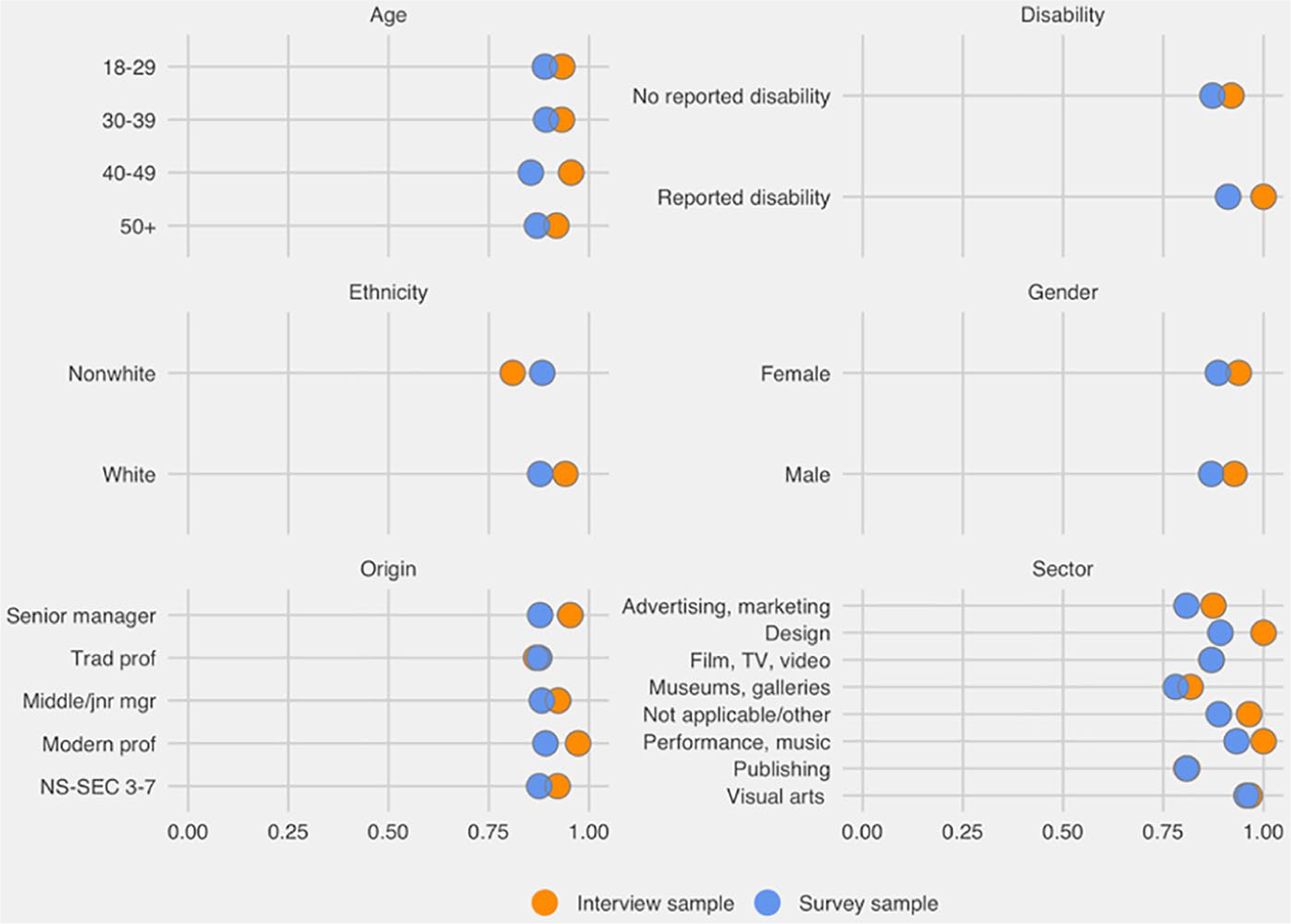
Respondents having ever worked without pay.
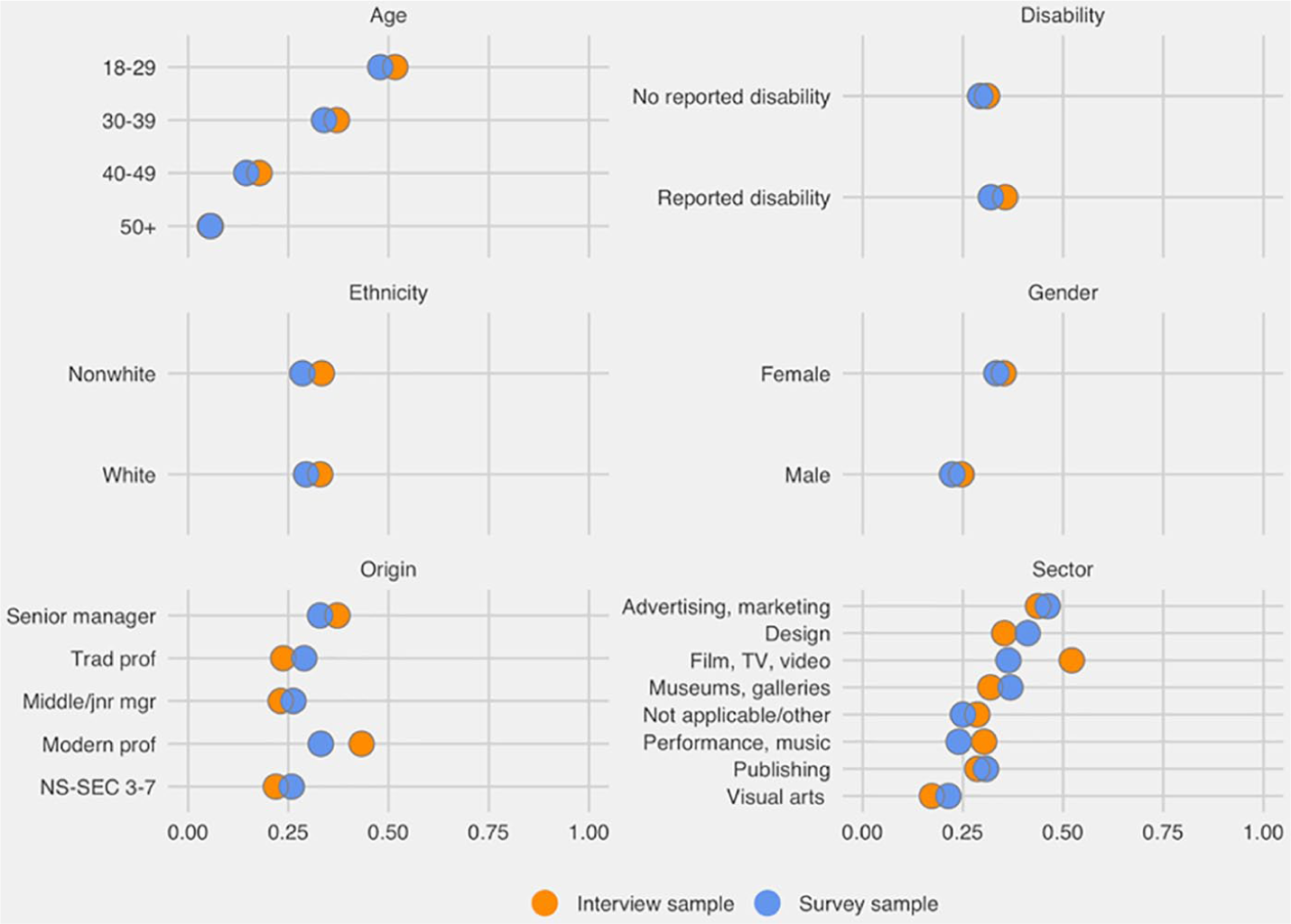
Respondents ever having done unpaid internships.
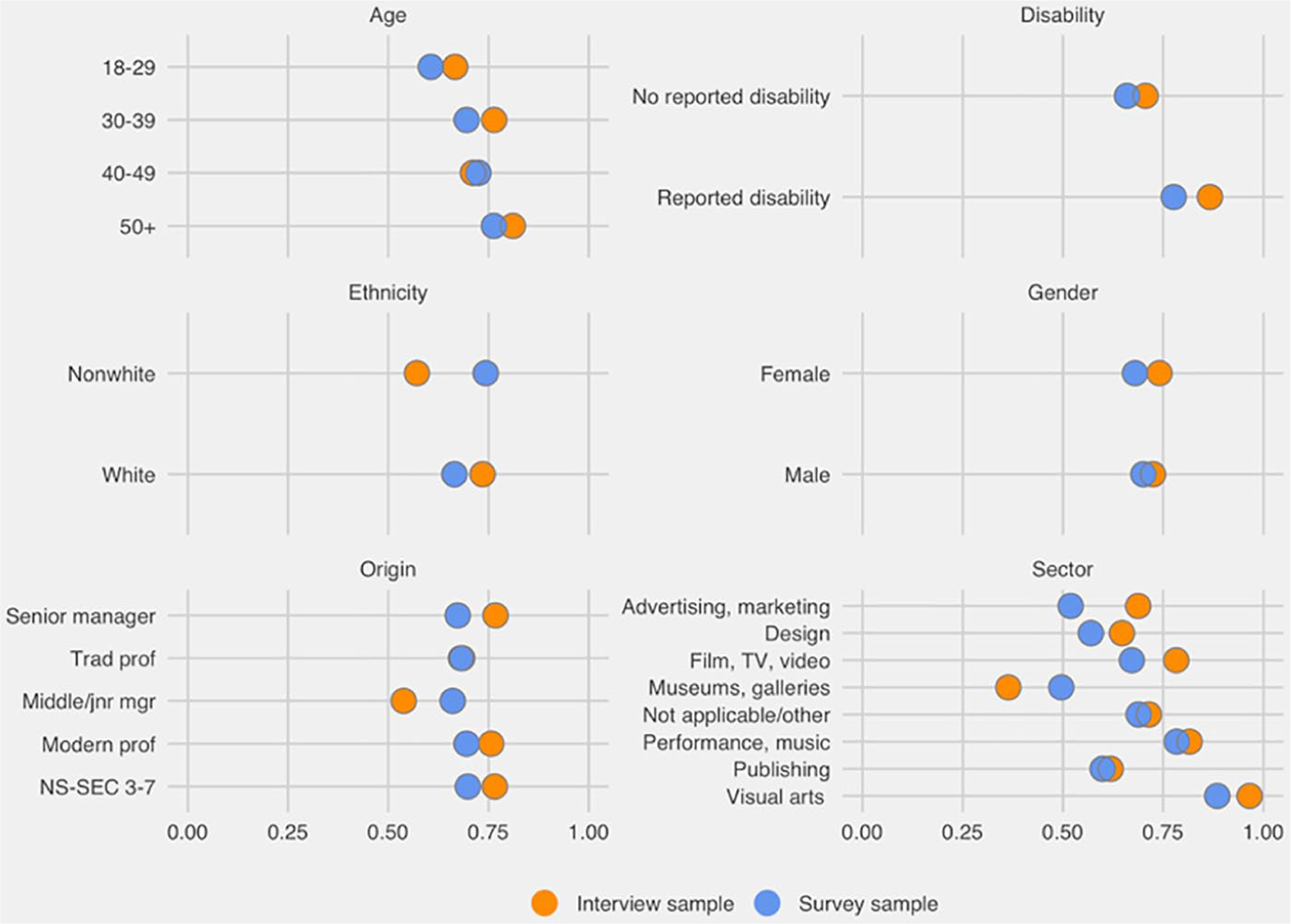
Respondents having not been paid for all hours worked in the last month.
These results make it clear that working for free is endemic across our survey sample. While there are some small differences between groups – more of our disabled interviewees have worked for free at some stage than those who do not report a disability, and those working in museums and galleries, in advertising and marketing, and in publishing are less likely to have worked for free. The idea that having to work for free in order to get ahead in the sector is a new phenomenon is inaccurate, with almost identical fractions of respondents from different age groups reporting having worked for free at some stage. More interview participants have worked for free than survey respondents, and more White interview participants have worked for free, compared to non-White participants.
While there are few differences in whether respondents have worked for free at all, there are some systematic differences in whether respondents have ever done unpaid internships, as detailed in Figure 2. The most striking difference is by age, with 47% of under-30s having done an unpaid internship, compared with 6% of over-50s; there are also large gender differences, with far more women having done unpaid internships than men. The other main difference is by sector; a majority of respondents working in film, television, and radio have done unpaid internships, while only a small fraction of respondents working in visual arts have done so. This finding is slightly at odds with recent policy interventions on arts internships (ACE, 2011), although, as we show in the discussion of interview data, there are explanations for these differences. In addition, there are some differences by social origin: those from senior managerial and modern professional backgrounds are far more likely to have done unpaid internships than those from less privileged class backgrounds, and from middle management backgrounds.
This final set of graphs in Figure 3 shows how the distribution of having not been paid for all hours worked in the last month varies. The most striking difference is that those sectors where relatively few respondents have done unpaid internships are those sectors where workers are most likely to have worked unpaid in the last month. However, given that the distribution of lifetime unpaid labour is relatively even across different age groups, with the most striking age difference being that younger people are far more likely to have done unpaid internships than older people, the age differences in reporting not having been paid for all hours worked in the last month are noteworthy; 77% of respondents over 50 years report having not been paid for all hours worked, compared with 60% of under-30s. This raises questions around whether this reflects genuine inequality in hours worked and hours paid for, or whether the older respondents are more aware of the hours for which they have not been paid.
The problem of unpaid work in CCIs
The survey results from our respondents suggested that, superficially, working for free, and thus a form of precarity, is a common experience for this sample of CCI workers. However, it has also pointed to some important differences, specifically about the prevalence of internships, and the different experiences of free work by age. We now turn to data from 237 interviews with our survey respondents to more fully answer our research questions and to make two core contributions. First, the seemingly endemic nature of unpaid work masks important differences across CCIs. And second, those differences are stratified by social origin and age or career stage. The responses to the question concerning internships gives a good illustration, as do responses about having not been paid for all hours worked: six interviewees illustrate the processes involved here. For all interviewees quoted, we offer details on age, occupational sector, parental background, and where they live, although a small amount of noise has been added to participants’ ages to aid anonymity.
First, we can see the experience of unpaid work for younger interviewees well captured by Molly, a White, female artist, whose parents were senior managers. She offers a bleak vision of artistic work, having never been paid for her practice, and having only received money intermittently from the art world for invigilating exhibitions or gallery openings: I’ve never been paid to make or do anything . . . I would see anything that I’ve done within a gallery context, that’s all been unpaid. Yes, I have a studio and I do exhibitions relatively frequently and I have done a residency and have worked for a couple of galleries but it’s always been unpaid. (Molly: aged 26, White, visual artist, senior manager parents, living in London)
Emily offers a similar account of her working life, focused on internships: I did an internship . . . that would have been completely unpaid and I probably got expenses. I did another internship that was completely unpaid straight after that. Two internships completely unpaid . . . So I have got, so over a period of about six months it was three internships, actually four because I started two simultaneously, but the second one, the second one of that simultaneous time was paying me and so then I was like wow, and that felt very unusual like I was getting £50 a day. (Emily: aged 33, White, working in the music industry, professional parents, living in London)
Louisa, originally from London, was able to survive on account of her parents’ location in the city. However, her story of the relentlessness of unpaid internships is common across our interviewees, as a core means of establishing a career: I joined publishing job agencies and they told me that there was no way in hell that I was getting a job in publishing without an unpaid internship. (Louisa: aged 30, White, working in publishing, professional parents, living in London)
These stories were extremely common across the interview dataset for younger people, albeit nuanced by job. Molly, an artist, experienced unpaid work as the inability to receive remuneration for her practice. A similar account came in design and performance. For those working in areas with stronger institutions, such as museums or publishing, the unpaid internship was the more common story.
These experiences directly contrast with older people’s experiences. For older and more established creative workers, the story was one of underpay or choice and autonomy. We can use three short comments by way of illustration. Jo, a 41-year-old freelancer for various arts organisations, experienced the underpay noted as part of precariousness, even as she rejected the idea of working for free itself: Not for free. No. Not necessarily. I have done projects where the fee did not in any way relate to the amount of work that needed doing. I have never done something completely for free. (Jo: aged 41, White, freelancer for various organisations, working class parents, living in the North West)
By contrast, Gerald and Rose both offered a perspective more grounded in their autonomy and ability to choose, and to ‘gift’ free work, whether as part of formal occupations or as a volunteer: Well I have chosen to do bits and bobs for free, when I have been a consultant. I think partly that is a generational thing. (Gerald: aged 57, White Jewish, curator, professional parents, living in the Home Counties) I’m a trustee and before that I was a volunteer, I always will try and do something which is consciously free. (Rose: aged 42, White, working in design, working class parents, living in the South West)
Here our initial set of data gestures towards important differences in the meaning and experience of unpaid work, particularly by age. It develops the distinction set out by Percival and Hesmondhalgh (2014), by showing how experiences of unpaid work are also differentiated. We can continue to examine this differentiation, along with pointing towards the role of social class, by turning to consider how our interviewees drew boundaries between work and non-work when thinking about pay.
It is obvious to state that those with more resources are more able to afford unpaid work; this came out strongly in the interview data. What is notable for this discussion are the affordances of age and social class. The older, established middle class origin creative workers were most able to blur life and work in a sustainable way. This was different from our younger, working class origin respondents. These differences, and the narrations of unpaid work attached to them, are an important set of structuring discourses that help to account for the acceptance of unpaid work. If everyone, regardless of demographic position, is working for free, then it becomes hard to mount direct forms of resistance to the practice. It is just, as one of our older interviewees suggested, that ‘There’s no way that you get paid to do the arts’.
The ability to resist is socially distributed, demonstrated here by a comment by Anna. Anna’s story is of a blurred line between work and not work, and of resistance to free or unpaid labour afforded to those who have been successful: It’s interesting to note what different people think of as work. When I started I didn’t think of it as work and so if someone asked me to do a reading I wouldn’t think oh they are not paying me, like I am doing something for free, it was more like they were doing me a favour . . . Now I don’t really do readings for free that often unless I really want to do it. Now I would say probably 70% of the things I get offered do have a fee attached, but it might not be a huge fee but, and I would be more bothered now because I see it as my career, and also I increasingly don’t like doing things if I am not going to be paid for doing them. (Anna: aged 33, White, author, parents in professional jobs, living in London)
For Anna, this choice was made deliberately. The blurred boundaries between work and life or leisure, alongside the problem of drawing distinctions between underpay, volunteering, or gifting work, are common issues across our dataset. They point to the differing experiences of precarity in CCI work. We have therefore presented an account from someone from an affluent class origin deliberately, so as to set up the subsequent section’s focus on the distribution of understandings and experiences of unpaid work by class origin, pointing ultimately towards the differing distribution of precarity itself.
Stratifying unpaid work: the reflexive role of class
Our middle class origin respondents who were earlier in their careers narrated a sense of autonomy and choice over engagements with unpaid work. Our working class origin respondents offered more constrained and pessimistic visions of working life. We turn now to three pairs of accounts to illustrate the classed difference in how unpaid work is stratified. If Anna, in our previous section, gave a tale of unpaid work as a choice related to her developing career, that choice was underpinned by her resources, including home ownership in London. Underpinning that choice is the social position related to social origin, the affordance of social class. Georgie’s comment was typical of the middle class origin, younger, respondents: I think it’s always been a choice to work. I’ve done some placements which were unpaid and I’ve done some projects which were unpaid or very, very low paid but I never had to do them because I didn’t have other work. There weren’t options to do other things. I haven’t personally felt like, ‘If I didn’t do unpaid work, I’d never be able to get a job’. (Georgie: aged 34, White, graphic designer, parents in professional jobs, living in London)
This is in contrast to Veronica, also in design and in her 30s, but from a working class social origin: There were girls in my year, I think, in the summer were spending, I think it was, six months in London, in Shoreditch, being able to work for free, whereas I could only do it for three months and that was a struggle. So, it is something that you really should be doing as a fashion designer because it really does help you, but then if you don’t have the money to do it, you don’t really get a chance to grow, so it’s not really fair. (Veronica: aged 35, Latin American, fashion designer, parents in working class jobs, living in the North West)
Veronica’s perception of the advantages of social class and the constraints of lack of resources, coupled with the impact on her career, shapes her sense of agency. She feels she had to work for free to compete with those for whom it is a choice. Again, we can see agency and resistance demonstrated by Ellie, a theatre maker in her 20s, discussing her experience of low pay on her first job: I think it is good that I had such a precarious horrible experience straight out of [DRAMA SCHOOL] because it just meant that I just thought I am never going to be in that position. If I am going to not be paid a proper wage at least I am going to enjoy myself doing it, and you know if someone asks me to do something that I don’t want to do and they are effectively not paying me to do it I am just going to say no. (Ellie: aged 27, White, theatre designer, parents in managerial jobs, living in the South East)
In contrast, our working class origin workers found their working lives to be more of a struggle, with success defined by the ability to be paid, rather than creative freedom or autonomy, as told by Sean: Yes, it’s hard to earn a full-time living. You have to do other jobs that you don’t particularly want to do. You have to compete with lots of other people, but for very few opportunities, and it’s very, very difficult . . . just getting a few opportunities would be success for me, and occasionally getting paid, perhaps. (Sean: aged 33, White, parents in working class jobs, living in London)
And Christine, around the same age but at an earlier career stage, having retrained from a manual job: It has all been free at the moment. I have had a couple of people approach me with their ideas of projects but it seems like there is never really much of a budget, and people either expect you to do something for next to nothing or either for free for them so I don’t really want to go down that road if I don’t have to. (Christine: aged 31, White, illustrator, parents in working class jobs, living in the North West)
Christine offers a sense of hope of being able to avoid the trap of always working for free and thus ultimately being exploited for others’ projects. However, this sense of hope is different from the sense of choice and autonomy described by our younger interviewees from affluent beginnings. This splits discourses and experiences of unpaid work, masking how for some free work is bound up with resistance and the ability to refuse, while for others there is inevitability and only a sense of hope that it will eventually be something they can avoid or escape. Our data suggest these differences serve to reinforce the sense of inevitability of unpaid work for those from less affluent social origins. The more affluent are able to blur the distinction between work and life. This issue, our data suggest, is a discourse that is also prevalent in older CCI workers, regardless of social origin. However, for older workers, the work/life distinction associated with their CCI occupation was enabled by various aspects of the welfare state (McRobbie, 2016). We close with data from this group, before turning to engage more substantively with the implications of a sense of autonomy with regard to unpaid work being shared by older CCI workers and younger, affluent origin CCI workers, but not those entering the labour market for cultural jobs from the working class.
Stratifying unpaid work: the role of age and career stage
Here we use the final cluster of themes from the interview fieldwork to develop Percival and Hesmondhalgh’s (2014) analysis, highlighting the way in which the stratification, by age or career stage, and by social origin, of accounts of unpaid work serves to reinforce the sense of inevitability of working for free and the sense that unpaid work may be a good or positive practice.
For a minority of our older respondents, when asked about having worked unpaid or for free, they would simply say no, moving on to the next question in the schedule, but, tellingly, would point to some element of volunteering or gifts as a form of unpaid work. As with elite social origin younger respondents, the ability to choose was key: No, and I never would. No, no, no, no, no. Never work for free as a writer. Sorry, I write poetry and I do that for free, and perform it in public for free, but no. I do that for fun. (Hazel: aged 53, White, writer, working class parents, living in the West Midlands) Only by choice . . . as a favour . . . it has been a pleasure to do it . . . it has never been onerous really. (Graham: aged 61, White, Film/TV executive, working class parents, living in London)
They were all, reflexively, able to situate the ability to think of free or unpaid work as a choice as a result of broader changes in social structure and social support, such as Felicity: I’ve been unbelievably fortunate, I really have. You know, I come from a generation where there were no university fees, you know? You could get . . . I’ve been unbelievably lucky. (Felicity: aged 55, White, theatre producer, parents in professional jobs, living in the Home Counties)
The sense of being fortunate and coming from the ‘right’ generation here is crucial, as it shapes expectations of working life and creative practice. Moreover, the accounts of luck and creative freedom track the accounts offered by those from affluent class origins. There is a powerful set of expectations associated with creative work, that working for free is the norm, as experienced by those who have ‘made it’. This form of working for free is crucially not the same as the type experienced by younger generations. We close with two comments to illustrate this point. The first, from Jenny, addresses the idea of low or no pay during her early career, but the support coming from the state and associated London institutions: Nobody ever got paid much, but there was quite a lot of public subsidy swishing around at that point, particularly for the sort of work that I was working in; niche, diverse work. We all got paid. I mean, nobody got paid anything like everybody was earning in the City at that point, but we all knew that. I have to say, at that point, I don’t think anybody really felt they were getting paid that badly. We were having so much fun. (Jenny: aged 54, White, communications director, parents working in professional jobs, living in the South East)
While Kerry had a similar account, of being paid, being supported by the social state and (later on in the interview) being able to work unpaid on a variety of her own interests and projects: We went to Edinburgh in 1990 and we made money and paid ourselves like 500 quid and that was probably the last time that was possible actually. So stand up, impro, beginning to write but not get paid for it, and occasionally bits of acting work. A couple of ads occasionally, which of course was loads of money. And I think I probably, I lived on the Enterprise Allowance Scheme. I got the Enterprise Allowance Scheme to become a stand up. (Kerry: aged 54, White, theatre-maker, parents in working class jobs, living in London)
These comments also remind us of the uneven geography of the UK’s creative industries (Kemeny et al., 2019), a vast subject beyond the scope of this article.
Conclusion
We have addressed two research questions: to what extent is working in CCI occupations precarious; and is unpaid labour, and thus precariousness, in CCIs socially stratified? We’ve shown how, in a web survey dataset, working for free seems endemic to CCIs. However, we’ve developed this understanding by showing the stratification of unpaid labour, and thus precariousness, by age and career stage, and by social class origin. Our interview data has demonstrated important differences surrounding the sense of choice and autonomy associated with unpaid work, how unpaid work takes different forms, and how cultural memory will be an important area for developing new research on this subject.
This analysis reinforces recent theoretical (McRobbie, 2016) and empirical (Percival and Hesmondhalgh, 2014) research on unpaid work in CCIs. We have reinforced Percival and Hesmondhalgh’s (2014) findings with a large-scale dataset. There are important differences between those older, more established, cultural workers and those, often younger, who are more recent entrants to cultural careers. Identifying these differences allows our analysis to demonstrate how both experiences of and attitudes towards free labour are stratified according to the resources, economic, cultural, and social, granted by class origins. While the ‘inevitability’ of free or unpaid labour is a common experience to newer entrants to the labour market, this both masks important differences and complicates the possibility of social solidarity against exploitation.
The argument, of the need for a nuanced understanding of the stratification of the experience of free work by age or career stage and social class complements arguments by Siebert and Wilson (2013) and Umney and Kretsos (2013), who have demonstrated the uneven distribution of the acceptance or otherwise of unpaid labour. By offering further empirical evidence for the different meanings and experiences of unpaid labour, we draw attention to the need for a similarly nuanced understanding of precariousness. McRobbie (2016) has already suggested the need for caution when narrating precariousness in CCIs as a unique phenomenon. We go further, suggesting the differences in unpaid labour in our dataset are differences in precariousness. This has implications for challenging the negative impacts of precariousness, particularly if those from affluent origins experience a core element of precariousness as a choice. They are, therefore, unlikely to be a source of the social solidarity needed to open creative occupations to all.
Footnotes
Funding
The author(s) disclosed receipt of the following financial support for the research, authorship, and/or publication of this article: from the Arts and Humanities Research Council ref AH/P013155/1.
