




Abstract
A recent report by the British Association for Music Therapy, in light of the global Black Lives Matter and anti-racism protests, highlighted the lack of diversity within the UK music therapy profession and MA training courses. Motivated by personal experience while training and observations of being a minority in a largely White cohort, this research examines some of the possible factors that could contribute to this lack of diversity. This article reports on a small research project undertaken as part of my studies for my MA Music Therapy. Three participants were interviewed for the study, each from different ethnic minority groups, and asked questions pertaining to their experiences while studying, in relation to race, accessibility, diversity and culture. Interpretative phenomenological analysis was used to contextualise their interview responses. The research findings highlighted barriers to accessibility of training such as a biased application process, lack of dialogue about race on training courses or within music therapy and the complexities of race and music therapy. This article provides suggestions of ways in which diversity in music therapy can be improved such as evaluating the curriculum and increasing cultural awareness.
Introduction
In 2020, the killing of George Floyd at the hands of the police sparked worldwide protests, inspired by the Black Lives Matter movement (Apata, 2020). Important conversations about race started to be held and many organisations and institutions began evaluating the way they addressed racism. In 2020 the British Association for Music Therapy (BAMT) commissioned a report to assess diversity within the music therapy field. The report shone a light on several issues relating to both the organisation and music therapy within the country. It largely focussed on two areas; lack of diversity within training institutions and the inaccessibility of training courses (Langford et al., 2020).
To gain registration, music therapists must have completed a Health and Care Professions Council (HCPC) approved master’s training course (MA) at an approved higher education institution. To gain entry to these programmes, applicants must meet specific entry requirements, including relevant work experience and formal music training (NHS, 2021). Statistics collated by BAMT (Langford et al., 2020) found that people from a White British, or White Irish background formed almost 85% of music therapists. In comparison, Black Caribbean and Black African music therapists made up only 1.38% while less than 5% were from an Asian background. Statistics were not included for people who classified themselves as Black British (Langford et al., 2020).
This report confirmed there was a lack of diversity within the music therapy profession in the United Kingdom; however, the reasons were still unknown. It soon became clear that some of the diversity issues could be traced back to a central point, the lack of accessible training courses. Specific entry requirements to training courses can present barriers to accessibility for certain individuals, namely, those who are not from middle-class backgrounds and those who do not have Western classical music training (Langford et al., 2020). In addition, there are greater challenges to access for applicants from ethnic minorities and limited representation within the training programmes themselves (Langford et al., 2020).
This article will present aspects of a small-scale research project undertaken during studies for the MA in Music Therapy. I began training at university studying music therapy in 2019. Upon my arrival on the course and when meeting my cohort, I was struck by the lack of diversity within the group. I come from a Black Caribbean household, and I am a second and third generation immigrant to the United Kingdom, with my family hailing from Jamaica originally. While I was born and raised within the United Kingdom, throughout my life the cultural differences have become apparent at times, and the fact that a large portion of my educational background has been spent being a minority, impacted my decision to explore this topic. I was interested in finding out why there were not more ethnic minority individuals on this course, and why there were so few Black people within music therapy in general. The article will begin with a brief literature review and explanation of the research process and then explore the main themes arising from the data.
Literature review
This review will briefly set out some key literature and ideas within cultural competence, music therapy training and diversity within higher education and the music industry.
Cultural competence within music therapy
Cultural competence can be described as ‘the ability to understand, appreciate and interact with people from cultures or belief systems different from one’s own’ (DeAngelis, 2015). The music therapy practitioner needs to be able to adapt to the needs of their client and in the case of music therapy, this may require playing music in different styles or showing an awareness of culture, diversity and equality (HCPC, 2021). The prevalence of classically trained musicians within music therapy has been noted in a recent report, while the ‘heavy emphasis’ on classical training as an entry requirement was also acknowledged (Langford et al., 2020: 6). It is likely that this, in turn, limits the diversity of applicants, especially those from non-classical musical backgrounds. Due to the connection between Western classical music and Whiteness (Leppänen, 2014), creative arts therapies in Western cultures have largely been viewed through a White lens, bypassing the practices and knowledge from ethnic minority groups such as those from the African diaspora (Norris et al., 2021).
According to the BAMT report, 87.18% of the individuals on MA Music Therapy training courses in the United Kingdom prior to starting training were from a classical music background, in contrast to 14.79% who had a background in world music (Langford et al., 2020: 26). World music can be described as popular music of various ethnic origins and styles outside the tradition of Western pop and rock music (Collins, 2021). The term is controversial because ‘it groups together traditions that are not deemed to be from a European or American tradition’ (Ammar Kalia, 2019). It calls into mind the usage of the term ‘Black, Asian and Minority Ethnic’ or BAME, which has been described as problematic (Aspinall, 2021), namely, in that it has been used to refer to all minority ethnic groups except those that are White (Aspinall, 2021). The BAMT report (Langford et al., 2020) makes usage of the phrase BAME on several occasions when referring to applicants from non-White backgrounds.
Music therapy training and course requirements
Wetherick (2016) conducted research into the entry requirements of universities in the United Kingdom offering an MA Music Therapy training and found that at that time, four out of the seven university programmes listed Grade 8 as a requirement in their application process. Grade 8 is widely recognised as the highest level of classical musical training, achieved through a specific entry route and with formal examinations through a board. The Associated Board of the Royal Schools of Music (ABRSM), one of the largest music examination organisations, only offers Grade 8 within the genre of classical music (ABRSM, 2021). Although alternative genres are considered by other exam boards such as Rockschool, Trinity and ABRSM Jazz, classical elements are still included such as knowledge of modes, sight-reading and arpeggios (Rockschool, 2021). This suggests a barrier to those from non-Western classical backgrounds, which potentially hinders them from entering a music therapy training course in the United Kingdom, as their level of musicianship may not be categorised in the accepted way. These barriers, therefore, begin prior to postgraduate study as detailed in the subsequent sections of this literature review.
Diversity and higher education in the United Kingdom
The BAMT report (Langford et al., 2020) provided key information relating to the factors, which contribute to training course demographics in the United Kingdom, such as the high cost of a master’s course, age restrictions, lack of entry routes and discrimination. However, the current literature review highlighted a paucity of research into diversity in music therapy courses specifically, with most research into access and diversity being focussed on general music courses in higher education. The recent 2022 report is noted (Bull et al., 2022). The issues concerning diversity supersede that of music therapy and point towards wider issues concerning diversity within higher education. A 2004 study showed that ethnic minority university students were more likely to drop out or leave their course before completion than any other ethnic group (Connor et al., 2004). It underlined ‘financial difficulties, poor teaching quality, the feeling of isolation or hostility in academic culture and work demands and personal commitments’ as causal factors to this (Connor et al., 2004: 60).
Diversity within the classical music industry and music education
Recent research has exposed a lack of diversity within Western and classical music. A 2015 report (Scharff, 2015) revealed that out of 629 orchestra players from British orchestras, only 11 were from an ethnic minority background. In addition, only 8% of students who undertook a course at a music conservatoire were of an ethnic minority heritage. Such underrepresentation could originate from music tuition received by children, while the sustained costs of music tuition affect young children from economically deprived backgrounds, resulting in a large number ceasing to continue learning an instrument (Burland, 2020). Of the students in the United Kingdom who received music tuition in 2014/15, 10.8% were from an Asian background and 6.1% were from a Black background (Sharp and Rabiasz, 2016). Another report showed that ethnic minorities made up only between 3% and 6% of the orchestral workforce within the United Kingdom while highlighting the underrepresentation of Black and Black British people at each stage of elite training (Tamsin and Kilshaw, 2021). Although music education students might enter university from diverse backgrounds and differing musical experiences, within the training programmes themselves, precedence is placed onto a particular model (Western music), and it is from this point that the Western canon of musical education develops. The music curriculum implemented by educators within music institutions then results in two groups of students ‘those who buy into the cultural norms implicit in their curriculum, and those who opt out of school music’ (Bradley, 2007: 149). Bradley writes that ‘those who disengage from school music often fail to see themselves as musical’, and goes on to state that these people may have the experience of ‘believing that musicality is a label that applies onto those with specialized training in institutionally sanctioned forms of music making’ (Bradley, 2007: 149). Conversely, those who undertake training in music programmes (and those whom the music programmes are ‘primarily interested in and actively recruit), believe themselves to be “musically literate”’. Links can be drawn to earlier statistics regarding demographics within Western and classical music, where it appears that within some institutions students from a Western musical background and statistically being more likely to come from a White background, may benefit from this system. This creates a hierarchy within these institutions and perpetuates ‘institutional whiteness’ (Bradley, 2007: 149).
This literature review suggests a clear barrier within higher education and music in higher education to those who are not from a White, classical background. It points towards issues concerning cultural competence, both within music therapy training courses and by practising professionals. Therefore, within higher education, cultural and racist structures exist, which affect access and representation of minority groups in music courses in higher education and can lead to higher dropout rates. The BAMT report suggests a diversity problem within the field of music therapy, and the focus of this project, ‘Examining the accessibility of MA Music Therapy training in the United Kingdom for ethnic minority communities’, analyses the important area of limited accessibility in music therapy training and what can be done about it.
Methodology
Interpretative phenomenological analysis (IPA) was used to investigate the topic of examining the accessibility of MA Music Therapy training in the United Kingdom for ethnic minority communities. This is a qualitative approach that ‘aims to provide detailed examinations of personal lived experience’ (Smith and Osborn, 2015: 41). This was intrinsic to the project because it sought to understand and provide insights into the unique lived experiences of music therapists from ethnic minority backgrounds, who have a shared experience, namely, undertaking and completing a music therapy training in higher education. IPA is particularly useful when examining this type of research question, as the primary focus of the phenomenological approach is to examine core experiences in relation to our conscious understanding (Smith and Osborn, 2015).
Due to the nature of this research, a qualitative approach was appropriate for this research because the research question requires knowledge of participants’ lived experiences, which is garnered by interviews. The research adopted a constructivist methodology, which assumes that subjective realties are from mutual understanding and that the data can be interpreted: ‘Qualitative research explores and understands the meanings people assign to their experiences’ while investigating the complexities of our social world (Tuffour, 2017). Thus, epistemologically speaking, the knowledge derived by this research was co-constructed between participants and researcher (Denscombe, 2014).
Three interviews were conducted. The inclusion criteria for participants were that they should be qualified music therapists who identified as BAME and had either completed or were undergoing an MA Music Therapy training at an accredited UK university at the time of the interview. The participant sampling was, therefore, purposive (Denscombe, 2014). The participants were invited to take part via professional connections and through an advertisement in the BAMT monthly bulletin.
These participants were interviewed online by the author and asked questions pertaining to their experiences while training on the course as Black/Asian/ethnic minorities. All participants, while having studied Music Therapy within the United Kingdom, came from different training courses. The interviews were originally intended to be 60-minutes long. However, within the interviews themselves, and while the participants were sharing their experiences, it was difficult to abruptly end them. As a result, some of the interviews lasted for longer than 60 minutes. Each participant came from a different ethnic background and not all were the same gender. Although not intentional, this provided the opportunity for a wide range of experiences within the findings of the research. One similarity was that due to several factors, each had the experience of being a minority within the training cohort.
To answer the research questions, semi-structured interviews were used. Semi-structured interviews are effective at collecting qualitative and open-ended data (DeJonckheere and Vaughn, 2019). Interviews can be used to explore participants’ feelings, thoughts or beliefs about a topic and to explore personal and sensitive issues (DeJonckheere and Vaughn, 2019). The interview questions were open-ended, to avoid yes/no answers and with careful consideration taken to avoid leading questions where possible. This approach has been used in previous music therapy research (e.g. Anderson, 2019; Magee and Burland, 2009). Anderson’s (2019) project examined intercultural music therapy with children with English as an additional language in a special school.
Each interview was conducted through video call and recorded using a voice recording application. The interviews were then transcribed to assist with familiarisation of the key points of the interviews and to properly explore the interview findings. Once transcribed, each transcript was examined to analyse the data and draw together themes discussed within the interview. Subsequently, themes which emerged within each interview were grouped which helped to aid in the process of drawing conclusions (Smith, 2015).
Each participant was given a consent form to sign and given a data privacy information form. This enabled information to be provided pertaining to the details of the research such as the topic, and a written agreement to filming and recording. The protection and wellbeing of participants was carefully considered throughout the interview process. The Institutional Review Board, or in this case University of Roehampton Ethics Board, have a responsibility of care to human research participants (Nijhawan et al., 2013). This included the right to withdraw, and aftercare. Therefore, each participant was also given a debrief form. Due to the sensitive nature of the research and the potentially difficulty in discussion personal experiences relating to race, support was offered. Within the debrief form, all participants were made aware of charities or organisations that they could contact in the event of any distress, such as The Survivors’ Network (2022) and The King’s Fund (2022).
All participant data were handled anonymously and confidentially. Data were identified by pseudonyms and referred to anonymously within the transcript. All data were stored securely in the encrypted online database, OneDrive. Care was taken to protect the individuals who partook in this study, to ‘protect the privacy of human subjects while collecting, analysing, and reporting data’ (Allen, 2017: 228). The participants viewed the transcripts to ensure that they accurately reflected their opinions.
Reflexivity
The fact that the researcher/author is a Black person was likely to have influenced the interviews. This information about the researcher was initially omitted from the purposive sampling advertisement but, after a misunderstanding with one of the eventual participants, and following discussion with a university tutor, it was added. In that instance, the potential participant had mistakenly assumed that the research was being conducted by a White person and expressed some concerns about the implications of this. The eventual inclusion of the author’s race seemed to remedy this. Among all the participants and their interviews, despite coming from different background, there seemed to be a shared understanding of experiences. It might have been possible that the participants felt more comfortable disclosing their experiences because of the author’s race. Solidarity through shared experiences among minority stigmatised groups is noted by Cortland et al. (2017) in their research. These authors found that disclosing shared experiences of discrimination can help to improve ‘intergroup’ outcomes between stigmatised groups. It seemed to me as researcher, that having participants of different ethnic minority backgrounds share their experiences in such an open way, ultimately helped aid the research and interview process, while the differing backgrounds of the participants helped shed some light on some of the similarities or differences between the experiences of each while training.
Reflections
Researcher was struck by the how open and vulnerable each of the participants were about their experiences relating to race within a music therapy context. At times, the interviews touched on subjects and topics that were individually profound and at times painful. In light of this, there was a challenge in ending the interviews within the allocated time. Guidelines on endings of therapy sessions were helpful in reflecting upon this. Researcher noted that some of the most profound issues were discussed after an ending was announced. The final few minutes within therapy sessions have been shown to result in a similar phenomenon according to research by Gans (2018), which posed a dilemma whether to extend or end a session if important material surfaced towards the end of the session. However, boundaries such as time within therapy help maintain an ethically appropriate relationship between client and therapist (Badawi, 2016). In light of this, it is the responsibility of the therapist, or in this case the interviewer to uphold this boundary by moving towards the end of the interview while acknowledging the difficulties that may arise from endings (Gans, 2018). These sensitivities were acknowledged by the researcher, whose skills were honed through a pilot interview.
Results and discussion
The main findings will now be presented and discussed in Appendix 1.
Key
P1-Participant one
P2-Participant two
P3-Participant three
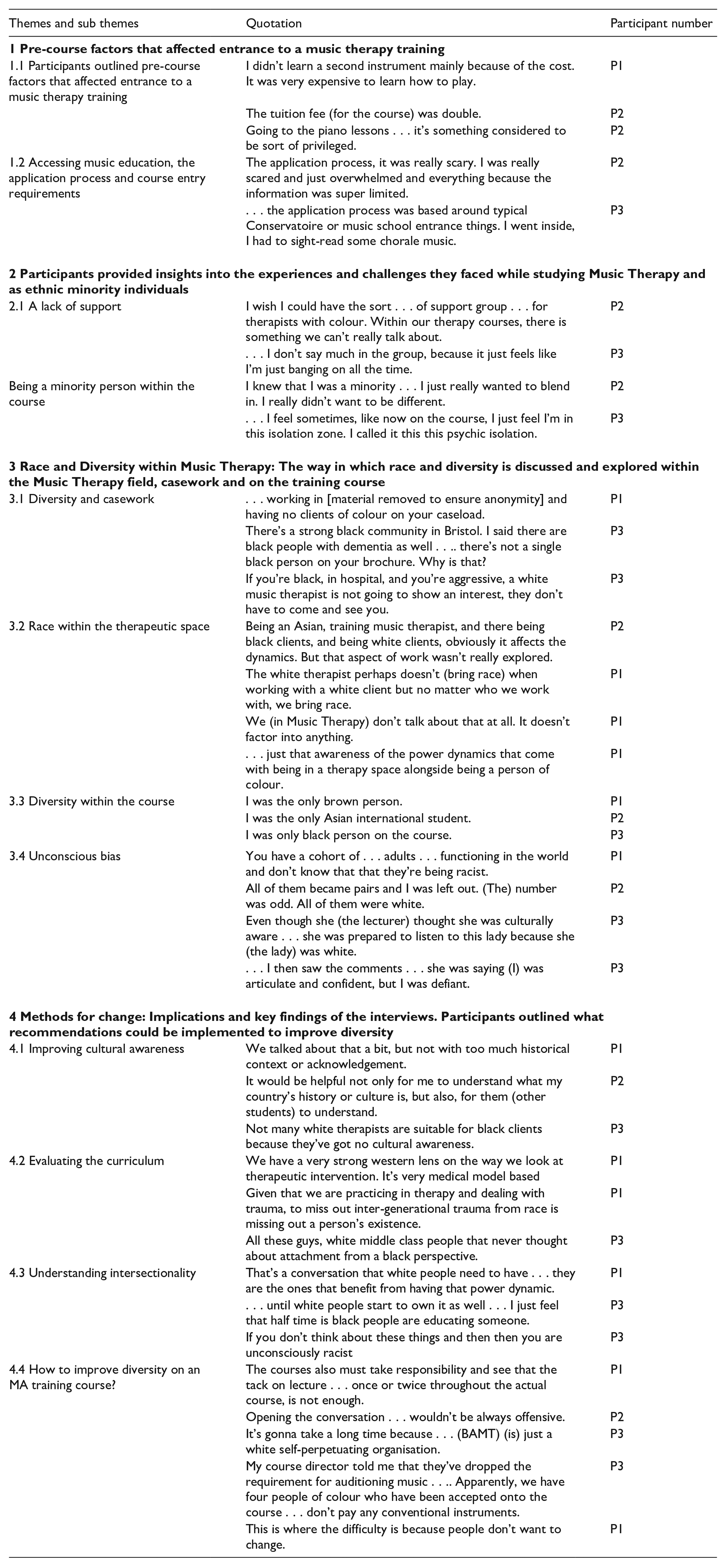
BAMT: British Association for Music Therapy.
Discussion
The research questions of this project were designed to examine the accessibility of MA Music Therapy training. In doing so, the interviews explored the experiences of ethnic minority music therapists on the training course and how they describe any barriers or challenges in accessing music therapy. The results detail the participants’ experiences prior to and while on the training course, in relation to topics such as diversity. It is worth noting that despite these barriers, all three participants were able to gain a place on an MA Music Therapy training course. In a way, their presence on a training course was evidence of them being able to defy these barriers. However, not every person from an ethnic minority background is afforded these opportunities. This discussion will explore these themes, presenting participant quotations (and referring to participants as P1, P2 and P3), and in relation to relevant literature.
Pre-course factors that affected entrance to a music therapy training
Participants outlined pre-course factors that affected entrance to a music therapy training
Tuition fees place a barrier to greater accessibility of music therapy MA training. UK students are entitled to a fixed loan of £11,570 (GOVUK, 2021), which is expected to cover the duration of their training. The majority of full-time training courses in the United Kingdom are 2 years for full-time students, with part-time courses varying in length. Comparing fees from four universities which included their fees on their websites, namely, Roehampton (2021), Guildhall School of Music and Drama (GSMD, 2021), Anglia Ruskin University (ARU, 2021) and Queen Margaret University (QMU, 2021), it can be seen that the average cost of a music therapy training course in the United Kingdom is £16,684. The high cost of the training course, coupled with a loan that does not extend to the amount of the course means that music therapy training courses are largely accessible to people from privileged, middle-class backgrounds, as written in the BAMT report (Langford et al., 2020). As P2 noted with their statement ‘the tuition fee was double’, the cost of training is substantially higher for students from international backgrounds, with the average fee for overseas/international students for the same universities, Roehampton (2021), Guildhall School of Music and Drama (ARU, 2021) and Queen Margaret University (QMU, 2021), being £30,024. Making training more financially accessible to students from other countries, would likely increase the ethnic diversity in the training courses, and therefore, the profession.
Accessing music education, the application process and course entry requirements
Each of the participants spoke of an area of difficulty they had regarding either music education or the application process of the course. P1 spoke of the challenges of learning a second instrument ‘because of the cost’ and how expensive it was. Limited access to music lessons due to cost presents a barrier to ethnic minority students within the United Kingdom. Where there is a requirement to learn more than one instrument, this adds a further barrier to training as a music therapist. Some classical musicians have spoken about the barriers to thriving within the music industry, echoing the sentiments expressed by the participants. A 2020 article highlighted the financial obstacles to learning to play an instrument, listing the high cost of a violin as an example of something that disqualifies aspiring players (Anderson and Freitas Bonadio-de, 2020).
The 2020 BAMT report (Langford et al., 2020) draws reference to the entry requirements for music therapy courses that lean more in the direction of those coming from a classical background due to the emphasis on achieving certain grades and the ability to read music, which limits the diversity of applicants. This was spoken about in depth by P3 who compared the initial audition and interview with a music exam at one training course. In their words, ‘the application process was based around typical conservatoire or music school entrance’. They also added that the way this is done ‘is almost like you’re being examined’.
Participants provided insights into the experiences and challenges they faced while studying Music Therapy and as ethnic minority individuals
A lack of support
The theme of lack of openness to addressing and discussing issues of race and ethnicity was raised through the interview data. Both P2 and P3 alluded to not feeling comfortable enough to speak about race and ethnicity within the course while studying, with P3 disclosing that they ‘don’t say much in the group’ because it often felt as if they were speaking a lot about the same subject (referring to race). P2 suggested that courses could include a support group for therapists of colour which might create a space to discuss issues they ‘do not feel comfortable sharing within the course group’. BAMT (Langford et al., 2020) acknowledge the lack of support within the course for ethnic minority students and there were suggestions by other minority individuals to create a support system. The learning undertaken during 2021 and 2022 has led to some of these initiatives being established both within training courses and the professional association (BAMT.org). This included BAMT run groups to support music therapists from ethnic minorities and for those who wish to support development. In addition, training was provided to the Training and Education Committee of BAMT (TEC) relating to equality and diversity. Within many higher education institutions (HEIs), changes have been made including implementing EDIB groups for students and staff to raise issues and develop good practice.
P1 mentioned the lack of ‘a language for talking about race, culture, or power dynamics within music therapy’, P2 added that ‘there is something in in the air that this (race) is something shouldn’t be talked about or touched’, while P3 explained that ‘they’re just scared talking about race now’. It seems all participants, being from ethnic minorities, experienced issues relating to race while on the course but this was seldom addressed. A 2015 report found that 34% of ethnic minority employees felt comfortable talking about race, while 42% of White employees felt comfortable talking about race (Business in the Community, 2015). The discomfort is often felt by both sides, with people of colour suffering from race-related trauma and White people being presented by hidden distress (Ellis, 2021). Ellis writes that people of colour may leave their trauma unaddressed, as a result of being in a world which is disengaged from their suffering and due to the potential dangers of voicing such concerns, while White people may find it difficult to proceed to engage with the hidden distress. As a result, neither side acknowledges the discomfort of race. This can be addressed in a relational way, by acknowledging that sometimes, Whiteness may be the trigger or source of distress for people of colour (Ellis, 2021).
Being a minority person within the course
P2 spoke about feeling they were ‘a minority’, while P3 talked about feeling that they were ‘in an isolation zone’, surrounded on the training by people with different backgrounds and experiences to them. Feelings of alienation and ethnic isolation within predominantly White universities may be attributed to a lack of diverse student representation and activities or policies designed for White students (Bourassa, 1991). As a result, students may feel a pressure to assimilate into White culture and abandon their own culture. This chimes with sentiments from P2 who at times felt pressure to ‘blend in’, and suppressed emotions caused by being different. P2 spoke extensively about how they were able to express themselves culturally through music while on the course. This included singing a song in their language during the audition which enabled them to show their identity, especially given their native origin. During class improvisations they took the opportunity to play music using a drum originating from their home country, which they describe as feeling grounding. This could be because music is a vital part of culture and ‘important for individual and social identity formation’ (Lidskog, 2016: 25). P3 spoke of the resistance they felt from course members during improvisation sessions, who may not be used to the musical styles expressed by P3 due to little exposure to genres existing outside of the Western classical sphere (Langford et al., 2020). HEIs within the United Kingdom have recently attempted to tackle the attainment gap between ethnic groups. An online panel (The Guardian, 2021) explored the issue while another report included recommendations on tackling barriers in attainment for success (Universities UK, 2019). Several pieces of literature discuss at length the narratives of trainees of colour and being a minority within psychology, counselling or training programmes. The experiences were likened to a survival, with participants within a research study discussing the loneliness they felt, and the pressures to manage or cope with their Blackness (Paulraj, 2016). Similarly, people of colour may deploy silence as a strategy in the face of racial oppression as a means of survival or protection (Suavansri, 2016). Carrero Pinedo et al. (2022) explained some of the rationale behind this stating that particularly in PWIs [predominantly White institutions], the dominant cultural standards are portrayed as the norm and to be successful, BIPOC [black, indigineous and people of colour] trainees need to adapt, compromise, or negotiate which aspects of themselves are accepted or even tolerated. (p. 144)
Race and diversity within Music Therapy: the way in which race and diversity are discussed and explored within the Music Therapy field, casework and on the training course
Diversity within music therapy and in casework
An interesting issue explored by all participants was the link between race and casework, and the ways in which they can affect each other. P1 spoke of an experience while working and the realisation that their caseload of primarily White clients ‘didn’t reflect the diversity’ or cultural demographics or diversity found within the area. Similarly, P3 shared an experience of a visiting lecturer with who presented a brochure from their service for people with dementia, containing only White clients, seemingly ignoring any Black clients they may have had. P3 also discussed the unconscious bias that may occur within practitioners, assigning clients and handling case referrals. A study into the allocation of mental health services showed that White people were twice as likely to receive treatment for mental health problems (GOVUK, 2017b) in comparison to other ethnic groups despite statistically suffering from mental disorders less (GOVUK, 2017a). This could be attributed to false historical racial biases, which still exist within healthcare such as the belief that Black people have a higher pain threshold than White people and, therefore, require less treatment (Hoffman et al., 2016) or due to the therapy itself seeming inaccessible to people who are not White. If service users only see brochures of White people or White therapists, they may not engage as they do not see themselves represented. Similarly, music therapists of ethnic minority backgrounds within the training course could be left feeling that their communities are not represented, which is important for the music therapy profession. It is worth training courses considering the racial representation seen within literature for this reason.
Race within the therapeutic space
Each participant had a different but poignant experience of their race being relevant to their therapy work. P2 stated ‘being an Asian, training in music therapy, and there being black clients and white clients, obviously it affects the dynamics. But that aspect of work wasn’t really explored’. Similarly P1 echoed this saying; ‘the white therapist perhaps doesn’t (bring race) when working with a white client but no matter who we (ethnic minorities) work with, we bring race’. All seemed to conclude that little was done on their training courses to prepare them for the way their race may factor when working with certain clients. It could be theorised that these training courses, with their largely White contingent and staff teams (Langford et al., 2020) were not comfortable discussing race for fear of causing offence (Apfelbaum et al., 2008).
Diversity within the course
It was interesting to note that each of the three participants reported being the only member of their respective races while training on the Music Therapy course. P3 stated that this experience made them feel as if they were in an ‘isolation zone’, particularly because they were surrounded by people with different backgrounds and experiences to them. Feelings of alienation and ethnic isolation within predominantly White universities were attributed by Bourassa to lack diverse student representation and activities or policies designed for White students (Bourassa, 1991). As a result, students may feel a pressure to assimilate into White culture and abandon their own culture. This echoed sentiments from P2 who at times felt pressure to ‘blend in’, and suppressed the emotions caused by being different.
Unconscious bias
Unconscious bias can loosely be defined as prejudice in favour or against a particular group, when compared with another, in a way that results in unfairness (Vanderbilt University, 2021). P1 talked about a cohort of majority White people who were not aware that ‘they were being racist’. P2 shared an upsetting moment where they were the only non-White person within the group and were excluded from a pairing activity. P3 also shared a troubling instance where they had been targeted racially with negative language rooted in microaggressions by a placement supervisor. In each instance, the individual was affected by unconscious bias which can result in an unfavourable impact on ethnic minorities (Allen and Garg, 2016). Racial exclusion within post-school education was researched by a 2017 report which found that 78% of ethnic minority respondents were sometimes or often excluded from decision making. This suggests that unconscious bias may be present in a way that does not allow those involved to recognise the impact it might have on already minoritised groups.
While acknowledging unconscious bias and its effects is of central concern, it is important that training and education related to unconscious bias does not become performative nor used to deflect further education and prevention. As Tate and Page suggest, if work and reflection around unconscious bias is not engaged with authentically, it disguises the effects of White supremacy and maintains the innocence of White people in upholding institutional racism (Tate and Page, 2018).
Methods for change: implications and key findings of the interviews. Participants outlined what recommendations could be implemented to improve diversity
Improving cultural awareness
The consensus between participants from interview data was that training courses could do more to improve cultural awareness (P3), in a way that is mutually beneficial (P2) for trainees/music therapists, clients and lecturers.
P1 spoke at length about the power dynamics that exist within both music therapy training courses and wider society. Due to lack of diversity within teaching staff and the wider cohort of students (Langford et al., 2020), important conversations did not take place pertaining to race, culture and language with P1 stating; ‘that’s a conversation that white people need to have . . . they’re the ones that benefit from having that power dynamic’. It was noted that trainees were not taught about the role that ‘white superiority’ (P3) and privilege can play within a therapeutic or educational context. Bain et al. (2018) noted how within a therapeutic relationship and within the therapeutic process, whether acknowledged, intentionally or not, systems of privilege and oppression can play a role. By its very nature, the therapeutic process is a reflection of experiences received within society. Historically, within Western society; Whiteness is seen as the standard and automatically placed on a higher standing than ethnic minority groups (Sue, 2006). It is also worth noting, how its presence can be invisible to those with whom it benefits (Sue, 2006).
Drawing back to earlier research by highlighting within music therapy, ‘blind spots which are embedded within a system that privileges whiteness as normal’ [author’s change to original] (Langford et al., 2020: 8)
Participants noted that within training courses, there was seldom any time dedicated to providing historical context of instruments or music, preferring to focus upon the performative aspects of music (P1). Understanding the history of music in diverse countries is important (P2), and where this is not done, White therapists may not be adequately placed to understand the nuances attached when working with people from different cultural backgrounds (P3). The BAMT report (Langford et al., 2020) concluded that more could be done to incorporate culturally centred practice, therefore showing an awareness of cultural similarities or differences between client and therapist (Bedersen, 2008), while also doing more than one-off lectures about culture, which could be seen as tokenism (Langford et al., 2020: 7).
Evaluating the curriculum
Within the curriculum of a master’s training in music therapy, P1 and P3 consider that changes need to take place. Some UK training courses and approaches to music therapy are viewed from a Western lens, with an emphasis on the medical model, which leads to areas of unseen curriculum (P1). These include ignoring the effects of race induced inter-generational trauma (P1), as written by Ellis (2021), and bypassing the perspectives of Black people (P3). A possible reason for this is that music therapy contains remnants of White European colonialism, and principles that support its existence which are both beneficial and harmful (Norris, 2020). Colonial and neo-colonial ideals have directly influenced music therapy learning, namely, in the assumption of improvisation as a universal language for therapeutic intervention (Comte, 2016).
Intersectionality within music therapy
Understanding intersectionality and the ways marginalised or oppressed groups are linked together while experiencing different lives to those with privilege is important (Bain et al., 2018; Collier et al., 2022). Although coming from different backgrounds, each participant had the experience of being a minority while studying. They may have all been ethnic minority groups, each person had unique characteristics which influenced their university experience, such as age, gender and their race. Recognition of this may support greater understanding of the historical context relating to power, rights and authority caused by race and White supremacy and avoid this being perpetuated (Oosthuizen, 2009). Turner (2021) explores the meaning of the phrase intersectionality in a recent book, recognising the way in which different groups are oppressed by aspects of their identity, whether that be gender, sexuality and/or race, among others. Although oppressed in different ways, each experience is uniquely different and certain groups may experiences privileges within the intersection.
Improving diversity
Participants were asked how they thought diversity within MA Music Therapy training courses could be broadened. It was suggested that training courses and BAMT could open the conversation about race (P2), alongside including more content throughout the training to provide a more sustained and deeper understanding of the issues and challenges for the profession, rather than providing a one-off lecture, as P1 reported experiencing. P1 acknowledged the potential difficulty in doing this because increasing diversity would require change, which people may be reluctant to embrace. HEIs may be resistant to change because they ‘fear that after the change, the organization will no longer be the organisation they value and identify with’ (Merlijn et al., 2018). P3 took a firm stance, viewing BAMT as a ‘a white self-perpetuating organisation’, which will take a long time to integrate diversity and feel comfortable with it. P1 considered that change within music therapy can only occur with the support of BAMT, the professional association (P1). BAMT recognises there are challenges to access for ethnic minorities within training courses, and has called for equal access ‘regardless of race, socio-economic and non-classical background’ (Langford et al., 2020: 6). Small changes, such as the removal of sight-reading at interview, or the removal of the requirement to play keyboard/piano, have been implemented within various HEIs, which have traditionally had differing application and interview criteria.
Conclusion
Examining the accessibility of MA Music Therapy training for ethnic minorities through literature and exploring the experiences of three music therapists from ethnic minority backgrounds has shed light on a number of key issues relating to diversity and race. For prospective ethnic minority students, there are barriers within the application process which can prevent access while favouring students from White, middle-class backgrounds. Ethnic minority students who are able to gain a place on a music therapy training course are likely to be subjected to difficulties such as alienation, lack of representation and an inadequate support system or language to discuss racism.
The music therapy field has been considerably impacted by a lack of diversity, arguably manifesting within the entry point of initial qualification through the master’s training course but also originating from lack of equal access to music education in early years and the education system within the United Kingdom. Entry requirements are biased towards students who are wealthier, and the application process places a heavy weighting towards students who come from a Western classical musical background. Training courses have been impacted by lack of cultural competency training and a dialogue surrounding race, which results in inadequate preparation for working with these complex topics.
This small-scale research study has heard the voices of three participants, and this article has articulated their views and opinions about barriers to accessibility of music therapy training courses. Developments that could help improve diversity for future years and improve the experiences of ethnic minority students within the course have also been considered. These methods include updating the course curriculum to address dated ideologies and creating an ongoing dialogue about race. This will afford greater understanding and education about the role of race within a therapeutic setting, the idea of White privilege and a deep understanding of intersectionality. These developments can only be accomplished by encouraging the embrace of change within the music therapy profession and the training courses and advocating for greater access to music therapy for all.
