



Abstract
This article adopts a material culture approach to clothing to investigate what sustainable practices women already employ when it comes to managing and engaging with clothes. The core elements of Sophie Woodward's concept ‘accidental sustainability’ are extended here. Practices considered as sustainable in nature are those that allow women's clothing to be retained and its active life extended. Utilising historical data from an Australian context, the everyday clothing practices of women are interrogated through two case studies to show that awareness of ecological implications are not necessary. That is, women often engage with clothing in sustainable ways without realising. As such, I argue that accidentally sustainable clothing practices are informed by material mastery through embodied skills that women develop through experiences with clothing. Overwhelmingly, the cases outlined in this article show that there remain further avenues to explore when it comes to encouraging sustainable clothing consumption amongst the end-user.
Keywords
Introduction
With the publication of the United Nations Sustainable Development Goals (2015), there has been increasing awareness and discussion around the environmental impact of clothing consumption, particularly amongst consumers in the Global North (Fletcher and Tham, 2015; Kleinhückelktten and Neitzke, 2019; Muthu, 2017; Niinimäki et al., 2020). Yet debates around the issue have prefigured individual consumers as a focal point for the remediation of the environmental impacts that the production and consumption of clothing generate (Gwozdz et al., 2017). Following these deliberations on clothing and sustainability from an industry perspective, popular discourses around the deleterious environmental and social impact of clothing consumption, and particularly the phenomenon of ‘fast fashion’ (Clark, 2019; Fletcher, 2016; S. Woodward, 2015), situates responsibility for the effects of clothing consumption with consumers who are urged to consider their clothing practices and the ways that clothing items are consumed and disposed of (Willett et al., 2022). Many (Bick et al., 2018; Niinimäki et al., 2020; von Busch, 2022) report that consumer engagement with fast-fashion sourced from large, multi-national chains for instance reveals the deflection of responsibility for the effects of fashion-clothing consumption to the consuming individual, and not the textiles industry and its supply chains. Beyond the legal, social, and environmental questions that this deflection of responsibility raises, a further oversight is also evident. Current debates around sustainable clothing practice largely overlook the practices that individuals already engage to retain and extend the active life of their clothing. For example, the industry-led but not-for-profit, Global Fashion Agenda, releases dictates to consumers under the umbrella of ‘Conscious Consumption – A Citizen's Guide’ (2021) without seeking to clarify how consumers already tend to their clothing. Admittedly, these practices are largely ignored because most individuals engage with their clothing behind closed doors. 1
Building on an emerging stream of research (Clark, 2019; Fletcher, 2016; Hackney et al., 2021; S. Woodward, 2007, 2009, 2015) examining women's existing social–material practices with clothing, this article is the first to empirically expand the concept of ‘accidental’ sustainable practice, as introduced by Sophie Woodward (2015). Her (S. Woodward, 2015) research shows that in accounting for relationships that end-users have with their clothing, consumption is not always short-lived or transient. Utilising a case study approach, this research asserts a direct correlation between material mastery (Ingold, 2000) as it manifests through specific embodied skills that result in accidental sustainable practices. Largely, this research highlights that materially based sustainable acts can manifest separate to attitudes or beliefs about the ecological. Considering the physical properties of clothing items and the ways women relate to these properties, this article highlights the various sustainable approaches that these women already employ as they navigate their clothing, and the clothing of others, in everyday contexts. In doing so, this article asserts that a material culture approach to clothing can contribute meaningfully to debates on living sustainably. For the purposes of this article, sustainable clothing practice is approached from a consumer perspective and includes extending product ‘use times, conscious consumption and slower consumption’ (Niinimäki et al., 2020: 196).
Accidental sustainability
In her reflection on denim jeans, S. Woodward (2015) highlights that the active lifespan of clothing items is considerably longer than is often assumed. In so arguing, S. Woodward (2015: 137) identifies that consumption choices may be ‘already sustainable’, and draws attention to the durability of fabrics and the conscious choices made by consumers around clothing lifespan, towards considerations of sustainability. As it is approached in the discussion that follows, ‘accidental sustainability’ implicates a complex of materially grounded factors and processes, from fabric type and production through to availability and the provision of certain cuts and styles of garment within local contexts. Overwhelmingly, accidental sustainability is informed by the material practices that associate with the production and consumption of clothing, and that enable women's clothing to be retained and active life extended. While not intentioned as ‘sustainable’ per se, the sustainability of clothing is built into these processes of production and consumption and results in an item of clothing having durability and the capacity to be maintained in use according to its material construction and nature of use. Importantly, although women engage with their clothing in myriad ways, the material practices associated with clothing can be sustainable without being ecologically rooted or pro-environmental. As such the terms ‘accidental sustainability’ could operate interchangeably with ‘unintentional sustainability.’
In this article, I put several sustainable material practices that clothing affords under a microscope. This includes elements such as the way stylistic choices are made, collections of clothes are managed in wardrobes, the ways clothing is cared for and sometimes, stored away. Clothing is a unique material object category in many ways. It is by no means passive in terms of the affordances it allows. Further, clothing is often rendered with complex meanings and generates object-specific practices. Unlike other material objects, our clothes are often considered as an extension of our selves due to the embodied practice of dressing (Botticello, 2014; Entwistle, 2000). Just as Ingold (2020: 7) states, ‘human beings do not exist on the “other side” of materiality, we swim in an ocean of materials.’ These entanglements with clothing are complex, wide-ranging, and often varied between persons, but account for the ways in which individuals engage with their clothing through personalised material practices. In this article, material practices are analysed within the context of sustainability to show that items of clothing that are retained and active life extended operate as evidence that consumers can most certainly be sustainable in practice without realising.
Empirical foundations: Accidental sustainable clothing practice
Sustainability is accounted for through data drawn from a multi-modal study involving 29 women situated in the Australian cities of Brisbane and the Gold Coast. The data was compiled through a sequence of interviews with participants, participant observation, and the compilation of a week-long dressing diary by participants that included a photographic component. In line with Miller (1998) and others (Corrigan, 1989, 2008; I. Woodward, 2001, 2003; S. Woodward, 2007, 2016, 2020), who describe the function of domestic spaces as sites for field research, I met with all participants in their homes. Where possible, interviews were conducted in proximity to the participant's wardrobes or within them, 2 allowing the participants access to the clothing items they were referring to in our conversations. In this respect, the ‘objects acted as important methodological aids within [the] interviews’ (Schneider, 2023: 288). Whereby, the ability to touch, feel, smell, play, move, or hold clothing items allowed participants ability to demonstrate the active properties (the materiality) of clothing (Hackney et al., 2021; Willett et al., 2022; S. Woodward, 2007, 2016, 2020). This practice enriched discussions and allowed for the materiality of clothing to be accounted for. Additionally, I found close proximity to clothing items beneficial for the production of object-based narratives. These narratives provided rich data to account for accidental sustainable material practice.
While several women were interviewed for my larger study, two case studies are presented below as illustrative, detailed accounts of accidental sustainability. The first focuses on the clothing-based practices of Eliza (54 years old). As outlined below, Eliza's approach to her clothing operates outside of market dictated, consumer logics. The clothing practices she has established allow her to engage in a process of continual renewal with items that have been housed in her wardrobe for extended periods of time. The second case study focuses on Peta (46 years old) and her daughter, Elle (18 years old). Peta held strong convictions in terms of her clothing; and at the time of data collection, she was actively involved in helping Elle to repurpose items from her clothing archive. Anchored in Peta's alternative aesthetic, the case highlights the significance of appreciation and valuing of hard-to-find items sourced from charity or second-hand stores. This valuing informed an archiving practice that allowed Peta to pass large amounts of clothing to Elle. The rupturing of typical clothing flows and ideas of what objects can be considered inheritable is discussed below.
Case study 1: Dressing for the self as accidental sustainable practice
I met with Eliza in her family home a number of times. Eliza and her husband raised their family of four children at this home located in the hinterlands of the Gold Coast, Queensland. Eliza worked as a contracted technical writer which placed her in corporate environments throughout the week. I was always met with a relaxed woman at weekends, decompressing from her working week. She wore a pair of red cotton cut-off yoga pants; no make-up and had slicked her hair back into a ponytail. Eliza approached clothing uniquely; most of her wardrobe had an extended active life. Indeed, clothing obsolescence was not something that Eliza readily considered. When interrogated, Eliza's wardrobe consisted of mostly formal wear such as suiting, tailored dresses, shirts, and blouses. In her own words, her clothing style was ‘classic.’ In utilising this term, Eliza aimed to evoke a sense of timelessness to her sartorial choices; illustrated in the longevity of the items in her wardrobe, insisting that most items had been in use for 20 years or more ‘but still looked good.’
Eliza was aware that her approach to clothing was against the grain to those around her. She was aware that her daughters, sister, and mother purchased new clothing more readily than she did. Despite the presence and disposition of these women in her life, Eliza did not prescribe to typical consumer logics. That is, Eliza did not consume to ‘fit in’. By evoking aesthetic values such as ‘classic’ it is argued that Eliza was not actually referring to stylistic sensibilities but rather to her aspiration of re-wearing items over extended periods of time. In operating this way, Eliza was able to rationalise avoidance of the fashion-clothing cycle and its inherent frequently changing styles. That is, she was not aware of changes to clothing of-the-moment and able to operate in a way that is consistent with her own aesthetic ‘know-how.’ Eliza was not an anti-consumer, but she rarely went shopping for new clothing. Instead, the wearing and re-wearing of the same dresses to attend her children's special occasions across the years felt like an achievement. The material practice of re-wearing the same garment for similar special events is rare within Australian culture; for example, a wedding or an anniversary. Consumer sentiment or, perhaps, consumer ‘wisdom’ often dictates that a new outfit is purchased for a new event. Hence the current demand for a multitude of dress-hire companies in the Australian market; a so-called sustainable solution, but one that operates within the fashion cycle. The source of Eliza's approach to clothing appeared not to be situated with minimising waste from clothing disposal or pro-environmental consciousness but rather, a unique consumer-sentiment; Eliza valued what she already had. Her material practice meant that Eliza was not endlessly consuming new items. Eliza would still ‘dress to impress’ or ‘reinvent’ herself if she desired but rather than heading to the store for additional clothing items to achieve this goal, she would utilise her existing wardrobe as the source for reinvention. Authors such as Fletcher (2016: 17) refer to this skill as ‘craft of use’ where endless possibilities for clothing items already owned can be accounted for.
This approach is not adopted by all women. In very pointed discussions with Eliza's eldest daughter, Zoe, I was told that her mother should rid her wardrobe of anything older than 4 to 5 years. Outlining her case, Zoe voiced exasperation using the example of an aqua skirt-suit. Zoe recalled Eliza wearing and re-wearing this same skirt-suit for family events. Most recently, Eliza had re-employed the outfit to celebrate the 50th wedding anniversary of her parents, Zoe elaborated that ‘it would be nice for her if she went and treated herself a bit nicer.’ Equating new or newer clothing items with self-care echoes the consumer-centric sentiment set in place by the fashion-clothing business model in the Global North (Clark, 2019; Fletcher, 2016). Rather than supporting her mother in her accidental sustainable practice, Eliza's daughter seeks to alter her mother's approach to clothing. This ‘out with the old, in with the new’ approach is not unique to Eliza's daughter either. On regular occasions, Eliza's sister and mother would gift their unwanted clothing to her, including both worn and not-worn items. Eliza is incredibly good humoured about it – perhaps it is the way they present this flow of new clothing items to her. For example, Eliza's sister buys clothing from expensive boutique labels that are of-the-moment clothing trends and then gives them to Eliza with the price tag still attached. She would show Eliza how to style the pieces together while claiming that she could no longer fit into the garments due to weight gain. The items were dress shirts and blouses, designer jackets, and dress pants; with each item costing over $200. Eliza's sister had done this so much that she had a surplus of items hanging together, tags attached; yet to be worn. See Figures 1 and 2 for examples of the whole outfits given to Eliza by her sister. Eliza's daughter and mother engage in similar practices. Instead, items are less likely to be new from stores but will have been briefly worn and offered to Eliza when they feel the garment is no longer useful to them.
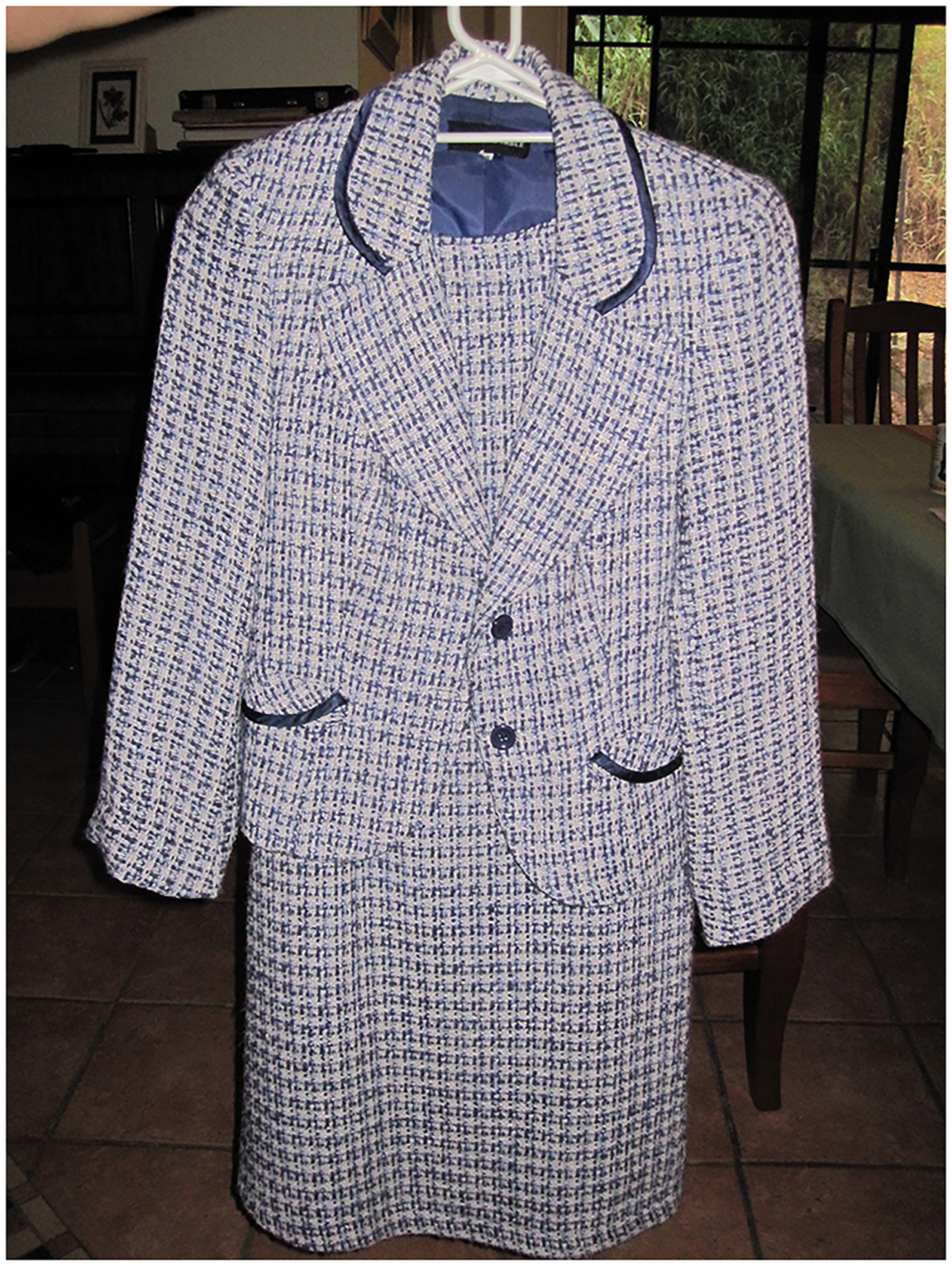
Designer-label plaid dress-suit given to Eliza from her sister. Photograph taken by the researcher.
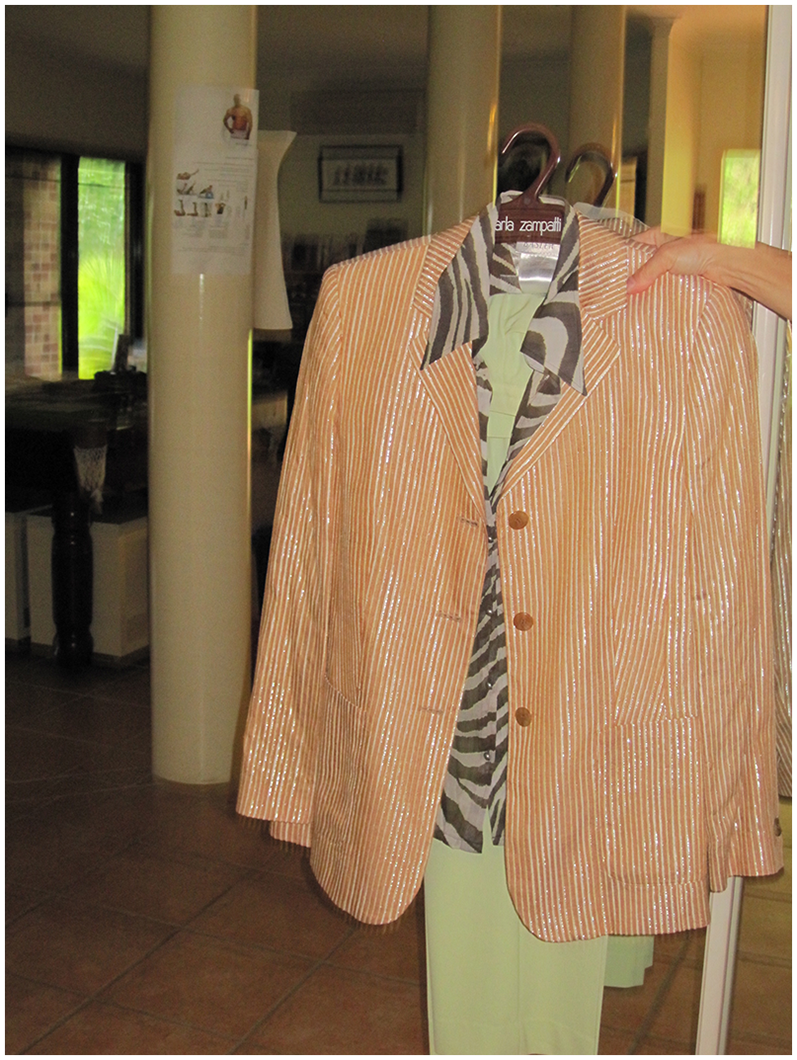
Assemblage of Australian designer-label pieces styled by and given to Eliza from her sister. Photograph taken by the researcher.
The examples above highlight that Eliza's motivations for sartorial decisions or practices are not located externally within social relations. Eliza's approach is a demonstration of ‘investment of time and effort’ (Clark, 2019: 318) in learning how to elongate the useful life of her clothing. As a middle-aged woman, Eliza has an expansive history of experiences with clothing. This has provided Eliza opportunity to accumulate necessary skills to ensure she can retain and extend the active life of her clothes. The material properties of clothing operate as a mechanism or tool-kit to navigate this element of the everyday. For Eliza, purchasing clothes made of natural fibres is very important; on which she claimed, ‘I think I’ve always been drawn to natural fibres.’ While this might appear to be an accurate statement for Eliza, one can only arrive at this position after engaging with myriad fabrics for comparison purposes. Certainly, on further probing, she admits to experiences, mostly negative, with other, mass-produced textiles such as polyester. She elaborates upon negative experiences such as excessive perspiration in acrylic jumpers and being embarrassed about her body odour while at work in smaller office spaces; realising that natural fibres allow air to circulate more readily through the weave of the fabric. This is one such example of knowledge born of engagement with the active material properties of clothing. Knowledge regarding fabrics might appear as innate for Eliza as she reflects on fabric preference, but the knowledge she refers to, or material mastery as Ingold (2000) would call it, has come to be embodied and practiced from engaging with clothing throughout her lifetime based on ‘sensory perception and practical engagement’ (Ingold, 2011: 30). The moisture-wicking properties as experienced by Eliza when wearing fabrics such as cotton and wool provided teachable moments many times over.
Discussing outfit assembly, Eliza described a formula she utilises to dress. The formula acts as a system or framework that guides what should be worn for the day's events. Again, gazing internally for guidance, rather than looking to external fashion-clothing cycles for inspiration or others around her. Having a wardrobe where clothing is organised into categories is one element of Eliza's system that provides an anchor for self-assuredness. For example, if it was a workday, Eliza would choose a skirt-suit or pantsuit with a blouse. See Figure 3 for an example of these suits. This sort of wardrobe organisation is echoed in research from others (Botticello, 2014; S. Woodward, 2007) but rather than interpreting this formulaic approach to outfit construction and wardrobe organisation as based in comfort or otherwise, I argue that Eliza's approach illustrates a sensibility to generate new imaginaries for her clothing – within categories and in combination with each other through assembly. This allows for her to operate outside of the market forces that suggest or conflate clothing changes with ‘transience and novelty’ (Botticello, 2014: 111) as those around her aim to imply.

Work outfits as photographed for Eliza’s dressing diary. Image supplied by participant.
Case study 2: Motherload and the archiving of clothes for (one-day) adult children
While Eliza does not need external modes of support through those that surround her, Peta and her young-adult daughter, Elle, demonstrate how it is that accidental sustainable practice can occur through repertoires of support. In this instance, support is manifest in material archives or collections of clothing. Oftentimes, storing of collections is associated with eccentricity or hoarding of materials in unhealthy amounts. Indeed, there is a whole industry built around helping individuals overcome the burden of too many things. It is what goes into Peta's archive and the longevity of each item that I examine here. In Ingold's (2011) terms, and as seen in Eliza, Peta demonstrates material mastery which manifests through material-based knowledge and skills when it comes to locating specific clothing styles and fabrications from charity or vintage stores. At the time of my data collection, Peta's repertoires of acquisition were not commonplace in Australia as they are across the contemporary Global North. This case is further enriched by the ways that Peta passes these archived pieces onto her now adult daughter. The rupturing of typical clothing flows and ideas of what objects can be considered inheritable is discussed below.
My first meeting with Peta and her young adult daughter, Elle, was in their family home in inner-city Brisbane. Best described as a house-in-progress, Peta and her husband were renovating while living at the property. First, I sat in the formal lounge with Peta drinking tea on newly reupholstered armchairs in leopard print fabric, before spending time in Elle's room and wardrobe with them both. Peta was a slender pale woman with dark wavy hair. She described herself as a former ‘fringe dweller’ to the Brisbane Gothic scene. Her clothing choices still reflected her identification with Gothic subculture to an extent some 20 years later. On this, Elle, described Peta as a ‘closet Goth’ when referring to her mother's collection of 1970s long black lurex dresses, high-top Converse sneakers, and well-worn denim jackets. Overwhelmingly, Peta held a deep and long-term appreciation for clothing fabrication and styles.
In discussions with Peta, it was very clear that she was a highly skilled woman when it came to locating items that were aligned with and informed by her subcultural sensibilities. What is significant to the consideration of accidental sustainable practices, however, is that Peta's clothes have rarely been sourced from retail stores that sell fresh-from-factory on-trend items of clothing. Instead, a majority of Peta's wardrobe has almost always been sourced from alternate channels. In our discussions, she described instances of driving to satellite suburbs far from where she lived to locate clothing from charity stores with her mother. Reflective of social sentiment at the time, shopping in charity stores was a source of shame for Peta as a child. As an adult, however, locating her clothing in charity or second-hand stores was a source of pride for Peta. The slow development of Brisbane's consumer markets meant that for many people, subcultural styles of clothing were located from second-hand stores before contemporary Western fashion transitioned to embrace second hand items as ‘vintage cool’ (Palmer, 2005: 198). Indeed, the sourcing of garments in this way had birthed a particular know-how in Peta. Not only did she know where to locate items, but she also understood what sorts of styles, cuts, fabrics, fabric patterns, and colours were associated with various decades of the 1900s. This knowing had been proactively pursued by Peta and continued to inform her clothing practices as a middle-aged woman.
These skills of procurement informed Peta's attachment to some items of clothing and accessories. As Niinimäki and Koskinen (2011) assert, the effort or achievement associated with locating these items in the first place has driven Peta to maintain a material archive of clothing. This collection largely features items that while no longer in use, continue to hold value for Peta. What makes the archive and what does not is largely informed by material determinations. For example, dimensions such as scarcity, fabrication, cut, colour, decade of origin, and condition help her to decide what to archive. Practicably, Peta's process of archiving involved careful laundering, curation, and storage; where the end-state of storage involved boxing of garments and accessories. On this, Peta is quoted: Peta: … because we’ve moved, this is the eighth house we’ve lived in since Elle was born; uh my husband is a builder, so we buy the grunge and renovate. So, you know, moving is horrendous and things get shed over the years, but I’ve kept - most of the things… there's not a huge amount, but what there is has been very well used and I’ve found that it's clothes that I wore probably just after Elle was born. They were second-hand clothes then - before the word ‘vintage’ happened - they were second-hand clothes, and they were things that I had from the fifties, sixties and seventies
3
that [others] really wouldn’t be caught dead in but now they’d be quite collectable. So, I kept those sorts of things.
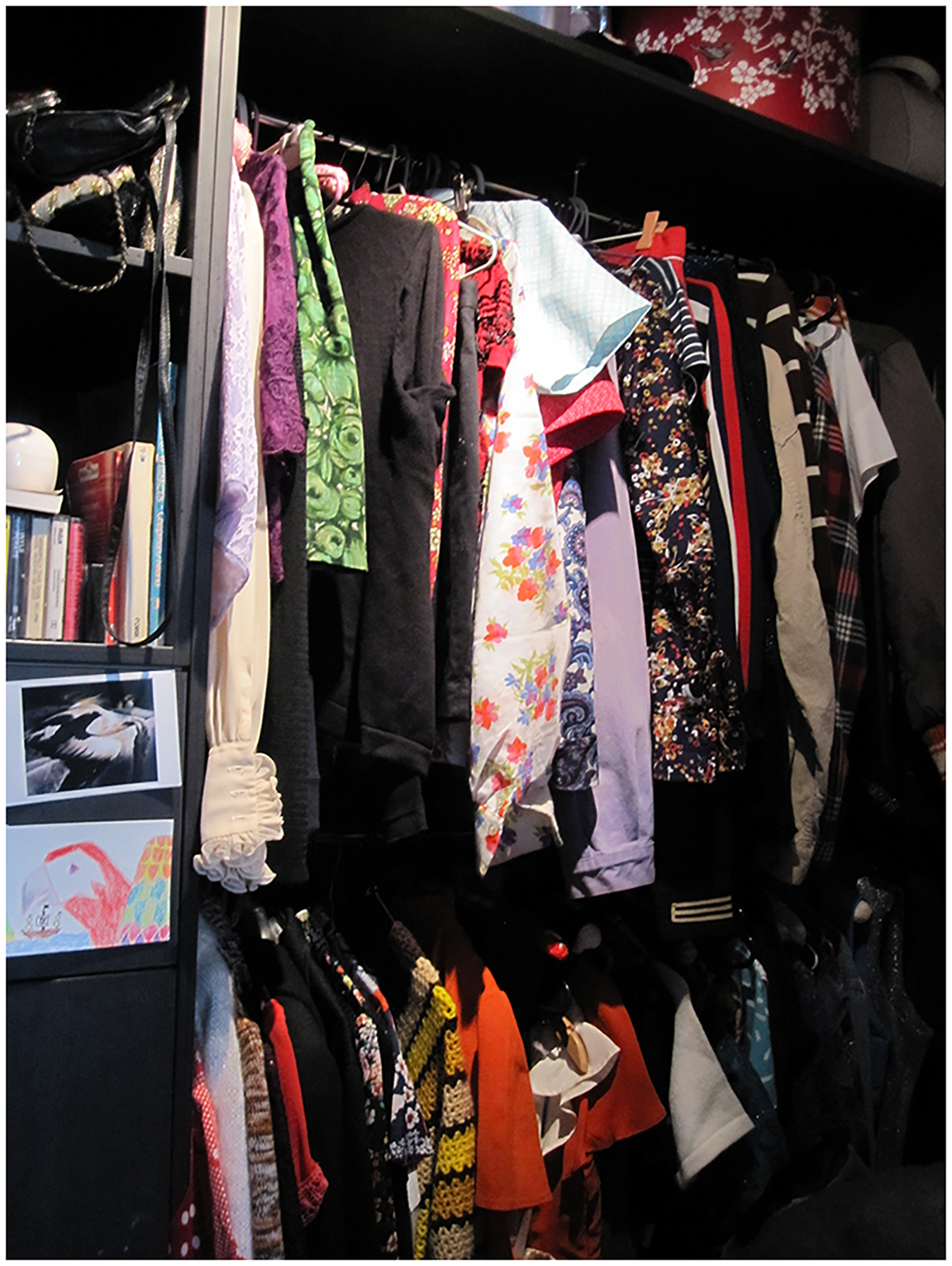
Portion of Elle's wardrobe as photographed by the researcher.
As a young adult, intergenerational flows of clothing operate as a site for Elle to embrace her mother's sartorial sensibilities while learning how to be a woman. As a gendered object category, clothing can provide an informal site of learning. The extent to which aesthetic reproduction occurs between this mother and daughter suggests that Elle views her mother as the materially assembled ‘ideal’ woman. When discussing her mother's style, Elle describes Peta as ‘very cool.’ In the context of master and apprentice as Ingold (2000) depicts, the clothing archived and shared between mother and daughter provides a material site where material mastery can be taught. This process greatly differs to Eliza's experience. For Elle, approach to clothing is heavily supported and converges with the interests and sensibilities of her mother. According to psychoanalytic accounts of visible aesthetic reproduction, the mother–daughter relationship is the apparatus that teaches girls how to be women. Elle has learnt ‘what it is to be womanlike in the context of personal identification with her mother’ (Chodorow, 1999: 175). The clothing collection that Elle embraced is treated as an inherited asset to draw from; allowing passage into adulthood from girl to woman while mirroring those aspects of her mother she admires. In many ways, this reproduction acts as a template or guide for navigating clothing.
As an example of the above, at our first interview Elle was wearing a pale pink dress that Peta had received as a gift from her sister, Elle's aunty. The dress was found in a second-hand store and worn often from around the time that Elle was a baby. Having once been a maxi-length dress, Elle had modified the dress to sit above her knees. She felt that shortening the length helped it to feel more age-appropriate. With its long sleeves and broderie anglaise, the dress maintained a mod aesthetic. Both women were particularly happy with the new life that Elle has given the dress. While use of this garment was not transformed, it was still a dress upon transformation, the form of the garment had been altered. This form influenced the way Elle visualised and styled it. Choosing black tights and a pair of black high-top Converse sneakers that she had ‘stolen’ from Peta's wardrobe was markedly different to the ways Peta once wore the pink dress. Elle can be seen wearing the altered pink dress in Figure 5.
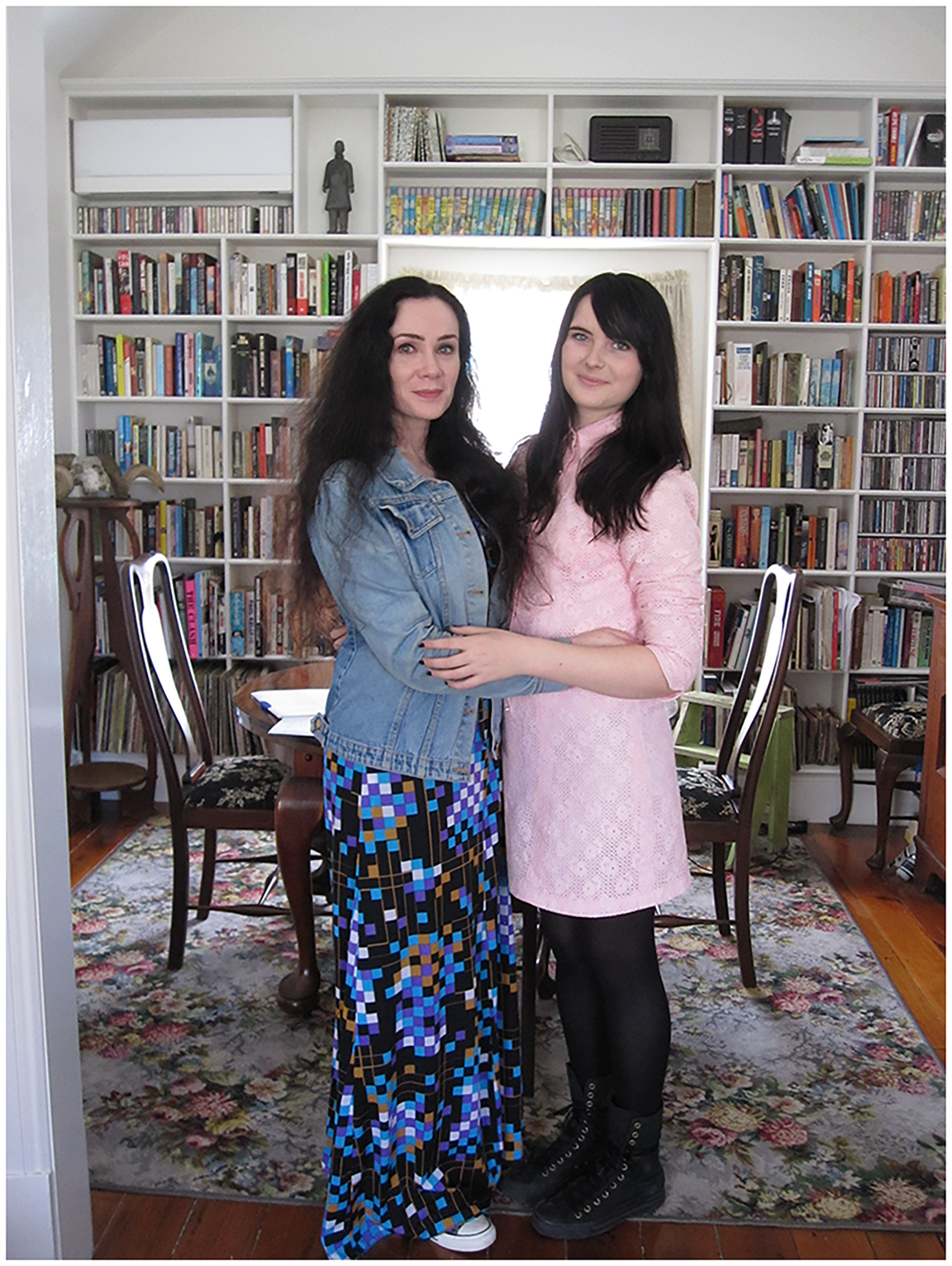
Peta and Elle together. Elle wears her ‘new’ pink dress.
Interestingly, despite the former life this pink dress experienced with Peta, Elle refers to it as her ‘new dress:’ Interviewer: Do you have one outfit or a piece of clothing that is your favourite for the moment? Elle: Alright, sure. This is my new dress [pointing to the dress she is wearing] and it's my favourite one at the moment but it's probably because it's new and I haven’t - I’ve only worn it once so I’m like, ohhhh, yeah.
In a separate discussion alone with Peta she also makes a mention of this dress to me: Peta: the dress she's got on today was something that my sister gave me from an op-shop in Gympie and it was floor length and I used to wear it like that and then probably about ten years ago I stopped wearing it. Um and then we just had it cut-off a couple of days ago, a friend hemmed it and it looks beautiful on. So it's kind of, you know, we’re sort of doing that with things now. I’m quite happy to chop some things off if I don’t wear them.
Discussion: Women's wisdom through enskilment
So, what is it that affords women opportunities to be sustainable or ‘pro-environmental’ without tending to the ecological or maintaining strong pro-environmental convictions? This research highlights those sensibilities that allow sustainable practice are deeply rooted in the material and the material affordances clothes allow women. In extending S. Woodward's (2015) consideration of accidental sustainability, this research shows that in particular contexts, women are able to retain and extend the active life of their clothes without being urged to do so for the sake of ecological demise, for example. Instead, the research presented here suggests that sustainable clothing practices amongst women occur outside of those market forces (fashion-clothing cycle) that are considered dominant to contemporary life. Moments of rupture to these logics likely occur in vast amounts for women as they draw on past experiences as these inform knowledge and skillsets. This is a similar observation and reflection offered by Clark (2019) in her analysis of slower modes of production and consumption that are inevitably more sustainable. Her (Clark, 2019: 313) concept of ‘women's wisdom’ is an effort to account for the logics that inform the sustainable choices that women make when it comes to their clothing. Clark (2019: 318) recognises that women exhibit this materially based wisdom as it manifests through ‘different levels of skill’. Overwhelmingly, my research corroborates these claims.
The common theme to the sustainable material practices reported here is material mastery. Mastering clothing practices through combination of knowledge and skill allow women opportunities for pro-environmental practices – accidentally. Knowing what practices are effective and to the same token, ineffective is only possible through lived experience. The full gamut of interactions with clothing are bridged by the skills that women employ; most of which are so embedded at the axis of mind–body there is no need to stop and question how they should navigate a particular situation. Ingold (2000: 316) refers to this collision of skill and knowledge as ‘knowledgeable practice and practical knowledge’ through the concept of enskilment. Broadly, enskilment is defined as a learning that is inseparable from doing (Ingold, 2000). It is the accumulation of ‘deep, tacit and practical knowledge’ (Woods et al., 2021: 3). Thus, enskilment allows for the accounting of women's wisdom in practice. Here, this is a tool to account for wisdom in action.
The relationship between knowledge and skill is dynamic, just as the relationship between a woman and her clothing is. For example, how is it that a woman knows what fabrics will last longer and feel better on her body? In these moments of evaluation, she is engaging with the materiality of clothing; how the fabric feels, moves, falls against the body while drawing on past experiences with clothing. This means that to be ‘enskilled’ is to have on-going understanding of clothing in practice. Ingold (2011: 30) refers to the knowledge held and used by craft persons (e.g. stonemasons) as knowledge that comes from ‘a lifetime's experience of working with the material. This is knowledge born of sensory perception and practical engagement… of the skilled practitioner participating in a world of materials.’ Eliza does not need additional clothing to dress for work, events, or socialising; she has developed a unique skillset that enables reuse of clothing items. Continual renewal or ‘continual possibility’ (Willett et al., 2022: 219) is achievable without the need for additions to her wardrobe and has become a practice embodied. As a system of practices that effectively works for her, this is argued to likely be a source of empowerment for Eliza (Clark, 2019). The skills that Eliza embodies and enacts with her clothes highlights the sort of material know-how or self-determination that accidental sustainability can capture in the context of the everyday.
Systems of sustainable material practices are not necessarily fixed. The ‘tool-kit’ can be adaptable for women. Peta's ability to take what is preserved and make it new again is one such example. As an assertion of wisdom in action as it manifests through being highly enskilled, the mastery involved in this process is based in specific material know-how. For example, working with existing cuts, styles, fabrications both allow and constrict what can be done when altering a garment to make it new (Botticello, 2014). Being enskilled within certain repertoires of clothing means that Peta can respond to each garment dynamically. At first glance Peta's sensibilities might appear as a steadfastness towards garments simply because of their era of origin or an aesthetic determinism associated with subculture, but further probing highlights that she embodies an understanding in practice. She demonstrates task and object-specific practice; readily shifting as a specific clothing item requires of her. The newly transformed pink dress is one such example of Peta's abilities. That is, altered in length, in a way that she understands will work for Elle, while also within the bounds of the dress itself. Ultimately, Peta's enskilment has informed the longevity of many garments. It is clear that her material mastery provides access to sustainable clothing practices.
Inasmuch as Elle takes in Peta's archived clothing as her own, there are further processes occurring in these moments that should be explored for the purposes of documenting sustainable practice. To this point, the role of Peta as experienced practitioner in relationship to Elle is akin to master and apprentice. In transforming old clothes to make them new again alongside her mother, Elle is provided opportunity to become enskilled herself. The materially grounded moments where Elle experiences or witnesses manifestations of Peta's material mastery ‘provide inspiration, guidance and criticism’ (Ingold, 2018: ix). Practice is based in doing which means that by paying attention to Peta's actions as they interact with clothing, Elle is guided through a ‘hands on’ (Woods et al., 2021: 6) approach to education that occurs through attention. Living within the same house provides opportunities for interactions with clothing daily. Access to each other's wardrobes, Peta's archived clothing, and conversations bound to the material means that clothing intrudes upon several of their daily interactions. While not all women have access to modes of support, as is the case for Eliza, the opportunities for learning skillsets that inform sustainable practices are indeed aided by one's social milieu.
Conclusion
Accidental sustainability is the concept explored here to reference the sustainable material practices women already engage when dealing with clothing. By adding to and extending the initial considerations of this material-culture bound concept (S. Woodward, 2015), the research findings outlined here are significant in developing greater form to the sorts of everyday practices that can be classified as accidentally sustainable. Utilising enskilment (Ingold, 2000) as a lens with which to account for the practices and models already in place (Clark, 2019) as actioned by women or wisdom in action, means that research such as this contributes towards frameworks that emphasise clothing-related sustainable practices that women already engage behind closed doors. To the same token, new skilled material-practitioners can be nurtured to ensure sustainable clothing consumption into the future. Similarities exist across the cases outlined above. While consistencies help to locate characteristics of accidental sustainability, I have not set out to identify typologies aligned with accidental sustainability. Instead, these cases show myriad ways that clothing retention and longevity might occur. Largely, material mastery is at the core of accidental sustainability. Material mastery includes valuing those items one already owns, textile choice, stylistic guideposts, garment care, and in some instances, genres of support. Understanding the ‘what’ and ‘how’ of everyday clothing practices amongst women is argued to provide important insight into sustainable practices – by accident.
Of substantial significance to the findings presented here is the use of historical data to explore sustainable practice that occurs accidentally. The material practices outlined here precede notions of green marketing or overt initiatives to slow consumption amongst ordinary Australians. Indeed, the popular sociocultural milieu was one of prosperity at the time (2011–2012) having narrowly avoided recession, the Australian dollar was at parity or above the market measure, the US dollar. By exploring the ways that women employ skills that are materially bound, but are sustainable, reinforces that solutions are not always born from innovations that are strikingly novel or linked to technological innovations as the clothing industry would have consumers believe (von Busch, 2022). In the cases outlined above, women have been shown to engage with clothing in ways that make sense to them based on their experiences with this object category. This was captured and explained through enskilment or material know-how. In all my interviews, no woman stated to me that she was still wearing, had kept, or repaired an item of clothing for the sake of the natural environment. Rather, clothing retention and longevity occurred because of multiple extenuating factors and ruptures to the well-documented assumptions aligned with the fashion-clothing cycle. If, as argued by Clark (2019), women were engaging with their clothing in sustainable ways for periods pre-dating capitalism, there is opportunity to emphasise and appeal to these factors when addressing women as consumers in the contemporary. That is to say, rather than a reliance on pro-environmental messages that work to vilify acts of consumption, or ignore the ‘garment use phase’ (Holgar, 2022: 133) there is opportunity to craft educational programmes, improve consumer messaging, and by extension, policy at the end-user level in order to draw attention to those sustainable acts that are already occurring behind closed doors. Holgar (2022: 133) refers to this approach as ‘fairly representing fashion consumption… to [be] agential, capable and responsible.’ While seemingly complex, this shift to engage and support clothing end-users is achievable.
There are considerable opportunities for future research associated with accidental sustainability as both a concept and a tool with which to approach end-users of material objects. This research is the first to provide further dimension and in-depth consideration to the concept as proposed by S. Woodward (2015). I propose that further research on the ways that women are accidentally sustainable is needed and research studies should include genres of material objects other than clothing. Further, it is imperative to include research studies that expand our documented understanding of the ways that other familial relationships act as sources for learning, or perhaps not learning, material mastery. Approaching these materially grounded relationships as they occur behind closed doors should be seen as the new frontier for material culture researchers. To this same token, research should expand to include other segments of the global population to consider if there are differences cross-culturally that can inform new ways of understanding, educating, and messaging to large groups of consumers. Gathering insight and forming depth to accidental sustainable practices is important in the pursuit of securing a more sustainable future for us all.
Footnotes

Funding
The author received no financial support for the research, authorship, and/or publication of this article.
Declaration of conflicting interests
The author declared no potential conflicts of interest with respect to the research, authorship, and/or publication of this article.