




Abstract
Carnival in New Orleans is a complex, vibrant field of cultural production that generates a wealth of material culture. In the small-scale, countercultural ‘new wave’ of carnival ‘krewes’ or clubs that have proliferated since Hurricane Katrina, that material culture is often handmade. Framed by Daniel Miller's dialectical theory of material culture and drawing on ethnographic fieldwork spanning several carnival seasons, this paper unpacks what is at stake in new-wave carnival's costumes, throws, and floats. We argue that making these objects makes carnival itself: the handmade things shape people's experiences of carnival, generating vivid, memorable interactions and encounters, which they later encapsulate as mementos. In their handmade-ness, carnival-makers not only recognize the effort that people put into the events, but also carnival's sociality and relationality. While Miller emphasizes ‘the humility of things,’ these things are loud and flamboyant. They nonetheless help illustrate how culture unfolds with and through stuff.
Introduction
Carnival in New Orleans is a complex, multifaceted, vibrant field of cultural production. The most exuberant pre-Lenten celebration in the USA, it begins on January 6, Twelfth Night, and culminates on Mardi Gras day, 47 days before Easter Sunday. The parades, parties, and costumed rambles of the season generate a rich and varied material culture, from formal fascinators to papier-mâché alligators, from pretty painted flowers to grotesque giant genitals, from regal beaded and feathered suits to thrown-together wordplay costumes. This article focuses on the material culture of one subset of carnival, new-wave carnival clubs or ‘krewes,’ drawing on interviews and participant observation to show how the things that krewe members create for carnival frame their experience of the celebration. In his theorization of material culture, Daniel Miller (2010) has unpacked the ‘humility of things,’ arguing that people rarely notice the ways that everyday objects shape society, culture, and experience precisely because they see those objects as banal. In contrast, our study offers a case of the ‘flamboyance of things’, showing that objects marked out as special also dialectically constitute social relationships and cultural forms – although even remarkable objects do this in ways that go unremarked. The material culture of carnival makes carnival, in that it structures the practices and experiences that relate to the celebration. By making things for carnival, often by hand, and then using them in various ways, members of new-wave krewes create carnival experiences.
Carnival has been part of New Orleans’ annual ritual calendar since the colonial city was founded by the French in 1718 and has always reflected the social shifts of the times (Gill, 1997; Kinser, 1990). Pre-Lenten carnival – the period of feasting, drinking, and sexual license that precedes the fast before Easter – travelled from Europe to the new world with Catholic colonizers, where it melded with festive practices from African, Indigenous, and Asian cultures (Burke, 1996). In colonial cities such as Port of Spain (Trinidad), Montevideo (Uruguay), Oruro (Bolivia), and São Paolo (Brazil), carnival ‘acted as a ritual site for sociocultural contestations and esthetic resistance, between a hegemonic European group and subordinate indigenous, creole, mestizo and African peoples’ (Nurse, 1999: 667). New Orleans’ carnival was no exception (Godet, 2020; Kinser, 1990; Roach, 1993). By the 1790s, it centred on a series of public and private balls, some masked. The potential for interracial mixing so disturbed the Spanish authorities that they tried to ban Black residents from masking in 1781 (Gill, 1997). Ostentatious travel to and from carnival balls evolved by the 1830s into loosely organized, exuberant street processions of costumed figures, ornate carriages, and musicians that drew crowds, and sometimes violence. Wanting to impose order on what they viewed as chaos and stake their own claim to the city, a group of Anglo-American businessmen founded a secret society, the Mistick Krewe of Comus, to stage the first formal parade of ‘two small but exquisite floats’ in 1857 (Gill, 1997: 45). This move, typical of the bourgeois ‘spectacularization’ of carnival (Stallybrass and White, 1993), divided spectators from paraders and introduced the idea of the ‘krewe’, a social club that organizes carnival events, typically consisting of a public parade and a private ball. The white upper classes of New Orleans embraced this new form for carnival, partly due to its city-boosting potential (Gotham, 2007), and formed other krewes after the Civil War. Until the 1930s, four to six male krewes staged parades each carnival season (Gotham, 2007). Committed to upholding white supremacy and undermining the civil rights gains of the Reconstruction period, these elite krewes codified a socially stratified, racialized, and gendered hierarchy of carnival celebrations (Gill, 1997; Roach, 1993). However, they never fully eclipsed the city's more ebullient, participatory traditions.
With the expansion of mass tourism and popular culture, carnival krewes proliferated in the second half of the twentieth century: there were ten official parades in 1940, 25 in 1970, and since the mid-1980s, krewes stage approximately 50 parades a year (Gotham, 2007), mostly in the last few weeks of the season. Councilor Dorothy Mae Taylor succeeded partially in her highly contested campaign to desegregate carnival krewes in the early 1990s (Gill, 1997). Women's krewes gained in prestige as women gained access to resources and professional standing (for discussions of gender see Roberts, 2006; Sheehan, 2023). Present-day krewes still reflect the social stratification and relative segregation of the city, varying by social class, gender, and racial composition, aesthetics, politics, cost, exclusivity, and longevity, as well as size and degree of formality. Most krewes are mostly white, a few, like the venerable Krewe of Zulu (Smith, 2013), are mostly Black, and some, like King Arthur, try to be racially mixed. Black New Orleanians maintain important carnival practices that are distinct from parading krewes. The Black Masking Indians draw on African masquerading traditions and honour a history of resistance to oppression and solidarity shared with Indigenous peoples (Lewis et al., 2009; Becker, 2013; Committee Members of Fi Yi Yi et al., 2018). The Baby Dolls are social and parading clubs of Black women that speak to their power, independence, sense of fun, and pleasure (Vaz, 2013). Unlike civic parades in many other cities, New Orleans’ carnival parades are funded through krewe members’ dues and donations, and commercial advertising in them is prohibited. They are also uniquely interactive, in that paraders toss ‘throws’ – strings of beads and other trinkets – to spectators. As voluntary organizations, krewes are an important local social infrastructure for sociability (Radice, 2021); people join them with friends and make friends in them, and they may become deeply involved in a single krewe or spread their energies among several. Carnival attracts millions of tourists and is woven through with local understandings of heritage and authenticity, performances of belonging, and constructions of community (Gotham, 2007).
Our research focuses on what we call the ‘new wave’ of carnival krewes, which emerged from the countercultures of the 1960s and 1970s and burgeoned in post-Katrina New Orleans as long-time residents and recent ‘transplants’ sought to claim and perform their sense of belonging to the city they feel to be unique. In contrast to mainstream krewes, whose members ride on big tractor-drawn floats along broad avenues uptown, new-wave krewes organize small-scale parades in which members walk alongside people-powered or mule-drawn floats that carry one or two people (if any). This means they parade on the same level as their audience, through the narrow streets of the French Quarter and nearby downtown (downriver) neighbourhoods. They often consist of an overarching ‘mother’ krewe, which organizes logistics and sets the annual theme, and subkrewes that present their own take on that theme. For example, bawdy, satirical Krewe du Vieux (founded in 1987) has 17 subkrewes, Krewe Bohème (founded in 2019) has about 30, and the massive sci-fi and fantasy themed Intergalactic Krewe of Chewbacchus (founded in 2011) has over 100. New-wave krewes are mostly white, though recently krewes have emerged such as the Women of Wakanda, an Afrofuturist Black women's subkrewe of Chewbacchus, and the South Asian women's Krewe da Bhan Gras and the pan-Asian Krewe of PhantAsia, both of which roll in Krewe Bohème. Membership dues, to pay for bands, permits, and policing, range from USD$100–350, rather than the USD$500–1000 mainstream krewes charge, though there are also ‘underground’ krewes that parade with neither a municipal permit nor a police escort. Crucially, new-wave krewe members typically make their costumes, floats, throws, and other props themselves, rather than outsourcing to professional float-building and costume-making companies of New Orleans and trinket-producing factories in China. Most new-wave krewe members also make or assemble a costume to wear on Mardi Gras day, when they might join a ramble (a less formal parade, the most renowned being the Society of Sainte Anne, founded in 1969) or just roam the French Quarter with thousands of other revelers. It is because of this desire for flamboyance that the crafting of things is central to new-wave krewes’ carnival practices.
The abundant material culture of carnival in New Orleans has received little scholarly attention. Henri Schindler, artistic director of several parades and co-founder of the Society of Sainte Anne, has published richly illustrated books on the ‘golden age’ (roughly 1870–1929) of the ‘old-line’ krewes, which first sourced costumes, jewels, and papier-mâché masks and figures in Paris, but soon hired local European immigrant artisans to make their materials (Schindler, 1997: 59, 2000, 2001). The beads thrown by mainstream krewes are the focus of a creative introductory archaeology textbook (Wilkie, 2014) and a critique of the globalized commodity chains, environmental harm, and behavioural excess in which carnival is enmeshed (Redmon, 2015). Two community ethnographies by the Neighborhood Story Project detail the intense creativity and finely honed skills that Black Masking Indians put into their beaded, feathered suits (Committee Members of Fi Yi Yi et al., 2018; Lewis et al., 2009). Finally, Wade, Roberts and De Caro (2019) describe the material culture of some new-wave krewes (which they call ‘downtown’ krewes), but do not take it up as a major analytical theme as we do here. Our paper begins by outlining the theoretical framework and methodological strategy we adopted. It then draws on ethnographic material to make three main points. First, we argue that by making material culture for carnival, new-wave krewe members are helping to create carnival itself. Second, new-wave carnival krewe members’ crafting work not only makes carnival, setting up the frame of the celebration as a whole, but also then shapes the experiences they have of carnival. And third, the material objects of carnival are meaningful because they help generate the social practices and interactions surrounding them. These closely related yet distinct points build an explanation of the centrality of material culture, especially handmade material culture, in the new wave of carnival krewes in New Orleans.
Investigating the material culture of carnival
Our approach to the material culture of carnival draws primarily on Daniel Miller's work (summarized in Miller, 2010). He rejects the semiotic idea that objects are mere representations or symbols of people, relations, and meanings, which he thinks oversimplifies the relationship between persons and things. Instead, Miller understands material culture as the frame through which people learn and enact culture, in the sense of Goffman's frame analysis. Although frames remain largely unnoticed, they prompt people's responses to situations, shaping the kinds of behaviours and interactions that occur in each setting. Miller gives art as an example: We experience something as art not because of its inherent qualities, but because it is framed as being art, and the art frame cues art-appropriate behaviour. Drawing on Bourdieu's theory of practice, Miller further argues that people learn and sustain their subconscious ways of being and doing, their habitus, in part ‘through a process of habituation with the order of the things around them’ (Miller, 2010: 52–53). So, the set of things that people interact with in their everyday routines is the frame through which they learn their socially and culturally specific habitus, which, in turn, constructs their ways of being. In this sense, objects create us as much as we create them. However, the things that frame the learning of habitus are often so familiar they are taken for granted and go unnoticed, which Miller refers to as the ‘humility of things.’ Indeed, Miller thinks that the less noticeable objects are, the more powerful their influence; the things we take for granted shape us the most. This theory of material culture is relational, in that any entity (whether a person, a thing, a norm, or something else) in a specific setting does not exist in isolation but in relation to the whole, as well as dialectical, in that people and objects are not distinct from but rather constitute each other.
We are also influenced by Henare, Holbraad and Wastell's (2007) approach of ‘thinking through things’ (despite the tension between this and Miller's work, see Geismar, 2011). Like Miller, these authors question the assumption that ‘meanings attach to things, impose themselves on things, may even be inscribed or embodied in certain things’ and ultimately that meanings are distinct from things (Henare et al., 2007: 3). Instead, their heuristic, ontological approach takes things as having meanings in themselves, before anthropological observers apply theory and analysis. Understanding those meanings then emerges from the ethnographic encounter, in which things can ‘dictate the terms of their own analysis,’ and potentially indicate new theoretical possibilities (Henare et al., 2007: 4). They recommend that anthropologists ‘take “things” encountered in the field as they present themselves, rather than immediately assuming that they signify, represent, or stand for something else’ (Henare et al., 2007: 4). By examining the centrality of objects in people's everyday lives, ‘thinking through things’ can shed new light on aspects of culture and sociality. Lewis, for example, ‘follow[ed] the “things”’ (2018: 309) in a working-class neighbourhood of Manchester, looking at how community was made among a group of older women who sustained social ties and supported each other and their families by exchanging material items like money, gifts, and cards. The material objects that traversed the women's social networks served as the frame through which the women mobilized their social ties and consolidated their social networks, as they coped with the precariousness of working-class life in a place where community is said to be fragmenting.
We combine these two approaches in our anthropological research on the material culture of carnival. We ‘think through things’ to elicit understandings of cultural practices that are closely aligned with participants’ realities (Craig, 2011; Henare et al., 2007; Lewis, 2018). We also take the stance that identities and social relations are partially constituted from people's interactions with and through the object world, which serves as the frame for their social and cultural lives (Miller, 2008; Miller, 2010; Wilkie, 2014). By exploring new-wave carnival's material culture, we show how a material culture approach can offer new insights into festive practices. Our article is part of a broader research project on new-wave carnival led by Martha Radice, who has conducted over 19 months of ethnographic fieldwork in New Orleans since 2016. Briana Kelly focused on material culture, and joined Martha for two weeks in February 2020, to experience carnival and prepare a return fieldwork trip of her own. The outbreak of the coronavirus disease 2019 (COVID-19) pandemic shifted our research online. Between August 2020 and January 2021, Briana conducted ten qualitative, semi-structured interviews over Skype with eleven participants from five new-wave krewes, recruited via the krewes’ social media presence, Martha's contacts, and interviewees’ suggestions. The interviewees ranged in age from 27 to mid-fifties; four were men and seven were women. Three self-identified as being of Mexican origin and one as ‘Caucasian Jewish;’ in the US context, the three of Mexican origin would probably be racialized as Latinx while the other eight would be seen as white. Two interviewees were from New Orleans, three were from Mexico, and six had moved to the city from elsewhere in the USA. Their main krewes were Mayahuel, a Mexican krewe that has paraded with krewedelusion and Krewe Mosaique; Interrobang‽, which uses industrial materials to build ambitious large-scale floats for parades and parties and rolls in Krewe Bohème; the feminist Krewe of Full Bush, also in Bohème; several subkrewes of the Intergalactic Krewe of Chewbacchus; and the Krewe of OAK, which parades in the Carollton neighbourhood the Friday before Mardi Gras and organizes a ‘Midsummer Mardi Gras’ in August.
Interviews probed participants’ experiences and views of carnival and Mardi Gras, especially their involvement in making, using, and appreciating its material culture. They also incorporated object-based interviewing (Miller, 2008; Woodward, 2016). Participants brought to their interview a couple of objects that they had made for carnival, which served as prompts ‘to elicit people's own accounts of their things’ (Woodward, 2016: 372) including the making of the things and what counted as ‘making.’ By inviting interviewees to tell us about the item while they held and looked at it, we heard stories that might not have been so accessible through abstract questions. The objects anchored their narratives. Since the interviews were conducted online, we could not handle the objects ourselves, but that made us ask more specific questions to figuratively grasp them from a distance. Carnival-makers had a great deal to say: interviews lasted from one and a half to nearly three hours, yielding 768 double-spaced pages of verbatim transcripts. These were qualitatively coded, checked, and re-coded using an open, inductive coding strategy (Bernard, 2011). We sorted the interview data into labelled chunks, which we then interpreted, compared, and reorganized into the patterns and themes that illustrated material culture's role in participants’ carnival practices (Emerson et al., 1995; McGarry and Mannik, 2017). We invited interviewees to deposit their interviews in a collection in the T. Harry Williams Center for Oral History at Louisiana State University; all accepted, which means that we use interviewees’ real names and that their interviews will be publicly available.
Our participant observation in carnival-related activities provided crucial context for understanding interview material and firsthand embodied experience of making, handling, and appreciating the material culture of carnival. We watched parades of all varieties and caught their throws. We paraded with several new-wave krewes as members or marshals, and we made costumes to join the street maskers on Mardi Gras day. By participating in some of the many layers of carnival in New Orleans, we grasped how enmeshed it is in the fabric of everyday urban life and we felt the energy and excitement that the season brings. Crucially, we appreciated through our senses as well as our intellects just how much carnival is made by its material culture.
‘Time to make Mardi Gras’: Making carnival
If, as Miller suggests, material culture and social norms and interactions mutually constitute each other, it follows that by making material culture for carnival, new-wave krewe members are helping to make carnival as a whole. Without the effort members put into making the costumes they wear in parades, the throws spectators look forward to catching, the floats, puppets, signs, and other props they roll with, new-wave krewes’ parades would not exist. So, by crafting the material culture that scaffolds their parades and carnival participation, new-wave krewe members are creating parts of carnival. This creative role was important to many interviewees. For example, when we asked Marie-Claire Serou, a member of the Krewe of Full Bush, what the costume pieces she made meant to her, she explained: I think they’re deeply connected with my sense of self-esteem, and who I am as an individual and who I am related to other people, that I am a contributor to a joyful atmosphere but also that I’m part of that, and that I share this love with other people who are also into this. It's a much more meaningful experience when you become a part of a parade krewe. Because then you’re making Mardi Gras. We even use that term, ‘time to make Mardi Gras.’ […] We enjoy so much making costumes and making throws that make people who come to our parade have fun. the making stuff in New Orleans, and especially the making of a costume, is everybody. That's the ethos. […] It's just part of the fabric of the thing. If you show up in a crappy costume, no one's going to say anything, but […] there's a lot of people who put in a lot of effort to [the costumes] because they really care.
Care is thus an indicator of quality: interviewees judged a costume or throw by the effort put into making it. For Marlene: a bad throw in Chewbacchus is a throw that somebody didn’t put any care into or any thought into or didn’t actually make themselves. A good throw is something that somebody put care into, that they made themselves, and that they thought about what it was going to mean to the person who receives it.
Moreover, carnival offers makers an opportunity to create elaborate pieces of material culture: ‘carnival is the stage for grand things,’ as Ricky Ostry put it. Another member of Interrobang‽, Ricky helped make Gilliam the Cloud Whale (Figure 1), the krewe's first large float and an impressive work of art (Krewe of Interrobang‽, n.d.). He explained: The whale […] would not exist if Mardi Gras didn’t exist. And there are other places that people are building things like that. […] [There are] giant puppet festivals all over the world, but this is our excuse to build something huge and be big, be loud.
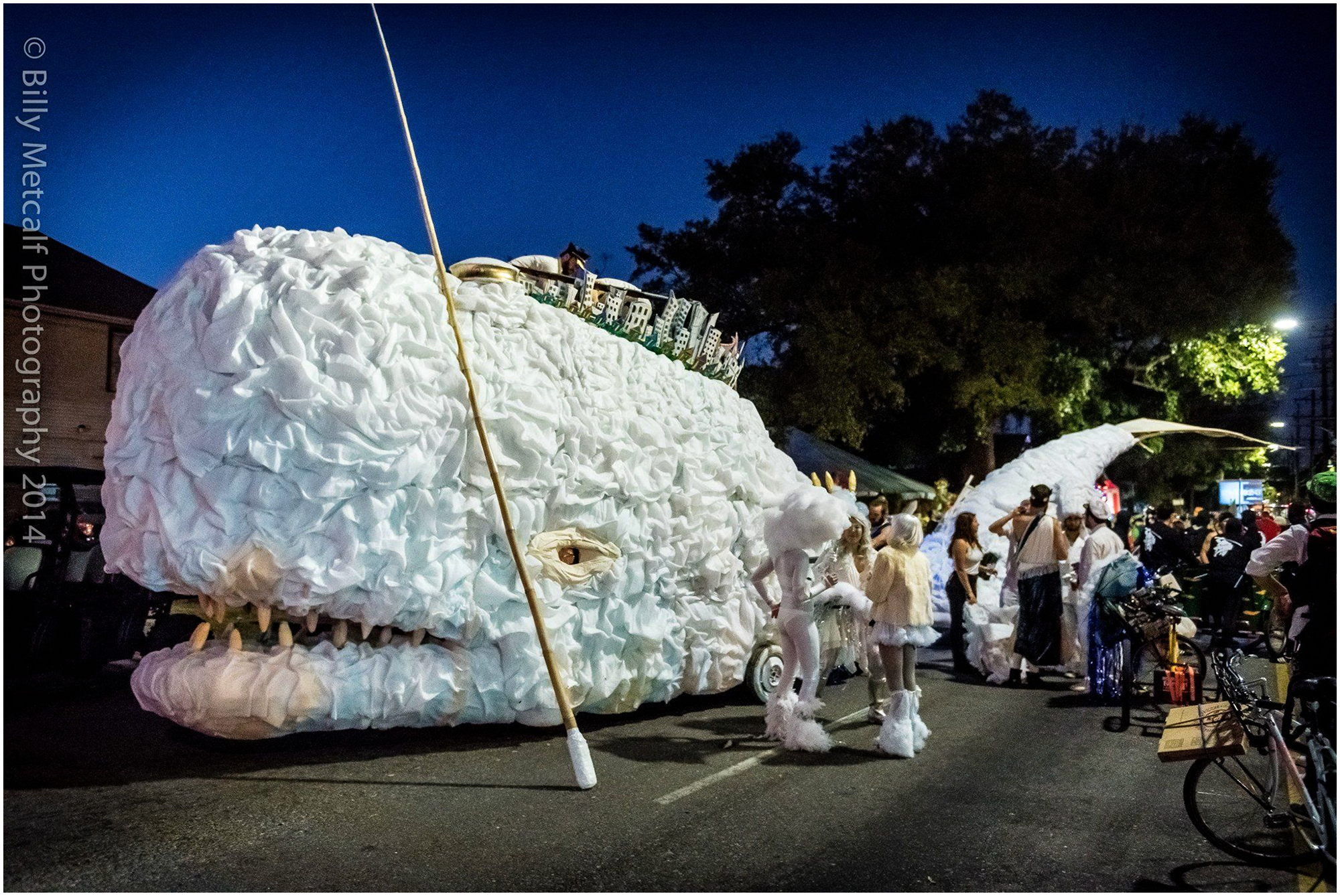
Gilliam the Cloud Whale. Photo courtesy of Ricky Ostry, copyright Billy Metcalf Photography 2014.
‘It's not about the beads, it's about everything around that’: Making experiences
Our second point is that the objects crafted by new-wave carnival krewe members not only make carnival, setting up the frame of the whole celebration, but also then shape the experiences they have there. Dan's story of his first Mardi Gras in 2015 illustrates this distinction. Originally from Connecticut, he recounted the moment that he decided to move to New Orleans: I basically left the house that I was staying at and I turned the corner, and parked on the corner was this giant whale made of clouds, with all of these hot half-naked people twerking on it, and they were all dressed as angels and there were lights coming out of the whale and sick house music, and it was like stumbling into a fever dream. I really didn’t know if I was asleep on the couch still or not. And I had already wanted to move, but that was really the moment that crystallized it.
One part of the experience is crafting the things themselves. It is often a sociable activity, undertaken in the company of fellow krewe members or friends. In 2020, for instance, we joined in a group costume for Box of Wine, a new-wave parade that rolls along St Charles Avenue before the mainstream super krewe Bacchus, pouring boxed wine into spectators’ mouths in a true homage to the eponymous god of wine. The theme was ‘Winesight is 2020’ and, thinking of hindsight and hindquarters, a group of friends formed the Secret Order of Assface People (SOAP) for the parade. We sat round a dining-room table, bantering as we figured out the best method to turn foam-rubber novelty buttocks into headpieces, using cardboard, needle and thread, and hot glue guns. Each person took their headpiece home to give it a face and a distinct personality. Collectively, SOAP made a striking contribution to Box of Wine. We made our headpieces mere days before the parade, but often, new-wave krewe members start preparing costumes, throws and floats well before their event, sometimes even before carnival season begins in January. They describe this labour as intense, even overwhelming, but also fun and ‘a very important step toward enjoying carnival […] it's all the things that are behind that count,’ as Maria Rodríguez-Casillas, a founding member of the Krewe de Mayahuel put it. Roberto Carillo, another founder of Mayahuel, told us: You look forward to carnival. And because you look forward to carnival, then you look forward to making your costume because you remember that it's coming. So you have to wake up in the morning and start doing that thing because if not, you won’t have a nice carnival.
1
A crucial element of carnival in New Orleans that is oriented toward other people is the practice of giving throws to spectators. Jenn Coursey marches with Chewbacchus in a subkrewe called the Jayne Austen Book & Gun Club, a pop-culture mash-up of Jane Austen and the science fiction show Firefly. She thinks the handmade throws she gives out can expose spectators to novel ideas: Sometimes people […] may not get the quote or the reference, but they’re still happy. Or maybe you introduce somebody to something brand new because they look it up. There's a quote on this magnet and they get it and they’re like, ‘I don’t know what this is,’ and they Google it and suddenly they’re going to see something they’ve never seen before. Someone that shows some type of increased participation in some way, I might give a better throw to. You can tell they’re actually appreciating and thinking about costumes that they’re seeing. Some people are just like, ‘Woo!’ the whole time. But someone who is like, ‘Wow, look at that, I love your… this thing,’ and taking it all in and really thinking about it, they’re engaging at a really high level, you might want to give them something special. To some people, you get this perception that the thing is more important, but I think to most of us, the experience is what's really more important. Like half the stuff that I catch, I don’t care about the stuff, I’ll give it to whomever. […] It's fun to catch it. It's fun when someone looks at you and you make eye contact and they give you a thing and you’re like, ‘they gave that to me.’ But I think we all get a little frustrated about people who seem like they’re really just there for the stuff and they’re willing to shoulder you out of the way to get to it. […] I think it saddens me that they’re not getting the true experience of Mardi Gras, right? Because it's really about being out with your friends, hearing awesome music, feeling the drums, the bass drums from the bands going by, you can feel them in your chest. Or seeing the Disco Amigos, or the Rolling Elvi, or the Laissez Boys, seeing all these really phenomenal krewes, and maybe seeing your friend that's in one of them. That's what's awesome about Mardi Gras. It's not about the beads, it's about everything around that.
Vessels of meaning, technologies of memory
Our third point is that the material objects of carnival are meaningful because they help generate specific practices and interactions. In her work on poetry chapbooks, sociologist Ailsa Craig argues that objects are not just ‘vessels for meaning,’ ‘mere packaging for the meanings we ascribe to them,’ but rather, can be ‘vessels of meaning,’ helping to produce the social and cultural context, practices, and interactions in which they are embedded (Craig, 2011: 47). As they are created and circulate within the subculture of contemporary poetry, chapbooks act as ‘key players’ in the formation and maintenance of the identities, values, and practices of poetry communities. Similarly, objects created for carnival shape as much as they are shaped by the culturally specific social interactions of carnival. Throws are obviously ‘vessels of meaning,’ generating a whole raft of practices around their fabrication and distribution, but costumes can also spark conversations, stories, and performances. For example, Jenn made a Princess Leia costume for Mardi Gras featuring a wig with the iconic side buns crafted from reused Mardi Gras items, like beads, ribbon, and toilet plungers (which are the signature throws of Krewe of Tucks) (Figure 2). Having made it for her first year of parading with Chewbacchus and worn it on Mardi Gras day, Jenn called it her ‘pride and joy piece’: It's just [made using] a glue gun, but I am very proud of it. I loaned it to a friend once to wear, and I was so nervous, I was so worried that something was going to happen. But it was fine. She brought it back intact. And then I was like, I’m not going to loan it out again, because that made me really nervous because I love it. […] I’d loan you my car, but I don’t know about this.
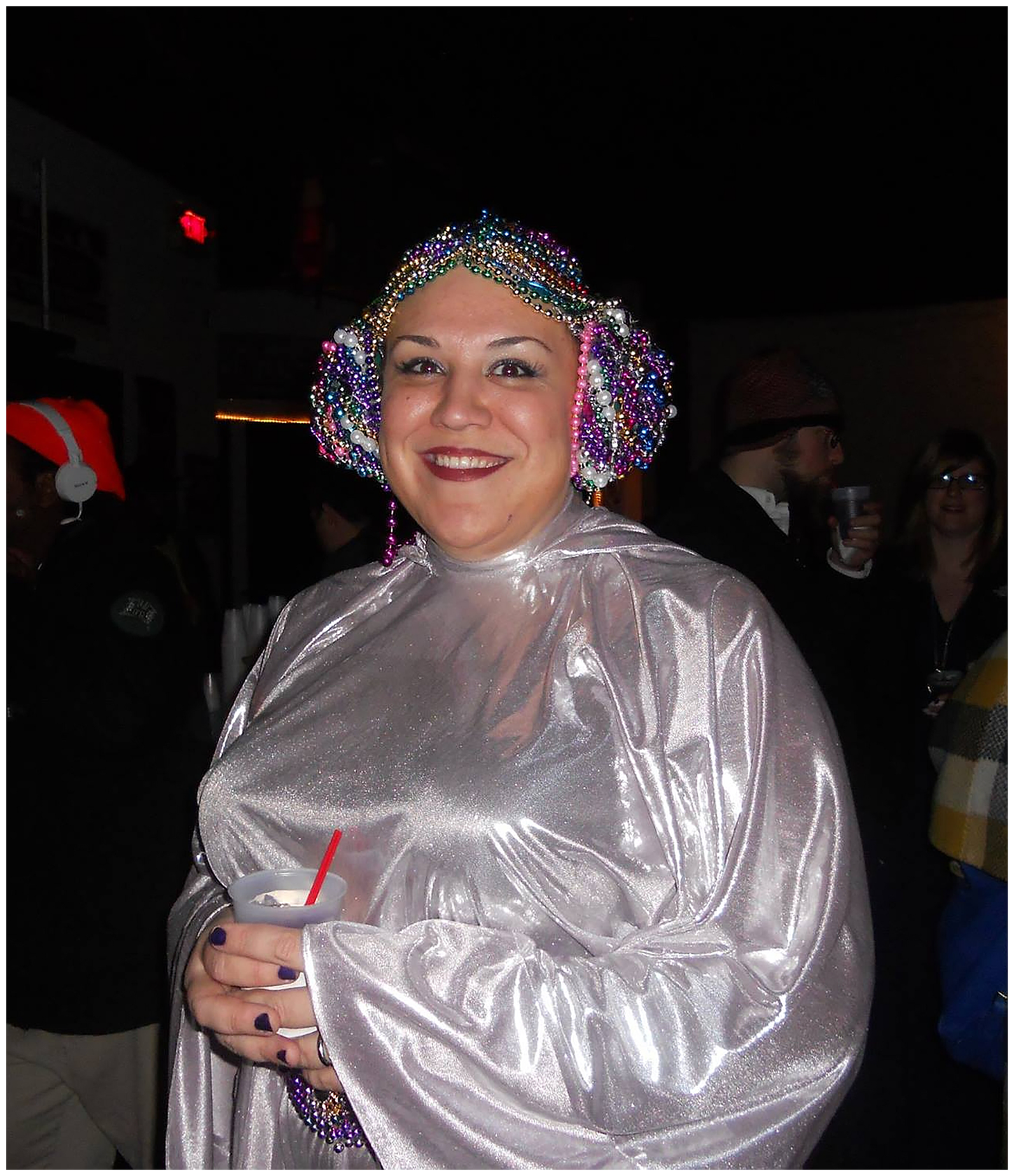
Jenn Coursey wearing her Mardi Gras Leia costume. Photo courtesy of Jenn Coursey.
The meanings of objects are not static; they can shift without any modifications in the objects’ physical form, as the objects move through different phases in their own social lives (Appadurai, 1986). An object may initially mean one thing to someone, but then something might happen in the setting that the object helps frame to change the object's meanings. That is, while material culture helps produce the social and cultural dynamics surrounding the object (Craig, 2011), the object can also be reshaped as a vessel of new, even conflicting, meanings as the social dynamics of its context unfold. For example, the meanings of the strings of shiny plastic Mardi Gras beads thrown in mainstream parades have shifted since the late 2010s, as New Orleanians have begun to acknowledge how problematic they are. Produced in exploitative, toxic conditions from low-grade, toxic materials, many are immediately discarded, and those that escape the city's post-parade cleanup operations go on to block storm drains, exacerbating flood risk (Borunda, 2019; Dryfoos, 2024; Redmon, 2015). In 2024, the Krewe of Freret was the first mainstream parade to ban plastic beads, reflecting their transformation from innocent trinket to poisoned chalice.
Most new-wave krewes, however, aim to minimize their waste by making throws by hand and reusing materials instead of throwing mass-produced items. Dan thought beads were wasteful, bad for the environment, and ‘boring.’ In his view: Dan: Throws are something that you craft and throw at people. This is one of our throws that I kept. […] I forget which parade this was, but the idea was that we had dreams that we had, and then we printed them on floppy disks and we would throw them to people. So this dream – can you read this? Briana [reads aloud]: ‘Interrobang archives. Dream number 104. I’m tiny and I smell like asparagus.’ [laughs] Dan: Yeah. So that was just a dream that my friend had, and he was just like ‘here, here's a floppy disk with a dream on it,’ because I think we were doing [a theme] with dreams that year. But this is a throw that I would keep. It's a funny joke. It's something that somebody made, it's not just cheap plastic.
Dan's dream archive disk illustrates how material objects can serve as ‘technologies of memory’ through the assorted meanings they articulate (Layne, 2003). Layne's (2003) research with pregnancy-loss support group members found that they often used physical objects such as baby shoes to preserve and compensate for the few memories they had of their babies who had died before or shortly after birth, pushing back against social pressure to forget and move on and resisting the deterioration of memory over time. Bereaved parents used technologies of memory to make, maintain, and share memories by treating memories as tangible things, a model that leads memories to take on the characteristics of things: ‘They can decay and decompose, be lost, or ruined; they can be also be kept, stored, lovingly cared for, and preserved for posterity’ (Layne, 2003: 209). These ‘technologies of memory’ are a specific kind of thing, one that is ‘special, precious, […] sometimes likened in size and value to jewels or other treasures’ (Layne, 2003: 209). In this sense, even though the objects in Layne's study were mostly consumer goods associated with traumatic experiences, they are akin to prized handmade carnival throws or costume pieces like Jenn's carefully maintained and displayed Princess Leia bead wig. Another example is that during the first parade Briana attended, the ‘tit Rəx parade of 2020, she received a set of tiny handmade throws from Martha (Figure 3). A witty response to the super krewes like Bacchus and Endymion, ‘tit Rəx styles itself ‘New Orleans only micro-krewe’ and features about 35 floats made from shoeboxes and pulled on leashes. Its 2020 theme was ‘That's a Little Much,’ and the float Martha and her teammates made (Figure 4) was based on the idiom of the straw that breaks the camel's back. These camel-related throws are now ‘technologies of memory’ for Briana because of the experiences they participated in generating, including the rich yet somewhat absurd undertaking of studying carnival.
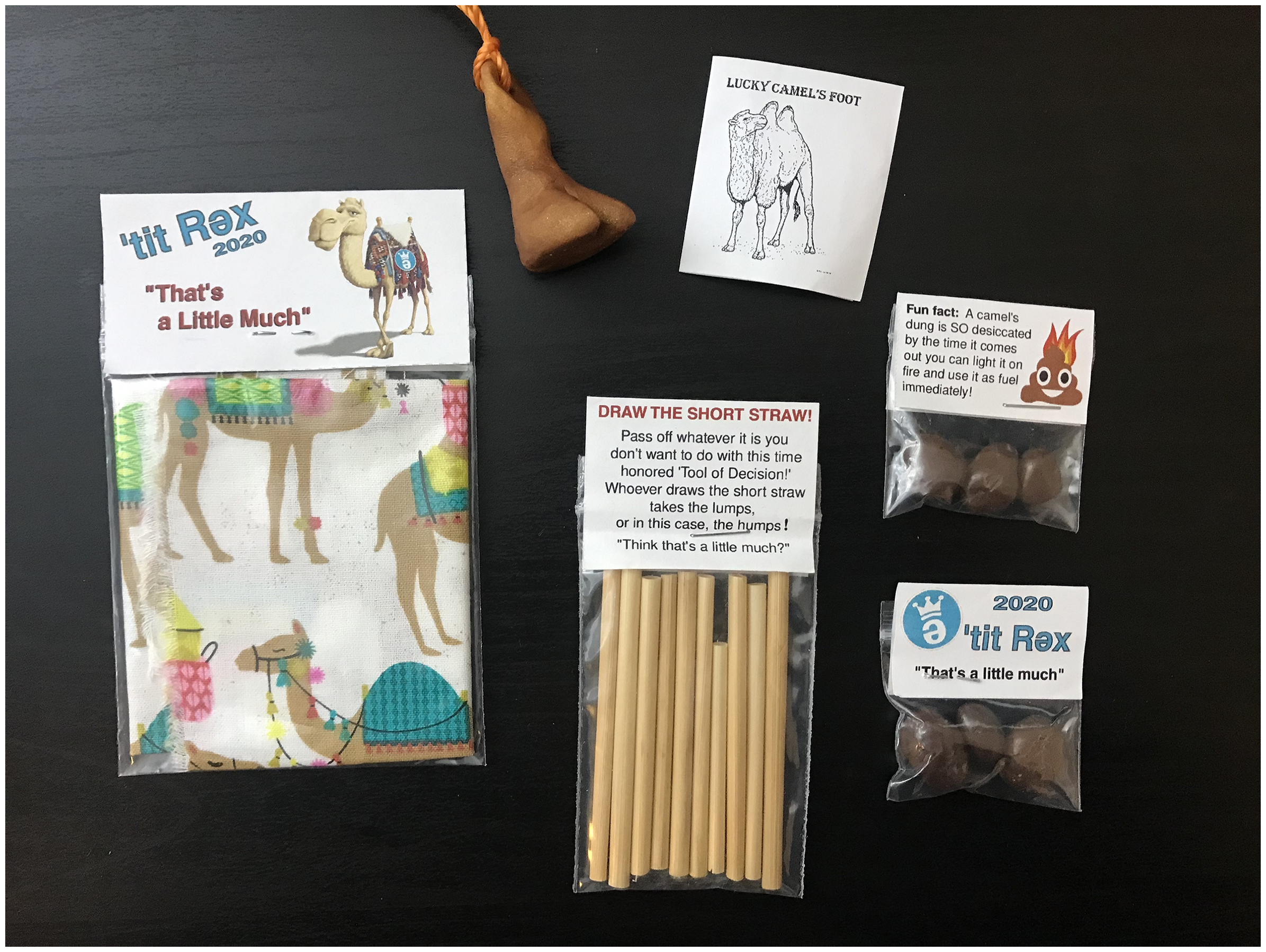
Throws from Martha, Brian, and Janine's 2020 ‘tit Rəx float (see Figure 4). Photo by Briana A. Kelly.
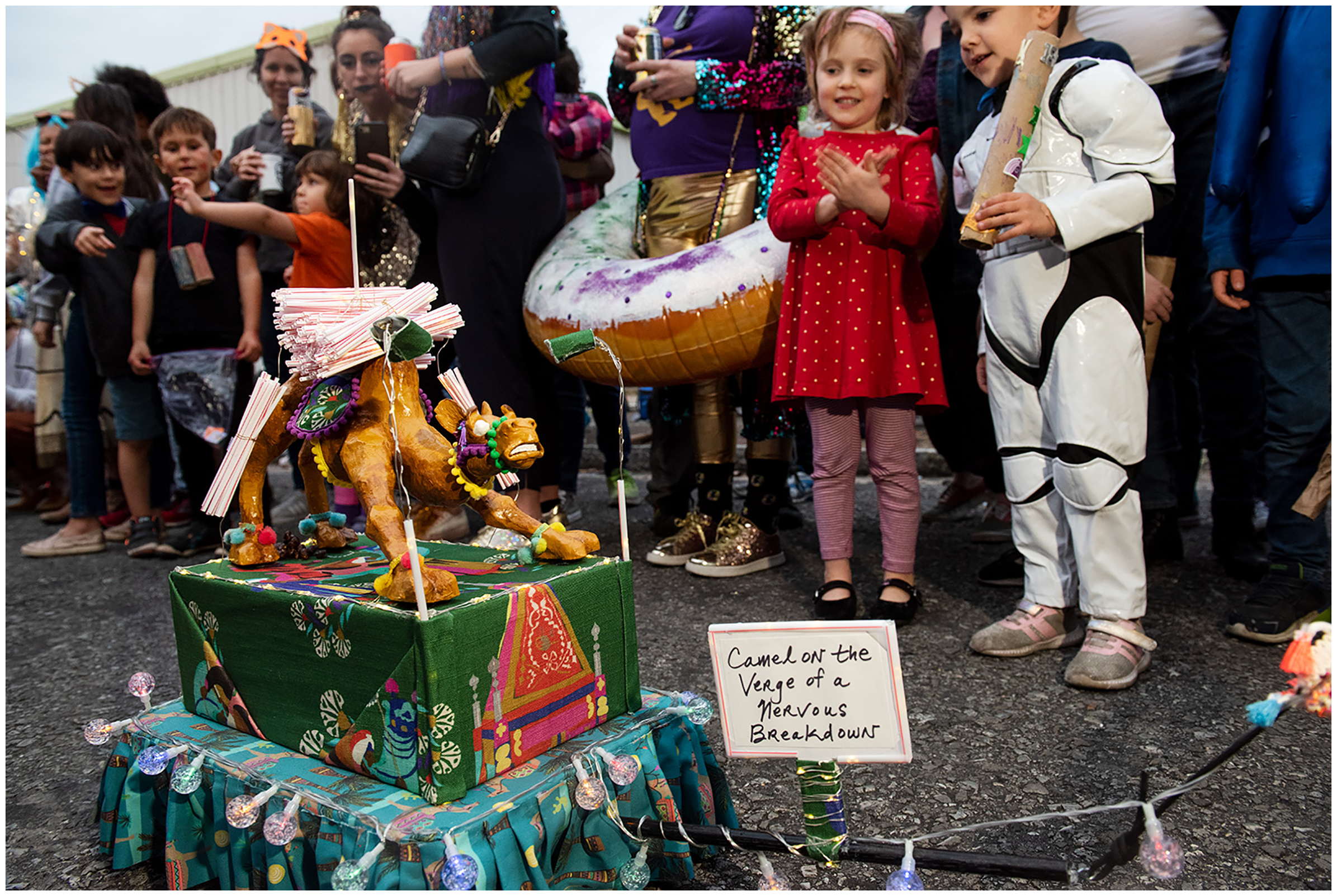
‘Camel on the Verge of a Nervous Breakdown,’ shoebox float made by Martha Radice, Brian Bow, and Janine Hayes. Photo by Ryan Hodgson-Rigsbee.
The handmade-ness of the objects of new-wave carnival tends to structure them as worthier technologies of memory than consumer goods. Marlene explained that while she might keep ‘really pretty beads’ or ‘really nice throws like plushies,’ she donates most throws from the large float parades to a local non-profit that sorts and repackages beads for reuse. However, she keeps a shelf of Chewbacchus things that other people have made, plus some of her own creations, as mementos of each year's parade, and saves all the handmade throws she receives from other walking krewes in a box if not on display. This substantiates Cristina's point that ‘it's so much more special when you give it to somebody and they see that it's also handmade. It's just a lot more meaningful.’
Susannah called a wooden doubloon from the Krewe of Full Bush a ‘perfect little keepsake’ of the krewe she helped create: The doubloon is like a time capsule of what we’ve created as a group of friends. Less about the message of Full Bush or the process or the party, and more just like, look at this thing we created, this whole krewe. Sometimes we just laugh that we established this krewe, that people like you email us and they’re like ‘I heard about your krewe, can I….’ […] Or my friends will go on dates and there are people who will be like ‘You’re in Full Bush? No way!’ And we’re like, ‘What?! We just slapped this together.’ We like to say it's an inside joke that went way too far. So my doubloon is like, ‘Look how legit we are,’ and it's funny and weird and exciting, and I want to hang onto this to share with people in the future.
Conclusion
In this article, we have shown how the handmade material culture of new-wave carnival in New Orleans makes carnival itself, frames people's experiences of carnival, and both prompts and encapsulates the interactions of carnival. We think that this ethnographic case study illustrates Miller's dialectical theory of material culture rather well. However, while Miller (2010) insists on ‘the humility of things,’ Gilliam the Cloud Whale, a Princess Leia wig made of Mardi Gras beads, or a floppy-disk dream-archive are hardly humble. The things that we encountered in our research in New Orleans are, instead, decidedly flamboyant. We argue that even when material culture is in the foreground of our sensory experience and quite obviously colours our surroundings, it can still frame and produce social and cultural worlds – and the ways it does so still need unpacking. In the case of carnival, we argue that material culture works as a productive setting precisely because it is so striking. The floats, costumes, and throws of new-wave carnival krewes are loud assemblages, noisily claiming much of the credit for carnival themselves. They attract attention and they provide an aesthetic focal point for many of the intangible activities of carnival, like hanging out with friends, parading through the streets, poking fun at everyday politics, gathering glory and status, goofing around, feeling extraordinary, and sharing joy. While these crucial components of carnival cannot be displayed on a mantelpiece as such, carnival-makers recognize them in the handmade or otherwise uniquely crafted qualities of the material culture of carnival. The flamboyant things of new-wave carnival in New Orleans, sociably made, sensually worn, excitedly handed from parader to stranger, proudly displayed, and perhaps, eventually, regretfully discarded, show us how culture unfolds with and through stuff.
Footnotes
Acknowledgements
We express our heartfelt thanks to everyone who participated in this study by sharing the stories and stuff of carnival and Mardi Gras with us. We are also grateful for the guidance of Helen A. Regis and Lindsay DuBois, as well as the support and help of many other friends and colleagues in New Orleans, Halifax, and elsewhere.
Data availability statement
The interviews on which this article is based have been deposited in the T. Harry Williams Center for Oral History, Louisiana State University Libraries, where they will be accessible by request in 2025 or 2026, five years after the date of each interview.
Declaration of conflicting interests
The authors declared no potential conflicts of interest with respect to the research, authorship, and/or publication of this article.
Ethical approval
The study on which this article is based was approved by Dalhousie University's Social Sciences and Humanities Research Ethics Board (2019-4038) on October 28, 2019, with amendments approved on April 9, 2020, and June 5, 2020.
Funding
The authors disclosed receipt of the following financial support for the research, authorship, and/or publication of this article: This work was supported by the Social Sciences and Humanities Research Council of Canada, Insight Grant 435-2018-1383 and a SSHRC Canada Graduate Scholarship. Preliminary research was funded by a New Orleans Jazz and Heritage Foundation Archive Fellowship and Dalhousie University.
Informed consent
Participants gave written consent for interviews. Participants named in this article gave written consent for their names to be used.
