




Abstract
This article discusses the elusive materiality of staying connected across borders. Objects brought in suitcases during visits home, images of objects sent via private parcel vans, and objects talked about but never sent all embody this connection. Using the concepts of trace and propinquity to presence the departed migrant and the objects used in family practices, I discuss relational proximity in degrees of nearness, considering seemingly immaterial traces of people and objects in material terms. Drawing on ethnographic examples of Moldovan private parcel van service users, I show how progressively immaterial transnational connections forged before the COVID-19 pandemic continued to create relations even in the absence of visits home during lockdowns.
Introduction
When I discussed the role of parcel-sending in creating and maintaining close connections in families separated by a migrant's departure during fieldwork in 2016–2018, my Moldovan informants mentioned visits home as an important contribution to reinforcing these connections. During visits home, informants brought gifts, tools, and clothing tucked into their suitcases. These objects later took part in family practices, placed, and replaced within the family home. Migrants also sent objects that did not fit into these extremely limited and restricted spaces via private parcel van companies, using their three-day delivery services at 1.5 GBP/kg that run weekly between the UK (and most European countries) and Moldova. While some of my informants had easy access to UK collection points, and, therefore, chose to send more often, others faced higher costs and additional difficulties because of their limited access to these services. These informants only opted to send occasionally and relied much more on visits home to bring objects for their family members in Moldova.
During the COVID-19 pandemic, most Moldovans were unable to visit home, missing important family holidays (Cantarji et al., 2021) like Easter. My informants who sent frequently only experienced temporary interruptions in parcel services channelling their material exchanges, while those without access to collection points continued to forge more subtle material connections in the absence of visits home. Travel restrictions during the pandemic raised new questions of how transnational migrants experience proximity and how tangible connections are reconfigured outside physical proximity. I wanted to take a closer look at the elusive materiality of transnational connections before and during the pandemic, experienced by private parcel-van users who were either restricted in sending due to lockdown restrictions or a lack of collection points, or limited in their engagement in family practices involving objects brought or sent by them. How important are face-to-face encounters when the possibility of physical proximity disappears? How is the materiality of transnational connection reconfigured in the absence of travel? What happens when parcel-sending opportunities are also restricted?
My intention in this article is not to assess the negative impact of the pandemic on transnational life, but to uncover the complex relationship between presence and absence, materiality and immateriality. I propose to do so by focusing on (im)material linkages that kept transnational connections alive before and throughout the pandemic. Starting with the contribution of visits home to forging transnational bonds after the migrant's departure, I discuss ethnographic accounts of three progressively ‘immaterial’ connections: from small objects brought in suitcases and used on visits home in occasional family practices, to using images of objects and engaging in online communication, to the materiality of talking about objects never sent. In doing so, I use the notion of ‘trace’ to conceptualize the migrant's presence in transnational family life, while discussing the tangibility of absence in terms of relational proximity.
Tracing absence in material terms: Moldovan transnational exchanges and the COVID-19 pandemic
Parcel-sending is at the heart of Moldovan transnational exchanges. Facilitated by dozens of small private parcel van companies that transport parcels between Moldovan migrants in almost every country in Europe and their family members in Moldova, this material connection first emerged after Moldova gained independence in 1991. Over the past thirty years, the services extended to cover new destinations, like the UK, while the migrant profile also changed to younger, mobile, fully legal, and not set on return. Pre-pandemic, the need for maintaining material links to home remained despite affordable flights which offered a high degree of flexibility to transnational families (Simola et al., 2022). As a result, Moldovan private parcel van services outcompeted traditional postal services by providing shorter, better-targeted deliveries, a more personal approach to caring for transported objects, lower pricing per kilogram, and a good area coverage.
According to Cuza and Rusnac (2015), 68% of Moldovans with family abroad send parcels, with 300–1000 parcels per van, per trip (Caracentev, 2020), containing foodstuffs, clothing, household objects, gifts, ritual objects, toys, books, and even bulky items such as furniture and large appliances. To Moldovan migrants, parcel-sending has become a tangible, material connection to home and their loved ones left behind in Moldova. Like other personal parcels across the world (Anastario, 2019; Burrell, 2008, 2012, 2016; Garni, 2014; Krzyzowski, 2011), sending objects and foodstuffs points to the ‘tangible, practical and symbolic act of connecting people keeping them embedded in their families’ needs and routines’ (Khrenova and Burrell, 2021: 261).
These practices point to the everyday things that families do together despite physical distance: sharing meals, celebrating birthdays, shopping, cooking, parenting, homemaking. Before the pandemic, the network of private van companies had been gradually expanding and adapting to their clients’ needs, with new collection areas defined in response to growing demand (Caracentev, 2020). The three UK lockdowns in 2020–2021 intermittently interrupted the flow of parcels transported by private parcel van companies over the course of almost two years. Despite these interruptions, social media activity on migrant Facebook pages like Moldovans in the UK and similar groups in other European countries (like France, Italy, and Spain) in the past three years shows a continuous use of services during lockdowns.
However, the COVID-19 pandemic has challenged the ways of staying connected in the absence or scarcity of visits home, bringing into focus the practices of staying connected in transnational space. In regular circumstances, visits home create the opportunity for physical co-presence and face-to-face exchanges, strengthening the bond between migrants and their families left behind. The lack of such contact has presented as ‘pandemic immobility’, opposed to travel options to visit home, that had a negative impact on family ties and migrant wellbeing (Skovgaard-Smith, 2021). Moreover, Nehring and Hu (2022) showed that the pandemic reconfigured transnational connections and linkages and had an unexpected and profound effect on family lives globally (Carel, 2020).
Since the COVID-19 restrictions uncovered the importance of physical proximity in transnational family life (Simola et al., 2022), my focus here is on how the materiality of shared practices continues beyond the moment of departure, and how transnational families negotiate the scarcity of physical proximity in relational terms. Looking at parcel-sending and visits home as traces of relations and practices with their material underpinnings, I begin ‘tracing’ the moment of the migrant's departure, followed by sequences of temporary presence during visits home, and other forms of co-presence like online communication. I follow Morgan Meyer's understanding of absence as an ‘unstable’ entity that still ‘leaves traces’ (2012: 104–106) in the material world, always interrelated with presence (Meyer, 2012: 108). While Meyer explores absence associated with physical death, more relationally finite in terms of physical proximity, I echo his idea that absence initially causes a tear in relations – in my informants’ case, through the migrant's departure.
In relation to the materiality of migrant life, Valentina Napolitano (2015: 47) argues that thinking materialities through trace incorporates both the ‘seen’ and the ‘unseen’, the past and the present. This recognition of presencing absence is particularly helpful in navigating the nexus of presence and absence in transnational life, and the material worlds associated with transnational practices affected by reduced parcel-sending or visits home. The intermittent post-departure absence-presence leaves traces of presence, where objects act as ‘remainders of absence’ (Napolitano, 2015).
These less tangible connections involve the occasional use of objects, imaging objects, or even discussing objects without physical exchanges in biographic sequences, starting with the moment of the migrant's departure. This temporal dimension and its relation to family histories reflects the connection between migrants, their family members left behind, and the objects (or their traces) that inform these exchanges. In this sense, it is helpful to approach tracing migrants’ (im)material exchanges in terms of ‘leaving a trace’ (Hetherington, 2003, 2004) as a connection created because of absence-presence that incorporates both temporality and relationality. On the one hand, traces of past visits and tactile connections continue to ‘presence’ transnational bonds. On the other hand, the social, temporal, and spatial contexts in which objects and people leave traces denote a nexus of relations that emerge and develop in transnational space.
John Urry (2002) has long pointed to the importance of physical travel in understanding human sociality and its relation to occasional physical, virtual, and imagined co-presence, particularly because face-to-face interaction involves the senses and being together in space and time. While the need for physical proximity is clear in my informants’ case, their experiences of (im)material exchanges show the need for a more nuanced understanding of proximity. Victor Buchli (2010) proposes approaching proximity as propinquity, according to degrees of nearness and non-physical proximity which, in my informants’ case, materialize post-departure through visits home and objects sent via parcels. This approach acknowledges the significance of intangible aspects in influencing our understanding of the past where immateriality pertains to the intangible characteristics associated with material exchanges.
The notion of immateriality thus closely corresponds to the concept of trace. Both concepts recognize that the significance of material objects extends beyond their physical attributes, moulded by the social and historical contexts in which they are situated. Traces left by objects transcend mere physical imprints, encompassing the memories, emotions, and stories intertwined with them. Similarly, the material nature of the objects themselves influences the intangible qualities of objects. I use Buchli's notion of propinquity as a concept enabling presence through relations and an interplay of various degrees of temporal and spatial proximity. As Buchli notes, conventional empirical reality based on visual and physical co-presence presents as a singular manifestation of multiple variations of propinquity, which I discuss in the three ethnographic sections.
In other words, people and objects that are relationally bound leave traces in transnational space and presence themselves in various degrees of nearness, or forms of propinquity that point to a range of material terms to understand the immateriality of transnational connection. To clarify, in this article I consider as ‘objects’ tools, toys, books, clothes, household items, foodstuffs, photographs, digital images, and verbal representations of objects. I am not including physical envelopes with money in this analysis because my informants did not speak about sending money via parcel vans, once popular because of reduced costs and the perceived safety of the physical transfers. This is because the rise of affordable digital transfer alternatives in recent years, among other factors, contributed to a reduction in envelope remittances. Therefore, while I do not engage in categorization debates around objects versus things (Brown, 2003, 2004; Brückner, 2019; Coole and Frost, 2010; Miller, 2005, 2010), my focus is on objects’ (im)materiality and the ethnographically evident relations they help create, develop, and maintain.
The following discussion is structured around three increasingly immaterial practices involving objects transmitted or desired to be transmitted by Moldovan migrants who use private parcel van services to send parcels to their family left behind in Moldova and who bring objects on their visits home. I use the preposition ‘un’ to reflect the duality of materiality and intangibility of sending practices, which are ‘done’ as much as ‘not done’ as a material exchange. In Untucked, I follow the journey of objects tightly tucked into suitcases or car boots during Moldovan migrants’ visits home. Extracted from their crammed and limited storage space after their journey, these objects participate in established family practices like housebuilding and commensality, as a form of temporal nearness.
In Untouched, I turn to a discussion of online co-presence and objects that migrants send to their family members who use them during video calls practices or engage with images of these objects captured on photographs and stills from video conversations. This ‘haptic visuality’, in Buchli's terms, allows transnational families to experience nearness without physical proximity while involving the senses – an essential attribute of being together.
Finally, in Unsent, I reflect on the materiality of talking about sending or receiving an object as oral-aural propinquity (Buchli, 2016) presencing the migrant. My ethnographic examples show that the relations associated with objects and familial practices continue to evolve in the absence of the migrant or even the object itself.
Methodology
This article is based on 18-month multi-sited fieldwork conducted in 2016–2018 as part of my doctoral research with Moldovan migrants in the UK and their families left behind in Moldova, and on the three-month fieldwork in 2023 with Moldovans in the UK, EU, and Switzerland who gave additional accounts of sending during the pandemic, with Swiss senders facing the strictest COVID-19 restrictions. A Moldovan parcel service user, I am a native speaker of Romanian and Russian, the languages are widely spoken in Moldova, still politically divided between Romanian (and Western/EU) and Russian (post-Soviet) influences. My own experience of parcel-sending allowed me to establish rapport with my informants, while being mindful of my own position in the field. In 2016–2018, I conducted 51 semi-structured interviews with adult informants between the ages of 22 and 78, including both Moldovan migrants in the UK and their family members in Moldova who sent or received parcels at least once after the migrant's move to the UK. Of these, there were 28 women and 23 men, with twice as many rural as urban residents. In addition, 12 out of 51 participants agreed to multiple visits and conversations, including daily activities, which offered an important temporal context for understanding transnational life. While most informants were regular or frequent senders and receivers, the ethnographic examples presented in this article come from five members of two families who participated in case studies and seven additional interviewees, both rural and urban residents, who only sent and received parcels once or twice in the span of the previous year. Two of the multiple interview participants gave additional interviews that covered the pandemic and post-pandemic period for a related ESRC-funded postdoctoral project in 2023 when I conducted 12 semi-structured interviews with eleven women and one man, on parcel-sending practices following the Ukrainian refugee crisis in Moldova.
Participant selection targeted a wide geographic spread of migrants’ preferred residence areas in the UK, as well as locations in Moldova with the largest concentrations of parcel-sending families with relatives in the UK. I interviewed both Romanian and Russian speakers, allowing for an inclusive cross-section selection of representatives of Moldovan society. I also used participant observation, secondary data analysis, and ethnographic photography to complement data collection. Individual and group activity on platforms like Facebook, VK (V Kontakte), particularly in groups like Moldovans in the UK, and on WhatsApp group chats I accessed during the pandemic, shows that Moldovan migrants in the UK continued to send parcels with short interruptions when lockdowns were imposed in the UK, followed by flight cancellations and strict testing and vaccination requirements.
All photographs are my own, taken on my phone during fieldwork in participants’ homes and at parcel collection points. All participants’ identities have been anonymized and code names have been assigned that bear no resemblance to informants’ real names.
Untucked
It is unfathomable for a Moldovan migrant to visit home without bringing at least a small ‘attention’ for the loved ones. In this section, I discuss objects brought by migrants in their suitcases during pre-pandemic visits home. The objects are used by migrants and their family members in shared family practices – first, during the visits, and later, after the migrant's return abroad. Before the pandemic, Moldovan migrants enjoyed affordable airline tickets and fixed-price bus tickets with a generous 50-kilogram luggage allowance, while also benefitting from the opportunity to drive home. As the rise of low-cost airlines facilitated migrant travel, with visits home becoming more frequent (Burrell, 2011), migrants used this opportunity to bring small objects in their personal luggage. To adhere to the stringent weight and size restrictions imposed by airlines, migrants tightly packed these objects to fit into their suitcases (Figure 1).
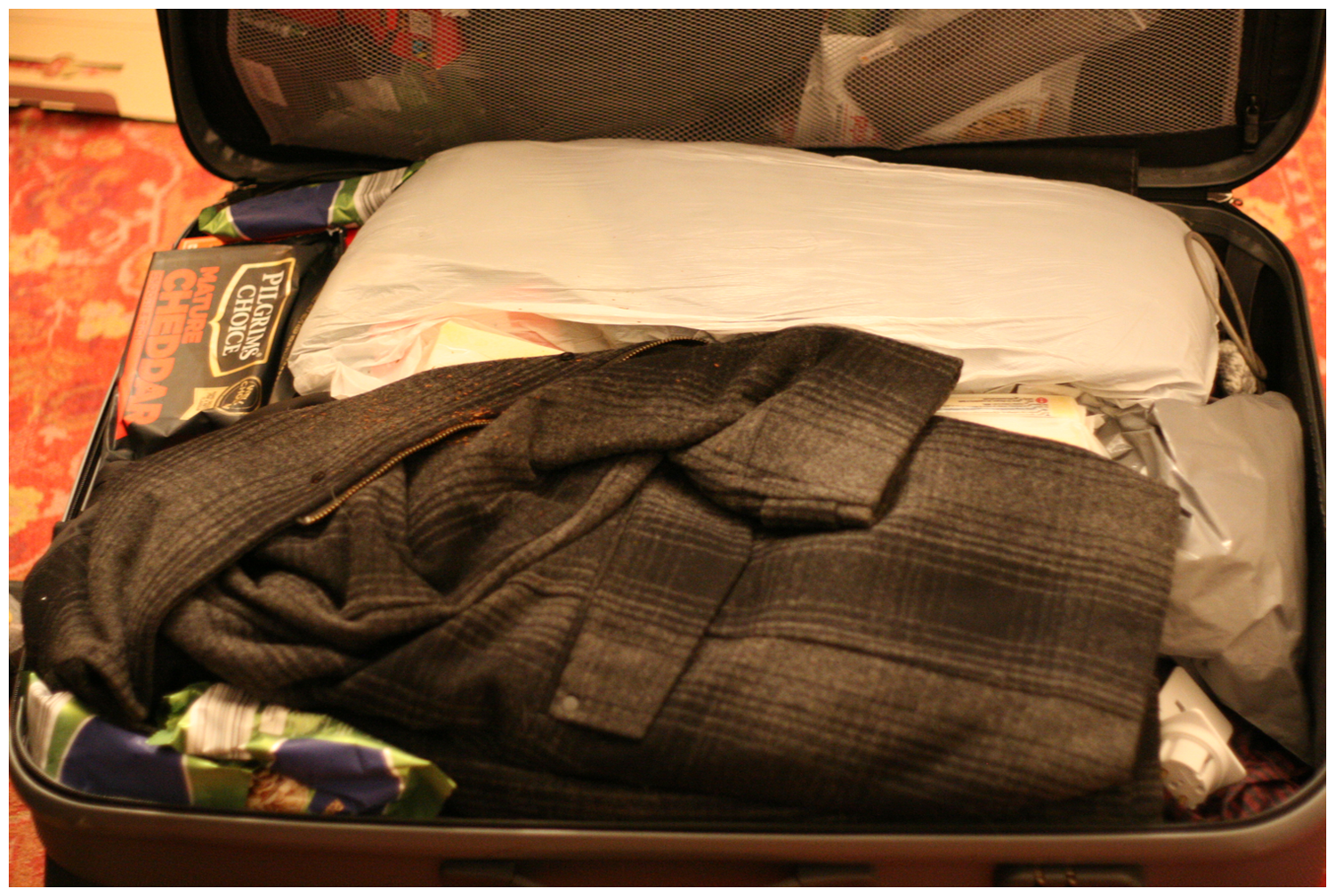
Contents of a suitcase brought home by a migrant. The foodstuffs and the packaged gifts are immediately visible (Source: Own Photograph, 2016).
Untucked from the confinements of suitcases and boots, the gifts – chocolates, cheese, coffee, tea, clothing, small electronics, and toys – create sensory and mnemonic reminders of the migrant's visit. Additionally, the placing of these objects within the family home and the interactive tactility during migrants’ visits play a crucial role in maintaining transnational connectedness. Wojtynska and Skaptadottir (2020) argue that visits home serve the dual purpose of combining leisure and refuelling familial ties, creating a unique opportunity to strengthen the sense of togetherness, strained due to being apart and living in different physical locations. Moreover, the act of travelling reaffirms corporeal proximity non-replicated by other forms of co-presence (Urry, 2002), unachievable during lockdowns.
Thus, visits home become special occasions to be sensorially ‘in the moment,’ helping establish a tangible, material link between the departed migrant and those left behind. This opportunity is particularly significant for migrants with restricted access to parcel van services like Gicu who has lived in London for a year and a half after leaving his village and his parents in Moldova. In his early thirties, he has settled well, with a permanent job as a health and safety officer. While he only sent one parcel since he left because of perceived high sending costs and difficulties accessing a collection point in his part of the city, he managed to drive home three times. One of these visits was during the winter, when he sourced a whole salmon to bring home as a treat. I brought a whole 6 kg salmon, yes, a frozen one. And it didn’t even defrost all the way home if you believe me. I put it in the boot, and since it was cold outside [it remained frozen]. And I brought lots and lots of little boxes of chocolates, small ones, like Snickers, Mars, because they have different ones, and I brought some presents, something more special.
This nearness is also evident in established practices that build on multiple visits and shared moments that involve using objects brought by the migrant. Radu, in his early thirties, is an agricultural engineer settled in Herefordshire in the UK, over 1.5 hours’ drive to the nearest parcel collection point. In his 5 years living permanently in the UK, Radu only sent a couple of parcels. The nearest airport with flights to Moldova is around 3 hours away, limiting the choice of objects to bring, so, on rare visits home, he always brings little gifts like chocolates or non-standard tools that fit in the luggage and cannot be sourced in Moldova – ‘small things […] which are difficult to find in Moldova’. To him, this choice of things to bring makes the most sense because his parents’ favourite sweets are chocolate truffles, and he only buys the tools his father needs.
Besides the distance from parcel van collection points, there is another aspect informing Radu's decision to pack lightly. His sister settled in Spain years earlier and, with easy access to parcel van companies, has been sending parcels as often as every month. Their parents George and Ina, both in their sixties, live in a well-connected village 30 km away from the Moldovan capital. Because of this accessibility, the couple engage in more elaborate parcel-sending practices with Radu's sister, while Radu's selection of objects to bring home mostly reflects the centrality of the father–son relationship in their transnational life affected by the separation.
Soon after moving to the UK, on a couple of visits home when he did not fly in, Radu drove his Fiat from Herefordshire to his village in Moldova. During these visits, both Radu and George would invest in this car and take care of it together – washing it, cleaning it, and repairing it. Later, Radu left the Fiat in Moldova for his father to use and continued to invest in it as a family car. Bringing a spare part in his luggage became the best opportunity to contribute to the car's maintenance. The […] bumper was missing a plastic part, on the right-hand side where the anti-fog lights are. I brought that for dad because he could not find them [in Moldova]. So, I bought it on eBay […] and I stuck it in the suitcase.
Moreover, George initiated a building project to provide extra space for Radu, his wife, and children to stay during subsequent visits home: a fully insulated outbuilding used for sleeping and outdoor cooking in the summer and doubling up as a smaller heated dwelling for George and Ina in the winter months. Moldovans in rural areas often build such structures to save on heating and accommodate family and visiting friends, a practice creating intergenerational and social linkages. Working together on a building project is thus an opportunity to deepen the bond between father and son. Although George acknowledges that Radu may never use it for himself, as he is not planning to return, the project needs to go ahead as a shared goal of being together. To accomplish this goal, George needed a particular type of screwdriver which he could not get in Moldova. Radu brought it in his luggage, so he did not ‘have to send’ it, and both father and son used it on the summerhouse.
The importance of this tool is evident. Owning it supersedes the difficulties of getting it from the UK to Moldova, deemed essential for the successful continuation and completion of the building project. In this sense, the continuity of working on the summerhouse becomes even more significant for maintaining the father–son connection across borders than the final product, eventually used by George and Ina in the winter. When George works on the project without his son being physically there, using the screwdriver presences Radu, acting as a trace of him being there to learn from his father and reaffirm their bond.
Both the car and the screwdriver thus act as traces of shared activities and the corporeal journey on the surfaces of tools and structures (Hetherington, 2003), incorporating the touch of Radu's hands. When Radu is not there, using the screwdriver and taking care of the Fiat brings George closer to his son, creating essential moments for shared practices to develop and flourish. And, while George understands that Radu may never return to Moldova, the few building and repair projects together alleviate the separation through tactile traces of a potential common future as a family. When this tactile proximity is absent, nearness is achieved through different registers of materiality. Next, I discuss objects used during online communication and the tactile voids brought on by the lockdowns. While, for most of my informants, visits home resumed with the same or even higher frequency after the pandemic, the connections created after the migrant's departure, and before the lockdowns, proved essential for transnational life.
Untouched
Physical proximity during visits home provides an irreplaceable sense of being together, leaving traces of presence through objects used in shared practices. When some of these practices are enacted online, nearness is achieved through digital materialities. I will now discuss proximity through digital images and the use of objects brought during visits home or sent via private parcel van services during online video calls. The pandemic, which temporarily halted visits home and even shortly disrupted parcel-sending, manifested as a crisis of sensory isolation, with online communication often providing the only tangible connection for transnational families. As physical co-presence during visits home already proved to be crucial for maintaining transnational ties (Baldassar, 2008), the absence of visits home that prevented migrants from being ‘there’ in times of crisis (Baldassar, 2014) led to increased online communication during the pandemic (Odasso and Geoffrion, 2023).
Although not physically touched by interlocutors on the other side of the screen, objects and digital images become traces of familial ties and shared practices meant to keep these ties going. According to Cantarji et al. (2021), the pandemic prevented Moldovan transnational families from coming together for visits home, thus increasing the number of families engaged in long-distance communication as their main way of staying connected. As migrants and their families left behind ‘leave traces of their selves in informational space’ (Urry, 2002: 266), the intermittent co-presence during visits home reinforces the bonds facilitated by online communication. Moreover, having common projects like Radu and George strengthens transnational connectedness where visits home contribute to the shared knowledge of doing things together, later maintained online (Mason, 2004). The significance of online communication and its implication in creating co-presence has already gained a lot of attention (Baldassar, 2008; Madianou, 2016; Madianou and Miller, 2012), with Miller and Horst (2012) notably stressing the importance of treating the immaterial aspects of digital life as material culture.
The pre-existence of material connections and sending practices allows participants in online communication to share the moment of togetherness in a register of nearness informed by visual connection. Seeing the objects used in shared projects without physically touching them or seeing the images of loved ones presences absent migrants in their families’ daily practices, in a biographical timeline of their transnational life. This haptic visuality, as Buchli (2010) defines it, ensures the tangibility of connection for the viewer, particularly through repeated and continual engagement. Before the pandemic, Alina, a freelance designer in her thirties, lived in Chisinau with her young son and received regular parcels from her partner Șerban, who settled in the Midlands in the UK. Șerban travelled to see them every three months, bringing objects like clothing and toys in his luggage for the boy, and sending sweets, toys, and English books via parcel services. When away, he used video calls to parent at a distance, and to be a constant presence in his stepson's life. During these calls, Șerban would teach his stepson English, and Alina would sometimes read the English books he sent via parcels, looking at it as a contribution to building their future life together in the UK. While Șerban did not touch the books, and was not physically present in the room, reading the books together enabled him and Alina to co-parent online. Indeed, when Alina and her son moved to the UK shortly before the pandemic, her son was able to enrol in a local primary school, having met the language requirements.
In George and Ina's case, the materiality of both hardware and the digital image mediated the sociality of their transnational online communication. There is a dedicated ‘Skype corner’ in their living room, set up as a desk with a computer gifted by Radu's sister. I use this term because the platform was the most popular choice for the whole family to communicate at the time of my visits, although they also used other applications like WhatsApp and Viber. The focus here is not on the platform, but on the practices mediated by online calls, and on the materiality of the corner space set up as a physical communication portal. Radu regularly sends photographs and videos of the grandchildren via Skype, and his parents often print them out and fix them onto the shelves above the desk or on the monitor. The photographs show Radu's wedding, the two children's birth and first steps, their first home in the UK, the eldest at school, the youngest at nursery. This haptic visuality presences Radu and his children by bringing together the viewers, George and Ina, and the images of Radu, his wife, and the children, in their digital or printed form. The image selection is not arbitrary, showing a timeline of Radu's family life since his departure and their strong relationship with his parents. In her exploration of materiality in relation to digital objects, Haidy Geismar (2018: XVII) argues that the digital should be understood ‘not only as material, rather than immaterial, but also in terms of a trajectory of materiality’, pointing to the indissoluble association between the digital and the analogue, as well as the story of the digital object, a ‘biography’ connecting the past and the future. This is particularly evident in George and Ina's printing of their grandchildren's images and placing them in the ‘Skype corner’ which becomes a get-together location, a truly living room in their home, with photographs acting as traces of Radu and the children's presence in their grandparents’ life.
During the pandemic, the materiality of these connections and family practices almost fully transcended into the digital world. In her account of online caregiving routines during the pandemic, Maruška Svašek et al. (2022) showed how migrants and their families adapted their practices to the digital environment, drawing on their pre-pandemic experiences and use of communication technologies which increased in the absence of physical travel. This is evident in the case of Alina, the designer who moved to the UK with her son to join partner Șerban I discussed earlier. After her move to the UK, Alina started sending parcels to her parents in Moldova with whom she had always been close, using Facebook and WhatsApp for daily video communication with them. Her experience during lockdowns is evocative of such pre-existent family practices moving online. Since her mother is a frontline medical practitioner, they temporarily halted their parcel exchanges, which Alina welcomed as their collective effort to stop the spread of the disease. A break from parcels, and all the boxes. Super OK, all good […], positive. Mum was telling me: ‘I did not need anything, I don’t want to go anywhere to pick up anything’, because people would not understand or keep distance, and I was telling her: ‘Ok, wonderful!’ We already used to call each other ten times a day. I think the [Facebook] messenger was running non-stop. With dad – my mum was working at the hospital, she still does – so, less with her, only in the evenings, but with dad – non-stop, yes.
While restarting sending was easy for Alina, for migrants without easy access to parcel van services, even discussing about potential sending informs the tangibility of transnational connection. Next, I will discuss how this tangibility of words materializes in a subtle manifestation of oral propinquity where the mere possibility of sending gives shape to unsent materialities.
Unsent
In this last section, I turn to the significance of objects that never materialized, never sent via parcels, and never used in family practices online. The intangibility of unsent objects may seem to negate any relationality underpinning transnational connectedness. However, I suggest that even traces of potential use materialized in conversations point to the continuity of family connections which persist in transnational space. As talking about things implies presence (Keane, 2005), absent objects acquire materiality through the expression of desire by those engaged in the conversation.
In the context of a conversation, the object presences through its desirability and potentiality of mediating shared family practices. In the absence of the desired object, words become traces of objects, and, implicitly, the migrant's presence during an activity contributing to a shared family future. Even informants who consider parcel-sending unnecessary for reasons including difficult access, excessive costs, effort needed to prepare the parcels, or insufficient time to manage the sending, still consider sending occasionally, sustaining the material link of the transnational connection. What is particularly interesting, informants who provide compelling explanations for not being able to send or receive more parcels, delve into greater detail when discussing the objects they would like to send if given the opportunity. Rather than citing a lack of necessity for the objects, the informants mention other more specific reasons for not sending them, such as high sending costs for bulky items (Figure 2) and volume restrictions.
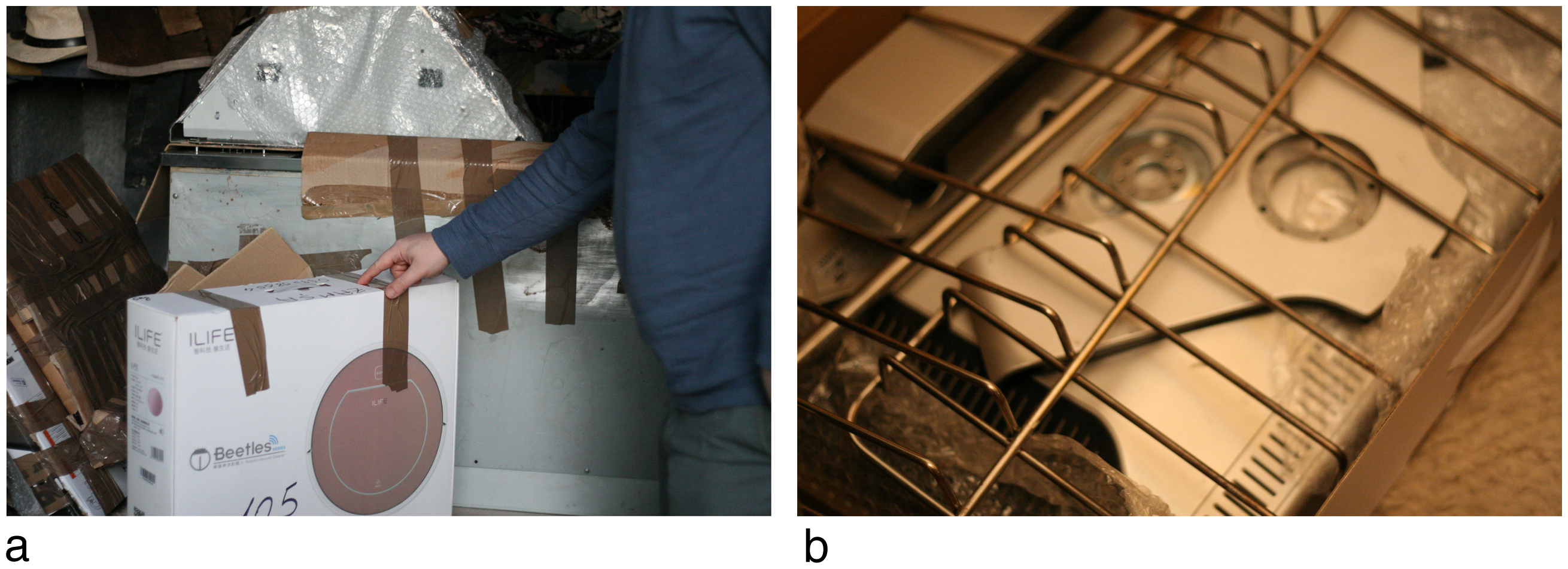
Examples of bulky items (oven, extractor fan, and gas hob) received in parcels sent by migrants with good access to parcel van services. Migrants with restricted access to these services often find objects like appliances or furniture too difficult and expensive to send (Source: Own Photographs, 2016).
For migrants and their families without the possibility to send, proximity still exists in its oral-aural form (Buchli, 2016), embodied in conversations and imaginations of sending parcels that reflect the strength of familial ties. Materiality is not always tangible, like the act of commemoration in the absence of the commemorated object (Küchler, 1999), where existence persists despite the physical absence of the object. Villager Ghenadie, in his late fifties, whose son moved to the UK a couple of years previously and who only sent a small parcel because of parcel van unavailability, says that he understands why sending is so difficult. There are rules. Not only rules, but also the location where [son] lives and works doesn’t allow it, he has to go to London. And it's not worth it. He says that there is no reason to send food, or whatever, but what else can we send? If I had to send something, like for example, a document that is needed, and you send it to London, to a post box, it's worth it, but not like this [by parcel].
Reflecting on his neighbours’ experience of owning second-hand German-made combine harvesters, Ghenadie appreciates the potential improvements in agricultural processes if he could source proper equipment abroad. Although it would not be possible to acquire and send a harvester via parcel vans, he says that buying a specialized compact tractor he needs to plough his vineyard would be a possibility in certain circumstances. The price is less important than the possibility of owning machinery perceived as being of higher quality. I don’t care [about costs], I only care about owning it, so I could hop on and ride it in between the rows of vine, to cultivate them. So that I don’t have to work the hoe. […] It's not the same [quality in the UK], they have their own standards there, even different from the continent […]. But with agricultural machinery, it doesn’t matter, you just use it, even if you’re riding it upside down. Tools. Starting with wrenches and keys, and all that sort of things. The ones that - I think the ones that you can find in the UK that are better quality. Tools like that, a screwdriver, a key set, they are made of metal, and they are very heavy. It costs a lot to bring them here. […] I would prioritize things you cannot find in Moldova, things you really need. Then yes, it would be worth the effort. Let's say, you need a boiler, one you don’t have in Moldova, that's British-made and high quality, with a 15-year warranty. […] It's worth it for a good quality item.
Conclusion
The COVID-19 pandemic challenged the ways transnational families stayed connected in the absence of visits home, drawing attention to the materialities informing transnational co-presence. This article addressed increasingly (im)material exchanges between Moldovan migrants and their families who use private parcel van companies to stay in touch, from using objects brought on visits home in shared family practices, to engaging in online exchanges, to the materiality of words pointing to similar practices of being together across borders.
Building on the concepts of trace and propinquity, I argued that people and objects are bound by relations of proximity and presence despite migrants’ physical absence. The ethnography showed that even infrequent parcel sending and reduced selection of objects to send point to a continuous relational connection, re-established through face-to-face interactions during visits home and online communication practices involving objects sent or brought by migrants in their suitcases.
Considering absence as materiality coming into being through tracing presence (Meyer, 2012) and proximity as degrees of sensorial nearness (Buchli, 2016), I showed that objects, in their solid, digital, and oral form all leave traces of the migrant's presence on two levels. On the one hand, visits home and using objects brought in suitcases offer migrants the opportunity to re-establish shared practices with family members left behind, replenish the sensory array of links to home, and reassert presence in the familial home in a haptic co-presence. On the other hand, when visits become limited because of costs or lockdown restrictions, nearness is achieved through haptic visuality and oral-aural exchanges, where even the lack of sending does not necessarily mean that the service is undesired.
The article shows that temporary disruptions to transnational connectedness prompt reconfigurations of communication channels and practices, rather than a radical change in staying connected, contributing to a better understanding of separation and lockdowns on transnational life. While this ethnography's limitations include an insufficient analysis of wider lockdown practices, the findings open an avenue for further discussions of (im)materialities in the transnational context. Suggestions would include looking closer at the dynamics of envelope remittances or following transnational families’ material exchanges over a longer period. Continuing these conversations is imperative in an increasingly mobile world facing post-pandemic challenges and further crises.
Footnotes
Acknowledgements
I wish to thank Prof. Kathy Burrell, Prof. Mathijs Pelkmans, Dr Dorina Rosca, and Prof. Susanne Küchler for their insightful comments on the earlier versions of this article.
Declaration of conflicting interests
The author(s) declared no potential conflicts of interest with respect to the research, authorship, and/or publication of this article.
Funding
The author(s) disclosed receipt of the following financial support for the research, authorship, and/or publication of this article: This work was partially supported by the Economic and Social Research Council [grant number ES/X005410/1]. Data Access Statement: Data supporting the ESRC-funded part of this study are available from UK Data Service at https://doi.org/10.5255/UKDA-SN-856679. Data are safeguarded and can be accessed subject to UK Data Service End User Licence Agreement.
