




Abstract
I examine in this article state-led infrastructural projects as embodiments of modernity and the way their divergent material transformations “play out on the ground.” I argue that such projects, through the way they transform material surroundings, provide a commentary on these modernization processes and surpass the intention of their creators. I focus on Halfeti, a town impacted by the southeast Anatolian project (GAP), a state-led damming project in southeast Turkey. GAP drastically transformed the social and material fabric of the town with the aim of developing the region by becoming modern. GAP involved forced relocation, the construction of uninhabitable zones, the redistribution of habitable territory, and the imposition of living standards on individuals, and can thus be held accountable for ruination. I focus on the way GAP has reused and strategically appropriated ruins for political purposes, simultaneously I take the processual part of ruination, into account. Meaning an outcome of a situation in which one is left behind with material leftovers after destruction, including personal feelings and emotions that continue to play a role in the aftermath of a such a violent event. I explain how renovated houses in Old-Halfeti, as well as newly built structures in New-Halfeti evoke social ruination. Subsequently, through alternative materialities, as expression givers to complex stratifications of histories which are ignored in dominant state-led infrastructure projects, the impact and importance of neglected and submerged infrastructures are understood. Alternative materialities give way to the agency of the material, and the way it brings about affect, shapes longing or nostalgia and expresses different histories. By considering the intertwined dynamics of social ruination, political appropriation of spaces, and the unveiling of alternative materialities, a more nuanced understanding of this landscape emerges and demonstrates the dissonance of modernity.
Introduction
“You cannot distinguish, here in Halfeti, where the water ends and where life begins.” (Nihat Özdal, responsible for Cittaslow)
Nihat Özdal refers to the Euphrates, implying there is no border between life and the river, they are intertwined. These words, poetic as they might seem, can also be interpreted differently. Water gives and creates, but also takes and destroys, as is the case in Halfeti, a town in southeast Turkey, situated at the shore of the Euphrates where the transformation of the river and water flow changed daily life drastically.
In 2000 Halfeti submerged for two-third behind the Birecik reservoir, which is part of the larger Southeast Anatolian Project (Güneydoğu Anadolu Projesi) with GAP as its acronym. GAP is an irrigation and hydroelectric power project, situated in the southeast of Turkey, in which 1.7 million acres are supposed to be irrigated by 22 dams in combination with 19 power plants that will double the amount of electric power (Kolars and Mitchell, 1991: 24). This, according to Jeroen Warner (2008), to meet the national demand for energy in Turkey.
In Halfeti the flooding and the transformations it brought about seriously disrupted socioeconomic life as it used to be, and not only its inhabitants but also the landscape is a witness of that. After inundation Halfeti morphed into a tourist town and is now officially known as Old-Halfeti or Eski-Halfeti. Once green and lush, the river shore is today filled with floating restaurants, souvenir shops, and, on crowded days, boats perpetually sailing up and down the river. Old-Halfeti is promoted as sunken city Batık Şehir, in which the inundation is used as an added value to attract tourists. This stands in stark contrast with New-Halfeti Yeni-Halfeti, a town purposely built after inundation, to replace partly inundated Halfeti. Here GAP built houses for people that lost their dwellings and the important institutions (e.g. schools, banks, and police station) that were once in pre-dam Halfeti moved to New-Halfeti.
1.Map of Turkey with Halfeti. Source: creative commons by-sa-3.0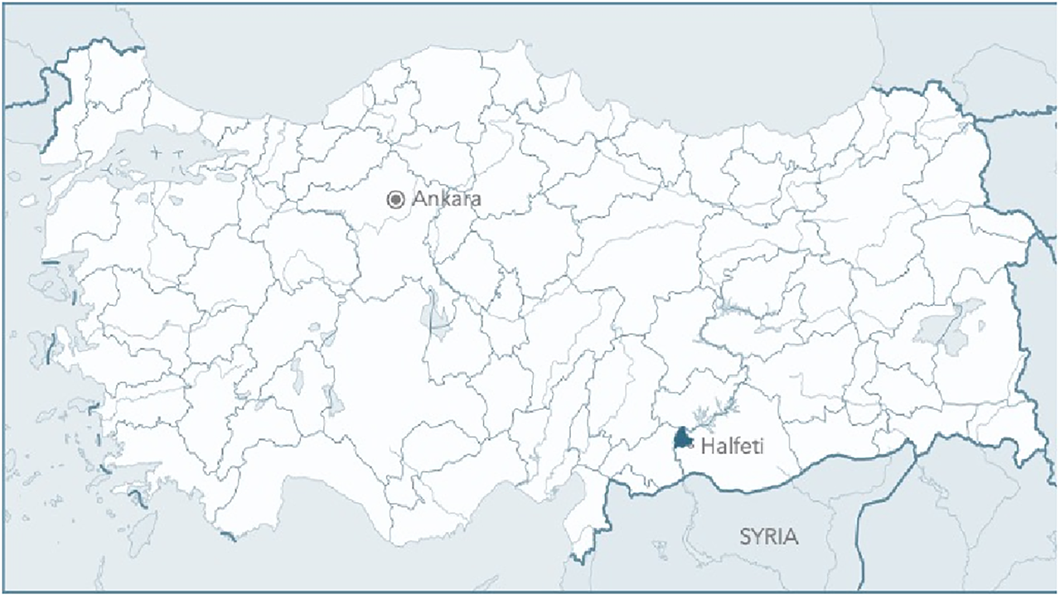
GAP is not unique in its aims and set-up. Many large-scale infrastructural projects worldwide, for example, in China, Pakistan, and Greece, are envisioned as what Maria Kaika (2006: 227) describes “iconic landmarks” of modernity and executed with the idea to create a “shortcut” to modernity (Akhter and Ormerod, 2015; Gilmartin, 2015; Rizvi. 2019 in Akhter, 2022: 1430). Scholars today however take a more critical stance and reckon with the downside, decline or sociomaterial ruination of state-led modernization projects (see Howe et al., 2016; Randle, 2022; Rao, 2013; Wakefield, 2018; Yarrow, 2017). This article situates itself within this debate, acknowledging how, in the framework of such state-led endeavors, modernization is often a continuous and contested process of creation and destruction.
Penelope Harvey (2005) points out how ambitions of a state materialize itself through infrastructural projects. GAP reflects such ambitions for the Turkish state. It involved forced removal, the creation of zones of uninhabitable space, but also reassigning habitable space and dictating people how to live there. It can therefore be held responsible for what Ann Laura Stoler (2013) calls “ruination” (p. 202). Ruination is an ongoing process evoked by imperial projects and includes “the material and social afterlife of structures, sensibilities, and things” (Stoler, 2008: 194). I “think with ruination” to focus on the one hand on the way GAP has reused, ignored, and strategically appropriated ruins for political purposes (Stoler, 2013: 11), at the same time I take the processual part of ruination, into account. Meaning an outcome of a situation in which one is left behind with material leftovers after destruction. Here I follow Yael Navaro-Yashin (2009) regarding her work on affective space and include personal feelings and emotions that continue to play a role in the aftermath of a violent event (p. 5). I use the concept “social ruination” and show, in line with the work of Ariella Azoulay(2013) on the all-encompassing power of empire's ruins (p. 195), how GAP as ruin-making project cuts through the mental and material space of people lives. Ruination remains present by lingering on in people's minds, touching upon the persistence of imperial formations through the “social ruination of people's lives” (Stoler, 2008: 194).
Inspired by the work of Gastón Gordillo (2014: 2) I rethink what space is, how GAP has destroyed it, and subsequently what is created through this destruction. Based on intensive fieldwork in Halfeti between 2013–2014 I scrutinize GAP's infrastructural changes as an ethnographic object (Anand et al., 2018) and how they, as Ashley Carse (2012) mentions “exceed, the intentions of their builders”(p. 543). I take the reader on a journey from Old- to New-Halfeti and its (hi)stories, which are intertwined with the material environment. The first part explains how GAP ties infrastructural development to modernity through reshaping Old- and New-Halfeti via renovating and rebuilding the local infrastructure. I follow the work of Nadia Abu-El Haj (2001) and consider the renovated buildings in Old-Halfeti as resurrected or remade ruins, which are used as “repositories of public knowledge” (Stoler, 2008: 202). Through these renovations GAP creates a modern, linear story about Old-Halfeti's past in the present. I juxtapose this to the surroundings of New-Halfeti that are experienced with feelings of alienation and loss. Social ruination, as a process, is thus not only part of crumbling materialities, but can also be evoked by perfect newly built and renovated structures. The unintended and unforeseen outcomes infrastructural projects have for the people in Old- and New-Halfeti, that live with and in them is exposed. Exploring the everyday ways modernity, imposed by a state operator, plays itself out in daily life, in which “breakdown, instability, and uncertainty are the norms” (Harvey, Jensen, & Morita, 2017 in Wakefield, 2018: 5).
The second part is concerned with how material traces in the form of (submerged) absences or neglected infrastructures are also part of this modernization project. For these traces I use the term alternative materialities, meaning expression givers to complex stratifications of histories which are ignored in dominant state-led infrastructure projects. Alternative materialities are necessary to understand the active presence or agency of the material, and, as Joost Fontein (2011) describes for the affective presence of graves and ruins, the way it brings about affect, shapes longing or nostalgia and expresses different histories. Alternative materialities surface complex and different stories about Halfeti. Stories that are invisible or untraceable in the official discourse of the town as a sunken city. I position myself here within the work of among others, Gordillo (2014) who engages with violent histories that materialize in landscapes and claims that we must take the “multiplicity of destructions” (p. 19) into account in which rubble is layered in its meanings delving into histories that are often for the sake of political convenience negated. But also, the work of Anoush Tamar Suni (2023) who works with the notion of palimpsest as “layers of material remnants of violence on the landscape… which constitute enmeshed histories” (p. 196). Finally, I conclude that the transformations GAP induced, including the production of alternative materialities, culminates in a dissonant landscape of modernity, implying that modernity encompasses decay and construction, prosperity and destitution, domination and subjugation simultaneously. It explains the social and material afterlife of Old- and New-Halfeti, in which the landscape itself provides a commentary on modernity (Howe et al., 2016: 556).
GAP: Epitome of modernity
The end of the nineteenth and beginning of the twentieth century were seen as the apex of man controlling nature (see e.g. Gandy, 2003; Wakefield, 2018 in Randle, 2022: 35), or the time of “archetypal technology of post-enlightenment, emancipatory modernity” (Mukerji, 1997, Collier and Ong, 2003, Joyce, 2003, Mukerji, 2009 in Harvey and Knox, 2012: 523). According to Brian Larkin (2013) civilization was defined by the sheer possession of infrastructures such as electricity networks or running water systems (p. 332). The construction of such projects would solely lead to progress and prosperity, and many nation-states created them only to show that they were advanced and modern (Ferguson, 1999; Apter, 2005; Appel, 2012b; Harvey and Knox, 2015; Gupta, this volume in Anand et al., 2018: 19). In terms of its aims and sheer size GAP is what James Scott (1998) calls a “high modernist” project, and according to Behrooz Morvaridi (2004: 722) it is considered the largest achievement in civic engineering in Turkey so far.
Wolfgang Wohlwend (2015: 213) explains that GAP in southeast Anatolia takes up 10% of Turkey. The region is home to 10% of the Turkish population that consist of Kurds, the biggest ethnic minority of the country, but also, besides Turkish, Arabic and Zazaki speakers live there. According to Arda Bilgen (2018) the southeast has the highest national population and fertility rate, the highest size of households, mortality of infants and unemployment rate, and the lowest national urban rates and average gross value added per capita (p. 130). Moreover, since 1984 the area is marked by longstanding military conflicts between the Turkish army and the PKK Partiya Karkerên Kurdistanê (Kurdish Workers Party). Zerrin Özlem Biner (2020) explains how this region has been perpetually part of development projects since the Turkish state sees development as the remedy against terrorism. Within this political climate GAP promises to bring a brighter future to this part of Turkey.
GAP's construction started in the 1970s. At the time it was solely focused on infrastructural transformations of the area. However, since the early nineties, due to among others severe national and international critique concerning the violation of human rights and destruction of cultural heritage, it has changed into a socioeconomic development project. Zeynep Sarıaslan underlines how the ideology of the Turkish state was to radically break with the Ottoman past, and progress would be reached through an evolutionary stage. Based on social goals and policies about development (geliştirme) and modernity (çağdaşlık) grounded in binaries, such as Islamic–secular, traditional–modern, and backwardness–development GAP followed global trends in development since the 1990s (Sarıaslan, 2023: xvii). It legitimized the invasive infrastructural and social transformations it imposes on the effected population, however without fully considering “‘homegrown’ sensitivities, concerns, and demands” (Bilgen, 2018: 151). Between 1993 and 1997 The GAP Region Action Plan was put in place with the idea to improve the level of investment and income in the region, to enhance health, education, transportation, and infrastructure services in urban and rural areas and to increase employment (Bilgen, 2018), with the main aim to develop the southeast of Turkey and to, as Maggie Ronayne describes, “reinstate civilization” (2005: 37). Majed Akhter (2022) explains how nation states envision hydraulic infrastructures like GAP necessary to develop peripheral areas of a country.
2.Birecik dam (picture by the author)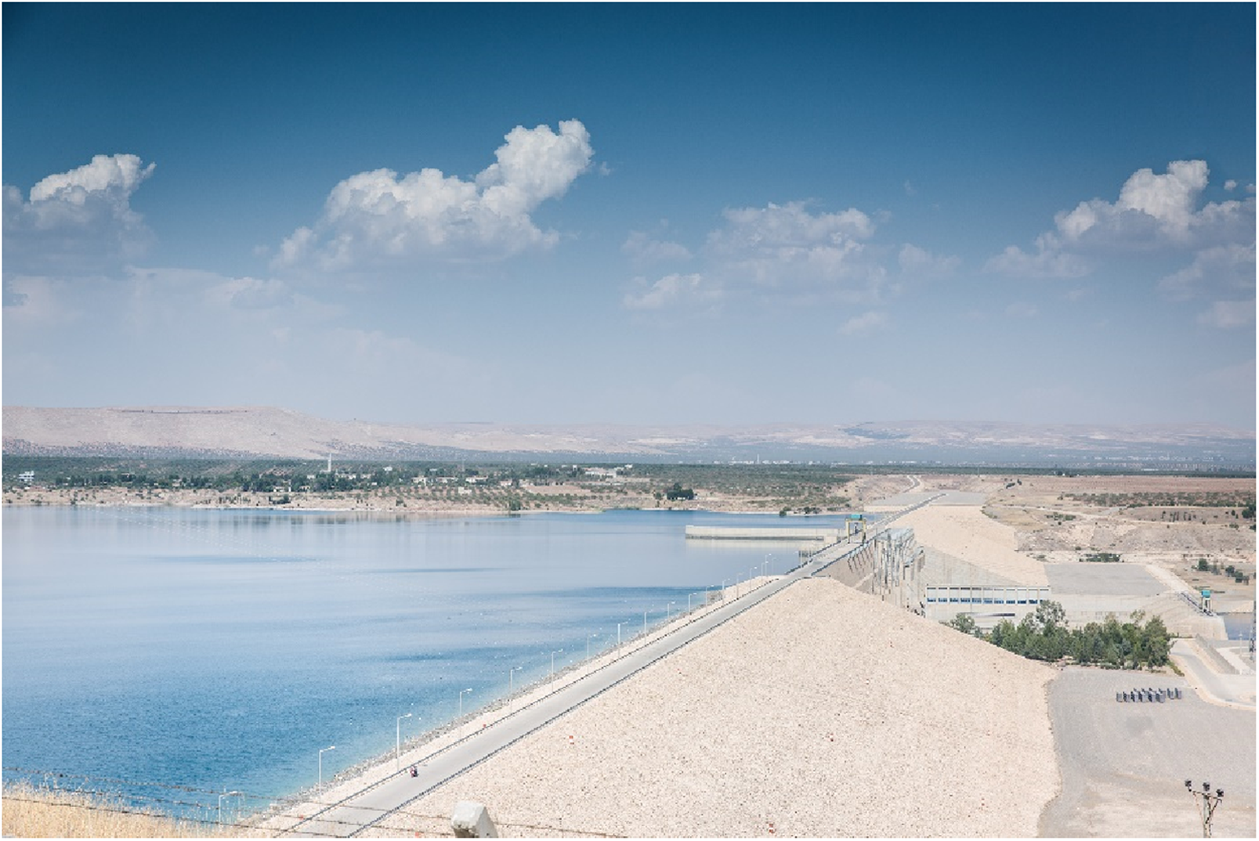
On their official website GAP clearly states that the wellbeing of people is their most important incentive, referring here to a human-centered approach. It reads: “The GAP is a human-centered regional development project. All public investments serve as instruments of equitable, fair, accessible, and sustainable development. The primary goal is the happiness of people.”
However, as Nurcan Baysal (2020) explains, since the project was launched, about 50 years ago, 74% capacity was achieved in the energy projects and 53% in irrigation projects. Only 13 of 19 hydroelectric power plants and 19 of 22 dams are finished. Seasonal labor is the main source of livelihood for most of the people in the area and forces them to migrate (temporarily) elsewhere, often working under precarious conditions. 1 All this to explain how GAPs promising agenda materialized differently thus far.
Old-Halfeti: From rubble to resurrected ruins
It was a sunny afternoon; the sun was setting down quite early this time of the year, but I was in the mood to make a walk before it became dark. While I was strolling along the river I suddenly heard “Annelies! Annelies come here!” It was Ayşe standing there, calling my name, and waving at me to come over. “The renovations are almost finished; you have to see the new hostel!” she proudly exclaimed referring to the place her son had bought, renovated, and turned into a hostel. Her son, Murat, invested in his hometown. Ayşe had been talking with me numerous times about the new hostel and how the renovations were progressing. She was proud of her son's work and showed me around. The place was just in front of the Duba restaurant, also owned by Murat. We crossed the street. When I entered the courtyard, it looked impressive. The hostel was completely designed in an “authentic Urfa style” with a courtyard and a fountain in the center of the building. In addition, there was a fake cave with imitations of ancient cave drawings, made into one of the walls. There were eight rooms with three beds each. Guests could eat breakfast in the restaurant on the opposite side of the street down at the waterfront. The hostel was almost rebuilt from scratch, and thus in a way completely new, but looking traditional or “authentic.”
Old-Halfeti today is an attractive tourist town for mostly domestic but also international visitors. It is advertised as sunken city in which the flood adds an extra dimension to the town's mysterious beauty. In addition, Halfeti became very famous nationally because it functioned as the setting for the telenovela Black Rose (Kara Gül) that was broadcasted weekly on Turkish television between 2013 and 2016. On top of that Old-Halfeti gained official Slow City status in 2013 which further enhanced the town's touristic allure. Rumkale or the Roman Castle is one of the main showstoppers put forward. It is said that in this monastery, chiseled out of the mountain, a copy of the bible is found. Also, the houses that escaped the flooding are purposely remarked for their special architectural value, not to forget the caves that refer to an even more ancient past. As the website, Go-Turkey, the main tourist portal of Turkey explains about Halfeti: “Rumkale and the other cultural treasures of Halfeti take visitors on a journey to the splendor of the past… Halfeti was established by Romans to the east of Euphrates. Halfeti town has many caves, which reflects its history. The houses of Halfeti have a unique architecture, which implies a spectacular wealth and prosperity. The stone architectural samples are rare and unique in this part of Anatolia.”
2
3. Roman Castle (picture by the author)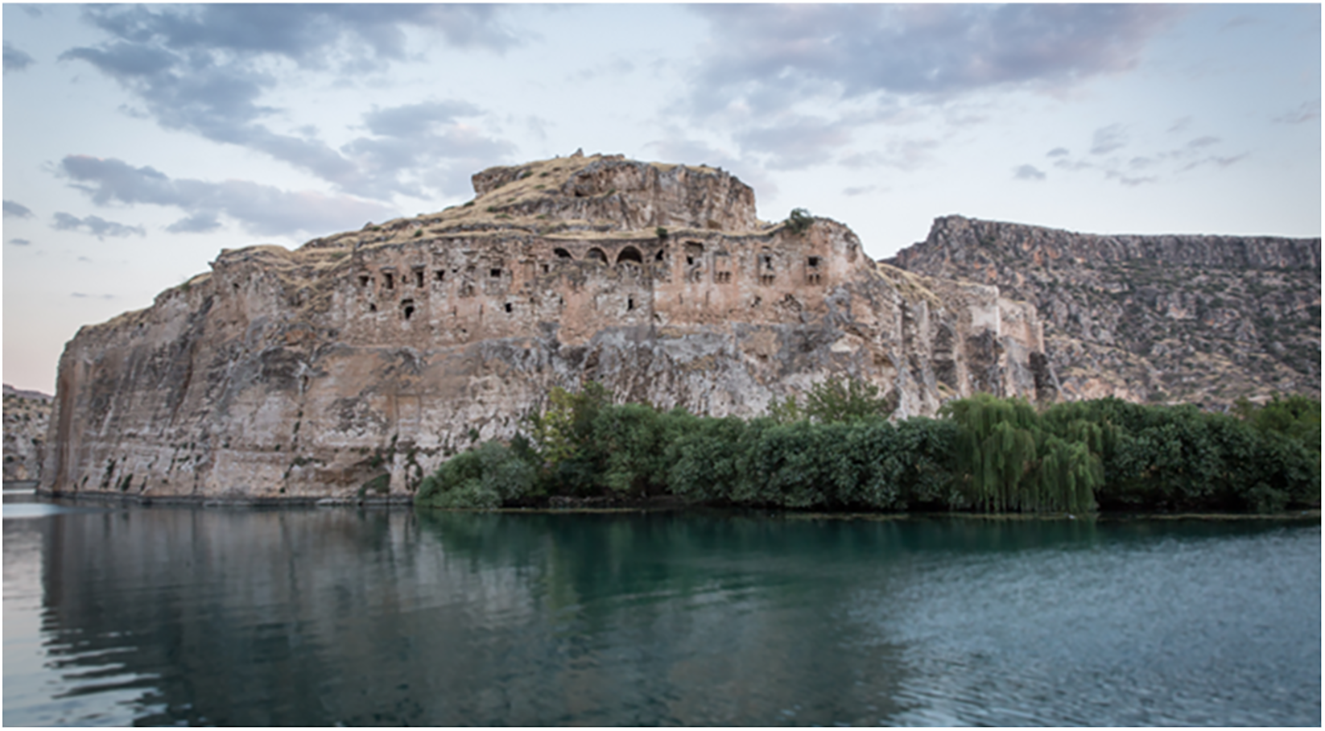
Due to national and international critique Turkey's awareness grew on the necessity to preserve, and even to regain cultural heritage that had been lost. As Michael Rowlands (2002) points out: “Heritage implies a threat of loss and the need to preserve or conserve against an inevitable sense of deprivation” (p. 110). Growing awareness was noticeable in projects like “the resurfacing of the Ulu Mosque” in which this partly inundated mosque will be rebuilt by removing it from its original place; and “the improvement of Savaşhan village” a project funded by the Ministries and the Directorate of Foundation. In addition, Müjgan Karatosun and Deniz Çakar (2017) make clear that the renovation of the facades of historical buildings in Halfeti is on the agenda (pp. 79–80). In Old-Halfeti inhabitants started to renovate traditional houses and transformed them into hotels, hostels or restaurants. Places that used to be in a bad state after the flooding, until people started to pick up their importance.
4. Traditional house turned into boutique hotel (picture by the author)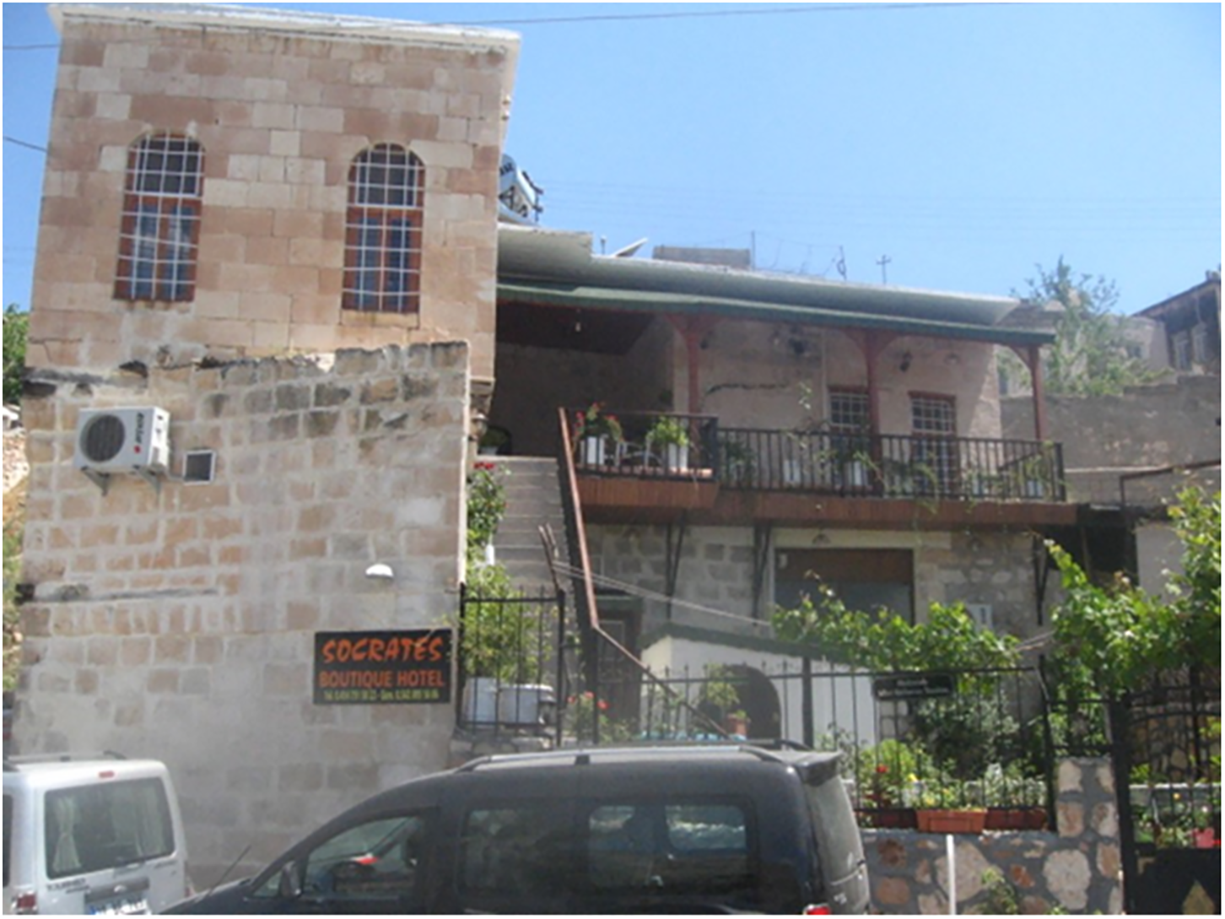
GAP creates a narrative and image about the value and importance of materiality, imbuing certain objects with status. Rubble or material leftovers that survived the flood are turned into resurrected ruins (Stoler, 2008), in which certain places become important enough to preserve. A process that is part of creating modernity (Gordillo, 2014: 9, 10). Within modernist views there is a strong importance given to “newness, rupture, and linear plot lines” (Koselleck, 1985; Latour, 1993; Ou-fan Lee, 1990; Schnapp, Shanks, and Tiews, 2004b; Taylor, 2001 in Dawdy, 2010: 762). In Halfeti materiality is rearranged and renovated in such a way that it fits into a coherent, linear story. The past is seen as something that can be “frozen” in time. As Vyjayanthi Rao (2013) explains in her work on a state-led dam infrastructure that flooded villages in India, similair to Halfeti's case, ostensibly the effects the past generate on people can be controlled through objects and the way they are shaped and represent the past (p. 310).
5.Old-Halfeti seen from the water shore (picture by the author)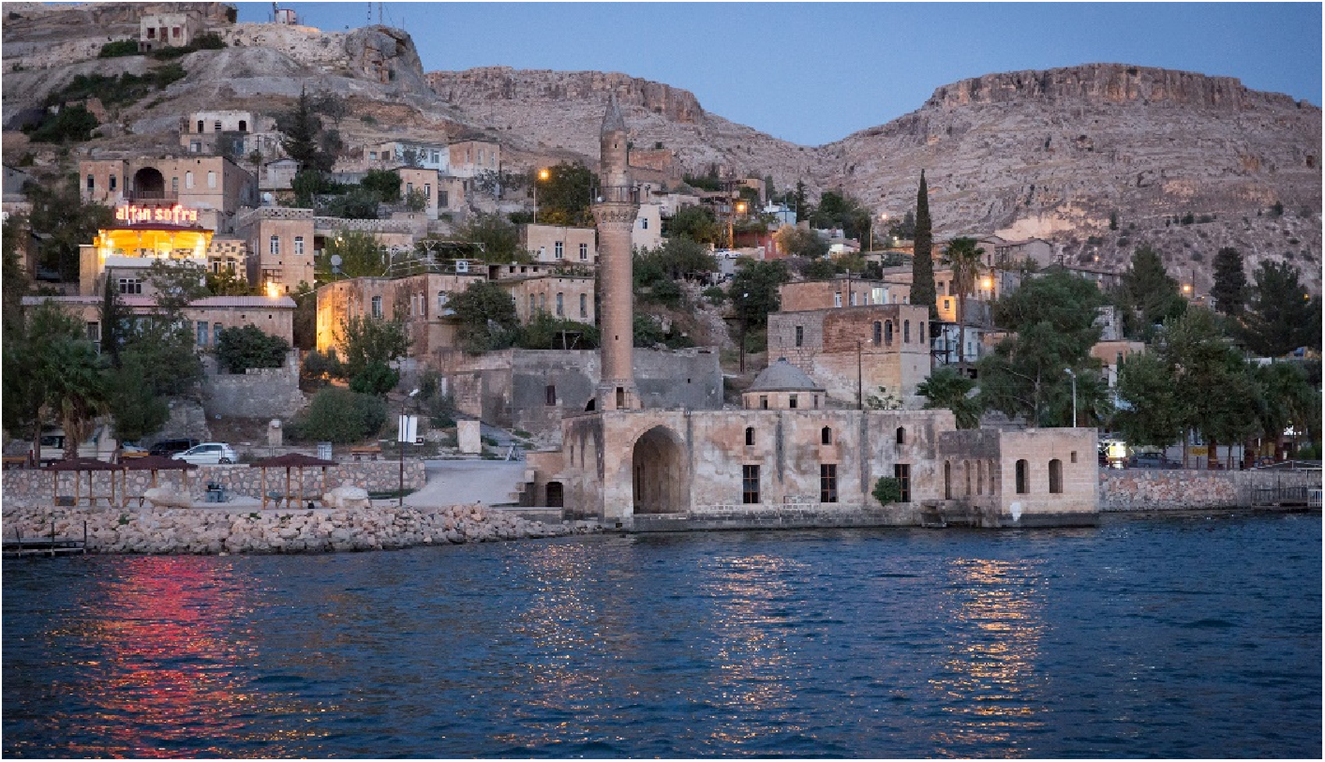
GAP perceives the way to modernity and development as one of overwriting local histories. These “heritage-making projects” are hiding the residues of “histories of exception” (Biner, 2020: 40) and create capital on the enticement of partially adjusted objects as well as individuals (Stoler, 2008: 198). This is part of Old-Halfeti's transformation from a small local village to a modern, contemporary tourist attraction based on processes of destruction and selective reconstruction, choosing only the parts that fit with the ideas of national history, politics, and tourism.
6. Birdseye view of Old-Halfeti (picture by the author)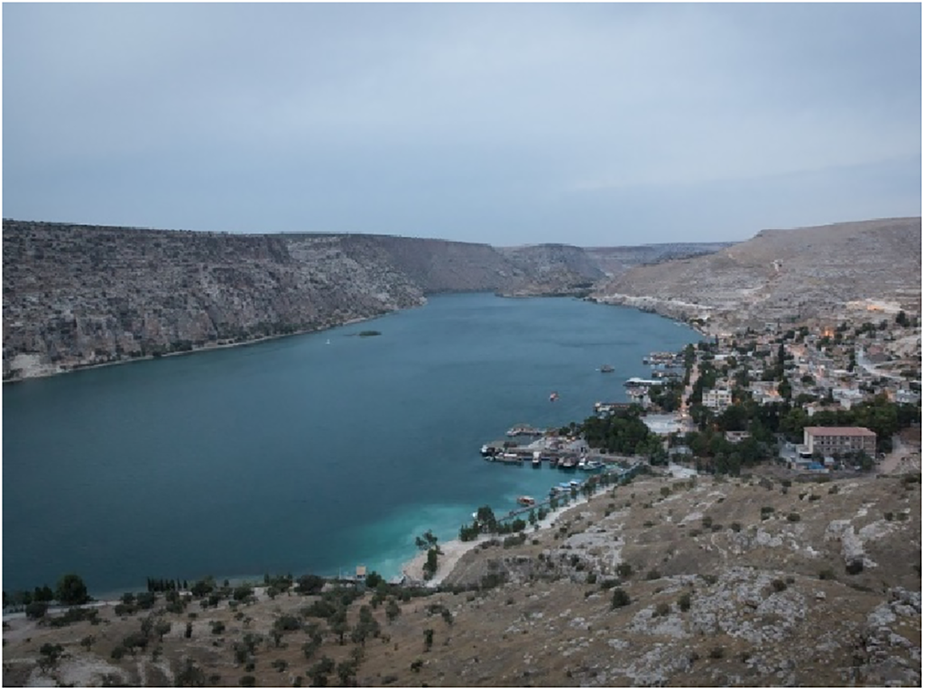
Old-Halfeti, picturesque and “authentic,” is a renovated polished, modern version of the past and of what a tourist town should be. New-Halfeti, on the contrary, breathes a “modern” and “new” atmosphere due to its taut architecture. Old- and New-Halfeti are both symbols of development and modernity expressed through its, albeit different, material arrangement. In the next section, I will elaborate on these places and how they both, through their infrastructure, evocate social ruination.
From Old- to New-Halfeti
A drive from Old- to New-Halfeti, 10 kilometer inland, reveals a landscape of newly constructed infrastructures and renovated dwellings that alternate with submerged or dilapidated houses and abandoned villages. New-Halfeti is primarily dominated by TOKI-houses. TOKI stands for Public Housing Development Administration Toplu Konut İdaresi Başkanlığı and provides state-funded housing for among others reconstruction activities and disaster relief. Organized in a grid-like structure the Toki-houseshave small gardens and can host only a nuclear family, the apartment blocks provide only a balcony as a connection to the outside world. This stands in stark contrast to Old-Halfeti where cobblestoned winding roads lead you up and down through a meandering village on terraces with multiple-story houses.
Before Old-Halfeti flooded, families used to own big communal gardens at the shore of the Euphrates where they spent the summers under the shade of the trees. River water irrigated the gardens next to its shore creating fertile soil in the otherwise dry landscape, people caught fish, and the river was a place to swim and to seek refreshment from the extremely hot summers in southeast Turkey which can amount to as much as 50 degrees Celsius. Inhabitants were self-sustainable thanks to the cultivation of fruits and vegetables, and the milk and meat from the animals that resided on the land.
During harvest time people helped each other collect vegetables and fruits, and the owners often shared their harvests with the helpers. More importantly, people planted the gardens for several generations to last; the orchards of trees symbolically expressed the intergenerational solidarity network of the family. The gardens are now all submerged. With the disappearance of the trees, the intergenerational, reciprocal network was simultaneously broken (Wohlwend, 2011: 87), and the connection to the past disappeared as well. As Stuart Kirsch (2001) explains after a disaster loss comes in many different ways and is among others visible in the loss of knowledge transmission between generations (pp. 167–169).
In New-Halfeti it is not possible anymore to have similar reciprocal exchanges of fruits and vegetables because there is no capacity that allows to produce it: due to the smaller houses extended families were divided over several houses, not necessarily in the same vicinity. Because of the arbitrary character of the resettlement policies, the mahalle (neighborhood), or solidarity communities weakened or completely disappeared in New-Halfeti. Mahalles in rural Turkey are an extension of the private home and characterized by kinship relations (Wohlwend, 2015). The dissolvement of the mahalle resulted in a lack of social control (Wohlwend, 2011: 99), a decline in social relationships in the communities, and an interruption of religious activities (Miyata, 2004: 6).
Bayram and his wife Selin underline the difference in social life between Old- and New-Halfeti. They are both born and raised in pre-dam Halfeti (now Old-Halfeti) and live with their three daughters in an apartment in New-Halfeti. Bayram runs a grocery store there. He initially tried to adapt to the new situation in Old-Halfeti by buying a boat (tekne) to work in tourism, but it was too hard for him to work in his hometown which had changed so drastically. The flooding was too traumatic and evoked a depression. He told me he cannot live in Old-Halfeti anymore, but he visits it regularly to see family and friends. The emotions surrounding Bayram's story emphasize how he is attached to his hometown, but at the same time feels alienated from its recent version. Even today, he is not capable of moving back, even though, or probably because, he loves it so deeply.
The couple told me that in pre-dam Halfeti contact with neighbors was particularly important. In New-Halfeti, the contact with neighbors is less significant. “It is more comparable to city life,” Selin explained. “People are more on their own, and the cohesion of the mahalle has disappeared in New-Halfeti,” she adds. She stresses here that she finds this a disadvantage of living in New-Halfeti. The forced, abrupt break with the more, traditional lifestyle is emblematic of the way GAP envisioned development and modernity, as is the individualistic lifestyle related to the relocation strategies and new ways of residing. Changes induced by among others the particular infrastructure in New-Halfeti.
Simultaneously, inhabitants of Old-Halfeti perceive the infrastructural transformations after the flood as a deterioration compared to the pre-flood situation. The flooding pushed Old-Halfeti, which used to be an important central place for the region, to the periphery with only one main road leading there today. Şerife told me that the old mosque could not be used anymore, although authorities promised otherwise. I lived with her and her husband for several months in the center of Old-Halfeti. This elderly couple lived their whole life in Halfeti. She was upset about how life changed since the flooding. Today, there is no doctor, hospital, police station, school and bank anymore in Old-Halfeti, they all moved to New-Halfeti. In addition, after the flooding, there are hardly any services provided for the elderly. When Şerife wants to do her shopping at the weekly market in New-Halfeti, it is hard for her to return home because there is no regular public transport like a dolmuş (minibus). This means that she must hitchhike and that can be very tiresome for an older woman. She asked in a concerned tone: “What will happen in case of a medical emergency? People must go to Yeni-Halfeti (New-Halfeti) by ambulance, but that takes time.”
7.Partly inundated mosque in the center of Old-Halfeti (picture by Lieve Willekens) “The nature was more beautiful before the dam. The living conditions were better in the past. For example, if right now from tourism one hundred people can eat bread, one thousand people could eat bread in the past because of agriculture. The old place was much better.”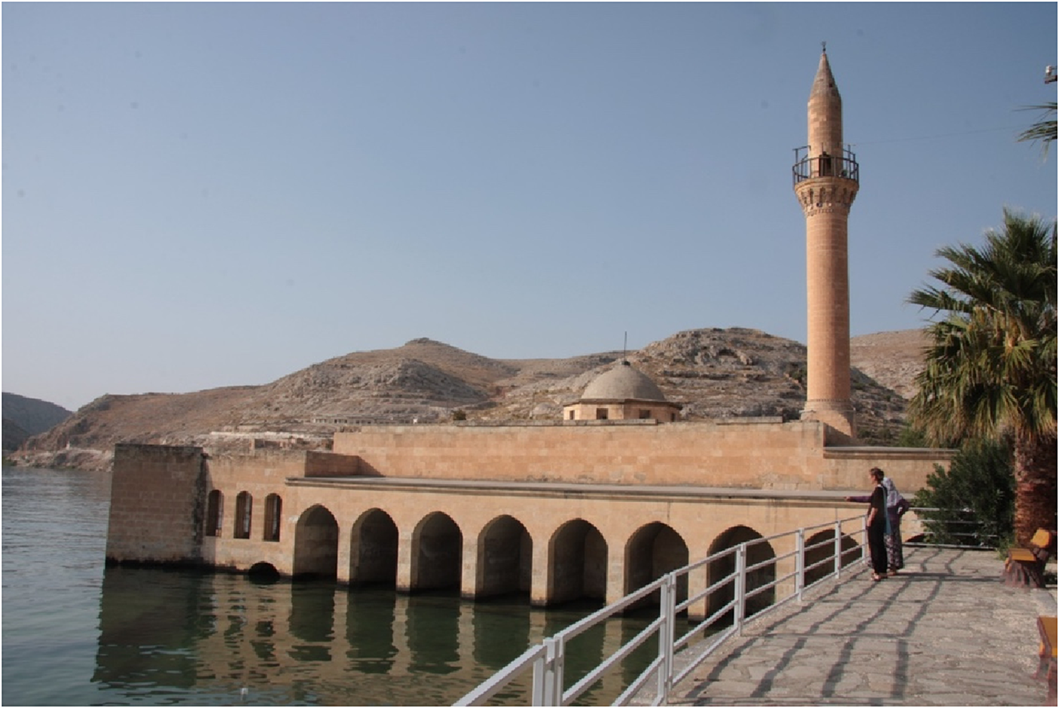
Thomas Yarrow (2017) mentions how “Temporal stasis and regression arise in this gap between the ideal and actual” (p. 579). Showing how an infrastructural project like GAP pushes a place further away from a new promised lifestyle in which modernity, progress, and ultimately freedom would be reached through such infrastructures (Larkin, 2013). According to Adrian Deoanca (2020) the “promises of modernization” can instill a sense of pride and hope but can also involve disturbance of space, in which the experience of being stagnant produces feelings of frustration and wretchedness (p. 153).
The vanishing of dwellings or facilities in Old-Halfeti, but also the disruption of social ties evoked by a different architectural set-up in New-Halfeti makes people feel out of place, since the prospect of recognition is not there anymore (Rowlands, 2002: 111). As Frida Hastrup notes in her research on a village affected by the Tsunami in South India in 2004, “disruptions in social life do not merely consist in the dramatic events as such, but also in an ensuing sense among survivors that their access to a habitual context has been blocked or threatened” (Das, 2007: 1–12 in Hastrup, 2010: 100). In both Old- and New-Halfeti the transformation of the material surroundings had such an impact that people cannot connect with it anymore. This provokes feelings of discomfort, alienation, and unsafety. Processes of social ruination are therefore discernible not only in destroyed or derelict landscapes but also in the decline of social ties, feelings of alienation and dysconnectivity with the new-build or renovated space one is living in. Even when from the outside this space looks neat, clean and raked, the personal feelings and emotions that continue to play a role in the aftermath of this event (Navaro-Yashin, 2009: 5) must be considered and linger on in the minds and bodies of people. These examples show the potency and power of infrastructures in the way they trigger emotions and affect and create feelings of belonging or loss through the way they shape us (Appel, Anand, and Gupta 2018: 26; Desilvey and Edensor, 2012).
The redesigning and resignification of places enforced by state-led infrastructural projects motivated within a context of preservation with one dominant narrative “risks the erasure of other, messier, memories and forms of experience” (Edensor, 2005a in Desilvey and Edensor, 2012: 473). In the next section, I will look deeper into these (partly) erased local histories and memories expressed through alternative material remnants and how they make a divergent past still part of present-day life and expose different, nonlinear (his)stories.
Back to Old-Halfeti: Alternative materialities, absences and neglected ruins
Kaan, a friend of mine, called me on a Sunday afternoon and told me he was on his way to Halfeti with some friends. Kaan is from Izmir, but he was doing his PhD at a university in Şanlıurfa. The latter city is the capital of the province of the same name and is about eighty kilometers east of Halfeti. Sometimes Kaan comes to Halfeti to have a break from the life he leads in Şanlıurfa. According to him, Halfeti is a beautiful, scenic, and a relaxed place where he can lay his mind to rest, even if it is just for a few hours.
Usually, Kaan comes alone, but this time he came with three female friends who were, like him, all from big cities in the west of Turkey. They were all traveling around the country as backpack tourists (two of them he met through couch surfing), and so they differed from the typical domestic visitors to Halfeti, who live in the vicinity and come by car or touring bus. Altogether, we strolled through the village and ended up taking a boat tour. While we were on the boat one of the girls told me that she was a political activist. She explained to me how she once, in the north of Turkey, demonstrated against the construction of a dam (not part of the GAP project) by climbing on machines while they were digging in the ground. Risking her life, she tried to stop the process of completing the dam. While we were on the boat making a tour enjoying ourselves, dancing to loud music with some other women, she suddenly shouted in my ear: “Here we are, dancing, having a good time, but actually we are dancing on their graves.”
Old-Halfeti today stands in stark contrast to the pre-dam one, with the natural winding river now a wide, static basin of water. Here boats perpetually sail up and down. The big ones with two floors play loud Turkish pop- or traditional music and create a cacophony of sounds in which visitors can bathe themselves while they dance around, watch the spectacular scenery and take pictures. Simultaneously they sail over sunken houses, pass by minarets and other remnants of the flood sticking out of the water. Absences are all encompassing, and the changed river reminds inhabitants every day of what happened. The flood left deep traumatic scars behind, not only inside people but inside the whole fabric of the town, deforming the social and material structure of daily life (see also Fernández, 2023).
8. Minaret sticking out water (picture by the author)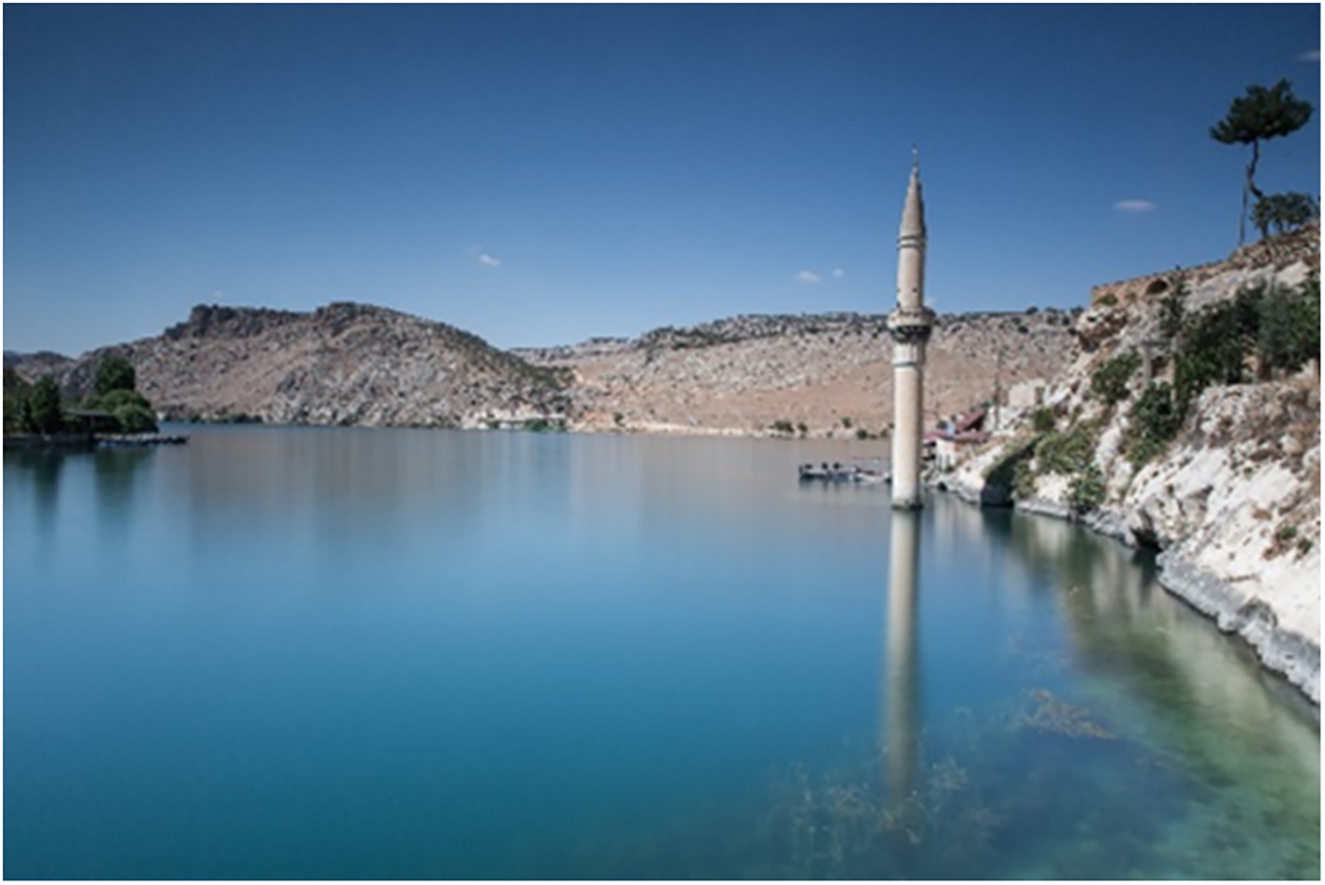
Despite what one might expect with a “controlled” flood like the one in Halfeti the event came as a complete surprise to its inhabitants. Before the flood ÇATOM, Çok Amaçlı Toplum Merkezleri, meaning multipurpose community centers or GAP's social outreach branch (Sarıaslan, 2023) notified people about and helped prepare them for, the arrival of the dam, trying to explain to them the exact time, date, and location of the flooding. Despite the warnings, most people could not believe it was going to happen.
As the former muhtar (village head) of Halfeti explained: No one, well, the state had said: at this and that day we will be damming the water, prepare yourself accordingly. At some windows, they put notes. They warned, only by writing notes. But such a thing we have never seen before, we have never been flooded by a dam! No one believed it, we told things to each other like ‘What if the water will not be dammed, it will all take much longer anyway, and whatnot’. But exactly that day the water flooded over its shore. (translated from Wohlwend, 2011: 84)
During the flooding, which lasted a few weeks, people tried to cut down the trees that were carrying fruits, but they could only save one-third. As the muhtar explained, most people were completely overwhelmed. Many people lost their dwellings and mode of income. Social networks dissolved, and the situation left people behind bereaved and traumatized. When people started to realize what they had lost, and that they would not be able to go back to their old homes and communities, some elderly people got sick and consequently died. Most locals describe the flooding as a tragic and traumatic event (Wohlwend, 2011: 78).
Old-Halfeti today can be seen as one big memento that confronts people daily with the flood that happened more than 20 years ago. Surroundings trigger memories about its pre-dam time. The river and all that is covered underwater were at the heart of these stories. Once, I was strolling around with a couple of women from the village. We were walking next to the river shore and one woman started to point out the exact location of her fruit trees. She told me that there used to be orange and banana trees. While she was pointing to the water, she said: “They were here my orange trees, can you imagine!” We both stared into the black water. She told me how beautiful and delicious those oranges were as if she could still taste them.
Walks in the village could trigger memories and conversations about the past, but also drinking tea in one of the duba (floating) restaurants. These restaurants give the sensation to the customer of sitting on the water enjoying the scenery while eating. While we were drinking tea, floating on the river, one friend explained that we were sitting “on” the former high school. Frida Hastrup (2010) mentions similar experiences when she walked with people in the South Indian village of Tarangambadi that survived a Tsunami. “When I walked around the affected areas…they would continuously point to ruined houses and tell me who had lived there, or which activities they associated with the damaged structures” (p. 101). People would point out the sense of displacement. It made me aware of how Old-Halfeti was a constant reminder to people of what happened and what was absent. Morgan Meyer (2012) explains how absences are powerful markers since due to their so-called invisibility they pull one's attention in the present to the past event (p. 4). The confrontation with the recent situation in Old-Halfeti was dramatic and seemed all-encompassing. The place formed one big reminder of the flooding and the losses that it brought about and exposed what David Berliner (2012) calls the plurality of nostalgia's, which are a product of ruination.
9. Duba restaurant by night in Old-Halfeti (picture by the author)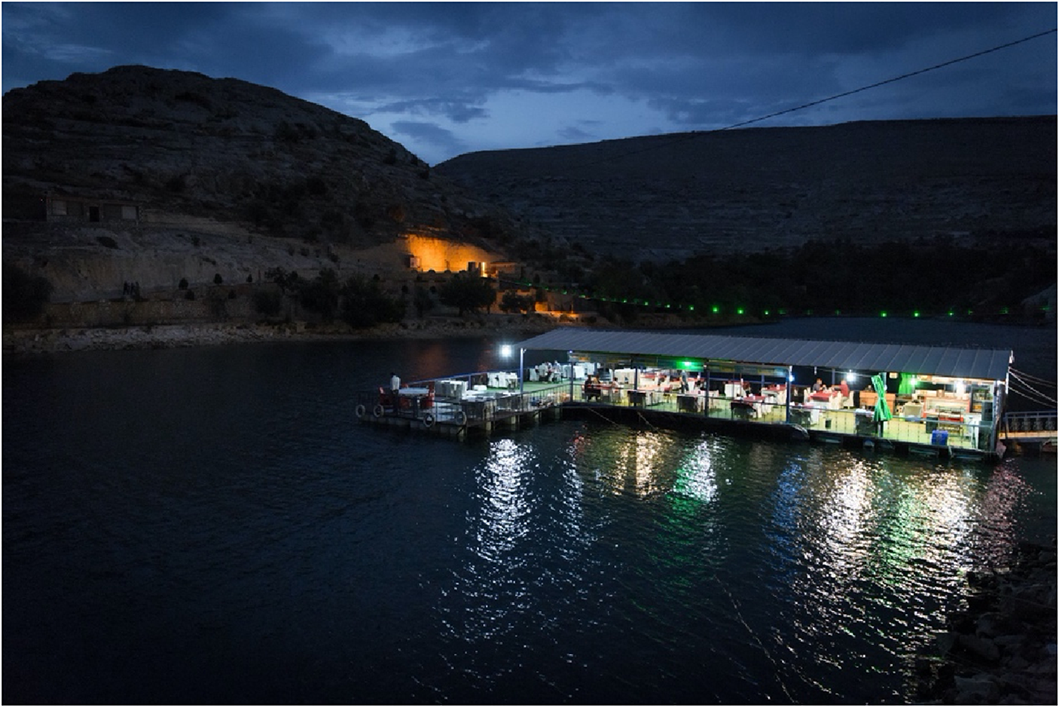
Not only the absences underwater but also “rubble” that escaped submersion made me aware of the untold (hi)stories that were inscribed in the landscape. When I roamed around the wider surroundings of Old-Halfeti I discovered many abandoned places that were in a bad state. During one boat trip we passed some abandoned villages. Most of the time only a few houses in an unlivable condition were still there since the rest was underwater. Nadir, an older man from Halfeti and my tour guide, explained that most people left because they either lost their housing or received so little compensation money that they were forced to move to big cities like Gaziantep or Şanlıurfa to find work. The few people that were still living here were the ones that worked in pistachio cultivation and were often owners of trees and land. While he was explaining this all of a sudden, a woman stuck out her head of a window surprised by people passing by, but also happy with unexpected company in this isolated area, inviting us over for tea and food.
It dawned on me how this place revealed layers of complex historical events. In her house, of Armenian origin, a picture of Atatürk was hanging on the wall. This portrait referred to the foundation of the Turkish Republic in 1923, a period marked by politics of national homogenization. Kerem Öktem (2003) describes how non-Turks were excluded from “both the material reality and the collective memory and imagination” (p. 3), resulting in an official uniform Turkish national identity. Alice von Bieberstein (2017) explains how for the nationalist project to be successful a remaking of material reality took place, amongst others through strategies of destruction, dispossession, denial, and neglect. The Armenian massacres in 1895–1896 and 1915 are a case in point, but also the destruction of Armenian and Christian Syriac houses, churches, schools, gardens, and cemeteries (Dündar, 2001). Subsequently, frequently Kurdish people took over these houses, in which the Armenian inhabitants that were the original owners of the house were forced to move out. Finally, the dilapidated state of the house exemplified how the flooding not only consists of submerged dwellings but also of ignored dwellings turned into rubble, showing the impact of the GAP project beyond the little “renovated” town of Halfeti, and the political power of neglect.
10.Neglected village in vicinity of Old-Halfeti (picture by the author)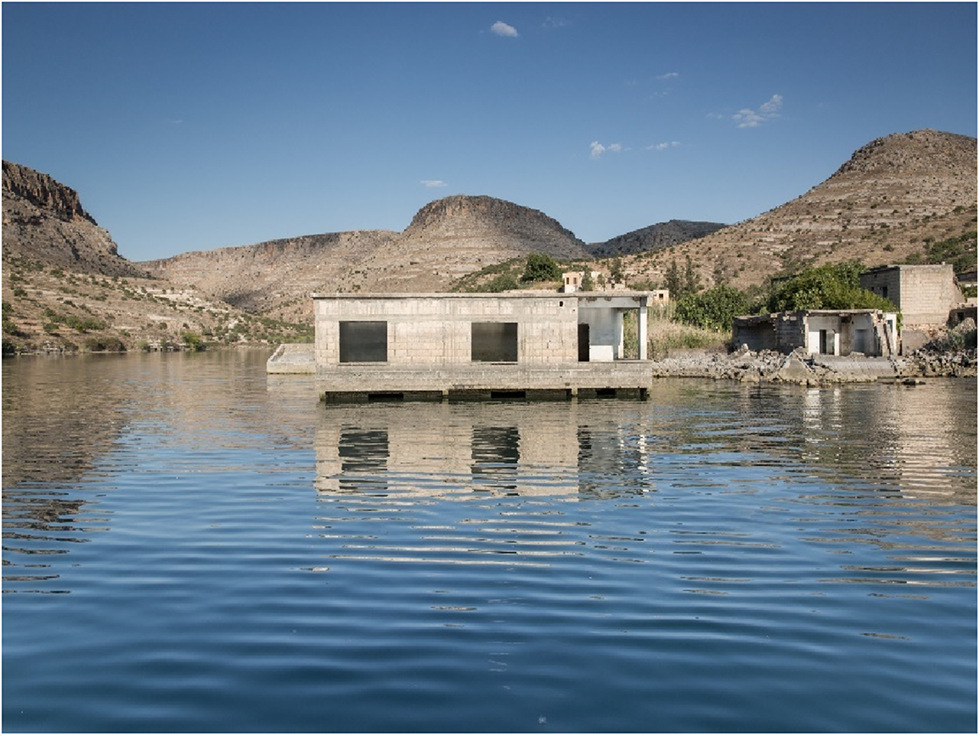
To create a “coherent” story and image about Old-Halfeti GAP excludes these complex historical layers and wraps materialities in stories “to hide the sounds and images that roam” in an around them (Stoler, 2008: 199). There is no reference for example to the Armenian origin of the renovated houses in Old-Halfeti. Armenian stone masters made the two- or three-story houses out of a stone called nahat, a calcareous stone that gets harder over time, and adorned with elaborate stencil work (Ballice, 2010 in Varolgüneş and Canan, 2018: 420). Adapted to the local climate they have big walls to keep out the heath in summer, and to isolate against the cold in winter. According to Ali Yamaç (2015) in depictions of Halfeti usually the only reference to Armenian heritage is made via Rumkale that has been the capital of the United Armenian Church for 90 years until 1293. The more complex history is, similar to the traumatic events of the flooding, not explicitly referred to. In this way, it is similar to the negating strategies under Kemalist rule. The creation of what Michael Herzfeld (1991) calls a “monolithic present” is part of a wider political project in Turkey where a reified national history and identity, not only excludes important and more complex parts of the past but is also used to legitimize state-led infrastructural projects like GAP. GAP is a continuation of Turkey's modernization project (Bilgen, 2019; Çarkoğlu and Eder, 2005 in Sarıaslan, 2023: 9).
11. Armenian house abandoned village (photo by the author)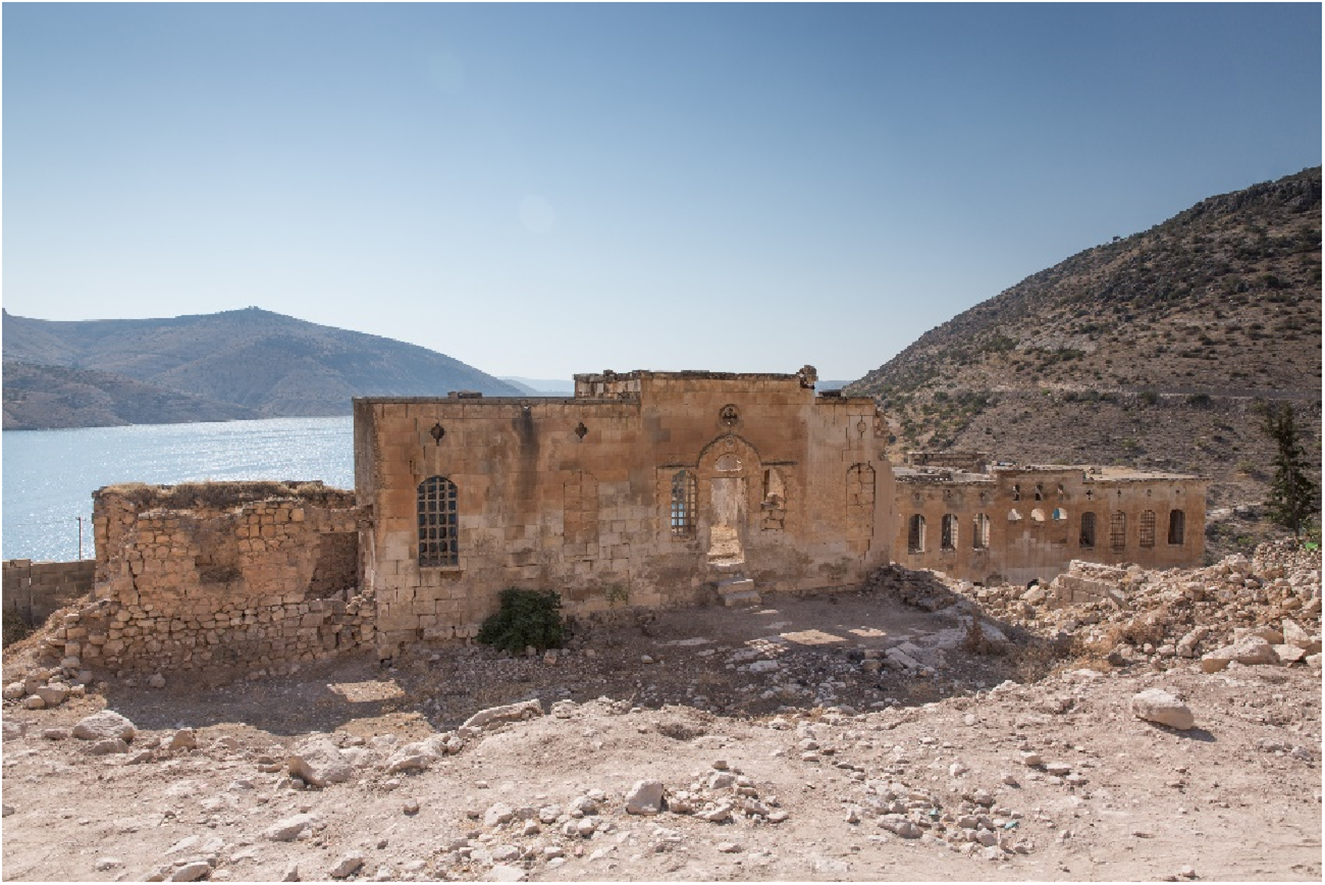
By “dissecting” alternative materialities that fall out of focus in the dominant discourse, the more complex, negated parts of (national) history surface. The latter discernible in the neglected and abandoned materialities considered rubble. These give way to alternative versions of the past and to reclaim negated stories of marginalized groups (Desilvey and Edensor, 2012: 471), and therefor destabilize conventional nationalistic histories that are excluding the experiences of minorities (Suni, 2023: 194). Exposing the intricacy and proximity of alternative materialities, in which divergent temporalities and histories live next to each other but are not in the same vein acknowledged (Fontein, 2011).
Alternative materialities criticize linear memory by bringing troubled past to the present and align with what Çiçek İlengiz (2022) calls counter-monuments (p. 406). In turn, these complex pasts, inscribed in alternative materialities, show the instability of modern progressive time and the incompleteness of modernity (Dawdy, 2010: 762) and make clear how “infrastructures simultaneously index the achievements and limits, expectations and failures, of modernity” (Appel, Annand and Gupta 2018: 26).
Alternative materialities have an active presence or agency because they tell different (hi)stories, evoke affect, and as such are entangled with the inhabitants of Halfeti. They cannot be erased completely, even though this might be the aim of modernist constructions (Rao, 2013). They stubbornly keep on telling their stories and show how as Annika Lems (2016) explains place persists even in the face of profound and utter disorder (p. 320). Finally, alternative materialities not only express the way the (undesirable) past is ingrained in the present, but also reveal how neglect is an active and political process executed by state-led modernizing projects like GAP. The consequences these projects produce are both including some and excluding others “silencing one point of view while applauding another” (Bowker and Star, 1999 in Howe et al., 2016: 556; see also Lesutis, 2021).
Reading the landscape of Old- and New-Halfeti constituting of the newly built houses, apartments and renovated buildings, as well as the alternative materialities, shows how all these are part of GAP's modernization project and should be included when we try to understand modernity holistically. Understanding the emotions, disruptions of social life and silenced histories these materialities evoke demonstrates the dissonance of modernity. Meaning that modernity entails both construction and deconstruction, prosperity and destitution, domination and subjugation simultaneously, and that any kind of infrastructure is “alive” and impregnated with social meanings (Howe et al., 2016: 548). By considering the intertwined dynamics of social ruination, political appropriation of spaces, and the unveiling of alternative materialities, a more nuanced understanding of the contemporary landscape emerges demonstrating the dissonance of modernity.
Conclusion
This article delved into the topic of state-led infrastructural projects as embodiments of modernity and the way their various material transformations ‘play out on the ground’. By reading the diverse materialities in these altered landscapes I argue that such projects not only bring modernity, but simultaneously, through the way they transform material surroundings, provide a commentary on these modernization processes and surpass the intention of their creators.
I focus more specifically on Halfeti, a town in Southeast Turkey that was for two-third submerged due to the construction of the Birecik dam—a component of the larger GAP damming project. Following the flooding, Halfeti became divided into Old-Halfeti and New-Halfeti. The former turned into a tourist destination, and the latter was purposefully constructed for those displaced by the inundation. GAP instigated profound infrastructural transformations that significantly impacted daily life and social dynamics.
Through the altered, albeit in a different way, surroundings of Old-and New-Halfeti I illustrate how not only derelict and dilapidated places evoke social ruination but also newly built infrastructures or renovated tourist projects. The altered surroundings evoke a disruption of social ties, loss of a sense of community, and create displacement and sensations of regression in time, feelings that persist within bodies and minds of inhabitants. Furthermore, alternative materialities, in the form of submerged or neglected places, are part of this altered landscape. They convey nonlinear, nondominant, heterogeneous and conflicting (hi)stories about Halfeti that are as much part of the surroundings and its people as the stories told by GAP. Through alternative materialities the afterlife of post-dam Halfeti is explained from divergent positionalities and demonstrates how modernity has not the same efficacy for all. Moreover, it scrutinizes the active presence or agency of the material, and the way it brings about affect, shapes longing or nostalgia and expresses different histories. Through the material, space and time are interrelated and divergent discourses, histories and affective relations live in proximity with each other, meaning that they coexist and actively meet each other (Fontein, 2011).
Both the renovated and newly constructed structures, along with the alternative materialities, create a dissonant landscape of modernity in Halfeti. This implies that modernity encompasses decay and construction, prosperity and destitution, domination and subjugation simultaneously. The intertwined dynamics of social ruination, political appropriation of spaces, and the unveiling of alternative materialities, demonstrates the dissonance of modernity. Exposing the instability of modernization and linearity of time that leads only to progression, and expressing the way modernity itself is incomplete, dynamic and often overconfident (Dawdy, 2010: 762).
Footnotes
Declaration of conflicting interests
The author declared no potential conflicts of interest with respect to the research, authorship, and/or publication of this article.
Funding
The author(s) disclosed receipt of the following financial support for the research, authorship, and/or publication of this article: The research was funded by the SNSF (Swiss National Science Foundation) and executed under the larger project titled Development and Trust in Upper Mesopotamia: The Social Impacts of GAP (Güneydoğu Anadolu Projesi). The research was run by Department of Social Anthropology and Cultural Studies of University of Zurich in cooperation with the Department of Sociology of Middle East Technical University, Ankara.
