



Abstract
The article focuses on the material culture of regions that underwent a shift in statehood when, post-World War II, formally German territories became Polish. It seeks to analyse how the heritage of post-conflict territories was integrated into everyday life and, in some instances, affirmed and appreciated by second and third-generation settlers. Through research conducted amongst contemporary city-dwellers, the authors scrutinise the relationships between people and pre-war German objects, identifying a form of relation referred to as ‘kinship’. By exploring the mechanisms through which objects are incorporated into individual and/or group history, they elaborate on the concept of ‘adopted heritage’, as demonstrated in various field research cases. This concept is derived from the idea of affinity and its application to material culture studies, and enhanced by theories that emphasise the role of emotions in heritage.
The territory of western and northern Poland is marked by sudden rupture and transition that have affected the people and material culture. Looking through and with objects applied to the post-conflict context in terms of kinship enables us to rethink the process of incorporating the possible challenges of the past into contemporary ‘imagined worlds’ (Appadurai, 1996). This article, based on field research in two cities that changed from German to Polish after World War II, develops the idea of affinity between people and things. It presents a methodology and theoretical frame of research, as well as selected results that lead us to propose the notion of adopted heritage.
‘Recovered lands’ and practices of spatial appropriation
The starting point of both our research 1 and the following article is post-World War II history, which transformed the population make-up of the western territories of contemporary Poland. After the war, the decisions of Allied Leaders shifted Polish borders from east to west. The Polish state lost its multiethnic territories in the east and, at the same time, absorbed part of Germany. The main consequence of this was a massive migration. Prewar inhabitants of annexed territories were forced to leave, while settlers arrived in the newly established Polish areas. Among them were Poles from Central and Eastern Poland, displaced persons, prisoners of war, and various ethnic and national minorities.
The new ‘promised lands’, as the government propaganda called them, were in fact also an arena of destruction and mutual antagonism among various groups of migrants. Moreover, the land bore traces of forcibly displaced Germans, Jews, Sorbs, and other minorities inhabiting this borderland area. These traces were altered both by the takeover of private material heritage (theft, looting) and the erasure of selected symbolic manifestations of the heritage in the public sphere (changing geographical and administrative names, removing monuments, etc.). The factors generating such practices include: Victory gestures, survival strategies in the postwar poverty and deprivation, and unconscious acts of vandalism arising from substantial cultural differences between the prewar residents and the settlers who arrived after the war e.g., changing toilets into cupboards, devastating agricultural machinery due to ignorance of its use, and different farming traditions (Davies and Moorhouse, 2003; Demshuk, 2012; Thum, 2011). Many objects, however, were seen as functional and useful. The new settlers suffered from poverty and postwar shortages, and from the fact that they could only bring a limited amount of goods (Zborowska, 2017, 2019, 2021). In everyday life, they dealt with a sense of temporality, loss, and unfamiliarity with the natural and cultural landscape, full of hostile and unfamiliar objects, foreign houses, factories, or farms.
The government legitimised the appropriation of space, buildings, and things, both on the local and state levels. Those practices, including vandalism and various forms of destruction, were officially called ‘de-Germanization’ and ‘re-Polonization,’ 2 and were pillars of the postwar policies toward the newly annexed lands (Thum, 2011). They were explained by the propagandist slogan of ‘returning to Recovered Territories’, as the western lands had been ruled by the Polish Piast dynasty in the Middle Ages. The result of these policies toward postwar heritage was its simultaneous takeover and repression, and then its annihilation through the process of constructing a new postwar reality. The present return of this heritage to the visible space prompts questions about the new context and significance of this restoration.
Research on the western and northern territories attached to Poland after World War II could only develop after 1989. During the whole Polish People's Republic period, the intense propaganda and policies of remembrance blocked research into the region's history and heritage. Individuals were forbidden to express their identity, the history of their family and its resettlement, which contradicted the propaganda of the success of ‘recovered lands’. In publications from this period, mainly focused on the Middle Ages, one finds many missteps and understatements. Since 1989, research on the history, tradition, and heritage of the western territories has begun developing dynamically. Most analyses, however, concern the postwar period and the creation of new social, administrative, institutional, and cultural structures (Bock-Matuszyk et al., 2018; Halicka, 2020). Meanwhile, the western lands are a field of dynamic transformation, primarily in terms of regional identity, constructing locality (familiarity), and searching for and creating cultural heritage. This local turn has been mentioned in publications concerning Wrocław and Szczecin, cities we have explored (Davies and Moorhouse, 2003; Musekamp, 2013; Thum 2011).
Methodology and theoretical framework
From 2019 to 2022 we conducted our study in Wrocław and Szczecin (pre-war Breslau and Stettin), principal cities in the western territories and regional capitals. Our methodology relied on diverse sources, allowing us to capture a holistic depiction of the multifaceted reality and intertwined transrelational ties (Majbroda, 2019). Our investigation aimed to delve into the relationship between the inhabitants of Wrocław and Szczecin and their cities’ pre-war heritage. In particular, we were interested in pre-war things that are still owned or used. We posed the questions regarding the significance and influence of these objects – are they cherished, acclaimed, or do they merely exist as overlooked elements of everyday life?
The primary data collection method required visiting private spaces, encompassing both apartments and residential houses. We managed to conduct forty interviews, twenty in each city of interest. The majority of these were not prearranged, we knocked on apartment doors and asked the inhabitants if they would be prepared to talk with us. Since we were interested in attitudes towards pre-war material culture, we conducted the research in pre-war districts, but we looked for heterogeneity within this category, visiting neighbourhoods of diverse social statuses.
Our research on private apartments involves a combination of ethnographic and artistic (photographic) tools that have been practised and theorised by many researchers (Leavy, 2009; Rakowski, 2018; Sansi, 2015; Schneider, 2020; Wright and Schneider, 2006, 2010, among others). We are working with Łukasz Skapski, 3 a Polish multimedia artist who photographs objects of interest and our interlocutors in their private spaces. This strategy encourages people to rummage in cabinets and wardrobes, to present their homes, things of value, and everyday items. Skąpski's source of inspiration was the monumental Sociological Record photography project by Zofia Rydet, who managed to visualise the relationships between people, materiality, and space (Pijarski, 2021). Photos accompanying this paper are illustrative as we aimed to visualise discussed objects. However, the set of images made during the research project 4 reveals a realm of things, ‘the game of exclusions and preferences’ that composes their owners’ ‘life narration’, as Michael de Certeau phrased it (1998: 141).
The attempts we undertook to overcome research bias focused on questions with a broader scope than just those about owned and used items. They are concerned about the quality of life in pre-war neighbourhoods or apartments, real or potential opportunities to influence the material environment, as well as the universal and contextual family, friendship, and lifestyle stories that underpin each statement. However, we observed that people with some knowledge of the past or with prewar objects in their homes were more likely to let us in than people with no such things, with no interest in history or in the place where they lived (in their rented apartments, for instance). Consequently, the results presented here focus on things that survived, were adopted, and incorporated into the ‘family’. Nonetheless, we are aware that this state and context of the biographies of things should be completed by histories of loss, war, and violence grounded in objects. Dan Hicks's concept of necrography will be a crucial contribution to unpacking the complexity of the prewar heritage rooted in conflict (Hicks, 2020). Since we are focused on heritage adaptation, we are tracing its ‘nocturnal body’ (Mbembe, 2019). We are highlighting the naturalisation of past takeovers and, in some cases, the marginalisation of past owners.
Moreover, our interlocutors live surrounded by things, yet their knowledge of the objects’ provenience appeared to be rather murky. It was sometimes revealed through their doubts, which were debated with the rest of the family. As one of our interviewees stated: ‘I am not sure which things are from that [pre-war] time, because the time, unfortunately, goes by’.
In addition to researching private households, we investigated the exhibiting practices in museums and interviewed museum staff and curators. We also conducted interviews with individuals whose activities were based on pre-war heritage, such as collectors, sellers, instagrammers, and city activists. These were interviews that were initially focused on the realm of their work or projects. However, in many instances, the conversation subsequently transitioned towards personal interests, familial histories, and local narratives.
The initial project's theoretical framework covers critical heritage studies, post-humanism, kinship studies, research on emotions, and migrant studies. We consider heritage as a discourse, a cultural process with its social and political meanings (Graham et al., 2005; Harrison, 2013; Smith, 2006). In tracing the complex relationships between people and objects, we have taken posthumanism, especially its focus on the agency of non-human actors (Latour, 2005; Malafouris, 2008), as a starting point for further reflection. Another pillar of the analysis is the kinship/materiality nexus. We acknowledge kinship as a verb, in that it is a practice through which a family and its sense are created (Carsten, 2004; Morgan, 2011). Thus, we go beyond the blood ties recognising affinity as a social and cultural construct that is creatively reproduced. In the given context, it is especially useful to employ the research underling the role of materiality in practicing kinship, not only concentrated on inheritance processes (Finch and Mason, 2000; Magee, 2019) but also on various forms of passing on objects between kin (Holmes, 2019). However, this article concerns a reverse situation in which the usages of objects belonging to non-kin generate a feeling of affinity.
Kinship studies are frequently intertwined with analysis of emotions, thus it is an important point of reference in our study. We stress the social nature of emotions, tracing how emotions are culturally and politically organised (Ahmed, 2004). We paid attention not only to the emotional reactions of our interlocutors but also to the emotional standards (Stearns and Stearns, 1985) related to the pre-war heritage, which were and are shaped, among other, by cultural production such as novels, reports, films, series, and – as shown in the further part of the article – the activities of cultural institutions 5 (Highmore, 2017).
Since the western territories of Poland are often described as ‘post-migrant’, among the ideas that have inspired us are the ‘imagined worlds’ Arjun Appadurai (1996) used to describe the relationships between globality and locality. We assume that the prewar objects that were transferred to or appropriated in the western lands after World War II along with their new owners have created special kinds of ‘imagined worlds’. The objects and people, not necessarily belonging to one country, culture, or cultural code, create localities and relationships based on varied hybrid identities (Basu, 2017; Smith et al., 2018). Although we are not adhering closely to Appadurai's theory, we underline the impact of imagination in constructing a vision of the past and its role in the present process of belonging. Bearing in mind that the past is always imaginary, we assume, however, that this statement is even more critical in examining postconflict areas with an interrupted history, where the past is ‘not ours’ (Trzeszczyńska, 2016).
Interrupted ownership and dissonant materiality evoke associations with a similar case – the takeover of Jewish properties in postwar Poland. Studies on Jewish materiality (Matyjaszek, 2013, 2019; Weitzman, 2017, 2022; Zatorska, 2018) make for an interesting comparison, providing theoretical insight. In both cases, the material goods were appropriated through the decree of 8 March 1946, on ‘abandoned and formerly German property’ (Weitzman, 2022: 70–72; Zborowska, 2019). The world ‘formerly’ officially used in the decree, is also added to Jewish objects. It reflects and naturalises the confiscation of goods – as it suggests – were left ownerless, and, as Jan Tomasz Gross suggests, it indicates the mass appropriation of someone else's property (Gross, 2008: 86. In relation to the notion of ‘formerly German’, see also: Zawada, 2015; Zborowska, 2019; Zybura, 2007).
Despite the affinity between the concepts of ‘formerly German’ and ‘formerly Jewish’, it is worth highlighting certain distinctions concerning the appropriation of property and justifying this practice through emerging moral arguments. Notwithstanding the profound lack of understanding regarding Jewish history in Poland, coupled with persistent manifestations of anti-Semitism (Ray and Kapralski, 2019; Tokarska-Bakir, 2008), Jewish heritage is associated with the property of victims. Thus, it could generate certain moral apprehensions regarding its acquisition among their post-war users, for instance, local leaders and bureaucrats who took an active part in the seizure of Jewish property (Weizman, 2017, 2022). The consequences of using Jewish property are perceived in spectral terms: Weizeman writes about ‘the ghost of Jewish owners’ hunting those who overtook the property, Patrycja Dołowy (2022) describes a curse that allegedly befell a Polish family for owning a Jewish sugar bowl, while Paweł Reszka (2019) discusses Jewish gold that cannot be used to accumulate wealth. In the case of the usurpation of ‘formerly German’ property, we are still dealing with echoes of post-war discourse of reparation and compensation for incurred losses a deserved punishment that befalls the German nation as war aggressors. According to this discourse, the Germans were culpable for the post-war border changes, as well as their displacement and deprivation of property. This negative stereotype of Germans was perpetuated during the Polish People's Republic, serving as a counterpoint to the propagandistically portrayed ‘friendly’ Soviets, who according to the political narrative of the era, ‘liberated’ Poland from Nazi oppression.
The people–object relationships we have studied are varied and not always aligned. This paper focuses, however, on a certain form of relations, which we categorise as kinship. Notions derived from the concept of affinity have previously been applied to heritage studies, as in the well-known case of orphaned heritage (Price, 2005); our proposal examines the reverse effect. Through investigating the mechanisms by which objects are incorporated into individual and group history, we have developed the category of adopted heritage. This is exemplified in various cases in our field research.
Material kinship
As Steph Lawler wrote: ‘Kin relations are, by definition, cultural. Kin are quite simply those persons we recognize as kin’ (Lawler, 2008: 38–39). What if we broaden the community of kin to include non-human actors? Such an idea was developed by Erica Lehrer, who proposes employing kinship to rethink the relationships between people and material heritage. Lehrer begins her investigations by emphasising that the language adapted to describe heritage tends to frame connections between people and things as ‘universalist/free-choice relationships (where anyone may claim as heritage the items that feel integral to them) or descent-essentialist relationships (where objects are understood as physical manifestations of the world views of the groups that created them—so-called “material culture”)’ (Lehrer, 2020: 290). Both are inadequate with regard to grasping the complexity of relations organised around a complicated heritage, the objects that she labels as ‘awkward’, which embody the traces of the forgotten or suppressed past. 6 Thus, Lehrer proposes the term ‘community of implication’, which highlights the ‘agency, process, and change to people-object relations’ (Lehrer, 2020: 304) instead of focusing on issues of ownership and property. At the same time, the concept of ‘community of implication’ points out that these relationships are not always initiated or chosen by people. In some instances, people are the ones affected by’ or ‘implicated’ in a particular heritage. The crucial part of Lehrer's article – that objects can be considered material kin, entangled with people – is the starting point of our proposal, the concept of adopted heritage.
The term ‘adoption’ as a notion framing the relationships with the material surrounding of the territories incorporated into Poland after World War II, appeared in a reportage novel Poniemieckie (Formerly-German) written by Karolina Kuszyk (2019). The author attempted to create an image of the regions’ identity through the description of the current condition of various elements of pre-war material culture, from paintings and everyday use objects to buildings and cemeteries. 7 In a chapter entitled ‘Adopted Ancestors’, Kuszyk describes a copy of a prewar photograph presenting the unknown past inhabitants of the city that hung on the wall of a home she visited and evoked the impression that the portrayed strangers are members of the family.
During the course of research, we met Karolina Gembara, an artist. She spoke about a pre-war object which was incorporated into the collection of heirlooms from her maternal grandparents who were settlers coming from eastern territories. Her relatives shared the house with its German inhabitants for several months. A wooden sculpture of goats – it accompanied my grandparents ever since they stayed in the former German house. Later, when they had a TV set, it was perched on top, on a doily. It was a thing we attached no importance to. (…) When my grandparents died, we took an inventory of the house. Everyone wanted to take a souvenir. My mother said she would take those goats. We thought they were terribly ugly and wondered why they were put there. I did a little investigating and it turned out to be a chintzy, commonplace decoration in Sudeten German houses. (…) I imagine that the German family had limits on what they could take. For some reason, they decided that the goats were not going with them. My grandmother, as a very young girl who had few decorative luxuries, for some reason kept this item and gave it a new value. But the irony is, something that was unimportant to the family moving out is of value to the family that stayed, and it's all the more valuable to me.
In the narrative, a special role of the knick-knack itself is revealed. Despite the lack of aesthetic values, the sculpture has remained in place and it finally attracted attention and generated emotional attachment (Figure 1).
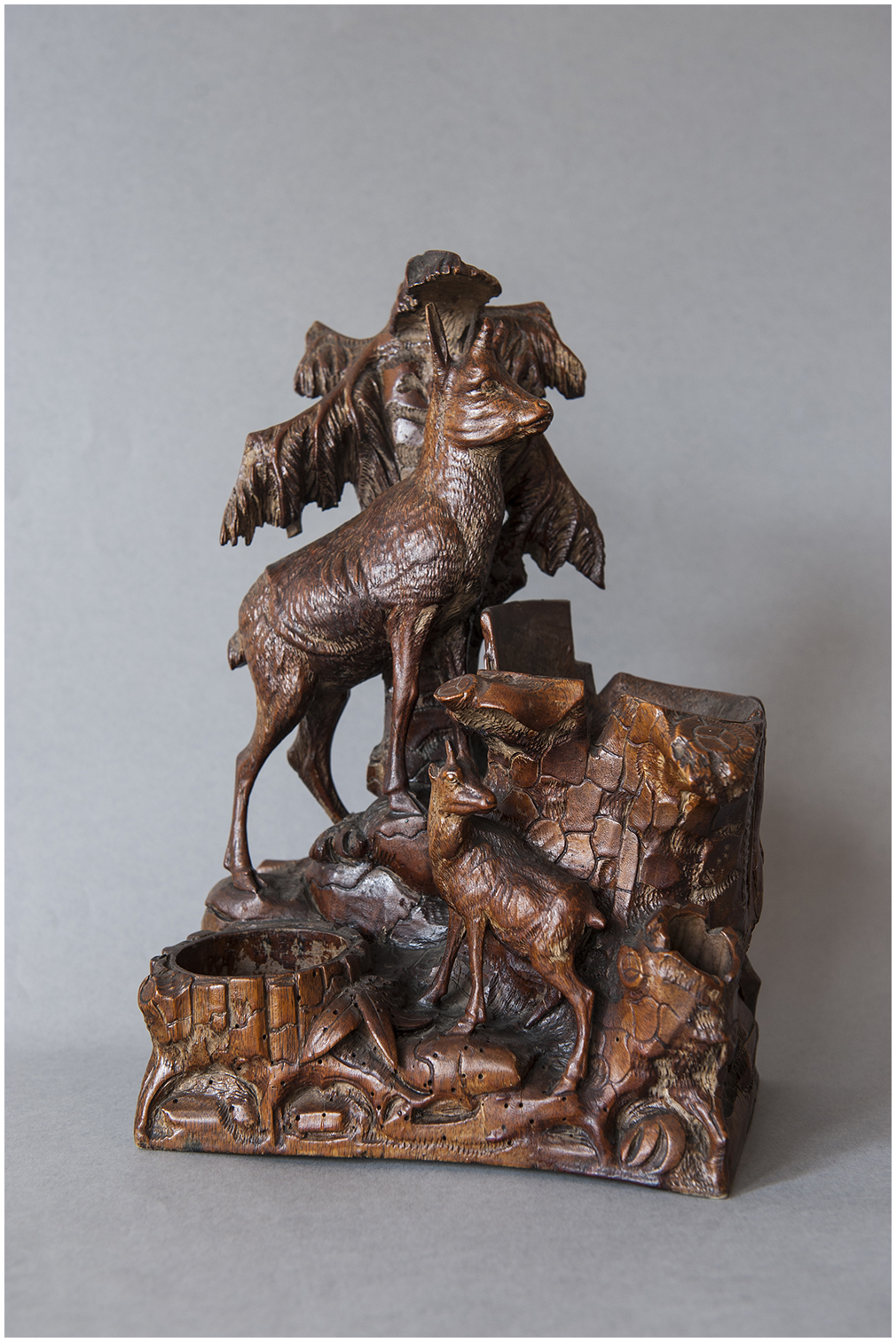
Karolina Gembara, from the series ‘A Mind of Winter’, 2015, untitled, courtesy of the artist.
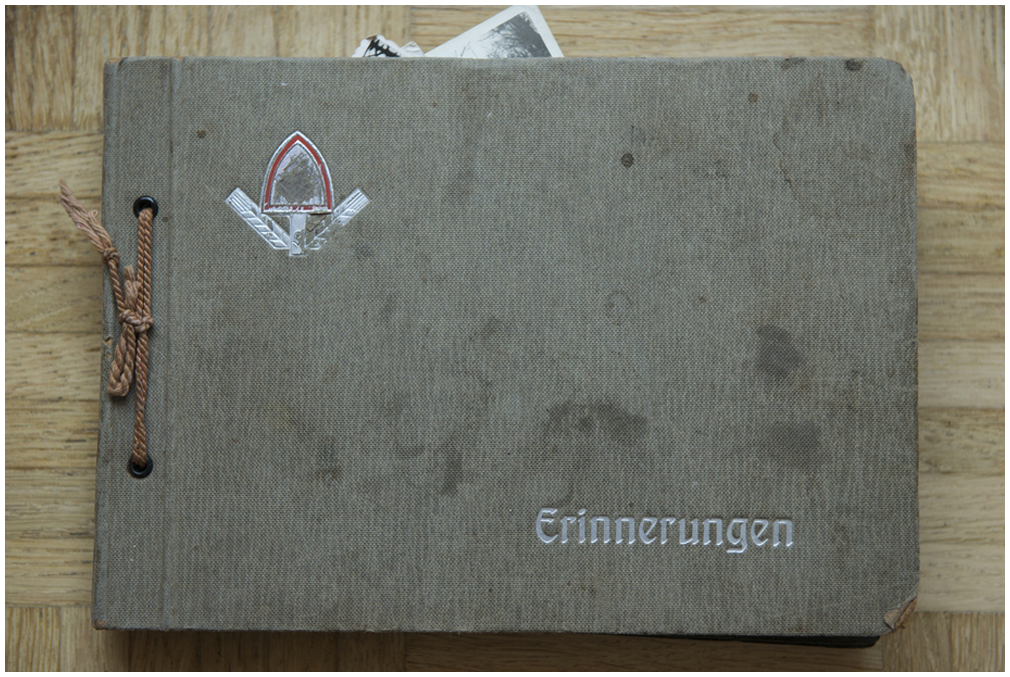
Karolina Gembara, from the series ‘A Mind of Winter’, 2021, untitled, courtesy of the artist.
Gembara also mentioned a photo album ‘inherited’ from the German owners by paternal grandparents (Figure 2). The front of the album had a German inscription, ‘Memories’ (Errinerungen), and a photograph of unknown women on the inside cover. ‘My theory’, says Gembara, ‘is that in the formerly German house where my grandparents lived after the war, they found a German photo album. They threw away the photos and started pasting theirs in. This tiny portrait is on the inside cover. We don’t know who it represents. Maybe the first owner of the album?’ Karolina was not aware of the object's existence, she recently received it from her father along with a bunch of photos that were supposedly her grandmother's belongings.
Karolina tries to identify the previous owners of the passed on objects and attempts to imagine their attitudes and ways of behaving. The objects encourage her to create new branches in a peculiar family tree. Similarly, the story of her family contributes to an artist project ‘A mind of winter’ (Zimowy umysł) 8 developed by Karolina and delving into migration experiences.
The connection made with and through the objects described above, as well as others presented in this article, has provided input to the following thesis. Adopted heritage concerns relationships between initially unfamiliar or even hostile people and things, which become co-participants in the process of creating familiarity and a sense of belonging and fill a void in an individual or group history. Its peculiarity stems from the fact that the past is disrupted by conflict, filled with unknowable people and stories, and only accessible through things. Adopted heritage becomes a tool for building a relationship that resembles kinship, inheritance, and continuation. However, it may have a flip side: The naturalisation of a takeover that happened in the past and the marginalisation of past owners. 9
In the following parts of the article, we concentrate on the circumstances and consequences of object adoption.
Which things afford adoption?
Amidst the multitude of relations between humans and non-human actors that we encountered while visiting apartments or houses and conducting interviews, the one we refer to as ‘adoption’ appears to be exceptional within the varied relationships we have mapped. It is then worth posing the question of which things afford adoption. Is there a certain list of characteristics that may influence an object's likelihood of being adopted? The analysis of the amassed empirical material does yield for a definitive answer. However, we recognise certain affordances that may affect the process of heritage adoption.
First of all, we noticed a focus on recognising particular resemblances between the current owner and the object itself, and through mediation, the former owner as well. This connection is noticeable in the narrative behind the nut grinder, that we encountered while visiting a couple in their sixties. The couple, named Orzechowscy
10
which is a Polish surname that derives from the word for nut (orzech) live in a pre-war house, inherited from a family who came to post-war Wrocław from Lviv. The house is full of things from different times and places. Among these items there is a pre-war nut grinder that is placed in the kitchen. The couple shared the following comments with regard to their grinder: Well, we have an excellent nut grinder that we use. (…) We only kept those things that are practical and useful. It is a fantastic nut grinder (…) it's made from good steel, it doesn’t warp. It's great. We grind nuts in it every Christmas. We are Orzechowski, so our family cake is a nut cake!
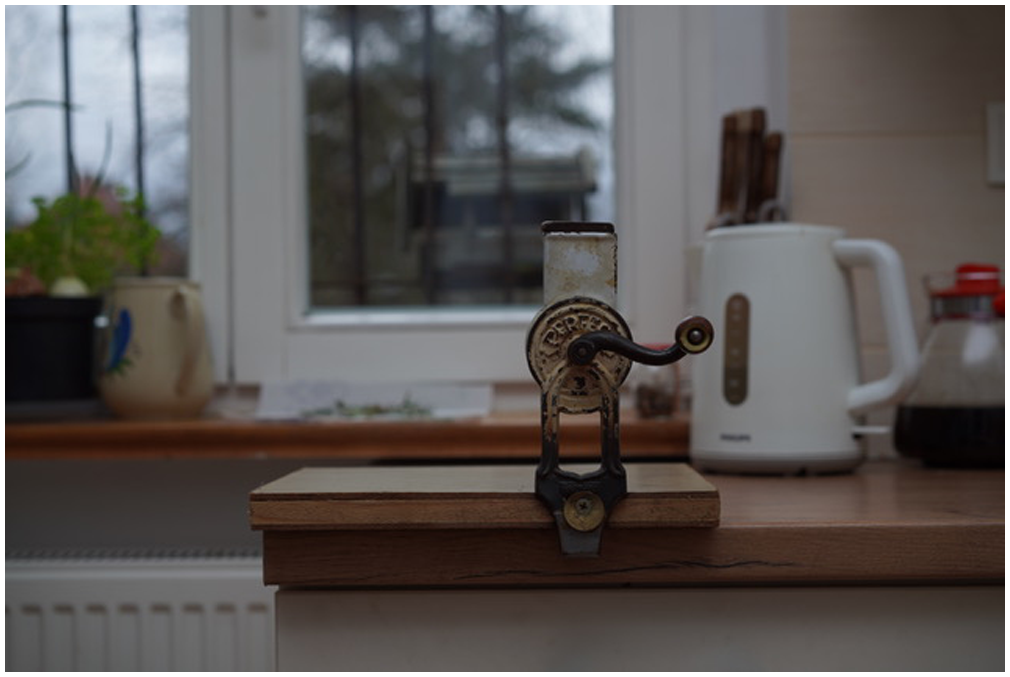
Nut grinder fot. Łukasz Skąpski.
A similar case to the above is evident in a story told by a woman 11 from Szczecin as she was showing us her family keepsakes. Among a few precious objects that she keeps in her flat, she pointed out a small figurine of three pigs. The knick-knack was found in the basement of the pre-war house into which her family had moved in the 1950s. The three creatures were seen as corresponding with the family as there were three daughters. ‘We were three sisters, it was absolutely our three little pigs’, said the woman.
A significant link between resemblance and kinship was observed by Jennifer Mason. Among four forms of affinities involved in understanding and practising relatedness, she proposes ‘fixed affinities’ that could rely on the ‘supposed evidential nature of physical resemblances’ (Mason, 2008: 33), as well as ‘negotiated’ and ‘creative affinities’, ‘ethereal affinities’, and ‘sensory affinities’. However, while Mason elaborates on resemblance, she notices that its perception is not limited to biology but also engages creativity and negotiations as well. We expand upon the issue of similarities, based on her recognition of the material and sensory dimensions of practicing kinship. Our findings reveal how the perception of resemblance is extended to the material sphere.
It is important to note that some objects which are adopted into the family have been, or continue to be, in active use. Usefulness is the next category that we have perceived as enforcing objects’ likelihood of being adopted. This can be seen in the Orzechowski family, whose members emphasised their preference for retaining only practical and functional items, and whose nut grinder remains in use. They highlighted its high-quality steel. A similar argument was presented by Helen Holmes, who develops research on kinship and materiality. According to her ‘material affinities are created not just by objects, but specifically by objects in use’ (…) ‘definition of material affinities is grounded in practice’ (Holmes, 2019: 177). The importance is given to the objects’ functionality, which derives from material qualities and allows them to be constantly in use. Holmes describes how ordinary objects are put in use, and how that is crucial for doing kinship by ‘memorialising, imagining, celebrating, ‘reckoning’ and displaying kin ties’ (Holmes, 2019: 187).
Another story of inheritance mediated through objects for which the value is rooted in their usefulness derives from the research project ‘Family Heirloom’ undertaken by researchers from the Ethnographic Museum in Kraków.
12
Katarzyna describes things passed on from her grandmother: Grandma told [of] how they arrived in these Regained Territories (today western Poland, before 1945 in Germany). How they made furniture into animal cages, how they burned the furniture. I managed to save a wardrobe, not too high, with such a beautiful carving, and a desk that served as a table for my grandfather's DIY in my grandparents’ basement. He would see things on it and so on. And in the wardrobe Grandma kept jars. I jokingly say that these things come from ‘my grandma’. That's what I think, it's part of my childhood, but they’re German.
13
The provided examples have revealed two categories that may conduce kin relations with objects: Resemblance and utility. Nevertheless, these categories do not constitute an exhaustive list; additional categories may be unveiled through further research. However, both similarity and usefulness are derived from the material qualities of objects, their forms and functions, which are recognised and practised in particular contexts. The issue that requires further explorations concerns the context of adoption itself. What social and historical circumstances enable and foster the affective process of the inclusion of things into the ‘family’?
The context of heritage adoption
The broader social conditions play an important role in relation to the analyses of emotions and affects in material culture and heritage studies (Wetherell et al., 2018: 2–7). Thus, we should outline the contexts in which this approach and affective pattern towards material culture might appear. We believe this was generally possible among second- or third-generation settlers, for whom the ‘Recovered Land’ was (becoming) a homeland and whose memory of the traumatic resettlement was slowly dissolving into the past. Adopted heritage might serve as a tool to fill a lack of continuity in terms of individual or collective identification with a place, if the value of the heritage is widely recognised and appreciated. Thus, we cannot overestimate the role of social actors and institutions who participate in the field of heritage.
Affective practices toward pre-war material objects have followed the interest in the history of western lands which has become widespread in recent decades. The quest for knowledge about the history of Wrocław and Szczecin, which was inaccessible for decades due to the historical policies of the Polish People's Republic, is practised by individuals born in these cities. These are the thirty and forty-year-olds of today, whose active engagement we could observe on social media platforms or through the varied non-governmental organisations in which they work. 14 This trend was noticed by one of our interviewees who professionally collects and sells pre-war items: ‘People have adapted these areas and delved deep into history. Not only regarding recent times; they have also become more interested in (…) what happened here earlier and they've taken this history as their own.’ He himself collects pre-war postcards from the district of Breslau in which he lives. He actively contributes to the local community, showcasing his collection in cultural institutions and sharing his knowledge of the local past.
According to Laurajane Smith, heritage prompts an emotional response if there is knowledge of the heritage in question (when it is recognised) and when it is valued and triggers sympathy (Smith, 2021). Interest in German history could be observed not only in individual perspective of city dwellers, but also in practices of varied institutions who play an active role in establishing bonds to the prewar heritage of both cities. This strategy has been implemented by the Szczecin History Museum within an exhibition entitled Hans Stettiner and Jan Szczeciński: Everyday Life in Szczecin in the twentieth Century 15 opened in 2010. 16 The exhibition presents a city first created by German Stettiners and later by Polish residents. Its history is therefore seen through the calendar of important events for the local community. Everyday life is the category that connects pre- and post-war experiences, and this is displayed, in part, through the lenses of home, school, work, and leisure time. The exhibition thus creates a sense of paradoxical continuity, despite the radical transformation: the war and the near-total replacement of the population.
The exhibition consists of thematic segments corresponding to the aforementioned aspects of everyday life. Each of these is divided into two parts. One presents the biography of Hans, the other is devoted to Jan's life. The first is marked blue, the second is red, together they make the colours of the city flag and the history of Szczecin. Hans and Jan sat at the same school desks, faced shortages in shops and took advantage of the city's port. They worked at the German Stoewer car-manufacturing company or at the Polish Junak motorcycle factory, at the prewar Wilvorst clothing company, or at Dana, where the Wilvorst was transformed. The people of Szczecin even had similar heroes, runners Otto Peltzer and Wiesław Maniak. Both the pre- and postwar inhabitants of the city suffered from hostilities, as is evident by obituaries from both the eastern and western fronts.
The similarities are emphasised at the obvious expense of the differences that existed not only between Jan and Hans but also between those who were reduced to a single male representative. In addition, there is a risk of marginalising issues that could interfere with the community-building process. However, the museum adopted this strategy of stressing the connections and the commonalities between Poles and Germans to create a sense of continuity and attachment to the past, and furthermore, to make this foreign past our history.
This exhibition presents the German inhabitants of the city as ordinary people, not the perpetrators of the war, and encourages the viewers to see the parallels that go beyond antagonism. It evokes empathy and a common horizon of experiences, which serve as links in building a sense of belonging and community. The goal of stirring empathy seems to be to develop an attitude that might be summarised as the Germans were ancestors of contemporary city dwellers, thus their legacy is a common inheritance.
Imaginary and naturalised ancestor
The object adoption may bring positive connotations as it concerns objects which were valued, taken care of, and consequently, gained a special status. However, this process seems to have a peculiar function, as it can serve to naturalise the process of appropriation. The relationship of kinship with and through things sanctions the act of ownership since it frames the current owner as a natural successor with the right to possession. It also relates things to an imaginary past and ‘ancestors’ rather than to concrete people or places. It obviously partly results from limited knowledge about previous owners but also facilitates the process of creating an affinity. This is best exemplified in the abovementioned figure of imaginary Hans, but it was also revealed through uncertainty concerning the objects’ provenience that many of our interlocutors have experienced. ‘Germanness’ 17 does not always appear as a central category in relation to objects, in many cases it is marginalised, dissolving into the realm of the past. The act of incorporation does not always entail deep, almost genealogical research, as in the case of Karolina Gembara's activity. Things are seen as unique as they come from indistinct past times that are not necessarily correlated with ‘Germanness’. Although, if the ‘Germanness’ of objects is recognised, it is appreciated, and associated with good quality and solidity.
The process of adoption appears to prefer positive affects, as well as references to the past being emphatically understood. The story of the untroubled coexistence of two families – Polish and German – on one farm is the basis for future valorisations of objects by Karolina Gembara. Orzechowski notices parallel experiences of migration – the resettlement of Orzechowski's own families coincides with the expulsion of German citizens. We have not observed any examples of such an approach towards objects that convey difficult or traumatic stories. Negative associations, as we assume, impede or even prevent practising kinship with and through things.
The disruption of affinities can be rooted not only in a German ancestor but also in their later Polish ‘successors’, as we find in the story of the rejection of a previously adopted object. A woman whose aunt and uncle were ‘Recovered Territories’ pioneers visited the town where they had lived after the war. She discovered the relationships between the prewar inhabitants of this area, and horrific memories of Polish brutality and violence. She concluded: ‘I have a tea set from my aunt. I came home and indeed—it has German stamps. And you know, I suddenly felt less sentimental towards this set. Because it is no longer a set my beloved aunt gave me; in my head, I have the pictures of what I read’. Consequently, affinities between objects and people were broken.
Conclusion
The phenomenon of adopted heritage demonstrates the entanglement of people and objects and the role of the latter in the process of building a sense of familiarity with a place marked by rupture or conflict. It appears when some objects are recognised as useful, chosen unconsciously or through the particular resemblance to the new owners, and then incorporated into ‘imagined worlds’ and held onto. However, we should mention that heritage adoption is not a neutral practice, even though it can be perceived as such, as it is juxtaposed to the rejection or destruction of material culture. In this nonlinear and disrupted process of inheritance, the ‘real’ ancestors can be marginalised, just like any other difficult topics that might confuse or break the ‘family relations’. Hence, the focus is on parallels and sentimental affection.
The adoption of heritage may appear in contexts other than the one described above. Yet, as we suggest, the analysis of the process of adoption should be structured around questions elicited by these examples, concerning how the past owners and property transfer are regarded, and what their social context, function, and outcome are.
Footnotes
Acknowledgements
The authors want to express our gratitude to everyone who played a role in this article, which was based on our research project, ‘Realities of Things in the Post-Conflict Space: The Role of Objects in the Creation of Imagined Worlds of Wrocław and Szczecin’, supported by the National Science Center (Grant number DEC-2018/31/D/HS3/00778). We would like to thank our research collaborators who shared their time and insights on the material surrounding they live with. Their contributions were invaluable to our work. Additionally, we wish to thank Łukasz Skąpski, whose photographs provided an additional visual narrative of our research topic. We also extend our thanks to the editor and anonymous peer reviewers for their helpful comments and suggestions, which greatly improved the manuscript.
Declaration of conflicting interests
The authors declared no potential conflicts of interest with respect to the research, authorship, and/or publication of this article.
Funding
The authors disclosed receipt of the following financial support for the research, authorship, and/or publication of this article: This work was supported by the National Science Center (grant number DEC-2018/31/D/HS3/00778).
