




Abstract
This article presents data from interviews with amateur knitters to explore the temporal-material entanglements which constitute meaning-making in everyday life, and the potential of thinking with knitting to better understand these entanglements. It follows three strands which reflect different aspects of the temporal-material in how knitting comes to matter for amateur makers. Firstly, knitters discuss the threads to and from the past which recursively shape their ongoing thinking and feeling about their craft. Secondly, temporal dimensions entwine with the material as participants describe the process of turning threads into a knitted surface. Thirdly, participants’ experiences of un-making and re-making, and the role of ‘stash’, challenge unilinear models of both time and meaning. Thinking with knitting not only re-opens ways of understanding it as a significant meaning-making practice in the present, it also dynamically re-connects us to the past and offers ways of re-imagining the future and how we make this together.
‘I think it's a tool for me to show people love for them, that I've spent the time to make something for them. I suppose it's also a way of passing time; if I haven't got anything to do, I can always just pick that up and do that. And in another way, it's carrying on a tradition in the family of doing the knitting that my mother did, my grandmother did’.
Linda, amateur knitter, UK
Linda 1 has been crafting since she was a small child, taught by her mother, aunt and grandmother. She took up knitting in earnest during the 1980s, and in this extract from an interview conducted in 2022, after she had retired, she explains what knitting means to her, and how knitting comes to matter through the experience of time. Knitting is a popular creative practice with well-established meanings in everyday life and work, including those associated with health and wellbeing, identity and heritage, political activism, and sustainability. However, formal institutions of education and public life have long been dominated by narrow ways of understanding how meanings come to be made and shared. Alongside the historic devaluing of everyday craft practice, this means that the significance of knitting as a contemporary resource for exploring and expressing what matters in everyday life has not been fully recognised. Neither has its potential to illustrate how what matters is temporally and materially constituted.
Text and textile share a long history, reflected both in their shared etymology (from the Latin, texere – to weave) and in their idiomatic entwining in relation to thought and communication (Weiner and Schneider, 1989). The role of textiles in making and sharing meanings has, however, been usurped in recent history by the reification of representation through words and the privileging of print. As Snaza (2019: 9) notes, ‘the sociogenic production of Man through assemblages of humanization is woven into the fabric of institutionalised capture of literacy’. Another feature of this institutionalisation of meaning-making practice is a unilinear conception of progression which divorces practices from their historic, cultural and material contexts (Burnett and Merchant, 2020). Increasing scholarly attention has challenged this position, recognising how meanings are made in the informal and domestic contexts of everyday life (Highmore, 2011; Jones, 2018; Miller, 2010). In this article, I draw from perspectives which see meanings as not solely produced by human cognitive and linguistic processes, and not purely emerging from or resulting in explicit or codified knowledge (Gascoigne and Thornton, 2013), despite the dominance of this kind of knowledge within many formal education systems. My position on meaning, and meaning-making, as a dynamic process is summarised by Barad's perspective: ‘meaning is not a property of individual words or groups of words but an ongoing performance of the world in its differential dance of intelligibility and unintelligibility’ (2007: 149). In the discussion that follows, I focus on knitting as a material, embodied and relational practice involving complex entanglements of modes and materials, affective and aesthetic engagements (Pahl, 2014; Rowsell, 2020; Saito, 2017). As Linda's summary of what knitting means to her reflects, time is also ‘a significant contextual dimension that contributes to how people make sense of themselves, their experiences, and their worlds’ (Compton-Lilly, 2020: 27).
We are living through global crises which are profoundly affecting everyday lives, including our experiences of time (Erll, 2020). In this article, I take up the call of Burnett and Rowsell (2022: xxxvii) to ‘unsettle and unravel’ established understandings of literacy in everyday life and to re-imagine its role in response to the ‘trouble’ wrought by the Capitalocene (Haraway, 2016). My aim is to re-open ways of understanding amateur fibre craft as a meaning-making practice. In so doing, I illustrate how temporal and material factors co-constitute what comes to matter for makers, and how this challenges the linearity that has dominated neoliberal and capitalist institutions of formal education (Springgay, 2022). I bring together interdisciplinary approaches to meaning-making and craft, and mobilise the lens of time which is integral to both, to explore data from interviews with amateur crafters sharing their experiences of knitting. 2 My approach is shaped by thinking with knitting, as a material activity that is particularly ‘temporally charged’ (Compton-Lilly, 2020: 40), revealing how both time and knitting are powerful lenses which, together, reveal the complex entanglements that constitute meaning-making in everyday lives.
Thinking with knitting
While textile metaphors are commonly used to refer to social practice, Pérez-Bustos et al. (2019) rightly call for researchers ‘to become more responsible for what these textile material metaphors have to offer in our understanding of these knowledge practices’ (p. 370). Haraway's (2016) ‘string figure’ is a prominent example which evokes the knotting of the material and semiotic in how we make sense of our worlds. As Mitchell (2012: 6–7) argues, ‘the textility of making suggests a practice which informs thought; unlike an architectonic framework for cognition, it provides evidence of a more supple fabrication’. Similarly, in Dormor's reflections on the philosophy of textile, ‘the notion of thinking or thought as a kinetic, temporal and dynamic dimension is key’ (2022: 21). Springgay also argues that ‘with is a milieu, an active set of relations that are composed of dimensions and vibrations that materialize a moment of space-time’ (2022: 21, emphasis in original). Thinking with knitting therefore offers a dynamic way of approaching the exploration of meaning-making.
Deleuze and Guattari (1987) have categorised knitting as a striated space, based on the limits imposed on the resulting fabric by straight needles of a fixed length. By contrast, as Springgay (2019) notes, yarn crafts such as felting are presented as creating a smooth space, which is ‘open and in continuous variation’ (p. 58). Although felting is beautifully activated by Springgay as ‘a practice of thinking-making-doing’ (p. 60), I want to argue here that thinking with knitting, and with a particular focus on temporal-materiality, allows us to deepen and extend understanding of how material forms come to matter through knitting. Within the limits of a printed article, and mindful of Barad's (2007) caution against the ‘representationalist fixation on words and things’ (p. 139), I offer an approach that takes us from considering knitted fabric in itself as a striated space to exploring its potential to unravel the dominance of other striated spaces, such as formal institutions of education and culture, and the limits they impose on understanding of meaning-making in everyday life.
Knitting as a temporal-material practice
Knitting is, essentially, a process through which a fabric is produced by the repeated action of knotting and looping thread (Whittaker and Padovani, 2012: 172); at its most basic level, it is therefore a temporal-material practice. The materiality of knitted fabric offers a powerful tool for thinking about meanings and how they are made, and I have explored this elsewhere (Jones, 2022). Although it might seem to be a linear, cumulative process, the emergence of worked stitches in a flat piece of knitting is recursive, as the work is turned at the end of a row before starting the next. In addition, individual stitches are constituted not only in a horizontal relationship with neighbouring stitches, but also vertically. A knitted surface also shows the co-constitution of stitches across the front and back of the fabric. In this article, I foreground temporal-materiality in how knitting comes to matter for makers and do so whilst acknowledging the entanglement of other factors in this process, much as we might view the ‘right side’ of knitted fabric: stitches, rows or patterns can only exist through their entwining with counterparts on sides which are not always outwardly presented. As such, in this section I bring together ideas from the anthropology of making and the scholarship of time to offer a way of thinking about their role in the dynamic process of meaning-making through knitting.
My previous work on the materiality of knitting as a way to understand meaning-making (Jones, 2022) draws on Ingold's taxonomy of lines (2007), and in particular the potential of thread to challenge the dominance of the written trace in the approaches to literacy that have shaped the experience of formal education over centuries. The historic marginalisation of thread can be linked to its temporal-material qualities: the association of handknitting with women's work, for example, came about as it was soft, portable and could be easily interrupted to fit alongside other domestic work such as childcare. As women's work consisted mainly of making perishables such as food and clothing, examples of this work have not survived over time (Barber, 1994). This is in contrast to the dominant feature of a masculinist, imperialist conception of literacy, as highlighted by Snaza (2019): ‘the marks must endure’ (p. 97). Arantes (2020) describes the thread as ‘a kind of possibility space’ representing ‘continually reconfigurable creativity’ (p. 161). A distinguishing feature of the loop stitch that creates knitted fabric is also ‘its potential to easily go out of existence without deforming the thread’ (p. 154), unlike the trace, which, as Ingold points out, cannot be unwound, wound up again, or moved about, ‘though you can of course rub it out, which you cannot do with thread’ (Ingold, 2021: 181).
Thinking with knitting as making with thread offers two useful points about the temporal-materiality of meaning that I would like to draw out here. The first is that, although Ingold (2007) views thread as a line, when thinking with knitting, it offers a powerful illustration of the nonlinearity and mutability of meaning. Ingold (2007) argues that knowledge develops not from linear ‘point to point’; rather it ‘builds up, from an array of points and the materials collected from them, into an integrated assembly’ (pp. 89–90, emphasis in original). This evokes the qualities of knitted fabric, discussed above, with its recursive connections across stitches, rows and different dimensions. Secondly, thinking with knitting offers a way of understanding the complex and multi-dimensional connections involved in the dynamic process of meaning-making. Making with thread, I argue, problematises anthropocentric notions of making where a human imposes a premeditated and unmediated form onto material. Rather than being a one-way, ‘hylomorphic’ act (which also evokes the enduring ‘marks’ of dominant, narrow models of knowledge invoked by Snaza, 2019), for Ingold (2013), making is an ongoing process of ‘correspondence’ between maker and material, each in direct response to the other. The process of making does, however, have temporal-material dimensions, not least linked to the properties of particular materials, as is explored by Arantes (2020). Molten metal or wet clay, for example, result in different temporal priorities for makers to those experienced by a knitter who, as discussed above, can put down their work as ‘its material qualities are preserved even in the moments when it is not being processed’ (p. 154). Howes (2022a) notes the limitations of a view of making that abstracts matter from its sensori-social context: ‘it is by sensing and making sense along with others that the material world comes alive for us’ (p. 329). In the context of my focus on meaning-making, and in light of the experiences shared by knitters who participated in my research, it is particularly important to draw attention here to sensing as both sensation and significance (Howes, 2022b). The interviews with knitters presented in this article show the role of material in how their craft comes to matter; they also emphasise the significance of relational, discursive and affective factors, including the importance of pleasure and presence for makers in their interactions with materials (Howes, 2022a). Howes argues that for makers, ‘their selection of materials, the manner in which they work with them, and the way their creations are valued, are all conditioned by their social and sensory situation’ (p. 327, emphasis in original). The gendered history of knitting, outlined briefly above and illustrated in the experiences presented later in this article, is a good example of the role of some of these relational and discursive factors in the materiality of making, as well as how these have a temporal dimension.
The relationship between time and material experience has long been recognised, as illustrated by the Ancient Greek differentiation of chronological time (chronos) from time as an intensity (aios) (Kohan, 2014). Just as time is a ‘condition of living, of matter, of the real, of the universe itself’ (Grosz, 2004: 4), it is ‘never homogeneous, it is multi-facetted and its aspects are distributed over its various contexts’ (Cipriani, 2013: 27). Humans have framed their experience of time in different ways (Adam, 2006; Munn, 1992), many of which we recognise and experience through the ‘rhythm and social construction’ (Kjlaerulff, 2020: 238) of life and work. This has shaped the often gendered experience of amateur craft, including attitudes towards the significance of time and how it is valued, such as how it is best ‘spent’ and when it is deemed to be ‘spare’ (Knott, 2015; Minahan and Cox, 2007; Thanhauser, 2022). Time can therefore be seen as ‘situated’ through cultural, social, sensorial and affective experiences of everyday life (Kjlaerulff, 2020).
Thinking with knitting, it is interesting to consider how some scholars of time have explored its situation and mediation. Ricoeur (1980) notes the narrative quality of human mediation of time through creativity and memory work, which loops back on itself and disrupts linearity (Compton-Lilly, 2014). This is reflected in Fisk's (2019) account of knitters’ use of their craft for memorialisation, and also in Minahan and Cox's (2007) consideration of nostalgia as a motivation for young women's participation in contemporary ‘Stitch’n’Bitch’ groups. It is also echoed in the experiences of the knitters presented later in this article, which illustrate the inseparability of past, present and future. Lemke's (2000) notion of timescales has been drawn upon in discussion of formal education systems, which are commonly dominated by a model of linear progression shaped and measured by units of ‘clock-time’ (Adam, 2006; Compton-Lilly, 2020; Falchi and Siegel, 2014). In Lemke's (2000) ecological model, meaning results from individual interactions with larger systems, not in a single instant in time, but through integration across timescales: ‘across who we are in this event and that, at this moment or the other, with this person or another, in one role and situation or another’ (p. 283). Drawing on Lemke's model, Falchi and Siegel (2014: 86) note that semiotic meaning is ‘an effect not simply of accumulating shorter timescales into a longer one but of the longer timescale giving meaning to a shorter timescale activity’. Compton-Lilly (2020: 39) also highlights how ‘the lower levels are constituent of the higher levels with the higher levels involving conceptualisations and interpretations of the lower level processes’. Thinking with knitting, we are reminded of initial stitches forming a foundation for those added later, and, as it grows, of the fabric itself as constituted by the vertical and horizontal relationship of stitches. Lemke notes that the experience of this ‘heterochrony’ is often mediated through the material and ‘the material characteristics of the object also function as signs for an interpreting system of meanings that belong to processes on a very different timescale than that of the event in which the interpreting process is taking place’ (2000: 281, emphasis in the original).
For Barad, however, the relationship between time and material is not one of mediation, but of co-constitution. They argue: ‘Matter doesn’t move in time. Matter doesn’t evolve in time. Matter does time. Matter materializes and enfolds different temporalities’ (2013: 16). Barad's notion of spacetimemattering emphasises the entanglement of the temporal and material in what comes to matter. My research participants’ descriptions of their knitting illustrate this entanglement, and show, just as knitting is not experienced in time, but through time, time is not experienced in knitting, but through knitting.
After sharing the context of the research, the next part of this article follows three strands which reflect ways of thinking with knitting about different aspects of the temporal-material in how their craft comes to matter for amateur makers. Firstly, I explore the threads to and from the past that not only form a foundation for knitting practice, but also recursively shape knitters’ ongoing thinking and feeling about their craft. I then share some of the ways in which temporal dimensions entwine with the material as participants describe the process of turning threads into a knitted surface. Thirdly, although it might seem to ultimately represent a cumulative process based on the repetitive looping of continuous thread, I present participants’ thoughts about what knitting means that challenge unilinearity. Knitters talk about undoing and redoing their work as well as the significance of their collection of yet-to-be-knitted material, or ‘stash’, which can be seen as a temporal-material embodiment of what knitting means and an example of ‘spacetimemattering’ (Barad, 2013) in everyday amateur knitting practice.
The research
The participants whose experiences are shared in this article are among 20 amateur knitters who responded to a call to take part in an interview about their knitting practice and what it meant to them. 3 Interviews took place online because of COVID restrictions. Although they were not asked to, some participants chose to knit while we talked. They were mainly at home when we spoke, and some held work in progress up to their webcams (see Figure 1), while others shared photographs, either during the interview or by email afterwards (see Figure 2).
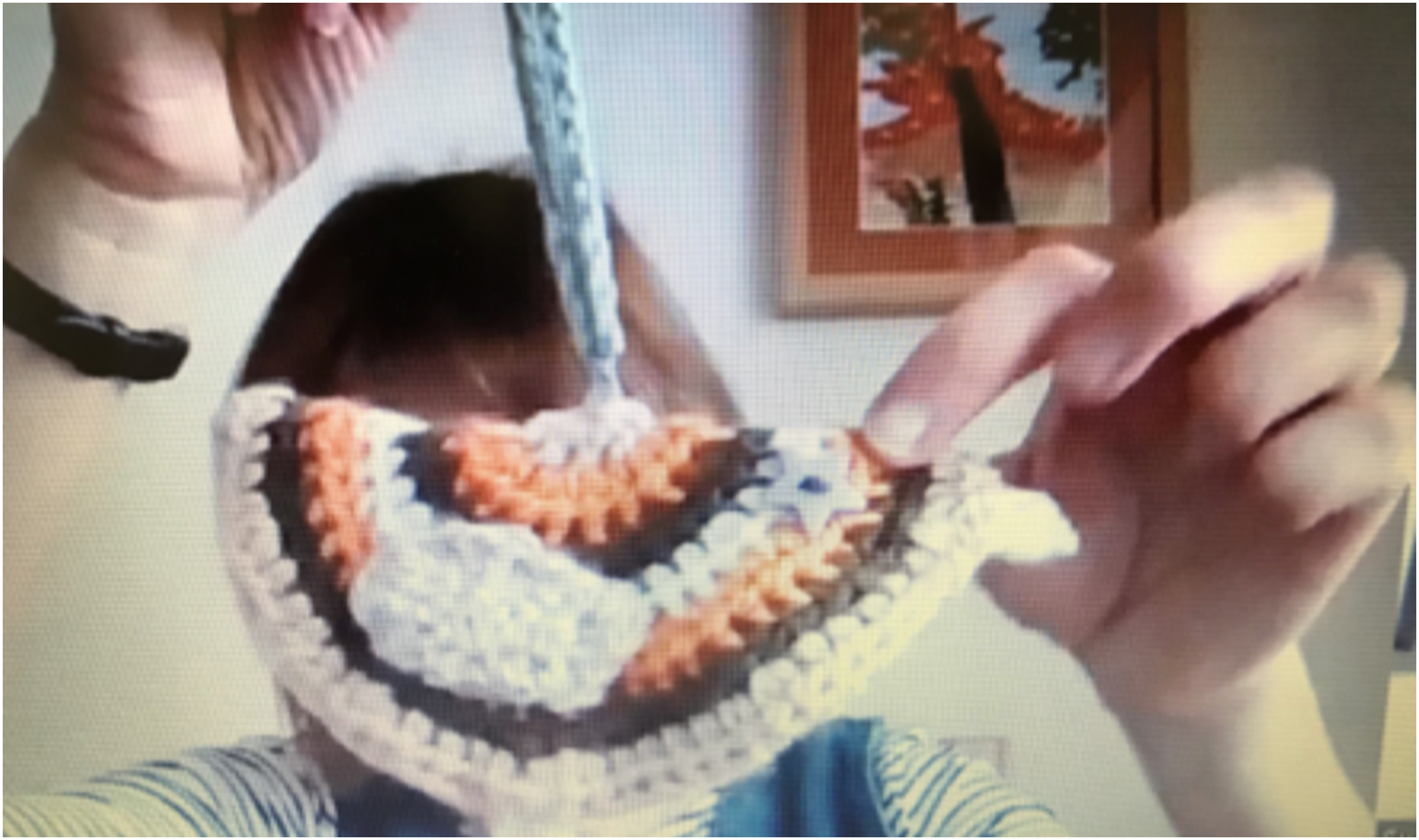
Screenshot of participant showing an example of their fibre craft during a video interview.
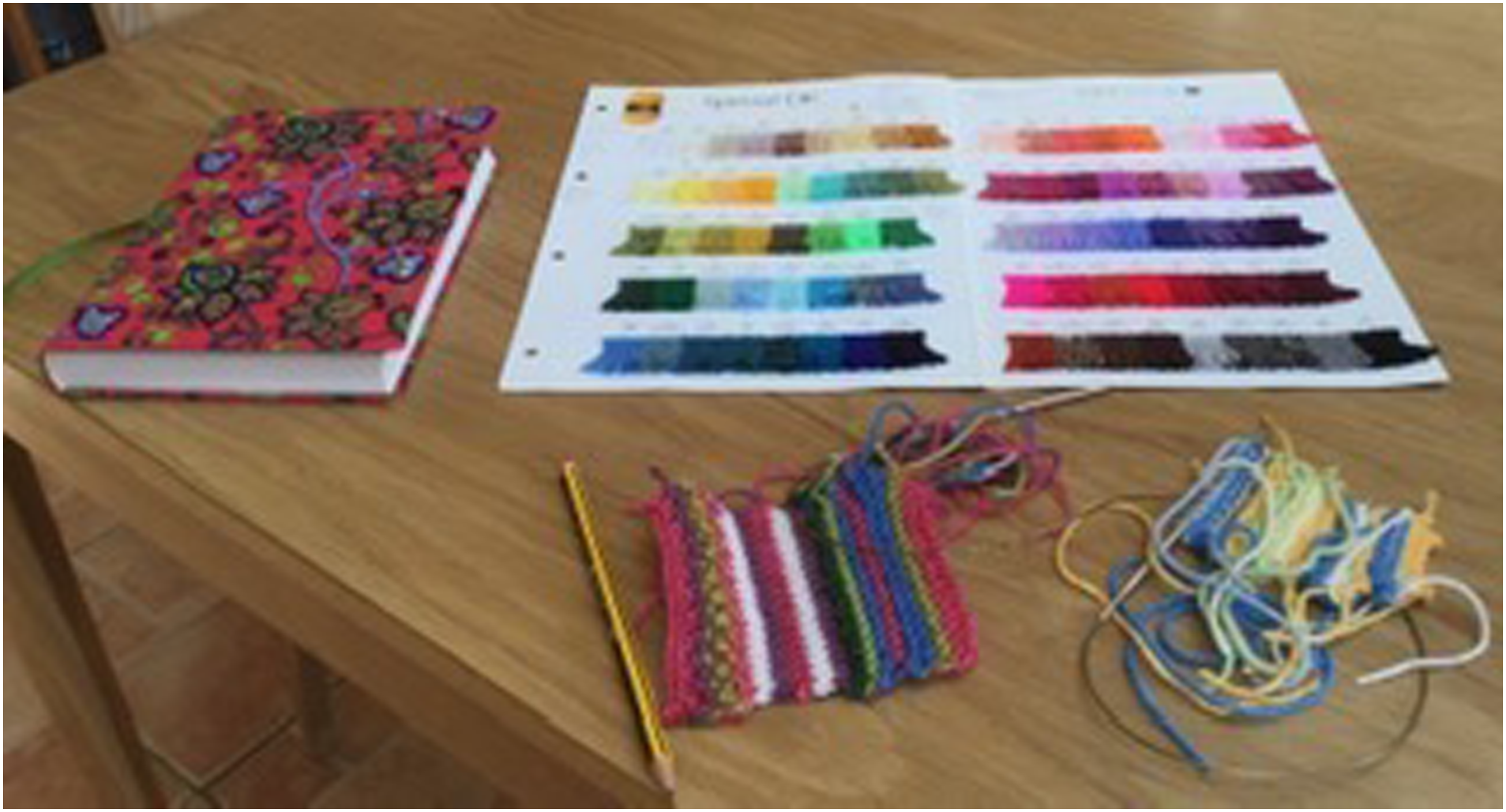
Photograph shared by a participant showing their planning for a project.
A semi-structured schedule of questions was informed by the interdisciplinary literature review that took place during the first phase of the research project. I started the interview by asking knitters to ‘look back’ at where it had all started for them as crafters, and subsequently asked them to talk about topics including their typical process of making and the influences on their choice of project and materials. Rather than reflecting linear narratives, however, the interviews were ‘material articulations of the world’ with non-linear temporal dimensions (Barad, 2007: 139; Juelskjaer, 2013).
The call for participants was shared through the networks of existing knitting groups and events. The knitters live mainly in the UK, but others live, or have grown up, in countries including New Zealand, the USA, Ireland and Sweden. Although the call did not specify age or gender, respondents are all adult women. Some are retired from paid work and others work in roles including business, healthcare and education. A temporal lens on the meanings of knitting does highlight the ways in which the practice and experience of it has been, and continues to be, gendered. 4 My own position as a white, middle aged, female amateur knitter is also a significant factor in the relational meanings that were a feature of the interviews and my subsequent analysis. As will be shown in the following extracts from the interviews, participants’ responses include assumptions about shared temporal and material experiences through knitting, such as what it means to work with yarn of differing weights. 5
Audio recordings were transcribed, according to the procedures agreed with participants at the start of the research. These were then thematically analysed. I acknowledge therefore that the data presented here reflects meanings attributed by participants to their knitting in an oral form, and often out of direct context. This was a limitation of the online format necessitated by the pandemic, and one which highlighted early on the significance of material and embodied as well as affective and relational factors in what matters to knitters. At the end of the research, as restrictions lifted, there were opportunities for participant validation through in-person workshops, where some of the more local participants, as well as others, were able to engage with findings from the project through making knitted and crochet items in response to some of its themes. The theme of time was significant in the online interviews, and similarly resonated with in-person audiences. In particular, many knitters remarked on the threads to and from the past that shaped their craft practice.
‘Everything builds off the knit stitch, right?': Knitting and the threads of time
Most participants explained that they’d been taught to knit by female relatives. As Fran said, ‘my grandmother knitted. I think everybody's grandmother did, didn’t they?’ While the often female genealogies of knitting (Pérez-Bustos et al., 2019) result in a continuation of the practice over generations, the tacit knowledges involved become one of the factors that individualise knitting even when following patterns (Myselev, 2009). Some participants told of learning not from mothers, but from grandmothers, and time was often a factor in this. Brenda learnt from her grandmother: ‘My mum could knit, but she couldn’t teach me. She had no patience’. When it came to her own daughter, a similar pattern emerged: ‘I tried to teach my daughter, but no – “go to your grandmother”. So, my mum taught her’. Others described spending time with grandmothers as their mothers worked outside the home or were busy taking care of siblings. Many participants reported that, after a gap in their teens, they took up knitting once again around significant life events, such as when their own children were born, only to then experience similar demands on their own time from their families and careers.
The pattern of tacit learning across generations also reveals how the commodification of time (Adam, 2006) has shaped the meanings and value of knitting as an everyday practice. Participants often described the knitting of older women in terms of economic necessity rather than creativity per se. Judith reflected on how her mother, for example, enjoyed sitting down at the end of a busy day to knit. However, part of this was ‘the necessity side. I mean, she would undo old sweaters and hand-washed all the yarn out, hang it on the line, and then she would make it up into something else, because money was quite short’. This compared to the generations of women who were young mothers in the 1970s and 1980s, for whom knitting may have carried the more politicised derogatory connotations of female domesticity that were a feature of both capitalist consumer society and second wave feminism. For example, Daisy described how her mother was told that knitting ‘wasn't that important or other things took precedence over that sort of thing’. However, now that Daisy has taken up yarn craft in earnest as an adult, enjoying its slower pace and with concerns for sustainability, this generational difference in its value has become evident: ‘My mum is always saying that I’m doing more knitting or more complex knitting than she has done. And it's like my grandmother used to do. She's always reiterating to me that connection to her family’.
This connection to family was articulated by many participants. Rebecca described being taught by her grandmother in the USA: ‘Out of all of her grandkids I'm the only person she ever taught, and so that's been a really cool thing for me because I had the least amount of time with her. But I have this connection to her and her mother, my great-grandma Mimi, who I did know a little bit’.
The connection is sustained through her family's interactions with Rebecca's knitting today: ‘I'll post my progress or my projects on Instagram, and my aunts will comment on it, and they'll be, like: “Oh, Nana is so proud of you. Mimi is so proud of you.” So, they make that connection […] they see what I'm doing and they're like: “Yes, this comes from…These are the women in our family”’.
Rebecca associates knitting, and her own identity as a knitter, with her grandmother and the time she spent with her, learning to knit. ‘Knitting for me is Nana. I wouldn't be doing what I'm doing today if she hadn't sat me down with her old metal needles and, you know, her scratchy acrylic or whatever it was. It was like: “Well, here's how this works.” I mean, everything builds off the knit stitch, right?’
Early memories of learning form an enduring foundation to ongoing knitting practice, but the threads which emerge enfold past, present and future in ways which challenge linear views of both time and meaning. When she knits, Helen is reminded of her mother doing the same in the past; her own knitting also extends these connections into the future: ‘I think the funny thing is the older you get, the more you sort of think: “Oh! Mum used to do this… she did it this way” and, you know, it's a very nice feeling […] it's nice to think in some way you’re carrying on that tradition.’
Fran warmly recalled her mother making her ‘hundreds’ of knitted jumpers and cardigans, right into her daughters’ adult life. This role in providing knitted garments has been something Fran's sister has taken up since their mother's death: ‘She's taken on that maternal role, really. Her own children wouldn’t let her do it. They definitely wouldn't want a knitted cardigan, you know? So yeah, we both enjoy the nostalgia of it, I suppose’.
As an affective experience of time, nostalgia contributes to the meanings of knitting in wider discourse, exemplified when Kath talked about the novelty knitted items she enjoys making for work colleagues, including a knitted David Bowie: ‘I think most people will remember older generations knitting. I’m talking people in their 40s, 50s, 60s – they can remember. So it's very nostalgic’.
Not all the knitters felt a simplistic nostalgic view of knitting was either helpful or accurate. Claire felt that ‘sometimes that inheritance gets, sort of, romanticised. Do I really like my nana? Like, no! I don't have anything to do with her’. Rebecca challenged tropes of ‘your grandmother's knitting’ by framing this in contemporary terms which reject linear conceptions of knowledge and progress: ‘I’m like “Why is that bad? Like, so? Ok, my grandmother lived through the Great Depression. Like hello? She is more badass than you are and if I knit the way she knits, I'm happy”’.
Viewing knitting as an ongoing temporal-material process, Arantes notes that, ‘the trajectory of the thread-becoming-a-surface and the biography of the knitter interweave with and imbue each other in a continuous process of joint growth’ (2020: 154). I expand upon this next, as we move from the threads that are drawn together in knitting to the emergence of a piece of knitted fabric.
‘I’d describe it as conversion of yarn’: Knitting as temporal-material entanglement
Knitting is an activity that involves the creation of a surface, rather than its manipulation (Arantes, 2020), a process that participant Penny described as ‘conversion of yarn’. 6 In this section I focus on temporal-material factors in how this process is experienced by knitters, in three specific ways: the materiality of making with yarn, time making for others, and knitters’ choices about ‘spending’ time.
The materiality of making with yarn
Some participants valued the way in which the materiality of emerging knitted fabric offered a visual representation of time and effort. As a professional writer, Rebecca finds this useful: ‘I can see how far I've come. And you can put in a little stitch marker and track like exactly how much you knit today. Or if it's stripes, right? You're like: “Oh, I got seven more stripes!” I can tell you how many words I wrote today, but it doesn't necessarily feel the same as being able to actually hold the thing in your hands and see how much you've actually completed’.
The materiality of yarn, including its weight, 7 also becomes a form of temporal shorthand for knitters, reflecting how ‘matter does time’ (Barad, 2013: 16). Brenda described making shawls during the COVID-19 lockdowns: ‘doing a round would take you all night. Because it wasn't just straight forward and knit row. But I’m a bit wary of starting another one because it's in two-ply’. Dwynwen similarly communicated the time it took her to make complex Fair Isle 8 sweaters for her husband when they were first married by saying: ‘I must have been mad because it was in four-ply wool’. Her adult son asked her in December to make him a Fair Isle jumper for Christmas, and she replied, ‘which Christmas?’. This comment not only reflects the time it takes to make a complex handknitted garment, but also how this is not always fully appreciated by others, due in part to the undervaluing of handknitting as a domestic skill, as well the impact of readily available ‘fast fashion’. Interestingly, Kath noted that in her workplace, a car company, ‘actually the engineers probably appreciate the work in it. So they understand that it's taking me time to make it’.
Making for others
Knitters’ choice of projects are guided by temporal-material factors, particularly when these are made for someone else and then become entwined with particular embodied and affective meanings. Making for others can be temporally inflected not just because of the time it takes, but also because of biological milestones. Baby items, particularly blankets, are material embodiments of a particular time in a family's history and are seen by some knitters as part of an imagined heritage materialised in the future. Brenda described the pressure on her schedule of projects imposed by imminent new arrivals: ‘I better put these down, get on with that because the baby’ll appear before I know it!’ Another aspect of the biological temporality of knitting is that time is also life; in knitting for others, makers are choosing to give away some of this time. The shape of human bodies is also a temporal-material factor in knitting for others. Dwynwen prefers to knit children's things ‘as they finish quicker, don't they? Then you can start the next project’. Lu often thinks about the projects she would like to make, including a fisherman's gansey for her husband. However, as she said, ‘my husband's got very broad shoulders so I don’t think I can face it’.
Penny is careful about making items for others because of the time it takes: ‘if I knew it was going to take me more than a couple of weeks, I wouldn't do it unless it's for a very close friend’. This sentiment was echoed by other participants, showing how time becomes an affective resource for amateur knitters. Dwynwen's son-in-law often suggests that she could sell her work online: ‘I went, “No, I don't want to have to do it. I want to do it because I want to do it in the time that I want to do it in”’. After the success of a knitted narwhal she made for a science class at her school, Meg was approached by a colleague to knit one for her son: ‘It has to be when I want to make it because I have a whole list of other things I want to make first. Like it took me four days to make it, but they were four days that I did not have work. It was snowy out and I literally just was spending like 50 hours. You know like 12 hours a day, just knit knit knit knit knit. And it's a very small size 4 [3.5 mm] needle so it's a lot of stitches to make this big narwhal. But eventually he’ll get one.’
Daisy knits for many of her family members and making for others is an integral part of what knitting means to her: ‘I find something that I think will be really meaningful to them, I'll take the time to do it’. Emily also responds to others who are in her thoughts, perhaps experiencing difficult times, by knitting for them: ‘I wouldn't tend to choose something huge for that because I want it to be a timely thing’. For Emily, much of the meaning of knitting for others comes from the time it takes: ‘those things that you've made have a bit more meaning and preciousness because they've taken a fuck of a long time to make’.
For Judith, meaning is made not only through time spent, but also the nature of that time: ‘I think you've put a lot of yourself into making something. And all the time you're making it, you're thinking of the person that you're making it for, so that makes it more special’. Daisy articulated how time making for those she cares about ‘solidifies memory in a way, that [my sister] doesn't feel like it's slipping away, that she can wear it, and there's a story then attached to this object that she's got, and she's got it’. In her motivation for contributing to a knitted installation at a local art gallery, Joycelyn also saw her knitting as a way to establish connections with the future: ‘I wanted to leave a bit of me behind’. This illustrates how knitting is a literal embodiment of the knitter and their time, echoing the presence of the maker described by Sennett (2008). Participants often felt that the time they had spent knitting was somehow materialised in the finished item. This could be car journeys, particular experiences such as medical treatments where knitting was a distraction, or even film and television watched while knitting: as Lu said, ‘it's almost, like, it's been connected to it’. Knitting for others also materialised imagined times and places, as Daisy described: ‘it's bringing them into my world as well as me being in theirs. For that period of time, you know. And for people who are far away, who I can't spend that sort of time with. It's a way to do that’. Others spoke of the lives of their finished pieces once off the needles. An example is a baby jacket that Kath chose to make, which she hoped would become ‘a heritage piece’. Daisy reflected on the items she makes for others slightly differently: ‘It's like that meaning grows and changes with the person, and because it's part of their experience, then it's also no longer mine, but in a way that it's with them, that I also don't control […] It has a history, and the history is mine, but they can take it with them into whatever’.
Participants’ discussion of making for others shows how knitting is an investment of time and an embodiment of how they value relationships with recipients, with whom makers connect across space as well as time. The more complex the task, such as the Fair Isle sweaters made by newly wed Dwynwen, or the fisherman's gansey on Lu's wish list, the more significant the investment required. Choices about ‘spending’ time are explored in more detail next.
‘Spending’ time
The association with amateur craft as a ‘pastime’ suggests two conceptions of time that could be challenged by the experiences of the knitters I spoke to. The first is a linear notion of time as something that can be ‘passed’ and the second is that this time is spent on trivial activities while waiting for other more important things to happen.
Productivity was an emotive theme for many of the knitters. Some spoke of giving themselves ‘permission’ to knit, or of guilt in spending time knitting when there was housework to be done, such as Helen, who sees knitting ‘as a marker of the end of the day, when everyday else is done’. For Claire, rather than time passed unproductively, knitting is linked to an ‘impetus from growing up to always be busy somehow’. As a result, she said, ‘I now resist the urge to knit at the same time as trying to rest in the evening sometimes’. On the other hand, Sarah feels that relaxing by knitting is an important ‘job to do’ in itself. Rather than seeing it as something that happens to ‘pass’ time otherwise spent more significantly, for some, making is a conscious reaction to their experience of time in other parts of their lives. As Fran said: ‘The world's not a kind place, particularly right now, is it? And I just think there's got to be room in life for something that brings some joy and some peace. I’ve always thought: “I should be doing something more useful”. But to think that concept of sitting peacefully making something has been of a bit of a revelation to me in the last couple of years. Nothing to feel guilty about’.
Fran talked about ‘losing hours’, suggestive of the ‘flow’ state that has been associated with creative practice, including knitting (Lampitt Adey, 2018). This runs counter to many of the demands of capitalist, structured time and its associations with meaning as fixed and externalised representation (Adam, 2006). As a contrast to capitalist expropriation of personal time as non-productive, Fran's investment of time in her craft reflects purposeful choice: ‘that's something that I've worked hard to achieve really’. Daisy reflected on this choice in how to spend her time: ‘I think knitting and things like that are deeply political. The time that it takes to make a thing, and that decision that I make, what I'm populating my life with’. For Tysse, ‘doing something slow’, like knitting, ‘is a little act of resistance’: ‘There are always dishes or books to be read, articles to be written. So when I withdraw there is also some kind of aspect of I'm doing this for me. And I guess that could be political in a way because, yeah, I think that women through history because they have had these expectations to do something for other ones. I guess that even if you do something for someone else, that time is yours’.
Like Tysse, for some of knitters, the choice of how to spend their own time is in direct opposition to their experience of time at work, and the demands of commodified time. For some, like Emily, this means spending time devoted to something that she feels can be physically completed, which is unlike her experience of working in healthcare. For others, such as Judith, the opposite is true: ‘it's a conscious thing. It's sort of: “Right. You don’t have to finish that”’.
The next section looks at the knitters’ experiences which more directly challenge a unilinear model of time and meaning-making. This includes the ways in which they don’t finish projects, how they undo and redo, as well as the temporal-material phenomenon of the ‘stash’, which materialises the imagining of futures as well as pasts.
‘I might never actually do it, but that's what's going on in my head’: Not-making, un-making and re-making
Penny's description of knitting as the ‘conversion of yarn’ suggests knitting is a process of becoming. In this section, I explore meaning-making through knitting beyond the physical act of turning thread into a surface. Once again, this challenges the immutability of meaning inherent in unilinear models of time and progress; rather, the experiences of knitters show how it is better understood as an ongoing entanglement of material and temporal factors, represented by Barad's (2013) notion of spacetimemattering.
Some knitters described how their enjoyment of knitting comes from planning, as Judith said: ‘Even if I don't end up making anything, I love to plan it. I think it's the researching and the process. I've done loads of swatches over the years. I might not have produced anything, but I've tried stitches out and, I just think it's the process really, more than the result. Anticipation is a big thing. The anticipation of starting something. But not finishing it necessarily’.
Although Emily noted the importance to mental health of ‘a thing that you're invested in that's in the future’, she said, ‘sometimes I think I spend quite a lot of time thinking about things and then end up not doing them, or they change a lot, or I start and then I think “nah”’.
Even when knitters choose not to finish items, their meanings continue, either as what Rhiannon called ‘UFOs’ (unfinished objects), which are part of their identity as a knitter, or remade as other items. Not finishing items was common amongst the knitters I spoke to, although this was another source of guilt for some. Of course, the idea of ‘finishing’ is temporally and materially framed, as is highlighted by Sarah: ‘I would say I have a lot of ongoing projects. I do intend on finishing them. I just want to knit more’. Emily sees not finishing as a positive choice: ‘I want it to be a pleasure, otherwise I just won't do it. I don't finish things. And also I happily leave things. I've certainly finished things after six years, and I don't think it matters. It doesn't. That's fine’.
Being un-made and re-made can be understood as a temporal as well as material property of knitted fabric. Undoing and redoing was an economic necessity in previous generations. For Lu the undoing process was part of ‘trying to rationalise and tidy and sort’. For others, it is a conscious, creative process. Stef, for example, learned to knit by studying the design of garments which she undid and reknitted into a sweater for her husband. Tysse's attempts to personalise the style of a cardigan didn’t go to plan. Inspired by kintsugi ‘I have had things that just don't work, and then realising that it doesn't have to sit there, you can reclaim it. Make it into something that will be used and will be loved. Or just, I mean, I have all that yarn right now, it's still balled up and, like, waiting to be used, but at least it's got potential.’
Rebecca's depiction of yarn, ‘waiting to be used’ evokes another strong theme for the knitters: stash. A material entanglement of times past, present and future, as Rebecca said, stash has ‘potential’. As well as being suggestive of a static state, ‘stash’ also has connotations of illicit practice, unproductive hoarding and women literally taking up space. Although the practice can be framed as an example of consumerist accumulation, as Stalp and Winge (2008: 204) note, ‘the larger social structure of family, friends, and paid work outside the home definitely shape how handcrafters think about and relate to their stash’. They argue that some of the negative connotations of stash can be attributed to the way in which space for leisure is unequally distributed in the home, due to the unequal valuing of women's leisure time. Stash represents a common practice in all kinds of amateur crafting, including knitting. As reflected by some of the participants in my own research, it has its own tongue in cheek terminology, such as ‘SABLE’ (‘Stash Acquisition Beyond Life Expectancy’). Whilst acknowledging the economic privilege of being in this position, Emily admitted that ‘I probably could knit from my stash for several years without needing to get more’. Like some of the other participants, she gives away yarn from her stash to friends who need it for their own projects.
Stashes include projects undone, but also those yet-to-be-made. Material may be acquired without a specific project in mind, as Rebecca noted: ‘I sometimes buy and then I'm, like: “What am I going to do with this? Ok, put it on the shelf.” But it's still my souvenir yarn’. Lu similarly described encountering yarn on her travels: ‘Lovely colours, lovely wool, pure wool. What's not to like? And then? I haven't done anything with it for years, and it's sitting there looking at me saying: “You better knit me up to something soon!”’
For Emily, ‘it's nice to be able to put some things together and you remember where you bought them […] I think sometimes stash has meaning like that, to do with where you found it, or somebody's given you something’. Emily's thoughts about her stash illustrate the way it represents an entanglement of time and material: ‘At the moment I'm thinking about – I haven't started – but I'm thinking about making something which is sort of, I guess it's like a big shawl, but it's like a big oblong with a split in it, so there are two fronts and one back kind of thing, and I think that the colours that I’ve got…I'm thinking about the sea and some different colours that will be that kind of background, but then some bright colours, a bit like having buoys and things like that. I might never actually do it, but that's what's going on in my head’.
The way Emily imagined her project is also reflected in Stef's approach to stash, which challenges narrow views of meaning as purely cognitively produced and experienced, emphasising the role of sensorial engagement with material in how her craft comes to matter: ‘It's not just about having stuff, it's about having almost like a palette to work with, and the passing things through my hands is what my brain needs to do in order to think about – imagine – a new project. That's a huge part of the joy and the pleasure of it, definitely’.
Tysse's feelings about materials yet-to-be-knitted extend the meanings of knitting into times-not-to-be. Her words evoke the close connection between material practices around both texts and textiles, despite the different levels of cultural acceptance that may exist around collecting books compared to owning a stash of yarn: ‘It's like a library I think, or your book collection. I don't think that you have to read all the books you own. Because it's also a reminder of life itself that you don't have the time for a lot of things. You will miss the most of it. You won't go to places, you won't meet fantastic people – you will meet some fantastic and you will go to some places - but most of the places you will miss, most of the books you will miss, most of the people you will miss’.
Thinking about the meaning of knitting held in the potential of material, as well as in recursive correspondence with it, offers a way to unravel the privileging of the ‘inscribed’ (Ingold, 2007) seen in the reductive constructions of knowledge and unilinear conceptions of time that dominate institutions including formal education. I explore some of the implications of this next.
Making time to unravel what matters
In this article, I have demonstrated that knitting is an important material practice in contemporary everyday lives. The accounts of knitters presented here show how this popular craft comes to matter through complex relational, embodied, affective and sensorial encounters, which go beyond the individual human cognitive processes and privileged codified knowledge that dominate institutional approaches to meaning-making. I have also shown that attending to amateur craft, illustrated by thinking with knitting in particular, can make a significant contribution to our understanding of everyday meaning-making. Knitters’ descriptions of their work with thread foreground the mutability and nonlinearity of how their craft comes to matter, in contrast to reductive neoliberal and capitalist models of unilinear progression.
Exploring the temporality of everyday creative practice extends the range of stories we have to tell about ourselves and our worlds beyond the ones that count within harmfully reductive views of the meanings that matter. For example, knitters’ memories of learning to knit are reflected in how they approach knitting in their contemporary everyday lives, as well as in the meanings they ascribe to the items they choose to spend their time making for future generations. This illustrates how knitting re-connects to timescales beyond those inscribed by the reductive perspectives and priorities of formal systems within education and public life. Recognising this offers ways to re-centre historically marginalised voices and practices, including amateur crafts such as knitting, which have long been integral to how meanings are made and shared. Thinking with knitting as a temporal-material entanglement also acknowledges Barad's call for us ‘to take account of the entangled materialization of which we are a part’ (Barad, 2007: 384). From stitch to stash, knitting is a recursive process of binding together, in inherently mutable ways, the different dimensions of how we make sense of what matters to us. This also evokes Haraway's (2016) warning not to imagine a clear, linear and anthropocentric progression away from the times in which we live; rather, she urges that we ‘stay with the trouble’.
I have argued elsewhere for ‘drawing attention to the discursive frames that shape everyday lives and the literacy practices that are a part of them, and disrupting these frames through research and practice which challenges how they are set’ (Jones, 2018: 14). Drawing on the textile metaphor of the string figure, Haraway says, ‘it matters what knots knot knots’ (Haraway, 2016: 12). Reductive models of meaning-making in everyday lives, including the privileging of the written ‘trace’, have a detrimental impact on individuals and communities. A larger scale impact of this marginalisation is seen in the effects of anthropogenic trauma wrought by the Capitalocene, as we are witnessing in global health and environmental crises. Burnett and Rowsell (2022: xxix) argue that one contribution of literacy studies to this situation ‘is to multiply the stories we tell, but also to connect them’. This article shows how recognising everyday meaning-making practices such as knitting as temporal-material entanglements through which we make sense of our worlds not only broadens perspectives on meaning-making practices in the present, it does this in ways which dynamically re-connect to the past and offers a way of thinking about the future and how we make this together.
Footnotes
Acknowledgements
The research presented in this article has been made possible through the generous contributions of participants and support from the Leverhulme Trust. I would like to thank the reviewers for their careful reading and constructive feedback which has helped to shape this article and my ongoing thinking about my research.
Declaration of conflicting interests
The author declared no potential conflicts of interest with respect to the research, authorship, and/or publication of this article.
Funding
The author disclosed receipt of the following financial support for the research, authorship, and/or publication of this article: Leverhulme Trust Research Fellowship [RF-2021-458]: ‘Crafting Literacy: amateur fibre-craft and everyday meaning-making’.

Notes
Author biography
Susan Jones is an associate professor of English in Education at the School of Education, University of Nottingham. She has researched and published in the areas of language, literacy, arts and cultural practices, with a particular focus on how these relate to the agency and identities of individuals and communities. In 2021, she was awarded a Leverhulme Trust Research Fellowship to explore links between amateur fibre crafts and everyday meaning-making.